
A GAP Project and a Generative Confluence Journey
A Story of Anchoring the Center
by Oliver Ding
February 13, 2026
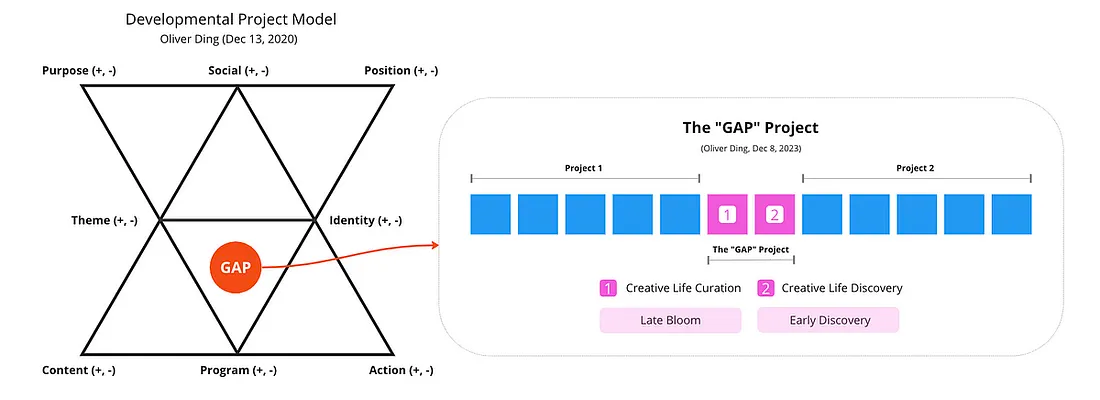
In every creative journey, there are "gaps"—informal, liminal spaces between formal projects. A gap is not just a rest; it is an Agency Threshold. When a project ends, you face a choice: stay with the given routines, or initiate a new GAP project, such as an "After" project for creative life curation, or a "Before" project for creative life discovery.
In June 2025, I crossed this threshold by launching a Before project: The “Theorizing Creative Life” Project, exploring a question:
Is my creative journey merely a collection of isolated creative actions?
After weaving together isolated thematic insights from the Wonder and Wander project — along with persona notes, conversations with a mentor and friends, and social media posts — I realized that my creative journey is a story with the “Theorizing Creative Life” theme.
This insight triggered a six-month "Generative Confluence" journey. By anchoring a new creative center within this GAP project, I moved beyond the boundaries of my previous work to develop Creative Life Theory v3.0. This journey shows that the gaps between formal projects are fertile grounds.
By intentionally occupying this gap, I turned a quiet transition into a vibrant space for theoretical exploration, setting the stage for a much larger unfolding. When we exercise our agency to bridge these gaps, we allow diverse theoretical streams to converge and generate an entirely new landscape of knowledge.
Note: This article is an excerpt from a chapter of the forthcoming book manuscript Lake 42: The Great Confluence, originally titled "Chapter Four: Anchoring the Center".
Chapter Four: Anchoring the Center
Turning a focus into a foundation for growth
by Oliver Ding
January 22, 2026
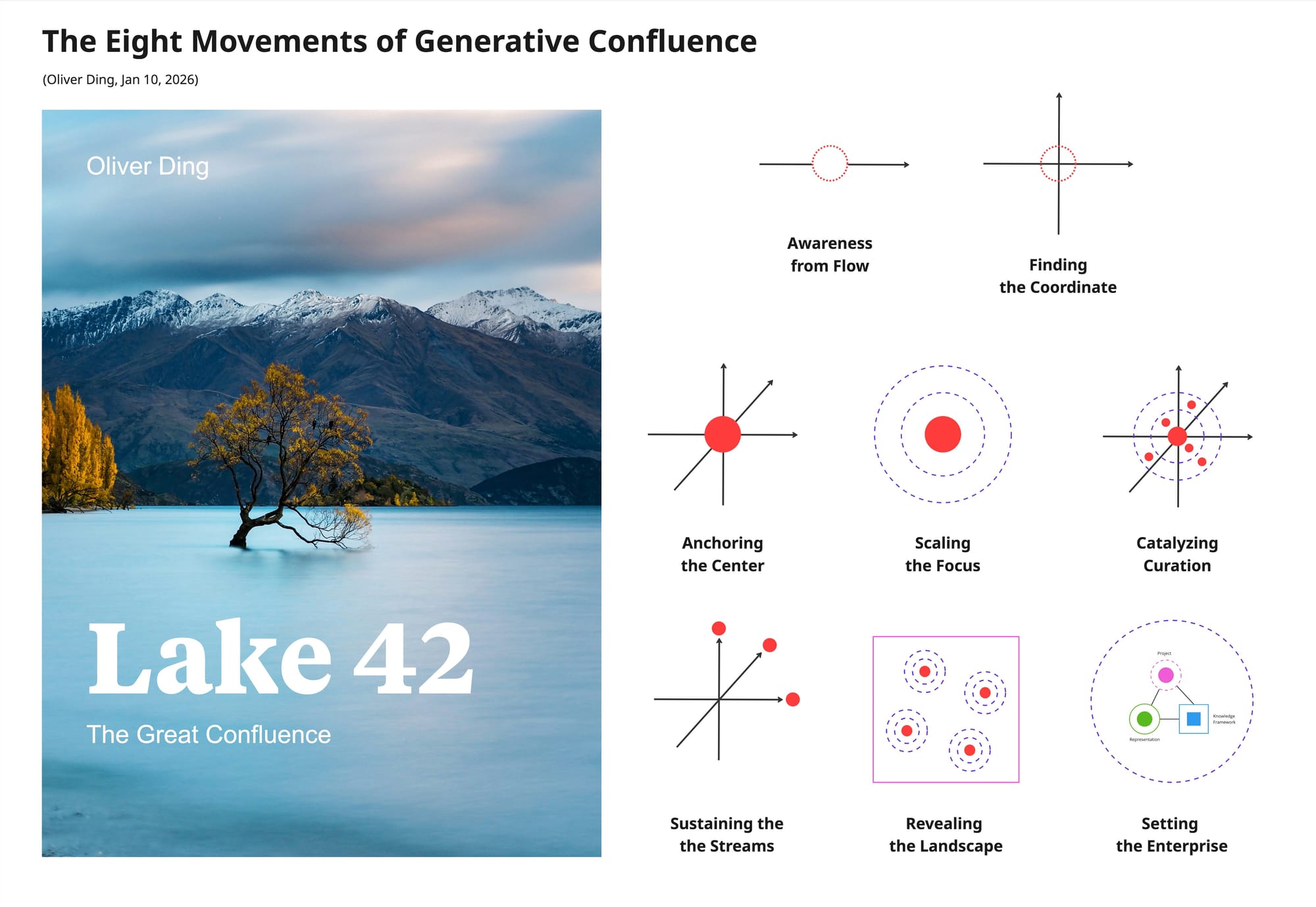
Finding the Coordinate and Anchoring the Center are two key movements of my Generative Confluence journey.
Finding the Coordinate refers to searching for a meta-framework to serve as a Life Coordinate for a person to answer the questions “Where am I?” and “Where should I be?”
Anchoring the Center refers to searching for a meta-framework to support a potential focus in transforming into a creative center by curating relevant creative elements together.
Both movements require searching for a meta-framework, understood as a conceptual system, yet the meta-framework serves different purposes in each case. The process of searching can lead to encountering, resonating with, echoing, applying, inspiring, modifying, curating, rejecting, critiquing, remixing, and creating, among others. These various activities of engaging with conceptual systems are sources of diverse forms of human life and cultural innovation.
In the previous chapters, I often used the diagram below to represent the Anchoring the Center movement.
In my journey of the Generative Confluence from June to December 2025, the Self-Life-Mind framework was the meta-framework used to anchor a new creative center.
The 3D coordinate is used to represent three theoretical traditions I worked on, while the three circles represent the new creative center I anchored. However, if the creative resources are not three, but one, two, four, or more, we need to choose other diagrams to represent the Anchoring the Center movement.
In this chapter, I will share the journey of how I reached the June 2 diagram, sharing the stories of engaging with the Self-Life-Mind meta-framework and three theoretical traditions. In the last part, I will explore other cases that utilize other numbers of creative resources, presenting a general model of Anchoring the Center.
1
While the June 2 diagram was the defining movement of my Generative Confluence journey, it was part of a Creative Life Discovery project across May 14 to June 21, 2025.
- May 14, 2025 — Designed a thematic card to represent “Creative Life Theory: Wonder, Wander, and Being by Doing”
- May 23, 2025 — Changed the title of the thematic card from “Creative life Theory” to “Theorizing Creative Life”
- June 2, 2025 — Designed the “Theorizing Creative Life Landscape” diagram and a series of related diagrams
- June 16, 2025 — Created the World of Activity Toolkit (v1, 2025)
- June 18, 2025 — Released a new possible book, GO Theory: Genidentity, Opportunity, and World of Activity (book, v1.0)
- June 21, 2025 — Published a report to summarize the “Theorizing Creative Life” Project
This Creative Life Discovery project is a GAP Project from the Project Engagement perspective.
Inspired by the concept of a gap year, I developed “GAP” projects as an application of the Developmental Project model in 2023. Later, I often ran GAP Projects as part of my creative journey from 2023 to the present.
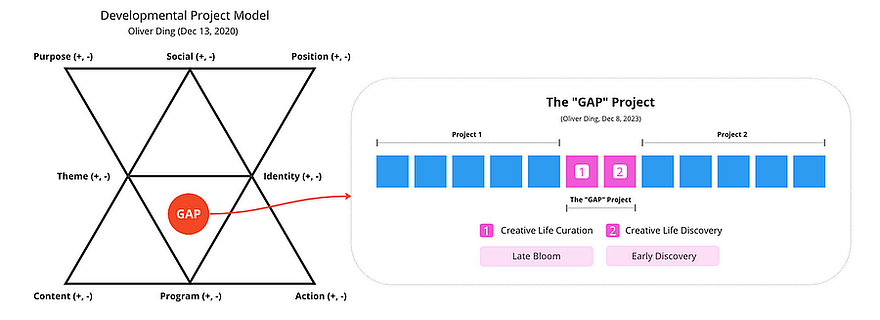
A “GAP” project refers to informal activities that take place between formal projects. The “After | Before” structure classifies these projects into two types:
- The “After” Project, like Creative Life Curation
- The “Before” Project, like Creative Life Discovery
From March 1, 2025, to June 8, 2025, I worked on the Wonder and Wander project, which belongs to a “Creative Life Curation” project. In contrast, the “Theorizing Creative Life” project is a “Creative Life Discovery” project.
The Wonder and Wander project is an ongoing reflection on my creative journey from March 2019 to March 2025. It is similar to my 2023 Mental Moves project. Both aim to utilize data from my creative journey to conduct multiple empirical studies. The method behind these two projects shares the following aspects:
- Empirical Study
- The Creative Life Curation Method
- Historical-cognitive Research
- Multiple-theme Reflection
- Framework Development
Distinguishing itself from traditional biographic research — which typically treats a life narrative as a singular story — my approach treats real-life experience as a primary resource, guided by the principle of Multiple-Theme Reflection in both research design and execution. In the Wonder and Wander project, I selected specific actions and projects spanning from 2019 to 2025, structuring them into eight Creative Journeys, each with a primary theme, original data, and defined temporal boundaries.
After conducting eight cases, I added two earlier ones to the project.
However, I realized that although the final outcome of the project presents the “Theory as Enterprise” framework, it does not present a singular story of my creative journey.
Is my creative journey merely a collection of isolated creative actions?
After weaving together isolated thematic insights from the Wonder and Wander project — along with persona notes, conversations with a mentor and friends, and social media posts — I realized that my creative journey is a story with the “Theorizing Creative Life” theme.
How did I develop the “Theorizing Creative Life” theme? It was born from the Wonder and Wander project.
On May 2, 2025, I published a case study titled [Wonder and Wander] The Aion Journey (2021–2025), in which I introduced several new ideas, such as the “Aion, Chronos, and Time Curation” Model. I also sent emails to a mentor and a friend to discuss the project and new insights from May 4 to May 8, 2025. These emails, titled “Mid-Journey Reflections on Wonder and Wander,” discussed the project and emerging insights.
On May 14, 2025, I created the picture as a thematic card: Creative Life Theory: Wonder, Wander, and Being by Doing.
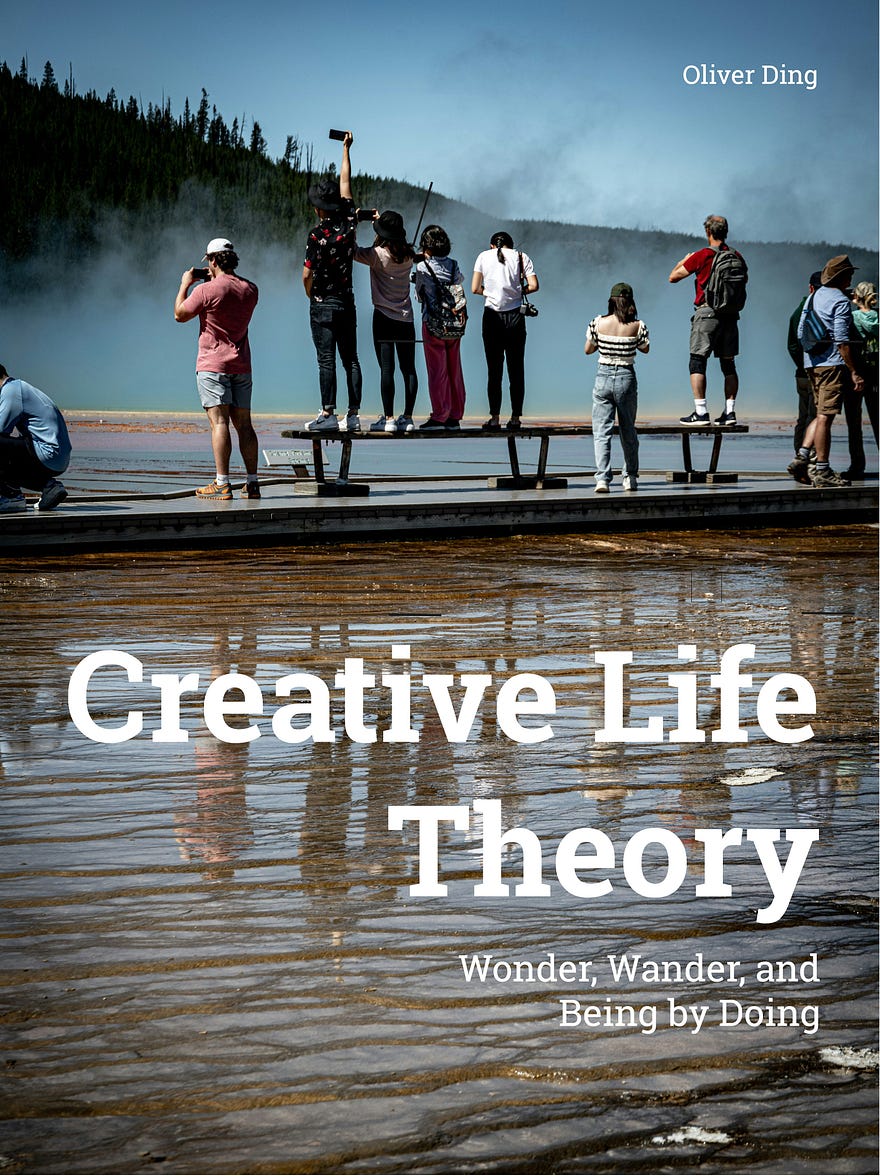
I often designed such thematic cards to take the first step of objectification of a concept. The thematic card highlights the theme from my daily creative Flow, turning an idea into a creative Focus.
The thematic card looks like the cover of a possible book. That is also part of the design. The card anticipates a future possible book. At that time, the new insights born from the Wonder and Wander project inspired me to revisit Creative Life Theory v2.0. I wondered if I could edit a new possible book to incorporate these new insights into the theory, forming a new version.
However, on May 23, 2025, I changed the title of the thematic card from “Creative Life Theory” to “Theorizing Creative Life” to represent a new theme.

The old one refers to a noun, while the new one refers to a verb.
If these pictures represent two books, then the old one is about introducing a completed product, a finished theory. The new one, however, shares the journey of developing such a theory — not just one theoretical approach, but multiple.
These pictures are by-products of the Wonder and Wander project. They also point to a new project centered on the “Theorizing Creative Life” theme.
From May 25 to June 21, 2025, the “Theorizing Creative Life” theme became a Creative Focus of my journey.
This Creative Focus led to the Anchoring the Center movement and the whole journey of Generative Confluence.
Chapter Four: Anchoring the Center
Turning a focus into a foundation for growth

Finding the Coordinate and Anchoring the Center are two key movements of my Generative Confluence journey.
Finding the Coordinate refers to searching for a meta-framework to serve as a Life Coordinate for a person to answer the questions “Where am I?” and “Where should I be?”
Anchoring the Center refers to searching for a meta-framework to support a potential focus in transforming into a creative center by curating relevant creative elements together.
Both movements require searching for a meta-framework, understood as a conceptual system, yet the meta-framework serves different purposes in each case. The process of searching can lead to encountering, resonating with, echoing, applying, inspiring, modifying, curating, rejecting, critiquing, remixing, and creating, among others. These various activities of engaging with conceptual systems are sources of diverse forms of human life and cultural innovation.
In the previous chapters, I often used the diagram below to represent the Anchoring the Center movement.
In my journey of the Generative Confluence from June to December 2025, the Self-Life-Mind framework was the meta-framework used to anchor a new creative center.
The 3D coordinate is used to represent three theoretical traditions I worked on, while the three circles represent the new creative center I anchored. However, if the creative resources are not three, but one, two, four, or more, we need to choose other diagrams to represent the Anchoring the Center movement.
In this chapter, I will share the journey of how I reached the June 2 diagram, sharing the stories of engaging with the Self-Life-Mind meta-framework and three theoretical traditions. In the last part, I will explore other cases that utilize other numbers of creative resources, presenting a general model of Anchoring the Center.
1
While the June 2 diagram was the defining movement of my Generative Confluence journey, it was part of a Creative Life Discovery project across May 14 to June 21, 2025.
- May 14, 2025 — Designed a thematic card to represent “Creative Life Theory: Wonder, Wander, and Being by Doing”
- May 23, 2025 — Changed the title of the thematic card from “Creative life Theory” to “Theorizing Creative Life”
- June 2, 2025 — Designed the “Theorizing Creative Life Landscape” diagram and a series of related diagrams
- June 16, 2025 — Created the World of Activity Toolkit (v1, 2025)
- June 18, 2025 — Released a new possible book, GO Theory: Genidentity, Opportunity, and World of Activity (book, v1.0)
- June 21, 2025 — Published a report to summarize the “Theorizing Creative Life” Project
This Creative Life Discovery project is a GAP Project from the Project Engagement perspective.
Inspired by the concept of a gap year, I developed “GAP” projects as an application of the Developmental Project model in 2023. Later, I often ran GAP Projects as part of my creative journey from 2023 to the present.
A “GAP” project refers to informal activities that take place between formal projects. The “After | Before” structure classifies these projects into two types:
- The “After” Project, like Creative Life Curation
- The “Before” Project, like Creative Life Discovery
From March 1, 2025, to June 8, 2025, I worked on the Wonder and Wander project, which belongs to a “Creative Life Curation” project. In contrast, the “Theorizing Creative Life” project is a “Creative Life Discovery” project.
The Wonder and Wander project is an ongoing reflection on my creative journey from March 2019 to March 2025. It is similar to my 2023 Mental Moves project. Both aim to utilize data from my creative journey to conduct multiple empirical studies. The method behind these two projects shares the following aspects:
- Empirical Study
- The Creative Life Curation Method
- Historical-cognitive Research
- Multiple-theme Reflection
- Framework Development
Distinguishing itself from traditional biographic research — which typically treats a life narrative as a singular story — my approach treats real-life experience as a primary resource, guided by the principle of Multiple-Theme Reflection in both research design and execution. In the Wonder and Wander project, I selected specific actions and projects spanning from 2019 to 2025, structuring them into eight Creative Journeys, each with a primary theme, original data, and defined temporal boundaries.
After conducting eight cases, I added two earlier ones to the project.
However, I realized that although the final outcome of the project presents the “Theory as Enterprise” framework, it does not present a singular story of my creative journey.
Is my creative journey merely a collection of isolated creative actions?
After weaving together isolated thematic insights from the Wonder and Wander project — along with persona notes, conversations with a mentor and friends, and social media posts — I realized that my creative journey is a story with the “Theorizing Creative Life” theme.
How did I develop the “Theorizing Creative Life” theme? It was born from the Wonder and Wander project.
On May 2, 2025, I published a case study titled [Wonder and Wander] The Aion Journey (2021–2025), in which I introduced several new ideas, such as the “Aion, Chronos, and Time Curation” Model. I also sent emails to a mentor and a friend to discuss the project and new insights from May 4 to May 8, 2025. These emails, titled “Mid-Journey Reflections on Wonder and Wander,” discussed the project and emerging insights.
On May 14, 2025, I created the picture as a thematic card: Creative Life Theory: Wonder, Wander, and Being by Doing.
I often designed such thematic cards to take the first step of objectification of a concept. The thematic card highlights the theme from my daily creative Flow, turning an idea into a creative Focus.
The thematic card looks like the cover of a possible book. That is also part of the design. The card anticipates a future possible book. At that time, the new insights born from the Wonder and Wander project inspired me to revisit Creative Life Theory v2.0. I wondered if I could edit a new possible book to incorporate these new insights into the theory, forming a new version.
However, on May 23, 2025, I changed the title of the thematic card from “Creative Life Theory” to “Theorizing Creative Life” to represent a new theme.
The old one refers to a noun, while the new one refers to a verb.
If these pictures represent two books, then the old one is about introducing a completed product, a finished theory. The new one, however, shares the journey of developing such a theory — not just one theoretical approach, but multiple.
These pictures are by-products of the Wonder and Wander project. They also point to a new project centered on the “Theorizing Creative Life” theme.
From May 25 to June 21, 2025, the “Theorizing Creative Life” theme became a Creative Focus of my journey.
This Creative Focus led to the Anchoring the Center movement and the whole journey of Generative Confluence.
2
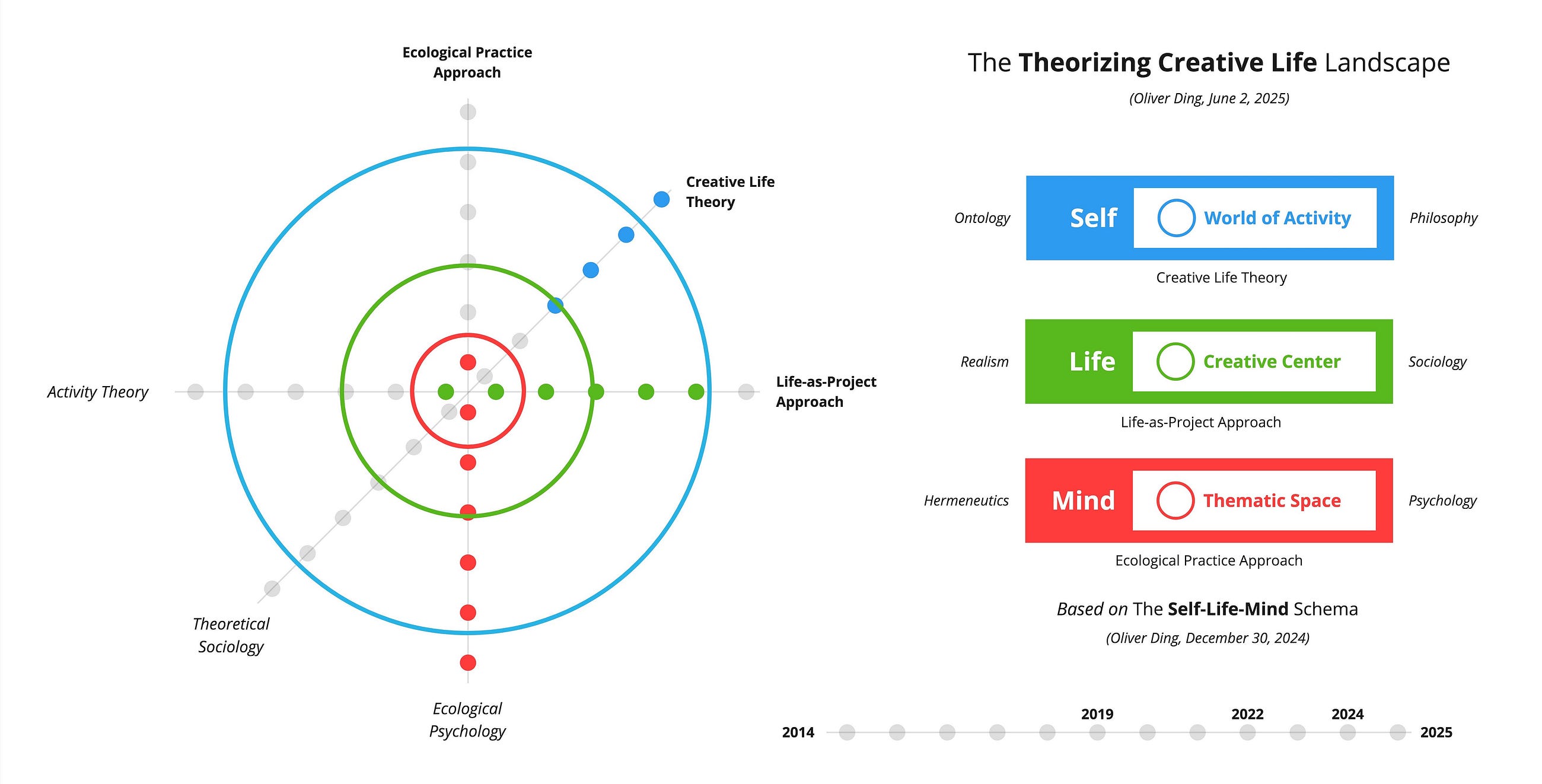
On June 2, 2025, I created a series of diagrams to reflect on the “Theorizing Creative Life” theme and my creative journey.
The first one represents a three-phase exploration, centered on three disciplines at each phase. Rather than being strictly sequential, these three phases reflect shifting but overlapping centers of theoretical focus.
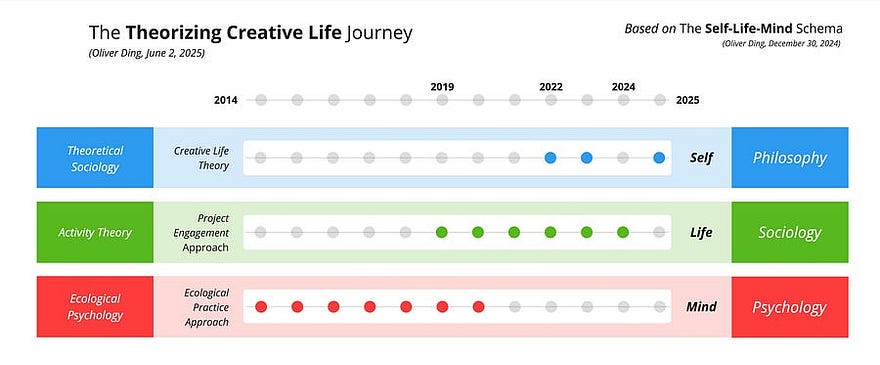
- Early phase (2014–2020): Psychology, especially Ecological Psychology.
- Middle phase (2019–2024): Sociology, especially activity-based social practice theories.
- Late phase (2022, 2023, 2025): Philosophy, especially self and subjectivity.
The diagram only highlights my mental focus on exploring a new discipline at different periods. It does not represent my actions and projects. For example, I actively worked on the Ecological Practice Approach from 2021 to 2025.
If we use the Creative Thematic Curation Framework as a meta-framework, this three-phase journey can be seen as a different story:
- First-wave: Focusing on one approach, the Ecological Practice Approach.
- Second-wave: Engaging with multiple approaches — three in total.
- Third-wave: Moving to a large creative dialogue between Western Philosophy and Eastern Philosophy.
By using the Self-Life-Mind schema, I made “Theorizing Creative Life” Landscape. See the diagram below.
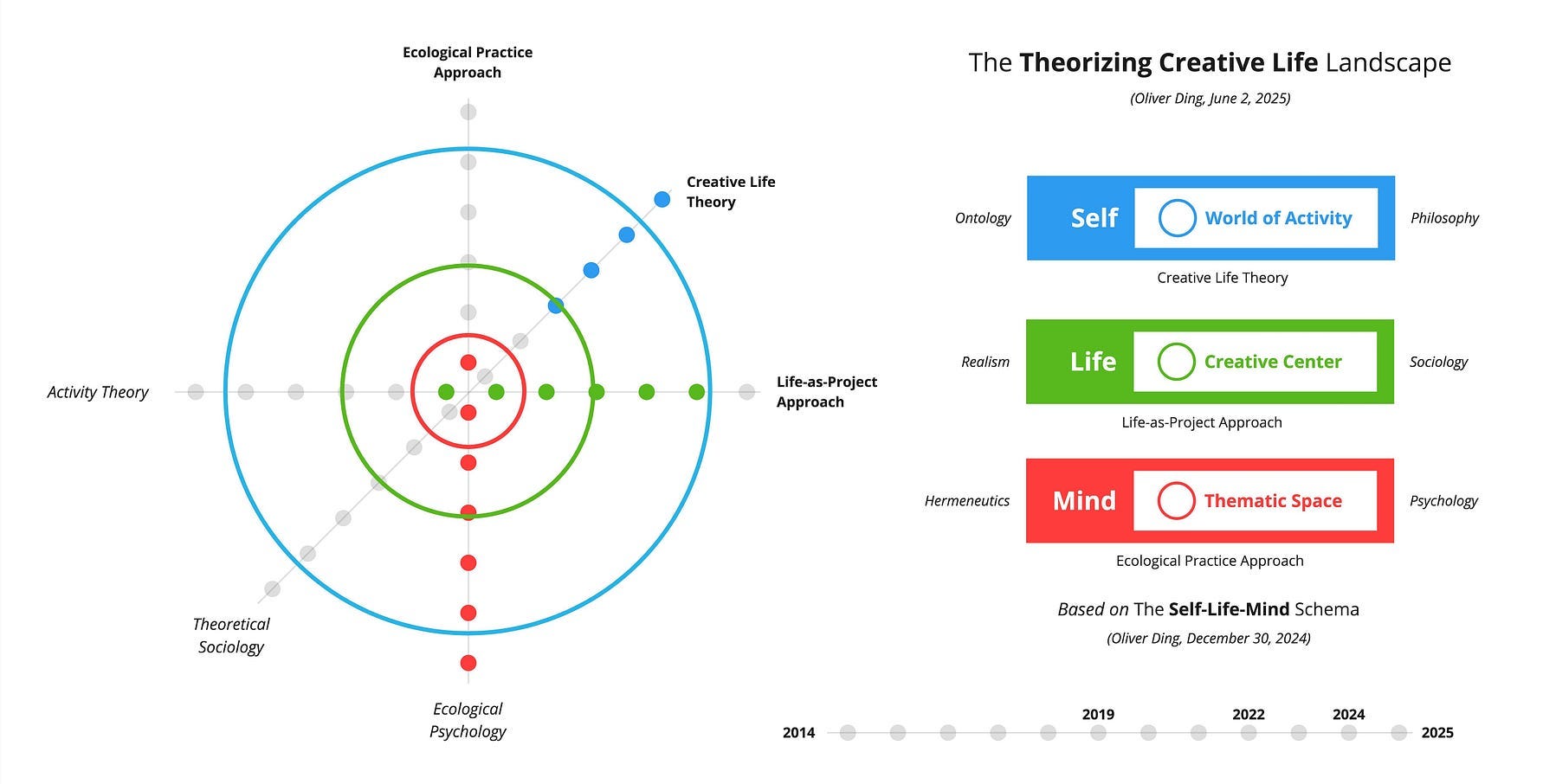
Over the past several years, I have drawn on three theoretical traditions as resources to develop three theoretical approaches. While I maintained boundaries between these approaches, across time, I applied them to study how a person achieves a creative life, resulting in different perspectives and knowledge frameworks.
At some points, I developed a series of concepts, forming the core of a new approach, weaving ideas inspired by other approaches into a meaningful whole, especially for understanding Creative Life.
In the diagram above, I selected three core concepts, based on the Self-Life-Mind schema:
- World of Activity [Ontology | Self | Philosophy]
- Creative Center [Realism | Life | Sociology]
- Thematic Space [Hermeneutics | Mind | Psychology]
The concept of “Thematic Space” was born from the Ecological Practice Approach and refers to the representation of cognitive space within the mind.
The concept of “Creative Center” was developed from the Knowledge Center project, especially the perspective of the Life-as-Project Approach, and my practice of running the Activity Analysis Center and other knowledge centers.
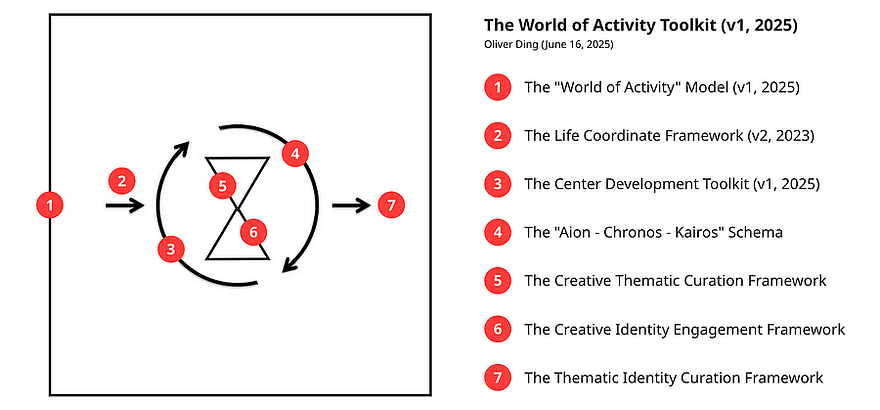
The concept of “World of Activity” was originally part of Creative Life Theory (v2.0, 2023). However, on June 16, 2025, I detached it from the theory and developed it as an independent concept to curate a series of concepts together, forming the World of Activity Toolkit. Later, on June 18, 2025, I edited a book draft, GO Theory: Genidentity, Opportunity, and World of Activity (book, v1.0), to introduce the toolkit.
These three concepts have evolved across different periods. While working on the Wonder and Wander project, I also developed a series of insights related to these concepts.
On June 2, 2025, I curated them together by using the Self-Life-Mind schema. Suddenly, I saw a new, meaningful whole.
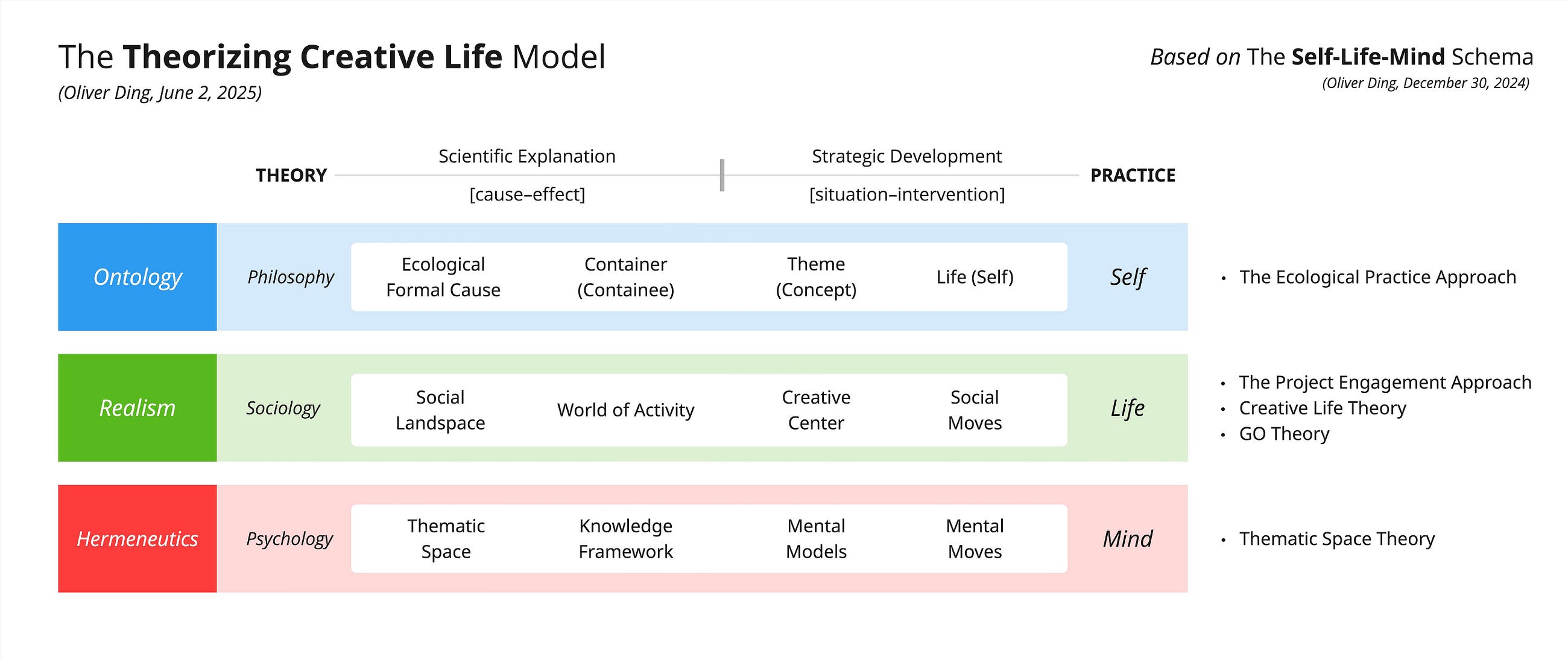
In summary, I assign the Ecological Practice Approach to the “Self/Ontology” layer. The Project Engagement approach and other similar approaches belong to the “Life/Realism” layer. Thematic Space Theory belongs to the “Mind/Hermeneutics” layer.
Each time, I selected different concepts from these approaches and placed them on diagrams. In the “Theorizing Creative Life” Model, the concept system is also framed by the “THEORY — PRACTICE” connection, also known as the “Theory as Thematic Enterprise” notion.
- At the THEORY side, the approach is framed as a scientific project that aims to offer a systematic framework to scientific explanation, with two concepts.
- On the PRACTICE side, the approach is presented as a practical project that offers a set of tools for strategic development, with two concepts.
This new whole goes beyond Creative Life Theory v2.0. It might be called Creative Life Theory v3.0, or a new name.
Moreover, this new landscape represents a 3+1 structure, revealing a new pattern I didn’t notice in my creative journey.
Inspired by geography, I named this pattern Generative Confluence.
Unlike traditional confluence in geography, where streams merge and lose their individual identities, the term “Generative Confluence” is used in Creative Life Theory with a new meaning.
It describes a pattern where ideas inspired by distinct theoretical approaches evolve from separate into interconnected, generating a new center for a brand-new possible theoretical enterprise. As the new one emerges, the original theoretical approaches still keep their developmental trajectories.
The Generative Confluence pattern goes beyond the Creative Dialogue pattern, where some new ideas are born from dialogue between two theoretical approaches.
3
While the “Theorizing Creative Life” theme defined a creative Focus in my creative Flow, the Self-Life-Mind meta-framework served as a key frame for the Anchoring the Center movement.
By using the meta-framework as a creative container, I can easily run a knowledge curation process, weaving ideas, insights, and concepts together to establish a new creative center.
As mentioned in the beginning, “the process of searching can lead to encountering, resonating with, echoing, applying, inspiring, modifying, curating, rejecting, critiquing, remixing, and creating, among others. These various activities of engaging with conceptual systems are sources of diverse forms of human life and cultural innovation.”
How did I develop the Self-Life-Mind meta-framework?
In my recent possible book, Meta-frameworks: Creative Heuristics for Individual and Social Development (book, v1.0, 2025), I shared my journey of engaging with the “Self-Life-Mind” schema in Part 2.
I traced its complete life cycle through a four-stage evolutionary model: Precursor — Practice — Bloom — Echo. This case study reveals the dynamic movement between thematic schemas, concept systems, and mental platforms, demonstrating how a meta-framework matures through embodied experience.
- Precursor (The “Ontology — Realism — Hermeneutics” Schema): Exploring the philosophical roots that provided the initial structural DNA for the schema.
- Practice (2024: The Heuristic Phase): Documenting how the schema was tested across various projects throughout 2024. While these projects were preliminary, they provided the essential embodied experience and “heuristic” power needed for deeper internalization.
- Bloom (2025: The Predictive Model): Showing how the schema matured into the meta-framework for Creative Life Theory (v3.0). During this phase, the previous year’s practice paid off, enabling an unprecedented creative explosion — completing six book manuscripts within six months by serving as a high-level “Predictive Model.”
- Echo (The “Living Way” of Development): This reflective stage reveals the “Living Way” — my unique methodology for developing concepts and concept systems by weaving thematic exploration, conceptual thinking, and embodied experience. Through several parallel cases, it demonstrates how individual concepts evolve into independent theoretical entities that eventually gravitate toward and aggregate within the “Self-Life-Mind” framework, forming a unified new theoretical enterprise.
Details of the story can be found in Meta-frameworks. Here I just share two pieces of the story.
The “Self — Life — Mind” schema was born in May 2024 when I worked on a possible project about developing a theoretical psychology. It was inspired by the “Ontology — Realism — Hermeneutics” schema, an idea of Ping-keung Lui’s theoretical sociology. See the diagram below.

The major idea of the diagram is the following correspondence:
- Self → Ontology
- Life → Realism
- Mind → Hermeneutics
For psychological science, the concept of “Self” is hard to study through empirical research. I use the concept of “Self” to refer to the Ontology of theoretical psychology. It means that we should define it from a philosophical perspective.
The Concept of “Life” refers to the Realism of theoretical psychology.
The concept of “Mind” refers to the Hermeneutics of theoretical psychology.
In this way, the “Self — Life — Mind” schema is established as a vehicle for the “Ontology — Realism — Hermeneutics” schema.
Since May 2024, I have used the “Self-Life-Mind” schema as a meta-framework for many knowledge projects, especially the Strategic Life Theory project, to curate ideas. For example, the diagram below is the Strategic Life Development Framework (v2, 2024).

More details can be found in Strategic Life (book, v1, 2024).
However, working with a meta-framework is not a one-time setup.
A meta-framework functions by anchoring multiple thematic spaces — in the case of Self-Life-Mind, three distinct spaces corresponding to ontology, realism, and hermeneutics. When we use such a framework to curate creative elements, these elements must be distributed across these thematic spaces according to their conceptual nature.
This distribution requires ongoing judgment: Does this concept belong at the Self layer (ontological), the Life layer (sociological reality), or the Mind layer (psychological interpretation)? As understanding deepens, initial placements may prove incorrect. Elements may need to be relocated to different thematic spaces or removed entirely to make room for better-fitting concepts.
On April 18, 2025, I had such a moment of conceptual reconfiguration.
While working on a reflection about the concept of “awareness” in Chinese philosophy, I arrived at an insight that forced me to reconsider how I had been using the Self-Life-Mind schema.
In the 2024 Strategic Life Development Framework shown above, I had placed a “meaning matrix” at the Self layer, defining life meaning through two dimensions: Love and Achievement. At the time, this seemed appropriate — meaning felt like a fundamental ontological question about the self.
But the April 18 reflection revealed a conceptual error.
Achievement does not belong at the ontological level.
Achievement manifests in Life — it is the result of subjectivity’s unfolding in the objective world. At the philosophical/ontological level where Self is positioned, achievement cannot appear. I had conflated the ontological question “What is the self?” with the evaluative question “What makes life meaningful?”
The solution was clear: move “achievement” from the Self layer to the Life layer, where it properly belongs. This seemingly small move had profound consequences. I further removed the “Meaning Matrix” module from the Self-Life-Mind meta-framework, relocating the concept of “meaning” to the Mind layer.
By clearing “Meaning Matrix” from the Self layer, I opened up conceptual space within the meta-framework. The Self layer could now properly address an ontological question: not “What gives meaning?” but “Where is the self?”
But what should occupy this space?
In April, I was still wrestling with the question: What is the self? What constitutes subjectivity at the ontological level? This is a profound philosophical challenge.
But by May, I had shifted to a different question entirely.
Instead of asking “What is the self?” I asked: “Where is the self?”
This seemingly simple shift opened up a new path. Drawing on the Container (Containee) pattern from the Ecological Practice Approach, I developed the notion of Life(Self) — understanding the self not as an essence to be defined, but as something situated within a larger life container.
On May 25, 2025, one month and one week after clearing the Self layer, I developed the Flow-Focus-Center-Circle schema as the answer to “Where is the self?” — giving birth to the World of Activity model.
The Self layer could now be properly occupied: not by a definition of what the self is, but by a framework locating where the self exists — within its World of Activity.
If the old element had remained occupying that thematic space, the new element could not have entered.
This episode reveals a crucial principle about using meta-frameworks: they provide structure by defining thematic spaces, but those spaces require active curation. Sometimes old elements must be moved or removed to make room for new insights. The framework organizes, but the theorist must maintain conceptual clarity about what belongs where.
In June 2025, I used the Self-Life-Mind schema to reflect on Creative Life Theory (v3.0), highlighting its core ideas. Simply, Creative Life Theory (v3.0) aims to answer a question:
How does a person achieve a creative life?
By using the Self-Life-Mind schema, this question is divided into three questions: how does a creative self develop? How does a creative enterprise develop? And how does a creative mind develop?
In the “Self-Life-Mind” schema, the “Self” is located at the “ontology” level; it is about the philosophical setting of a theory. For Creative Life Theory, it refers to understanding the development of a creative self from the ontological level.
Instead of asking what the self is, I ask where the self is. By using the Container (Containee) pattern of the Ecological Practice Approach, I develop the notion of Life(Self), which leads to the concept of “World of Activity.”
I introduced the concept of the “World of Activity” to define the large life container of a person. Since the concept takes the individual subject perspective, it provides an ideal answer to the question of where the self is.
The World of Activity has a twofold structure: its boundary and its content.
As a large life container, every person’s World of Activity is bounded by what phenomenology terms “givenness” (Gegebenheit) — those aspects of existence that present themselves to consciousness as already there, prior to our choosing or willing. Drawing on this insight and inspired by Chinese philosophical imagery, I identify four fundamental givens: Birth, Death, Heaven (e.g., language, culture), and Earth (e.g., environment, geography).
Inspired by ecological formism, the World of Activity emphasizes the “Flow-Focus-Center-Circle” schema as four entities of content at the ontological level.
In the “Self-Life-Mind” schema, “Life” is located at the “realism” level, which concerns the sociological reality of a theory. For Creative Life Theory, it refers to understanding the development of a creative enterprise from the realism level.
Since Creative Life Theory (v2.0) focuses on knowledge engagement and building a knowledge enterprise, the dual-center structure of developing a creative enterprise appears as a form of the “Create — Curate” schema, also known as knowledge creation and knowledge curation. However, v3.0 of Creative Life Theory aims to expand from knowledge engagement to a general theory of thematic enterprise, covering cultural, business, and other forms of creative enterprise.
In the “Self-Life-Mind” schema, “Mind” is located at the “hermeneutics” level, which concerns the psychological interpretation of a theory. For Creative Life Theory, it refers to understanding the development of a creative mind from the Hermeneutics level.
In the “Theorizing Creative Life” Model, the “Mind/Hermeneutics” layer displays four concepts from Thematic Space Theory:
- Thematic Space
- Knowledge Framework
- Mental Models
- Mental Moves
Creative Life Theory (v3.0) marks not a conclusion, but a new departure — an invitation to engage with the theory as a living enterprise.
4
Attaching to a new meta-framework often means detaching from an old meta-framework.
In the “Theorizing Creative Life” project, while I was attached to the Self-Life-Mind schema, I also detached from the Creative Course framework, which is the meta-framework for Creative Life Theory (v2.0).
My fascination with creativity and discovery has spanned many years. In 2022, I made significant progress on this exploration. After running several projects, I developed a series of tools, resulting in four book drafts: Aspects of Creative Life.
Although these four books were initially developed for different purposes, I later curated them as a coherent body of work. Together, they formed a new conceptual whole, which I named Creative Life Theory (v1.0).
In 2023, I adopted Ping-keung Lui’s Subjectivist Structuralism, a part of his theoretical sociology, to develop the Creative Course Framework, a meta-framework for Creative Life Theory (v2.0).
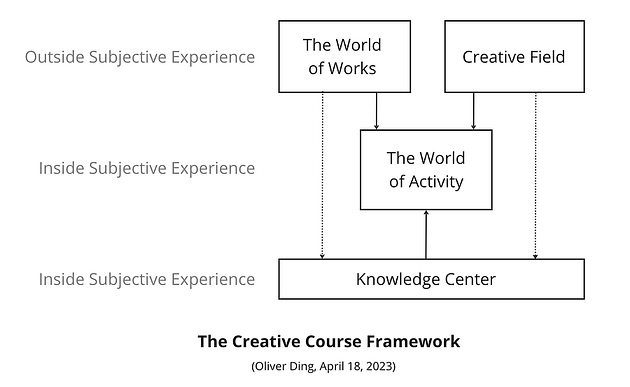
Building on the Creative Course Framework, I created an expanded diagram through a process I call Diagram Blending. This integrates five sub-frameworks:
- Center: The Creative Course Framework
- Left: The Value Circle Framework
- Right: The Universal Reference Framework
- Up: The Anticipatory Activity System Framework
- Down: The Knowledge Circle Framework
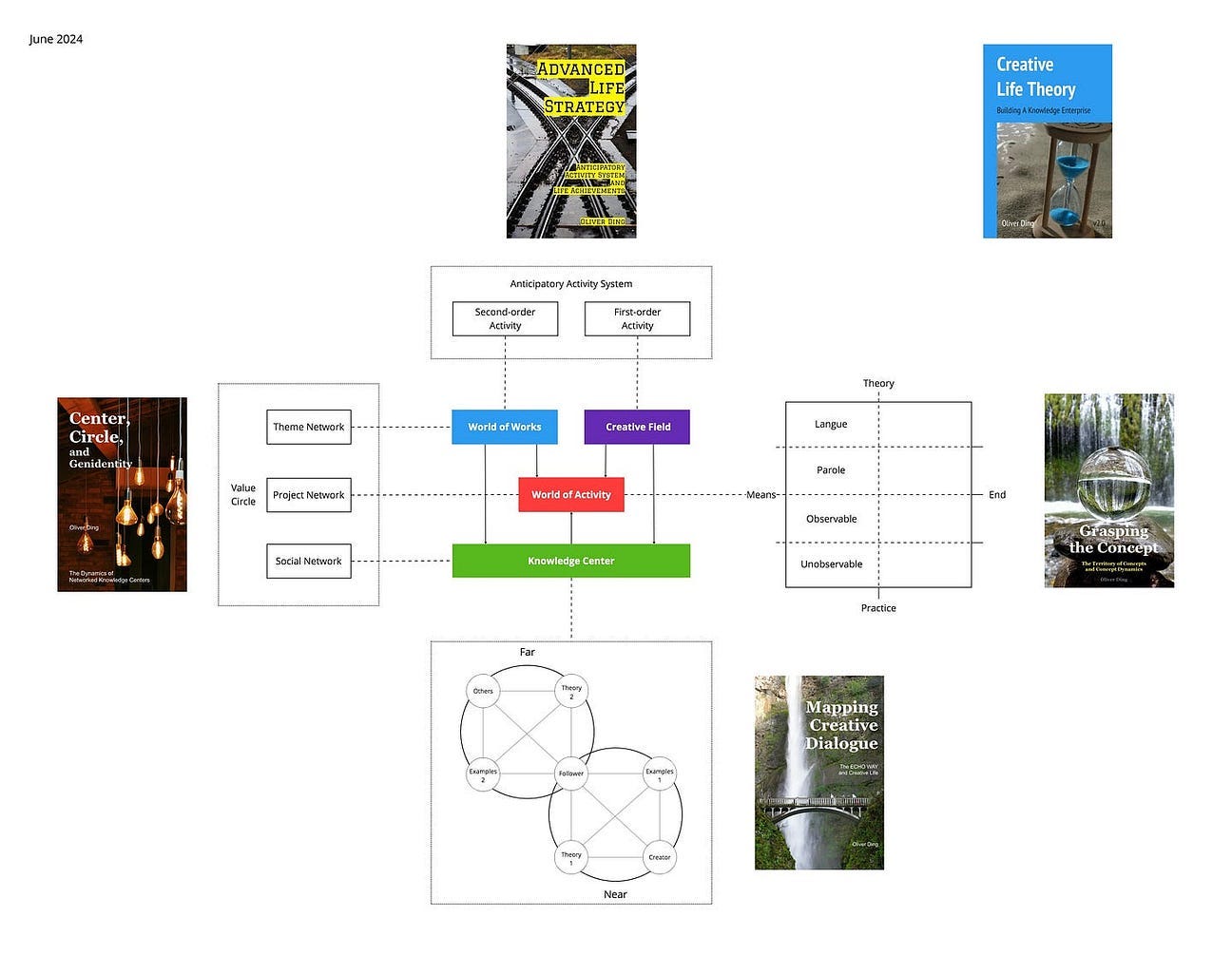
On June 1, 2024, I edited a book draft titled Center, Circle, and Genidentity: The Dynamics of Networked Knowledge Center. It offers a unique theoretical lens for understanding both the Knowledge Center and the Value Circle as standalone concepts.
From 2022 to June 2024, I developed five corresponding book drafts. This body of work marked the culmination of Creative Life Theory (v2.0), which I now consider an independent knowledge enterprise.
In this way, the Expanded Creative Course Framework achieved its mission.
Since then, my mental focus has moved from the concept of “Knowledge Center” to the concept of “World of Activity,” planting the seed of version 3.0 of Creative Life Theory.
Eventually, a new meta-framework is needed to capture this new exploration.
While version 3.0 does not replace v2.0, it represents a significant expansion. I remain engaged with Lui’s theoretical sociology; although the Creative Course Framework no longer functions as the meta-framework, his Ontology–Realism–Hermeneutics schema continues to shape my thinking. In fact, it inspired the Self–Life–Mind schema now used as the meta-framework in version 3.0.
5
In the June 2 diagram, I used a 3D Coordinate to represent the “Anchoring the Center” movement.
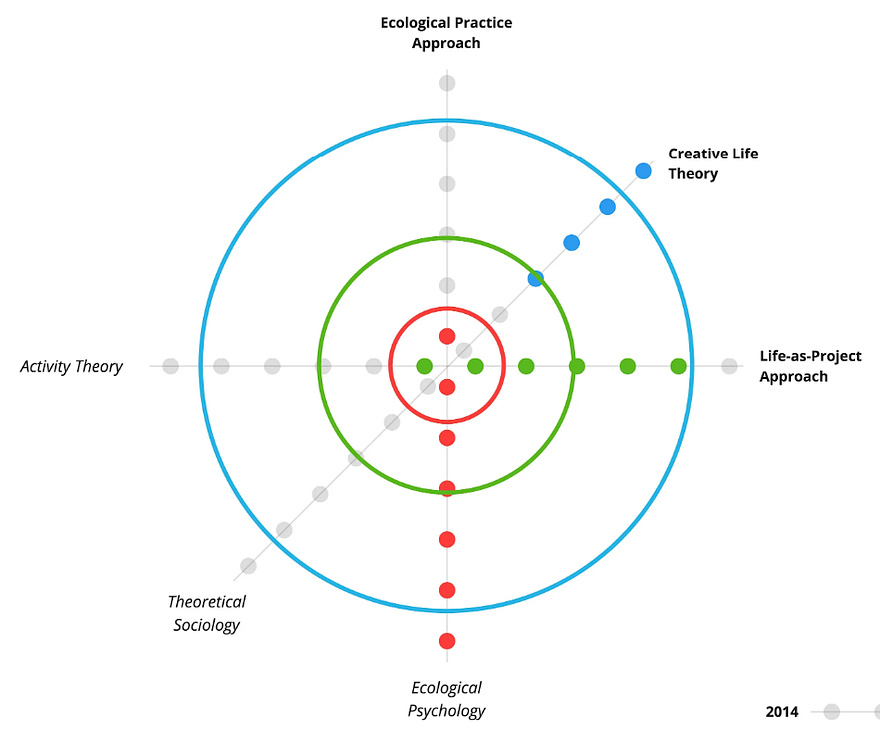
In my journey of the Generative Confluence from June to December 2025, the Self-Life-Mind framework was the meta-framework used to anchor a new creative center.
The 3D coordinate is used to represent three theoretical traditions I worked on, while the three circles represent the new creative center I anchored.
However, if we see “Anchoring the Center” as a general pattern of creative life, then the “Anchoring the Center” movement within my “Generative Confluence” journey is a specific case of the general pattern.
It means that there are many ways to achieve the “Anchoring the Center” creative pattern.
While my journey involved three theoretical traditions (requiring a 3D coordinate as visual representation), the Anchoring the Center movement can take many forms:
- A single focus generating a creative center (e.g., Curativity Theory → Curativity Center)
- A two-way dialogue between creative sources (e.g., the TALE project’s Thematic Engagement)
- A three-way confluence (my Creative Life Theory v3.0)
- Or even four or more sources weaving together
The key is not the number of sources, but how they are curated together through a meta-framework — and how the resulting center then develops its own generative capacity.
6
Now, looking back from January 2026, I can see the Anchoring the Center movement with much greater clarity than I had in September 2025.
The movement’s defining moment came on June 2, 2025. That day, while still immersed in the Wonder and Wander project, I created a series of diagrams exploring the “Theorizing Creative Life” theme. The breakthrough diagram — what I would later call the “Theorizing Creative Life Landscape” — emerged that afternoon.
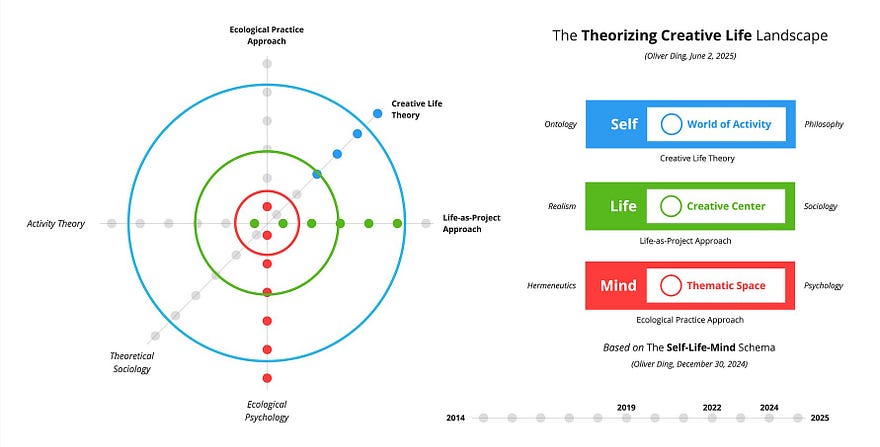
This was the moment of conceptual clarity. The Self-Life-Mind schema suddenly provided the frame I needed to see my decade-long journey across three theoretical traditions as a coherent pattern: a Generative Confluence.
But conceptual clarity and public articulation operate at different speeds. Thinking with diagramming is fast — the June 2 diagrams took hours to create. Producing reports and articles is slow — they require dedicated time and sustained focus.
I couldn’t immediately write up these insights. The Wonder and Wander project demanded completion. From June 2 to June 8, I continued working through its final case studies. On June 13, I released the book manuscript that marked the project’s formal closure.
Only after closing Wonder and Wander could I return to the June 2 insights and develop them further.
On June 16, three days after that closure and a week before leaving for China, I created a more operational version of the diagram — one that could guide actual creative work:

At the core of the diagram, the Self-Life-Mind schema serves as the meta-framework and the hub of the new creative center.
On June 18, I released GO Theory: Genidentity, Opportunity, and World of Activity (book, v1), incorporating some of these new insights.
Finally, on June 21 — nearly three weeks after the original breakthrough — I published the full report: “The ‘Theorizing Creative Life’ Project.” This 44-minute read synthesized the June 2 diagrams, the insights from Wonder and Wander’s by-products, and the theoretical reflections that had emerged in between.
The lag between conceptual breakthrough (June 2) and public articulation (June 21) reveals something important about creative work: insights arrive quickly, but translating them into shareable forms takes time. The June 2 diagrams captured a moment of clarity, but that clarity needed weeks to ripen into communicable knowledge.
Over the next three months, the June 16 framework would guide an intensive period of development:
- June 18: GO Theory: Genidentity, Opportunity, and World of Activity (book, v1)
- June 21: Published the “Theorizing Creative Life” report, synthesizing insights from Wonder and Wander’s by-products
- September 7: Homecoming: A Thematic Trip and the World of Activity Approach (kindle book)
- September 20: Being by Doing: World of Activity and Creative Life Theory (v3.0)
By September 16, I had created an updated version of the June 16 diagram, now populated with specific concepts and frameworks:
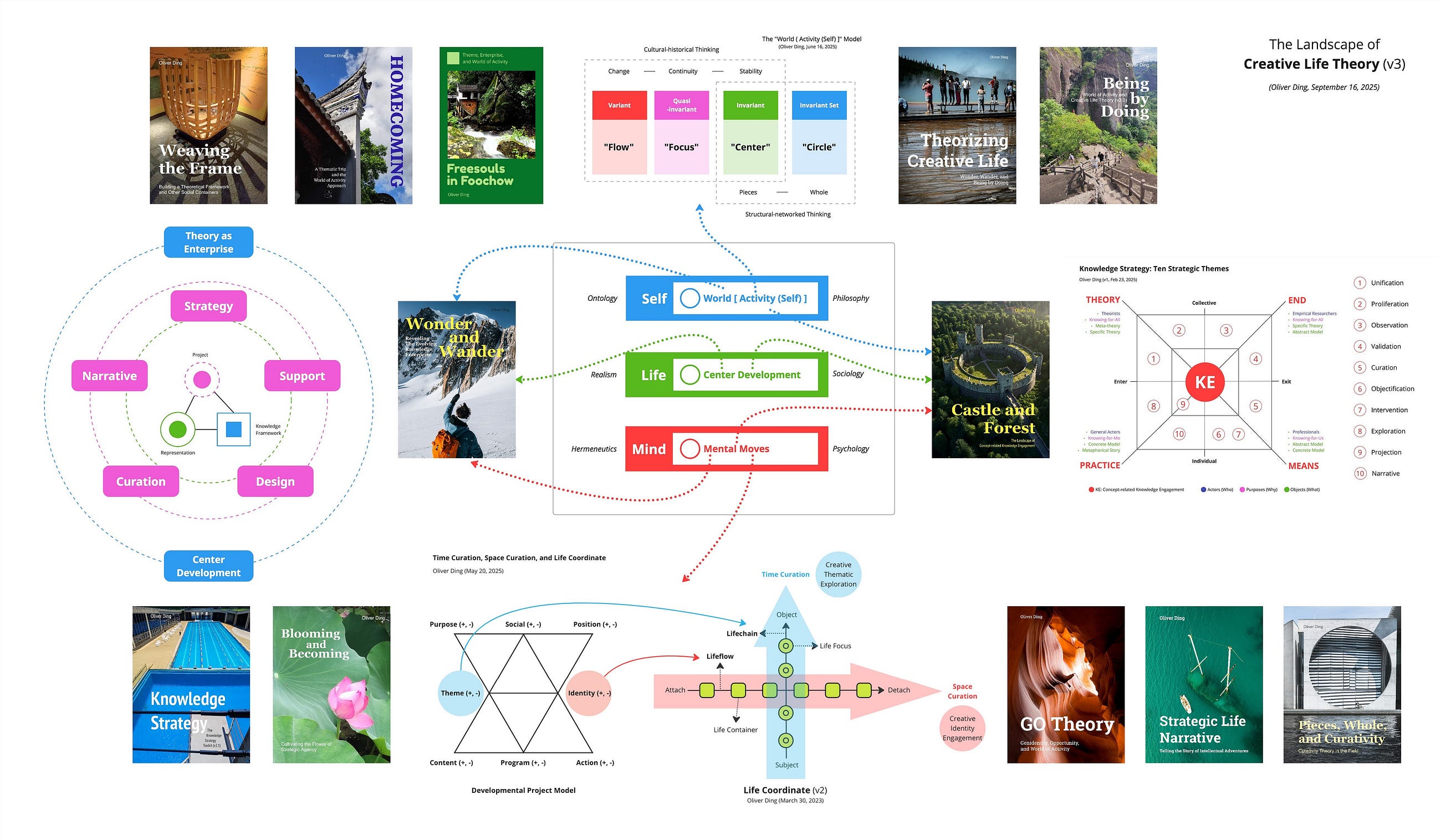
The transformation seemed complete. The Self-Life-Mind framework had successfully served as a container, curating concepts from three theoretical traditions into a coherent new center.
On September 24, when I sent an email to my mentor and several friends describing this development, I genuinely believed the Anchoring the Center movement was finished.
But I was wrong — or rather, I was only partially right.
7
In September 2025, looking at that diagram, I saw completion. The structure appeared balanced and coherent:
The Self layer was anchored by the World of Activity approach and the Flow-Focus-Center-Circle schema — developed and tested through the Homecoming journey from June to September.
The Life layer was filled with concepts from the Life-as-Project approach and the Knowledge Center project — frameworks I had developed between 2022 and 2025.
The Mind layer contained ideas from Thematic Space Theory and the Ecological Practice approach — again, drawing on earlier work.
At that time, I interpreted this structure as successful integration. The Self-Life-Mind framework provided coherent organization. The new center seemed solid, complete, ready to become the foundation for future work.
What I didn’t recognize — what only became visible in the months that followed — was a fundamental asymmetry hidden within this apparently balanced structure.
The Self layer represented genuinely new ground. The World of Activity framework had been developed in May 2025, tested in the wild during the Fuzhou trip in June-July, validated through systematic biographical analysis, and transformed from a theoretical framework into a lived Life Coordinate. This was fresh creative work, breaking new territory.
But the Life and Mind layers?
In retrospect, I can see they were populated with concepts from my earlier theoretical phase — concepts that, while valuable and carefully developed, remained focused on “individual knowledge engagement.” This was the core focus of Creative Life Theory v2.0, which centered on knowledge creators and their knowledge enterprises.
I had placed these concepts within the new Self-Life-Mind framework, but I hadn’t yet developed them beyond their original constraints. They were like plants transplanted into new soil but not yet adapted to it.
In September, I saw this reuse of earlier concepts as a strength — a sign of theoretical continuity and cumulative development. I didn’t see it as a limitation.
I didn’t recognize that while I had successfully answered “How does a creative self develop?” (the Self layer), I was still answering “How does a creative enterprise develop?” and “How does a creative mind develop?” (the Life and Mind layers) within the narrower frame of knowledge engagement.
The questions had expanded, but my answers hadn’t yet caught up.
Now I understand what I couldn’t see in September: anchoring a creative center is not an endpoint. It’s a beginning.
The Self-Life-Mind framework had provided the structure — the container that made it possible to curate disparate concepts into a coherent whole. The three circles representing World of Activity, Creative Enterprise, and Thematic Space had been positioned. The center had been anchored.
But anchoring a center means establishing a foundation for growth. The framework provides structure, but the concepts within it must continue to develop. They must gradually shed the constraints of their original contexts and take on new meanings within their new home.
This developmental process — the movement from anchored center to scaled focus to sustained streams — would unfold over the next three months, from September to December 2025.
In the next chapter, we will explore the Scaling the Focus movement.