
World of Activity
An Ecological Approach to Activity Analysis and Intervention (AAI)
by Oliver Ding
September 4, 2026
This page presents the World of Activity approach — the ecological foundation for the Activity Analysis & Intervention (AAI) program. It provides the structural map — a series of ecological forms — for understanding subjectivity as it unfolds within a person's World of Activity.
The AAI positions the World of Activity approach as foundational module, while leaving interpretation to the analyst's own knowledge frameworks. For the practical application of this approach, see Analyst. For the theoretical platform that builds on it, see GO Theory.
On this page
- The Ecological Approach to AAI
- Four Boundaries of World of Activity
- The FFCC Model
- Living Coordinate
- The World of Activity Toolkit
- How It Works in AAI
- Curating the Situational Toolkit
- Offering the Theoretical Resources
- Three Paths, One Knowledge Ecology
1. The Ecological Approach to AAI
The World of Activity is an ecologically oriented theoretical framework for understanding subjectivity — instead of asking what the self is, we ask where the self is and where it ought to be.
The framework is built on a nested structure:
History [ Life ( Self ) ]
- Body (Self) — the embodied individual, the starting point of subjectivity
- Life (Self) — the Self as lived through activities and engagements in the world
- History [Life (Self)] — the Self as situated within historical and cultural contexts
These three layers are not stages of development. Every individual exists in all three layers at every moment — the differences lie in whether and how they are perceived, and to what extent. I present them as three states for the purpose of explanation, not as a developmental sequence.
This framework provides the ontological grounding for the Activity Analysis & Intervention (AAI) program. It is not a method of intervention itself, but an ecological approach — a way of seeing and mapping the structural forms of a person's life course or life situation before any interpretation or intervention begins.
Built on this nested ontological structure, the approach identifies a series of ecological forms within individual's life course: boundary, flow, focus, center, circle, and coordinate.
The following sections will unpack these ecological forms.
2. Four Boundaries of World of Activity
The initial diagram of the World of Activity was created on November 18, 2022, in the process of making Creative Life Theory (v1.0). See the diagram below.
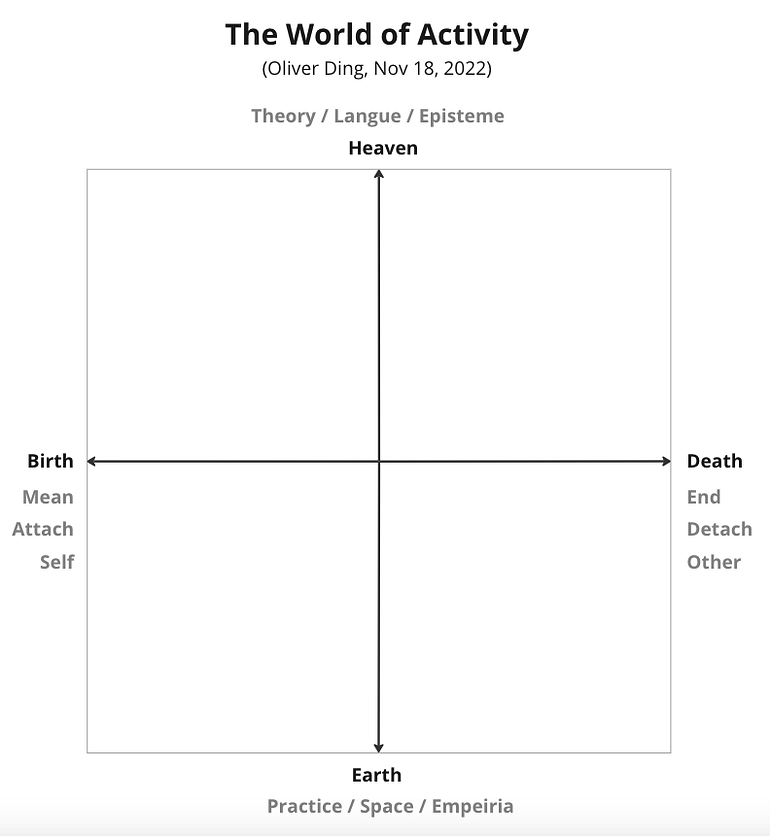
As a large life container, every person’s World of Activity is fundamentally bounded by what phenomenology terms “givenness” (Gegebenheit) — those aspects of existence that present themselves to consciousness as already-there, prior to our choosing or willing. Drawing on this insight and inspired by Chinese philosophical imagery, I identify four fundamental givens:
- Birth — the temporal beginning. Literally, birth marks the start of life, family formation, lineage continuation, and social participation. Metaphorically, it represents the “starting state” from which all activity unfolds.
- Death — the temporal horizon. Literally, death defines the endpoint of life, influencing healthcare, cultural legacies, and societal structures. Metaphorically, it represents the “ending state” that frames urgency and purpose within the World of Activity.
- Heaven — the upper spatial and conceptual boundary. Literally, it refers to the heights humans can reach; metaphorically, it includes language, culture, symbolic systems, and thought — the abstract dimensions we are immersed in upon entering a World of Activity.
- Earth — the lower spatial and material boundary. Literally, it refers to the ground we inhabit; metaphorically, it encompasses ecology, environment, and material conditions — the concrete circumstances shaping every action.
These four dimensions of givenness — Birth, Death, Heaven (Language), and Earth (Environment) — define the “boundaries” of the World of Activity. They are not chosen but inherited conditions that set the stage for human action. Yet within these very boundaries lie the openings for creativity. While we cannot choose the circumstances of our birth or the language we first acquire, we can choose how to engage with them in inventive and transformative ways.
More details can be found in links below:
- The Concept of "World of Activity"
- The World of Activity (v1.0, 2022) Framework: Theoretical Foundation and Generative Confluence
3. The FFCC Model
Over the years, I developed a series of frameworks to understand the dynamics and structure of the World of Activity. Its central model, the "World of Activity" Model (v1, 2025), represents the “Flow — Focus — Center — Circle” schema.
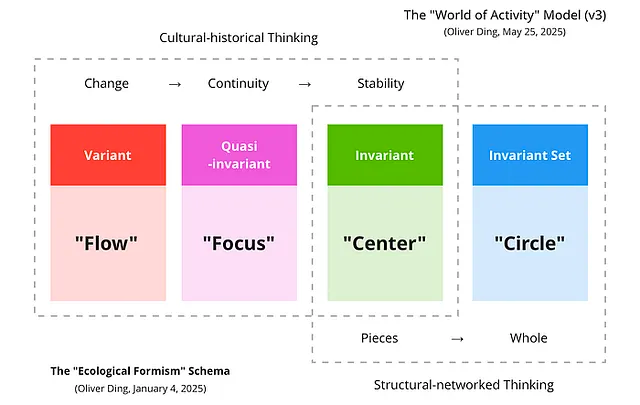
Flow represents the movement of everyday life experience — the continuous stream of activities, encounters, and engagements that constitute our lived reality. Think of Flow as the raw material of experience: attending classes, meeting friends, working on projects, having conversations, traveling, and creating. It’s the basic level of “what happens” in life.
Focus marks the emergence of mental concentration that creates thematic coherence. The key difference from Flow is that Focus involves the emergence of a thematic space that channels attention toward specific domains of meaning. When scattered activities begin to coalesce around particular themes or interests, Focus emerges. For example, when various creative activities (poetry writing, logo design, journal editing) begin to organize around a shared theme of creative expression.
Center represents the creative center we work with continuously. While Focus emphasizes intention and attention, Center involves sustained action and ongoing curation. Centers are the stable organizing principles that give structure to experience over time. They represent not just what we pay attention to, but what we actively develop, maintain, and build our activities around. A poetry society, a professional specialization, or a theoretical framework can each function as a Center.
Circle encompasses the network of connected creative centers — the broader social and cultural contexts that link individual Worlds of Activity to collective enterprises. Circles represent how our personal Centers connect with others’ Centers, forming communities, movements, and cultural phenomena.
This schema reveals how human experience organizes itself from basic Flow through increasingly complex levels of curation, culminating in Circles that connect individual development to broader cultural contributions.
The schema is simple, but applying it appropriately is not always straightforward. Over the past year, I have used it both as a creative heuristic and as a formal analytical framework. For examples, see the following articles:
- Tiny Culture: The “Culture as Thematic Enterprise” Framework - a short note
- See the Move: Four Looks at the World of Activity Approach
- Activity Analysis Network - a newsletter organized around the FFCC schema
- Homecoming: A Thematic Trip and the World of Activity Approach - a book-lenth case study based on the FFCC schema
- [Case Study] When the Circle Changes the Center
- World of Activity: Center as RelationField and the Dual-Center Pattern
- Joint Center: Revisiting the van Gogh brothers' Creative Life
4. Living Coordinate
Based on case studies of the World of Activity and the FFCC model, I further discovered an ecological form that underline the "Center" form: the Living Coordinate.
A personal Life Coordinate is a conceptual framework that maps an individual’s orientation within the World of Activity, integrating both worldview and life orientation.
From the case studies, we found that the Center is anchored on the basis of a Coordinate: before anchoring the center, one must first find the coordinate. What is striking, however, is that many people are not aware of this condition. The Coordinate operates as a deep structure beneath the Center — it remains invisible until the Center begins to falter or collapse. Only then does the question of Coordinate surface as a problem to be addressed.
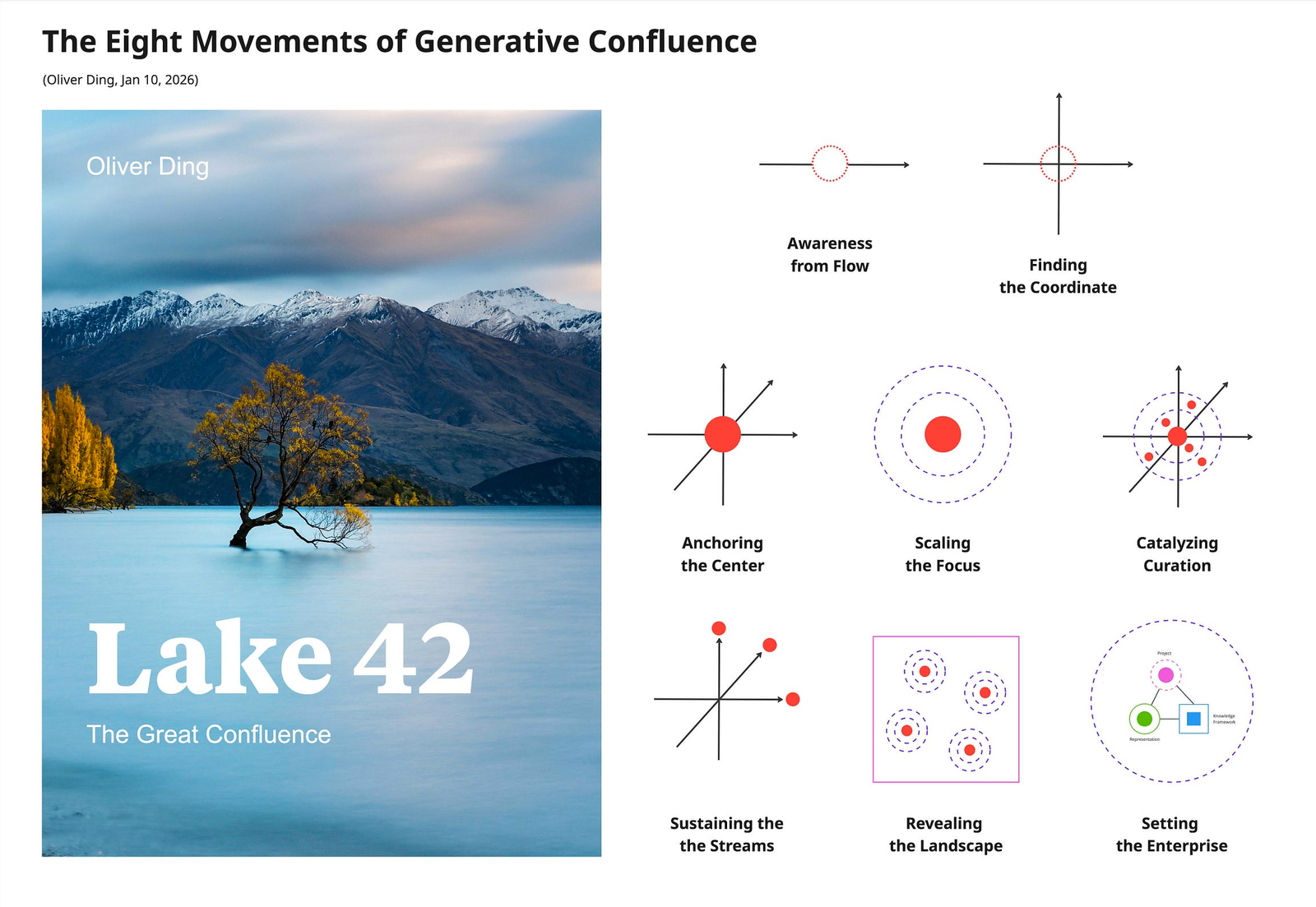
In the case study documented in Lake 42: The Great Confluence (2026), I identified two relevant movements and developed the Living Coordinate Model:
- Finding the Coordinate — searching for a meta-framework to answer “Where am I?” and “Where should I be?”
- Anchoring the Center — searching for a meta-framework to transform a potential Focus into a creative Center
Both movements require searching for a meta-framework, understood as a conceptual system, yet the meta-framework serves different purposes in each case. The process of searching can lead to encountering, resonating with, echoing, applying, inspiring, modifying, curating, rejecting, critiquing, remixing, and creating, among others. These various activities of engaging with conceptual systems are sources of diverse forms of human life and cultural innovation.
More details can be found in links below:
- Lake 42: The Great Confluence (2026)
- [World of Activity] The Living Coordinate Model (2026)
- A Journey of Finding the Coordinate
- Rebuilding the Living Coordinate: A Case Study Summary
- Making a Living Coordinate for Creative Life Discovery
5. The World of Activity Toolkit
Beyond the FFCC model, the World of Activity approach also incorporates several knowledge frameworks into a toolkit.
The v1.0 was released in June 2025. See diagram below.
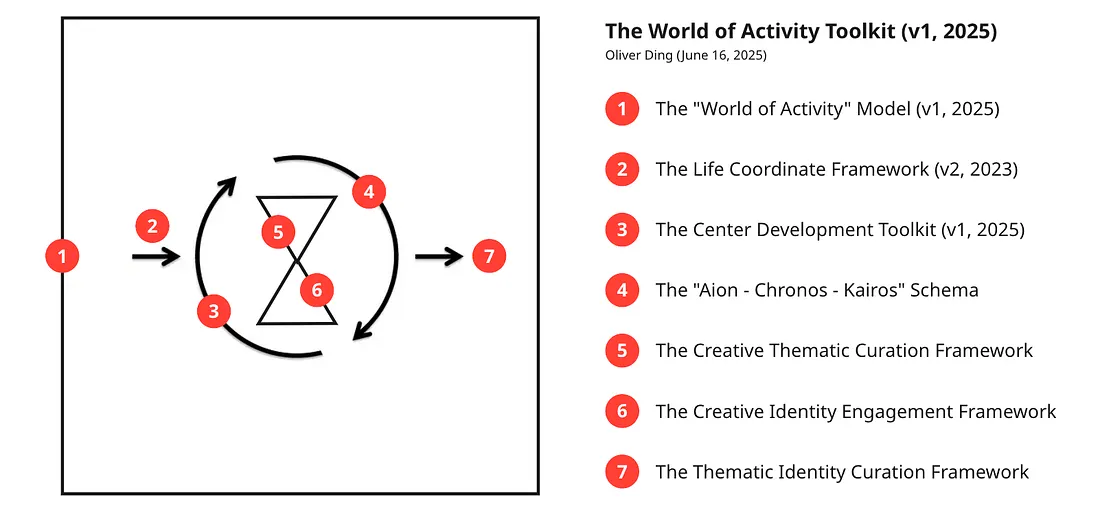
After one year work on case studies, v2.0 was released in April 2026.
The v2.0 was made by two major changes. First, expanded through Ecological Formism into a four-layer architecture, the FFCC model now maintains its core simplicity — four basic ecological forms — while being able to accommodate rich empirical research and support diverse situational reflection:
- Invariant: FFCC Schema, four basic Ecological Forms
- Quasi-invariant: A series of movements, described with the FFCC vocabulary
- Variant: Situational life events and themes (open category)
- Invariant Set: Other Ecological Forms
Secord, organized through Thematic Space Theory, its four thematic spaces now carry multiple dimensions simultaneously:
- Forms
- Themes
- Identities
- Methods
- Moves
- Achievements
What were separate knowledge frameworks in the World of Activity Toolkit v1.0 — each attending to one of these dimensions — have been curated together into a coherent whole.
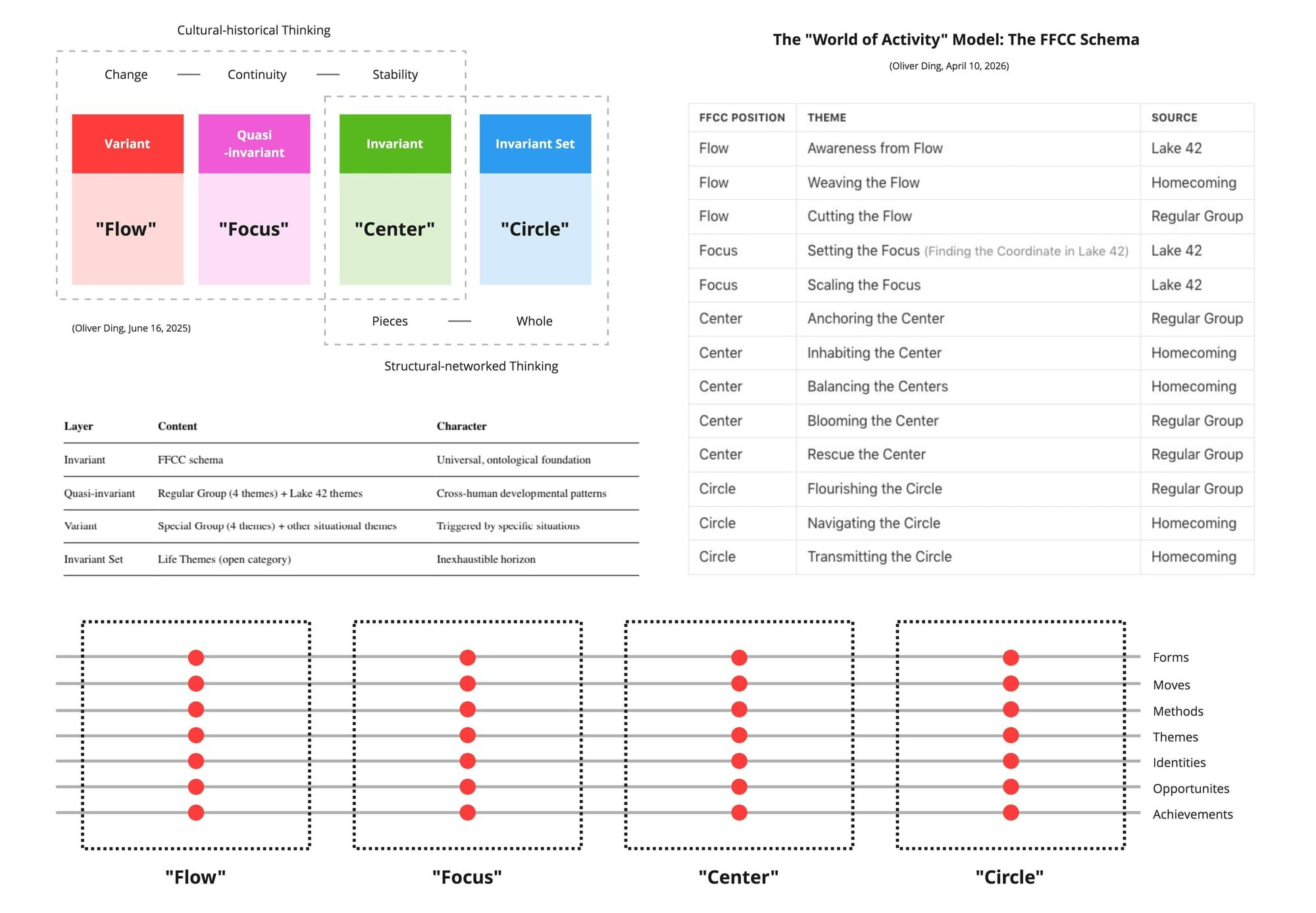
This constitutes the World of Activity Toolkit v2.0. The FFCC model has become a significantly more powerful knowledge framework — one that can serve not only as a theoretical explanatory model, but also as a tool for case study analysis and behavioral intervention. The simple four-part schema that began as a descriptive map of ecological forms has grown into the primary organizing structure of an entire approach to creative life development.
More details can be found in links below:
- GO Theory: Chronos Space, Aion Space, and World of Activity - v1.0
- The World of Activity Toolkit (v2.0, 2026) - v1.0
- The Creative Identity Engagement Framework - identity
- The Creative Thematic Curation Framework - theme
- The Thematic Identity Curation Framework - identity
6. How It Works in AAI
Through case studies conducted over the past year, a specific function of the World of Activity approach within the AAI program has emerged. Two temporal scales are relevant when analyzing a client's world: life course refers to long-term developmental trajectories; life situation refers to the current context and immediate challenges.
- Identify — the analyst uses the FFCC Model and other ecological forms to identify the structural forms of the client's life course or life situation.
- Map — these forms are mapped onto the client's World of Activity, revealing its organization and dynamics.
- Discover - at the situational level, some significant aspects or dramatic life patterns are discovered. However, the World of Activity approach does not interpret or explain what is found
The interpretation of the identified aspects or patterns is left to the analyst. The World of Activity provides the map; it does not provide the model to explain what is found.
This is a deliberate design choice. The ecological approach respects the uniqueness of each client's world of activity. It provides a theoretical framework for recognizing patterns, but it does not impose a predetermined narrative on the client's experience.
7. Curating the Situational Toolkit
This is a crucial moment in the Client–Analyst–Theorist relational field. The analyst is not simply applying theoretical frameworks developed by theorists. The analyst is an autonomous creator who plays a distinctive role: bridging theory and practice. And building that bridge is itself an art.
An AAI Analyst is expected to find relevant knowledge frameworks as models to explain the insights discovered in the client's World of Activity.
Once the map is drawn, the analyst brings in theoretical resources to make sense of what they see.
The outcome of this process is a situational toolkit — a curated set of concepts, frameworks, and methods tailored to the specific case. The toolkit is not prescribed by the World of Activity; it is assembled by the analyst in response to what the map reveals.
More details can be found on the Analyst page.
8. Offering the Theoretical Resources
The AAI program is a meta-framework, open to both analysts and theorists. While analysts build situational toolkits for clients, theorists contribute specific knowledge frameworks as theoretical resources for analysts to draw on.
Creative Life Theory is one such framework. While the World of Activity focuses on the general structure of subjectivity and life worlds, Creative Life Theory zooms in on creative activity — the ways in which individuals transform themselves into cultural creators through thematic enterprises.
In the AAI framework, these two are not competing or layered. They are complementary. The World of Activity provides the map; Creative Life Theory provides one possible interpretive model. Depending on what the map reveals, the analyst may draw on Creative Life Theory, or other frameworks, to explain what they see.
Together, they demonstrate how an ecologically oriented structural framework (World of Activity) and a more targeted analytical framework (Creative Life Theory) can be organized into a coherent situational toolkit — not as a fixed combination, but as a flexible response to what each client's World of Activity reveals.
In addition, I have been studying theoretical activity for years and have developed a series of tools for theorists. If you are interested, you can explore the Theorist page.
9. Three Paths, One Knowledge Ecology
Under the principle of Knowledge for Development — one of the five principles of the AAI program — the Activity Analysis Center is designed to serve the growth and practice of analysts and theorists. The Center provides the meta-framework, the foundational modules, and the knowledge ecology that enable analysts to build situational toolkits for their clients, and theorists to develop knowledge frameworks for general use.
This is not a one-way pipeline from theory to practice. It is a knowledge ecology in which different roles contribute different kinds of work, and together they generate value that none could produce alone.
The Activity Analysis Center operates through three interconnected paths:
| Path | Role | Focus |
|---|---|---|
| Analyst | builds situational toolkits for specific cases | applying the map |
| Theorist | develops knowledge frameworks for general use | building the tools |
| AAI / World of Activity | provides the meta-framework and foundational modules | supporting the ecosystem |
The World of Activity sits at the foundation of this knowledge ecology. It provides the shared reference point that makes communication between analysts and theorists possible. Analysts use it to map clients' Worlds of Activity; theorists use it as a common ground for developing new frameworks; and the AAI program uses it as the unifying framework that ties the entire enterprise together.
v1.0 - September 4, 2025 - 2,453 words