
Activity Analysis Network #23: 安身立命 (Ānshēn Lìmìng), Gejunction in the Wild, and GO Theory (III)
From Theoretical Development to Practical Analysis — The August Exploration
by Oliver Ding
August 31, 2026
Hi, and welcome to Activity Analysis Network, a newsletter hosted by the Activity Analysis Center.
Each issue is organized around the "Flow - Focus - Center - Circle" schema, the primary model of the World of Activity Toolkit (v1, 2025).
In this biweekly newsletter, I share summaries of new articles from the Activity Analysis Center, along with updates on related activities, including some of my own published work elsewhere.
This issue (#23) marks a significant moment. Two months ago, I announced the Center's shift from theoretical development to practical analysis. The August exploration—a Creative Life Discovery project triggered by my three-week trip to China—has now crystallized into two collections that capture both the theoretical grounding and the practical exploration.
Early this week, I launched a membership program for the Activity Analysis Center, with some content—especially in-depth case studies—available only to members.
Flow
The historical development of the Activity Analysis Center and my experience of daily life
August was a month of sustained exploration. After returning from China on July 30, I entered a Creative Life Discovery project—a "Before" project in the gap between formal commitments. I did not know where it would lead. I only knew that I was in discovery mode, the kind of open-ended exploration where you don't yet know what you're looking for, only that you'll recognize it when it arrives.
Over the past weeks, several threads developed independently. Three, in particular, shaped the month's direction.
Thread One: Closure and Unfolding. A photograph taken in Pengdun—two new walls with an old earth wall between them—became the seed for a theme that refused to settle into a book. It felt like it should occupy a physical space, a space you could walk into. A book? An exhibition? The question lingered. (Spatial Heuristics: A Thematic Trip and a Possible Book)
Thread Two: The Book Diagram. On August 27, I updated the "Mapping Strategic Moves" diagram. The count reached sixty possible books. I knew exactly how to do this—and that knowing itself became a question: what else haven't I considered? Cards? Maps? Objects? (Project Engagement: Activity, Curativity, and Creativity)
Thread Three: A LinkedIn Conversation. A friend shared his own series of evolving diagrams. I suggested he write about the process—show the sequence, tell the story of how the diagrams changed. After I sent the message, I sat with my own advice. It pushed me to think further about classification and operation.
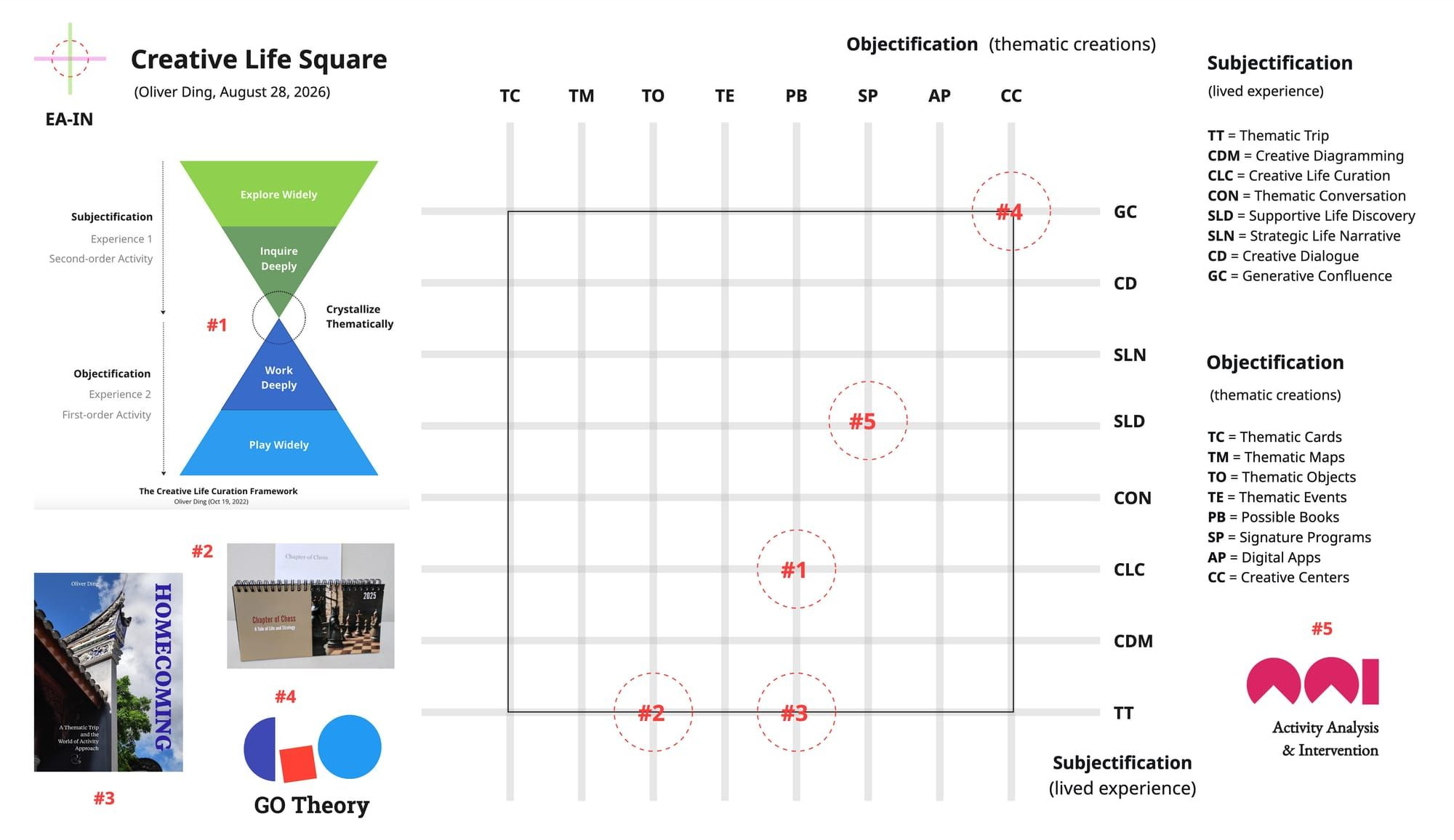
These three threads converged on August 29. The result was the Creative Life Square: an EA-IN sub-square of GO Square with 8×8=64 weave-points, cross-classifying eight types of subjectification experience and eight types of objectification creation. (Spatial Heuristics: Introducing the Creative Life Square)
Focus
The Thematic Foci of the Activity Analysis Center
While August was filled with multiple exploratory threads, my creative activity throughout the month was organized around two primary foci—each eventually crystallizing into a thematic collection. One in Chinese, one in English. Both are rooted in the same arc: the three-week trip to China in July, the return to Houston, and the sustained period of discovery throughout August.
A Chinese Collection: Twenty Lectures on Activity Analysis and Intervention (Volume 1)
During my stay in Fuzhou in July, I began drafting a lecture series in Chinese—Twenty Lectures on Activity Analysis and Intervention (活动分析与干预二十讲). I planned the series in three modules: the first five lectures cover the foundational models shared by the World of Activity approach and Creative Life Theory; the last five focus on the methodology of case analysis; and the ten in between form a toolkit of optional knowledge models that can be drawn upon depending on the case.
After returning to the U.S., I completed the first module of six lectures, which establish the theoretical foundations.
To help Chinese readers enter my theoretical system, I named this first module "安身立命" (Ānshēn Lìmìng)—settling oneself and establishing one's destiny. Instead of introducing the framework with unfamiliar terminology, I used Confucian classical allusions as creative entry points: "宇宙吾心" (the universe and my mind), "三省吾身" (examining myself thrice daily), "修齐治平" (cultivating the self, ordering the family, governing the state, and bringing peace to the world), and "月映万川" (the moon reflecting in ten thousand rivers). These familiar cultural anchors gradually open into the theoretical vocabulary of my own system.
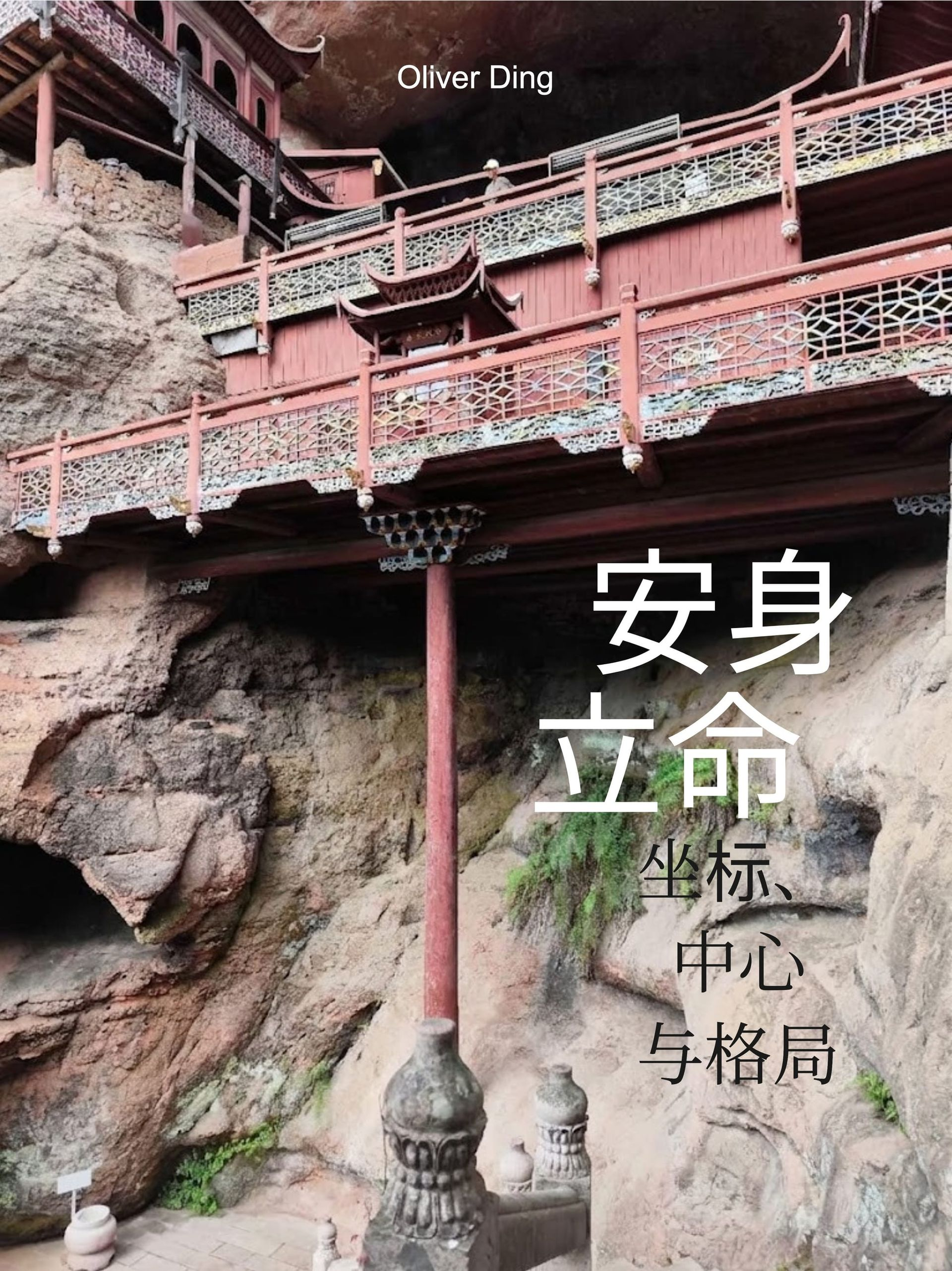
The full module totals approximately 87,000 words. The preface, appendix, and the introduction to each lecture are publicly accessible; full lecture texts are available to members.
This is the first time I have systematically presented the AAI theoretical system in Chinese. The result has been a rewarding experiment in cross-cultural articulation—finding the points of resonance between a theoretical vocabulary developed in English and a cultural tradition that speaks through classical Chinese.
I am curious how others, from different linguistic and cultural backgrounds, might draw upon their own cultural allusions to introduce the World of Activity and Creative Life Theory in their mother tongues.
Gejunction in the Wild: Toward a Gejunction Analysis Method
In the second half of August, I produced a series of diagrams—each exploring a different facet of the same underlying transition: the movement from theory to practice that I had been anticipating since June, and that the July trip had set in motion.
On August 13, I released the AAI (2026) Framework—a meta-framework for designing supportive developmental programs.
But from August 13 to August 29, something else happened. I drew a series of diagrams—each exploring a different facet of the same transition. At some point in mid-August, I realized: these diagrams were not random musings; they were spontaneous articulations of Gejunction's four aspects. I was using my own theoretical tools to understand my own situation—using Gejunction to observe the occurrence of Gejunction itself.
Gejunction is a concept I recently introduced in a newest released possible book Strategic Developmental Psychology (July 7, 2026) as GO Theory's unit of synthesis—a way of grasping a person's overall standing in the social world as a single, coherent configuration. Its four aspects—Thematic Spaces, Living Coordinates, RelationFields, and Weave-points—were not designed for this August exploration; they had been developed through independent theoretical work over the preceding months. But here, in the midst of a Creative Life Discovery project, they unexpectedly became the very framework I needed to map my own transition.
The result is a thematic collection: Gejunction in the Wild: Toward a Gejunction Analysis Method. It comprises thirteen articles, organized in three parts:
- Part I: Background — Three articles establishing the theoretical foundations (Gejunction as GO Theory's Unit of Synthesis, the AAI 2026 Meta-Framework, and GO Theory Phase III)
- Part II: Gejunction Analysis — Nine articles organized under the four aspects of Gejunction: Thematic Spaces, Living Coordinates, RelationFields, and Weave-points
- Part III: Project Engagement — Two articles documenting the action-activity within this standing

This collection is not a presentation of a mature method. It is a record of an exploration—a case study of a theorist in transition, using his own theoretical tools to understand his own situation, in real time.
Both collections—the Chinese lectures and the English thematic collection—emerged from the same August journey. They speak to different audiences, in different languages, through different genres. But they share the same root: a sustained period of discovery, reflection, and articulation.
Center
The Core of the Activity Analysis Center
The Activity Analysis Center's current focus is the AAI project—Activity Analysis & Intervention. This is the operational core of our transition from theoretical development to practical analysis. All of my recent explorations—the diagrams, the articles, the collection—have been driven by a single question: How do we translate the theoretical resources we have built into concrete programs that support human development?
Throughout August, I have been using the Living Coordinate model to anchor my own position within this work.
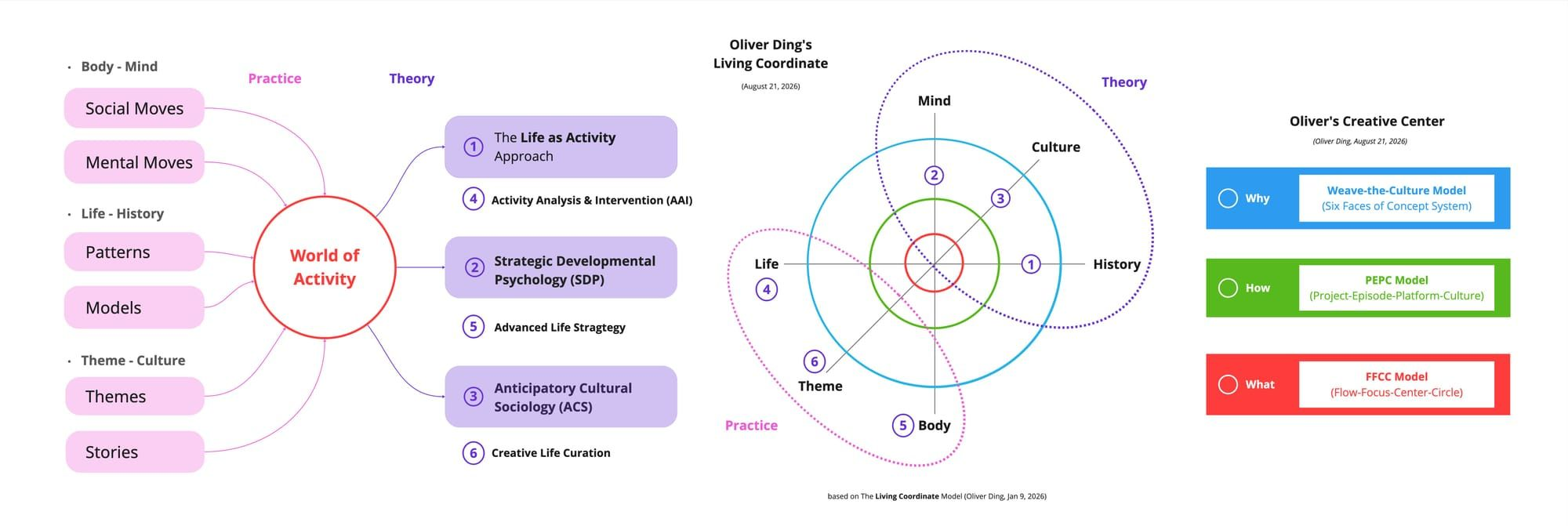
The diagram anchors AAI at the intersection of three dimensions:
- Thinking (Mind-Body) — the cognitive and bodily dimension
- Doing (Life-History) — the action and life trajectory dimension
- Creating (Theme-Culture) — the thematic and cultural dimension
In the three rings, I placed three core models that form the theoretical backbone of AAI:
- The FFCC Model (Flow-Focus-Center-Circle) provides a foundational description of a person's World of Activity.
- The PEPC Model (Project-Episode-Platform-Culture) traces how an individual's center develops into a thematic enterprise and eventually into a platform that supports others.
- The Weave-the-Culture Model (Six Faces of Concept System) shows how the themes and concept systems generated by these enterprises become curated into the broader collective culture.
On the practice side, symmetrically aligned with these three theoretical systems, I placed three corresponding practical methods:
- Activity Analysis & Intervention (AAI) — corresponding to the Life-as-Activity Approach
- Advanced Life Strategy — corresponding to SDP, with an emphasis on patterns and models
- Creative Life Curation — corresponding to ACS, with an emphasis on themes and stories
Together, the three models form a complete arc: from the body-centered self, unfolding through the various dimensions of life, to finally becoming a cultural creator. This arc echoes the nested framework introduced in Meta-frameworks (December 2025):
History { Life [ Body (Self) ] }
For now, most of my attention is focused on the overall design of AAI. However, my considerations remain largely at the level of analysis—using the FFCC model to map the basic contours of a person's World of Activity. I have not yet ventured into intervention. Yet Advanced Life Strategy and Creative Life Curation already point toward two broad directions for intervention: one centered on patterns and models, the other on themes and stories. They mark the path ahead—from describing a World of Activity to actively participating in its transformation.
The Supportive Life Discovery program—which I have been developing through ongoing work with Maya—serves as a concrete example of the AAI method in action.
More details can be found in Making a Living Coordinate for Creative Life Discovery.
Circle
The Context of the Activity Analysis Center
Since September 2025, the Activity Analysis Center has been operating as a meta-center, using GO Theory as my theoretical platform to host several theoretical enterprises. These enterprises constitute the Center's Circle—the broader context within which the Center operates.
On this platform, five theoretical enterprises operate, each occupying a distinct position within the World of Life:
- Life as Activity (including the Project Engagement Approach) — at the center, attending to activity itself
- Anticipatory Cultural Sociology (ACS) — at the Collectives boundary, attending to cultural development
- Strategic Developmental Psychology (SDP) — at the Individuals boundary, attending to individual life development
- Cognitive Hydrology — at the Spirituality boundary, attending to the flow of ideas and meaning
- Platform Ecology — at the Science boundary, attending to ecological and structural conditions of platform development
These five enterprises are equal. Each occupies a different position within the World of Life, which means each brings a genuinely different theoretical perspective. And because they share the same spatial foundation—the same map, the same boundaries, the same operating concepts—they naturally support one another, forming a network of enterprises rather than a hierarchy.
The August work, however, was not distributed across all five. It was concentrated on three: Life-as-Activity (through AAI and Project Engagement), SDP, and ACS.
On August 17, I drew a map of the creative landscape. I returned to GO Theory's nested square diagram—representing World of Life and World of Activity—and placed it at the center of the map. Around it, I arranged the creative themes that had been accumulating in recent weeks.
What emerged by the end of the day was simple: Gejunction and AI.
Most of the themes I had been carrying connected to one of Gejunction's four aspects. Two of them engaged AI directly. And all of them, read together, pointed toward the same underlying direction: case-based exploration.
This convergence marks a formal transition. GO Theory Phase I established the World of Activity. Phase II expanded to the World of Life and cultural development through ACS. The work ahead—centered on Gejunction, AI, and the movement from theory into practice—I am naming Phase III.
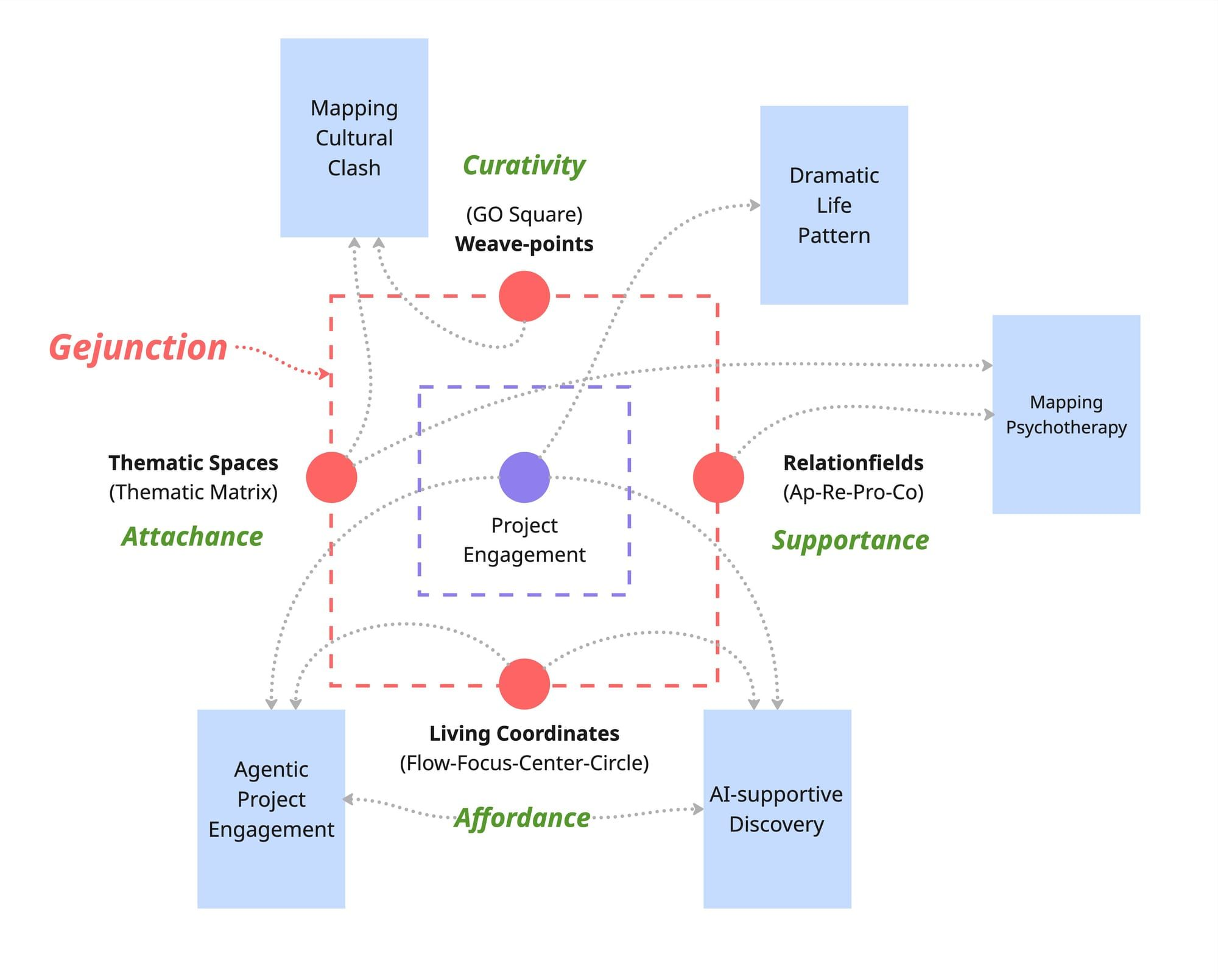
The four positive frontiers of Project Engagement identify four kinds of ecological opportunity: Affordance, Attachance, Supportance, and Curativity. Gejunction provides the concrete social environment in which these possibilities become available to the individual. Genidentity concerns the individual's process of selection: whether to take up an opportunity, which opportunity to pursue, and how to orient oneself toward it.
The relationship can be expressed simply:
Gejunction provides the field of opportunities; Genidentity concerns how the individual selects among them.
Strategic action is consequently not merely a response to an external stimulus. It is the actualization of one or more possibilities perceived within a comprehended Gejunction.
World
Me, You, and We
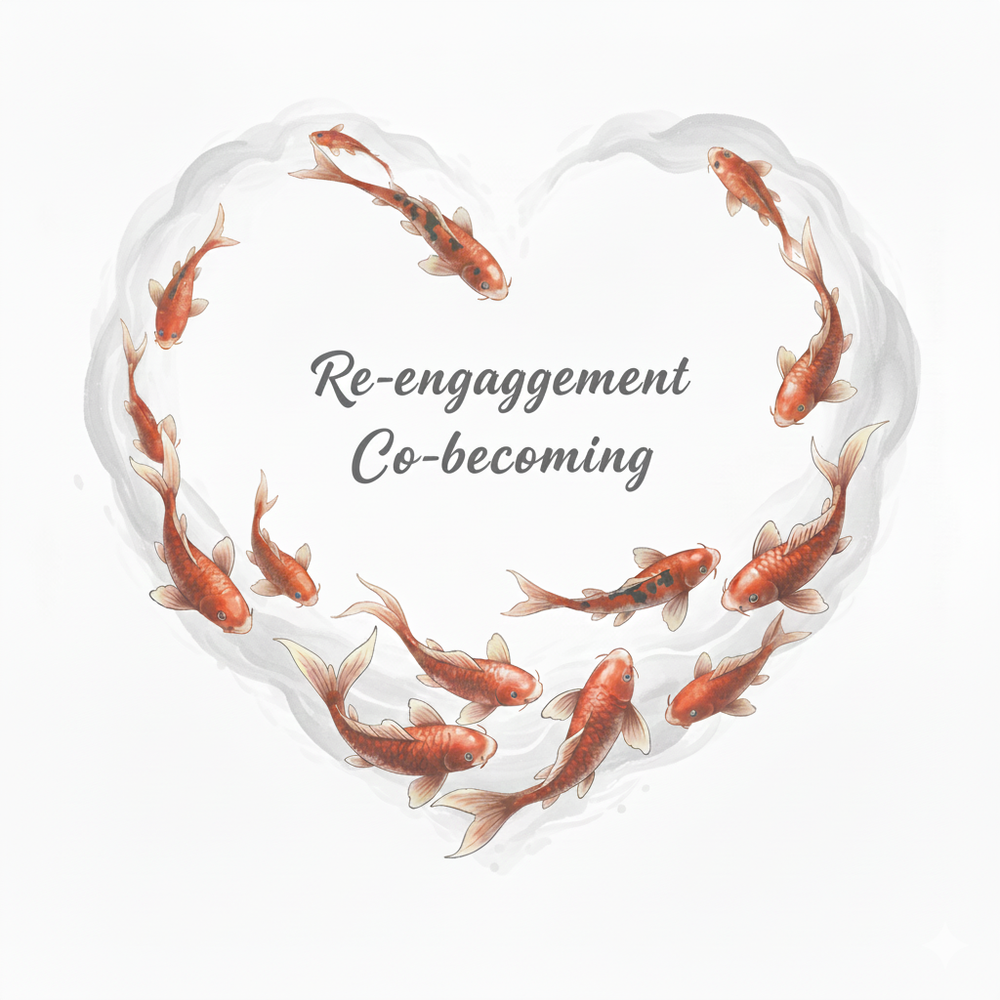
The image above is my New Year's greeting card — and also my annual theme for 2026: Re-engagement and Co-becoming.
The AAI framework now provides the application-design layer for the entire platform. The next step is to develop concrete programs—for analysts, for theorists, and for practitioners—that translate these principles into practice.
The August exploration was the beginning. More will follow.
Re-engagement and Co-becoming. I placed them there in January. The year answered.
Oliver Ding
Founder of the Activity Analysis Center
August 31, 2026
p.s. I am based in Houston, Texas, US. Where are you?
v1.0 - August 31, 2026 - 2,321 words