
Creative Diagramming: The House of World of Activity
A new thematic map
by Oliver Ding
September 4, 2026
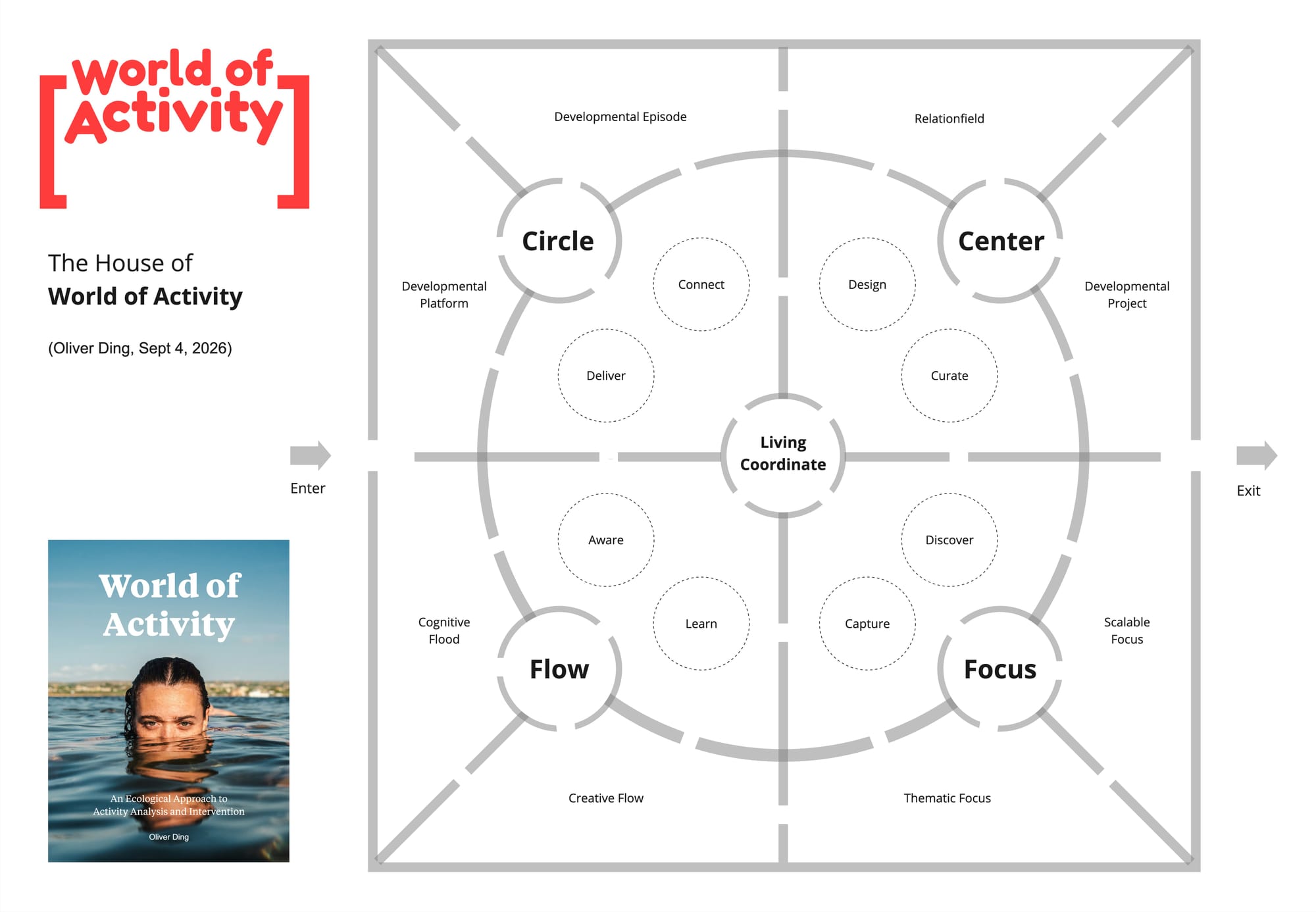
Today I updated the World of Activity page on the Activity Analysis Center website. After completing the work, I just designed a new thematic map (see the diagram above) for fun.
However, this new design brings a new insight. This is what the article about.
One-year Creative Journey
Over the past few days, I have been curating and consolidating some of my theoretical work on the World of Activity approach, and today I updated a page on the Activity Analysis Center website that was originally published about a year ago.
In a sense, this update is a small report on what happened during the past year.
The concept of World of Activity was born in 2022. At first, it did something quite simple: it defined four boundaries of a World of Activity — Heaven, Earth, Life, and Death. But at that stage, I had not really explored the dynamics of the activities taking place within those boundaries.
In May 2025, I developed the FFCC model — Flow, Focus, Center, Circle. Together with the four original boundaries, these became a set of ecological forms for understanding the form of a World of Activity.
This was an important turning point.
The concept of World of Activity gradually developed into an independent theoretical framework. I began curating knowledge frameworks around these ecological forms. In June 2025, a theoretical toolkit for working with the approach was released.
Then, during my trip in China in the summer of 2025, I spent some time in Fuzhou and used the World of Activity framework to analyze my own autobiography. That produced a surprisingly rich body of research.
Over the following months, I continued conducting different kinds of case analyses, gradually accumulating more observations and insights.
In April 2026, I released World of Activity v2.0, together with the second-generation version of the theoretical toolkit.
Last month, during another trip to China, I spent some time in Fuzhou thinking about my next major project: the 20-lecture series on Activity Analysis and Intervention. In that project, World of Activity has become one of the foundational modules.
So updating this old webpage today felt almost like preparing a year-end report of my theoretical creation.
A Gift for Celebration
After finishing the update, I decided to make a small visual experiment to celebrate the work.
I created a thematic map as a visual template for presenting the six ecological forms of World of Activity:
Boundary · Coordinate · Flow · Focus · Center · Circle
I also selected sixteen themes from the research insights accumulated through the past year and placed them on the canvas.
It also offers a simple enter point for people who are not familiar with the approach.
The v2.0 framework had accumulated so many concepts, models, cases, and insights that I began to worry that a comprehensive presentation might actually make it harder for someone new to enter the approach.
That experiment became The House of World of Activity.
Instead of presenting World of Activity as a large conceptual system, I presented it as a house — a place that people could enter, explore, and leave.
The idea was almost playful, but it also had a history.
In 2024, I designed a series of thematic maps, experimenting with different visual forms for representing complex knowledge landscapes. I continued developing similar designs in early 2025.
This afternoon, while looking for a simple visual form for the updated World of Activity page, I went back to one of those earlier maps: “Castle and Forest: The House of Knowledge Discovery.”
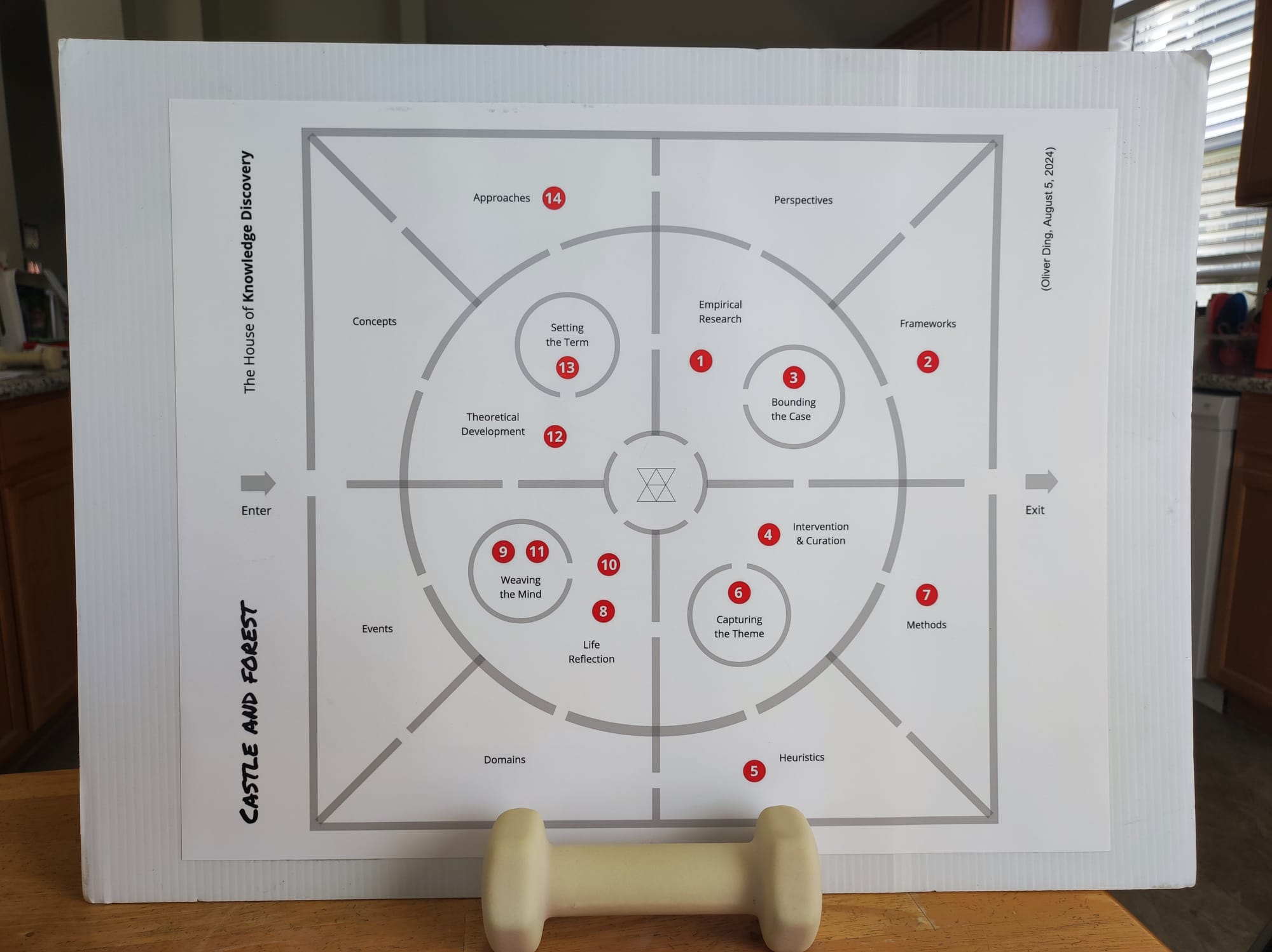
Rather than designing something completely new, I decided to modify its visual form. I changed the architecture, adapted the spatial organization, and reworked the content to fit the World of Activity framework.
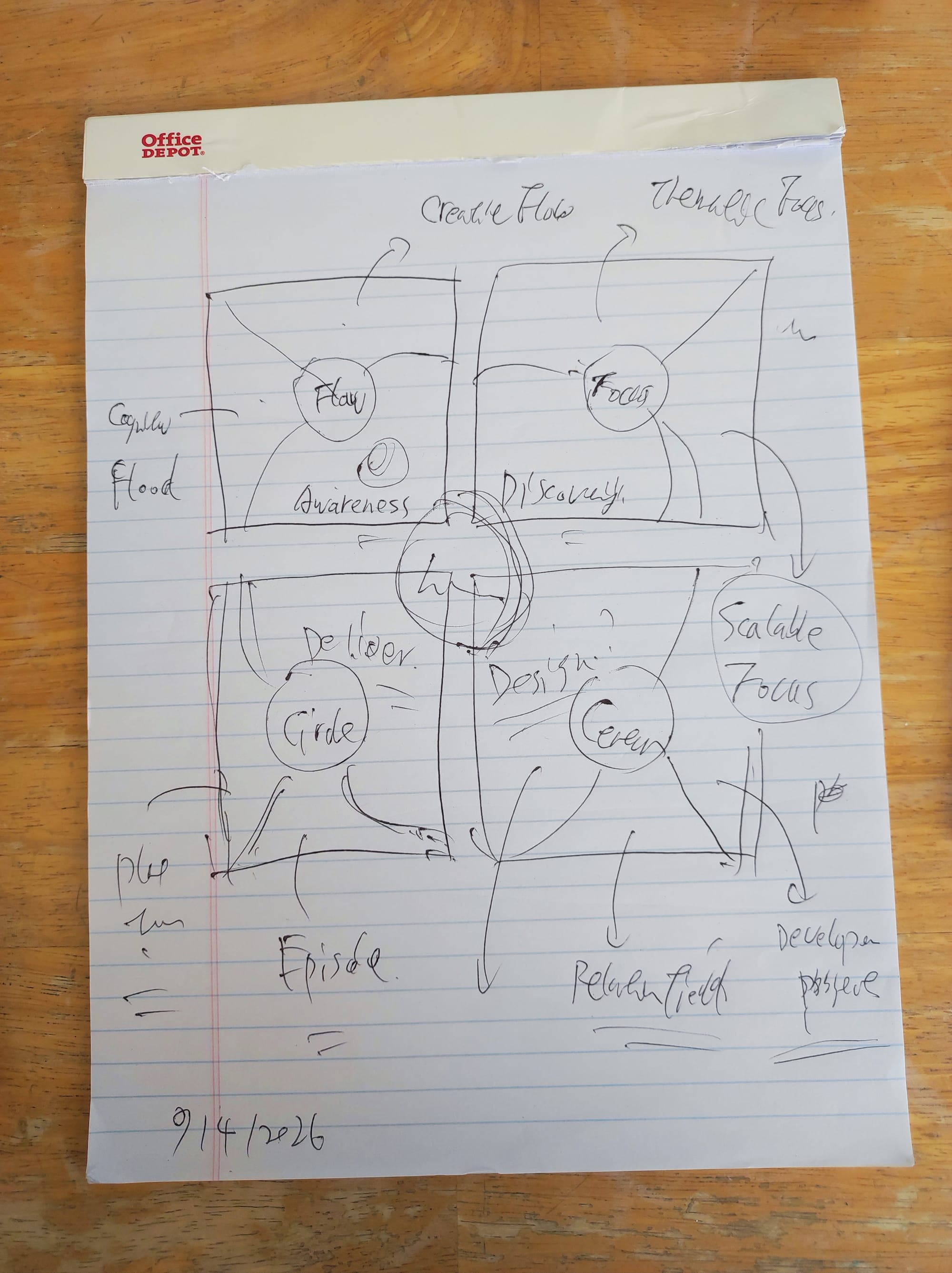
The result became a new thematic map.
The House of World of Activity
What began as a reuse and modification of an old visual experiment unexpectedly became a new way of representing the theory.
As mentioned in the new webpage, the World of Activity approach identifies a series of ecological forms within individual's life course: boundary, flow, focus, center, circle, and coordinate. These six ecological forms become the structure of the house.
- The square became the visual embodiment of Boundary. There is an Enter on the left and an Exit on the right, giving the whole structure something of the character of a museum or exhibition space.
- Inside the house, the four major areas correspond to four ecological forms: Flow · Focus · Center · Circle
- And in the very middle is a small circle containing the Living Coordinate, visually embodying the sixth ecological form: Coordinate.
But the House also contains another part of the underlying theoretical structure. The four FFCC areas organize eight external objects and eight internal actions:
Flow
- External: Cognitive Flood · Creative Flow
- Internal: Aware · Learn
Focus
- External: Thematic Focus · Scalable Focus
- Internal: Capture · Discover
Center
- External: Developmental Project · RelationField
- Internal: Curate · Design
Circle
- External: Developmental Episode · Developmental Platform
- Internal: Deliver · Connect
So the compact architecture of the World of Activity becomes:
- 6 ecological forms
- 8 external objects
- 8 internal actions
These are not three visual layers of the house. They are three aspects of the underlying theoretical structure. The House is simply a spatial representation of that structure.
A Generative Template
There is another important detail. The sixteen external objects and internal actions were not created as a new taxonomy. I selected them intuitively from the much larger knowledge system accumulated through World of Activity v2.0. After a year of case studies, experiments, and theoretical development, there were many possible concepts I could have included.
I selected 16 themes as examples and placed them on the house. Someone familiar with the World of Activity approach could choose a different set of themes, based on a different purpose, audience, or area of interest, and create another version of the House.
In this sense, the House is not a fixed representation of the World of Activity. It is a generative template for representing a World of Activity. The six ecological forms provide the underlying architecture, while the themes placed within that architecture can be changed.
This is also part of the point of the design: the House is not meant to tell people which themes they should have. It offers a way to explore how different themes can be organized within a World of Activity.
A By-product
And then something unexpected happened.
I began to see a connection with the classical Chinese idea of 内圣外王(Inner Sageliness and Outer Kingliness).
Back to November 2025, I added 内圣外王(Inner Sageliness and Outer Kingliness) to the Cultural Projection Model (2025) and connected it with the Internalization-Externalization principle of Activity Theory.
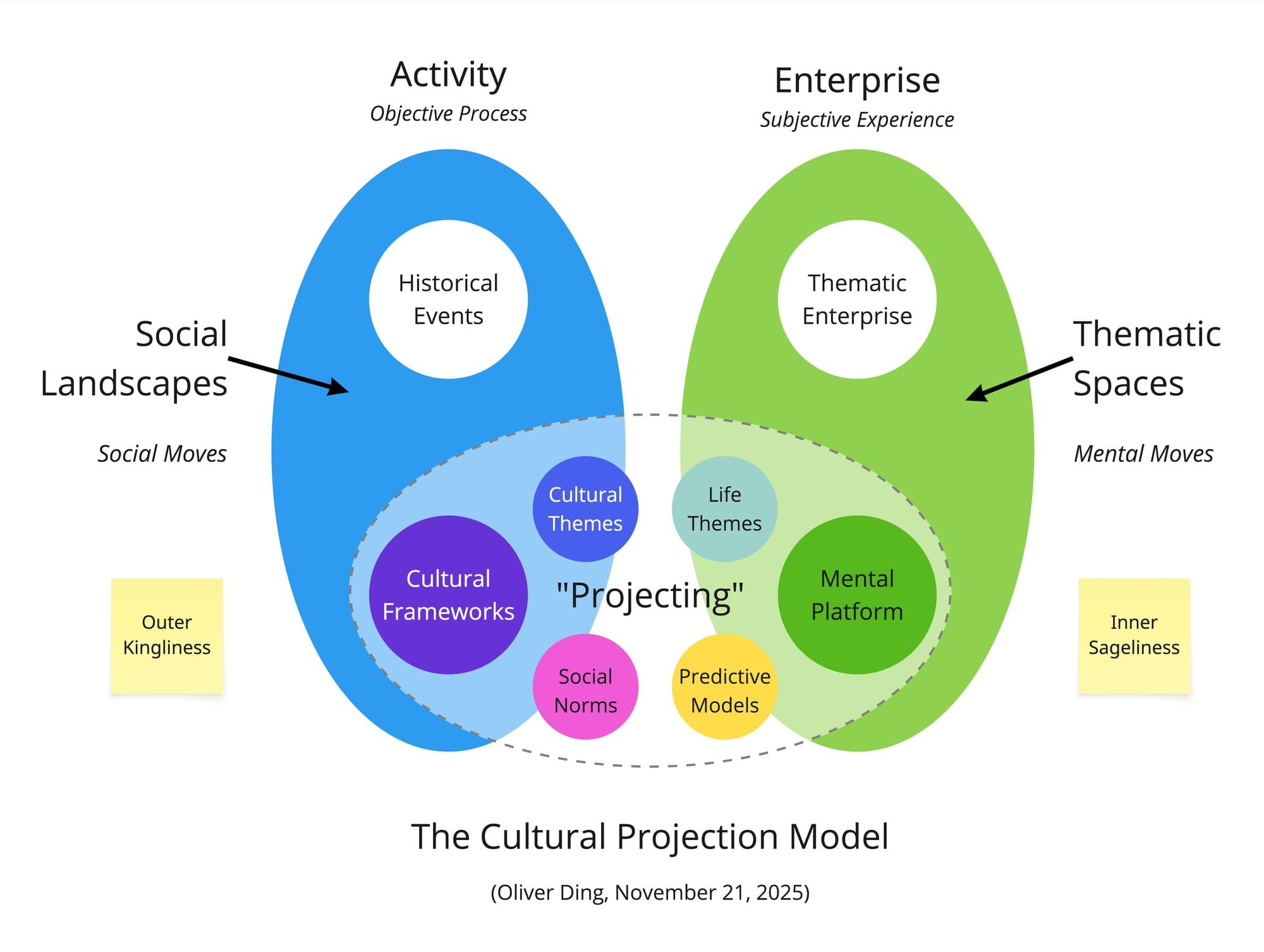
By placing Inner Sageliness (referring to subjective elements like Mental Platform, Life Themes) and Outer Kingliness (referring to objective elements like Cultural Frameworks, Social Norms) into the Cultural Projection Model, this dialogue identifies a deeper structural resonance between the two traditions.
At that time, I claimed that this cross-cultural comparison suggests that the “Outside — Projecting—Inside” triad is potentially a cross-cultural general structure of social formation. More details can be found in The Cultural Projection Model (2025).
The triad is about the activity itself. Now, the House offers a different interpretation from the ecological perspective. It was not simply about inner versus outer. The design brought together:
- Ecological forms
- External objects
- Internal actions
The external and internal dimensions are not separate worlds. They are organized within the same ecological architecture. A person enters a world, encounters its objects, acts within it, develops through it, and eventually moves toward an exit. And at the center is the Living Coordinate — a way for the individual to locate themselves within their own World of Activity.
This was not what I set out to discover. I was simply trying to make a very large body of theoretical work less overwhelming.
But the act of simplifying it produced a new visual structure, and the new structure revealed something I had not seen so clearly before. This is one reason I increasingly see creative diagramming as a form of theoretical activity.
A diagram does not merely illustrate a theory. Sometimes, when a complex knowledge system is reorganized into a simple visual form, the form itself begins to think with you.
The House of World of Activity started as a way of making the theory easier to enter.
It ended up becoming a new way of seeing the theory itself.
v1.0 - September 4, 2026 - 1,428 words