
by Oliver Ding
August 26, 2026
This page is one of the two paths for engaging with the Activity Analysis Center — for those drawn to theoretical development rather than practical analysis. For the practical path, see Analyst.
Over the past years, my work has been driven by a sustained exploration of the theory-practice connection. This journey has led me to identify four themes that are critical for theorists:
- Knowledge Niche — where is your theoretical work located within the broader knowledge ecology?
- Creative Cognition — how do theoretical insights emerge and develop, from raw materials to refined concepts, models, and frameworks?
- Knowledge System - how do you organize an ongoing, evolving system of knowledge outcomes?
- Knowledge Value Chain — how does theoretical work deliver value for others?
Since 2025, I have been using two terms — theoretical activity and theoretical enterprise — to frame this practice, bringing together several theoretical frameworks I developed over the past years. This page shares these frameworks as tools for theorists.
The table below maps each tool to a primary theme, though in practice each tool touches on multiple themes.
| Theme | Tool / Perspective |
|---|---|
| Knowledge Niche | Strategic Themes of Knowledge Strategy — four thematic areas and twelve strategic themes to locate your activity within the knowledge ecology |
| Creative Cognition | Weave the Theory — a model and book draft that traces how theoretical insights emerge and develop |
| Knowledge System | Theme–Concept–Framework Transformation — a systematic path for organizing evolving knowledge outcomes |
| Knowledge Value Chain | Theoretical Enterprise — a perspective that distinguishes internal value opportunities from external ones |
On this page:
- My Theoretical Journey
- Strategic Themes of Knowledge Strategy
- Weave the Theory
- The Theme-Concept-Framework Transformation
- Theoretical Enterprise
1. My Theoretical Journey
For the past decade, I have engaged with Activity Theory as a theoretical tradition — studying its concepts, tracing its historical and contemporary development, and bringing its resources into dialogue with other intellectual traditions.
At the same time, I chose theoretical activity itself as a distinct type of activity for sustained inquiry. Rather than looking only at what theories say, I became interested in how theories develop: how theorists engage with existing knowledge, discover new questions, appropriate and transform conceptual resources, develop frameworks, and weave different resources into evolving theoretical enterprises.
This inquiry has resulted in a number of theoretical frameworks and book projects. The four resources on this page — each aligned with one of the four themes introduced above — are particularly relevant for theorists exploring their own theoretical activity.
In May 2025, I used Robert Kegan's core models — the Five Orders of Consciousness — to reflect on the development of my own “Evolving Knowledge Enterprise” journey from 2020 to 2025. See the diagram below.
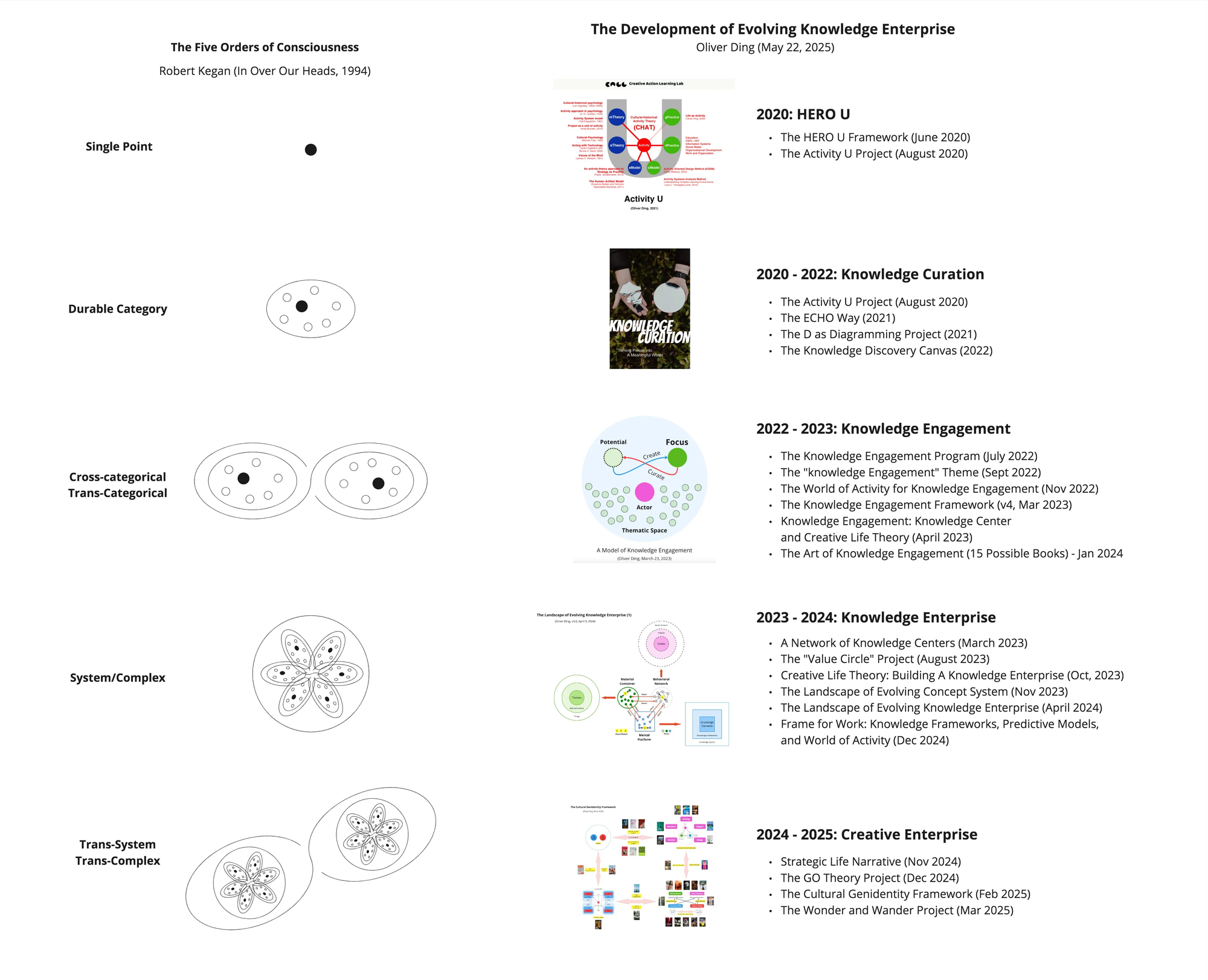
This journey is framed in five phases, each centered around a core creative theme and a constellation of knowledge projects.
- Single Point: “HERO U” (2020)
- Durable Category: “Knowledge Curation” (2020–2022)
- Cross-categorical/Trans-categorical: “Knowledge Engagement” (2022–2023)
- System/Complex: “Knowledge Enterprise” (2023–2024)
- Trans-system/Trans-complex: “Creative Enterprise” (2024–2025)
More details can be found in [Wander and Wander] The “Evolving Knowledge Enterprise” Journey (2020–2025).
2. Strategic Themes of Knowledge Strategy
From: Castle and Forest: The Landscape of Concept-related Knowledge Engagement (2025)
The Strategic Themes of Knowledge Strategy model identifies twelve recurring themes through which theorists and other knowledge actors engage with concepts and knowledge systems.
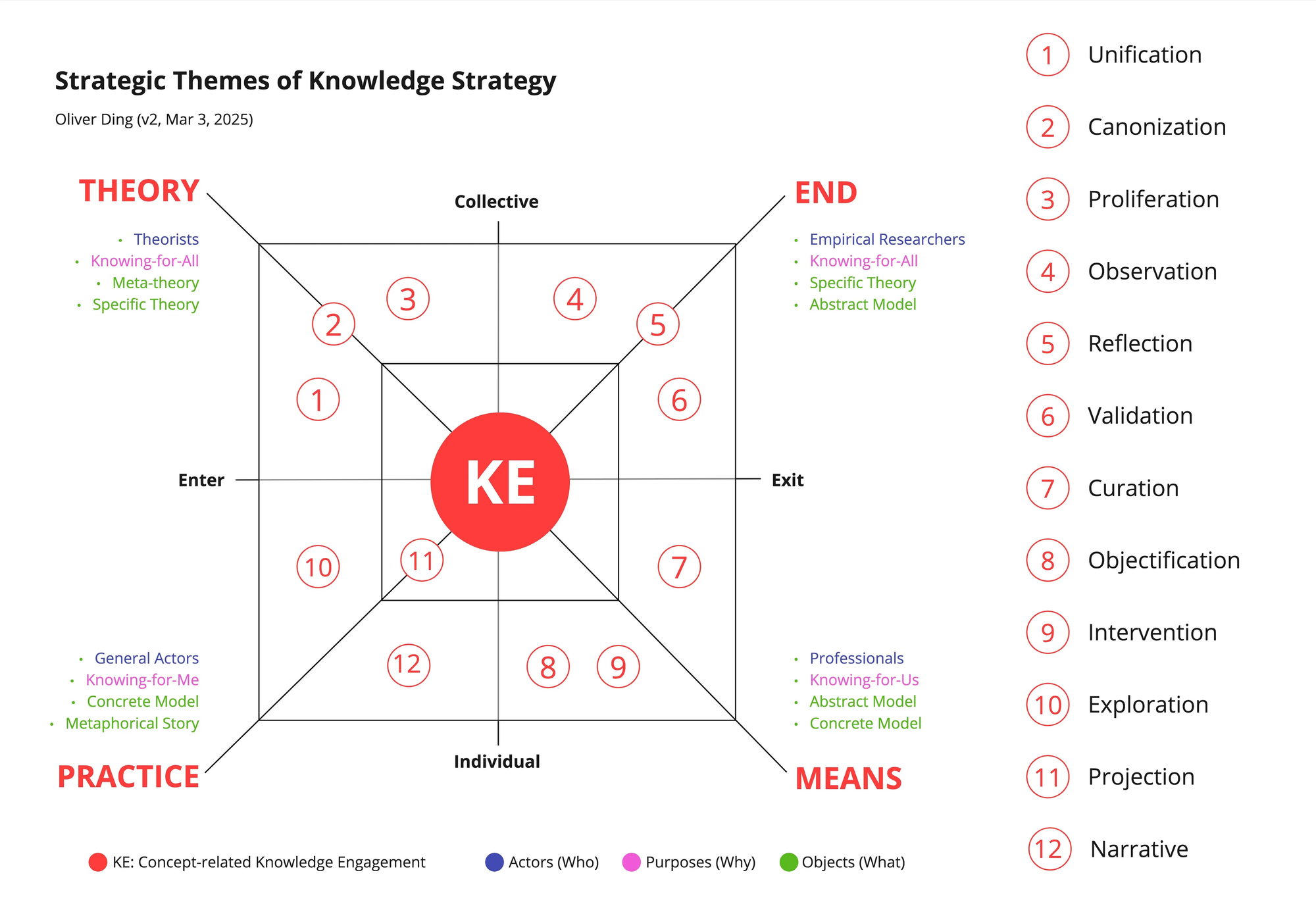
The model grew out of the Knowledge Discovery Canvas (KDC) , introduced in the 2022 book draft Knowledge Discovery. KDC provided a vocabulary for identifying and organizing different types of knowledge entities — concepts, approaches, frameworks, and more. Building on this foundation, Castle and Forest (2025) refined the KDC's insights into a strategic model of theoretical activity.
For theorists, these twelve themes provide a precise vocabulary for recognizing different kinds of theoretical activity — whether unifying existing traditions (unification), validating propositions (validation), objectifying tacit insights (objectification), curating a knowledge system (curation), projecting a new initiative (projection), exploring new directions (exploration), or constructing a narrative (narrative). The model also accounts for canonization, observation, reflection, intervention, and proliferation as distinct strategic moves.
The model therefore offers a strategic map of theoretical activity rather than a model of theory itself.
More details can be found in Castle and Forest (book, v2.0, 2025).
3. Weave the Theory
The Weave-the-Theory Model offers a framework for understanding the development of theoretical activity over time.
It conceptualizes theoretical development through the interplay of two diachronic movements — Creativity / Proliferation and Curativity / Unification — together with two synchronic dimensions — Aspects and Approaches. Their intersections generate four key weave-points in theoretical development: Theme, Model, Concept, and Principle.
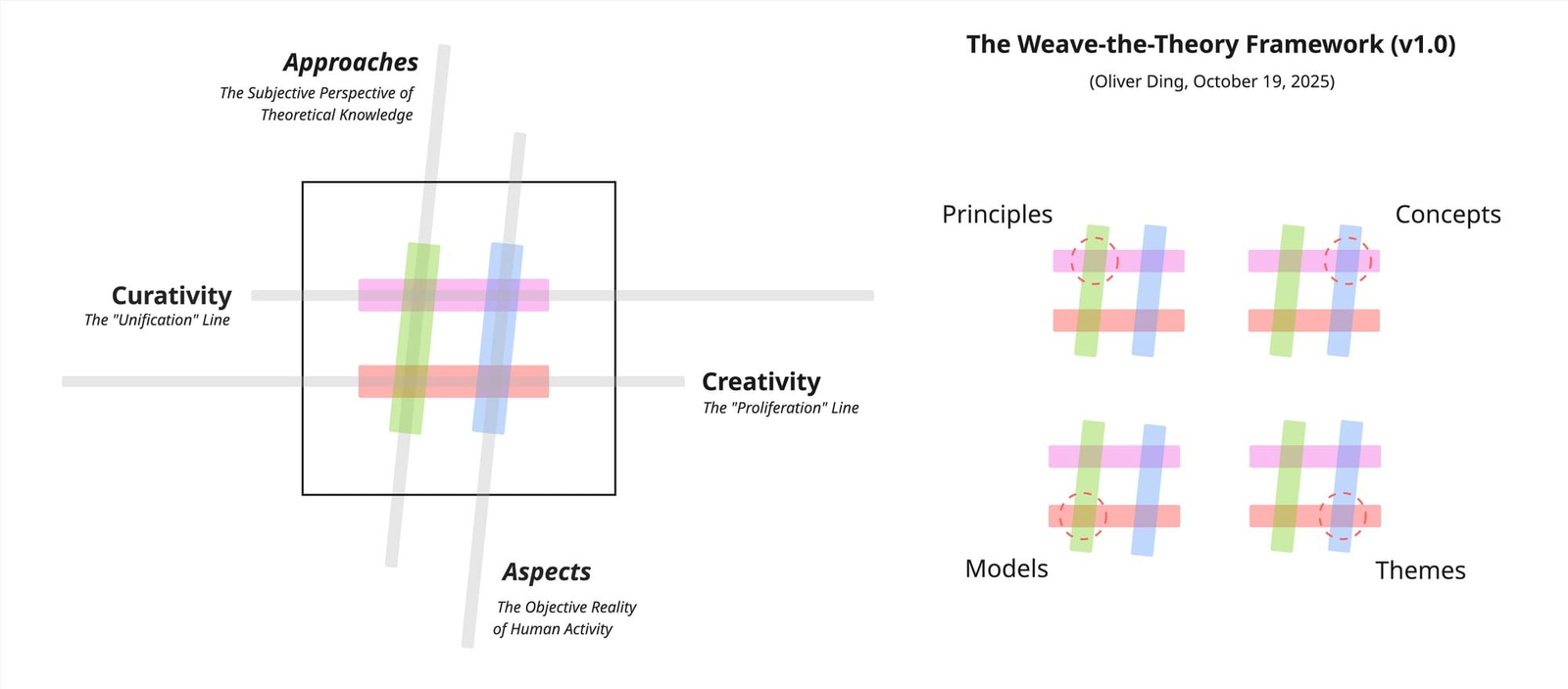
The model provides a structural way to examine how theoretical work develops: how themes generate new directions, how models organize emerging structures, how concepts take shape through engagement with existing and emerging materials, and how principles eventually emerge from the longer process of creating, curating, and weaving theoretical work.
Rather than treating a theory as a finished system of propositions, the model approaches theory as a developing activity. It can therefore be used to examine theoretical work at different scales, from an individual's long-term theoretical enterprise to the development of a collective theoretical tradition.
The model is accompanied by the Weave-the-Theory Toolkit, a set of analytical tools developed through its application to concrete cases.
Weave the Theory: The Art of Theoretical Activity and Knowledge Ecology is a collection of case studies demonstrating the Weave-the-Theory Model and its accompanying toolkit in practice.
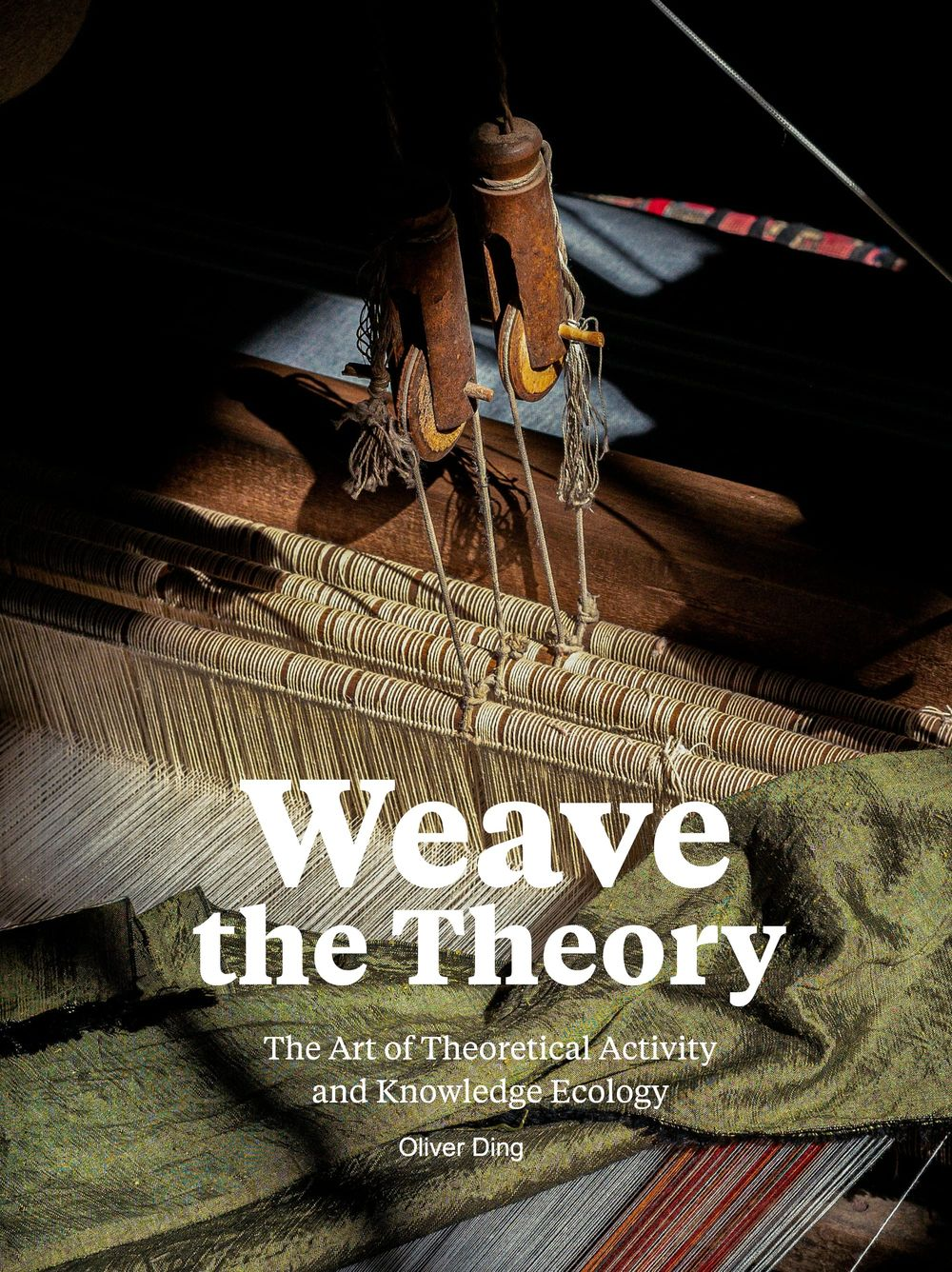
The book operates at two levels.
- Reflexive case studies — it documents the development of my own theoretical enterprises, using the model to revisit and analyze how theories and frameworks emerged, developed, and transformed through years of theoretical activity.
- Historical case studies — it applies the model to Activity Theory as a developing tradition, examining the work of contributors such as Engeström, Nardi, and Spinuzzi alongside the tradition's own development.
Together, these cases demonstrate how the same analytical model can operate across different scales — from individual theoretical enterprises to a multi-generational theoretical tradition. The book serves not simply as an introduction to the model, but as a demonstration of theoretical activity analyzed from within theoretical activity itself. The model, the toolkit, and the cases have developed together through this process of analysis.
4. The Theme-Concept-Framework Transformation
From: The "Theme–Concept–Framework" Transformation (2023–2026)
The Theme-Concept-Framework Transformation Model traces a journey from early thematic explorations to mature concepts, and finally to structured frameworks. It began in 2023 with the TALE Project (Thematic Analysis Learning Engagement) and the Strategic Thematic Exploration Framework, which outlined a linear process from "Possible Theme" to "Knowledge Framework". Three types of transformation were identified along the way: the "Possible–Primary" transformation (discovering opportunities for knowledge creation), the "Theme–Concept" transformation (turning themes into conceptual forms), and the "Concept–Framework" transformation (curating concepts into coherent frameworks).
By December 2025, the journey had produced a series of book drafts — from Clues to Meaning Discovery, from Thematic Exploration to Grasping the Concept, from Frame for Work to Ecological Formism and Meta-frameworks. Meta-frameworks, released on December 31, 2025, marked the completion of this long-term construction.
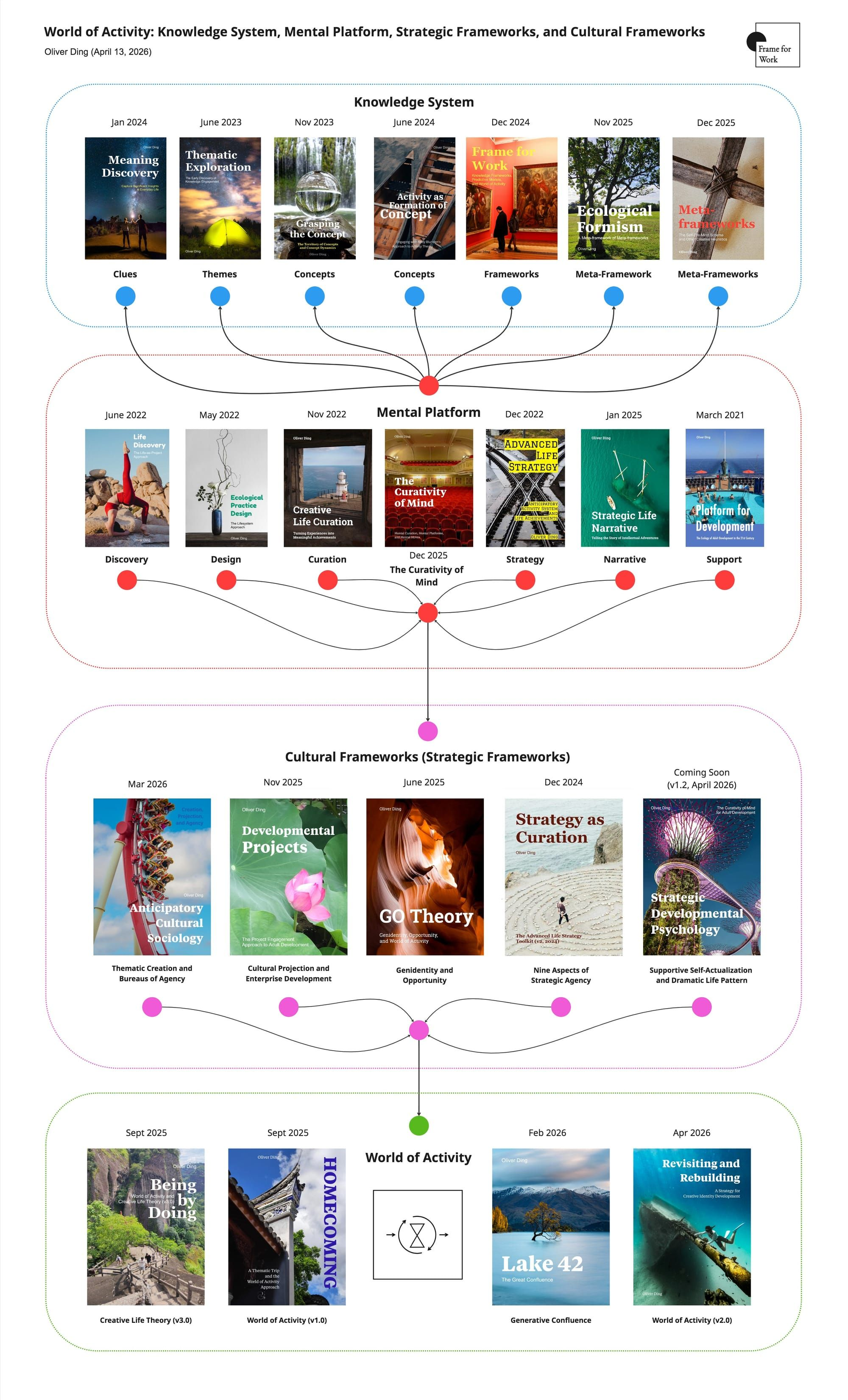
The framework also maps the development of the knowledge enterprise across four interconnected layers:
- Layer 1: The Knowledge System — the foundational exploration from Clues to Meta-Frameworks (2023–2025)
- Layer 2: The Mental Platform — built on the insight that the essence of mind is mental curation
- Layer 3: Cultural Frameworks and Strategic Frameworks — where two faces meet, reflected in the symmetry between ACS (collective scale) and SDP (individual scale)
- Layer 4: The World of Activity — the ontological foundation, organized around the FFCC Schema (Flow, Focus, Center, Circle)
These four layers are more than an organizational structure. They also illustrate a knowledge value chain in action: from raw thematic materials (Layer 1) to personal cognitive infrastructure (Layer 2) to frameworks that engage with external contexts (Layer 3) — all grounded in an ontological foundation that provides coherence across the entire system (Layer 4).
The model has been applied in concrete settings. It supports ACS (Anticipatory Cultural Sociology) and SDP (Strategic Developmental Psychology) as a shared organizational structure, enabling theoretical work at different scales to be developed and coordinated under a common framework. It also provides the structural foundation for AAI (Activity Analysis & Intervention), supporting the development of signature developmental programs in practical contexts.
Taken together, the four layers demonstrate how a knowledge system can be organized — not as a flat collection of outputs, but as a multi-level structure where each layer builds on and extends the others — and how value is generated and delivered through the knowledge value chain.
More details can be found in The "Theme–Concept–Framework" Transformation (2023–2026).
5. Theoretical Enterprise
From: Wonder and Wander: Revealing the Evolving Knowledge Enterprise (2025)
A theorist is someone engaged in the development of a theoretical enterprise, whether within an established theoretical tradition or through the development of an independent knowledge system.
A theoretical enterprise is more than a theory understood as a static body of knowledge. It is an evolving thematic enterprise through which a theorist develops concepts, models, frameworks, methods, and related knowledge projects around a sustained area of inquiry. Theory is not simply something a theorist possesses or applies; it is something that develops through theoretical activity.
Introduced in the 2025 book draft Wonder and Wander, the Landscape of Theoretical Enterprise model (named the Theory as Enterprise framework in 2025) provides a way to understand the evolving structure of a theoretical enterprise through two components: a three-layer map describing the structure of an evolving thematic enterprise, and a four-level model, drawing on core concepts from the Ecological Practice Approach, to explain the dynamic complexity of an evolving knowledge enterprise.
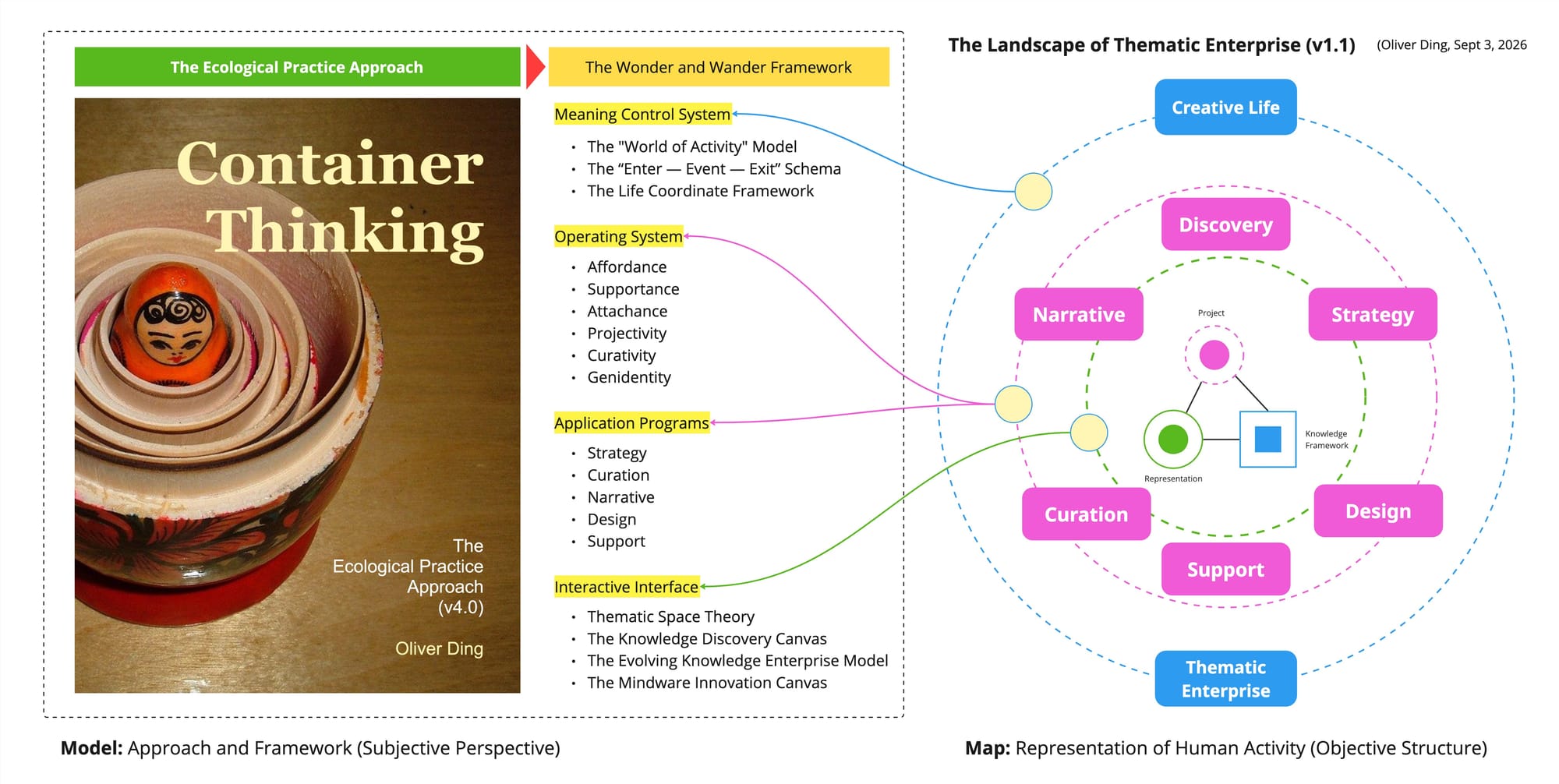
The Theoretical Enterprise framework — a new perspective that sees theory as an evolving theoretical enterprise, and the related model — illuminates two types of value for engaging within the knowledge ecology:
- Internal value — the enterprise functions as a developmental platform for its participants, offering diverse opportunities for action and contribution. These opportunities can be understood through six functional aspects of a theoretical enterprise: Discovery, Strategy, Design, Curation, Narrative, and Support.
- External value — the knowledge outcomes produced by the enterprise — concepts, frameworks, methods — become resources for others to use. These knowledge products can be appropriated into other theoretical activities and applied in practical settings. Examples include ACS and SDP sharing the Theme-Concept-Framework structure, and AAI applying it to develop signature developmental programs.
In this sense, a theoretical enterprise is not only a vehicle for generating knowledge; it is a platform that enables both the development of those who contribute to it and the application of its outputs to the wider world.
More details can be found in Wonder and Wander (book, v1.0, 2025).
v1.0 - August 26, 2026 - 1,808 words