Knowledge for Development: A Situational Map After Three Weeks in China
Case Study: World of Activity and Strategy
by Oliver Ding
August 26, 2026
On July 30, 2026, I came back to Houston after completing a three-week trip in China. In the following days, I entered the GAP Projects mode:
- After: a "Creative Life Curation" project: Reflecting on the trip and developing a creative theme into a plan for a new book
- Before: a "Creative Life Discovery" project: Exploring the situation and the future direction
I often use a diagram with a pre-made knowledge framework to curate creative elements for a Creative Life Discovery project. This kind of diagram is called a Situational Map. It is not a direct application of a knowledge framework, but a landscape inspired by the framework.
Last year, on August 4, 2025, I made one called Theoretical Companions of the World of Activity Approach, just after coming back from the trip to China. Details can be found in See the Move: Four Looks at the World of Activity Approach.
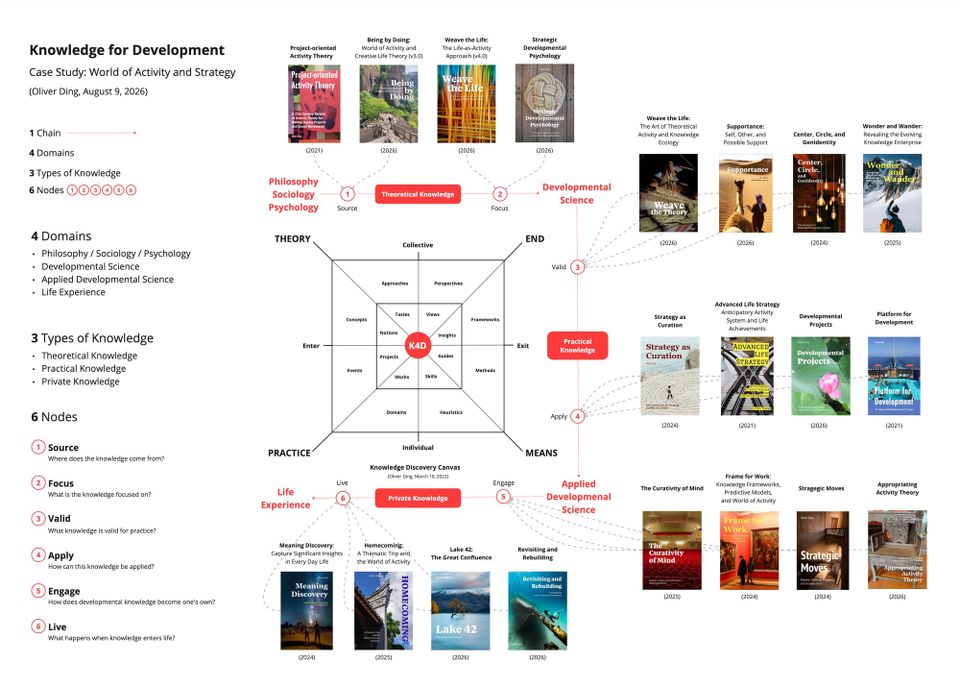
This year, I made a similar one, titled Knowledge for Development, with the subtitle Case Study: World of Activity and Strategy. See the diagram below.

It is the same pattern. One thematic trip led to a creative theme, which in turn led to a possible book. After completing the trip, I ran into GAP Projects, which adopted the situational mapping method for creative life discovery.
But this year, the new situational map tells a different story.
The Situation
In July 2026, I took a three-week trip to China. I traveled back with my children—from the U.S. to Fuzhou, then to Jianyang, and finally to Pengdun, a small village about 12 km from Jianyang where I grew up.
Last year, a similar trip led to a Kindle book: Homecoming: A Thematic Trip and the World of Activity Approach. This year's journey turned out to be unexpectedly interesting — it echoed last year's theme in a way I hadn't anticipated, and it gave birth to a sequel.
In Jianyang, I gathered with my cousins. Most of them left Pengdun years ago; their children are now scattered – some in Fuzhou, some in Japan, one heading to Vienna later this year. From Pengdun to Jianyang, from Jianyang to Fuzhou, from Fuzhou to overseas – a four‑generation migration pattern unfolded right there at the dinner table.
The next day, I visited my aunt and uncle, who still live in the old ancestral house – a Ming‑Qing building now marked as “historic architecture.” The house is nearly empty; only they remain. After saying goodbye, I walked down the lane I used to take to elementary school. The road was being paved with concrete; on both sides, new cement walls were rising, with an old earth wall still standing between them. I took a photo and stood there for a long time.
That image – two new walls like curtains, one old wall like a stage – became the core metaphor of the trip. Back in the U.S., I kept returning to it. A theme slowly emerged: Closure and Unfolding. My aunt and uncle’s world is closing; their descendants’ worlds are unfolding across continents. Two movements, happening at the same time.
On July 30, I came back to Houston. In the following days, the "Closure and Unfolding" theme evolved into a plan for a new book: Closure and Unfolding: The World of Activity Across Generations and Continents.
In my 2025 book Homecoming, I first introduced the World of Activity approach, and the FFCC model (flow-focus-center-circle), and used it to analyze my autobiography, generating several forms of World of Activity. This year, Closure and Unfolding takes it one step further, identifying a special form of World of Activity beyond the individual level.
But this journey was not only personal. It also marked a significant institutional shift.
On June 15, 2026, I mentioned a major transition in my neweletter: the Activity Analysis Center is moving from theoretical development to practical analysis.
To recap, the Center hosts two major theoretical enterprises:
- The Life-as-Activity Approach (including the Project Engagement Approach), now at v4.0.
- The World of Activity Approach, now operating within a nested structure: World of Life (World of Activity).
The release of three recent possible books — Weave the Life, Weave the Theory, and Appropriating Activity Theory — marked a milestone in my engagement with Activity Theory.
Since the Life-as-Activity Approach has reached v4.0, the future of the Activity Analysis Center will no longer focus primarily on theoretical development. Instead, it will shift toward testing the theoretical approach, empirical research, and intervention. This new direction was first named Activity Analysis & Intervention (AAI) in 2023. Now it becomes the operational core.
I've come to see this trip — this moment of return, of seeing my family's world close and unfold — as the Center's own "closing and unfolding": the chapter of theory is closing, while the chapter of practice is opening.
The Change
Before the trip, I started using the World of Activity v2.0 toolkit for case analysis. Each case was based on publicly available materials. I would begin by using the FFCC model to get a rough picture of an individual's World of Activity, then identify specific areas that warranted further exploration and bring in other knowledge models from the toolkit for deeper analysis. In some cases, the analysis ended up chaining together multiple models. The experience felt unique to me—I came to see that the analyst role would be a distinctive and important one in the future development of the World of Activity approach.
A few days before leaving for China, I had a conversation on WeChat with two friends. One of them was doing a career development analysis for the other. This friend had read my previous writings on the World of Activity and was using the FFCC model to analyze his client. He shared his insights with me, and we had some back-and-forth about his and his AI assistant's understanding of the FFCC model. Based on my feedback, he continued to update his analysis and shared his client's latest responses with me. Eventually, he introduced me to his client directly, and we had a three-way conversation on WeChat. Throughout this process, I kept sharing content from the World of Activity theoretical framework and explaining how to use the FFCC model.
During my stay in Fuzhou, I also had video calls with several friends in other cities, catching up on each other's progress and introducing the World of Activity approach to them. One friend in Hangzhou, after our call, decided to come back to Fuzhou—partly to visit his family, but also to meet me in person for a deeper conversation. Before we met, I designed a set of 12 cards as a prototype to showcase the World of Activity toolkit. When we finally sat down together, we explored how to disseminate the theoretical framework to the field of practice.
While in Fuzhou, I also wrote some notes and began drafting a lecture series called AAI: Twenty Lectures, completing the first lecture. As I did last year, I wrote in Chinese on a knowledge-sharing app called Xiaomiquan. The difference was that last year I finished writing all the Chinese draft materials for Homecoming while still in Fuzhou; this year, I only completed the first lecture, with the rest consisting of scattered notes. That first lecture, however, set the tone—I used a Confucian allusion as an entry point to introduce key concepts and frameworks from my theoretical system.
After returning to the U.S., I continued writing this twenty-lecture series in Chinese. This week, I finished the first six lectures, which cover the theoretical foundations.
The journey to China in July was the unfolding I had announced—the theoretical closure making way for practical engagement, played out not in abstract plans, but in real conversations, real case analyses, and real writing. The lectures, the toolkit, the exchanges with friends—all of it became the Center's opening chapter in practice.
The Framework
Back in the U.S., I found myself operating in two modes simultaneously. On one hand, I was in curation mode—organizing the scattered reflections from the trip, developing the "Closure and Unfolding" theme into a book proposal. On the other hand, I remained in discovery mode, continuing to think through the larger transition the Center was undergoing. As I mentioned at the beginning, I turned to a diagram to help me explore.
I opened an old document—a Knowledge Discovery Canvas (KDC) I had made a year ago, analyzing the knowledge value chain in applied behavioral science. The canvas traced how knowledge moves from basic theory to empirical research, and from empirical research to applied intervention. Around the main diagram, I had placed book covers representing relevant works. That early diagram later inspired a manuscript: Castle and Forest: The Landscape of Concept-related Knowledge Engagement (book, v2.0, 2025).
This time, I repurposed that canvas to explore how my own theoretical system could be extended into the field of practice. I changed the title to Knowledge for Development, and reorganized the four thematic zones as follows:
- Theory — philosophy / sociology / psychology
- End — developmental science
- Means — applied developmental science
- Practice — life experience
This reframing gave me an unexpected insight. I realized that my transdisciplinary approach—moving across philosophy, sociology, and psychology—could be oriented toward developmental science as a unifying direction. Particularly when the focus is on practice—analysis and intervention—this transdisciplinary stance becomes much more accessible and readily accepted. This repositioning resolved a long-standing identity tension I had felt between sociology and psychology.
Building on this framework, I identified three types of knowledge: theoretical knowledge, practical knowledge, and private knowledge. Between them, I mapped six key nodes:
- Source — where does the knowledge come from?
- Focus — what is the knowledge focused on?
- Valid — what knowledge is valid for practice?
- Apply — how can this knowledge be applied?
- Engage — how does developmental knowledge become one's own?
- Live — what happens when knowledge enters life?
With these nodes in place, I selected twenty book covers from my own published and unpublished manuscripts and distributed them across the six nodes. The path emerged clearly.

It is worth noting that the KDC framework offers many possible paths—I have written about this elsewhere. My map is simply an exploration of my own path. For years, I have focused primarily on the theoretical level, accumulating a substantial body of work. Given that history, the path traced by the current map is a natural fit for where I stand now.
The Path
Over the past several years, I have written more than fifty unpublished manuscripts—each one documenting a different phase of my theoretical exploration. For this mapping exercise, I selected twenty of them as a representative sample. The selection was not meant to be precise or exhaustive; rather, I used these book covers as visual anchors to organize my own thinking and trace the movement of my mental path.
The six nodes—Source, Focus, Valid, Apply, Engage, and Live—form a trajectory that moves from theoretical foundations toward practical engagement, and finally to the transformation of lived experience into shareable knowledge. Here is how the twenty manuscripts are distributed across them.
Source
At this node, I placed two books: Project-oriented Activity Theory (2021) and Being by Doing: World of Activity and Creative Life Theory (2025). These two works represent the theoretical roots of my entire framework. Behind them lie three foundational traditions:
- Activity Theory
- Ecological Psychology
- Theoretical Sociology (particularly Phenomenological Sociology)
They are the soil from which everything else has grown.
Focus
Here I placed two more recent manuscripts: Weave the Life: The Life-as-Activity Approach (2026) and Strategic Developmental Psychology (2026). Though my theoretical work is broadly applicable across domains, these two books reveal a clear personal orientation. My deepest interest lies in adult personal development—both intellectual and professional. These manuscripts, completed earlier this year, embody that focus and give direction to my theoretical efforts.
Valid
At this node, I placed four manuscripts that represent my empirical research efforts:
- Weave the Theory (2026), a collection of case studies applying the knowledge framework of the same name, including several cases drawn from Activity Theory;
- Supportance (2026), a compilation of years of work on the concept of "supportance" and its companion notion of "social environment," documented through multiple case studies;
- Center, Circle, and Genidentity (2024), a summary of case analyses conducted between 2022 and 2024 through the operation of several Knowledge Centers, which laid the early groundwork for the center-circle concepts in the FFCC model;
- Wonder and Wander (2025), a large-scale case study employing historical-cognitive research methods to examine my own creative process over many years, revealing recurring themes across a timespan of several years.
Taken together, these four books demonstrate that my theoretical constructs are not merely abstract—they have been tested, refined, and grounded in empirical inquiry.
Apply
Here I also selected four manuscripts:
- Strategy as Curation: The Advanced Life Strategy Toolkit v2.0 (2024)
- Advanced Life Strategy: Anticipatory Activity System and Achievement (2022)
- Developmental Projects: The Project Engagement Approach for Adult Development (2025)
- Platform for Development: The Ecology of Adult Development in the 21st Century (2021).
These works translate theoretical concepts and knowledge frameworks into practical tools for personal development, strategic planning, project engagement, and platform building. They reflect my stated preference for strategic operation in adult personal development—moving from insight to application, from understanding to doing.
Engage
At this node, I placed four manuscripts that share a common concern: how individuals develop their own knowledge frameworks for strategic purposes, and how they engage with theoretical traditions in meaningful ways. These are:
- The Curativity of Mind: Mental Curation, Mental Platforms, and Mental Moves (2025)
- Frame for Work: Knowledge Frameworks, Predictive Models, and World of Activity (2024)
- Strategic Moves: Mapping Knowledge Engagement and Strategic Choices (2024)
- Appropriating Activity Theory: A Decade of Engaging with a Century-Old Tradition (2026)
Together, they explore the processes through which one not only adopts existing theories but actively appropriates, adapts, and integrates them into personal frameworks. They ask: How does a thinker make a theoretical tradition their own? How does one build a mental platform that supports ongoing strategic development? And what does it mean to move from engagement with ideas to ownership of a living framework?
Live
This node is particularly special. It emphasizes how individual subjective experience can be distilled into creative themes, developed into creative works, and ultimately presented as shareable knowledge models or dramatic life patterns. Here I placed four manuscripts:
- Meaning Discovery: Capture Significant Insights in Everyday Life (2024), the third installment of my "Discovery" trilogy, which presents a model of discovery along with a methodology covering awareness, note-taking, mental curation, project operation, and manuscript writing;
- Homecoming: A Thematic Trip and the World of Activity Approach (2025), which marked the beginning of empirical research within the World of Activity approach and was also an application of the historical-cognitive research method;
- Lake 42: The Great Confluence (2026), which documents a six-month period of theoretical exploration through eight movements, following three traditions that converged into a new creative center
- Revisiting and Rebuilding: A Strategy for Creative Identity Development (2026), which uses the historical-cognitive method to document a dramatic life pattern I identified.
Taken together, these four works demonstrate how qualitative research methods can be used to reflect on and study individual life experience, transforming it into a source of knowledge innovation.
Looking at the distribution of these twenty manuscripts across the six nodes, a clear trajectory emerges. The path moves from theoretical roots (Source), through a personal orientation (Focus), into empirical grounding (Valid), toward practical application (Apply), then to active appropriation and framework-building (Engage), and finally arrives at the transformation of lived experience into shareable knowledge (Live). It is, in effect, a map of my own intellectual development—from theory to practice, from external tradition to personal ownership, from abstract knowledge to embodied wisdom.
This, I realized, is not just a path of knowledge engagement. It is a path of mental moves—a record of how my thinking has traveled, node by node, over the years.
The Reflection
When I titled the diagram Knowledge for Development, with the subtitle Case Study: World of Activity and Strategy, I was already gesturing toward what had become the central concern of this period: the transition from theoretical development to practical analysis—what I had been calling Activity Analysis & Intervention (AAI).
That mapping exercise, as it turned out, was not an isolated act of reflection. It became the seed of something larger.
On August 16, I wrote an article titled Activity Analysis & Intervention (AAI) 2026, looking back at the original 2023 version of the AAI program and proposing five principles to upgrade it into a meta-framework. The article was structured as follows:
- From Program to Meta-framework
- Principle 1: The Agency Cascade Principle
- Principle 2: The Knowledge for Development Principle
- Principle 3: The Supportive Self-Actualization Principle
- Principle 4: The Project Engagement Principle
- Principle 5: The Weave-the-Knowledge Principle
- Case Study: Supportive Life Discovery (v2.0) — The Mid-life Curation Edition
- Case Study: Cognitive Hydrology Pedagogy (v1.0)
- Calling a Toolkit
The Knowledge for Development principle, in particular, was born directly from the mapping work—from the act of selecting twenty book covers and tracing their movement across the six nodes. The map gave the principle its shape; the principle gave the map its theoretical weight.
As I reflected on this evolution, I found myself returning to a diagram I had made earlier this year—one I had never shared publicly until now.
On February 12, 2026, I created a diagram titled The Landscape of Creative Life Theory. At the time, I was organizing my manuscripts to show the full panorama of Creative Life Theory v3.0. Looking back now, that diagram was not merely a catalogue of books. It was a record of a discovery: Creative Life Theory had grown from a theoretical framework into a complete theory-practice system—one that had generated its own methodological ecosystem and produced rich cycles of objectification and subjectification.
The main part of the diagram was organized as a 3×4 grid. The three columns, anchored on the sign of Creative Life Theory, moved from inner to outer:
- The Work — the foundational actions and operations of knowledge work and creative work.
- The Enterprise — the organizational forms of knowledge enterprises and thematic enterprises: projects, platforms, strategic narratives, epistemological meta-frameworks, and more.
- The World — the ecology: works like Castle and Forest (on knowledge ecologies), Being by Doing, and meta-frameworks that situate the theory in a larger context.
The four rows, from top to bottom, traced a progression of engagement:
- Knowledge Engagement — specific exploration
- Creative Engagement — general reflection
- Weave the Culture — methods in practice
- Weave the Mind — methods in practice

From these methods-in-practice layers, three extensions emerged, each branching into a cluster of works:
- Meta-frameworks and The Curativity of Mind led to Concept Creation (Case Study) — a cluster of three books representing subjectification.
- Creative Diagramming led to Creative Cartography (Thematic Mapping) — a cluster of three books positioned between subjectification and objectification.
- Creative Life Curation led to Creative Life Footbook (Narrative Text) — a cluster of three books created through the application of the Creative Life Curation method.
What struck me most about this diagram was that half of it was dedicated not to theoretical propositions, but to methodology. The diagram showed, in concrete terms, that Creative Life Theory had produced a rich methodological ecosystem—one that had already generated numerous concrete works across different formats: concepts, diagrams, maps, narratives, and case studies. This was not a theory waiting to be tested. It was a theory that had already been validated through repeated practice.
This, I realized, was what made Creative Life Theory stand out among my various theoretical systems. It was not the most ambitious theory, but it was the one with the most mature theory-practice pathway—a complete cycle from concept to method to practice to outcome to reflection and back to revised theory.
But between February and August, something shifted.
In the second half of 2025 and into 2026, I began expanding my focus from knowledge engagement to cultural development more broadly—moving beyond the specific context of intellectual creators toward a more general understanding of creators and cultural actors. This expansion demanded a larger frame.
That is where the August diagram came in. It was no longer a map of Creative Life Theory's internal landscape. It was a map of how theoretical knowledge moves into practice and life—a knowledge development architecture.
The August diagram asked a fundamentally different question: How does knowledge move from theory into developmental practice?
It introduced four domains (Philosophy/Sociology/Psychology → Developmental Science → Applied Developmental Science → Life Experience), three types of knowledge (Theoretical, Practical, Private), and six transformation nodes (Source, Focus, Valid, Apply, Engage, Live). Creative Life Theory was no longer the center of the map; it had become one mature knowledge source among others, feeding into a larger developmental framework.
Looking at these two diagrams side by side, I now see a clear trajectory.
February's diagram was about theory maturity: Which of my theoretical systems has actually developed a complete theory-practice cycle? The answer was Creative Life Theory—and the diagram itself provided the evidence, with half of its landscape dedicated to methodology and concrete outcomes.
August's diagram was about knowledge transfer: Given that I have mature theoretical knowledge, how does it become practical knowledge for development?
The first was a view from inside the theory. The second was a view from outside—observing how theoretical knowledge crosses into the world of practice.
Together, they trace the path I have been walking: from building theories, to validating them through method and practice, to asking how they can serve development in a broader field. And at the center of that path, connecting both diagrams, stands Being by Doing—a work that began as part of the theoretical ecology and has become an interface between theory and practice.
The Challenge
The Challenge
During my stay in Fuzhou, when my friend from Hangzhou came back to meet me, he shared his recent career journey. We tried to make sense of it using the World of Activity framework. The preliminary insight was striking: he was in a state of relationfield shifting. His center remained unchanged—the core creative capacity he had developed over many years still worked well. What had shifted was the relationfield around it. The subject-subject relationships within his relationfield had transformed from high-trust internal collaborations to external market-based transactions. And this shift was posing real challenges to how his center could operate.
As soon as I saw this pattern in my friend's situation, I recognized it in my own. Even then, in July, I could see that the move from Creative Life Theory to AAI was not just a change of content—it was a change of relational structure. In the Creative Life Theory phase, my relationfield had been simple: a subject-object relationship between myself and the theory—concepts, models, frameworks, diagrams, manuscripts. But AAI operates in a different structure. It involves a tripartite subject configuration: Theorist – Analyst – Actor. This is no longer a solitary engagement with ideas. It is a collaborative field in which knowledge moves between subjects, not just between a subject and an object.
July was when the transition took shape as social moves—the conversations with friends across different cities, the shared analysis, the exchange of insights, the face-to-face meeting with my Hangzhou friend, the design of the toolkit. These were concrete acts of engagement with people, testing and applying the framework in real relational contexts. The transition from theory to practice was already happening, and it was happening through people.
When I returned to Houston, the focus shifted. In August, I stepped back and began to think about the transition at a more abstract level. The diagram I drew was not a map of social interactions; it was a map of mental moves—the internal path of thinking that had been set in motion by those social encounters, traced and given structural form on paper. Where July had been about engaging with people, August was about engaging with concepts: tracing the trajectory my mind had been following as it moved from theory toward practice.
The diagram did not reveal a new path; it rendered legible a path that was already being walked. It showed me, in structural terms, the shape of my own relationfield shifting.
Looking back now, I see the full arc. The social moves—the conversations with friends across different cities, the shared analysis, the exchange of insights, the design of the toolkit—were concrete engagements with people, where the framework was tested and applied in real relational contexts. The mental moves—the mapping, the structuring, the drawing of a diagram—were engagements with concepts, tracing the trajectory of thinking that had been set in motion and giving it structural form on paper.
They are not separate phases. They are two aspects of the same transition—one unfolding through people and relationships, the other through concepts and frameworks. Sometimes the social moves lead; sometimes the mental moves lead; often they move together, each feeding the other.
Together, they trace the movement from theory to practice: not as a single step, but as a dynamic interplay between acting in the world and thinking about that action—between engaging with others and engaging with ideas.
v1.0 - August 26, 2026 - 4,294 words