
AAI in Context: When Psychotherapy meets Qualitative Sociology
Using the ECHO Way to explore the knowledge niche of the Activity Analysis & Intervention (AAI) project
by Oliver Ding
August 25, 2026
The Activity Analysis Center hosts two major theoretical enterprises: the Life-as-Activity Approach (including the Project Engagement Approach) and the World of Activity Approach. In April 2026, the Life-as-Activity Approach reached v4.0, and the Center's focus shifted from theoretical development toward empirical research and intervention. This new direction was named Activity Analysis & Intervention (AAI) in 2023.
But where does AAI stand in the broader landscape of knowledge? It is neither psychotherapy nor qualitative sociology—yet it learns from both. AAI draws on psychotherapy's attention to the development of a person, and on qualitative sociology's analysis of subjective meaning within social life, as complementary theoretical resources. Yet AAI's own focus is entirely its own: the world of activity, creative life, and strategic development. It does not reproduce the concerns of its neighboring disciplines, but builds its own frameworks for understanding and intervening in human activity.
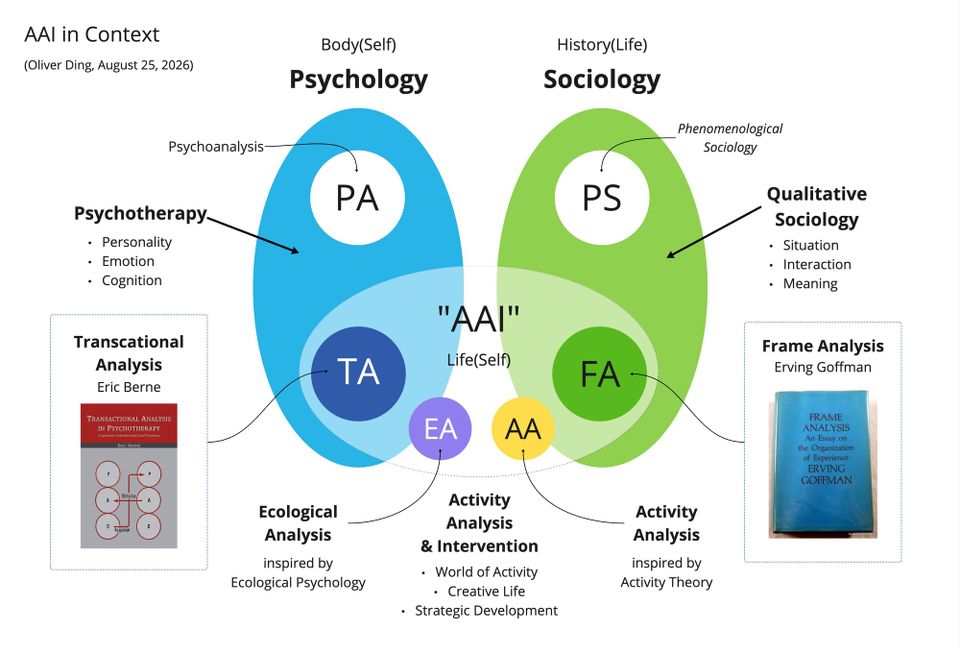
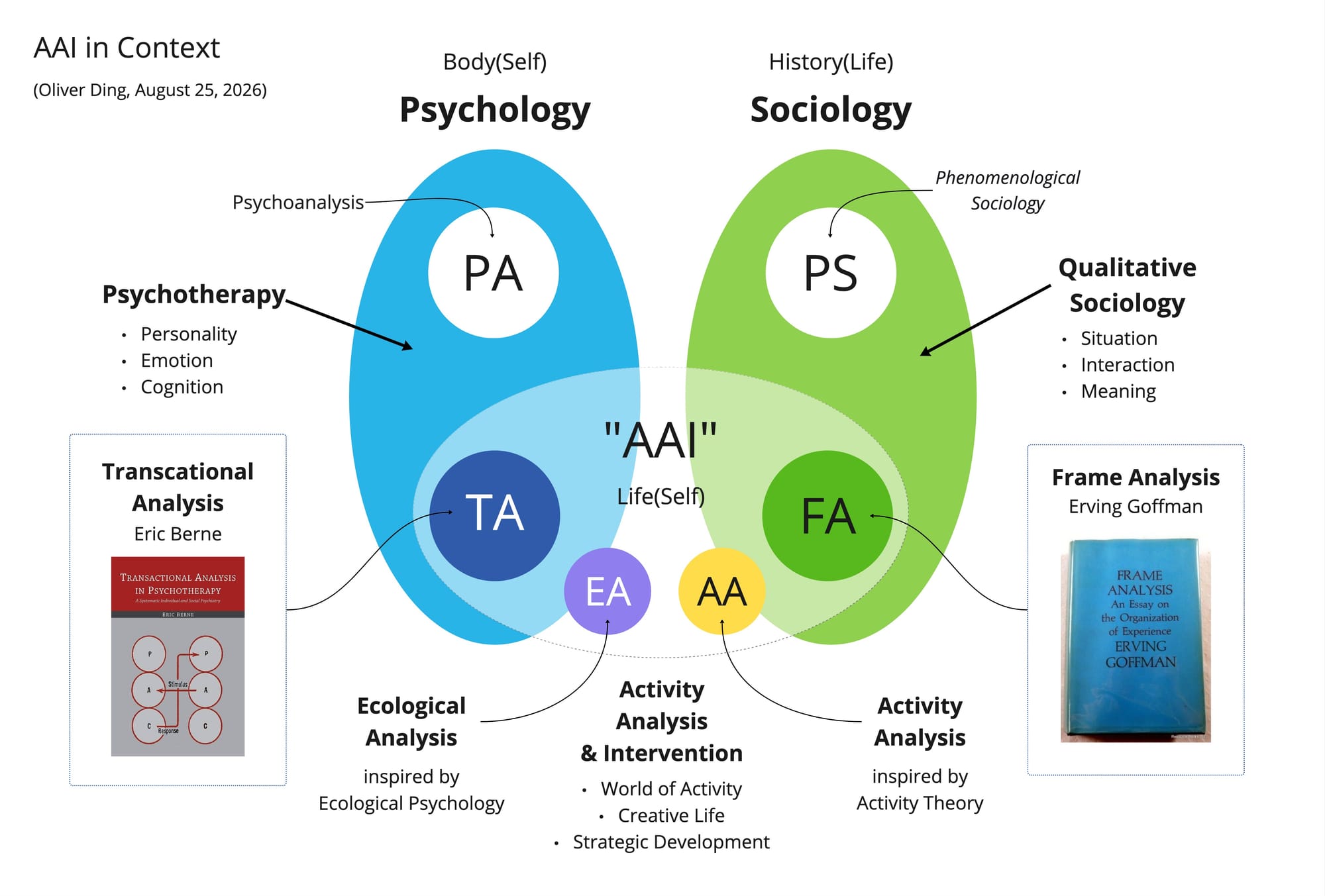
Ten days ago, I released the AAI (2026) Framework, introducing five principles for developing a supportive developmental program. Over the past several days, I have been reflecting on how AAI relates to various practical and academic fields. Today, I use the ECHO Way—a framework for guiding research, design, and development—to visualize these relationships in a diagram titled "AAI in Context." This article introduces the diagram and the thinking behind it.
1. The Unfolding of Subjectivity
In December 2025, I completed a book manuscript titled Meta-frameworks, in which I introduced the nested framework History (Life [ Body (Self) ] ) . This model uses a nested structure to show how subjectivity unfolds from the foundational unit of embodied cognition—Body (Self) —through the intermediate layer of Life (Self) where one actively lives out the self, and extends outward to History (Life) where one becomes an actor embedded in historical and cultural contexts. This framework has since become the ontological foundation for many of my theoretical systems.
In the present exploration, I use the ECHO Way—with its three-container model—to re-present this nested framework. The three containers now map onto the three layers as follows:
- Left Container (Psychology / Psychotherapy) → Body (Self)
- Center Container (AAI) → Life (Self)
- Right Container (Qualitative Sociology) → History (Life)
This three-container configuration places AAI at the very center of the unfolding of subjectivity—not as a synthesis of the two sides, but as an independent analytical layer that attends to the concrete activities through which a person lives out the self, between the embodied interior and the historical exterior.
2. The ECHO Zone as a Thematic Space
In the ECHO Way model, the center container—the ECHO Zone—is a thematic space: a dynamic container for developing ideas. What does this mean in practice? A thematic space is not defined by disciplinary boundaries, but by the creative questions and concerns that a thinker brings to it. Different elements—theories, methods, inspirations, and referents—can be placed within the same thematic space, and their configuration shifts as the thinker's focus evolves.
This section examines how the ECHO Zone works by comparing two configurations: the "Creative Life" thematic space in 2023 and the "AAI" thematic space in 2026.
The 2023 Configuration: Creative Life
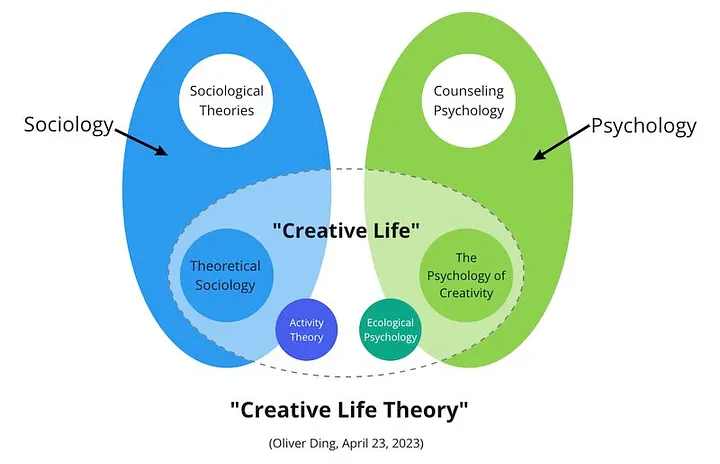
In April 2023, I used the ECHO Way model to develop the Creative Life Theory project. At that time, my focus was on a potential space connecting sociology and psychology—yet I was not working directly on sociological theories or counseling psychology. Instead, I named the ECHO Zone "Creative Life" and placed four theoretical traditions within it as equal and direct resources:
- The Psychology of Creativity
- Ecological Psychology
- Activity Theory
- Theoretical Sociology
Each of these four sources contributed directly to the development of Creative Life Theory. They were all theoretical resources of equal weight.
The 2026 Configuration: AAI
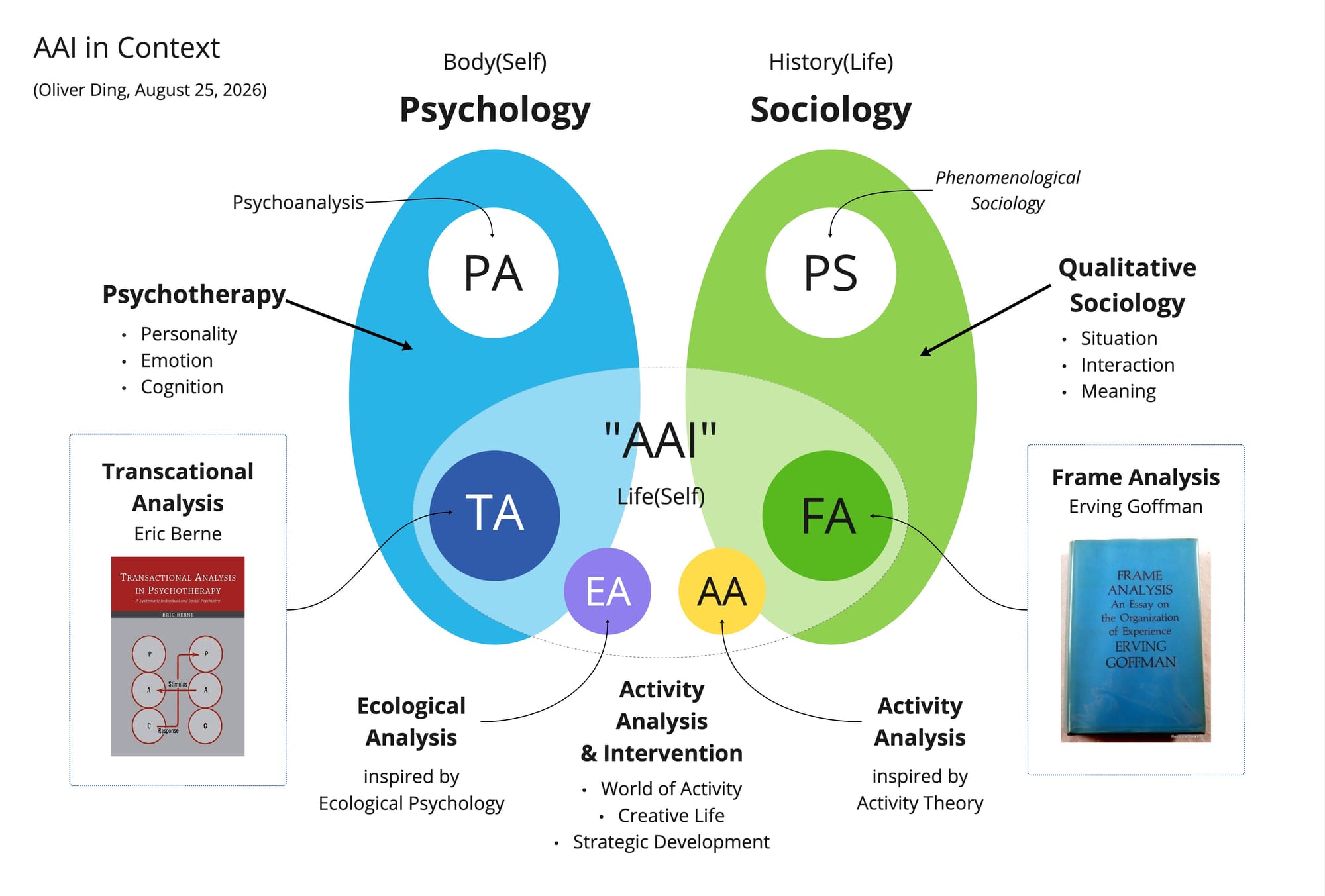
In 2026, I placed four creative elements within the ECHO Zone—now named "AAI" —but their configuration is fundamentally different:
- EA (Ecological Analysis) and AA (Activity Analysis) — internal knowledge body
- TA (Transactional Analysis) and FA (Frame Analysis) — emotional inspiration and niche reference
Unlike the 2023 configuration, where all four sources were equal, the 2026 configuration divides the four elements into two distinct groups. EA and AA refer to a series of knowledge frameworks I have developed over the past years, grounded primarily in Ecological Psychology and Activity Theory. TA and FA, however, do not directly contribute to my theoretical development; I have not followed these two approaches to develop related models further.
What TA and FA Inspired
TA (Transactional Analysis) and its author Eric Berne inspired me in two ways. First, Berne's diagrammatic approach—his ability to represent theoretical ideas visually and apply them in practical contexts—simply attracted me. Second, Berne's detachment from the old psychoanalytic camp and his establishment of an independent theoretical tradition marked him as a knowledge hero in my own personal archive of creative life.
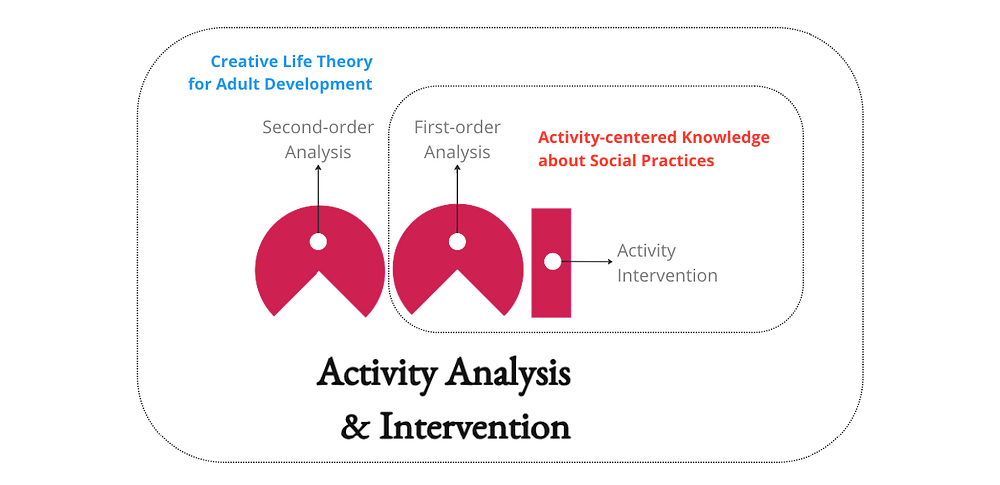
Before launching the AAI project in 2023, I had not used the term "Activity Analysis" as a unique theoretical concept—it was simply a name for a knowledge center dedicated to Activity Theory and related approaches. However, the 2023 version of AAI introduced the idea of "First-order Analysis / Second-order Analysis," transforming "Activity Analysis" from an ordinary name into a theoretical concept with its own methodological implications.
On October 11, 2023, I began to explore how this new method of Activity Analysis might take shape. What would it look like? I drew inspiration from Berne's Transactional Analysis—a psychoanalytic theory and therapeutic method that involves analyzing social interactions ("transactions") to identify the communicator's ego state (parent-like, childlike, or adult-like). For me, the new method of Activity Analysis meant a new approach to developing a person's tacit knowledge—about self, mind, life, and mindset—by systematically analyzing their activities.
Traditionally, Activity Theory has focused on understanding human activity and social practices, with less emphasis on individual adult development as a primary theoretical interest. By hosting the AAI program, the Activity Analysis Center creates a new avenue within the field of Activity Theory—one that opens a door to other knowledge centers dedicated to adult developmental processes, such as Creative Life Theory (hosted by CALL) and Curativity Theory. These frameworks are particularly useful when applied to Second-order Analysis within the AAI project.
FA (Frame Analysis) and its author Erving Goffman inspired me differently. Goffman's mastery lay in developing innovative sociological theories by watching real-life events and capturing information through a qualitative sociological approach.
On July 21, 2020—three years before AAI was formally named—I published an article titled Frame Analysis in Context and used it to develop a method called Ecological Interaction Analysis.
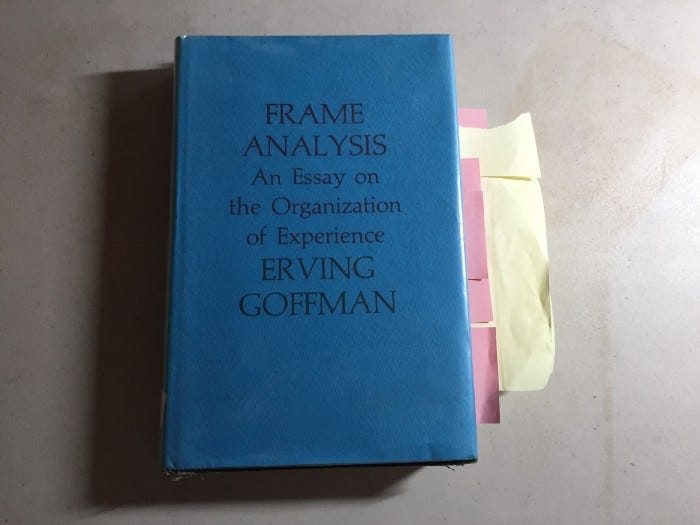
That article recorded my reading experience of Goffman's Frame Analysis (1974). Part I used photos to document my reading activity across three days; Part II developed the Ecological Interaction Analysis framework and used it to reflect on my reading experience; Part III adopted the 3I model to understand a new concept I coined—Quasi-social Interaction—for discussing my reading case.
In retrospect, this was an early case study of what would later become Activity Analysis. It was also a unique tribute to Erving Goffman.
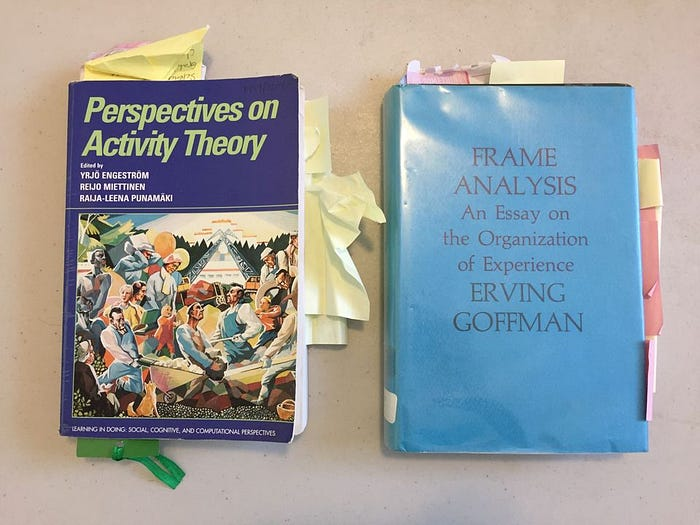
In 2022, when I launched the website for the Activity Analysis Center, I placed Perspectives on Activity Theory and Frame Analysis side by side and took a photograph.
On the "About" page, I wrote:
The name of the website is inspired by two books. The word “Activity” is adopted from Perspectives on Activity Theory while the word “Analysis” is inspired by Frame Analysis.
Activity: looking at human activities and social practices.
Analysis: linking theory and social research.
The website is designed for people who want to conduct studies of human activities and reflect on their own daily life world with theoretical perspectives.
The Dynamic Life of a Thematic Space
Years passed, and TA and FA have since taken on new meanings for me. They are no longer direct theoretical resources, nor are they methodological inputs. Instead, they serve as emotional support—reminders of what is possible when a thinker breaks from tradition (Berne) or builds theory from the ground up by observing real life (Goffman). They are niche referents that help me locate my own work in the broader intellectual landscape, offering inspiration rather than instruction.
This is how a thematic space works. Some elements are used in one way at one time, and later, as the thinker moves between projects, they take on new roles. The ECHO Zone is not a fixed container but a living field of creative engagement—one that evolves with the questions we bring to it.
3. The Left Container — Psychotherapy
The left container of the ECHO Way diagram represents Psychotherapy. Its core focus—personality, emotion, and cognition—has long been centered on the inner world of the individual. Yet, as I traced the historical development of this tradition, a clear trajectory emerged: psychotherapy has been moving, step by step, from the isolated individual mind toward relationship, and from there toward increasingly broader boundaries.
This trajectory is perhaps most visible within the psychoanalytic tradition. Beginning with Freud's drive model and his theory of the unconscious—rooted in biological and instinctual forces—psychoanalysis gradually expanded its horizons. The development from Freud to ego psychology marked a shift toward the adaptive functions of the self in relation to reality. Later, object relations theory moved the focus further outward, emphasizing how the self is shaped through early relationships with others, and how internalized patterns of relating continue to influence adult life.
Eric Berne's detachment from the old psychoanalytic camp and his founding of Transactional Analysis (TA) can be understood as a concrete manifestation of this larger historical movement. TA brought the relational focus into a more accessible, diagrammatic form—analyzing social interactions through the lens of ego states (Parent, Adult, Child) and offering a practical method for understanding how people communicate and relate.
In the left container, I have placed PA (Psychoanalysis) and TA (Transactional Analysis) as representational referents. They stand for the tradition of attending to the development of a person from the inside out.
However, in the ECHO Zone configuration, I placed EA (Ecological Analysis) alongside TA—not because they belong to the same tradition, but because EA carries the logic of the "outward movement" even further. While TA moves from the individual mind to interpersonal relationships, EA draws on Ecological Psychology—a tradition that takes the individual-environment whole as its basic unit of analysis. It does not treat the person and the environment as separate entities that interact; rather, it treats them as inherently coupled. Psychological phenomena, from this perspective, cannot be understood without analyzing the environment in which they are embedded.
I find this historical trajectory from the inner psyche toward relational and environmental contexts particularly striking—not because I followed it myself, but precisely because I did not.
My own intellectual journey moved in the opposite direction. I started with ecological psychology and spent years developing the Ecological Practice Approach, which centers on a set of concepts around potential action opportunities—affordance, supportance, and projectivity. This theoretical framework matured over time. Only recently, after the Ecological Practice Approach had reached a stable form, did I find the leisure to engage with psychoanalysis. And when I did, I encountered it almost as an exotic landscape—a foreign territory whose inner workings I had never explored firsthand.
In this sense, my learning path reversed the historical trajectory of psychotherapy. I began at its farthest frontier—where the individual and the environment are treated as a single analytical whole—and only later circled back to its early core: the inner world of drives, defenses, and unconscious processes. This reverse journey has given me a distinctive way of approaching the left container—not as a native practitioner, but as a traveler who arrived at its center from the outside.
4. The Right Container — Qualitative Sociology
The right container of the ECHO Way diagram represents Qualitative Sociology. Its core concerns—situation, interaction, and meaning—have long centered on how individuals and groups make sense of their social world, and how social order is produced and reproduced through everyday practices.
In this container, I have placed Phenomenological Sociology (PS) and Frame Analysis (FA) as representational referents. They were not chosen arbitrarily. They mark a journey—my journey—from the middle toward the right, and from there, much farther.
Frame Analysis: An Early Encounter
My first encounter with Frame Analysis came in 2018, during my early years of studying ecological psychology. I was reading Roger Barker's Behavior Settings—a foundational text of ecological psychology—when I came across a chapter that reviewed Behavior Settings alongside several adjacent theoretical traditions. One of them was Erving Goffman's Frame Analysis. The book was listed as a related work, and I followed the trail. At that time, I did not fully grasp its implications, but the concept of "frame" stayed with me—a way of understanding how people define what is going on in a situation, and how that definition organizes their actions and interpretations.
This was my first step toward the right container, though I did not know it yet.
The Turn to Theoretical Sociology
In 2022, while working on the Creative Life Theory project, I reached out to Prof. Lui Ping-keung, a theoretical sociologist based in Hong Kong. I became interested in his intellectual journey—how he developed his theoretical framework over decades, and how his work engaged with some of the deepest questions in social theory. What started as a research interest in his creative life gradually became an opportunity for deep learning. I studied his work closely, and eventually incorporated the core framework of his theoretical system—Subjectivist Structuralism—into my own theoretical vocabulary.
Prof. Lui is, at his roots, a phenomenological sociologist. His theoretical lineage traces back to Max Weber's interpretive sociology (Verstehende Soziologie) and Alfred Schütz's phenomenological sociology. Schütz, in turn, extended Weber's concern for subjective meaning into a rigorous phenomenological framework, examining how the life-world is constituted through everyday practices and intersubjective understanding. Prof. Lui's work deepens this tradition by engaging with structural questions—hence his signature framework, Subjectivist Structuralism, which bridges subjective experience and objective social structure.
Thus, the right container tells a story of a long journey—from behavior settings to frame analysis to phenomenological sociology and, finally, to theoretical sociology. I began with the ecological psychology tradition, moved through frame analysis, entered the terrain of subjective meaning, and eventually arrived at the most abstract and ambitious of these traditions through my engagement with Prof. Lui's Subjectivist Structuralism. The path took me far from where I started, yet each step was continuous.
A Note on Activity Analysis and Frame Analysis
Finally, in the ECHO Zone configuration, I placed AA (Activity Analysis) alongside FA (Frame Analysis) —not because they belong to the same tradition, but because AA, in its empirical methods, draws inspiration from activity theorists whose empirical research has been described by some scholars as a distinctive kind of organizational sociology.
The attention to how activities are organized, how they unfold in situ, and how they are shaped by institutional contexts—these concerns echo across the boundary between activity analysis and frame analysis. And yet, AA remains rooted in its own tradition, while FA stands as a referent from the right, offering a neighboring perspective.
5. AAI's Own Identity — EA, AA, and Three Foci
After traversing the left container and the right container—each with its own history, commitments, and theoretical lineage—we return to the center: AAI.
The center is not a synthesis of the two sides. It is not psychotherapy applied to social contexts, nor is it qualitative sociology turned inward toward the individual. It is its own knowledge domain, with its own analytical unit, its own theoretical grounding, and its own practical mission.
AAI's internal structure consists of two branches:
- AA (Activity Analysis) — corresponds to the Life-as-Activity approach. Inspired by the Activity Theory tradition, this system encompasses a series of knowledge frameworks I have developed over the years, spanning multiple levels of analysis and offering a rich toolkit for examining human activities in their various specific forms.
- EA (Ecological Analysis) — corresponds to the Ecological Practice approach. Inspired by Ecological Psychology, this approach centers on a family of concepts around potential action opportunities, with the concept of Supportance playing a central role, leading to a series of investigations into different types of social environments.
In 2026, AAI is developed as a meta-framework—a container that, in principle, can accommodate various theoretical systems and knowledge frameworks. However, at this stage, my immediate focus is on integrating my own three theoretical systems into the AAI framework, using it as a unifying structure to bring together the knowledge frameworks I have developed over the years.
The Unit of Analysis: Life (Self)
The analytical unit of AAI is Life (Self) —the intermediate layer that sits between the embodied interior of Body (Self) and the historical exterior of History (Life). AAI is anchored precisely at this middle layer: where a person actively lives out the self through concrete activities and engagements. It is on this ground that the three foci of AAI are built.
Building upon AA and EA, AAI's three foci are organized around the Life (Self) unit:
- World of Activity — seen from the individual's perspective, this is the world as they experience it through action. It refers to the largest scope of action an individual can take in the social world, understood primarily as the subjective experience of social life. The World of Activity is supported by a set of knowledge frameworks based on the FFCC Model, which describes the concrete forms of an individual's Life (Self) through four ecological forms: Flow, Focus, Center, and Circle.
- Creative Life — grounded in Creative Life Theory, this focus examines how an individual's world of activity unfolds and develops, particularly when creative activities are central. It explores how individual experiences develop into creative themes, and how creative projects develop into creative platforms.
- Strategic Development — drawing on Anticipatory Cultural Sociology and Strategic Developmental Psychology, this focus investigates how an individual's creative life and a group's thematic enterprise can navigate different faces of concept systems—shifting between cultural frameworks and strategic frameworks, enacting anticipatory activities, and driving cultural innovation.
This is what AAI is. It does not replicate the work of psychotherapy or qualitative sociology. It stands between them and beyond them—not as a bridge, but as its own territory.
Postscript: A Tiny Case Study
This article, titled "AAI in Context: When Psychotherapy Meets Qualitative Sociology," set out to explore the knowledge niche of the Activity Analysis & Intervention (AAI) project using the ECHO Way as a guiding framework — a practical framework for guiding research, design, and development in real-life contexts.
As a knowledge framework, it has three core components: diagrams, concepts, and methods. Its foundational structure consists of three interconnected models:
- Theme U — a diagram that organizes six themes in a U-shaped configuration, representing complex thematic relationships through spatial mediation. It is not merely about six fixed themes but about how thematic spaces relate to one another across contexts.
- Project I — inspired by the Developmental Project Model, this diagram serves as a container for curating multiple frameworks together. It provides a visual language for understanding how projects develop, operate, and generate outcomes across time.
- Container Z — the third container of a creative dialogue. It represents the ECHO Zone, a thematic space where different knowledge elements are brought together for reflection, innovation, and cross-disciplinary dialogue.
The core idea of the ECHO Way is the "fit" between the two sides of a creative tension—whether between psychology and sociology, between subjective experience and objective structure, or between individual development and social context. This "fit" occurs within what I call the Echozone, where new insights emerge from the convergence of diverse perspectives.
The ECHO Way has been applied across multiple domains, including Personal Innovation (Career-fit), Platform Innovation (Concept-fit), and Youth Development (Drama-fit). Its versatility lies in its ability to hold creative tensions and facilitate structured reflection.
In the Developmental Projects book, the ECHO Way is introduced in Part 6: Container Z, where it serves as the central framework for understanding Creative Dialogue as a key strategy in adult development. It integrates Theme U (Part 2), Project I (Part 4), and Container Z itself into a unified approach for navigating structural tensions, fostering individual agency, and supporting cognitive growth.
The present article demonstrates a specific application of the ECHO Way: using its three-container logic to map the knowledge niche of AAI. The ECHO Zone here contains four elements—TA, FA, EA, and AA—configured in a specific arrangement that reflects both theoretical grounding and personal intellectual history.
Moreover, a deeper trajectory emerges in the contrast between two configurations presented in the main text—one that is not explicitly stated but becomes visible when we look at them together.
In the 2023 configuration, psychology and sociology appeared as two equal fields —two distinct territories standing side by side, with "Creative Life" as the thematic space between them. In the 2026 configuration, however, they are no longer merely juxtaposed. They are organically connected by the nested framework:
History (Life [ Body (Self) ] )
Psychology now corresponds to Body (Self) —the foundational unit of embodied subjectivity. Qualitative sociology corresponds to History (Life) —the historical and cultural field in which subjectivity unfolds. AAI occupies the intermediate layer—Life (Self) —where a person actively lives out the self through concrete activities.
The difference between 2023 and 2026 indicates the major development of my theoretical enterprise. In 2023, I didn't development an approach to connect two disciplines. In 2026, the unfolding of subjectivity naturally frames these two together.
In this sense, the article itself serves as a tiny case study of AAI in action. It demonstrates how a model from the Developmental Project Toolkit can be used within an exploratory activity—not only to illuminate a theoretical configuration, but also to clarify how a knowledge framework relates to its neighboring disciplines over time. And when psychotherapy meets qualitative sociology, what emerges is not a merger, but a territory of one's own.
V1.0 - August 25, 2026 - 3,745 words