
The World of Life (World of Activity) Approach
by Oliver Ding
September 2, 2026
Hi, and welcome to the Activity Analysis Center, which is the meta-center of a network of knowledge centers.
GO Theory is an interdisciplinary theoretical platform for supporting my theoretical enterprises that are run by these knowledge centers.
Over the past several years, I worked on several theoretical enterprises, such as the Life-as-Activity Approach, the Ecological Practice Approach, Curativity Theory, Creative Life Theory, and Thematic Space Theory.
Inspired by creativity researcher Howard Gruber's idea of "Network of Enterprises," I used the "Knowledge Center" approach to manage this large knowledge system. Each knowledge center hosts one or two related theoretical approaches.
- Activity Analysis Center: the Life-as-Activity Approach, the World of Activity Approach, and the Activity Analysis & Intervention method.
- CALL (Creative Action Learning Lab): the Ecological Practice Approach and Creative Life Theory
- Curativity Center: Curativity Theory
- TALE (Thematic Analysis Learning Engagement): Thematic Space Theory
- Frame for Work: A theory about Knowledge Frameworks
Since September 2025, the Activity Analysis Center has been operating as a meta-center — not only developing its own theoretical work, but also supporting and hosting content from its sister theoretical enterprises.
However, in early 2026, I slowly shifted to the "Mental Platform" approach from the "Knowledge Center" approach. That "Mental Platform" was named GO Theory.
On This Page
- GO Theory: An Interdisciplinary Theoretical Platform
- The Five Theoretical Enterprises
- History: The Name
- History: The Approach
- Closing and Unfolding
- Foundational Mechanisms
- A New Unit of Synthesis
- Weave the Meaning
- Spatial Heuristics
- Quick Links
1. GO Theory: An Interdisciplinary Theoretical Platform
In the #14 issue (March 31, 2026), I started to use GO Theory to name a new theoretical platform to support these enterprises.
GO Theory is a short name for the World of Life (World of Activity) Approach which was initially introduced in December 2025, within Meta-frameworks.
This platform has its own knowledge ecosystem, built on a series of meta-frameworks completed between November 2025 and September 2026:
- Ontology: The History{Life[Self(Body)]} Framework (HLS Framework, v3.0, 2025) — the map of the social world, introduced in Meta-frameworks: Creative Heuristics for Individual and Social Development (book, v1.0, 2025), December 2025; The World of Activity Approach and the Coordinate–Center–Gejunction framework (book, v1.0, 2026), September 2026.
- Epistemology: The Ecological Formism Framework (v2.0, 2025) — the structure of knowledge systems, introduced in Ecological Formism (book, v1, 2025), November 2025; Thematic Space Theory — A foundational epistemological framework for how themes become concepts and how concept systems take shape across contexts, March 2025; Six Faces of the Concept System — An epistemological reflection on the concept system in the abstract: not six fixed types, but six faces across contexts, December 2025.
- Methodology: The LARGE Method (v3.0, 2026) — the meta-method governing all methods within the platform, February 2026; the notion of Developmental Functionalism - a methodological lens for constructing and selecting developmental concepts by their function in context, June 2026; the Activity Analysis & Intervention (AAI) method (2026) - a method for developing supportive programs, introduced in August 2026.
- Pedagogy: Cognitive Hydrology Pedagogy (v.1.0) — a pedagogical framework for thematic development and concept creation.
- Unit of Synthesis: The concept of Gejunction — a way of grasping a person's overall standing in the social world as a single, coherent configuration. Its four aspects—Thematic Spaces, Living Coordinates, Relationfields, and Weave-points—refer to four knowledge systems. It was introduced in Strategic Developmental Psychology (book, July 2026).
These meta-frameworks are not external scaffolding. They are the internal architecture of GO Theory itself — the ontological, epistemological, and methodological foundations on which several theoretical enterprises build.
2. The Five Theoretical Enterprises
On this platform, five theoretical enterprises operate, each occupying a distinct position within the World of Life:
- Life as Activity (including the Project Engagement Approach) — at the center, attending to the structure of activity itself, the operational language shared by all the other enterprises
- Anticipatory Cultural Sociology — at the Collectives boundary, attending to cultural development at the collective scale
- Strategic Developmental Psychology — at the Individuals boundary, attending to individual life development at the personal scale
- Cognitive Hydrology — at the Spirituality boundary, attending to the flow of ideas and meaning in creative life
- Platform Ecology — at the Science boundary, attending to the ecological and structural conditions of platform development
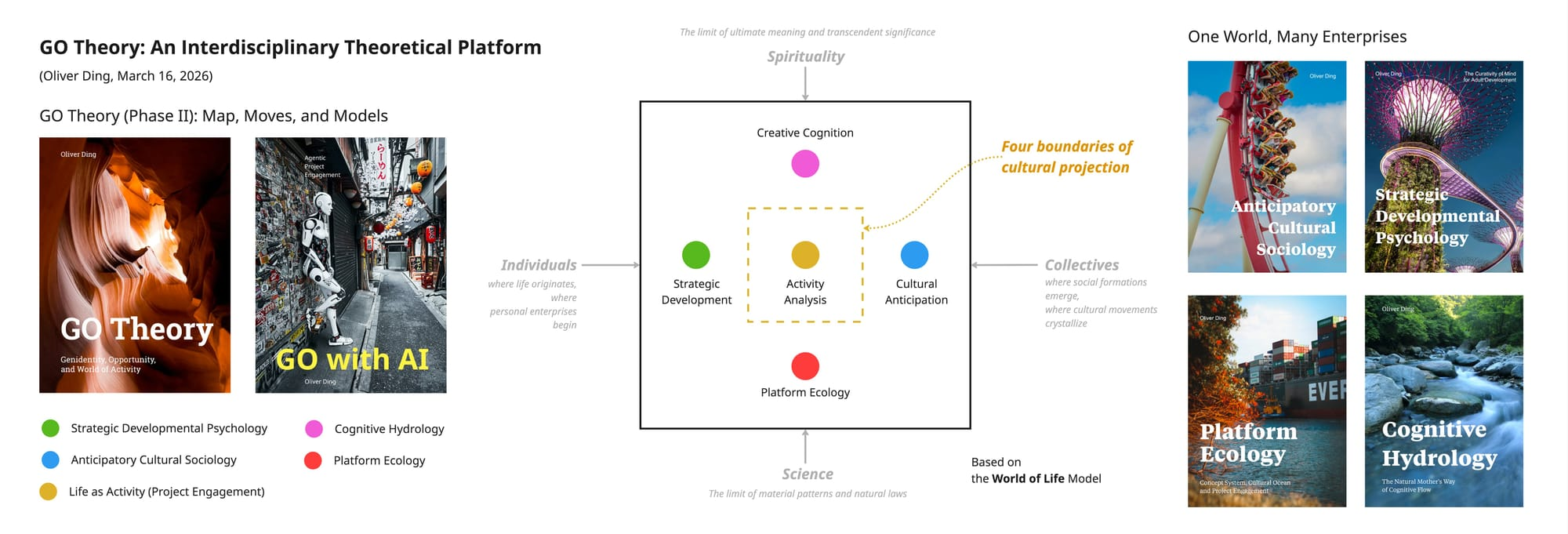
These five enterprises are equal. None is the foundation of the others. Each occupies a different position within the World of Life, which means each brings a genuinely different theoretical perspective. And because they share the same spatial foundation — the same map, the same boundaries, the same operating concepts — they naturally support one another, forming a network of enterprises rather than a hierarchy.
Newest updates can be found under the Z Lab/GO Theory category of the site.
3. History: The Name
The name "GO Theory" referred to several knowledge projects in the past several years.
The GO Theory (Phase I) was launched in October 2024 with three goals. At that time, the initials GO stand for Genidentity and Opportunity.
The first was to launch a book draft around the concept of Genidentity. The second was to run a creative dialogue between Creative Life Theory and the Ecological Practice Approach. The third — the most ambitious — was to move into the field of cultural development by building the Cultural Genidentity Framework. The ambition behind all three goals was the same: to broaden the scope of my theoretical work from individual life development toward Social Life Development.
In practice, the first half of 2025 unfolded differently than planned. Rather than pursuing these goals directly, I worked on them through Indirect Activity — developing adjacent projects whose by-products fed into GO Theory. The most significant outcome was the World of Activity toolkit, which included a systematic exploration of the dialectical relationship between Theme and Identity. These were genuine achievements. But they remained at the level of individual development. The third goal — entering the territory of cultural development — had not yet been reached.
On June 18, 2025, I curated these outcomes into GO Theory: Genidentity, Opportunity, and World of Activity (book, v1.0) and declared it Phase I. The subtitle names what had actually been accomplished: Genidentity, Opportunity, and World of Activity. Phase II — the move into cultural development — remained ahead.
On January 5, 2026, the Anticipatory Cultural Sociology (ACS) project was formally named. In the months since, the work has centered on deep exploration of the World of Life — including the landscape you are reading now.
I did not plan it this way. But looking back, it is now clear: ACS is actually Phase II of GO Theory. The third goal set in October 2024 — moving into cultural development — is now being pursued in earnest. The vocabulary is the same: Genidentity, Opportunity, World of Activity. But the container has expanded. The question is no longer only how a creative individual develops within their life course. It is how cultural enterprises develop within the World of Life.
On March 31, 2026, I decided to use GO Theory to name a new theoretical platform to support my enterprises.
And looking further still, a larger picture has come into view. GO Theory is not only the name for Phase II. It is the name for the theoretical platform itself — now carrying a fuller title:
GO Theory: The World of Life (World of Activity) Approach
The initials GO — originally standing for Genidentity and Opportunity, now expanded to Generation and Orientation — name the two directions that define the platform's theoretical character. Generation names the productive, emergent, forward-moving dimension of cultural and individual life: things are created, enterprises unfold, meaning accrues. Orientation names the positional, directional, sense-making dimension: actors are always somewhere, always facing some directions rather than others, always situated within a World of Life that both enables and limits — and always anticipating, projecting themselves toward futures that are not yet given but are already shaping present action.
4. History: The Approach
The World of Life (World of Activity) Approach was introduced in Meta-frameworks: Creative Heuristics for Individual and Social Development (book, v1.0, 2025) in December 2025.
In December 2025, I reviewed the development of the History{Life[Self(Body)]} Framework and the World of Activity Approach, then made a synthesis: expanding World of Activity to World of Life.
The journey of the HLS framework (v3.0) began as an ontological exploration and eventually evolved into a central node within a larger ecosystem of meta-frameworks. To represent this curated knowledge system as a meaningful whole, I term it:
World of Life (World of Activity)
In September 2025, I created a large diagram to present the landscape of the World of Activity Approach.
Based on the “Variant — Quasi-invariant — Invariant — Invariant Set” schema, I organize knowledge frameworks that are considered members of the World of Activity into a hierarchical system.
- Invariant / Basic Forms: 1 (World of Activity)
- Invariant Set / Frames: 1 (World of Life)
- Quasi-invariant / Derived Forms: 7
- Variant / Frameworks: 10 examples
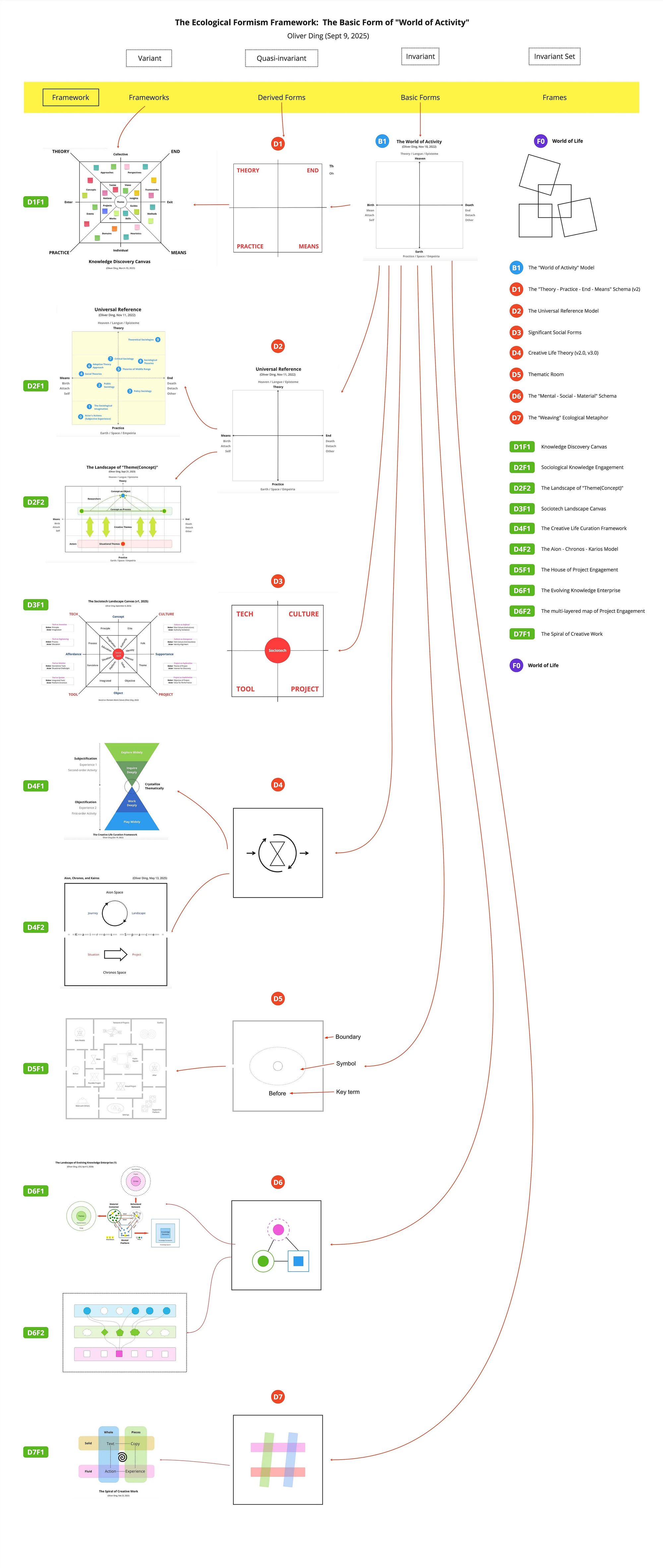
At that time, I considered the World of Activity as Invariant, with its corresponding Invariant Set named the World of Life. At that time, the World of Life referred primarily to the Circle of connected Centers, in other words, a network of interconnected Worlds of Activity.
From September 2025 to December 2025, a new set of knowledge framework emerged, offering a refined way to understand the social world. Reflection on the HLS framework revealed that this set could be called the World of Life Toolkit:
- HLS framework (v3.0) → Provides a five-system structure of the social world, including individual and social life.
- Weave-the-Culture Framework (2025) → Highlights four mechanisms of cultural development.
- Cultural Projection Model (2025) → Connects Mental Platforms and Cultural Frameworks via the Projecting mechanism and Developmental Projects.
- Function — Context — Knowledge — Activity Schema (2025) → Explores Mental Platforms and Mind within the Context (Mind) layer.
- Meta-Frameworks — in — Context Framework (2025) → Identifies six faces of concept system in the social world.
- Embodied Social Forms Framework (2025) → Connects body-scale experience with deep social cognition.
Together, these knowledge frameworks provide a way to zoom in on the details of the Social World while connecting micro-AAS and macro-AAS.
Within this system, the World of Activity toolkit primarily addresses the Life(Self) layer, whereas the World of Life encompasses broader layers, including History (Culture) and Context (Mind), highlighting the hierarchical and interconnected nature of the knowledge ecosystem.
The Body System, initially presented as the Ecological Basic Forms in my book draft Homecoming: A Thematic Trip and the World of Activity Approach, has now evolved into the Embodied Social Forms Framework, which will be introduced in a forthcoming book draft on Meta-Frameworks.
The developmental loop is now complete: beginning with the Body’s flow and the Self’s focus, moving through the Centers of our developmental projects and enterprises, we ultimately locate our activities within the Historical Circle. In this way, the World of Activity has been curated into the World of Life.
5. Closing and Unfolding
During the 2024 Christmas holiday, I had a reflective conversation with a mentor, revisiting my work on HELLO THEORY, GO Theory, and the Strategic Life Narrative project. Through this reflection, I realized my newest focus had shifted toward Cultural Life Development, marking a detachment from Individual Life Development. This strategic move was encapsulated in the theme of “Cultural Grounding/Cultural Growing.”
Over the past 12 months, while I worked on closing my multi-year journey of Knowledge Engagement and Individual Life Development — culminating in Creative Life Theory v3.1 — I simultaneously unfolded a new journey of Cultural Development.
The birth of the World of Life (World of Activity) approach marks a nexus-point where the act of Closing a rich history meets the act of Unfolding a new future.
In the end of the article titled The History{Life[Self(Body)]} Framework (v3.0) — Part 3: Reflection, I wrote:
As I move forward into the Cultural Development journey, the World of Life (World of Activity) approach will serve as my mental platform, while the Weave-the-Culture framework will guide the exploration of the four mechanisms of cultural development.
From January to July 2026, the World of Life model as a creative heuristic to run the ACS project and the SDP project. Eventually, some new ideas were born from the journey and returned to the theoretical platform itself, for example, the concept of Gejunction and the GO Square model.
6. Foundational Mechanisms
To further develop the World of Life toolkit, I launched the Anticipatory Cultural Sociology (ACS) project in January 2026. The five mechanisms of the World of Life — Mental Moves, Social Moves, Project Engagement, Strategic Curation, and Generative Narrative — were brought into the ACS project for testing. Established in the original landscape and applied in a growing body of case analyses, they remain the operational core of ACS: the five modes through which cultural development is actually enacted.
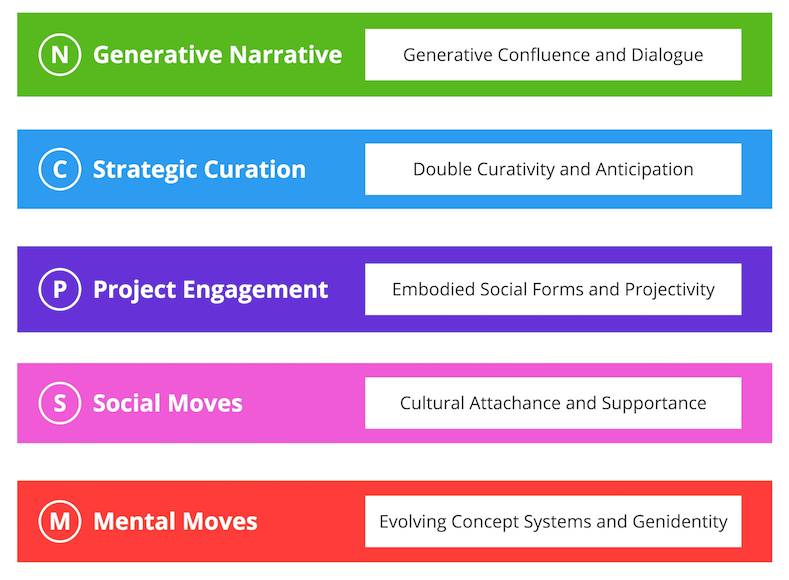
Strategic Curation is one of the five mechanisms of ACS v1.0 and, across the development from v1.0 to v2.0, the operative principle most consistently at work. Every major conceptual advance in this period involved an act of Strategic Curation: selecting, positioning, and integrating concepts into the ACS framework not through logical derivation but through structural recognition — finding which existing concepts fit which structural positions, and what new relationships emerge from their placement.
The most productive form of Strategic Curation in this period was the four-boundary curation: using the World of Life's four boundaries as a generative container, identifying one concept per boundary, and thereby bringing a coherent set of four structurally differentiated concepts into ACS at a single operation. Each concept inherits the orientation of its boundary — ecological and quasi-invariant near Science, trans-situational and belief-saturated near Spirituality, identity-related near Individuals, social and role-related near Collectives.
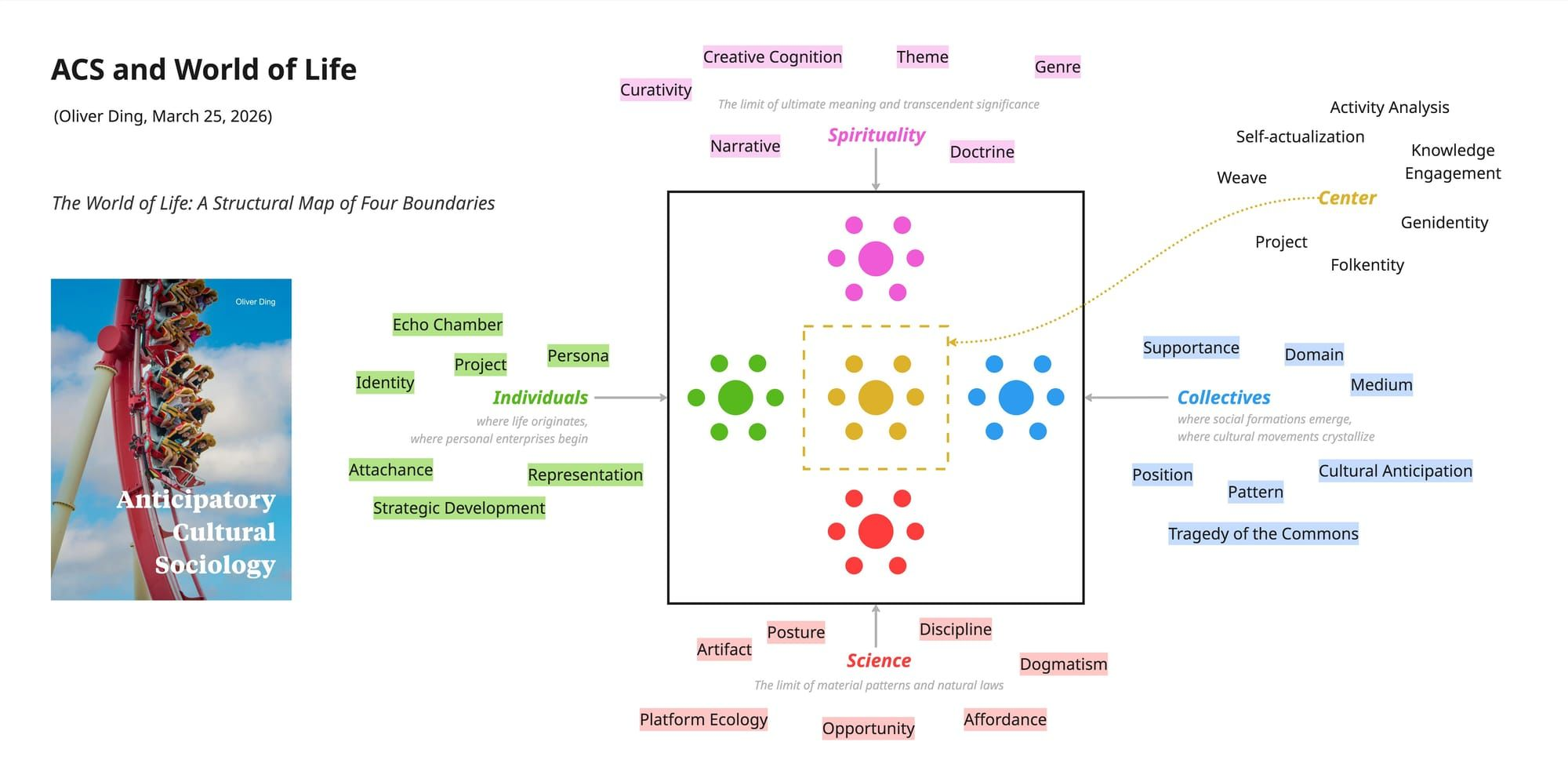
The result is not a collection but a system: four concepts that are structurally complete at the boundary level. This operation was repeated across the development of ACS v1.1, each repetition populating a different thematic domain with a new set of four concepts — Personal Orientation, Cognitive Container, Learning Landscape, and others.
The Double Square diagram, developed on February 7, 2026, extended this creative space further. Within the original World of Life square, a second, smaller square was drawn at the center to represent the Project — the primary unit of engagement in the Life-as-Activity approach. The space between the two squares became a new creative territory: the Boundary of Projection, the zone where individuals stand as they prepare to enter a project. Four positions in this intermediate region — one near each boundary — each inherit the orientation of the nearest boundary while remaining directed toward the project at the center. This structure is itself a spatial heuristic: it specifies what kind of concept belongs at each position, and the search through the existing conceptual archive for candidates that fit is guided by structural necessity rather than arbitrary choice.
The five mechanisms of ACS are not merely analytical tools applied to external cases. They are also the mechanisms through which ACS itself has been enacted. ACS studies cultural development — and ACS itself is a cultural innovation project. In this sense, the mechanisms have been tested: they were used to build the very framework that now uses them to analyze the world.
7. A New Unit of Synthesis
In June 2026, I introduced the concept of Gejunction as a Unit of Synthesis within GO Theory. It is not a unit obtained through decomposition and analysis. Rather, it is a unit constituted through the synthesis of multiple dimensions of social life.
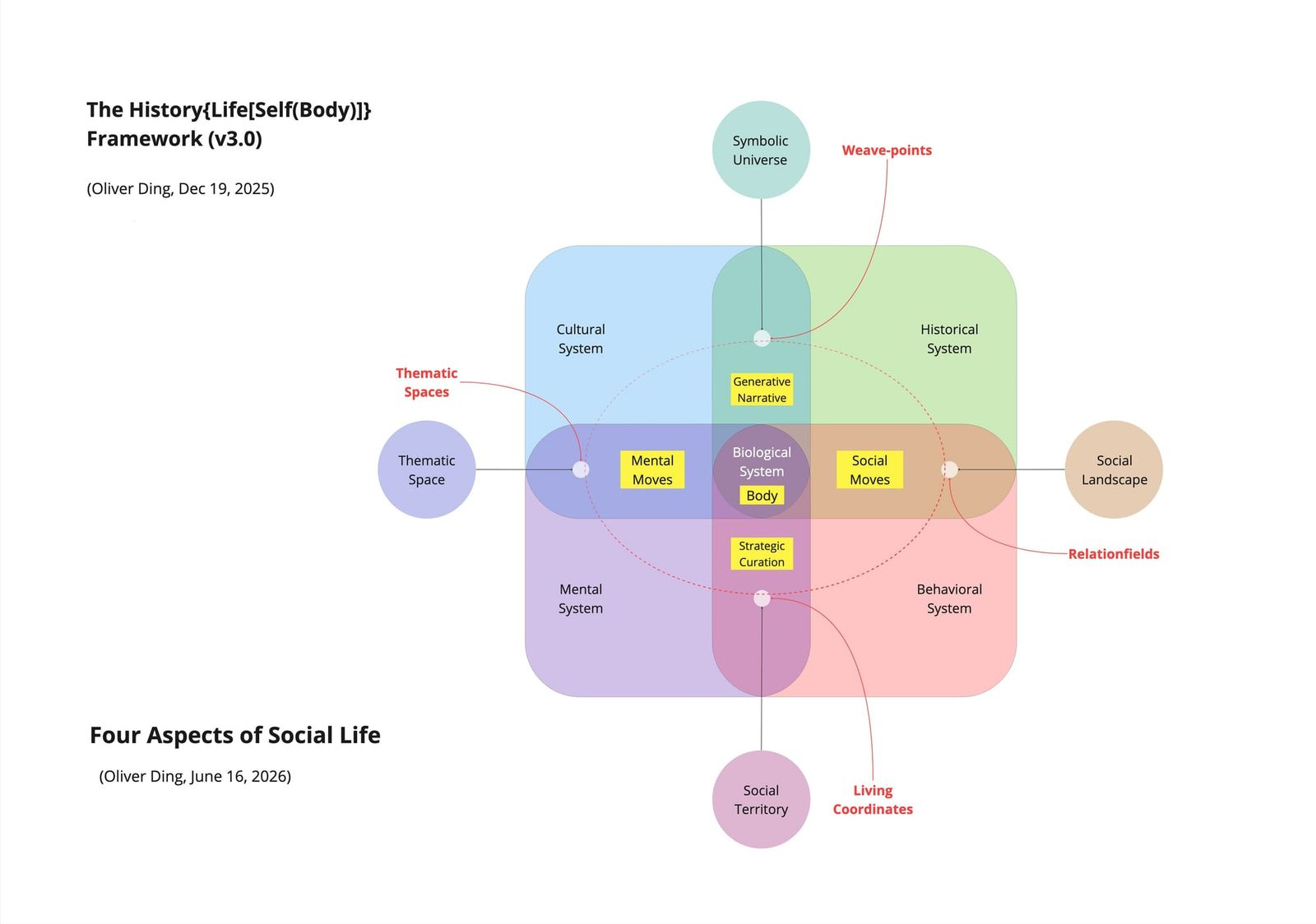
A Gejunction can be understood through four aspects.
- Thematic Spaces represent the thematic aspect. They reveal what a particular social life configuration is about and how attention, interest, and commitment become organized around a theme.
- Weave-points represent the symbolic aspect. They identify points where concepts, narratives, values, and meanings become woven together within a broader symbolic universe.
- RelationFields represent the relational aspect. They capture the intersubjective configurations through which people, resources, opportunities, and social environments are constituted.
- Living Coordinates represent the territorial aspect. They describe how a person becomes situated within a concrete life world.
These four aspects are not separate entities. They are four analytical perspectives on the same social unit.
This development also connects directly to the ACS project and the SDP project because it offers a systematic framework for addressing the issue of "weaving active agency and evolving structure."
For the ACS project, if concept systems and thematic enterprises are important units for understanding cultural development, then Gejunctions may be understood as the social units through which such development becomes possible. They are the sites where themes become lived, meanings become organized, relationships become constituted, and individuals become situated within the life world.
For the SDP project, the concept of Gejunction offers an ecological approach to the social environment of adult development. It connects to four types of action opportunities: Affordance, Curativity, Attachance, and Supportance, as shown in World of Life: Four Positive Frontiers of Project Engagement.
From this perspective, Gejunction is not simply another concept within GO Theory.
It is an attempt to identify the basic unit through which social life, cultural development, agency, and structure become woven together into a coherent whole.
It is a Unit of Synthesis.
8. Weave the Meaning
In April 2026, I introduced the GO Square Map as a new tool of GO Theory.
As mentioned in the #16 issue (April 30, 2026), I spent five days to explore the Weave knowledge system and Yinyang-Bagua knowledge system. During this exploration, a creative insight emerged: the formal logic of the Yinyang-Bagua (8 × 8 = 64 structural positions) could be productively engaged with the substantive content of my own theoretical framework. The question became: what eight fundamental elements, derived from GO Theory's ontology, could serve as the basis for such a matrix?
The answer was already present in the theoretical materials developed over the preceding years. The World of Activity defines four boundaries: Heaven (HE), Earth (EA), Birth (BI), and Death (DE). The World of Life defines another four boundaries: Collectives (CO), Individuals (IN), Spirituality (SP), and Science (SC). Together, these eight boundaries constitute the complete set of structural limits within which all human meaning-making activity unfolds. They are the eight basic concepts—the Eight Units—from which a 64-fold matrix can be generated.
The Weave model, with its synchronic-diachronic logic, provides the method for generating the matrix.
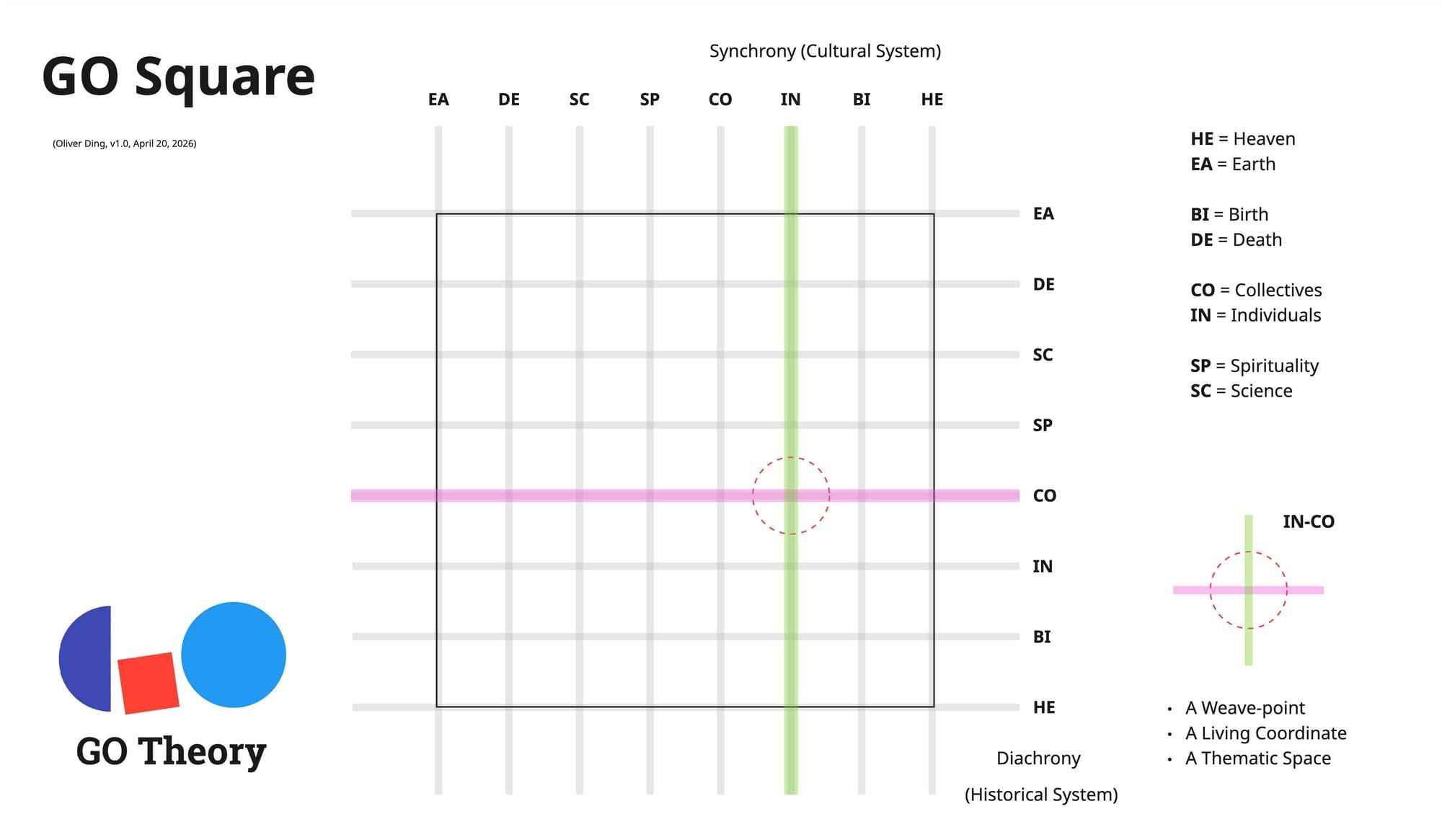
The outcome is the GO Square, a tool for mapping the Symbolic Universe.
In the second article about the GO Square, How to Navigate the Symbolic Universe: Three Principles of Spatial Heuristics, I introduce three principles of using the GO Square:
- Genidentity: Where is this concept system located?
- Attachance: How does it move between locations?
- Curativity: How does it form larger wholes with others?
The seven case studies demonstrated that navigation is possible. Each concept system—whether an academic methodology, a cultural theme, a philosophical revival, a doctrinal document, or a technological fantasy—could be located at a primary GO Coordinate. The diagnoses of Genidentity, the trajectories of Attachance, and the constellations of Curativity transformed isolated placements into a coherent method.
As discussed in the article, GO Square opens new possibilities for the history of concepts (Begriffsgeschichte) by adding spatial anchoring to semantic analysis. It also serves my own practice of Thematic Development Study. Beyond these, GO Square can support comparative intellectual history, science and technology studies, personal knowledge management, and educational design.
9. Spatial Heuristics
The development of GO Theory as an interdisciplinary theoretical platform inspired me to write the Spatial Heuristics series — a research project that takes GO Theory itself as its subject.
In January 2026, while writing the final chapter of Lake 42: The Great Confluence, I recognized a mirror symmetry between two newly established theoretical enterprises: Anticipatory Cultural Sociology (ACS) and Strategic Developmental Psychology (SDP). ACS attends to cultural life development at the collective scale; SDP attends to individual life development at the personal scale. The two enterprises are structurally symmetric — the same fundamental pattern, wearing different disciplinary clothing.
This recognition, documented in the "Setting the Enterprise" chapter of Lake 42, was more than a theoretical observation. It was a generative signal: if the pattern was this consistent, there must be a method operating beneath it. Something was generating these symmetric structures. The question was what.
From January to July 2026, I used the World of Life model as a creative heuristic to guide the ACS project and the SDP project. Throughout the period from January to February 2026, working on the ACS framework, I repeatedly found myself using the spatial construction of the World of Life model as a creative guide — placing concepts into structured positions, letting the spatial logic of a diagram call out to my conceptual archive, finding new insights not through logical derivation but through structural recognition. By the end of February, the pattern had a name: Spatial Heuristics.
Later, I started the Spatial Heuristics series to reflect on the development of GO Theory in 2026.
On September 1, 2026, I revisited the Network-Container-Platform model (see the diagram below) and recognized that my creative journey unpacked this model in the real world.
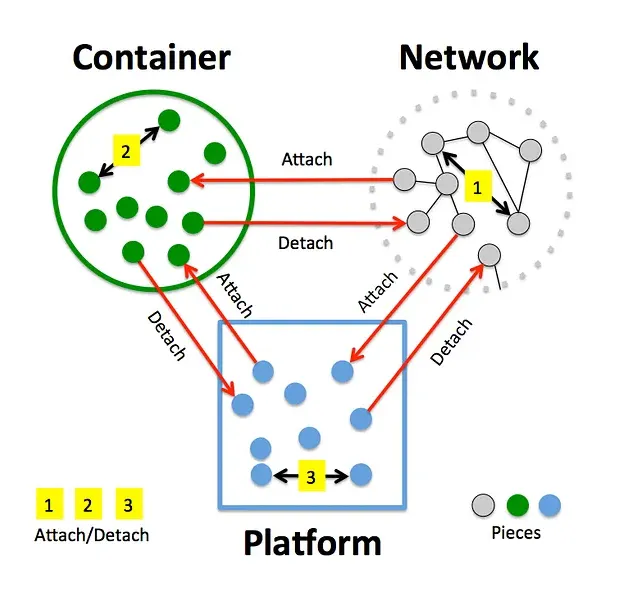
In the beginning, I ran CALL (Creative Action Learning Lab) as a studio for the knowledge curation project from 2020 to 2022; it was a Container. From 2022 to 2024, I ran a network of knowledge centers, which matched the "Network" status. In 2026, I am running GO Theory as a theoretical platform to support my several theoretical enterprises.
The "Spatial Heuristics" effort indicates a significant difference between the "Knowledge Center" approach and the "Mental Platform" approach.
The former operates as a network of loosely coupled centers — even with a meta-center, coordination remains loose by design. As documented in the 2024 book draft Center, Circle, and Genidentity, the case studies already revealed insights such as Indirect Activity, which showed how a network operates through its own logic.
The latter functions as a platform with an explicit design orientation, actively shaping and guiding the theoretical enterprises it hosts. The 2026 research project Spatial Heuristics demonstrates a different operational logic at work. Rather than emerging primarily from interaction among loosely coupled nodes, the platform operates through deliberate spatial configuration: boundaries, positions, symmetry, and relations are designed as conditions for further theoretical activity.
This also returns to an earlier theoretical concern. In the 2021 book draft Platform for Development, I introduced the concept of a developmental platform: an environment designed to provide supportance and potential action opportunities for development. The current work on GO Theory as a theoretical platform brings this earlier question into a new context.
10. Quick Links
- [Z Lab / GO Theory] – Latest updates
- The Landscape of Anticipatory Cultural Sociology (v1.0)
- The Landscape of Anticipatory Cultural Sociology (v2.0)
- Meta-frameworks: Creative Heuristics for Individual and Social Development (book, v1.0, 2025)
- Anticipatory Cultural Sociology: Creation, Projection, and Agency (Possible Book, 2026)
- Strategic Developmental Psychology: Situation, Gejunction, and Supportive Self-Actualization (Possible Book, 2026)
- Gejunction in the Wild: Toward a Gejunction Analysis Method (Collection, v1,2026)
- Center, Circle, and Genidentity: The Dynamics of Networked Knoweldge Centers (book, v1, 2024)
- Platform for Development: The Ecology of Adult Development in the 21st Century (book, v1, 2021)
- Supportance: Self, Other, and Possible Support (v1, 2026)
v1.0 - September 2, 2026 - 3,920 words