
Strategic Developmental Psychology (Possible Book, 2026)
Situation, Gejunction, and Supportive Self-Actualization
by Oliver Ding
July 9, 2026
This book does not aim to introduce a well-developed knowledge system. Instead, it is a snapshot of the Strategic Developmental Psychology (SDP) theoretical enterprise, releasing its v2.0 as a milestone.
Early Development
The Strategic Developmental Psychology (SDP) project started with a curious question: why has psychology never developed a proper theoretical concept of strategy — a construct with the same standing as emotion, cognition, or personality, rather than a mere operational label attached to specific coping or decision techniques?
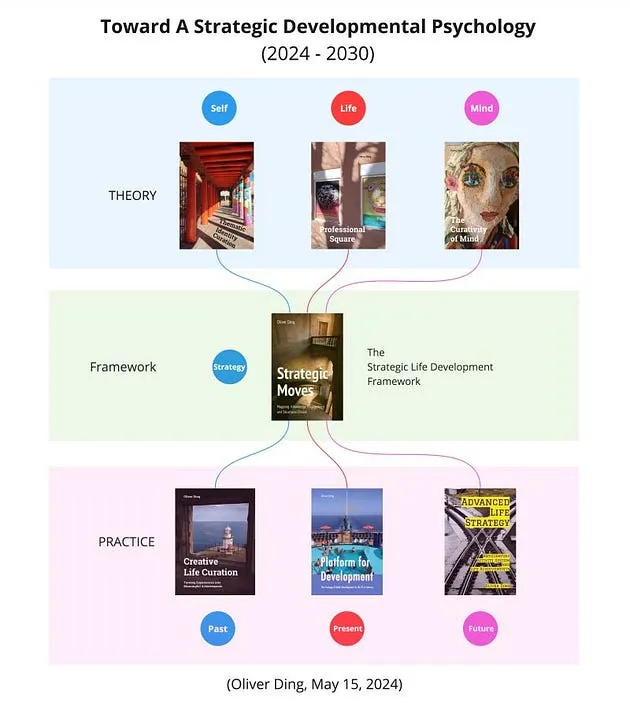
On May 15, 2024, I made the diagram above and initiated an Anticipatory Journey toward Strategic Developmental Psychology (2024–2030). Though the specific activities remained undefined, this declaration framed the journey from 2024 to 2030 — a 6-year journey.
Between May 2024 to January 2025, I worked on a series of projects about adult life development, strategic life development, and advanced life strategy. On February 1, 2025, I named this evolving body of work: Strategic Life Theory.
On February 1, 2025, I reflected on the landscape of Strategic Life Theory and used the House of Creative Life Strategy to curate related possible books and models together. The knowledge map above features nine themes, five models, and nineteen possible books.
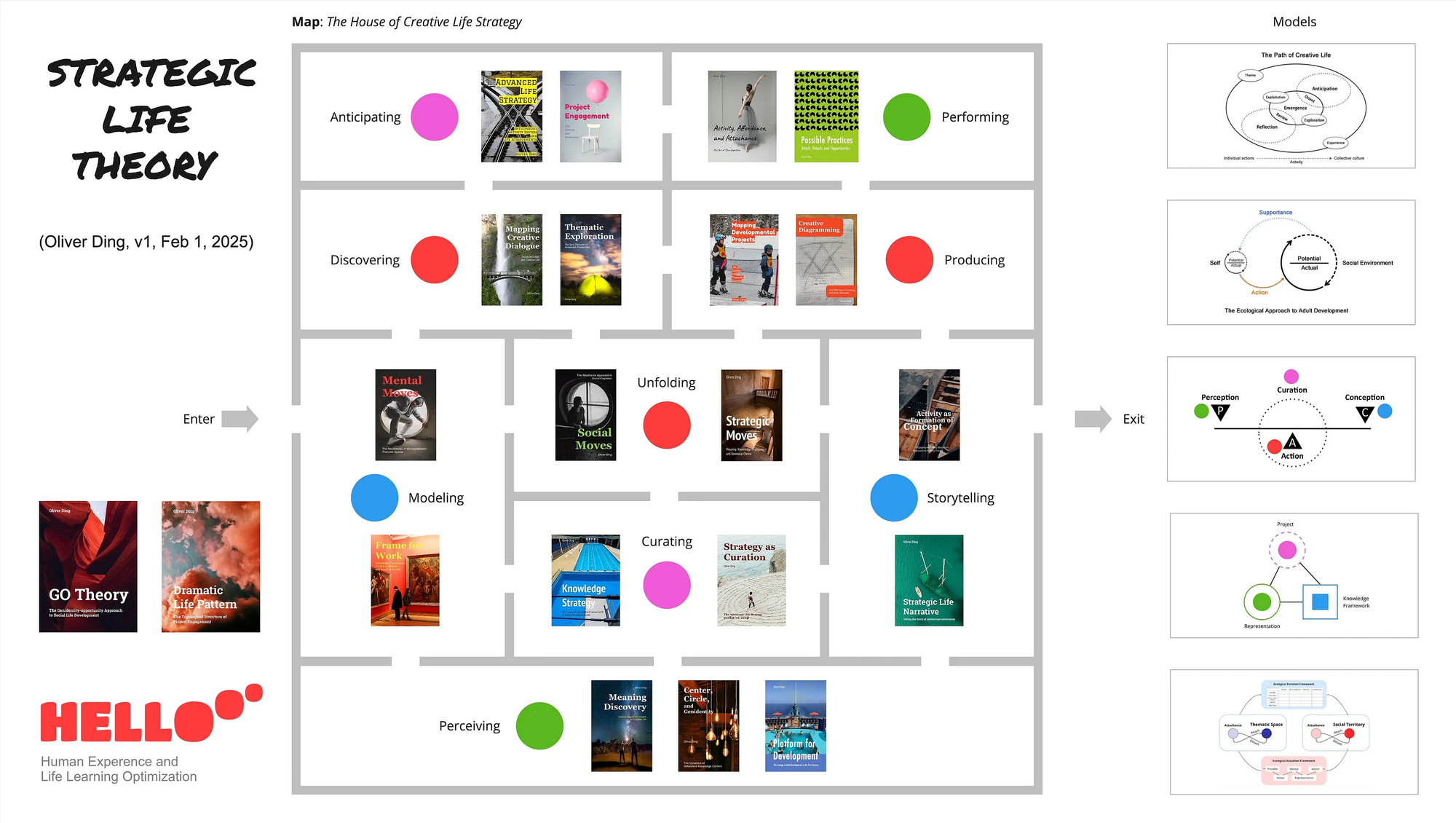
Back in May 2024, I envisioned dedicating six years to developing the concept of "strategy" within the field of Developmental Psychology. The landscape of Strategic Life Theory now offers a well-developed knowledge system aligned with this vision.
However, Strategic Life Theory was developed primarily as a practical theoretical framework. It did not directly investigate the original, meta-theoretical question.
In 2026, based on the Self-Life-Mind meta-framework, I adopted a cross-disciplinary method to develop the SDP project.
A Cross-Disciplinary Investigation
In 2026, I moved the SDP project to the GO Theory platform where the SDP project and the ACS (Anticipatory Cultural Sociology) project were designed as a symmetric pair.
ACS and SDP share the same ontological foundation — the World of Life — but are oriented toward different dimensions of the same social reality. ACS attends to cultural development at the collective scale: how thematic enterprises emerge, develop, and settle into the cultural world as Worldentity. SDP attends to individual life development at the personal scale: how a person strategically develops their capacity to contribute to and be shaped by that cultural world.
In ACS, anchoring is static while expansion is dynamic, seeking to answer how a core intention influences and ripples through the vast world; whereas in SDP, the boundary is static while the internal elasticity is dynamic, seeking to answer how a finite world can nurture an infinite self.
The structural consequence of this symmetry is what might be called mutual enrichment through indirect activity. Because ACS and SDP share the same spatial foundation — the same map, the same boundaries, the same operating concepts — theoretical work done on one side simultaneously generates resources for the other. The development of the Self–Other dimension within ACS produced, as a by-product, the theoretical core of SDP's Supportive Life Discovery dimension. The five developmental orientations developed within ACS became the five rings of SDP's Living Coordinate.
The most intimate zone of convergence between the two enterprises is precisely this Supportive Life Discovery axis. What ACS calls the relational conditions of cultural creation — the way Other is not merely an audience but a constitutive presence in the unfolding of any thematic enterprise — SDP calls the supportive conditions of individual actualization. These are two descriptions of the same fundamental fact: that human development, whether cultural or individual, is always already a co-becoming.
To track this new development after the Strategic Life Theory project, I started a new version numbering system. The Strategic Life Theory development and the AAS work are not included in the SDP version sequence. The versions mark only the creative progress beginning from December 2025.
v1.0 — December 2025
The completion of The Curativity of Mind established the first dimension: The Curativity of Mind itself — Mental Curation, Mental Platforms, and Mental Moves. This dimension attends to the cognitive interior of the actor: how the mind works as a creative platform, how it curates knowledge, and how it generates and deploys mental moves.
v1.1 — January–February 2026
The development of Anticipatory Cultural Sociology (ACS) during this period produced an unexpected by-product. The five-ring developmental orientation structure — Learn, Discover, Design, Deliver, Weave — emerged as part of the ACS framework (v1.2), but its natural home was SDP. It was transferred as a by-product and became the five rings of the SDP Living Coordinate. This orientation structure describes the fundamental modes through which an individual actor develops: from the innermost integrative action (Weave) to the outermost receptive orientation (Learn).
v1.2 — March–April 2026
Two developments together constitute v1.2. First, a series of articles on Supportive Life Discovery — developed through the Revisiting–Rebuilding practice and the exploration of the Self–Other dimension — established the second dimension of SDP's three-dimensional landscape. This dimension addresses the relational conditions of individual development: how the presence, support, and co-becoming of others shapes the trajectory of a creative life.
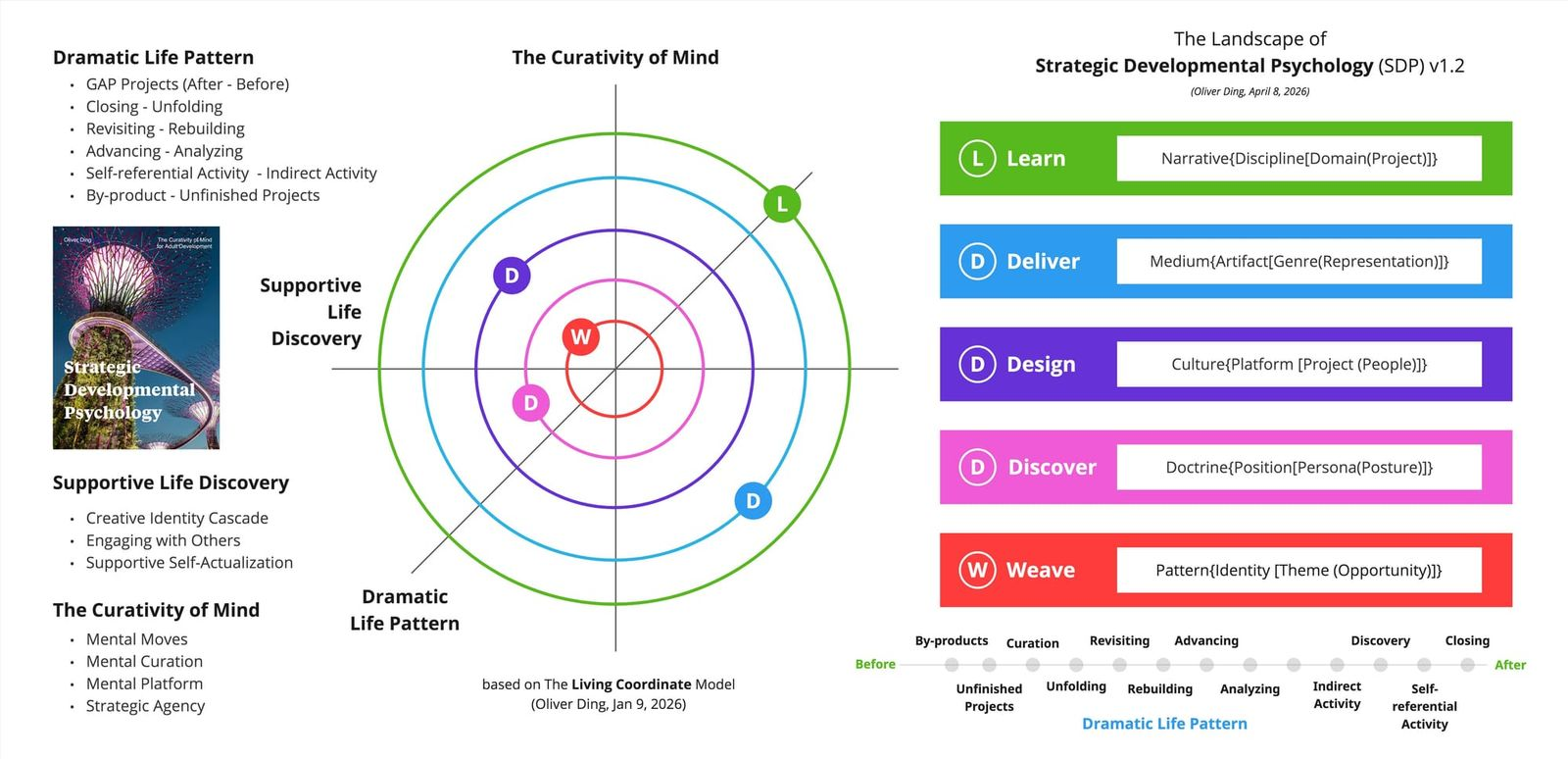
Second, the formal launch of work on the third dimension: Dramatic Life Pattern — the study of how a creative life unfolds across time, structured through patterns of Discovery, Revisiting, Advancing, and Indirect Activity. The Revisiting–Rebuilding collection, assembled in March 2026, marked the beginning of this work's systematic organization.
What the V2.0 Contribute
Between April and July 2026, several lines of work matured in parallel. Their outcome marked the version 2.0 and led to this book.
- The Self-Life-Mind schema was turned outward — used for the first time as a meta-framework to diagnose psychology's own conceptual apparatus, yielding a series of papers revisiting the "Self," "Situation," and "Belief" issues.
- The RelationField framework reached maturity, and the Supportance manuscript was completed, providing a systematic account of how others enable, constrain, and co-shape a creator's trajectory.
- A series of case studies using real individuals' World of Activity revealed that SDP's practice should work as case-by-case toolkit assembly.
- And the concept of Gejunction — developing along two independent lines since January — finally converged into a formal unit of synthesis.
These parallel developments, each advancing on its own trajectory, converged to form the v2.0 framework.
Two major developments distinguish v2.0 from v1.2. Neither replaces the earlier framework. Both enrich it, providing deeper foundations for the three dimensions and five rings that were already in place.
First, a reconception of Self. This is the SDP side of the exchange — how Self(Body) moves through Self-Other relation to become an actor.
ACS's work on the Self-Other dimension provided the raw material. But what ACS developed at the cultural scale needed to be translated into SDP's own terms. The unitary, present-moment Self of traditional psychology is replaced by a three-layer architecture: Sub-individual (Past, Present, and Future Selves — the temporal depth of the self), Individual (the present-moment actor), and Supra-individual (what emerges when two or more agents act in concert).
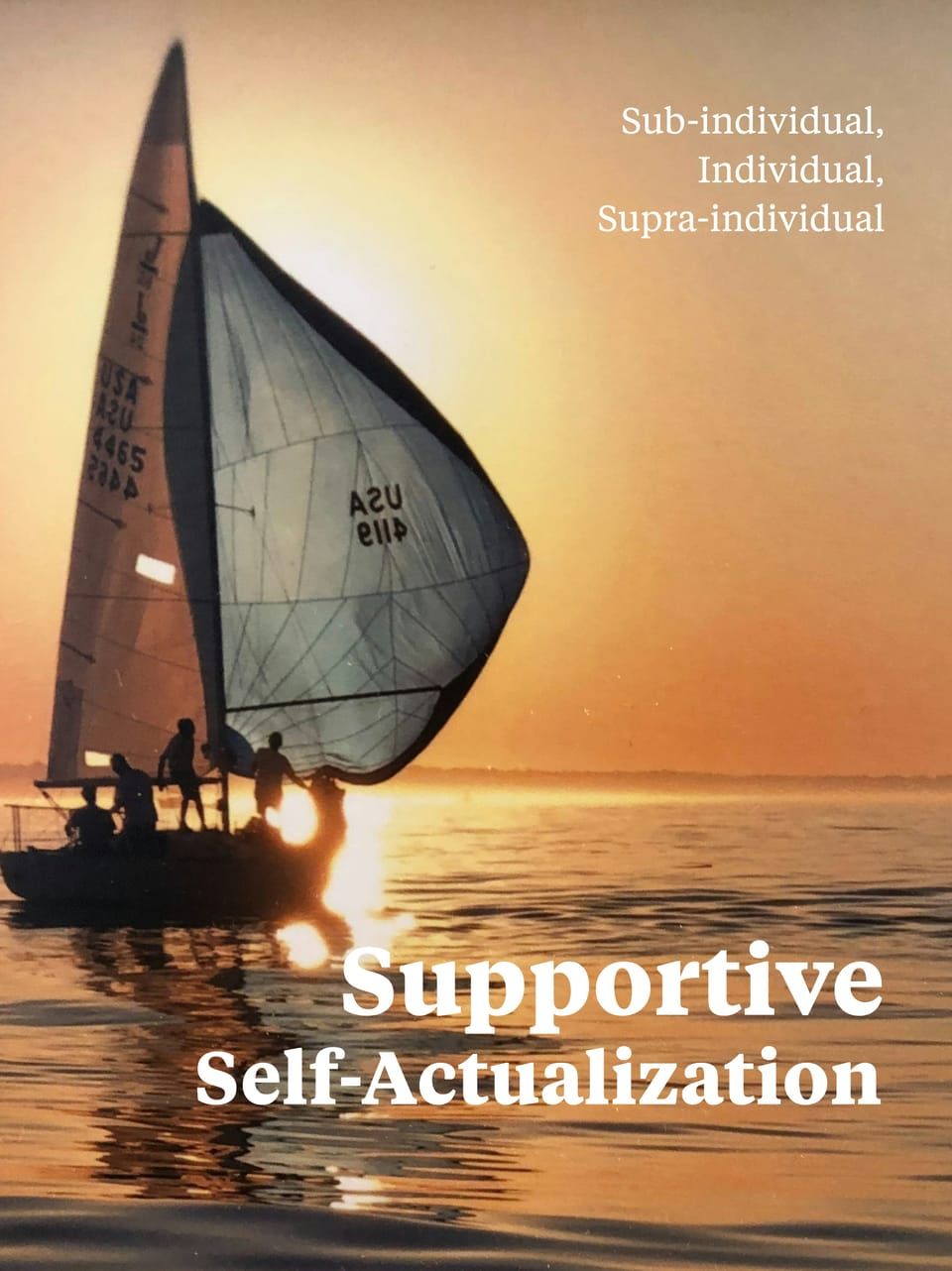
The key mechanism is Persons Acting in Concert — drawn from legal practice and adapted for developmental theory. It supplies the structure by which a Self and an Other constitute a Supra-individual whole. This is not a relationship entered into after the Self is fully formed; it is the structure through which the Self becomes an actor in the first place. The Supra-individual is not an optional extension — it is a constitutive dimension of the Self.
On this foundation, Self-actualization is reconceived: not a peak to be reached, but an ongoing anticipatory activity — the continuous movement by which a Self, accompanied by another, moves from ecological potential to enacted actuality. This is what Supportive Self-Actualization means.
Second, the concept of Gejunction. Where the reconception of Self traces the path from Self(Body) to Actor, Gejunction marks the point where the reverse journey — from Actor back to Self(Body) — also becomes possible.
Gejunction is a unit of synthesis within the GO Theory platform. Its most direct contribution is to close a gap that neither ACS nor SDP v1.2 had addressed. ACS never addressed the Biological System at all; it operated at the cultural scale and never explained how Self(Body) becomes an actor in the first place. SDP's own landscape was, at bottom, an actor model inherited from ACS, but it never explained its own starting condition.

Gejunction supplies exactly this interface. Self(Body), moving through the social world along two axes — the diachronic (time) and the synchronic (space) — is thereby constituted as what sociology calls an actor. Along the time axis, Flow becomes Focus; along the space axis, Center and Circle emerge. These four forms — Flow, Focus, Center, Circle — constitute the FFCC model, the basic ecological forms of World of Activity. Gejunction captures this movement, and in doing so, it functions as the meeting point between ACS and SDP: not merely a shared platform resource, but the specific connector that lets an actor model inherited from ACS finally explain its own starting condition.
Beyond this interface function, Gejunction also supplies what psychology has never had: a unit of synthesis for a person's overall standing. Psychology's treatments of "situation" and "environment" have always been units of analysis — decomposed variables — never a unit that holds a person's standing whole. Yet strategic action requires exactly this: a holistic reading of where one is, with its latent possibilities as well as its actualities. Gejunction addresses this through four aspects — Weave-point (symbolic), Living Coordinate (territorial), RelationField (relational), and Thematic Space (thematic) — and connects to four action opportunities (Affordance, Supportance, Attachance, Curativity) that constitute the bridge from ecological potential to enacted action.
It is worth noting that the Self-Other relation — central to the reconception of Self — lands specifically on RelationField, one of Gejunction's four aspects. This is where the circuit between Self(Body) and Actor is most directly visible. The other three aspects — Weave-point, Living Coordinate, and Thematic Space — are introduced in this volume, but their full development remains work for the future. The chapters collected here serve as an opening, not a closure.
Taken together, the reconception of Self and Gejunction complete a full circuit. Self(Body) → (through Self-Other relation, at Gejunction) → Actor → (through Gejunction) → back to Self(Body). This is how the individual perspective of World of Activity and the collective perspective of World of Life are connected.
In addition, the concept of the Dream — first encountered in Daniel Levinson's work — was revisited and rebuilt. SDP departs from Levinson's single dramatic arc of early emergence, midlife suppression, and midlife recovery. Instead, it treats the Dream as a matter of creative achievement without a normative timeline, and treats strategy — not patience, and not a fixed season of life — as what makes navigating toward it possible.
The Structure of This Book
The book is organized into seven parts. Their sequence is intentional, but not all parts need to be read in order. A detailed reading guide follows this overview.
- Preface: One World, Many Dreams
- Part 1: An Investigation of Theoretical Psychology
- Part 2: Psychological Knowledge Engagement
- Part 3: Journey and Landscape
- Part 4: Supportive Self-Actualization
- Part 5: Gejunction
- Part 6: Creative Engagement
- Part 7: Agency and Cognition
How to Read This Book
The seven parts are not all equally central to what SDP v2.0 aims to show. The structure reflects a deliberate choice: to provide both a complete record of the project's development and a clear path to its most important new contributions.
The Core Sequence
If you want to get to v2.0's developments directly, read in this order:
- Preface: One World, Many Dreams — what SDP means by "Dream" and why it matters
- Part 3: Journey and Landscape (Chapters 5–7) — the historical context and the full v1.2 landscape
- Part 4: Supportive Self-Actualization (Chapters 8–9) — the first v2.0 development: three-layer Self
- Part 5: Gejunction (Chapters 10–14) — the second v2.0 development: a unit of synthesis for strategy
- Selected chapters from Parts 6–7 based on your interest (see "Essential Chapters" below)
This core sequence — Preface → Part 3 → Part 4 → Part 5 — gives you the theoretical spine of SDP v2.0.
Optional Background
If you are interested in the meta-theoretical foundations, add Part 1: An Investigation of Theoretical Psychology. These chapters use the Self-Life-Mind schema to diagnose specific shortcomings in psychology's own conceptual apparatus — the "Self" issue, the "Situation" issue, the "Belief" issue. Essential for readers who want to understand why psychology has never developed a proper concept of strategy, but it can be read after the core sequence without loss.
If you are considering participating in the SDP knowledge enterprise — as a researcher, practitioner, or contributor — read Part 2: Psychological Knowledge Engagement. This part offers a map for locating your own orientation toward SDP and understanding how different types of engagement move across thematic territories. It can be read at any point.
If you are a practitioner or creator looking for tools and methods, focus on Part 6: Creative Engagement, particularly Chapters 16 (Supportive Life Discovery) and 18 (Actualization of Opportunity). These chapters translate the theoretical architecture into actionable frameworks.
A Note on the Chapters
Each chapter in Parts 4–7 is largely self-contained. They were written as independent articles and later curated into this book. You can read them in any order once you have grasped the core concepts from the Preface and Part 3. Cross-references are provided where concepts build on one another.
Preface
- One World, Many Dreams - July 2026
"Dream" here does not refer to the unconscious material of psychoanalytic tradition — Freud's dream as a window onto repressed desire. Nor does it refer to the short-term goals of action psychology, the proximal targets that motivate behavior in the near term. SDP's "Dream" points to something harder and longer: a person's conscious, sustained anticipation of a future they want to make happen, together with the long-term commitments that orient their life toward it.
Part 1: An Investigation of Theoretical Psychology
Part 1 establishes the meta-theoretical groundwork. Using the Self-Life-Mind schema, these chapters re-examine three concepts — "Self," "Situation," and "Belief" — and identify shortcomings that psychology's own methods have not been able to resolve. If psychology has never developed a proper concept of strategy, the reasons lie in how it has treated these concepts. A cross-disciplinary approach — drawing on philosophy and sociology — is required to move forward. This Part is optional background for readers interested in the meta-theoretical foundations.
Chapter 1: The Self-Life-Mind schema and the History of SDP
Chapter 2: Revisiting Key Psychological Concepts
- Revisiting the "Self" Issue from the Self-Life-Mind Perspective (2026)
- Revisiting the "Situation" Issue from the Self-Life-Mind Perspective (2026)
- Revisiting the "Belief" Issue from the Self-Life-Mind Perspective (2026)
Part 2: Psychological Knowledge Engagement
Part 2 is a methodological case study. Using "Mindset" as an example, it maps four thematic areas of psychological knowledge — theoretical extension, empirical research, intervention application, individual reflection — and shows how knowledge activity moves across these territories. This Part serves two purposes: it demonstrates the approach SDP uses to organize its knowledge enterprise, and it invites readers to locate their own orientation toward SDP within these four areas. This Part is optional for readers considering participating in the SDP knowledge enterprise.
Chapter 3: Four Thematic Areas and a Case Study
- The Concept of Mindset and Theoretical Integration (2023)
- The Concept of Mindset and Empirical Psychologists (2023)
- The Concept of Mindset and Intervenors (2023)
- The Concept of Mindset and Actors (2023)
- Four Mindsets of Knowledge Engagement and “AAI as Mental Tuning” (2023)
Chapter 4: Social Moves and Mental Moves
- Psychological Counseling Platform: A Case Study of “Social Moves” (2023)
- Robert Kegan’s Knowledge Enterprise (2023)
- One Map and Four Paths (2025)
Part 3: Journey and Landscape
Part 3: Journey and Landscape provides the historical context for SDP as a project. It traces the trajectory from Advanced Life Strategy (2022) through Strategic Life Theory (2025) to SDP v1.2 (April 2026), and introduces the meta-frameworks — GO Theory, Ecological Formism, the LARGE Method — that constitute the theoretical infrastructure. This is where the full landscape of SDP is presented, with the v2.0 developments built upon it. This Part is the recommended starting point for readers who want to get to v2.0 directly.
Chapter 5: The Historical Development
- Advanced Life Strategy: Anticipatory Activity System and Life Achievements (Book) - 2022
- The Indirect Activity of Life Strategy Center - 2024
- The Journey of Strategic Life Theory (V1, 2025) and its Landscape - 2025
- The Aion Journey (2021–2025): From Strategic Developmental Psychology to Strategic Life Theory
Chapter 6: Meta-frameworks
At the meta-framework level, we have developed a series of foundational frameworks that constitute the theoretical infrastructure of SDP.
- Self-Life-Mind has long been a heuristic tool within SDP, and has recently been used to re-examine core psychological concepts such as self, belief system, situation, and development.
- World of Activity offers an ecological perspective on the largest category of individual activity and its morphological structure; its FFCC model (Flow-Focus-Center-Circle) has generated multiple empirical case studies in adult development.
- GO Theory — formerly the HLS Framework (v3.0, 2025), now called The World of Life (World of Activity) Approach — provides an ontological grounding for social life.
- Ecological Formism addresses the epistemological level, attending to four layers of knowledge: variables, quasi-invariants, invariants, and invariant sets.
- And the LARGE Method (v3.0, 2026) serves as the meta-method governing all methods within the GO Theory platform.
Chapter 7: The Landscape of SDP
- The Landscape of Strategic Developmental Psychology (v1.2) - April 2026
- The L3D Model (v1.0, 2026) - March 2026
- The Landscape of Strategic Developmental Psychology (v2.0) - July 2026
Part 4: Supportive Self-Actualization
What is the purpose of navigating all of this — situation, junction, anticipatory modeling, relational support? The book's sub-title names it: Supportive Self-Actualization. It is SDP's answer to the question of what development is for. Reconceived within the three-layer architecture of Self (Sub-individual, Individual, Supra-individual) — developed through the structure of Persons Acting in Concert and navigated within the social ecology of the World of Life — it is the ongoing anticipatory activity by which a Self, accompanied by another, moves from ecological potential to enacted actuality. It is what the entire strategic apparatus of SDP ultimately serves.
Chapter 8: Self, Other, and Actualization
- Supportive Self-Actualization as Anticipatory Activity
- Revisiting, Rebuilding, Re-engaging with Past Selves
- Agency Cascade and The Transformation of Self
- Engaging with Others for Developing Anticipated Identity
Chapter 9: A Model of the Actor and World of Activity
- Weave: A Model of the Actor - 2026
- The World of Activity (v1.0, 2022) Framework: Theoretical Foundation and Generative Confluence - 2026
- The World of Activity Toolkit (v2.0, 2026) - 2026
Part 5: Gejunction
Part 5: Gejunction presents the second major development of v2.0. Gejunction is a unit of synthesis within the GO Theory platform — a single construct for grasping a person's overall standing across four aspects: Weave-point (symbolic), Living Coordinate (territorial), RelationField (relational), and Thematic Space (thematic). Each aspect corresponds to a distinct knowledge system — the Weave Knowledge System, the World of Activity Approach, Supportance Theory, and Thematic Space theory — all of which were developed independently of SDP but are hosted on the GO Theory platform.
This Part collects selected articles from each knowledge system, offering readers a window into their respective frameworks and models. In future work, SDP will draw on these knowledge systems as a toolkit, assembling them case by case rather than applying a single fixed model. This Part also explains why psychology has never developed a proper concept of strategy, and shows how Gejunction fills that gap.
Chapter 10: Gejunction as a Unit of Synthesis
- Gejunction — A Unit of Synthesis within GO Theory - 2026 - 7,573 words
- Gejunction: Toward a Unit of Synthesis for Social Life - 2026 - 1,249 words
Chapter 11: RelationFields
- A Chair from a Hundred Years Ago - 2026
- RelationField (v3.0): A Model of Social Appropriation - 2026
- Supportances in Intimate Relationships: A Theoretical Framework - 2026
- The Alienation of Supportance: The RelationField of High-Conflict Divorce (HCD) - 2026
- World of Activity: Center as RelationField and the Dual-Center Pattern - 2026
The RelationField Framework introduced a new unit of analysis — Subject–Subject (and its derivative, Subject–Object) — moving beyond the individual-as-container to see relationships as fields of mutual constitution.
And Supportance Theory matured from a nascent concept into a full theoretical framework, offering a systematic account of how others enable, constrain, and co-shape a creator's trajectory.
Chapter 12: Living Coordinates
- The Living Coordinate Model (2026) - 2026
- A Journey of Finding the Coordinate - 2026
- Rebuilding the Living Coordinate: A Case Study Summary - 2026
Chapter 13: Weave-points
- Life-as-Activity: The Weave-the-Life Framework (v3.0) - 2026
- GO Square: Mapping the Symbolic Universe - 2026
- How to Navigate the Symbolic Universe: Three Principles of Spatial Heuristics - 2026
- Weave 2.0: Synchronic Line, Diachronic Line, and Living Coordinate - 2020
Chapter 14: Thematic Spaces
- An Ecological Approach to Social Cognition — 9 min
- Mental Moves: The Attachance Approach to Ecological Creative Cognition (2023) — Moving between Thematic Spaces — 16 min
- Social Moves: The Attachance Approach to Social Cognition (2023) — Moving between Social Landscapes — 13 min
- Strategic Moves: Mapping Knowledge Engagement and Structural Choice (2024) — 15 min
Part 6: Creative Engagement
Part 6 presents several "themes of practice" that have emerged from v1.2's model. While not mapping directly onto the three dimensions or five rings in a one-to-one fashion, these themes — Enterprise Development, Supportive Life Discovery, Dramatic Life Pattern, and Actualization of Opportunity — enrich and deepen SDP's knowledge system, particularly in the directions of empirical research and intervention application.
For example, Dramatic Life Pattern offers a method of self-study. I have identified a series of patterns from my own creative trajectory — GAP Project, RR (Revisiting-Rebuilding), Creative Confluence, Creative Watershed, and AA (Advancing-Analyzing) — and readers can conduct similar self-studies of their own lives. These patterns are also being introduced into intervention design: the Supportive Life Discovery (v2.0): The Mid-life Curation Edition draws on four of these patterns in its design.
Chapter 15: Enterprise Development
- Supportance Analysis: How a Theoretical Platform Supports Creative Work - 8,197 words
- Generative Confluence: Theoretical Activity, Theoretical Enterprise, and Theoretical Platform - 6,899 words
Chapter 16: Supportive Life Discovery
- Vygotsky’s “Ecological Mind” and a New Approach to Adult Development (2021) - 8,834 words
- Before, After, and Watershed - April 2026 - 3,051 words
- [Case Study] When the Circle Changes the Center - April 2026
- Supportive Life Discovery (v2.0): The Mid-life Curation Edition - 4,198 words
Chapter 17: Dramatic Life Pattern
- Toward Dramatic Life Pattern - November 2025
- Revisiting and Rebuilding: A Strategy for Creative Identity Development (Possible Book, 2026) - April 2026
- A GAP Project and a Generative Confluence Journey - May 2026
- Generative Confluence: Theoretical Activity, Theoretical Enterprise, and Theoretical Platform - May 2026
- The World of Activity (v1.0, 2022) Framework: Theoretical Foundation and Generative Confluence - Feb 2026
- Weave 2.0: Synchronic Line, Diachronic Line, and Living Coordinate - June 2026
- A Watershed of Creative Life - April 2026
- Dramatic Life Pattern: The Watershed I Lived By - 6,899 words - April 2026
- Weave the Curativity: When Advancing Dances with Analyzing - 9,884 words - May 2026
Chapter 18: Actualization of Opportunity
- The “Difference — Conversion — Opportunity” Schema - 2025 - 12 min
- The House of Ecological Practice - 2024 - 2024 - 18 min
- Four Positive Frontiers of Project Engagement - 2026 - 3,526 words
- The Actualization of Thematic Supportance as a Creative Action - July 2026
- The Affordance - Supportance Loop - 2021 - 17 min
- The Affordance — Supportance Cycle - 2023 - 8 min
- Leeway: The Ecological Total of Supportances - 2026 - 5,356 words
- Supportance: Self, Other, and Possible Support (book, v1, 2026)
Part 7: Agency and Cognition
Part 7: Agency and Cognition completes SDP's account of the actor. It addresses two interconnected dimensions: how a person exercises agency across social worlds, and how the mind organizes strategic thought.
This Part introduces two renamings that reflect recent theoretical consolidation. The Bureaus of Agency series is now formally named Strategic Agency, encompassing the Agency Cascade, Agency Resonance, Agency Threshold, and Agency Frontier. The Nine Aspects of Strategic Agency is reframed as Aspects of Strategic Mind, serving as the operational layer of the Curativity of Mind. Ecological Strategic Cognition offers a meta-framework for understanding strategic thinking within thematic spaces.
Chapter 19: Strategic Agency
- Activity Analysis Network #10: Re-visiting, Re-building, and Agency Cascade (1/30/2026 - 1,846 words)
- Activity Analysis Network #11: Boundary, Givenness, and Agency Threshold - (2/15/2026 - 2,243 words)
- Activity Analysis Network #12: Design, Medium, and Agency Resonance - (2/25/2026 - 1,914 words)
- Activity Analysis Network #13: Learn, Weave, and Agency Frontier - (3/15/2026 - 2,654 words)
Chapter 20: Strategic Mind
- Three Paths of Creative Life and A Semiotic System - 2022
- The Advanced Life Strategy Toolkit (v2, Dec 2024) - 2024
- Strategy as Curation: The Advanced Life Strategy Toolkit v2.0 (book, v1.0) - 2024
- The Curativity of Mind: Mental Curation, Mental Platforms, and Mental Moves (book, v1.0, 2025)
Chapter 21: Ecological Strategic Cognition
- A Possible Theme called “Ecological Strategic Cognition” - 2023
- Ecological Strategic Cognition: A Theory of Strategy (v1, 2024)
- Ecological Strategic Cognition: A Theory of Strategy (v2, 2025)
- The Ecological Strategic Cognition Frameworks (v2.3) as a Meta-Framework - 2025
- Thematic Space Theory: A Toolkit as a Specific Theory - 2025
v1.0 - July 8, 2026 - 4,301 words