
[Creation Note] Gejunction: Toward a Unit of Synthesis for Social Life
weaving active agency and evolving structure
by Oliver Ding
June 22, 2026
This article documents the developmental history of the concept Gejunction. Rather than presenting a finalized theory, it records the sequence of ideas, experiments, conceptual substitutions, and theoretical integrations that eventually led to the formulation of Gejunction as a Unit of Synthesis within GO Theory. It is intended both as a reflective account and as an archival record of the concept's emergence.
In January 2026, I launched the Anticipatory Cultural Sociology (ACS) project with a working definition of cultural development:
Cultural development is a continuous, dynamic anticipatory activity of creating and curating concept systems and transforming them into thematic enterprises by weaving active agency and evolving structure within the social world.
While working on the ACS project in January, I used the term "Bureaus of Agency" to name a dimension, exploring the "weaving active agency and evolving structure" part. I temporarily adopted the term bureau as a placeholder to describe structural domains within which agency operates. At that time, I was searching for a precise English equivalent for the Chinese concept of 格局 (geju) which is closer to what I wand to express.
However, it was difficult to find an appropriate word. Rather than adopting an existing term, I coined a new one: Gejunction.
At the time, the concept was still vague and largely intuitive. To preserve and explore this intuition, I created a thematic card that combined three expressive elements: a name (Gejunction), an image, and a guiding phrase.
The image showed a simple wooden stool casting a large shadow. The accompanying phrase read:
"With genius, every tiny junction fine-tunes your life configuration."
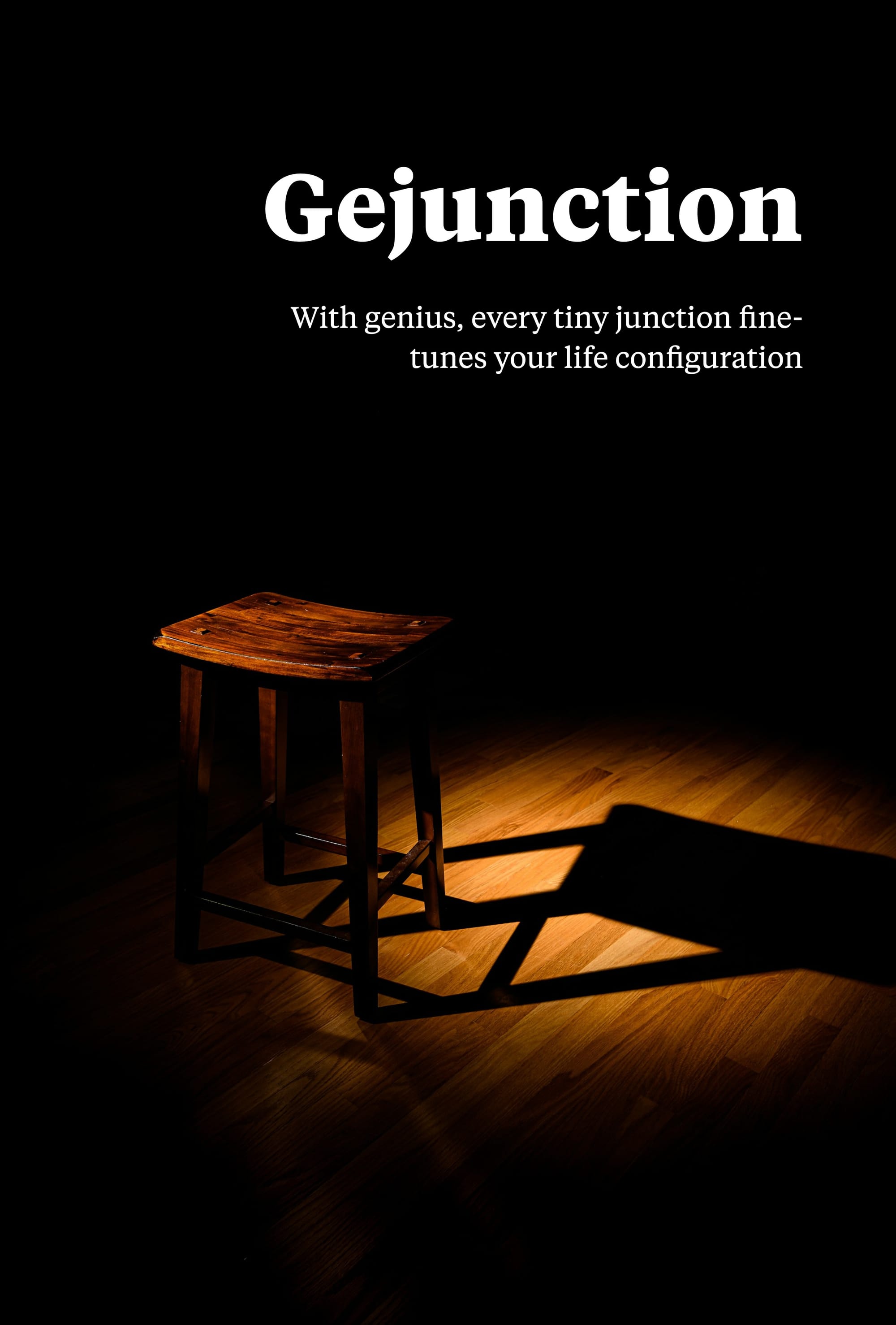
Together, the name, the image, and the phrase served as three complementary forms of expression for a theoretical intuition that had not yet been fully articulated. I did not yet have a formal definition. Instead, I used the thematic card as a way of capturing a vague but persistent sense that small points of connection, positioning, and coordination could gradually shape the larger configuration of a person's life.
Only later, through the development of Weave-points, Living Coordinates, Thematic Spaces, and RelationFields, did this early intuition begin to take on a more systematic theoretical form.
But I didn't publicly use it. Instead, I used "Bureaus of Agency" as a placeholder.
At the end of March, I released a possible book, Anticipatory Cultural Sociology: Creation, Projection, and Agency, which introduced v2.0 of ACS. Later, I moved to the Strategic Developmental Psychology (SDP) project and the GO Theory project.
In recent months, I developed a series of concepts for the SDP project and the GO Theory project. Eventually, the following four concepts became my primary focus:
- Weave-points
- Living Coordinates
- Thematic Spaces
- RelationFields
The first three concepts were considered as a Creative Confluence because these three ideas come from three knowledge systems, but they describe three aspects of the same thing. On May 26, 2026, I conducted a Creative Confluence case study with the diagram below: Weave 2.0: Synchronic Line, Diachronic Line, and Living Coordinate.
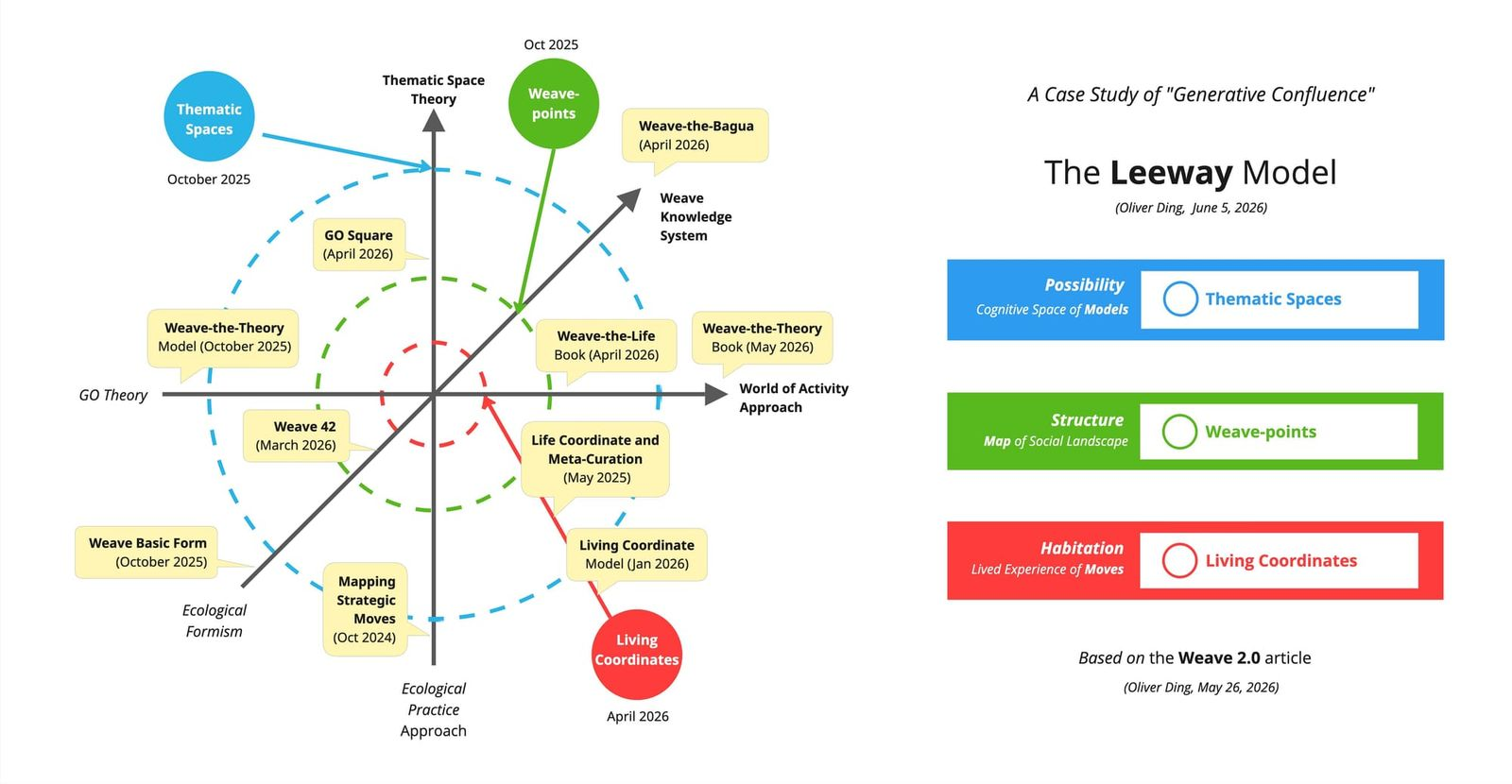
At that time, I used "Leeway" to name the outcome of the Creative Confluence:
The new creative center of Weave 2.0 is the Leeway Model — a conceptual object that names what the three creative elements, taken together, reveal. The name leeway captures the essential insight: the environment provides structure, the actor is situated within it, but the actor retains many possibilities for movement. Leeway is not freedom from structure — the Weave-point is given, the axes are fixed — but freedom within structure: the range of moves, trajectories, and cognitive explorations that remain available at any given position.
Soon, I developed the RelationField (v3.0) framework on June 14, 2026. The framework uses a nested structure to model the social environment: Subject–Subject (Subject–Object). A relation that begins at the Subject–Object kernel does not remain there; it is taken up, carried, and told between subjects — and it is this carrying-and-telling that constitutes a field rather than a single point.
Moreover, I discovered that RelationField is related to the three ideas mentioned above. These four ideas just describe the same thing, but, each one focuses on one particular aspect.
On June 16, 2026, I put these four concepts on the landscape of the HLS framework (see below). The landscape made it clearer that they represent four units of analysis for the social life world.
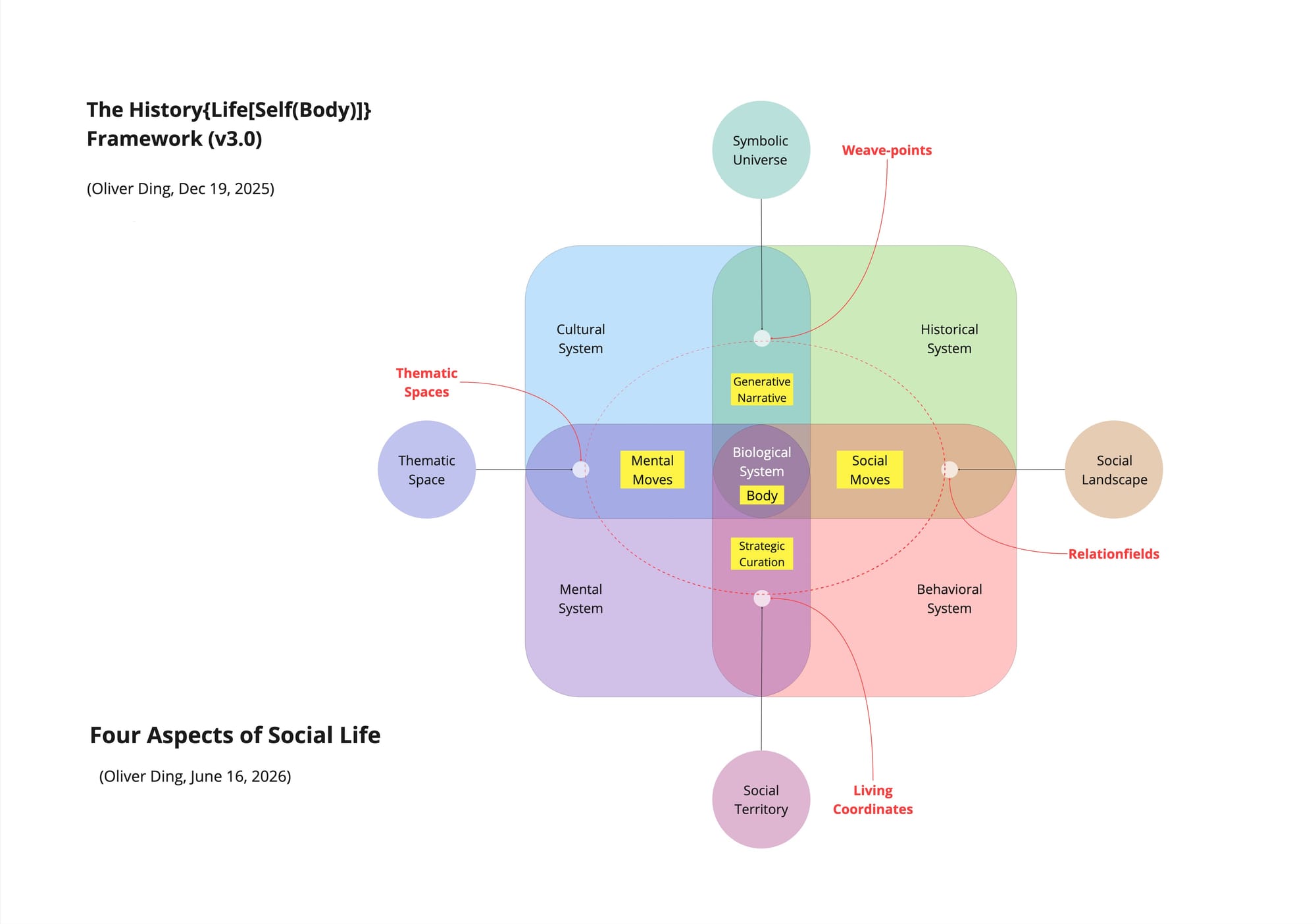
At that time, I knew that it was time to publicly use the term Gejunction to name the same thing behind these four concepts.
Within GO Theory, I define a Gejunction as a Unit of Synthesis. It is not a unit obtained through decomposition and analysis. Rather, it is a unit constituted through the synthesis of multiple dimensions of social life.
A Gejunction can be understood through four aspects.
- Thematic Spaces represent the thematic aspect. They reveal what a particular social life configuration is about and how attention, interest, and commitment become organized around a theme.
- Weave-points represent the symbolic aspect. They identify points where concepts, narratives, values, and meanings become woven together within a broader symbolic universe.
- RelationFields represent the relational aspect. They capture the intersubjective configurations through which people, resources, opportunities, and social environments are constituted.
- Living Coordinates represent the territorial aspect. They describe how a person becomes situated within a concrete life world.
These four aspects are not separate entities. They are four analytical perspectives on the same social unit.
A Gejunction appears as a Thematic Space when viewed from a thematic perspective. It appears as a Weave-point when viewed from a symbolic perspective. It appears as a Relationfield when viewed from a relational perspective. It appears as a Living Coordinate when viewed from a territorial perspective.
The ontological foundation of this formulation is the HLS Framework. Within HLS, social life unfolds across four interconnected dimensions: Symbolic Universe, Thematic Space, Social Landscape, and Social Territory. Gejunction does not belong exclusively to any one of these dimensions. Instead, it emerges at their intersection.
For this reason, Gejunction should not be understood as a static structure. It is continually generated and transformed through four mechanisms:
- Mental Moves
- Generative Narratives
- Social Moves
- Strategic Curation
These mechanisms contribute to the ongoing formation of thematic spaces, weave-points, relationfields, and living coordinates. Together they explain how agency and structure become intertwined within social life.
This development also connects directly to the ACS project and the SDP project because it offers a systematic framework for addressing the issue of "weaving active agency and evolving structure."
For the ACS project, if concept systems and thematic enterprises are important units for understanding cultural development, then Gejunctions may be understood as the social units through which such development becomes possible. They are the sites where themes become lived, meanings become organized, relationships become constituted, and individuals become situated within the life world.
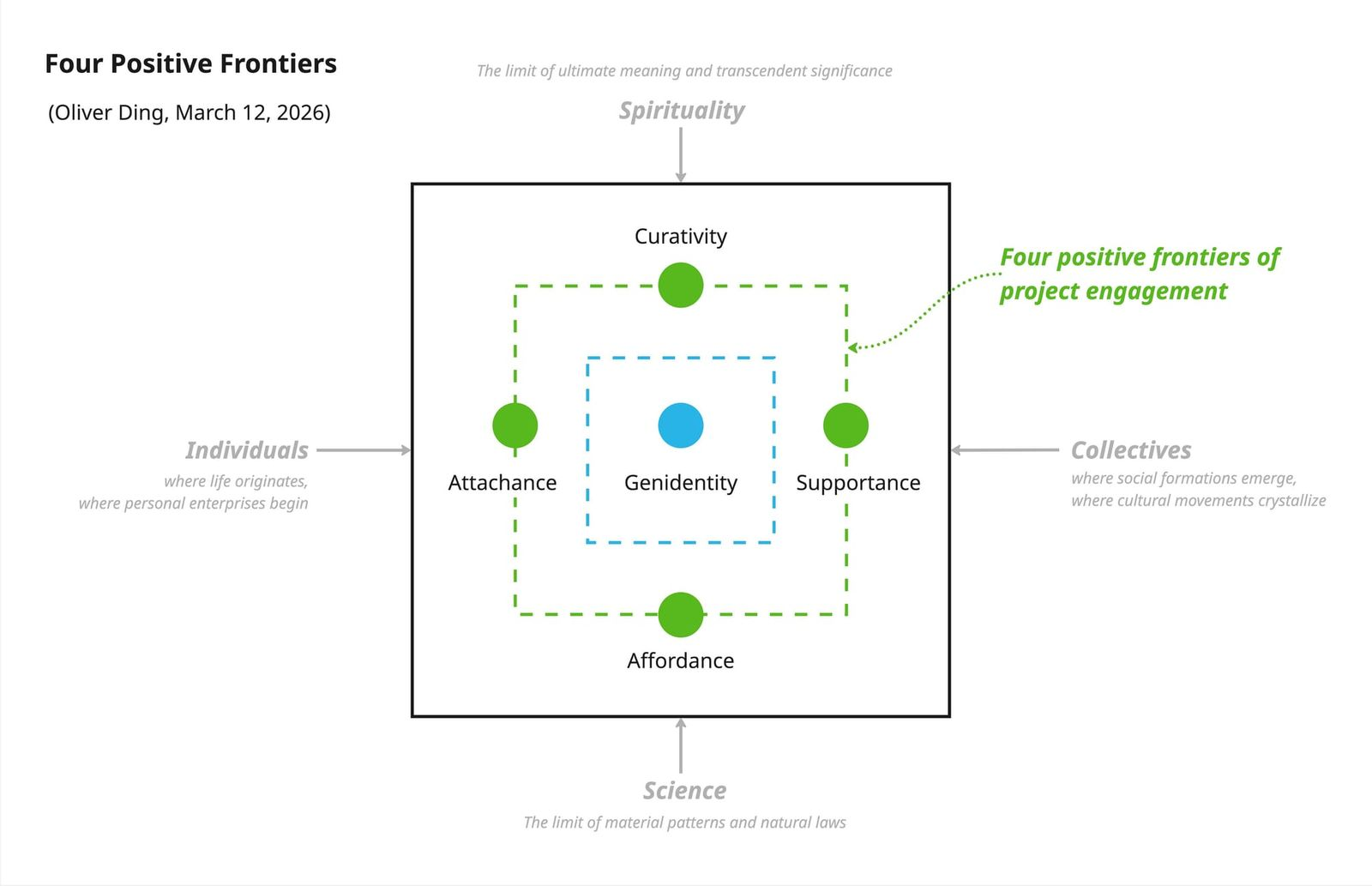
For the SDP project, the concept of Gejunction offers an ecological approach to the social environment of adult development. It connects to four types of action opportunities: Affordance, Curativity, Attachance, and Supportance, as shown in World of Life: Four Positive Frontiers of Project Engagement and the diagram below.
From this perspective, Gejunction is not simply another concept within GO Theory.
It is an attempt to identify the basic unit through which social life, cultural development, agency, and structure become woven together into a coherent whole.
It is a Unit of Synthesis.
v1.0 - June 22, 2026 - 1,249 words