
Weave 2.0: Synchronic Line, Diachronic Line, and Living Coordinate

Weave Basic From, Thematic Space Theory, and World of Activity
by Oliver Ding
May 26, 2026
In October 2025, I introduced the “Weave” Basic Form as a meta-framework that conceptualizes the "World of Activity" as the synthesis of two diachronic dimensions and two synchronic dimensions. Later, I used the basic form to develop a series of diagrams for various knowledge projects.
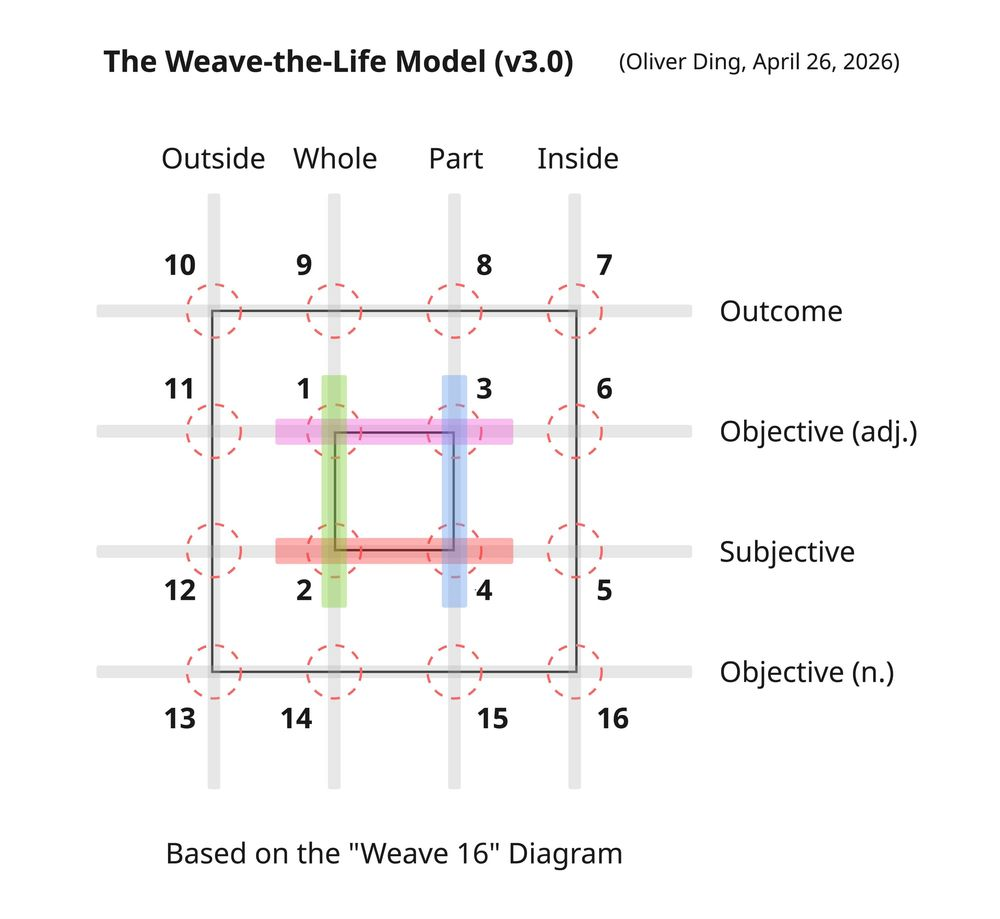
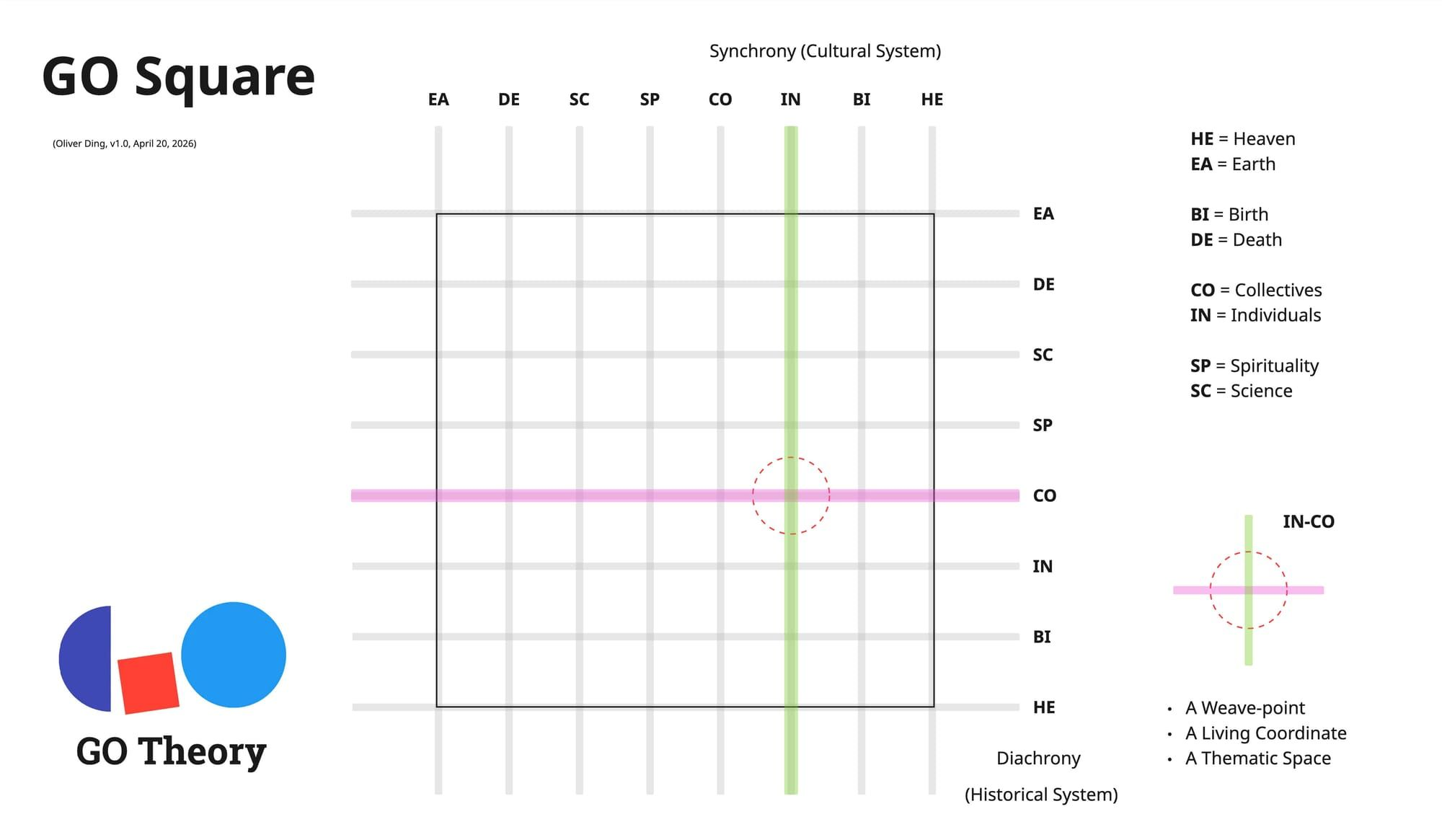
In April 2026, while working on the Weave 42 project, I developed a new version of the Weave Basic Form, a 4×4 edition that I call the Weave 16 diagram. Based on the new diagram, I created the Weave-the-Life framework (v3.0) and used it to curate 16 key concepts of the Life-as-Activity Approach. The same idea is applied to developing GO Square: the Weave 8×8 edition produces 64 GO coordinates for mapping concept systems within the GO Theory framework. Yet, there are more creative elements I curated within this version, especially the following three ideas:
- Weave-points
- Living Coordinates
- Thematic Spaces
These three ideas come from three different knowledge systems:
- Weave knowledge system
- The World of Activity Approach
- Thematic Space Theory
This expansion from 2×2 to 4×4 and 8×8 can be considered as Weave 2.0 — not only a scale expansion, but the moment when the Weave knowledge system found its own unit of analysis.
This article reflects on this creative development. It uses two analytical frameworks — Creative Confluence and the Sandglass Model — to examine how Weave 2.0 came about and where the Weave knowledge system now stands.
The title of this article carries a meaning worth making explicit. One diachronic line crosses one synchronic line — and their intersection is a Living Coordinate. This crossing is not merely a diagrammatic convention. It is Weave 2.0's unit of analysis: the simplest form in which the whole system is already present.
The two lines come from the Weave knowledge system; the Living Coordinate is what their intersection produces within the World of Activity Approach; and each such coordinate opens onto a Thematic Space — the populated territory that Thematic Space Theory names and studies. The unit of analysis thus connects three theoretical enterprises in a single structural gesture. Weave 2.0 is not only a scale expansion from 2×2 to 4×4 and 8×8. More fundamentally, it is the moment when the Weave knowledge system found its own unit of analysis.
Contents
1. Weave 2.0: Discovering a Unit of Synthesis
1.1 The Expansion: From 2×2 to 4×4 and 8×8
1.2 The Discovery: A Unit of Synthesis
1.3 Internal Sublimation: Beyond the Diagram
1.4 External Expansion: Three Knowledge Systems in Synergy
1.5 Weave 2.0: A Threshold
2. Creative Confluence: The Three Streams
2.1 The First Stream: Weave Knowledge System
2.2 The Second Stream: World of Activity Approach
2.3 The Third Stream: Thematic Space Theory
2.4 Three Streams, Three Contributions
3. Creative Confluence: Creative Elements and Creative Center
3.1 Three Creative Elements
3.2 A New Creative Center: The Leeway Model
4. Creative Confluence: The Meta-framework
5. From Creative Confluence to the Sandglass Model
6. The First Wave: Core
7. The Second Wave: Two Single-Point Breakthroughs
7.1 Weave-the-Life
7.2 Weave-the-Theory
8. The Third Wave: Creative Dialogue and Weave 2.0
8.1 The Weave-the-Bagua Dialogue
8.2 The Weave 16 Diagram
8.3 The GO Square (Weave 8×8 edition)
9. A Summary: Milestone and Opening
Postscript
Leeway, A New Member of Cognitive Hydrology
1. Weave 2.0: Discovering a Unit of Synthesis
The Weave knowledge system has been developing since October 2025. In the months that followed its introduction, it generated a series of derived frameworks, two major books, and a growing toolkit of analytical instruments. Each of these developments was significant in its own right.
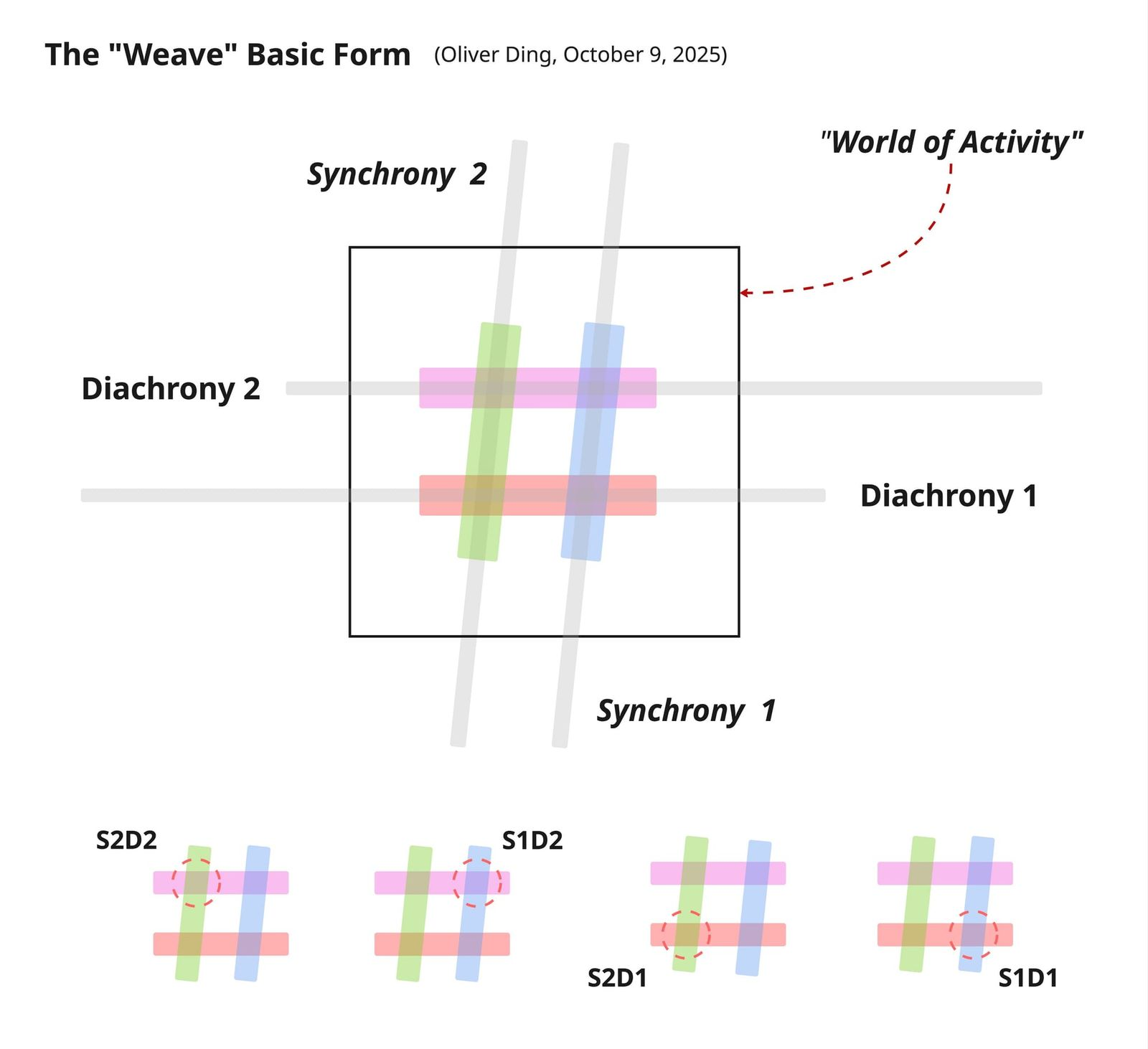
But recent months have brought something different in kind — not more development along the same lines, but a qualitative change in what the system is. The Weave knowledge system has crossed a threshold. It has found its generative principle, established structural bonds with two other knowledge systems, and arrived at a form capable of principled extension at any scale in any direction. This is a milestone. Weave 2.0 names it.
1.1 The Expansion: From 2×2 to 4×4 and 8×8
The Weave Basic Form was introduced in October 2025 as a 2×2 structure: two diachronic dimensions crossing two synchronic dimensions, producing four weave-points. It was a generative diagram — compact, structurally complete, capable of being applied to different domains. In April 2026, working on the Weave 42 project, this structure was expanded to a 4×4 edition: the Weave 16 diagram, with sixteen weave-points.
The same logic was then extended to an 8×8 edition — the Go Square — producing sixty-four coordinates for mapping concept systems within the GO Theory framework.
This expansion from 2×2 to 4×4 and 8×8 is what this article calls Weave 2.0. But the scale expansion is not the most important thing that happened. More important is what the expansion revealed: a unit of synthesis.
1.2 The Discovery: A Unit of Synthesis
In Unit of Analysis, Unit of Synthesis, and Configurational Theory (Part 6 of Weave the Theory), four distinct uses of "unit of analysis" are distinguished. The deepest — Vygotsky's sense — is the unit of synthesis: not a boundary drawn around a phenomenon for analytical convenience, but the simplest form in which the whole is already fully present. Word meaning, for Vygotsky, was such a unit: it contained verbal thought in its essential structure, and nothing about that structure would be lost by starting the analysis there.
As the Weave 16 diagram developed, it became clear that each coordinate position was not merely a structural intersection. It was simultaneously a Weave-point (a position defined by the intersection of axes), a Living Coordinate (a position an actor can inhabit and move through), and a Thematic Space (a populated territory of concepts, cases, and tools). These three aspects were not added to the diagram from outside — they were discovered within it. One diachronic line crossing one synchronic line produces a Living Coordinate; every such coordinate opens onto a Thematic Space.
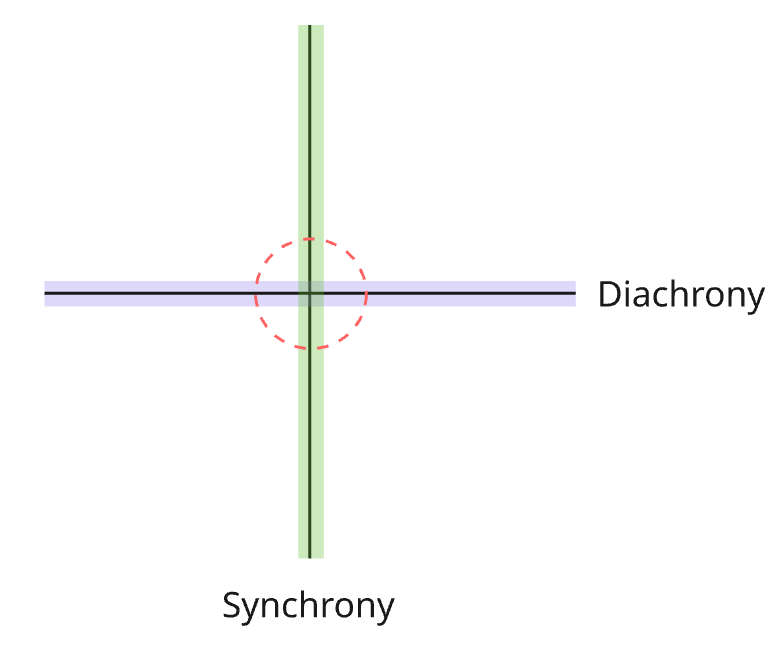
This is the unit of synthesis: the smallest structural unit from which the entire 16-point and 64-point architecture can be derived.
1.3 Internal Sublimation: Beyond the Diagram
This discovery carries a deeper implication — one that reaches back before the 2×2 diagram itself. The Weave Basic Form was introduced as a 2×2 structure: four weave-points, two diachronic lines, two synchronic lines. It was understood as foundational. But the unit of synthesis discovered through the Weave 16 development reveals that the 2×2 is not the Basic Form in the deepest sense. It is one level of resolution — a specific instantiation of something more fundamental. The truly basic unit is not the 2×2 grid; it is the single crossing: one diachronic line meeting one synchronic line, producing a Living Coordinate that opens onto a Thematic Space. The 2×2 is four such crossings; the 4×4 is sixteen; the 8×8 is sixty-four. All of them are expressions of the same basic unit at different scales.
This realization marks a significant maturation of the Weave knowledge system. A knowledge system that has found its unit of synthesis has found its generative principle — the simplest form from which all its elaborations can be derived. Before this discovery, the Weave knowledge system had a Basic Form diagram. After it, the system has a foundational logic. The difference is substantial: a diagram can be applied, but a foundational logic can generate. The system is now capable of principled extension in any direction, at any scale, because the generative principle is explicit.
1.4 External Expansion: Three Knowledge Systems in Synergy
Moreover, the connection among Weave-point, Living Coordinate, and Thematic Space does more than establish a unit of synthesis within the Weave knowledge system. It creates a structural bond between the Weave knowledge system and two other knowledge systems — the World of Activity Approach and Thematic Space Theory — that had previously developed in parallel. Each system now supports and amplifies the others: the Weave knowledge system provides the structural architecture; the World of Activity Approach provides the actor's inhabitation of that architecture; Thematic Space Theory provides the populated territory that gives each position its analytical depth. This is not integration by absorption — each system retains its own identity and developmental logic — but synergy: the three systems together can do what none could do alone. This is the external expansion of Weave 2.0.
1.5 Weave 2.0: A Threshold
Internal sublimation and external expansion together mark a threshold. The Weave knowledge system is no longer primarily a diagram — a useful structural form that can be applied to different domains. It is now a powerful, multi-dimensional, extensible, and adaptive knowledge system: internally grounded in a generative principle, externally connected to two other knowledge systems through structural bonds, and capable of principled development at any scale. Weave 2.0 names this threshold.
The discovery that this unit connects three different knowledge systems — the Weave knowledge system, the World of Activity Approach, and Thematic Space Theory — is what makes it a moment of Creative Confluence, and what the following sections analyze.
2. Creative Confluence: The Three Streams
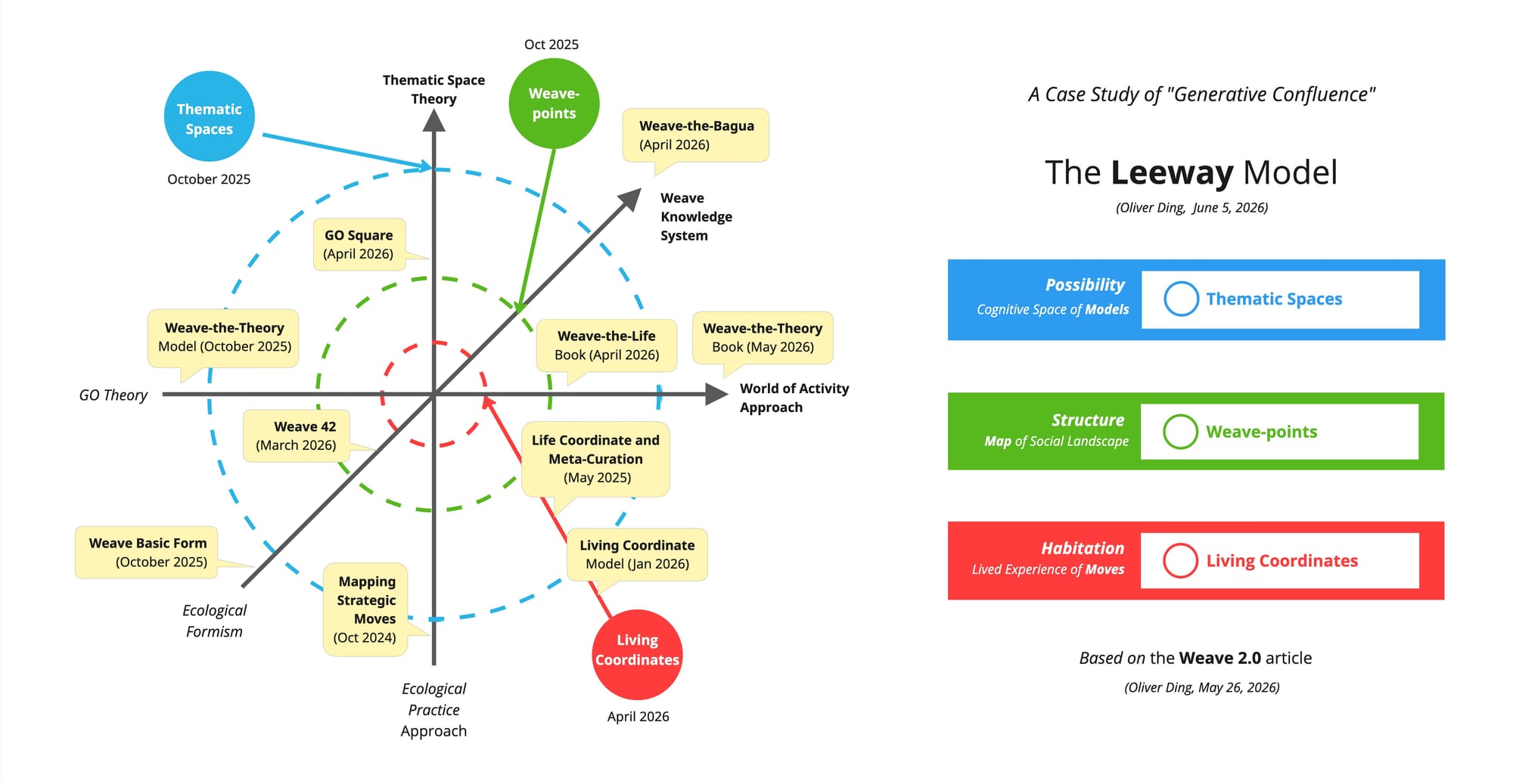
The Creative Confluence model — a simplified version of the full eight-movement Generative Confluence pattern — examines a creative development through four components: creative resources, developmental episodes, new creative center, and meta-framework. A detailed case study applying this model can be found in Generative Confluence: Theoretical Activity, Theoretical Enterprise, and Theoretical Platform (May 24, 2026). This section applies the same model to identify the three creative resources that fed the confluence producing Weave 2.0.
2.1 The First Stream: Weave Knowledge System
The Weave knowledge system is the first stream. Originating in October 2025 with the introduction of the Weave Basic Form, this system developed through a series of derived frameworks — Weave-the-Theory, Weave-the-Life, Weave-the-Enterprise, Weave-the-Culture — each applying the same structural logic to a different domain.
The core contribution of this stream to Weave 2.0 is the Weave-point: the structural intersection of diachronic and synchronic dimensions, a positional coordinate within a knowledge architecture. The Weave 16 diagram (the 4×4 expansion) is the most developed form of this contribution — not only four weave-points but sixteen, each potentially opening onto an entire sub-system of knowledge.
2.2 The Second Stream: World of Activity Approach
The World of Activity Approach is the second stream. This is the broader theoretical platform within which the Weave knowledge system developed, encompassing the Life-as-Activity Approach, Activity Theory, and several other theoretical enterprises organized around the structure of human activity in social life.
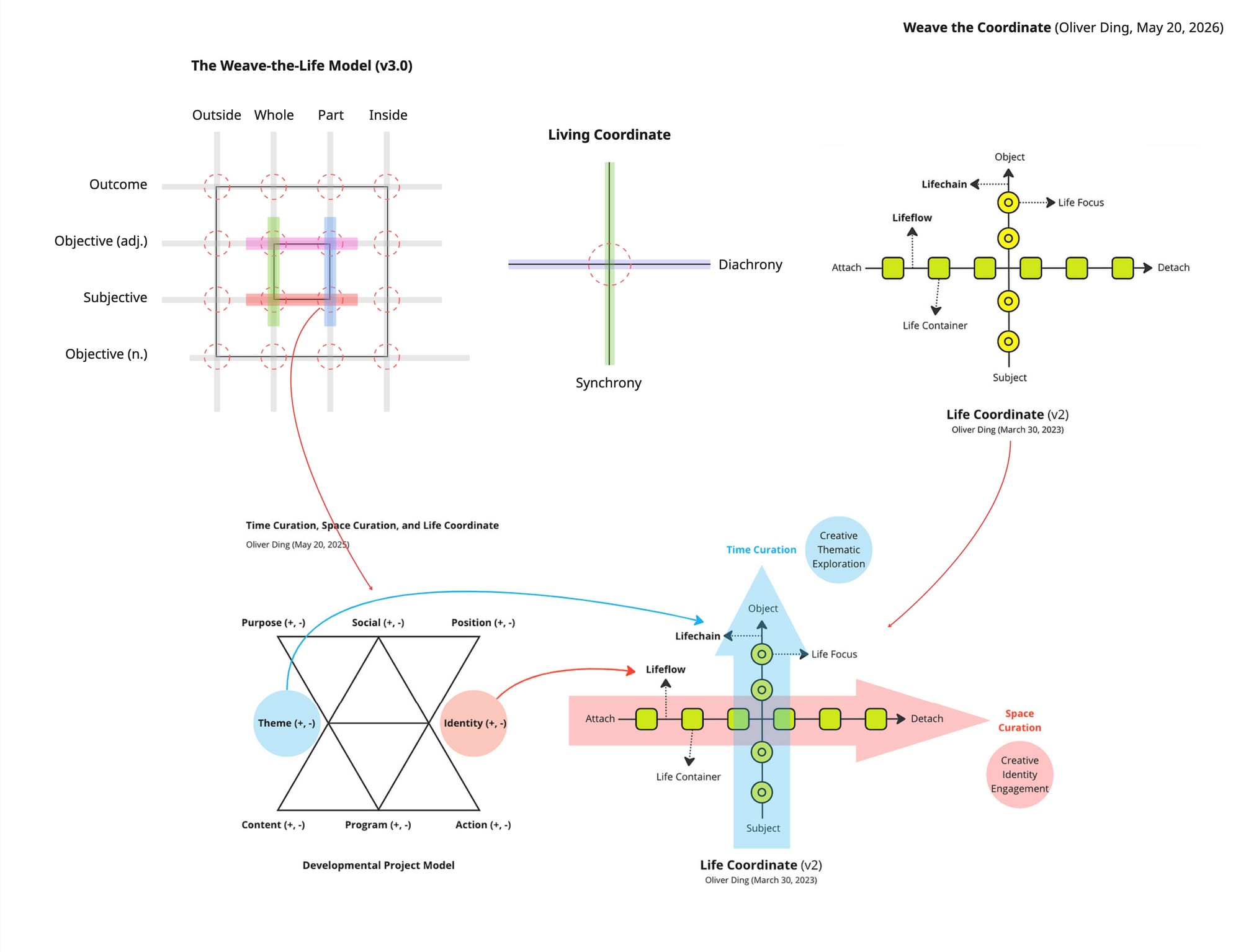
Its contribution to Weave 2.0 is the Living Coordinate. The life coordinate model was first incorporated into the World of Activity Toolkit v1.0 in 2025. Then, based on the life coordinate model, I created the living coordinate model in January 2026. Finally, in the Weave the Life v3.0 model (April 2026), I articulated the connection between weave-points and living coordinates. The Living Coordinate gives the abstract weave-point a human inhabitable form: it is not merely a structural intersection but a position that an actor can occupy, navigate from, and develop within.
2.3 The Third Stream: Thematic Space Theory
Thematic Space Theory is the third stream. Developed since 2022 through the Knowledge Discovery Canvas and related work, Thematic Space Theory understands each named theoretical or creative territory as a structured space — with its own concepts, cases, tools, and developmental history — that a researcher enters, inhabits, and contributes to.
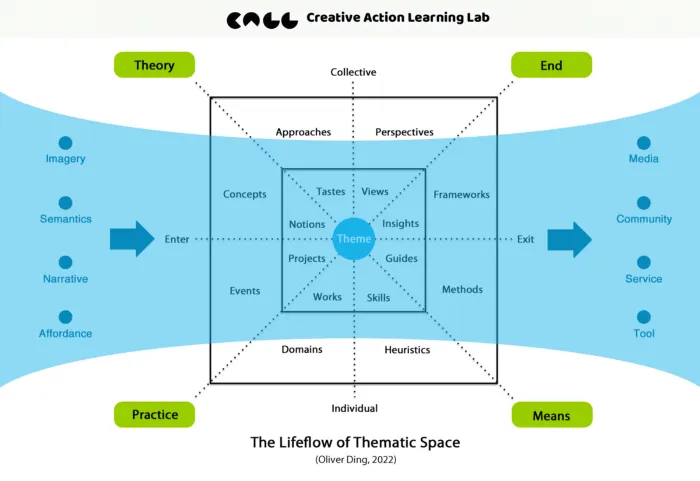
Its contribution to Weave 2.0 is the Thematic Space itself: the understanding that each coordinate in the Weave 16 diagram is not merely a structural position but a populated territory. The Go Square's 64-fold system is the fullest expression of this contribution: sixty-four thematic spaces, each a stable structural position whose conceptual contents vary across cultural and historical time while their relational position remains invariant.
2.4 Three Streams, Three Contributions
The three streams were not developed in isolation from each other. The Weave knowledge system emerged within and draws on the World of Activity Approach; Thematic Space Theory was developed partly through the same research activities. But their contributions to Weave 2.0 are distinct: Weave-point provides the structural architecture, Living Coordinate provides the actor's inhabitation of that architecture, and Thematic Space provides the populated territory that makes each position analytically substantive.
3. Creative Confluence: Creative Elements and Creative Center
In the Creative Confluence model, creative resources are the streams that feed the confluence — the knowledge systems or theoretical enterprises whose encounter makes the confluence possible. Creative elements are the conceptual building blocks that emerge from within those streams and become the constituents of the new creative center. The distinction matters: the three streams identified in Part 2 (Weave knowledge system, World of Activity Approach, Thematic Space Theory) are the creative resources; the three concepts they contribute — Weave-point, Living Coordinate, Thematic Space — are the creative elements. The new creative center is what the creative elements form when they converge into an integrated whole.
This section examines the three creative elements and the new creative center they produce.
3.1 Three Creative Elements
Before the confluence, the three concepts existed separately: Weave-point as a structural position, Living Coordinate as the actor's developmental orientation, Thematic Space as a populated knowledge territory. Each was analytically useful on its own. After the confluence, they are three dimensions of a single integrated understanding — three aspects of what it means to inhabit a position within any structured space of human activity:
- Structure (Weave-point): the given positional architecture of the environment — where the actor is located within the diachronic and synchronic grid
- Habitation (Living Coordinate): the actor's lived experience of dwelling in and moving through that position over time — the developmental trajectory from the inside
- Possibility (Thematic Space): the dynamic cognitive space of what can be explored, reflected upon, and created from within that position — the open territory that gives each position its generative character
3.2 A New Creative Center: The Leeway Model
The new creative center of Weave 2.0 is the Leeway Model — a conceptual object that names what the three creative elements, taken together, reveal. The name leeway captures the essential insight: the environment provides structure, the actor is situated within it, but the actor retains many possibilities for movement. Leeway is not freedom from structure — the Weave-point is given, the axes are fixed — but freedom within structure: the range of moves, trajectories, and cognitive explorations that remain available at any given position. This condition is not specific to knowledge ecology. It applies wherever structure and freedom coexist — which is everywhere that human activity occurs.
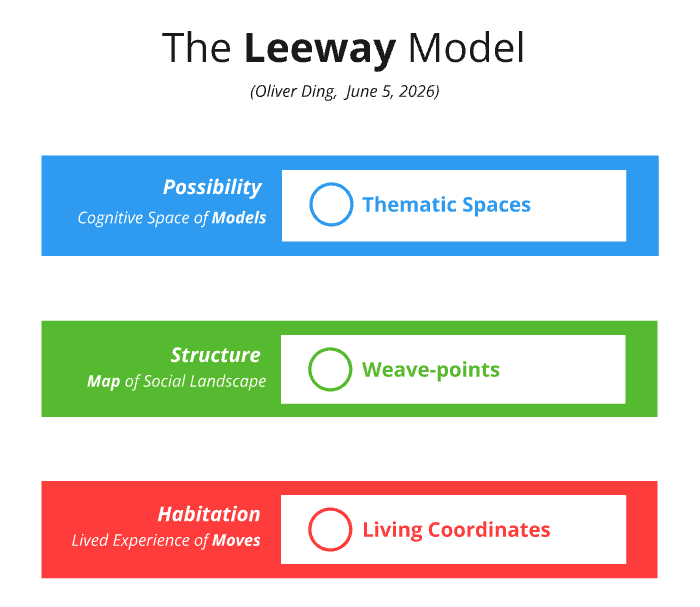
The Leeway Model is a unit of synthesis in Vygotsky's sense: the smallest form in which the whole relationship between structure, habitation, and possibility is already fully present. One diachronic line crossing one synchronic line produces a Living Coordinate — and every such coordinate is simultaneously a Weave-point, a Living Coordinate, and a Thematic Space. The scale expansion from 2×2 to 4×4 to 8×8 is the unfolding of this unit at different levels of resolution, not the addition of new structure.
This convergence parallels the Creative Confluence documented in Generative Confluence: Theoretical Activity, Theoretical Enterprise, and Theoretical Platform (May 24, 2026). In that case, three concepts from three different theoretical enterprises converged to produce a new creative center. Here, three concepts from three different knowledge systems converge to produce the Leeway Model. The structural pattern is the same: distinct streams, each maturing through its own developmental episode, meeting at the right moment within a shared platform.
4. Creative Confluence: The Meta-framework
The Creative Confluence model has four components: creative resources, developmental episodes, new creative center, and meta-framework. Parts 2 and 3 have covered three of them: creative resources (the three knowledge system streams), creative elements and new creative center (the Leeway Model). The developmental episodes — the trajectories through which each creative element matured — are not addressed in a dedicated section here; instead, they are taken up by the Sandglass Model analysis in Parts 6–8, which traces the three waves of the Weave knowledge system's development. This section addresses the fourth component: what is the meta-framework that organizes the case and shows how the three creative elements relate?
In the Generative Confluence case study (May 24, 2026), the meta-framework was the Weave-the-Life Model — an existing framework that provided the structural vocabulary for showing how three concepts from three different enterprises were connected. The meta-framework is not one of the contributing streams. It is the overarching conceptual structure that makes the relationships among the creative elements visible and analytically articulable.
For the Weave 2.0 case, the Leeway Model — introduced in Part 3 as the new creative center — is itself a case-driven theoretical discovery. But it is not the meta-framework. The meta-framework is what organizes the Leeway Model within a larger methodological structure. The natural home for the Leeway Model is the LARGE Method — the meta-method developed in February 2026 that unifies all of the author's methods under five principles: L (Landscape), A (Anticipation), R (Reflection), G (Generation), and E (Enterprise). The three dimensions of Leeway map onto LARGE's dimensions precisely:
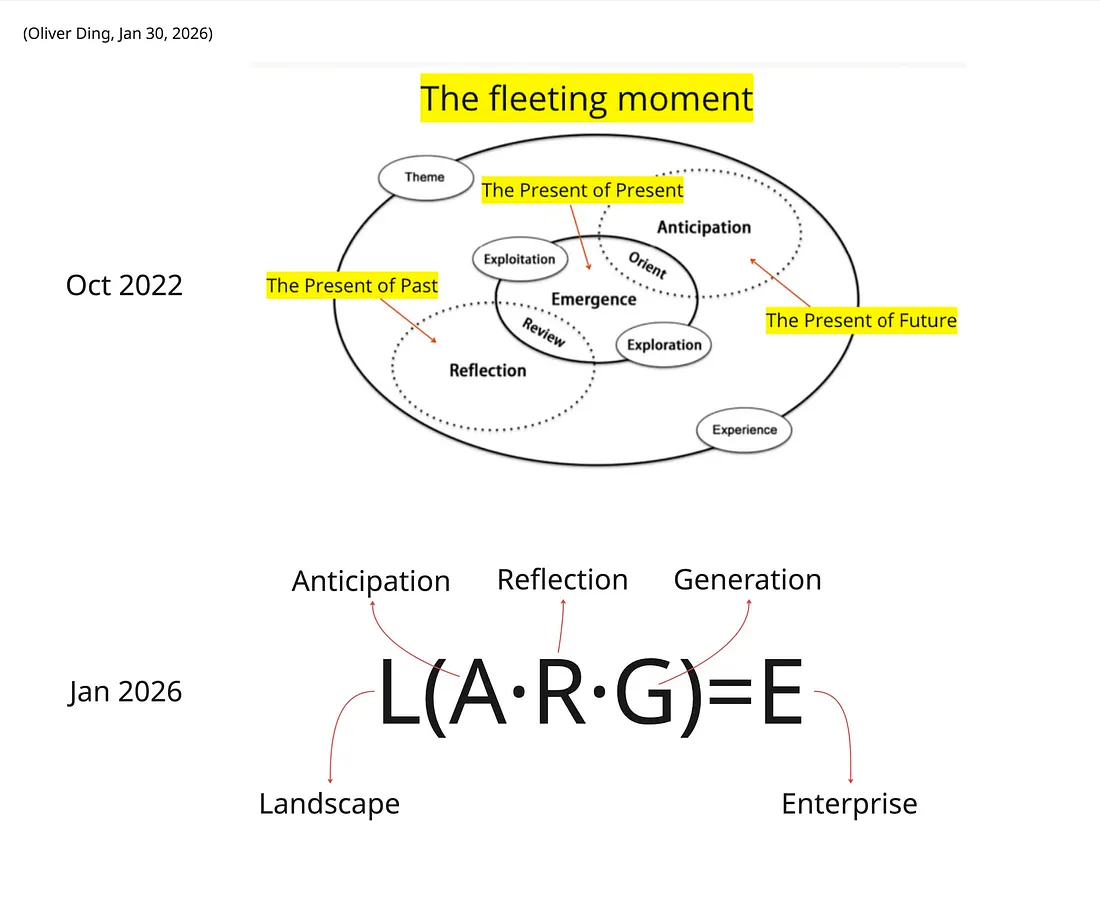
Structure (Weave-point) → L (Landscape): Landscape is the synchronic view of the whole — the capacity to see the full structural terrain at any given moment. A Weave-point is a position on that terrain. The structural dimension of Leeway is the map.
Habitation (Living Coordinate) → E (Enterprise): Enterprise is the diachronic unfolding of projects — the historical arc of a sustained trajectory lived from the inside. A Living Coordinate is the actor's experience of that unfolding: attachments, detachments, developments. The habitation dimension of Leeway is the lived journey.
Possibility (Thematic Space) → A·R·G (Anticipation, Reflection, Generation): A Thematic Space is the dynamic cognitive arena within which an actor anticipates future possibilities, reflects on accumulated history, and generates new knowledge in the present. The possibility dimension of Leeway is the cognitive movement within the space.
The Leeway Model thus covers the full structure of LARGE: L (map), E (journey), A·R·G (cognitive dynamics). It is a methodological integration — not a structural finding about the Weave knowledge system, but a claim about how any actor inhabits any structured space of human activity. Its scope is not limited to knowledge ecology; it applies wherever structure and freedom coexist, which is everywhere that human activity occurs.
5. From Creative Confluence to the Sandglass Model
The Creative Confluence analysis identifies three streams and a new creative center. But it leaves one question open: when did each stream mature to the point where confluence became possible? The model names developmental episodes as a component but does not itself provide the vocabulary for tracing them in detail.
While working through the Creative Confluence analysis, I noticed an unexpected structural correspondence. Each of the three streams had its own developmental trajectory — and when I placed these trajectories side by side, they fell into a recognizable pattern. The Weave knowledge system had a clearly marked originating moment (October 2025), a period of extension through derived frameworks, and a culminating synthesis. The World of Activity Approach had a sustained development through the Weave the Life and Weave the Theory book projects, each a single-point breakthrough in a different direction. Thematic Space Theory had grown through successive applications — from the Knowledge Discovery Canvas to the GO Square — each operating at a larger scale than the previous.
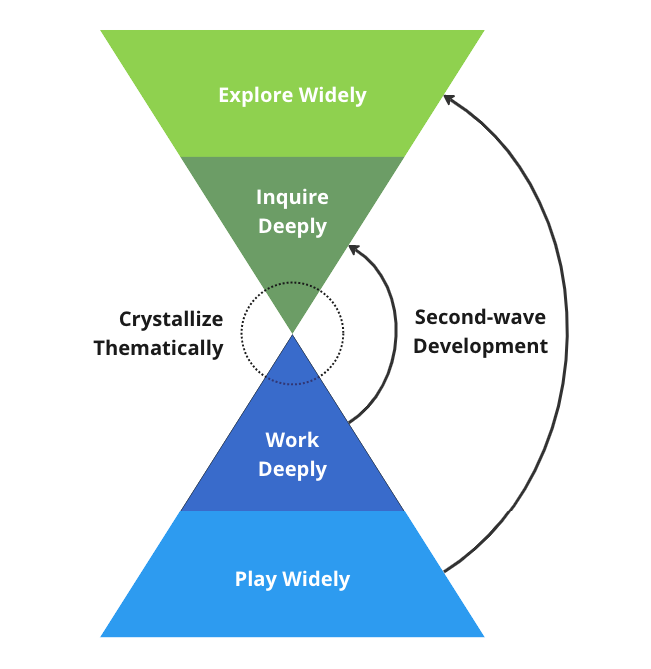
These three trajectories were not sequential. They overlapped and interacted. But together, they organized naturally into three distinct phases: an originating phase in which the Core was established, an extension phase in which the Core branched in parallel directions, and a dialogue phase in which the system encountered other knowledge systems and was transformed by the encounters.
This three-phase pattern is precisely what the Sandglass Model (the Creative Thematic Curation Framework) describes as three waves of development. The correspondence was not designed — it was discovered in the course of the analysis. And once noticed, it suggested a second analytical pass: using the Sandglass Model to trace the developmental arc of the Weave knowledge system as a whole, rather than only the convergence that produced Weave 2.0. The three developmental episodes of the Creative Confluence analysis become, in the Sandglass reading, the three waves of a single developmental arc.
6. The First Wave: Core
The first wave crystallized in October 2025 with the introduction of the Weave Basic Form. Its form was not a book manuscript or a board, but a structural insight recorded in working notes: two diachronic dimensions and two synchronic dimensions, crossing to produce four weave-points. The recognition felt, as it arrived, like something that had always already been true.
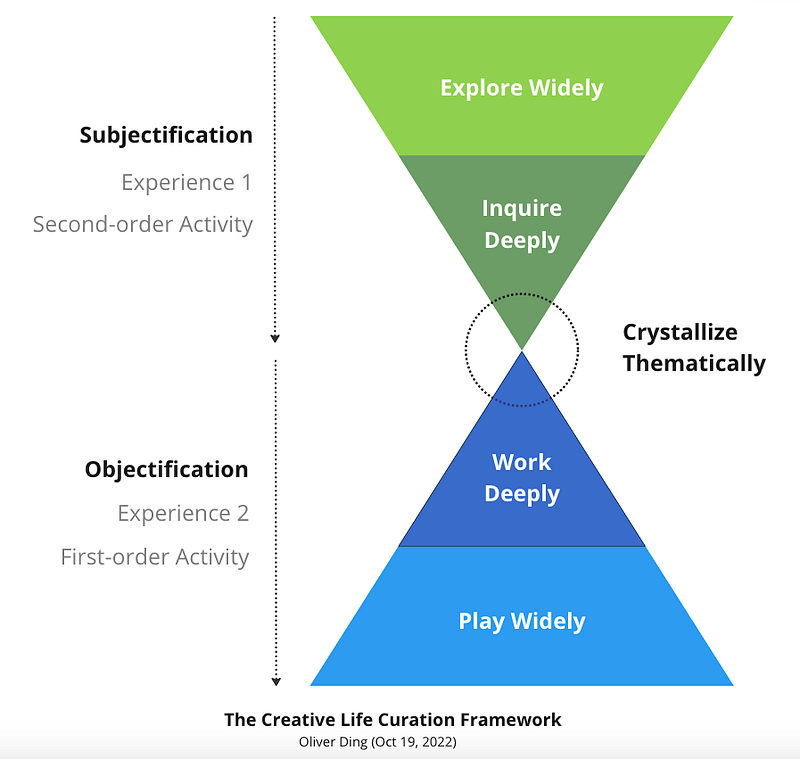
The Work Deeply stage followed immediately. The Basic Form was applied to a series of knowledge projects — Weave-the-Theory, Weave-the-Life, Weave-the-Enterprise, Weave-the-Culture — each a derived framework applying the same structural logic to a different domain. This proliferation was not arbitrary; it demonstrated that the Basic Form was genuinely generative: the same four-point structure produced analytically useful results across domains as different as theoretical activity, life development, enterprise analysis, and cultural development.
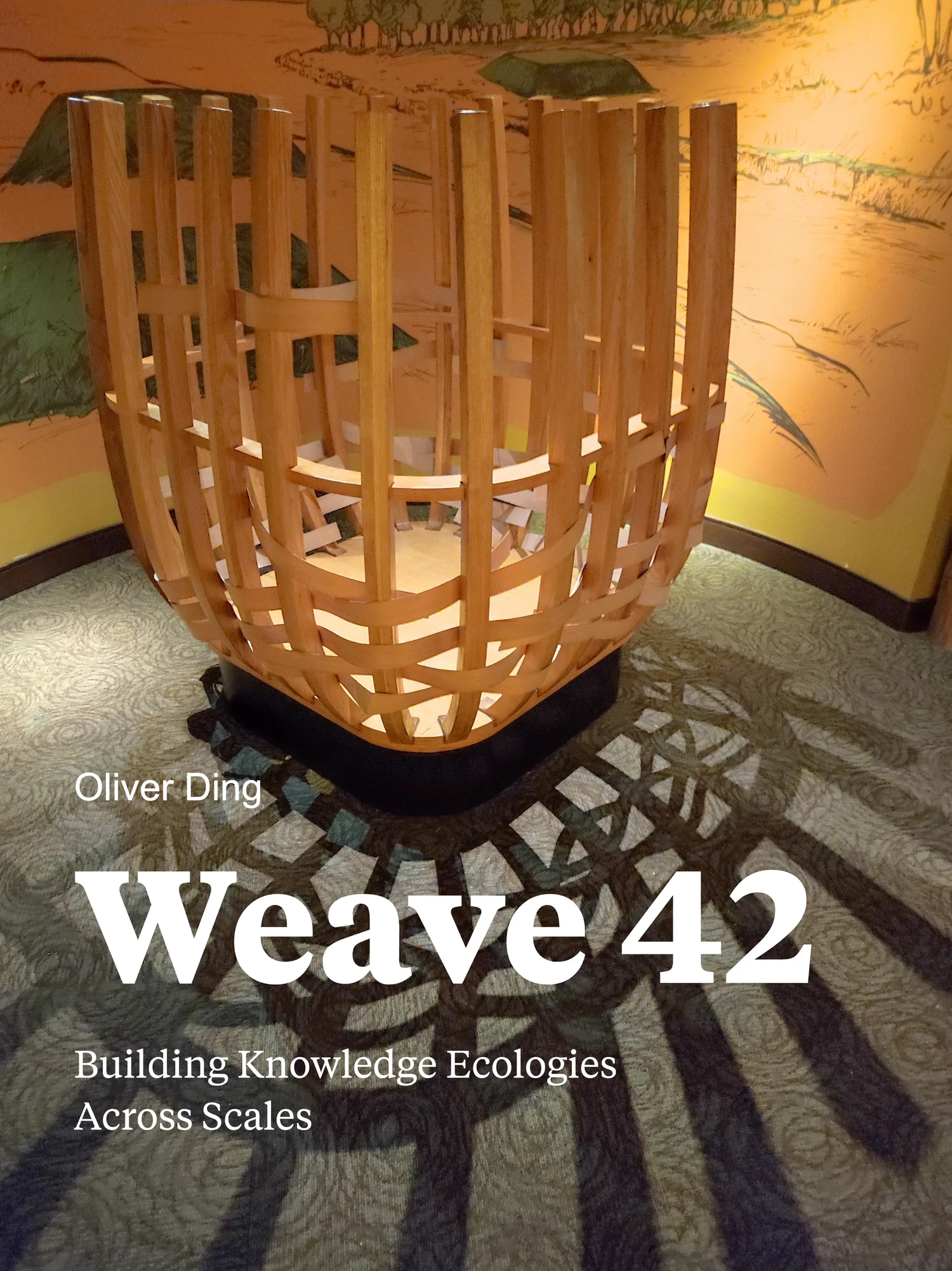
The Play Widely stage of the first wave was the Weave 42 project (March 2026), which produced the first systematic account of the full Weave knowledge system: its Basic Form, its derived frameworks, their relationships, and their shared structural logic. Weave 42 marked the end of the first wave — the moment when the framework had been used enough to be documented as a system and communicated beyond the creator.
The first wave established the Core. The Weave Basic Form was not yet a toolkit or a multi-level architecture. It was a generative seed — structurally complete in itself, but not yet branching into the Extensions that the second wave would produce.
7. The Second Wave: Two Single-Point Breakthroughs
The second wave developed through two parallel single-point breakthroughs, each extending the Weave Basic Form into a specific domain with its own accumulated materials and questions. The two breakthroughs were not coordinated; they developed simultaneously in April and May 2026, each following its own internal logic.
7.1 Weave-the-Life
Weave-the-Life applied the Basic Form to the Life-as-Activity Approach, culminating in the Weave the Life book (April 2026) and the Weave-the-Life Framework (v3.0). This was a breakthrough in the direction of individual development: the four dimensions of the Basic Form — Subjective, Objective, Part, Whole — became the organizing logic for sixteen key concepts of LAA v4.0, giving the approach its first high-resolution spatial map. The Living Coordinate emerged from within this development as the model of the actor — the innermost ring of the five-ring structure that the framework places at its center.
7.2 Weave-the-Theory
Weave-the-Theory applied the Basic Form to theoretical activity, culminating in the Weave the Theory book (May 2026, v1.1). This was a breakthrough in the direction of knowledge ecology: the two diachronic lines (Creativity / Curativity) and two synchronic dimensions (Aspects / Approaches) became the analytical vocabulary for understanding how theoretical enterprises develop, how theoretical traditions maintain their identity across generations, and how contributors find and actualize the creative opportunities a tradition makes available. Through the case study series, the Basic Form generated a nine-tool toolkit — not by design, but through the demands of the cases themselves.
The two breakthroughs were parallel in time and complementary in direction: one oriented toward the actor's inner development, the other toward the ecology of knowledge within which that development occurs. Together, they constituted the Extension phase of the second wave — the Core branching outward in two directions simultaneously. This mirrors the structural logic of the Weave Basic Form's parent system: Ecological Formism treats the Weave knowledge system as one of its Extensions. Now the Weave Basic Form has its own family of Extensions, each a single-point breakthrough in a different direction, each reproducing at a new level the Core-Extension structure that governs the parent system.
8. The Third Wave: Creative Dialogue and Weave 2.0
The third wave was different in character from the first two. Where the first wave built the Core and the second wave extended it into specific domains, the third wave involved encounter — the Weave knowledge system meeting other knowledge systems and being transformed by the meeting. Three encounters define this wave, and together they constitute Weave 2.0.
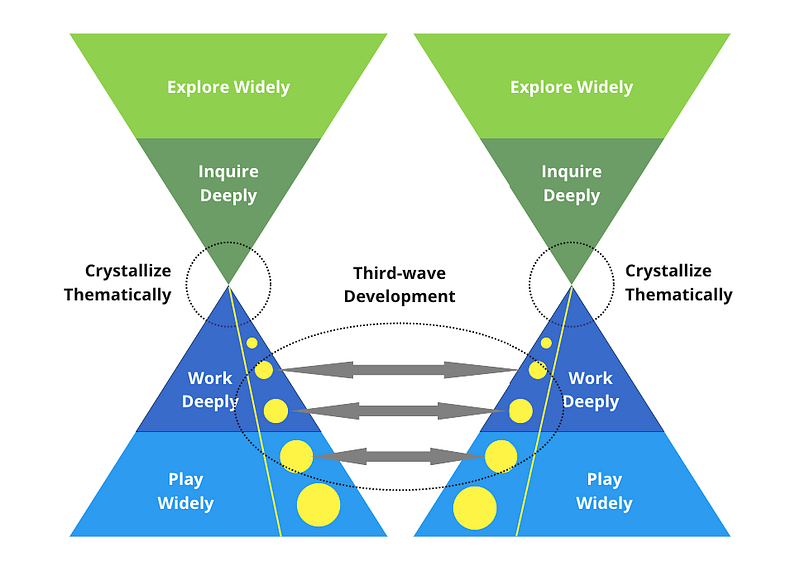
8.1 The Weave-the-Bagua Dialogue
The Weave-the-Bagua dialogue began in April 2026 as a sustained exploration of the structural relationship between the Weave knowledge system and the Yinyang-Bagua knowledge system. This was not an application of one to the other, but a genuine creative dialogue: two structural vocabularies developed in entirely different cultural and intellectual contexts, placed in conversation to discover whether their formal logics resonated. The exploration revealed a structural correspondence between the eight elements of the GO Square boundaries and the eight trigrams of the Bagua — not a coincidence of content, but a convergence of form. Both systems use a combinatorial logic to generate a structured universe from a small number of foundational elements; both treat the resulting coordinates as stable structural positions whose content varies across historical time while their relational logic remains invariant. The dialogue raised the deepest version of the genidentity question: what persists in a knowledge system across cultural translation? This question had been implicit in the Genidentity Analysis Method developed in Weave the Theory; the Bagua dialogue made it explicit at the scale of civilizational knowledge systems.
8.2 The Weave 16 Diagram
The Weave 16 diagram (4×4 edition) emerged from the same April period. The original 2×2 Basic Form had served well as a conceptual anchor, but it could not hold the full architecture that the second wave's breakthroughs had revealed was needed. The 4×4 expansion — sixteen weave-points instead of four — was not simply a scaling-up. It introduced the nesting capacity that the earlier version lacked: each weave-point could now function as a thematic space opening onto an entire sub-system of knowledge. Frameworks that had previously required separate diagrams could be integrated into a single spatial argument. The Weave-the-Life Framework (v3.0), built on this expanded foundation, demonstrated the capacity in practice: sixteen key concepts of the Life-as-Activity Approach, previously distributed across separate diagrams, organized into a single coordinated map.
8.3 The GO Square (Weave 8×8 edition)
The Go Square (Weave 8×8 edition) extended the logic to the scale of the Symbolic Universe. By merging the eight boundaries of the World of Activity (Heaven, Earth, Birth, Death) and the World of Life (Collectives, Individuals, Spirituality, Science) into a unified coordinate system, Go Square produced sixty-four thematic spaces — a stable reference map for locating any concept system within the landscape of human meaning-making. The synchronic-diachronic weave logic of the Basic Form now operated at the scale of cultural history: the internal contents of the sixty-four spaces change across time, while their structural positions remain invariant. This is the Weave Basic Form's principle expressed at its widest possible scope.
The three encounters — Bagua dialogue, Weave 16, Go Square — are not independent. The Bagua dialogue raised the question of formal structural universals; the Weave 16 diagram provided the expanded architecture that made the question analytically tractable; and the Go Square demonstrated what a universal structural map looks like when the logic is followed to its fullest extension. Together, they constitute the third wave's creative core: the Weave knowledge system discovering, through encounter with other knowledge systems, what its own structural logic implies at scales and in contexts it had not yet reached. Weave 2.0 names the integrated outcome of these three encounters.
9. A Summary: Milestone and Opening
The two analyses converge on the same conclusion from different directions.
The Creative Confluence analysis shows that Weave 2.0 is the outcome of three streams meeting at the right moment within a shared platform. Each stream had matured through its own developmental episode; the confluence was not planned but discovered; and what emerged — the unit of analysis formed by one diachronic line crossing one synchronic line to produce a Living Coordinate — is something none of the streams could have generated alone.
The Sandglass analysis shows that Weave 2.0 marks the Crystallize Thematically moment of the third wave. The first wave built the Core; the second wave extended it in two parallel directions; the third wave encountered other knowledge systems and discovered what the Core implies at scales it had not yet reached. The Weave knowledge system has found its unit of analysis: the smallest structural unit from which the entire 16-point and 64-point architecture can be derived, and in which the connections among the three contributing knowledge systems are already fully implicit.
Together, they make clear that Weave 2.0 is a milestone — a point of arrival that is also a point of departure. What it has accomplished is real. What it has opened is also real: the third wave's Objectification phase has not yet fully unfolded. The Weave-the-Bagua dialogue has opened a question about the genidentity of knowledge systems across cultural translation that belongs to future work. The Weave the Method direction, opened by Part 6 of Weave the Theory, is beginning rather than ending. The Go Square's sixty-four thematic spaces are a research program, not a conclusion.
Postscript: Leeway, A New Member of Cognitive Hydrology
There is one more connection that Weave 2.0 makes visible — one that was implicit all along but only becomes clear at this milestone. The Leeway Model, named after the nautical concept of the freedom a vessel retains within the constraints of wind and current, belongs to a broader theoretical project: Cognitive Hydrology.
Cognitive Hydrology uses the metaphor of water — flow, confluence, delta, current — to describe how knowledge and creativity move through structured environments. Thematic Space Theory has been its foundation: thematic spaces are the terrain through which cognitive currents flow, accumulate, and transform. Spatial Heuristics is one of its three core dimensions — the capacity to navigate cognitive terrain through structural perception.
The Weave knowledge system, with its architecture of intersecting diachronic and synchronic lines producing Living Coordinates that open onto Thematic Spaces, is not merely compatible with Cognitive Hydrology. It provides the structural backbone that Cognitive Hydrology needs: a principled map of how cognitive spaces are organized and how actors navigate within them. The Leeway Model is the connective tissue — a nautical concept that names the freedom of movement available to any actor navigating a structured cognitive environment. Weave 2.0 is thus not only a milestone for the Weave knowledge system. It is the moment when the Weave knowledge system formally joins Cognitive Hydrology as one of its core members.
There is one more connection that Weave 2.0 makes visible — one that was implicit all along but only becomes clear at this milestone. The Leeway Model, named after the nautical concept of the freedom a vessel retains within the constraints of wind and current, belongs to a broader theoretical project: Cognitive Hydrology. Cognitive Hydrology uses the metaphor of water — flow, confluence, delta, current — to describe how knowledge and creativity move through structured environments. Thematic Space Theory has been its foundation: thematic spaces are the terrain through which cognitive currents flow, accumulate, and transform. Spatial Heuristics is one of its three core dimensions — the capacity to navigate cognitive terrain through structural perception.
The Weave knowledge system, with its architecture of intersecting diachronic and synchronic lines producing Living Coordinates that open onto Thematic Spaces, is not merely compatible with Cognitive Hydrology. It provides the structural backbone that Cognitive Hydrology needs: a principled map of how cognitive spaces are organized and how actors navigate within them. The Leeway Model is the connective tissue — a nautical concept that names the freedom of movement available to any actor navigating a structured cognitive environment. Weave 2.0 is thus not only a milestone for the Weave knowledge system. It is the moment when the Weave knowledge system formally joins Cognitive Hydrology as one of its core members.
There is a self-referential quality to this milestone that deserves to be named. The three-wave structure used throughout Weave the Theory to analyze Activity Theory, the Life-as-Activity Approach, and other theoretical enterprises is the same structure that describes the Weave knowledge system's own development. The Sandglass Model was built to describe how theoretical traditions develop. In tracing the Weave knowledge system's three waves, it describes its own developer. The framework has walked the path it describes. This is not a design decision. It is what happened.
v1.0 — May 26, 2026 - 5,552 words