
Appropriating Activity Theory #18: Revisiting and Rebuilding a Theoretical Tradition
This post is part of the "Appropriating Activity Theory" series, which reflects my creative journey of engaging with Activity Theory from 2015 to 2025.
by Oliver Ding
May 30, 2026
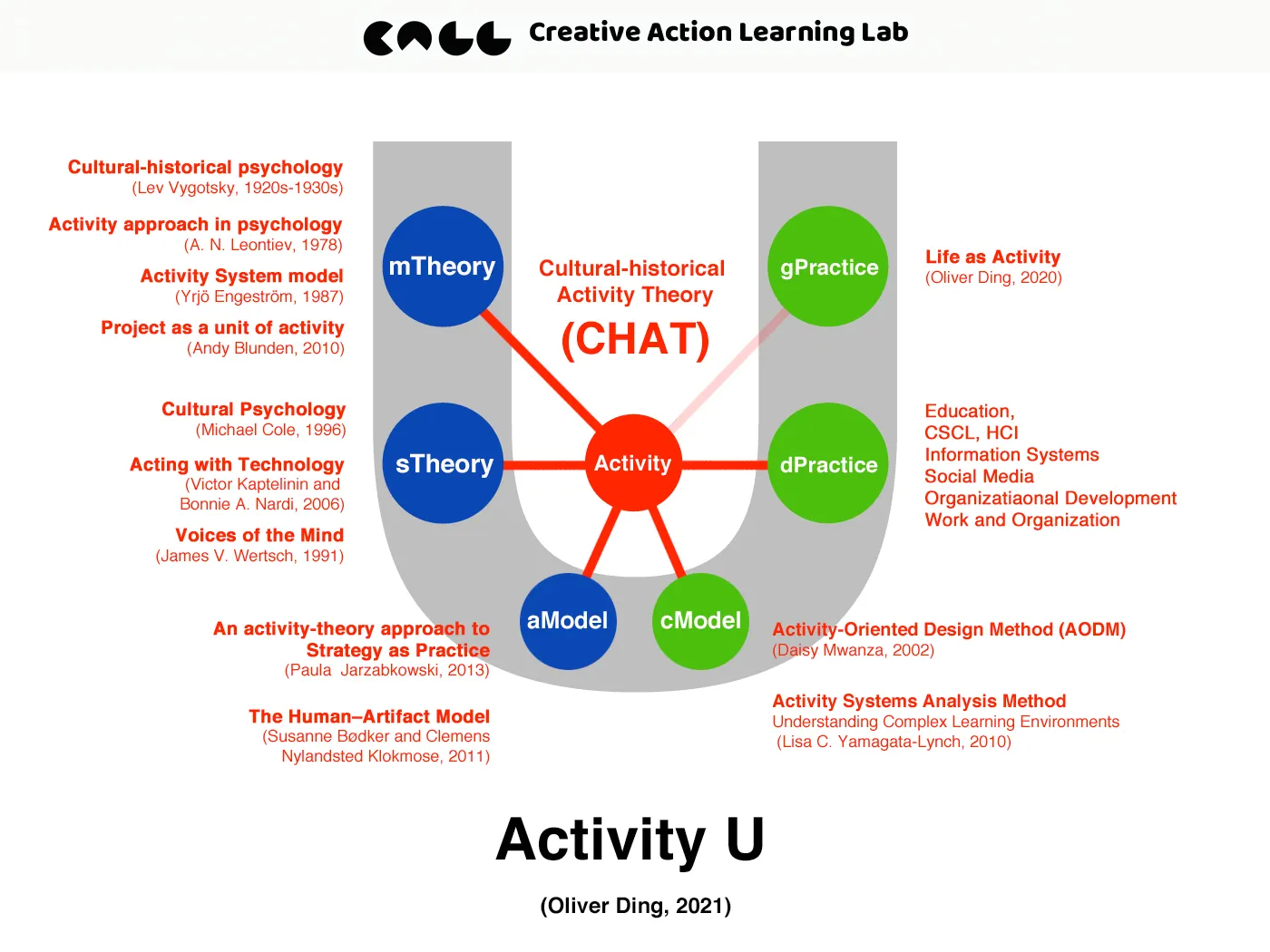
In 2020, I spent several months mapping the landscape of Activity Theory. The result was the Activity U project — a diagram that placed representative contributions across six types of knowing, from Meta-theory to General Practice. Each position on the diagram corresponded to several specific contributors and their works.
There was one exception. At the gPractice position (General Practice) I put a question mark.
I knew something belonged there. I could not yet name it.
Several months later, in 2021, I updated the diagram. The question mark was replaced by a name: Life as Activity (Oliver Ding, 2020) — a framework I had been developing, then at version 0.3.
In the years that followed, I returned to it irregularly. I set aside older versions, worked on other models, let it sit. And yet I kept coming back. Eventually I chose this name again — to give it to the entire body of activity-centered creations I had been building over many years. Last month, v4.0 was released as a possible book. A long arc, finally named.
Looking back at that journey now, I notice something I had not seen while living it. The pattern of returning — setting aside, continuing elsewhere, coming back at a different level — is exactly what I have recently named the Revisiting–Rebuilding strategy. And the more I look at my years of engaging with Activity Theory, the more I find the same pattern everywhere. RR is not just a creative technique. It may be one of the characteristic ways a creator appropriates a theoretical tradition over time.
This issue of the column is about three rounds of that practice, all compressed into the last month.
1
The story begins with a room.
In April 2022, I was reading a design thesis by an activity theorist. Something in the historical survey section caught my attention — not the content, but the structure underneath it. I reached for a notebook and began drawing by hand: a table with four rows, each row a different theorist, each row following the same pattern. An inherited dualism. A third element introduced. A new triadic structure.
- Vygotsky: Stimulus — Mediation — Response
- Leontiev: Individual Actions — Object-orientedness — Collective Activity
- Engeström: Object — System — Outcome
- Blunden: Practice — Concept — Sign
When I got home, I reproduced the table in Milanote and added a fifth row: my own work. Outside — Engagement — Inside. Activity as Project Engagement.
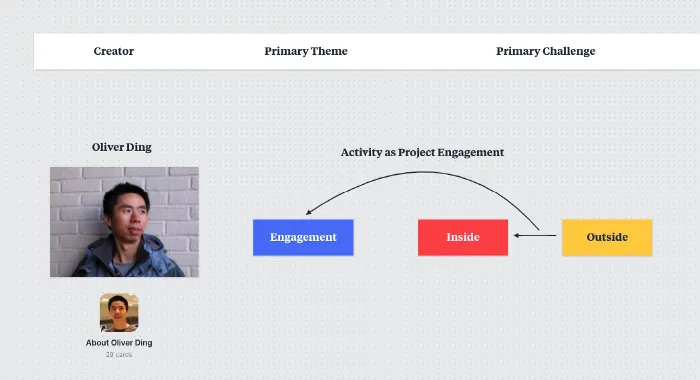
The table revealed something I had not been looking for: Activity Theory's coordination mechanism. Every major contributor had performed the same structural operation — inherited a dualism, introduced a third element, produced a triadic unity. The tradition's coherence across a century was not doctrinal. It was methodological.
I wrote this up as a note and set it aside. The observation was real. The tools to say precisely what it meant were not yet available.
That note sat for four years.
2
Last month, I released Weave the Life — a possible book on the Life-as-Activity Approach v4.0. One of its parts collected theoretical activity work, and inside that part was a chapter based on the 2022 note. I had included it because it belonged there. I also knew it was unfinished.
A few days after the book was released, I went back to the note. Not to revise it — to rebuild it. The Genidentity Analysis Method, the Meta-framework / Thematic Enterprise pairing, the distinction between Core Concept Systems and Coordination Mechanism — these were tools that had been developed in the months between 2022 and 2026. The 2022 note had identified the pattern. The 2026 rebuild could now name it precisely, explain why it had persisted across generations, and situate it within a broader account of how theoretical traditions maintain their identity through change.
Same structural discovery. Four years apart. Two entirely different levels of depth.
That rebuilt article — Revisiting the Genidentity of Activity Theory — was the first move. And it opened something I had not anticipated.
3
Once the Genidentity rebuild was done, I found myself looking at the 2020 Activity U articles differently.
The 2020 project had mapped the tradition's landscape. What it had not done — could not have done with the tools available then — was read the tradition's dynamics. Why had it remained coherent? How had it expanded across disciplines without fragmenting? What did it mean that Nardi spent thirty years building the tradition's institutional presence in North America, or that Spinuzzi kept returning to Activity Theory across book after book while always bringing another tradition with him?
These questions had answers now. I went back to the same contributors, the same cases, and rebuilt.
The Nardi article became the most unexpected of the series. I was reading about her career when I came across a satellite image of a river delta — water channels branching across a wide terrain, some deepening into stable courses, others narrowing and disappearing, new ecological zones forming at the intersections. Looking at that image, a concept arrived: Creative Delta. The moment when a theoretical tradition crosses disciplinary boundaries and begins branching across unfamiliar terrain — no longer a single concentrated stream, but a distributed landscape of channels, each developing its own ecology.
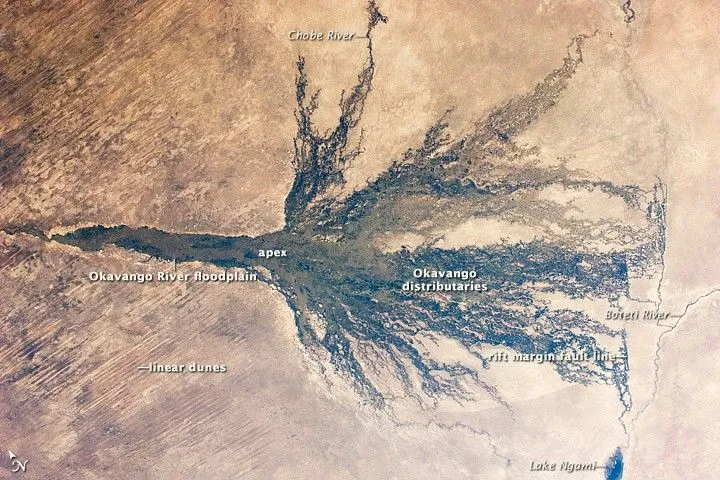
That image gave the Nardi article its organizing concept. Her contribution was not primarily theoretical — it was ecological. She built channels. She stabilized the tradition's presence in new terrain at exactly the moment when it was branching fastest.
Completing this series of articles changed the shape of the work itself. What had originally been one part of Weave the Life now had enough material — and enough momentum — to stand on its own. I detached it, expanded it, and released it as an independent possible book two weeks ago: Weave the Theory: The Art of Theoretical Activity and Knowledge Ecology.
4
There was a third round, which arrived without announcement.
After Weave the Theory was released, I continued working on the Spinuzzi article — reading related literature, making small revisions. One thing led to another. I found myself returning to a 2023 article on the HITED framework — a visual language for mapping methodological differences, written at the time for a design innovation audience. That article had introduced Methodological Empathy as an aspiration in its final paragraph, then ended.
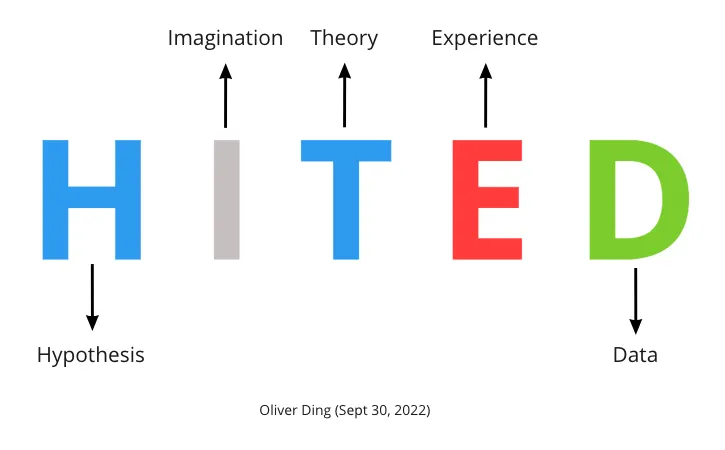
The diagram was the same one from 2023. But now there was a vocabulary for what it had been doing all along. The HITED framework was a Model. Methodological Empathy, now theorized with three levels of depth, was the Concept. Theory-Method Fit — the binding relationship between a researcher's theoretical commitments and their methodological choices — was the Principle.
Theme and Model in 2023. Concept and Principle in 2026. Four weave-points, two moments, one development.
This became Chapter 20 of the book. Two more articles followed — on the Aspects-Approaches Fit, on four entirely different meanings of "unit of analysis" that Activity Theory had been conflating for decades. Together they became Part 6 of Weave the Theory: Methodological Empathy.
5
It was only while writing the review of Part 6 that I stopped and looked back at the full arc of the month.
Three rounds of Revisiting–Rebuilding. Three different objects, three different scales, three different distances in time.
The 2022 genidentity note was the closest — four years, a single piece, a clear structural discovery waiting for the right vocabulary. The rebuild was surgical: same material, new tools, a depth the original could not reach.
The 2020 Activity U project was further back — six years, multiple articles, a whole mapping effort. The rebuild was not surgical but stratigraphic: same contributors, same tradition, now read from a different level entirely. What the map had displayed as diversity, the series could analyze as a knowledge ecology with its own dynamics, its own developmental stages, its own logic of expansion and coherence.
The 2023 HITED article was different in kind — not old theoretical work but a practical framework written for practitioners. Its rebuild did not deepen an existing analysis so much as complete an interrupted one. Theme and Model had been there since 2023; the rebuild supplied Concept and Principle. Four weave-points that had never been together in the same piece finally were.
Three structures, one pattern. In each case, the prior work had reached as far as its tools allowed, named something real, and stopped. Not because it was wrong — because what it had found was pointing toward something it could not yet name. The rebuild did not replace the prior work. It fulfilled it.
6
The largest gain from this month was not any single article. It was a shift in how I understand knowledge ecology itself.
Before this work, I had used the phrase knowledge engagement to describe the relationship between an individual and knowledge — how a person explores a thematic space, develops tacit knowledge, moves between theory and practice. The individual was the center; knowledge was the terrain they moved through.
This month changed the frame. Working through the Activity Theory case studies — tracing how Engeström built CRADLE, how Nardi moved from Platform-ba to Platform Core, how a tradition maintains its coordination mechanism across a century of otherwise radical change — I found myself thinking about theoretical traditions not as objects of study but as environments for individual development. A theoretical tradition is a knowledge ecology. The individual creator moves inside it, draws from it, contributes to it, and is shaped by it in return.
The trio of concepts that emerged from this work — Theoretical Activity, Theoretical Enterprise, and Theoretical Platform — gives this ecology a model. Theoretical Activity names the objective process, seen from outside. Theoretical Enterprise names the subjective trajectory, lived from inside. Theoretical Platform names what a tradition becomes when it has matured enough to actively support the development of others. Three perspectives on the same reality, each indispensable for the others.
What interests me now is that this model is not limited to theoretical traditions. Any knowledge ecology — a knowledge center, a creative community, a long-term personal project — has the same three faces. The Activity U project was a Theoretical Activity I participated in. My own creative journey with Activity Theory is a Theoretical Enterprise. And Activity Theory itself, by the time I encountered it, was already a Theoretical Platform — structured, rich, capable of supporting work it would never directly touch.
7
Reflecting on the RR strategy at the scale of a theoretical tradition, something becomes clear that was not visible at the individual scale.
A tradition that only generates new work — new frameworks, new case studies, new applications — proliferates on the Creativity Line without the Curativity Line work that gives the proliferation coherence. This distinction is central to the Weave-the-Theory model: the Creativity Line moves outward through Theme and Model, generating new territory; the Curativity Line moves inward through Concept and Principle, giving that territory depth and coherence. Both lines are necessary. But in a large, fast-expanding tradition, the Creativity Line tends to dominate — there are always more problems to address, more domains to enter, more frameworks to build. The Curativity Line work is harder to see, slower to arrive, and easier to defer.
This is not a hypothetical risk. The chapter on unit of analysis in Part 6 diagnosed exactly this pattern in Activity Theory: decades of methodological discussion, four entirely different operations all called by the same name, the confusion compounding with each new contributor who borrowed the phrase without examining what it meant.
Revisiting–Rebuilding provides the Curativity Line work that accumulation alone cannot supply. It takes the prior work seriously enough to ask: what was this really about? What Concept and Principle was it pointing toward without reaching? The answer is never available at the time of the original work — it requires distance, and it requires tools that did not yet exist when the original was written. This is why RR is not revision. Revision corrects. Rebuilding fulfills.
At the scale of a tradition, this means that the most generative raw material is often not the newest work but the oldest — the foundational observations made before the vocabulary existed to say precisely what they had found. The 2022 genidentity note was more generative, in this sense, than any of the 2026 articles that built on it. It had found something real and stopped there. That stopping place was an invitation.
A tradition grows not only outward but downward. RR is how it goes deep.
8
This column began in September 2025. Its subtitle has always been 2015–2025 — a decade of engaging with Activity Theory, told one episode at a time.
Eighteen issues later, I find myself at a natural stopping point. Not because the engagement is over — it is not — but because the story this column was built to tell has reached its conclusion. The decade has been accounted for. The pattern has been named.
What comes next belongs to a different kind of writing.
v1.0 - May 30, 2026 - 2,192 words