
Generative Confluence: Theoretical Activity, Theoretical Enterprise, and Theoretical Platform

A case study of the "Generative Confluence" dramatic life pattern
by Oliver Ding
May 24, 2026
In June 2025, while reflecting on my creative journey, I discovered a pattern I had not previously recognized: three theoretical traditions I had engaged with over several years had, without deliberate planning, begun to converge. I named this pattern Generative Confluence — a process in which distinct streams of ideas, each inspired by different theoretical approaches, evolve from separate into interconnected, generating a new creative center while preserving the independent trajectories of the original streams.
Soon after, I uncovered a deeper structure. The three streams that converged in 2025 were themselves outcomes of earlier confluences. Each branch had its own story of generative confluence. I called this recursive, scale-crossing pattern Fractal Confluence — a journey in which confluences nest inside confluences, and the outcome of one confluence becomes the soil for the next. Looking back, my creative journey from 2019 to 2025 can be understood precisely as a Fractal Confluence journey.
In the months following the 2025 Generative Confluence, a new theoretical platform — GO Theory: the World of Life(World of Activity) approach — emerged as its central outcome. That platform did not mark an end. As the Fractal Confluence pattern would predict, it became the developmental environment for yet another confluence.
In May 2026, I recognized that the trio of concepts I had recently developed — Theoretical Activity, Theoretical Enterprise, and Theoretical Platform — was itself a product of a smaller, nested confluence. Each of the three concepts had its own developmental episode (2023, mid-2025, late-2025), and they converged within the GO Theory platform to form a coherent, interdefined triad. This is a fresh case of Fractal Confluence in action — a continuing episode of the same recursive journey.
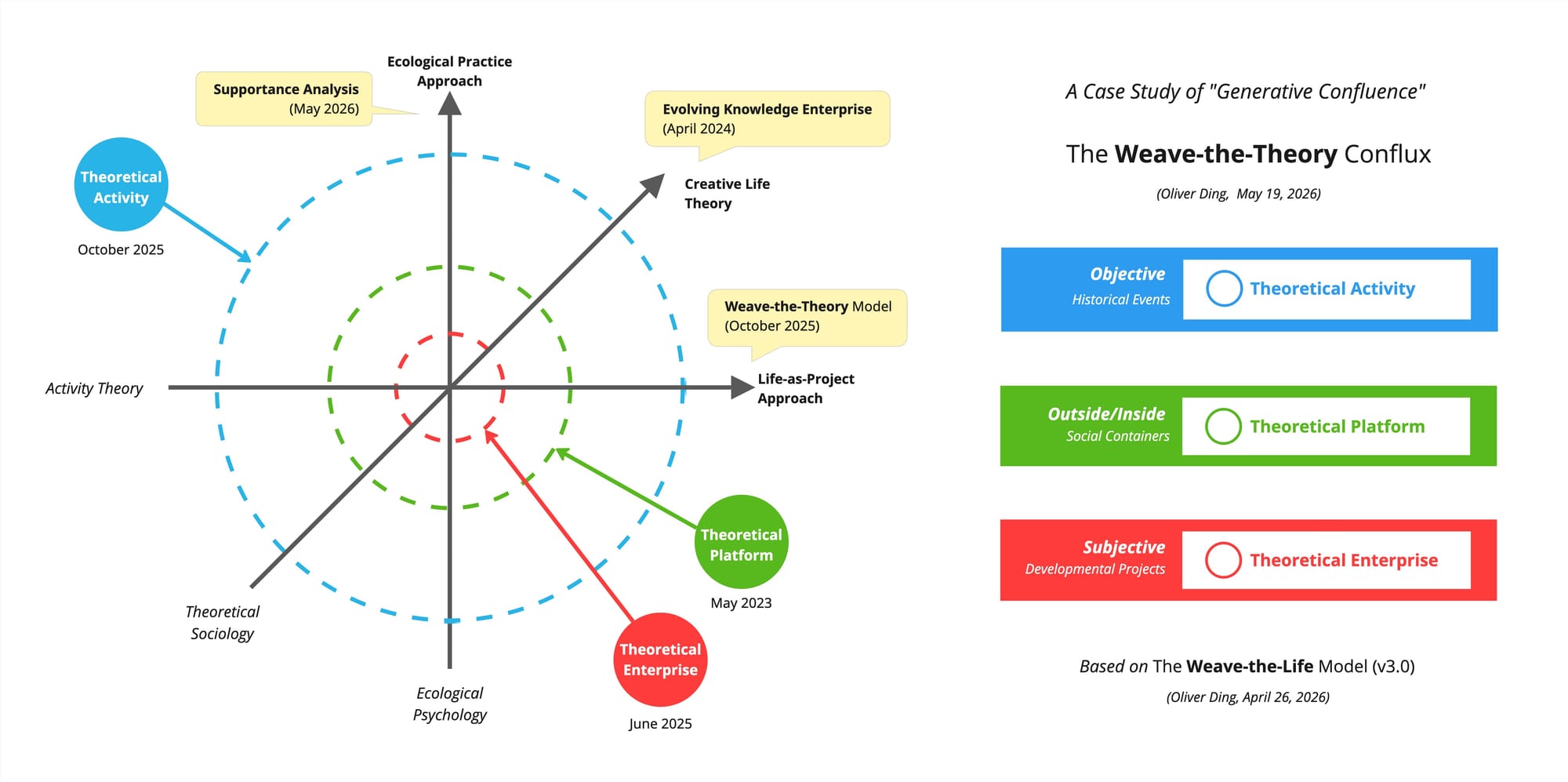
This article presents that case. Drawing on the simplified Creative Confluence analysis method (a version of the full eight-movement Generative Confluence pattern, focused on center emergence), I reconstruct the three developmental episodes, show how they converged, and demonstrate that theoretical platforms can function as recursive engines for further confluences. The diagram below offers a visual map of the case.
1. Generative Confluence
As introduced above, Generative Confluence names a pattern in which multiple distinct streams of ideas — each inspired by different theoretical resources — evolve from separate into interconnected, generating a new creative center while preserving the independent trajectories of the original streams. Unlike a geographical confluence where tributaries merge and lose their identities, a Generative Confluence keeps each tributary alive and growing.
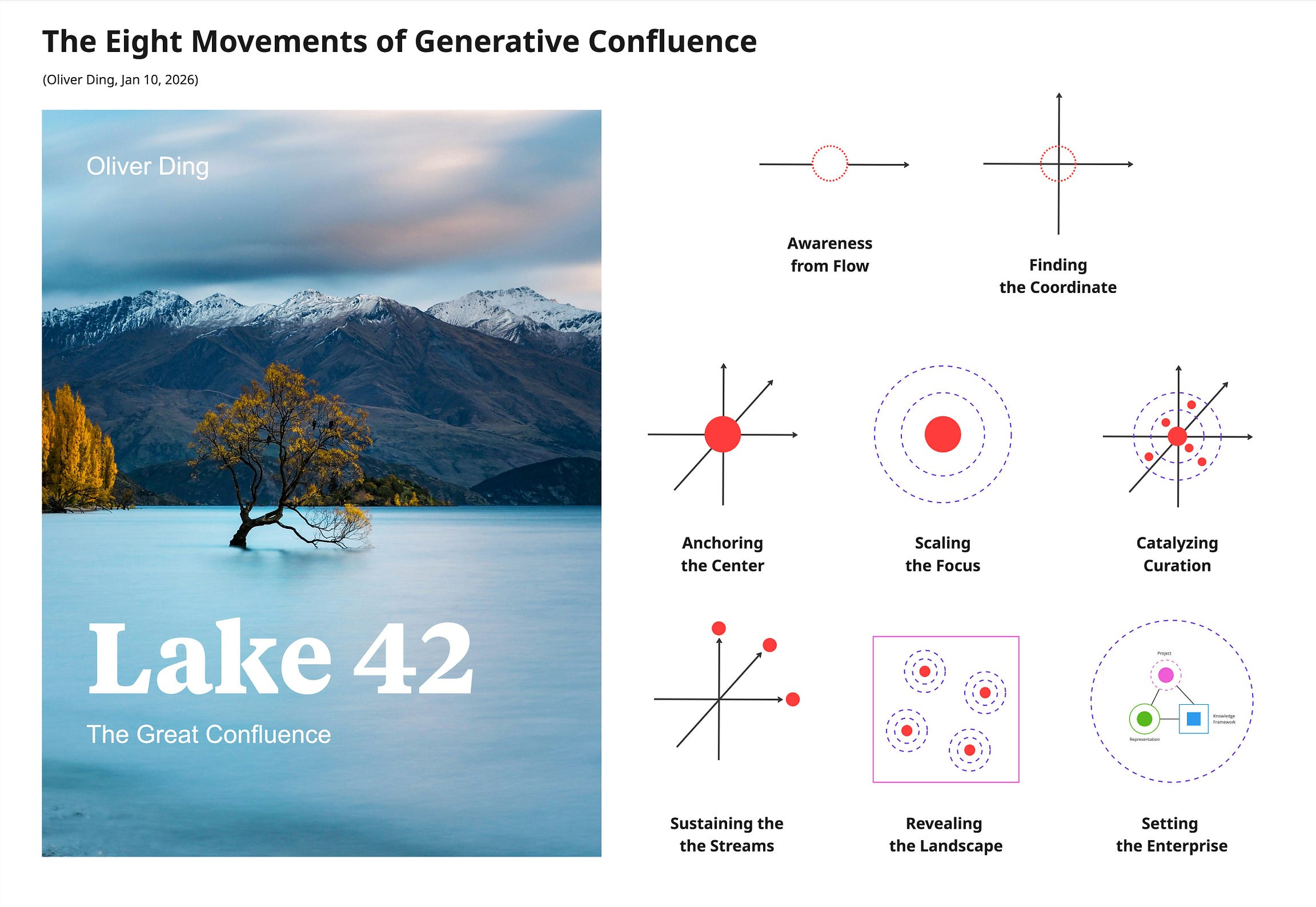
In Lake 42: The Great Confluence (2026 book draft), I documented the full eight‑movement structure of Generative Confluence through my 2025 journey. I also introduced a related recursive pattern: Fractal Confluence, where each tributary is itself the outcome of earlier confluences, and the product of one confluence can become the developmental environment for another.
For the purpose of this article — a focused case study of the trio Theoretical Activity, Theoretical Enterprise, and Theoretical Platform — I use a simplified version of the Generative Confluence pattern, which I call Creative Confluence. This simplified version concentrates on only two of the eight movements: Finding the Coordinate and Anchoring the Center.
In applying Creative Confluence to a case, I examine four interconnected components:
- Creative resources – the distinct streams or tributaries that come into the confluence. In this case, they are the three theoretical enterprises (Life‑as‑Activity, Ecological Practice, Creative Life Theory) that formed the three‑dimensional coordinate system.
- Developmental episodes – the key trajectories through which each creative element (the conceptual building blocks of the new center) emerged and matured. Each creative element has its own developmental episode, documented in Sections 7–9.
- New creative center – the emergent outcome of the confluence. Here, it is the integrated framework consisting of three concepts — Theoretical Activity, Theoretical Enterprise, Theoretical Platform — which together allow us to view theoretical work from three different perspectives. These three concepts are the creative elements that populate the new center.
- Meta‑framework – the overarching conceptual structure that organizes the case and shows how the elements relate. In this article, the meta‑framework is the Weave‑the‑Life Model (presented in Section 5).
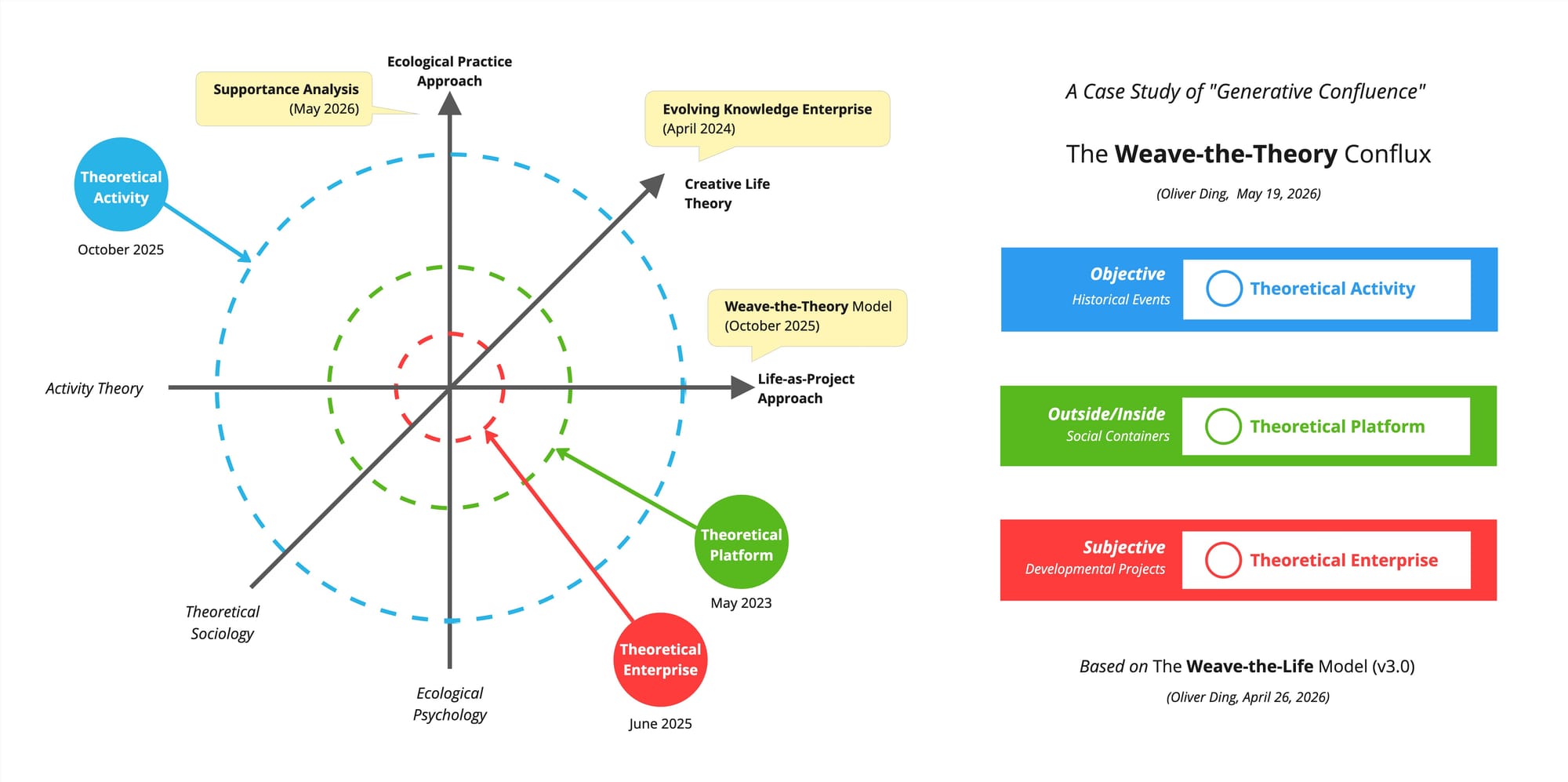
The diagram above visualizes this case using the Creative Confluence model. The three theoretical enterprises form the three‑dimensional coordinate system; the three concepts (the creative elements) are distributed across three rings; and their convergence constitutes the new creative center. The remainder of the article walks through the three developmental episodes (Sections 7–9) and demonstrates how this convergence unfolded within the GO Theory platform — a real‑time instance of Fractal Confluence.
2. Three Views of Theoretical Work
Before I reconstruct how the trio of Theoretical Activity, Theoretical Enterprise, and Theoretical Platform emerged through a Creative Confluence, let me first illustrate what these three concepts mean—using a case that readers may already recognize.
Consider Activity Theory (AT). For researchers who have built their careers within this tradition, AT is not merely a set of ideas. It is a Theoretical Platform—a mature knowledge ecology that supplies concepts, analytical methods, a shared theoretical principles, and a lineage of canonical problems and solutions. Within such a platform, a researcher can locate their own questions, build upon prior work, and position their contributions relative to an ongoing tradition. The platform does not directly grant degrees or fund projects, but it makes certain theoretical moves recognizable, arguable, and cumulative. It provides the cognitive and communicative infrastructure for a community of inquiry.
Now, look at individual AT scholars—Yrjö Engeström, Bonnie Nardi, Clay Spinuzzi, and many others. Each has developed their own Theoretical Enterprise. Each enterprise has a guiding theme (e.g., expansive learning, HCI, workplace network), a developing concept system, a body of publications, and a distinct trajectory across years or decades. These enterprises share the common platform of AT, yet each is genuinely different—reflecting the creator's questions, context, and choices. An enterprise is theoretical work from the inside: the subjective, developmental arc of a single creator engaging with the platform over time.
Now, take the perspective of an observer who never participates in AT. From outside, what do they see? They see a series of events—conferences, publications, debates, new concepts introduced, controversies resolved or left open. They see Theoretical Activity unfolding over time, not as a single enterprise but as a distributed, collective historical process. From this external view, the internal distinctions between "enterprise" and "platform" fade away; what remains is activity that takes theoretical knowledge as its object—an ongoing flow of actions, interactions, and artifacts that together constitute the life of the tradition.
Thus, the same body of work can be seen from three different views:
- Theoretical Activity – the external, historical view: a series of events in which theoretical knowledge is produced, exchanged, and transformed.
- Theoretical Enterprise – the internal, developmental view: an individual creator's sustained, project‑based trajectory.
- Theoretical Platform – the enabling, structural view: a mature knowledge ecology that supports the work of many creators by providing conceptual and communicative resources.
This three‑view framework emerged from my recent work on two possible books released in 2026: Weave the Life (introducing the Life‑as‑Activity Approach v4.0) and Weave the Theory (collecting case studies of theoretical activity across AT scholars and beyond). Writing these books, I found myself moving between these three perspectives constantly. The trio did not appear fully formed. Instead, each concept came into focus at a different moment—and their eventual convergence became the subject of this article.
However, I did not recognize this convergence immediately. At the time I was writing the two books, my primary orientation was still the Life‑as‑Activity Approach, because my immediate task was to advance it to version 4.0. I was inside that theoretical enterprise, focused on its internal development. Only after stepping back—after both books were released and I could see the landscape from a distance—did I realize that the three concepts (Theoretical Activity, Enterprise, Platform) had not originated from Life‑as‑Activity alone. They drew, implicitly, from three distinct theoretical enterprises that I had been cultivating over the years: the Life‑as‑Activity Approach itself, the Ecological Practice Approach, and Creative Life Theory.
That realization was the moment I saw a Generative Confluence at work. The three concepts were not arbitrary constructs; they were creative elements that had emerged from three different intellectual streams, each with its own developmental trajectory. Their eventual convergence into an integrated trio was not a planned synthesis but a discovered pattern—a confluence that had already happened while I was looking elsewhere.
The diagram below visualizes this case. The three theoretical enterprises form the three‑dimensional coordinate system. The three concepts (Theoretical Activity, Theoretical Enterprise, Theoretical Platform) are the creative elements, distributed across three rings nested within that coordinate system. Together, they constitute the new creative center—an integrated framework for viewing theoretical work from three different perspectives.
Sections 7–9 reconstruct that convergence. But first, let me briefly present the broader platform (GO Theory) within which this convergence took place, as well as the new creative center and meta‑framework that emerged from it.
3. A New Theoretical Platform
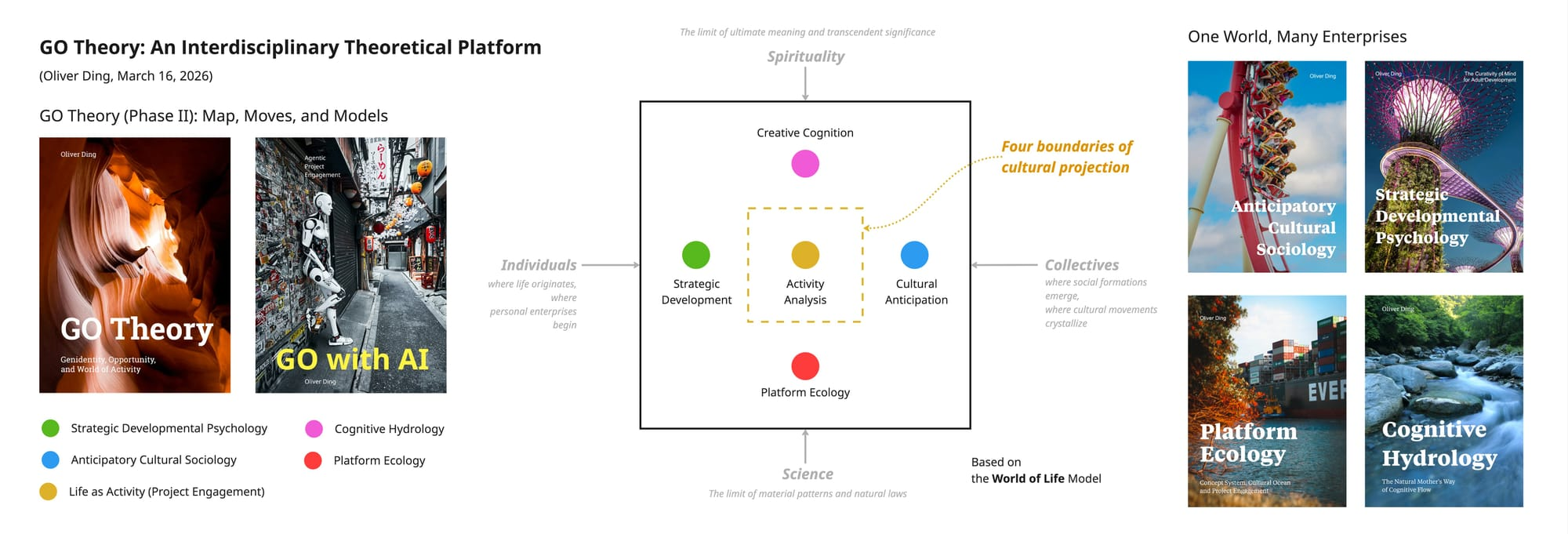
The 2025 Generative Confluence — the full eight‑movement journey documented in Lake 42 — produced a structured outcome that I now call GO Theory (Generation and Orientation). GO Theory is the World of Life (World of Activity) approach, a theoretical platform with its own ontology, epistemology, and methodology.
This platform has its own knowledge ecosystem, built on three meta‑frameworks completed between November 2025 and February 2026:
- Ontology: The History{Life[Self(Body)]} Framework (HLS Framework, v3.0, 2025) — the map of the social world, introduced in Meta-frameworks: Creative Heuristics for Individual and Social Development (book, v1.0, 2025), December 2025
- Epistemology: The Ecological Formism Framework (v2.0, 2025) — the structure of knowledge systems, introduced in Ecological Formism (book, v1, 2025), November 2025
- Methodology: The LARGE Method (v3.0, 2026) — the meta-method governing all methods within the platform, February 2026
On this platform, five theoretical enterprises operate, each occupying a distinct position within the World of Life:
- Life as Activity (including the Project Engagement Approach) — at the center, attending to the structure of activity itself, the operational language shared by all the other enterprises
- Anticipatory Cultural Sociology — at the Collectives boundary, attending to cultural development at the collective scale
- Strategic Developmental Psychology — at the Individuals boundary, attending to individual life development at the personal scale
- Cognitive Hydrology — at the Spirituality boundary, attending to the flow of ideas and meaning in creative life
- Platform Ecology — at the Science boundary, attending to the ecological and structural conditions of platform development
Here is the key for this article: GO Theory is not only the outcome of the 2025 Generative Confluence; it also became the developmental environment for the Creative Confluence analyzed here. As the Fractal Confluence pattern predicts, a platform produced by one confluence can serve as the soil for another, smaller‑scale confluence. Within this platform, the three creative elements — Theoretical Activity, Theoretical Enterprise, and Theoretical Platform — each developed along their own trajectories (Sections 7–9) and eventually converged into an integrated trio.
Thus, this case serves two purposes. First, it demonstrates the Creative Confluence analysis method at a micro‑scale: tracing how the three creative elements — Theoretical Activity, Theoretical Enterprise, and Theoretical Platform — each developed through their own developmental episodes and converged into a new creative center. Second, it illustrates how a theoretical platform — in this case, GO Theory — can incubate a new knowledge center through a special form of Supportance: not direct intervention, but an enabling environment that allows new conceptual structures to emerge and be recognized.
4. A New Creative Center
The new creative center that emerged from this Creative Confluence is named knowledge ecology. Although Section 3 introduced GO Theory as a theoretical platform with five ongoing theoretical enterprises, the platform is open‑ended. It can continue to incubate new creative centers and support their development into full theoretical enterprises. The case of knowledge ecology offers one such example.
The phrase "knowledge ecology" first appeared as part of the subtitle of the Weave 42 methodological document in March 2026: Building Knowledge Ecologies Across Scales. But the theme it names had been developing for much longer — quietly present in the work without yet having a name precise enough to organize it.
In 2022, I designed the Knowledge Discovery Canvas and edited a possible book titled Knowledge Discovery: Developing Tacit Knowledge with Thematic Space Canvas. The focus at that stage was on the individual cognitive level: how a person explores a thematic space, develops tacit knowledge, and moves between theory and practice. The Canvas was the primary tool; Thematic Space was its foundational concept.
In 2025, a follow-up possible book took shape: Castle and Forest: The Landscape of Concept-related Knowledge Engagement. The primary focus shifted from tacit knowledge to the broader knowledge ecosystem — the landscape of concept-related activities in which an individual operates. From 2022 to 2025, the work had moved from individual cognitive activity to social interactions within socio-cultural development contexts. A series of tools emerged alongside the Canvas: the Grasping the Concept model, the House of Knowledge Discovery, and eventually a typology of twelve types of concept-related activities in knowledge engagement.
In April 2026, while working on the Weave-the-Theory cases and editing the Weave the Life book, the organizing concept finally arrived: Personal Knowledge Ecology. As the Weave the Life introduction states, this concept expands the earlier focus on tacit knowledge and concept-centered engagement to encompass the individual's full social interactions — collaborative projects and activity systems — as essential contexts for cognitive development. The tools I have designed — knowledge maps, canvases, frameworks — are themselves integral parts of this ecology, not merely instruments for studying it.
The three possible books form a trilogy in retrospect:
- Knowledge Discovery (2022) — the individual cognitive level: developing tacit knowledge through thematic space engagement
- Castle and Forest (2025) — the landscape level: the broader ecosystem of concept-related knowledge activities
- Weave the Theory (2026) — the ecology level: how theoretical activity builds, sustains, and transforms knowledge ecologies across different scales
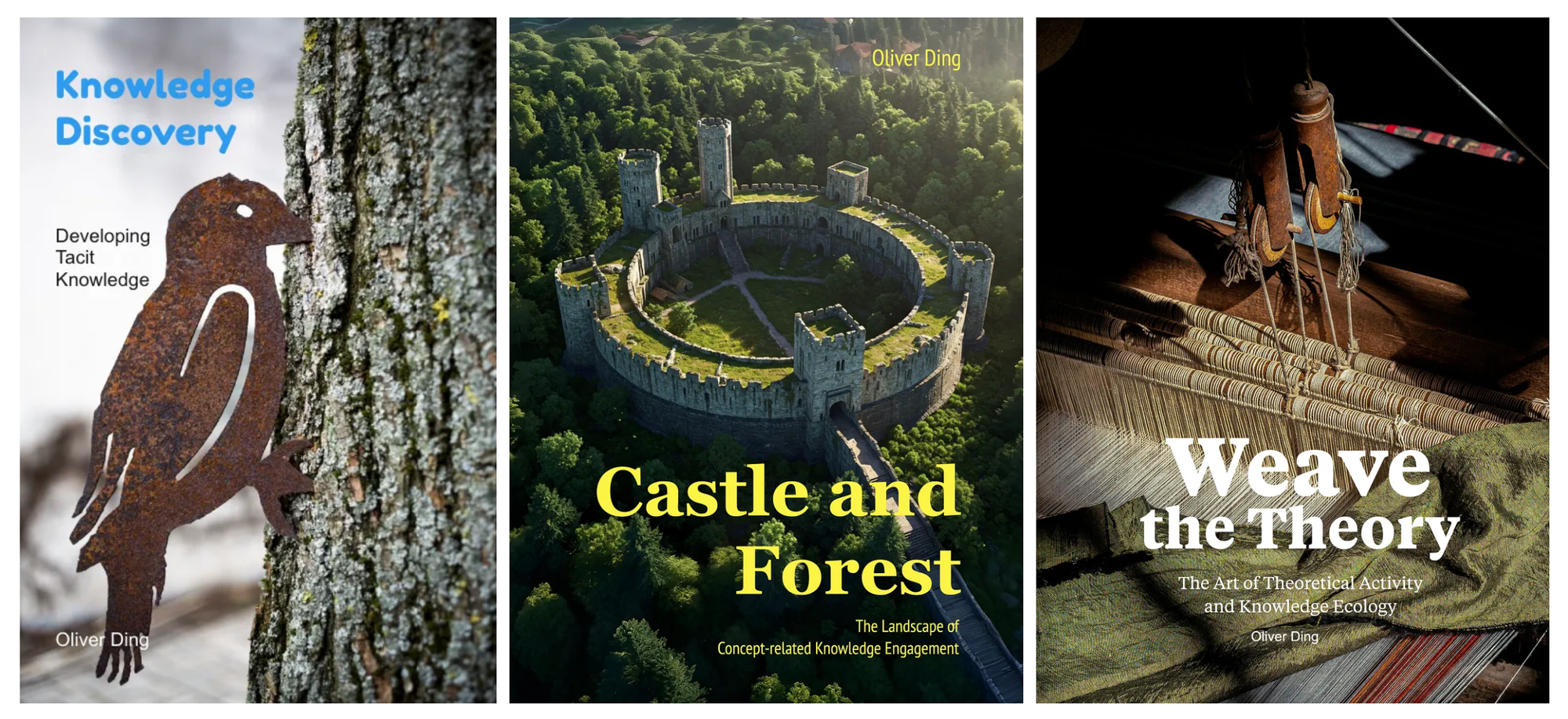
Over the past several years, I often used "Knowledge Engagement" as the primary theme of my creative journey.
The release of Weave the Theory marks the moment when the knowledge engagement exploration reaches the knowledge ecology stage. What had been implicit across years of canvas design, framework development, and case study writing is now named and organized: the work is about how people — individually and collectively — build and sustain their knowledge ecologies over time.
5. A New Meta-framework
A Generative Confluence cannot rely on the three theoretical enterprises (the creative resources) to organize themselves into a new center. Without an external structuring device, one enterprise would tend to assimilate the others back into its own terms. A meta‑framework is needed to curate the emergent creative elements, give them a common language, and reveal how they relate to one another. In the 2025 Generative Confluence documented in Lake 42, the meta‑framework was the Self‑Life‑Mind Schema.
In the present Creative Confluence — the one that produced the Theoretical‑Activity‑Enterprise‑Platform trio — the meta‑framework is the OOIS schema, see below
Objective - Outside/Inside - Subjective
These ideas are adopted from the Weave-the-Life Model (v3.0), a core model of the Life-as-Activity Approach (v4.0).
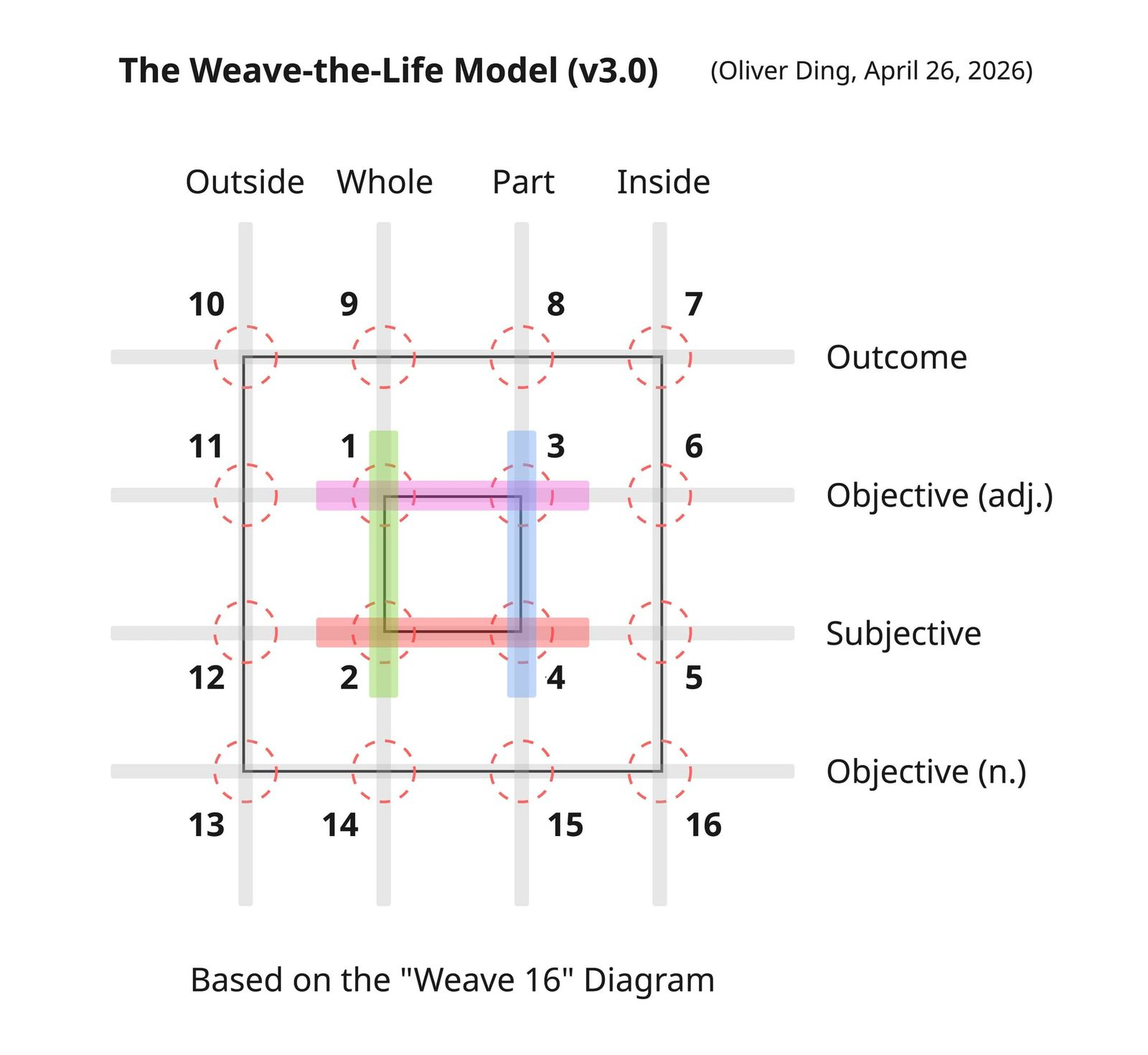
Without going into a full exposition of the model (for which see Weave the Life), its essential structure for our purpose is this: it defines two axes — a vertical axis distinguishing Objective (observable, historical processes) from Subjective (individual, developmental trajectories), and a horizontal axis tracing a continuum from Outside (culture and history) through Whole (activity systems) and Part (projects and events) to Inside (individual psychology and immediate situation).
Using this model as a meta-framework, we can see the relationship between Theoretical Activity, Theoretical Enterprise, and Theoretical Platform.
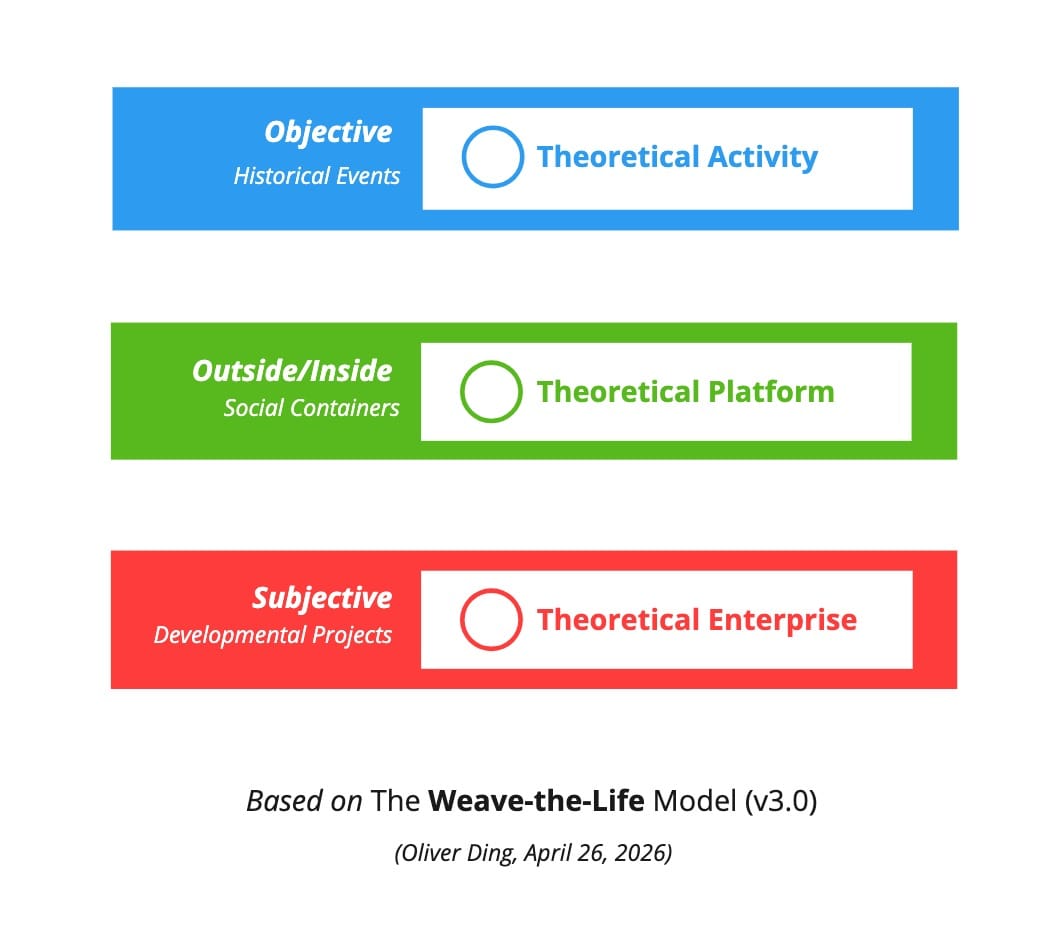
- Theoretical Activity – a series of historical events, located at the Objective level.
- Theoretical Enterprise – a series of developmental projects, located at the Subjective level.
- Theoretical Platform – – a knowledge ecology or theoretical tradition, located at the Outside/Inside intersection: an objective container from the outside, a lived developmental environment from the inside.
These three concepts were not developed simultaneously. Each has its own developmental track — a point to which we now turn.
6. One Journey, Three Episodes
Methodological note: This section defines the analytical terms used to reconstruct the three developmental episodes. Readers primarily interested in the case narrative itself may skip directly to Section 7.
For Creative Life Theory, a Creative Journey refers to a series of Creative Projects centered on a primary theme.
For the Creative Confluence Analysis, we see the whole historical developmental track of a Creative Confluence as a Creative Journey. The primary theme refers to the new Creative Center. Yet we need more terms to describe the relationship between the Creative Elements that form the new Creative Center and the Creative Projects that produced them.
In Revisiting the Genidentity of Activity Theory (May 4, 2026), I introduced a new term called Developmental Episode for the Genidentity Analysis Method:
Within the Meta-framework vs. Thematic Enterprise pairing, a thematic enterprise is composed of many projects — each contributor decides their own project, pursues their own questions, and works within their own intellectual context. Not all of these projects contribute equally to the Meta-framework. Some remain at the level of application or extension; others make a more fundamental contribution — they change, clarify, or extend the core concept systems that constitute the theoretical foundation.
I use the term Developmental Episode to designate this second type: a project that makes a contribution to the Meta-framework of a theoretical enterprise. A developmental episode is not simply any moment of theoretical work; it is a specific project in which a contributor engages directly with the foundational concept systems of the tradition — identifying a limitation, introducing a new concept, or restructuring the coordination mechanism — in a way that leaves a lasting mark on what the tradition is.
The essential aspect of Developmental Episode is its functional orientation. While the concept of Developmental Project defines a basic unit, the concept of Developmental Episode further highlights a special function of projects: contribution to the growth of an enterprise.
According to the Enterprise Development Framework (Oct 2025), we can use a five‑stage model to understand how a Theoretical Enterprise evolves over time. Each stage represents not merely a quantitative increase in the enterprise's scale or output, but a structural transformation in what the enterprise is and what it can do. The five stages — Creative Theme, Scalable Focus, Center Development, Value Circle, and Developmental Platform — correspond to five distinct states of development.
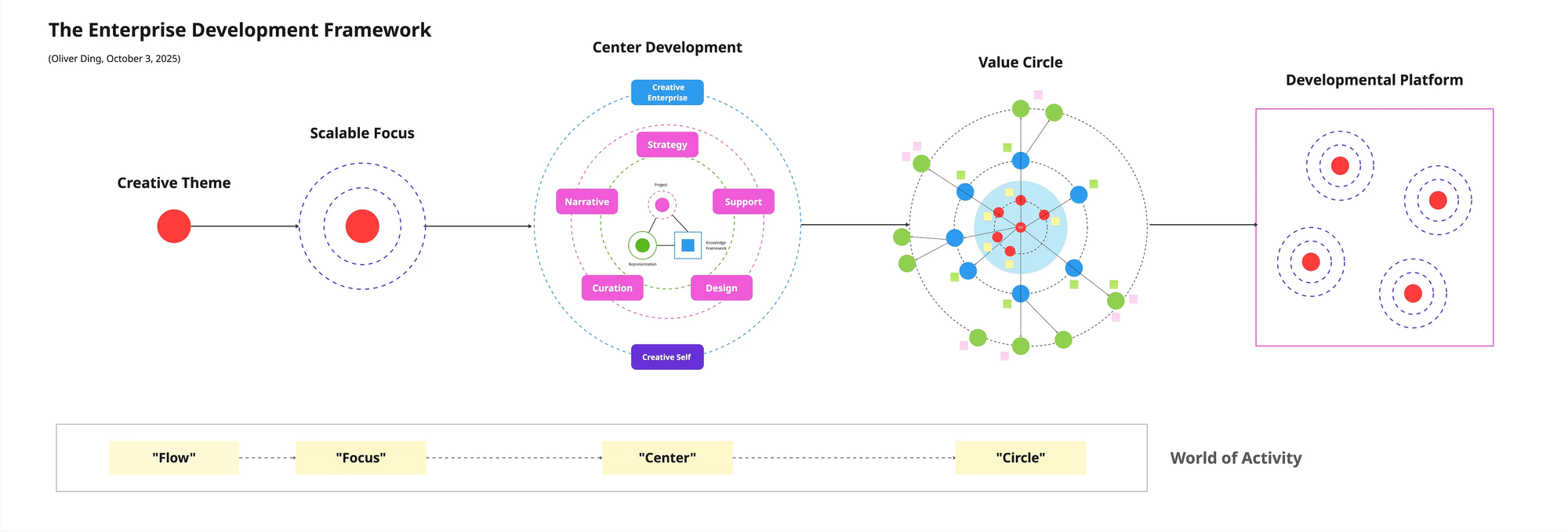
Although the concept of Developmental Episode was developed for discussing Developmental Platform, it can be applied to other stages of Enterprise Development.
For the Creative Confluence Analysis, Developmental Episode is reframed to refer to a series of projects that contribute to the development of a Creative Element (one of the building blocks of the new Creative Center). In the present case, we identify the following three Developmental Episodes, each corresponding to one of the three Creative Elements:
- Theoretical Platform (May 2023)
- Theoretical Enterprise (June 2025)
- Theoretical Activity (October 2025)
The following sections will share more details about each.
7. Theoretical Platform (May 2023)
This section reconstructs the developmental episode of Theoretical Platform as a creative element. The episode spans roughly 2021–2025, with May 2023 highlighted as a key moment when the concept was explicitly applied and articulated through a concrete analytical framework.
Theoretical Platform names a theoretical tradition — or any theoretical enterprise — that has reached sufficient maturity to function as a structured developmental environment for the work of others. A Theoretical Platform is characterized by a stable Meta-framework, an established Social network (Platform Core and Platform-ba), and a rich body of Material artifacts.
In 2021, I finished Platform for Development in which I introduced the concept of "Developmental Platform." At that time, Theoretical Platform was considered as a specific type of Developmental Platform. Later, I developed Platform Genidentity Framework in 2022. The framework is for understanding how any platform (technological, sociocultural, or theoretical) maintains its unique identity over time through the interplay of Essential Differences, Situated Dynamics, Platform Core, and Platform-ba.
From the perspective of an individual creative actor, a Theoretical Enterprise becomes a Developmental Platform at the moment when that actor finds in it the structured support — the Meta-framework, the conceptual tools, the social connections, the material resources — that enables their own work to develop. This moment is personal and situational. It does not require the enterprise to have reached the fifth stage in any objective sense. A Possible Platform — one that has done the internal conceptual work but has not yet achieved broad social recognition — can already function as a Developmental Platform for a specific contributor who has found their way into it and discovered what it makes possible for them.
In May 2023, I applied the "Theoretical Platform" concept to study Ping-keung Lui's theoretical sociology. After connecting to Kuhn's Disciplinary Matrix, the concept presents the five analytical perspectives examines Ping-keung Lui's theoretical sociology as a case of Possible Platform, and traces my four-phase engagement with his work that unfolded between 2022 and 2025.
- Kuhn's Disciplinary Matrix
- Oliver Ding's Knowledge Center
- Oliver Ding's Perceived Platform
- Lui's Scientific Project
- Lui's Scientific Community
Theoretical sociology, for Lui, is a candidate for the paradigm of sociology — it operates at the level of Symbolic Generalizations in Kuhn's Disciplinary Matrix. The individual sociological theories that support it correspond to Exemplars. Together they constitute what Lui calls the "scientific project" of sociology.
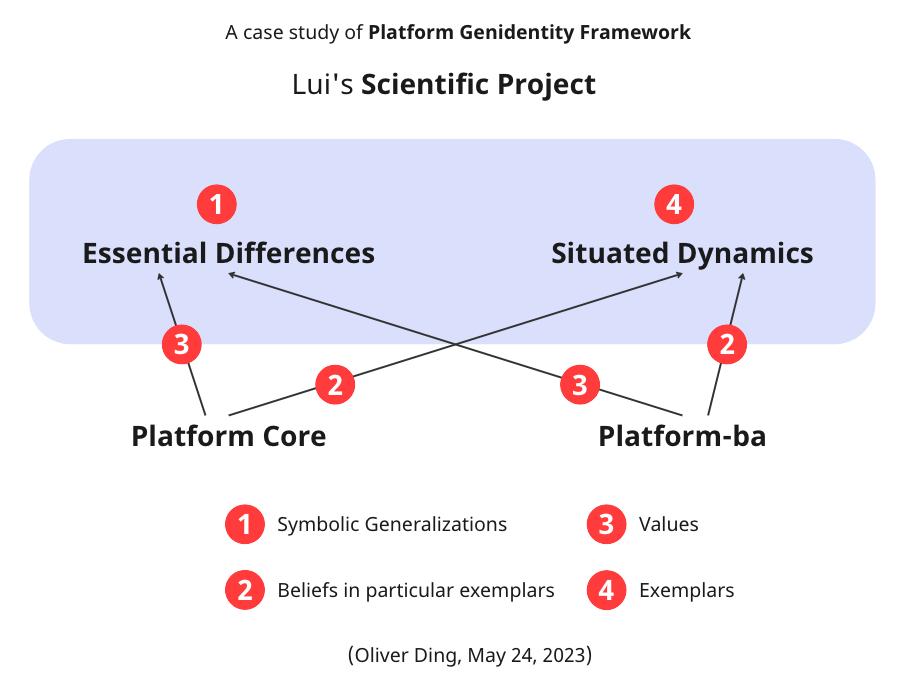
What is significant — and what directly motivated the 2023 use of the Platform Genidentity Framework — is Lui's deliberate decision to concentrate his creative work exclusively on the Scientific Project dimension: Symbolic Generalizations and Exemplars. He explicitly sets aside Values and Beliefs in particular exemplars — the two components of Kuhn's Disciplinary Matrix that belong to the Scientific Community rather than the Scientific Project itself. This is a purely cognitive Disciplinary Matrix, with the human factor excluded.
This was not a limitation but a strategic choice. To build a theoretical sociology is to work at the Symbolic Generalizations level. Whether it becomes a genuine paradigm — whether the Scientific Community adopts it, grants it its Beliefs and Values — is not something a single creator can determine. That belongs to the community. What a creator can determine is the quality and coherence of the Scientific Project itself: the theoretical sociology as Symbolic Generalizations, and its supporting sociological theories as Exemplars. Lui concentrated his effort precisely there.
Applied to the Platform Genidentity Framework, Lui's enterprise maps onto the Scientific Project perspective: Essential Differences (his theoretical sociology as Symbolic Generalizations) and Situated Dynamics (his supporting sociological theories as Exemplars), with Platform Core and Platform-ba present but deliberately outside the analytical boundary of his own creative focus. His theoretical enterprise, viewed through this lens, is what I named at the time a Possible Platform — an enterprise that has developed sufficient conceptual structure and internal coherence to function as a platform for others, but whose status as a fully realized Developmental Platform depends on whether the wider community takes it up and builds on it. The "possible" in "Possible Platform" corresponds to what I called at the time "Possible Paradigm" as opposed to "Actual Paradigm" — the distinction between what a theoretical enterprise has achieved in its own terms and what it has been granted by its social recognition.
The concept of Possible Platform was one of the productive outcomes of the 2023 exploration. It names a real and important stage in the life of a theoretical enterprise: the stage at which the enterprise has done the internal work — built the Meta-framework, produced the Material artifacts, developed the conceptual coherence — but has not yet achieved the Social recognition and uptake that would make it a fully realized Developmental Platform. For Lui's theoretical sociology, this stage was clearly visible in 2023. The work was there; the community reception remained partial and uncertain.
There is, however, a personal dimension to this case study that belongs in the record. Between 2022 and 2025, I found myself drawing directly and substantially on Lui's theoretical sociology in my own work. From my own perspective as a creative actor engaging with Lui's Platform-ba, his theoretical enterprise had already become a Developmental Platform for me — regardless of its status within the broader sociological community. This is an important observation, because it reveals something about the nature of Theoretical Platforms that the purely structural account misses: the transition from Possible Platform to Developmental Platform is not a single event that happens at one moment for all potential users simultaneously. It is a distributed and personal process. An enterprise becomes a Developmental Platform for a specific contributor at the moment when that contributor finds in it the structured support — the Meta-framework, the conceptual tools, the action opportunities — that enables their own work to develop. For me, Lui's theoretical sociology crossed that threshold somewhere between 2022 and 2025.
The developmental episode of Theoretical Platform did not end in 2023. It continued to evolve, and the concept would later become one of three creative elements that converged within the GO Theory platform in 2025–2026. The next two sections reconstruct the developmental episodes of the other two creative elements — Theoretical Enterprise and Theoretical Activity — that would eventually join it in that convergence.
8. Theoretical Enterprise (June 2025)
This section reconstructs the developmental episode of Theoretical Enterprise as a creative element. The episode spans roughly 2023–2025, with June 2025 highlighted as a key moment. The concrete outcome at that moment was the completion of the Wonder and Wander project, which produced eight case studies and the Theory as Enterprise framework, including the Center Development Toolkit.
Theoretical Enterprise is the broader concept of which Theoretical Platform is a specific stage. A Theoretical Enterprise names the evolving, multi-dimensional, project-based process through which a theoretical knowledge system develops across time — from its earliest Creative Theme stage through to its potential maturity as a Developmental Platform. Every Theoretical Platform is a Theoretical Enterprise that has reached a particular stage of development; not every Theoretical Enterprise has yet become a Theoretical Platform.
The early seed of the Theoretical Enterprise was the Evolving Knowledge Enterprise model (November 2023). At that time, Theoretical Enterprise was considered as a special type of Evolving Knowledge Enterprise. Its core insight is an expansion: starting from the Mental dimension of conceptual and cognitive work, the model extends outward to cover the complete presence of a concept system in social life — encompassing not only the mental activity of theorizing but also the social activities through which the enterprise is enacted and the material artifacts through which its knowledge becomes objectified and transmissible. The "Mental—Social—Material" Schema is the thematic name that distills this three-dimensional structure.
In the original model, the three dimensions are named Mental Platform, Behavioral Network, and Material Container — names that have been rendered differently across projects depending on context, but always referring to the same underlying structure: a 3 dimensions × 3 hierarchical levels model that captures the full landscape of an evolving enterprise.
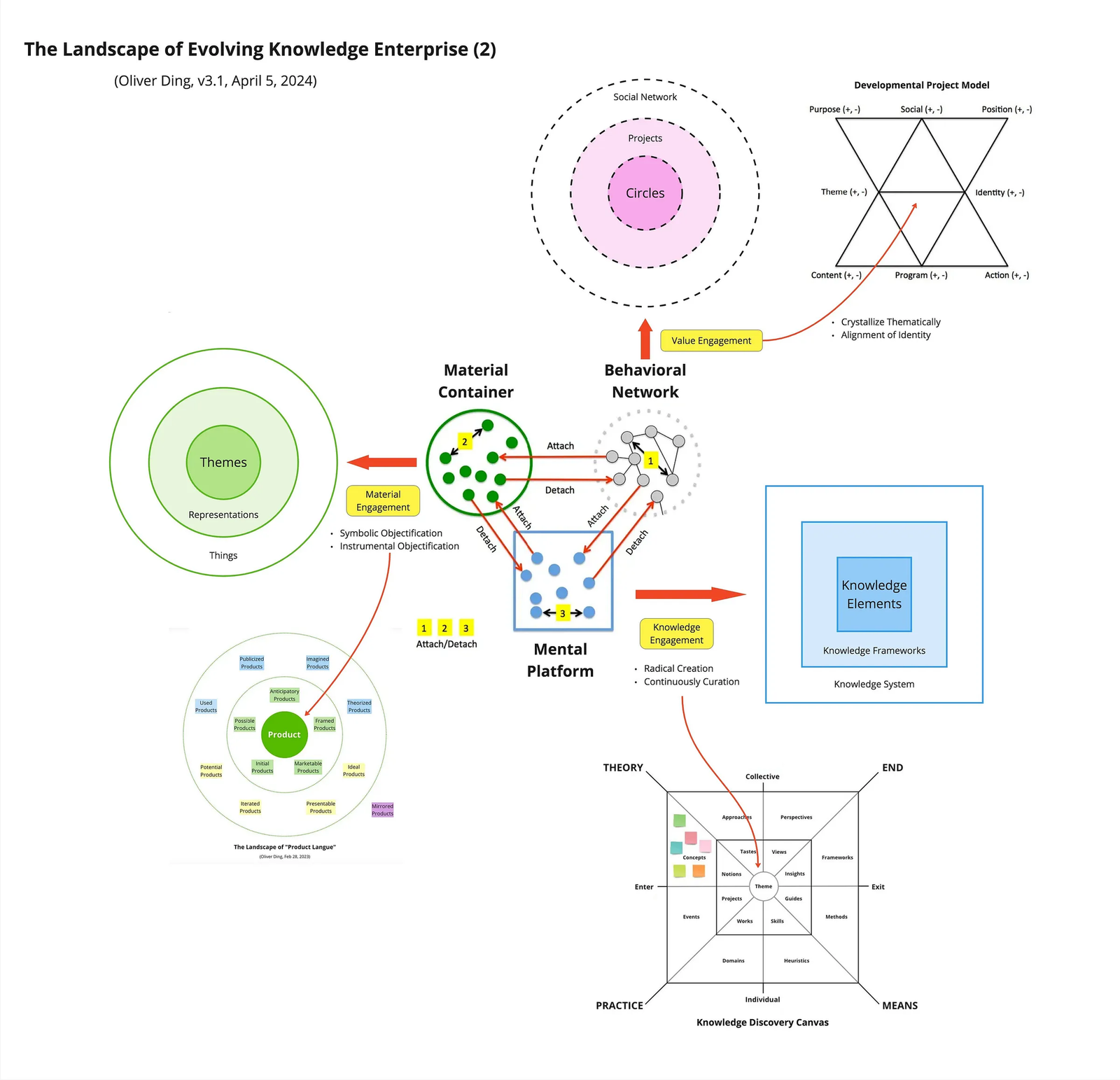
Between March to June 2025, I worked on the Wonder and Wander project to test and validate the Evolving Knowledge Enterprise model through a series of case studies. Eight case studies were conducted, examining the development of different knowledge centers and creative enterprises across different time periods and contexts. The Curativity Center served as one of the primary cases — its development traced from a single theme (Curativity Theory, March 2019) through successive stages: Single Project (Knowledge Curation, June 2020), Single Knowledge Center (Curativity Center, June 2022), Single Knowledge Enterprise (September 2022), and Single Value Circle (September 2023). This progression — from thematic exploration to project formation, to organizational structure, to an interconnected ecosystem — illustrated the five-stage developmental trajectory in concrete terms.
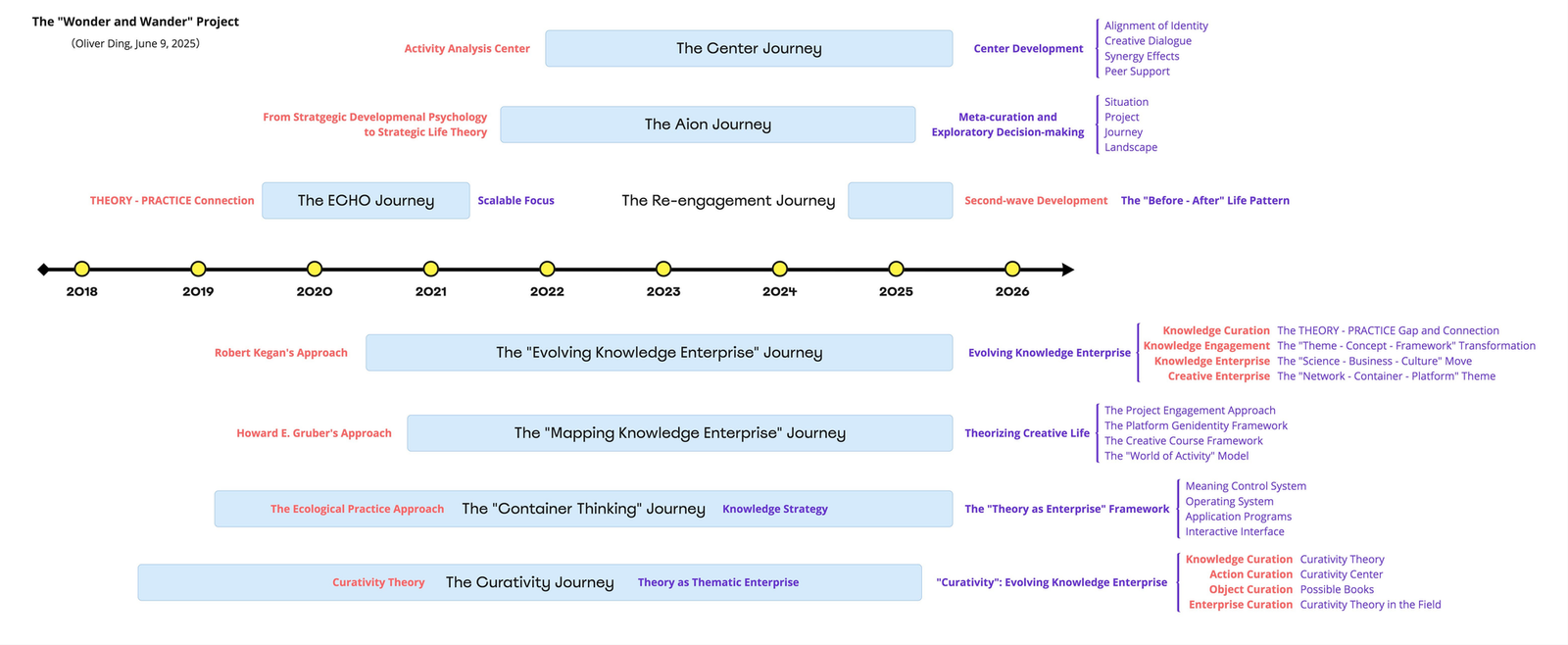
But the outcome of the project went beyond its original goal. Through the eight case studies, a richer picture of thematic enterprise emerged — one that the three-dimensional model alone could not fully capture. The "Mental—Social—Material" Schema remained a valid and useful landscape model for describing the terrain of a knowledge enterprise organized around a concept system. But a thematic enterprise is more than its conceptual operations. It also has multiple functional dimensions — Strategy, Narrative, Curation, Design, Support — through which a knowledge center actually runs and sustains itself. And beyond the enterprise itself, there is a larger context: the creative life of the creator, within which the thematic enterprise is embedded and from which it draws its orientation and meaning. These considerations called for a more expansive framework — one that could hold the three-dimensional model within a larger picture of what a thematic enterprise actually is and how it exists in a creator's life.
The result was the Center Development Toolkit (June 2025). Though named after "Center Development," the Toolkit is in effect an expanded landscape of thematic enterprise — a more complete picture that situates the three-dimensional model within a broader whole.
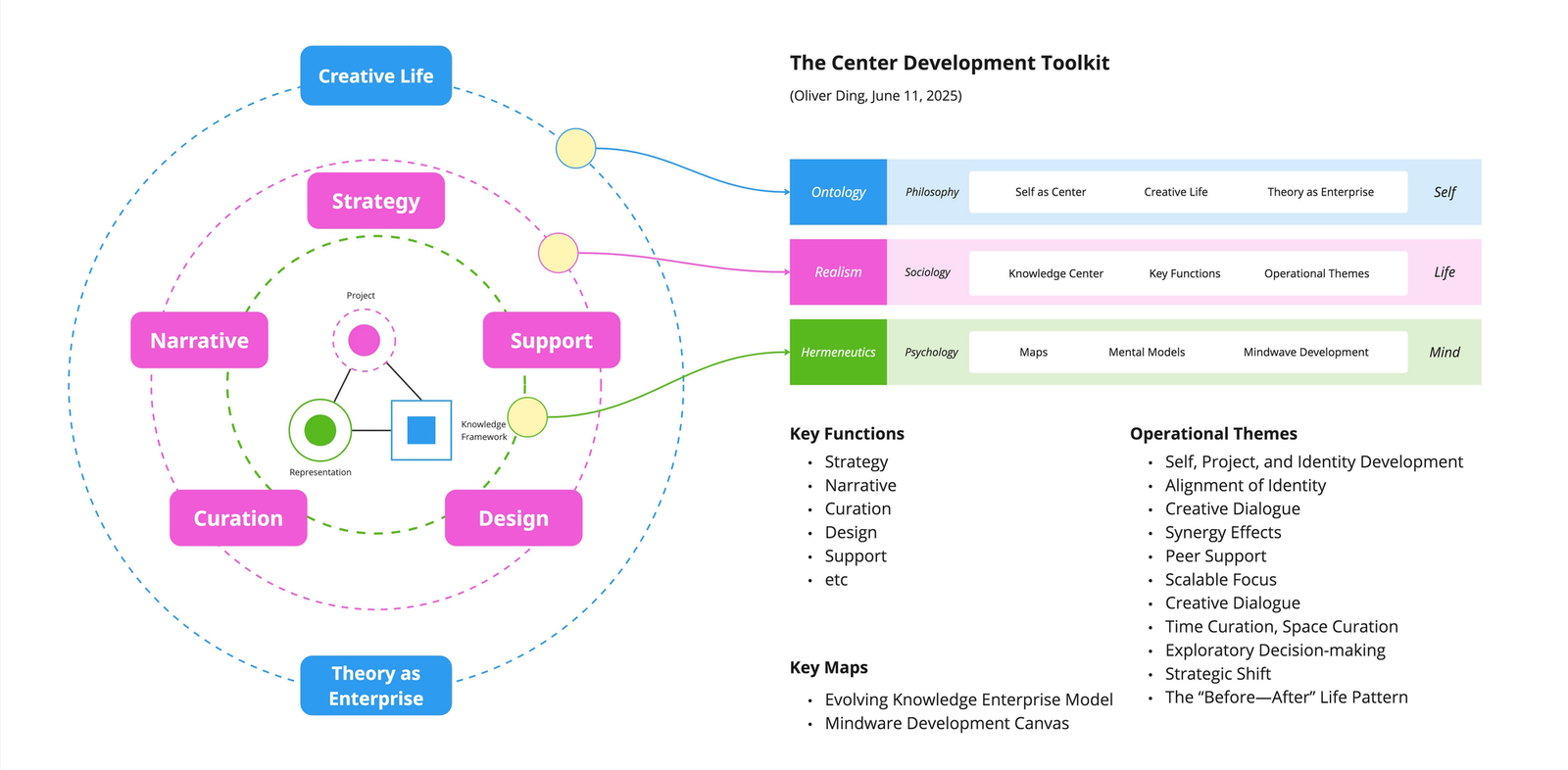
The three-dimensional model — Mental, Social, and Material — began as the primary framework for understanding a Theoretical Enterprise, capturing the full landscape of a concept system's operations across cognitive, social, and material dimensions. The Wonder and Wander project revealed that this landscape, while accurate as far as it goes, is itself embedded within a larger picture. A thematic enterprise does not exist only as a concept system in operation — it exists within the functional reality of a knowledge center (with its Key Functions and Operational Themes) and within the broader context of a creator's Creative Life (with its orientation, identity, and developmental arc). The Center Development Toolkit holds all of this together: the three-dimensional landscape occupies the Realism layer, flanked by the philosophical grounding of the Ontology layer and the cognitive tools of the Hermeneutics layer. Together, the three layers constitute a more complete picture of what a thematic enterprise is — not just what it contains, but how it functions and whose life it is part of.
In October 2025, the Enterprise Development Framework was developed, introducing a five-stage account of how a Theoretical Enterprise evolves over time. Each stage represents not merely a quantitative increase in the enterprise's scale or output, but a structural transformation in what the enterprise is and what it can do. The five stages — Creative Theme, Scalable Focus, Center Development, Value Circle, and Developmental Platform — correspond to five distinct states of development, each explored in one of five previous book drafts, combining theoretical insights with practical experience drawn from my own creative journey.
The developmental episode of Theoretical Enterprise continued beyond June 2025. The concept of Enterprise was adopted to form the "Activity - Enterprise" pair for the Cultural Projection Model in November 2025. This marked a further integration of the concept into the GO Theory platform, where it would later meet Theoretical Platform and Theoretical Activity in the creative confluence reconstructed in this article.
9. Theoretical Activity (October 2025)
This section reconstructs the developmental episode of Theoretical Activity as a creative element. The episode spans roughly 2019–2025, with October 2025 highlighted as a key moment. The concrete outcome at that moment was the formal naming of Theoretical Activity as a distinct type of activity and the articulation of the Weave‑the‑Theory framework as a model for understanding it.
Long before I had a name for it, I was already engaged in what would later be called Theoretical Activity. My work between 2019 and 2022 — building the Curativity framework, designing the Knowledge Discovery Canvas, developing the Thematic Space approach — was all, in retrospect, activity that took theoretical knowledge as its object. At the time, I organized these activities under the theme of knowledge engagement, but I had not yet recognized them as a specific type of activity — theoretical activity — with its own structure and dynamics.
In October 2022, I developed the 5A Slow Cognition model as a retrospective account of my research practice. The model introduced the Aspects‑Approaches distinction: Aspects are the objective reality of human activity; Approaches are the theoretical resources I bring to illuminate them. The movement between Aspects and Approaches, sustained across time, generates theoretical insights. The 5A model was my first systematic attempt to understand what I was doing when I was theorizing — but it remained focused on the cognitive process of “slow cognition” rather than on activity as such. It did not yet name Theoretical Activity as a distinct category. Its limitation was structural: Aspects remained a terminal category, with no account of deepening into a single Aspect over time.
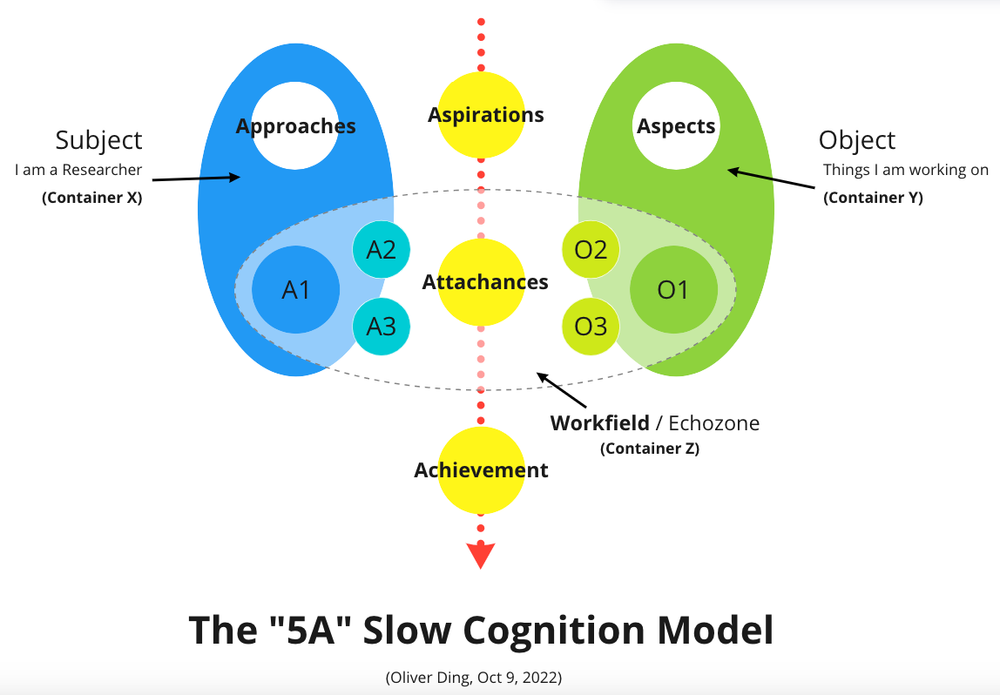
In October 2025, I returned to this terrain with a clearer question: what kind of activity is theorizing, and how can it be studied systematically? I coined the term Theoretical Activity to name this specific type of activity as an object of study for the Life‑as‑Activity approach. Theoretical Activity encompasses building theories, theoretical curation, theory integration, and theorizing. It operates at two levels: the individual cognitive level of theoretical projects, and the collective, collaborative level of building a theoretical enterprise. Both levels belong to Theoretical Activity.
To model Theoretical Activity more adequately than the 5A model allowed, I developed the Weave‑the‑Theory framework. This framework retained the Aspects‑Approaches distinction but added a vertical dimension of depth:
- On the Aspects side: Theme (phenomenal recognition) vs. Concept (structural understanding).
- On the Approaches side: Model (operational tool) vs. Principle (governing claim).
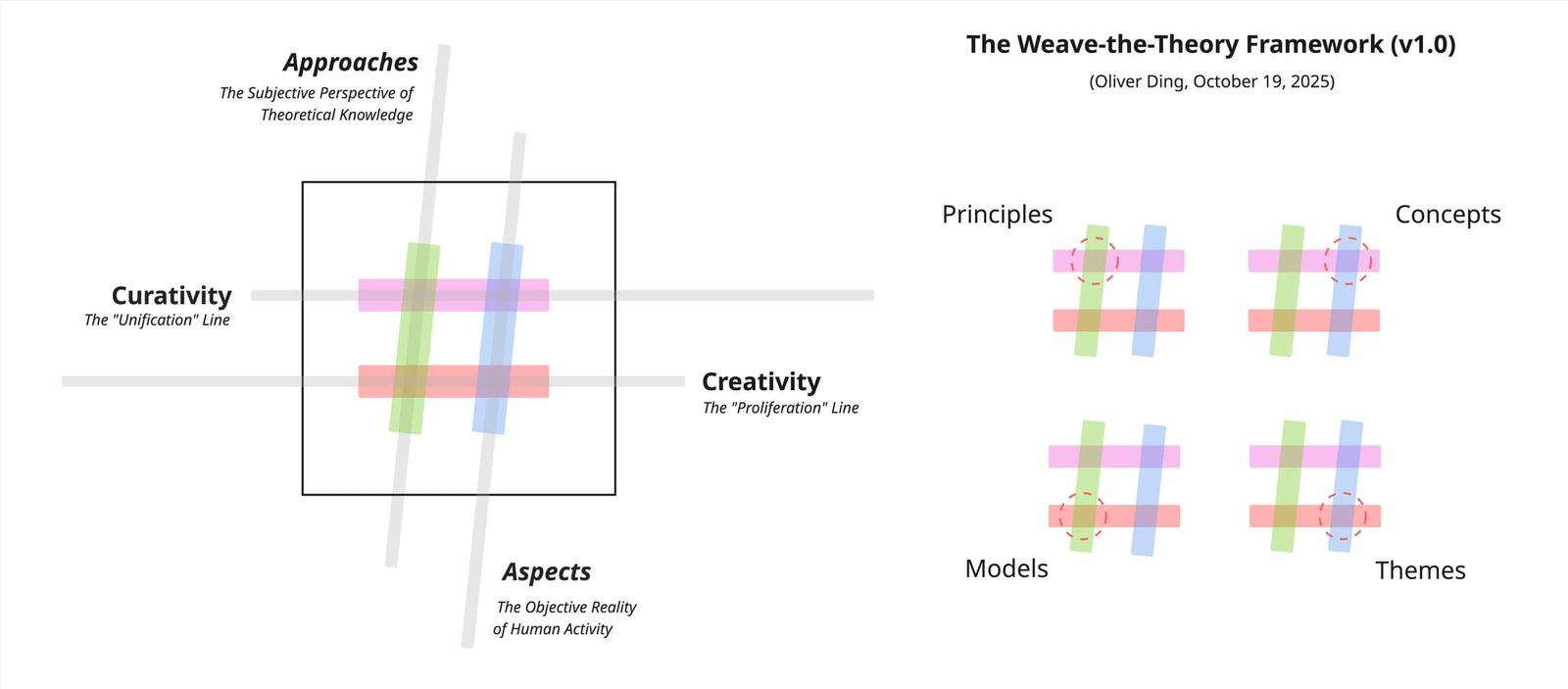
The framework also introduced two diachronic dimensions — Creativity (Proliferation) and Curativity (Unification) — and four weave‑points (Themes, Models, Concepts, Principles) that map onto these dimensions. Together, these elements provide an analytical tool for case studies of theoretical activity.
This framework led to a series of case studies from October 2025 to May 2026, resulting in a book draft titled Weave the Theory: The Art of Theoretical Activity and Knowledge Ecology.
The developmental episode of Theoretical Activity continued beyond October 2025. The concept, together with the Weave‑the‑Theory framework, would later become the third creative element to converge within the GO Theory platform, alongside Theoretical Platform and Theoretical Enterprise — completing the trio that this article analyzes as a Creative Confluence.
10. Building the Center
In the full eight‑movement Generative Confluence pattern, after Anchoring the Center comes Scaling the Focus, Catalyzing Curation, and Sustaining the Streams. Among these, Catalyzing Curation is the movement most directly concerned with assembling and integrating the contributions of different streams into a coherent center. For the purpose of this case study, I group these activities under the single heading Building the Center — the work of curating the instruments and insights brought by the three theoretical enterprises into a stable, generative framework for the new creative center.
In the present case — a Creative Confluence nested within an already‑established platform — the 3D living coordinate formed by the three theoretical enterprises (Life‑as‑Activity, Ecological Practice, Creative Life Theory) was already in place, carried forward from the 2025 Generative Confluence that produced GO Theory. What remains is the work of Building the Center: articulating what these three dimensions bring to the new confluence and curating their contributions into a coherent toolkit.
Each of the three theoretical enterprises has contributed a distinctive analytical instrument to the present case.
10.1 From Creative Life Theory: The Evolving Knowledge Enterprise Model
The Evolving Knowledge Enterprise model has been a continuing outcome of my work within Creative Life Theory. In 2025, while developing version 3.1 of Creative Life Theory, I produced the Enterprise Development Framework — a five‑stage model of how a theoretical enterprise evolves over time: Creative Theme, Scalable Focus, Center Development, Value Circle, and Developmental Platform. This framework captures the diachronic dimension of enterprise development: the structural transformations an enterprise undergoes as it matures.
10.2 From the Life‑as‑Activity Approach: The Weave‑the‑Theory Model
As introduced in Section 9, the Weave‑the‑Theory model was developed within the Life‑as‑Activity Approach as a framework for understanding Theoretical Activity as a specific type of activity. It provides a synchronic analysis of theoretical work, with two diachronic dimensions (Creativity as Proliferation, Curativity as Unification) and four weave‑points (Themes, Models, Concepts, Principles).
More recently, the Life‑as‑Activity Approach (v4.0) has paired Activity and Enterprise as two sides of the same coin — one subjective, one objective. This Activity‑Enterprise pairing emerged from a creative dialogue between the Life‑as‑Activity Approach and Creative Life Theory.
10.3 From the Ecological Practice Approach: The Supportance Analysis Method
The concept of supportance has been central to the Ecological Practice Approach since its early formulation in the 2021 book draft Platform for Development. Supportance names the enabling condition that a platform provides without direct intervention — the creation of an environment within which actors can discover their own opportunities and launch their own projects. In the recent Weave the Theory book draft, I analyzed Activity Theory as a theoretical platform and, in doing so, developed a concrete Supportance Analysis Method for examining how platforms support the work of others.
10.4 Curation into a Unified Toolkit
In Weave the Enterprise: Theoretical Platform and Theoretical Enterprise, I curated these three models together. The Evolving Knowledge Enterprise model (diachronic, five‑stage development) and the Weave‑the‑Theory model (synchronic, multi‑dimensional analysis) complement each other perfectly. Together, they form a comprehensive analytical framework for understanding a theoretical enterprise from both its developmental trajectory and its structural composition. The Supportance Analysis Method adds a third lens: how a mature enterprise (as a platform) enables the work of others.
These three instruments are not merely listed here; they are curated as part of the Building the Center movement. They demonstrate concretely what the three theoretical enterprises — the living coordinate — have brought to this Creative Confluence. Their integration into a coherent toolkit is one of the ways the new creative center (knowledge ecology) has been stabilized and made generative.
11. Setting the Enterprise
In the full eight‑movement Generative Confluence pattern, Setting the Enterprise is the final movement. It follows the earlier work of Finding the Coordinate, Anchoring the Center, Scaling the Focus, Catalyzing Curation, and Sustaining the Streams. While those movements establish and stabilize the new creative center, Setting the Enterprise turns toward the future: it defines what the center is about as a field of inquiry, and prepares that field to support ongoing development — both the creator’s own future work and, potentially, the work of others who may enter it.
The present Creative Confluence has produced a new creative center, which I call knowledge ecology. However, this name does not mean that the center itself is a knowledge ecology. Rather, knowledge ecology is the object of study of this new center. The center is a theoretical framework for investigating:
- What knowledge ecologies are — their structures, boundaries, and dynamics.
- How people develop their thematic enterprises within different knowledge ecologies.
- How theoretical activity builds, sustains, and transforms knowledge ecologies across scales.
The concrete content of this new center includes the three core creative elements — Theoretical Activity, Theoretical Enterprise, Theoretical Platform — and the analytical instruments curated in the Weave‑the‑Enterprise toolkit (Evolving Knowledge Enterprise model, Weave‑the‑Theory model, Supportance Analysis Method). It also includes the book drafts that embody and articulate this inquiry: Weave the Life, Weave the Theory, Lake 42, GO Theory, Anticipatory Cultural Sociology, and the knowledge‑ecology trilogy (Knowledge Discovery, Castle and Forest, Weave the Theory). These are not separate achievements; they are interconnected components of a single emergent framework for studying knowledge ecologies.
What does it mean to set this enterprise? As I wrote in the postscript to Weave the Theory (titled “From Personal Epistemology to Knowledge Ecology”):
This book is offered in that spirit: as a contribution to a research direction that is larger than any single book, and whose development will require the work of many contributors across many years — each perceiving and actualizing the supportances that this and other prior work has made available.
Setting the enterprise means recognizing that the study of knowledge ecologies is not a closed system. It is a generative research direction — a terrain that can support further theoretical enterprises. The concepts, frameworks, and book drafts assembled here are not the final word. They are resources for future work: tools that others can pick up, cases they can extend, distinctions they can refine, and supportances they can actualize in ways I have not yet imagined.
In the language of the Enterprise Development Framework (Section 8), this new center is still in its earliest stages. Its task now is to continue developing its internal coherence, to test its concepts through further case studies, and gradually to make its framework available to others who might find footholds within it. The object of study — knowledge ecology — is open. The framework for studying it is, at this moment, being set.
This article has been one act of setting the enterprise: documenting the confluence, anchoring the center, and making the conceptual architecture visible. The next acts will belong to whoever enters this terrain next.
v1.0 - May 24, 2026 - 6,899 words