
The Aspects - Approaches Fit

A Methodological Note on the Synchronic Dimension of Weave-the-Theory
by Oliver Ding
May 21, 2026
This article is part of Weave the Theory: The Art of Theoretical Activity and Knowledge Ecology
While assembling the Weave-the-Theory case study series, a pattern became visible that had not been planned for. Most of the articles in the series — on Revisiting-Rebuilding, Curativity, AAS, the Life-as-Activity Approach, the Genidentity of Activity Theory, Theoretical Enterprise, and the journey of Activity Theory since 2000 — concentrated their analytical energy on the two diachronic lines: the Creativity Line and the Curativity Line. This was not an oversight. Those cases were primarily stories of theoretical development across time — how a Theme crystallized into a Model, how a Concept slowly earned its place, how a Principle arrived. The diachronic dimension was where the action was.
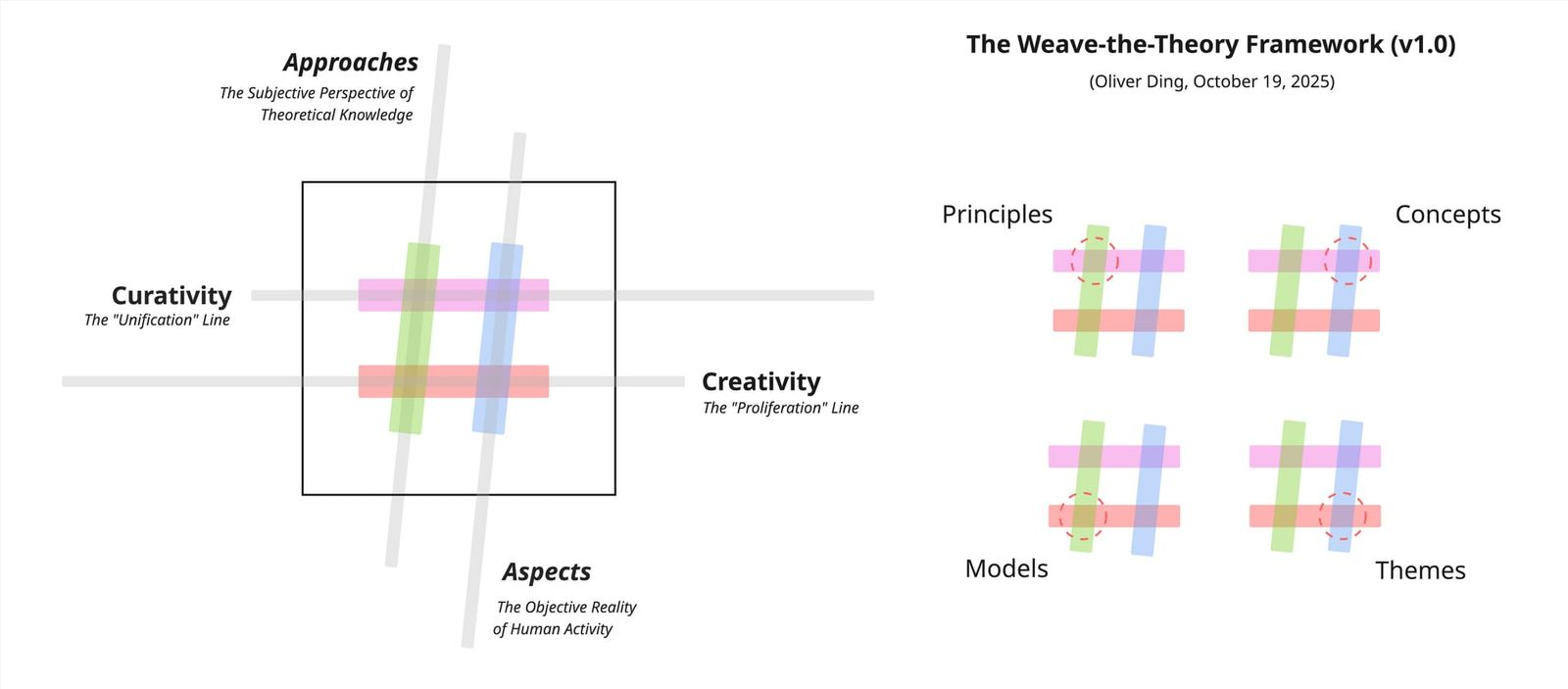
But the Weave-the-Theory framework has two synchronic lines as well: Aspects and Approaches. These two dimensions were present in every case analysis, doing structural work quietly — but they were rarely named directly. Reading back across the series, it became clear that this silence was not accidental. Most of the cases simply did not require the synchronic dimension to be made explicit. The diachronic narrative was sufficient to tell the story.
Two cases were different. In the AAS case, the entire development begins with a moment that cannot be described without invoking Aspects directly: the direct perception of a structure — Self, Other, Present, Future — in an observed situation, before any theoretical vocabulary was available to name it. In the Spinuzzi case, the Weave-the-Theory analysis required identifying how the Aspect of Network governed the selection of two theoretical Approaches, and how a long accumulation of Themes around that Aspect eventually built a distinctive knowledge niche — a development that reveals a genuinely different, and more mixed, relationship between Aspects and Approaches than the AAS case displays. In both cases, the synchronic dimension was not background. It was the hinge on which the analysis turned.
This article addresses the silence directly. It traces the Aspects-Approaches distinction back to its methodological source, explains what Weave-the-Theory adds to that source, situates the distinction within a broader methodological conversation, and shows — through the two cases where it became unavoidable — what it means in practice.
Contents
Part 1. The Discovery: A Dimension That Was Always Working
Part 2. The Source: The 5A Slow Cognition Model
Part 3. The Upgrade: What Weave-the-Theory Adds
Part 4. Four Methodological Positions
4.1 Grounded Theory: Induction Without Structure
4.2 Adaptive Theory: Approaches First, Aspects as Encounter
4.3 Swedberg's Theorizing: Craft Before Framework
4.4 Ecological Formism: Aspects First, Structure Before Theory
4.5 From Induction to Perception: A Methodological Spectrum
Part 5. Prestudy, Observation, and Perspective
5.1 Against Problem-Driven Research
5.2 Prestudy as the Context of Discovery
5.3 Peirce on Observation: Two Levels
5.4 Gibson: Point of Observation and Invariant Structure
5.5 Three Perspectives: Theoretical, Practical, Ecological
5.6 Why Ecological Formism Can Directly Perceive Aspects
Part 6. Weave-the-Theory Is Methodologically Neutral — But I Am Not
Part 7. Concept: Aspects, Curativity, and Orientation
6.1 Concept as Position, Not Definition
6.2 Layder's Orienting Concepts
6.3 Meta-model vs. Methodological Recommendation
Part 8. Two Cases, Two Paths
7.1 The AAS Case: The Shortest Path
7.2 The Spinuzzi Case: A Mixed Strategy
7.3 What the Two Cases Reveal Together
Postscript
A Note on What Remains
Part 1. The Discovery: A Dimension That Was Always Working
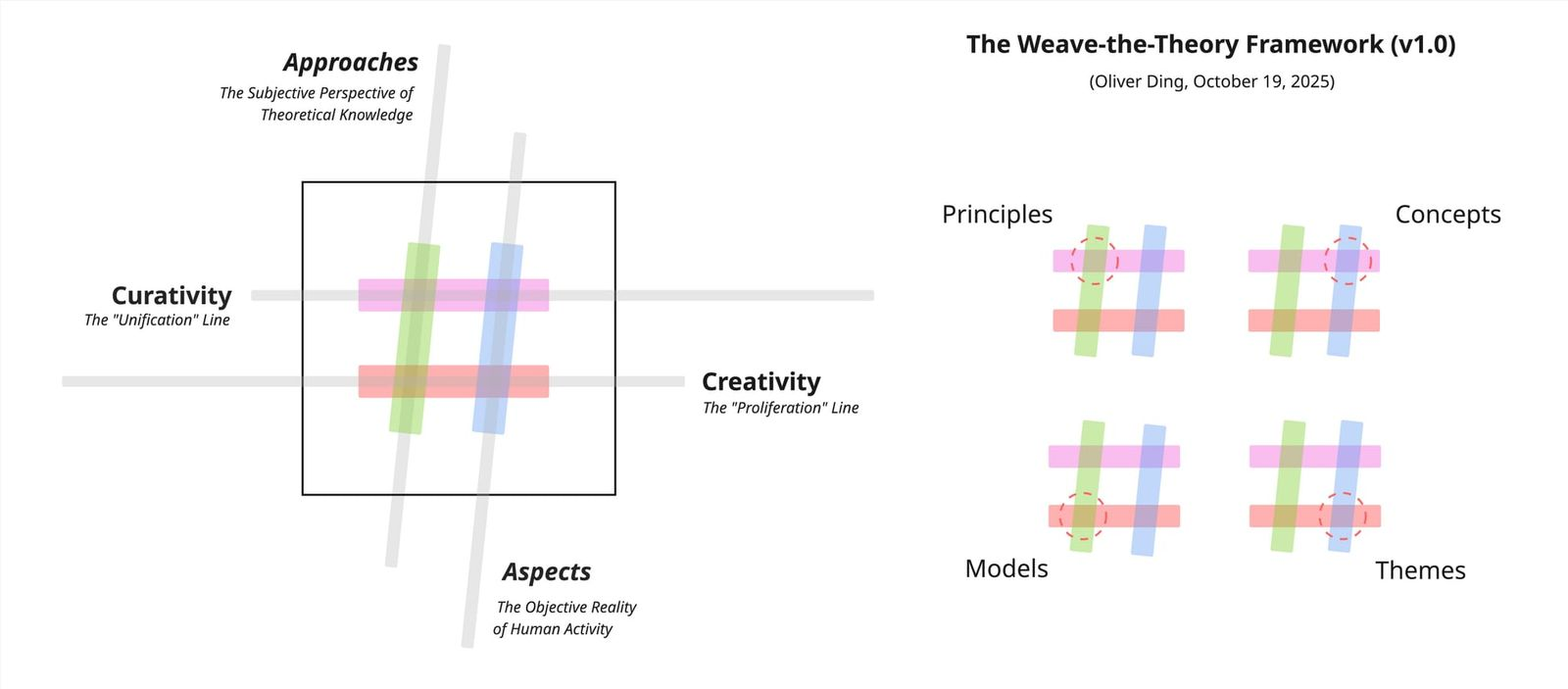
The Weave-the-Theory framework is organized around two pairs of lines. The first pair is diachronic: the Creativity Line (Proliferation) and the Curativity Line (Unification). The Creativity Line traces the outward movement of theoretical work — the generation of new Themes from lived experience, the development of structural Models that give those themes form. The Curativity Line traces the integrative movement — the refinement of accumulated insights into precisely defined Concepts, and the synthesis of those Concepts into governing Principles. These two diachronic lines intersect at four weave-points: Theme, Model, Concept, and Principle.
The second pair is synchronic: Aspects and Approaches. Aspects refers to the objective reality of human activity that theory seeks to explain — the actual structures, patterns, and dynamics that exist independently of the theoretical traditions used to analyze them. Approaches refers to the subjective perspective of theoretical knowledge through which that reality is interpreted — the conceptual vocabulary, analytical frameworks, and intellectual traditions that give the theorist a language for what they have observed. These two dimensions do not describe stages of development. They describe the two faces of any theoretical enterprise at any given moment: what it is about, and how it is being seen.
The four weave-points emerge from the intersections of all four lines simultaneously. Theme sits at the crossing of Creativity and Aspects: the lived, practiced inhabitation of a real pattern in human activity — something the theorist has noticed in the world, named, and begun to inhabit, before the full theoretical apparatus for understanding it is in place. Model sits at the crossing of Creativity and Approaches: the structural map built from the analytical vocabulary the theorist brings — a diagram, a framework, a typology that makes the pattern tractable. Concept sits at the crossing of Curativity and Aspects: the precisely defined theoretical proposition that names what is really happening — not merely the name of a phenomenon, but a structured claim about its underlying nature. Principle sits at the crossing of Curativity and Approaches: the governing insight that unifies the whole — the most abstract claim the development earns the right to make.
This structure means that every weave-point has a synchronic location as well as a diachronic one. Theme and Concept both belong to the Aspects side — they differ not in their relationship to the world, but in the depth at which they engage it: Theme is phenomenal, Concept is structural. Model and Principle both belong to the Approaches side — they differ in their level of integration: Model is operational, Principle is governing. The diachronic lines describe movement across time; the synchronic lines describe depth at any given moment.
Why, then, was this synchronic dimension so rarely made explicit in the case study series? The answer is structural. Most of the cases studied were long-cycle theoretical developments in which a single creator moved through the full arc of Theme, Model, Concept, and Principle across years or decades. The interesting question in those cases was always temporal: how did the development move, what triggered each transition, where did the governing Principle finally arrive? The synchronic dimension was the stable background against which the diachronic movement took place. It did not need to be discussed, because it was not varying.
It varied — visibly, consequentially — in exactly two cases. The AAS case turned on a synchronic crossing that happened in a single day: the movement from direct Aspects perception to the immediate adoption of multiple theoretical Approaches. The Spinuzzi case turned on a synchronic discovery: two Approaches in dialogue producing the recognition of Aspects that neither had previously named. In both cases, the synchronic dimension was not the background. It was the event.
Part 2. The Source: The 5A Slow Cognition Model
The Aspects-Approaches distinction did not arrive with the Weave-the-Theory framework. It was carried into the framework from an earlier layer of methodological reflection — the 5A Slow Cognition Model, developed in October 2022 as a retrospective account of a sustained period of independent empirical research.
The 5A model takes its name from five keywords that organize the creative pattern behind a long cycle of research activity: Aspirations, Aspects, Approaches, Attachances, Achievement. Each names a different dimension of my engagement with my work.
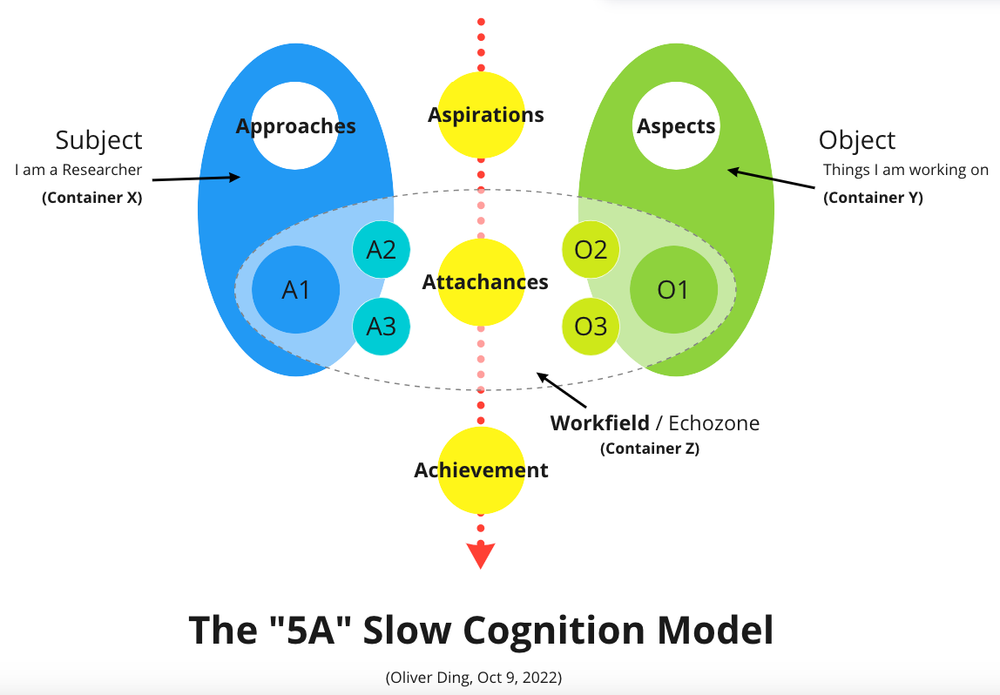
Aspirations names the orienting motivation: the questions, concerns, and theoretical commitments that bring me to the field in the first place. Aspects names the multifaceted character of any research object: the recognition that what one is studying has many faces, and that no single framework captures all of them. Approaches names the theoretical resources I bring: the frameworks, models, and conceptual vocabularies that make specific Aspects analytically tractable. Attachances names the cognitive motion between Aspects and Approaches: my movement of detaching from one Aspect-Approach configuration and attaching to another, generating insights at each crossing. Achievement names the accumulated outcomes: the concepts, frameworks, and insights that the journey produces, including both intended products and unexpected by-products.
The operational heart of the model is the Aspects-Approaches fit. I enter a Workfield — a sustained research situation — and discover that the object of study has multiple Aspects. Some of these Aspects are illuminated by Approaches I already carry; others require reaching for new theoretical resources; still others reveal the limits of every available Approach and demand new concepts. The movement between Aspects and Approaches, sustained across time and driven by the demands of the field, is where significant theoretical insights are generated.
This model was drawn directly from research practice — from the experience of working on a network of independent projects, each involving different empirical encounters with digital platforms and social practices, each requiring me to move fluidly between observational attentiveness and theoretical interpretation. It was not derived from philosophical principles about the nature of social inquiry. It was recognized in the structure of actual research activity and then named.
The 5A model's contribution was real and significant: it made the Aspects-Approaches distinction explicit as a methodological unit. But it had a structural limitation. In the 5A model, Aspects is a terminal category — I discover Aspects, find matching Approaches, and the fit generates insights. Aspects itself has no internal articulation. There is no account of how my relationship to an Aspect might deepen over time, moving from a first phenomenal recognition to a more structural understanding. The model describes a horizontal movement — across different Aspects, across different Approaches, across different configurations of fit — but not a vertical movement: downward into the depth of a single Aspect.
This is where Weave-the-Theory enters.
Part 3. The Upgrade: What Weave-the-Theory Adds
The 5A model named the Aspects-Approaches distinction and made it operational. But it left the Aspects side structurally flat: once an Aspect was identified, the model had nothing more to say about it. Weave-the-Theory addresses this limitation by introducing a vertical dimension — a path of deepening that runs through both the Aspects side and the Approaches side simultaneously.
The Weave-the-Theory framework inherits the Aspects-Approaches distinction from the 5A model but transforms it through a structural addition: the distinction between Theme and Concept on the Aspects side, and between Model and Principle on the Approaches side.
On the Aspects side, Theme and Concept mark two qualitatively different levels of engagement with the same objective reality. A Theme is phenomenal: I have noticed something real in human activity, given it a name, and begun to inhabit the territory it names. The recognition is genuine — there is something there — but its structural character has not yet been worked out. I can describe instances of the Theme, recognize it when it appears, and feel its presence in a situation. But I cannot yet say precisely what kind of structure it is, how it relates to adjacent phenomena, or what theoretical claim it underwrites. Theme is the name before its full meaning is understood.
A Concept is structural: I have moved from phenomenal recognition to theoretical proposition. A Concept does not merely name a phenomenon; it makes a claim about the objective structure of the phenomenon — what it is, how it is constituted, what it implies for adjacent theoretical questions. A Concept is anchored in Aspects not loosely, through resemblance or association, but precisely, through a defined structural relationship. The difference between Theme and Concept is not a matter of sophistication or theoretical elaboration. It is a matter of depth: how far into the structure of the phenomenon I have actually penetrated.
This distinction matters practically. A researcher who accumulates multiple Themes and then tries to abstract a Concept from them through inductive synthesis is performing a legitimate operation — but the result depends entirely on whether the Themes were each tracking the same underlying structure or merely a family of related surface phenomena. If the underlying structure was never directly perceived, the Concept produced by induction will be grounded in the phenomenal surface rather than in the objective structure. It will look like a Concept — it will have a definition, a theoretical position, a relationship to other concepts — but it will lack the structural solidity that comes from having been anchored directly in an Aspect. Such a Concept cannot bear the theoretical weight it claims to carry. It is, in the precise sense, ungrounded.
On the Approaches side, the parallel distinction between Model and Principle operates differently, but the logic is analogous. A Model is an operational analytical tool — it makes a domain of phenomena tractable, provides a vocabulary for their key elements and relationships, and enables analysis to proceed. A Principle is a governing claim about the deep structure of a theoretical enterprise — the most abstract proposition the accumulated work earns the right to assert. The movement from Model to Principle is not merely a matter of generalization or abstraction. It is a movement from operational adequacy to theoretical necessity: from "this model works in this domain" to "this is what the entire enterprise is fundamentally about."
Together, these two upgrades — Theme/Concept on the Aspects side, Model/Principle on the Approaches side — transform the Weave-the-Theory framework from a horizontal map of theoretical activity into a map with both horizontal and vertical dimensions. Movement along the diachronic lines traces development across time. Movement across the synchronic lines traces depth at any given moment. The four weave-points are not only stations on a developmental journey; they are positions in a thematic space defined by two axes of depth.
This is the structural contribution that Weave-the-Theory makes to the 5A model's original insight. The Aspects-Approaches fit is not merely a matter of finding the right theoretical resource for the right empirical phenomenon. It is a matter of depth on both sides: how deeply I have penetrated into the structure of the Aspect, and how completely I have integrated the theoretical Approach into a governing Principle. A shallow Aspect-Approach fit — Theme meeting Model — generates situated insights. A deep Aspect-Approach fit — Concept meeting Principle — generates theoretical architecture.
Part 4. Four Methodological Positions
The Aspects-Approaches distinction, and the question of where theoretical work legitimately begins, places the Weave-the-Theory framework in a broader methodological conversation. Before situating that framework within this conversation, it is useful to note what was already established in the companion piece Weave 42: Building Knowledge Ecologies Across Scales.
Weave 42 engaged the question of grounded theory's structural limitations at the architectural level. It identified two problems: the absence of an integrative architecture — grounded theory produces situated small theories without any mechanism for curating them into larger knowledge structures — and the presupposition of a researcher-actor division that prevents practitioners from using theoretical methods to understand their own situations. The Weave-Ecological Formism dual mechanism was proposed as a response to both limitations: Ecological Formism provides the integrative architecture, and the Weave diagram dissolves the researcher-actor division by making structural analysis available to practitioners working directly with their own material.
These are architectural arguments. They concern what happens to the knowledge that empirical research produces — how it is organized, curated, and made available across scales. They do not directly address the prior question: where does theoretical work begin? What is my relationship to the objective reality they are studying at the moment of first engagement? This epistemological question is where the present article picks up.
Three distinct positions can be identified, each representing a different answer to the question of how my prior knowledge and the empirical field relate to each other.
4.1 Grounded Theory: Induction Without Structure
Grounded theory, developed by Glaser and Strauss, prescribes a single legitimate starting point: the raw empirical field, approached as free as possible from prior theoretical commitments. The method's core injunction is to suspend existing theory and allow concepts to emerge inductively from systematic analysis of the data. The movement is always from particular to general, from data to code to category to theory.
In the vocabulary of Weave-the-Theory, grounded theory operates entirely on the Aspects side — but only at the phenomenal surface. It produces Themes in abundance. Its route to Concepts is always inductive: the accumulation of Themes, their comparison, their gradual abstraction. The structural claim of the resulting Concept is only as deep as the inductive process that produced it. If the Themes were each tracking the same underlying structure, the Concept may eventually reach that structure. If they were tracking surface similarities, the Concept will be ungrounded — a generalization of appearances rather than a proposition about structure.
Grounded theory has no method for distinguishing between these two outcomes, because it has no independent access to the structural level. It cannot see Aspects directly; it can only accumulate Themes and hope the structure eventually shows through.
4.2 Adaptive Theory: Approaches First, Aspects as Encounter
Derek Layder's Adaptive Theory, proposed in Sociological Practice: Linking Theory and Social Research (1998), represents a significant and underappreciated alternative. Layder's argument is directed precisely against grounded theory's epistemological presupposition: the idea that prior theoretical knowledge is a source of bias to be bracketed. Against this, he argues that the theorist never enters the field without theoretical resources, and that the attempt to simulate such a blank state does not produce purer knowledge — it produces impoverished observation.
His adaptive theory proposes that prior theory can legitimately organize and pattern research, while remaining genuinely open to revision by what the empirical encounter reveals. The relationship between theory and data is bidirectional: theory shapes observation, and observation reshapes theory. This is a genuine advance. It brings Approaches explicitly into the research process from the beginning, as legitimate resources rather than biases to be controlled. In the vocabulary of Weave-the-Theory, Layder makes the Approaches side visible as an active element of research practice.
But Layder's prior theory is always theoretical content — existing sociological frameworks, conceptual vocabularies, substantive claims about social reality. What he does not thematize is the possibility of prior structural perception: the direct recognition of an objective Aspect as a formal structure, prior to and independent of any theoretical Approach. His prior theory arrives in the field already carrying theoretical commitments; it is an Approach, not an Aspect. The Aspects side, in Layder's account, remains the domain of empirical encounter — what the field reveals — rather than a mode of direct structural perception that I might bring independently to the field.
4.3 Swedberg's Theorizing: Craft Before Framework
Richard Swedberg's project of "theorizing in sociology," developed through a series of papers and the 2014 book The Art of Social Theory, occupies a distinctive position that does not fit neatly into either the grounded theory tradition or Layder's Adaptive Theory. Its most revealing feature is what it refuses: the use of established theoretical frameworks as the entry point into the research process.
Swedberg is direct about this refusal. "The fact that theory is typically someone else's theory," he writes, "also means that it is exterior and alien to one's own thinking or, to phrase it differently, that it lacks a certain organic quality. Incorporating someone else's theory into one's own set of thought is also a difficult process that can easily go wrong ('organ rejection')." This is not merely a practical concern about theoretical fluency. It is an epistemological claim: prior theoretical frameworks, when imported into the research process at the beginning, colonize the researcher's observation before it has had a chance to encounter the phenomenon on its own terms. Layder welcomes this colonization as legitimate and generative; Swedberg treats it as a risk to be managed, if not avoided.
In place of prior theory, Swedberg proposes craft. Theorizing is not a logical procedure but a skill — one that involves tacit knowledge, intuition, and what he calls, borrowing from C. Wright Mills, the craft of sociology. "It is well understood that the hand of the craftsman knows more than his or her mind," he writes, "and being aware of this, helps the craftsman do a better job." The researcher develops, through sustained practice, a capacity for observation and conceptualization that is personal and organic — grown from inside the researcher's own intellectual engagement, not transplanted from outside.
The practical expression of this approach is the distinction between Prestudy and Main Study. Prestudy belongs to the context of discovery: its goal is not to prove or test, but to produce something interesting and novel. The steps Swedberg prescribes are revealing in their sequence: observe the phenomenon; name it; transform the name into a concept or introduce existing concepts tentatively; use analogy and metaphor; construct typologies; and finally, propose an explanation. This is a movement from the phenomenal surface toward theoretical proposition — from naming toward conceptualizing — that operates without a governing theoretical framework at the outset.
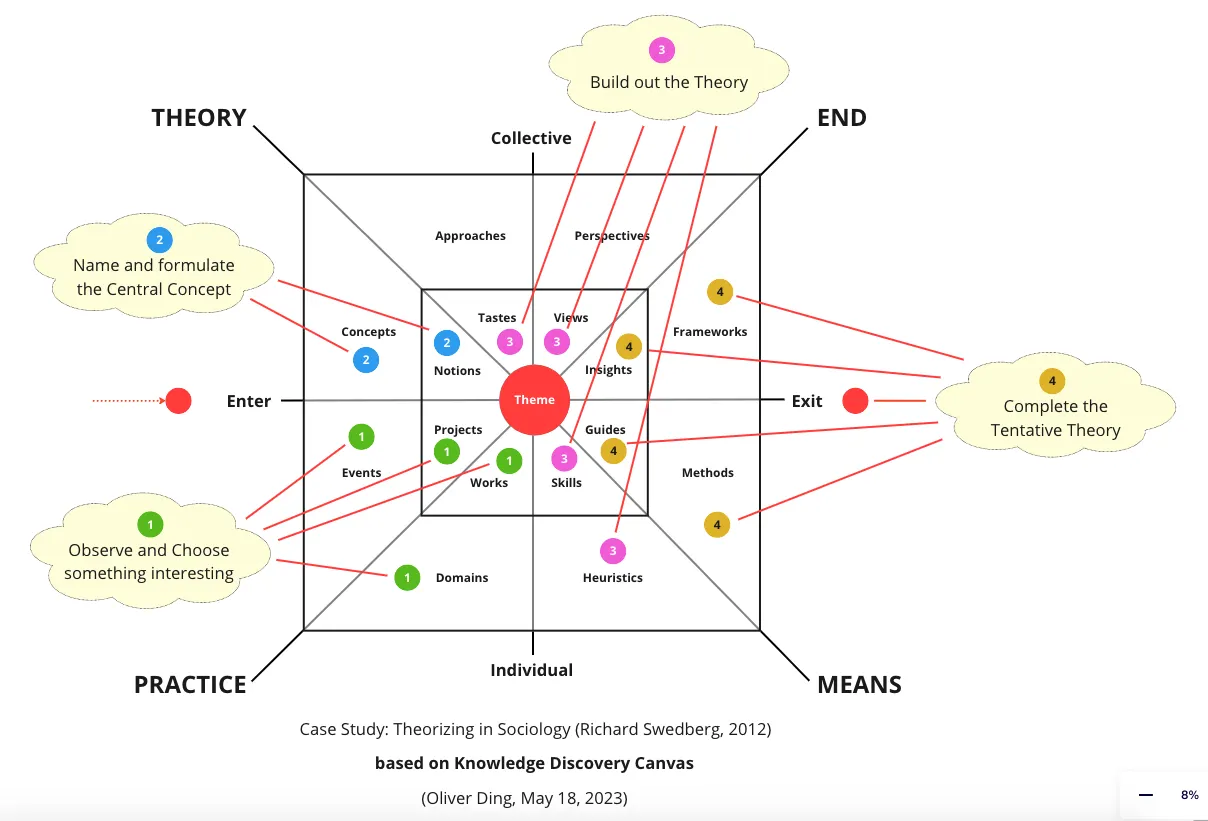
In the vocabulary of Weave-the-Theory, Swedberg's Prestudy works primarily on the Aspects side of the thematic space, moving from Theme toward Concept through craft-based observation and naming. It is not Approaches-driven — the theoretical frameworks arrive late, tentatively, as heuristic tools rather than governing structures. And it is not purely inductive in the grounded theory sense — Swedberg is not suspending judgment and waiting for patterns to emerge from data. He is actively making conceptual moves, using intuition, analogy, and imagination as instruments.
But Swedberg's framework leaves a crucial question unanswered: what exactly is observation, and what makes some observations capable of reaching the structural level while others remain at the surface? He acknowledges the role of tacit knowledge and intuition, but treats them as irreducible — as the mysterious dimension of craft that cannot be fully articulated. "One should warn against the idea that theorizing can be reduced to a set of explicit rules," he writes, "especially cognitive rules that should always be followed." This is an honest acknowledgment of the limit of his framework, but it is also where it stops. Swedberg stands at the threshold of the question that Ecological Formism enters directly: not what theorizing produces, but what kind of seeing makes structural perception possible in the first place.
4.4 Ecological Formism: Aspects First, Structure Before Theory
Ecological Formism, the framework within which the Weave knowledge system is positioned, represents a fourth position — and in some respects the natural continuation of where Swedberg's project reaches its limit. Its distinctive claim is that the researcher can perceive objective ecological structures directly — prior to theoretical elaboration, prior even to the phenomenal accumulation of Themes.
This is not the grounded theorist's empirical openness, which begins with particulars and builds upward. Nor is it Layder's theoretically informed observation, which begins with prior Approaches and remains alert to what the field corrects or extends. Nor is it Swedberg's craft-based observation, which moves from naming toward concept through intuition and tacit knowledge. It is a different cognitive operation: the direct recognition of a formal structure — a pattern of relationships, a basic ecological form — in a situation, before any theoretical vocabulary is available to name it.
This perceptual capacity is not reducible to prior theoretical knowledge, though prior theoretical work shapes and develops it. It is not reducible to empirical observation, though it is always grounded in real situations. It is not reducible to craft or tacit knowledge, though it has something in common with both. It is a form of structural intuition — the ability to see, in a particular situation, the formal pattern of which that situation is an instance. In the vocabulary of Weave-the-Theory, this is the capacity to perceive at the Concept level before building through the Theme level — to begin already at the structural depth, rather than accumulating at the phenomenal surface and hoping the structure eventually appears. Why this capacity is possible, and how it can be developed, is the subject of the next Part.
4.4 From Induction to Perception: A Methodological Spectrum
The four positions can be mapped as a development — each one addressing a limitation that the previous position left unresolved:
Grounded theory: Aspects accessible only through phenomenal accumulation — no direct structural perception, all movement inductive from Theme toward Concept. Approaches are bracketed as biases.
Adaptive Theory: Approaches enter the field legitimately from the beginning, prior theory is a resource rather than a bias. But Aspects remain the domain of empirical encounter rather than direct structural perception.
Swedberg's Theorizing: Approaches are treated with suspicion — their premature introduction risks "organ rejection." Observation and craft are foregrounded. But the capacity for structural observation remains tacit and unarticulated — a skill that cannot be fully taught.
Ecological Formism: Aspects can be directly perceived as formal structures, independent of any particular Approach, prior to theoretical elaboration. The capacity for this perception is not a mystery — it has a foundation in ecological epistemology that makes it describable and, in principle, trainable.
Part 5. Prestudy, Observation, and Perspective
Part 4 identified four methodological positions and noted that Ecological Formism claims a capacity — the direct perception of formal structures — that the other three positions cannot fully explain. That claim requires a foundation. This Part provides it, moving from Swedberg's recovery of the context of discovery, through Peirce's account of observation, to Gibson's ecological epistemology, and finally to a classification of three distinct modes of perspective that explains why Ecological Formism can do what it claims.
5.1 Against Problem-Driven Research
There is a dominant assumption in social science research that inquiry begins with a problem. The researcher identifies a gap in the literature, a social phenomenon that demands explanation, a question that existing theory cannot answer — and this problem organizes everything that follows: the theoretical framework, the research design, the data collection, the analysis. Problem-driven research is not merely a methodological convention. It is treated as a sign of intellectual rigor — evidence that the researcher knows what they are looking for and why it matters.
Swedberg challenges this assumption directly. The problem-driven approach, he argues, is one of the epistemological obstacles to genuine theorizing. "The social scientist should start the study with a distinct problem or a distinct theoretical point in mind, then construct hypotheses, and finally confront these with data." The result is a research culture that emphasizes method over creativity, replication over originality, and confirmation over discovery. Theorizing — the actual generation of new theoretical insight — is crowded out by the machinery of justification.
The diagnosis runs deeper than a methodological preference. A problem is not a neutral analytical starting point. It is a practical interest expressed as an intellectual question — a judgment about what matters, what counts as a gap, what deserves explanation. In the vocabulary of the perspective classification developed below, problem-driven research is governed by Practical Perspectives: the researcher's observations are organized by what their practical interests define as important, and the Aspects of the phenomenon that do not align with those interests remain invisible. The problem frames what can be seen before the observation has begun.
This is precisely the limitation that Ecological Formism addresses. The claim that Aspects can be directly perceived — that formal structures can be seen before theoretical frameworks or practical interests impose their organization — requires a different account of observation than the problem-driven model provides. That account begins with Swedberg's Prestudy, deepens through Peirce's analysis of observation, and finds its clearest articulation in Gibson's ecological epistemology.
5.2 Prestudy as the Context of Discovery
The distinction between the context of discovery and the context of justification — introduced by Reichenbach in the 1930s and given wide currency through Popper's The Logic of Scientific Discovery — identifies a structural feature of the research process that mainstream social science methodology has largely ignored. The context of justification is where results are tested, evidence is marshaled, and claims are submitted to public scrutiny. This is the domain of rigorous method, logical consistency, and replicable procedure. The context of discovery is where the ideas come from in the first place — the domain of intuition, imagination, and the first recognition that something is theoretically interesting. Because this domain seemed resistant to systematic analysis, it was largely left to psychology and left out of methodology.
Swedberg's recovery of the context of discovery as a legitimate object of methodological attention is the central contribution of his theorizing project. His Prestudy is the operational form of this recovery: a structured phase of inquiry whose goal is not to prove but to discover, not to test hypotheses but to generate them. Its steps — observe, name, conceptualize, use analogy and metaphor, construct typologies, propose an explanation — are explicitly heuristic. Their purpose is not to summarize the results of research but to produce something interesting enough to take into the Main Study phase.
In the vocabulary of the Weave-the-Theory toolkit, Prestudy maps naturally onto Second-order Activity — the exploratory phase in which the researcher is not yet performing a defined project but is discovering what the project should be. It is the activity of finding an Object and an Objective before the work proper has begun. Main Study, by contrast, is First-order Activity: the execution of a defined research project with its own logic of rigor and accountability.
What makes Swedberg's Prestudy methodologically significant — and what distinguishes it from both grounded theory and Layder's Adaptive Theory — is its treatment of theoretical frameworks. Where grounded theory brackets them, and Layder welcomes them as prior resources, Swedberg treats them with productive suspicion. They can be introduced tentatively, as heuristic tools, but they must not be allowed to colonize the observation before it has had a chance to encounter the phenomenon directly. The researcher's own observation, naming, and conceptualization must precede the adoption of someone else's theoretical apparatus. This is not anti-theoretical — it is a claim about sequencing and organic development. Theory grows from inside the encounter, not from outside it.
5.3 Peirce on Observation: Two Levels
Swedberg draws on Charles S. Peirce's account of observation to articulate what happens in the Prestudy phase — specifically Peirce's description of observation as a "mental operation" that combines a conscious structural dimension with a more intuitive one.
Peirce distinguishes between what he calls upper consciousness and subconscious in the act of observation. The conscious part — upper consciousness — is the deliberate, structural dimension: the researcher proceeds "with this purpose in mind till one's idea corresponds to the phenomenon," moulding "a more or less skeletonized idea until it is felt to respond to the object of observation." This is active structural seeking — the observer is not passively receiving impressions but actively constructing a skeletal form that fits what is being observed. The subconscious part — less conscious, more associative — operates through "associational potency" or "a magnified tendency to call up ideas rather than logical thought." It is the dimension of intuition, of unexpected connection, of the sudden recognition that this phenomenon resembles something seen elsewhere.
The two-level account is illuminating because it explains why Swedberg's craft cannot be reduced to explicit rules. The conscious structural dimension can be described and taught — it is the deliberate act of moulding a skeletonized idea against the phenomenon. The subconscious dimension, operating through association and intuition, is precisely the tacit knowledge that Swedberg identifies as irreducible. Both are necessary; neither alone is sufficient.
But Peirce's account, for all its precision, remains inside the observer's cognitive activity. It describes what happens in the mind of the observer, not the relationship between the observer and what they are observing. The question that Peirce's framework does not answer is: what determines which structural forms are available to be perceived? What makes it possible for some observers, in some situations, to mould their skeletonized idea against the phenomenon with great speed and accuracy — while others accumulate observations for years without the structure becoming clear? For this question, the turn to Gibson is necessary.
5.4 Gibson: Point of Observation and Invariant Structure
James J. Gibson's ecological psychology, developed most fully in The Ecological Approach to Visual Perception (1979), offers a radically different account of perception from the cognitivist tradition within which Peirce's analysis is often read. For Gibson, perception is not primarily a cognitive event — the construction of a mental representation from incoming sensory data. It is an ecological event — the direct pickup of information that is already structured in the environment, available to an organism that moves through it.
The distinction Gibson draws between Perspective Structure and Invariant Structure is central to this account. Perspective Structure is the arrangement of optical information that is unique to each stationary point of observation: as the observer moves, the perspective structure changes continuously. Invariant Structure, by contrast, is what remains constant across all points of observation — the structural features of the environment that persist through all the transformations of perspective. As Gibson writes: "The invariant structure separates off best when the frozen perspective structure begins to flow." It is precisely when the observer moves — when perspective structure begins to vary — that invariant structure becomes most clearly visible, because it is the only thing that does not change.
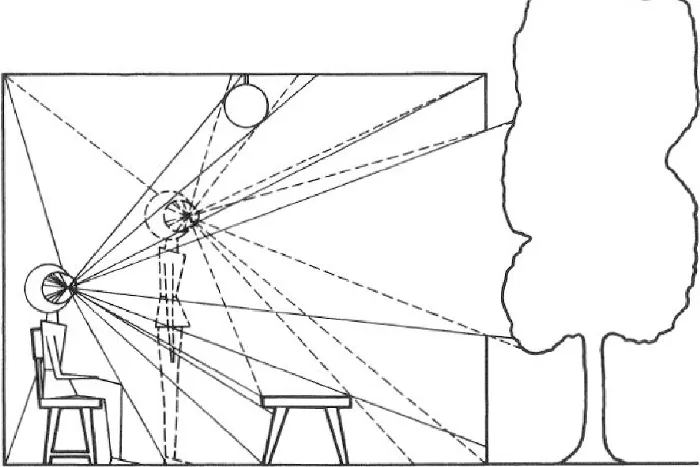
This has a direct epistemological implication. Invariant Structure is not constructed by the observer — it is picked up from the environment through the movement of the point of observation. The observer does not impose structure on the field; they discover structure that was already there, made visible by the contrast with the varying perspective structure. And this discovery is available to any observer who moves — it does not require a particular theoretical framework, a particular set of practical interests, or a particular level of prior training. What it requires is movement: the willingness to change one's point of observation and attend to what remains stable through the change.
In the vocabulary of Weave-the-Theory, Invariant Structure corresponds to Aspects — the objective features of human activity that theory seeks to explain, which exist independently of the theoretical traditions used to analyze them. The movement that makes Aspects visible is not theoretical elaboration but ecological locomotion: the displacement of the observer's position in the landscape of inquiry.
5.5 Three Perspectives: Theoretical, Practical, Ecological
Gibson's framework provides the foundation for a classification of three distinct modes of perspective — three different ways in which an observer's relationship to the phenomena they are studying can be organized.
Theoretical Perspectives are derived from theoretical approaches. The observer sees the phenomenon through the lens of a theoretical framework — concepts, models, and analytical vocabularies that organize what is relevant and what is not. Theoretical Perspectives are powerful precisely because they are systematic: they make certain structures highly visible and enable sophisticated analysis of the phenomena they illuminate. But they are also constraining: the theoretical framework determines the point of observation, and what falls outside that framework's perspective structure remains invisible. In the vocabulary of Weave-the-Theory, Theoretical Perspectives correspond to Approaches-driven observation — the researcher enters the field with a Model already in hand.
Practical Perspectives are determined by practical interests. The observer sees the phenomenon through the lens of what matters to them practically — what problems need solving, what goals need achieving, what questions are worth asking from the standpoint of their situation and commitments. Practical Perspectives are not theoretically neutral — they involve implicit theoretical assumptions — but they are organized by value judgments about importance rather than by explicit theoretical frameworks. Problem-driven research is the methodological expression of Practical Perspectives: the problem that organizes the inquiry is itself a practical interest expressed as an intellectual question. What this perspective reveals is determined by what the observer cares about; what it conceals is everything that falls outside the frame of practical relevance.
Ecological Perspectives come from changes in the point of observation. They are independent of both theoretical frameworks and practical interests. The observer moves — changes their position in the landscape of inquiry — and attends to what remains stable through the movement. What becomes visible through this process is Invariant Structure: the formal patterns that persist across all the varying perspectives. Ecological Perspectives do not require the observer to bring a theoretical framework or to have a practical problem in mind. They require only the willingness to move and to attend.
This classification clarifies what Ecological Formism actually claims. It is not that the Ecological Formist researcher has no theoretical training or practical interests — of course they do. It is that, at the moment of direct structural perception, neither the theoretical framework nor the practical interest is organizing the observation. What is organizing it is the movement of the point of observation and the attention to what remains invariant through that movement. The formal structure — Self-Other-Present-Future, Outside-Projecting-Inside, Create-Curate-Weave — is picked up from the environment of inquiry, not constructed from theoretical resources or practical problems.
5.6 Why Ecological Formism Can Directly Perceive Aspects
The question posed at the end of Part 4 can now be answered directly: why is Ecological Formism able to directly perceive Aspects — formal structures of human activity — when other methodological positions cannot?
Because Aspects, in the precise sense of the Weave-the-Theory framework, correspond to Invariant Structure in Gibson's ecological epistemology. They are the features of human activity that persist across theoretical frameworks, across practical contexts, across cultural and historical variation — the formal patterns that remain constant through all the changes of perspective. And Invariant Structure, as Gibson demonstrated, becomes most clearly visible not through the imposition of a framework, not through the organization of a practical problem, but through the movement of the point of observation: the ecological locomotion that makes perspective structure flow and invariant structure stand out.
Grounded theory cannot directly perceive Aspects because it does not move its point of observation systematically — it accumulates observations from within the same domain, hoping the invariant structure eventually reveals itself through inductive saturation. Adaptive Theory cannot directly perceive Aspects because its prior theoretical framework fixes the point of observation — the framework determines what counts as relevant, and the invariant structure outside that frame remains invisible. Swedberg's craft-based theorizing comes closest — his suspicion of prior frameworks preserves the freedom to move, and his emphasis on observation and naming reflects the ecological instinct — but without an explicit account of how to move the point of observation, the capacity for structural perception remains tacit and unarticulated.
Ecological Formism makes this capacity explicit. The direct perception of Aspects is not a mysterious gift. It is the result of moving the point of observation and attending to what remains invariant through the movement. This is learnable. It is trainable. And the instruments through which it is trained — the meta-diagram series developed from 2017 onward — are the subject of a companion article. Each meta-diagram establishes a specific point of observation; using it is an act of ecological locomotion; what becomes visible through its use is a specific type of Invariant Structure — a specific Aspect of human activity that persists across the varying perspectives of different theoretical frameworks and practical contexts.
Swedberg spoke of craft and tacit knowledge as the irreducible core of theorizing. He was right that these dimensions cannot be replaced by explicit rules. But they are not irreducible in the sense of being unexplainable. The hand of the craftsman knows more than their mind because it has moved through more positions — has touched more surfaces, felt more resistances, developed through practice the capacity to distinguish what varies from what remains constant. This is ecological knowledge: knowledge gained through the movement of the point of observation, knowledge that is structural because it is invariant, knowledge that is tacit only because it has not yet been given its ecological account.
Part 6. Weave-the-Theory Is Methodologically Neutral — But I Am Not
The Weave-the-Theory framework, as an analytical tool, is compatible with all three positions described in Part 4. Its structure does not prescribe where theoretical work must begin.
A researcher working in the grounded theory tradition can enter the framework at the Theme weave-point: starting from phenomenal observation, accumulating cases, and moving inductively toward the Concept level. The framework accommodates this path — it simply describes where the researcher is in the thematic space of Aspects depth and Approaches integration, without prescribing where they should begin.
A researcher working in the Adaptive Theory tradition can enter at the Model weave-point: bringing an existing theoretical framework into the field, using it to organize initial observations, and remaining open to the revisions that empirical encounter demands. The framework accommodates this path as well — the Model is a legitimate entry point, and the movement from Model toward Principle, or from Model toward deeper Concept engagement, is a recognized trajectory.
A researcher working in Swedberg's theorizing tradition can enter at the Theme weave-point through a different route: not through inductive data analysis but through craft-based observation and naming, moving from phenomenal encounter toward tentative conceptualization. The framework accommodates this path — the Prestudy phase maps naturally onto the early movement along the Aspects side of the thematic space.
A researcher working in the Ecological Formism tradition can enter at the Concept level: beginning from the direct perception of a formal structure, and moving simultaneously toward Approaches and toward Themes. This is also a legitimate entry point — and, as the AAS case demonstrates, it produces a distinctive trajectory.
Four entry points, four trajectories, one analytical framework. The framework is neutral between them. Its value is descriptive and comparative — it provides a structural vocabulary for understanding what kind of theoretical work is being done at any given moment, regardless of the methodological tradition within which that work is situated.
I am not neutral. The methodological position underlying both the 5A model and the AAS development is Ecological Formism: the direct perception of objective structural forms as the preferred starting point for theoretical work. This preference is not a prescription for others. It reflects a specific combination of intellectual background — sustained engagement with ecological psychology, activity theory, and diagrammatic thinking — and a specific kind of theoretical sensibility: the tendency to see formal patterns before theoretical vocabularies, and to find those patterns more trustworthy as anchors for Concepts than the accumulated results of inductive synthesis.
This preference is worth stating openly rather than leaving implicit, for two reasons. First, it explains features of the case studies in this series that might otherwise appear arbitrary — the speed of the AAS development, the particular form of the Spinuzzi analysis, the repeated appearance of basic ecological forms (Self-Other-Present-Future, Outside-Projecting-Inside, Create-Curate-Weave) as the deep structure beneath diverse theoretical constructions. These are not coincidences. They are the signature of a particular methodological disposition.
Second, making the preference explicit allows readers to locate themselves in relation to it. A reader whose methodological sensibility is closer to grounded theory or Adaptive Theory is not excluded from the Weave-the-Theory framework — they are working in the same thematic space, from a different entry point. The framework is large enough to hold all four positions. I simply occupy one corner of it more naturally than the others.
Part 6. Concept: Aspects, Curativity, and Orientation
Part 6 established that Weave-the-Theory accommodates multiple methodological paths, all of which lead to the same weave-points. But this raises a question worth pausing on before the case studies: what exactly is the Concept weave-point, and how does it relate to the ordinary use of the word "concept" in theoretical work and everyday thinking? The answer requires a brief detour through the most familiar term in the framework — and through a comparison with another thinker who has thought carefully about it.
6.1 Concept as Position, Not Definition
The word "concept" is one of the most commonly used terms in theoretical work, in everyday thinking, and in reflective practice. Precisely because it is so familiar, it carries accumulated meanings that can mislead when a reader encounters it in the Weave-the-Theory framework. Before proceeding to the case analyses, it is worth pausing to clarify what Concept means — and does not mean — in this framework.
In everyday usage, a concept is typically understood as a definition: a precise formulation of what a term means, its essential features, its boundaries. To have a concept of X is to be able to say what X is. In theoretical work, concepts are developed through argument, refined through critique, and judged by their precision and explanatory power. This is a legitimate and important understanding. But it is not what the Concept weave-point in Weave-the-Theory primarily designates.
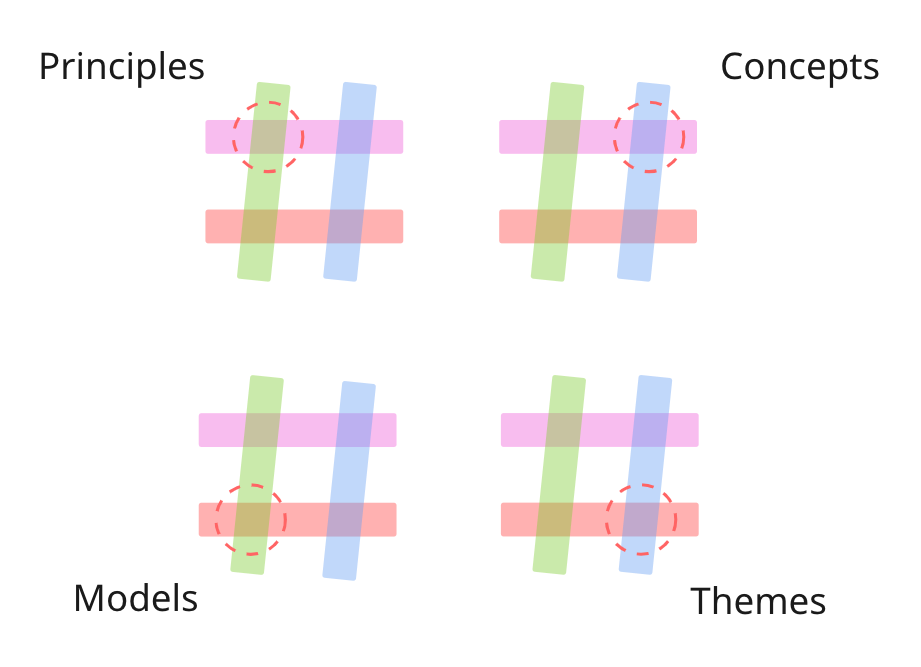
In this framework, Concept names a position in a thematic space — the intersection of the Curativity Line and the Aspects dimension. This positional definition has two implications that differ from everyday usage. First, a Concept in this sense is not simply what the term means in isolation, but what it does at this particular intersection: it is the theoretical proposition that names an objective structure — that moves from the phenomenal surface of a Theme to the structural depth of an Aspect, and does so through the integrative movement of the Curativity Line. Second, its meaning is not fully determined by its own definition but by its relationship to the other three weave-points. What a Concept is, in any given theoretical enterprise, is partly constituted by the Themes it organizes, the Models it governs, and the Principle it points toward. The position defines the territory; the relations define the content.
A reader who approaches the Concept weave-point expecting to find a neatly bounded definition will miss what is actually at stake. The question to ask is not "what does this concept mean?" but "what thematic space does this position open, and how is that space shaped by its coordinates in the framework?" This is a different cognitive act — closer to spatial orientation than to lexical definition.
6.2 Layder's Orienting Concepts
It is at this point that a comparison with Derek Layder's notion of Orienting Concepts becomes illuminating — not because the two are equivalent, but because they are genuinely different, and the difference clarifies what Weave-the-Theory's Concept weave-point is doing.
Layder introduced Orienting Concepts in Sociological Practice (1998) as a methodological tool for guiding empirical research. An orienting concept, in his account, has two defining features: it is "two-sided," referring simultaneously to the objective and subjective dimensions of social life, and it is oriented toward social processes — capable of tracing activity and events across time and space. The canonical example is "Career": a concept that bridges macro and micro analysis, connects individual experience to collective forces, and is empirically applicable across domains far beyond its original home in occupational sociology. Its virtue is breadth and bridging power — it can reach into many territories at once, and it holds together dimensions of social reality that other frameworks tend to separate.
I have used Layder's suggestion directly on two occasions. In 2020, "Project" served as the orienting concept for Project-oriented Activity Theory — a concept that, in precisely Layder's sense, could reach into both the subjective experience of individual engagement and the objective structures of collective activity, bridging the individual-society distinction. In September 2023, I began working with "Mindset" as another orienting concept, precisely because of the same two-sided quality: it spans cognitive psychology and social structure, individual disposition and cultural formation, and can anchor empirical inquiry across diverse domains.
These are genuine uses of Layder's framework. They work. And they produce results that, analyzed through Weave-the-Theory, would occupy the Concept weave-point — because they are structural propositions about objective social reality, reached through a specific methodological strategy.
6.3 Meta-model vs. Methodological Recommendation
But Weave-the-Theory and Layder's Orienting Concepts are not in the same business. The difference is not one of better or worse, but of level.
Layder's Orienting Concepts is a methodological recommendation: it tells a researcher how to begin empirical work. Choose a concept with the right two-sided structure, and it will guide observation without closing off discovery. It is a tool for entering a research domain.
Weave-the-Theory is a meta-model: it analyzes and describes theoretical activity — the work that theorists and researchers do — without prescribing how they should do it. Its Concept weave-point is not a recommendation. It is an analytical position: the place in the thematic space where a theoretical enterprise has produced a structural proposition about objective reality, however it arrived there.
This distinction has a direct consequence for how the framework handles methodological pluralism. Because Weave-the-Theory is a meta-model rather than a methodological prescription, its Concept weave-point can receive and describe the outputs of all four methodological traditions discussed in Part 4 — without privileging any of them:
A Concept produced through grounded theory — arrived at inductively, through the accumulation and abstraction of Themes — occupies the Concept weave-point if it has genuinely reached the structural level. The path was inductive; the destination, if successful, is structural.
A Concept produced as a Layder-style Orienting Concept — chosen for its two-sided bridging capacity, used to organize and enter a research domain — also occupies the Concept weave-point. The path was theory-guided; the destination is the same structural position.
A Concept produced through Ecological Formism — perceived directly as a formal structure before Themes have been accumulated — also occupies the Concept weave-point. The path was the shortest; the destination is identical.
Four paths, one position. Weave-the-Theory does not ask how the Concept was produced. It asks whether it has genuinely arrived — whether it names an objective structure, not merely a phenomenal surface. The framework is an observatory, not a laboratory: it observes where theoretical work has reached, not how the journey was conducted.
This is also why the Concept weave-point cannot be read as a simple synonym for "orienting concept" in Layder's sense, even when the two overlap in practice. An orienting concept is defined by its methodological function — what it does for the researcher entering the field. The Concept weave-point is defined by its structural position — what it does in the architecture of the theoretical enterprise. The same term can perform both functions simultaneously; but the two frameworks are asking different questions about it.
Part 7. Two Cases, Two Paths
The preceding Parts have established the framework, traced its sources, situated it methodologically, and clarified the meaning of its key terms. What remains is the demonstration — two cases from the Weave-the-Theory series where the synchronic dimension was not background but event, and where the methodological differences described in Parts 4 and 5 were not abstract but concretely visible in how the theoretical work unfolded.
The two cases where the synchronic dimension became unavoidable in the Weave-the-Theory series demonstrate not only what Aspects and Approaches mean, but what it looks like when theoretical work begins from genuinely different positions on the synchronic dimension.
7.1 The AAS Case: The Shortest Path
In August 2021, while observing an adult development program as an advisor, a structure became visible. The program involved a young creator navigating a life transition, supported by peer feedback and structured reflection. What the observation revealed was not a set of interesting phenomena to be catalogued. It was a formal pattern: the simultaneous presence of Self and Other, Present and Future, in every meaningful activity taking place within the program. This was not derived from prior theoretical reading. It was perceived directly, as the structure of the situation.
On August 17, 2021, the structure was recognized. On August 18, a meta-diagram was adopted and the iART framework was designed — an early version of what would become the Anticipatory Activity System. In less than two days, the movement from Aspects to Approaches was substantially complete: the formal structure [Self — Other — Present — Future] had been perceived, named, and translated into a framework that drew simultaneously on Rosen's Anticipatory System Theory, Activity Theory's concept of Second-order Activity, and Schutz's phenomenological sociology.
The speed of this development reflects the nature of the Aspects-first entry. When a formal structure is directly perceived, the search for adequate Approaches is not exploratory — it is convergent. The researcher knows what they are looking for: a theoretical vocabulary adequate to the structure already in hand. The three theoretical traditions adopted were not discovered through broad reading and gradual synthesis. They were recognized as fits for a structure that was already clearly seen.
This is the shortest path through the Weave-the-Theory thematic space: Concept before Theme, structural perception before phenomenal accumulation. It is the most demanding path — it requires a perceptual capacity that is not easily acquired — but it is also the most generative, because the Concept it produces is anchored in a directly perceived structure rather than in the inductive residue of accumulated observations.
One further detail deserves emphasis. The meta-diagram adopted on August 18 was not new. It had been developed in 2017, in a project exploring the Thing-People ecological structure. The capacity to directly perceive [Self — Other — Present — Future] as a formal structure was not independent of prior diagrammatic work. It was enabled by it. The 2017 meta-diagram had trained my perceptual apparatus to recognize ecological structures as formal patterns — shapes that can be seen before they are named. This point connects directly to a question that lies beyond the scope of this article but will be taken up elsewhere: how the capacity for direct Aspects perception can be developed through deliberate practice with meta-diagram series.
7.2 The Spinuzzi Case: A Mixed Strategy
The Spinuzzi case does not represent a single, clean methodological position. It is more honest — and more instructive — than that. What it shows is what a sophisticated researcher's actual practice looks like when multiple methodological instincts are simultaneously at work.
It is important first to note what the Spinuzzi case is and is not. The Weave-the-Theory analysis in Clay Spinuzzi: Mediating Concept and Network of Projects examined Spinuzzi's creative work across more than two decades — compressing a long career trajectory into a single analytical account. This is fundamentally different from the AAS case, which concerned a single project unfolding over days. The comparison is not between two researchers working at the same scale; it is between a single intense project and a long-cycle creative enterprise, read through the same analytical lens. That difference in scale must be kept in view.
With that clarification, Spinuzzi's actual methodological practice, as documented across his own words and published work, reveals three distinct instincts operating in combination.
The first is closer to Layder's Adaptive Theory than to either grounded theory or Ecological Formism. Spinuzzi's self-description is explicit: "Activity theory often does a good job of helping me interpret the results of that qualitative research, so I often use it and have tried to develop it further in ways that will aid that work. But I sometimes reach for other frameworks such as actor-network theory, which is good at interpreting other aspects of this work." This is Approaches as instruments — theoretical frameworks are actively selected because they fit the empirical domain, not generated from the data. The publication of Topsight (2013) — a research methodology handbook that operationalizes Activity Theory into a systematic guide for practitioners — is the most thoroughgoing expression of this instinct: Approaches are not only prior, they are codified into procedure.
The second instinct is genuinely Aspects-first, operating at the level of the 2008 Network book. Spinuzzi was working in a telecommunications company, face to face with complex overlapping work activities. There were many possible analytical focuses. He chose Network. This was not derived from either AT or ANT; it was a recognition of what the empirical situation was fundamentally about — a structural choice that preceded and governed the selection of theoretical frameworks. When he subsequently found that AT alone could not account for the political and rhetorical dimensions of network-building, he reached for ANT. The Aspect drove the Approach selection, not the other way around. This is the Ecological Formism instinct: the direct recognition of a structural feature of the domain as the primary anchor.
The third instinct is genuinely inductive, and it governs the development from Network (2008) to All Edge (2015). Spinuzzi's own account of this development is precise: "I think of each case study as a stair step, and when I have enough steps, I write a book, which is like the landing at the top of the stairs." The articles came first; the concept of "all edge" arrived late, as a way of naming what the accumulated cases had been revealing. This is not Ecological Formism — the Concept did not precede the Themes. It is closer to grounded theory's inductive logic, though operating with theoretical frameworks already in hand. What the case studies generated was not raw data waiting to be coded, but empirically grounded Themes accumulating around the Aspect of Network that had been identified in 2008. The landing at the top of the stairs was built from steps that each had a theoretical orientation — but the landing itself required the accumulation.
What holds these three instincts together is the Aspect of Network as a stable anchor. Once Network was identified in 2008 as the structural feature of the domain that mattered most, it became the organizing center around which subsequent empirical work accumulated — a knowledge niche, in the sense developed in Weave the Enterprise. The Themes generated through the case studies (nonemployer firms, coworking spaces, SEO professionals, gig workers) are diverse in content but unified in their relationship to the same Aspect. The Approaches (AT and ANT) remain the analytical instruments through which each case is interpreted. And the Concept that eventually crystallized — Network of Projects, as named in the Weave-the-Theory analysis — is the structural proposition that the accumulated Themes, taken together, earn the right to assert.
Spinuzzi himself would not use this vocabulary. The concept of "Network of Projects" is my curation of his work, not his own formulation. But the structure it names is genuinely present in his scholarship — and the methodological mixture that produced it is precisely what makes the case instructive. It demonstrates that the four positions described in Part 4 are not mutually exclusive. A researcher can move between Layder's Approaches-first instinct, an Ecological Formism moment of direct Aspect recognition, and an inductive accumulation of Themes — across different phases of a long creative enterprise, according to the demands of each situation. Weave-the-Theory, as a methodologically neutral framework, can accommodate and describe all movements within the same case.
7.3 What the Two Cases Reveal Together
The AAS and Spinuzzi cases do not form a simple contrast. They do not represent opposite ends of a single spectrum. They represent two genuinely different relationships between a researcher and the synchronic dimension of theoretical work — and both are instructive precisely because of their differences.
In the AAS case, the synchronic dimension was the event: a formal structure perceived in a single moment, immediately governing the search for adequate Approaches. The diachronic development that followed was rapid because the synchronic anchor was clear from the start. The case demonstrates what is possible when Ecological Formism operates at its most direct — and it demonstrates equally that this directness was enabled by prior diagrammatic practice, not given independently of it.
In the Spinuzzi case, the synchronic dimension worked differently at different phases. The initial Aspect recognition in 2008 was a genuine Ecological Formism moment — Network as the structural anchor for a long subsequent enterprise. But the development from that anchor proceeded through Layder's Approaches-first instinct (theory as instrument, codified in Topsight) and through genuinely inductive Theme accumulation (case studies as stair steps). The synchronic dimension was not a single event; it was a stable reference point around which a mixed and evolving practice organized itself across years.
Most theoretical work does not look like the AAS case. It looks more like Spinuzzi's — a mixture of instincts, shifting across phases, with the Aspect sometimes clearly perceived and sometimes approached obliquely through accumulated Themes and competing Approaches. The Weave-the-Theory framework does not prescribe which path is correct. It provides the analytical vocabulary for recognizing which path is being taken at any given moment — and for asking what each path produces at the level of Concept and Principle.
Postscript: A Note on What Remains
This article has established the methodological status of the Aspects-Approaches distinction within the Weave-the-Theory framework, traced its source in the 5A model, and shown — through the AAS and Spinuzzi cases — what it looks like when theoretical work enters from different positions on the synchronic dimension.
One question has been named but not answered: how is the capacity for direct Aspects perception developed? The AAS case makes clear that it is not innate. The 2017 meta-diagram was explicitly identified, in the AAS case study, as part of what made the recognition of [Self — Other — Present — Future] possible. The perceptual apparatus had been trained. The structure was visible because earlier work had taught my eye to see it.
This implies that the capacity for Ecological Formism — for beginning theoretical work from the direct perception of formal structures — is not a fixed endowment. It is a skill, acquired through deliberate practice. The meta-diagram series developed between 2017 and the present represents one body of such practice: each diagram a training instrument for recognizing a specific type of ecological structure, each engagement with a diagram an exercise in structural perception.
How this practice works, what it trains, and how it connects to the broader program of developing what might be called ecological perception as a theoretical capacity — these questions belong to a companion article, tentatively titled Meta-diagrams as Training Instruments. The present article ends here, at the edge of that question, with the acknowledgment that the Aspects-Approaches fit is not only a structural feature of the Weave-the-Theory framework. It is a practical challenge: the ability to perceive at the Concept level, directly and quickly, is not given. It is built.
This article draws on: The 5A Slow Cognition Model (October 2022); Weave the Theory: A Case Study of the AAS Framework Development (April 24, 2026); Clay Spinuzzi: Mediating Concept and Network of Projects (May 2026); Weave 42: Building Knowledge Ecologies Across Scales (March 9, 2026); Derek Layder, Sociological Practice: Linking Theory and Social Research (Sage, 1998); Richard Swedberg, Theorizing in Sociology and Social Science: Turning to the Context of Discovery (2011) and The Art of Social Theory (Princeton University Press, 2014); James J. Gibson, The Ecological Approach to Visual Perception (1979); and Charles S. Peirce, Reasoning and the Logic of Things (1898/1992).
v1.0 - May 21, 2026 - 10,606 words