
Weave the Enterprise: Theoretical Platform and Theoretical Enterprise

A Revisiting and Rebuilding of the 2023 Exploration
by Oliver Ding
May 6, 2026
This article follows the Revisiting–Rebuilding practice. It revisits a 2023 exploration of the concept of Theoretical Platform, developed through a creative dialogue with Thomas Kuhn's Disciplinary Matrix, and rebuilds it by integrating several conceptual developments from 2025: the Cultural Genidentity Framework, the Enterprise Development Framework, and the Weave-the-Theory model.
The 2023 exploration produced a significant insight: that Kuhn's four components of the Disciplinary Matrix — Symbolic Generalizations, Beliefs in particular exemplars, Values, and Exemplars — could be mapped onto the Platform Genidentity Framework, and that several seemingly distinct concepts (Knowledge Center, Perceived Platform, Scientific Project, Scientific Community) could be unified within a single analytical structure. This insight was named "Theoretical Platform." But at the time, the concept remained primarily structural and synchronic. It described what a theoretical tradition is at any given moment, without yet providing adequate tools to understand how it develops over time.
The rebuilding moves in two directions. The first direction deepens the analysis of Theoretical Platform itself, adding the conceptual dimension of Meta-framework and expanding the social dimension of Platform-ba into a three-dimensional model of Theoretical Enterprise — encompassing Social, Mental, and Material dimensions. The second direction introduces a developmental account: Theoretical Enterprise unfolds through five stages, and Theoretical Platform is not a starting condition but an achievement — the stage at which an enterprise becomes capable of supporting the work of others.
The article draws on the companion piece published the previous day, Revisiting the Genidentity of Activity Theory (May 4, 2026), which provided the primary case study. Activity Theory serves here as a concrete instance through which the abstract concepts of Theoretical Platform and Theoretical Enterprise become analytically visible. Together, the two articles constitute a contribution to the Weave-the-Theory toolkit: the Theoretical Platform concept provides the synchronic analytical dimension, and the Theoretical Enterprise model provides the diachronic dimension, giving the toolkit the conceptual resources it needs for analyzing theoretical traditions as a special case of human creative activity.
Part 1. Background: The Core Frameworks
This part introduces the conceptual foundations upon which the entire article builds. Each framework presented here — the Platform Genidentity Framework, the creative dialogue with Kuhn's Disciplinary Matrix, the Cultural Genidentity Framework, and the Enterprise Development Framework — represents a distinct stage in a years-long exploration of Theoretical Enterprise and Theoretical Platform. What follows in Parts 2 through 5 revisits these crystallizations, re-examining them through the lens of the Weave-the-Theory model in order to curate them into a coherent whole.
1.1 The Platform Genidentity Framework (2022)
The Platform Genidentity Framework was developed in May 2022 to understand how a platform maintains its unique identity over a long duration. Drawing on Kurt Lewin's philosophical concept of genidentity — the existential continuity of a thing through successive phases of development — the framework proposed that a platform's identity is defined not by static properties but by the interplay of Essential Differences and Situated Dynamics. Essential Differences capture what makes a platform distinctively itself; Situated Dynamics capture how that distinctiveness is expressed through varying content, context, and application across time.
The framework introduced two further structural elements: Platform Core and Platform-ba. Platform Core refers to the core members of a platform — the knowledge center, the creative actors who carry and develop the platform's foundational commitments. Platform-ba, borrowing the Japanese concept of ba (place, field), refers to the platform-based sociocultural space formed by users, collaborators, and practitioners who engage with the platform from the outside. Together, these four elements — Essential Differences, Situated Dynamics, Platform Core, and Platform-ba — form the basic structure of the Platform Genidentity Framework.
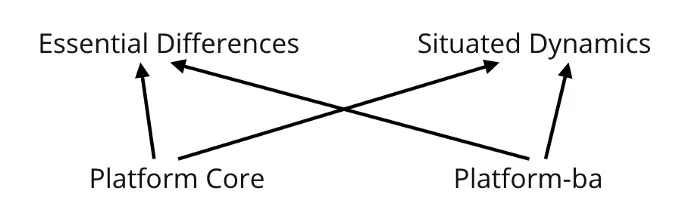
When this framework was applied to theoretical traditions, an important intuition emerged: for scholars who engage deeply with a theoretical tradition over years, that tradition functions as a developmental platform — a structured environment within which their own theoretical work becomes possible. A theoretical tradition has a Platform Core (its founding theorists and core concept systems), a Platform-ba (the community of practitioners and researchers who work within it), Essential Differences (the structural features that make it recognizably itself), and Situated Dynamics (the diverse frameworks, models, and applications that express those features across contexts). This application of the Platform Genidentity Framework to theoretical traditions produced the concept of Theoretical Platform.
1.2 A Creative Dialogue with Kuhn: Understanding the Complexity of Theoretical Platform (2023)
In May 2023, I was studying Ping-keung Lui's theoretical sociology as a case study within the Creative Life Theory project. Lui's work presented an immediate analytical challenge: he himself used Thomas Kuhn's concept of the Disciplinary Matrix as the central framework for describing his own theoretical enterprise — its structure, its ambitions, and its relationship to the broader field of sociology. While working on this case, I made an unexpected discovery: the Platform Genidentity Framework turned out to be a fitting model for understanding Kuhn's Disciplinary Matrix. The structural correspondence between the two frameworks was not something I had anticipated — it emerged from the demands of the case itself. This discovery opened a productive dialogue between the two frameworks and produced a more precise understanding of the internal complexity of a Theoretical Platform.
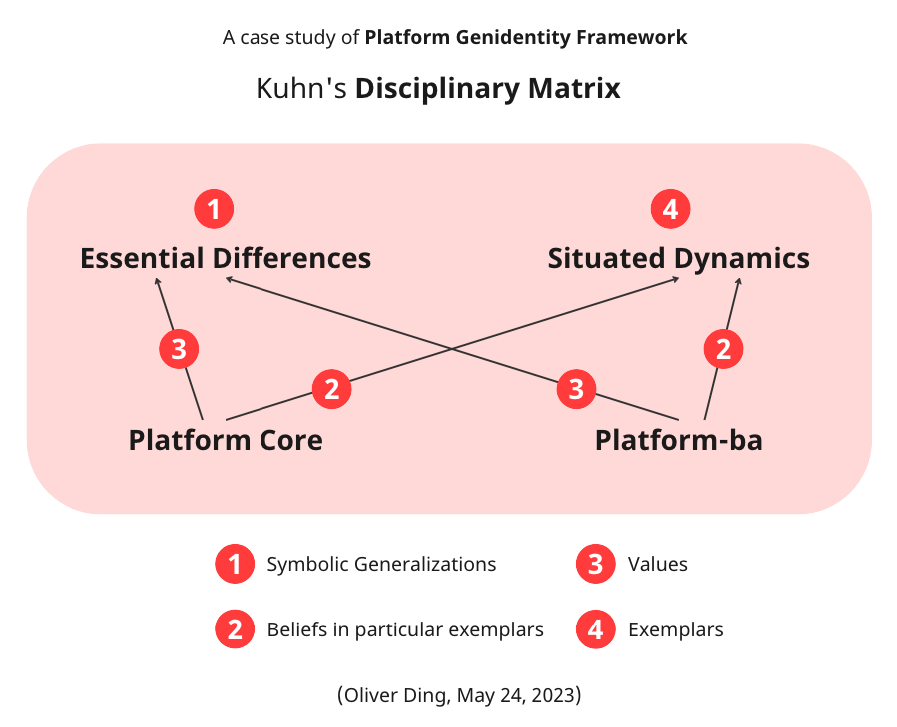
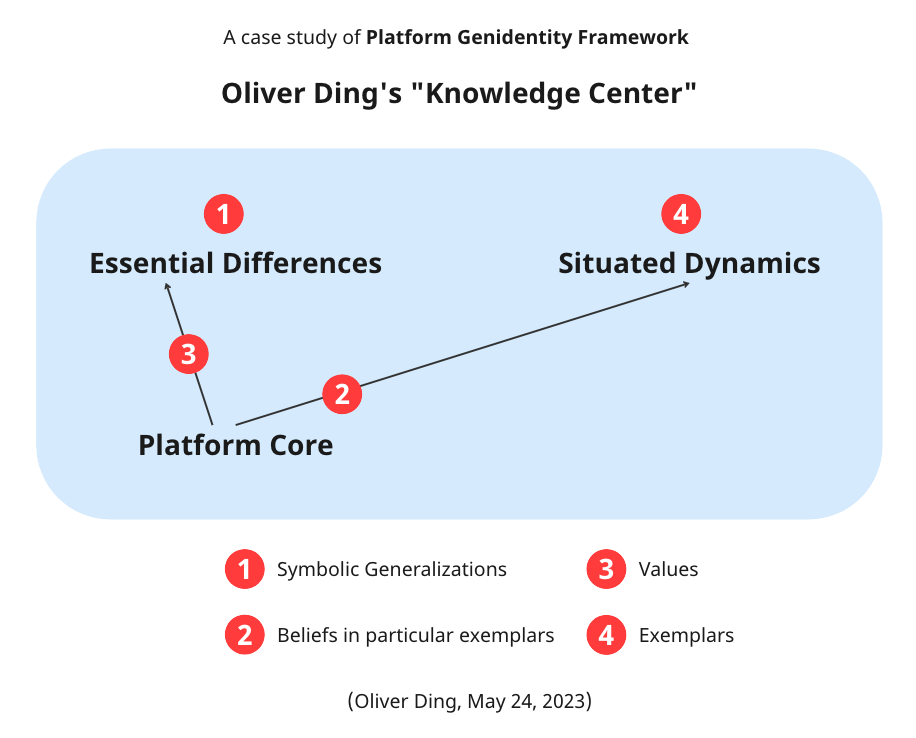
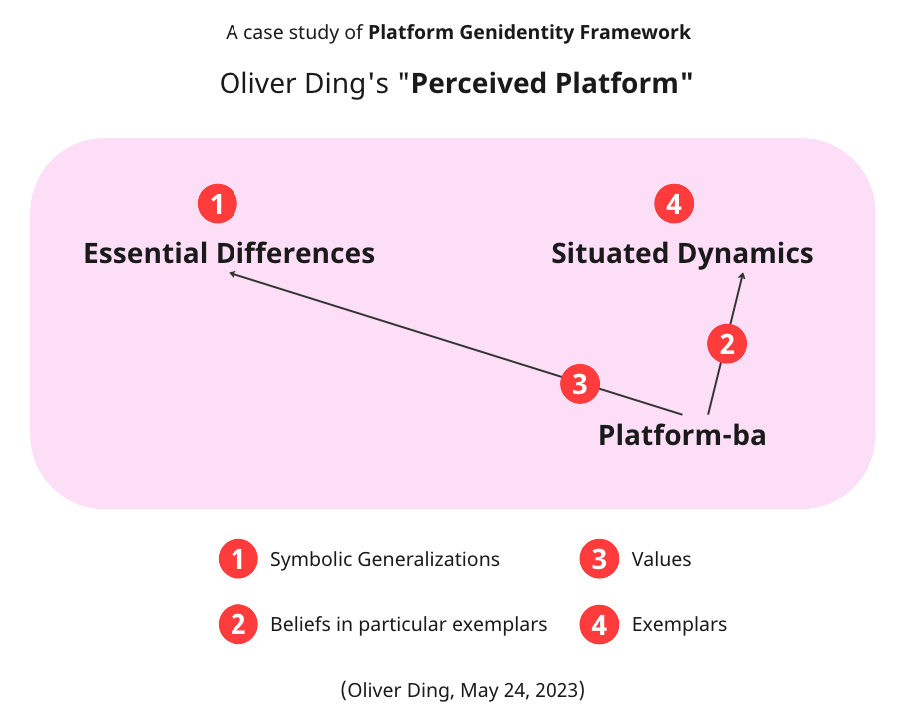
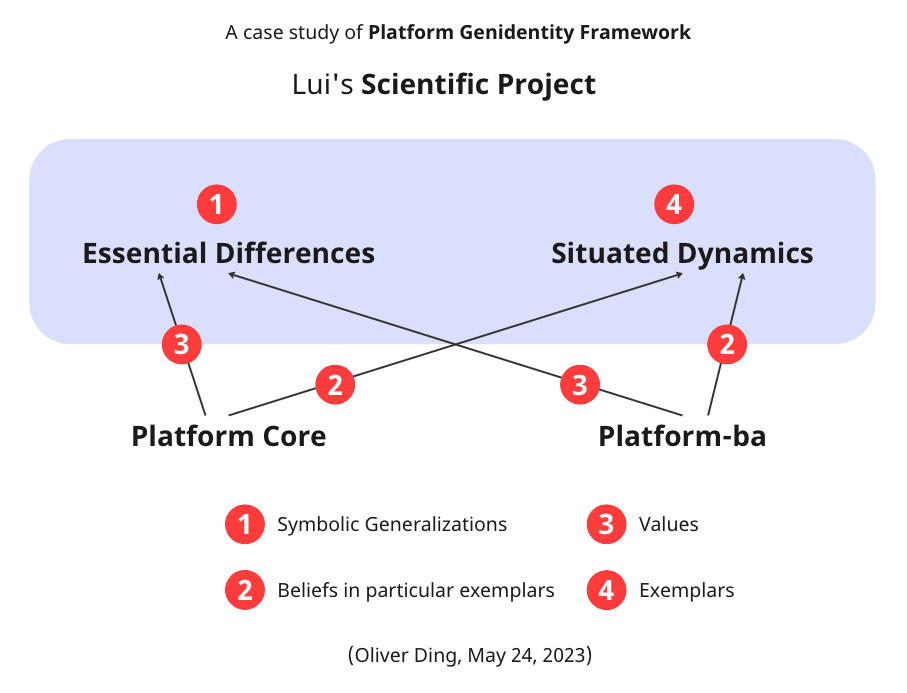
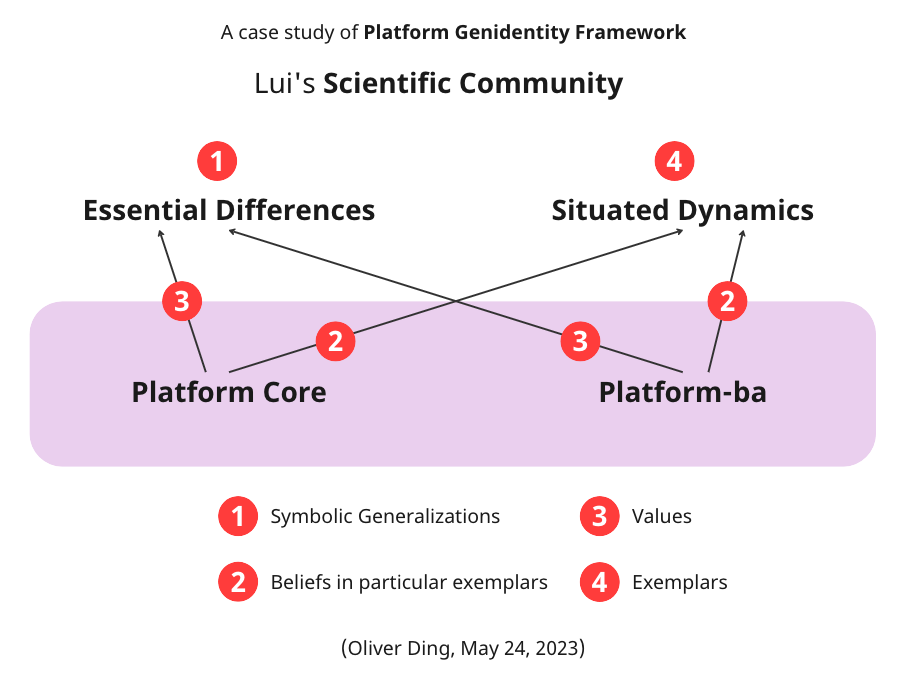
Kuhn's Disciplinary Matrix consists of four components: Symbolic Generalizations (the formal expressions that function as laws or definitions), Beliefs in particular exemplars (shared commitments about which examples best instantiate the tradition's achievements), Values (shared standards for evaluating theories and explanations), and Exemplars (the concrete problem-solutions that serve as models for future work). The mapping between the two frameworks revealed a structural correspondence: Symbolic Generalizations align with Essential Differences, Exemplars align with Situated Dynamics, while Beliefs in particular exemplars and Values function as the relational connections running from Platform Core and Platform-ba toward Essential Differences and Situated Dynamics respectively.
This mapping generated an unexpected discovery. By varying which elements were included within the analytical boundary, five distinct analytical perspectives on a theoretical tradition could be derived from the same framework:
- the full Disciplinary Matrix (all four elements),
- the Knowledge Center (Platform Core only, emphasizing Essential Differences),
- the Perceived Platform (Platform-ba only, emphasizing Situated Dynamics),
- the Scientific Project (Essential Differences and Situated Dynamics without the human actors), and
- the Scientific Community (Platform Core and Platform-ba without the conceptual content).
These five perspectives are not five different theories — they are five different ways of cutting the same underlying structure, each revealing a different face of what a Theoretical Platform is.
This insight was named "Theoretical Platform." However, at this stage the concept remained primarily synchronic and social. The analysis described the structure of a theoretical tradition at a given moment, and both Platform Core and Platform-ba were conceived primarily in terms of their human and social dimensions. What was missing was an account of how a Theoretical Platform develops over time, and a more precise conceptual vocabulary for the non-social dimensions of that development.
1.3 The Cultural Genidentity Framework: Adding the Conceptual Dimension (2025)
On February 4, 2025, the Cultural Genidentity model was created, later evolving into the Cultural Genidentity Framework. This development brought two significant conceptual advances.
The first advance was a terminological refinement. Platform Core was reconceptualized as Cultural Creators, and Platform-ba was reconceptualized as Cultural Supporters. More importantly, the framework introduced a new conceptual pairing: Meta-framework and Cultural Enterprise. Meta-framework corresponds to the conceptual dimension of a theoretical tradition — the core concept systems and coordination mechanisms that constitute its Essential Differences. Cultural Enterprise corresponds to the thematic enterprise dimension — the evolving body of work, projects, and practitioners through which the tradition's Situated Dynamics unfold.
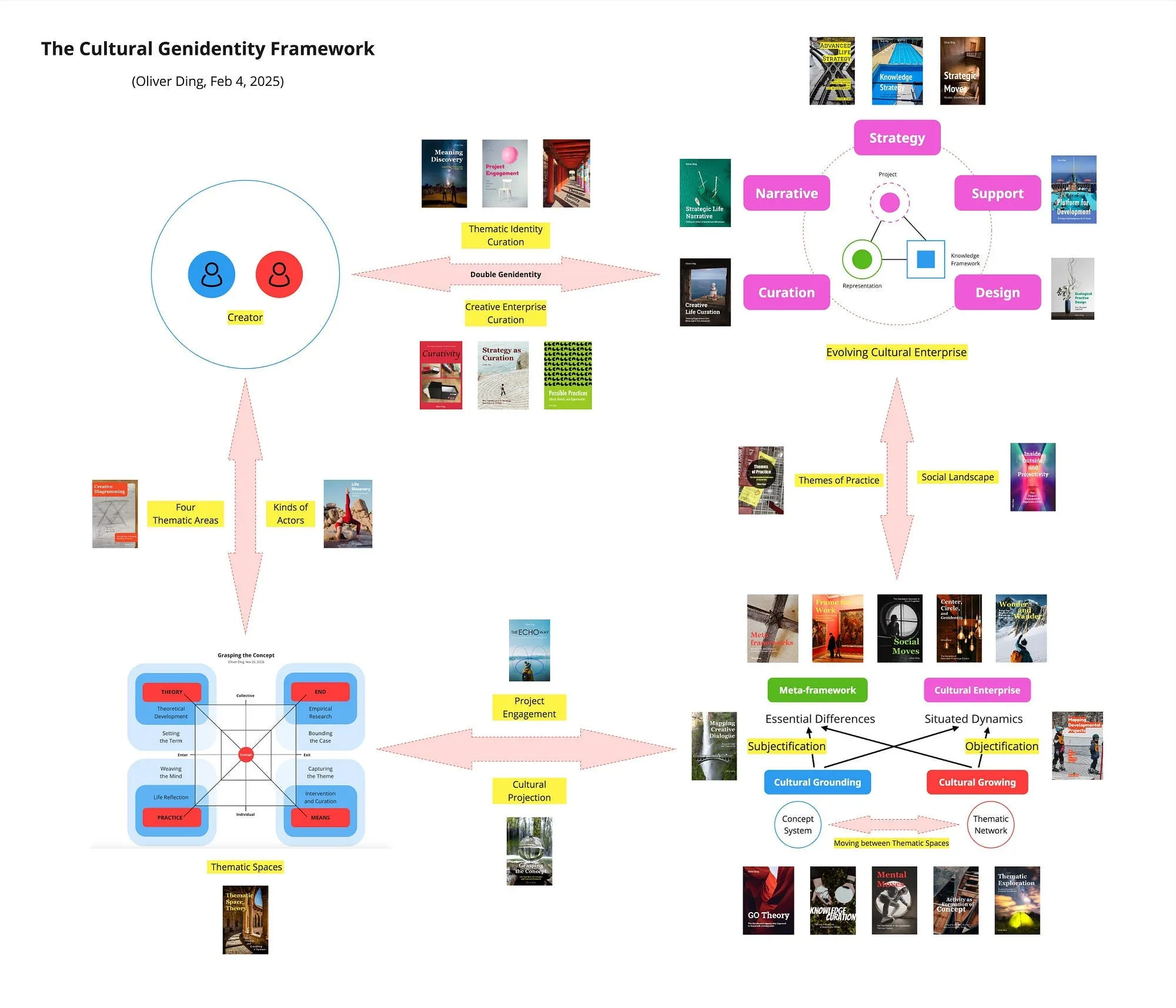
The second and more significant advance was dimensional. In the Platform Genidentity Framework of 2022–2023, both Platform Core and Platform-ba were understood primarily within the Social dimension — as human actors and social fields. The Cultural Genidentity Framework retained Platform Core and Platform-ba within the Social dimension, but added two further dimensions to the Enterprise: the Mental dimension (the cognitive, conceptual, and theoretical work through which the enterprise develops) and the Material dimension (the texts, diagrams, artifacts, and tools through which the enterprise's knowledge becomes objectified and transmissible). Meta-framework, meanwhile, was introduced as a new and independent Conceptual dimension — not derived from Platform Core, but added alongside it as a separate analytical layer.
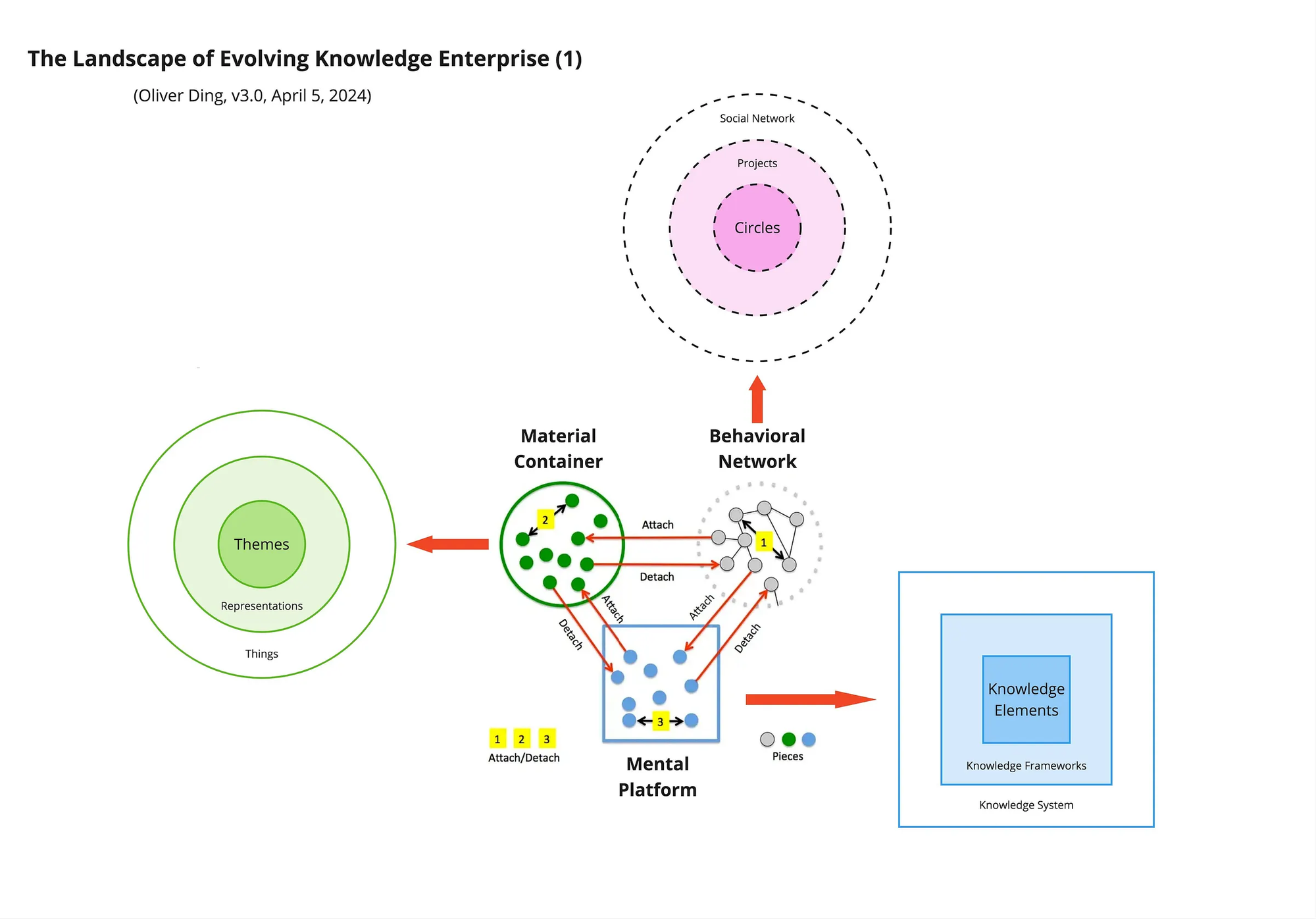
This expansion transformed the concept of Theoretical Enterprise from a primarily social construct into a three-dimensional one: Social (Platform Core, Platform-ba, and their interactions), Mental (the cognitive and theoretical work of the enterprise), and Material (the artifacts and representations the enterprise produces and circulates).
1.4 The Enterprise Development Framework: Five Stages (October 2025)
In October 2025, the Enterprise Development Framework was developed, introducing a five-stage account of how an enterprise evolves over time. The five stages are: Creative Theme, Scalable Focus, Center Development, Value Circle, and Developmental Platform. Each stage represents a qualitative shift in the nature and scope of the enterprise.
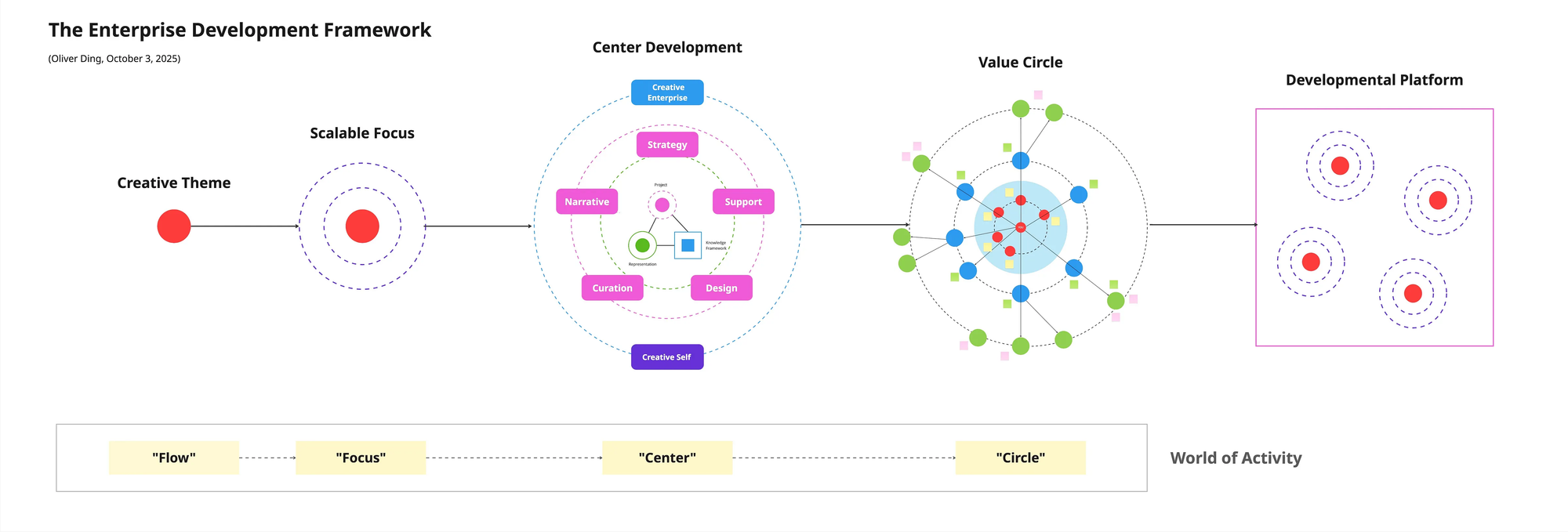
At the Creative Theme stage, a single generative idea begins to attract attention and energy. At the Scalable Focus stage, the theme develops sufficient structure to sustain a sustained line of inquiry. At Center Development, the enterprise establishes its own active center — with projects, representations, and a series of developed practices. At Value Circle, the creative center connects to other creative centers, forming a network. At the Developmental Platform stage, the enterprise has achieved sufficient maturity and structural stability to actively support the work of others — not merely as a resource to be drawn upon, but as a structured environment within which new enterprises can themselves develop.
This final stage — Developmental Platform — is precisely what the concept of Theoretical Platform designates. A Theoretical Platform is not a starting point but an achievement: the stage at which a Theoretical Enterprise becomes capable of functioning as a developmental platform for others. The Platform Genidentity Framework describes what this stage looks like structurally; the Enterprise Development Framework describes how an enterprise arrives there.
1.5 A Note on Key Terms
Several terms in this article share the word "Platform" and are easy to conflate. This section distinguishes them before the analysis proceeds.
Platform Genidentity Framework is an analytical tool — a framework for understanding how any platform (technological, sociocultural, or theoretical) maintains its unique identity over time through the interplay of Essential Differences, Situated Dynamics, Platform Core, and Platform-ba. It is the instrument of analysis, not the thing being analyzed.
Theoretical Platform is the primary concept this article develops. It names a theoretical tradition — or any theoretical enterprise — that has reached sufficient maturity to function as a structured developmental environment for the work of others. A Theoretical Platform is characterized by a stable Meta-framework, an established Social network (Platform Core and Platform-ba), and a rich body of Material artifacts. Activity Theory is the primary case study of a Theoretical Platform in this article and its companion piece.
Theoretical Enterprise is the broader concept of which Theoretical Platform is a specific stage. A Theoretical Enterprise names the evolving, multi-dimensional, project-based process through which a theoretical tradition develops across time — from its earliest Creative Theme stage through to its potential maturity as a Developmental Platform. Every Theoretical Platform is a Theoretical Enterprise that has reached a particular stage of development; not every Theoretical Enterprise has yet become a Theoretical Platform.
Developmental Platform carries two related but distinct meanings in this article, and keeping them apart is important.
The first meaning is objective and developmental: Developmental Platform is the name given to the fifth and final stage in the Enterprise Development Framework — the stage at which a Theoretical Enterprise has achieved, across all three dimensions (Social, Mental, and Material), the maturity and structural stability required to actively support the work of others. In this sense, Developmental Platform describes the enterprise itself and its objective developmental state. When a Theoretical Enterprise reaches this stage, it becomes what this article calls a Theoretical Platform. The two terms designate the same reality from different analytical perspectives: Developmental Platform is the stage name within the developmental model; Theoretical Platform is the concept name within the Platform Genidentity analysis.
The second meaning is subjective and perceptual: from the perspective of an individual creative actor, a Theoretical Enterprise becomes a Developmental Platform at the moment when that actor finds in it the structured support — the Meta-framework, the conceptual tools, the social connections, the material resources — that enables their own work to develop. This moment is personal and situational. It does not require the enterprise to have reached the fifth stage in any objective sense. A Possible Platform — one that has done the internal conceptual work but has not yet achieved broad social recognition — can already function as a Developmental Platform for a specific contributor who has found their way into it and discovered what it makes possible for them.
The case of Lui's theoretical sociology illustrates both meanings in relation to each other. In the objective developmental sense, Lui's enterprise was a Possible Platform in 2023 — not yet a fully realized Developmental Platform in the eyes of the broader sociological community. But in the perceptual sense, it had already become a Developmental Platform for me: between 2023 and 2025, his conceptual apparatus actively shaped and supported several of my own developments. These two assessments are not contradictory. They operate at different levels — one describes the enterprise's position in its own developmental trajectory; the other describes a specific actor's relationship to that enterprise at a specific moment.
Possible Platform is a concept introduced in the 2023 exploration through the case study of Ping-keung Lui's theoretical sociology. It names an intermediate state: a theoretical enterprise that has completed the internal conceptual work — developed a coherent Meta-framework, produced significant Material artifacts, established a Platform Core — but whose status as a fully realized Developmental Platform remains uncertain because the wider Social recognition and uptake has not yet been settled. A Possible Platform has done what its creator can do; whether it becomes an Actual Platform depends on what the community does with it. The distinction maps onto the Chinese terms used in the 2023 notes: Possible Paradigm versus Actual Paradigm.
These five terms operate at different levels: the Framework is an analytical instrument; Theoretical Enterprise is the broadest developmental concept; Theoretical Platform and Developmental Platform name the same achieved stage from two different perspectives; and Possible Platform names an intermediate state on the path between enterprise and platform. Keeping these distinctions in view will help orient the analysis that follows.
Part 2. Revisiting: The 2023 Exploration
This part returns to the 2023 exploration where the concept of Theoretical Platform first emerged from a creative dialogue with Kuhn's Disciplinary Matrix. It presents the five analytical perspectives that were the primary discovery of that year, examines Ping-keung Lui's theoretical sociology as a case of Possible Platform, and traces my four-phase engagement with his work that unfolded between 2022 and 2025. This revisiting sets the stage for the rebuilding that follows in Part 3.
2.1 The Five Analytical Perspectives
The 2023 dialogue with Kuhn's Disciplinary Matrix produced a set of five analytical perspectives, each derived by varying which elements of the Platform Genidentity Framework were included within the analytical boundary. These five perspectives are worth presenting in full, because they constitute the primary finding of the 2023 exploration and the starting point for today's rebuilding.
The first perspective is the full Disciplinary Matrix — all four elements present within the boundary: Platform Core, Platform-ba, Essential Differences, and Situated Dynamics. In Kuhn's terms, this is the complete scientific community with its full complement of shared commitments, exemplars, values, and symbolic generalizations. For a theoretical tradition, this is the broadest view: the tradition as a whole, including both its conceptual content and its human carriers.
The second perspective is the Knowledge Center — only Platform Core within the boundary, with its arrows pointing toward Essential Differences and Situated Dynamics. This is the view from inside the core: the founding theorists, the knowledge center's creators, whose work directly constitutes and carries the tradition's Essential Differences. Platform-ba is outside the boundary — they are the wider world that the Knowledge Center faces outward toward. For a theoretical tradition, this perspective captures the creative source: the small group of theorists whose work defines what the tradition fundamentally is.
The third perspective is the Perceived Platform — only Platform-ba within the boundary, with its arrow pointing toward Essential Differences and Situated Dynamics. This is the view from outside: the tradition as it appears to its practitioners, users, and wider community of engagement. Platform Core is outside the boundary — they are what the Perceived Platform points back toward, but does not itself constitute. For a theoretical tradition, this perspective captures how the tradition is received, applied, and adapted across diverse contexts.
The fourth perspective is the Scientific Project — only Essential Differences and Situated Dynamics within the boundary, with no human actors present. This is the view of the tradition as pure content: its conceptual structure and its empirical applications, abstracted from the people who created and carry it. This corresponds to what Lui called the "scientific project" — the tradition considered solely as an intellectual object, independent of its social embedding.
The fifth perspective is the Scientific Community — Platform Core and Platform-ba within the boundary, but Essential Differences and Situated Dynamics outside it. This is the view of the tradition as a social formation: the community of practitioners who share commitments and practices, considered independently of the specific conceptual content that unifies them. The conceptual content is present but external — it is what the community is organized around, but it is not the community itself.
2.2 A Case Study of a Possible Platform: Ping-keung Lui's Theoretical Sociology
The dialogue with Kuhn's Disciplinary Matrix did not arise in the abstract. It was motivated by a specific and concrete intellectual encounter: the effort to understand, through the Platform Genidentity Framework, the theoretical enterprise of Ping-keung Lui — a Hong Kong sociologist whose work on theoretical sociology had become an important reference point in my own intellectual development.
Lui's project is ambitious in its scope and precise in its strategy. He aims to build a brand new theoretical sociology as a candidate for the paradigm of sociology. His account of what this means draws directly on Kuhn, but with a careful conceptual refinement. According to Lui, there are three kinds of theories in sociology:
Social theories are speculations about the social world. They constitute the speculative project of sociology. Some social theories are amenable to positivistic investigation under certain specific conditions. I call them sociological theories. Also, some other social theories, being very ambitious, attempt to recruit as many as they can sociological theories supporting themselves. I call them theoretical sociologies. They compete against each other. The winner becomes the paradigm of sociology, and its supporting sociological theories become exemplars of the paradigm. In this way, theoretical sociologies and sociological theories constitute the scientific project of sociology.
This passage clarifies Lui's strategic position within the landscape of sociological knowledge. Theoretical sociology, for Lui, is a candidate for the paradigm of sociology — it operates at the level of Symbolic Generalizations in Kuhn's Disciplinary Matrix. The individual sociological theories that support it correspond to Exemplars. Together they constitute what Lui calls the "scientific project" of sociology.
Lui's engagement with Kuhn's concept of "Paradigm" involves a series of deliberate Concept Choices — decisions about which version of a concept to adopt and at which level of abstraction to work. See the diagram below.
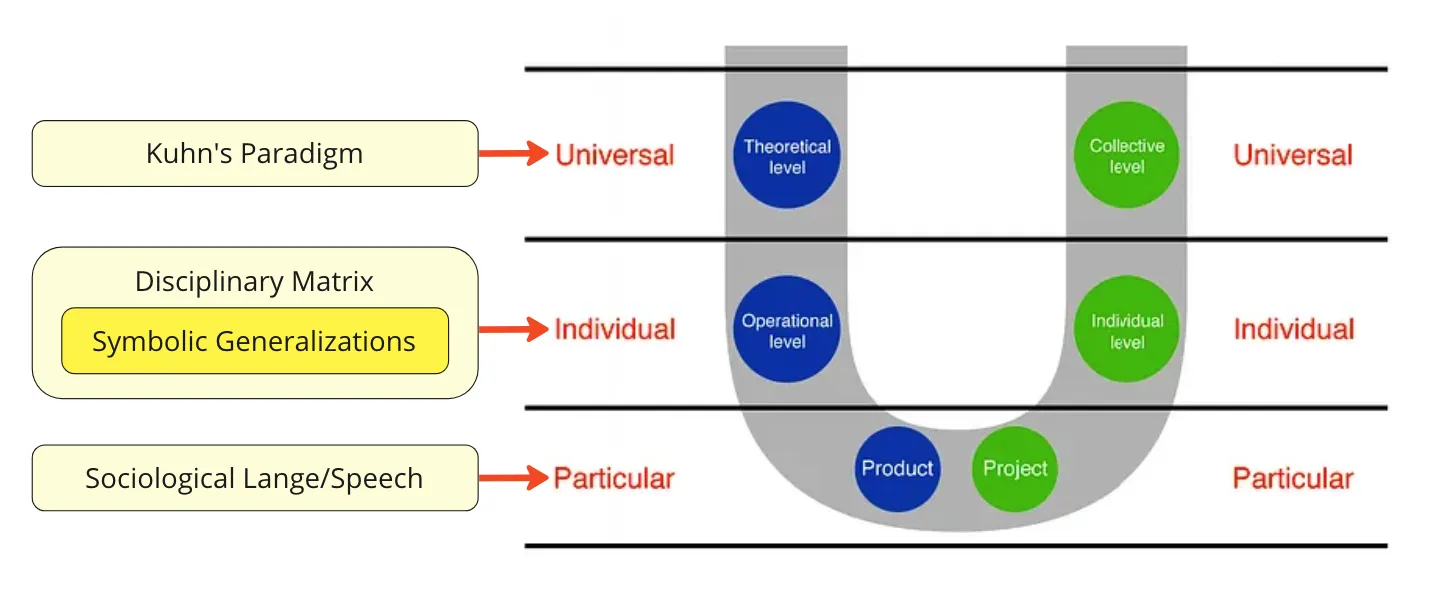
At the level of Universal Concept, Kuhn’s Paradigm competes with Lakatos’ Scientific Research Programmes and other philosophical accounts of scientific identity. Lui's choice is Kuhn's Paradigm.
At the level of Individual Concept, Lui had to choose one idea from among the various versions of Paradigm that Kuhn himself developed across his career. Lui's choice is half of the Disciplinary Matrix — specifically, the half that belongs to the Scientific Project rather than the Scientific Community. As Lui explains:
The result is the disciplinary matrix in which various uses of the term “paradigm” are sorted into its components. There are four main components, namely, symbolic generalizations, beliefs in particular exemplars, values, exemplars. […T]hese four components belong to two kinds of subject matters; symbolic generalizations and exemplars are subject matters internal to the scientific project itself, and the remaining two are external to the project but internal to the scientific community.
Both kinds of subject matters are indispensable, since the scientific project and the community that carries it out and carries it on the scientific project of sociology, […] I shall retain the term “paradigm” and equate it with “symbolic generalizations”. In this way, we make the paradigm (a theoretial sociology) and its exemplars (sociological theories) a worthy topic on the scientific project. […]
(Aspects of Sociological Explanation: Lectures on Sociology-Philosophy, Fall 2016, p.107)
At the level of Particular Concept — where the choice must be made concrete and actionable — Lui adopts Ferdinand de Saussure's distinction between langue and parole as the foundation for his theoretical sociology. Langue refers to the abstract system of language; parole means concrete speech. Lui's deployment of this distinction as "Sociological Langue/Speech" gives his version of Symbolic Generalizations a specific and workable theoretical basis.
What is significant — and what directly motivated the 2023 use of the Platform Genidentity Framework — is Lui's deliberate decision to concentrate his creative work exclusively on the Scientific Project dimension: Symbolic Generalizations and Exemplars. He explicitly sets aside Values and Beliefs in particular exemplars — the two components of Kuhn's Disciplinary Matrix that belong to the Scientific Community rather than the Scientific Project itself. This is a purely cognitive Disciplinary Matrix, with the human factor excluded.
This was not a limitation but a strategic choice. To build a theoretical sociology is to work at the Symbolic Generalizations level. Whether it becomes a genuine paradigm — whether the Scientific Community adopts it, grants it its Beliefs and Values — is not something a single creator can determine. That belongs to the community. What a creator can determine is the quality and coherence of the Scientific Project itself: the theoretical sociology as Symbolic Generalizations, and its supporting sociological theories as Exemplars. Lui concentrated his effort precisely there.
Applied to the Platform Genidentity Framework, Lui's enterprise maps onto the Scientific Project perspective: Essential Differences (his theoretical sociology as Symbolic Generalizations) and Situated Dynamics (his supporting sociological theories as Exemplars), with Platform Core and Platform-ba present but deliberately outside the analytical boundary of his own creative focus. His theoretical enterprise, viewed through this lens, is what I named at the time a Possible Platform — an enterprise that has developed sufficient conceptual structure and internal coherence to function as a platform for others, but whose status as a fully realized Developmental Platform depends on whether the wider community takes it up and builds on it. The "possible" in "Possible Platform" corresponds to what I called at the time "Possible Paradigm" as opposed to "Actual Paradigm" — the distinction between what a theoretical enterprise has achieved in its own terms and what it has been granted by its social recognition.
The concept of Possible Platform was one of the productive outcomes of the 2023 exploration. It names a real and important stage in the life of a theoretical enterprise: the stage at which the enterprise has done the internal work — built the Meta-framework, produced the Material artifacts, developed the conceptual coherence — but has not yet achieved the Social recognition and uptake that would make it a fully realized Developmental Platform. For Lui's theoretical sociology, this stage was clearly visible in 2023. The work was there; the community reception remained partial and uncertain.
There is, however, a personal dimension to this case study that belongs in the record. Between 2022 and 2025, I found myself drawing directly and substantially on Lui's theoretical sociology in my own work. From my own perspective as a creative actor engaging with Lui's Platform-ba, his theoretical enterprise had already become a Developmental Platform for me — regardless of its status within the broader sociological community. This is an important observation, because it reveals something about the nature of Theoretical Platforms that the purely structural account misses: the transition from Possible Platform to Developmental Platform is not a single event that happens at one moment for all potential users simultaneously. It is a distributed and personal process. An enterprise becomes a Developmental Platform for a specific contributor at the moment when that contributor finds in it the structured support — the Meta-framework, the conceptual tools, the action opportunities — that enables their own work to develop. For me, Lui's theoretical sociology crossed that threshold somewhere between 2022 and 2025.
2.3 Engaging with Lui's Theoretical Sociology
The engagement with Lui unfolded across four phases spanning 2022 to 2025, each driven by a different forming Anticipated Identity.
Phase 1: Resonance (Before April 2022)
Before direct contact was established, a sociologist friend and I were already reading Lui's articles together and discovering a structural convergence: Lui's foundational ontological construction resonated with my own Ecological Practice Approach, whose core concept of Container/Containee — derived from Johnson and Lakoff's container schema in cognitive linguistics, but ecologized — appeared to be structurally compatible with Lui's proposition that the body, action, and the fleeting moment are mutually contained.
Phase 2: Discussion, Reflection, and Curation (April–December 2022)
In April 2022, I initiated email correspondence with Lui directly. Reading Lui's work through the lens of Activity Theory prompted a sustained reflection: is Activity Theory a sociological theory? This question, sharpened through correspondence, drove the development of Project Engagement (v2.1) in mid-2022. In October 2022, I performed a major theoretical curation operation: using Lui's meta-framework of Ontology → Realism → Hermeneutics as a structural container, I curated three separate theoretical orientations into a coherent whole, producing both a semiotic system diagram and the manuscript foundation of Creative Life Strategy.
In November 2022, a productive divergence occurred. Analyzing Lui's Semiotic System method — which removes spatial structure from diagrams, retaining only conceptual relationships — as a counterexample to my own diagramming typology, I revised my classification model. The revision generated the Universal Reference model, which was immediately renamed the World of Activity — a concept that became the core of Creative Life Theory v2.0 throughout 2023 and 2024, and which in 2025 was further developed into an independent theoretical construct, becoming the foundational core of Creative Life Theory v3.0. This is a textbook instance of the By-product Effect: the most significant outcome of the engagement with Lui's diagramming method was not what was sought, but what arrived obliquely.
Phase 3: Deep Re-engagement (January–April 2023)
At Christmas 2022, Lui sent me a copy of his out-of-print book Gaze, Action, and the Social World — a gesture that marked the transition from correspondence to genuine intellectual fellowship. From January to April 2023, I read this work chapter by chapter, writing detailed notes that were eventually compiled into a separate manuscript.
Through this sustained reading, a broader theoretical vision crystallized. Lui's theoretical sociology was building a bridge between philosophy of science and sociology — and in his writings and the volumes of email and WeChat discussions with younger scholars over many years, I could see where Lui had placed his own creative life: theoretical sociology was Lui's lifelong vocation, his life's work explicitly conceived as such.
This recognition triggered a direct personal reflection. Applying the ECHO Way model to map my own creative life in the same spirit, I arrived at a parallel commitment: Creative Life Theory as a bridge between sociology and psychology, drawing on theoretical sociology, activity theory, ecological psychology, and creativity research as its four foundational streams — a lifelong project explicitly conceived as such.
Phase 4: Meta-framework Continuity (2024–2025)
The Ontology → Realism → Hermeneutics meta-framework, appropriated in 2022, continued to generate theoretical offspring. In 2025, the Self-Life-Mind meta-framework — a central organizing structure in Creative Life Theory v3.0 and v3.1 — was directly inspired by this three-level architecture. In late 2024, an email exchange with Lui gave rise to the idea of studying meta-frameworks themselves: the role of conceptual systems and cultural frameworks in social life. This became the founding vision of the Frame for Work knowledge center, established in January 2025, and the Meta-frameworks manuscript drafted in the end of 2025.
Taken together, these four phases demonstrate what a Theoretical Platform actually does for an individual contributor. It does not provide a fixed doctrine to be applied — it provides a structured landscape of action opportunities that a contributor can enter from multiple angles, at multiple scales, and through multiple modes of engagement. Conceptual tools (the Container/Containee resonance, the Ontology → Realism → Hermeneutics meta-framework), social connections (the correspondence and fellowship with Lui himself), and material artifacts (the books, articles, and manuscripts) all played distinct roles in making Lui's enterprise productive for my own development. The four phases were not planned; they emerged from the ongoing encounter between my own developing questions and the structured resources that Lui's enterprise made available.
2.4 The Discovery and Its Limitation
The unexpected discovery of the 2023 exploration was structural unity: these five perspectives, which might at first appear to be five different theoretical frameworks, turned out to be five different cuts of the same underlying structure. Knowledge Center, Perceived Platform, Scientific Project, Scientific Community, and Disciplinary Matrix are not competing accounts of what a theoretical tradition is. They are partial views of a single four-element structure, each partial view produced by a different boundary decision. This structural unity was the insight named "Theoretical Platform." The Lui case added a further nuance: a Possible Platform names the stage at which the internal work is done but the social recognition is not yet settled — a temporally and socially distributed threshold rather than a fixed structural state.
But the 2023 exploration had a clear limitation, which is worth stating precisely. The analysis was synchronic: it described the structure of a theoretical tradition at a given moment, asking "what is it?" rather than "how does it develop?" And it was primarily social: both Platform Core and Platform-ba were understood as human and social entities. The Mental and Material dimensions of a theoretical enterprise — the cognitive work, the conceptual artifacts, the texts and diagrams that carry the tradition's knowledge across time and space — were not yet part of the analytical vocabulary. Nor was there yet any account of how a Theoretical Platform comes into existence: the five-stage developmental trajectory from Creative Theme to Developmental Platform had not yet been developed. The 2023 exploration named the destination without yet mapping the journey.
Part 3. Theoretical Enterprise: A Multi-dimensional Model
The 2023 exploration yielded a structural map of Theoretical Platform, but what remained missing was an account of how such a platform develops over time, and what non-social dimensions — mental, material — sustain it. Part 3 addresses these gaps by rebuilding the concept of Theoretical Enterprise through the frameworks introduced in Part 1.
Before examining the specific dimensions and stages of a Theoretical Enterprise, it is necessary to clarify the concept of enterprise itself and locate Theoretical Enterprise within the broader family of enterprise forms.
3.1 Forms of Enterprise
There are multiple ways to define the concept of enterprise. In Creative Life Theory (v3.0), the terms "Enterprise" and "Creative Enterprise" are used interchangeably. Theoretically, however, both refer to Thematic Enterprise, emphasizing that all enterprises are fundamentally thematic — centered around a guiding theme. This core thematic orientation provides the unity across all enterprises, while different forms — Knowledge, Business, and Cultural — express this concept in distinct ways.
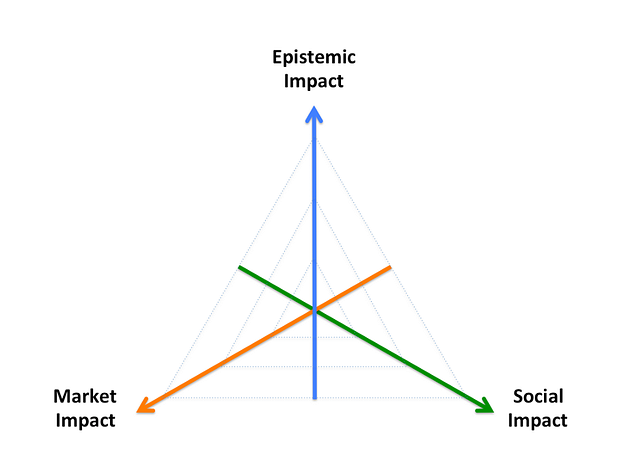
The model below highlights the different purposes of three forms of enterprises:
- Knowledge Enterprise → Epistemic Impact
- Business Enterprise → Market Impact
- Cultural Enterprise → Social Impact
This model also indicates the three types of themes: knowledge themes, business themes, and cultural themes. While both are concept systems at the deep level, they appear as different thematic frameworks to guide their enterprises.
It is also worth noting that the Enterprise Development Framework introduced in 1.4 uses the term Creative Enterprise as its primary concept, while the Cultural Genidentity Framework used the term Cultural Enterprise. These different names reflect different moments in the conceptual development, but they all point toward the same underlying idea — most precisely named Thematic Enterprise.
Within this family of enterprise forms, Theoretical Enterprise is a specific type of Knowledge Enterprise — one in which the guiding theme is a theoretical approach, and the primary work of the enterprise is the development, extension, and application of a theoretical framework. A Theoretical Enterprise is distinguished from other knowledge enterprises by its orientation toward theoretical construction: its contributors are engaged not merely in applying existing knowledge but in building, refining, and transforming the conceptual systems that define the tradition's identity.
3.2 Three Dimensions: Social, Mental, and Material
The three-dimensional model of Theoretical Enterprise was developed through the Evolving Knowledge Enterprise model (November 2023) and subsequently refined through the Cultural Genidentity Framework and related work. The full name of the model is the Landscape of Evolving Knowledge Enterprise.
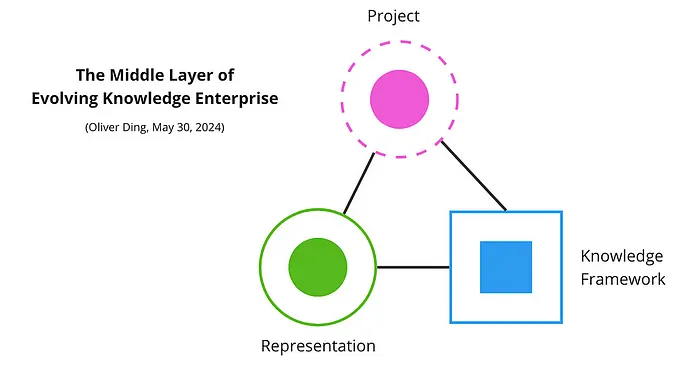
Its core insight is an expansion: starting from the Mental dimension of conceptual and cognitive work, the model extends outward to cover the complete presence of a concept system in social life — encompassing not only the mental activity of theorizing but also the social activities through which the enterprise is enacted and the material artifacts through which its knowledge becomes objectified and transmissible. The "Mental—Social—Material" Schema is the thematic name that distills this three-dimensional structure.
In the original model, the three dimensions are named Mental Platform, Behavioral Network, and Material Container — names that have been rendered differently across projects depending on context, but always referring to the same underlying structure: a 3 dimensions × 3 hierarchical levels model that captures the full landscape of an evolving enterprise.
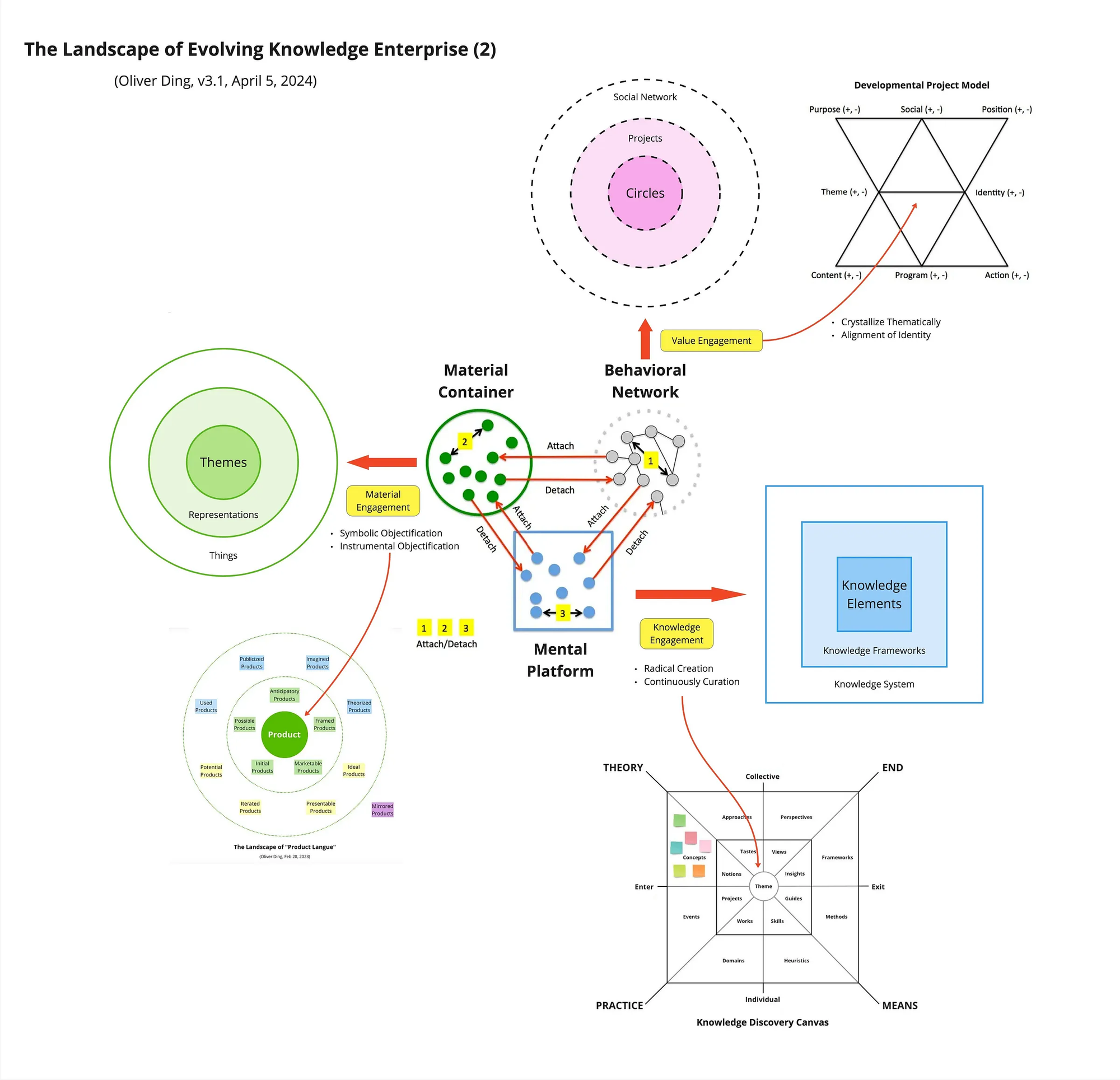
The Mental dimension (Mental Platform) addresses the question: how does the enterprise think? It encompasses the cognitive and conceptual work through which the enterprise develops its knowledge, moving from the smallest unit outward to the most complex system:
- Knowledge Elements — the basic units of conceptual work: clues, themes, insights, notions, concepts. These are the irreducible building blocks from which all further theoretical work is constructed.
- Knowledge Frameworks — structured arrangements of knowledge elements into coherent analytical tools. At this level, isolated elements are organized into frameworks that can be applied, tested, and communicated.
- Knowledge System — the integrated whole formed by multiple frameworks organized around a core concept system. This is the most complex level: a fully developed theoretical system with its own internal logic and coordination mechanism.
In the context of a Theoretical Enterprise, the Mental dimension is where the Meta-framework operates. The Core Concept Systems and Coordination Mechanism that constitute a tradition's Essential Differences are carried and developed within this dimension — from individual conceptual elements, through frameworks, to the integrated knowledge system that defines what the tradition is.
The Social dimension (Behavioral Network) addresses the question: how does the enterprise act? "Social" here means Social Life and Human Activity — not a static community, but the dynamic, action-oriented dimension of the enterprise. It expands from the most basic unit of human interaction outward to the broadest social field:
- Circles — the most basic unit, referring specifically to the Activity Circle model: the dyadic interaction of Self–Other–Thing–Think. This is the irreducible social unit within which all theoretical work ultimately happens — two people in dialogue, with a shared object of attention and a shared act of thinking.
- Projects — the bounded undertakings through which contributors actively engage with and contribute to the enterprise. Projects are the primary unit of activity: it is through Projects that the Social dimension and the Mental dimension connect, as conceptual work is always done by people pursuing specific projects.
- Social Networks — the broadest social field: the wider network of practitioners, readers, collaborators, and interested parties who engage with the enterprise from various distances.
In Platform Genidentity terms, Platform Core corresponds roughly to the Circles level — the inner creative group engaged in the most direct, dyadic theoretical exchange. Platform-ba corresponds to the broader Social Network level — the wider field of practitioners and users who engage with the enterprise from the outside.
The Material dimension (Material Container) addresses the question: what does the enterprise make? It expands from the most abstract and central conceptual object outward to the most concrete physical artifact:
- Themes — the innermost level: the core conceptual objects of the enterprise. These are not Thematic Spaces in the broader sense, but the themes themselves — the core concept systems, the central questions, the primary topics of discussion that define what the enterprise is fundamentally about.
- Representations — the symbolic and visual objectifications of those themes: diagrams, canvases, semiotic system diagrams, thematic maps, charts. These are the primary medium through which theoretical work becomes portable, teachable, and citable.
- Things — the most concrete and outer level: physical books, printed artifacts, tools, instruments — the material objects through which the enterprise's knowledge enters the world as tangible things.
The Material dimension is the condition for the enterprise's persistence across time and its extension across space. A theme developed in the Mental dimension must be objectified first as a Representation, then potentially as a Thing, before it can circulate fully in the Social dimension. The movement from Theme to Representation to Thing is the movement of objectification — the process by which inner conceptual work becomes outer social reality.
These three dimensions are not independent. They are deeply interpenetrating, and understanding a Theoretical Enterprise requires attending to all three simultaneously. A social encounter between practitioners in the Social dimension generates new problems that drive further work in the Mental dimension. A material artifact — a diagram, a canonical text, a framework — shapes the conceptual possibilities available to contributors in the Mental dimension. A concept developed in the Mental dimension must pass through the Material dimension before it can circulate in the Social dimension. The Theoretical Enterprise is the dynamic whole constituted by the ongoing interaction of all three dimensions across all three levels.
3.3 The Wonder and Wander Project: From Three Dimensions to Three Layers
The three-dimensional model described in 3.1 was originally developed as a landscape model — a synchronic map of the full terrain of an evolving enterprise. But a landscape model, by definition, describes what the enterprise looks like at a given moment, not how it develops over time. This limitation became the starting point for the Wonder and Wander project (March–June 2025).
The Wonder and Wander project was initially conceived as an empirical research project: to test and validate the Evolving Knowledge Enterprise model through a series of case studies. Eight case studies were conducted, examining the development of different knowledge centers and creative enterprises across different time periods and contexts. The Curativity Center served as one of the primary cases — its development traced from a single theme (Curativity Theory, March 2019) through successive stages: Single Project (Knowledge Curation, June 2020), Single Knowledge Center (Curativity Center, June 2022), Single Knowledge Enterprise (September 2022), and Single Value Circle (September 2023). This progression — from thematic exploration to project formation, to organizational structure, to an interconnected ecosystem — illustrated the five-stage developmental trajectory in concrete terms.
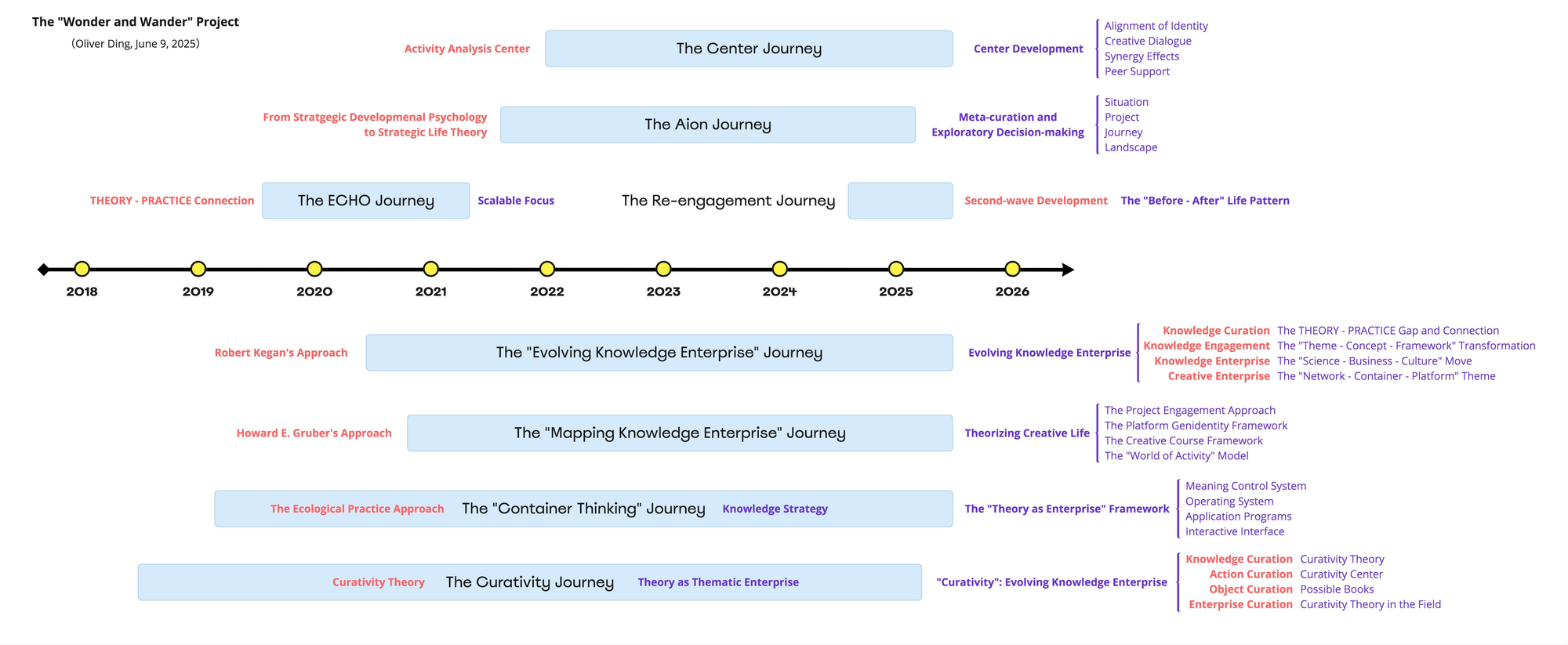
But the outcome of the project went beyond its original goal. Through the eight case studies, a richer picture of thematic enterprise emerged — one that the three-dimensional model alone could not fully capture. The "Mental—Social—Material" Schema remained a valid and useful landscape model for describing the terrain of a knowledge enterprise organized around a concept system. But a thematic enterprise is more than its conceptual operations. It also has multiple functional dimensions — Strategy, Narrative, Curation, Design, Support — through which a knowledge center actually runs and sustains itself. And beyond the enterprise itself, there is a larger context: the creative life of the creator, within which the thematic enterprise is embedded and from which it draws its orientation and meaning. These considerations called for a more expansive framework — one that could hold the three-dimensional model within a larger picture of what a thematic enterprise actually is and how it exists in a creator's life.
The result was the Center Development Toolkit (June 2025). Though named after "Center Development," the Toolkit is in effect an expanded landscape of thematic enterprise — a more complete picture that situates the three-dimensional model within a broader whole.
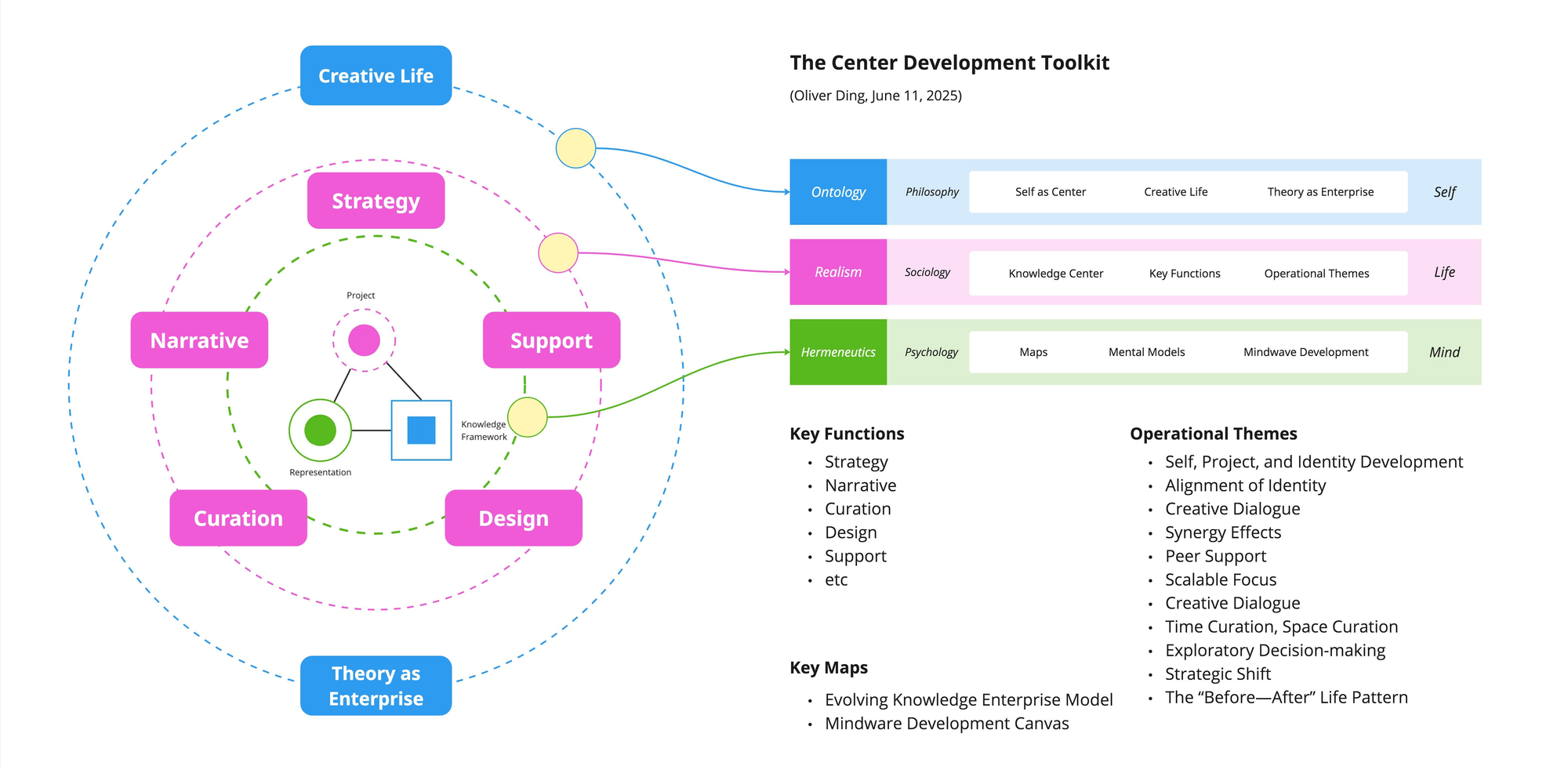
The Toolkit is structured around three layers, drawn from Lui's meta-framework of Ontology → Realism → Hermeneutics:
The Ontology layer addresses the philosophical foundation of Center Development — the relationship between Self as Center (Gruber's concept of the creative individual as a mobile center of synthesis and orientation), Creative Life (the individual developmental context within which thematic enterprises unfold), and Theory as Enterprise (the thematic enterprise as the object of development).
The Realism layer addresses the sociological dimension of Center Development — the Knowledge Center as a socially embedded and ecologically structured entity, with its Key Functions (Strategy, Narrative, Curation, Design, Support, and others) and Operational Themes (Self and Identity Development, Alignment of Identity, Creative Dialogue, Synergy Effects, Peer Support, Scalable Focus, Time Curation, Exploratory Decision-making, Strategic Shift, and the Before—After Life Pattern). It is within this Realism layer that the original three-dimensional Landscape of Evolving Knowledge Enterprise model is embedded — as one component among several, providing the global map of a knowledge center's terrain while the other components address its developmental dynamics.
The Hermeneutics layer addresses the psychological dimension of Center Development — the cognitive tools through which creators manage the complexity of running a knowledge center: Maps, Mental Models, and Mindwave Development.
The significance of this development for the present article is structural. The three-dimensional model — Mental, Social, and Material — began as the primary framework for understanding a Theoretical Enterprise, capturing the full landscape of a concept system's operations across cognitive, social, and material dimensions. The Wonder and Wander project revealed that this landscape, while accurate as far as it goes, is itself embedded within a larger picture. A thematic enterprise does not exist only as a concept system in operation — it exists within the functional reality of a knowledge center (with its Key Functions and Operational Themes) and within the broader context of a creator's Creative Life (with its orientation, identity, and developmental arc). The Center Development Toolkit holds all of this together: the three-dimensional landscape occupies the Realism layer, flanked by the philosophical grounding of the Ontology layer and the cognitive tools of the Hermeneutics layer. Together, the three layers constitute a more complete picture of what a thematic enterprise is — not just what it contains, but how it functions and whose life it is part of.
3.4 Five Stages: From Creative Theme to Developmental Platform
In October 2025, the Enterprise Development Framework was developed, introducing a five-stage account of how a Theoretical Enterprise evolves over time. Each stage represents not merely a quantitative increase in the enterprise's scale or output, but a structural transformation in what the enterprise is and what it can do. The five stages — Creative Theme, Scalable Focus, Center Development, Value Circle, and Developmental Platform — correspond to five distinct states of development, each explored in one of five previous book drafts, combining theoretical insights with practical experience drawn from my own creative journey.
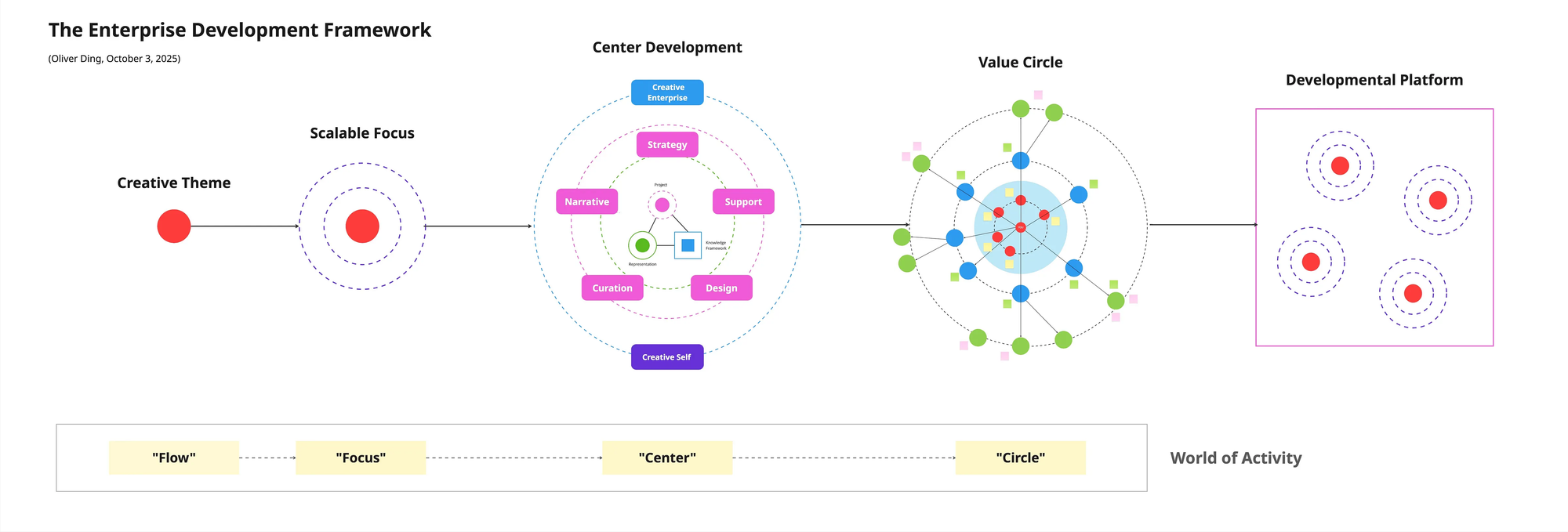
At the Creative Theme stage, a single generative idea begins to attract the attention and energy of a creative actor. The idea is not yet a theory, not yet a framework — it is a theme: a named space of inquiry that promises productive exploration. At this stage, the enterprise exists primarily in the Mental dimension of a single person or a very small group. The Social and Material dimensions are minimal: there is no community yet organized around the theme, and the material objectifications are tentative and provisional.
At the Scalable Focus stage, the theme has developed sufficient internal structure to sustain a sustained and scalable line of inquiry. The creative actor has identified the theme's core questions, its most productive sub-themes, and its relationship to other intellectual traditions. The Mental dimension deepens; the Material dimension begins to accumulate as the actor produces more developed and stable artifacts; the Social dimension begins to expand as the theme starts to attract the attention of others.
At the Center Development stage, the enterprise establishes its own organizational center. Projects multiply; a developing community of practice forms around the enterprise; representations, frameworks, and canonical texts begin to consolidate. The three dimensions are now all substantially engaged: the Social dimension has a recognizable community, the Material dimension has a growing body of artifacts, and the Mental dimension has a developing Meta-framework that begins to give coherence to the accumulating work.
At the Value Circle stage, the enterprise's value becomes visible to a wider network, and multiple actors begin both to contribute to and to draw from it. The enterprise is no longer primarily the creation of a single person or small group — it is a genuinely collective project, with contributors bringing their own questions, methods, and perspectives. The Value Circle stage is characterized by productive diversity: different actors work on different aspects of the enterprise, and their work feeds back into the enterprise's development in ways that no single actor could have planned.
At the Developmental Platform stage, the enterprise has achieved sufficient maturity and structural stability to actively support the work of others in a systematic way. It is no longer primarily a site of creation — it is a platform for creation. New enterprises can develop within it, drawing on its Meta-framework, its Social network, and its Material resources as a structured developmental environment. This is the stage at which a Theoretical Enterprise becomes a Theoretical Platform.
3.5 Theoretical Platform as a Stage of Theoretical Enterprise
The relationship between Theoretical Platform and Theoretical Enterprise can now be stated precisely. Theoretical Enterprise is the broader concept: it names the evolving, multi-dimensional, project-based process through which a theoretical tradition develops across time. Theoretical Platform is a specific stage within that development: the Developmental Platform stage, at which the enterprise has achieved the maturity and structural stability required to support the work of others.
This means that every Theoretical Platform was once a Theoretical Enterprise that had not yet reached the Developmental Platform stage. Activity Theory began as the creative work of a small number of Soviet psychologists in the 1920s and 1930s — a Creative Theme stage enterprise, centered on a small Platform Core with minimal Platform-ba. Over decades, through successive stages of development, it accumulated the Meta-framework, the Social network, and the Material resources that eventually made it capable of functioning as a developmental platform for contributors across the world and across generations.
The Platform Genidentity Framework describes what a Theoretical Platform looks like at the Developmental Platform stage: its Essential Differences, its Situated Dynamics, its Platform Core, its Platform-ba, and — with the addition of the Meta-framework concept — its conceptual foundation. The Enterprise Development Framework describes how a Theoretical Enterprise arrives at that stage. Together, the two frameworks provide a complete analytical account: synchronic structure and diachronic development, what a Theoretical Platform is and how it comes to be.
Part 4. Weave the Enterprise
Part 3 established the multi-dimensional model of Theoretical Enterprise and the five-stage developmental trajectory. This part applies those frameworks to a concrete case — Curativity Theory — tracing its evolution from creative theme to possible platform, and mapping its current landscape across the mental, social, and material dimensions. It then introduces the Weave-the-Theory model, which captures the internal dynamic that the structural and developmental analyses leave unaddressed: the ongoing tension between creative proliferation and curatorial unification, held together by the act of weaving.
4.1 A Case Study: Curativity Theory as a Thematic Enterprise
Before introducing the Weave-the-Theory model and its analytical implications, it is useful to ground the discussion in a concrete case. Curativity Theory — a theoretical enterprise I have been developing since 2019 — serves as the primary case study for testing the models introduced in Part 3. It is a case that is particularly close to hand: I am both its creator and its analyst, which makes it possible to speak with precision about both its internal structure and its developmental history.
A preliminary observation is necessary. Curativity Theory is, to date, an enterprise led by a single person. There are readers who follow the work, collaborators who have contributed cases for research, and friends who engage in related discussions — but the core of the enterprise remains one person, not a team. Furthermore, although the theoretical system has reached considerable maturity, its influence remains limited. I do not regard either of these features as deficiencies. Multiple participation and broad influence are not necessary conditions for a thematic enterprise. An enterprise is defined by its guiding theme and the work organized around it — not by the number of its contributors or the size of its audience. Curativity Theory is a fully realized thematic enterprise precisely because it has a coherent theme, a developing concept system, a body of material artifacts, and a sustained trajectory of creative work. Its scale is simply what it is.
4.2 Diachronic Analysis: The Five-Stage Trajectory of Curativity Theory
Applying the Enterprise Development Framework to Curativity Theory reveals a clear five-stage developmental trajectory.
The Creative Theme stage spans from approximately 2014 to March 2019. The thematic seed was planted in 2014, when a shift from digital activism to theoretical exploration began — reading ecological psychology, creativity research, and related fields. From 2015 to 2016, the focus deepened into Gibson's Affordance Theory and ecological psychology. The crystallization moment arrived through the convergence of two trajectories: a decade of experience in the curation field (including the BagTheWeb project launched in 2010) and the sustained theoretical inquiry into ecological psychology. In September 2018, an outline for a thesis titled "Curation Theory: Container, Theme, and Action" was written. From October 2018 to March 2019, this expanded into a 615-page book draft: Curativity: The Ecological Practice Approach to General Curation Practice. The completion of this draft marks the transition from Creative Theme to the next stage.
The Scalable Focus stage spans from March 2019 to June 2022. After the initial book draft, the work expanded into multiple application directions: Knowledge Curation, Action Curation, Life Curation, and Platform Curation. In 2020, the decision to apply Curativity Theory to knowledge building led to the Knowledge Curation project — a sustained line of inquiry that produced several further book drafts and frameworks. The defining dynamic of this stage is the application of a meta-theory as a scalable focus into different applicational domains — each domain representing a different path through which the core concept of Curativity could be extended, tested, and developed further.
The Center Development stage arrived in June 2022 with the formal launch of the Curativity Center as an independent knowledge center. In September 2022, a Thematic Landscape Map was used to visualize the full landscape of the "Curativity" knowledge enterprise — marking the moment when the enterprise acquired a structured self-image. By this point, the enterprise had developed its key functions: Strategy (defining the enterprise's direction), Narrative (articulating its story), Curation (organizing its accumulated work), Design (producing its visual artifacts), and Support (providing knowledge curation skills and methods as resources for developing other knowledge enterprises). The enterprise's genidentity was now established: its Essential Differences (Curativity as an ontological invention — the concept of Container/Containee as the basis for understanding curation) and its Situated Dynamics (the expanding range of applications across knowledge, action, life, and cultural curation).
The Value Circle stage emerged from late 2022 through 2023. In 2022, six knowledge centers were launched — Curativity Center, Activity Analysis Center, CALL (Creative Action Learning Lab), Platform Ecology Center, Life Strategy Center, and TALE — forming a Value Circle — a network in which the Curativity Center functioned as meta-center. By March 2023, the network had expanded to seven centers. The synergy effects between Direct Activity (projects contributing to their own center) and Indirect Activity (projects contributing to other centers) became the defining dynamic of this stage. The Curativity Center's Value Circle included three core centers (Curativity Center, CALL, Activity Analysis Center) and four application centers (ARCH, Life Strategy, Platform Ecology, TALE), together forming an interconnected ecosystem in which the Curativity theory's concepts circulated and generated new work across multiple directions simultaneously.
The Developmental Platform stage represents the current situation — though it is more precisely characterized as a Possible Platform in the terms developed in Part 2. The theoretical system of Curativity Theory has achieved considerable maturity: three waves of development (First-wave: Knowledge/Action/Mental Curation; Second-wave: Thematic Space Theory; Third-wave: Thematic Identity Curation integrating Curativity Theory, Thematic Space Theory, Project Engagement, and GO Theory) have produced a rich body of concept systems, frameworks, and material artifacts. The enterprise has the internal structure of a Developmental Platform. Whether it functions as one for others depends on whether contributors find in it the structured support that enables their own work — a threshold that, as discussed in 2.2, is crossed differently by different people at different moments.
4.3 Synchronic Analysis: The Three-Dimensional Landscape of Curativity Theory
Applying the Landscape of Evolving Knowledge Enterprise model to Curativity Theory at its current stage of development reveals a rich and differentiated three-dimensional structure.
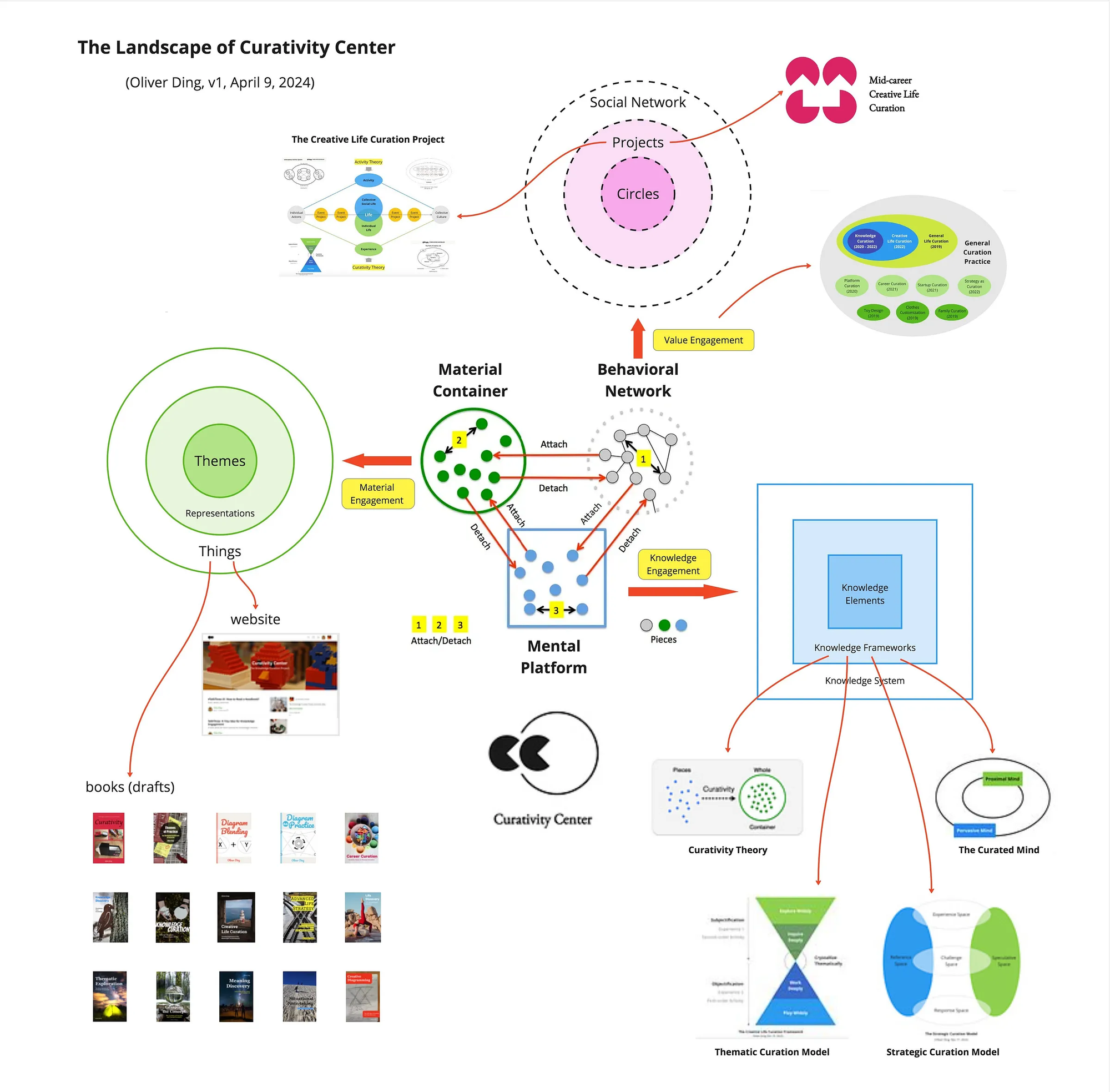
In the Mental dimension (Mental Platform), the enterprise has developed across all three hierarchical levels. At the Knowledge Elements level, the enterprise's core conceptual vocabulary is extensive: Curativity, Container/Containee, Pieces–Whole, Curation Types (Knowledge, Action, Life, Mental, Platform, Cultural), Thematic Space, Genidentity, and many others. At the Knowledge Frameworks level, numerous frameworks have been developed: the General Curation Framework, the Creative Thematic Curation Framework, the Creative Life Curation Framework, the Thematic Identity Curation Framework, the Curativity of Activity model, and others. At the Knowledge System level, the enterprise has produced an integrated concept system — Curativity Theory as a meta-theory — that has been applied consistently across diverse knowledge projects from 2019 to the present. The Mental dimension of Curativity Theory is its strongest dimension: it is where the enterprise's Essential Differences are most fully realized.
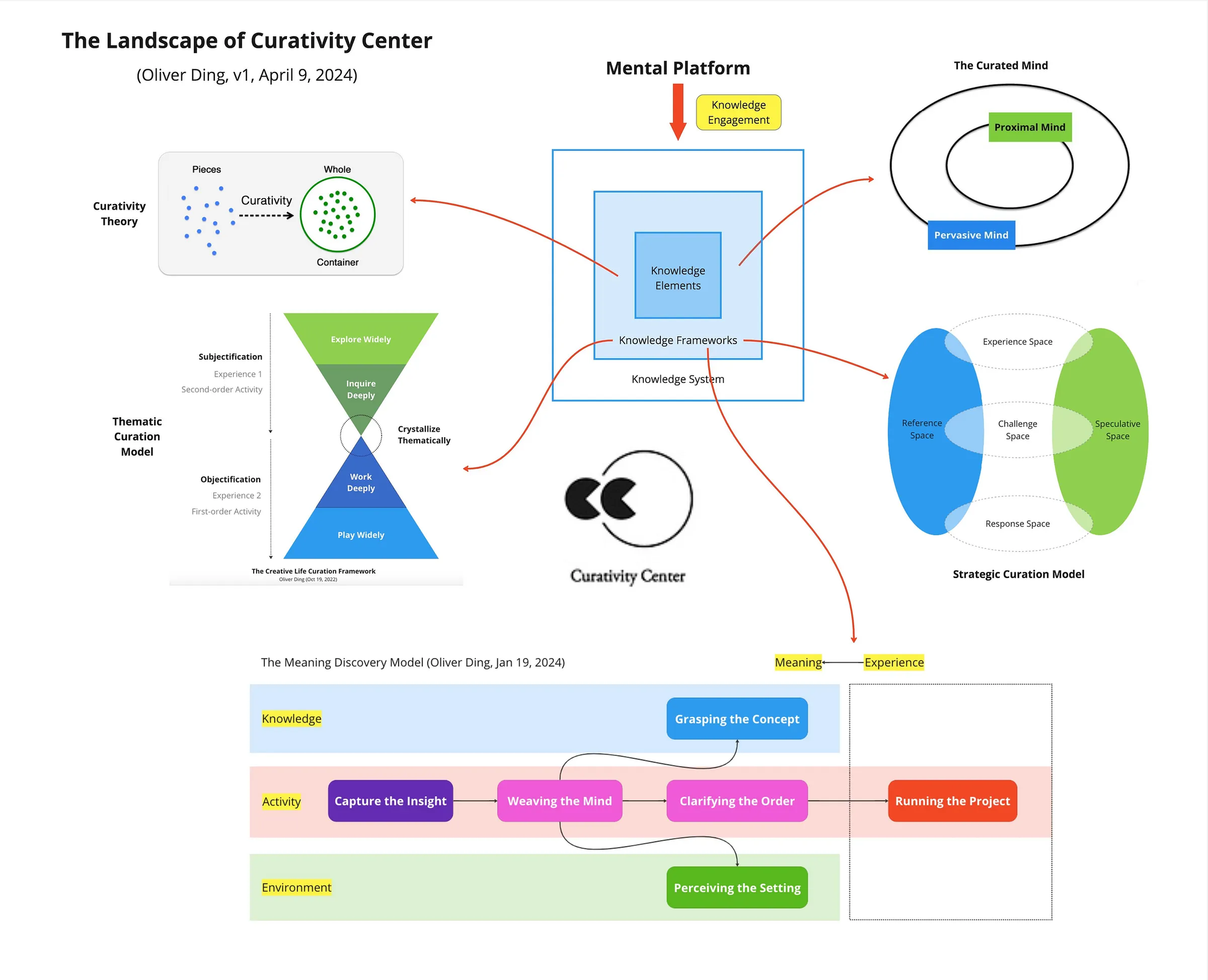
In the Social dimension (Behavioral Network), the enterprise reflects its single-person character most clearly. At the Circles level — the Activity Circle of direct dyadic interaction — the primary circle is the author's own creative work, supplemented by a small number of sustained intellectual dialogues (with Lui, with collaborators on specific projects, with the Mental Engagement Center partner). At the Projects level, the enterprise has generated an extensive series of projects across the Value Circle's seven knowledge centers. At the Social Network level, there is a reader community and a network of interested practitioners, but the enterprise has not yet developed the broader social infrastructure that would characterize a fully realized Developmental Platform. The Social dimension is the enterprise's most limited dimension — not as a deficiency, but as a reflection of its deliberate scale and the nature of individual-led theoretical work.
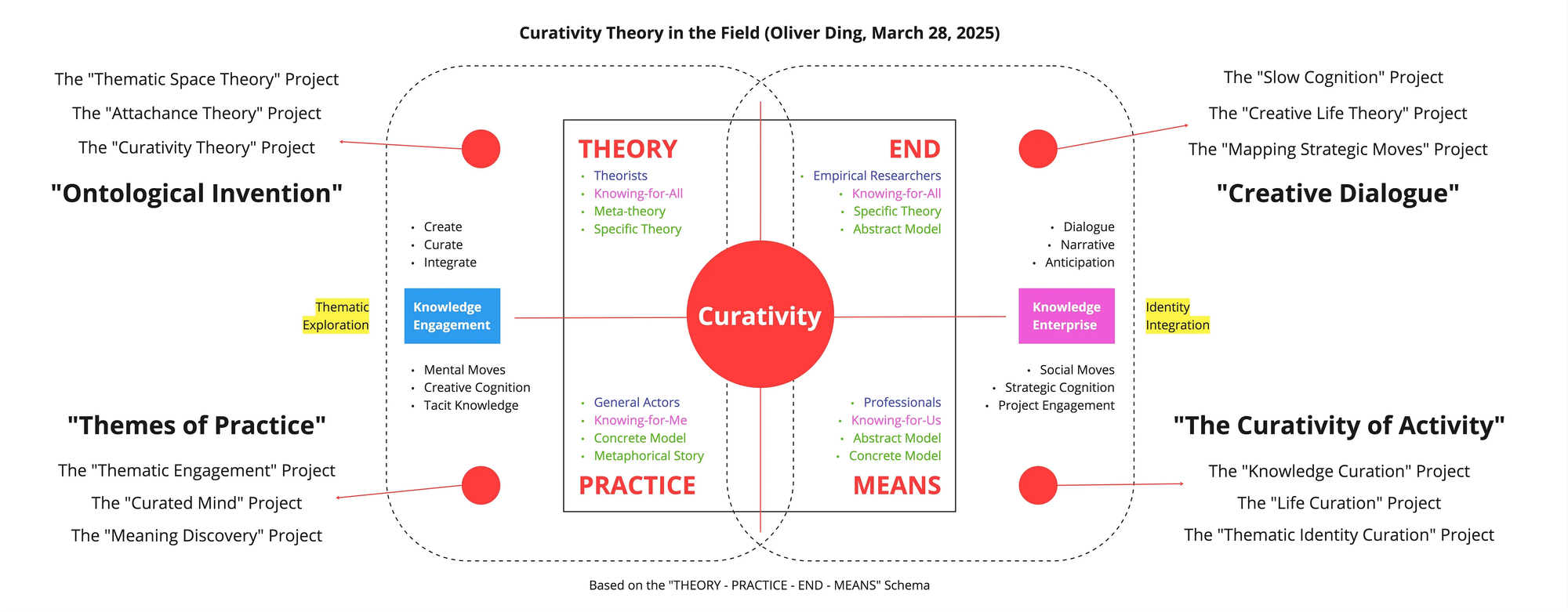
In the Material dimension (Material Container), the enterprise has produced substantial output across all three levels. At the Themes level, the core thematic objects are well-established: "Curativity," "Container/Containee," "Knowledge Curation," "Life Curation," "Thematic Space," and others each constitute named and developed thematic spaces that organize further work. At the Representations level, the enterprise has produced an extensive body of diagrams, canvases, thematic maps, semiotic system diagrams, and visual frameworks — the Thematic Landscape Map, the General Curation diagram, the Creative Thematic Curation framework diagram, and many others. At the Things level, the enterprise has produced multiple book drafts, published articles, and thematic cards — material artifacts that make the theoretical work portable and transmissible.
What the Three Dimensions Reveal — and What They Do Not
The synchronic analysis reveals a Theoretical Enterprise with a highly developed Mental dimension, a rich Material dimension, and a comparatively limited Social dimension. This profile is consistent with the enterprise's character as individual-led theoretical work: the conceptual and material dimensions of the work have been developed intensively, while the social dimension has grown more slowly and selectively.
But both analyses — diachronic and synchronic — leave something important unaddressed. The five-stage model describes the enterprise's developmental trajectory from the outside, as a sequence of structural transformations. The three-dimensional model describes its current landscape as a static cross-section. Neither captures the internal dynamic of how the enterprise actually moves — the tension between the drive to generate new concepts and directions (the Creativity Line) and the drive to organize, unify, and consolidate what has been generated (the Curativity Line). It is precisely this tension — and the act of Weaving that holds it — that the Weave-the-Theory model is designed to analyze. This is where the next section begins.
4.4 The Weave-the-Theory Model
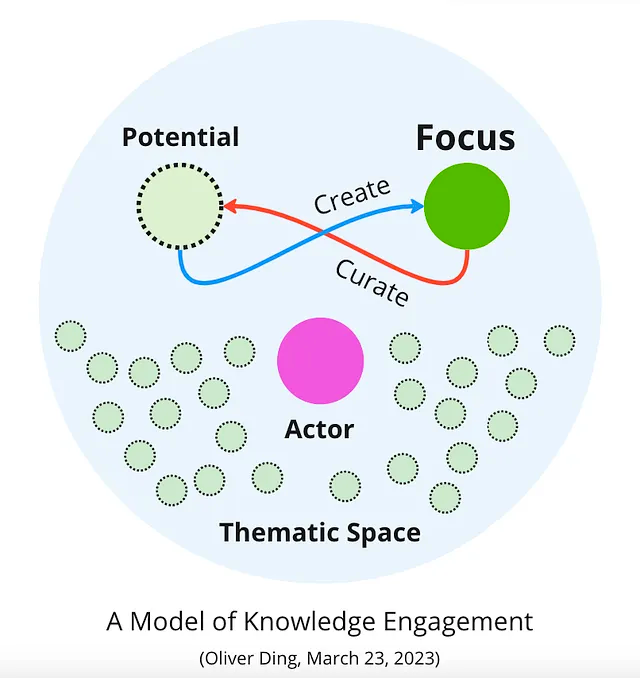
Any Theoretical Enterprise faces a fundamental tension at the heart of its development. On one side is the drive to Create: to generate new concepts, new frameworks, new models, to proliferate outward into new territory, to explore the full range of questions that the enterprise's core theme makes possible. On the other side is the drive to Curate: to organize, to unify, to distill the accumulated work into coherent structures, to ensure that what has been created holds together as a meaningful whole. These two drives are not merely different preferences among different contributors — they are structural necessities. An enterprise that only creates becomes incoherent: its outputs proliferate without converging, and the enterprise loses the ability to communicate its achievements to newcomers or to build cumulatively on prior work. An enterprise that only curates stops growing: it consolidates what exists without generating the new material on which further development depends.
The Weave-the-Theory model proposes that this tension is not resolved by choosing one drive over the other, but by holding both simultaneously through the act of Weaving. The model describes theoretical development as the interplay of two diachronic lines — the Creativity Line and the Curativity Line — that move in different directions but are structurally interdependent. The Creativity Line moves outward through Theme and Model: it is the line of proliferation, of new ideas and new frameworks. The Curativity Line moves inward through Concept and Principle: it is the line of unification, of distillation and theoretical consolidation. The four weave-points — Theme, Model, Concept, Principle — providing a mapping tool for further case studies.
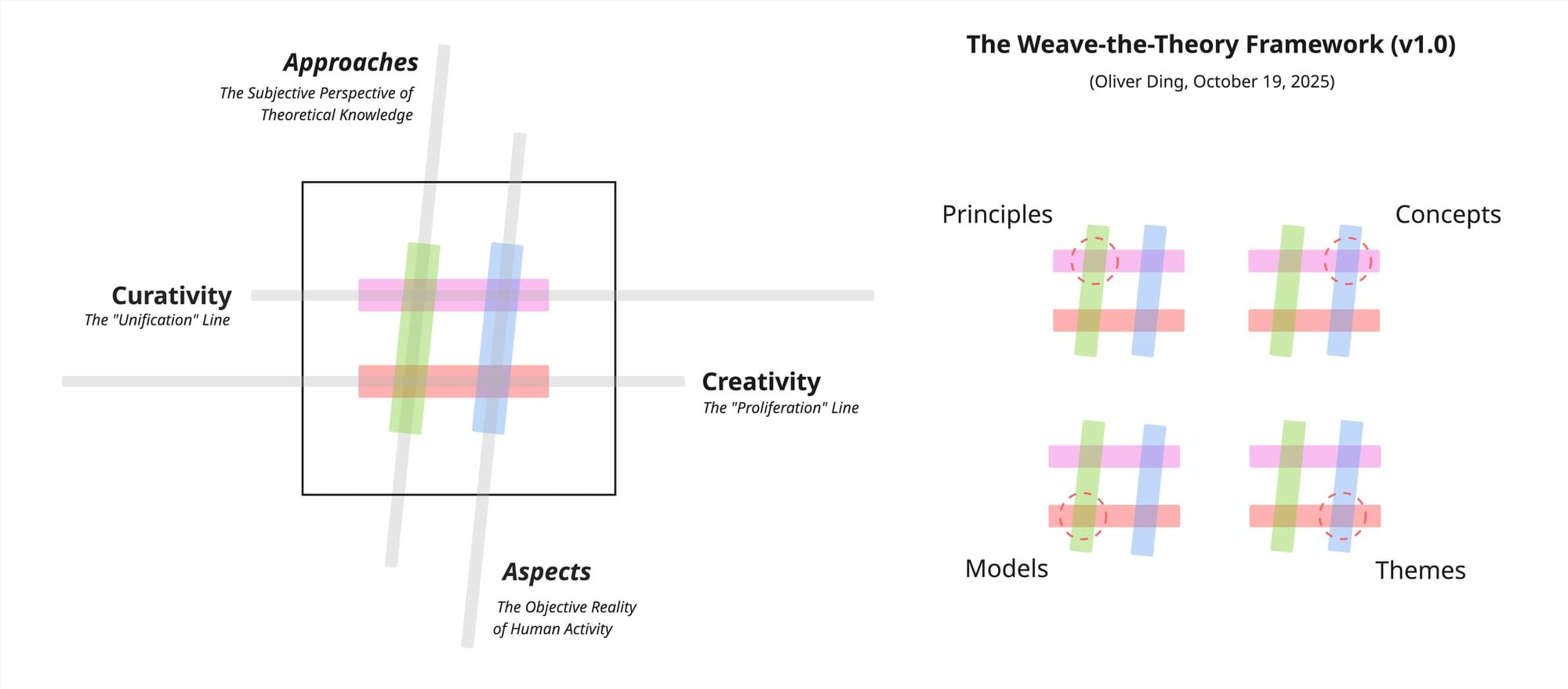
Applying this perspective to a Theoretical Enterprise as a whole — rather than to a single theorist's work — reveals something important. A Theoretical Enterprise develops not through the linear accumulation of contributions, but through the ongoing tension between creative proliferation and curatorial unification across many contributors simultaneously. At any given moment, some contributors are working on the Creativity Line — developing new themes, building new models, extending the enterprise into new empirical territory. Others are working on the Curativity Line — developing concepts that unify existing work, articulating principles that give the enterprise coherence. The enterprise's development is the emergent outcome of this distributed, tension-driven process.
This is why the Weave perspective is necessary for analyzing a Theoretical Enterprise. A purely social account of the enterprise — one that focuses only on the community of contributors and their interactions — cannot explain the specific direction of the enterprise's development, because direction is a function of the conceptual work being done in the Mental dimension. A purely conceptual account — one that focuses only on the Meta-framework and its development — cannot explain how the enterprise sustains itself over time, because sustainability is a function of the Social and Material dimensions. The Weave perspective holds all three dimensions together and traces the interplay of creativity and curativity across them.
4.5 Meta-framework: Core Concept Systems and Coordination Mechanism
Within a Theoretical Enterprise, the Meta-framework occupies a specific and crucial position. It is the conceptual foundation of the enterprise — the layer of the Mental dimension that gives the enterprise its Essential Differences and governs what counts as a valid theoretical contribution. Understanding the Meta-framework is therefore central to understanding what makes a Theoretical Enterprise distinctively itself.
The companion article Revisiting the Genidentity of Activity Theory (May 4, 2026) developed a detailed analysis of the Meta-framework of Activity Theory. That analysis is summarized here, because it provides the analytical vocabulary that the present discussion requires.
A Meta-framework consists of two components: Core Concept Systems and a Coordination Mechanism. Core Concept Systems are the foundational concepts that define the enterprise's intellectual territory — the concepts that every contributor must engage with, whether to extend, modify, or challenge them. In Activity Theory, the Core Concept Systems include the concepts of mediation, object-orientedness, the three-level hierarchy of Activity–Actions–Operations, the Activity System model, and the Project as unit of activity, among others. These are not all the concepts in the tradition — the tradition has generated an enormous diversity of frameworks and models — but they are the concepts that constitute the tradition's theoretical foundation.
The Coordination Mechanism is more fundamental than any particular Core Concept System. It is the deep logic that governs how new Core Concept Systems are constructed — the structural operation that each contributor performs when making a genuine contribution to the Meta-framework. In Activity Theory, the Coordination Mechanism is the anti-dualist triadic operation: the pattern, consistent across a century of development, of inheriting a dualism, exposing its inadequacy, and resolving it through the introduction of a third element that transforms the opposition into a productive triadic structure. Vygotsky did this with Stimulus–Mediation–Response. Leontiev did it with Individual Actions–Object-orientedness–Collective Activity. Engeström did it with Object–System–Outcome. Blunden did it twice: with Individual–Project–Collective, and with Practice–Concept–Sign. The concepts changed with each contributor. The operation did not.
This distinction between Core Concept Systems and Coordination Mechanism is analytically important because it identifies two different levels at which a Theoretical Enterprise can be understood and engaged with. A contributor who works at the level of Core Concept Systems — extending, applying, or modifying the existing concepts — is doing important work, but it is work at the Creativity Line level: developing new Themes and Models within the framework the Meta-framework has established. A contributor who works at the level of the Coordination Mechanism — identifying a new dualism that the existing concept systems cannot resolve, and introducing a third element that resolves it — is doing work at the Curativity Line level: making a contribution that changes the Meta-framework itself.
4.6 Enterprise, Projects, and Episodes
A Theoretical Enterprise is composed of Projects. This is not merely a metaphor — it reflects the actual structure of theoretical work. Every contribution to a theoretical tradition, at whatever scale, takes the form of a project: a bounded undertaking with its own questions, methods, materials, and outcomes. A doctoral dissertation is a project. A journal article is a project. A book is a project. A years-long research program organized around a central question is a project. Projects vary enormously in scale, ambition, and outcome — but they are the basic unit of activity within a Theoretical Enterprise.
The relationship between projects and the enterprise they belong to is not one of central coordination. No institution, no founding figure, and no editorial board determines what projects contributors may pursue within a Theoretical Enterprise. Contributors decide their own projects, follow their own questions, and work within their own intellectual contexts. The enterprise's development is not planned — it is emergent. The accumulated outcomes of independently pursued projects naturally aggregate into the enterprise's overall developmental situation: some lines of inquiry flourish, others stagnate, and the enterprise as a whole moves in directions that no single contributor fully anticipated or intended.
Not all projects contribute equally to the enterprise's development. Most projects work within the framework the enterprise has already established: they apply existing concepts to new empirical cases, develop existing models in new directions, or synthesize existing work for new audiences. These are valuable contributions to the enterprise's vitality and reach — they populate the Creativity Line with new Themes and Models — but they do not change what the enterprise fundamentally is. A smaller number of projects make contributions of a different kind: they engage directly with the Meta-framework, identifying limitations in the existing Core Concept Systems or extending the Coordination Mechanism into new territory.
The companion article used the term Developmental Episode specifically to designate projects that make direct contributions to the Meta-framework of a theoretical tradition — projects that change the Core Concept Systems or demonstrate a new application of the Coordination Mechanism in ways that endure. In the present article, the concept of Developmental Episode is extended somewhat. A Developmental Episode designates any project that makes a genuine and lasting contribution to the development of a Theoretical Enterprise — whether that contribution operates at the Meta-framework level (changing or extending Core Concept Systems and the Coordination Mechanism) or at other levels of the enterprise (significantly expanding the Social dimension, producing Material artifacts of lasting importance, or demonstrating new applications that substantially extend the enterprise's Situated Dynamics). The essential criterion remains Laudan's: a Developmental Episode is a project whose contribution endures — whose outcomes are adopted, built upon, and carried forward by subsequent contributors.
Part 5. The Weave-the-Theory Toolkit
The preceding parts of this article have introduced a substantial set of models, frameworks, and analytical concepts: the Platform Genidentity Framework, the five analytical perspectives on Theoretical Platform, the three-dimensional Landscape of Evolving Knowledge Enterprise, the Center Development Toolkit, the Enterprise Development Framework's five stages, the Meta-framework analysis with its Core Concept Systems and Coordination Mechanism, and the Enterprise–Projects–Episodes structure.
The question that naturally arises is: how do these tools relate to the Weave-the-Theory model, and what is their status within the broader analytical toolkit that the model is building?
5.1 Theoretical Enterprise and Theoretical Activity
Throughout this article, the primary concept has been Theoretical Enterprise. But the Weave-the-Theory model, as introduced in Part 4, is a model of Theoretical Activity. What is the relationship between these two concepts?
The answer lies in the Activity–Enterprise pairing developed in the Life-as-Activity Approach (v4.0). In that framework, Activity and Enterprise are not two different things — they are two perspectives on the same social reality, operating at the meso level between individual projects and the full arc of a life. Activity names the objective side: the collective process of theoretical work as seen from the outside, the tradition unfolding through the contributions of many people across time. Enterprise names the subjective side: the sustained trajectory of a creator's engagement with a theoretical tradition, the series of projects organized by a continuous commitment to a guiding theme.
Applied to the theoretical domain: Theoretical Activity is what Activity Theory looks like from the outside — the century-long collective process through which Vygotsky, Leontiev, Engeström, Blunden, and others have contributed to a shared theoretical tradition. Theoretical Enterprise is what that same tradition looks like from the inside — the sustained creative trajectory of any one contributor who has committed to working within and developing that tradition. The two concepts describe the same reality from different vantage points: one objective and collective, the other subjective and individual.
This distinction clarifies why the Weave-the-Theory model — a model of Theoretical Activity — is equally applicable at both the individual and the collective level. When a single theorist works on their own theoretical project, they are engaging in Theoretical Activity at the micro level: navigating the Create–Curate tension within their own work. When a theoretical tradition develops across generations of contributors, it is Theoretical Activity at the meso level: the collective enterprise navigating the same tension through the distributed work of many projects. The Weave-the-Theory model's two diachronic lines (Creativity and Curativity) and four weave-points (Theme, Model, Concept, Principle) describe this tension at both scales simultaneously.
5.2 A Toolkit for Theoretical Activity
In recent articles on Weave-the-Theory, I have adopted several analytical frameworks beyond the core model during case studies. I view these as essential members of the Weave-the-Theory Toolkit. As the number of cases grows, the membership of this toolkit continues to expand accordingly.
The present article has introduced a further set of models and frameworks, developed through a different path — the path of Platform Genidentity and Theoretical Enterprise. Placed in the larger context of Theoretical Activity and Theoretical Enterprise, these models become natural additions to the toolkit, each serving a distinct analytical function:
The Platform Genidentity Framework — with its four elements (Essential Differences, Situated Dynamics, Platform Core, Platform-ba) and five analytical perspectives (Disciplinary Matrix, Knowledge Center, Perceived Platform, Scientific Project, Scientific Community) — provides the synchronic analytical dimension: a structural map of what a Theoretical Platform is at any given moment. It answers the question: what makes this theoretical tradition distinctively itself?
The Landscape of Evolving Knowledge Enterprise (the three-dimensional model: Mental, Social, Material) provides a comprehensive map of the terrain of a Theoretical Enterprise across all three dimensions of its existence. It answers the question: what does the full landscape of this theoretical tradition look like right now?
The Center Development Toolkit (three layers: Ontology, Realism, Hermeneutics) embeds the three-dimensional landscape within a larger picture that includes the creator's Creative Life and the enterprise's functional dimensions. It answers the question: what is the complete context within which this theoretical enterprise exists and develops?
The Enterprise Development Framework (five stages: Creative Theme → Scalable Focus → Center Development → Value Circle → Developmental Platform) provides the diachronic developmental account: how a theoretical enterprise evolves from a single generative idea to a mature platform capable of supporting the work of others. It answers the question: where is this theoretical tradition in its developmental trajectory?
The Meta-framework analysis (Core Concept Systems + Coordination Mechanism) provides the deep conceptual analysis of a tradition's Essential Differences. It answers the question: what is the foundational logic that has governed the construction of this tradition's concept systems across generations?
The Enterprise–Projects–Episodes structure provides the analytical vocabulary for understanding how individual contributions relate to collective development. It answers the question: which projects have made lasting contributions to this tradition's development, and how?
Together with the toolkit's founding members from the companion article, these additions give the Weave-the-Theory toolkit the conceptual resources it needs for analyzing theoretical traditions comprehensively — from their synchronic structure and developmental trajectory, through their internal conceptual logic and functional landscape, to the individual contributions that have shaped their evolution. Theoretical Platform and Theoretical Enterprise now stand as the toolkit's two primary orienting concepts: Platform for the synchronic dimension, Enterprise for the diachronic — and between them, the full complexity of how theoretical traditions develop as a special case of human creative activity.
Conclusion
This article has revisited the 2023 exploration of Theoretical Platform and rebuilt it through the conceptual resources developed between 2025 and 2026. The rebuilding has produced four main contributions.
The first is a more complete account of what a Theoretical Platform is. The 2023 exploration identified its synchronic structure — the five analytical perspectives derivable from the Platform Genidentity Framework — but lacked the vocabulary to describe its non-social dimensions. The three-dimensional model of Theoretical Enterprise (Social, Mental, Material), the Center Development Toolkit's three-layer structure, and the addition of the Meta-framework as an independent Conceptual dimension now provide that vocabulary.
The second is a developmental account of how a Theoretical Platform comes to be. The Enterprise Development Framework's five stages (Creative Theme → Scalable Focus → Center Development → Value Circle → Developmental Platform) map the trajectory from a single generative idea to a mature platform capable of supporting the work of others. Theoretical Platform is not a starting condition but an achievement — the Developmental Platform stage of a Theoretical Enterprise. The case study of Curativity Theory demonstrates this trajectory concretely, showing how a single-person theoretical enterprise can develop through all five stages while remaining fully realized as a thematic enterprise at each stage.
The third is an analytical account of the internal structure of a Theoretical Enterprise, centered on the Weave-the-Theory model. The Create–Curate tension, the distinction between Core Concept Systems and Coordination Mechanism within the Meta-framework, and the relationship between Enterprise, Projects, and Developmental Episodes together provide a toolkit for analyzing how theoretical traditions develop and how individual contributions relate to collective development.
The fourth is a clarification of how the models introduced in this article relate to the Weave-the-Theory toolkit. The distinction between Theoretical Activity (objective, collective) and Theoretical Enterprise (subjective, individual) — grounded in the Activity–Enterprise–Attachance triad — explains why the Weave-the-Theory model applies at both the individual and the collective scale. The toolkit's new members — Platform Genidentity Framework, Landscape of Evolving Knowledge Enterprise, Center Development Toolkit, Enterprise Development Framework, Meta-framework analysis, and Enterprise–Projects–Episodes structure — each serve a distinct analytical function, giving the toolkit the resources it needs for comprehensive analysis of theoretical traditions.
Together, these four contributions give the concepts of Theoretical Platform and Theoretical Enterprise the analytical depth they need to function as productive tools within the Weave-the-Theory toolkit. The question of how a Theoretical Platform supports the work of others — the analysis of supportance — is taken up in a companion article.
v1.0 - May 6, 2026 - 12,394 words