
Creativity, Curativity, and Theoretical Activity

The Weave-the-Theory Framework
by Oliver Ding
On March 15, 2025, I introduced the Weave-the-Life Framework (v2.0) as a new member of the Life-as-Activity Approach. It is based on the "Weave" Basic Form.
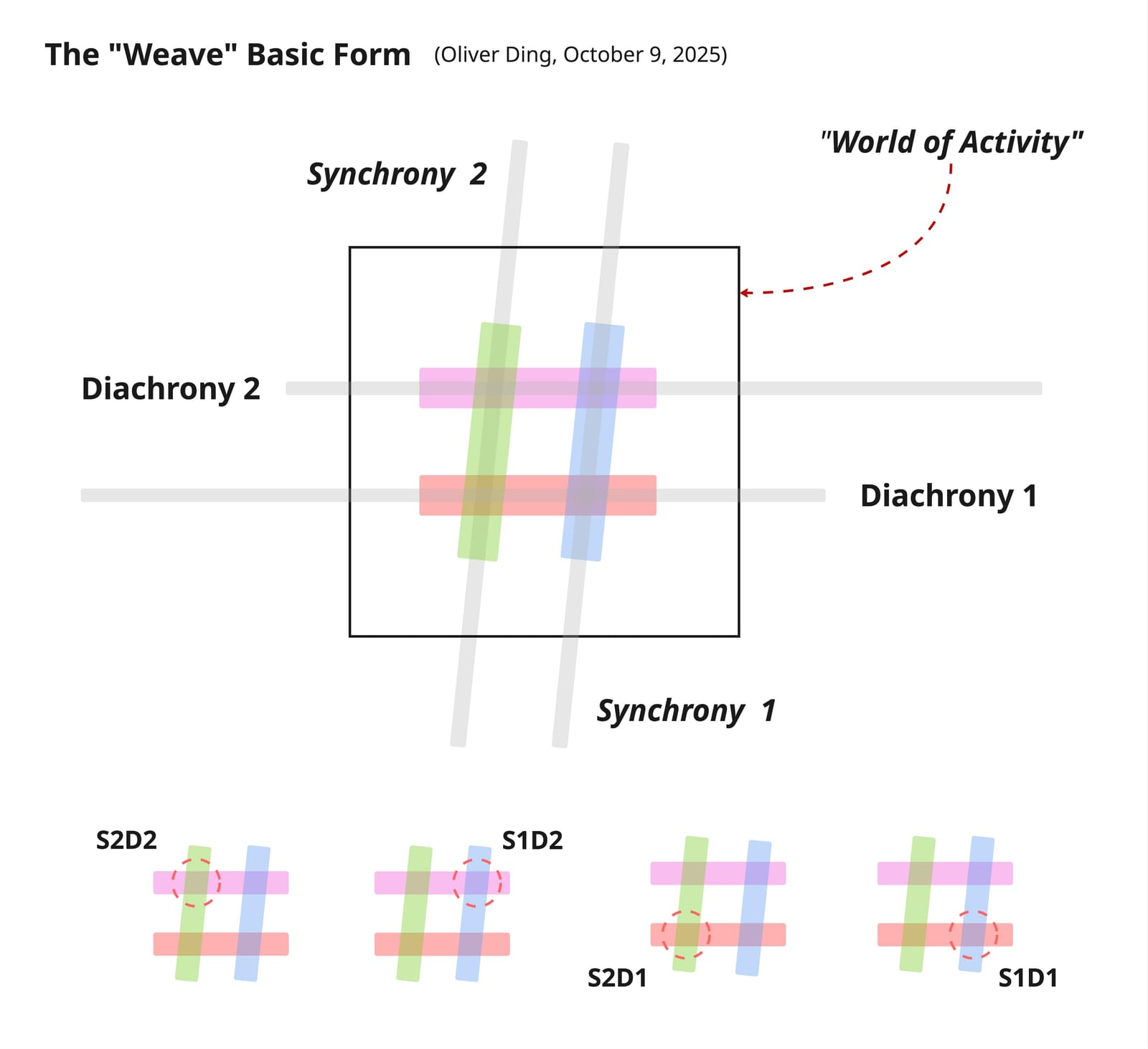
This is a super-simple diagram that frames the activity within the World of Activity as the synthesis of two diachronical dimensions and two synchronical dimensions. The model consists of four Weave-points (S1D1, S1D2, S2D1, S2D2), each representing a structural nexus where one synchrony dimension intersects with one diachrony dimension.
As an abstract model, the “Weave” basic form serves as the foundation for generating derived forms and situational frameworks. More details can be found in [Meta-framework] The “Weave” Basic Form.
The Weave Basic Form functions as a meta-framework. It can be used to curate knowledge elements and develop new frameworks for situational research and reflection.
In this article, I will introduce the Weave-the-Theory framework to discuss a special type of activity: Theoretical Activity.
Contents
- What is Theoretical Activity?
- Two Evolving Lines: Creativity vs. Curativity
- Two Structural Dimensions: Aspects vs. Approaches
- The Creative Path of Theoretical Activity
- The Curative Process of Concept Formation
- The Curative Process of Theoretical Abstraction
- Weave the Theory
- Case Study: The Anticipatory Activity System (AAS)
- The Journey of Slow Cognition
What is Theoretical Activity?
Over the past few years, I have worked on connecting theory with practice and developing knowledge frameworks. Eventually, I also studied how theorists develop their theories. While theorists always deal with abstract ideas, what they do can be considered a type of activity. I call this special type of activity Theoretical Activity, which encompasses activities such as building theories, theoretical curation, theory integration, and theorizing. I also distinguish between the individual cognitive level of theoretical projects and the collective, collaborative level involved in building a theoretical enterprise. Both levels belong to Theoretical Activity.
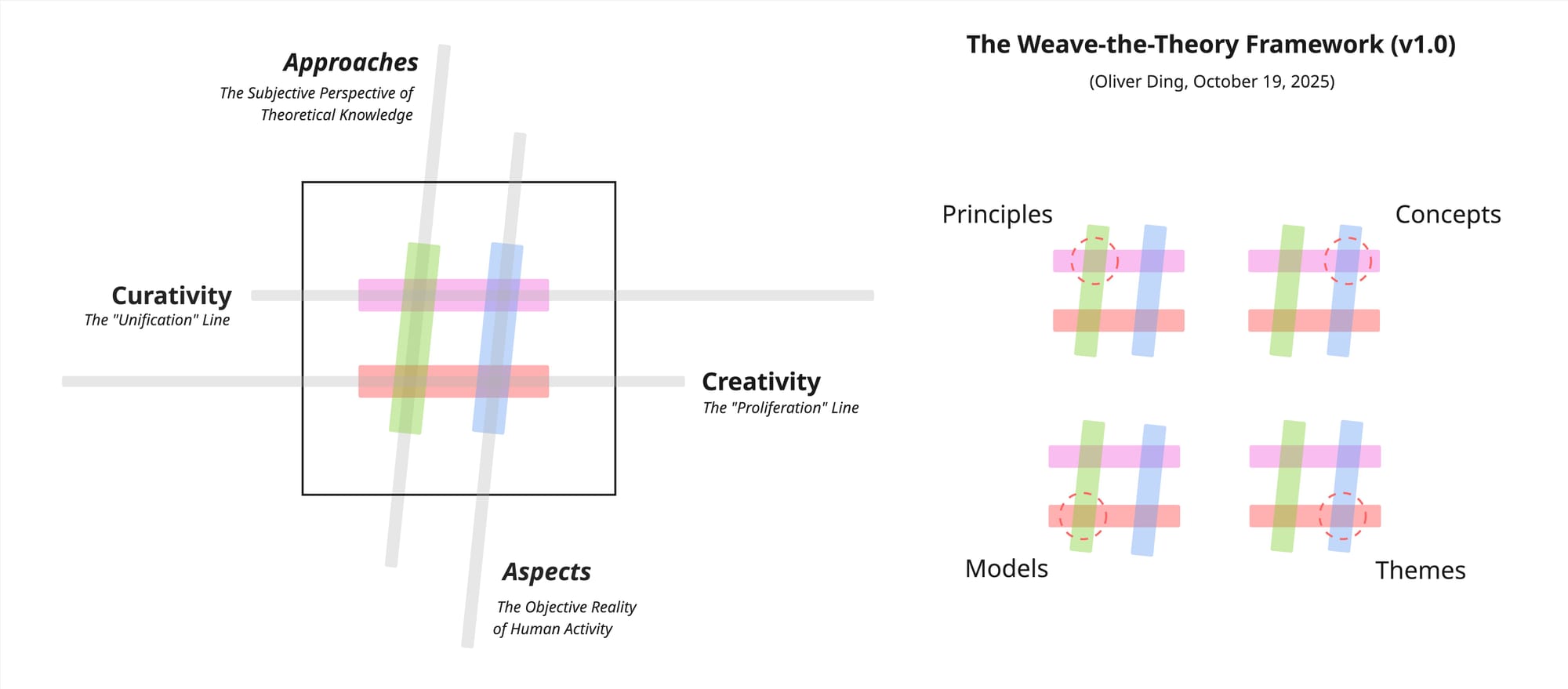
The diagram above provides an abstract model of Theoretical Activity, applied at both the individual and collective levels. It visualizes how theoretical work unfolds across cognitive and social dimensions, offering a conceptual map for understanding the structure and dynamics of theorizing as an activity.
Two Evolving Lines: Creativity vs. Curativity
In this model, two diachronic dimensions are defined as follows:
- Creativity: The "Proliferation" Line, representing the expansion and generation of new ideas.
- Curativity: The "Unification" Line, representing the integration and synthesis of existing ideas.
In a 1993 paper, the theoretical sociologist Thomas J. Fararo and his student John Skvoretz mentioned a term called “the Spirit of Unification”.
“…proliferation and unification are both essential processes in science. If only proliferation were to occur, a field would spawn endlessly branching discrete ideas and give rise to a sense of intellectual chaos. If only unification were to occur, a field would eventually arrive at a non-growth condition in which integration would have gone as far as it could with the given intellectual materials.
In real theoretical sciences, both processes occur together. But fields differ in their relative weight. In some sciences, despite proliferation, a sense of movement toward more and more comprehensive theory exists even as new problems and theories continue to be generated. In other sciences, despite occasional episodes of integration, the predominant tendency is to ever-increasing proliferation with insufficient integration. In Sociology, the latter is the case.
… The spirit of unification in its most general sense is a value commitment to activities that, while not theory-integrating episodes as such, are important to the creation of an intellectual situation that produces such episodes. This means that not only direct theory integration is valued, but so are other sorts of unifying intellectual activities is valued, but so are other sorts of unifying intellectual activities. Thus, we think that the spirit of unification can be embodied in at least four distinct modes of inquiry.
The theme of “Proliferation vs. Unification” parallels that of “Creativity vs. Curativity.”
In the academic world, a concept serves as a foundational object of a knowledge enterprise, including theories and frameworks. Scholars engage with the conceptual reality of a concept. A significant aspect of academic creativity is developing brand-new concepts that can reshape a discipline’s objects, directions, methods, and more.
The tendency to create conceptual reality can lead to conceptual heterogeneity, which refers to different people using the same word to express different conceptual meanings. This phenomenon leads to knowledge fragmentation within a discipline and raises the cost of cross-boundary collaborative projects.
In 2019, I coined the term “Curativity” and drafted a book to discuss the process of turning pieces into a meaningful whole. From June 2020 to October 2022, I worked on the Knowledge Curation Project (Phase 1), which aimed to connect theory and practice. Later, I developed Knowledge Engagement to integrate Knowledge Creation and Knowledge Curation.
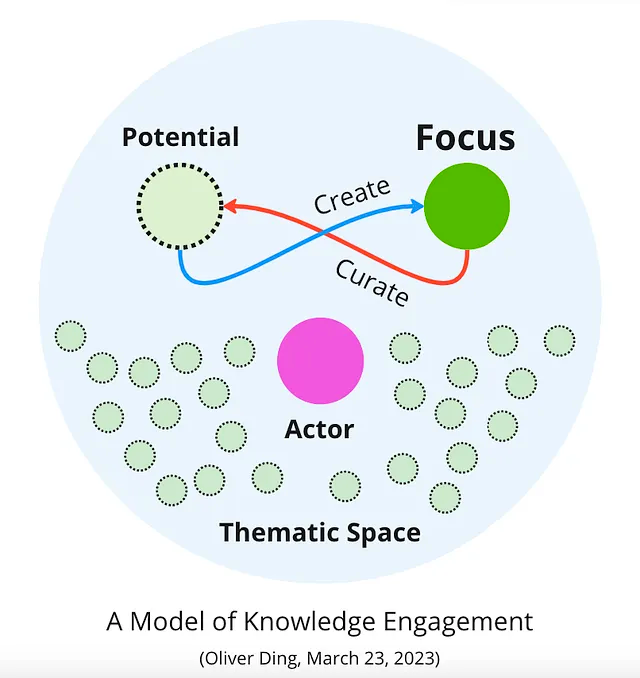
Over the past several years, the Curation-Creation schema has represented the dual-center structure underlying the evolution of the Activity Analysis Center. More details can be seen in Center.
Within the Weave-the-Theory framework, I treat these as two diachronic dimensions.
Two Structural Dimensions: Aspects vs. Approaches
In general, any theory aims to explain practice. This tendency can be divided into two focal objects: Approaches and Aspects.
- Aspects: The objective reality of human activity
- Approaches: The subjective perspective of theoretical knowledge
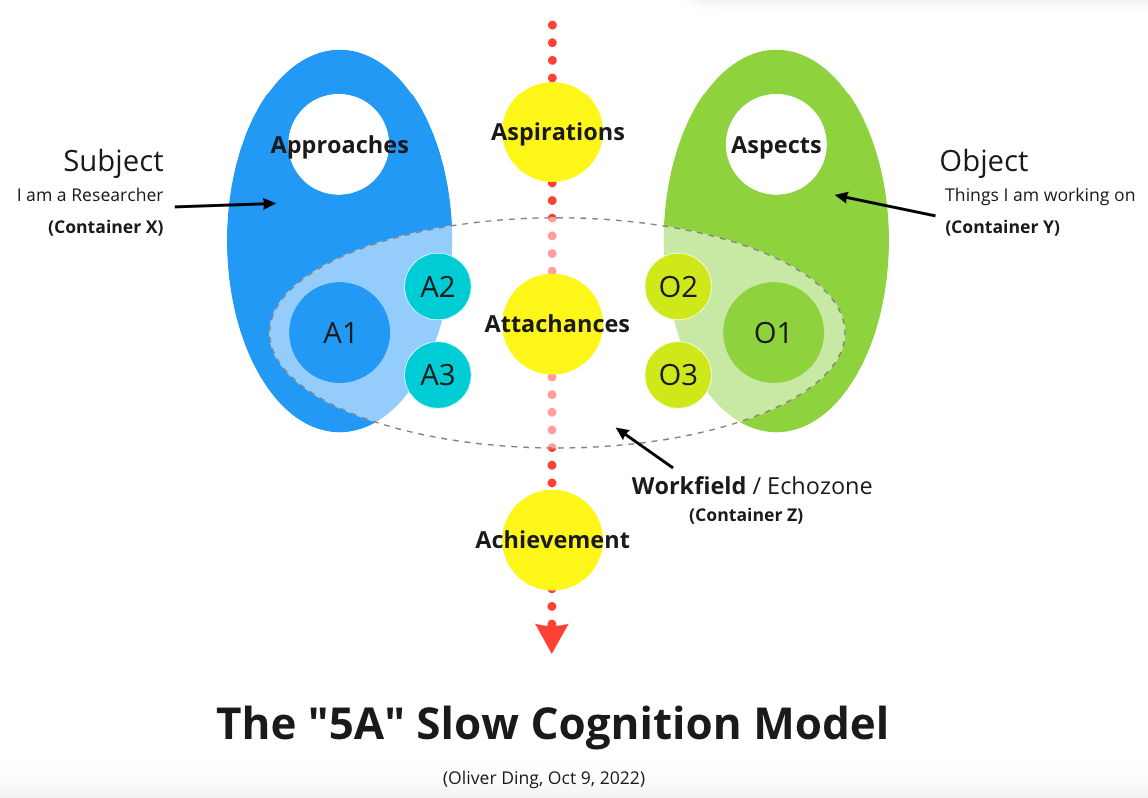
This "Aspect - Approach" schema was introduced in the 5A Slow Cognition model I developed in 2022.
There are many types of knowledge elements within theoretical approaches. For the Weave-the-Theory framework, I focus on the following four:
- "Principles"
- "Concepts"
- "Models"
- "Themes"
They are assigned to four weave-points, providing a mapping tool for further case studies.
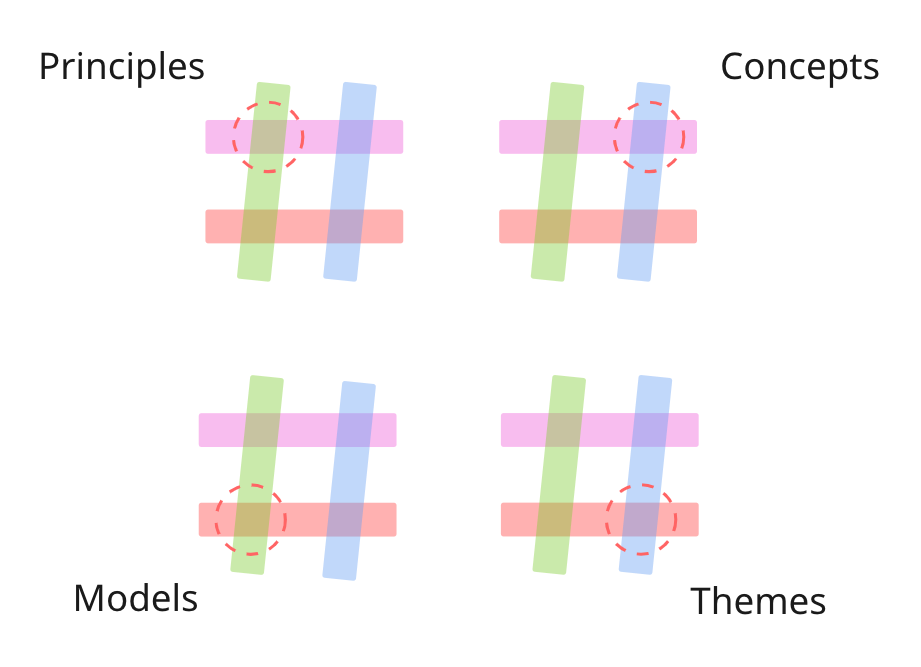
A theoretical approach is formed by a set of core concepts, while principles describe how these concepts interact.
Both concepts and principles are located at a higher, more abstract level, so I placed them at the "Unification" line, associated with Curativity.
In contrast, themes and models are located at a lower, more concrete level, associated with Creativity on the "Proliferation" line.
The Creative Path of Theoretical Activity
The process of Theoretical Activity begins with creativity.
A theorist identifies a particular aspect of human activity and introduces a new term to capture its essence, marking the emergence of a theme.
For example, in August 2021, I joined an adult development program as an advisor. The program was initiated by a young girl who is a friend of mine and was designed with three components: 1) Life Purpose Awareness, 2) Personal OKR Practice, and 3) Peer Review and Feedback. My friend also adopted the Building In Public approach to share her goals, challenges, progress, and discussions with others on social media platforms.
The program inspired me to introduce the term “Life Discovery” as a theme for further integration with Activity-based approaches.
As inquiry deepens, the theorist seeks to explain and organize new themes, constructing a model to represent the underlying structure of the phenomenon. Such models are rarely created in isolation; they are often shaped by existing principles derived from established theoretical orientations. These principles provide the conceptual scaffolding through which the new model gains coherence and becomes part of a broader intellectual lineage.
After three weeks of discussing various themes related to the program with her, on August 17, 2021, I realized that it was possible to develop a framework for reflecting on her project and our conversations. I adopted Anticipatory System Theory as the primary theoretical resource and used a meta-diagram to develop the early version of the AAS framework (see the diagram below).
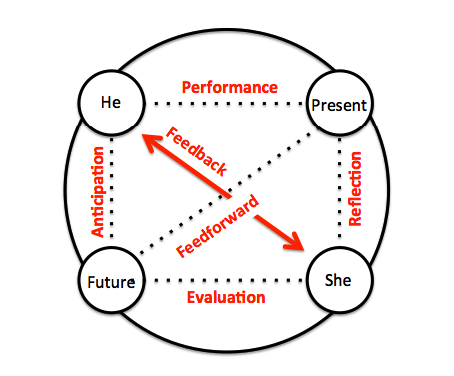
Originally, the framework was called the iART framework, where "iART" stands for i + Activity + Relationship + Themes.
The Curative Process of Concept Formation
For any given aspect of human activity, there may exist multiple themes — each introduced by different authors using distinct terms to describe the same underlying phenomenon.
Along the line of Curativity, these dispersed themes gradually converge into a single theoretical concept that serves as a stable reference for that aspect.
However, the diverse themes do not disappear. They persist as situated expressions or contextual manifestations of the concept — representing its dynamic presence across different theoretical and practical settings.
In this sense, Curativity does not merely consolidate knowledge; it also preserves the living diversity of creative expressions within a shared conceptual horizon.
Later, in 2022, I created the Knowledge Discovery theme and the related canvas. In 2024, I introduced the Meaning Discovery theme.
At a higher level, I coined a new concept: Second-order Activity.
The Curative Process of Theoretical Abstraction
Similarly, when multiple models emerge to address related phenomena, the need for integration arises once again.
Through comparative reflection and synthesis, these models can be abstracted into a set of principles that transcend their original formulations.
While each model retains its distinctive structure and historical context, the derived principles express the invariant logic that connects them.
In this way, Curativity operates not only at the level of concepts but also at the level of theoretical abstraction — transforming a diversity of models into a shared foundation of understanding.
Let's continue the story of Second-order Activity.
After a conversation about sustainable business development with two friends, I began to apply ideas from Activity Theory to develop a framework for sustainable design. The idea was later visualized in the diagram below.
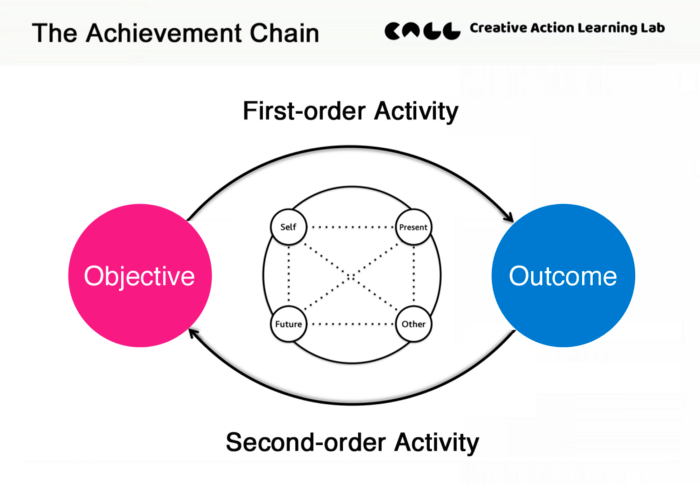
The diagram of Second-order Activity inspired me to reflect on the iART Diagram. I realized that I could create a new diagram by blending two systems:
Transactional Anticipatory System + Second-order Activity = Anticipatory Activity System
The result was a new framework with a new diagram:
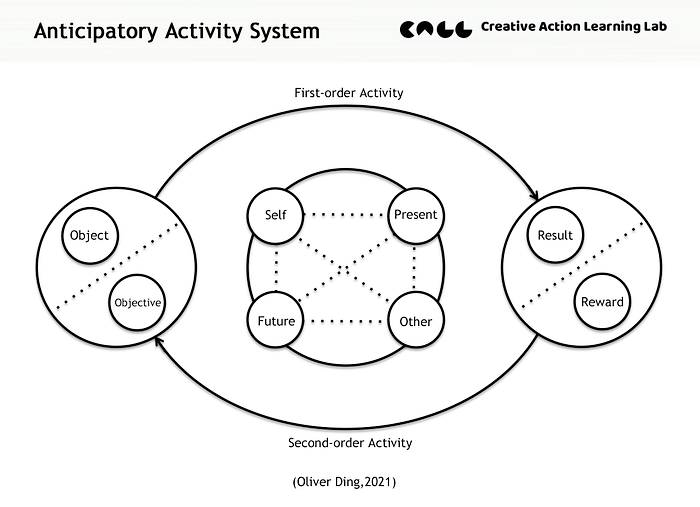
This framework proved especially useful for thinking about the complex relations among Self, Other, Present, and Future—for example:
- "Sustainable Business Development"
- "Organizational Strategy"
- "Startup Studio or Venture Studio"
- "Technology Choices"
- "Educational Strategy"
- "Family Development"
- "Intimate Relationship"
On September 15, 2021, I wrote an article titled D as Diagramming: Strategy as Anticipatory Activity System and began using a new name for the framework. Since the iART Framework was originally inspired by Anticipatory System Theory, I named this new synthesis Anticipatory Activity System.
Weave the Theory
When numerous themes and models emerge, a new line of activity becomes necessary — the line of curativity.
Whether undertaken by the original theorist or by the broader academic community, this phase involves organizing, comparing, and integrating existing conceptual creations. Curativity seeks to weave the dispersed results of creative inquiry into coherent frameworks, identifying their relationships, boundaries, and underlying assumptions.
Through this process, theoretical activity shifts from the invention of new ideas to the cultivation of conceptual ecosystems — sustaining the continuity and development of knowledge.
What emerges from curativity does not operate in isolation. Once consolidated, the resulting concepts, principles, and frameworks are reintroduced into the academic environment, where they become resources for new creativity.
Subsequent theorists rarely begin from raw experience alone.
Instead, they engage with the existing body of theoretical work — interpreting, extending, and recontextualizing what has already been curated.
In this recursive process, curativity and creativity form a mutual cycle: creativity produces the materials that curativity organizes, and curativity, in turn, provides the structured context that nurtures new creative insight.
Thus, the evolution of theoretical activity unfolds not as a linear progression, but as a series of weaving movements — between invention and cultivation, between the solitary act of discovery and the shared work of preservation.
Case Study: The Anticipatory Activity System (AAS)
From August 2021 to August 2022, I worked on developing the Anticipatory Activity System (AAS) framework. During this process, I used the Theme U Framework to manage its development.
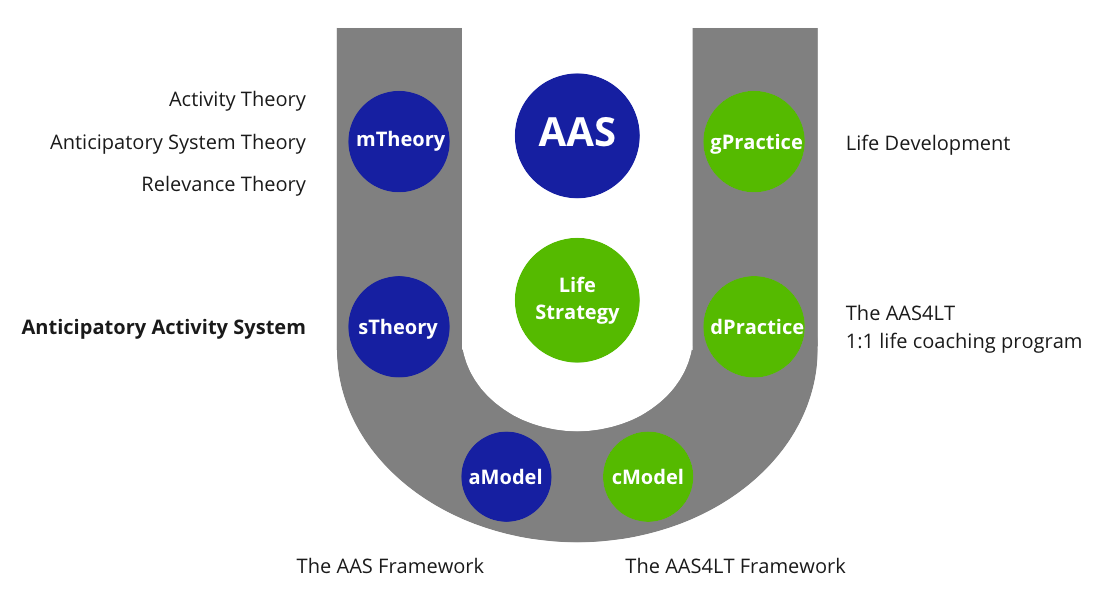
The diagram above is based on the HERO U Framework, which presents six types of “objects of knowing” arranged in a U-shaped schema:
- mTheory: Meta-theory
- sTheory: Specific Theory
- aModel: Abstract Model
- cModel: Concrete Model
- dPractice: Domain Practice
- gPractice: General Practice
For the AAS project, I identified the following “Objects of Knowing” that connect Theory (AAS) and Practice (Life Strategy):
- Meta-theory: Activity Theory, Anticipatory System Theory, Relevance Theory, etc.
- Specific Theory: Anticipatory Activity System
- Abstract Model: The AAS Framework
- Concrete Model: The AAS4LT Framework
- Domain Practice: The AAS4LT 1:1 life coaching program
- General Practice: Life Development
Further details can be found in Life Discovery: The AAS Framework.
On August 26, 2022, I reviewed this one-year journey and identified nine transitions between several thematic spaces (see the diagram below).
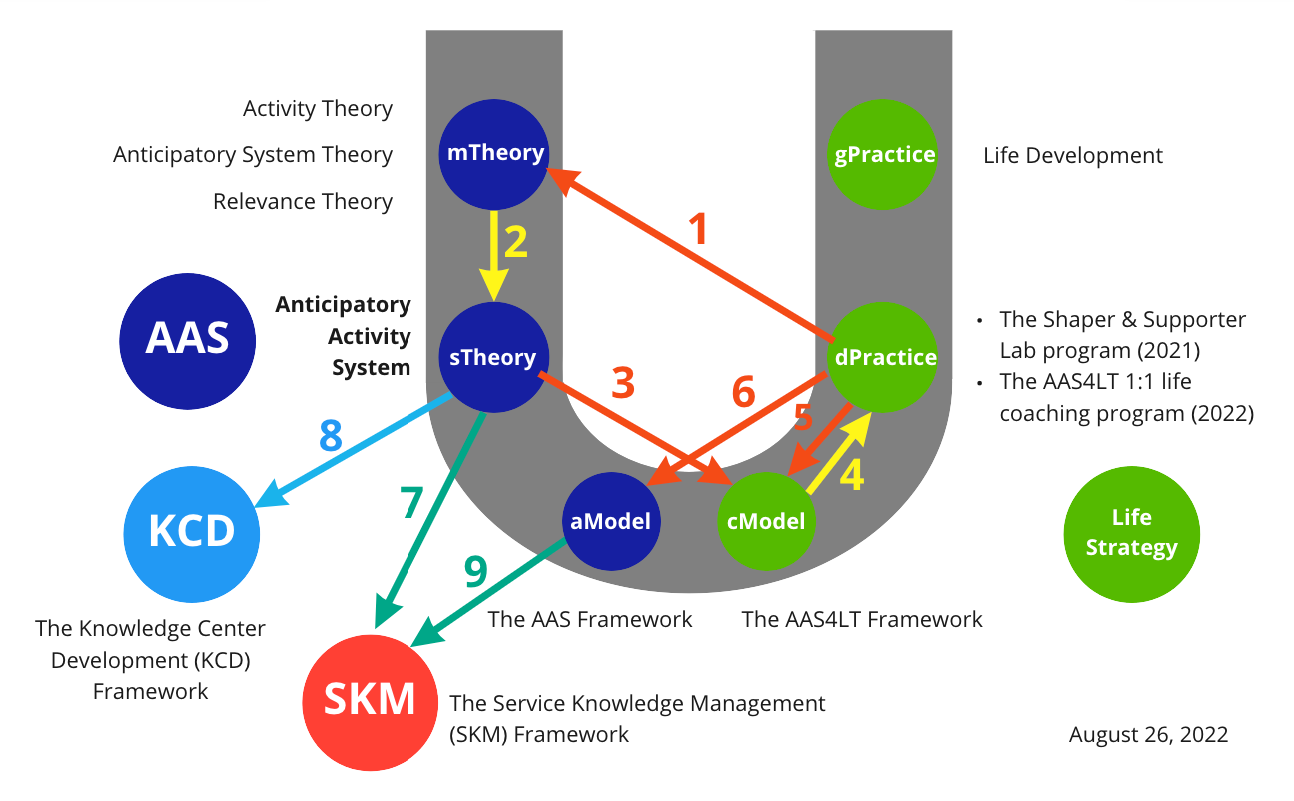
More details can be found in Slow Cognition: The Development of AAS (August 21, 2021 - August 26, 2022).
Later, I curated the AAS framework into the Life-as-Activity Approach, marking a transition from an internally developed creation to an externally integrated member within a larger knowledge system.
This transition exemplifies a double curativity movement — an internal process of synthesis within a single framework, followed by an external process of integration across multiple frameworks.
Through this double curativity movement, theoretical development becomes an ecology of weaving — where each framework evolves not only through self-curation but also through its participation in a collective structure of knowledge.
The knowledge map below presents the landscape of the Life-as-Activity Approach, where the AAS framework appears alongside its sister frameworks.
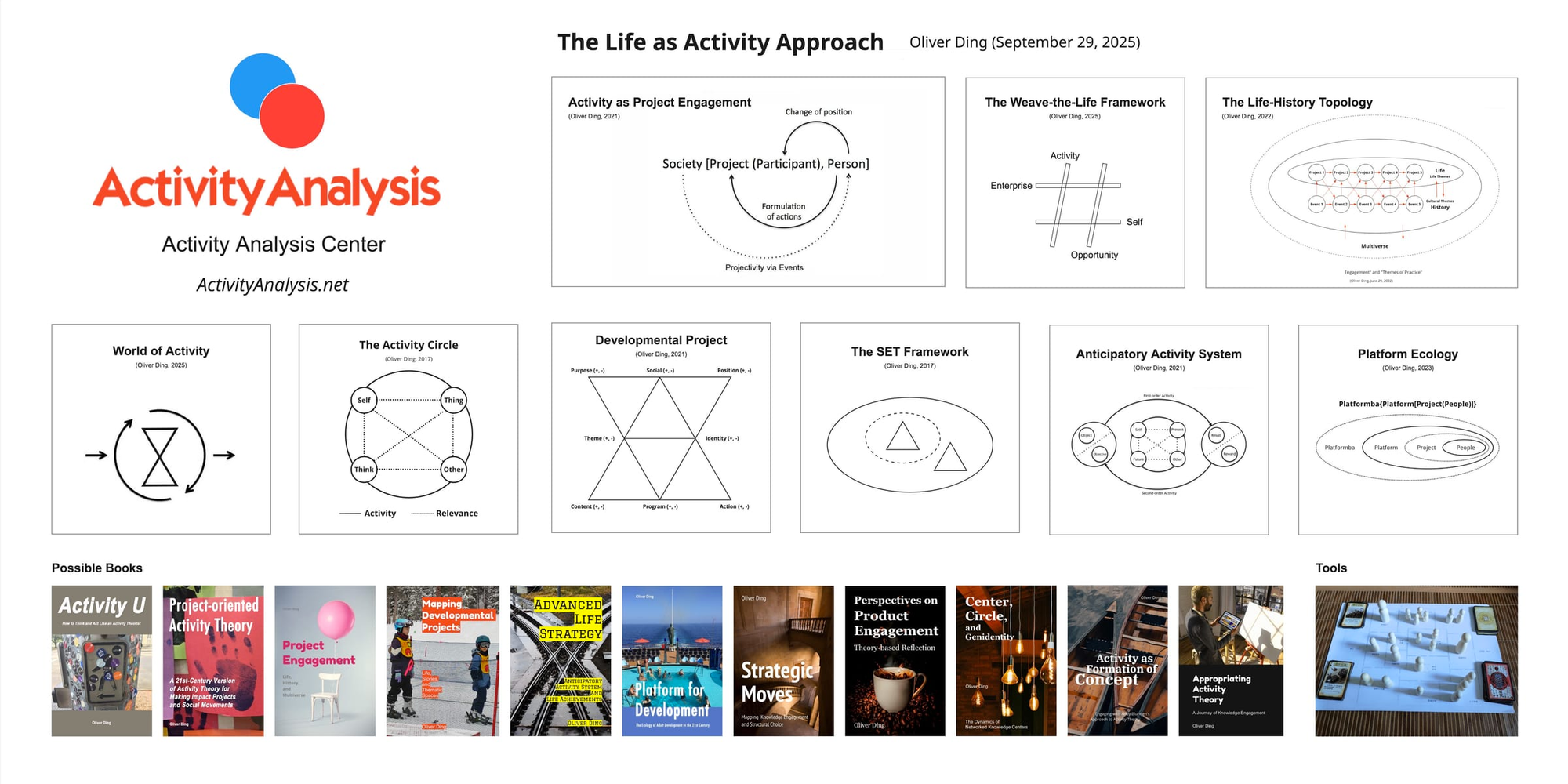
The first three frameworks provide an ontological-level explanation that frames the entire approach.
- The Activity as Project Engagement model offers a theoretical integration that connects Andy Blunden’s approach with Yrjö Engeström’s Activity System Model.
- The Life-History Topology model proposes a way to understand social life, serving as the foundation for individual life development.
- The Weave-the-Life framework bridges Activity as Project Engagement and Life-History Topology, explaining how the former unfolds into the latter.
The other six frameworks function as an epistemological-level toolkit, each approaching a different unit of analysis with a distinct model:
- Individual subject perspective: World of Activity model
- Intersubjective perspective: Activity Circle model
- Project level: Developmental Project model
- Environmental level: SET Framework
- System level: Anticipatory Activity System (AAS) Framework
- Platform level: Platform Ecology model
Finally, the eleven featured Possible Books are drafts rather than published works. They document the outcomes of my exploration of these frameworks over the past several years.
Here, we see the AAS framework positioned within a broader landscape, demonstrating how a single internally curated framework can, through external curativity, become a member of a collective knowledge system.
The Journey of Slow Cognition
Theoretical Activity unfolds not only in immediate acts of discovery and synthesis, but also as a form of long-term cognitive weaving. Both creativity and curativity, while appearing as distinct temporal threads in the development of ideas, are supported and sustained by the processes of slow cognition. Over time, these threads interlace, producing coherent conceptual structures and evolving frameworks.
To capture this temporal dimension, I developed the House of Slow Cognition in December 2024, building on the 5A Slow Cognition model (see the diagram below).
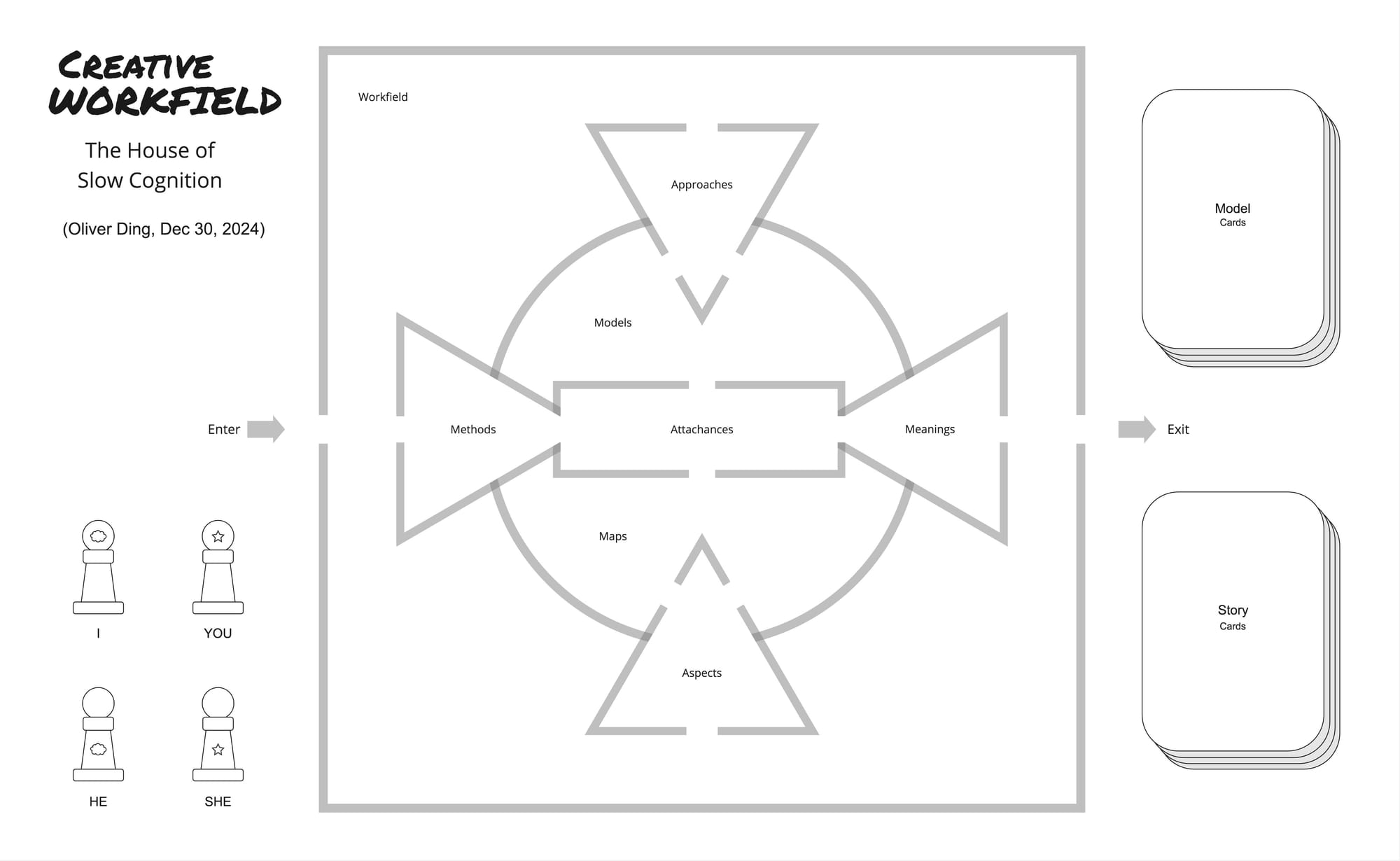
In this map, the concept of "Attachances" represents a sequence of detaching and attaching acts — micro-processes through which ideas are continuously reshaped and connected.
If we consider Theoretical Activity as a series of such detaching and attaching acts, we can naturally connect the Weave-the-Theory framework with the House of Slow Cognition. Together, they form a complementary toolkit for understanding theoretical activity at both the individual cognitive level and the collective, collaborative level.
v1 - October 21, 2025 - 2,542 words