
Weave the Life: The Life-as-Activity Approach (v4.0)

by Oliver Ding
April 30, 2026
Introduction to Weave the Life: The Life-as-Activity Approach and Personal Knowledge Ecology
I began studying Activity Theory around 2015. In 2020, I worked on the Activity U project, which resulted in two book drafts and the initial development of the Project Engagement approach. From 2021 to 2022, I created the Anticipatory Activity System (AAS) framework and applied it to explore life strategy. In 2023, I designed the Activity Analysis & Intervention (AAI) Program. In 2024, I revisited and refined the Project Engagement approach, developing version 3.1.In November 2025, I released the book draft Developmental Projects: The Project Engagement Approach to Adult Development, marking a significant milestone — and updating the approach to v4.0.
Yet the Project Engagement approach is only one among many activity-centered creations I have developed over the years. The journey has led to many creations, including book drafts, knowledge frameworks, diagrams, digital boards, and more. How to curate these diverse knowledge frameworks — diagrams, models, canvases, theoretical approaches — into a coherent whole has been an ongoing challenge.
On December 4, 2024, I used "World of Activity" to name my activity-centered creations as a theoretical toolkit, marking the end of a creative journey of theoretical exploration. However, in June 2025, I developed "World of Activity" as an independent concept for further growth, resulting in the World of Activity approach, which connects several theoretical frameworks I am working on — some of which are based on my activity-centered creations.
In September 2025, I decided to reuse "Life as Activity" to name my activity-centered creations. This idea dates back to 2020, when, during the Activity U project, I developed version 0.3 of the Life-as-Activity framework. Since my primary interest lies in individual development and creative life, I use Life-as-Activity to highlight my direction of exploration in the field of activity-centered social theories.
We can understand both our daily life and life as a whole as forms of activity. In fact, the founder of Activity Theory once considered calling his framework Life Theory. According to Kaptelinin and Nardi (2006):
Leontiev's ambition was to translate this general statement into a concrete description of how the first phenomena that can be called 'psyche' emerged in history, and how they developed into the current variety of mental phenomena. To accomplish this goal Leontiev needed a special kind of analytical tool, a concept more general than the psyche, that would make it possible to define the context in which the psyche emerges and develops. An obvious candidate for such a concept is 'Life' since ultimately this is what undergoes evolutionary change. However, this concept is too general and too vague. 'Activity,' as we will see below, was chosen by Leontiev as a concept that can provide a more concrete insight into what 'Life' is. (pp.51–52)
In my own work, I treat Life as encompassing both individual life and social life. While I emphasize individual creative agency, many of my frameworks also address the structural dimensions of social life, since understanding these complexities is essential for identifying potential opportunities for action.
I used "Weave-the-Life" to name a Weave diagram for the Life-as-Activity approach in October 2025. Later, on April 26, 2026, I released the Weave-the-Life Model (v3.0), which also marked the v4.0 of the Life-as-Activity approach. The milestone inspired me to edit a new possible book titled Weave the Life: The Life-as-Activity Approach (v4.0) and Personal Knowledge Ecology.
In this book, "Weave-the-Life" also refers to a new model of the actor, serving as a shared foundation across my theoretical enterprises, including the Life-as-Activity Approach, the Anticipatory Cultural Sociology (ACS) approach, and the Strategic Developmental Psychology (SDP) approach.
This possible book re‑presents the recent work through a unified symbolic system — the Weave form — and, for the first time, organizes the full territory of the Life‑as‑Activity Approach (v4.0) around the concept of Personal Knowledge Ecology. The adult development studies collected here and the theoretical activity cases documented in later parts are not separate interests. They are two expressions of the same underlying phenomenon: how a person builds, sustains, and transforms their own knowledge ecology over time.
This book is therefore not a final statement but a curated snapshot — a structured presentation of a living theoretical enterprise at a particular moment in its development.
Contents
The Life-as-Activity Approach (v3.2)
The Weave-the-Life Framework (v3.0)
Activity, Enterprise, and Attachance
Create, Curate, and Weave
Personal Knowledge Ecology
What This Book Contains
The Life-as-Activity Approach (v3.2)
A key milestone in the development of the Life-as-Activity approach was the book draft Developmental Projects: The Project Engagement Approach to Adult Development, completed in November 2025. While that book intends to offer a practical toolkit for applying the Developmental Project concept to adult development, its theoretical contributions also advance the Project Engagement approach to version 4.0.
Previously, the full landscape of the Life-as-Activity approach was presented through a knowledge map — a curated display that gathered key framework diagrams, featured a series of book draft covers, and included an image of one tool.
On November 11, 2025, I launched a knowledge map to present a landscape of the Life-as-Activity approach (v3.2). It includes 9 knowledge frameworks, 11 book drafts, and one tool.
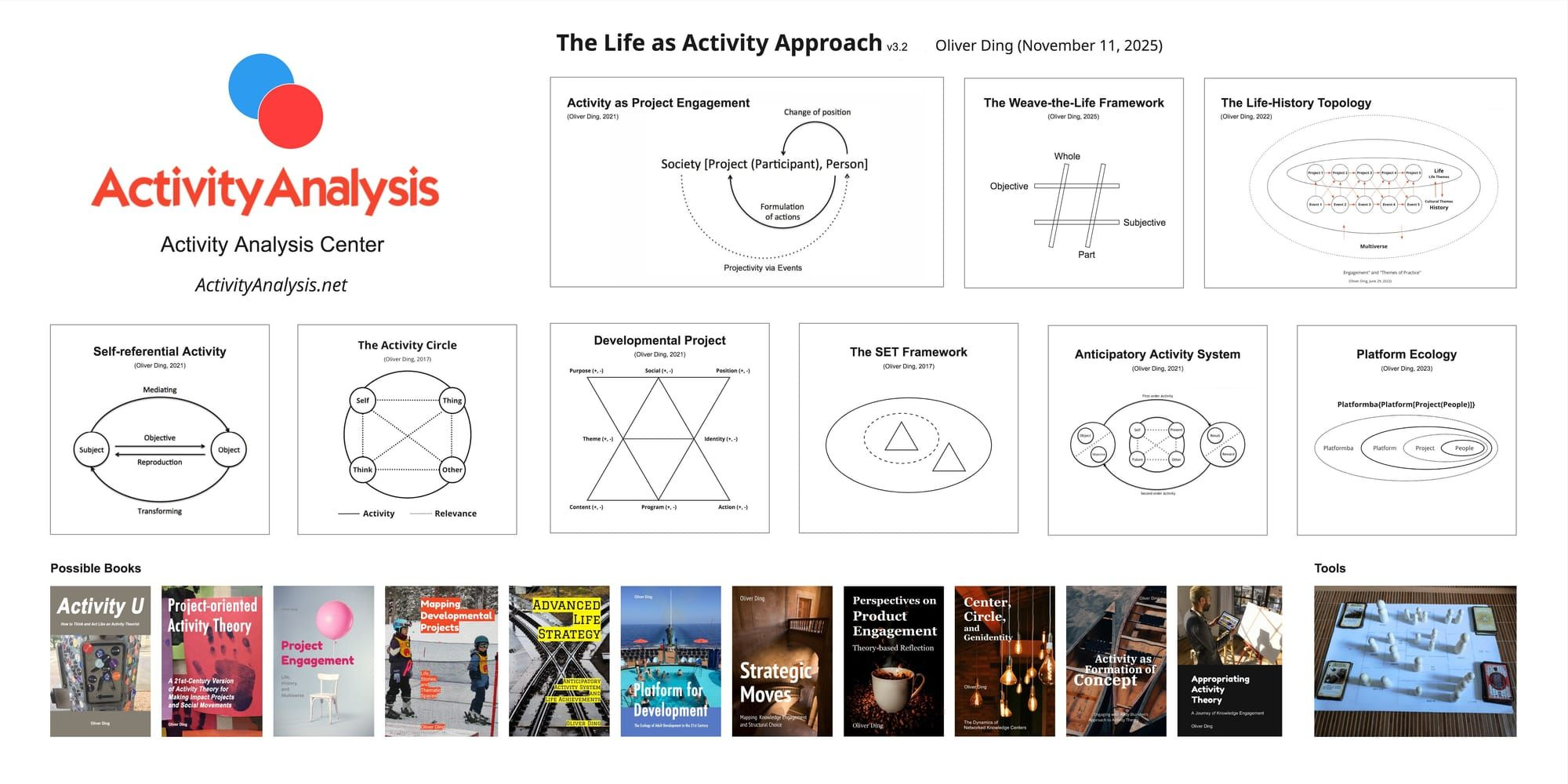
The first three frameworks provide an ontological-level explanation that frames the entire approach:
- The Activity as Project Engagement model offers a theoretical curation that connects Andy Blunden's approach with Yrjö Engeström's Activity System Model.
- The Life-History Topology model proposes a way to understand social life, serving as the foundation for individual life development.
- The Weave-the-Life framework bridges Activity as Project Engagement and Life-History Topology, explaining how the former unfolds into the latter.
The other six frameworks function as an epistemological-level toolkit, each approaching a different unit of analysis with a distinct model: the Self-referential Activity model (individual subject perspective), the Activity Circle model (intersubjective perspective), the Developmental Project model (project level), the SET Framework (environmental level), the Anticipatory Activity System framework (system level), and the Platform Ecology model (platform level).
The knowledge map showed the territory. But it lacked a coordinating mechanism among the different knowledge frameworks. They sat side by side, each in its own space, their relationships implied but not structurally articulated.
The Weave-the-Life Framework (v3.0)
In October 2025, I introduced the "Weave" Basic Form as a meta-framework that conceptualizes activity as the synthesis of two diachronic dimensions and two synchronic dimensions. Later, I used the basic form to systematically design the Weave-the-Life framework, which includes a series of diagrams.
The Weave-the-Life framework was incorporated into the Life-as-Activity Approach (v3.2, 2025) in November 2025. The framework bridges the other two ontological-level members — Activity as Project Engagement and Life-History Topology — explaining how the former unfolds into the latter.
In April 2026, while working on the Weave 42 project, I developed a new version of the Weave Basic Form, a 4×4 edition that I call the Weave 16 diagram. Based on the new diagram, I created the Weave-the-Life Framework (v3.0) and used it to curate 16 key concepts of the Life-as-Activity Approach.
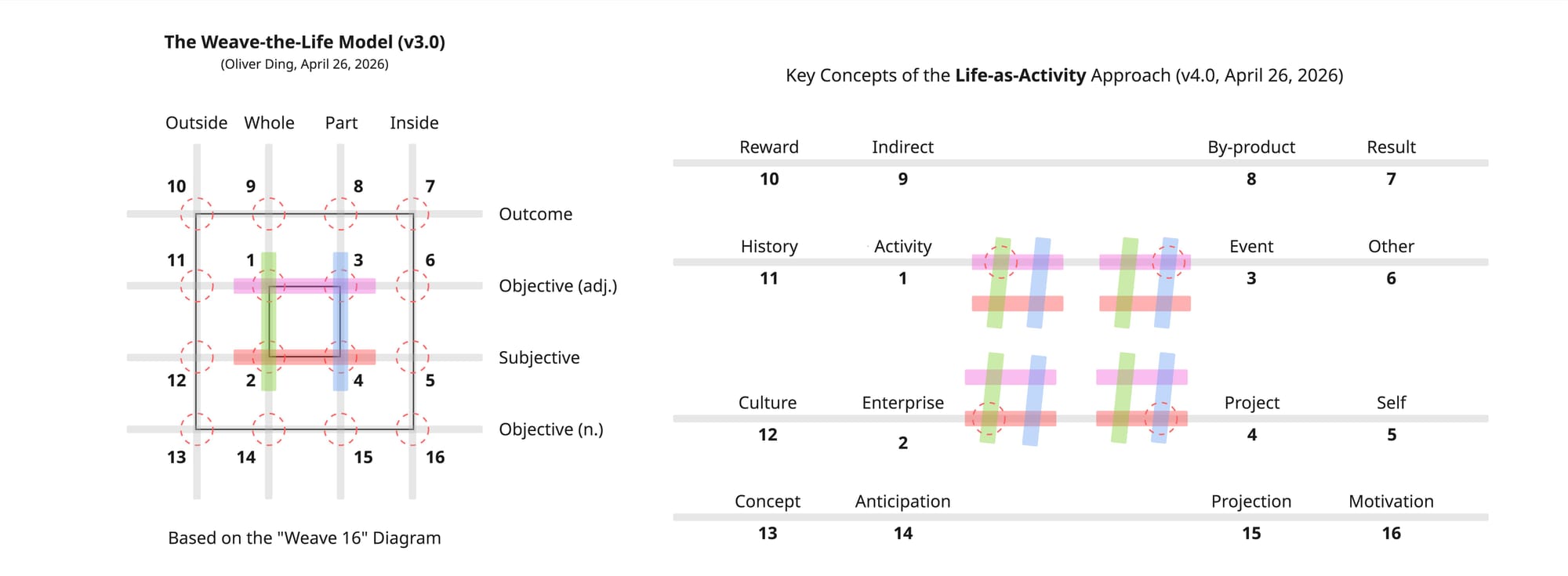
The Weave-the-Life Framework (v3.0) addresses the limitation of the knowledge map through a formal innovation. It goes beyond the static, single-layer character of the knowledge map by introducing the nesting capacity of thematic spaces, the positional logic of coordinates, the scalability of Weave-Points as foci, and the integration of the actor's Living Coordinate into the structure itself.
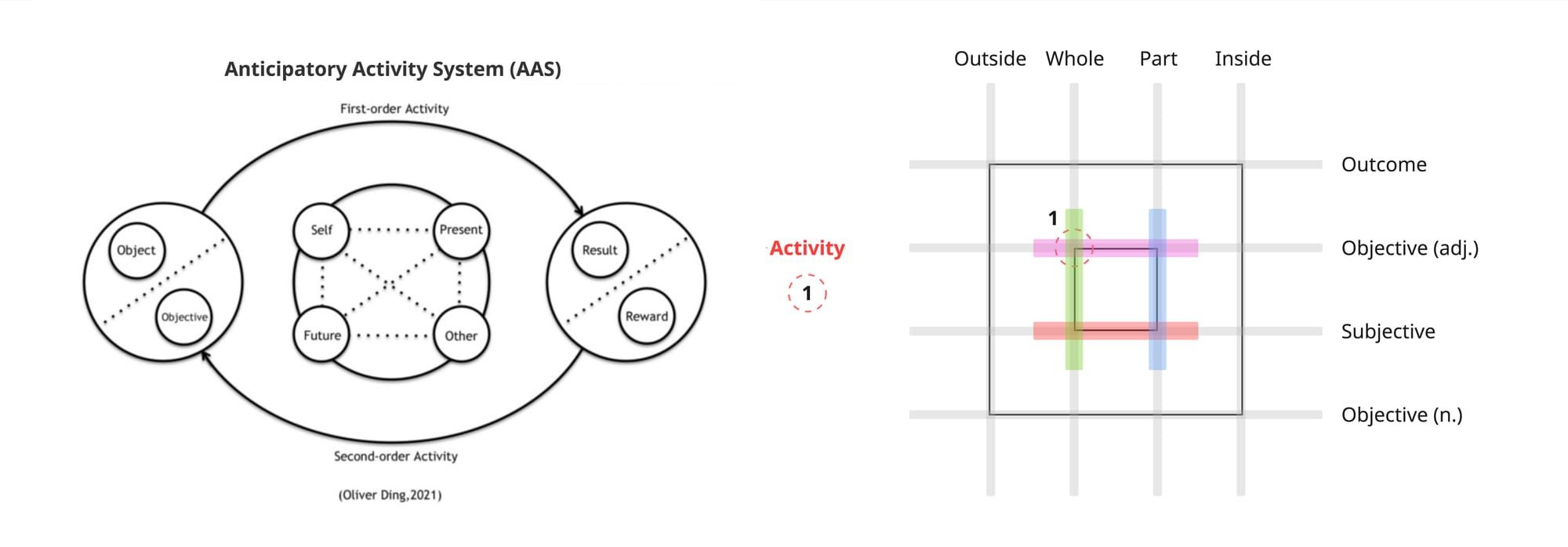
Through these innovations, knowledge frameworks that were previously distributed across separate diagrams are now organized within a single spatial argument. The matrix does not merely display them. It integrates them — placing each framework at its proper coordinate, linking each to its relevant thematic space, and revealing the structural relationships among them through the logic of rows, columns, and pairs.
I designate this milestone as the Life-as-Activity Approach (v4.0).
Activity, Enterprise, and Attachance
In November 2025, in the book draft Developmental Projects: The Project Engagement Approach to Adult Development, I introduced the Cultural Projection Model (2025), organized around the Activity—Enterprise pairing.
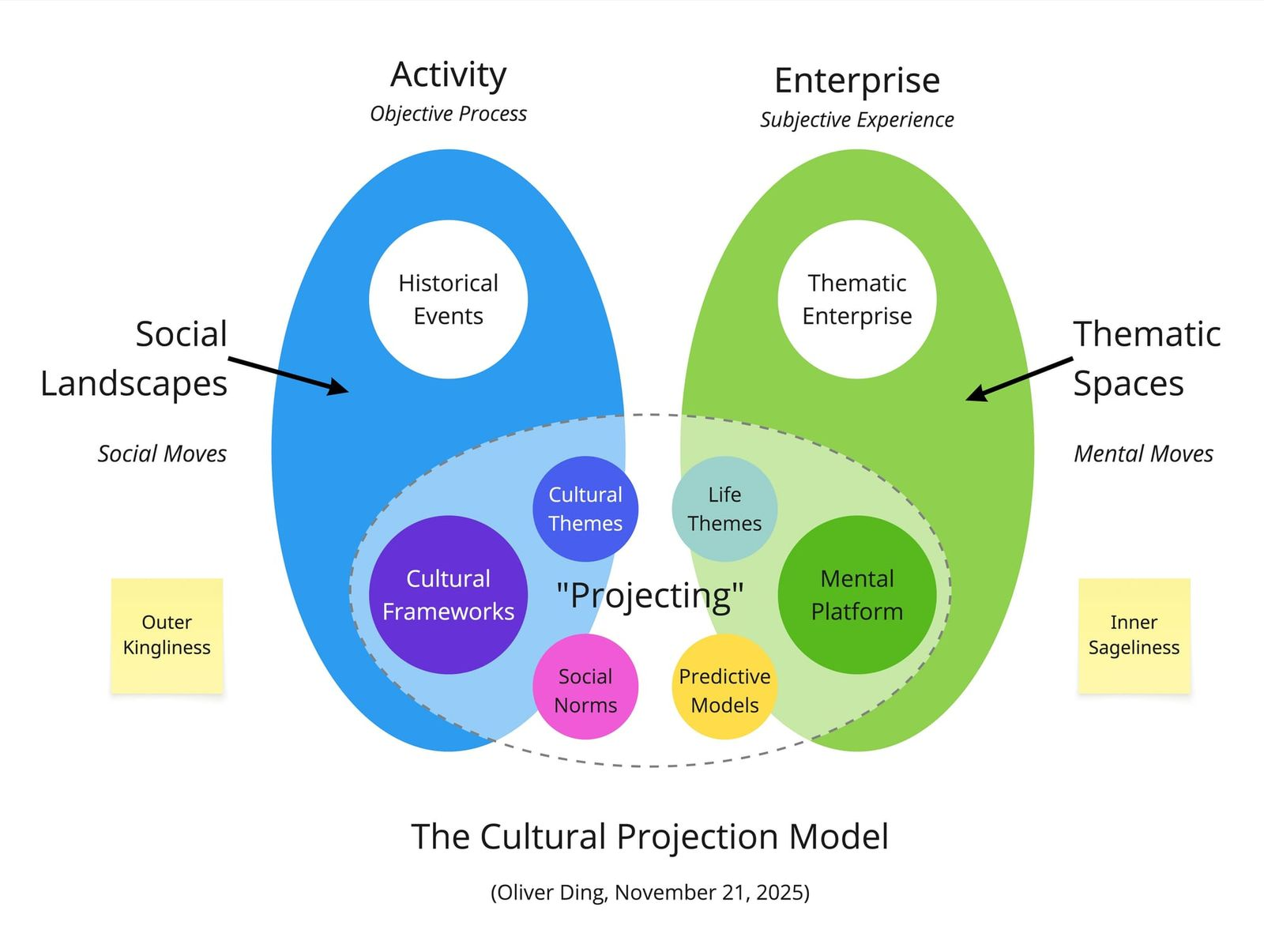
In the Life-as-Activity Approach (v 4.0), I take a further step: the Activity—Enterprise—Attachance triad provides a more complete account of how Activity as Project Engagement is expressed at the meso level — the level between individual projects and the full arc of a life.
Activity names the tradition this work belongs to and the organizing concept that has been present from the beginning. The Life-as-Activity Approach was developed primarily through its engagement with the concept of project — the basic unit of individual engagement with the social world. Its governing principle, Activity as Project Engagement, describes how a person moves from outside a project to inside it, forming identity and contributing to collective life through this ecological movement. The foundational equation Life = Projects = Thematic Spaces = Events = History gave the approach its basic ontological structure: Projects on the subjective side, Events on the objective side, and Activity Theory's internalization—externalization principle providing the theoretical home for the Outside—Inside movement.
Enterprise names the concept that arrived through an indirect activity — the development of Creative Life Theory in 2025 — and resolved a structural gap that had been latent in the approach since the formulation of the Life-History Topology in 2022. That ontological framework — Life = Projects = Thematic Spaces = Events = History — established a foundational symmetry: Project sits within the individual's subjective experience, while Event sits outside it, belonging to the objective activities of others. This Project—Event symmetry is the concrete expression of the governing principle Activity as Project Engagement at the micro level. However, the topology left a gap unaddressed. Moving from the micro level (individual projects and events) to the macro level (Life and History) required crossing a meso level that had no clearly named concepts.
When Enterprise emerged as a theoretical element, it became clear that it filled this gap precisely: Enterprise is a higher-order organization of Projects — a series of projects organized by a sustained subjective trajectory. And if Enterprise is the meso-level counterpart to Project on the subjective side, then by the same logic, the meso-level counterpart to Event on the objective side must be Activity itself. The Activity—Enterprise symmetry thus completed the topology at a new level of scale, giving the Life-History framework its missing middle.
Attachance names the mechanism of movement through the social world — and it brings with it a clarification about the theoretical foundations of the approach. In 2021, Projectivity was introduced to describe the ecological interaction between a person and a project: the potential action opportunities that draw a person from outside to inside. What was implicit in this concept, but not yet named directly, was its deeper structure: the fundamental capacity to detach from one thematic space and attach to another. Projectivity, at its deepest level, is Attachance at the project scale. With the Activity—Enterprise pairing now in place, Attachance finds its natural position at the enterprise scale as well — describing the larger movements of a creative life as a person's sustained trajectory shifts and reorients across time. The movement between Living Coordinates is explained by Attachance. It is the concept that connects the micro-level dynamics of project engagement with the meso-level dynamics of enterprise development.
In The Genidentity of Activity Theory, I reviewed the work of Activity Theory's predecessors and found that they all followed the same method: when confronted with a dualism — a pair of opposing concepts — they introduced a third element to form a triadic structure. Vygotsky introduced Mediation to resolve the Stimulus—Response dualism. Leontiev introduced Object-orientedness to resolve the Individual Actions—Collective Activity dualism. Engeström introduced System to resolve the Object—Outcome dualism. Blunden introduced Concept to resolve the Practice—Sign dualism. The triadic structure presented in this book — Activity, Enterprise, and Attachance — continues this tradition.
Create, Curate, and Weave
In the Weave-the-Life Framework (v3.0), Weave occupies the innermost ring of the model of the actor. Its position is its meaning: Weave is the integrative action that holds everything together. A person who discovers, designs, delivers, and learns is always also weaving — weaving these orientations into a coherent practice, a coherent life, a coherent self. But what does it mean, precisely, to weave? And where does this concept come from?
The answer begins with a dualism.
In 2019, I coined the term Curativity to describe the process of turning pieces into a meaningful whole. Curativity is the complement of Creativity: where Creativity generates new conceptual objects — new ideas, new frameworks, new approaches — Curativity organises existing ones into coherent structures. For several years, the Creativity—Curativity schema served as the dual-center structure underlying the evolution of the Activity Analysis Center. It described two essential movements of intellectual life: the outward movement of creation and the inward movement of curation.
The tension between these two movements is not new. Theoretical sociologists have described it as the tension between proliferation and unification — two essential processes that must occur together, yet pull in opposite directions. Within the Weave-the-Theory framework, Creativity and Curativity appear as two diachronic dimensions — the Proliferation Line and the Unification Line — that together describe how theoretical work develops over time. The key insight is that these two lines are not alternatives; they weave together. A theoretical enterprise that only proliferates becomes incoherent; one that only unifies stops growing. What makes a theoretical enterprise alive is the ongoing movement between the two lines — the weaving of proliferation and unification into a single developing whole.
In human activity more broadly, the Create—Curate dualism takes a familiar form. On one side: the drive to seek the new, to explore, to open up, to embrace productive disorder. On the other: the need to preserve, to make good use of what exists, to establish norms, to build coherent order. These two tendencies are not merely intellectual orientations; they are lived experiences that many people find genuinely difficult to hold together. The person who creates prolifically often struggles to organise what they have made. The person who curates carefully often finds it hard to generate something genuinely new. The tension between them is real, and it does not resolve itself automatically.
Within the Life-as-Activity Approach, this tension has been addressed at different levels. In the Anticipatory Activity System (AAS) framework, first-order activity and second-order activity form a self-referential loop — a system in which Life Performance and Life Discovery are not opposing forces but two phases of a single continuous cycle, each feeding the other. This was an early recognition that the Create—Curate dualism could be transformed into a dynamic whole rather than a static opposition.
Following the pattern established by Activity Theory's predecessors — each of whom resolved a dualism by introducing a third element — the question becomes: what is the third element that resolves the Create—Curate dualism?
The answer is Weave.
Weave is not a compromise between Create and Curate, nor a sequence in which one follows the other. It is the integrative action that holds both in motion simultaneously. To weave is to work the two lines together — to create in a way that is already organised, to curate in a way that is still generative. In the Weave-the-Life model, this is why Weave occupies the innermost position: it is not one orientation among others, but the action through which all the other orientations become coherent practice.
This triadic structure — Create, Curate, Weave — continues the tradition identified in The Genidentity of Activity Theory. Vygotsky introduced Mediation to resolve the Stimulus—Response dualism. Leontiev introduced Object-orientedness to resolve the Individual—Collective dualism. Blunden introduced Concept to resolve the Practice—Sign dualism. In each case, the third element does not eliminate the tension between the first two — it transforms that tension into a productive dynamic. Weave does the same for the Create—Curate dualism: it transforms the opposition between proliferation and unification into the lived coherence of a developing person.
Every person who engages with knowledge — who creates and curates, who generates and organizes, who expands outward and integrates inward — is already weaving. The Weave-the-Life Framework (v3.0) gives this activity its structural form.
In this book, I use "Weave-the-Life" to name this new model of the actor, serving as a shared foundation across my theoretical enterprises, including the Life-as-Activity Approach, the Anticipatory Cultural Sociology (ACS) approach, and the Strategic Developmental Psychology (SDP) approach.
Personal Knowledge Ecology
Like many activity theory researchers, I am committed not only to the general theoretical direction of Activity Theory but also to a deep engagement with specific types of activity that bridge theory and practice. However, unlike most mainstream activity theorists who focus on collaborative activity at the organisational level, I have placed adult development and concept‑centred knowledge engagement at the heart of my inquiry. The very name Life‑as‑Activity makes this orientation clear: individual development is my core concern. This direction was set as early as 2020, during the Activity U project, when I surveyed the full landscape of Activity Theory and chose to centre the individual.
Mediating tools occupy a central place in Activity Theory. They are not neutral instruments — they shape the activity they serve, and they are reshaped by it in return. Over the years, my engagement with Activity Theory has moved well beyond reading and citation. I have tried to live its principles: to design tools, test them in practice, and follow what the practice reveals. One kind of activity became a particular focus of this effort: concept‑centred knowledge engagement. To explore this activity, I designed a series of tools — and early versions focused on the Knowledge Discovery Canvas, and how the concept behind it, Thematic Space, travelled from an operational design decision to an abstract theoretical framework.
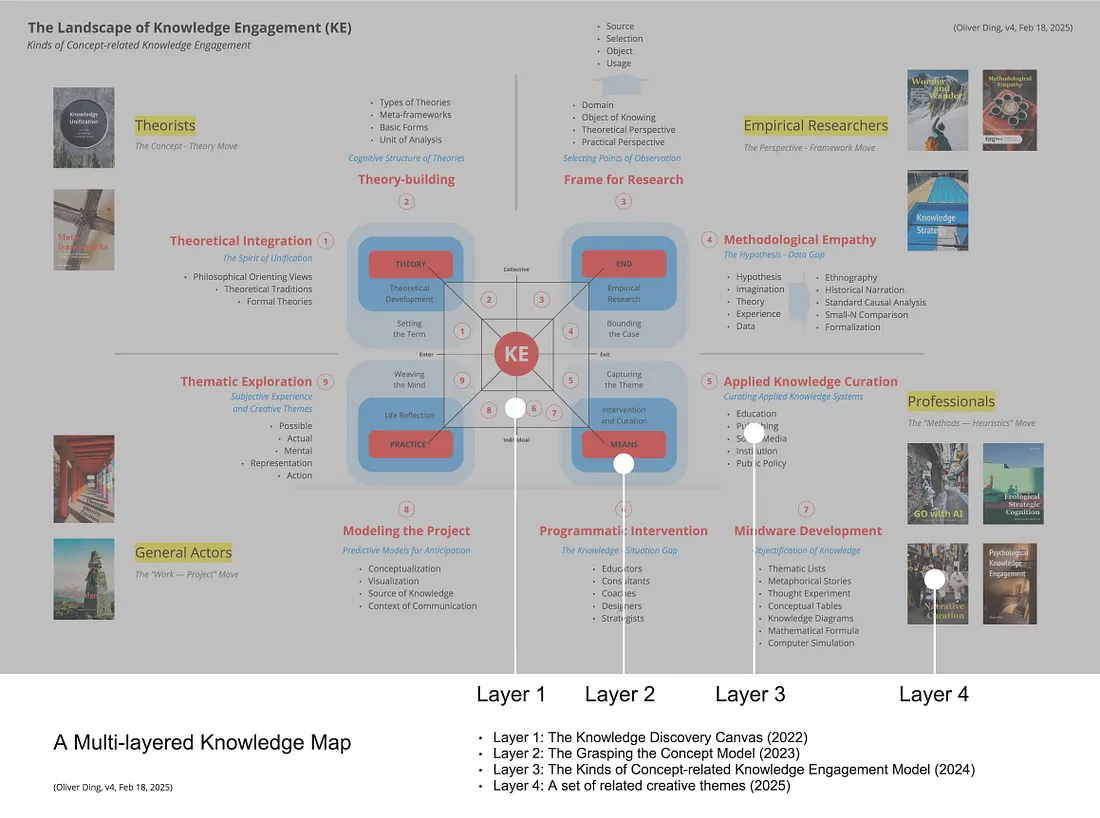
The development of Weave‑the‑Life (v3.0) introduced a nesting capacity that the earlier canvas could not provide: each Weave‑Point opens onto an entire sub‑system of knowledge — frameworks, diagrams, case studies, and tools. A single coordinate can hold a book draft. The 4×4 diagram does not merely display the Life‑as‑Activity Approach; it organises it — giving each framework its proper coordinate, linking each to its thematic space, and revealing the structural relationships among them through the logic of the matrix itself.
The years spent designing canvases were not merely practical work. They were, in retrospect, a long preparation. Each canvas had been an exercise in spatial argument — in finding the right configuration of dimensions, regions, and positions to make a type of activity visible and navigable. The Thematic Space concept, developed through this practice, carried a design logic that proved transferable far beyond any single canvas.
While working on the Weave‑the‑Theory cases and editing this book, I unexpectedly realised that my many years of exploration in two directions — adult development and concept‑centred knowledge engagement — could be gathered under a new thematic space. I call this space Personal Knowledge Ecology.
In 2022, using the Thematic Space Canvas as a meta‑canvas, I developed the Knowledge Discovery Canvas and the Life Discovery Canvas. They address, respectively, how an individual explores knowledge around a specific theme, and how an individual explores their own life. At the time, these two directions were already unified under the theme of developing tacit knowledge. If the theme an individual explores is “my life,” then Knowledge Discovery becomes Life Discovery.
Personal Knowledge Ecology expands this view further. It takes the individual’s social interactions — collaborative projects and activity systems — as essential contexts for cognitive development. Moreover, the various tools I have designed, such as knowledge maps and canvases, are themselves integral parts of this knowledge ecology.
The case studies collected in this book, along with the tools for concept‑centred knowledge engagement they demonstrate, fully display the dynamic development and rich content of my own personal knowledge ecology over the past several years.
The structure of this book reflects the same pattern. After Part 1 introduces the theoretical foundations of the Life‑as‑Activity Approach (v4.0), the second major section focuses on key thematic explorations behind adult development and dramatic life patterns. In this part, my aim is to share and demonstrate how to conduct Self‑study using the Weave knowledge system together with the LAA framework. An individual’s life is the primary container of their personal knowledge ecology. I only provide the theories, methods, and tools — the reader themselves must do the work of studying their own life and advancing the development of their own knowledge ecology.
The third section addresses a special case: theoretical activity. The cases here focus on my own theoretical work over the past several years, including the creative process of developing the LAA itself. This is a presentation of my personal knowledge ecology as a theorist, in its actual form. The cases I have chosen range from large‑scale “grand theories” developed over years to smaller‑scale “mini‑theories” such as individual dramatic life patterns. Thus, the core model of this section — Weave‑the‑Theory and its method of use — is not merely my own special case. Many others can apply it. Even if most people do not develop grand theories, they can benefit greatly from developing small theories about their own lives.
What This Book Contains
This book is organized into five parts, each taking "Weave" as its organizing theme — but each meaning something different by it.
Part 1, Weave the Activity, presents the theoretical foundations of the Life-as-Activity Approach (v4.0) and its key knowledge frameworks — a comprehensive display of the activity-centered creations developed over many years. It introduces the Weave-the-Life Framework (v3.0) as a new model of the actor, the Living Coordinate as its dynamic expression, and Attachance as the mechanism of movement between thematic spaces. It also introduces the World of Life model — the social ontology that provides the larger landscape within which all this movement takes place.
Part 2, Weave the Development, collects new knowledge frameworks and case studies developed from November 2025 to the present, addressing Adult Development as a sustained focus of this work. It introduces new theoretical concepts, including Supportive Self-Actualization, the L3D Model, and Creative Identity Cascade, and applies the Weave-the-System framework to eight Significant Themes of life development.
Part 3, Weave the Strategy, collects articles on Dramatic Life Pattern, ecological action opportunities, and strategic moves. The Creative Watershed and Revisiting–Rebuilding patterns are the primary cases for Dramatic Life Pattern. The Mapping Strategic Moves method, developed through the House of Project Engagement canvas, leads into the Weave-the-Decision and Weave-the-Strategy models.
Part 4, Weave the Theory, turns the analytical lens on theoretical activity itself — the special kind of activity involved in building knowledge frameworks, developing concepts, and curating theoretical enterprises. It includes the Weave-the-Theory framework and a series of case studies ranging from "mini-theories" such as individual Dramatic Life Patterns to "grand theories" developed over years.
Part 5, Weave the Method, addresses the methodological dimension: Weave 42 and the building of knowledge ecologies across scales.
Together, these five parts present the Life-as-Activity Approach (v4.0) as a living theoretical project — not a completed system, but a developing enterprise whose current form is documented here, and whose next developments are already underway.
v1.0 - April 30, 2026 - 3,967 words