
Appropriating Activity Theory #16: The Tool That Kept Changing Its Purpose
This post is part of the "Appropriating Activity Theory" series, which reflects my creative journey of engaging with Activity Theory from 2015 to 2025.
by Oliver Ding
April 15, 2026
Over the past two weeks, I have been conducting a series of case studies using the Weave-the-Theory model — examining the development of Curativity Theory, the Anticipatory Activity System framework, and the Life-as-Activity Approach. Though I have revisited these knowledge enterprises many times over the years, each time with a different analytical tool, this round has been different: the Weave-the-Theory model keeps the focus on how the Creativity Line and the Curativity Line interweave — how a creator moves between Themes, Models, Concepts, and Principles.
Mediating tools occupy a central place in Activity Theory. They are not neutral instruments — they shape the activity they serve, and they are reshaped by it in return. Over the years, my engagement with Activity Theory has moved well beyond reading and citation. I have tried to live its principles: to design tools, test them in practice, and follow what the practice reveals. One kind of activity became a particular focus of this effort: concept-centered knowledge engagement. To explore this activity, I designed a series of tools — and this issue focuses on the Knowledge Discovery Canvas, and how the concept behind it, Thematic Space, traveled from an operational design decision to an abstract theoretical framework.
That story is itself a case the Weave-the-Theory model can analyze.
1
On January 5, 2022, I published an article titled The Notion of Thematic Spaces. It was, on the surface, a terminological decision. But terminological decisions, when they are made carefully, are theoretical decisions.
The issue was a canvas I had published on December 16, 2021 — a model for curating similar theoretical approaches together, in which I used the term Conceptual Spaces, inspired by Peter Gärdenfors' 2004 book Conceptual Space: The Geometry of Thought. In the weeks that followed, I grew uneasy with the borrowing. What I was describing was not Gärdenfors' geometric space of properties and dimensions. It was something different: a region of inquiry that was simultaneously objective and subjective — a container that connected established theoretical resources with personal work experience. The term Conceptual Spaces belonged to someone else's vocabulary and carried someone else's commitments. I needed a term of my own.
I settled on Thematic Space, defined it as connecting objective theoretical resources and subjective work experience, and then — almost as an aside — built a new canvas on the foundation of an earlier Opportunity Space canvas to give the concept a visual form. That offhand act, a canvas made in the margin of a naming decision, set off a sequence of developments that I had not planned and could not have predicted.
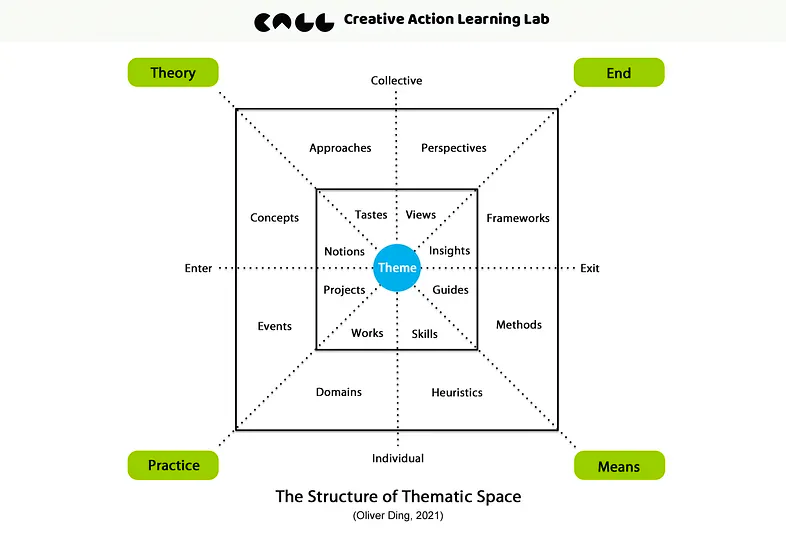
The Thematic Space Canvas was designed along four structural dimensions: Theory–Practice, End–Means, Enter–Exit, and Individual–Collective. Two nested squares divided the space into an inner region and an outer region, corresponding to Activity Theory's principle of internalization–externalization. The outer space held objective knowledge — approaches, concepts, frameworks, methods, domains, events. The inner space held subjective knowing — tastes, notions, insights, guides, skills, works, projects. Between the two, eight mapping dimensions traced the movement of knowledge from the external world into personal practice.
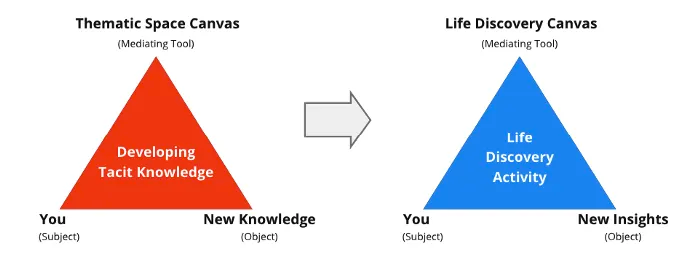
The activity this canvas was designed to serve was Developing Tacit Knowledge — understood not as passive absorption but as a genuine Activity in the Activity Theory sense: Subject (You) — Mediating Tool (Thematic Space Canvas) — Object (New Knowledge). The canvas was the mediating tool. The activity was concept-centered knowledge engagement.
To test the canvas, I used my own "Activity" Thematic Space as a case study — mapping my years of engagement with Activity Theory across all eight dimensions. What emerged was not a summary of what I had read, but a structured account of how theoretical concepts had become personal notions, how approaches had shaped my tastes, how frameworks had generated insights. The canvas made visible a process that had been happening implicitly for years. Naming it did not change the process. But it changed my relationship to it.
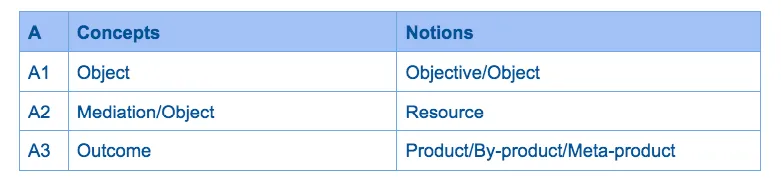
Something else became clear in this mapping exercise. Many of my own ideas — the ones that diverged from the official vocabulary of Activity Theory, the personal notions and coined concepts that did not fit neatly into the established framework — now had a proper place. The inner space held them without apology.
And the moment I could see them clearly distinguished from the outer space of official knowledge, I realized what the canvas had actually achieved: it was not merely a design convenience but a working embodiment of the internalization–externalization principle.
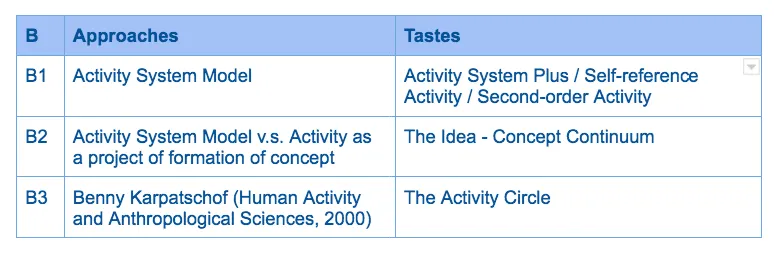
My own ideas, pointing outward, were precisely externalization — the movement from personal knowing back into the shared world. Knowledge engagement, the canvas made plain, is not a one-way absorption of other people's ideas. It is a two-directional process: taking in, and giving back in a form that is genuinely your own.
This was the canvas's first purpose: a tool for understanding how tacit knowledge develops through sustained engagement with a thematic space.
2
In February 2022, I faced a different problem. I was working on a Life Discovery project — not the study of how knowledge develops in general, but the more intimate question of how a person discovers direction in their own life. The activity was different. The object was different. But something felt structurally similar.
The insight arrived quickly: Life Discovery is a subcategory of Developing Tacit Knowledge. When the focus of knowing turns toward one's own life development — when the question is not "what do I understand about Activity Theory?" but "what do I understand about where my life is going?" — the underlying activity structure is the same. Subject — Mediating Tool — Object. The subject is still you. The object is now new insights about your own life. The mediating tool needs to be redesigned for this new object, but it does not need a new spatial structure.
So I did not redesign the canvas. I translated it. The spatial configuration of the Thematic Space Canvas — its four corners, its inner and outer regions, its Enter–Exit axis, its Individual–Collective axis — was carried over intact. What changed were the concepts occupying the positions. Theory became Think. Practice became Learn. End became Say. Means became Do. The inner space now held Supplies, Aspirations, Resources, Concepts, and Solutions. The outer space now holds Demands, Situations, Opportunities, Ideas, and Problems.
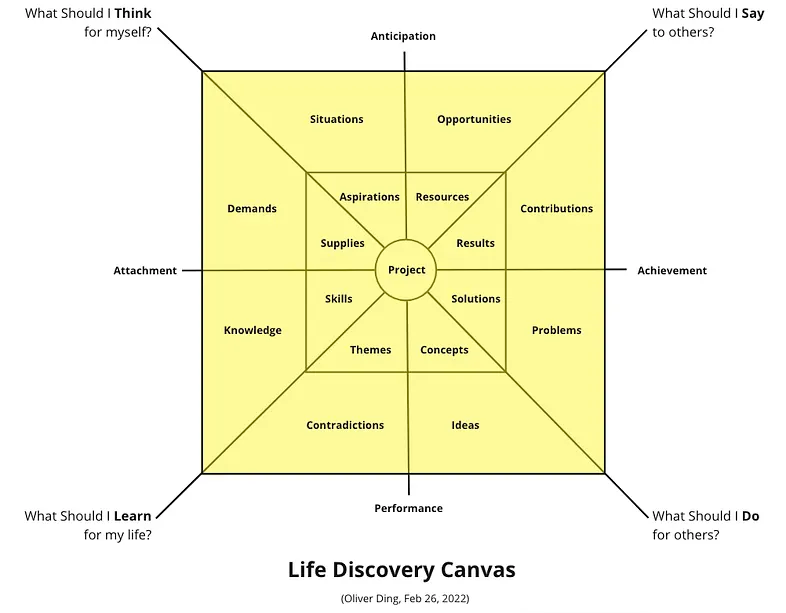
The Life Discovery Canvas was not a new tool. It was the same spatial argument, restated in a new vocabulary for a new type of activity.
Looking back, this moment of translation was more significant than it appeared at the time. It revealed that the canvas's spatial structure was not merely a design convenience — it was an ecological knowledge structure, in Harry Heft's sense: a built environment that embeds what is known about a type of activity, making that knowledge available to anyone who inhabits the space. The fact that the same structure could hold two different types of activity without modification was evidence that something invariant had been captured. The canvas was not just a tool. It was a theory of the space in which a certain family of activities takes place.
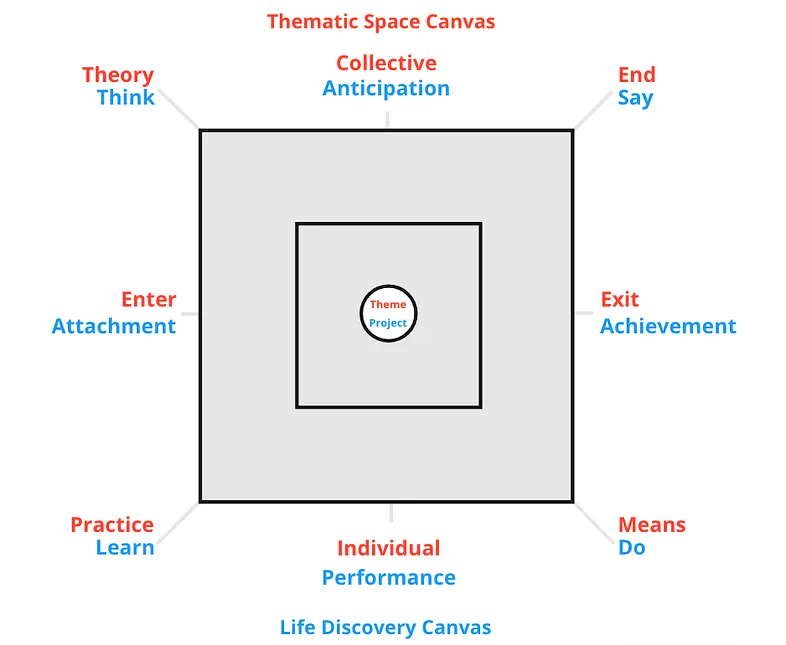
The implication arrived quickly, and I acted on it in naming. If the Thematic Space Canvas was not just one canvas but a spatial argument that could generate other canvases, then it deserved a different status. I designated it a meta-canvas — the structural source from which specific canvases are derived — and renamed the original instrument the Knowledge Discovery Canvas. The name change was not cosmetic. It clarified the relationship between the general and the particular: the meta-canvas holds the invariant spatial logic; the Knowledge Discovery Canvas is one instantiation of that logic, oriented toward a specific type of activity.
This naming also freed the concept of Thematic Space from its dependence on any particular canvas. I began to see that the canvas design was only one way of formalizing what a Thematic Space already is. Any knowledge model, considered carefully, is a configuration of concepts, and those concepts, along with the structural relationships among them, correspond to a set of Thematic Spaces. A person's engagement with a knowledge model is not the passive reception of information. It is the movement of a mind through those spaces: entering some, dwelling in others, passing through, returning. The canvas made this movement visible in one domain. But the movement itself was everywhere.
3
Once Thematic Space was freed from its dependence on any particular canvas, it began to move. From 2022 into 2023, the concept itself — not the tool, but the idea — migrated into new territory, driven not by design but by a theoretical observation that arrived unexpectedly.
Working on the Life-as-Project approach in mid-2022, I arrived at a formulation that changed how I understood Thematic Space: Life = Project = Thematic Space = Events = History. The claim was that a life, understood as a chain of projects, is simultaneously a journey of moving between thematic spaces. Each project is a thematic space. To live is to enter and exit thematic spaces — to attach to one region of inquiry, develop it, and then move on, carrying what you have learned into the next.
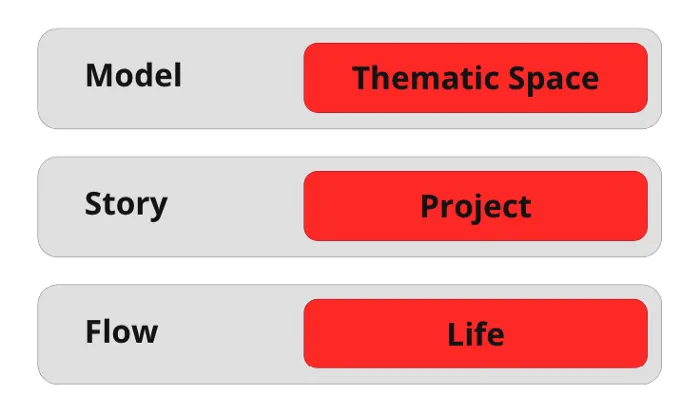
This shift was decisive. Thematic Space was no longer primarily a design concept for building canvases. It had become an ontological entity — a kind of social and cognitive container that exists in the world, that people inhabit and move through. The canvas was now one possible instrument for navigating these containers. But the containers themselves were something larger.
The Mental Moves project (2023) grew directly from this insight. Its organizing question was: how do mental elements — concepts, notions, frameworks, insights — move between thematic spaces as a person moves through their intellectual life? To answer this, The concept of Attachance — coined from attach and chance, and first introduced in a 2020 book draft as an ecological counterpart to Gibson's affordance — was brought into the Mental Moves project. Where affordance describes the action opportunities that an environment offers, Attachance describes the potential action opportunities behind acts of attaching and detaching.
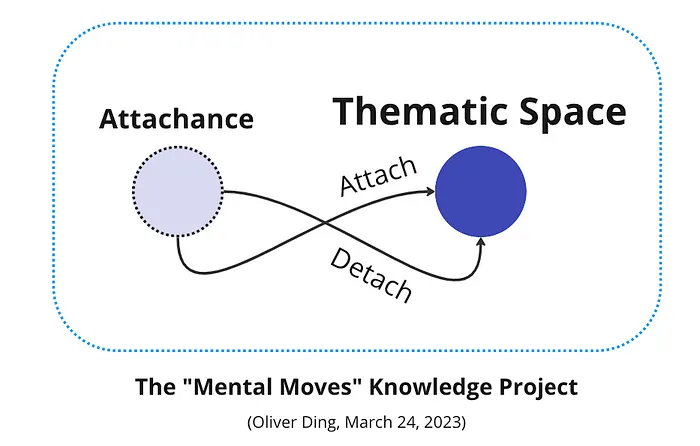
Applied to knowledge engagement, it focused attention on what is at stake when a person moves between cognitive containers: the attachances of moving between thematic spaces grounded in knowledge frameworks. The basic model was simple: Container [Configuration (Mental Elements)]. Each project corresponds to a thematic space. Each thematic space is supported by a platform. A mental element can move between thematic spaces, carrying its attachances with it.
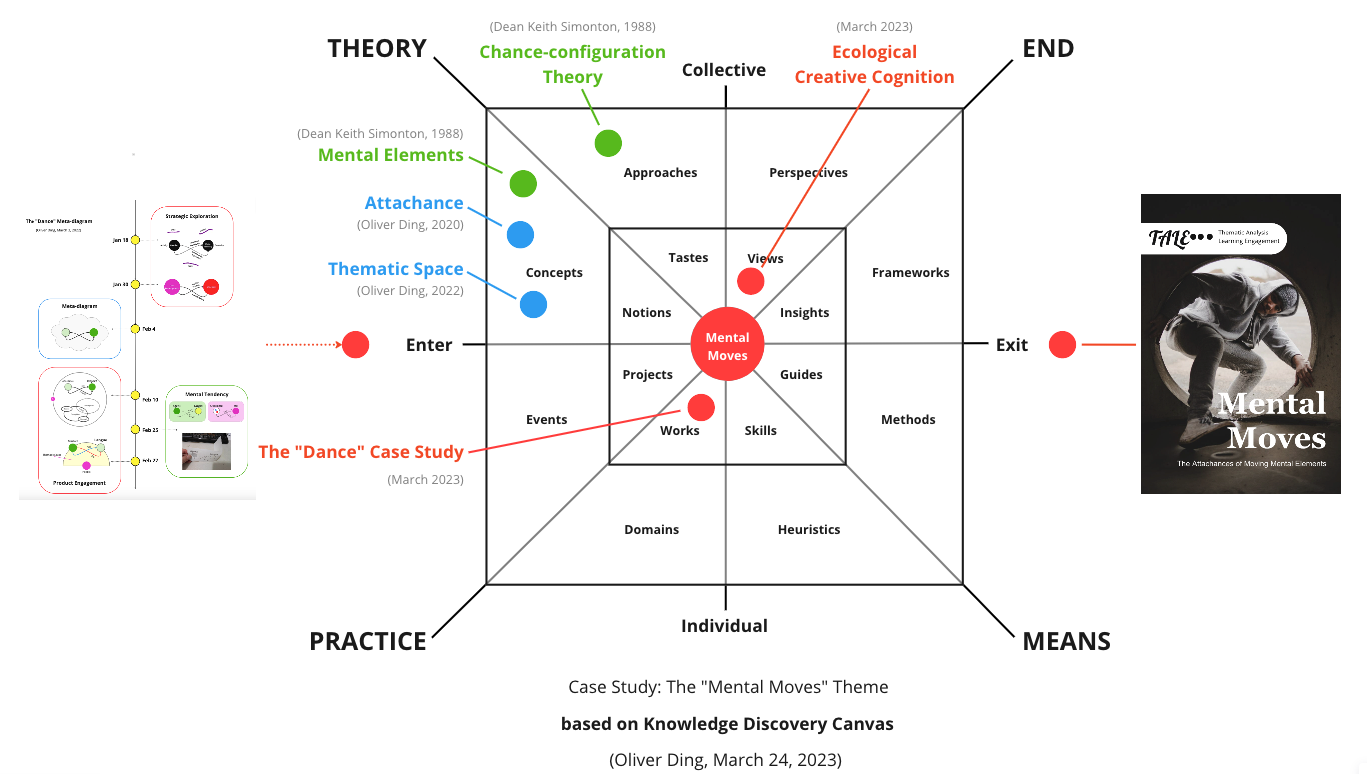
The Social Moves project followed in August 2023, extending the same logic into the social dimension. Where Mental Moves tracked the cognitive geography of moving between thematic spaces, Social Moves tracked the social geography — the territories, platforms, and communities within which those moves occur. The concept of Social Territory, drawn from Ping-keung Lui's theoretical sociology, gave this social geography its basic unit. Thematic Spaces were understood as psychological projections of Social Territory: the inner cognitive map of an outer social terrain.
Together, Mental Moves and Social Moves produced a new unit of analysis for social cognition: Social Cognition = Social Moves (Mental Moves). The activity being studied had expanded far beyond Developing Tacit Knowledge or Life Discovery. It was now the coordinated movement of minds and communities through shared knowledge spaces — creative cognition and social cognition understood as a single process.
And here something structurally significant happened. In 2024, while developing Project Engagement (v3.1) and helping a friend design a workshop, I drew on my accumulated experience with thematic space design to create a new canvas: The House of Project Engagement. It organized twelve thematic rooms to map how a person moves through twelve types of social terrain. The canvas generated a series of case studies and a diagrammatic analysis method, eventually collected in Strategic Moves: Mapping Knowledge Engagement and Structural Choice (book, v1, 2024).
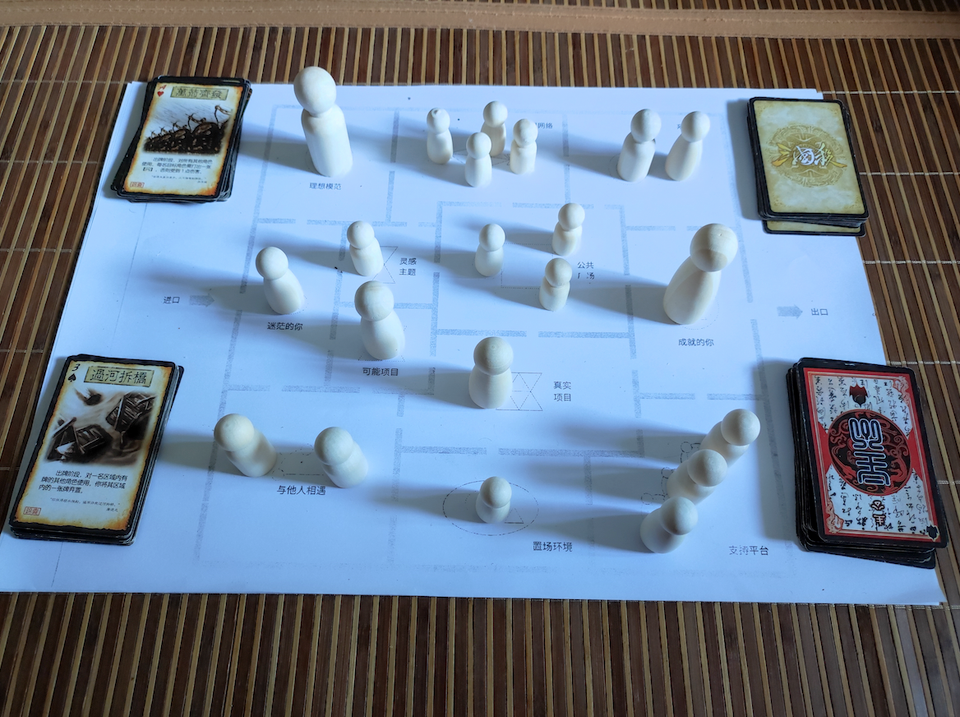
This was a means–end reversal. Activity Theory had originally been the means — the theoretical resource I drew upon to design the Thematic Space Canvas and develop the concept behind it. Now, Activity Theory had become the end: my Project Engagement approach, which is itself a deep appropriation of Activity Theory, was being developed further through the design thinking of thematic spaces. The tool that Activity Theory had helped create was now returning the favor — giving the Activity Theory project a richer vocabulary, a more articulated spatial structure, and new empirical ground.
4
From 2022 to 2025, I developed a series of diagrams around the Knowledge Discovery Canvas. In February 2025, I brought them together into a single multi-layered knowledge map about knowledge engagement, composed of four layers:
- Layer 1: The Knowledge Discovery Canvas (2022)
- Layer 2: The Grasping the Concept Model (2023)
- Layer 3: The Kinds of Concept-related Knowledge Engagement Model (2024)
- Layer 4: A curated set of related creative themes (2025)
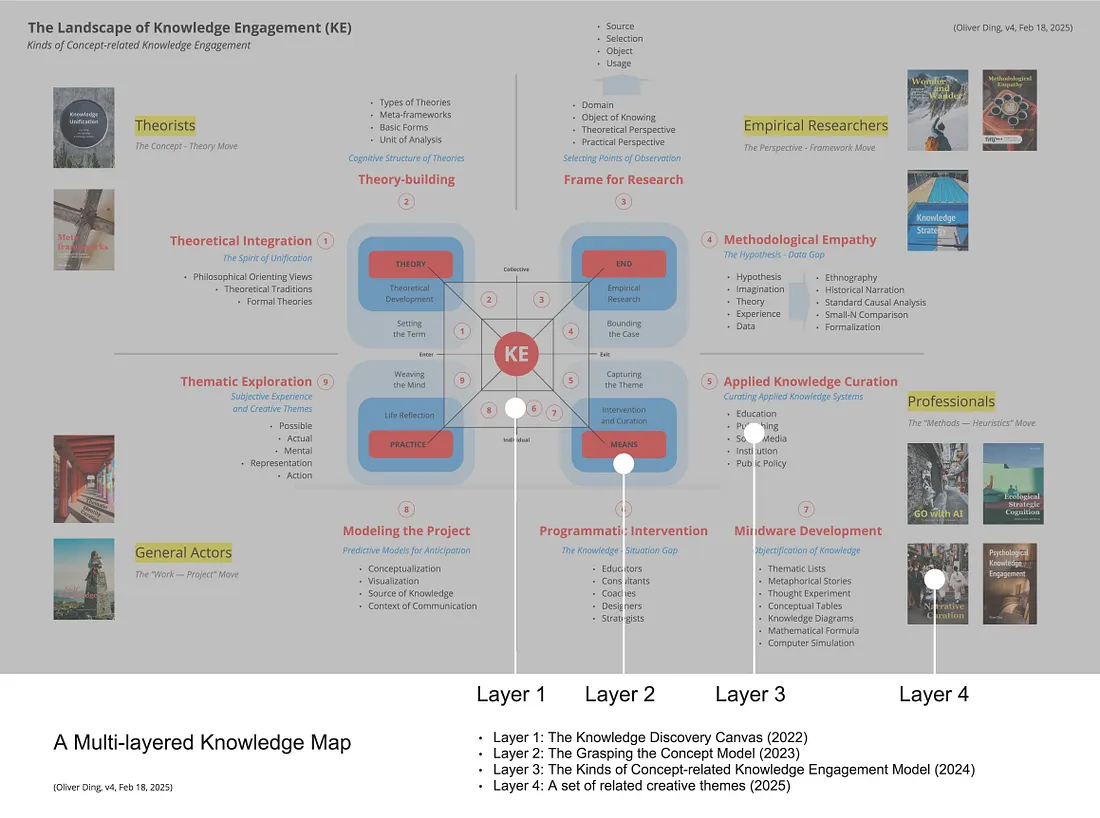
Layers 1 and 2 are closely tied to key models of Thematic Space Theory. The Knowledge Discovery Canvas is an application of the Thematic Space Canvas, while the Thematic Areas and Thematic Zones model is grounded in the Grasping the Concept Model. Reviewing the evolution of these four layers from 2022 to 2025, I captured a creative clue: I had made four distinct paths based on one map — the Knowledge Discovery Canvas.
Instead of a singular, fixed structure, a thematic map enables multiple Paths, each representing a different mode of engagement with the knowledge ecology it maps. the canvas is not just a tool for one type of actor. It is a map of the entire social ecology of knowledge engagement. The four areas — Theory, End, Means, Practice — are not four stages in a sequence. They are four positions in a field, each occupied by actors with different identities, different questions, and different criteria of success. Movement between them is not progress. It is social navigation — the strategic moves of a knowledge creator who must inhabit multiple positions to develop a genuine contribution.
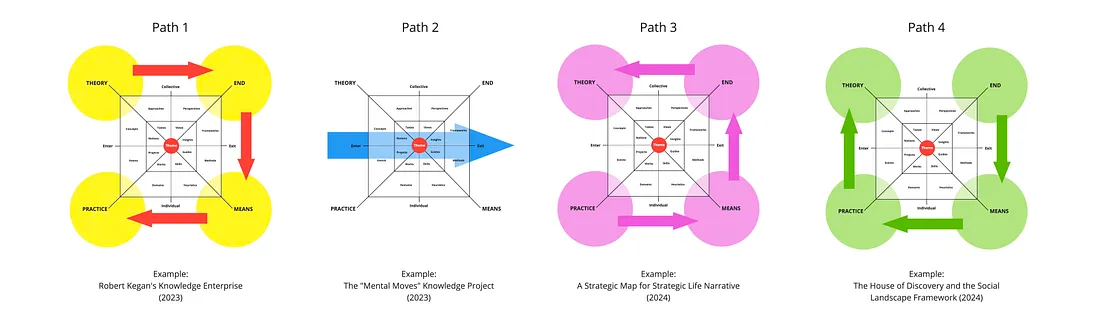
From this observation, four distinct Paths through the canvas emerged. Path 1 is top-down: beginning in Theory, moving toward Practice. Path 2 is predictive: using the canvas as a model for planning a knowledge project before it begins. Path 3 is bottom-up: beginning in Practice, moving toward Theory through the Theme–Concept–Framework transformation. Path 4 is adaptive: an iterative movement between areas that follows the logic of the work rather than a predetermined sequence.
These four Paths, together with 12 strategic themes of knowledge engagement across the four thematic areas, produced the conceptual architecture for a book draft completed in 2025: Castle and Forest: The Landscape of Concept-related Knowledge Engagement. In that book, the canvas is no longer a mediating tool for a single activity. It is the central navigational instrument for understanding an entire knowledge ecology — the complex landscape in which concepts develop, move, and find their place in collective intellectual life.
5
In November 2025, I introduced the Weave-the-Theory model. But the concept that gave it its deepest purpose — Theoretical Activity — had crystallized almost a year earlier, on the evening of December 7, 2024, after a day spent reading in the library.
The insight was this: the historical development of Activity Theory was not best described as a Research Programme in Lakatos's sense, nor as a sequence of theoretical versions. It was better understood as a series of Theoretical Projects and Theoretical Events — each theorist contributing a project to a collaborative journey, each generation expanding the conceptual landscape without displacing what came before. And if that was true, then theory-building is itself a form of activity, subject to the same analytical tools that Activity Theory applies to other domains of practice. Theoretical Activity is a specific type of Second-order Activity — one whose object is a theoretical enterprise itself.
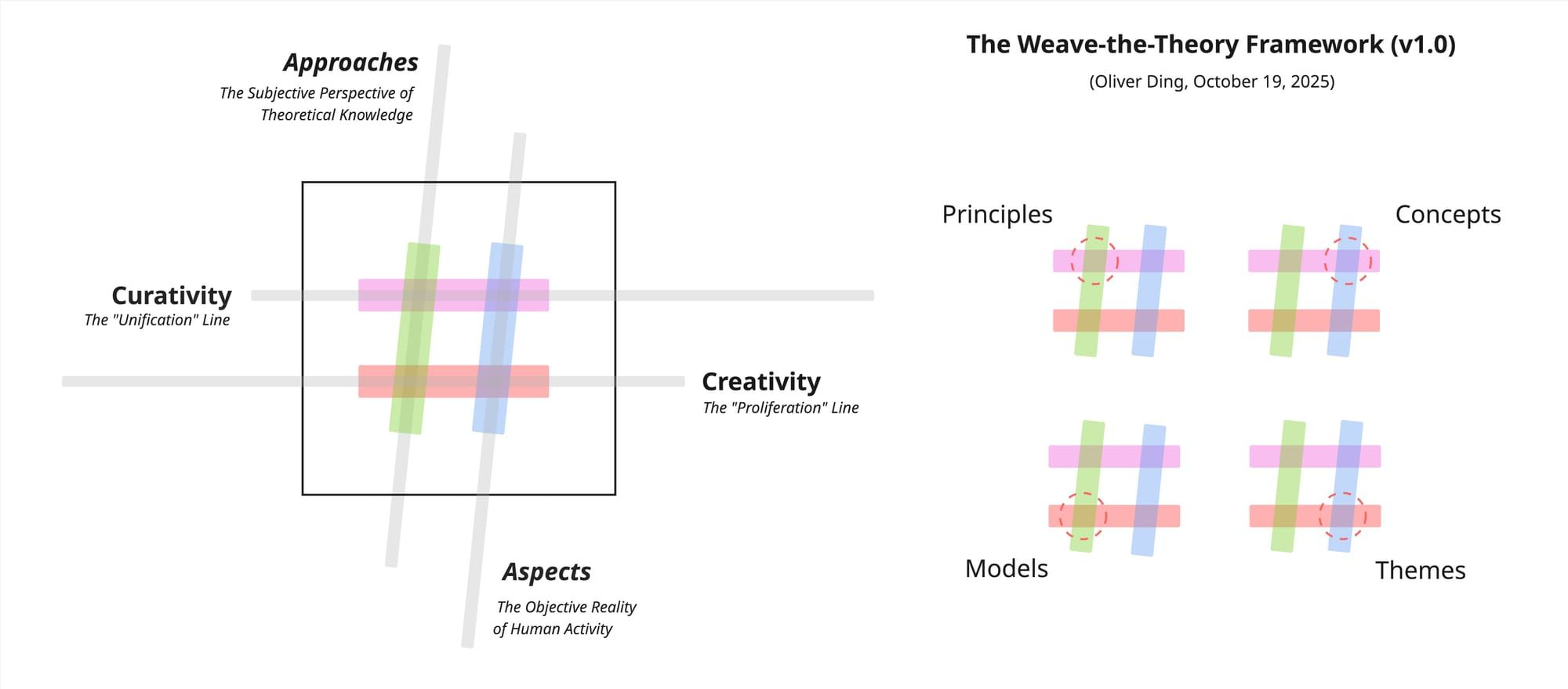
In April 2026, working on the Weave 42 project, I conducted a series of case studies using the Weave-the-Theory model and assembled a set of companion tools to work alongside it. In the AAS case study, the Knowledge Discovery Canvas was selected as a partner model — mapping the social ecology of the AAS knowledge enterprise across the four thematic areas, while Weave-the-Theory tracked its cognitive structure across the four weave-points.
The tool that had been designed to help one person develop tacit knowledge about Activity Theory was now being used to understand the ecology of a sustained theoretical enterprise. The canvas had not changed. The activity it was serving had become, in the fullest sense, Theoretical Activity.
6
The Life-as-Activity Approach is the name I give to the cumulative body of activity-centered work developed over these years — the frameworks, canvases, concepts, and theoretical contributions that together form an integrated approach to understanding creative life through the lens of activity. It is the project within which Activity Theory, Knowledge Discovery, Thematic Space Theory, AAS, and Weave-the-Theory all find their common ground. And it is within this project that the loop finally closes.
In October 2025, I introduced the Weave Basic Form as a metaframework — a 2×2 structure combining two diachronic dimensions and two synchronic dimensions. In April 2026, while working on the Weave 42 project, I developed a new version of the Weave Basic Form, a 4×4 edition that I call the Weave 16 diagram.
Based on the new diagram, I created the Weave-the-Life framework (v3.0) and used it to curate 16 key concepts of the Life-as-Activity Approach into a single spatial argument. Each cell in the matrix is simultaneously a Weave-Point (a structural intersection), a Coordinate (a positional address), and a Thematic Space (a living cognitive container). The three terms name three aspects of the same entity seen from three theoretical angles.
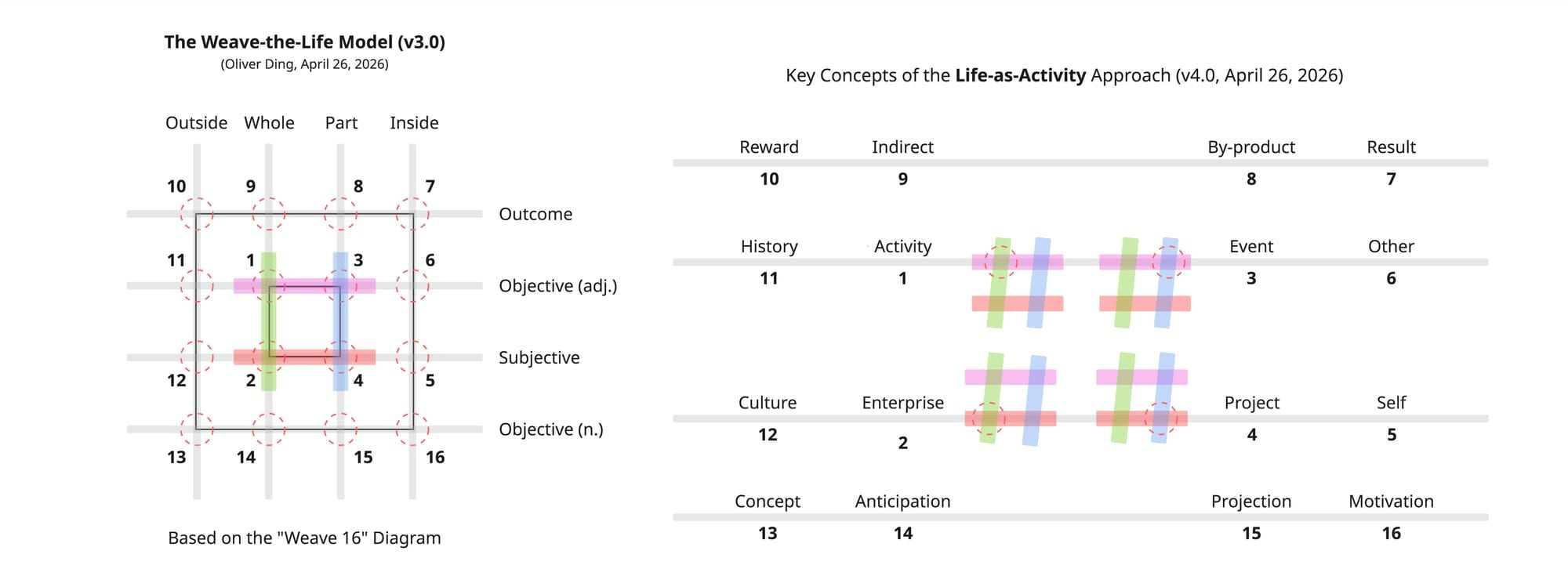
What the Weave-the-Life Framework (v3.0) accomplished was not simply to add more cells to a matrix. It introduced a nesting capacity that the earlier canvas could not provide: each Weave-Point opens onto an entire sub-system of knowledge — frameworks, diagrams, case studies, tools. A single coordinate can hold a book draft. The 4×4 diagram does not display the Life-as-Activity Approach. It organizes it — giving each framework its proper coordinate, linking each to its thematic space, and revealing the structural relationships among them through the logic of the matrix itself.
The years spent designing canvases were not merely practical work. They were, in retrospect, a long preparation. Each canvas had been an exercise in spatial argument — in finding the right configuration of dimensions, regions, and positions to make a type of activity visible and navigable. The Thematic Space concept, developed through this practice, carried a design logic that proved transferable far beyond any single canvas.
That transferability became decisive in the development of the Weave-the-Life Framework (v3.0). Previously, the full landscape of the Life-as-Activity Approach had been presented through a knowledge map — a curated display that gathered key framework diagrams, book draft covers, and tools. The map showed the territory. But it lacked a coordinating mechanism. The frameworks sat side by side, their relationships implied but not structurally articulated.
The Weave-the-Life Framework (v3.0) addressed this limitation through a formal innovation that drew directly on the logic of Thematic Space. Each cell in the 4×4 Weave diagram is simultaneously a Weave-point, a Coordinate, and a Thematic Space — a structural intersection, a positional address, and a living cognitive container. This nesting capacity meant that knowledge frameworks previously distributed across separate diagrams could now be organized within a single spatial argument.
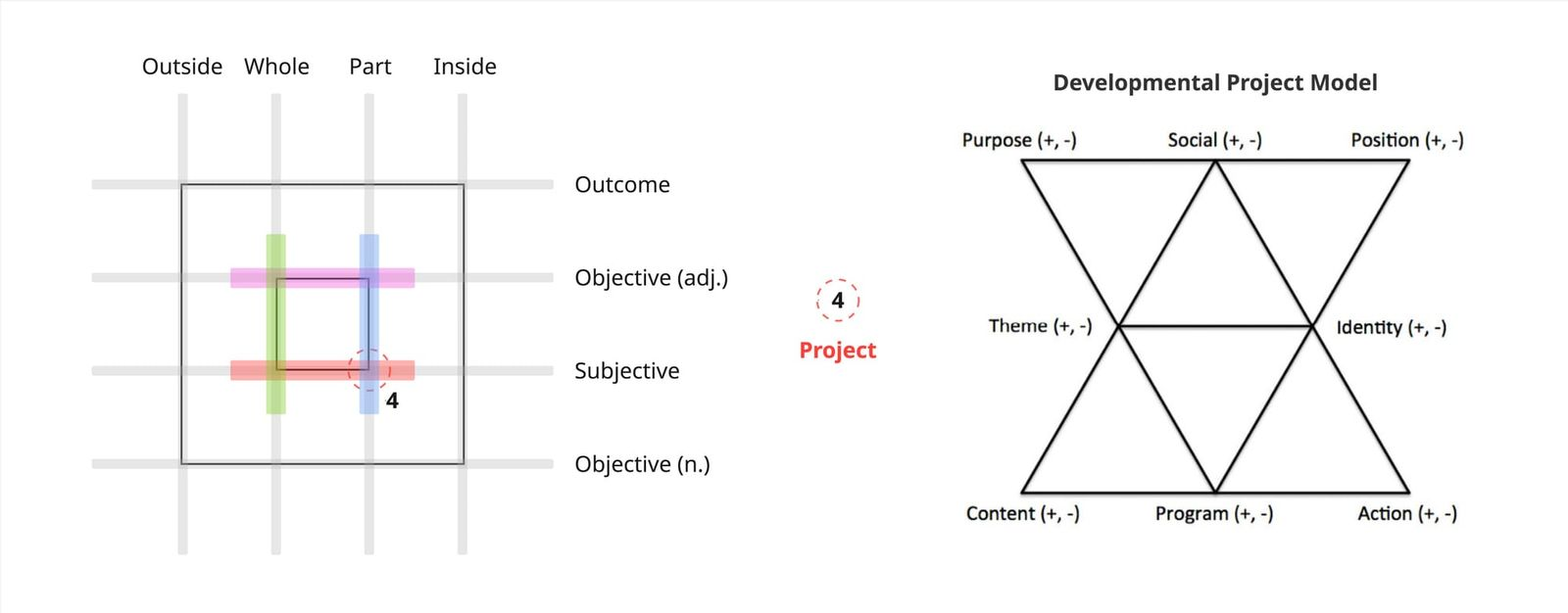
The matrix does not merely display them. It integrates them — placing each framework at its proper coordinate, linking each to its thematic space, and revealing the structural relationships among them through the logic of rows, columns, and pairs. What canvas design had been practiced at the level of a single tool, Weave accomplished as an innovative formal symbolic system capable of carrying complex, large-scale knowledge systems within its structure.
This is what it means for the loop to close. The tool that was built to help investigate a type of activity became, through its own development, part of the theoretical account of activity itself. Activity Theory gave rise to a mediating tool. The mediating tool, put to work in successive activities, generated a theoretical framework. The theoretical framework returned to enrich the account of activity from which the tool first emerged.
The tool kept changing its purpose. But it never stopped being a mediating tool. That, perhaps, is what Activity Theory would have predicted all along.
v1.0 - April 29, 2026 - 3,466 words