
Weave the Theory: A Case Study of the AAS Framework Development

This article is part of the Weave-the-Theory series
by Oliver Ding
April 24, 2026
The Anticipatory Activity System (AAS) is a theoretical framework for understanding a structure that shows up everywhere in human life but is rarely named directly: the simultaneous presence of Self and Other, Present and Future, in any meaningful activity.
This article examines that development through the lens of the Weave-the-Theory model — one of the analytical frameworks within the Weave knowledge system. Weave-the-Theory provides a structural map for understanding how theoretical knowledge grows: not as a linear progression from observation to conclusion, but as a weaving process in which lived themes, analytical models, theoretical concepts, and governing principles develop in relation to one another.
Contents
Introduction
Part 1. From Nine Moves to Weave-the-Theory
1.1 The 2022 Retrospective and the Theme U Map
1.2 A Different Set of Questions
1.3 Two Complementary Tools
Part 2. The Weave-the-Theory Framework
2.1 Two Pairs of Lines
2.2 Four Weave-Points
2.3 The Freedom of Entry
Part 3. The Originating Leap: From Aspects to Approaches
3.1 An Adult Developmental Program and a Discovery
3.2 Crossing to Approaches: Three Theoretical Traditions
3.3 What This Crossing Means Methodologically
Part 4. The Return: Approaches Meeting New Aspects
4.1 The First Empirical Test
4.2 From Observation to Operational Model
4.3 Extending to New Domains
4.4 Fifteen Moves
4.5 The Historical-Cognitive Research Method
Part 5. The Knowledge Ecology in Four Areas: An Overview
5.1 The Knowledge Discovery Canvas
5.2 Four Creative Identities
5.3 KDC and Weave-the-Theory as Complementary Tools
Part 6. The THEORY Area: A Principle That Governs from the Start
6.1 A Principle Present from the Beginning
6.2 Knowledge Frameworks, Mental Models, Predictive Models
6.3 The Micro AAS: Rosen at the Level of Action
6.4 From Life(Self) to the HLS Framework
6.5 Micro AAS and Mega AAS: The Social World as a Nested System
Part 7. The END Area: A Concept and Its Expanding Empirical Domains
7.1 The First Domain: Life Discovery
7.2 The Second Domain: Knowledge Discovery
7.3 The Third Domain: Meaning Discovery
7.4 What the Trilogy Earned
Part 8. The MEANS Area: Tools, Programs, and Indirect Effects
8.1 The AAS4LT Coaching Program
8.2 Life Strategy: From Strategy to Life
8.3 The Power of Indirect Activity
Part 9. The PRACTICE Area: When the Framework Becomes the Map
9.1 The Background: From First-order to Second-order
9.2 Launching TALE: A Strategic Second-order Activity Decision
9.3 The Strategic Thematic Exploration Framework
9.4 The Decision: Focusing on Early Discovery
9.5 Four Projects, One Foundation
Postscript: What This Case Adds to the Weave Toolkit
1. Comparison with Previous Cases
2. The Aspects-to-Approaches Crossing
3. Two New Tools for the Weave Toolkit
4. Meta-diagrams as Instruments of Ecological Perception
5. Theory as Map for the Creator's Own Life
Appendix: Source Articles
Introduction
The Anticipatory Activity System (AAS) is a theoretical framework for understanding a structure that shows up everywhere in human life but is rarely named directly: the simultaneous presence of Self and Other, Present and Future, in any meaningful activity. When a person makes a career decision, develops a creative project, or navigates a relationship, they are not simply responding to what is immediately in front of them. They are operating within a system shaped by anticipation — by what they expect from themselves, from others, and from the future they are moving toward. The AAS framework makes this structure visible and workable.
At the heart of AAS is a distinction between two types of activity. First-order Activity is goal-directed: you know what you are trying to achieve, and you act toward it. Second-order Activity is something different — it is the activity of discovering what your goal should be in the first place. Before you can pursue a direction, you need to find it. Before you can commit to a project, you need to understand what kind of project is worth committing to. This prior activity — exploratory, anticipatory, oriented toward a future that has not yet taken shape — is what AAS was built to describe and support.
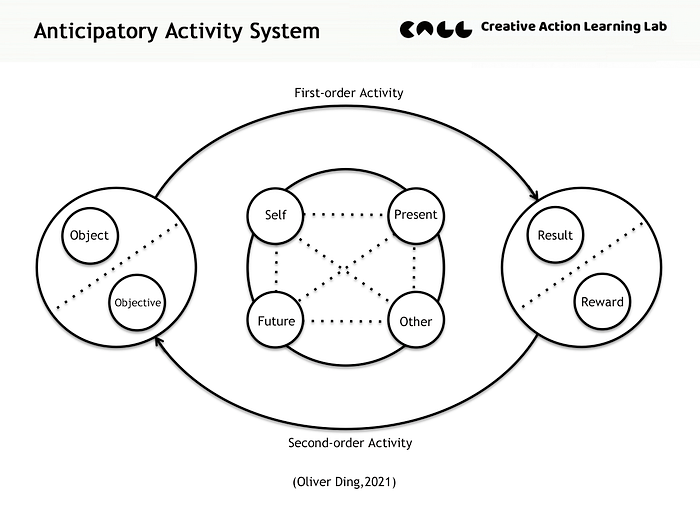
The tension between these two modes of activity is not a new concern. James March's influential distinction between exploration and exploitation captures something similar: the pull between searching for new possibilities and deepening existing ones. Organizational theorists, cognitive scientists, and philosophers of action have each approached this territory from their own angles. What distinguishes AAS from these traditions is not the recognition of the tension, but the refusal to treat it as a tension at all. Rather than positioning First-order and Second-order Activity as competing orientations — a binary that must be balanced or traded off — AAS understands them as forming a self-referential loop. The outcome of Second-order Activity produces the Significant Insights that give direction to First-order Activity. The outcome of First-order Activity generates the results and rewards that feed back into Second-order Activity. They are not rivals. They are the two halves of a single system that refers back to itself.
The framework grew from a specific observation made in August 2021, during an advisory conversation with a friend navigating a significant life transition. Existing tools could not capture what was actually happening in that conversation — the simultaneous pull of self and other, present and future, that shaped every decision. That gap produced the first diagram. Over the following months, the diagram became a framework. Over the following years, the framework became a knowledge enterprise spanning life strategy, creative practice, and ultimately the structure of the social world itself.
This article examines that development through the lens of the Weave-the-Theory model — one of the analytical frameworks within the Weave knowledge system. Weave-the-Theory provides a structural map for understanding how theoretical knowledge grows: not as a linear progression from observation to conclusion, but as a weaving process in which lived themes, analytical models, theoretical concepts, and governing principles develop in relation to one another. Applied to the AAS case, this lens reveals dimensions of the development that the original retrospective accounts did not foreground. It also opens a question that runs beneath the entire case: what kind of knowledge ecology does a sustained theoretical enterprise actually build, and how can that ecology be made visible?
Part 1. From Nine Moves to Weave-the-Theory
1.1 The 2022 Retrospective and the Theme U Map
On August 28, 2022, one year after the first AAS diagram was sketched, I sat down to write a long retrospective account of what had happened. The result was an article titled Slow Cognition: The Development of AAS (August 21, 2021 – August 26, 2022). To organize the account, I used the Theme U diagram — a framework built on the HERO U model that maps knowledge development across six levels of cognitive objects: Meta-theory (mTheory) and Specific Theory (sTheory) on the left, Abstract Model (aModel) and Concrete Model (cModel) in the middle, Domain Practice (dPractice) and General Practice (gPractice) on the right.
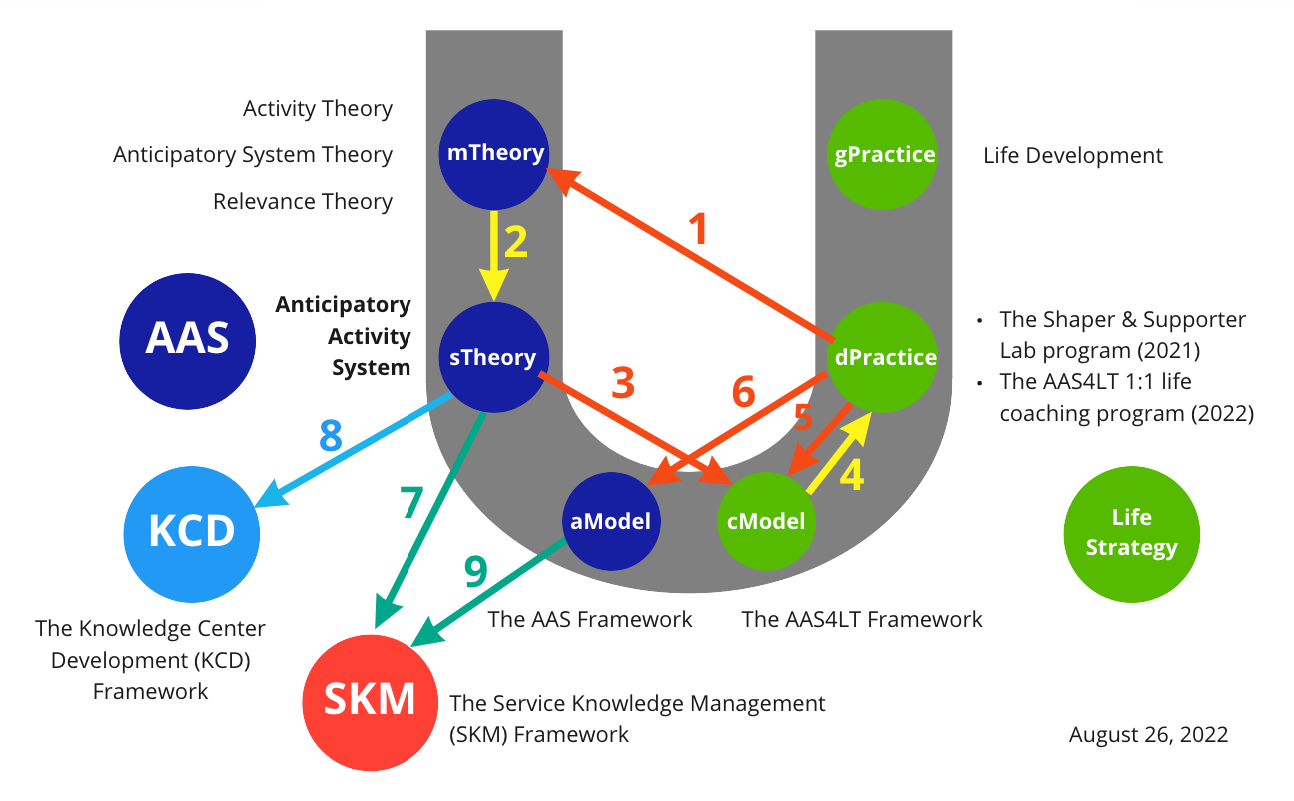
The Theme U diagram gave the year's work a shape it had not previously had. Nine distinct moves became visible — not as a timeline of events, but as a map of trajectories across cognitive levels.
Move #1 began from Domain Practice (my friend's adult development program, which I joined as an advisor) and reached toward Meta-theory: I adopted Anticipatory System Theory as the primary theoretical resource and used it to develop the early iART framework.
Move #2 descended from Meta-theory to Specific Theory: working on a separate project on Sustainable Business Development, I developed the concept of Second-order Activity from Activity Theory, then realized this new concept could be synthesized with the iART diagram — Transactional Anticipatory System + Second-order Activity = Anticipatory Activity System. On September 15, 2021, the framework was renamed AAS.
Move #3 moved from Specific Theory to Concrete Model, producing the AAS4LT coaching framework. The map was honest about the journey's shape: it was not a march from abstract to concrete, or from theory to application. It was a series of crossings between levels, each one driven by the encounter with a new problem or a new opportunity.
What made these moves possible was not logical derivation from first principles but over a year of sustained empirical engagement — observing, testing, and refining in continuous contact with real cases and real practice.
The Theme U framework did its job well. It reduced the complexity of the year's cognitive operations into a navigable structure. It also revealed something that a purely chronological account would have obscured: the development of AAS was not linear, but it was not random either. It had a shape — a characteristic pattern of moves between cognitive levels that could be named, analyzed, and, in principle, understood by others.
1.2 A Different Set of Questions
Now, revisiting the same development through the Weave-the-Theory framework, a different set of questions comes into focus. The Weave-the-Theory model does not ask only about cognitive levels. It asks about the two fundamental directions of theoretical work — the Creativity Line, which generates new ideas outward through lived themes and structural models, and the Curativity Line, which integrates ideas upward through theoretical concepts and governing principles. It also asks about the two synchronic dimensions that hold the framework in the present — Aspects, which refers to the objective reality of human activity that theory seeks to explain, and Approaches, which refers to the subjective perspective of theoretical knowledge through which that reality is interpreted.
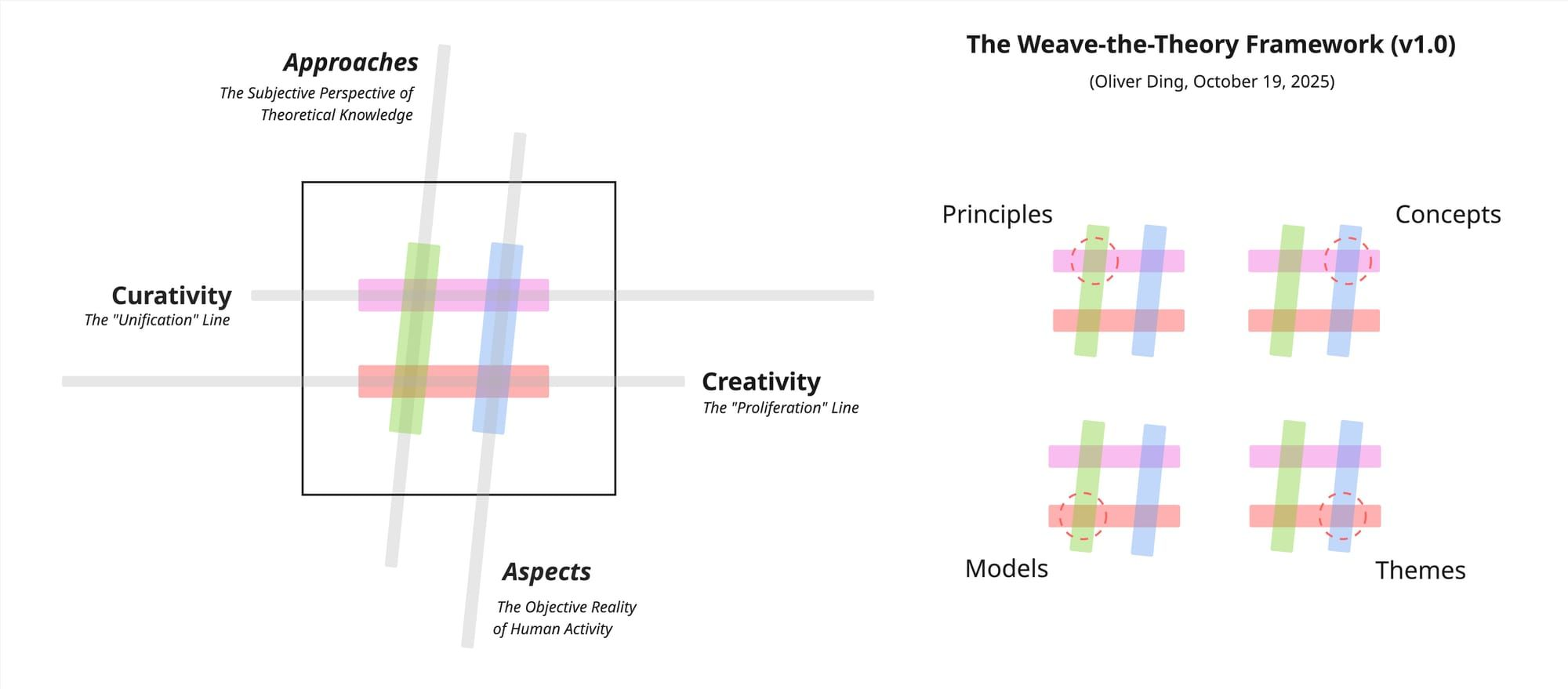
These two pairs of lines generate four weave-points: Theme, Model, Concept, and Principle. But in the AAS case, the weave-points are not the most revealing thing to look at. What is more instructive is the movement between the two synchronic lines — the crossing from Aspects to Approaches that launched the entire development, and the repeated returns to new Aspects that sustained it over the following years. That crossing, and what it means for how theoretical work can legitimately begin, is the central story this article tells.
1.3 Two Complementary Tools
The Theme U framework is not replaced by Weave-the-Theory. It is complemented by it. Theme U maps the vertical dimension of theoretical development — movement across cognitive levels, what we might call the mental moves of the knowledge enterprise. Weave-the-Theory maps the other dimensions — the synchronic crossing between Aspects and Approaches, and the diachronic interplay between Creativity and Curativity over time. Both tools belong in the knowledge analyst's toolkit, and how they fit together is part of what this case study demonstrates.
Part 2. The Weave-the-Theory Framework
2.1 Two Pairs of Lines
The Weave-the-Theory framework provides a structural description of how theoretical knowledge is built — not as a normative prescription for how it should be built, but as an analytical lens for understanding how it actually develops in practice.
The framework is organized around two pairs of lines. The first pair is diachronic: the Creativity Line (Proliferation) and the Curativity Line (Unification). The Creativity Line moves outward — generating new themes, testing them against lived experience and observed reality, and developing the structural models that give them form. The Curativity Line moves upward — integrating accumulated insights into precisely defined concepts, and synthesizing those concepts into governing principles that unify the whole. The two lines do not converge toward a single point. Their ongoing intersection produces weave-points — nodes of generative synthesis that are possible only because both lines remain active simultaneously.
The second pair is synchronic: Aspects and Approaches. Aspects refers to the objective reality of human activity that theory seeks to explain — the actual structure of the social world, the recurring patterns in human practice, the phenomena that make a theoretical account necessary in the first place. Approaches refers to the subjective perspective of theoretical knowledge through which that reality is interpreted — the conceptual vocabulary, the analytical frameworks, the intellectual traditions that give the theorist a language for what they have observed.
2.2 Four Weave-Points
The four weave-points emerge from the intersections of these four lines. Theme sits at the crossing of Creativity and Aspects: the lived, practiced inhabitation of a real pattern in human activity. Model sits at the crossing of Creativity and Approaches: the structural map built from the analytical vocabulary available to the theorist. Concept sits at the crossing of Curativity and Aspects: the precisely defined theoretical proposition that names what is really happening in the domain under study. Principle sits at the crossing of Curativity and Approaches: the governing insight that unifies the whole — the most abstract claim the development earns the right to make.
2.3 The Freedom of Entry
One structural feature of the Weave-the-Theory framework deserves particular emphasis here: the question of where theoretical work can begin. The framework does not prescribe a starting point. Entry can happen from any of the four lines or from any of the four weave-points. This freedom is not a minor methodological footnote.
It is what distinguishes Weave-the-Theory from approaches like grounded theory, which prescribes a single legitimate starting point — raw empirical data, uncontaminated by prior theoretical concepts — and treats prior theoretical knowledge as a potential source of bias to be bracketed. Weave-the-Theory holds a different epistemological position: the theorist never begins from a blank cognitive state, and the attempt to simulate such a state does not produce purer knowledge — it produces impoverished observation. The AAS case makes this visible in an unusually direct way.
Part 3. The Originating Leap: From Aspects to Approaches
3.1 An Adult Developmental Program and a Discovery
In August 2021, I joined an adult development program as an advisor. The program was initiated by a friend — a young woman who had designed it around three components: Life Purpose Awareness, Personal OKR Practice, and Peer Review and Feedback. Observing the program over three weeks of ongoing discussion, something started to become visible.
On August 17, 2021, I realized it was possible to develop a framework for reflecting on her project and our conversation. The recognition was not primarily about the limits of existing tools. It was about the direct perception of a structure — [Self — Other — Present — Future] — that seemed to organize everything happening in the program: the actor's relationship to her own present situation and imagined future, and her relationship to others who were part of the project. This was an Aspects moment in the precise sense of the Weave-the-Theory framework: the direct recognition of an objective structure in human activity, prior to any theoretical elaboration.
On August 18, I adopted a meta-diagram and designed the iART framework — the early version of what would become AAS. The name iART stood for i + Activity + Relationship + Themes. The framework offered an ecological perspective on personal adult development organized around three contexts: the Practice context (the "Know — Act" ecology), the Spatial context (the "Self — Other" ecology), and the Temporal context (the "Present — Future" ecology).
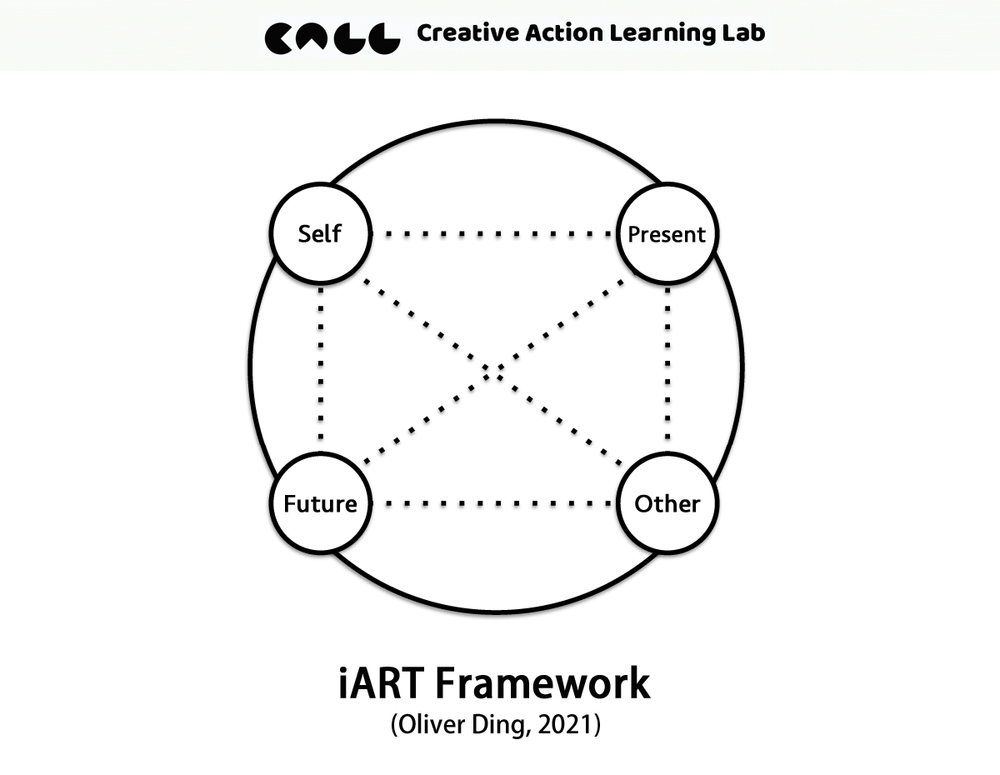
Both the adult development program and the conversation between myself and my friend shared the same underlying structure — and that shared structure was what the framework was designed to make visible. The Meta-diagram behind iART was developed in 2017. It was the outcome of my project "Activity as Container" which aims to discuss the Thing-People ecological structure.
3.2 Crossing to Approaches: Three Theoretical Traditions
The recognition of [Self — Other — Present — Future] as an objective structure in human activity immediately raised a question: what theoretical vocabulary is adequate to name and analyze it? This is the crossing from Aspects to Approaches. In fact, the crossing happened faster than "within weeks" might suggest — it happened in the same article that introduced the iART framework.
Working from Rosen's definition of an anticipatory system — a natural system that contains an internal predictive model of itself and its environment, allowing it to change state in accord with the model's predictions about a later instant — I distinguished three perspectives on the boundary of the anticipatory system: the intrapersonal perspective (a closed predictive model, ignoring feedback from others), the interpersonal perspective (an open model, incorporating others' feedback), and the transactional perspective (which treats Self and Other as a whole, producing a reciprocal model). This last perspective was the one the iART framework was built around.
From this theoretical engagement, a new concept emerged immediately: Feedforward Bias. Watching my friend's information-searching behavior about the theme of "Community," I noticed that her prior knowledge about the topic led her to ask questions that were shaped — and limited — by what she already knew, producing less effective actions than she anticipated. I named this phenomenon Feedforward Bias: the way an inadequate or poorly constructed predictive model generates systematic distortions in the direction of future action. The concept was not derived from the theoretical literature. It was recognized in observed behavior and then named through the theoretical vocabulary that Rosen's framework had just provided. This is the Aspects-to-Approaches crossing in its most compressed form: observation and theoretical interpretation happening not in sequence, but simultaneously.
In September 2021, working on a separate project about Sustainable Business Development, I encountered Activity Theory's concept of activity systems and began to see how it could illuminate the structure I had observed. But traditional Activity Theory had a gap: it focused on goal-directed activity and had relatively little to say about the activity of discovering a goal. I proposed the concept of Second-order Activity to name what Activity Theory had left unnamed — the activity whose object is the future objective of a First-order Activity system.
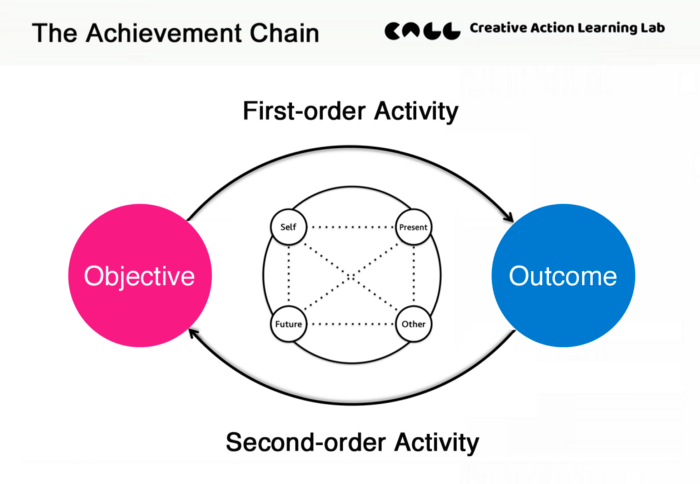
The combination came quickly. Anticipatory System Theory, developed by Robert Rosen, provided the temporal structure — the relationship between an anticipatory system's internal predictive model and the real-world system it models. Second-order Activity, drawn from Activity Theory, provided the operational structure — the distinction between discovering a goal and pursuing one. Relevance Theory, from Alfred Schutz's phenomenological sociology, provided the social structure — the differential relevance of situations to actors with different positions and interests. Together, these three theoretical traditions — all from the Approaches side of the Weave framework — became the conceptual apparatus for a new specific theory.
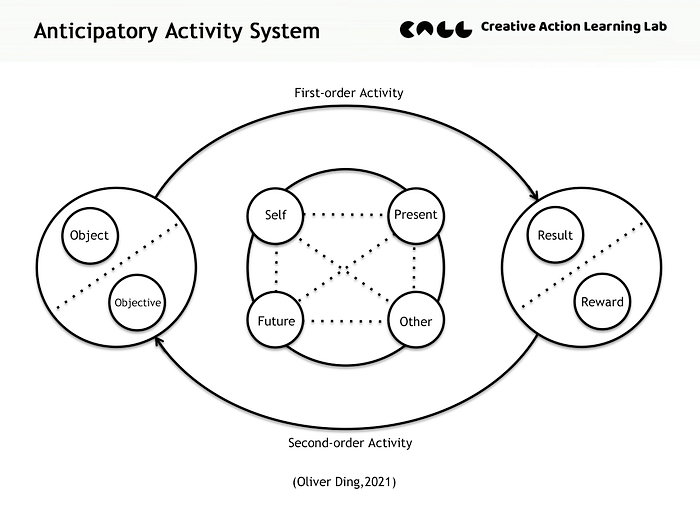
On September 15, 2021, I wrote the article that gave the framework its name: D as Diagramming: Strategy as Anticipatory Activity System. The AAS framework was born.
3.3 What This Crossing Means Methodologically
The speed of this development reflects the nature of the Aspects-to-Approaches crossing in this particular case. The originating move was not an inductive accumulation of data, nor a deductive application of existing theory to a new domain. It was something more direct: the immediate recognition of an ecological structure — [Self — Other — Present — Future] — in the observed reality of the program. This kind of direct perception requires a particular capacity in the researcher: the ability to see a structural pattern in a situation before having a name for it, and to hold that pattern clearly enough to then move simultaneously in two directions — toward theoretical interpretation on one side, and toward empirical deepening on the other. The 2017 meta-diagram was not incidental to this capacity. It was part of what made the recognition possible.
This is the distinctive character of this case within the Weave-the-Theory framework. Weave-the-Theory does not prescribe a single legitimate starting point — other cases begin from lived themes, from existing concepts, from governing principles. What this case demonstrates is one particular mode of entry: beginning from the direct recognition of an objective ecological structure in human activity, and from that recognition moving outward simultaneously into Approaches and into Aspects. It is a demanding mode, because it requires the researcher to trust a perception before it has been theoretically validated. But it is also a generative one, because the perception carries more information than any single theoretical tradition could have supplied on its own.
Part 4. The Return: Approaches Meeting New Aspects
4.1 The First Empirical Test
Having established the AAS framework — a specific theory grounded in three theoretical traditions — the next question was empirical. The framework made a claim about the structure of human activity. Did that claim hold up when tested against actual cases?
The first test was close at hand. The friend whose program had sparked the original observation was twelve months into her project. In March 2022, we sat down for a ninety-minute video conversation to reflect on her year. What I saw in that reflection was the AAS framework made visible in a real life: she had spent the early months on Second-order Activity — Life Discovery, figuring out what she was building and why. Then, once that direction was clear, she had shifted into First-order Activity — the actual development of her program. The two phases were sequential parts of the same system. The observation confirmed the framework's claim and simultaneously demanded a more precise account of how the two phases were connected in practice.
4.2 From Observation to Operational Model
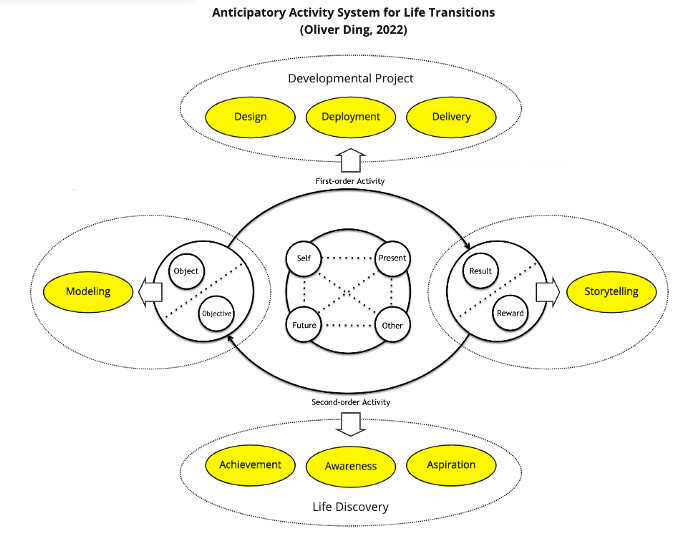
The AAS4LT framework emerged from the empirical observation of her program. The existing AAS model was highly abstract — precise as a theoretical structure, but unable to accommodate the richness of what observation was revealing about how Life Discovery actually unfolds in practice. On March 22, 2022, I developed the AAS4LT framework as a Concrete Model that could hold those insights: an 8-step coaching program designed for people undergoing life transitions.
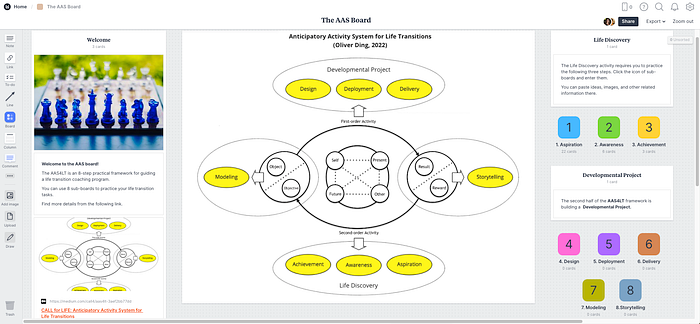
With the AAS4LT framework in hand, I decided to run my own coaching program — creating a deliberate contrast with my friend's program. Her program had used existing tools: OKRs, peer review conducted through Excel, where she and her members would discuss and align cell by cell, and other established approaches. My program would use the 8-step method directly, with Milanote as the primary tool — deliberately chosen for its capacity to support sense-making rather than task tracking. On March 26, 2022, the first AAS Board appeared on Milanote — a digital coaching room where coach and client could work through each step together. The two programs, running in parallel, formed a natural comparative study: different tools, same underlying territory of Life Discovery as Second-order Activity.
But the descent from abstract theory to operational practice was not one-directional. In May 2022, working with the Concrete Model in the coaching program, I made a small but significant revision to the framework's vocabulary. I had been using the word "Decision" to name one of the key movements in the AAS system — the moment when an actor commits to a direction. I replaced it with "Unfolding." The change was not cosmetic. "Decision" had suggested a cognitive operation: a mental event in which options are weighed, and a choice is made. "Unfolding" suggested something different — a change of context, a process in which the situation develops in a way that makes a new direction visible.
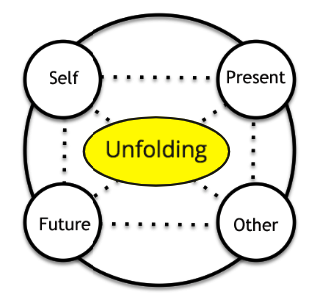
The revision reflected something learned from working with the framework in practice: the moment of commitment in Second-order Activity is rarely a deliberate choice among clearly specified alternatives. It is more often a gradual emergence, a becoming-clear of what was previously obscure. This kind of feedback from Domain Practice to Abstract Model — from operational work back to theoretical revision — is characteristic of the Weave-the-Theory process. The Creativity Line moves not only outward toward application but also backward: applications reveal limitations in the models, and those limitations generate revisions that feed back into the theoretical structure.
4.3 Extending to New Domains
In parallel, the framework was extended into new domains. In July 2022, I developed a Knowledge Engagement Program for a client whose core activity was Service Knowledge Management. Applying AAS to that context, I identified the organization's Second-order Activity — managing knowledge about its services — as oriented toward supporting a First-order Activity — Software Product Development. The framework translated cleanly. A new domain had been reached from the same theoretical base.
4.4 Fifteen Moves
By August 2022, the nine-move map was complete. The framework had crossed between cognitive levels nine times, producing a specific theory, multiple models at different levels of abstraction, and two distinct application domains. But the development did not stop there. In November 2023, reviewing the period from August 2022 onward, I identified six additional moves — #10 through #15 — spanning from December 2022 to January 2024. I also added a retrospective Move #0 — Idea Development as Meta-activity (January 2021) — tracing the development back to an earlier origin point before the program observation in August.
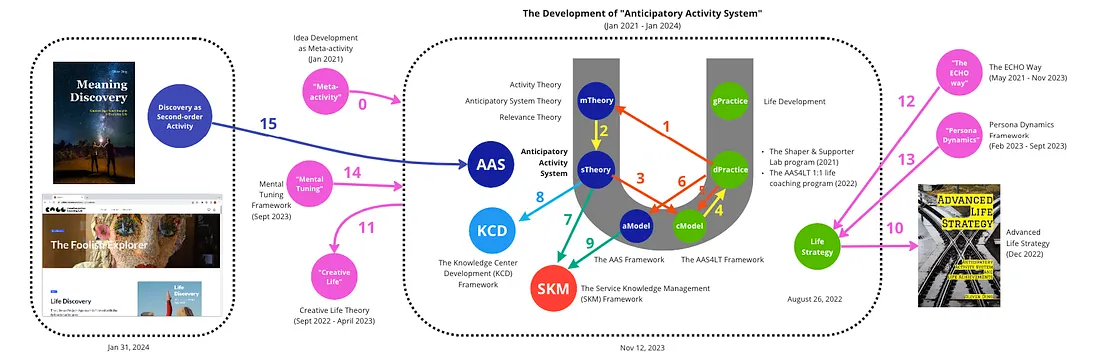
The pattern across the full fifteen moves is consistent: each move is a return to new Aspects, a new domain of human activity that the existing Approaches had not yet encountered. Life Discovery, Knowledge Discovery, Meaning Discovery — the three projects that eventually formed the "Foolish Explorer" trilogy — were each a new Aspects encounter, each one bringing the established concept of Second-order Activity into a domain different enough from the original that its appearance there constituted genuine evidence of the concept's generality.
The three domains were selected precisely because they seemed different: life transitions, knowledge development, and meaning-making. If Second-order Activity could be clearly identified in all three, the concept had earned a broader claim. By January 2024, when the trilogy was named and the #15 move recorded, that claim had been earned.
4.5 The Historical-Cognitive Research Method
The pattern across the full fifteen moves — plus the retrospective Move #0 — reveals something characteristic of the historical-cognitive research method, an approach I was inspired to adopt from Howard Gruber's work. Gruber developed this method through his landmark study of Darwin's creative thinking, reconstructing the development of Darwin's ideas by tracing notebooks, drafts, and correspondence over time — showing that major theoretical breakthroughs were not sudden events but the outcome of long, branching, often indirect cognitive journeys.
Applied to the AAS development, the method reveals what a purely chronological account would obscure: the starting point is never fixed. The nine-move map produced in August 2022 took August 2021 as its origin. The November 2023 review pushed that origin back to January 2021. The 2017 meta-diagram pushes it back further still. Each retrospective act, conducted from a more developed present understanding, illuminates a different past — not because the past has changed, but because the present framework that illuminates it has. Move #0 was not discovered; it was constructed, made visible by a theoretical maturity that did not exist at the moment it originally occurred. This is the diachronic dimension of the AAS development: a history that deepens as it is revisited, from a series of ever more developed present vantage points.
But a knowledge enterprise does not only have a history. It also has a simultaneous structure — a set of areas it inhabits at any given moment, each with its own logic and its own demands. To see that structure clearly, a different analytical instrument is needed: not one that tracks movement across time, but one that maps the social landscape across which the work is distributed at once.
Part 5. The Knowledge Ecology in Four Areas: An Overview
5.1 The Knowledge Discovery Canvas
The Knowledge Discovery Canvas (KDC) divides the landscape of knowledge engagement into four thematic areas. The THEORY area is the domain of the theorist, oriented toward "knowing-for-all" — building frameworks that explain the structure of reality for anyone who encounters them. The PRACTICE area is the domain of the individual actor, oriented toward "knowing-for-me" — discovering meaning through personal experience and reflection.
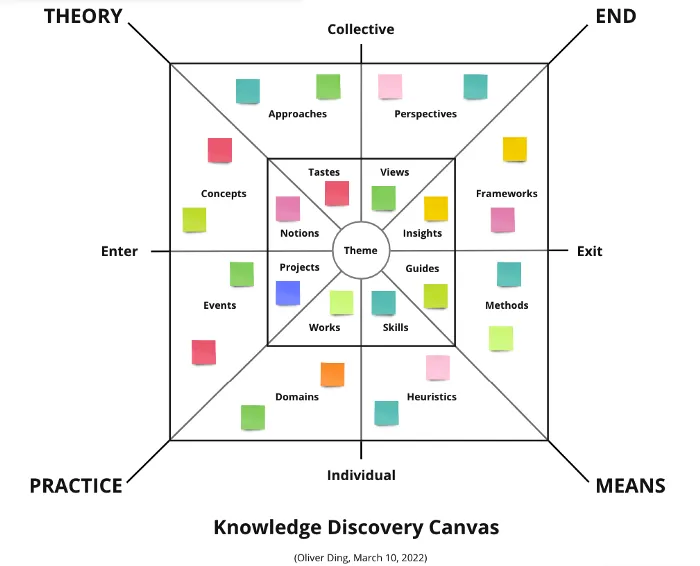
The END area is the domain of the empirical researcher, oriented toward bounding the case — testing abstract claims against specific observed reality. The MEANS area is the domain of the professional intervener, oriented toward "knowing-for-us" — translating theoretical knowledge into practical tools for specific professional contexts.
5.2 Four Creative Identities
What the KDC reveals about the AAS development is that it was never confined to a single area. From the beginning, the work moved across all four — and doing so required not a single identity but four distinct creative identities, each operating according to its own logic and serving its own purposes. The THEORY area called for a theorist who could inherit intellectual traditions and extend them into new territory. The END area called for an empirical researcher who could hold the framework accountable to specific observed cases. The MEANS area called for a professional practitioner who could translate abstract claims into workable tools and programs. The PRACTICE area called for a reflective actor who could use the framework on their own life and recognize what it revealed and what it missed.
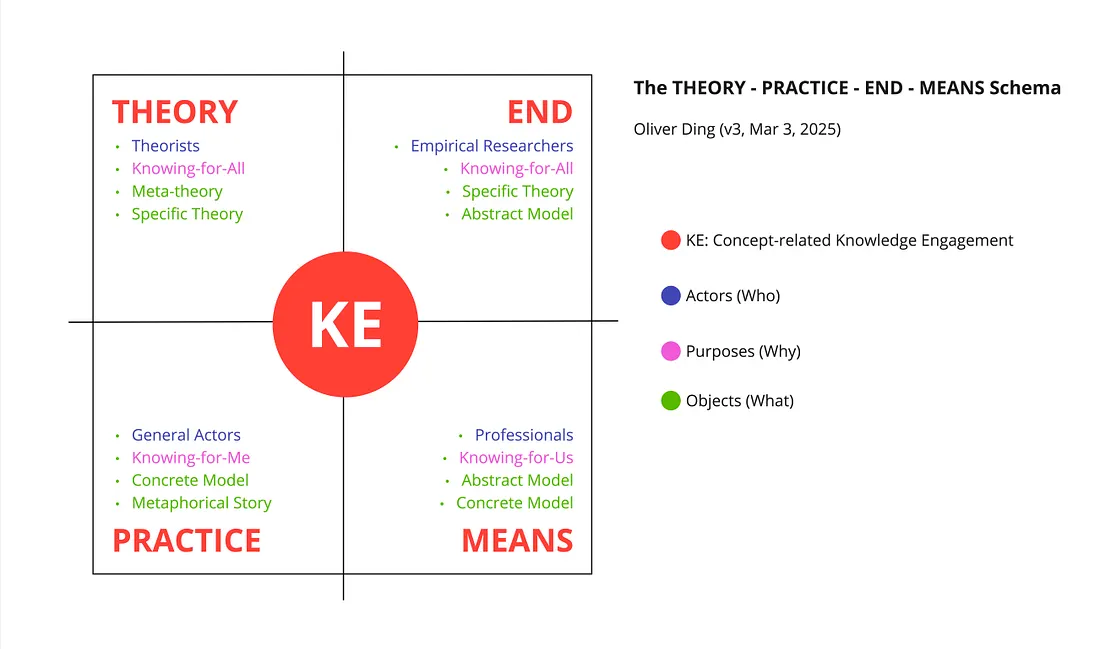
These four identities were not performed in sequence. They were genuine orientations, often simultaneously active, each with its own questions, its own methods, its own criteria of success. The crossings between them — and the unexpected consequences those crossings produced — are where the most significant developments in the AAS enterprise tended to happen. The following four sections tell stories from each area, selected not to be exhaustive but to be representative: each story captures something that the area uniquely made possible, and something that could not have happened without the sustained inhabitation of that identity over time.
5.3 KDC and Weave-the-Theory as Complementary Tools
The relationship between the KDC and Weave-the-Theory is one of complementarity. Where Weave-the-Theory tracks the weaving of theoretical knowledge along diachronic and synchronic lines — the interplay of Creativity and Curativity, the crossing between Aspects and Approaches — the KDC tracks the social movement of the knowledge enterprise across different areas of engagement. Weave-the-Theory maps the mental moves. The KDC maps the social moves.
Both the Theme U and the KDC can now be understood as analytical tools within the Weave knowledge system's extended toolkit: Theme U for vertical movement across cognitive levels, KDC for horizontal movement across social areas of knowledge engagement. Both tools attend to diachronic and synchronic dimensions simultaneously — tracking how a knowledge enterprise develops over time while also mapping its structure at any given moment — which is precisely why they can be articulated with the Weave-the-Theory framework, whose own four lines operate across the same two dimensions. Weave-the-Theory provides the structural logic that holds them both.
Part 6. The THEORY Area: A Principle That Governs from the Start
6.1 A Principle Present from the Beginning
In the Weave-the-Theory framework, Principle sits at the crossing of the Curativity Line and the Approaches dimension. It is the governing insight that unifies the whole — the most abstract claim the development earns the right to make. In most cases, the Principle is also the last element to arrive: it requires the accumulated work of Theme, Model, and Concept before it can be stated with confidence.
The AAS case is different. The governing principle was present from the very first move.
When I named the iART framework "Anticipatory Activity System" on September 15, 2021, the choice of the word "anticipatory" was not decorative. It was an explicit inheritance: the adoption of Robert Rosen's Anticipatory System Theory as the primary governing principle of the entire enterprise. Rosen's central claim is that an anticipatory system contains an internal model of itself and its environment, and uses that model to determine present behavior in light of predicted future states. This is not a minor technical point. It is a claim about the nature of living systems — that they are fundamentally forward-looking, that their present actions are shaped by anticipated futures rather than merely by past causes. Anticipation, in Rosen's sense, is what distinguishes a system that is alive from a system that is merely mechanical.
I inherited this principle and took it seriously. The early years of the AAS development were, in large part, an empirical investigation of what anticipation looks like at the level of an individual knowledge creator navigating a life transition. The concept of predictive model — the internal representation that an anticipatory system uses to generate expectations about the future — became a concrete focus of research. What does a person's predictive model actually look like? How does it shape their decisions? How does it develop and change through experience? These were not abstract questions. They were pursued through observation, through coaching practice, through the study of real cases.
6.2 Knowledge Frameworks, Mental Models, Predictive Models
Over time, this empirical work on predictive models produced a clarification that departed significantly from conventional accounts. On June 10, 2023, I developed a model that drew a precise boundary between two domains that are often conflated: the external and the internal, knowledge and activity.
In this model, Knowledge Frameworks belong to the public world — they are the organized bodies of conceptual work that exist outside any particular individual.
When a person learns from a Knowledge Framework, they internalize it as a Mental Model — a personal cognitive structure that reflects their own engagement with and interpretation of that public knowledge. The Mental Model is inside; the Knowledge Framework is outside.
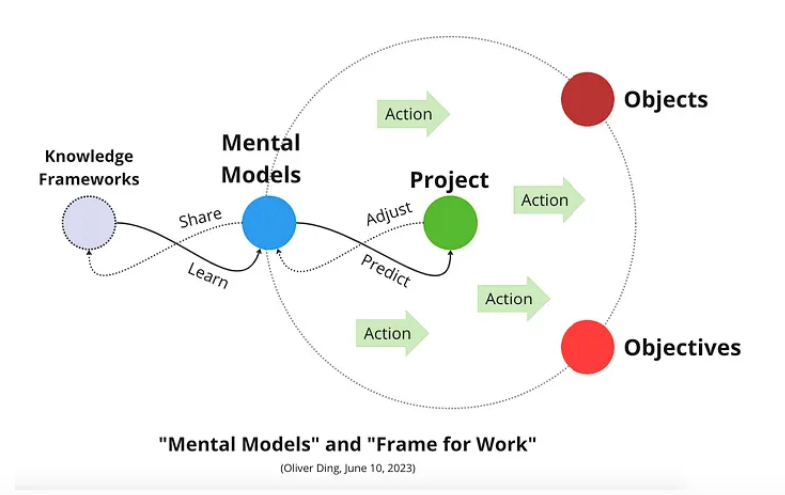
But the distinction between Mental Model and Predictive Model is of a different kind: not a boundary between external and internal, but a boundary between knowledge and activity. A Mental Model becomes a Predictive Model only when it is actually deployed in a specific Project — when the person brings their internalized understanding to bear on a concrete situation with real Objects and Objectives. Outside of that deployment, it remains a Mental Model. Inside the activity of the Project, it functions as a Predictive Model, generating Actions and anticipating outcomes. This clarification — that the same cognitive structure changes its functional character depending on whether it is held privately or actively deployed in a project — gave the Rosen principle its most precise operational form within the AAS framework.
Rosen's Anticipatory System Theory has made clear how a predictive model functions within an anticipatory system — the encoding and decoding relationship between the Natural System and the Formal System, the way present behavior is shaped by model-based predictions about future states. But Rosen did not ask where predictive models come from. That question was not within his scope of interest. It was left open.
The empirical observation of my friend's program was what opened that question in practice. Over more than a year, she repeatedly revised her program — and each revision produced a new model. I collected a series of her model drafts and versions, comparing them against the design and execution of her program at different periods.
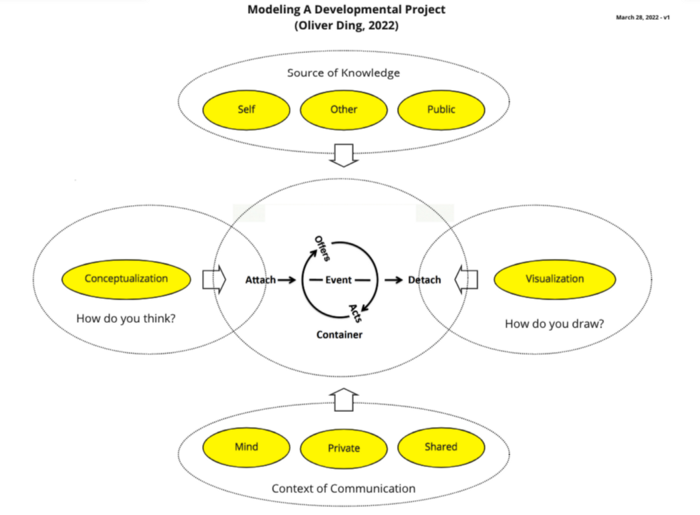
What emerged from this comparative study was a reflection on the relationship between her knowledge and these models: why did some of her prior knowledge translate effectively into workable models while other knowledge did not? Why did some models survive contact with practice while others required revision? Tracing these questions through the evidence led to the three-way distinction — Knowledge Frameworks, Mental Models, Predictive Models — as the answer to the question Rosen had left open: this is how predictive models come to be.
6.3 The Micro AAS: Rosen at the Level of Action
But the Rosen principle was guiding something larger than the study of individual predictive models. The decisive moment came in September 2023, while working on the Mental Tuning Framework — a project that began as a theoretical curation of Carol Dweck's and Peter Gollwitzer's accounts of mindset. In developing that framework, I applied Rosen's Natural System / Formal System distinction directly to the structure of individual human activity:
- Life = Behavioral System = Natural System
- Self = Mental System = Formal System
- Mindset = Predictive Model
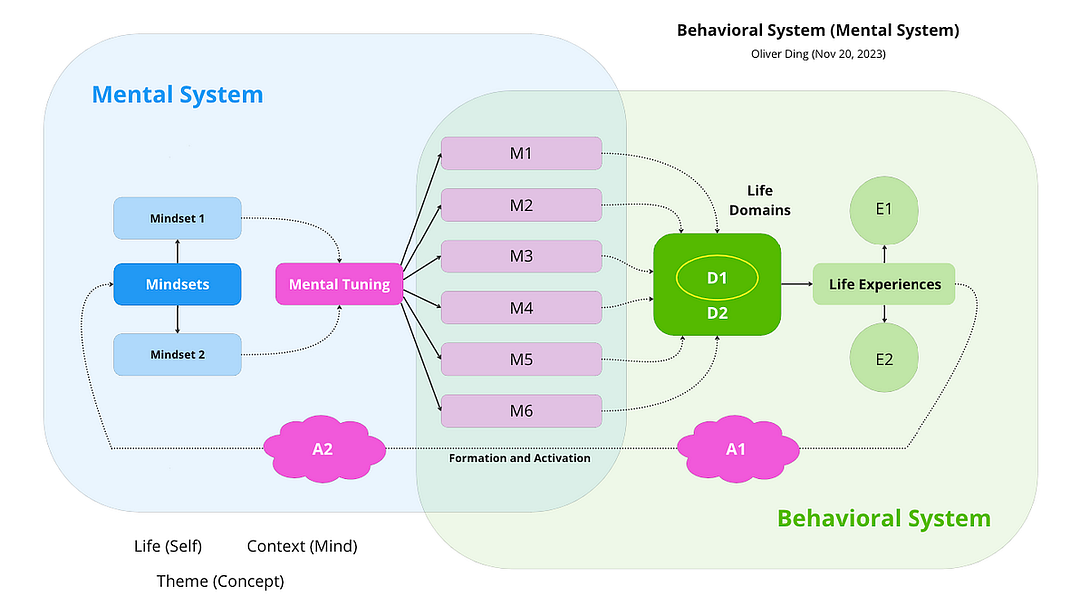
This mapping — Rosen's abstract theoretical architecture applied to the concrete relationship between a person's mental life and their behavioral life — produced what I began to call the Micro AAS. It was not two separate systems but a single whole with two subsystems, structured by the same encoding / decoding relationship that Rosen had described between natural and formal systems.
The AAS framework itself was already an application of Rosen's principle at the level of activity — following the Activity Theory tradition in which activity, not action, is the primary unit of analysis. What the Micro AAS added was an application at the level of action: the fine-grained relationship between a person's Mental System and Behavioral System within everyday life.
This distinction matters theoretically.
North American psychology has the concept of action but not activity; the AAS framework, grounded in Activity Theory, operates at a different level of analysis than most psychological frameworks. The Micro AAS brought Rosen's principle into contact with that finer-grained level without abandoning the activity-level foundation. This gap — between the activity-level analysis of AAS and the action-level analysis of North American psychology — carried a generative seed. The possibility of bridging the two, through a framework that could speak to both scales, planted the idea that would eventually develop into Strategic Life Theory (2025) and its formal launch as version 1.2 in March 2026.
6.4 From Life(Self) to the HLS Framework
The question of what larger system the individual's mental and behavioral systems are embedded within did not arise from theoretical deduction. It emerged gradually, as a by-product of the 2023 TALE work.
On June 2, 2023, the Life(Self) theme appeared — the outcome of a literature review on theories of the self in psychology. The theme proposed that "Life" is the container of "Self": one cannot understand the self without understanding the life within which it is embedded. This was not yet a framework. It was a thematic recognition, the kind of Aspects observation that starts a theoretical development rather than completing one. Over the following months, through the Meaning Discovery project in January 2024 and the Value Circle article in March 2024, the Life(Self) theme accumulated theoretical content — accounts of how meaning and experience are related, how mindset connects to action, how identity moves within a life trajectory.
On April 18, 2024, these accumulated threads were integrated into the History{Life[Self(Body)]} Framework (v1.0).
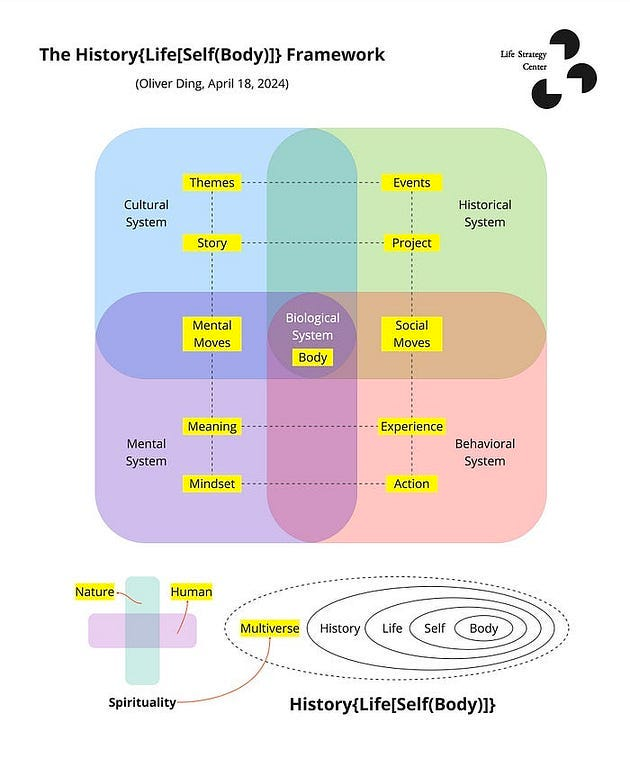
The framework defined a nested system: Body within Self within Life within History, each level containing the ones inside it and being contained by the ones outside it.
6.5 Micro AAS and Mega AAS: The Social World as a Nested System
The framework reached its macro-scale form in December 2024. On December 27, 2024, I added four theoretical concepts to produce HLS v2.0: Symbolic Universe and Social Territory, drawn from Ping-keung Lui's Subjectivist Structuralism, and Thematic Space and Social Landscape, developed through the 2023-2024 project work.
With these additions, the nested structure could now account for the full range of the social world: the Micro AAS corresponds to the Mental System and Behavioral System — the individual's anticipatory activity at the level of mindset, meaning, and behavioral choice; the Mega AAS corresponds to the Cultural System and Historical System — the collective anticipatory activity of cultural communities and historical formations. The framework that began as a tool for thinking about a friend's career transition had become, through the sustained governance of Rosen's principle and the gradual accumulation of theoretical resources, a unified ontological account of the social world at every scale from the individual body to historical time.
One year later, in December 2025, I finished a book draft titled Meta-frameworks, in which the HLS framework reached version 3.0 and was launched as a meta-framework for understanding social life at the collective level and creative life at the individual level.
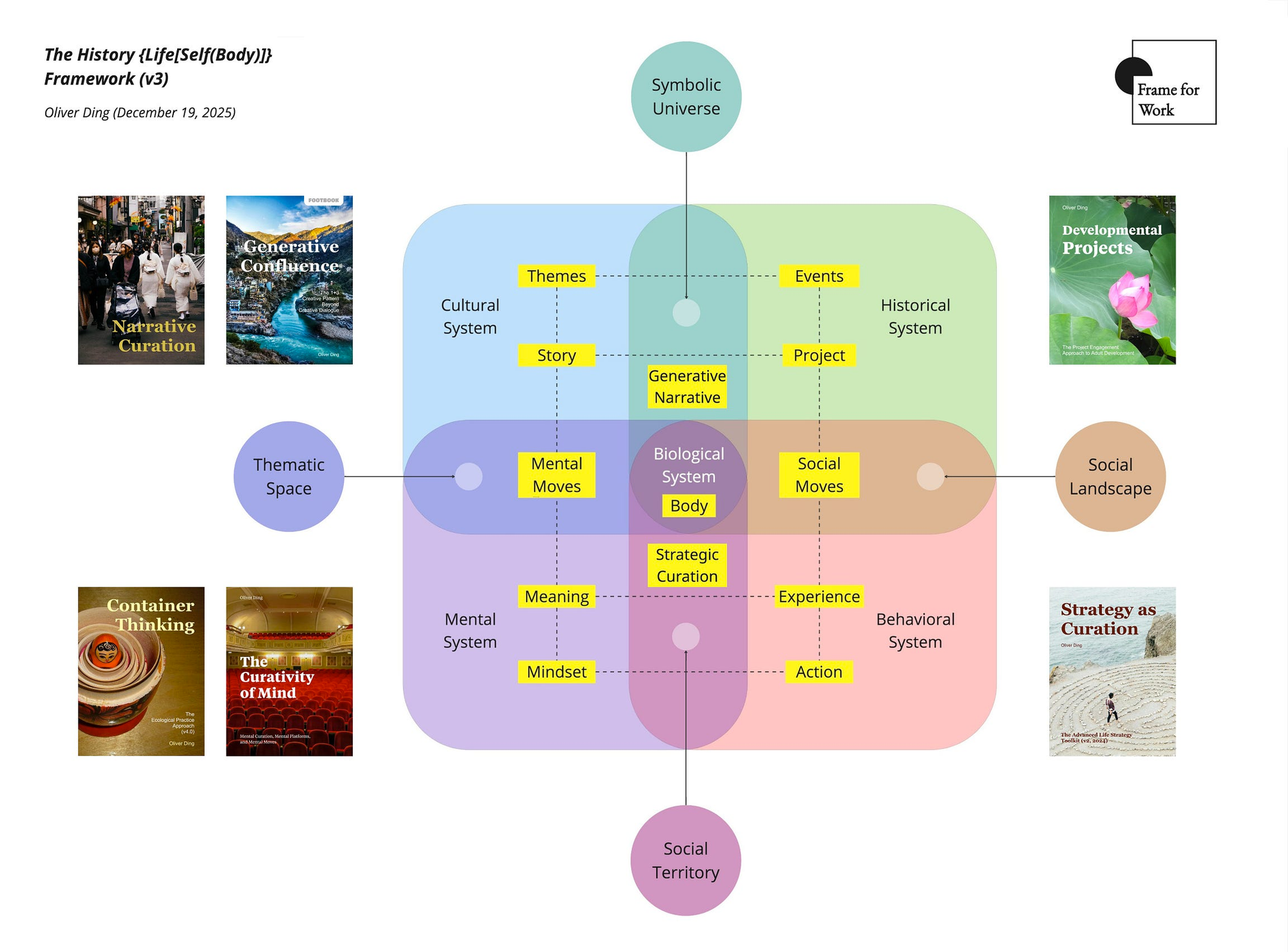
Building on HLS v3.0, Anticipatory Cultural Sociology (ACS) was launched in January 2026, and Strategic Developmental Psychology (SDP) was officially launched as version 1.2 in March 2026.
This is what a Principle does in the Weave-the-Theory framework. It does not wait until the end to assert itself. It is present from the beginning as a governing orientation — shaping what questions get asked, what observations count as significant, what connections are worth pursuing. The Rosen principle governed the AAS development not by prescribing its contents but by maintaining its direction: always toward a fuller account of what anticipation means, at every scale where human activity takes place.
Part 7. The END Area: A Concept and Its Expanding Empirical Domains
The END area of the KDC is the domain of empirical research — bounding the case, testing the framework against specific observed reality, asking whether the abstract claim actually holds when confronted with the particular. In the AAS development, the primary inhabitant of the END area was the concept of Second-order Activity, and the story of that concept's empirical development is the story of a concept meeting its own expanding range of domains, one at a time, over three years.
The concept arrived before the empirical work. The concept of Second-order Activity was proposed in September 2021, within weeks of the original observation, as part of the Aspects-to-Approaches crossing described in Part 3. At that point, the empirical support for the concept consisted of a single observation of a real program — sufficient to establish that Second-order Activity existed and operated as described, but not yet sufficient to support the concept's broader claim. A single case could confirm the structure; it could not demonstrate the concept's range. The subsequent years were, among other things, a sustained process of earning that breadth.
7.1 The First Domain: Life Discovery
The empirical foundation of Second-order Activity was built not from a single case but from a set of cases observed in parallel and over time. The original observation — my friend's adult development program — was the starting point. The research then expanded to include two additional cases, deliberately selected from different contexts to strengthen the comparative basis of the study.

The first additional case was a participant in my friend's program: a young married woman with a small child, working as a clerk in a commodity trading company. She joined my friend's program and then, after leaving it, continued her self-exploration independently. Over time, she developed a podcast practice, gradually finding her footing in that creative direction. Her Life Discovery was slow, indirect, and deeply shaped by the constraints of her life situation — the child, the job, the limited time. But the structure of Second-order Activity was clearly present: a sustained phase of exploration and orientation, operating beneath and alongside the routines of everyday life, eventually producing a direction stable enough to act on.
The second additional case was independently selected — a young married woman without children, working as a clerk at a major internet company. She wanted to change careers and eventually identified psychotherapy as her direction — but the process of arriving at that clarity took considerable time and involved multiple false starts. Her case illustrated a different dimension of Second-order Activity: the role of elimination, of discovering what one does not want as part of the process of discovering what one does.
Together with the original case — my friend, the program initiator — these three women provided the comparative material needed to move from description to classification. The three cases shared the same underlying structure of Second-order Activity but expressed it differently: different life contexts, different time horizons, different kinds of obstacles, different relationships between the discovery phase and the eventual direction. Comparing them made it possible to begin developing a typology of Second-order Activity — a systematic account of the different forms this activity takes depending on the actor's situation, resources, and the nature of the objective being sought. This typology became important empirical material for the Advanced Life Strategy book draft completed at the end of 2022.
My own Life Discovery during the first half of 2022 added a fourth case — this time from the inside. The experience of navigating my own project choices and directions during that period produced two theoretical outcomes: the Life-as-Project framework, which understands a life as a structured sequence of projects each with its own Object and Objective; and the advancement of the Project Engagement Approach from version 1.0 to version 2.0.
These two frameworks clarified an important theoretical relationship that the AAS framework had not yet made explicit: the relationship between a single project and the larger AAS. A project operates at the level of a single First-order or Second-order Activity — it has a defined scope, a beginning and an end. The AAS operates at a higher level, holding multiple projects together in a self-referential system where the outcomes of one project feed into the orientation of the next. Project is a unit; AAS is the system that gives those units their larger meaning.
7.2 The Second Domain: Knowledge Discovery
The second domain was Knowledge Discovery — and this case had a distinctive character that set it apart from the Life Discovery cases. Rather than observing others, I designed and built the empirical vehicle myself: a tool, a practice, and a book, all in one integrated project.
The theoretical starting point was a distinction between Knowledge Discovery and Knowledge Production. Where Knowledge Production — writing papers, publishing books, developing software — is a First-order Activity oriented toward producing knowledge artifacts, Knowledge Discovery is the prior Second-order Activity: the process of developing tacit knowledge, discovering possible themes, and generating the Significant Insights that make Knowledge Production possible and meaningful. This distinction mapped directly onto the AAS framework's core structure, and the project was designed to test whether the framework could illuminate the dynamics of intellectual work as clearly as it had illuminated life transitions.
The primary instrument developed for this purpose was the Thematic Space Canvas — later called the Knowledge Discovery Canvas. Designed along multiple dimensions (Theory–Practice, End–Means, Enter–Exit, Individual–Collective), the canvas provided a structured space for the activities of Knowledge Discovery: connecting objective theoretical resources with subjective work experience, mapping the movement between inner personal knowing and outer social interaction, tracing the transformation from Approaches to Tastes, from Concepts to Notions, from Frameworks to Insights. I designed the canvas, used it myself in sustained practice, and then wrote the book Knowledge Discovery: Developing Tacit Knowledge with Thematic Space Canvas to document the process and its insights.

The project revealed a theoretical relationship that the Life Discovery cases had not made visible: Life Discovery is a subcategory of Developing Tacit Knowledge, specifically the case where the focus of knowing concerns one's own life development. Discovering new insights about life development is itself a process of developing tacit knowledge. This relationship — Life Discovery nested within Knowledge Discovery as a more general category — gave the concept of Second-order Activity a more precise internal structure than it had possessed after the first domain alone.
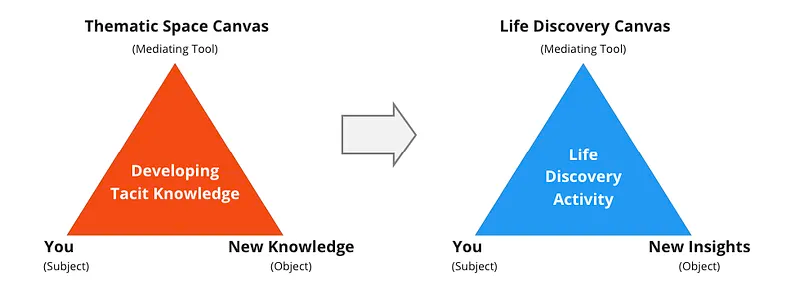
There is also a self-referential dimension to this case that is worth noting explicitly. The Knowledge Discovery Canvas developed through this project is the same KDC that this article uses in Part 5 to analyze the AAS development itself. The analytical tool and the case study that produced it are part of the same knowledge enterprise — the canvas was born from Second-order Activity, and it is now being used to map the ecology of that very enterprise.
7.3 The Third Domain: Meaning Discovery
The third domain was Meaning Discovery, and its significance within the trilogy was twofold: it completed the empirical range of the concept, and it provided the integrative theoretical model that unified all three domains.
The Meaning Discovery book, developed in January 2024, completed the "Foolish Explorer" trilogy. With three domains now in hand — Life Discovery, Knowledge Discovery, Meaning Discovery — it became possible to articulate what they shared at a structural level.

The Meaning Discovery Model gave this shared structure an explicit form: a 3×2 conceptual framework organized around the "Meaning — Experience" Transformation and the "Knowledge — Activity — Environment" Hierarchy, with six focal points: Capture the Insight, Weaving the Mind, Clarifying the Order, Running the Project, Grasping the Concept, and Perceiving the Setting.
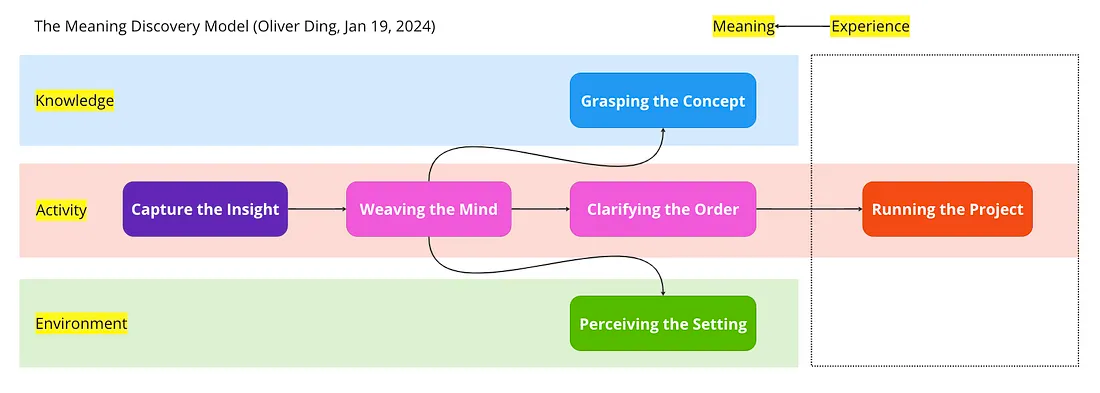
This model did not describe Meaning Discovery alone. It described the general structure of Second-order Activity across all three domains — the pattern that Life Discovery, Knowledge Discovery, and Meaning Discovery all instantiate in their different ways. I also developed three canvases for these three types of Discovery Activity, all based on the Thematic Matrix Canvas as a meta-canvas.
The second contribution of this domain was methodological: the development of Situational Note-taking as a practice for supporting Second-order Activity. From June 15 to June 21, 2023, a thematic email conversation with a friend about note-taking and knowledge engagement prompted a clarification of what note-taking actually does in the context of Discovery Activity. Note-taking, in this account, is not primarily about recording information. It is about developing concept systems and tacit knowledge — capturing Significant Insights as they emerge in situated encounters, and building them into the Early Discovery trajectory: Theme → Note → Framework → Possible Book. This pattern, which I had been practicing for years without fully naming it, became explicit through the Meaning Discovery project.
A case study of the Social Moves project — from a possible theme on October 17, 2023, through situational notes, to a framework article on December 5, and a completed book draft on December 19 — demonstrated the pattern in compressed and traceable form. The resulting collection, Situational Note-taking, documented this practice as an independent body of work.
7.4 What the Trilogy Earned
Looking back at the trilogy from the vantage point of the completed #15 move, the empirical logic is clear. The three domains were not chosen arbitrarily. They were chosen because they were different enough from each other that any single domain-specific feature could not explain the concept of Second-order Activity. If Second-order Activity only appeared in life transitions, it might be a feature of that particular kind of situation. But when the same structural logic appeared in knowledge development and in meaning-making — domains that share almost no surface features with life transitions — the concept had earned a stronger claim. It was not a description of one kind of activity. It was a description of a structural position that could be occupied in many different kinds of activity: the position of the person who is engaged in discovering what they are trying to do before they can do it.
This is what the END area produces in a knowledge enterprise: not just validation of an existing concept, but a progressive deepening of that concept's content through the friction of encounter with new empirical domains. Each domain added a distinct layer to the concept. Life Discovery provided the empirical base and the typological diversity — multiple cases in different life contexts, producing the first classification of the forms Second-order Activity can take. Knowledge Discovery revealed the nested structure of the concept: Life Discovery is a subcategory of Developing Tacit Knowledge, giving Second-order Activity an internal hierarchy it had not previously had. It also produced the KDC — the analytical canvas that this article itself uses. Meaning Discovery provided the integrative model: the Meaning Discovery Model, with its 3×2 conceptual framework, described the general structure shared by all three Discovery types, completing the theoretical unification of the trilogy. Together, the three projects — named "The Foolish Explorer" trilogy — earned the concept's claim to generality. The full concept, as it stands after the trilogy, is the same concept proposed in September 2021, but it has been through more.
Part 8. The MEANS Area: Tools, Programs, and Indirect Effects
The MEANS area of the KDC is the domain of the professional practitioner — the person who translates theoretical knowledge into workable tools and programs for use in specific professional contexts. In the AAS development, the MEANS area was the site of two distinct stories: the development and operation of the AAS4LT coaching program, and the longer, slower development of the Life Strategy concept through the effects of indirect activity.
8.1 The AAS4LT Coaching Program
The AAS4LT coaching program — described in its origins in Part 4 — was the primary vehicle for MEANS work in the first phase of the development. What matters from the MEANS area perspective is not only what the program produced for clients, but what it produced for the theory. Running a real coaching program created conditions for encountering the actual texture of Second-order Activity in a way that observation alone had not. The most significant outcome was the vocabulary revision: "Decision" became "Unfolding." This change — made in the MEANS area, traveled back to the Abstract Model level — illustrates the characteristic dynamic of the Creativity Line in practice: it moves not only outward toward application but backward, from operational encounter to theoretical revision.
8.2 Life Strategy: From Strategy to Life
The second story from the MEANS area is subtler and takes longer to tell. It concerns the development of the Life Strategy concept — specifically, the shift in that concept's center of gravity from its "Strategy" part to its "Life" part between 2022 and 2024.
In 2022, my engagement with the Life Strategy thematic space was primarily oriented toward "Strategy." The Advanced Life Strategy: Anticipatory Activity System and Life Achievements book draft, edited in December 2022, reflected this orientation: it was a systematic account of the strategic logic of knowledge work, organized around the AAS framework and populated with tools, models, and frameworks for thinking about how a knowledge creator's activities could be organized more effectively. The concept of Life Strategy, at that point, was primarily an application of strategic thinking to the domain of personal development. The "Life" part of the compound was treated as the domain; the "Strategy" part was treated as the framework.
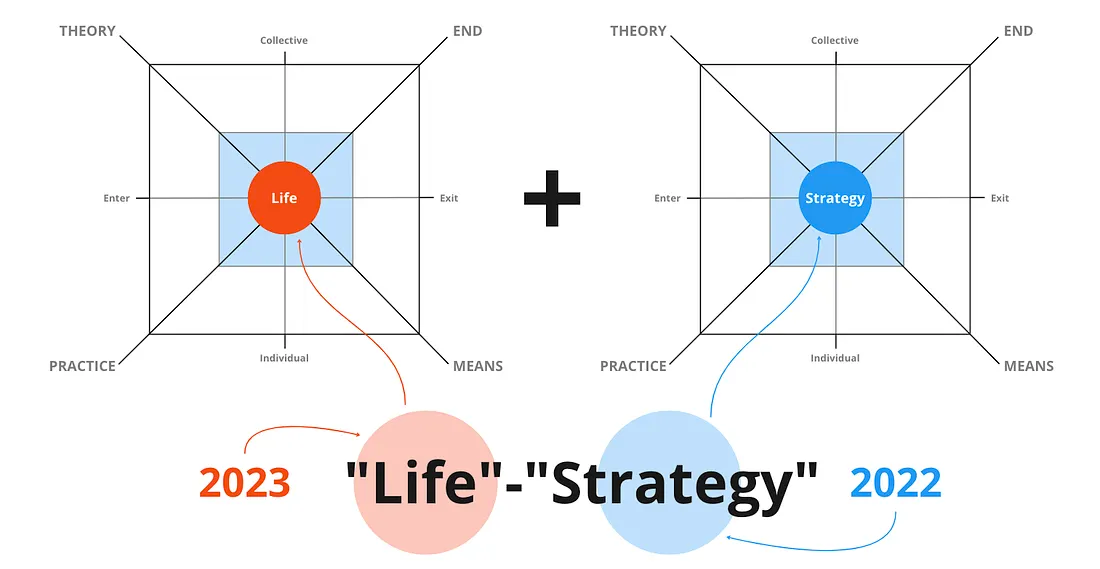
What changed this was not a direct theoretical decision. It was the accumulation of indirect activity — work done in other knowledge centers, on other projects, for other purposes, that produced by-products which gradually altered the conceptual landscape of the Life Strategy project.
Through TALE's thematic exploration work in 2023, I spent sustained time with themes that the Life Strategy project had not directly engaged: the "Possible Personas" theme, which connected AAS to Possible Selves theory and raised questions about identity that the strategic framework had left unaddressed; the "Possible Discipline" theme, which explored the relationship between Life Discovery Activities and Emerging Disciplines; the "Microdynamics of Creative Identity" theme, which developed a fine-grained account of how a person's identity shifts as they enter and exit projects. None of these were undertaken as contributions to the Life Strategy project. They were hosted by TALE, driven by TALE's own logic of thematic exploration. But their conceptual outputs accumulated in the Life Strategy thematic space, because all of them were, at bottom, about the "Life" part of the compound: about what a life actually is, what a person actually is, how identity and activity and development actually relate to each other.
8.3 The Power of Indirect Activity
By 2023-2024, this accumulation had changed the concept of Life Strategy in a way that no direct conceptual work could have produced. The "Life" part was no longer a domain to which strategic thinking was applied. It was a theoretically rich object in its own right — populated with accounts of identity dynamics, possible personas, microdynamics of creative development, and the relationship between Life Discovery and Emerging Disciplines. Life Strategy had become, through the indirect route of thematic exploration in adjacent projects, a genuinely compound concept: two theoretically developed parts in productive tension with each other, rather than one theoretical framework applied to one underspecified domain.
This is what indirect activity produces in a knowledge ecology: conceptual development that could not have been achieved through direct effort, because the directness of the effort would have foreclosed the exploratory movement that made the development possible. The MEANS area, precisely because it is oriented toward practical application rather than theoretical development, creates the conditions for encountering Aspects that the THEORY area would never have sought out. And those encounters, accumulated over time, change the theory in ways the theorist did not plan.
Part 9. The PRACTICE Area: When the Framework Becomes the Map
9.1 The Background: From First-order to Second-order
The PRACTICE area of the KDC is the domain of the individual actor engaged in first-person reflection — "knowing-for-me," the discovery of meaning through personal experience, the use of theoretical frameworks not to explain others but to understand oneself. In the AAS development, the PRACTICE area was inhabited most intensely in 2023, when a single decision — to invest a full year in the sustained exploration of Early Discovery — produced consequences that are still unfolding.
To understand that decision, it is necessary to understand what preceded it. In 2022, the completion of the Aspects of Creative Life series and related projects produced a significant result: the Thematic Engagement Toolkit (v1.0), published in September 2022. This toolkit emerged from the convergence of two theoretical lines — the Themes of Practice approach (2019, 2021), which connects life themes to cultural themes, and the Project Engagement approach (2021, 2022), which treats projects as units of activity analysis. Their meeting produced a set of tools for engaging with thematic work across different contexts.
From the perspective of the AAS framework, the Thematic Engagement Toolkit was the outcome of a completed cycle of First-order Activity. The result had arrived. The question was: what next?
9.2 Launching TALE: A Strategic Second-order Activity Decision
The answer was to set up a new knowledge center: TALE (Thematic Analysis Learning Engagement), launched in January 2023. The decision was not arbitrary. Applying the AAS framework to my own creative situation, I recognized that I was at a Second-order Activity juncture — a moment of orientation rather than execution. The Thematic Engagement Toolkit had produced a result, but the thematic space it pointed toward remained largely unexplored.
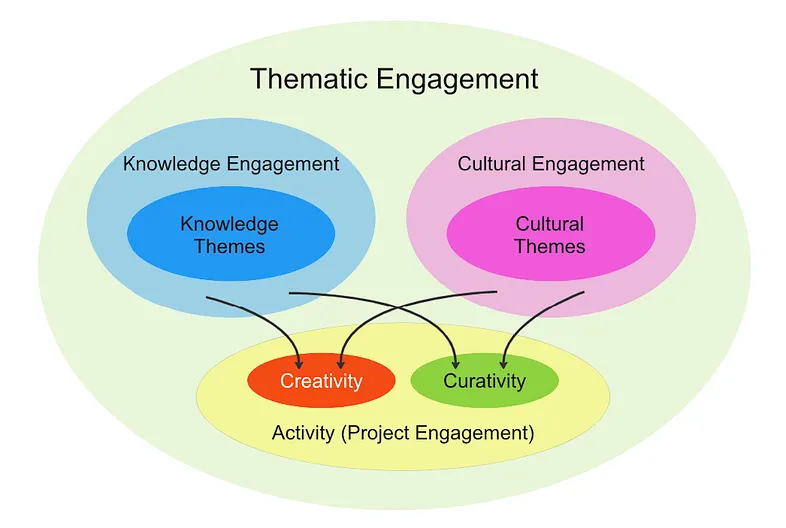
TALE was designed to host that exploration, with knowledge themes as the primary object of work for its first phase. Cultural themes — equally important in the longer arc — were deliberately deferred to a later phase. This was a strategic choice: to go deep in one direction before expanding to the other.
9.3 The Strategic Thematic Exploration Framework
Within the first three months of TALE's operation, something unexpected emerged. On March 31, 2023, I shared the Strategic Thematic Exploration framework (v1.0) — a structure for understanding the journey of knowledge engagement as a progression through three transformations:
- The Possible→Primary Transformation (discovering opportunities for knowledge creation)
- The Theme→Concept Transformation (turning themes into concepts)
- The Concept→Framework Transformation (curating concepts into a knowledge framework).
The full path was Theme→Concept→Framework, organized around six states from "A Possible Theme without a Clue" to "A Knowledge Framework with a set of concepts."
9.4 The Decision: Focusing on Early Discovery
When the Strategic Thematic Exploration framework emerged from the first three months of TALE's operation, I recognized immediately that the Second-order Activity phase had reached its natural end. The framework was the Significant Insight that marked the transition: specific enough, operational enough, and theoretically rich enough to serve as both a clear Objective (the deep study of the Theme→Concept transformation) and a concrete Object (the Strategic Thematic Exploration framework itself). It offered a stage-by-stage account of how themes become concepts, with enough precision to guide sustained and detailed research. The direction was clear.
The decision to commit was further confirmed by a convergence across three theoretical lines I had been developing for years. Curativity Theory had been built around the Themes of Practice approach — the relationship between life themes and cultural themes. The Project Engagement approach, grounded in Activity Theory, understood concepts as the formative units of projects. And Creative Life Theory, developed in dialogue with Ping-keung Lui's theoretical sociology, was also fundamentally about how themes become concepts in a knowledge creator's life. All three lines met at the Theme→Concept relationship. This convergence was itself a Significant Insight: the direction was not a detour from the larger theoretical enterprise. It was where multiple theoretical streams could be simultaneously deepened. In the language of my later book draft Lake 42: The Great Confluence, this was a Generative Confluence — a moment where independently developed theoretical lines meet at a single point and mutually amplify each other.
In March 2023 — just three months after TALE's launch — the Second-order Activity phase ended. I moved into nine months of First-order Activity with a clear Objective (the deep study of the Theme→Concept transformation) and a concrete Object (the Strategic Thematic Exploration framework). There is a pleasing irony in this structure: the nine months of First-order Activity that followed were entirely devoted to the study of Early Discovery in knowledge engagement — that is, to the study of Second-order Activity itself. The researcher had completed their own Second-order Activity and was now, through First-order Activity, investigating what Second-order Activity looks like for others.
9.5 Four Projects, One Foundation
The year 2023, organized under the orientation of Early Discovery, produced four interlocking series of projects hosted by TALE: Thematic Exploration, Mental Moves, Grasping the Concept, and Social Moves. The Thematic Exploration project developed the Strategic Thematic Exploration framework into a fuller account of how themes are discovered, named, and developed. The Mental Moves project curated examples of moving between thematic spaces, developing the concept of Attachance. The Grasping the Concept project addressed the subjective experience of conceptual objectification — the Territory of Concepts. The Social Moves project extended the ecological approach from mental to social dynamics.
It is worth noting that these four projects were not fully planned out in March 2023. Each one unfolded through its own process of exploration and development — with its own local cycles of Second-order Activity and First-order Activity nested within the larger arc. This is the fractal structure of the AAS model: the same pattern of discovery and performance operates at every scale, from the overall year-long enterprise down to each individual project within it. The details of these nested cycles lie beyond the scope of this article.
Looking back from 2026, the four projects of 2023 were the opening move of a long arc that has since unfolded through a series of book drafts organized around the Theme–Concept–Framework Transformation Model:
- Thematic Exploration (June 2023)
- Grasping the Concept (November 2023)
- Meaning Discovery (January 2024)
- Activity as Formation of Concept (June 2024)
- Frame for Work (December 2024)
- Ecological Formism (November 2025)
- Meta-frameworks (December 2025)
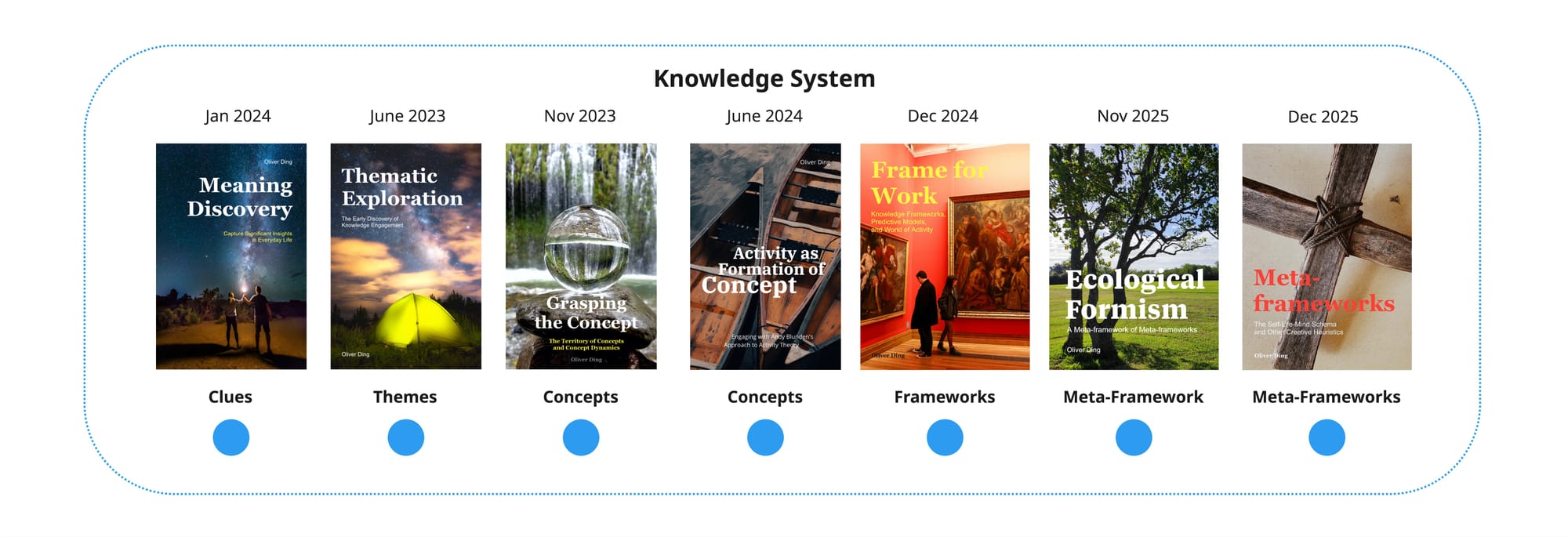
Meta-frameworks marked the completion of this arc — the Knowledge System layer, from Clues to Meta-Frameworks, was complete. But it also marked a watershed: beginning in December 2024, the focus began to shift from Knowledge Engagement to Cultural Development, eventually producing Anticipatory Cultural Sociology (ACS, January 2026) and Strategic Developmental Psychology (SDP, March 2026).
The 2023 decision to invest in Early Discovery did not produce these outcomes directly — they emerged through years of sustained development. But the Theme→Concept work of 2023 provided the conceptual infrastructure that made everything subsequent possible. In the language of the Six Faces of the Concept System — a framework developed in Meta-frameworks — the 2023 work built the Knowledge Frameworks layer that underlies all the others.
Postscript: What This Case Adds to the Weave Toolkit
1. Comparison with Previous Cases
Three previous applications of the Weave-the-Theory framework have now been completed, each revealing something the others did not.
The Revisiting–Rebuilding case analyzed a sustained personal practice — returning to past work and rebuilding it through a more developed present identity — as a Dramatic Life Pattern with a stable internal structure.
The Creative Watershed case grounded a retrospectively recognized structural moment in a creative life — the point where Before and After diverge significantly — in the Before | After Basic Form of the Ecological Formism Framework, revealing unexpected family relationships between patterns.
The Curativity case traced the long-term development of a knowledge enterprise whose central concept — Enterprise — accumulated gradually through the convergence of multiple independently developed themes, arriving only after years of lived practice had created the conditions for its naming. In the Curativity case, the direction of development was self-evidently bottom-up: themes first, concept later.
2. The Aspects-to-Approaches Crossing
The AAS case adds a methodological contribution that none of the previous cases feature. It demonstrates the Aspects-to-Approaches crossing as the originating move of theoretical work — a crossing that happened in less than a month, before any substantial accumulation of lived themes, driven by the direct perception of an objective structure in human activity and the immediate deployment of existing theoretical traditions to give that structure a language. Where the Curativity case moved from Theme toward Concept — bottom-up — the AAS case moved from Aspects to Approaches — a synchronic crossing that preceded the diachronic accumulation of themes.
The two cases together demonstrate that Weave-the-Theory has no preferred direction. It is not a bottom-up methodology. It is not a top-down methodology. It is a framework that can accommodate both, and whose analytical power comes precisely from this neutrality about starting points.
The most important epistemological implication of this case is about the nature of observation itself. The AAS case makes visible something that is easy to overlook: theoretical knowledge does not contaminate observation — it enables it. The observation of [Self — Other — Present — Future] as an objective structure in human activity was only possible because Activity Theory, Anticipatory System Theory, and Relevance Theory were already available as lenses — and because years of meta-diagram practice had cultivated the perceptual capacity to recognize an ecological structure directly. Prior theoretical knowledge is not a bias to be controlled. It is the instrument of perception.
3. Two New Tools for the Weave Toolkit
Beyond this methodological contribution, the AAS case extends the Weave toolkit with two analytical instruments that have now demonstrated their value in practice.
The Theme U diagram, first used in the original 2022 retrospective, is now explicitly positioned as a mental-moves mapping tool within the Weave framework — capturing vertical movement across cognitive levels as a complement to Weave-the-Theory's diachronic and synchronic analysis.
The Knowledge Discovery Canvas is now explicitly positioned as a social-moves mapping tool — capturing horizontal movement across four areas of knowledge engagement, revealing the four creative identities that a sustained knowledge enterprise requires its practitioner to inhabit.
Together with Weave-the-Theory itself, these three instruments form a more complete analytical apparatus for understanding how knowledge enterprises develop.
4. Meta-diagrams as Instruments of Ecological Perception
The AAS case also points toward a methodological innovation that goes beyond the question of where theoretical work can begin. The direct recognition of [Self — Other — Present — Future] as an ecological structure in August 2021 was an act of pure intuition. But this kind of intuition is not easily acquired. It is a cultivated capacity — and the instrument for cultivating it is the meta-diagram.
The meta-diagram behind iART had been developed in 2017, as the outcome of the "Activity as Container" project exploring the Thing-People ecological structure. Over the years, developing and working with a series of meta-diagrams had trained a particular perceptual capacity: the ability to look at a real situation and directly recognize the ecological structure organizing it, without first translating the situation into theoretical language. When I encountered my friend's adult development program in August 2021, that capacity was already in place. The recognition of [Self — Other — Present — Future] was immediate and direct — not the output of a reasoning process, but a perception.
This is the deeper methodological point. The capacity for direct ecological perception is real, but it is not a natural talent distributed unevenly among researchers. It is something that can be developed through deliberate practice — specifically, through the sustained work of building and using meta-diagrams. A meta-diagram is not a tool for illustrating theories that already exist. It is a training instrument: working with it repeatedly, across different situations and domains, gradually sharpens the researcher's ability to see structural patterns in observed reality before those patterns have been theoretically named.
Over the years, I have developed a series of meta-diagrams for this purpose. Each one is designed to make a particular kind of ecological configuration perceptible — to give the researcher's eye a shape to recognize. The accumulation of this practice is what makes the Aspects-to-Approaches crossing possible in its most compressed form: the immediate perception of a structure, followed at once by the movement into theoretical interpretation. Without the cultivated capacity, the structure might be present in the situation but invisible to the observer. The meta-diagram practice is what opens the eye.
5. Theory as Map for the Creator's Own Life
Finally, the AAS case reveals a pattern that the Curativity case had hinted at but not made explicit: the pattern by which a theoretical framework, upon reaching maturity, immediately becomes available as a predictive model for its creator's own next creative decisions. Curativity Theory, completed in 2019, guided the Knowledge Curation project of 2020-2022. The AAS framework, reaching sufficient maturity by the end of 2022, guided the decision to invest 2023 in the Early Discovery territory.
But the AAS case also reveals something more precise about how this guidance actually works. It is not that the framework simply points toward a direction. The guidance operates through the framework's structural logic: recognizing when one is in Second-order Activity, recognizing when that phase has reached its natural end, and recognizing when a Significant Insight has produced a concrete enough Object and Objective to transition into First-order Activity. When the Strategic Thematic Exploration framework emerged in March 2023, the recognition was immediate — not because the framework prescribed what to do next, but because it provided the structural language for understanding what had just happened. And when the convergence of three theoretical lines at the Theme→Concept junction revealed itself as a Generative Confluence, that recognition confirmed the direction with a clarity that no amount of planning could have produced.
This is the self-referential structure that AAS describes from the inside: the framework that explains Second-order Activity is itself the product of Second-order Activity, and when it matures, it becomes the instrument for the next round of Second-order Activity. The theory and the life that produces it are not separate objects. They are two aspects of the same anticipatory system, referring back to itself.
Appendix: Source Articles
Phase One: The First Nine Moves (2021–2022)
- D as Diagramming: The iART Framework — August 21, 2021
- D as Diagramming: Strategy as Anticipatory Activity System — September 15, 2021
- CALL for LIFE: Anticipatory Activity System for Life Transitions — March 22, 2022
- CALL for LIFE: Modeling A Developmental Project — March 28, 2022
- The AAS Framework — May 20, 2022
- Slow Cognition: The Development of AAS (August 21, 2021 – August 26, 2022) — August 28, 2022
Phase Two: The Extended Development (2022–2024)
- Advanced Life Strategy: Anticipatory Activity System and Life Achievements (book draft) — December 2022
- TALE: A Possible Theme called "Possible Personas" — February 16, 2023
- TALE: A Possible Theme called "Possible Discipline" — April 28, 2023
- Advanced Life Strategy: The Microdynamics of Creative Identity — September 24, 2023
- Social Moves: Weaving the Mind and Clarifying the Order — December 7, 2023
- The Foolish Explorer: A Trilogy about "Discovery" — January 29–30, 2024
- Value Circle #7: The Indirect Activity of Life Strategy Center — March 7, 2024
Phase Three: The Macro Expansion (2024–2026)
- The Advanced Life Strategy Toolkit (v2) — December 26, 2024
- Strategy as Curation: The Meaning of the Social World and Its Consequences — December 31, 2024
- The History{Life[Self(Body)]} Framework (v3.0) — December 19, 2025
- Frame for Work (book draft) — 2024
v1.0 - April 24, 2026 - 12,074 words