
Dramatic Life Pattern: The Watershed I Lived By

This article is the part of the Strategic Developmental Psychology (SDP) project.
by Oliver Ding
April 21, 2026
Introduction
Dramatic Life Pattern is one of three dimensions in the Strategic Developmental Psychology (SDP) framework (v1.2). The three dimensions — The Curativity of Mind, Supportive Life Discovery, and Dramatic Life Pattern — each correspond to a different aspect of individual development. Where Curativity of Mind addresses the cognitive interior of the actor, and Supportive Life Discovery addresses the relational conditions that shape a creative life, Dramatic Life Pattern addresses how a creative life unfolds, structured through patterns that can be recognized, named, and strategically engaged.
This dimension originated from my GAP Projects practice in 2023. GAP Projects — the informal creative activities that occur between formal projects — represent a temporal pattern in their own right: the structural opportunities that exist in the gaps between major endeavors. While practicing and researching that pattern, I began to notice other recurring structural configurations in my creative life. I named the entire line of exploration Dramatic Life Pattern. The April 2026 collection of articles on the Revisiting–Rebuilding practice formally launched this dimension's systematic development.
Creative Watershed is the pattern I have been living by without fully naming it — until now. Over the past several weeks, I published a collection of essays touching on the watershed theme across multiple contexts: my decade-long journey with Activity Theory, the development of the Theme–Concept–Framework Transformation, the RR chronicle, and a coaching case study. Each time, the word "watershed" appeared as a natural descriptor for a structural moment that changed the shape of what came before and after. In this article, I formally name and develop this pattern as Creative Watershed.
This article uses the Weave-the-Theory model to develop Creative Watershed as a pattern within the Dramatic Life Pattern dimension. It proceeds from the Theme (the lived experience of Creative Watershed) through the Model (structural representations across multiple frameworks) to the Concept (the deeper theoretical proposition) and finally to the Principle (the governing insight that unifies the whole). This is the second time I have applied the Weave-the-Theory model to develop a Dramatic Life Pattern — the first was the Revisiting–Rebuilding case. Through these applications, the method is gradually maturing.
Strategic Developmental Psychology (Emerging Studies)
Contents
Introduction
Part 1. Dramatic Life Pattern
Part 2. The Weave-the-Theory Model
Part 3. Theme: Creative Watershed
3.1 Creative Watershed vs. Crossing the Watershed
3.2 Story: October 2018 — The Practitioner Crosses into the Theorist
3.3 Story: The Activity U Project - 2020 as the Center of a Decade
3.4 Story: AAT Column Issue #9 - From Revisiting to Revisiting-Rebuilding
3.5 Story: The Theme-Concept-Framework Transformation — 2025 as Closure and Opening
3.6 Story: A Watershed of Creative Life — Meta-frameworks as Nexus-Point
3.7 Practice-Based Reflection
Part 4. Model
4.1 The Ecological Transformation Framework (2018)
4.2 The Creative Thematic Curation Framework (2022)
4.3 The Anticipatory Activity System (AAS) Framework (2021)
4.4 Supportive Life Discovery (2026)
Part 5. Concept: Creative Watershed
Part 6. Principle: Ecological Social Forms
6.1 From Embodied Experience to Social Form
6.2 Trust the Ecological Metaphor
6.3 Watersheds Are Fractal
6.4 The Six ACS Mechanisms as Analytical Lens
Postscript:
Two Applications of Weave-the-Theory in Dramatic Life Pattern
Appendix:
Source Articles
Part 1. Dramatic Life Pattern
The concept of Dramatic Life Pattern emerged from an observation that development is not random — it exhibits recognizable structural configurations. These patterns are not functions (which describe what we do) but topological structures (which describe how development unfolds across time and space). They are concerned with positions, turning points, relations, and timing rather than with categories of action.
The origin of this dimension lies in my GAP Projects practice, which I began documenting in 2023. GAP Projects — "Before" and "After" projects occupying the gaps between formal endeavors — were the first pattern I recognized. From there, I noticed others: the 1E/2S pattern describing curation as closure and dialogue as development, the Anticipatory Analogy pattern enabling predictive use of structural resemblances across time. By late 2025, this line of exploration had a name: Dramatic Life Pattern.
Within the SDP v1.2 landscape, Dramatic Life Pattern corresponds to the "Life–History" dimension of the LARGE Method. It is the projection dimension, concerned with how an individual's creative life unfolds across time in ways that can be observed, theorized, and strategically engaged. The five developmental orientations of SDP — Learn, Discover, Design, Deliver, Weave — apply to this dimension as to the others, with pattern recognition emerging primarily through the Discover and Weave orientations.
The systematic development of this dimension formally began in March–April 2026, with the assembly of the Revisiting–Rebuilding collection. That collection examined six months of RR practice (September 2025 – March 2026) and identified October 2018 as the organizing watershed of the entire archive. In doing so, it produced a by-product: "watershed" emerged as a named theme demanding theoretical development. This article takes up that work.
Part 2. The Weave-the-Theory Model
The Weave-the-Theory Framework (v1.0, October 2025) is a model for understanding how theoretical work unfolds across cognitive and social dimensions. It organizes theoretical knowledge around two diachronic lines and four weave-points.
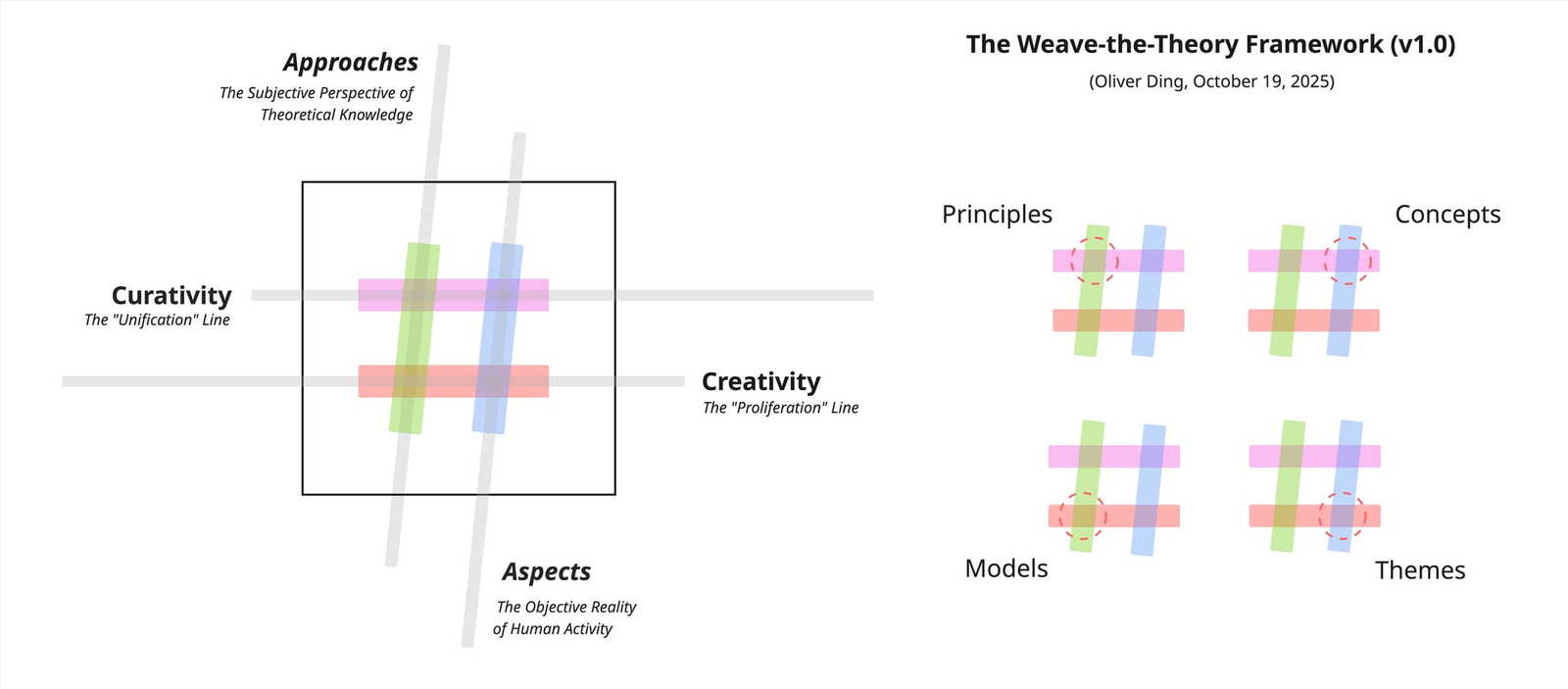
The two lines are: the Creativity Line — the "Proliferation" line, representing the expansion and generation of new ideas at a more concrete level; and the Curativity Line — the "Unification" line, representing the integration and synthesis of existing ideas at a more abstract level. Along the Creativity Line sit Themes and Models; along the Curativity Line sit Concepts and Principles.
The four weave-points — Theme, Model, Concept, Principle — are not sequential stages but intersecting dimensions of the same theoretical activity. A Theme is a lived, practiced inhabitation of an idea, giving it the texture of experience. A Model is the structural map of how that practice unfolds — its internal dynamic. A Concept is the precisely defined theoretical proposition, grounded in prior intellectual traditions, that the Theme and Model express. A Principle is the governing insight that unifies the whole — the most abstract claim that the theoretical development earns the right to make.
This article uses the framework in a specific way: taking Creative Watershed as the starting weave-point — the Theme — and then asking what larger theoretical context surrounds it. What Model does it generate? What Concept does it express? What Principle governs it? In this way, the Weave-the-Theory Framework does not merely describe Creative Watershed. It situates it within a living theoretical system — showing how a named practice connects upward to abstract principles and outward to a wider conceptual ecology.
The four sections that follow present the weave-points in a deliberate order: Theme and Model first (Creativity Line), then Concept and Principle (Curativity Line), moving from the concrete to the abstract.
Part 3. Theme: Creative Watershed
A Theme, in the Weave-the-Theory Framework, is a lived, practiced inhabitation of an idea — the texture of experience that gives it reality. The watershed theme inhabited my creative life long before I named it. It surfaced gradually, then unmistakably, across the articles published in the April 2026 update to the Activity Analysis Center.
3.1 Creative Watershed vs. Crossing the Watershed
Before surveying the stories themselves, a naming question deserves attention. Until today, I had been using the word "watershed" informally — as a descriptor for moments of structural change, without elevating it to a formal pattern name. Today, I formally name this pattern Creative Watershed.
Why Creative Watershed, and not Crossing the Watershed?
Both names are available within the same thematic space. The difference lies in their orientation. When we say Creative Watershed, we use it as a noun — it names a terrain, a topographic feature, a structural configuration. When we say Crossing the Watershed, we use it as a verb phrase — it names an action, a movement, a practice. Both are valid, and ultimately, both will be used. They are not mutually exclusive.
My current preference for Creative Watershed is that it directly and clearly names the terrain first. Once the terrain is mapped, Crossing the Watershed follows naturally as the corresponding practice pattern. Furthermore, the noun form fits more naturally into the typological scheme I developed in the Strategic Life Narrative book draft (January 2025), which organized twelve practice types into three groups — the "Theme" Group, the "Practice" Group, and the "Space" Group — all carrying the "Creative ___" prefix. Crossing the Watershed belongs in the "Space" Group, where it will eventually join Creative Projects, Creative Works, Creative Centers, and Creative Platforms as a distinct type of Strategic Life Narrative practice.
The naming is, in itself, an act of objectification — the watershed becomes a thing that can be studied, used, and strategically engaged.
3.2 Story: October 2018 — The Practitioner Crosses into the Theorist
The most explicit watershed in the materials is October 2018, which serves as the organizing axis of A Chronicle of Revisiting–Rebuilding Practice (September 2025 – March 2026).
That month marks the moment when sustained theoretical book-writing became my primary creative mode. The shift was not announced or planned. It crystallized in practice: the first major manuscript, written between October 2018 and March 2019, covering the theme of Curativity across 615 pages. Before October 2018, my creative work was carried out primarily through conceptual decks, practical frameworks, and community engagement. The output form was slide-based and practice-oriented, designed to serve clients and communities. After October 2018, the book manuscript became the dominant medium. More than forty drafts followed over the subsequent years.
This shift in creative identity — from practitioner to theorist — was the basis for organizing the RR archive into two parts. The significance of this division is not merely chronological. When a present self revisits material created by a past self who inhabited a different creative identity, the revisiting tension is at its greatest: the distance crossed is not only temporal but identity-level. The two sides of the watershed are not simply earlier and later; they are inhabited by different selves with different methods, purposes, and relationships to knowledge.
The watershed of October 2018 retrospectively reorganized the entire archive. It revealed that what appeared to be a continuous journey had a hidden structure — a topology with a fold at its center. The fold had always been there. The chronicle made it visible.
3.3 Story: The Activity U Project — 2020 as the Center of a Decade
The second watershed story appears in Appropriating Activity Theory #15: Before, After, and Watershed, where I reflect on a decade of engaging with Activity Theory (2015–2025).
On December 31, 2022, I drew a diagram to map that journey. In constructing the diagram, I chose the Activity U project (2020) as the central point — the watershed of the decade-long engagement. Before 2020, my engagement with Activity Theory was focused on HCI practice reflection: I read theoretical books and articles, but without broad exploration or deep independent thinking about Activity Theory as a whole. After 2020, I expanded beyond HCI, examined Activity Theory in its full scope, and began developing my own original theoretical concepts and knowledge frameworks.
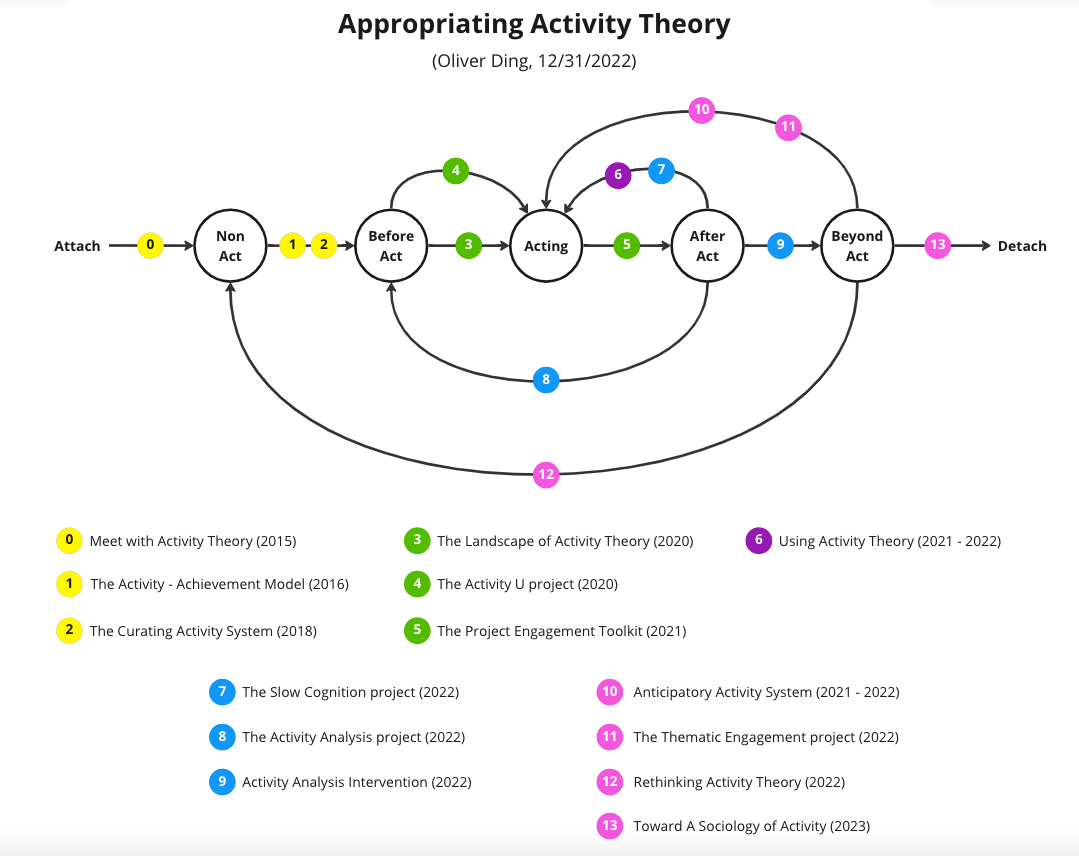
Two significant outcomes of the Activity U project — Life as Activity (v0.3) and Project Engagement (v1.0) — have since evolved through multiple versions and generated a series of book manuscripts. The Activity U project remains, even looking back from 2026, the unmoved center of the journey. Chronologically, 2020 sits in the middle of 2015–2025, which makes it fitting as the dividing line. But the significance is structural rather than arithmetic. The Activity U project was the moment of expansion: the moment when a practitioner reading became a theorist developing.
This watershed is nested within the one that preceded it. October 2018 marked the shift from practitioner to theorist — opening a new identity and a new trajectory. The Activity U watershed of 2020 occurred inside that trajectory: a shift in intellectual scope within the theorist's journey, from domain-specific engagement with Activity Theory to full-spectrum theoretical development. The 2020 watershed presupposes the 2018 one; it could not have occurred without it.
3.4 Story: AAT Column Issue #9 — From Revisiting to Revisiting-Rebuilding
Within the shorter timescale of a few months, a watershed emerged in the operation of the Appropriating Activity Theory (AAT) column.
The column was launched shortly after the completion of Homecoming in September 2025. Initially, its mode was straightforward: revisiting past material, tracing how earlier concepts had developed into their current forms. Each article traveled through time, showing the evolution of a diagram, a model, a framework.
The structural turn came with Issue #9 (January 2026). The trigger was an email exchange with a friend — an education researcher — who mentioned Donald Schön's concepts of "high ground" and "swamp." This prompted a return to the 2021 manuscript The ECHO Way: When Theory Meets Practice. The private exchange was intense and generative. The ECHO Framework was now readable at a new level of social complexity, expanded through the Cultural Projection Model and connecting individual cognitive moves to the social ecology of practice.
With Issue #9, the column's mode shifted. It was no longer simply revisiting — it was revisiting and rebuilding simultaneously. The present theoretical development was determining which past materials became relevant; the past was being summoned by the present, not excavated for its own sake. I wrote at the time: "Previously, I focused on revisiting the past and writing its story. Now, the column immerses in the present, returns to the past, and moves toward the future."
This shift was named: Revisiting-Rebuilding (RR). The watershed between pure Revisiting and Revisiting-Rebuilding was Issue #9 — a single editorial decision that reorganized the entire subsequent operation of the column. Before it, the relationship to the past was archival. After it, the relationship was generative.
3.5 Story: The Theme–Concept–Framework Transformation — 2025 as Closure and Opening
The article The "Theme–Concept–Framework" Transformation (2023–2026) describes a watershed of a different type: not a shift in method or medium, but the completion of a long arc.
From 2023 to 2025, the Theme–Concept–Framework Transformation Model guided my exploration into the development of knowledge systems. The journey progressed through a sequence of book drafts, each representing a stage of maturation: from Clues (Meaning Discovery, January 2024) through Themes, Concepts, Frameworks, and Meta-Framework, arriving at Meta-Frameworks (Meta-frameworks, December 2025).
The release of Meta-frameworks on December 31, 2025, marked the completion of the Knowledge System layer. The long arc from Clues to Meta-Frameworks had closed. But the article's insight is not simply that a journey ended — it is that the ending was also a beginning. Meta-frameworks did more than complete a sequence: it marked a watershed. The act of closing a rich history met the act of unfolding a new future.
Specifically, the completion of Meta-frameworks coincided with — and enabled — a strategic pivot from Individual Life Development to Cultural Life Development. The switching from the Self–Life–Mind schema to the HLS framework marks this shift. What came before was organized around the individual actor developing knowledge; what comes after is organized around the cultural projection of that knowledge into collective contexts. The watershed of December 2025 is therefore not merely an endpoint on a timeline. It is a topographic shift: the terrain that opens after it runs in a different direction from the terrain that led up to it.
3.6 Story: A Watershed of Creative Life — Meta-frameworks as Nexus-Point
The article A Watershed of Creative Life (April 14, 2026) stands apart from the others as a first-person, large-scale retrospective: the author looking back across the full arc of their creative development and naming the point where a rich history closes and a new future opens.
The article was originally the epilogue of Meta-frameworks, titled "Beyond Creative Life: Toward the World of Life." Its republication as a standalone piece signals that this moment of retrospective self-awareness has itself become a theoretical resource.
The watershed described here is at the scale of a creative life. The World of Life (World of Activity) approach marks a nexus-point where the act of Closing a rich history meets the act of Unfolding a new future. What makes this watershed distinctive is its reflexivity: it is a watershed about watersheds, a moment of standing at the divide and seeing the full landscape on both sides. The author is not simply crossing a threshold — they are mapping the topography of crossing itself.
This article is, in a sense, the theoretical origin point of the present article. The watershed was first lived; then named; now it is being theorized.
3.7 Practice-Based Reflection
Taken together, these six stories reveal several recurring features of Creative Watershed as a pattern.
First, watersheds appear at multiple scales — a decade (Activity U, 2020), a multi-year arc (Theme–Concept–Framework, 2025), a period of months (RR column, Issue #9), a single event in another's life (Maya's graduate program). The scale varies, but the structural logic is consistent: a before and an after, separated by a significant shift.
Second, watersheds often involve a change in identity — not merely a change in output or method. The October 2018 watershed separated a practitioner self from a theorist self. Maya's watershed separated a coaching identity from an emergent, unnamed one. The December 2025 watershed separated Individual Life Development from Cultural Life Development. The before and after are not merely different phases of the same self — they may be inhabited by selves with different orientations, purposes, and relationships to the world.
Third, watersheds are frequently recognized retrospectively. The October 2018 watershed was named in 2025, years after it occurred. Maya had already crossed her watershed before the coaching engagement helped her see it. This retrospective character does not diminish the watershed — it is part of its nature. The terrain only becomes visible from a certain altitude, and altitude requires time.
Fourth, and perhaps most importantly, recognizing a watershed is itself a creative act. It is not simply observation; it is objectification — the transformation of a lived experience into a named, theorizable structure. This is where the Theme phase of Weave-the-Theory does its work: it turns inhabitation into material for theoretical development.
Fifth, a Creative Watershed involves a transformation of cognitive terrain — and with it, a shift in the mental moves and social moves available to the actor. Maya's case makes this particularly visible: her graduate program did not erase her existing Center, but it expanded the cognitive terrain so significantly that the Center, measured against the new scale, appeared smaller than before. What had been the whole field became one region within a larger landscape. The Center did not disappear — but its relative position, its weight, its sufficiency as an organizing principle, all changed.
My own watershed cases involve similar transformations, though often more directional than scalar. The shift from practitioner to theorist was not simply an expansion of terrain — it was a reorientation of the entire cognitive and action landscape: different questions became primary, different methods became appropriate, different communities became relevant. Before and after a Creative Watershed, the mental moves one makes — how one frames problems, selects concepts, develops arguments — and the social moves one makes — how one engages with others, builds communities, positions work — can differ substantially. The watershed is not just a marker on a timeline; it is the point at which the operating logic of a creative life changes.
Part 4. Model
When I attempt to understand these watershed stories through the knowledge frameworks I have developed over the years, something unexpected appears: many of those frameworks carry watersheds within them, embedded in their structure. Some are explicit — the watershed is marked in the diagram. Others are implicit — the watershed has to be inferred from the logic of the model. Together, they form a set of structural models for understanding what Creative Watershed looks like at the level of form.
4.1 The Ecological Transformation Framework (2018)
On December 31, 2022, I used the Ecological Transformation Framework (originally called the Attachance Framework) to reflect on my journey of engaging with Activity Theory from 2015 to 2022. The framework uses Far — Near — With — Near — Far as a spatial structure, corresponding to three types of experience: Non-Experience (Far), Quasi-Experience (Near), and Real-Experience (With).
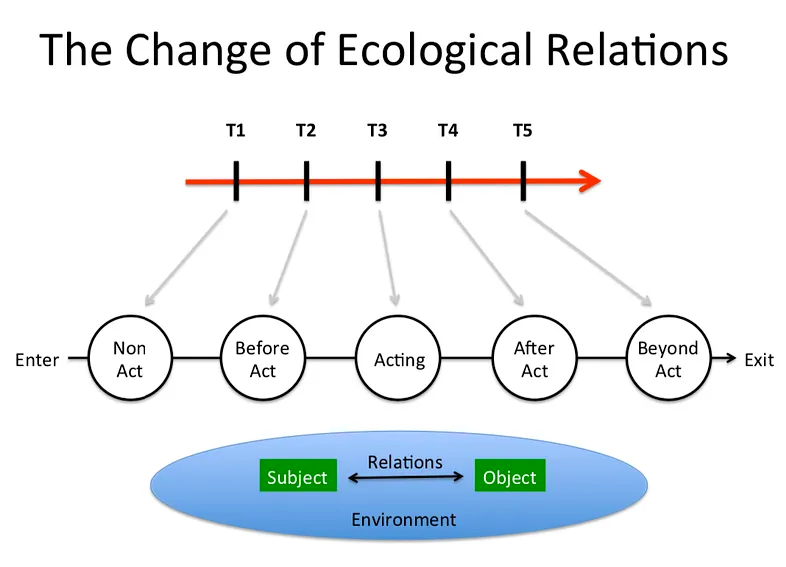
In this model, the watershed is With. This is a counterintuitive insight: in a long journey measured across years, the moment of genuine, intimate engagement — of real, interaction-based experience — is not the default state but the exceptional one. Far is the common condition. Near is already an achievement. With is rare enough to mark a genuine turning point.
This gives the Creative Watershed an unexpected valence. It is not merely a divide between two phases; it is a moment of maximum contact, maximum reality. The watershed is not a rupture but a with-ness — and if that with-ness is sufficiently creative, it readily generates a Creative Watershed in the fuller sense. What comes before is the approach; what comes after is the departure. The with is the peak.
4.2 The Creative Thematic Curation Framework (2022)
The Creative Thematic Curation Framework, originally called the Creative Life Curation framework and introduced in my November 2022 book draft, outlines five movements of thematic engagement. The diagram is inspired by the sandglass — and its structure makes the watershed immediately visible.
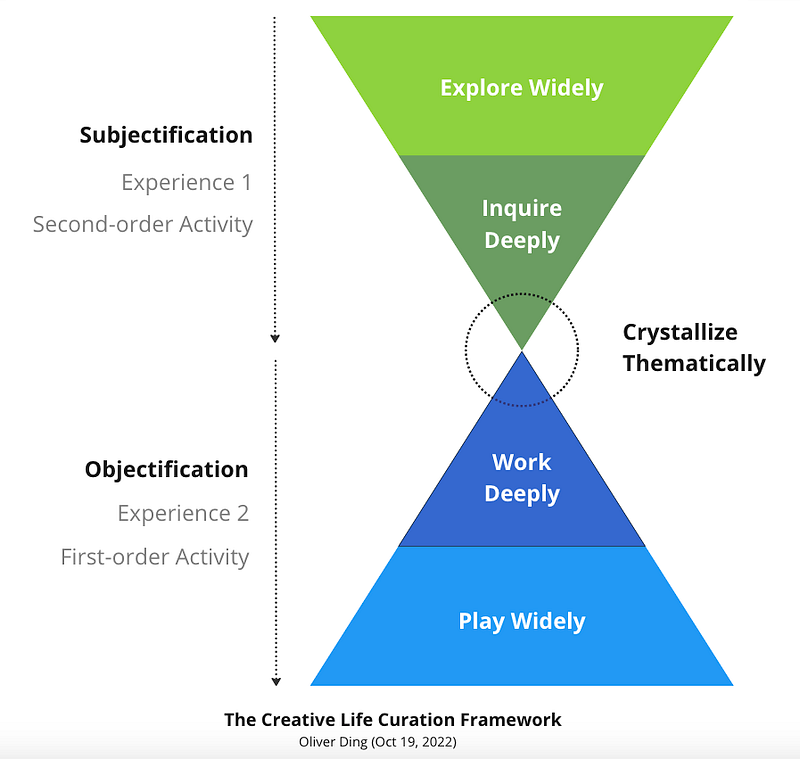
The five movements are: Explore Widely → Inquire Deeply → Crystallize Thematically → Work Deeply → Play Widely. The framework further divides these into two tendencies: Subjectification (turning the world into a person's experience) and Objectification (turning the person's experience into artifacts for the world). These two tendencies echo Second-order Activity and First-order Activity, respectively.
The watershed is Crystallize Thematically — the narrowest point of the hourglass, where the two tendencies reverse direction. Before it, the movement is inward: the world becomes experience. After it, the movement is outward: experience becoming artifact. The orientation is completely inverted at this point.
My journey developing the theme of Curativity offers a concrete example: the "Crystallize Thematically" movement was marked by coining the term "Curativity" itself and writing the 615-page manuscript between October 2018 and March 2019 — which is, notably, the same watershed as Part 3.2. The model and the story illuminate each other.
4.3 The Anticipatory Activity System (AAS) Framework (2021)
The Anticipatory Activity System (AAS) Framework, inspired by Activity Theory and Anticipatory System theory, offers an abstract model for understanding "Self, Other, Present, Future." Its primary conceptual pair is First-order Activity (goal-directed activity) and Second-order Activity (discovering a goal for First-order Activity).
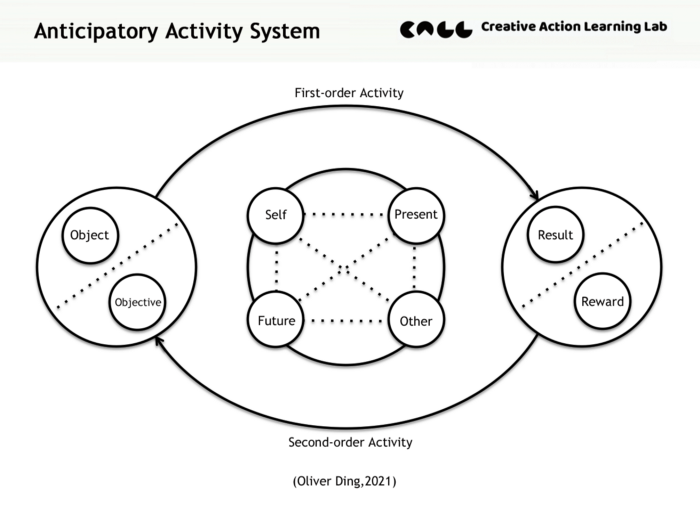
The two activity types connect end-to-end, forming a self-referential system. First-order Activity ends with results, rewards, and resources feeding into subsequent activity. That subsequent activity may continue as First-order Activity or switch to Second-order Activity to explore new directions and objectives. Second-order Activity ends with one or more new objectives; selecting among them designates a new First-order Activity and begins a new cycle.
Unlike the previous frameworks, the AAS does not display a watershed as obviously in its diagram, but the two watersheds are structurally present. They occur at the transition points between the two types of activity: the shift from First-order to Second-order Activity, and the shift from Second-order back to First-order Activity. These two watersheds face each other across the cycle; they are not linear but circular, each leading to the other.
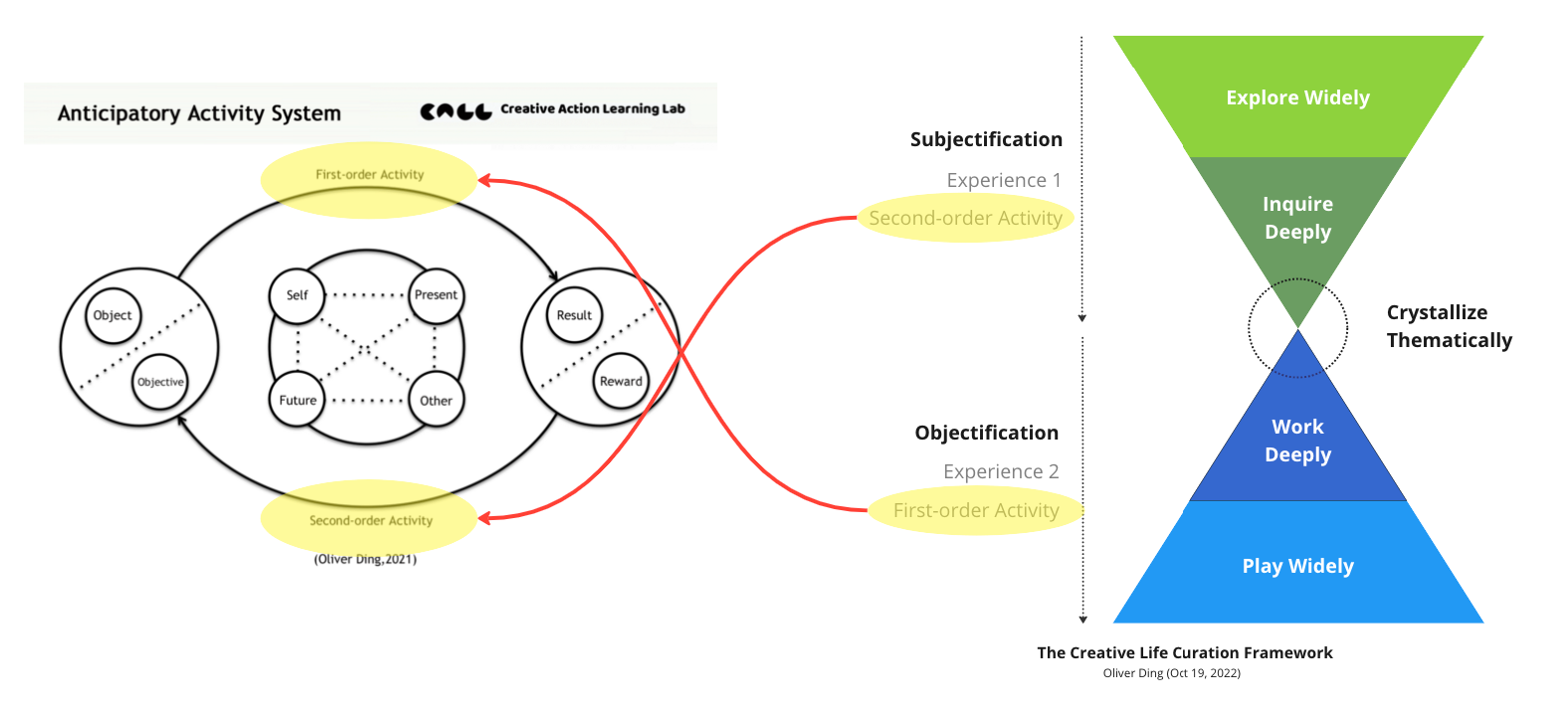
This reveals something important: the watershed concept is not limited to linear models. In the AAS, the two watershed moments form a loop — and the loop is the creative life. The practitioner and the theorist are not two separate people divided by a single watershed; they are two phases of a cycle that continues to turn.
4.4 Supportive Life Discovery (2026)
The Supportive Life Discovery framework (2026) employs the L3D model (Learn–Discover–Design–Deliver) as its basic structure, and specifies the Achievement Chain for the SLD context:
Flow → Focus → Coordinate → Center → Circle
The L3D model divides naturally into two groups: Learn–Discover, which tends toward Subjectification (developing new insight from the world), and Design–Deliver, which tends toward Objectification (transforming insight into creations for others). This resonance with the Creative Thematic Curation framework is not accidental — both frameworks encode the same fundamental directional shift.
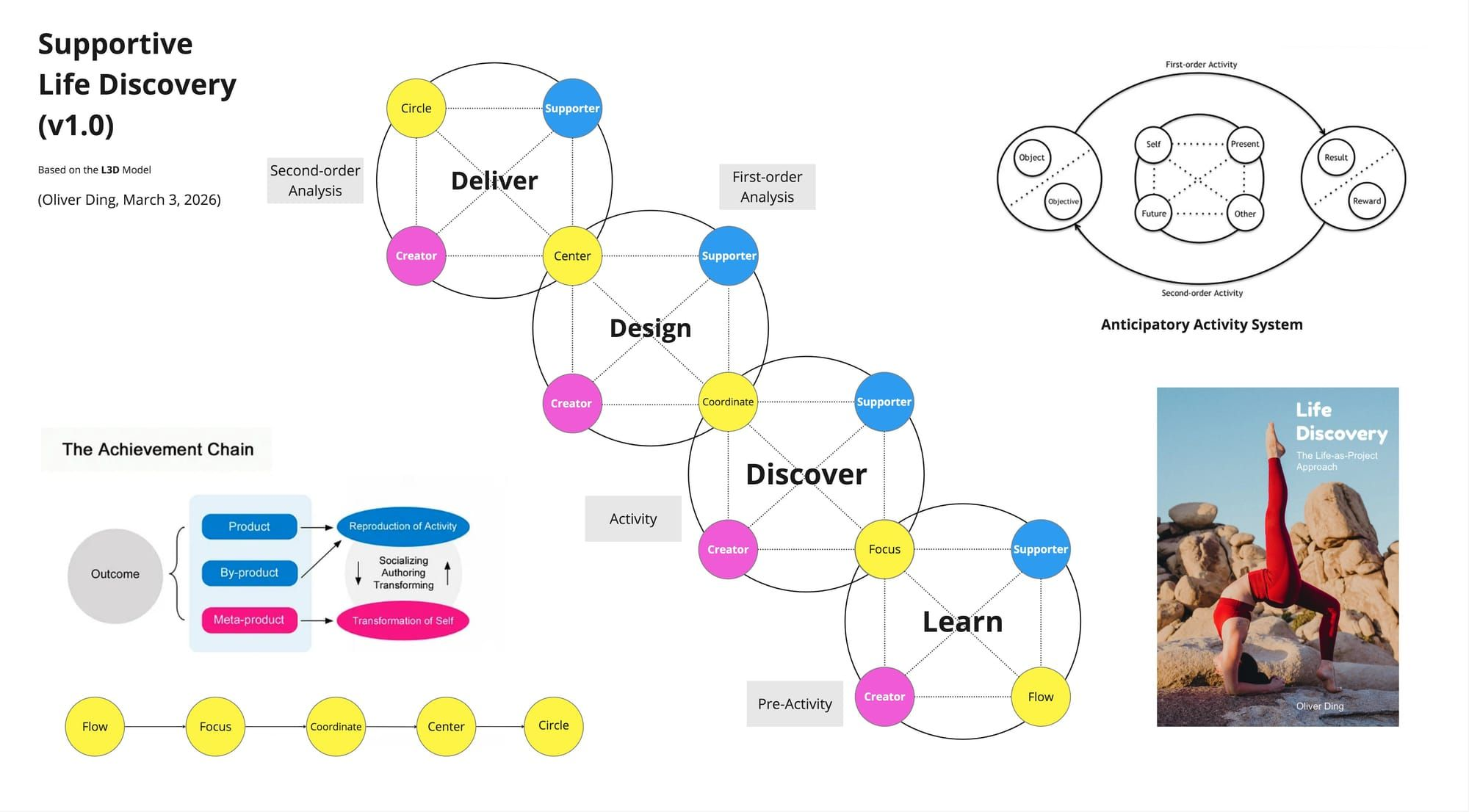
In the SLD Achievement Chain, I deliberately added Coordinate at the center point, making the hidden watershed of the L3D model explicit. Coordinate is the pivotal transition: what genuine Discover activity produces, and what makes Design and Deliver possible. Before Coordinate, the engagement focuses on reflective thinking. After Coordinate, the engagement shifts to actual actions. The Coordinate is the watershed of the program.
This is further confirmed in the Cognitive Hydrology Pedagogy (v1.0), where the Achievement Chain reads: Cognitive Flood → Creative Flow → Mental Model → Thematic Creation → Theoretical Innovation. Here, Mental Model is the watershed — resonating exactly with Coordinate, and with Crystallize Thematically from the Creative Thematic Curation Framework. Three frameworks, three different names for the same structural position: the center point at which inward subjectification turns into outward objectification.
Part 5. Concept: Creative Watershed
Moving from the Creativity Line to the Curativity Line means moving from the concrete to the abstract — from the lived practice and its structural models to the underlying concept that gives them their theoretical coherence. The question is: what is the deeper idea that Creative Watershed expresses?
The answer arrives through the Ecological Formism Framework, which I used in Mapping Creative Dialogue (2024) to develop the basic form of Creative Dialogue. The strategy is: to identify the most abstract, invariant structure that the pattern expresses — its Basic Form.
The Ecological Formism Framework uses "Variant → Quasi-invariant → Invariant → Invariant Set" as its foundational structure:
- Invariant: Basic Forms
- Invariant Set: Frames
- Quasi-invariant: Derived Forms
- Variant: Frameworks
The Basic Form of Creative Watershed is:
Before | After
This is its most elemental expression: two states, separated by a dividing line. The vertical bar is the watershed itself.
The Derived Form is the ecological metaphor "Watershed" — the geographical image of a ridge that divides drainage basins, where water on one side flows toward one ocean and water on the other flows toward another. It is a perfect embodiment of Before | After: same ridge, opposite flows.
But Watershed is not the only Derived Form of Before | After. Looking across the patterns explored within Dramatic Life Pattern, a family of ecological metaphors emerges — each capturing a different face of the same Basic Form:
- Creative Watershed: the ridge that divides two phases of a creative life, where the terrain on each side runs in different directions
- GAP Projects: the gap between formal projects — the interval space that Before and After jointly create, and that becomes a structural opportunity in its own right
- Revisiting–Rebuilding: the movement that crosses back from After to Before, and returns to After transformed — a creative traversal of the divide
- Closure and Opening: the moment where Before completes itself and After becomes possible, as in the completion of Meta-frameworks and the pivot toward Cultural Life Development
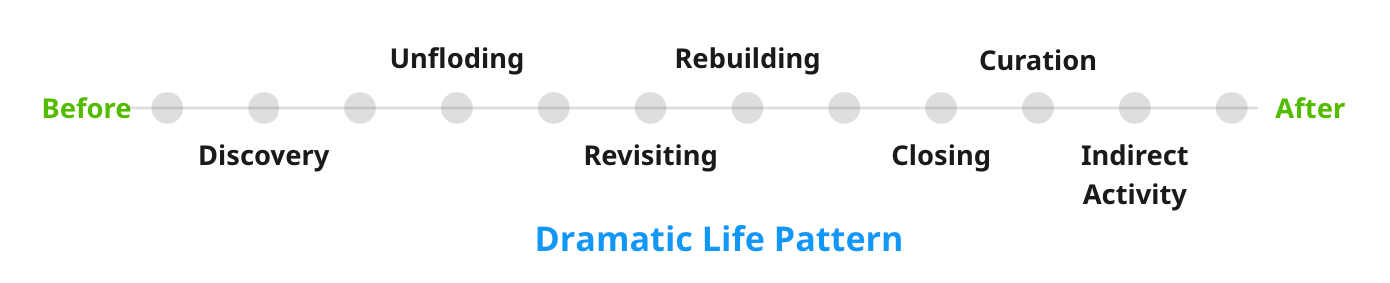
These are not unrelated patterns that happen to share a temporal flavor. They are all Derived Forms of the same Invariant — Before | After — each elaborated through a different ecological metaphor, each operative in a different structural context. This means that the temporal dimension of Dramatic Life Pattern has a unified theoretical foundation: the Before | After basic form underlies the entire family of patterns concerned with how a creative life unfolds across time.
The Frameworks are the models discussed in Part 4 — the Ecological Transformation Framework, the Creative Thematic Curation Framework, the AAS, and the SLD Achievement Chain. Each is a variant expression of the same underlying form, elaborated in a specific context with specific content.
Before | After is one of six ecological basic forms developed in my 2025 book Homecoming:
- Before–After
- Slow–Fast
- Up–Down
- Left–Right
- Inside–Outside
- Center–Periphery
These ecological basic forms are pre-linguistic, embodied experiences rooted in human spatial cognition. Just as elementary mathematics provides the foundation for higher-level mathematics, these basic ecological forms serve as the foundation for adult social cognition. Creative Watershed is the specific elaboration of Before–After in the domain of creative development — the Before | After basic form made visible, named, and theoretically operative in a creative life.
Part 6. Principle: Ecological Social Forms
The Principle is the most abstract level of the Weave-the-Theory Framework — the governing insight that the entire theoretical development earns the right to make. For Creative Watershed, the governing principle is Ecological Social Forms: the claim that significant social and creative forms are not arbitrary cultural constructions, but are grounded in pre-linguistic, embodied, and ecological experiences that human beings share. This principle does three things for Creative Watershed: it validates the ecological metaphor, it explains the fractal structure, and it provides a systematic analytical toolkit for understanding what actually changes when a watershed occurs.
6.1 From Embodied Experience to Social Form
The principle that governs Creative Watershed is Ecological Social Forms — a theoretical commitment that I developed within Anticipatory Cultural Sociology (ACS) in January 2026. Originally named "Embodied Social Forms," it was recently renamed to emphasize that the body is not the only ecological scale at work: the broader environment and its affordances also contribute to the forms through which social life is experienced and organized.
The sequence this principle describes is:
Body → Embodied Experience → Ecological Basic Forms → Cultural Interpretation (linguistic encoding + situated context) → Significant Social Forms
This sequence shows how pre-linguistic bodily and ecological experiences are gradually transformed into socially meaningful forms through cognitive and cultural processes. The principle distinguishes this approach from Georg Simmel's classical theory of social forms, which did not systematically address the embodied and ecological basis of social forms. A similar orientation has been adopted in cognitive linguistics; sociology has rarely gone this far.
6.2 Trust the Ecological Metaphor
What this principle tells us about Creative Watershed is direct: when we encounter a watershed in our creative life, the right first move is to understand it through its ecological metaphor — to trust the geographical image. A watershed is a Before | After structure in which the terrain has shifted significantly. Understanding it that way is not merely poetic; it is epistemically correct, because the ecological basic form is the pre-linguistic foundation from which the theoretical concept derives its validity.
Once the terrain is understood through its ecological metaphor, the next move is to go to the models: to examine, across the different dimensions of the frameworks, what the specific before and after consist of — and how they interact. The Ecological Transformation Framework tells us about the relational dimension (Far vs. With). The Creative Thematic Curation Framework tells us about the directional dimension (Subjectification vs. Objectification). The AAS tells us about the activity-type dimension (First-order vs. Second-order). The SLD tells us about the developmental trajectory (reflective vs. active engagement). Each framework illuminates a different face of the same terrain.
And once the terrain is mapped, the principle offers a further possibility: we can introduce Creative Watershed as a strategic landmark in our predictive models and strategic frameworks. To recognize a Creative Watershed — whether in our own history or in someone else's — is not merely to describe a past. It is to gain orientation for what comes next. Before tells us what accumulated. After tells us what became possible. The watershed itself tells us where the turn occurred.
6.3 Watersheds Are Fractal
The stories in Part 3 suggest a further structural insight: watersheds are fractal. The October 2018 watershed opened a new identity — the theorist. Within that identity, the Activity U project of 2020 formed a nested watershed: a Before | After within the After. Within that theorist's journey, the AAT column's Issue #9 formed yet another nested watershed: from Revisiting to Revisiting-Rebuilding. Each watershed contains smaller watersheds within it; each Before | After can itself be divided by a new Before | After at a finer scale.
This fractal character addresses a potential objection to the watershed concept. Once we identify a watershed in a creative life, there is a risk of oversimplification: the rich complexity of a lived journey gets flattened into a linear before-and-after, two clean phases separated by a single turning point. The world is more complex than that — and the concept should be too.
The fractal insight resolves this tension. Watersheds at different scales coexist without canceling each other. The large-scale watershed does not erase the smaller ones nested within it; the smaller ones do not dissolve the larger structure. A creative life can be organized around a decade-level watershed and simultaneously contain year-level, month-level, and event-level watersheds — each real, each structurally significant at its own scale. Complexity is preserved, not flattened.
Geography offers the same pattern: a continental watershed contains regional watersheds, which contain local ones, all the way down to the ridge between two puddles after rain. The ecological metaphor, once again, is epistemically trustworthy. Creative Watershed inherits this fractal property from the Before | After basic form itself — and with it, the capacity to describe a creative life in its full, multi-scale complexity.
This is the ecological validity the principle promises: understanding that applies not just to theory but to life — validating knowledge through its consequences in one's own ecological context.
6.4 The Six ACS Mechanisms as Analytical Lens
A further analytical tool emerges from the Anticipatory Cultural Sociology (ACS) framework. When I established ACS in January 2026, I proposed five dynamic mechanisms that drive cultural innovation: Mental Moves, Social Moves, Project Engagement, Strategic Curation, and Generative Narrative. A sixth mechanism has since been added: Thematic Creations. These mechanisms were originally formulated for ACS, but since ACS and SDP share a common ontological model of the social world, they apply equally to SDP — and therefore to the analysis of Creative Watershed within the Dramatic Life Pattern dimension.
These six mechanisms can serve as a systematic lens for analyzing any Creative Watershed — examining, across each dimension, what changed before and after, and how those changes interact. The questions become concrete:
- Mental Moves: How did the actor's cognitive operations shift? What new ways of framing, selecting, and developing concepts became available after the watershed?
- Social Moves: How did the actor's patterns of engagement with others change? Which communities became relevant, which receded?
- Project Engagement: What types of projects became possible, necessary, or meaningful after the watershed that were not before?
- Strategic Curation: How did the actor's relationship to their own archive and accumulated knowledge change? What got revalued, repurposed, or released?
- Generative Narrative: How did the story the actor tells about their creative life shift? What new narrative became available to organize the before and after?
- Thematic Creations: What new themes, artifacts, or creative outputs became possible after the watershed — and what does their emergence reveal about the nature of the shift?
Used together, these six mechanisms transform Creative Watershed from a descriptive concept into a diagnostic and predictive instrument. A watershed can be analyzed by mapping the before-and-after profile across all six dimensions. Patterns in that profile — which mechanisms shifted dramatically, which remained stable — can inform both retrospective understanding and prospective strategy. Recognizing that a watershed is approaching, or has recently occurred, becomes an occasion for deliberate engagement rather than passive experience.
v1.0 — April 21, 2026
Postscript: Two Applications of Weave-the-Theory in Dramatic Life Pattern
This article is the second application of the Weave-the-Theory model to develop a pattern within the Dramatic Life Pattern dimension. The first was Weave the Theory: A Case Study of the Revisiting–Rebuilding Practice (March 22, 2026). Having now completed both, it is worth reflecting on what the two applications reveal about the method itself.
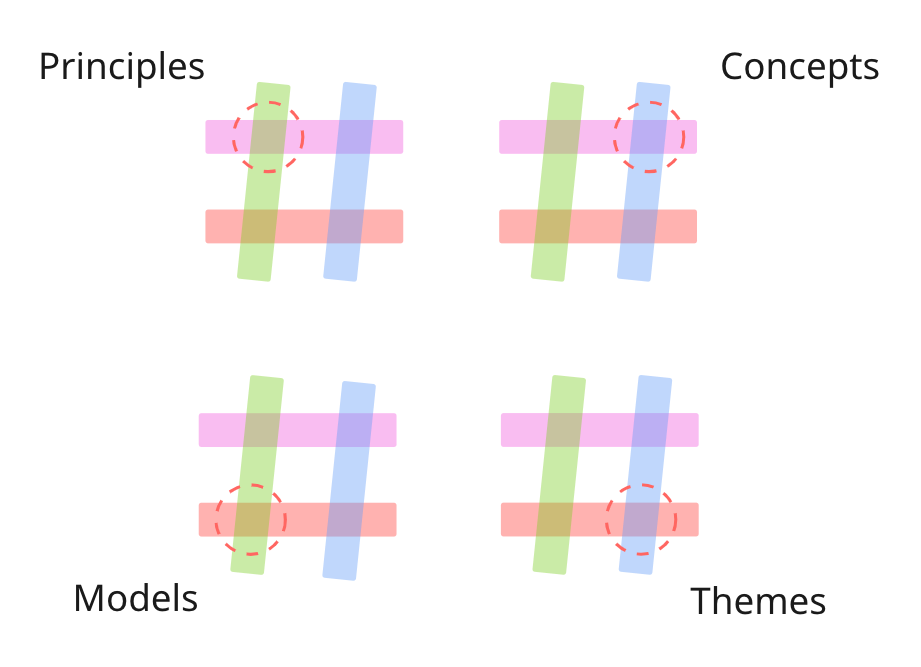
The Theme–Model relationship is not fixed. In the RR case, the Theme was an active, evolving practice, and the Models — the AA model and the Creative Identity Cascade — emerged organically from within that practice. Practice generated model. In the Creative Watershed case, the Theme was a retrospectively recognized pattern, and the Models were existing theoretical frameworks that were re-examined to reveal the watershed structure already embedded within them. Pattern illuminated pre-existing models. These are two genuinely different relationships between Theme and Model, both valid within the Weave-the-Theory framework. As more patterns are developed through this method, further varieties of Theme–Model relationship will likely emerge — and those varieties are themselves theoretically informative about how Dramatic Life Patterns are discovered and developed.
The Principle does not arrive fully formed. In both cases, the Principle section was the last to take shape and the hardest to develop. In the RR case, the governing principle — L(A·R·G)=E — was an existing framework applied with precision. In the Creative Watershed case, the Principle began as a theoretical commitment (Ecological Social Forms) and gradually accumulated layers through the writing process itself: the ecological metaphor as epistemic foundation, the fractal structure as a response to the linear oversimplification objection, and the six ACS mechanisms as a diagnostic toolkit. The Principle was not found; it was built. This suggests that in Dramatic Life Pattern work, the Principle level is where the deepest theoretical contribution tends to reside — and that it rewards patience and iterative reflection rather than premature closure.
The Concept level reveals the theoretical family. In the RR case, the underlying concept was Re-Engagement — a concept with a specific birth story (March 2020, the pandemic, SXSW cancellation) and a traceable intellectual lineage. In the Creative Watershed case, the underlying concept was Before | After — one of six ecological basic forms, pre-linguistic and embodied, serving as the invariant foundation for an entire family of Dramatic Life Patterns. This discovery — that Before | After underlies not just Creative Watershed but also GAP Projects, Revisiting–Rebuilding, and Closure-Opening — was unexpected. It gives the Concept level a double function: not only grounding the specific pattern theoretically, but also revealing its relationship to other patterns within the same theoretical family.
The method matures through use. The first application established the structure; the second confirmed it while revealing its flexibility. With two cases in hand, it becomes possible to see the Weave-the-Theory model not as a fixed template but as a living heuristic — one that adapts to the character of each pattern while maintaining enough consistency to enable comparison across cases. Future applications will continue to test and refine the method, building toward a systematic theory of Dramatic Life Pattern grounded in empirical practice.
April 21, 2026
Appendix: Source Articles
The watershed stories documented in Part 3 draw on a collection of articles published in the April 2026 update to the Activity Analysis Center. Readers wishing to explore the cases in greater depth are encouraged to consult the sources:
- Appropriating Activity Theory #15: Before, After, and Watershed (April 15, 2026) — The decade-long journey of engaging with Activity Theory, with October 2018 and the Activity U project (2020) as watersheds; and the AAT column's transition from Revisiting to Revisiting-Rebuilding at Issue #9.
- The "Theme–Concept–Framework" Transformation (2023–2026) (April 13, 2026) — The completion of the Knowledge System arc from Clues to Meta-Frameworks, and the strategic pivot from Individual Life Development to Cultural Life Development.
- Revisiting and Rebuilding: A Journey of Developing a New Practice (March 22, 2026) — The development of the RR practice as a new creative identity strategy, tracing how the practice emerged and matured.
- A Chronicle of Revisiting–Rebuilding Practice (September 2025 – March 2026) (March 23, 2026) — A detailed chronicle of six months of RR practice, organized around October 2018 as the central watershed of the archive.
- A Watershed of Creative Life (April 14, 2026) — A first-person retrospective on the full arc of Creative Life Theory development, naming Meta-frameworks (December 2025) as a nexus-point where a rich history closes and a new future opens.
v1.0 - April 21, 2026 - 6,724 words