
Activity Analysis Network #15: Dream, Watershed, and Dramatic Life Pattern

This is the 15th issue of the Activity Analysis Center newsletter
by Oliver Ding
April 15, 2026
Hi, and welcome to Activity Analysis Network, a newsletter hosted by the Activity Analysis Center.
Each issue is organized around the "Flow - Focus - Center - Circle" schema, the primary model of the World of Activity Toolkit (v1, 2025).
As a biweekly newsletter, I share summaries of new articles from the Activity Analysis Center, along with updates on related activities, including some of my own published work elsewhere.
In this issue (#15), 13 new articles have been added to the site:
- #1 - Appropriating Activity Theory #15: Before, After, and Watershed
- #2 - Concepts: [Meta-frameworks] Six Faces of the Concept System
- #3 - Frameworks: The "Theme–Concept–Framework" Transformation (2023–2026)
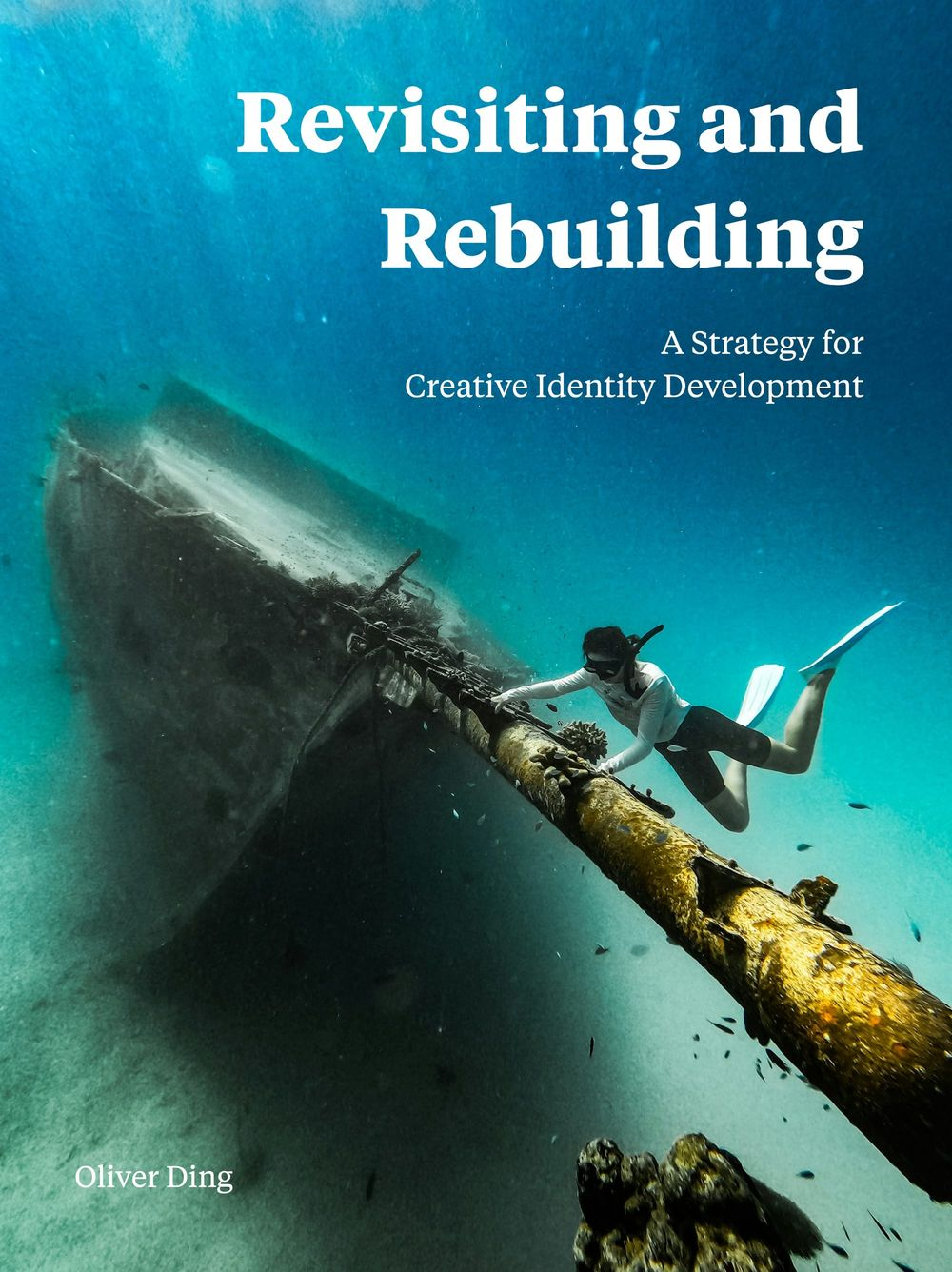
- #4 - Library: Revisiting and Rebuilding: A Strategy for Creative Identity Development (Possible Book, 2026)
- #5 - Methods: Revisiting and Rebuilding: A Journey of Developing a New Practice
- #6 - Case Studies: A Chronicle of Revisiting–Rebuilding Practice (September 2025 – March 2026)
- #7 - Case Studies: Weave the Theory: A Case Study of the Revisiting-Rebuilding Practice
- #8 - Case Studies: Two Constructions: Theoretical Statement and Historical Narrative in Creative Work
- #9 - Z Lab: The Landscape of Strategic Developmental Psychology (v1.2)
- #10 - Case Studies: A Watershed of Creative Life
- #11 - World of Activity: The World of Activity Toolkit (v2.0, 2026)
- #12 - World of Activity: The World of Activity of Mid-life
- #13 - World of Activity: [Case Studies] When the Circle Changes the Center
These articles represent three major milestones — and together, they tell a single story.
The first milestone is a new possible book on the Revisiting–Rebuilding (RR) practice (#4, #5, #6, #7): a strategy for creative identity development that has been taking shape over the past several months. The second is the emergence of "Watershed" as a named theme (#1, #3, #5, #6, #10, #13) — a pattern that cuts across a decade of creative work, now visible as one of the core examples of Dramatic Life Pattern. The third is the release of the World of Activity Toolkit v2.0 (#11, #12, #13): a significant upgrade that brings multiple knowledge frameworks into a single coherent structure.
The deeper connection: both RR and Watershed now belong to the third dimension of Strategic Developmental Psychology (SDP, v1.2) — Dramatic Life Pattern. The Curativity of Mind attends to how the mind works. Supportive Life Discovery attends to how others support our growth. Dramatic Life Pattern attends to how a creative life unfolds across time. This issue marks the moment that the third dimension came into focus.
Flow
The historical development of the Activity Analysis Center and my experience of daily life
Over the past two weeks, I published a collection of essays examining the RR practice (Revisiting‑Rebuilding). In editing the chronicle A Chronicle of Revisiting‑Rebuilding Practice (September 2025 – March 2026), I noticed that I had deliberately used October 2018 as a watershed.
This chronicle is organized around a single watershed: October 2018. That month marks the moment when sustained theoretical book‑writing became the primary creative mode — the transition from a practitioner identity to a theorist identity.
Before October 2018, the creative work was carried out mainly through conceptual decks, practical frameworks, and community engagement. After October 2018, the book manuscript became the dominant medium, and more than forty drafts followed over the subsequent years.
This shift in creative identity is the basis for dividing the archive into two parts: cases where the original material predates the watershed, and cases where it postdates it. The significance of this distinction is not merely chronological. When a present self revisits material created by a past self who inhabited a different creative identity, the RR tension is at its greatest — the distance crossed is not only temporal but identity‑level. When the revisiting stays within the same identity phase, the value is different: primarily one of creative heuristics, pattern recognition, and theoretical integration.
After editing that chronicle, “watershed” became a new theme for me. I began to wonder whether similar dividing lines existed in my decade‑long journey of appropriating Activity Theory. This issue of the "Appropriating Activity Theory" column is dedicated to that theme.
The theme did not stay confined to the column. It spread across the entire issue — appearing in case studies, method reflections, and life narratives, each approaching the same question from a different angle:
- #1 - Appropriating Activity Theory #15: Before, After, and Watershed
- #5 - Methods: Revisiting and Rebuilding: A Journey of Developing a New Practice
- #6 - Case Studies: A Chronicle of Revisiting–Rebuilding Practice (September 2025 – March 2026)
- #10 - Case Studies: A Watershed of Creative Life
- #13 - World of Activity: [Case Studies] When the Circle Changes the Center
Focus
The Thematic Foci of the Activity Analysis Center
In the last issue, the ACS framework was updated from v1.2 to v2.0 with a possible book. In the past two weeks, I moved to the Strategic Developmental Psychology (SDP) theoretical enterprise.
As the World of Life matured through three months of intensive ACS development — and particularly through the Double Square diagram, which had become a central spatial heuristic for mapping the relationship between the social world and the individual project — it became clear that the time had come to design a sign for SDP: a compressed visual form that could express its ontological foundations.
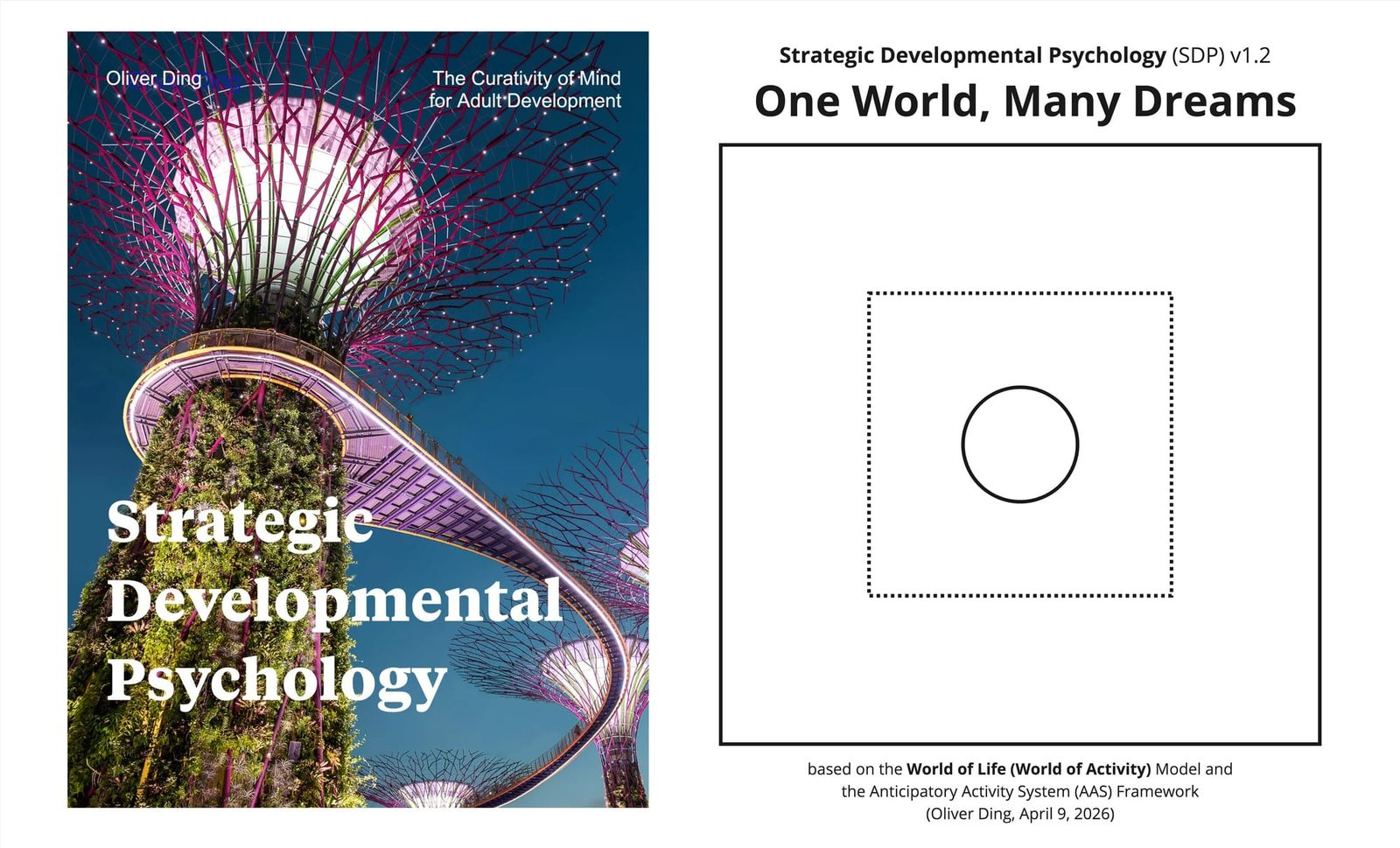
The SDP sign, finalized on April 9, 2026, consists of three concentric, center-aligned elements:
- Outer solid square — World of Life: the shared boundary of the social world
- Inner dashed square — World of Activity: each person's creative space, elastic and variable in size
- Solid circle, centered — the core of AAS: Self–Other–Present–Future
One World, Many Dreams.
The tagline requires careful interpretation. "Dream" here does not refer to the unconscious material of psychoanalytic tradition — Freud's dream as a window onto repressed desire. Nor does it refer to the short-term goals of action psychology, the proximal targets that motivate behavior in the near term. SDP's "Dream" points to something harder and longer: a person's conscious, sustained anticipation of a future they want to make happen, together with the long-term commitments that orient their life toward it.
The kinds of dreams SDP is interested in are the kind that require strategy precisely because they are difficult. Creating a new cultural enterprise. Developing a new theoretical discipline. Building something that does not yet exist and cannot be achieved through a simple sequence of planned steps. This is why "Strategy" needed to be brought into developmental psychology at all. Losing weight is a goal; it requires motivation and technique, not strategy in the deeper sense. But developing a new cultural enterprise — building it from a vague anticipation into a structured, sustainable trajectory — requires something more specific: Strategic Frameworks that orient decisions across time, Mental Platforms that support sustained creative work, and a clear understanding of what a Developmental Enterprise is and how it grows. These three concepts define the core of SDP's theoretical concern.
SDP is not interested in psychological health as a topic in itself. But it is deeply interested in the person who is developing a new theory of psychological health, or building software that changes how people access mental health support. How does such a person develop mental platforms and strategic frameworks? How do they advance their enterprise across years and decades? These are SDP's questions.
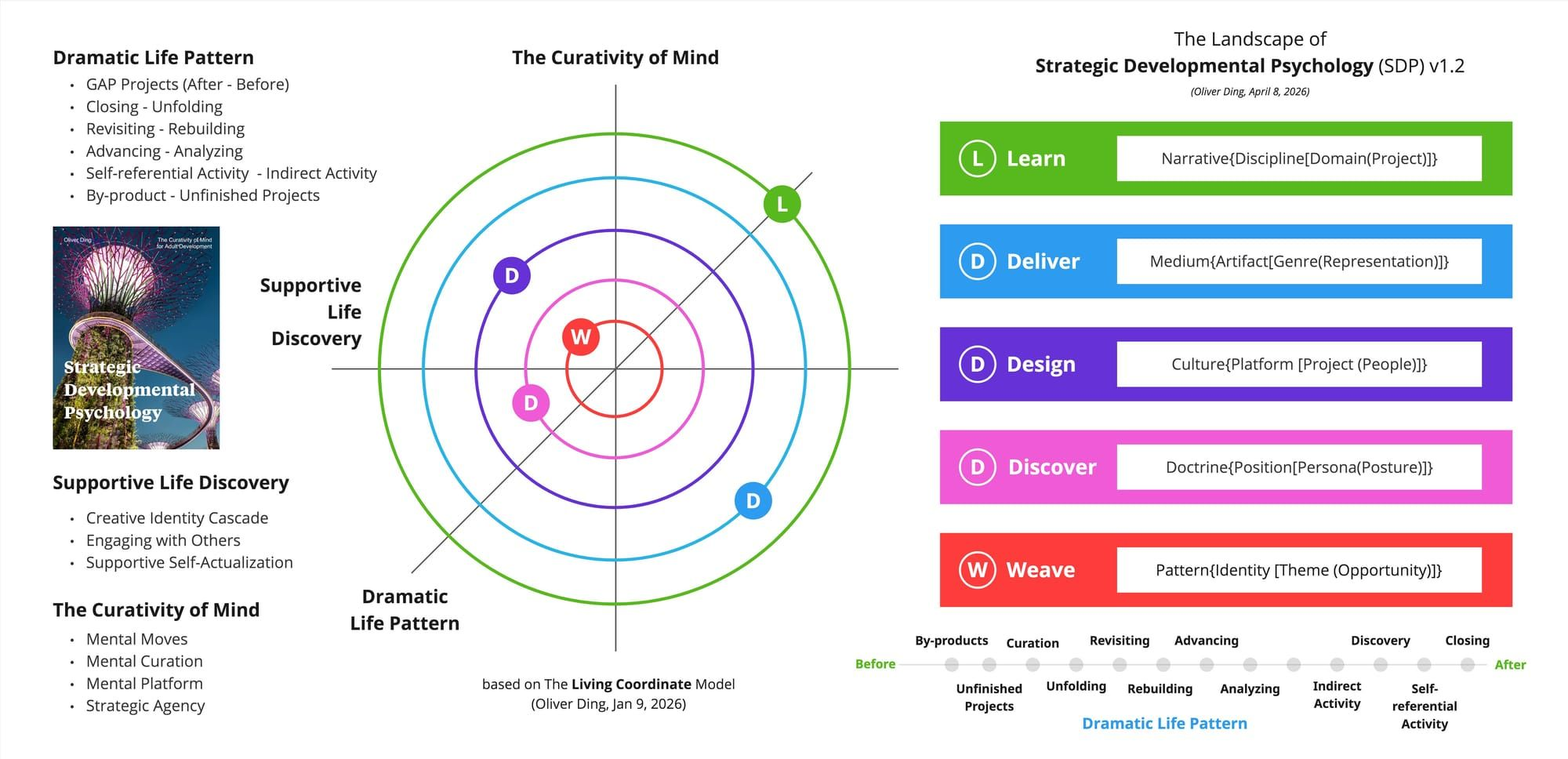
On April 8, 2026, I made the diagram below to represent the landscape of Strategic Developmental Psychology (v1.2). Each version contributes to the whole by making a special part.
v1.0 — December 2025
The completion of The Curativity of Mind established the first dimension: The Curativity of Mind itself — Mental Curation, Mental Platforms, and Mental Moves. This dimension attends to the cognitive interior of the actor: how the mind works as a creative platform, how it curates knowledge, and how it generates and deploys mental moves.
v1.1 — January–February 2026
The development of Anticipatory Cultural Sociology (ACS) during this period produced an unexpected by-product. The five-ring developmental orientation structure — Learn, Discover, Design, Deliver, Weave — emerged as part of the ACS framework (v1.2), but its natural home was SDP. It was transferred as a by-product and became the five rings of the SDP Living Coordinate. This orientation structure describes the fundamental modes through which an individual actor develops: from the innermost integrative action (Weave) to the outermost receptive orientation (Learn).
v1.2 — March–April 2026
Two developments together constitute v1.2. First, a series of articles on Supportive Life Discovery — developed through the Revisiting–Rebuilding practice and the exploration of the Self–Other dimension — established the second dimension of SDP's three-dimensional landscape. This dimension addresses the relational conditions of individual development: how the presence, support, and co-becoming of others shapes the trajectory of a creative life.
Second, the formal launch of work on the third dimension: Dramatic Life Pattern — the study of how a creative life unfolds across time, structured through patterns of Discovery, Revisiting, Advancing, and Indirect Activity.
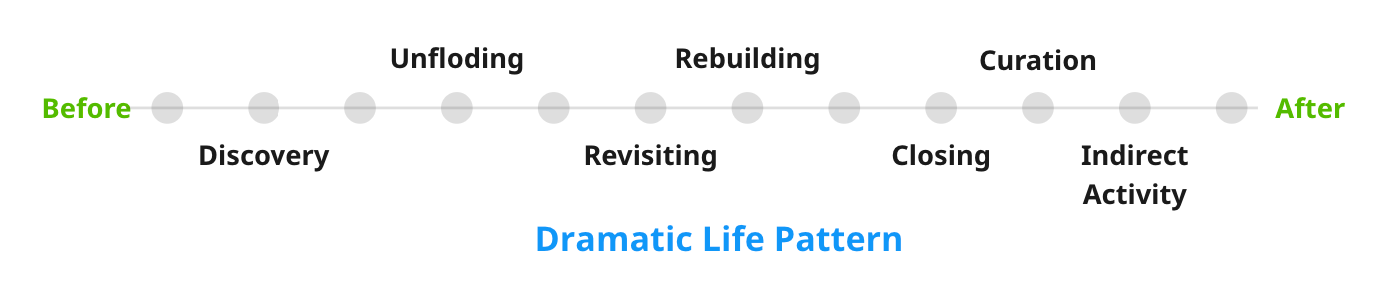
The Revisiting–Rebuilding collection, curated in March 2026, marked the beginning of this work's systematic organization.
The v1.2 diagram presents the landscape as it stands at this moment: three dimensions, five rings, and a clear map of what remains to be developed.
Center
The Core of the Activity Analysis Center
The Activity Analysis Center hosts two major theoretical enterprises:
- The Life-as-Activity Approach (including the Project Engagement Approach)
- The World of Activity Approach, now operating within a nested structure: World of Life (World of Activity).
This issue marks a significant milestone: The World of Activity Toolkit was updated to v2.0.
The v2.0 was made by two major changes. Expanded through Ecological Formism into a four-layer architecture, the FFCC model now maintains its core simplicity — four basic ecological forms — while being able to accommodate rich empirical research and support diverse situational reflection.
- Invariant: FFCC Schema, four basic Ecological Forms
- Quasi-invariant: A series of movements, described with the FFCC vocabulary
- Variant: Situational life events and themes (open category)
- Invariant Set: Other Ecological Forms
At the same time, organized through Thematic Space Theory, its four thematic spaces now carry multiple dimensions simultaneously:
- forms,
- themes,
- identities,
- methods,
- moves, and
- achievements.
What were separate knowledge frameworks in the World of Activity Toolkit v1.0 — each attending to one of these dimensions — have been curated together into a coherent whole.
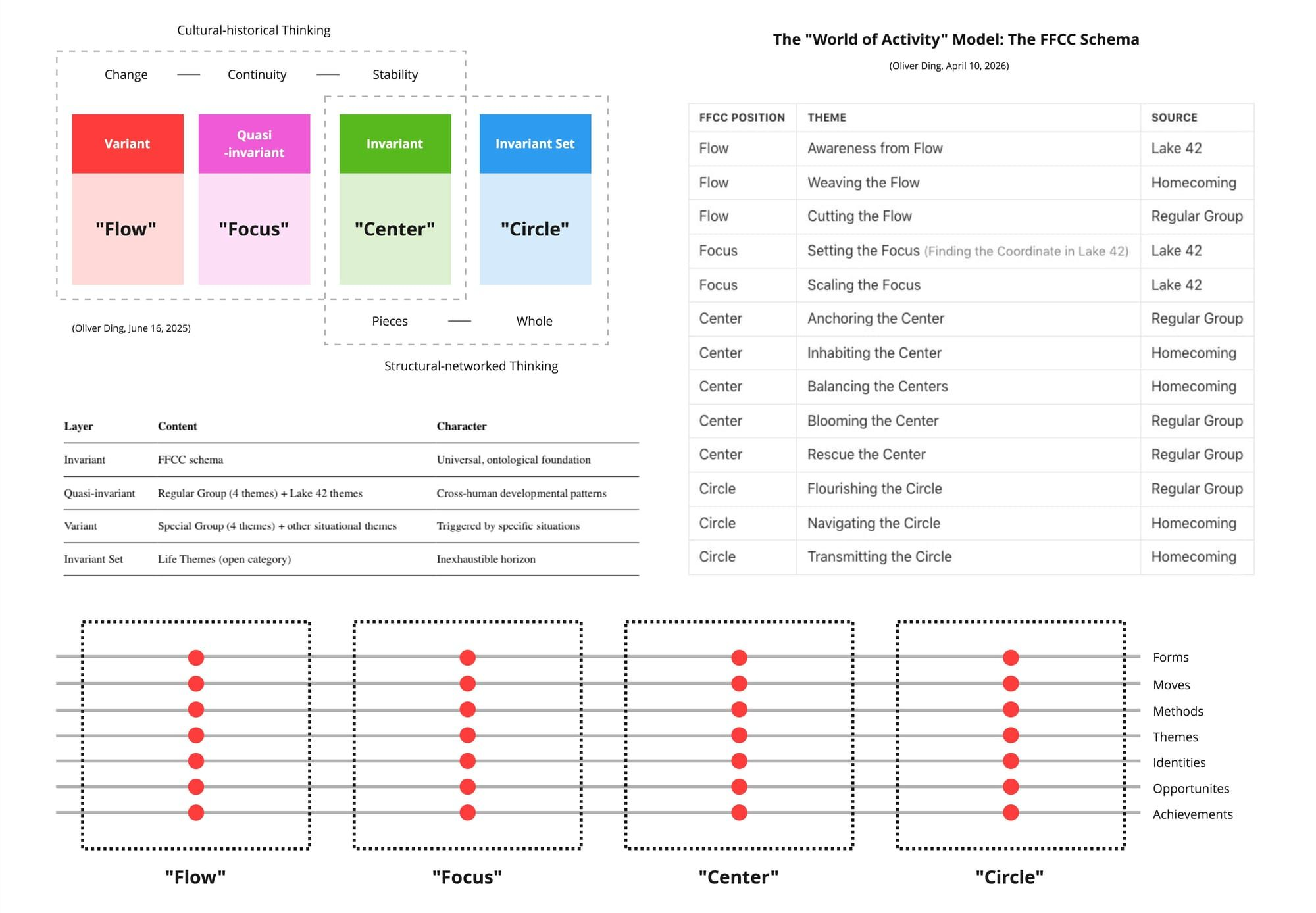
This constitutes the World of Activity Toolkit v2.0. The FFCC model has become a significantly more powerful knowledge framework — one that can serve not only as a theoretical explanatory model, but also as a tool for case study analysis and behavioral intervention. The simple four-part schema that began as a descriptive map of ecological forms has grown into the primary organizing structure of an entire approach to creative life development.
- #11 - World of Activity: The World of Activity Toolkit (v2.0, 2026)
Circle
The Context of the Activity Analysis Center
Over the past several years, I worked on several theoretical projects, such as the Ecological Practice Approach, Curativity Theory, Creative Life Theory, and Thematic Space Theory.
Inspired by creativity researcher Howard Gruber's idea of "Network of Enterprises," I used the "Knowledge Center" approach to manage this large knowledge system. Each knowledge center hosts one or two related theoretical approaches.
- CALL (Creative Action Learning Lab): the Ecological Practice Approach and Creative Life Theory
- Curativity Center: Curativity Theory
- TALE (Thematic Analysis Learning Engagement): Thematic Space Theory
- Frame for Work: A theory about Knowledge Frameworks
On April 13, 2026, I revisited a diagram for the Frame for Work and updated it with new development.
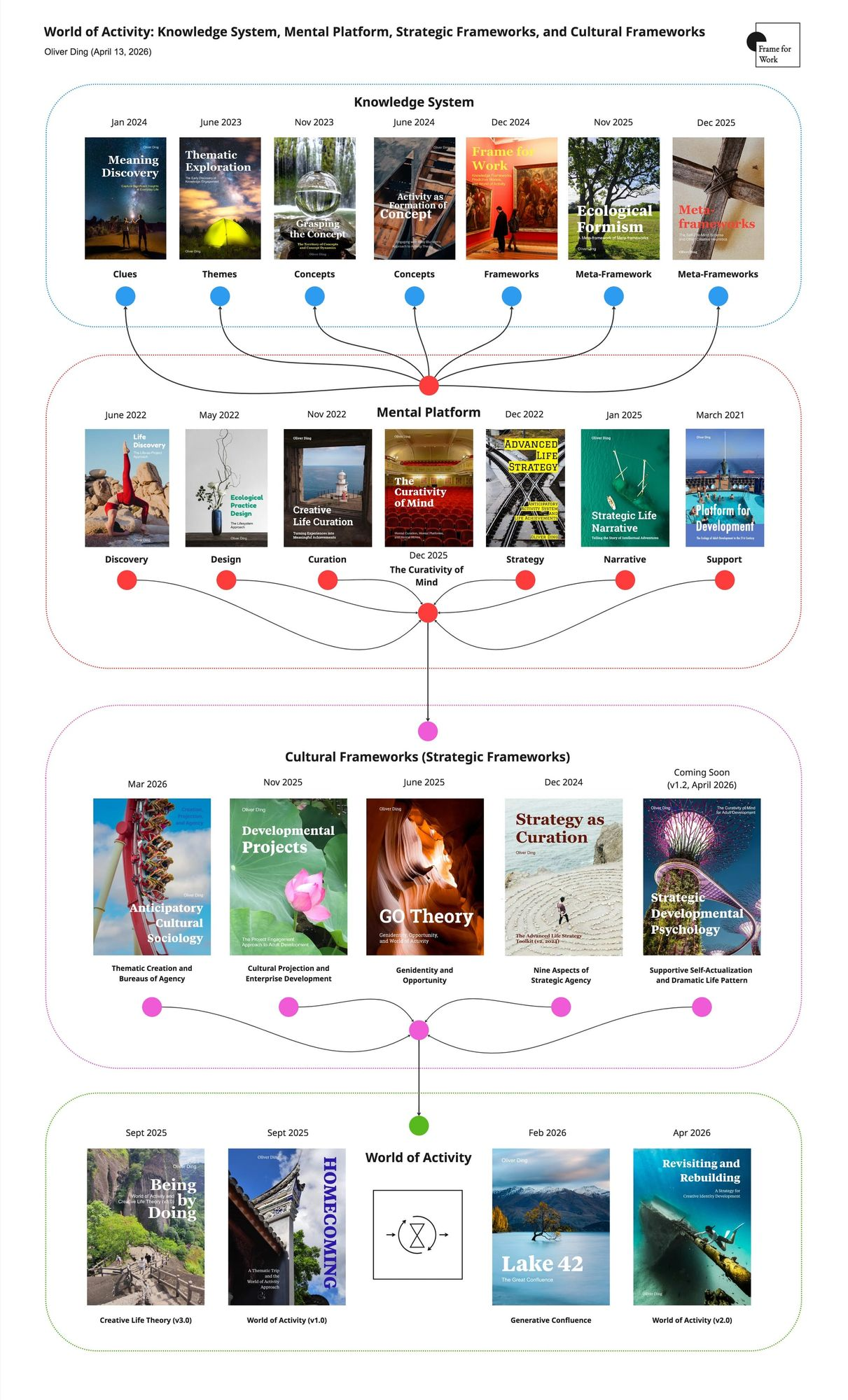
The change was small on the surface — a version date, a few new book covers, a new layer at the bottom — but it reflects something more substantial: a journey that has quietly crossed a threshold.
More details can be found in The "Theme–Concept–Framework" Transformation (2023–2026) and A Watershed of Creative Life.
World
Me, You, and We
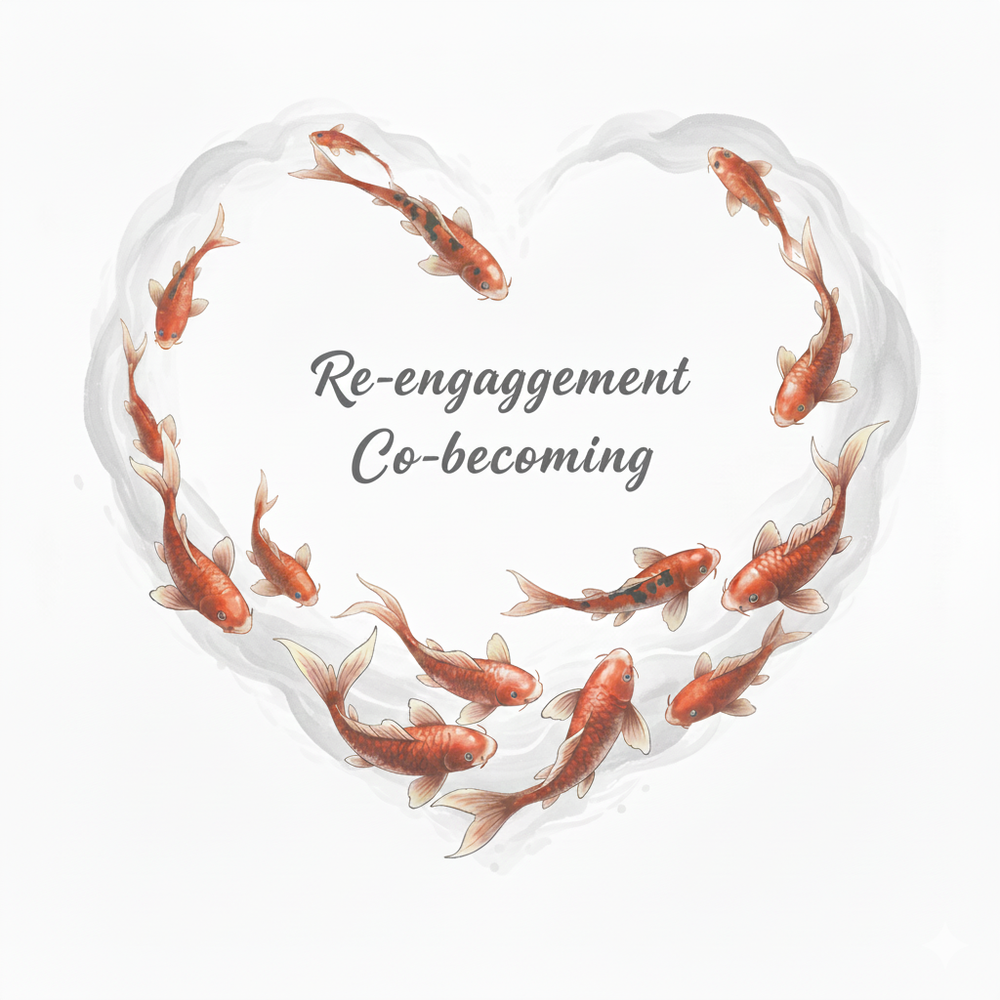
The image above is my New Year's greeting card — and also my annual theme for 2026: Re-engagement and Co-becoming.
Three months later, looking back at what has actually been written, something unexpected is visible. Those two slogans did not stay as slogans. They quietly seeded concrete work. Re-engagement became the Revisiting–Rebuilding series: returning to past selves, past projects, past theoretical moments — not to repeat them, but to find in them what had not yet been seen. Co-becoming became the Self–Other series.
And then, unexpectedly, both themes found their way into a single conversation.
On April 9, I spent ninety minutes on a video call with Maya — a professional coach with a psychology background who is thinking about writing her first book. We had exchanged emails before. But it was in the conversation itself that something shifted.
She was not stuck on writing. She was standing at a threshold — the kind that appears after a significant life change has already happened, but before a new identity has found its shape. Her graduate program had changed her Circle. Her Center had not yet caught up.
I did not offer a plan. I tried to stay with the question: what is actually happening here, and what does genuine support look like at this moment?
The connection to Re-engagement and Co-becoming was not planned. It became visible only afterward.
This is, perhaps, how annual themes work. You place them at the threshold of a year. You do not yet know what they will ask of you. Then, month by month, they find their way into the work — not as topics chosen from a list, but as questions that turn out to have been active all along, pulling the thinking in directions you recognize only after you have already arrived.
Re-engagement and Co-becoming. I placed them there in January. The year answered.
Oliver Ding
Founder of the Activity Analysis Center
April 15, 2026
p.s. I am based in Houston, Texas, US. Where are you?
v1.0 - April 15, 2026 - 2,362 words