
A Watershed of Creative Life

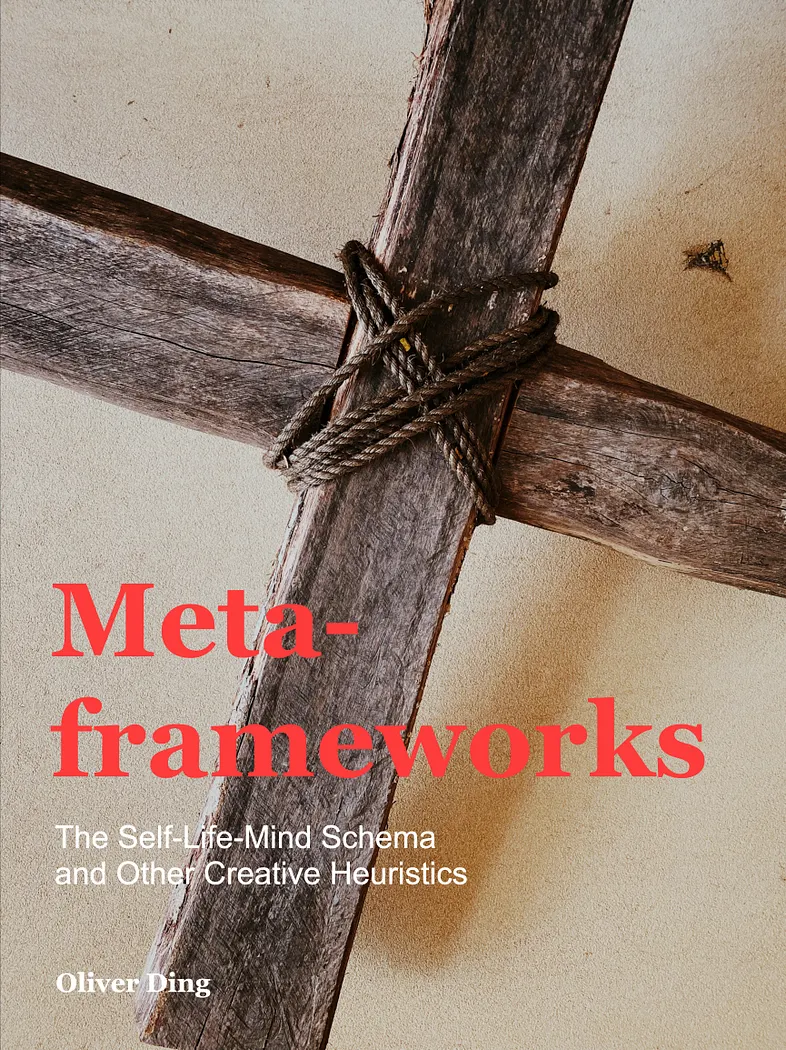
This article is originally titled Beyond Creative Life, the Epilogue of Meta-Frameworks: Creative Heuristics for Individual and Social Development (book, v1.0, 2025).
by Oliver Ding
April 14, 2026
Meta-frameworks, released on December 31, 2025, marked the completion of the long-term journey of constructing the Theme–Concept–Framework Transformation Model.
In early 2023, I worked on the TALE Project — short for Thematic Analysis Learning Engagement. One of the major outcomes of this project was the Strategic Thematic Exploration Framework.
From my experience in developing knowledge frameworks and cultivating tacit knowledge in general, I have observed a consistent tendency for themes to evolve into concepts. The Strategic Thematic Exploration Framework represents a linear process of "From Theme to Framework," consisting of the following six stages:
- A Possible Theme without a Clue
- A Possible Theme with a Clue
- A Primary Theme without Related Themes
- A Primary Theme with its Network
- A Knowledge Concept with a Working Definition
- A Knowledge Framework with a Set of Concepts
From 2023 to 2025, the Theme–Concept–Framework Transformation Model has guided my exploration into the development of knowledge systems, resulting in a series of book drafts:
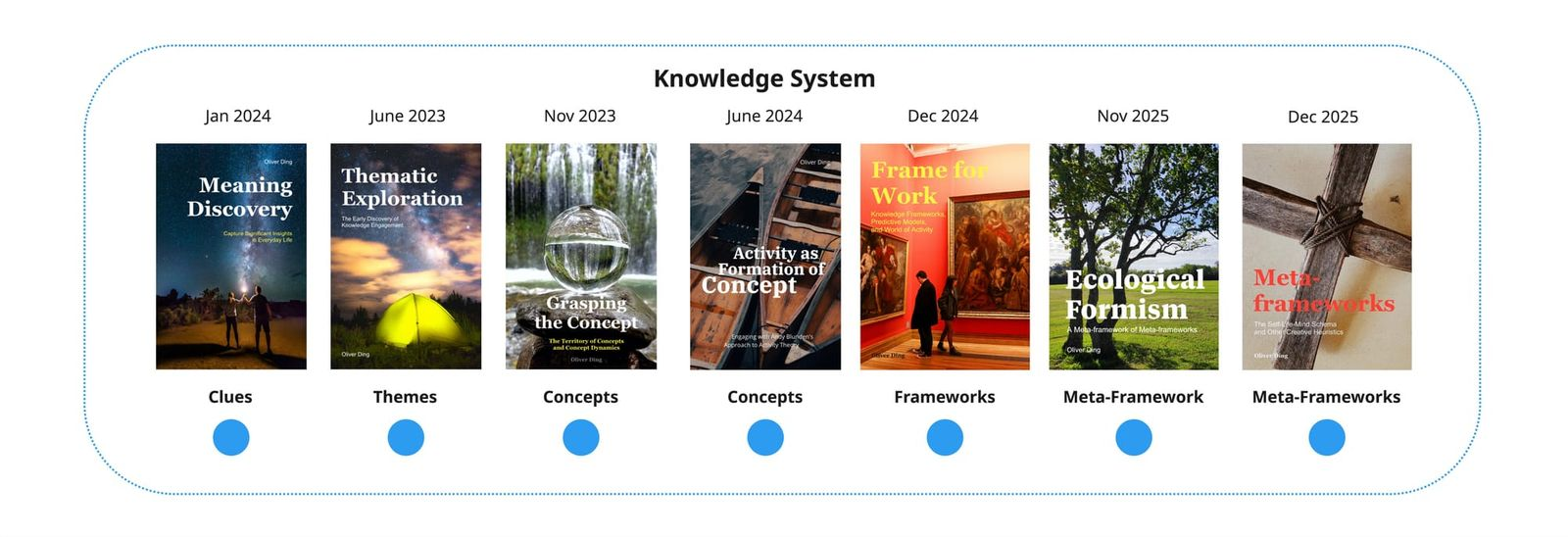
- Clues → Meaning Discovery (Jan 2024)
- Themes → Thematic Exploration (June 2023)
- Concepts → Grasping the Concept (Nov 2023)
- Concepts → Activity as Formation of Concept (June 2024)
- Frameworks → Frame for Work (Dec 2024)
- Meta-Framework → Ecological Formism (Nov 2025)
- Meta-Frameworks → Meta-Frameworks (Dec 2025)
Meta-frameworks, released on December 31, 2025, marked the completion of the long-term journey of constructing the Theme–Concept–Framework Transformation Model. By that date, the Knowledge System layer was complete. The long arc from Clues to Meta-Frameworks had closed. (More details can be found in The "Theme–Concept–Framework" Transformation (2023–2026).)
But Meta-frameworks did more than complete a sequence. It marked a watershed.
To understand why, it is necessary to step back. Starting in December 2024, I gradually shifted from Knowledge Engagement to Cultural Development. During the Christmas holiday of 2024, a reflective conversation with a mentor clarified something: my focus had shifted toward Cultural Life Development, marking a detachment from Individual Life Development. This strategic move was encapsulated in the theme of "Cultural Grounding / Cultural Growing."
Over the following twelve months, I worked on several projects related to Cultural Development: the Tiny Culture project, the "Culture as Thematic Enterprise" Framework, the Frame-for-Work Canvas, and the Cultural Projection Model (2025). These explorations were accumulating materials and testing frameworks, but were not yet unified under a single theoretical roof.
Then, on December 20, 2025, I formally started the Meta-frameworks project. I wrote three foundational articles — the History{Life[Self(Body)]} Framework (v3.0), the Six Faces of the Concept System, and Weave the Culture — and curated a series of related knowledge models into a comprehensive Weave-the-Culture toolkit.
The epilogue of Meta-frameworks reviewed the development of Creative Life Theory from v2.0 to v3.1. The switching from the Self–Life–Mind schema to the HLS framework marks a strategic pivot from Individual Life Development to Cultural Life Development. The birth of the World of Life (World of Activity) approach marks a nexus-point where the act of Closing a rich history meets the act of Unfolding a new future.
Beyond Creative Life: Toward the World of Life
An Epilogue
by Oliver Ding
December 31, 2025
A by-product of the book is the World of Life Toolkit, which marks the end of version 3.1 of Creative Life Theory.
In these final words, I briefly review the development of Creative Life Theory from v2.0 to v3.1. The switching from the Self-Life-Mind schema to the HLS framework marks a strategic pivot from Individual Life Development to Cultural Life Development, framing meta-frameworks as living systems that grow through dialogue and evolve through practice.
The World of Life Toolkit goes beyond the individual perspective of Creative Life Theory. The past six-month journey of Generative Confluence now leads to a new thematic space: Generative Narrative, where the cultural anticipation evolving into human history.
1. Theorizing Creative Life
In June 2025, I discovered the “Theorizing Creative Life” theme from my journey between 2014 and 2025, and classified it into four phases:
- Early Phase: The Ecological Practice Approach (2014–2020)
- Middle Phase: The Project Engagement Approach (2019–2024)
- Late Phase: Creative Life Theory (2022, 2023, 2025)
- A New Beginning: Philosophy and Culture (2025)
Using the Self-Life-Mind schema, I created the “Theorizing Creative Life” Landscape on June 2, 2025. See the diagram below.

On June 2, 2025, after making the “Theorizing Creative Life” model, I saw a new, meaningful whole. This new whole goes beyond Creative Life Theory v2.0. It might be called Creative Life Theory v3.0, or a new name.
I continued making a new diagram to present the interaction between three theoretical approaches. See the diagram above.
Suddenly, I was shocked by the pattern within the diagram. The new landscape represents a 3+1 structure, revealing a new pattern I didn’t notice in my creative journey.
Over the years, I maintained boundaries between these three theoretical approaches because they are influenced by different theoretical traditions.
My engagement with these traditions is neither a matter of inheritance nor linear expansion. Instead, I treat each as a creative resource — a reservoir of concepts, metaphors, and structural tensions that can be activated in context-specific knowledge work. This dialogical strategy is at the core of Creative Life Theory and is elaborated in one of my book drafts, Mapping Creative Dialogue.
Although I even did several creative dialogues to make new knowledge frameworks, I never thought about integrating them into one.
However, the “Theorizing Creative Life” landscape presents a new pattern to me. At some point, a set of related ideas has already been curated as a new, meaningful whole. It emerged as a new approach, not replacing any of the old approaches.
The three approaches could still be developed by following their original trajectory. The new one starts at a coordinate origin, defining a position of a new center, with the potential to grow into a new theoretical enterprise.
Inspired by geography, I named this pattern Generative Confluence.
Unlike traditional confluence in geography, where streams merge and lose their individual identities, the term “Generative Confluence” is used in Creative Life Theory with a new meaning.
It describes a pattern where ideas inspired by distinct theoretical approaches evolve from separate into interconnected, generating a new center for a brand-new possible theoretical enterprise. As the new one emerges, the original theoretical approaches still keep their developmental trajectories.
The Generative Confluence pattern goes beyond the Creative Dialogue pattern, where some new ideas are born from dialogue between two theoretical approaches.
2. Unfolding a “Generative Confluence” Journey
Over the past six months, I further unfolded the Generative Confluence and developed Creative Life Theory from version 3.0 to v3.1.
- Step 1 (Finding the Coordinate): Using the Self-Life-Mind schema as a new meta-framework (June 2025)
- Step 2 (Anchoring the Center): Launching the World of Activity Model to understand “Life(Self)” with the book draft Homecoming (Sept 2025)
- Step 3 (Scaling the Focus): Launching the Enterprise Developmental Framework and releasing the book draft, Developmental Projects, capturing the complexity of “Life” and the development of Creative Enterprise (Nov 2025).
- Step 4 (Completing the Platform): Launching the book draft, The Curativity of Mind, addressing mental curation, mental platforms, and mental moves, responding to the “Context (Mind)” section (Dec 2025).
- Step 5 (Revealing the Landscape): Working on the Meta-frameworks project, curating the HLS Frameworks with other frameworks, connecting to the Ecological Practice Approach, and leading to World of Life (World of Activity) — a new landscape in which individual and collective practices are woven together.
Over the past six months, this unfolding creative journey of Generative Confluence has been observed in my real-life practice. The process has proven far more complex and generative than I had anticipated six months ago.
This is a case record of how a theory reveals its own structure through practice.
I began by naming a theme to hold the pattern I had discovered. Over the following six months, I practiced according to the structure that this theme disclosed, allowing it to unfold in real-life work. Through this process, the theme gradually transformed into a concept.
3. The Meta-framework in Action
This new book draft, Meta-frameworks: Creative Heuristics for Individual and Social Development, marked the end of Creative Life Theory (v3.1). The six-month journey of its creation has become part of the model itself. As I conclude this work, I reflect on the evolutionary path that led from the HLS framework to the “Grand Weaving” of cultural development.

In The Landscape of Creative Life Theory (v3.0) and Two Meta-Frameworks, I shared the story of shifting from the Creative Course Framework to the Self-Life-Mind framework.
In 2023, I adopted Ping-keung Lui’s Subjectivist Structuralism, a part of his theoretical sociology, to develop the Creative Course Framework, a meta-framework for Creative Life Theory (v2.0).

Building on the Creative Course Framework, I created an expanded diagram through a process I call Diagram Blending. This integrates five sub-frameworks:
- Center: The Creative Course Framework
- Left: The Value Circle Framework
- Right: The Universal Reference Framework
- Up: The Anticipatory Activity System Framework
- Down: The Knowledge Circle Framework

On June 1, 2024, I edited a book draft titled Center, Circle, and Genidentity: The Dynamics of Networked Knowledge Center. It offers a unique theoretical lens for understanding both the Knowledge Center and the Value Circle as standalone concepts.
From 2022 to June 2024, I developed five corresponding book drafts. This body of work marked the culmination of Creative Life Theory (v2.0), which I now consider an independent knowledge enterprise.
In this way, the Expanded Creative Course Framework achieved its mission.
Since then, my mental focus has moved from the concept of “Knowledge Center” to the concept of “World of Activity,” planting the seed of version 3.0 of Creative Life Theory.
Eventually, a new meta-framework is needed to capture this new exploration.
While version 3.0 does not replace v2.0, it represents a significant expansion. I remain engaged with Lui’s theoretical sociology; although the Creative Course Framework no longer functions as the meta-framework, his Ontology–Realism–Hermeneutics schema continues to shape my thinking. In fact, it inspired the Self–Life–Mind schema now used as the meta-framework in version 3.0.
On June 16, 2025, I created a new diagram to highlight several knowledge frameworks within the landscape of Creative Life Theory (v3.0), curated by the Self-Life-Mind schema.
I selected three core concepts, based on the Self-Life-Mind schema:
- World of Activity [Ontology | Self | Philosophy]
- Creative Center [Realism | Life | Sociology]
- Thematic Space [Hermeneutics | Mind | Psychology]

Creative Life Theory (v3.0) marks not a conclusion, but a new departure — an invitation to engage with the theory as a living enterprise.
From June to September, I used the diagram as the new meta-framework to guide my projects for Creative Life Theory (v3.0). On September 20, 2025, I released Being by Doing: World of Activity and Creative Life Theory (v3.0).

It presents the core frameworks and concepts that underpin the theory, showing how a creative self, a creative enterprise, and a creative mind develop through practice.
In the Meta-frameworks project, I shifted the meta-framework from the Self-Life-Mind schema to the History{Life[Self(Body)]} framework (version 3.0).

The journey of the HLS framework (v3.0) began as an ontological exploration and eventually evolved into a central node within a larger ecosystem of meta-frameworks.
4. From World of Activity to World of Life
As we move from Part 3.3’s “Grand Weaving” to this final reflection, we encounter the ultimate synthesis: the transition from the World of Activity to the World of Life.
To represent this curated knowledge system as a meaningful whole, I term it:
World of Life (World of Activity)
In September 2025, I created a large diagram to present the landscape of the World of Activity Approach.
Based on the “Variant — Quasi-invariant — Invariant — Invariant Set” schema, I organize knowledge frameworks that are considered members of the World of Activity into a hierarchical system.
- Invariant / Basic Forms: 1 (World of Activity)
- Invariant Set / Frames: 1 (World of Life)
- Quasi-invariant / Derived Forms: 7
- Variant / Frameworks: 10 examples

As a hierarchical system, it is an open structure. While Invariant / Basic Forms and Invariant Set / Frames represent a single, stable element, Quasi-invariant / Derived Forms and Variant / Frameworks are dynamic and changeable.
The concept of the World of Activity was inspired by the social phenomenologist Alfred Schutz’s idea of the World of Working.
According to Schutz, Working refers to action in the outer world.
Working, thus, is action in the outer world, based upon a project and characterized by the intention to bring about the projected state of affairs by bodily movements. Among all the described forms of spontaneity that of working is the most important one for the constitution of the reality of the world of daily life… The wide-awake self integrates in its working and by its working its present, past, and future into a specific dimension of time; it realizes itself as a totality in its working acts; it communicates with others through working acts; it organizes the different spatial perspectives of the world of daily life through working acts.
Source: Alfred Schutz on Phenomenology and Social Relations (1970, p.126)
Schutz’s concept captures something essential about human engagement with reality: that our most significant acts are those that project intention into the outer world through bodily action. This “Working” constitutes not just individual activity, but the very fabric of social reality — integrating time, enabling communication, and organizing our spatial experience. However, Schutz’s framework primarily focused on the practical world of daily life, treating other realms like fantasy and dreams as separate sub-worlds within the broader Life-world.
The World of Working is one sub-world within the World of Daily Life, or Life-world. There are other sub-worlds in the Life-world. For example, the worlds of fantasy and dream.
In 2022, when developing my approach to researching creative life, I recognized that Schutz’s distinction between different sub-worlds needed to be reconsidered. For creative individuals, the worlds of fantasy and dreams are not merely separate realms — they are significant sources of creative inspiration that actively inform and shape their outer-world projects. A novelist’s dream becomes the seed of a story; an artist’s fantasy transforms into a painting; a theorist’s imaginative leap leads to new frameworks.
This insight led me to coin the term “World of Activity” to capture a more integrated understanding of creative engagement. While Schutz’s “Working” emphasizes the projection of intention into the outer world through bodily movements, my “Activity” encompasses the fuller spectrum of creative engagement — including how inner experiences of imagination and reflection actively contribute to outer-world projects.
The “World of Activity” thus represents both a continuation and an expansion of Schutz’s insights. It maintains his emphasis on intentional, project-based engagement with reality, but recognizes that for creative individuals, the boundaries between inner and outer worlds are more porous and dynamic than his framework suggests.
In Creative Life Theory, the “World of Activity” refers to the world of a person’s all working activities within their life course.
From the perspective of the Ecological Practice Approach, the “World of Activity” can be understood in two complementary ways: as a large life container, where we can discover the structure and patterns of development of life activities; and as a thematic space, where we can curate a set of relevant knowledge elements together.
In this way, we can define the boundary of the container and curate the items inside.
In September 2025, inspired by the Variant — Quasi-invariant — Invariant — Invariant Set schema, I considered the World of Activity as Invariant, with its corresponding Invariant Set named the World of Life. At that time, the World of Life referred primarily to the Circle of connected Centers, in other words, a network of interconnected Worlds of Activity.
From September 2025 to the present, a new set of knoweldge framework emerged, offering a refined way to understand the social world. Reflection on the HLS framework revealed that this set could be called the World of Life Toolkit:
- HLS framework (v3.0) → Provides a five-system structure of the social world, including individual and social life.
- Weave-the-Culture Framework (2025) → Highlights four mechanisms of cultural development.
- Cultural Projection Model (2025) → Connects Mental Platforms and Cultural Frameworks via the Projecting mechanism and Developmental Projects.
- Function — Context — Knowledge — Activity Schema (2025) → Explors Mental Platforms and Mind within the Context (Mind) layer.
- Meta-Frameworks — in — Context Framework (2025) → Identifies six faces of concept system in the social world.
- Embodied Social Forms Framework (2025) → Connects body-scale experience with deep social cognition.
Together, these knowledge frameworks provide a way to zoom in on the details of the Social World while connecting micro-AAS and macro-AAS.
Within this system, the World of Activity toolkit primarily addresses the Life(Self) layer, whereas the World of Life encompasses broader layers, including History (Culture) and Context (Mind), highlighting the hierarchical and interconnected nature of the knowledge ecosystem.
The Body System, initially presented as the Ecological Basic Forms in my book draft Homecoming: A Thematic Trip and the World of Activity Approach, has now evolved into the Embodied Social Forms Framework, which will be introduced in a forthcoming book draft on Meta-Frameworks.
The developmental loop is now complete: beginning with the Body’s flow and the Self’s focus, moving through the Centers of our developmental projects and enterprises, we ultimately locate our activities within the Historical Circle. In this way, the World of Activity has been curated into the World of Life.
5. Closing while Unfolding
During the 2024 Christmas holiday, I had a reflective conversation with a mentor, revisiting my work on HELLO THEORY, GO Theory, and the Strategic Life Narrative project. Through this reflection, I realized my newest focus had shifted toward Cultural Life Development, marking a detachment from Individual Life Development. This strategic move was encapsulated in the theme of “Cultural Grounding/Cultural Growing.”
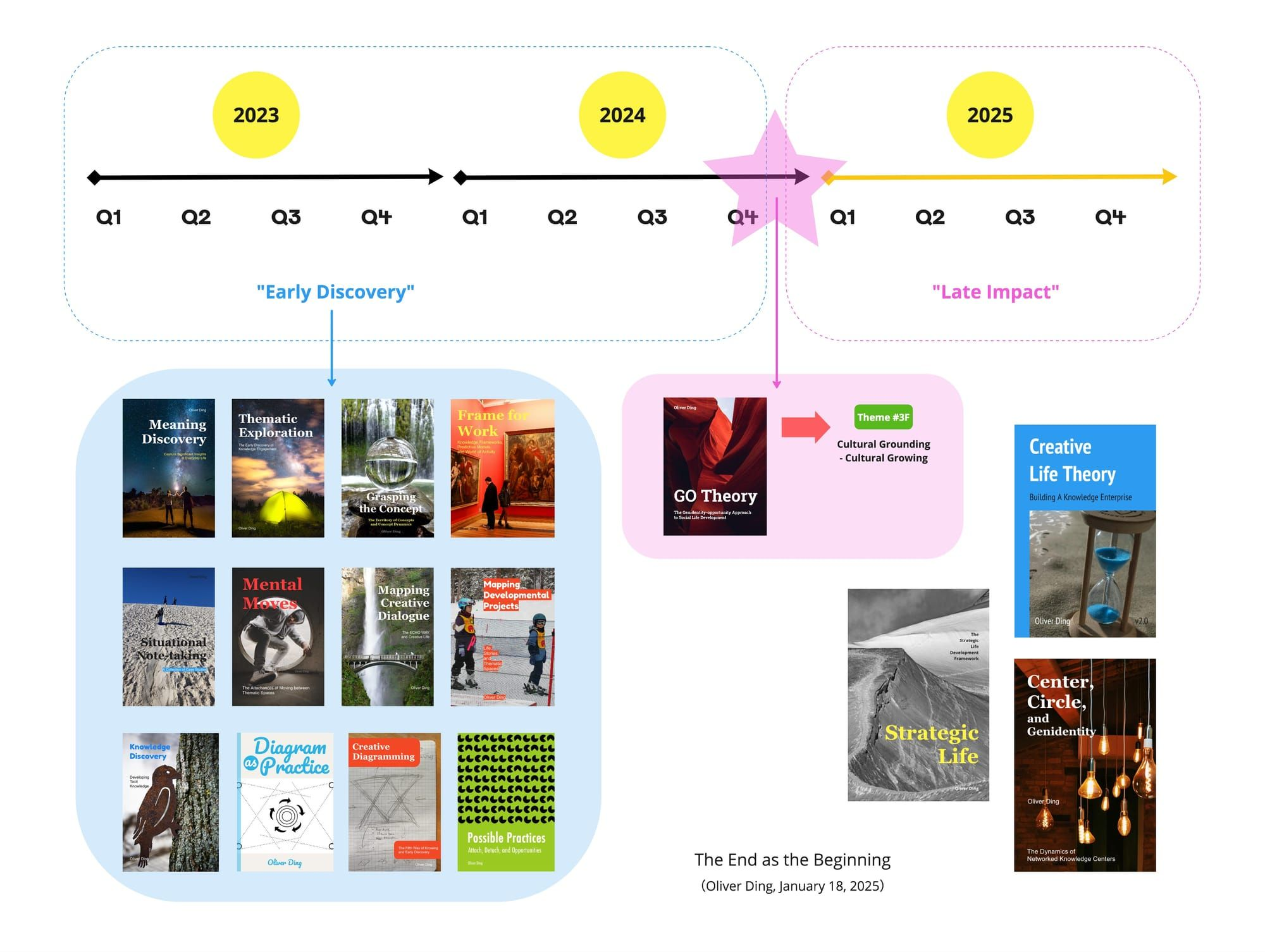
Over the past 12 months, while I worked on closing my multi-year journey of Knowledge Engagement and Individual Life Development — culminating in Creative Life Theory v3.1 — I simultaneously unfolded a new journey of Cultural Development.
The birth of the World of Life (World of Activity) approach marks a nexus-point where the act of Closing a rich history meets the act of Unfolding a new future.
The exploration reveals a fundamental truth: meta-frameworks are not static tools, but living systems that grow through dialogue, evolve through practice, and ultimately form ecosystems supporting both individual creative life and cultural development.
As I move forward into the Cultural Development journey, the World of Life (World of Activity) approach will serve as my mental platform, while the Weave-the-Culture framework will guide the exploration of the four mechanisms of cultural development.
The World of Life Toolkit goes beyond the individual perspective of Creative Life Theory. The past six-month journey of Generative Confluence now leads to a new thematic space: Generative Narrative, where the cultural anticipation evolving into human history.
The story continues.
Updated on April 14, 2026
On the first day of 2026, I walked around a lake near my home with my wife. As we reflected on the past year, I revisited my long journey of writing and curating more than 42 possible books — unpublished drafts — between 2019 and 2025. That evening, a new idea emerged: the lake could serve as an ecological metaphor for what had gradually taken shape through these 42+ possible books — a point of convergence rather than a destination.
After launching the “Lake 42” thematic card on January 2, 2026, I reflected on the six-month journey and discovered eight movements that captured the complexity of my experience:
- #0 — Awareness from Flow: The initial recognition of patterns emerging from everyday experience
- #1 — Finding the Coordinate: Searching for a meta-framework to answer “Where am I?” and “Where should I be?”
- #2 — Anchoring the Center: Establishing a meta-framework to transform a potential focus into a creative center
- #3 — Scaling the Focus: Systematically developing the anchored center across multiple dimensions
- #4 — Sustaining the Streams: Maintaining momentum across parallel theoretical developments
- #5 — Catalyzing Curation: Integrating diverse frameworks through strategic curation
- #6 — Revealing the Landscape: Making visible the emerging theoretical terrain
- #7 — Setting the Enterprise: Creating new themes and opening new theoretical horizons
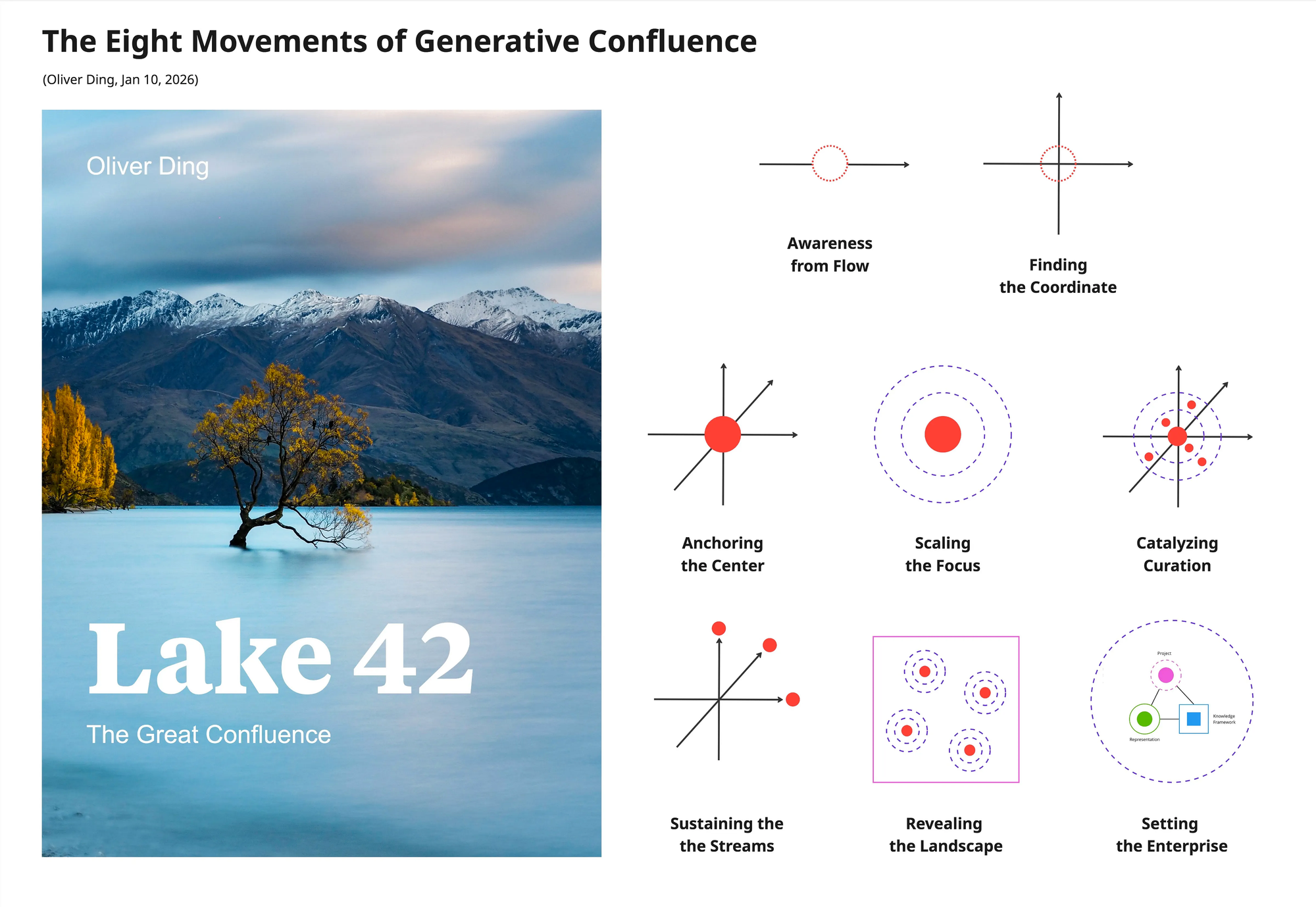
After 42 days, on the first day of the horse year, Lake 42: The Great Confluence was released on Possible Press. It is the third in a trilogy applying the Creative Life Curation method to my own creative life
- Homecoming: A Thematic Trip and the World of Activity Approach (1974–2014)
- Wonder and Wander: Revealing The Evolving Knowledge Enterprise (2019–2025)
- Lake 42: The Great Confluence (June–December 2025)
This book, Lake 42: The Great Confluence, documents a six-month journey of theoretical development from June to December 2025, culminating in Creative Life Theory v3.1. Chapters 1 through 9 follow the eight movements of Generative Confluence in close detail — the day-to-day decisions, the breakthrough moments, the parallel developments, and the strategic curation that brings coherence to complexity. Readers will find theory alive in the texture of lived experience.
The remaining chapters develop the theoretical implications in three ascending layers. The first layer stays within the six-month journey: Chapter 10 introduces the Living Coordinate Model, an intermediate framework that situates the Generative Confluence pattern within a broader knowledge hierarchy. The second layer extends outward in time: Chapter 11, Fractal Confluence, reveals that the same generative pattern had been operating across my entire 2019–2025 creative life — nested within each other at micro, meso, and macro scales. The third layer reaches furthest: the Epilogue introduces Cognitive Hydrology, connecting the theoretical pattern to its deepest source — the embodied experience of growing up within a river watershed, where water itself was the first teacher.
Lake 42 marked a milestone in a long journey of exploring the Creative Life Curation method. In Appendix 1, I drew on Ping-keung Lui’s Ontology — Realism — Hermeneutics schema to organize three layers of methodological development into a unified framework: Thematic Space Theory, Slow Cognition, and Creative Life Curation. For the first time, these threads — developed across different projects and years — came together as a coherent whole.
Lake 42 holds a special position within this framework. As the third part of a trilogy applying Creative Life Curation at different time scales — Homecoming (1974–2014), Wonder and Wander (2019–2025), and Lake 42 (June–December 2025) — it demonstrates Thematic Development Study as a living project, tracing “Generative Confluence” from its first stirrings through full articulation. It also continues the signature genre developed in Homecoming, weaving together Life Narrative, Theoretical Development, and Cultural Reflection into a single form. In this sense, Lake 42 is both a case study and a proof of concept: every operation of Slow Cognition appears in its pages, and every principle of Thematic Space Theory structures its development.
On December 31, 2025, I released a possible book, Meta-frameworks: Creative Heuristics for Individual and Social Development (book, v1.0, 2025), to close a several-year journey of knowledge engagement. A major by-product of the project is the History{Life[Self(Body)]} Framework (v3.0), which understands the social world as a nested AAS (Anticipatory Activity System). The book proposes that,
Cultural development, in this view, is a continuous, dynamic anticipatory activity of creating and curating concept systems and transforming them into thematic enterprises by weaving active agency and evolving structure within the social world.
This statement goes beyond the book, but covers a series of book drafts I wrote and curated in the past year.
On January 4, 2026, I revisited an early note I wrote in April 2023. At that time, I read Ping-keung Lui's book Gaze, Actions, and the Social World (2007) and wrote 15 reading notes.
Chapter 8 of The Gaze is titled “The Conditionality of Social Structures: The Next Theoretical Task.” Its main content concerns the empirical reality and autonomy of social structures. Professor Lü argues that a “social structure” cannot possess empirical reality and autonomy unconditionally, but that it can, under certain conditions, temporarily possess—or nearly possess—them. This idea is referred to as the conditionality of social structures.
One of my notes reviewed Professor Lü’s discussion of empirical reality and autonomy, applying it to the Knowledge Engagement project and the Creative Life Theory project. In addition, starting from the theme of the next theoretical task, I also explored the potential of anticipatory sociology.
Now, that note appears as an early anticipation of my creative journey over the past nine months. Interestingly, I framed the journey as the "closing" of my several-year journey on Knowledge Engagement, and the result as Creative Life Theory v3.1. If we detach the HLS framework from the Meta-frameworks project, it can be used as a large map of the social world, further curating my other frameworks together.
On January 5, 2026, I created a new diagram to curate the HLS Framework (v3.0) and other related frameworks, forming a new landscape of a thematic enterprise: Anticipatory Cultural Sociology (ACS).
The ACS v1.0 was a curation of meta-frameworks — a landscape that brought together six major frameworks under a shared ontological foundation. What it established was breadth and coherence at the meta level. What it did not yet provide were more operationally specific knowledge frameworks at finer levels of abstraction, nor a coordination mechanism that could articulate how the different parts of the landscape relate and work together.
The development from v1.0 to v2.0 has been driven by precisely these two needs: building out the operational layer and establishing the coordination structure that holds it together.
ACS v1.1 began taking shape on January 5th, when v1.0 was anchored as a creative center. What followed — through February — was Scaling the Focus: three lines of development advancing simultaneously, independently, and entangled, expanding the center across the dimensions of Thematic Creation, Cultural Projection, and Bureaus of Agency.
Between late February and March 13, 2026, three series of articles were completed simultaneously — one for each axis of the coordinate. All of them were published on the Activity Analysis Center website. The three axes were not advancing at the same pace or through the same mechanism — each had its own internal logic of development. The method-orientations expanded from three (Discover, Design, Deliver) to five, with the addition of Learn and Weave.
By March 13, 2026, ACS v1.2 was complete. The landscape had reached a new level of articulation: three dimensions, five method-orientations, the full structure of Cultural Projection, the full ontology of Thematic Creation, the four Bureaus of Agency, and the Dramatic Life Pattern. The diagram — three-dimensional coordinate, five concentric rings, individual at center, world at periphery — was drawn.
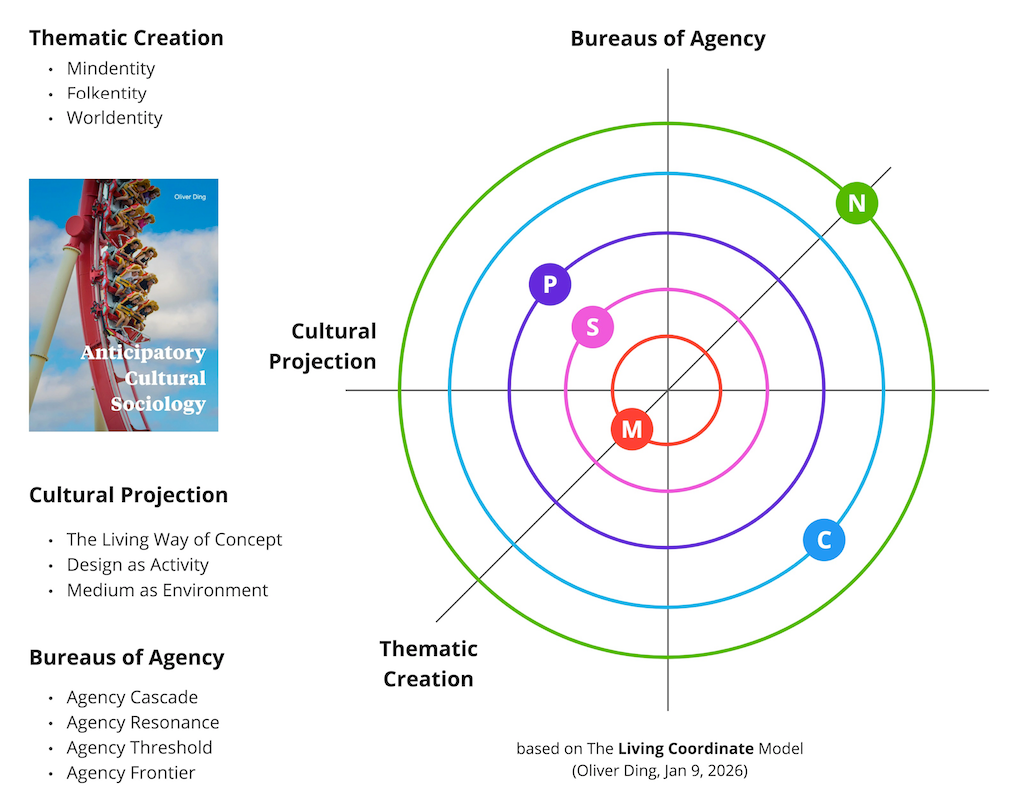
On March 18, 2026, reflecting on the relationship between the LARGE Method and the ACS v1.2 Actor Model, it became clear that the Self–Other dimension was absent from the three-dimensional structure. The question was how to respond. The decision was to maintain the simplicity and integrity of ACS's three-dimensional model rather than expand it to four dimensions. The Self–Other dimension would continue to develop — but within Strategic Developmental Psychology (SDP), where it more naturally belongs, under the axis of Supportive Life Discovery.
The relationship between ACS and SDP has been a structural background condition since both enterprises were named in December 2025. In v2.0, this relationship becomes an explicit theoretical element. ACS and SDP are symmetric enterprises, anchored in the same spatial foundation — the World of Life — but oriented toward different dimensions of the same social reality. ACS attends to cultural development at the collective scale; SDP attends to individual life development at the personal scale. The four boundaries of the World of Life define both: each enterprise inhabits the same structural terrain, and approaches it from a different direction.
The shift from ACS to SDP marks a sign. After a three-month creative sprint, it is time to edit a book to collect articles that build the ACS (v2.0).
The new book was titled Anticipatory Cultural Sociology: Creation, Projection, and Agency. It was organized around the "Flow - Focus - Center - Circle" schema, the primary model of the World of Activity Toolkit (v1, 2025).
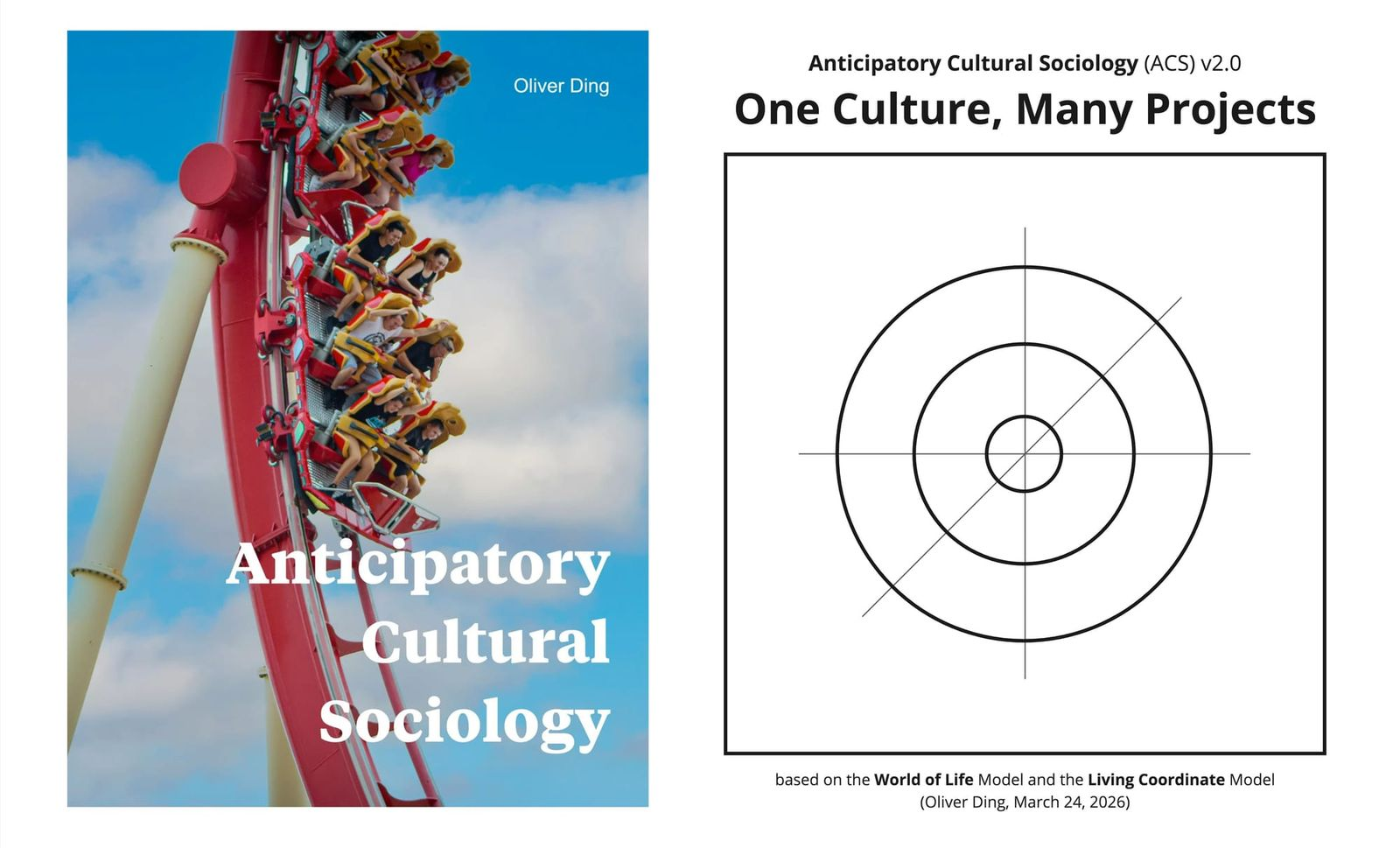
More details can be found in Anticipatory Cultural Sociology: Creation, Projection, and Agency (Possible Book, 2026).
On February 2, 2026, the LARGE Method was developed as a comprehensive methodological framework for organizing creative work across multiple dimensions. It has been used to map the development of ACS.
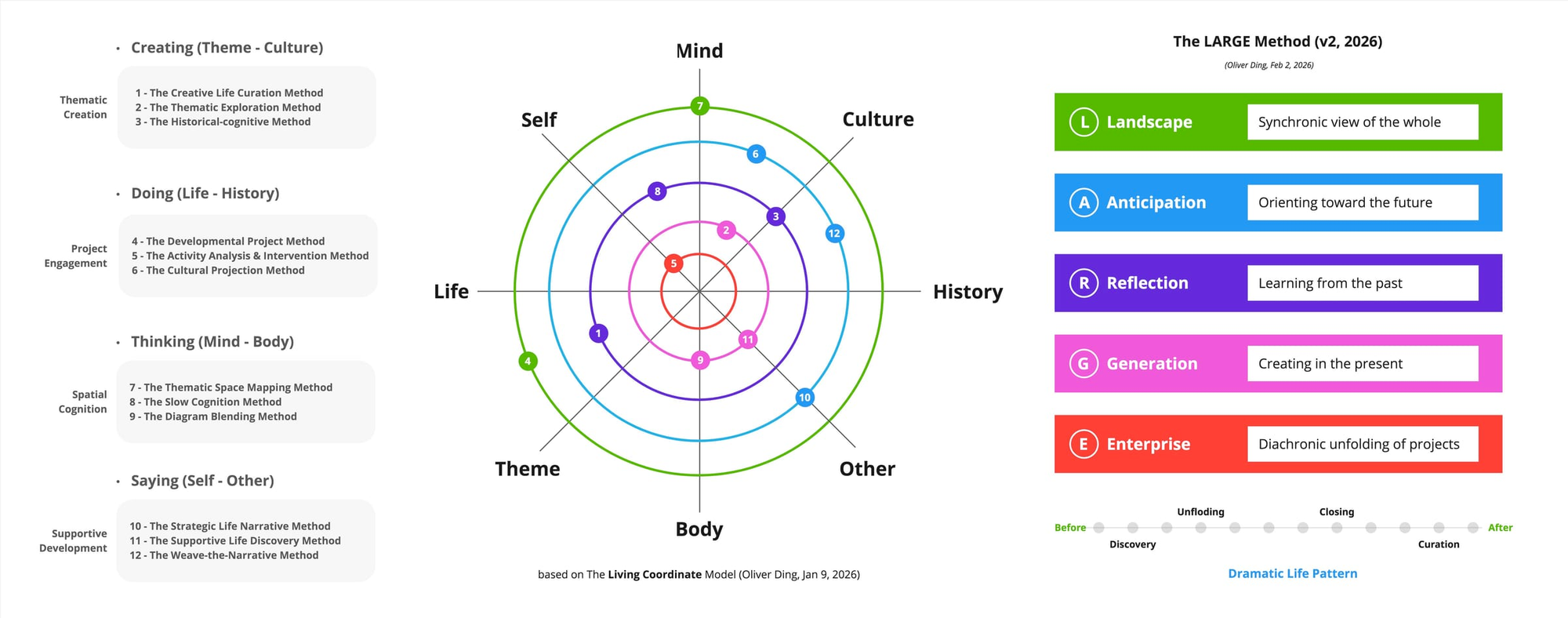
The diagram above presents the LARGE Method (v2, 2026). The Living Coordinate model was originally composed of two parts: a 3D coordinate system and a series of circles. The LARGE Method extends this structure by adopting a 4D coordinate and five circles. On the right side of the diagram, five methodological principles are presented in five differently colored boxes — Landscape, Anticipation, Reflection, Generation, Enterprise — each corresponding to one of the five circles in the central diagram. On the left side, four dimensions are unfolded into four thematic spaces: Creating (Theme — Culture), Doing (Life — History), Thinking (Mind — Body), and Saying (Self — Other).
The development of ACS turned out to align naturally with the LARGE Method — not by design, but by convergence. On February 27, 2026, drawing on the Living Coordinate model, the landscape of ACS v1.1 was mapped for the first time as a three-dimensional structure. Once that structure was made visible, what had been discovery-driven development became design-driven: the diagram itself became the guide.
The landscape of SDP (v1.2) was inspired by the landscape of ACS. SDP v1.2 is organized around three theoretical dimensions, each corresponding to a different aspect of individual development, and five concentric rings representing the fundamental developmental orientations.
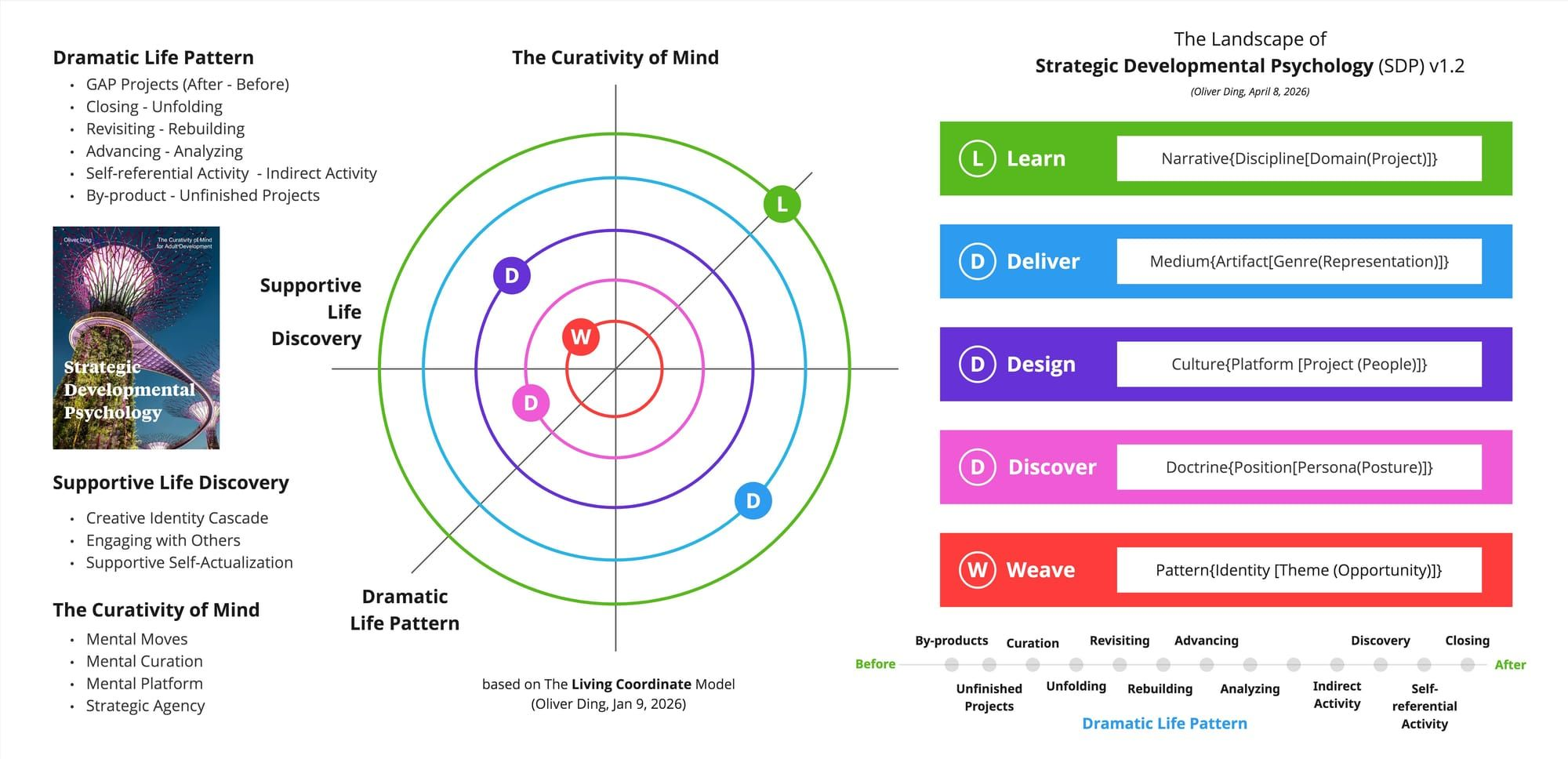
The three dimensions of the SDP Living Coordinate are:
The Curativity of Mind — the cognitive dimension, corresponding to the "Body - Mind" dimension of the LARGE Method.
This is the most developed dimension at present, built on the theoretical work completed in December 2025. It addresses Mental Curation (how the mind selects, organizes, and transforms knowledge), Mental Platforms (the cognitive structures that support sustained creative work), Mental Moves (the operations through which concepts are developed and deployed), and Strategic Agency (the capacity to act strategically within a complex knowledge terrain).
Supportive Life Discovery — the relational dimension, corresponding to the "Self - Other" dimension of the LARGE Method.
Creative development does not happen in isolation: it is shaped by the presence of supporters, collaborators, teachers, and communities of practice. Supportive Life Discovery maps the conditions under which this relational support enables — and sometimes enables for the first time — the individual's capacity to discover their own direction. Key concepts include Creative Identity Cascade, Engaging with Others, and Supportive Self-Actualization.
Dramatic Life Pattern — the projection dimension, corresponding to the "Life - History" dimension of the LARGE Method.
This dimension was originally born from my practice of GAP Projects in 2023. GAP Projects represent a temporal pattern: the structural opportunities that exist between formal projects. These “After” and “Before” projects — such as Creative Life Curation and Creative Life Discovery — occupy the gaps between major endeavors. They serve as reflection points, transition spaces, and moments of strategic choice. The timing of GAP projects is itself a pattern: recognizing when to pause, curate, or explore can dramatically affect developmental outcomes.
Over the past three years, while practicing the "GAP Projects" pattern and researching its development, I detected other specific patterns of project engagement. Thus, I named this line of exploration Dramatic Life Pattern.
Watershed: A Dramatic Life Pattern
The theme "Watershed" was discovered while editing the manuscript Revisiting and Rebuilding: A Strategy for Creative Identity Development.
In A Chronicle of Revisiting–Rebuilding Practice (September 2025 – March 2026), a series of RR practices is organized around a single watershed: October 2018. That month marks the moment when sustained theoretical book-writing became the primary creative mode — the transition from a practitioner identity to a theorist identity.
Before October 2018, the creative work was carried out mainly through conceptual decks, practical frameworks, and community engagement. After October 2018, the book manuscript became the dominant medium, and more than forty drafts followed over the subsequent years.
This shift in creative identity is the basis for dividing the archive into two parts: cases where the original material predates the watershed, and cases where it postdates it. The significance of this distinction is not merely chronological. When a present self revisits material created by a past self who inhabited a different creative identity, the RR tension is at its greatest — the distance crossed is not only temporal but identity-level. When the revisiting stays within the same identity phase, the value is different: primarily one of creative heuristics, pattern recognition, and theoretical integration.
December 2025 marks a new watershed in my creative life.
v1.0 - April 14, 2026 - 5,589 words