
The "Theme–Concept–Framework" Transformation (2023–2026)

A journey and a situational map
by Oliver Ding
April 13, 2026
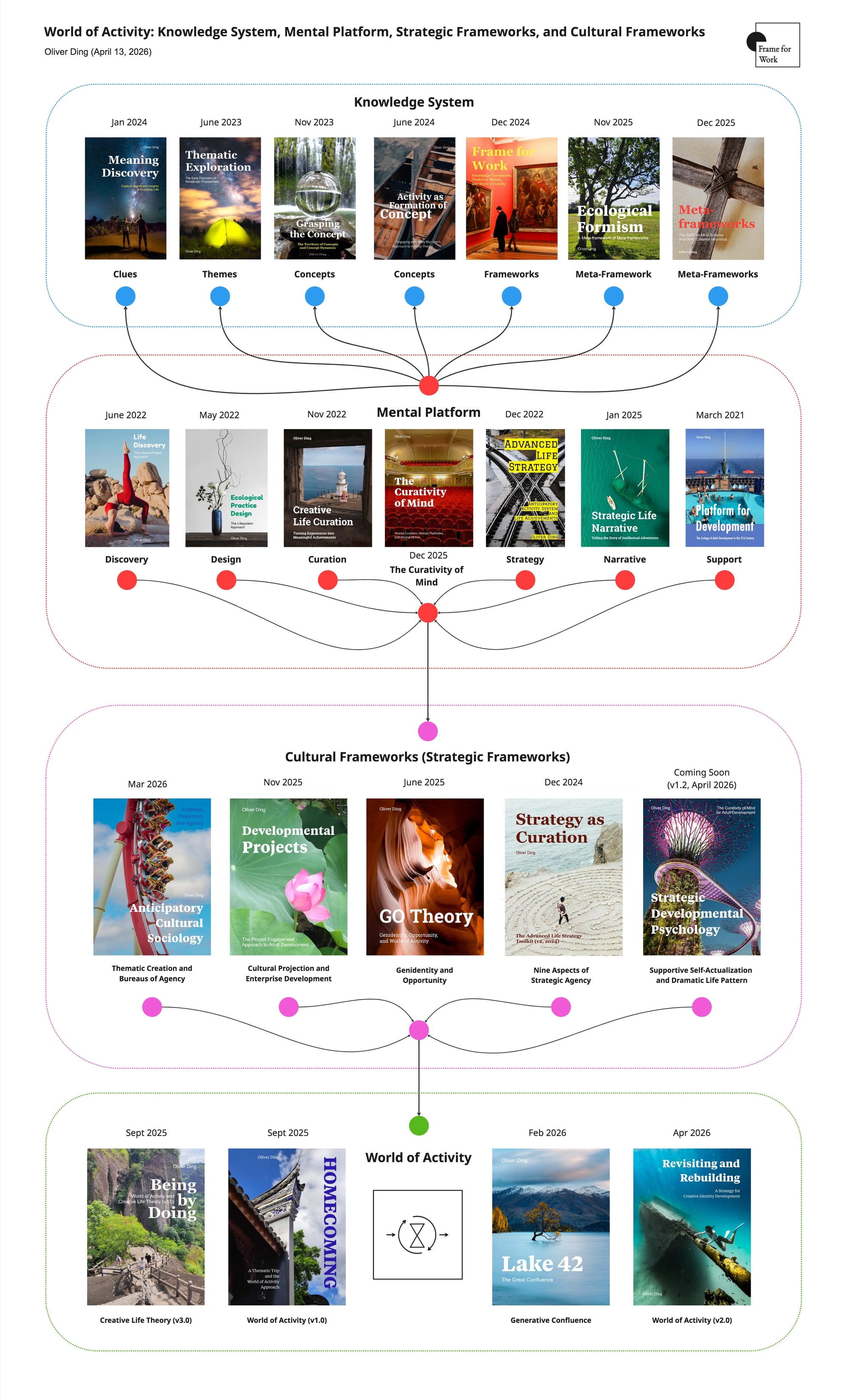
This afternoon, I updated a diagram. The change was small on the surface — a version date, a few new book covers, a new layer at the bottom — but it reflects something more substantial: a journey that has quietly crossed a threshold.
The previous version of this map was made in November 2025. The new version is dated April 13, 2026. The title of the article it accompanies has changed accordingly: from The "Theme-Concept-Framework" Transformation (2023–2025) to The "Theme-Concept-Framework" Transformation (2023–2026). One year added. But the addition is not merely temporal.
An End as a Beginning: The Knowledge System
In early 2023, I worked on the TALE Project — short for Thematic Analysis Learning Engagement. One of the major outcomes of this project was the Strategic Thematic Exploration Framework.
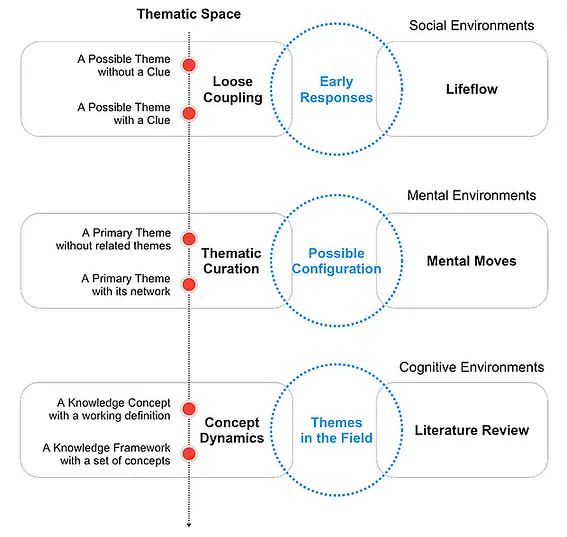
From my experience in developing knowledge frameworks and cultivating tacit knowledge in general, I have observed a consistent tendency for themes to evolve into concepts. The Strategic Thematic Exploration Framework represents a linear process of "From Theme to Framework," consisting of the following six stages:
- A Possible Theme without a Clue
- A Possible Theme with a Clue
- A Primary Theme without Related Themes
- A Primary Theme with its Network
- A Knowledge Concept with a Working Definition
- A Knowledge Framework with a Set of Concepts
I also identified three types of transformation that describe how this process unfolds. The "Possible–Primary" Transformation concerns the discovery of opportunities for knowledge creation and knowledge curation. It establishes the primary strategic intent for the entire journey of knowledge engagement. The "Theme–Concept" Transformation focuses on turning themes into concepts, treating themes as raw materials and creative resources for generating new conceptual forms that can later be expanded or refined. The "Concept–Framework" Transformation centers on curating conceptual components into a coherent and meaningful whole — the stage at which a knowledge framework emerges through the organization of multiple interrelated concepts.
From 2023 to the present, the Theme–Concept–Framework Transformation Model has guided my exploration into the development of knowledge systems, resulting in a series of book drafts:
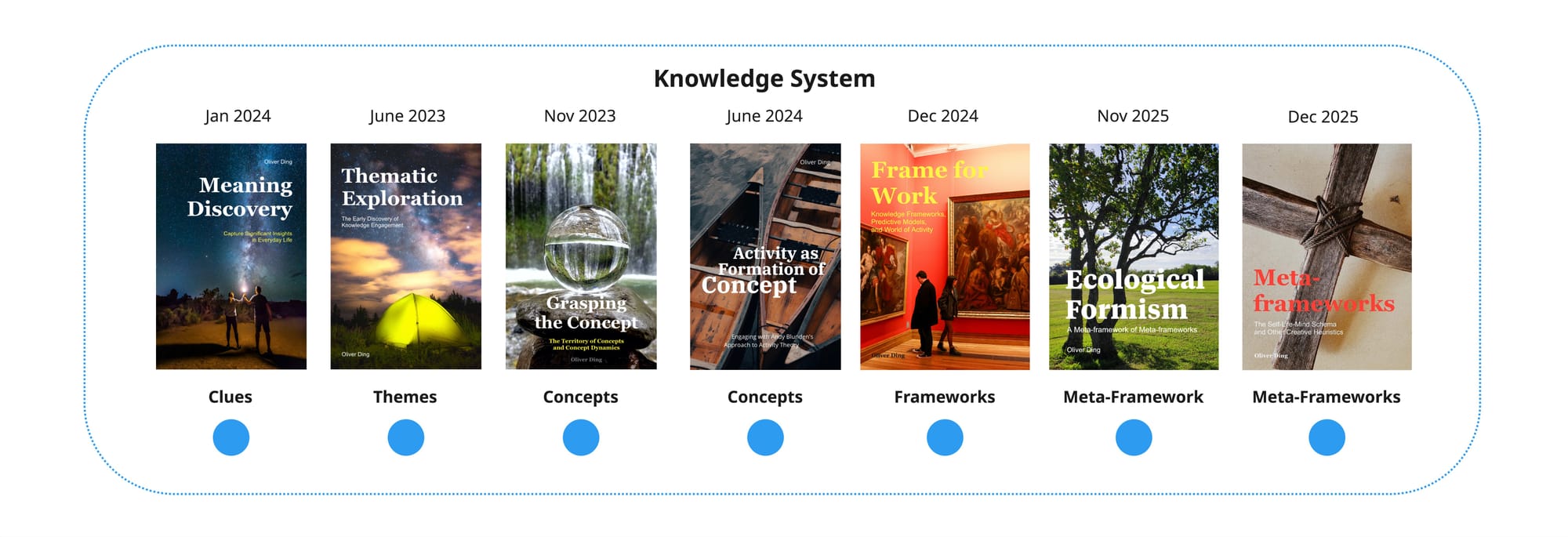
- Clues → Meaning Discovery (Jan 2024)
- Themes → Thematic Exploration (June 2023)
- Concepts → Grasping the Concept (Nov 2023)
- Concepts → Activity as Formation of Concept (June 2024)
- Frameworks → Frame for Work (Dec 2024)
- Meta-Framework → Ecological Formism (Nov 2025)
- Meta-Frameworks → Meta-Frameworks (Dec 2025)
In December 2024, I completed Frame for Work. The following month, January 2025, I launched a new knowledge center to support its further development. Later, I chose "Meta-Frameworks" as the annual theme for 2025. Over the following months, I wrote a series of articles around this theme, eventually compiling and refining them into a new book draft.
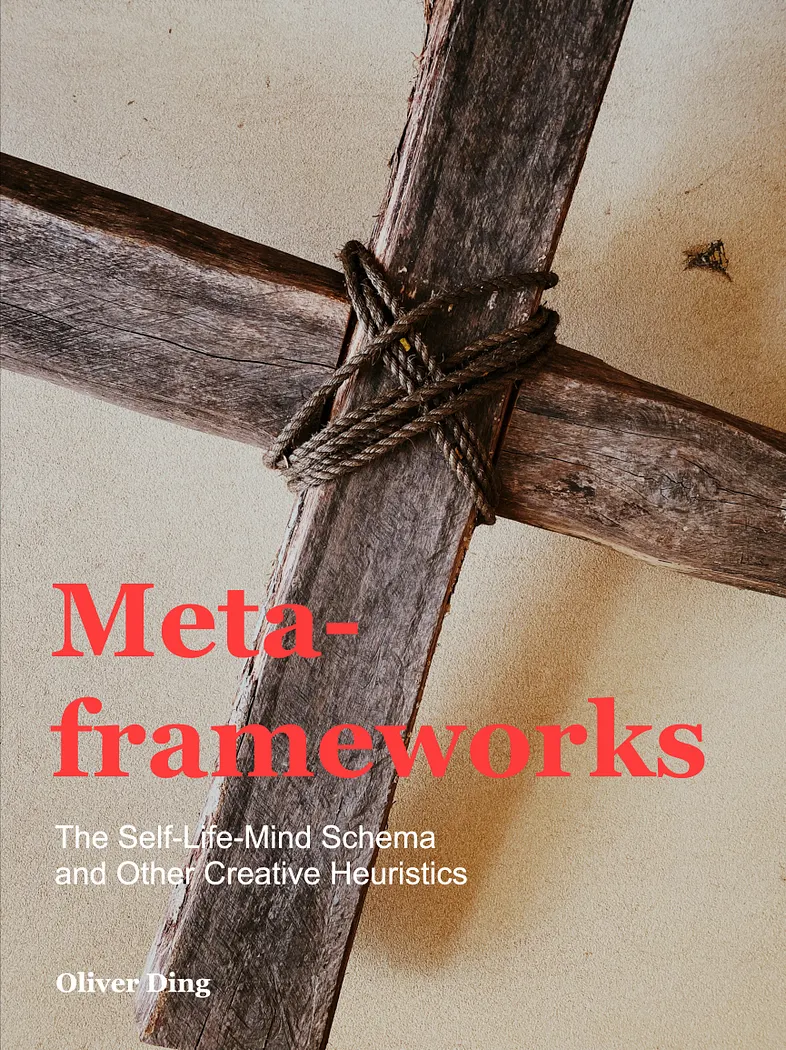
The distinction between Ecological Formism and Meta-frameworks is crucial: the former focuses on a single meta-framework, while the latter explores the concept of "Meta-Framework" itself — along with a collection of 38 meta-frameworks.
Meta-frameworks, released on December 31, 2025, marked the completion of the long-term journey of constructing the Theme–Concept–Framework Transformation Model. By that date, the Knowledge System layer was complete. The long arc from Clues to Meta-Frameworks had closed.
A Watershed: Meta-frameworks and the Pivot to Cultural Development
But Meta-frameworks did more than complete a sequence. It marked a watershed.
To understand why, it is necessary to step back. Starting in December 2024, I gradually shifted from Knowledge Engagement to Cultural Development. During the Christmas holiday of 2024, a reflective conversation with a mentor clarified something: my focus had shifted toward Cultural Life Development, marking a detachment from Individual Life Development. This strategic move was encapsulated in the theme of "Cultural Grounding / Cultural Growing."
Over the following twelve months, I worked on several projects related to Cultural Development: the Tiny Culture project, the "Culture as Thematic Enterprise" Framework, the Frame-for-Work Canvas, and the Cultural Projection Model (2025). These explorations were accumulating materials and testing frameworks, but were not yet unified under a single theoretical roof.
Then, on December 20, 2025, I formally started the Meta-frameworks project. I wrote three foundational articles — the History{Life[Self(Body)]} Framework (v3.0), the Six Faces of the Concept System, and Weave the Culture — and curated a series of related knowledge models into a comprehensive Weave-the-Culture toolkit.
The epilogue of Meta-frameworks reviewed the development of Creative Life Theory from v2.0 to v3.1. The switching from the Self–Life–Mind schema to the HLS framework marks a strategic pivot from Individual Life Development to Cultural Life Development. The birth of the World of Life (World of Activity) approach marks a nexus-point where the act of Closing a rich history meets the act of Unfolding a new future. (More details can be found in the epilogue of Meta-frameworks: Beyond Creative Life.)
Six Faces of the Concept System
The most structurally significant contribution of Meta-frameworks was the Six Faces of the Concept System.
By placing my accumulated work onto the History{Life[Self(Body)]} (HLS) framework — which understands the social world as a nested Anticipatory Activity System — six distinct types of concept systems came into view:
- Knowledge Frameworks — concept systems oriented toward objective truth; the cognitive prototype
- Mental Platforms — the personal cognitive infrastructure that supports individual development
- Strategic Frameworks — concept systems that translate understanding into long-term action
- Cultural Frameworks — concept systems through which values and meanings are negotiated collectively
- Institutional Frameworks — the historical crystallization of Cultural Frameworks over time
- Spiritual Frameworks — concept systems oriented toward transcendent meaning
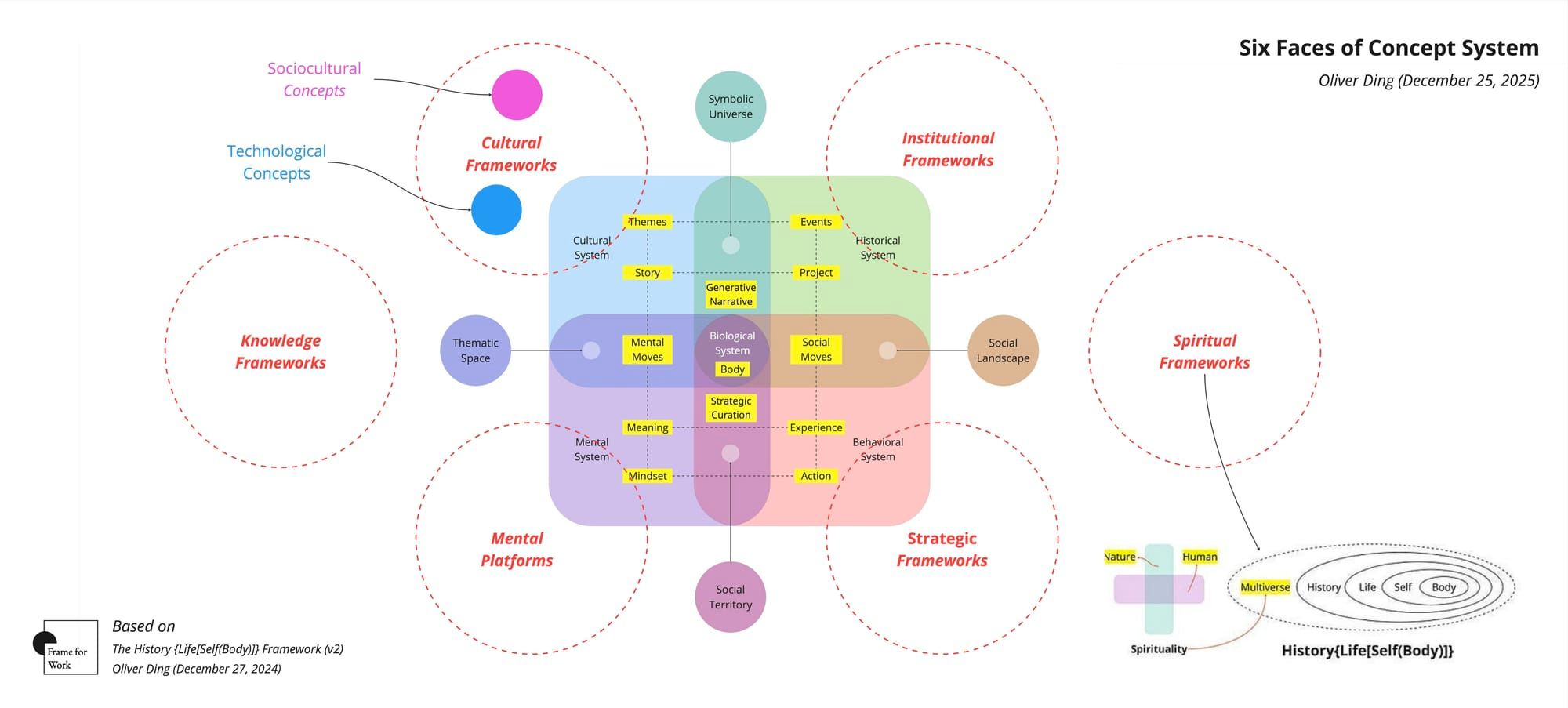
The six faces are not a simple typology. They form a dynamic map of the social world with internal coordination mechanisms. At the individual level, Mental Platforms serve as the source of Strategic Frameworks: a person's cognitive infrastructure generates the strategic orientations that guide their creative enterprise across time. At the collective level, Cultural Frameworks evolve into Institutional Frameworks — the accumulated, stabilized outcomes of cultural activity across generations. And across levels, the relationship runs in both directions: individuals can internalize Cultural Frameworks to develop their Mental Platforms, while publicly shared Mental Platforms can contribute to new Cultural Frameworks. Knowledge Frameworks and Spiritual Frameworks occupy the boundary positions — one oriented toward objective reality, the other toward transcendent meaning — and in doing so, they define the outer limits within which the four central faces operate.
This model was not constructed from scratch. Over the preceding years, I had already been exploring mental models, mental platforms, predictive models, strategic frameworks, and cultural frameworks — each in its own context, through its own projects. The Six Faces did not invent these; it crystallized them. What the HLS framework provided was the shared ontological ground on which these parallel explorations could finally be seen together, as distinct but related faces of the same underlying phenomenon. (More details can be found in Six Faces of the Concept System.)
The Four Layers: A Unified Map
With the Six Faces model as background, the diagram updated today becomes legible as something more than a collection of book covers arranged by date. It is a map of four interconnected layers, each corresponding to a distinct register of creative and cultural development. The four layers are not independent — they are nested. What follows is a brief account of each.
Layer 1: The Knowledge System
The Knowledge System traces the Theme–Concept–Framework journey from 2023 to 2025, from Clues to Meta-Frameworks. This is the layer where the prototype was built — the foundational exploration of how knowledge elements mature into frameworks and frameworks into systems.
It is worth noting that from the beginning, the theoretical focus was deliberately positioned on concept systems in general — a framing broad enough to accommodate cross-domain application. The case studies, however, concentrated on knowledge-type concept systems, using them as the primary material for developing the models and mechanisms.
From 2020 to 2022, I explored knowledge engagement through a series of projects. In 2023, I decided to continue along this direction. Thus, I defined the first phase of TALE to focus specifically on Knowledge Themes, in order to stay aligned with my other knowledge-related initiatives.
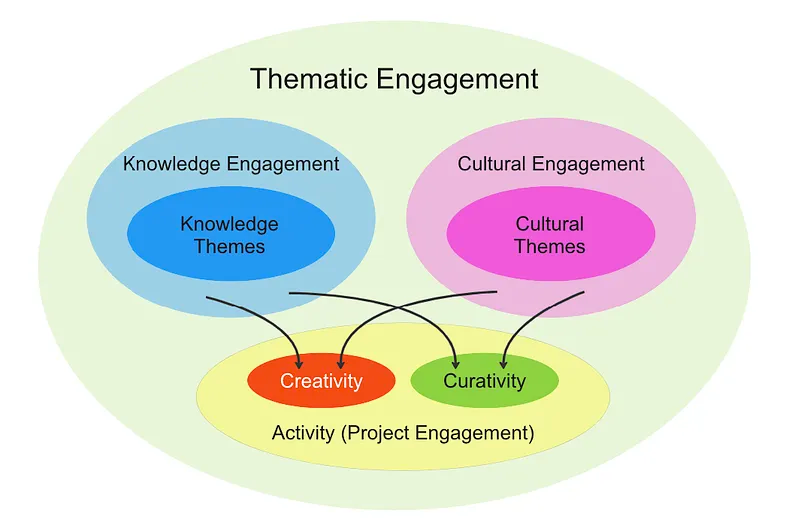
Moreover, I positioned the exploration of “Themes/Concepts” as my primary focus. This strategic intention creates a pathway for evolving from knowledge engagement toward cultural engagement.
By the end of 2024, I began shifting from Knowledge Engagement to Cultural Engagement. Interestingly, the entire body of knowledge created under TALE in 2023–2024 turned out to be ready for this transition. I simply rephrased parts of my frameworks — changing terms like “knowledge X” to “creative X.”
In fact, I don’t see this as a shift but rather an expansion — because all creations about themes and concepts within the context of knowledge engagement can also be applied meaningfully to cultural engagement.
This strategic model has helped me navigate the balance between Performance (as present objects) and Anticipation (as future objectives). (More details can be found in [Frame for Work] Case Study #2: The TALE Model (2023).)
Layer 2: The Mental Platform
The Mental Platform layer is built around a single foundational insight: the essence of mind is mental curation. Across more than a century of psychological research — from Gestalt perception to Piagetian development, from Jungian individuation to narrative identity — a common theme emerges: mind constantly organizes pieces into meaningful wholes. The Curativity of Mind makes this principle explicit, developing a comprehensive framework for understanding the mind as a mental curation activity across extended time periods, from momentary perception to lifelong creative enterprises.
At the core of this framework is the "Perception — Action — Conception — Curation" schema. Curation is proposed as a fourth foundation alongside the three traditional keywords of mind: not merely passive (perception), active (action), or representational (conception), but fundamentally curatorial — constantly selecting, organizing, and synthesizing experiences, concepts, and actions into coherent wholes.
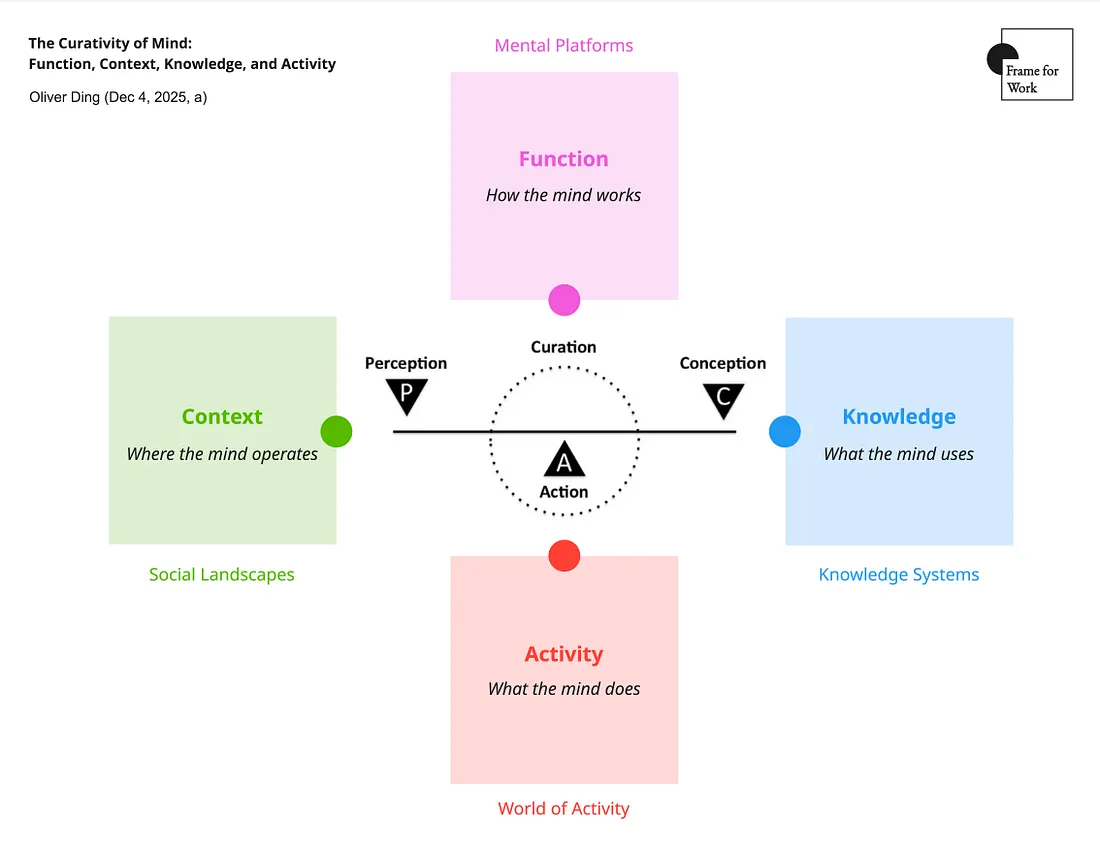
The framework is built on four dimensions:
- Function: How the mind works (by curating)
- Context: Where the mind operates (in social landscapes)
- Knowledge: What the mind uses (conceptual systems)
- Activity: What the mind does (developmental projects)
The Mental Platform emerges as the theme that bridges the Context and Knowledge dimensions. This theme investigates the structural products of curatorial activity — the dynamic, self-organizing concept systems that the mind continuously builds.
When these concept systems are connected to a concrete context — such as the Creative Enterprise emphasized in Creative Life Theory — they reveal their functional role in supporting purposeful activity. It is this contextualized, functionalized concept system that constitutes the Mental Platform.
Focusing on the Mental Platform allows us to understand not only the stable structures the mind relies on but also how these structures provide the essential support and context for strategic thought and action.
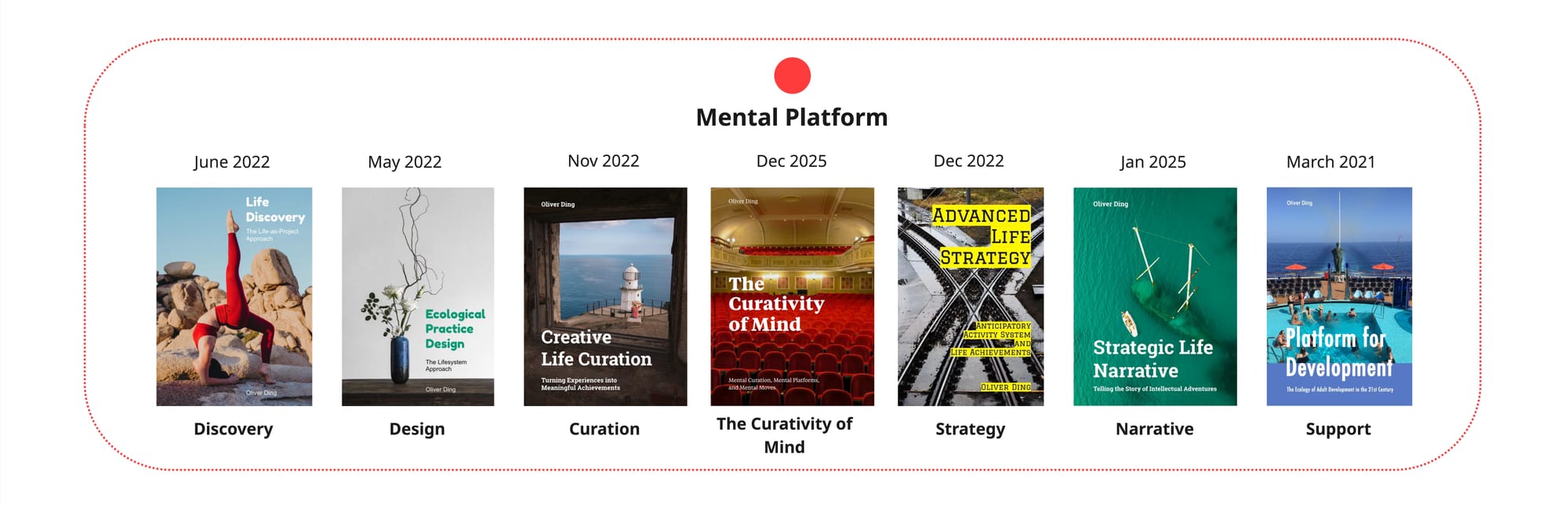
The seven books in this layer — Life Discovery, Ecological Practice Design, Creative Life Curation, The Curativity of Mind, Advanced Life Strategy, Strategic Life Narrative, Platform for Development — each addressed one key function of the creative enterprise:
- Discovery
- Design
- Curation
- Strategy
- Narrative
- Support
Five key functions were identified in June 2025 within the “Theory as Enterprise” Framework (see the diagram below). On November 9, 2025, I added “Discovery” as a sixth key function.
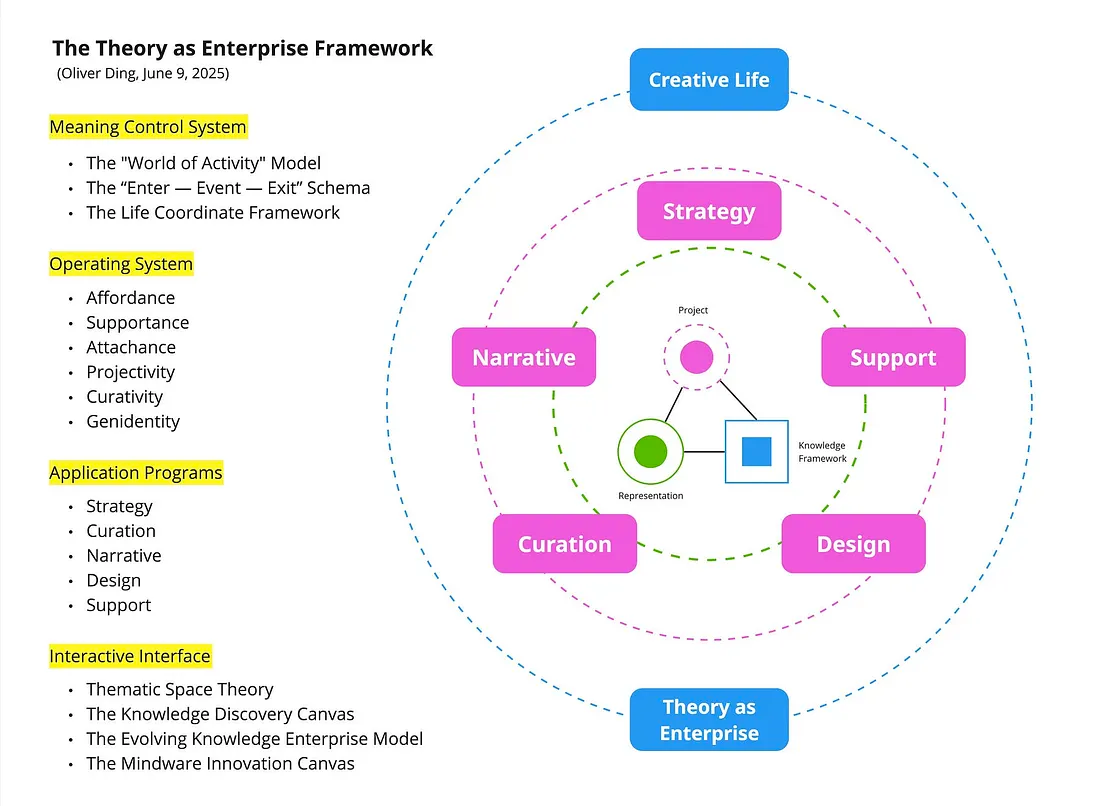
The Curativity of Mind (Dec 2025) brought these six functions together under a unified framework. This layer corresponds to the Mental Platforms face in the Six Faces model.
Layer 3: Cultural Frameworks and Strategic Frameworks
The third layer is where two faces of the Six Faces model meet: Cultural Frameworks and Strategic Frameworks. This pairing is not incidental — it reflects a symmetry that runs through the entire knowledge enterprise at multiple levels.
At the book level, The Curativity of Mind and Meta-frameworks form a symmetric pair: one attends to the mind's interior (Mental Platform), the other maps the social world (Knowledge System and its six faces).
- At the framework level, Cultural Frameworks attend to how concept systems develop at the collective scale, while Strategic Frameworks attend to how they operate at the individual scale of purposeful action.
- At the project level, ACS and SDP are symmetric enterprises sharing the same ontological foundation — the World of Life — but oriented toward different dimensions of the same social reality.
- And at the agency level, the Bureaus of Agency (within ACS) and the Nine Aspects of Strategic Agency (within SDP) form another symmetric pair: one describing the structural positions through which collective agency operates, the other mapping the dimensions through which individual strategic agency develops.
This symmetry is not decorative. It reflects a structural claim: that cultural development and individual development are two faces of the same anticipatory process, and that any adequate theory must attend to both simultaneously.
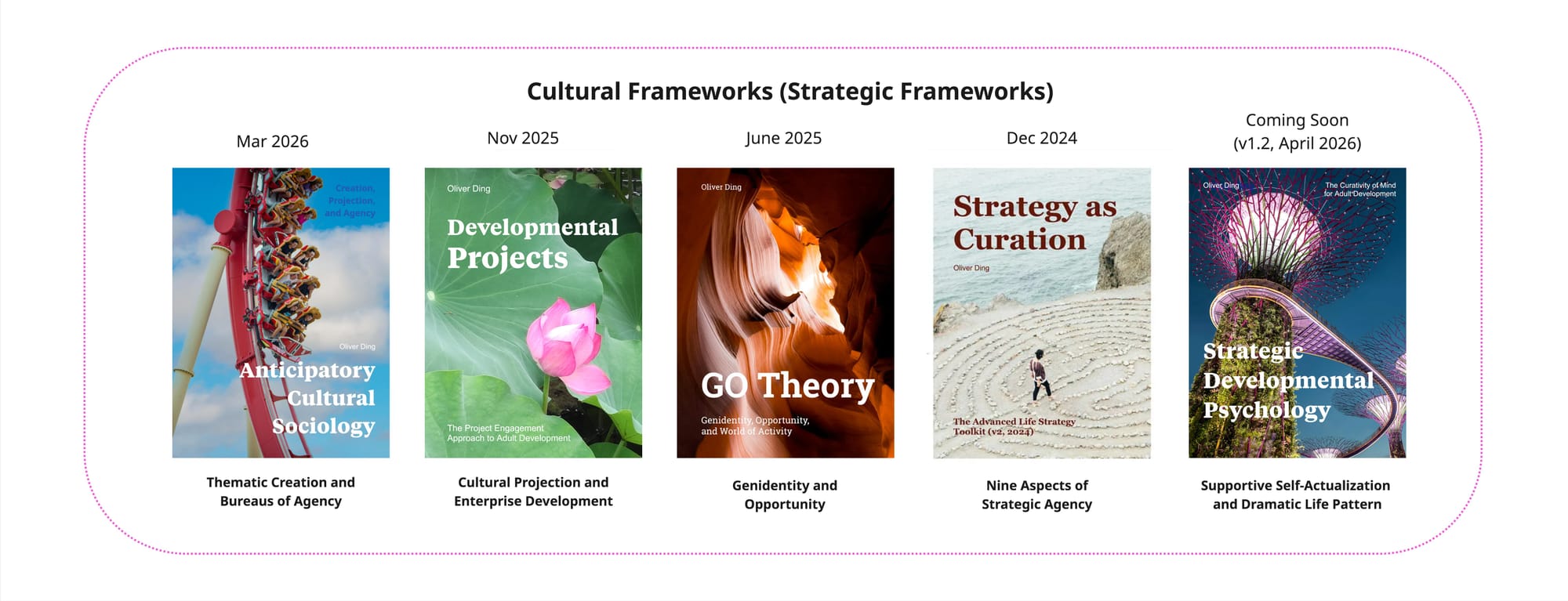
The books in this layer — GO Theory (June 2025), Strategy as Curation (Dec 2024), Developmental Projects (Nov 2025), Anticipatory Cultural Sociology (Mar 2026), and Strategic Developmental Psychology (Coming Soon, v1.2) — map this dual terrain.
Anticipatory Cultural Sociology operates at the collective scale, organized around three dimensions: Thematic Creation, Cultural Projection, and Bureaus of Agency. Cultural development, in ACS's view, is a continuous anticipatory activity of creating and curating concept systems and transforming them into thematic enterprises by weaving active agency and evolving structure within the social world.
Strategic Developmental Psychology attends to the individual scale — how a person builds the mental platforms and strategic frameworks needed to develop a creative enterprise across time. SDP's three dimensions correspond to three versions of development: the Curativity of Mind (v1.0), the five developmental orientations of Learn–Discover–Design–Deliver–Weave (v1.1), and Supportive Life Discovery together with Dramatic Life Pattern (v1.2).
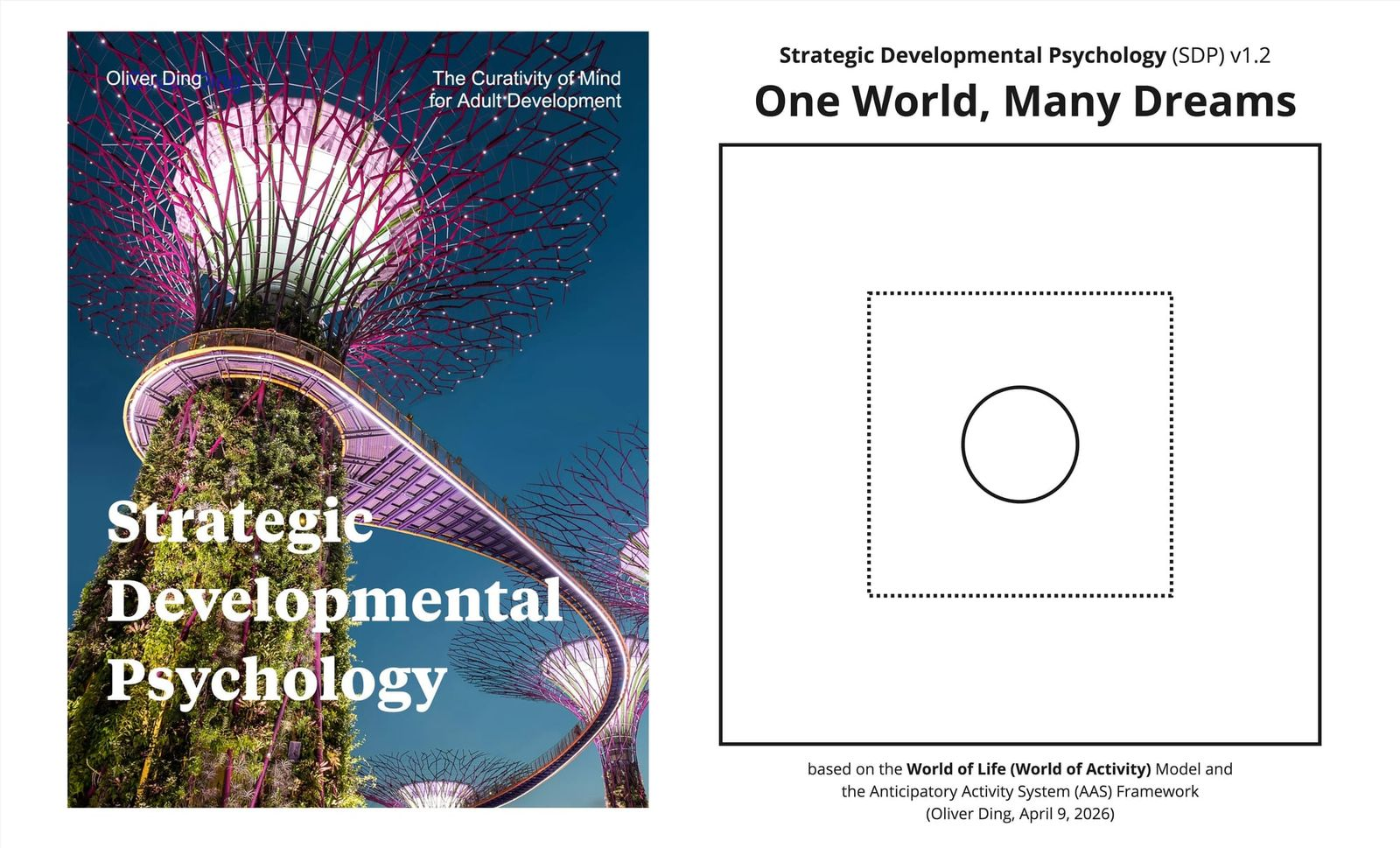
One World, Many Dreams. Together, ACS and SDP give the third layer the theoretical architecture it previously lacked — transforming it from a collection of strategic tools into a coherent account of how concept systems develop across both individual and social life.
Layer 4: The World of Activity
The World of Activity layer sits at the foundation of the entire map. But it is not a static foundation — it has been one of the most actively developing areas of the enterprise through 2025 and into 2026.
The most important theoretical development of 2025 was the establishment of the World of Life (World of Activity) approach — the social world ontological framework that holds both individual development and cultural innovation together. The two concepts are connected through a container-nesting structure: World of Activity nested within World of Life, the individual creative enterprise nested within the broader social ecology it inhabits. The World of Activity focuses on describing the scope within which individual development can intervene and the patterns operating within it. The World of Life addresses the boundaries of the social world and the patterns within those boundaries.
The theoretical core of this layer is the FFCC Schema — the primary model of the World of Activity, and later the primary model for understanding Life (Self) itself. The FFCC Schema organizes the World of Activity around four basic ecological forms:
- Flow (the stream of experience moving through a life),
- Focus (the thematic concentration that gives direction to the flow),
- Center (the organizing core around which creative activity stabilizes), and
- Circle (the social relational network within which the center operates and extends).
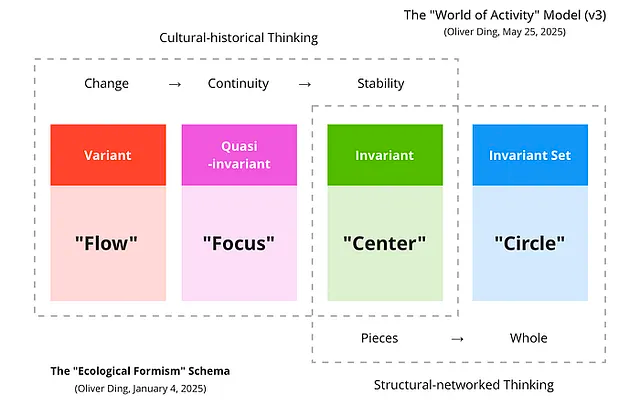
These four ecological forms are not sequential stages but simultaneously active aspects of any creative life — each shaping the others, each visible from a different angle.
The books in this layer have each made distinct contributions to the FFCC model. Homecoming was the empirical research project built around the FFCC Schema — analyzing the author's own autobiography and 2025 journey to Fuzhou, identifying seven specific forms of the World of Activity, and using the FFCC model to explain the dynamics and differences between them. Lake 42 developed this further, articulating eight movements using FFCC terminology and integrating the Living Coordinate concept with the FFCC model into a unified framework. The recent Revisiting and Rebuilding practice — particularly the Significant Themes case study — made a further contribution: several new FFCC model cases emerged, and insights from Homecoming, Lake 42, the Knowledge Discovery Canvas, and other projects were integrated into a multi-layered structure centered on the FFCC model.
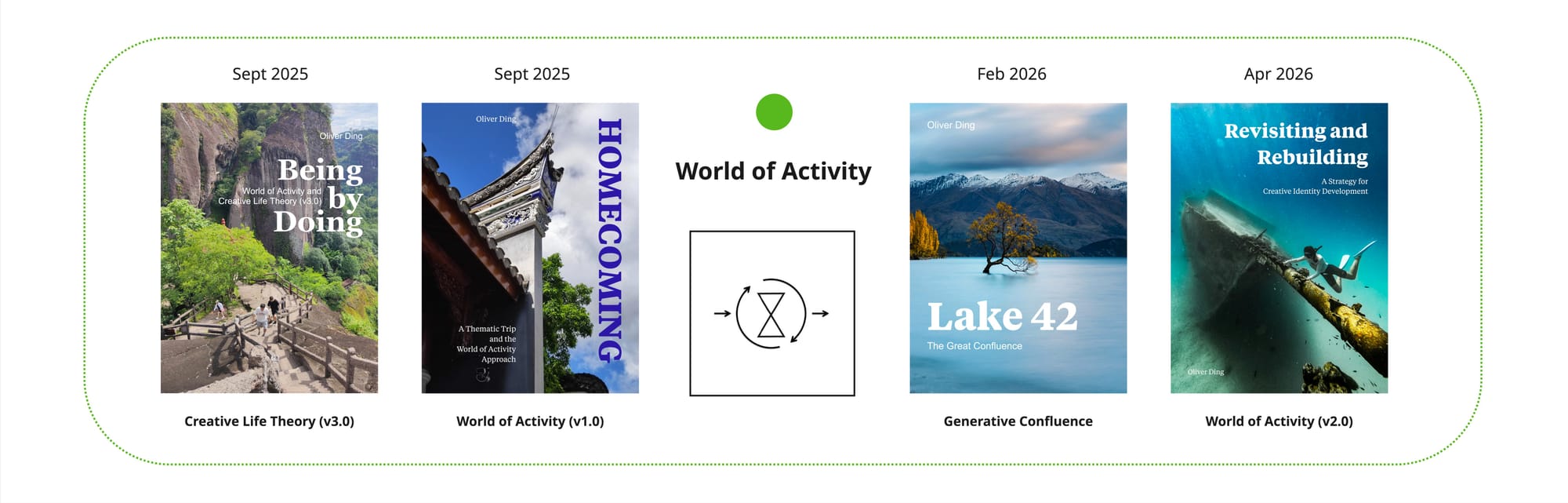
The organizing architecture for this integration is Ecological Formism — a four-layer framework in which patterns are classified according to their degree of universality: the Invariant layer (the FFCC schema itself, as universal ontological foundation), the Quasi-invariant layer (cross-human developmental patterns), the Variant layer (patterns triggered by specific situations), and the Invariant Set (Life Themes as an inexhaustible open category). Through this structure, the Quasi-invariant layer has been significantly expanded, now containing thirteen themes across all four FFCC positions — drawn from three complementary sources: the Regular Group providing the core career and professional developmental arc, Lake 42 providing fine-grained differentiation at the Flow and Focus stages, and Homecoming providing ecological diversity of Center and Circle configurations.
Together, these books map the full developmental terrain of a creative life organized around the FFCC model. This layer does not sit above the others — it holds them. The Knowledge System develops within it. The Mental Platform operates through it. ACS and SDP give it theoretical articulation at both ends of the individual–collective spectrum. The entire knowledge enterprise, from Knowledge Frameworks to Cultural Frameworks, is grounded in a single coherent understanding of what creative life is and how it unfolds.
In this sense, the development of this knowledge enterprise itself is a case study of the Theme–Concept–Framework Transformation — from early thematic explorations to maturing concepts to a structured system of interconnected frameworks.
From One Face to Six
The title shift from 2023–2025 to 2023–2026 marks more than a year's passage. It marks a transition in the nature of the journey itself.
From 2023 to 2025, the Theme–Concept–Framework Transformation was a journey conducted within one face of the concept system — Knowledge Frameworks. The work was deep and disciplined, producing a coherent sequence from Clues to Meta-Frameworks.
Meta-frameworks completed that sequence and simultaneously revealed the larger map. The Six Faces model showed that Knowledge Frameworks, however thoroughly developed, is one face among six. The other faces — Mental Platforms, Strategic Frameworks, Cultural Frameworks — had been developing in parallel, but without a shared ontological framework to explain their relationships.
That framework now exists. And with ACS and SDP providing theoretical elaboration at the collective and individual scales respectively, the Cultural Frameworks layer has acquired the depth needed to serve as genuine counterpart to the Knowledge System.
The map updated today reflects a knowledge enterprise that has grown from a focused exploration of themes and concepts into something broader: a theory of how concept systems develop across individual and social life, supported by a coherent ontology of the social world.
The journey continues. But it now has a larger shape.
v1.0 - April 13, 2026 - 3,140 words