
Appropriating Activity Theory #15: Before, After, and Watershed
This post is part of the "Appropriating Activity Theory" series, which reflects my creative journey of engaging with Activity Theory from 2015 to 2025.
by Oliver Ding
April 15, 2026
Over the past two weeks, I published a collection of essays examining the RR practice (Revisiting‑Rebuilding). In editing the chronicle A Chronicle of Revisiting‑Rebuilding Practice (September 2025 – March 2026), I noticed that I had deliberately used October 2018 as a watershed.
This chronicle is organized around a single watershed: October 2018. That month marks the moment when sustained theoretical book‑writing became the primary creative mode — the transition from a practitioner identity to a theorist identity.
Before October 2018, the creative work was carried out mainly through conceptual decks, practical frameworks, and community engagement. After October 2018, the book manuscript became the dominant medium, and more than forty drafts followed over the subsequent years.
This shift in creative identity is the basis for dividing the archive into two parts: cases where the original material predates the watershed, and cases where it postdates it. The significance of this distinction is not merely chronological. When a present self revisits material created by a past self who inhabited a different creative identity, the RR tension is at its greatest — the distance crossed is not only temporal but identity‑level. When the revisiting stays within the same identity phase, the value is different: primarily one of creative heuristics, pattern recognition, and theoretical integration.
After editing that chronicle, “watershed” became a new theme for me. I began to wonder whether similar dividing lines existed in my decade‑long journey of appropriating Activity Theory. This issue of the column is dedicated to that theme.
1
On December 31, 2022, I drew a diagram to reflect on my “Oliver – Activity” thematic engagementand from 2015 to 2022.
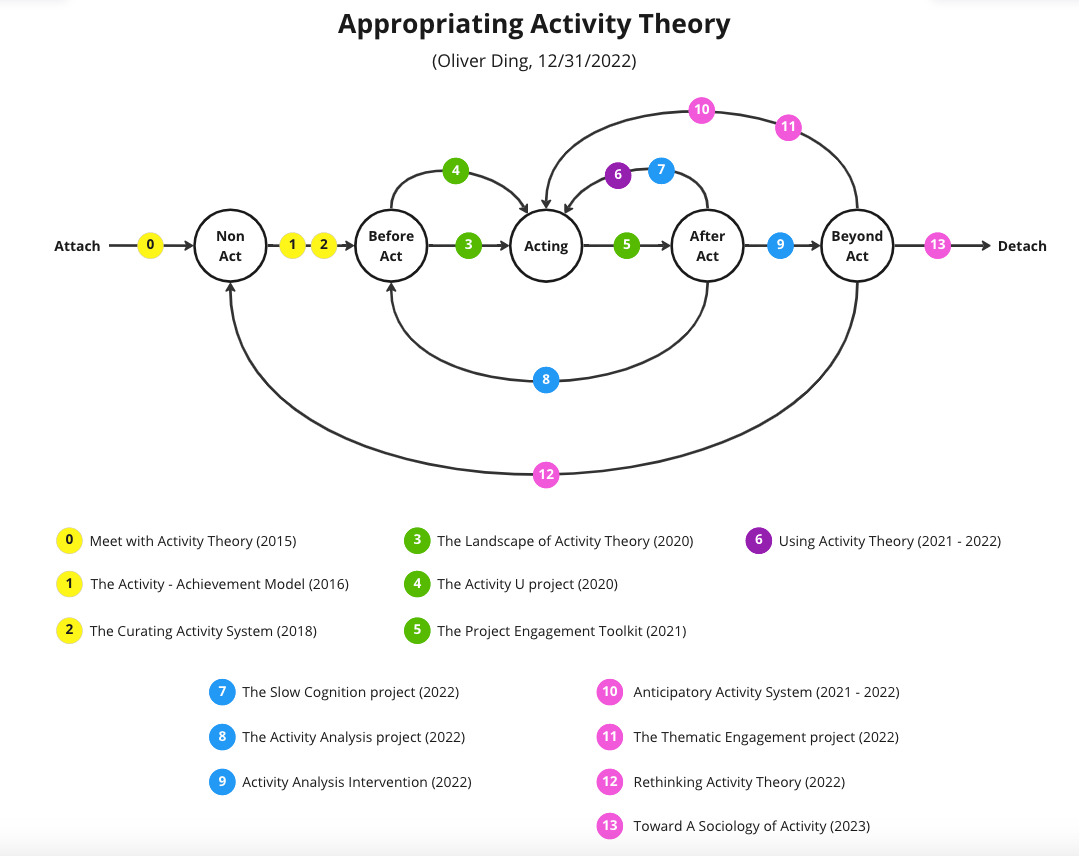
How did I make this diagram? I consider the Activity U knowledge curation project (#4) as the central point of the journey.
I started the Activity U project on August 19, 2020. Initially, I made a diagram called “Activity U” as a test of the “HERO U” framework, and wrote a post titled The Landscape of Activity Theory to explain it. That was the #3 movement.
From August 2020 to January 2021, I worked on the Activity U project and wrote a series of articles about Activity Theory. That was the #4 movement.
Eventually, I edited two possible books: Activity U: How to Think and Act like an Activity Theorist and Project‑oriented Activity Theory. Finally, in February 2021, I launched a toolkit called Project Engagement. That was the #5 movement.
Based on the diagram, the #5 movement is a key component of the project engagement process.
My journey with Activity Theory was inspired by several activity theorists. The starting point lies at the intersection of Activity Theory and HCI (human‑computer interaction), since my daily work is digital interaction design. I began reading books such as Activity Theory in HCI and Acting with Technology: Activity Theory and Interaction Design, and noticed a common author: Bonnie A. Nardi. Her short biography “Appropriating Theory” encouraged me. I later used Appropriating Activity Theory as the title for a new possible book, structured in six parts: The Journey, The Curation, The Creation, The Dialogue, The Discovery, and The Anticipation.
Looking back now, the Activity U project remains a watershed in this journey. Chronologically, 2020 sits in the middle of 2015–2025, which makes it even more fitting as a dividing line. Before 2020, I read theoretical books and articles focused on HCI practice reflection, without a broad exploration or deep thinking about Activity Theory as a whole. After 2020, I expanded beyond HCI, examined Activity Theory in its full scope, and began developing my own original theoretical concepts and knowledge frameworks.
One outcome of the Activity U project was two knowledge frameworks: Life as Activity v0.3 and Project Engagement v1.0. They have since evolved through multiple versions. Their latest versions are Life as Activity Approach (v3.2), released November 11, 2025, and Project Engagement Approach (v3.1), released December 21, 2024. These have generated a series of book manuscripts, most recently Developmental Projects: The Project Engagement Approach to Adult Development (November 30, 2025), which effectively announces Project Engagement Approach v4.0.
If I were to update the diagram I made at the end of 2022, the central position of the Activity U project would remain unchanged. I would only need to add new projects in the “beyond” section, updating key developments from 2023 to 2025.
2
The watershed pattern appears not only on a ten‑year scale but also on a scale of months. In A Chronicle of Revisiting‑Rebuilding Practice (September 2025 – March 2026), I described the operation of the Appropriating Activity Theory (AAT) column. Within just a few months, a watershed emerged.
In 2025, I published Homecoming: A Thematic Trip and the World of Activity Approach as a Kindle book. With that, a project was closed. Homecoming traced my life from childhood to around 2013–2015, using the World of Activity framework as a lens for reflection.
Within days of finishing Homecoming, I opened the AAT column on the ActivityAnalysis Center website. The column introduction said plainly:
“On December 31, 2022, I completed the editing of a book titled Appropriating Activity Theory: A Journey of Knowledge Engagement, a reflection on my path of learning and applying Activity Theory. My first encounter with Activity Theory dates back to 2015… Now, looking back, this journey has already spanned ten years. This series is an attempt to share the stories, experiences, and insights I gathered along the way.”
The column was embedded within a larger editorial rhythm. Every two weeks, I publish the ActivityAnalysis Network (AAN) newsletter, and I made a particular decision: the column article would always be written last — after the rest of each issue’s content was complete. The reasoning was practical: the choice of which past material to revisit could then be shaped by what the current fortnight had actually produced. The past would respond to the present.
This structural constraint turned out to be the hinge on which everything turned. It meant that my relationship to the past was no longer autonomous. I was not browsing the archive at will. The present was calling the past forward. The current creative work was determining which past materials became relevant. The past was being summoned, not excavated.
And as I wrote each entry, I found myself doing something that went beyond curation. I was not simply reporting what had happened. I was tracking concepts and methods through time — connecting their origins to their current forms, showing how a diagram from 2017 had evolved into a framework in 2025, how an early intuition had become a governing principle. The past was not being preserved; it was being rebuilt.
By the time issue #9 appeared in January 2026, I could see the transformation clearly enough to name it. This issue had an unusual trigger: an email exchange with a friend who is an education researcher. Her mention of Donald Schön’s “high ground” and “swamp” prompted a return to the 2021 manuscript The ECHO Way: When Theory Meets Practice. The private exchange was intense and generative — dimensions that did not appear in the published column. The ECHO Framework — for navigating the theory‑practice gap — was now readable at a new level of social complexity, expanded through the Cultural Projection Model, connecting individual cognitive moves to the social ecology of practice.
This issue marked the explicit naming of the RR pattern. I wrote:
“Previously, I focused on revisiting the past and writing its story. Now, the column immerses in the present, returns to the past, and moves toward the future.”
The once‑singular movement of Revisiting had expanded. A new pattern had emerged: Revisiting‑Rebuilding (RR). This is a watershed of the AAT column.
3
From issue #9 onward, something shifted at the level of the entire ActivityAnalysis Center website — not just the AAT column, but the whole biweekly update structure.
In January 2026, I formally launched the Anticipatory Cultural Sociology (ACS) project as a creative center. ACS v1.0 was anchored on January 5th, curating six meta‑frameworks into a unified landscape. From that point forward, the biweekly newsletter issues were not simply reporting on disparate developments — they were organized around the deliberate advancement of ACS along three simultaneous dimensions: Thematic Creation, Cultural Projection, and Bureaus of Agency.
The Bureaus of Agency dimension gave the RR strategy its most visible organizational role. The Four Bureaus of Agency — a framework describing how agency operates differently depending on structural position within the World of Life — were introduced one per issue across four consecutive issues, each bureau becoming the organizing theme of that fortnight’s entire creative work:
- Issue #10: Agency Cascade — the pattern in which agency flows downward through nested levels of social structure. The AAT column revisited the LARGE Method (2018); the RR case studies of Midentity and LARGE were published; the whole issue centered on Re‑Engagement as theme.
- Issue #11: Agency Threshold — the pattern in which agency operates at structural boundaries, where transformation most powerfully occurs. The AAT column revisited the four puzzling moments from the Chinese weekend school (2023), which in retrospect were early empirical instances of precisely this pattern.
- Issue #12: Agency Resonance — the pattern in which multiple activity circles activate simultaneously and begin to trigger one another. The AAT column revisited the 2022 project network, now legible as an early instance of Agency Resonance.
- Issue #13: Agency Frontier — the pattern of working at the outermost edges of established territory. The AAT column revisited a 2020 article on the Universal Hierarchy of Human Activity, recognized in retrospect as an early instance of frontier‑facing work.
The structure was precise and deliberate: each bureau was introduced through the Focus section’s theoretical development, then grounded through the AAT column’s Revisiting‑Rebuilding of a past case that had, unknowingly at the time, enacted exactly that pattern. The present theoretical concept and the past empirical instance illuminate each other. This is RR operating not just as a personal creative practice but as an editorial and intellectual organizing principle — a way of structuring the entire forward movement of a research project through deliberate re‑engagement with its own prehistory.
AAN #12 described this explicitly: “Over the past three issues, the Four Bureaus of Agency have been introduced one by one as a framework for understanding how agency operates differently depending on structural position within the World of Life.” The sequence was not accidental. It was designed.
4
While revising the 2022 version of Appropriating Activity Theory (the book), I found a movement before the Activity U project: #1: The Activity‑Achievement Model (2016).
As a serial creator and a lifelong thinker, I am passionate about intellectual development and life reflection. Initially, I was influenced by Chris Argyris’s action science and Donald Schön’s Theory in Practice and The Reflective Practitioner. I wrote my first learning autobiography in 2015 and was attracted to biographical studies. In 2016, I developed a framework called Career Landscape, inspired by Activity Theory, Communities of Practice, and other ideas. I also developed a series of tools: the Learning Autobiography Guide, Learning & Reflective Cards, Learning & Reflective Canvas, Learning & Reflective Monthly Report Template, etc. Later, I renamed it The Talent Circle: the Activity‑Achievement (AA) model.
The AA model (2016) was my early knowledge curation work. It was born from a 1:1 life reflection coaching project. To explain a client’s life and career experience, I developed the AA model for that case. On October 11, 2022, I shared the model on LinkedIn, noting that it was developed for people with a high Need for Achievement (n‑Ach), not for everyone.
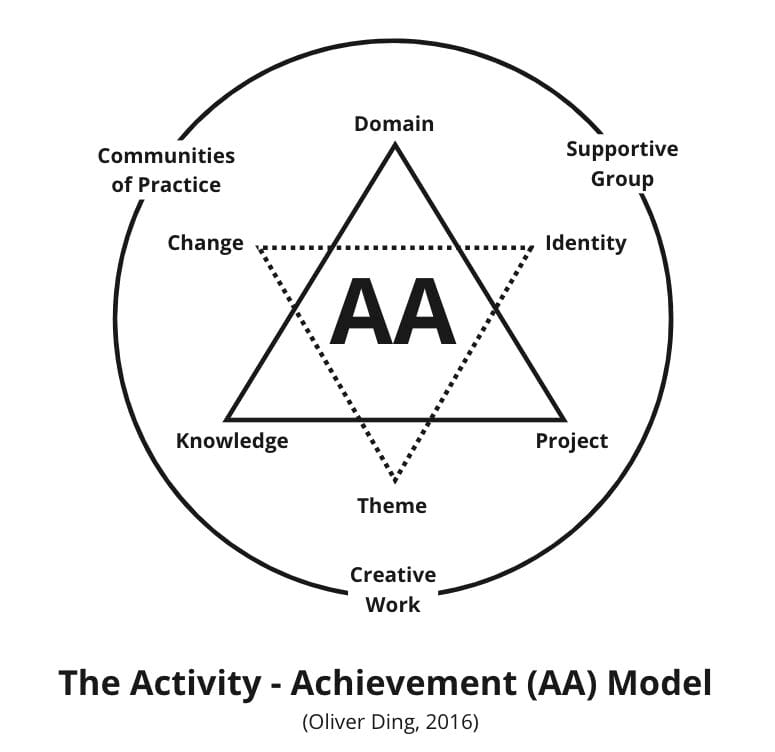
The model had three components: Mind (Identity, Theme, Change), Action (Knowledge, Project, Domain), and Context (Creative Work, Supportive Group, Communities of Practice). Its theoretical resources drew from fourteen sources, including Activity Theory, Csikszentmihalyi’s social systems model of creativity, Egri’s dramatic writing, Wenger’s communities of practice, Argyris’s action science, Kegan’s immunity change, Dweck’s growth mindset, Schein’s career anchors, and others.
If we use October 2018 as a watershed (as in the chronicle), we see the difference between the AA model and my recent creations. Before October 2018, my creative identity was a practitioner; the method behind the AA model was knowledge curation, and the project’s purpose was to serve the client. After October 2018, my creative identity shifted to a theorist; my method changed to knowledge creation, paying attention to original theoretical concepts and using fewer external resources. The purpose of my knowledge projects became to serve the public knowledge ecosystem.
5
Watersheds are not only found in one’s own intellectual history. They also appear in the lives of those we support. I recently encountered a striking example in a coaching engagement that, in retrospect, mirrors the structure of my 2016 client work — and reveals the same logic of a before‑and‑after reorganization.
Interestingly, I recently had a coaching engagement with Maya, a professional coach with a psychology background who is considering writing her first book. The engagement unfolded across three phases: an initial email exchange, a follow‑up via messaging, and a ninety‑minute video conversation on April 9, 2026.
As a supporter, I used the Supportive Life Discovery (SLD) approach to guide the engagement — specifically as an instance of the Achievement Chain in action: Flow → Focus → Coordinate → Center → Circle.
Supportive Life Discovery is concerned not with a specific thematic domain but with the full arc of a person’s life discovery process. The central question of this case is therefore broader than “how does Maya’s book get written?” It is: What is happening in Maya’s World of Activity, and what does genuine support look like at this moment in her development?
The FFCC framework — in its expanded seven‑dimension form (Forms, Moves, Methods, Themes, Identities, Opportunities, Achievements) — provides the analytical backbone. The seven dimensions are not applied mechanically but used as a diagnostic lens: each illuminates a different aspect of Maya’s situation and the support it calls for.
The graduate program was the watershed event that reorganized Maya’s World of Activity.
Before: Maya’s World of Activity had a coherent configuration. Her Center was organized around coaching practice. Her Circle consisted of clients, colleagues, and professional peers — a network that confirmed and extended her coaching identity. The Circle and Center were mutually reinforcing: she was known as a coach, she worked as a coach, she thought of herself as a coach.
After: The graduate program introduced Maya to an entirely different Circle. Academic communities, research traditions, cross‑cultural thinkers, and scholars whose own Centers were organized around inquiry, writing, and theory — these became part of her social world. And with this new Circle came, implicitly, new possibilities for her Center.
In SLD terms, this is the classic dynamic by which the Circle changes the Center: the Circle does not simply expand; it changes in kind, and in doing so, it begins to ask new questions of the existing Center. Is this center still the right one? Is life coaching the full expression of what you are capable of? What would a larger center look like?
Maya could not yet articulate these questions. But she felt their pressure as paralysis — as the inability to write the book that publishers were asking for. What looked like a writing problem was a World of Activity problem. The Circle had changed. The Center had not yet caught up.
6
Maya’s case inspired me to revisit the 2016 case. At that time, I focused on the learning autobiography practice and learning narrative. The client wrote a learning autobiography, and then we had a structured Q&A via email. After collecting enough facts about the client’s life and career, I developed the Activity‑Achievement Model (2016), represented with a conceptual deck. Based on the model, I also wrote a long report explaining the client’s learning and career development.
Although I did not have a video session with the client in 2016, that 1:1 life reflection coaching engagement can be seen as a case of what I now call Supportive Life Discovery (SLD) in 2026.
Ten years ago, my method was learning autobiography and learning narrative, and my model was the Activity‑Achievement Model. Ten years later, my method is called the L3D approach (Learn‑Discover‑Design‑Deliver), and my model is the FFCC schema. However, these two cases are the same type of activity: Supportive Life Discovery.
By curating the two cases together, I made a new version of the Supportive Life Discovery model. This version is framed as the Mid‑life Curation edition, since it sets concrete actions for the L3D sections:
- Learn: Learning Autobiography
- Discover: Thematic Conversation
- Design: Developmental Project
- Deliver: Possible Book
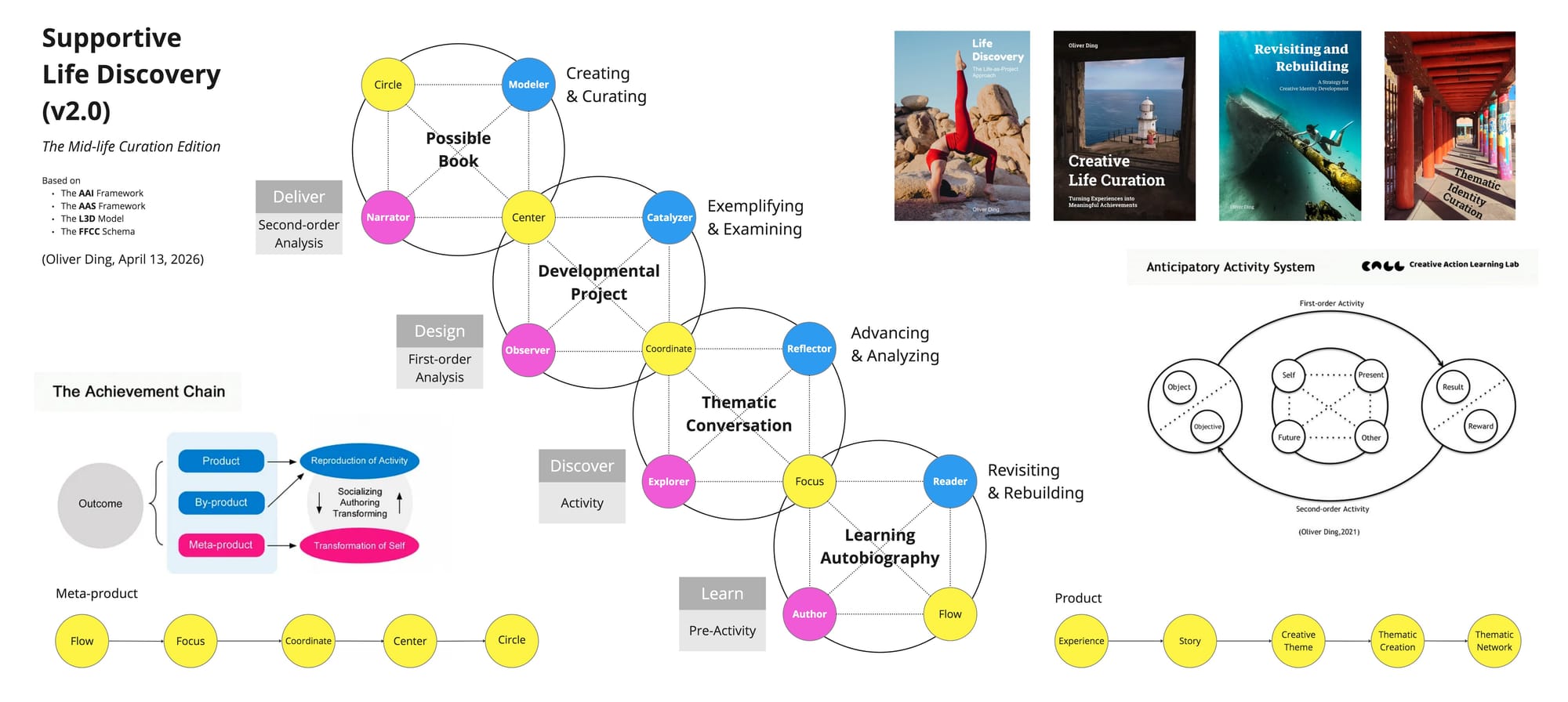
This model also has a watershed: Finding a Coordinate. The achievement chain of the model considers five types of outcomes: Flow, Focus, Coordinate, Center, Circle. The moment of finding a Coordinate is the watershed of the program.

Before that moment, the engagement focuses on reflective thinking. After the engagement shifts to actual actions.
To my surprise, the Supportive Life Discovery project now has a ten‑year history.
7
Watersheds, then, appear at multiple scales — a decade, a year, a single editorial decision, a client’s graduate program. What unites them is the recognition that before and after are not merely chronological markers but structural reorganizations of identity, method, and purpose.
The October 2018 watershed separated a practitioner from a theorist. The Activity U project of 2020 separated HCI‑bound engagement from full‑spectrum theoretical development. Issue #9 of this column separated passive revisiting from active rebuilding. Maya’s graduate program separated a stable coaching identity from an emergent, unnamed identity.
Each watershed is a point where the past becomes legible in a new way — and where the future opens along a different axis. To curate one’s own watersheds is not to fragment a life into disconnected periods. It is to see the continuity of a creative orientation that, at certain moments, finds it necessary to cross its own boundaries.
v1.0 - April 15, 2025 - 3,051 words