
[Case Study] When the Circle Changes the Center
![[Case Study] When the Circle Changes the Center](https://images.unsplash.com/photo-1591162689269-a3fcdab967e3?crop=entropy&cs=tinysrgb&fit=max&fm=jpg&ixid=M3wxMTc3M3wwfDF8c2VhcmNofDY3fHxkYW5jZXxlbnwwfHx8fDE3NzYyMTk3MTh8MA&ixlib=rb-4.1.0&q=80&w=960)
by Oliver Ding
April 9, 2026
This case study is part of the Supportive Life Discovery Case Study Series, documenting real instances of SLD practice. The subject's name and identifying details have been anonymized. The theoretical frameworks referenced — FFCC Schema, World of Activity, Significant Themes Framework, Achievement Chain, Living Coordinate Model, Sandglass Model — are documented in the World of Activity Toolkit (v2.0, 2026) and related publications.
Introduction
This case study documents a coaching engagement with Maya, a professional coach with a psychology background who is considering writing her first book. The engagement unfolded across three phases: an initial email exchange, a follow-up via messaging, and a ninety-minute video conversation on April 9, 2026. It is presented here as a case study in Supportive Life Discovery (SLD) — specifically as an instance of the Achievement Chain in action: Flow → Focus → Coordinate → Center → Circle.

Supportive Life Discovery is concerned not with a specific thematic domain but with the full arc of a person's life discovery process. The central question of this case is therefore broader than "how does Maya's book get written?" It is: what is happening in Maya's World of Activity, and what does genuine support look like at this moment in her development?
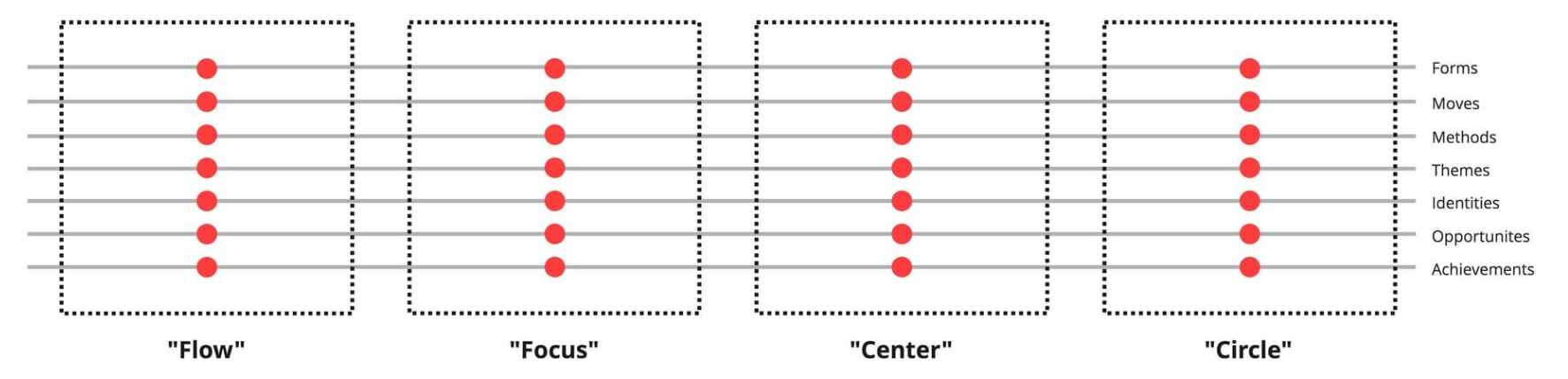
The FFCC framework — in its expanded seven-dimension form — provides the analytical backbone of this case. The seven dimensions (Forms, Moves, Methods, Themes, Identities, Opportunities, Achievements) are not applied mechanically but used as a diagnostic lens: each dimension illuminates a different aspect of Maya's situation and the support it calls for.
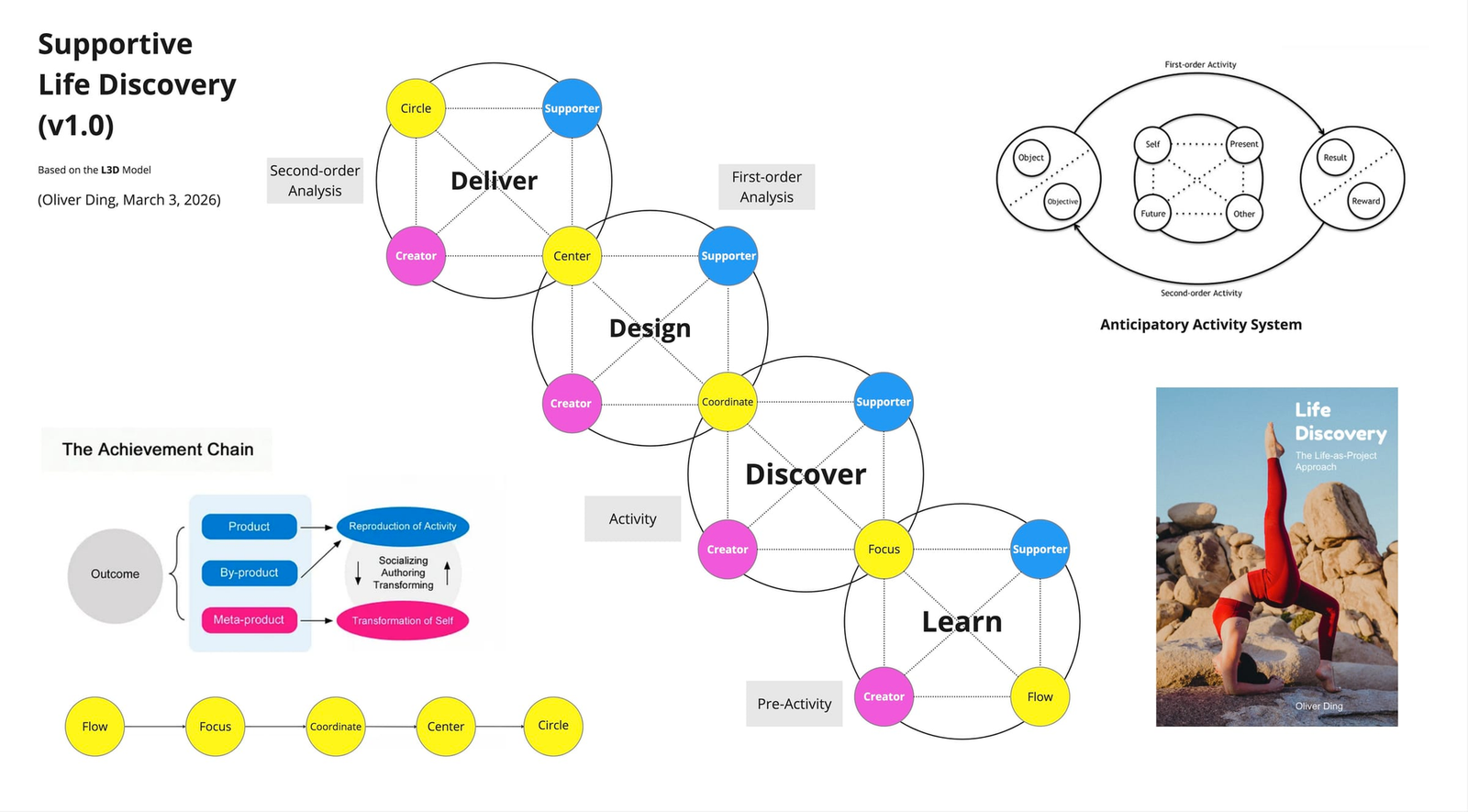
Reference:
- The L3D Model (v1.0, 2026) - Supportive Life Discovery
- The World of Activity Toolkit (v2.0, 2026) - The FFCC Framework
Part One: Reading Maya's World of Activity
1.1 The FFCC Position: Between Center and Finding the Coordinate
Before any conversation took place, the email exchange already made Maya's FFCC position legible.
She had an established professional practice (Center). She had a clear creative ambition (writing a book). She had abundant material. And she was paralyzed. This combination — established center, clear direction, rich resources, and yet inability to move — is a recognizable signature in the FFCC map. It belongs to the transition zone between Inhabiting the Center and Finding the Coordinate: a person who has fully occupied one center and is beginning to feel the pressure of a new one, but has not yet found the coordinate from which the new configuration can take shape.
The seven FFCC dimensions, read together, give a fuller picture:
- Forms: Maya is at Center level — she has an established professional identity and practice. But the Center is under pressure. A new form is beginning to emerge that her current Center configuration cannot contain.
- Themes: The relevant Quasi-invariant theme is Finding the Coordinate (or Setting the Focus) — the developmental pattern in which an established center encounters the conditions for a new flowering, often triggered by a significant expansion of the Circle. This pattern belongs to the Center cluster and is cross-human: any person whose creative enterprise is ready to move to a new level will encounter it.
- Identities: Maya's primary creative identity — life coach — is stable and validated. But it has been relativized by the graduate program. A second identity is forming in the background, without yet having a name. This is the characteristic identity configuration of the Finding the Coordinate transition: the old identity remains, but it is no longer sufficient; the new identity is present as pressure but not yet as form.
- Methods: At this stage, the dominant L3D method is Discover — genuine thematic exploration to find the coordinate from which the new center can be built. The Learn phase (tool acquisition, cognitive preparation) has already been accomplished through years of coaching practice and academic study. The Design phase (sustained creative production) lies ahead.
- Moves: The most needed Slow Cognition operations at this moment are Strategic Curation (helping Maya see the structure of her accumulated material) and Thematic Exploration (tracing the organizing themes that run through her diverse experience).
- Opportunities: The graduate program has created a significant window of opportunity: Maya now has the theoretical frameworks, the cross-cultural perspective, and the expanded Circle to support a creative enterprise that her pre-graduate self could not have undertaken. The conditions for a new center are in place. What is needed is the recognition of the coordinate.
- Achievements: The expected achievement of the Discover stage in Maya's situation is the Coordinate: a clear thematic and structural map of her first book, from which the sustained work of writing can proceed.
1.2 The World of Activity: Before and After the Graduate Program
The graduate program was the watershed event that reorganized Maya's World of Activity.
- Before: Maya's World of Activity had a coherent configuration. Her Center was organized around coaching practice. Her Circle consisted of clients, colleagues, and professional peers — a network that confirmed and extended her coaching identity. The Circle and Center were mutually reinforcing: she was known as a coach, she worked as a coach, she thought of herself as a coach.
- After: The graduate program introduced Maya to an entirely different Circle. Academic communities, research traditions, cross-cultural thinkers, and scholars whose own Centers were organized around inquiry, writing, and theory — these became part of her social world. And with this new Circle came, implicitly, new possibilities for her Center.
In SLD terms, this is the classic dynamic by which the Circle changes the Center: the Circle does not simply expand; it changes in kind, and in doing so, it begins to ask new questions of the existing Center. Is this center still the right one? Is life coaching the full expression of what you are capable of? What would a larger center look like?
Maya could not yet articulate these questions. But she felt their pressure as paralysis — as the inability to write the book that publishers were asking for. What looked like a writing problem was a World of Activity problem. The Circle had changed. The Center had not yet caught up.
Part Two: The Center–Circle Dynamic in Detail
2.1 A Center Relativized
The FFCC model treats Center and Circle not as independent positions but as positions in ongoing dialogue. A stable Circle confirms a Center. A changing Circle destabilizes it — not by destroying the Center, but by relativizing it: reducing its proportion within the newly expanded landscape of possibilities.
This is precisely what happened to Maya's coaching identity. It did not become less real after the graduate program. It became smaller in proportion. In the newly expanded landscape of Maya's World of Activity — populated by scholars, researchers, and cross-cultural thinkers — the coaching practice was no longer the whole picture. It was one dimension of a larger creative self that had not yet found its full configuration.
This relativization is the identity-level expression of the watershed. And it is characteristically experienced not as liberation but as loss — as a vague dissatisfaction with what once felt sufficient, a reluctance to be confined to an identity that no longer fully fits.
2.2 The Unnamed Second Center
What makes Maya's situation particularly complex — and particularly characteristic of the Finding the Coordinate transition — is that what is emerging is not simply a replacement for the coaching center. It is a second center, beginning to form alongside the first.
In the SLD framework, Center does not require singularity. A person's World of Activity can support multiple centers simultaneously — different domains of creative engagement, organized around different themes, serving different circles. What is disorienting for Maya is not that her coaching center is disappearing, but that a second center is forming without yet having a name, a structure, or a circle to support it.
The unnamed second center is organized, as the conversation would reveal, around the thematic movement through which a person comes to see what they have been living inside of — the movement from immersion to observation to researcher's perspective. This theme runs through Maya's coaching practice (she helped clients see what they could not see from inside their situations), through her cross-cultural experience (she moved from being inside a culture to observing it to analyzing it), and through her spiritual journey (she moved from practice to study to ecological understanding). It is the organizing theme of the second center. But it had not yet been named.
The first book is not simply a product. It is the act of founding the second center — the thematic creation that will give the unnamed center its form, its name, and eventually its circle.
Part Three: The Engagement as SLD Practice
3.1 Phase One: Learn — Reading the Situation
The SLD engagement did not begin with the video conversation. It began with the email exchange and messaging that preceded it.
In L3D terms, this preliminary phase was the Learn stage of the engagement: the supporter was building sufficient understanding of Maya's situation to be genuinely useful in the conversation that would follow. The emails revealed Maya's three-book directions, her sense of being stuck, her concern about being confined to the coaching identity, and her awareness that something larger was trying to emerge.
This pre-activity learning is not passive information gathering. It is the cognitive preparation that makes genuine Discover possible. Without it, the video conversation would have needed to spend its first thirty minutes establishing context. With it, the conversation could begin at depth.
It is also worth noting that this Learn phase served Maya as well. The act of writing the emails — articulating her situation, naming her three possible book directions, asking the question "how did you go from zero to one?" — was itself a form of thematic clarification. The learner was already doing Discover before the formal Discover conversation began.
3.2 Phase Two: Discover — The Ninety-Minute Conversation
The video conversation was the Discover stage of the SLD engagement: the Activity-level work of genuine thematic exploration, moving from Focus (writing a book) to Coordinate (the thematic map of the first book).
The conversation accomplished five movements, each building on the previous:
Reframing the difficulty: The paralysis was named not as a personal failing but as the structural consequence of thematic richness. This reframe shifted Maya from self-criticism to structural curiosity — from "what is wrong with me" to "what is the shape of my situation."
Expanding the scale: The trilogy challenge forced Maya to stand back far enough to see the arc of her entire creative enterprise, not just the immediate problem of the first book. This is the Scaling the Focus move of Generative Confluence — making the larger structure visible so that the immediate step can be taken in the right direction.
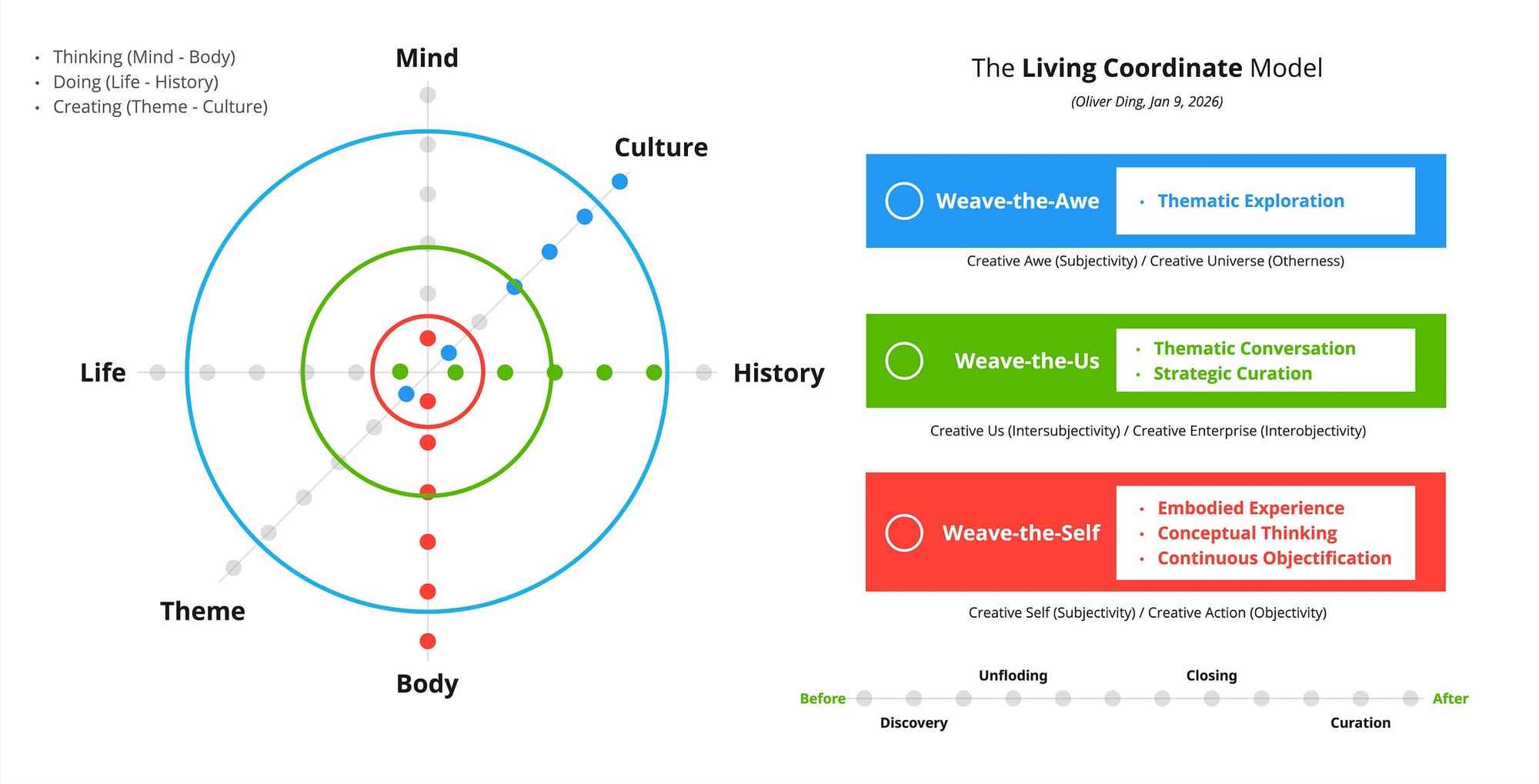
Finding the coordinate: The Living Coordinate Model organized Maya's material into three developmental lines, each following the same thematic dynamic: taken-for-granted → disrupted → researcher's perspective. This identified both the thematic structure of the first book and the organizing theme of the second center.
Naming the emerging identity: The observation — a new identity is emerging; it simply does not yet have a name — was a recognition act, not an analysis. It named the process Maya was in, giving her permission to inhabit the transition without needing to have arrived. This is characteristic of SLD support at the Finding the Coordinate transition: the supporter does not supply the new identity. They name the process of its emergence.
Anchoring the center: The conversation closed by translating the thematic coordinate into a concrete structural form — three narrative threads, each moving through three stages, each following the same deep dynamic. This is not a book outline. It is the thematic scaffold from which the writing can begin.
The conversation moved Maya from Flow (abundant material, no direction) through Focus (writing a book as the organizing intention) to Coordinate (the thematic map from which the first book can be written). It did not establish the Center. That lies ahead, in the writing.
3.3 Phase Three: Design — The Long Accompaniment
The Design stage of the SLD engagement is the period of sustained accompaniment through the writing of the book. This is inherently long — months of drafting, revising, deepening.
The supporter's role in this stage is qualitatively different from the role in the Discover conversation. In the conversation, the primary work was recognition: helping Maya see the thematic and structural coordinate that was already present in her material. In the Design stage, the primary work is accompaniment: helping Maya sustain connection to the organizing theme across the long arc of writing, navigate the moments when the coordinate feels uncertain, and maintain the distinction between the first book (which establishes the coordinate) and the trilogy (which develops it).
The second center is not yet established. It will be established when the first book is written — when the thematic creation has crossed the narrowest point of the Sandglass and begun its outward movement into form.
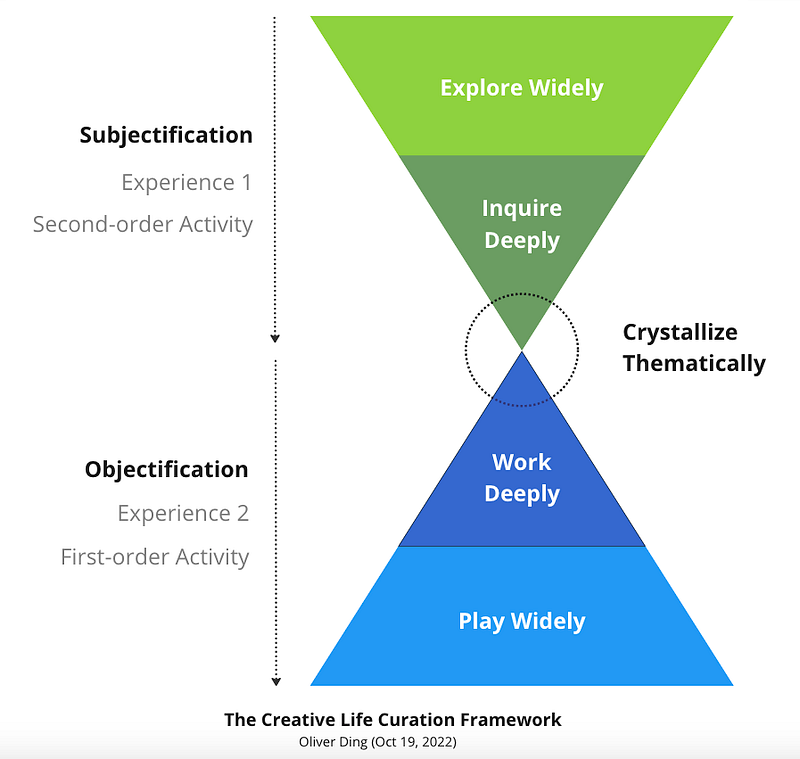
The Design stage is the work of crossing that point.
3.4 Phase Four: Deliver — The Center Finds Its Circle
The Deliver stage lies further ahead: a new possible book or a published book, the building of a new circle around the second center, and the extension of the creative enterprise into further forms — talks, courses, future books.
In SLD terms, this is where the second center finds its circle. The first book does not only communicate Maya's thematic understanding to readers; it identifies and attracts the community of people for whom that understanding is relevant. This new circle — organized around the second center rather than the coaching center — is what will eventually give the unnamed identity its social form and confirmation.
The trajectory from Coordinate to Circle, in Maya's case, is a trajectory from the unnamed to the named: from an emerging identity that has no circle, to a creative center that has found its community.
Part Four: What Genuine SLD Support Looks Like
Several features of this engagement are worth naming explicitly for SLD practitioners.
Support is relational before it is methodological. The video conversation did not begin with frameworks. It began with the supporter sharing a personal story: writing a major manuscript in 2019, arriving at the office an hour early every morning for six months, treating the project as the last thing he would leave the world. This testimony established the relational register: the supporter is not an expert dispensing methods, but a fellow traveler who has navigated similar terrain.
The supporter reads the World of Activity, not just the presenting problem. Maya presented a writing problem. The support she needed was a World of Activity reading: understanding that the writing problem was the surface expression of a Center-Circle dynamic, an identity transition, and an emerging second center. Without this reading, the support would have addressed the symptom rather than the situation.
Frameworks are activated by the situation, not deployed to the learner. The AAS model, the Living Coordinate Model, the RR self-perspective — none of these were introduced as "frameworks I want to share with you." Each arose because Maya's situation called for it. The supporter's frameworks are like water in a riverbed: invisible when the conditions are right, but structuring the flow.
Recognition is the primary act at the Coordinate stage. The most significant moments in the conversation were acts of recognition: naming the thematic pattern shared by all three lines, naming the new identity as emerging, and naming the coordinate as the ground from which the book can be written. Recognition does not add something new to the situation — it makes visible what is already there. This is what the Discover stage of SLD calls for: not instruction, not advice, but precise seeing.
Continuous Objectification closes the loop. The follow-up email — sent within hours of the conversation — translated the oral exchange into written form, extending the thematic analysis and providing Maya with a document she could work from. This is Continuous Objectification as SLD practice: the cognitive work of the conversation is immediately externalized into a shareable artifact, making the thematic development visible and revisable.
Part Five: The Achievement Chain in This Engagement
Looking back across the full engagement, the SLD Achievement Chain — Flow → Focus → Coordinate → Center → Circle — maps precisely onto what happened and what lies ahead:

Flow — Maya's pre-engagement state: abundant material, multiple possible directions, cognitive flood. Felt as paralysis.
Focus — Established through the email exchange and the initial framing of the conversation: writing a book as the organizing intention that gives direction to the flow.
Coordinate — Accomplished in the ninety-minute conversation: the three-line thematic map, the identification of the organizing theme, and the structural scaffold of the first book.
Center — Ahead: the writing of the book. The second center is established not when the coordinate is found but when the thematic creation is produced. This is the work of the Design stage — the long accompaniment.
Circle — Further ahead: the book's publication, the formation of a new community around the second center, the extension of the creative enterprise. This is the work of the Deliver stage.
The conversation accomplished the pivot between Focus and Coordinate. It did not accomplish the Center. But it made the Center visible — and that visibility is what makes the journey toward it possible.
Conclusion: The Second Center Is Beginning
Maya came to the conversation with a writing problem. She left with something more important: a World of Activity reading of her own situation.
She now knows that the paralysis she felt was not a personal failing but a structural signal — the signal that her World of Activity was ready for a new configuration. She knows that the coaching center is not being abandoned but carried forward as a resource. She knows that the unnamed identity that has been pressing against the edges of her current configuration is the organizing principle of a second center, beginning to form. And she knows the thematic coordinate from which the first book — the founding act of that second center — can be written.
The second center is beginning. It does not yet have a name. It will find one in the writing.
Oliver Ding | Activity Analysis Center | April 2026