
The World of Activity Toolkit (v2.0, 2026)

What were separate knowledge frameworks in the World of Activity Toolkit v1.0 — each attending to one of these dimensions — have been curated together into a coherent whole.
by Oliver Ding
April 14, 2026
Ten days ago, I wrote an epilogue for a new possible book: Revisiting and Rebuilding: A Strategy for Creative Identity Development (Possible Book).In the article, I reviewed the development of the World of Activity Toolkit from June 2025 to April 2026.
In June 2025, the World of Activity Toolkit (v1, 2025) curated a series of knowledge frameworks for understanding the patterns within an individual's World of Activity.
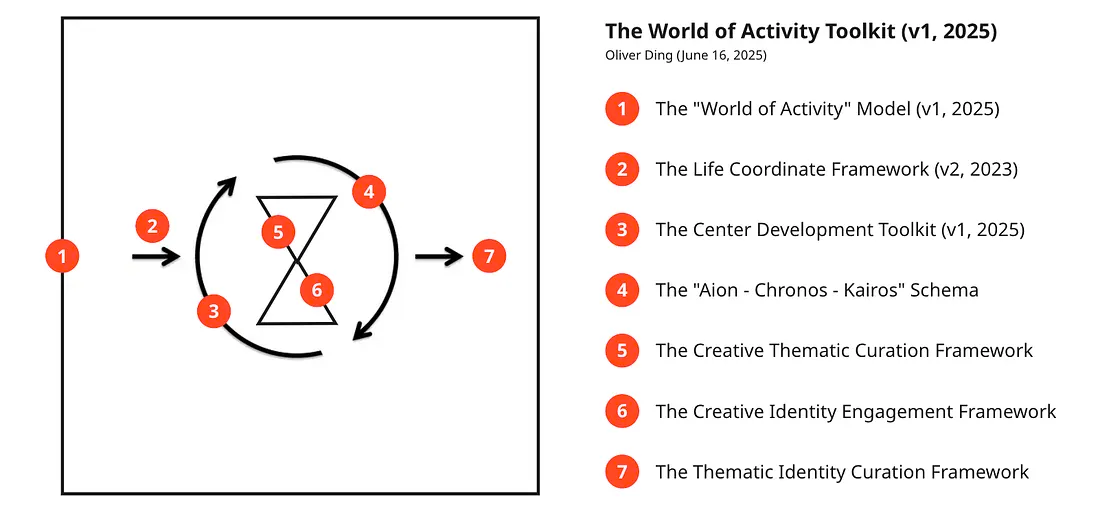
Of these, The FFCC Schema became the model I invested in most intensively through mid-2025 — first as the primary model of the World of Activity, and later as the primary model for understanding Life (Self) itself.
The FFCC Schema organizes the World of Activity around four basic ecological forms: Flow (the stream of experience moving through a life), Focus (the thematic concentration that gives direction to the flow), Center (the organizing core around which creative activity stabilizes), and Circle (the social relational network within which the center operates and extends). These four ecological forms are not sequential stages but simultaneously active aspects of any creative life — each shaping the others, each visible from a different angle.
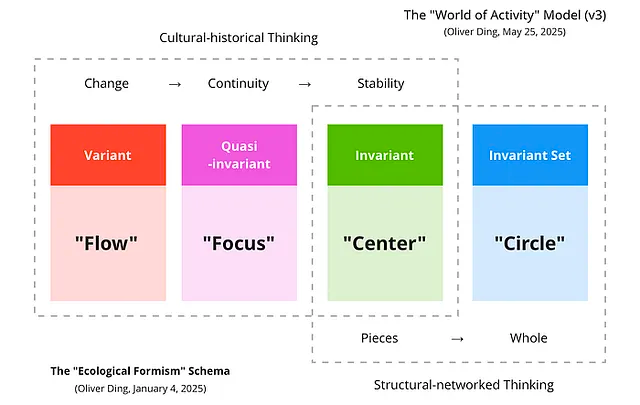
The Homecoming manuscript was the empirical research project built around the FFCC Schema — analyzing my own autobiography and my 2025 journey to Fuzhou, identifying seven specific forms of the World of Activity, and using the FFCC model to explain the dynamics and differences between them. Lake 42 developed this further, articulating eight movements using FFCC terminology and integrating the Living Coordinate concept with the FFCC model into a unified framework.
The recent RR practice — particularly the Significant Themes case study — made a further contribution: several new FFCC model cases emerged, and the insights from Homecoming, Lake 42, the Knowledge Discovery Canvas, and other projects were integrated into a multi-layered structure centered on the FFCC model.
The three sources are not additive by accident. The Regular Group provides the core career and professional developmental arc. Lake 42 provides fine-grained differentiation at the Flow and Focus stages. Homecoming provides ecological diversity of Center and Circle configurations. Together, they map the full developmental terrain of a creative life organized around the FFCC model.
In this article, the new version of the toolkit is introduced for further reference.
The Landscape of the World of Activity Toolkit (v2.0)
The v2.0 was made by two major changes. Expanded through Ecological Formism into a four-layer architecture, the FFCC model now maintains its core simplicity — four basic ecological forms — while being able to accommodate rich empirical research and support diverse situational reflection.
- Invariant: FFCC Schema, four basic Ecological Forms
- Quasi-invariant: A series of movements, described with the FFCC vocabulary
- Variant: Situational life events and themes (open category)
- Invariant Set: Other Ecological Forms
This four-layer structure does more than classify the themes — it provides the framework with a principled openness. The Variant layer can always receive new themes as new situations are analyzed. The Quasi-invariant layer can grow as new cross-human developmental patterns are identified. The Invariant layer (FFCC) remains stable as the ontological foundation. The Invariant Set connects to other ecological forms.
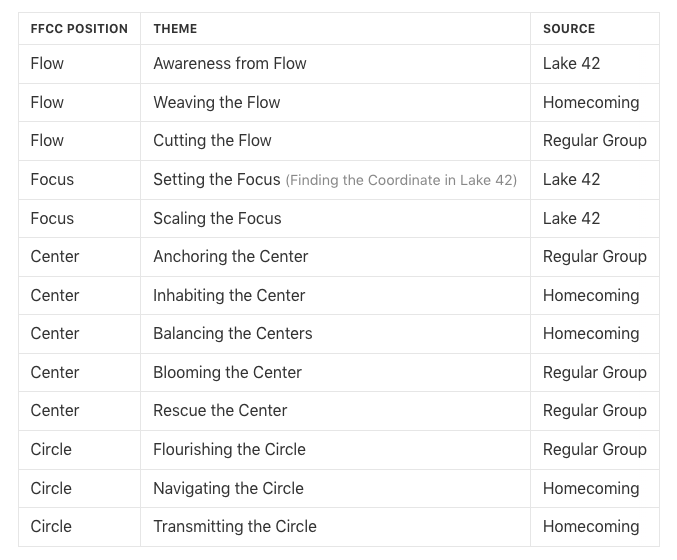
Through the RR operations of March 2026, the Quasi-invariant layer was expanded significantly by integrating insights from Lake 42 and Homecoming. The complete Quasi-invariant layer now contains thirteen themes across all four FFCC positions. The three sources are not additive by accident. The Regular Group provides the core career and professional developmental arc. Lake 42 provides fine-grained differentiation at the Flow and Focus stages. Homecoming provides ecological diversity of Center and Circle configurations. Together, they map the full developmental terrain of a creative life organized around the FFCC model.
At the same time, organized through Thematic Space Theory, its four thematic spaces now carry multiple dimensions simultaneously:
- forms,
- themes,
- identities,
- methods,
- moves, and
- achievements.
What were separate knowledge frameworks in the World of Activity Toolkit v1.0 — each attending to one of these dimensions — have been curated together into a coherent whole.
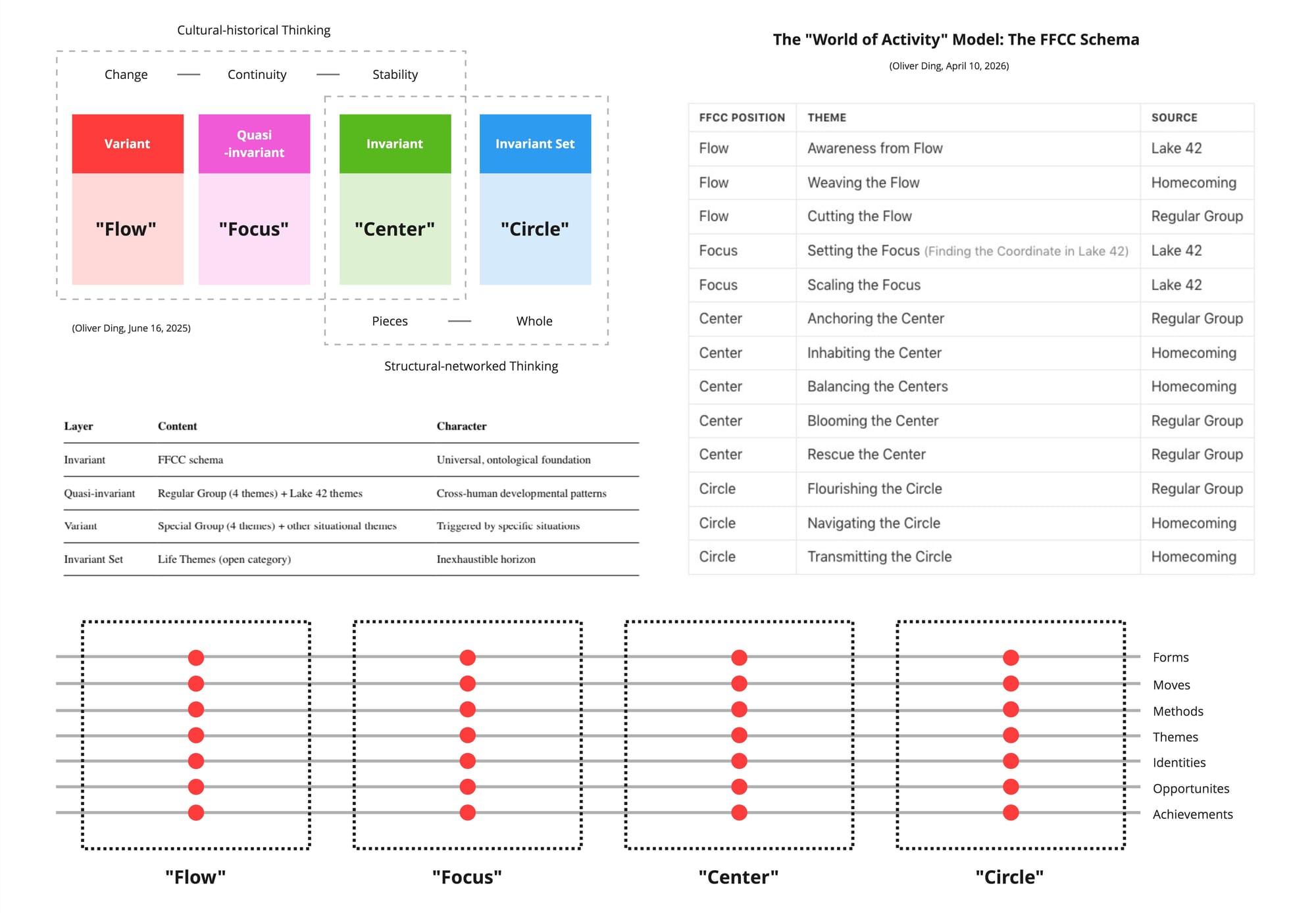
This constitutes the World of Activity Toolkit v2.0. The FFCC model has become a significantly more powerful knowledge framework — one that can serve not only as a theoretical explanatory model, but also as a tool for case study analysis and behavioral intervention. The simple four-part schema that began as a descriptive map of ecological forms has grown into the primary organizing structure of an entire approach to creative life development.
The Invariant Foundation: Flow-Focus-Center-Circle
The Flow-Focus-Center-Circle (FFCC) schema is the primary model of the World of Activity — the individual-centered ecology of meaningful activity that organizes how a person engages with their life. Its four forms describe the four basic ecological states of any World of Activity:
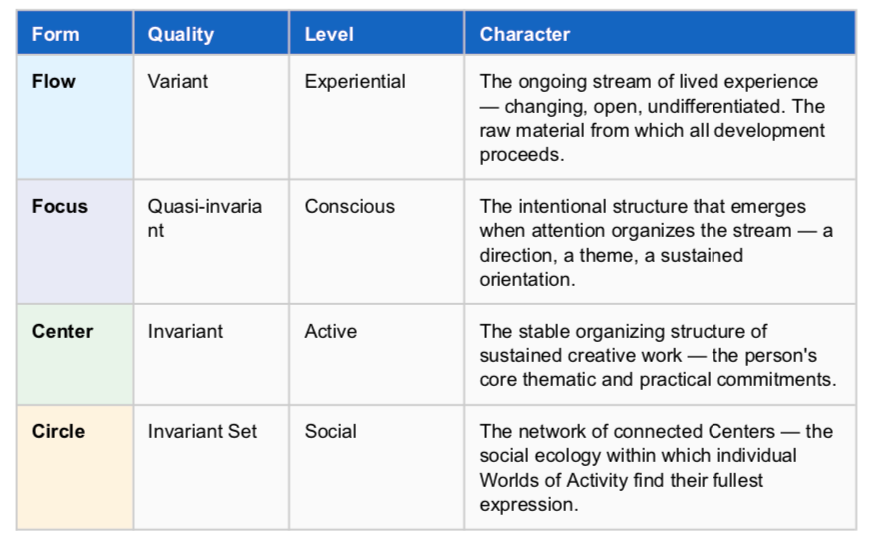
The FFCC schema is Invariant — it does not change across contexts, cultures, or historical periods. It is the stable foundation upon which all the Significant Themes of the upper layers are built. Every Significant Theme, whether Quasi-invariant or Variant, can be understood as a specific configuration of FFCC dynamics triggered by particular developmental or situational conditions.
The Quasi-invariant Layer: FFCC-Named Movements
The Quasi-invariant layer contains a series of movements that are named using FFCC vocabulary and that describe cross-human developmental patterns — patterns that are not universal in the strict sense (not everyone experiences all of them) but that are sufficiently widespread and stable to function as general maps of adult development.
This layer has been built from three bodies of work — the Regular Group (the Significant Themes framework, 2015/2025), Lake 42: The Great Confluence (2025), and Homecoming: A Thematic Trip and the World of Activity Approach (2025). Together they yield thirteen Quasi-invariant Significant Themes, organized along the FFCC developmental arc:
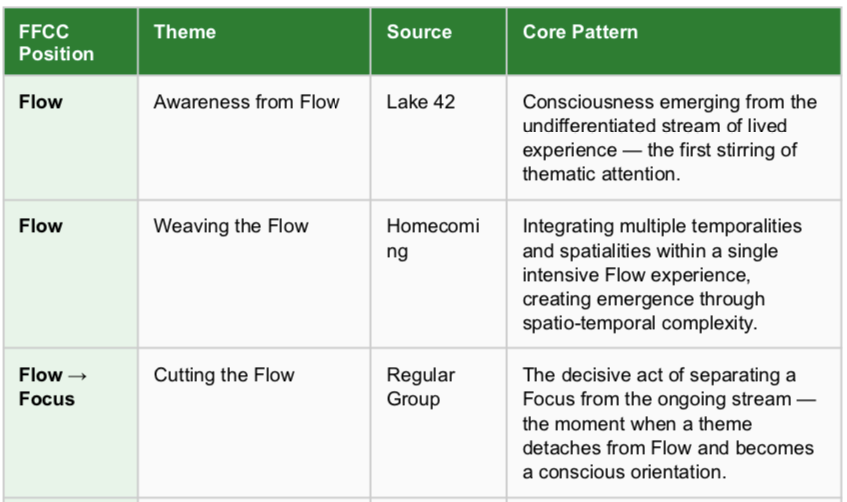
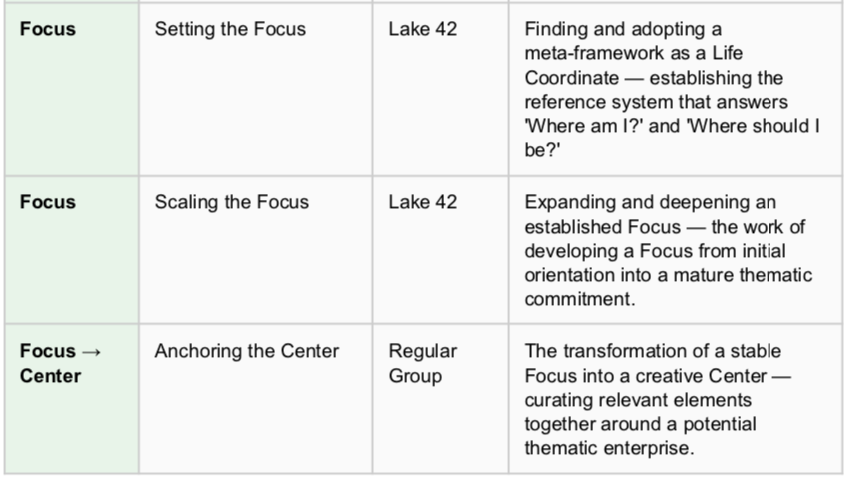
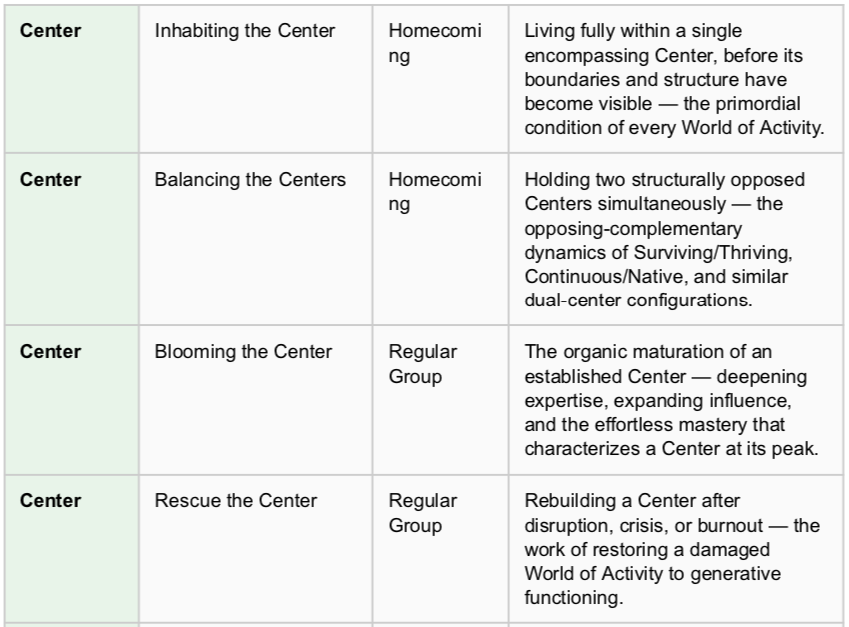
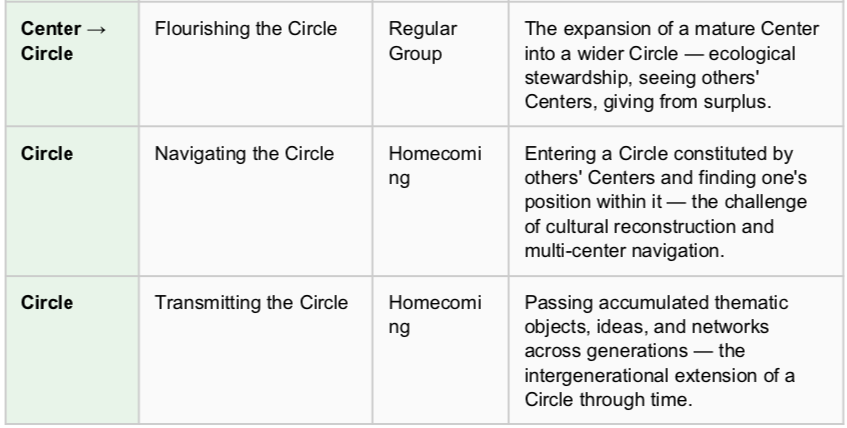
The thirteen movements trace a complete developmental arc through the FFCC schema — from the first awakening of consciousness within Flow, through the formation and maturation of Focus and Center, to the ecological flourishing of Circle. This arc is not a fixed sequence: any movement can recur at different life stages, and a person may inhabit multiple movements simultaneously. But as a map of the terrain, the arc reveals the full range of developmental challenges and opportunities that constitute a creative life.
The three source works contribute to different regions of the map. The Regular Group of Significant Themes framework captures the core career and life development arc (Cutting the Flow through Flourishing the Circle). Lake 42 articulates the fine-grained operations of Flow and Focus (Awareness, Setting, Scaling). Homecoming extends the map into the ecological diversity of Center and Circle life — the primordial, the dual, the navigated, the transmitted. Together, they constitute the first systematic charting of the Quasi-invariant layer of the World of Activity.
The Variant Layer: Situationally-Triggered Themes
The Variant layer contains Significant Themes that are triggered by specific life situations and named by their situational content rather than FFCC vocabulary. These themes do not apply to everyone — they arise when particular circumstances create distinctive challenges and opportunities that cannot be adequately described by the more general Quasi-invariant themes.
The Variant layer is characterized by two qualities that distinguish it from the Quasi-invariant layer: high situational specificity (a precise trigger and time window) and strong narrative resonance (those who have lived the situation recognize it immediately). This combination makes Variant themes particularly powerful as educational and developmental resources: they attract through shared recognition and then provide a theoretical structure for understanding what is being lived.
The Variant layer is open and expansive — it is not limited to major life events or transitions. Any specific domain of practice, when it generates characteristic themes that are recognizable to practitioners but not universal across all human activity, produces its own Variant-layer Significant Themes.
This layer establishes a connection between the FFCC schema and the Significant Themes Framework. More examples of significant themes can be found in the Significant Themes Framework 2026 (v1).
The Invariant Set: Other Ecological Forms
The FFCC schema is part of a large theoretical enterprise: the Ecological Formism approach.
The newest development of the approach is Embodied Social Forms.
The Embodied Social Forms principle, developed within ACS in 2025, provides the analytical key for understanding where these dimensions come from. Six Basic Ecological Forms were introduced in Homecoming: A Thematic Trip and the World of Activity Approach (Kindle edition, September 2025):
- Before–After
- Slow–Fast
- Up–Down
- Left–Right
- Inside–Outside
- Center–Periphery
In the Conclusion of Homecoming, these forms were expanded into the Ecological Dynamics of the World of Activity framework. Each pair names a dimension of dynamic change. More recently, three further basic forms were added: Virtual–Real, grounded in the embodied experience of dreaming and waking, Near–Far, and Part–Whole.
In the same period, several Significant Social Forms (SSF) were identified using five schemas. Among them: the Self–Other–Present–Future schema, recognized as the SSF of interpersonal interaction.
What is now named Embodied Social Forms is the explicit articulation of that practice as a theoretical principle. The major difference between this approach and Georg Simmel's classical theory of social forms is methodological. Simmel's social forms are derived from the observation of recurring patterns of association. The Embodied Social Forms approach follows a different sequence:
Body → Embodied Experience → Ecological Basic Forms → Cultural Interpretation (linguistic encoding + situated context) → Significant Social Forms
This sequence illustrates how bodily experiences are gradually transformed into socially meaningful forms through cognitive and cultural processes. By encoding pre-linguistic experiences into language within specific social contexts, the model links the Body System to higher-level cultural and social structures, tracing how micro-level embodied experiences shape macro-level social forms.
I use the term grounded in to express the relationship between embodied experience and social form. This is not a relation of direct causation — Basic Ecological Forms do not determine Significant Social Forms in a simple mechanical way. The connection is formal: a structural correspondence between the shape of bodily experience and the shape of social life. The universality lies in the Basic Ecological Forms, which are unavoidable and unmodifiable — they are given with embodied existence. The diversity of cultural variation lies entirely in the Cultural Interpretation step: the moment of linguistic encoding within a situated context, where the universal form is inflected by history, language, and circumstance.
This is what makes the principle analytically powerful. It establishes a unified formal structure that underlies the complexity and diversity of social phenomena, while preserving the full weight of cultural difference at the point where that difference actually enters the picture.
A similar approach has already been developed in cognitive linguistics — notably in the tradition of conceptual metaphor theory and image schema research. What is relatively new is its systematic application to sociology, where the embodied basis of social forms has rarely been addressed in this explicit manner.
Creative Identity Cascade
In the past three months, while working on the Supportive Life Discovery project, a series of models were developed. Eventually, the FFCC schema was applied to set the thematic spaces for hosting the Creative Identity Cascade.
The diagram below, named Cognitive Hydrology Pedagogy (v1.0), is an example of such an application.
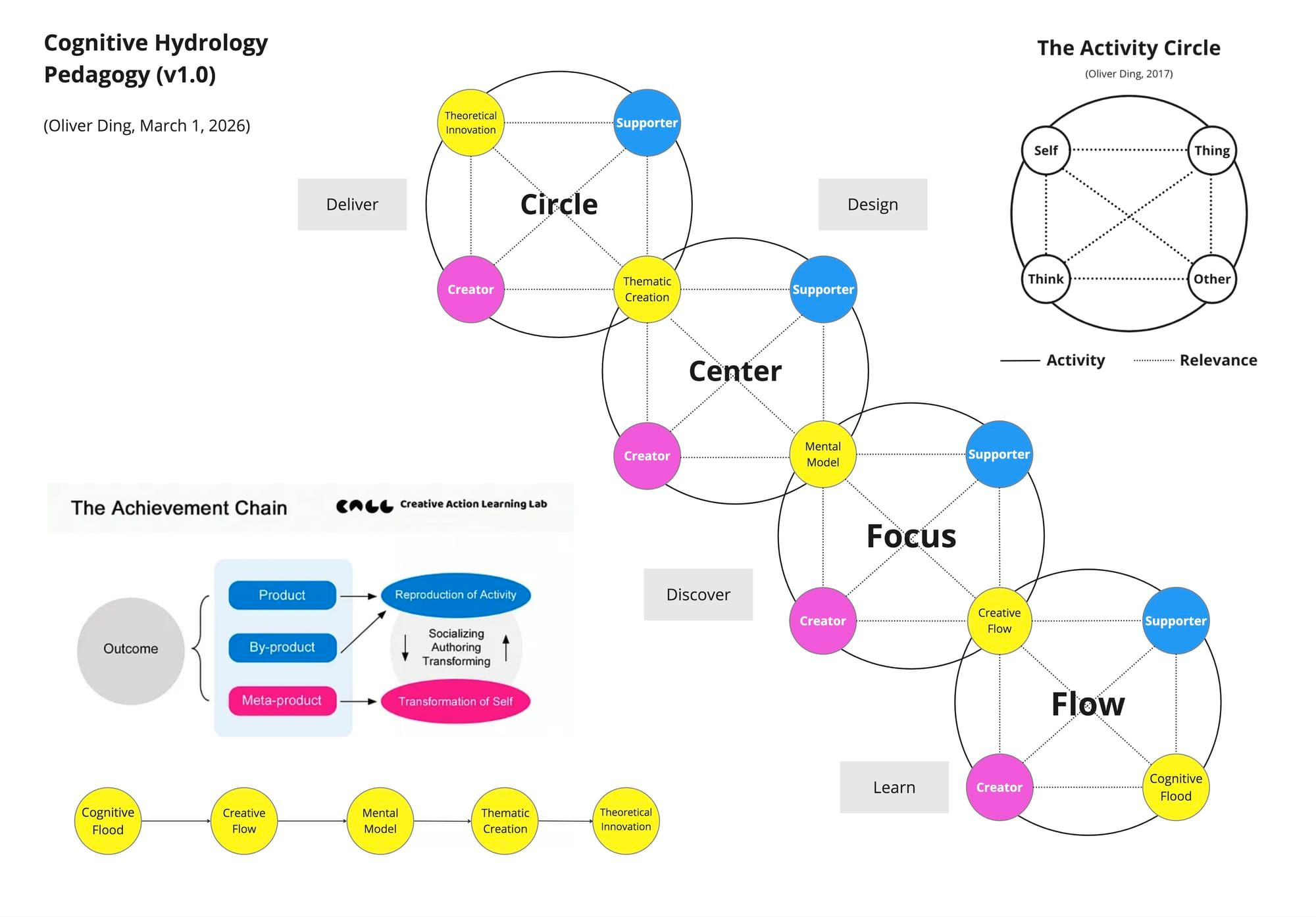
Where the Significant Themes project injected life themes into the FFCC's four thematic spaces, the Creative Identity Cascade injected the identity development dimension — showing how creative identities cascade through the FFCC positions across a creative life, with each level's Other becoming the next level's Self.
The FFCC schema became not only a map of thematic spaces but a framework for understanding how identity itself evolves as a person moves through Flow, Focus, Center, and Circle across time.
Methods, Moves, and Achievements
The L3D model and Supportive Life Discovery extended the FFCC framework further still, bringing method into the picture.
Where the Significant Themes project had added themes and the Creative Identity Cascade had added identity, the L3D model added the methodological dimension — specifying the concrete practices (Learn, Discover, Design, Deliver) through which a person moves through the FFCC terrain. Supportive Life Discovery provided the relational and facilitative framework for supporting others in that movement.
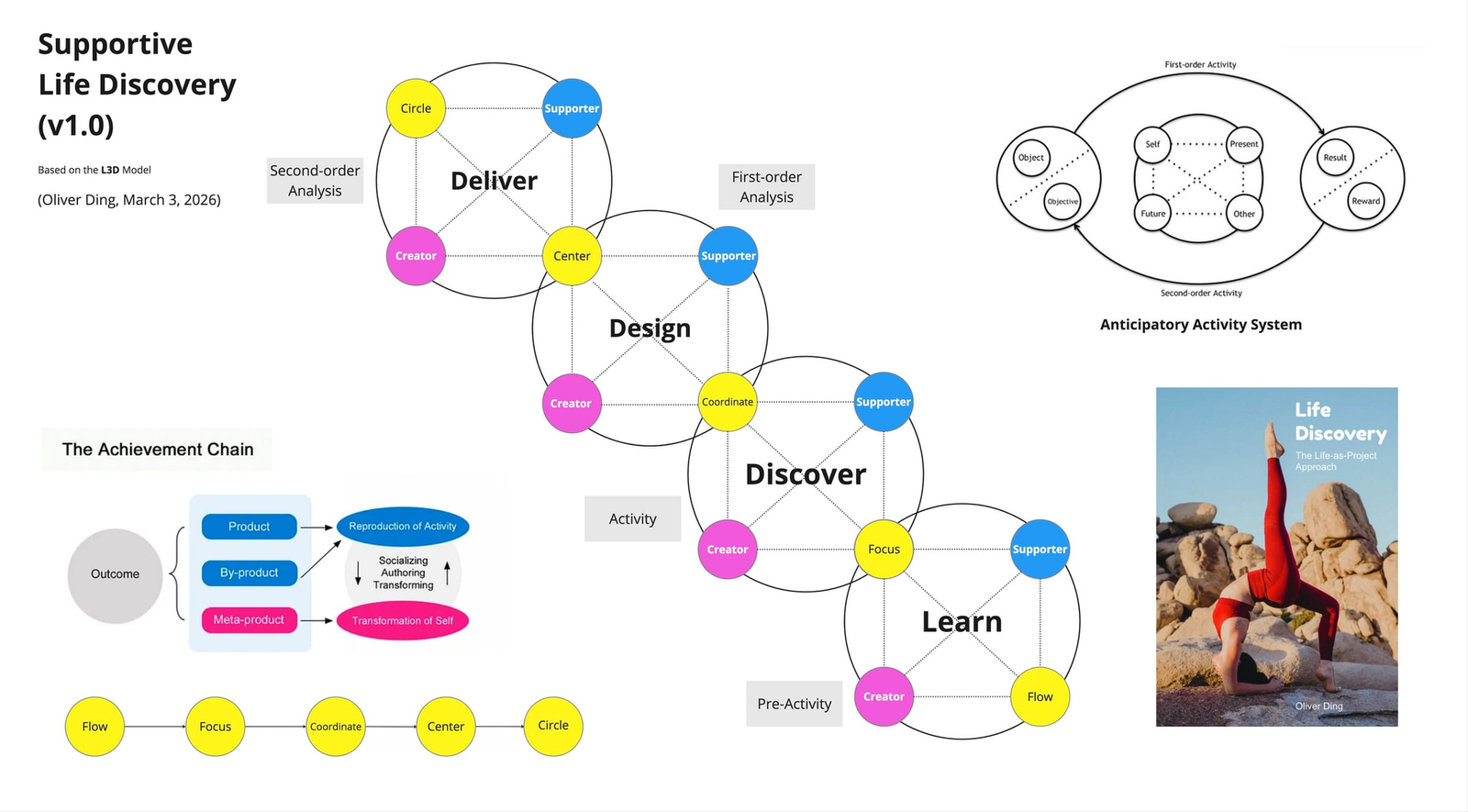
Cognitive Hydrology Pedagogy (v1.0) was built on this architecture, selecting four heuristic tools that proved most generative for thematic development and concept creation — the Thematic Matrix Canvas, the ECHO Way, Generative Confluence, and Weave the Theory — and organizing them as the foundational pedagogical instruments of the four stages.
Together, the FFCC model, the L3D model, the Supportive Life Discovery framework, and the LARGE Method constitute a new map and methodology for creative life development — one that is simultaneously abstract enough to be principled and concrete enough to be applied. The FFCC model provides the terrain. The L3D model describes the movement through that terrain. The LARGE Method provides the governing principles for navigating it. Supportive Life Discovery provides the relational and methodological framework for supporting others in that navigation.
A Coherent Whole
What were separate knowledge frameworks in the World of Activity Toolkit v1.0 — each attending to one of these dimensions — have been curated together into a coherent whole.
This constitutes the World of Activity Toolkit v2.0. The FFCC model has become a significantly more powerful knowledge framework — one that can serve not only as a theoretical explanatory model, but also as a tool for case study analysis and behavioral intervention.
The simple four-part schema that began as a descriptive map of ecological forms has grown into the primary organizing structure of an entire approach to creative life development.
v1.0 - April 14, 2026 - 2,268 words