
Weave the Theory: Unfolding the Way of Curation

A Case Study of the Life-as-Activity Approach
by Oliver Ding
April 27, 2026
Activity Theory is not a single, unified theory, but a rich theoretical tradition. Over time, many scholars and researchers have developed a wide range of knowledge frameworks within it. This diversity was precisely why I chose it as the focus of my knowledge curation project in 2020. In that project, I selected several representative approaches, brought them together, and wrote a review and commentary titled The Landscape of Activity Theory and CHAT. This work later expanded into the Activity U project and a book manuscript of the same name.
What I did not expect was that, years later, my own explorations in this direction would lead to a similar situation. The various activity-centered creations I developed gradually formed a landscape of their own. The challenge was not simply a matter of naming this body of work, but of addressing a deeper tension between creativity and curativity — between generating new conceptual artifacts and organizing them into a coherent structure.
For a long time, this tension remained unresolved. Eventually, I settled on the name Life-as-Activity, but more importantly, I began to see the need for a principle that could hold these creations together without reducing their diversity.
This is where the "Weave-the-Theory" model comes in. Rather than eliminating the tension between creativity and curativity, it treats this tension as a source of development. In this article, I use this model to examine how, over several years, I arrived at a guiding principle that allows these diverse creations to be woven into a more coherent theoretical whole.
Contents
Part 1. Background
1.1 The Life-as-Activity Approach
1.2 The Weave-the-Theory Framework and This Case
Part 2. The First Wave: From Exploration to Crystallization
2.1 The Question This Case Addresses
2.2 Stage One: A Name Looking for Its Meaning (November 2020)
2.3 Stage Two: A Concept That Bridges Two Traditions (January 2022)
2.4 Stage Three: The Principle Recognized Through Deep Analogy (April 2022)
2.5 A Reflection on the Three Stages
2.6 The Crystallization of a Principle
Part 3. The Second Wave: The Principle Returns at a Higher Level
3.1 Inquire Deeply: The Emergence of Enterprise
3.2 Crystallize Thematically: The Developmental Projects Manuscript
3.3 Work Deeply & Play Widely: The Principle in Operation
Part 4. The Third Wave: Dialogue with Another Knowledge System
4.1 The Weave-the-Life Framework: From v1.0 to v3.0
4.2 Weave as a Model of the Actor
4.3 The Collision: Writing This Article Triggered v3.0
Postscript: Where Is Weave-the-Theory Now?
Part 1. Background
1.1 The Life-as-Activity Approach
I began studying Activity Theory around 2015. In 2020, I worked on the Activity U project, which resulted in two book drafts and the initial development of the Project Engagement approach. From 2021 to 2022, I created the Anticipatory Activity System (AAS) framework and applied it to explore life strategy. In 2023, I designed the Activity Analysis & Intervention (AAI) Program. In 2024, I revisited and refined the Project Engagement approach, developing version 3.1.
The journey has led to many creations, including book drafts, knowledge frameworks, diagrams, digital boards, and more. On December 4, 2024, I used "World of Activity" to name my activity-centered creations as a theoretical toolkit, marking the end of a creative journey of theoretical exploration. However, in June 2025, I developed "World of Activity" as an independent concept for further growth, resulting in the World of Activity approach, which connects several theoretical frameworks I am working on — some of which are based on my activity-centered creations.
In September 2025, I decided to reuse "Life-as-Activity" to name my activity-centered creations. This idea dates back to 2020, when, during the Activity U project, I developed version 0.3 of the Life-as-Activity framework. Since my primary interest lies in individual development and creative life, I use Life-as-Activity to highlight my direction of exploration in the field of activity-centered social theories.
We can understand both our daily life and social life as a whole as forms of activity. In fact, the founder of Activity Theory once considered calling his framework Life Theory. According to Kaptelinin and Nardi (2006):
Leontiev's ambition was to translate this general statement into a concrete description of how the first phenomena that can be called 'psyche' emerged in history, and how they developed into the current variety of mental phenomena. To accomplish this goal Leontiev needed a special kind of analytical tool, a concept more general than the psyche, that would make it possible to define the context in which the psyche emerges and develops. An obvious candidate for such a concept is 'Life' since ultimately this is what undergoes evolutionary change. However, this concept is too general and too vague. 'Activity,' as we will see below, was chosen by Leontiev as a concept that can provide a more concrete insight into what 'Life' is. (pp.51–52)
In my own work, I treat Life as encompassing both individual life and social life. While I emphasize individual creative agency, many of my frameworks also address the structural dimensions of social life, since understanding these complexities is essential for identifying potential opportunities for action.
1.2 The Weave-the-Theory Framework and This Case
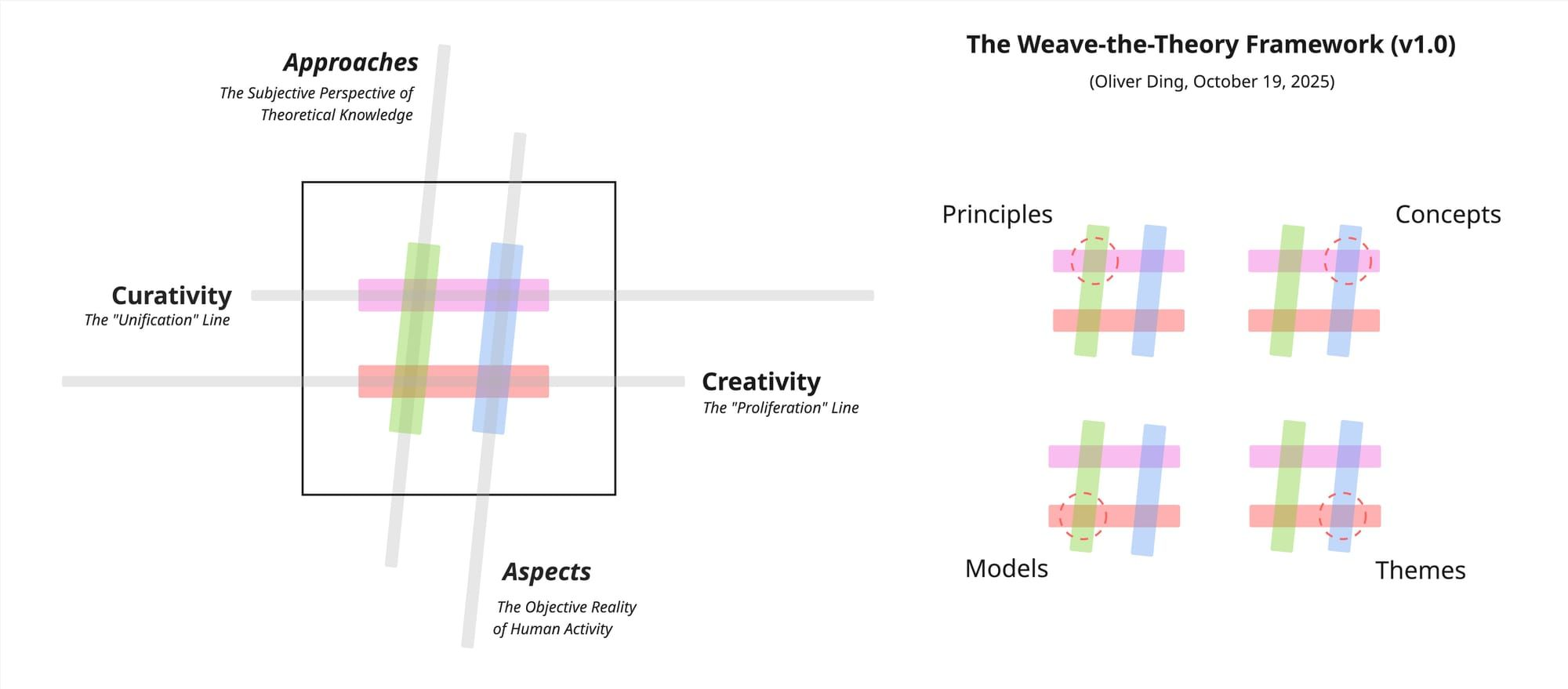
The Weave-the-Theory model is a framework for understanding how theoretical work develops — not what it concludes, but how it moves. It proposes that theoretical development always involves two simultaneous lines of movement: a Creativity Line, which proliferates outward through Theme and Model, and a Curativity Line, which unifies inward through Concept and Principle. These two lines intersect at four weave-points that mark the key moments of transformation in any theoretical enterprise.
A companion framework for reading this kind of development is the Sandglass Model — formally, the Creative Life Curation Framework. The Sandglass describes a complete wave of creative development as passing through five stages: Explore Widely, Inquire Deeply, Crystallize Thematically, Work Deeply, and Play Widely.
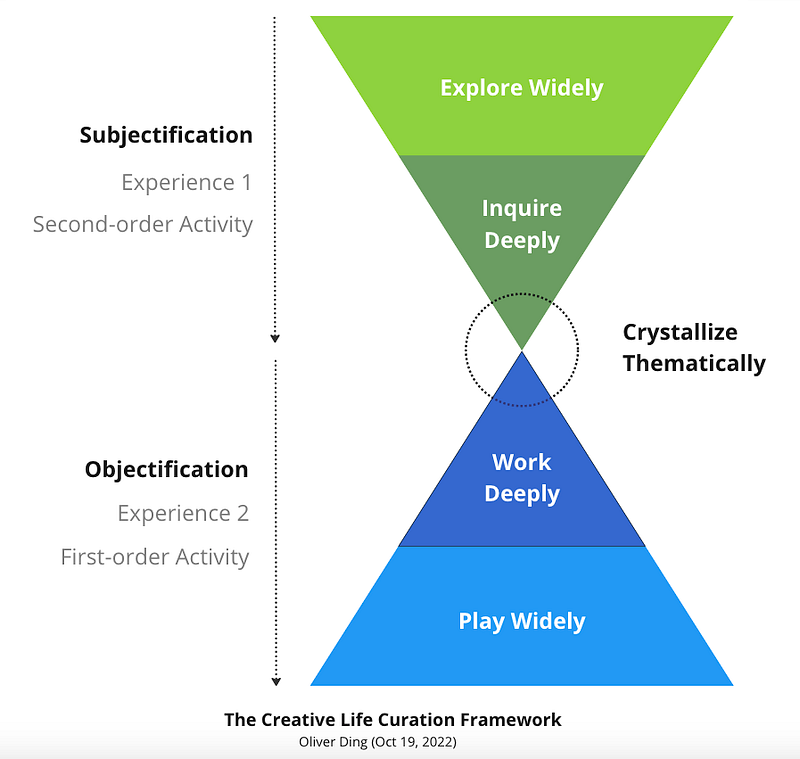
The first two stages belong to the Subjectification phase — second-order activity, experience accumulating inward. The last two belong to the Objectification phase — first-order activity, knowledge being externalized and applied. Between them, at the narrowest point of the sandglass, sits Crystallize Thematically: the moment when accumulated inquiry condenses into a thematic center that organizes everything before and after it.
One complete wave of development passes through all five stages. A second wave begins when the Objectification phase generates new material that feeds back into a fresh round of Subjectification. A third wave describes a more complex situation: dialogue with another knowledge system, in which the two enterprises mutually transform each other.
This article reads the development of the Life-as-Activity Approach through both frameworks simultaneously. The Weave-the-Theory model tracks the four weave-points; the Sandglass model tracks the three waves of development. Together, they reveal a structure that neither framework alone would make fully visible.
This article is the fourth application of Weave-the-Theory to a specific case of theoretical development. The three previous cases have each revealed a different structural configuration:
In the Revisiting–Rebuilding (RR) case, the weave-points emerged organically from a long-standing creative practice. The Theme was lived for years before it was named; the Model grew from within the practice itself; the Concept clarified the theoretical identity of what had been done; the Principle connected the practice to broader questions of creative identity across time.
In the Curativity case, the development followed what we might call the Weave-AA pattern: an alternating rhythm of Advancing and Analyzing that spiraled upward over six years. The Concept (Enterprise) surfaced slowly through accumulated practice, bottom-up, before it could support any Principle. The models proliferated across many projects; the unifying concept arrived late and gradually.
In the AAS (Anticipatory Activity System) case, the structure was strikingly different: the Principle — drawn from Robert Rosen's theory of anticipatory systems — was present from the beginning, governing the development from above even before the full implications of the framework were worked out. The weave moved from Principle downward, clarifying and elaborating.
The present case — the Life-as-Activity Approach — offers yet another structural configuration. The governing principle (Activity as Project Engagement) did not arrive fully formed. It went through three distinct stages of maturation — from a practical name, to a bridging concept, to a principle recognized through genealogical comparison — before becoming the organizing center for all subsequent development. What is distinctive about this case is that its full arc maps onto three complete waves of the Sandglass model, with the Crystallize Thematically moment producing not an ordinary theme but an unusually abstract principle. This double mapping — Weave-the-Theory and Sandglass together — is the analytical lens this article uses.
Part 2. The First Wave: From Exploration to Crystallization
The Sandglass model describes the first wave of creative development as a complete arc: Explore Widely, Inquire Deeply, Crystallize Thematically, Work Deeply, Play Widely. In the Subjectification phase, experience and material accumulate inward; at the narrowest point, something crystallizes; in the Objectification phase, the crystallized insight is worked out and played into the world. One complete wave requires all five stages.
For the Life-as-Activity Approach, this first wave unfolded from 2020 to 2024. What makes it distinctive within the Sandglass framework is the nature of what crystallized at the narrowest point. In most cases, Crystallize Thematically produces a theme — a named territory that organizes the work. Here, the crystallization produced something more abstract: a governing principle. The moment in the sealed room in April 2022, when Deep Analogy revealed Activity as Project Engagement as the organizing claim of the entire enterprise, was a Crystallize Thematically event of unusual depth. The Weave-the-Theory framework tracks this same moment as the arrival of the Principle weave-point — the most abstract claim the development had earned the right to make.
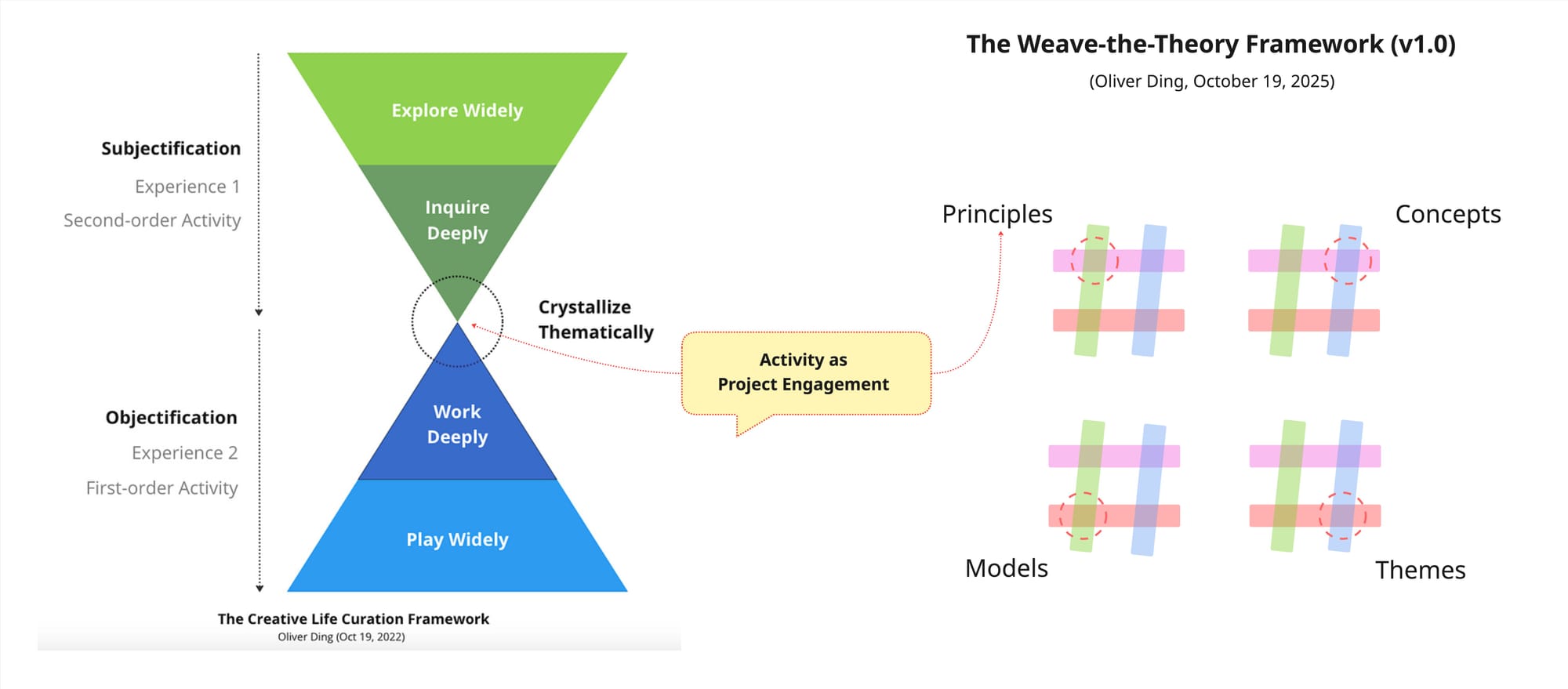
The first wave completed when the Project line reached its Play Widely stage: the development of the House of Project Engagement canvas in 2024, which turned the framework into a narrative and practical tool.
2.1 The Question This Case Addresses
How does a creator move from a vague practical intuition to a named concept to a principle that can finally be stated with full theoretical confidence?
The development of the Life-as-Activity Approach offers an unusually clear answer, because the governing principle — Activity as Project Engagement — did not arrive fully formed. It went through three distinct stages, each a step in the curation of a body of work that had been accumulating without yet knowing its own center.
This is the story of that movement.
2.2 Stage One: A Name Looking for Its Meaning (November 2020)
In November 2020, I was working on developing the Ecological Practice Approach — a broad theoretical project that had been underway for several years. Within this project, I was trying to address a specific problem: how do platforms support individual development? The Platform for Development (P4D) framework was my attempt to build a structural answer.
The triggering moment came while reading Andy Blunden's work on "project as a unit of activity." Blunden's account describes the objectification of a project across three dimensions: symbolic, instrumental, and practical. Reading this, I was immediately reminded of the Corporate Identity System (CIS) developed by Motoo Nakanishi in Japan — a practical knowledge framework that organizes corporate identity across three parallel dimensions: Mind Identity (MI), Behavior Identity (BI), and Visual Identity (VI). The structural correspondence was striking. Here was a theoretical framework from the Hegelian-Vygotskian tradition, and here was a practical knowledge system from the world of corporate communication, and they were saying the same thing in different languages.
From this encounter, I developed the Project Identity System — taking the CIS structure and redirecting it from corporations to projects. But almost immediately, I recognized that Identity was only one half of what I needed. A project does not only define a person through identity; it also attracts a person through its themes. The framework needed to hold both. I added Theme alongside Identity, forming the paired concept of "Theme — Identity" as the core of the model.
At that point, the framework needed a new name — one that could contain both Theme and Identity without privileging either. I chose Project Engagement System. The word "Engagement" was selected because it seemed large enough to encompass the "individual — project" relationship in its full complexity: both the attraction of a person to a project, and the shaping of identity that follows participation.
This is the Theme stage. At this moment, I did not have a clear idea of what "Engagement" theoretically meant. I would later write explicitly: "I didn't have a clear idea about the concept of 'Engagement' when I used the word to name the Project Engagement approach in 2021." The word was not chosen from theoretical clarity; it was chosen from practical necessity. The Theme stage is like this: a name arrives before its meaning, carried forward by the pressure of a lived problem that has not yet found its theoretical form.
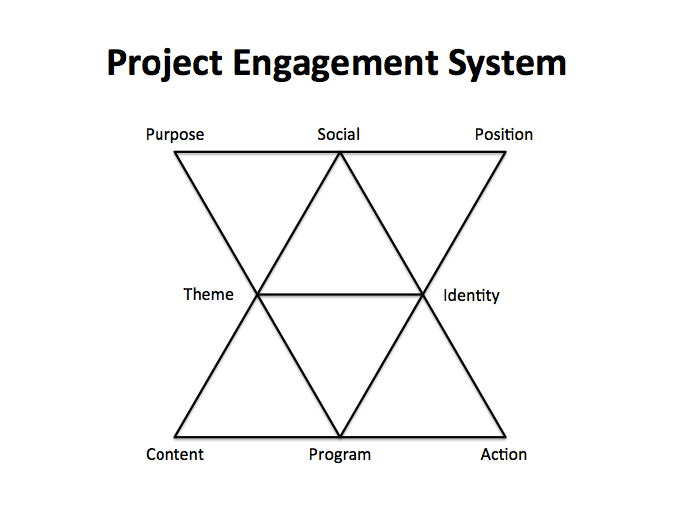
The primary model associated with this stage is the Project Engagement System diagram — later renamed the Developmental Project Model — with Theme and Identity as its two organizing centers, surrounded by six supporting elements: Purpose, Social, Position, Content, Program, and Action. The diagram captures the structure of "individual — project" engagement as a field of forces, without yet explaining the principle that governs the field.
2.3 Stage Two: A Concept That Bridges Two Traditions (January 2022)
By January 2022, the Project Engagement approach had been further developed and tested through the writing of Project-oriented Activity Theory (2021). The approach now had a broader scope: not just the "Person — Project" relationship (v1.0), but also the "Project — Project" complexity — the network structure through which multiple projects form a life-history and a social ecology.
In January 2022, I developed the Project Engagement Toolkit (v1.0) and introduced a model that made a different kind of claim. The diagram placed Idea at the center, with two overlapping dotted ellipses: one labeled Concept (associated with Project-oriented Activity Theory, i.e., Blunden's approach), the other labeled Work (associated with the Activity System model, i.e., Engeström's approach). Problem and Solution appeared as the two poles of the Idea.
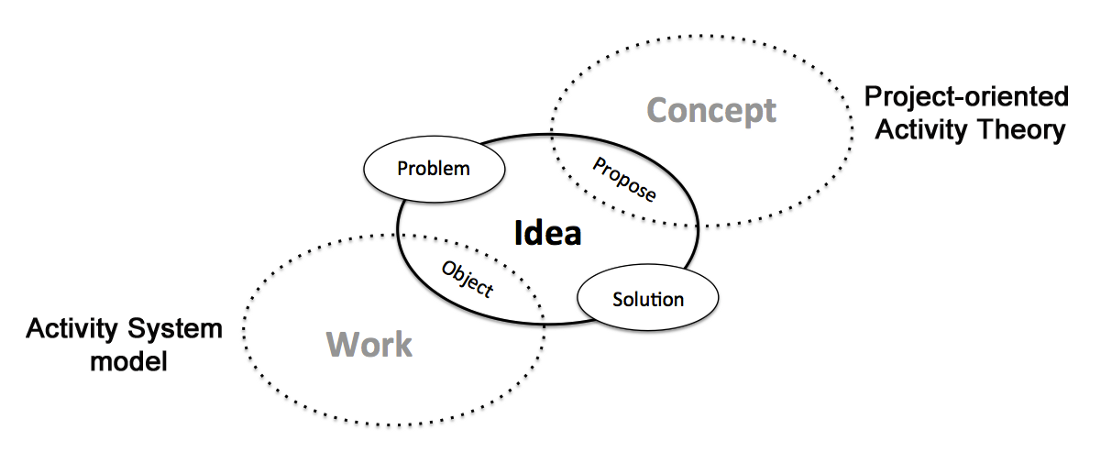
This model was not merely a description of project engagement. It was a positioning statement within Activity Theory. Activity Theory is not a unified school — it is a family of approaches that share a lineage but have developed in divergent directions. Blunden's approach emphasizes "Activity as Formation of Concept" and foregrounds the individual's relationship to a project as a cultural-conceptual formation. Engeström's approach emphasizes the collective activity system and the transformation of objects through systemic intervention. These two branches had remained largely separate.
The Project Engagement concept, as this model defined it, worked as a bridge between them. It held the conceptual dimension (Blunden) and the work dimension (Engeström) together in a single frame, with the idea — the generative unit of both — at the center. By doing so, it completed a theoretical operation: it resolved a tension within Activity Theory that had previously been left unaddressed.
This is the Concept stage. What changed from Stage One is not the content but the epistemic status. "Project Engagement" was now more than a name large enough to contain two elements. It was a theoretically functional concept — one that did something specific: it bridged two branches of a tradition, demonstrated their underlying unity, and staked out the position of my approach within that wider field.
The primary model associated with this stage is the Idea-centered bridging diagram — the intersection of Concept and Work, with Blunden and Engeström as the two theoretical sources on either side.
2.4 Stage Three: The Principle Recognized Through Deep Analogy (April 2022)
The Principle arrived in a room without the Internet.
On April 21, 2022, I was reading a thesis by an activity theorist working in design. While reading a section on the historical development of Activity Theory, I captured a significant insight and began working in my notebook. On April 22, I reproduced the result on Milanote.
The technique I used was Deep Analogy: taking a structural pattern that recurs across multiple instances and using it as a lens to read new material. The structural pattern I had identified in Activity Theory was this: each major theorist poses a challenge in the form of a dualism and resolves it by introducing a third element that transforms the dualism into a triad.
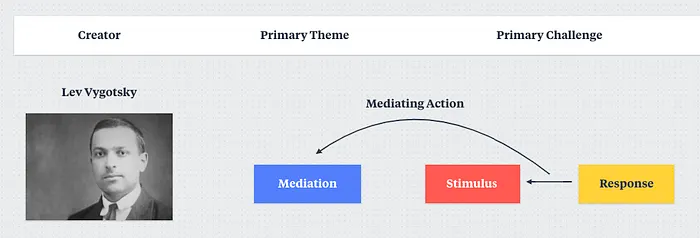
- Vygotsky: Stimulus — Response → Mediation (S-X-R); theme: Cultural-historical psychology
- Leontiev: Individual Actions — Collective Activity → Object-orientedness; theme: Activity as basic unit
- Engeström: Object — Outcome → System; theme: Transformation by collective activity system
- Blunden: Practice — Sign → Concept; theme: Activity as Formation of Concept
I then applied the same structure to my own work:
- Oliver Ding: Outside — Inside → Engagement; theme: Activity as Project Engagement
The moment of placing myself in the same table as these theorists was also the moment of recognizing what my principle actually was.
The word "Engagement" — which had been chosen in 2020 as a practical container for Theme and Identity, and refined in 2022 as a bridge between two traditions — now revealed its deeper theoretical identity. It was the third element in a structure that resolved the Outside/Inside dualism: the ecological movement by which a person moves from being outside a project to being inside it. This movement — Engagement as Projection — is what the Cultural Projection Analysis diagrams had been modeling all along, without my having named them as the core of my theoretical approach.
This is the Principle stage. The principle does not arrive as a new idea. It arrives as a recognition — the sudden clarity that something already present in the work has been the organizing center all along. The 2021 book contained the Cultural Projection diagrams. The 2022 toolkit contained the bridging model. But neither of these, on their own, revealed the governing claim. It took the Deep Analogy technique — the act of placing my work in structural dialogue with the theorists who came before me — to make the principle visible.
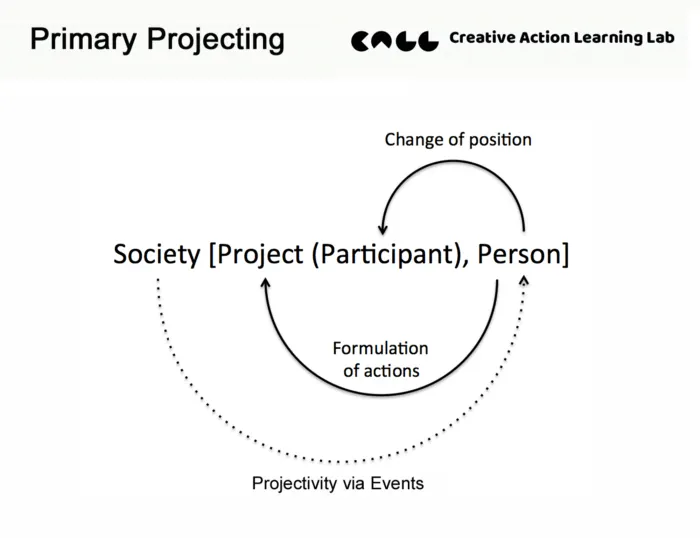
The primary model associated with this stage is the Deep Analogy table — the parallel rows of Challenge and Solution across theorists, with "Activity as Project Engagement" occupying the final row — alongside the Cultural Projection Analysis diagrams (Primary Projecting, Secondary Projecting, Tertiary Projecting), which the Principle retrospectively identifies as the core visual language of the approach.
2.5 A Reflection on the Three Stages
Looking back across the three stages, a pattern becomes visible that the Weave-the-Theory framework would predict, but that is worth making explicit in this case.
The Theme stage (2020) was characterized by practical pressure: I needed a word that could hold two elements. The word arrived before its meaning. This is typical of the Theme stage — the lived experience generates a name, but the name is still a container waiting to be filled.
The Concept stage (2022) was characterized by theoretical positioning: the concept now did something — it resolved a tension within Activity Theory and defined the approach's location within a wider intellectual tradition. The meaning of "Engagement" became more precise, even though the deepest theoretical claim had not yet been stated.
The Principle stage (2022) was characterized by recognition through genealogy: by placing my work in the same structural series as Vygotsky, Leontiev, Engeström, and Blunden, I recognized that my approach made the same kind of move they made — and that its core claim was not "Project" (the noun) but "Engagement" (the dynamic, the movement, the ecological relation). The Principle resolved the Outside/Inside dualism; the Cultural Projection diagrams were its primary visual expression.
What this case demonstrates, in contrast to the AAS case, where the Principle was present from the beginning and governed the development from above, is the possibility of a fully bottom-up route to a governing principle. The principle was latent in the earliest work. It became visible only through accumulated practice, theoretical dialogue, and finally the structural illumination provided by Deep Analogy.
2.6 The Crystallization of a Principle
In the Sandglass model, the five stages of a first wave are divided into three phases. The first phase — Explore Widely and Inquire Deeply — belongs to Subjectification: experience and material accumulate inward, second-order activity predominates, and the creator is building toward a center that has not yet become visible. The third phase — Work Deeply and Play Widely — belongs to Objectification: what was crystallized is now worked out in concrete forms — frameworks, tools, applications — and first-order activity takes over. Between these two phases, at the narrowest point of the sandglass, sits Crystallize Thematically: the moment when the accumulated work of a thematic enterprise condenses into its core theme, making the transition from Subjectification to Objectification possible.
Crystallize Thematically does not produce a small or narrow result. It produces the core theme of an entire thematic enterprise — the central claim or theoretical identity that holds everything together. Its form varies: it can be a book manuscript (as when the Curativity theoretical framework crystallized into a 600-page draft in March 2019, marking the completion of years of inquiry into curation), a diagram system, a conceptual framework, or any other form in which a sustained body of work finally achieves coherence. What matters is not the form but the function: the Subjectification phase reaches its conclusion, the work knows what it is about, and the turn toward Objectification becomes possible.
In this case, the crystallization occurred on April 21–22, 2022. On April 21, in a room without the Internet, while reading a thesis by an activity theorist working in design, I captured a significant insight and began working in my notebook — drawing the Deep Analogy table by hand. On April 22, back home, I reproduced it on a Milanote board. The content was a systematic comparison of how each major Activity theorist had posed a challenge and resolved it, followed by the placement of my own work in the same structural series. This was the act of recognition: the moment when the accumulated work of two years found its theoretical identity by locating itself within a tradition.
What crystallized was the core theme of the Life-as-Activity Approach as a theoretical enterprise: Activity as Project Engagement. This is a particular type of core theme — a principle, a positioning statement within a tradition, a claim about the deep structure of the work. It is more abstract than a thematic name; it is the logic that makes all the thematic territories intelligible. This is what gives this case its distinctive character within the Sandglass framework: the Crystallize Thematically moment produced not just a named center but a governing principle of unusual abstraction.
The Objectification phase that followed centered on the successive versions of the Project Engagement framework — specifically the expansion and deepening of the "project" dimension of the approach. Version 2.0 and 2.1 (2022) introduced the key equation Life = Projects = Thematic Spaces = Events = History, expanded the scope from the Person—Project relationship to the full complexity of the Project Network, and brought in Genidentity and Platform as new structural levels. This was Work Deeply: taking the crystallized principle and building out the framework it implied, version by version, each answering a question the previous one had left open.
The Play Widely stage reached its fullest expression in 2024, when the Project Engagement approach produced the House of Project Engagement — a canvas tool organized around twelve thematic rooms representing different types of social landscape. This tool marked the completion of the first wave: the framework had moved from theoretical principle to practical narrative instrument. The approach could now be inhabited and explored as a space, not just analyzed as a structure. Version 3.1, formalized in the same year, gave this expansion its theoretical name — project-oriented social ecology — and integrated the Social Landscape concept as its spatial foundation.
Part 3. The Second Wave: The Principle Returns at a Higher Level
The Sandglass model is an idealized five-stage framework. Used alone, it risks turning the actual development of a knowledge enterprise into an overly neat linear narrative. To avoid this, the model can be extended through the concept of multiple waves. A second wave does not mean starting over from scratch. It means that after the Objectification phase of the first wave, a return to Subjectification becomes possible — opening a new cycle of development.
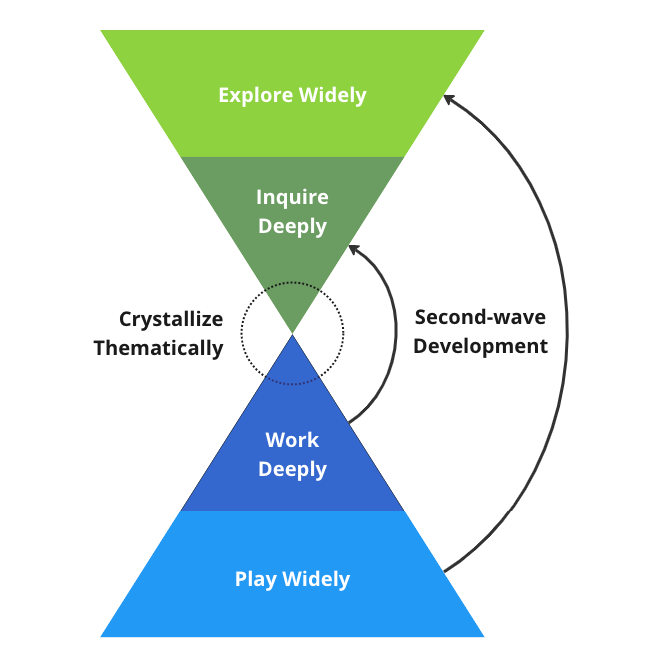
This new cycle may operate at a higher level of abstraction, or it may develop a parallel concept at the same level, or extend into an adjacent territory. What matters is not the direction but the structure: a new S-T-O cycle begins, building on the foundation of the first wave rather than repeating it. The Sandglass model is fractal in nature: its basic Subjectification—Crystallize—Objectification structure can appear at different scales within a larger development.
In the case of the Life-as-Activity Approach, the second wave does not revisit the entire enterprise from the beginning. It focuses on a specific dimension: how the governing principle — Activity as Project Engagement — returned at a higher level of abstraction in the years following the first wave's completion. The first wave had crystallized the principle around the Project—Event symmetry, as expressed in Cultural Projection Model v1 (2021): the Outside—Projecting—Inside triad, with Primary, Secondary, and Tertiary Projecting as its three movements. This was the principle's first concrete articulation. But a deeper symmetry remained latent — one that would only become visible through the second wave.
3.1 Inquire Deeply: The Emergence of Enterprise
The Inquire Deeply stage of the second wave did not begin with a deliberate exploration of the Life-as-Activity Approach. It arrived through an indirect activity.
During 2025, the primary theoretical work was the development of Creative Life Theory v3.0–v3.1. Within that project, the concept of Enterprise was developed and refined as a core theoretical element. Enterprise names the subjective experience dimension of a person's engagement with the social world: not the objective structure of activity systems, but the long-term, self-directed trajectory of a person's endeavors as lived from the inside.
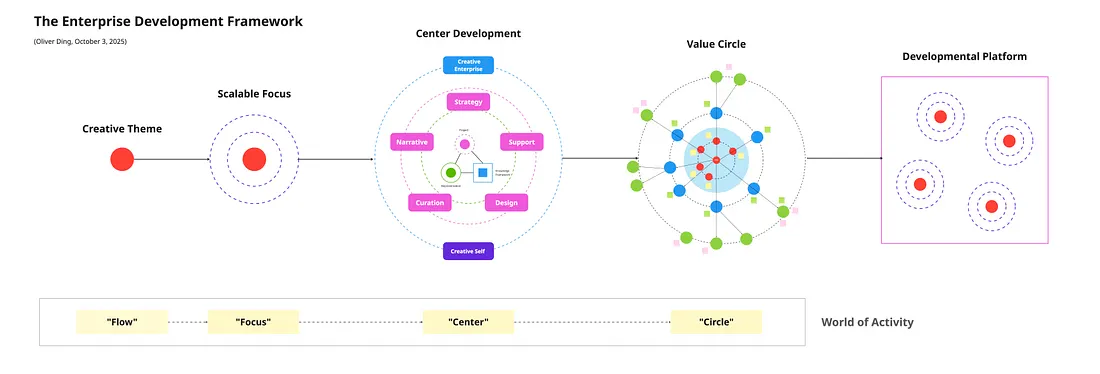
This concept solved a structural gap that had been latent in the Life-as-Activity Approach since the formulation of the Life-History Topology in 2022. That ontological framework — Life = Projects = Thematic Spaces = Events = History — established a foundational symmetry: Project sits within the individual's subjective experience, while Event sits outside it, belonging to the objective activities of others. This Project—Event symmetry is the concrete expression of the governing principle Activity as Project Engagement at the micro level.
However, the topology left a gap unaddressed. Moving from the micro level (individual projects and events) to the macro level (Life and History) required crossing a meso level that had no clearly named concepts. When Enterprise emerged as a theoretical element, it became clear that it filled this gap precisely: Enterprise is a higher-order organization of Projects — a series of projects organized by a sustained subjective trajectory. And if Enterprise is the meso-level counterpart to Project on the subjective side, then by the same logic, the meso-level counterpart to Event on the objective side must be Activity itself. The Activity—Enterprise symmetry thus completed the topology at a new level of scale, giving the Life-History framework its missing middle.
The transfer of Enterprise back into the Project Engagement framework was a deliberate curatorial act — a recognition that a concept developed elsewhere had solved a problem that had been waiting here. This is the pattern Howard Gruber identified in Darwin's notebooks: the most significant theoretical breakthroughs often arrive as by-products of efforts aimed elsewhere. The approach describes this dynamic; this case enacts it.
3.2 Crystallize Thematically: The Developmental Projects Manuscript
The crystallization of the second wave took place in November 2025, through the editing of the book draft Developmental Projects: The Project Engagement Approach to Adult Development. This manuscript served two theoretical enterprises simultaneously — advancing Creative Life Theory and bringing the Project Engagement approach to version 4.0 — and it was within this dual project that the new symmetry finally became explicit.
The Activity—Enterprise symmetry — whose theoretical logic had emerged through the Inquire Deeply stage — now needed a concrete form. The manuscript provided that form: a sustained writing process in which the symmetry was articulated, tested against case studies, and integrated into a revised version of the Cultural Projection Model.
The Cultural Projection Model v2 (November 2025) gave this symmetry its visual form — but with a crucial clarification. The Activity—Enterprise pairing is not a binary opposition. It is a distinction that emerges naturally from the Outside—Projecting—Inside triad itself.
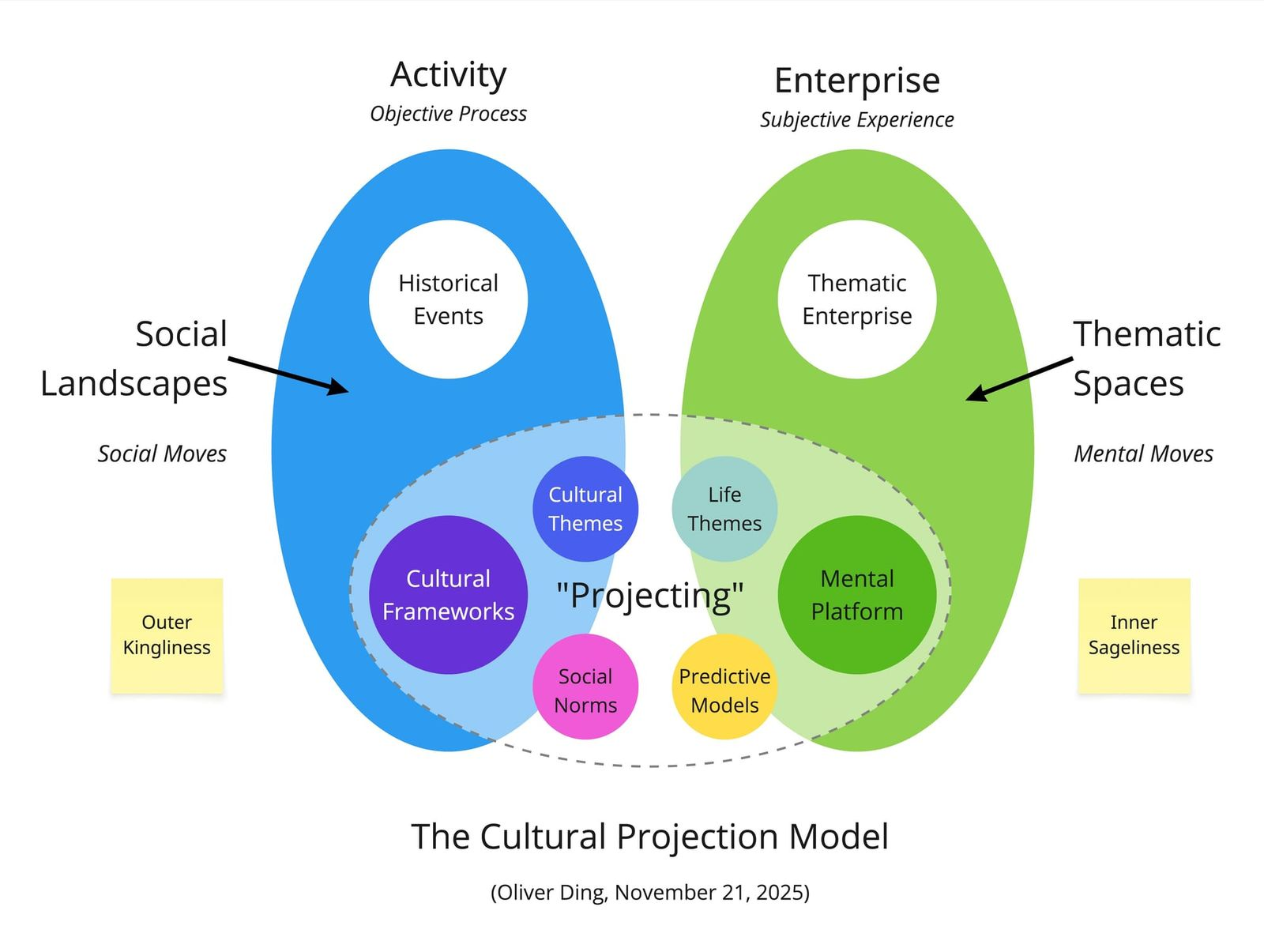
The Project Engagement Approach, building on Activity Theory's internalization–externalization principle, introduces the Outside—Projecting—Inside triad as a basic ecological form: the person observes from Outside, takes action through Projecting, and becomes engaged on the Inside. A project is defined as a primary type of social environment. What the second wave revealed is that this same triad operates at multiple scales simultaneously. At the micro level, the symmetry is Project (inside, subjective) versus Event (outside, objective). At the meso level, the symmetry is Enterprise (subjective experience, a series of projects organized by a sustained personal trajectory) versus Activity (objective process, the collective social structures within which those trajectories unfold).
The key insight is that these are not two separate domains but two perspectives on the same social reality. What I experience from the inside as my Enterprise is, from the outside, observable as Activity. Just as a Project and an Event are the same social occurrence seen from different positions — participant versus observer — so Enterprise and Activity are the same ongoing social process seen from inside or outside. The Cultural Projection Model v2 makes this visible through its three conceptual containers: Container X (Activity / Objective Process / Social Landscapes / Social Moves), Container Y (Enterprise / Subjective Experience / Thematic Spaces / Mental Moves), and Container Z (Projecting / the movement between outside and inside). The model does not oppose Activity to Enterprise; it shows them as the two faces of a single Projecting movement, framing the space in which engagement takes place.
3.3 Work Deeply & Play Widely: The Principle in Operation
The Objectification phase of the second wave unfolded in early 2026, during the development of the Anticipatory Cultural Sociology (ACS) project. With the Activity—Enterprise symmetry now established as a theoretical foundation, it became possible to apply Cultural Projection as an operational dimension across a series of new frameworks and articles.
This Work Deeply stage produced several concrete models: the Design-oriented Project Engagement framework, the Discover—Design—Deliver model, and a series of related operational tools that brought the principle down from the level of theoretical claim to the level of practical analysis and intervention. These developments demonstrated that the second wave's crystallization was not merely a refinement of vocabulary but a genuine expansion of the approach's operational capacity — the higher-level symmetry made new kinds of analysis possible that the first wave's framework could not have supported.
Part 4. The Third Wave: Dialogue with Another Knowledge System
The Sandglass model describes the third wave as dialogue with another knowledge system — a situation more complex than the first two waves, because the development is no longer internal to a single enterprise. Two bodies of work encounter each other, each bringing its own tools and questions, and both are transformed by the encounter.
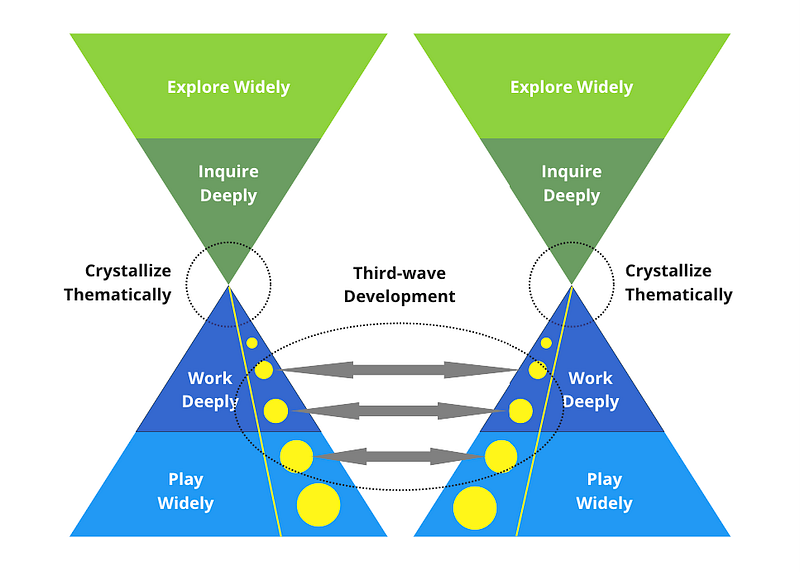
In this case, the Life-as-Activity Approach and the Weave knowledge system entered into a dialogue that ultimately produced a new synthesis neither could have generated alone.
4.1 The Weave-the-Life Framework: From v1.0 to v3.0
The Weave Basic Form was introduced in October 2025 as a meta-framework that conceptualizes activity as the synthesis of two diachronic dimensions and two synchronic dimensions, yielding four Weave-Points. Almost immediately, it was applied to the Life-as-Activity Approach.
On October 3, 2025, the Weave-the-Life model v1.0 was added to the approach. Its purpose was to serve as the intermediate layer between the two existing ontological-level frameworks — Activity as Project Engagement and the Life-History Topology — explaining how the former unfolds into the latter and enabling the micro–meso–macro connection that had previously been implicit.
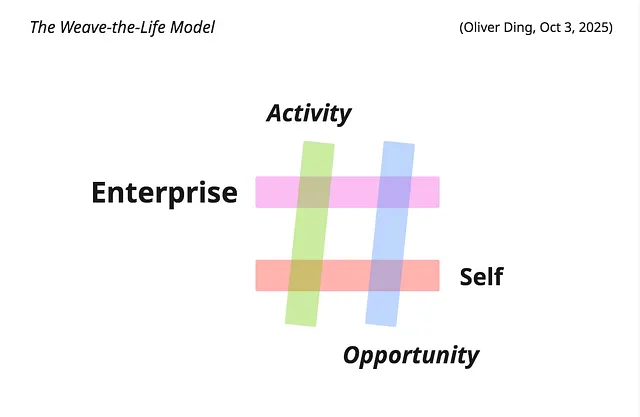
On November 11, 2025, Weave-the-Life v2.0 gave the framework its abstract structural form: four dimensions (Subjective / Objective (adj.) / Part / Whole), four Weave-Points (Self, Enterprise, Project, Activity). This version was incorporated into the Life-as-Activity Approach v3.2 — and it was the first version to place Activity and Enterprise in an explicit structural relationship, giving the Activity—Enterprise symmetry developed during the second wave its diagrammatic home. The framework operates bidirectionally: individual actions crystallize into enterprises that transcend personal will, while social structures and historical events enter individual life through activities and projects.
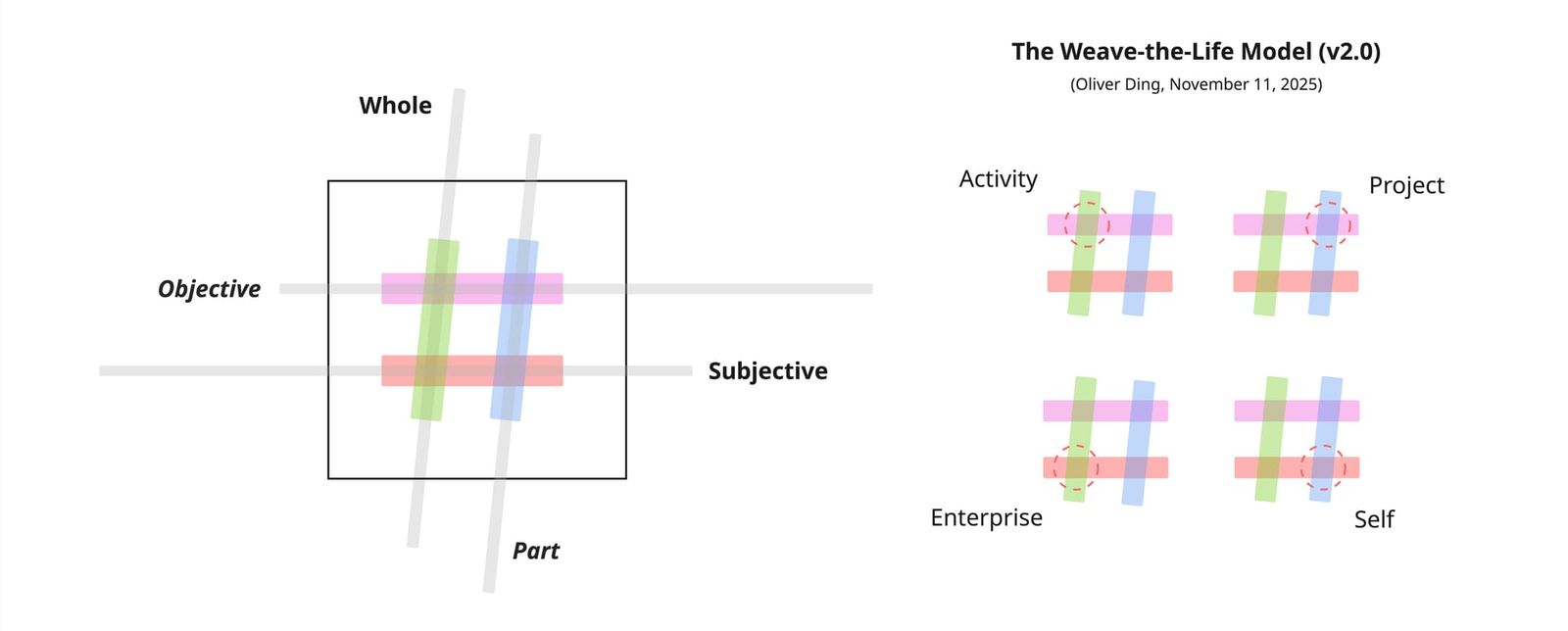
Yet v2.0 left one tension unresolved. The four Weave-Points could hold only four concepts at the core, and there had been a persistent question about whether the fourth position should be occupied by Event or Self. Both were theoretically necessary. The 2×2 structure forced a choice that neither option could fully satisfy.
In April 2026, while working on the Weave 42 project, a new version of the Weave Basic Form emerged — a 4×4 edition called the Weave 16 diagram. The expanded structure dissolved the tension naturally.
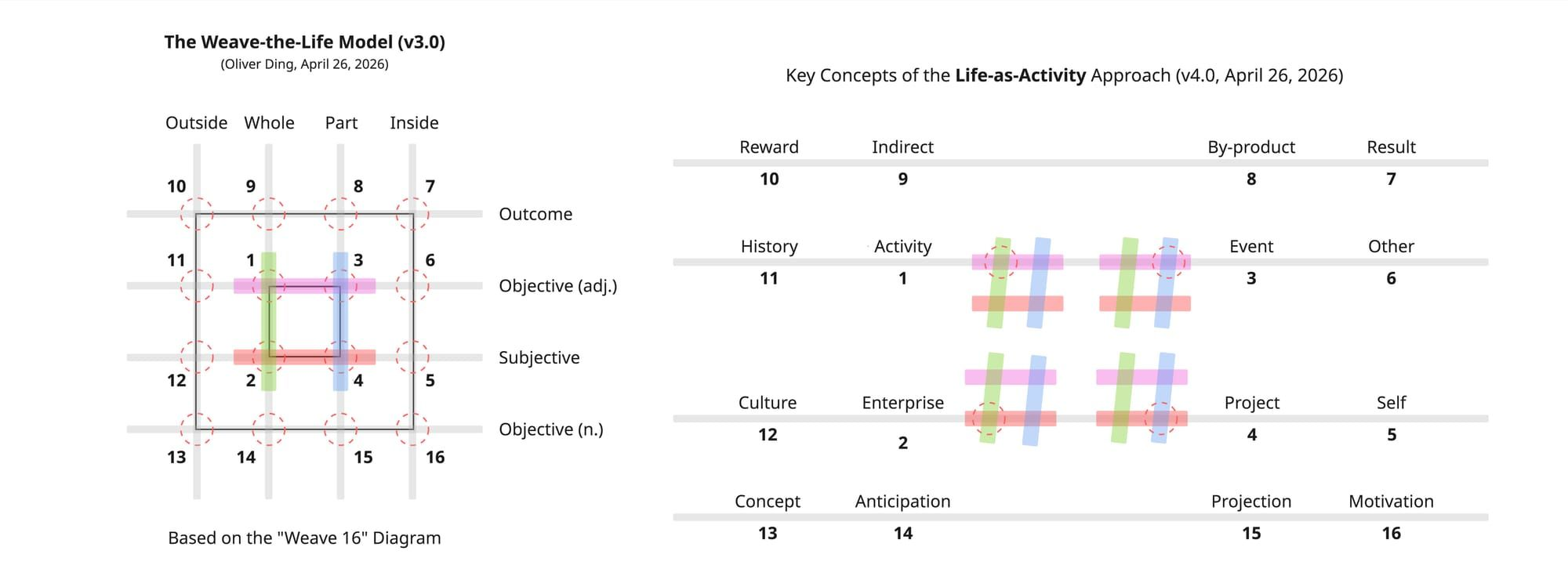
Event joined Activity, Enterprise, and Project in the inner square, forming a coherent fourfold core. Self moved outward to the Inside column, gaining its own structural position rather than competing for space at the center. What had been a forced choice became, in the larger diagram, a clarified architecture. Weave-the-Life v3.0 was built on this new foundation, placing all sixteen key concepts of the Life-as-Activity Approach into a single spatially organized map.
4.2 Weave as a Model of the Actor
The development from v2.0 to v3.0 was not driven by a desire to add more concepts. It was driven by a recognition — one that had been dormant for more than two years before it returned.
In 2023, while reading a collection of discussions by theoretical sociologist Lui Ping-keung and his colleagues — on weekend mornings, sitting at the sidelines of a football field while his son practiced with the team — the phrase model of the actor appeared repeatedly. In their framework, every social theory carries an implicit model of the actor at its core: a set of assumptions about what human beings are, how they act, and what drives them, often undeclared but structurally determinative. At the time, the concept was noted and set aside.
In March 2026, while working on the Anticipatory Cultural Sociology (ACS) project, the concept returned. Looking at the ACS v1.2 diagram — a three-dimensional, five-ring coordinate that had been built as a map of cultural development — an unexpected recognition surfaced: this structure had quietly become exactly what Lui's framework described. A model of the actor.
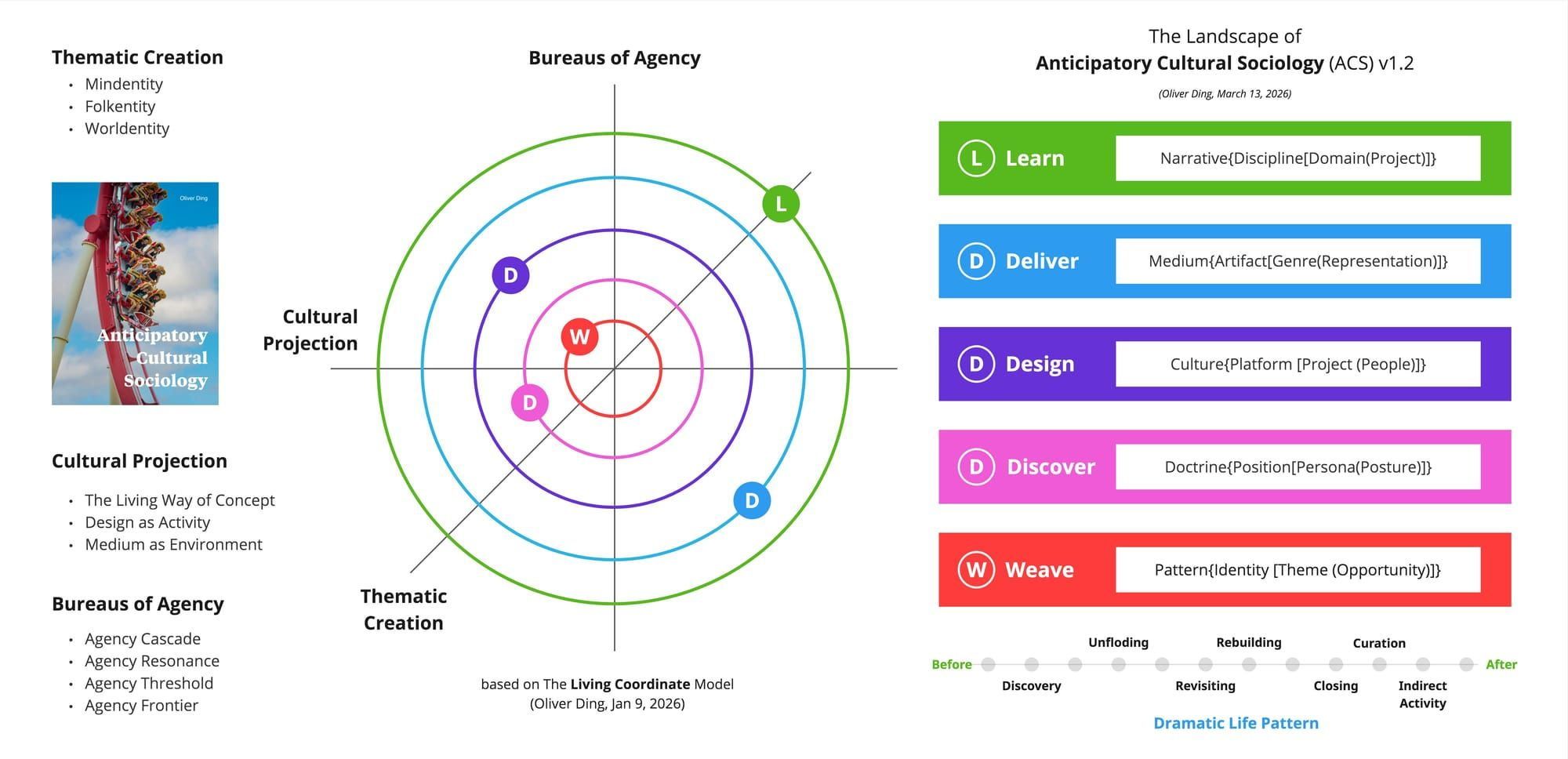
This recognition was the bridge between the two knowledge systems. The Weave Basic Form had been developed as a structural tool for theoretical curation. But the recognition that Weave — in its five-ring form — described the fundamental orientations through which a cultural actor engages with the world gave it a different kind of significance. It was no longer only a diagrammatic tool; it was a theoretical claim about human beings.
On April 8, 2026, the model was detached from the ACS project and attached to the Strategic Developmental Psychology (SDP) project as the five rings of the SDP Living Coordinate: Weave, Discover, Design, Deliver, Learn — from the innermost integrative action to the outermost receptive orientation.
On April 21, 2026, revisiting Weave-the-Life v2.0 with this new understanding in place, it became clear that the 2×2 structure was no longer sufficient. What was needed was a structure capable of holding multiple dimensions of the actor simultaneously — not just the intersection of two axes, but a richer field that could map how a cultural actor moves through different orientations. This recognition sent the framework back to the drawing board, and the 4×4 Weave 16 structure provided the answer.
4.3 The Collision: Writing This Article Triggered v3.0
This article was written on April 26–27, 2026. The act of writing it — a second-order reflection on the development of the Life-as-Activity Approach through the lens of Weave-the-Theory — was itself part of the third wave's dialogue. And on the morning of April 26, while the writing was underway, something happened that belongs to the story being told: Weave-the-Life v3.0 was completed.
The path to this moment runs through the full arc of the third wave. The Weave Basic Form had arrived from the Curativity side of the work and crossed into the Life-as-Activity territory. The recognition of Weave as a model of the actor had elevated the framework from a structural tool to a theoretical claim about human development. The Weave-the-Theory case studies — including this one — were pressing a question: how could the full conceptual architecture of the Life-as-Activity Approach be presented in a single high-resolution diagram? The 4×4 Weave 16 structure provided the answer.
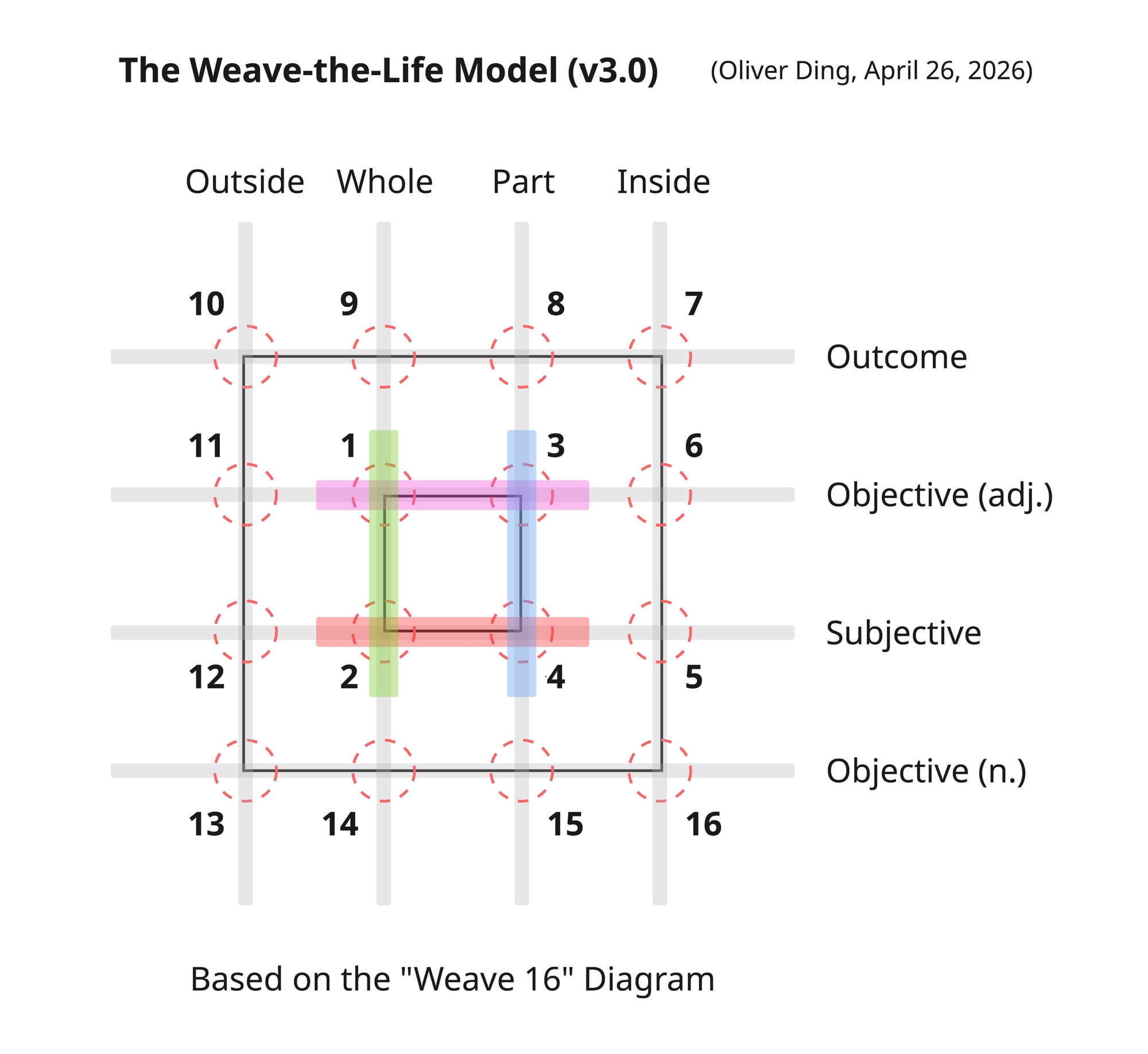
What makes this collision significant is not only that it produced a new diagram. It is that it solved a structural problem that had persisted through the entire development of the approach. Previously, the full landscape of the Life-as-Activity Approach had been presented through a knowledge map — a curated display that gathered key framework diagrams and book draft covers, showing the territory. But the knowledge map lacked a coordinating mechanism. The frameworks sat side by side, each in its own space, their relationships implied but not structurally articulated.
The Weave-the-Life Framework (v3.0) addresses this limitation through a formal innovation. Each of the sixteen Weave-points is simultaneously a structural intersection, a positional Coordinate, and a Thematic Space — a cognitive container that opens onto a region populated by frameworks, diagrams, case studies, and tools.
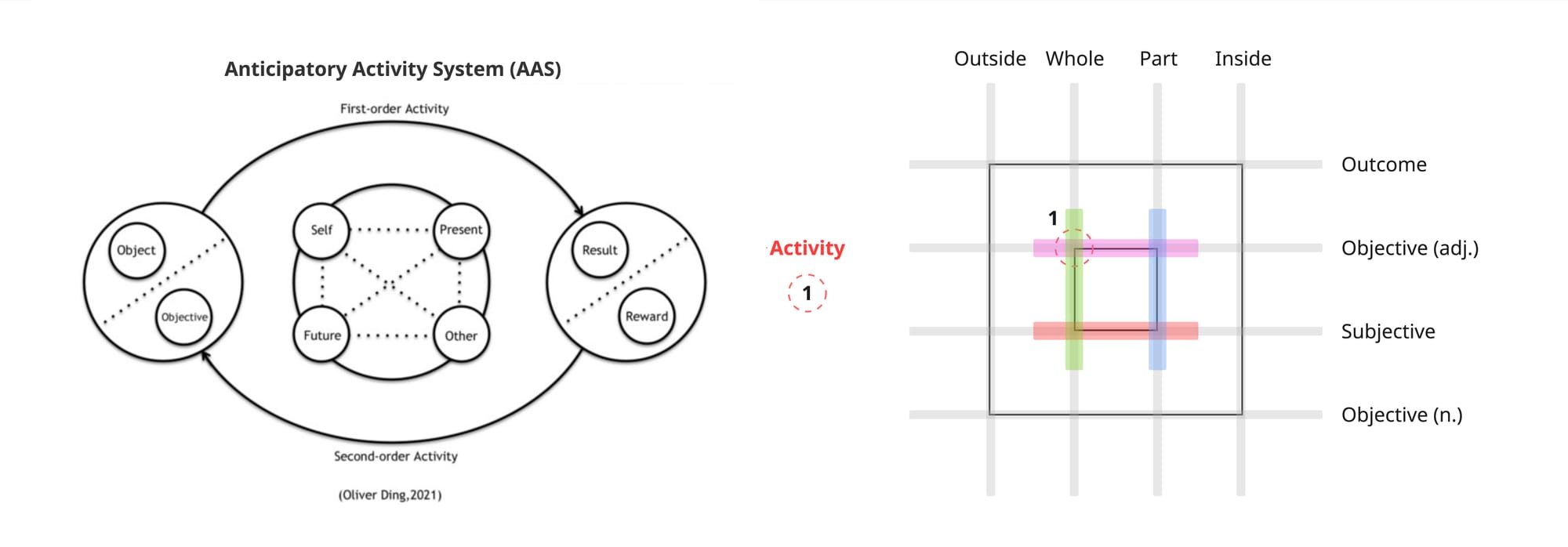
This gives the diagram a nesting capacity: a single Coordinate can hold an entire sub-system of knowledge. Knowledge frameworks that were previously distributed across separate diagrams are now organized within a single spatial argument — not merely displayed, but integrated, their structural relationships made visible through the logic of rows, columns, and pairs.
This is what a third-wave dialogue produces: not just the application of one system's tools to another, but a new artifact that neither system could have generated alone. The Weave knowledge system provided the spatial architecture and the integrating logic; the Life-as-Activity Approach provided the sixteen concepts and the theoretical relationships that needed to be integrated. Their collision, in the course of writing a case study about how curation unfolds, produced a milestone.
Weave-the-Life v3.0 is designated as the foundation of the Life-as-Activity Approach v4.0. It is also, more precisely, the Life-as-Activity Approach's model of the actor. A fuller account — one that uses this diagram as its central navigational device to tour the entire landscape of the approach, thematic space by thematic space — will be the work of the forthcoming Life-as-Activity Approach (v4.0). The sandglass of the third wave has reached its narrowest point. What expands from here belongs to future work.
Postscript: Where Is Weave-the-Theory Now?
Every theoretical enterprise can be examined with its own tools. The Sandglass model was developed to describe how a creative life unfolds through waves of development. It is worth asking: where does Weave-the-Theory itself stand within that model?
The answer requires tracing a development that began earlier than the framework itself.
From 2020 to 2022, a sustained engagement with Activity Theory — reading widely, writing two book drafts, building the Activity Analysis website — generated a question that resisted easy resolution: what is the genidentity of Activity Theory? What makes it a coherent tradition rather than a collection of loosely related approaches? The Explore Widely and Inquire Deeply stages of this first wave were long. In April 2022, the Deep Analogy technique provided a partial answer: each generation of Activity theorists had followed the same structural pattern — posing a challenge as a dualism and resolving it by introducing a third element. The genidentity of Activity Theory was this shared method of theoretical growth.
But this observation, while clarifying, did not yet produce a general theory of how theorists work. That crystallization came later.
On the evening of December 7, 2024 — at home, after a day spent reading in the library — a new idea surfaced. The historical development of Activity Theory was not best described as a Research Programme (developed by Imre Lakatos) or as a sequence of Theoretical Versions (developed by Ruilin Chen). It was better described as a series of Theoretical Projects and Theoretical Events — each theorist contributing a project to a collaborative journey, each generation expanding the conceptual landscape without displacing what came before. The concept of Theoretical Activity crystallized in that moment: theory-building is itself a form of activity, subject to the same analytical tools that Activity Theory applies to other domains of practice.
This was the Crystallize Thematically moment of the first wave. Its form was not a book manuscript or a board, but a conceptual breakthrough recorded in a journal entry — the kind of recognition that feels, as it arrives, like something that was always already true.
The Work Deeply stage followed in October 2025, when the Weave-the-Theory framework was developed as the operational form of this insight: a diagram that maps theoretical activity across two diachronic lines (Creativity / Curativity) and two synchronic dimensions (Aspects / Approaches), with four weave-points (Theme, Model, Concept, Principle) as its analytical vocabulary.
The Play Widely stage is the series of case studies that began immediately and continues through this article. Each case applies the framework to a specific long-cycle theoretical development, testing its analytical capacity and revealing configurations it had not anticipated. The cases are not merely applications; they are the framework for discovering what it can do.
By this account, Weave-the-Theory is currently in its Play Widely stage — the Objectification phase of the first wave, in which the crystallized insight is worked out through concrete applications and the framework earns its claims case by case. The Toolkit articles (on Theme U, the Knowledge Discovery Canvas, and Creative Thematic Curation) remain to be written; they belong to this same Play Widely stage, the analytical infrastructure that the case studies have been implicitly drawing on.
What lies beyond Play Widely is not yet visible. But the LAA case has already provided one signal: the act of applying Weave-the-Theory to a long-cycle development triggered new questions — about the Sandglass model, about the word "Principle," about what curation means across different containers — that belong to a second wave not yet begun. The framework is approaching the moment when its own Play Widely stage generates enough material to feed a new round of Subjectification.
There is a final observation worth making. The two key insights that produced Weave-the-Theory map precisely onto its two lines. The 2022 insight—the Genidentity of Activity Theory—corresponds to my earlier conception of a "theoretical platform" at the time. It used the definition of Genidentity (essential difference + situational dynamics) to delineate two levels of a theoretical platform. In retrospect, this insight targets the synchronic structural pattern, and corresponds to the Curativity Line (the unifying movement).
The 2024 insight—theoretical activity as a journey of projects and events, i.e., the diachronic unfolding of theoretical work—corresponds to the Creativity Line (the proliferating movement). Moreover, the Activity–Enterprise symmetry brings my works on "Theory as Enterprise" (June 2025) and Enterprise Development (October 2025) to this Creativity Line, where theoretical work unfolds as an enterprise over time.
These two insights are not in conflict but complementary, realized in Weave-the-Theory (2025) as the synchrony line and diachrony line. Arriving two years apart, from different reading contexts and moments of recognition, they were woven into the same framework—not by design, but simply because that is what happened. And that may be the most direct demonstration of what Weave‑the‑Theory is for.
Placing this model within the larger system of theoretical activity / theoretical platform reveals an even broader landscape: when we bring the Life‑as‑Activity framework to bear on this specific type of human activity, we see how theoretical activity / theoretical enterprise weaves together the individual's creative life and the unfolding of cultural‑historical development.
v1.0 - April 26, 2026 - 7,534 words