
Life-as-Activity: The Weave-the-Life Framework (v3.0)

A New Model and Key Concepts of the Life-as-Activity Approach (v4.0)
by Oliver Ding
April 26, 2026
In October 2025, I introduced the “Weave” Basic Form as a meta-framework that conceptualizes the activity as the synthesis of two diachronic dimensions and two synchronic dimensions. Later, I used the basic form to systematically design the Weave-the-Life framework, which includes a series of diagrams.
The Weave-the-Life framework was incorporated into the Life-as-Activity Approach (v3.2, 2025) in November 2025. The framework is a member of the approach's ontological-level explanation, bridging the other two members—Activity as Project Engagement and Life-History Topology—and explaining how the former unfolds into the latter.
In April 2026, while working on the Weave 42 project, I developed a new version of the Weave Basic Form, a 4×4 edition that I call the Weave 16 diagram. Based on the new diagram, I created the Weave-the-Life framework (v3.0) and used it to curate 16 key concepts of the Life-as-Activity Approach.
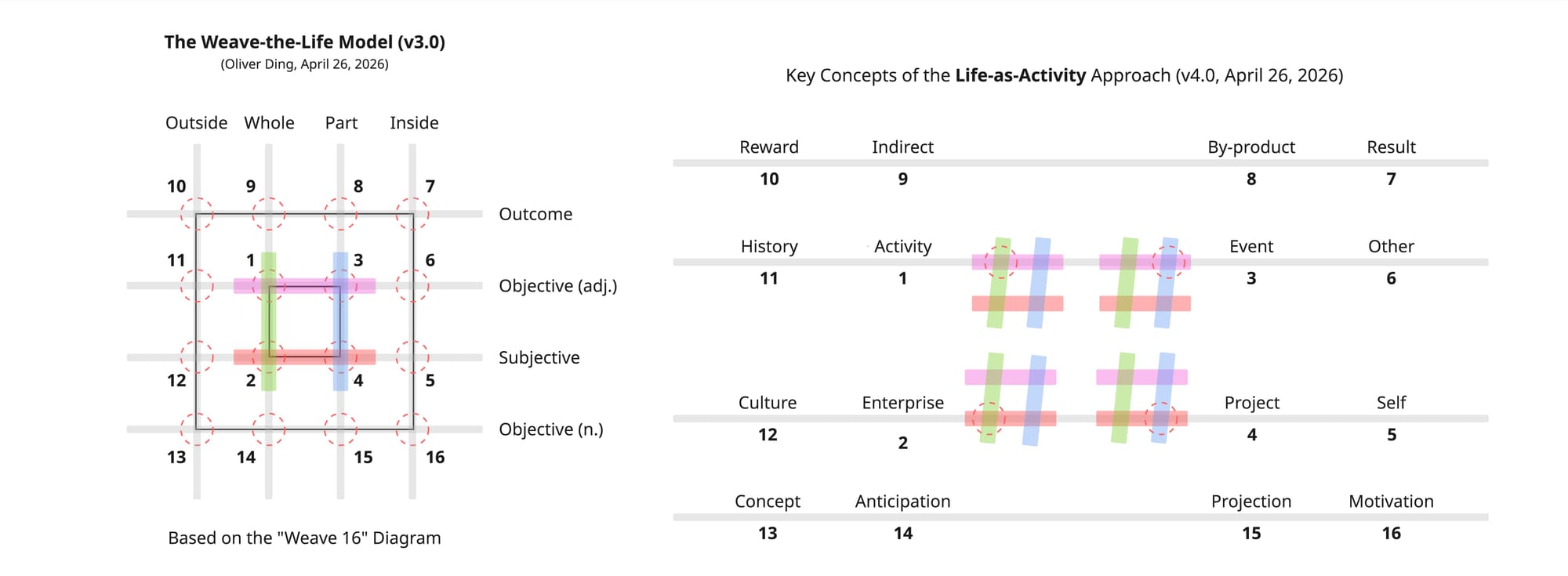
This diagram marks a milestone in the development of the Life-as-Activity Approach. I’d like to designate this milestone as version 4.0 of the approach.
Contents
Part 1. Background
1.1 The Weave Basic Form
1.2 The Weave-the-Life Framework (v1.0, v2.0)
1.3 The Life-as-Activity Approach (v3.2)
1.4 Weave: A Model of the Actor
Part 2. The Weave-the-Life Framework (v3.0)
2.1 The Diagram at a Glance
2.2 The Center Holds: v2.0 as the Core Engine
2.3 The Diachronic Expansion: Objective (n.) and Outcome
2.4 The Synchronic Expansion: Inside and Outside
Part 3. Key Concepts and Thematic Spaces
3.1 From Weave-Points to Thematic Spaces
3.2 Individual Concepts: Three Portals into the Core Engine
- Case #1 — Activity
- Case #2 — Enterprise
- Case #3 — Project
3.3 Pair: Two Concepts, One Container
- Case #4 — Event + Project
- Case #5 — Self + Other
3.4 Group: Several Concepts, One Larger Container
- Case #6 — The "Self-Referential Activity" Thematic Space
- Case #7 — The "Life-History Topology" Thematic Space
Part 4. Toward the Life-as-Activity Approach (v4.0)
4.1 Weave 2.0, Living Coordinate, and Thematic Space
4.2 A Weave-Point as a Scalable Focus
4.3 A New Model of the Actor
4.4 The Life-as-Activity Approach (v4.0)
Part 1. Background
The Weave-the-Life Framework (v3.0) did not emerge in isolation. It grew out of a series of prior developments — a basic form, two earlier framework versions, an approach, and a personal intellectual journey. This part traces those foundations.
1.1 The Weave Basic Form
On October 9, 2025, I introduced the “Weave” Basic Form as a meta-framework (see the diagram above).
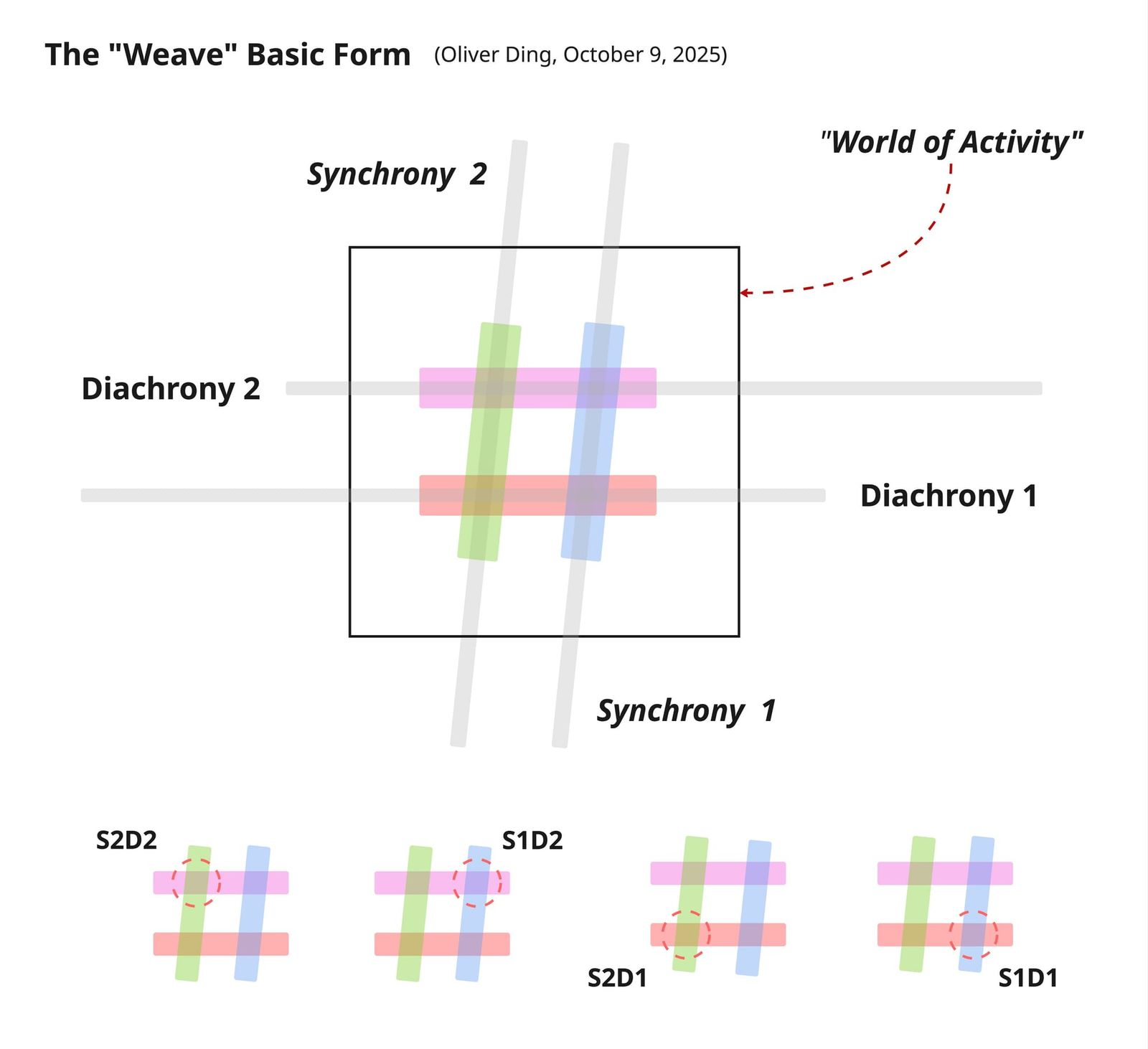
This is a super-simple diagram that frames the activity within the World of Activity as the synthesis of two diachronic dimensions and two synchronic dimensions. The model consists of four Weave-points (S1D1, S1D2, S2D1, S2D2), each representing a structural nexus where one synchrony dimension intersects with one diachrony dimension.
As an abstract model, the “Weave” basic form serves as the foundation for generating derived forms and situational frameworks. More details can be found in [Meta-framework] The “Weave” Basic Form.
During the development of the Weave Basic Form, I experimented with several cases that incorporated activity-inspired principles as key elements. After the basic model stabilized, I applied it to systematically design the Weave-the-Life framework – a series of operational diagrams that translate the abstract dimensions into a life-design grammar.
1.2 The Weave-the-Life Framework (v1.0, v2.0)
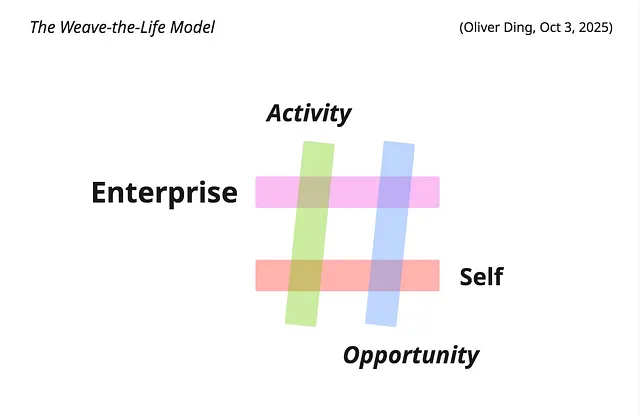
On October 3, 2025, I added the Weave-the-Life model (v1.0) to the Life-as-Activity approach (see the diagram below). This model aims to bridge the "Activity as Project Engagement" level and the "Life-History Topology" level, explaining how the former unfolds into the latter.
On October 13, 2025, I revisited the Weave-the-Life model and developed a series of frameworks that together form the Weave-the-Life Framework Family:
- Weave-the-System
- Weave-the-Project
- Weave-the-Case
These three frameworks create a nested structure, providing a scalable way to connect meso-level and micro-level analysis. Further details are available in Life-as-Activity: The Weave-the-Life Framework (v2.0).
On November 11, 2025, I designed a new abstract diagram to represent the deep structure of the Weave-the-Life Framework.
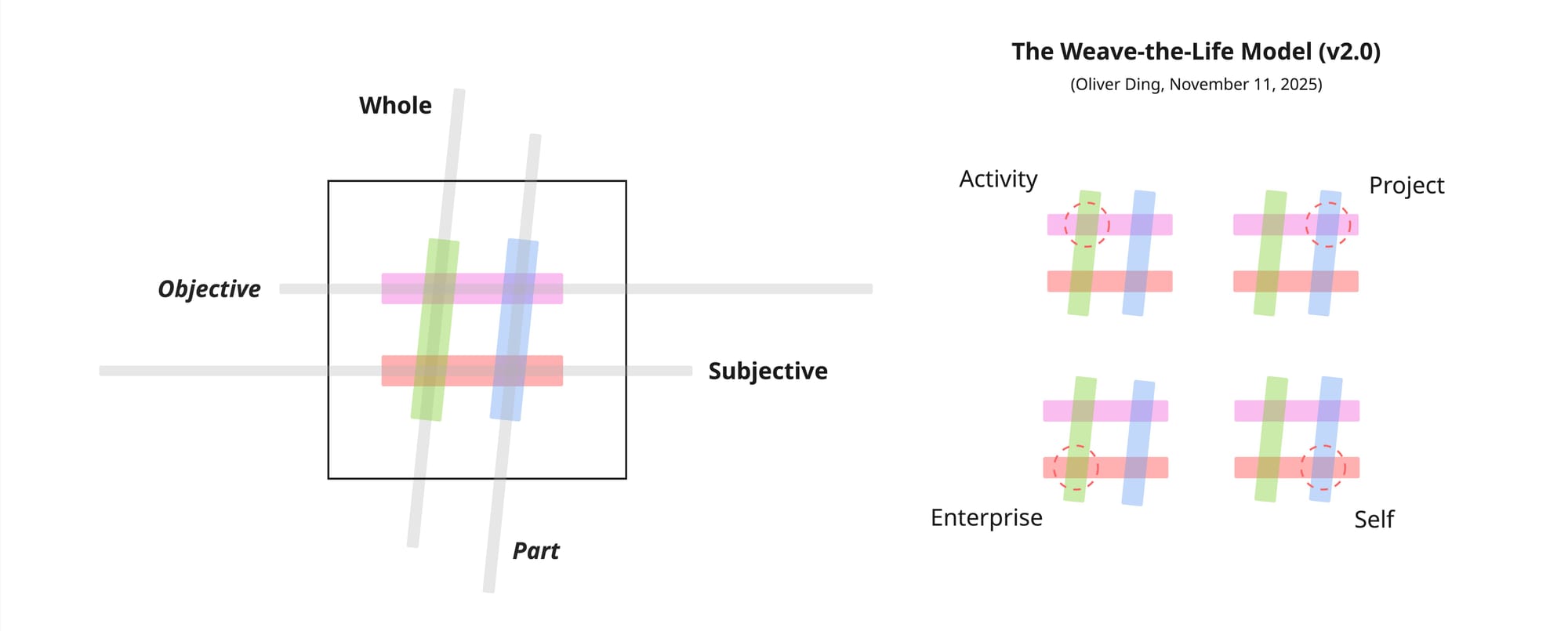
The new model integrates four dimensions: Subjective, Objective, Part, and Whole. The Subjective–Objective dimensions capture diachronic aspects of life, while the Part–Whole dimensions capture synchronic aspects. Together, these dimensions weave individual and collective life within an evolving structural, cultural, and historical landscape.
The model defines four Weave-Points, where one synchronic dimension intersects with one diachronic dimension. Concepts from v1.0 are positioned at these points: Self, Enterprise, Project, and Activity.
- At the Part dimension, the Self–Project connection represents "Project Engagement," where an individual participates in a specific project.
- At the Whole dimension, Activity refers to the aggregation of individual projects, while Enterprise encompasses a series of self-directed actions that extend beyond immediate projects.
The distinction between Subjective and Objective reflects the dual aspects of life: individual experience versus collective existence. The Part–Whole distinction reflects the structural depth of life. These four dimensions are continuously interwoven in lived experience, forming the fabric of both personal biography and social reality.
The framework operates bidirectionally. In the forward direction, individual actions crystallize into enterprises that transcend personal will. In the reverse direction, social structures and historical events enter individual life through activities and projects. This bidirectional dynamic illuminates both individual agency and structural constraints, demonstrating how otherness—aspects of social reality beyond immediate intersubjective negotiation—becomes incorporated into personal life.
By incorporating the concept of Enterprise, the Weave-the-Life Framework emphasizes the subjective dimension of social life: a long-term, self-determined trajectory of actions.
1.3 The Life-as-Activity Approach (v3.2)
On November 11, 2025, I launched a knowledge map to present a landscape of the Life-as-Activity approach. It includes 9 knowledge frameworks, 11 book drafts, and one tool.
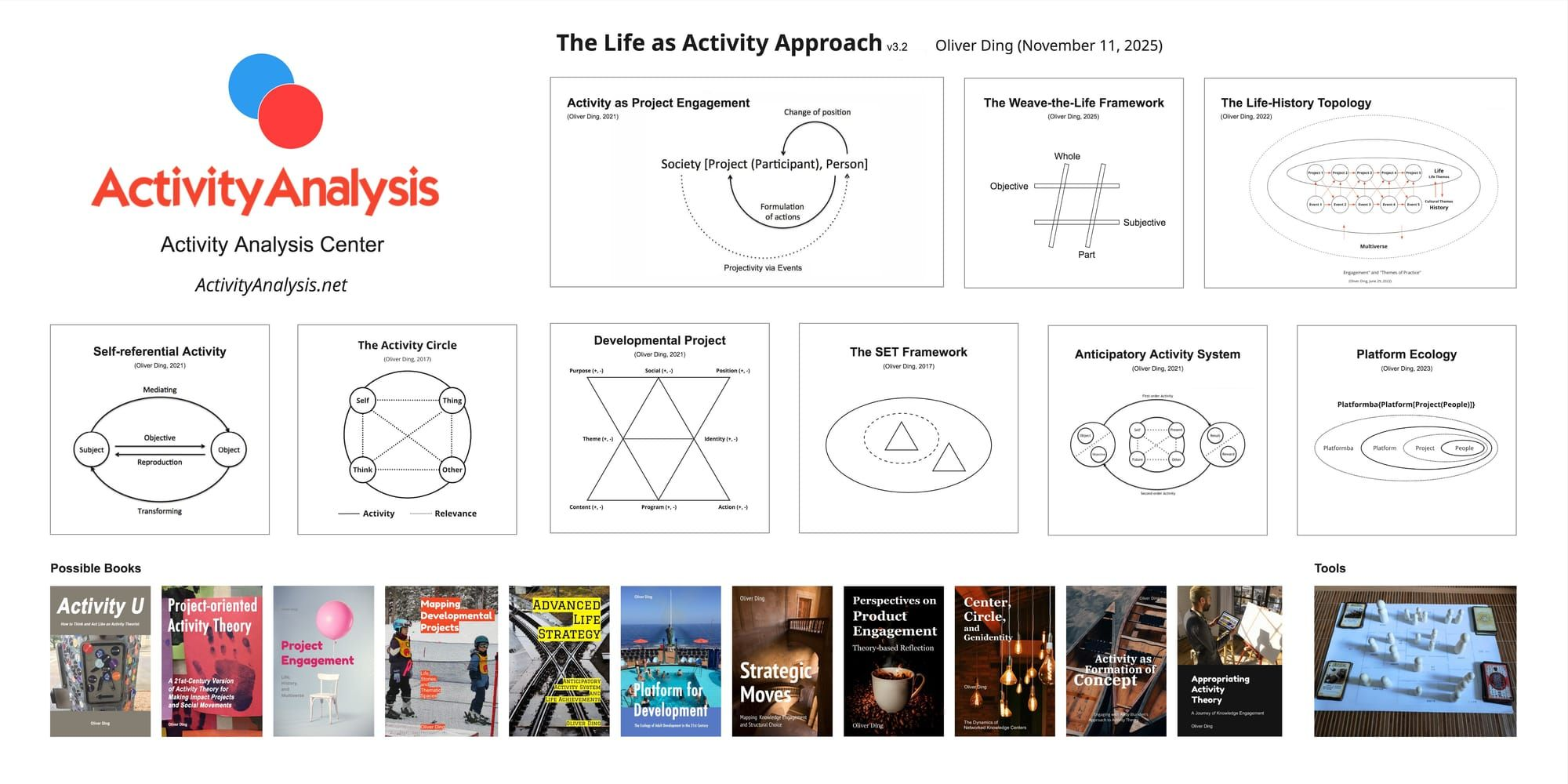
The first three frameworks provide an ontological-level explanation that frames the entire approach.
- The Activity as Project Engagement model offers a theoretical curation that connects Andy Blunden’s approach with Yrjö Engeström’s Activity System Model.
- The Life-History Topology model proposes a way to understand social life, serving as the foundation for individual life development.
- The Weave-the-Life framework bridges Activity as Project Engagement and Life-History Topology, explaining how the former unfolds into the latter.
The other six frameworks function as an epistemological-level toolkit, each approaching a different unit of analysis with a distinct model:
- Individual subject perspective: Self-referential Activity model
- Intersubjective perspective: Activity Circle model
- Project level: Developmental Project model
- Environmental level: SET Framework
- System level: Anticipatory Activity System (AAS) Framework
- Platform level: Platform Ecology model
The eleven featured possible books are drafts rather than published works. They represent the outcomes of my exploration of these frameworks over the past several years.
The one featured tool is the House of Project Engagement—a map, based on the Project Engagement approach (v3.1), developed to support life narrative activity.
More details can be found in The Life as Activity Approach (v3.2, 2025)
1.4 Weave: A Model of the Actor
The following section traces the personal intellectual journey that led to the reconceptualization of “Weave” as a model of the actor — a shift that ultimately demanded a new diagrammatic language beyond the 2×2 structure.
As the intermediate layer between the Activity as Project Engagement model and the Life-History Topology model, the Weave-the-Life framework plays a significant role in the Life-as-Activity approach. Although it is the newest member of the approach, it marks an important milestone because it enables the micro–meso–macro connection.
More importantly, the model draws a clear distinction between researchers and actors. While traditional Activity Theorists study activity as an object of analysis from the researcher’s perspective, the concept of Enterprise re-centers the actor’s own perspective, restoring subjective experience to the person living it.
In the Weave-the-Life model, an Enterprise can be pictured as a chain — an ongoing sequence of endeavors that unfolds over time — while an Activity can be seen as a node within that chain, a self-contained system of coordinated actions. This metaphor highlights how Enterprise foregrounds temporal unfolding (the diachronic), whereas Activity foregrounds systemic organization at a given moment (the synchronic). Thus, while Activity Theory provides a structural snapshot of mediated action, the notion of Enterprise restores the temporal and experiential flow of human endeavor.
After November 2025, the concept of “Weave” became a significant theme in my creative journey. In March 2026, while working on the Anticipatory Cultural Sociology (ACS) project, I developed a diagram that turned out to be far more than I had intended. The diagram was part of the larger ACS v1.2 picture.
Looking at it, an unexpected recognition surfaced. The phrase “model of the actor” came to mind — a term I had first encountered in 2023.
That year, I was reading a collection of discussions by theoretical sociologist Lui Ping-keung and his younger colleagues. I read these texts on weekend mornings, sitting at the sidelines of a football field while my son practiced with his team. In those recorded conversations about the development of theoretical sociology, “model of the actor” appeared repeatedly — a meta-analytical tool for comparing social theories, revealing what each theory implicitly assumes about human beings without necessarily declaring it. Every social theory, in their view, carries an implicit model of the actor at its core.
At that time, I considered Lui’s more than twenty years of theoretical sociology work as a case of Creative Life Theory. I noted the concept, and then I moved on. Other work followed.
Now, more than two years later, looking at the ACS v1.2 diagram, the concept returned. And with it, a recognition: the three-dimensional, five-ring coordinate I had been building — not as a portrait of the person, but as a map of cultural development — had quietly become exactly that. A model of the actor.
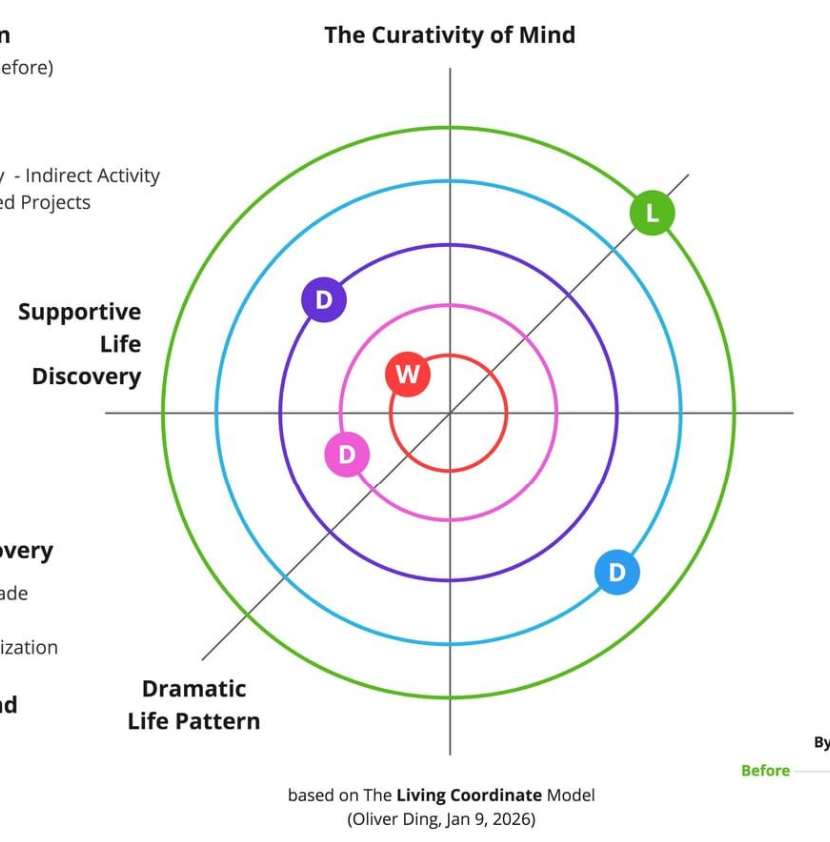
On April 8, 2026, I detached the model from the ACS project and attached it to the Strategic Developmental Psychology (SDP) project. It now appears as five rings of the SDP Living Coordinate.
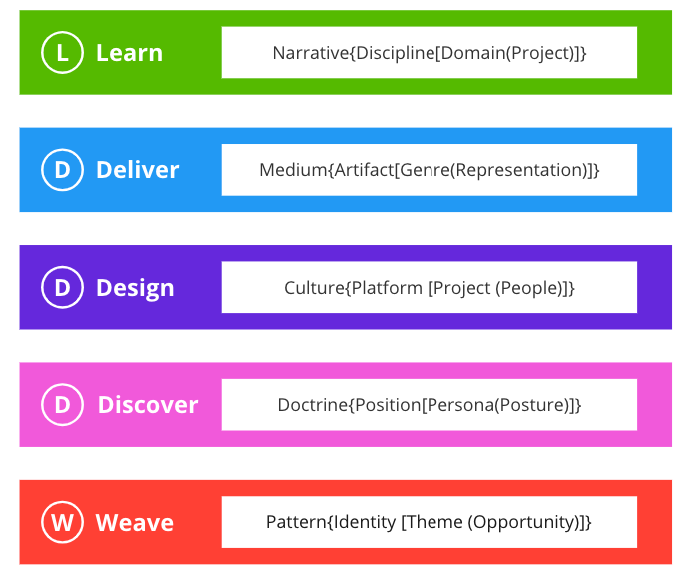
These five rings - Weave, Discover, Design, Deliver, Learn — describe the five fundamental orientations through which an individual engages with the world and with their own development. They represent the fundamental modes through which an actor develops: from the innermost integrative action (Weave) to the outermost receptive orientation (Learn).
Weave is the innermost ring; it names the integrative action that holds everything together: real practice is never single-mode. A cultural actor always simultaneously discovers, designs, delivers, and learns — and the action that holds these together, that weaves them into a coherent practice, is Weave. Its position at the center is its meaning.
Learn marks the condition of possibility for all the other orientations: an actor who cannot learn cannot act. Knowledge and skill are the necessary antecedents of every cultural engagement. Its position in the diagram — the outermost ring, green — reflects this: it is where the world enters the actor, the interface between an actor’s interiority and the surrounding cultural resources.
Between them, Discover, Design, and Deliver describe the cycle of creative engagement. This cycle was developed in Design-oriented Project Engagement (February 2026) as an operational framework for Anticipatory Cultural Sociology.
An important distinction governs the five rings. Weave and Learn apply to all people — they are two universal orientations that describe how any person develops, connecting naturally to the existing literature in positive psychology, motivational psychology, action psychology, developmental psychology, and educational psychology. The Discover–Design–Deliver model, however, is more specifically oriented toward cultural creators — those whose development is organized around the creation of new thematic enterprises. SDP’s core concern is with this latter type of actor, but its foundations in the Weave–Learn orientations give it relevance to the broader human condition.
On April 21, 2026, I revisited the Weave-the-Life Framework (v2.0) and realized that I should incorporate the concept of “Weave” as a model of the actor into the framework. However, the 2×2 Weave diagram was no longer enough. What was missing was a structure capable of holding multiple dimensions of the actor simultaneously — not just the intersection of two axes, but a richer field of orientations that a cultural actor moves through. This recognition sent me back to the drawing board.
Part 2. The Weave-the-Life Framework (v3.0)
In April 2026, while working on the Weave 42 project, I developed a new version of the Weave Basic Form — a 4×4 edition that I call the Weave 16 diagram. Based on this new diagram, I built the Weave-the-Life Framework (v3.0) and used it to curate 16 key concepts of the Life-as-Activity Approach.
2.1 The Diagram at a Glance
The original Weave Basic Form was a 2×2 model: the synthesis of two diachronic dimensions and two synchronic dimensions, yielding four Weave Points. The 4×4 edition expands both axes from two to four, increasing the Weave Points from four to sixteen.
The diagram below presents the Weave-the-Life Model (v3.0) in full. The original v2.0 structure remains intact at the center; the entire model has grown outward into a larger Weave Diagram.
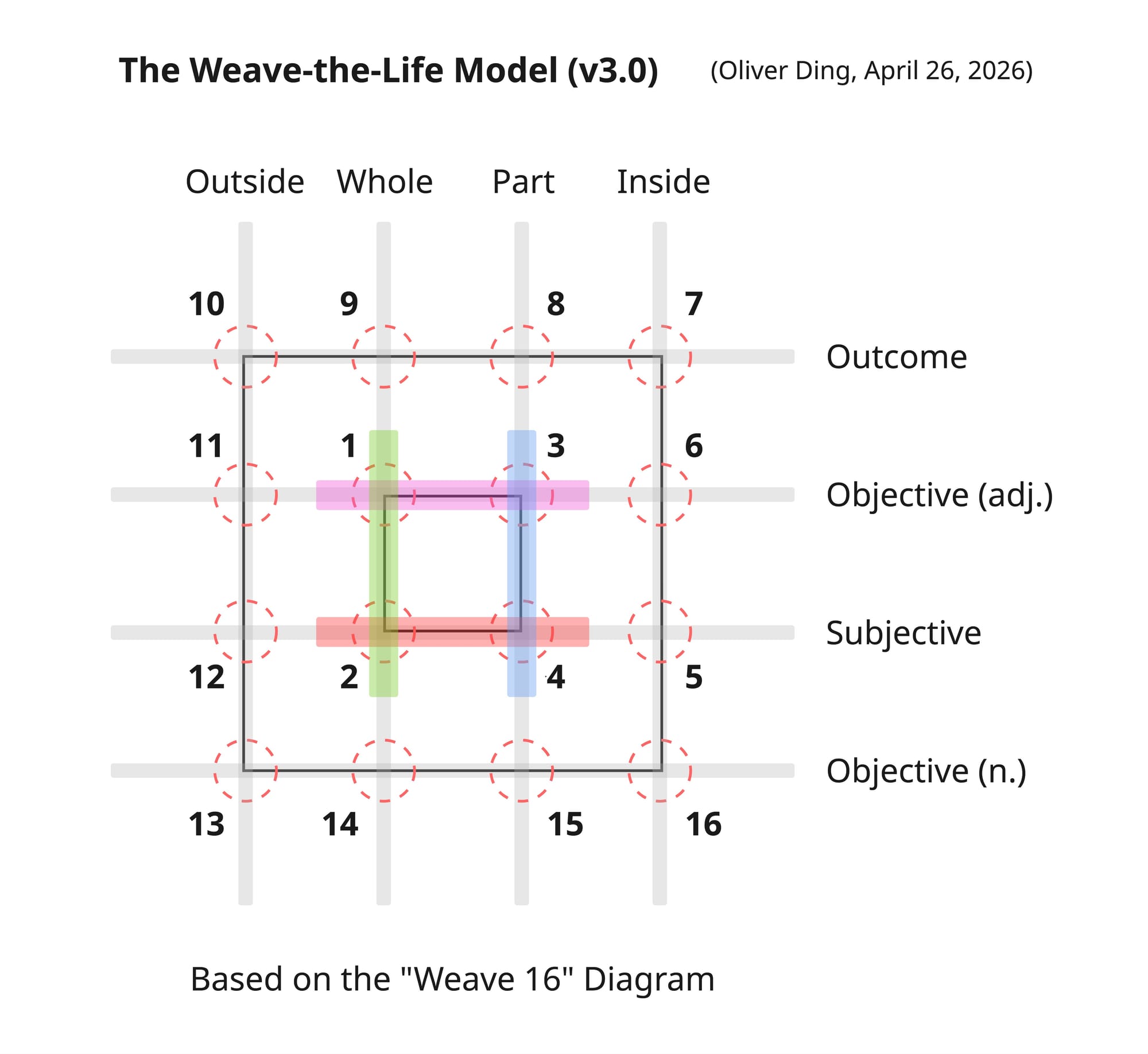
The four diachronic dimensions and four synchronic dimensions draw inspiration from four pairs of concepts — some rooted in traditional Activity Theory, others emerging from my own explorations.
- Whole - Part: Although traditional Activity Theory does not foreground this pair explicitly, it surfaces in many of its models — the hierarchical structure of Operation-Action-Activity, the Activity System model, and others.
- Inside - Outside: The principle of internalization–externalization is central to Activity Theory. Building on it, the “Activity as Project Engagement” principle introduces the “Outside — Projecting — Inside” triad — a basic ecological form that describes how people engage with social environments through a cyclical movement between person and project. These social moves echo the mental moves of internalization–externalization, linking changes in social action with changes in psychological process.
- Objective (n.) - Outcome: The concept of “Object” and the Object-Orientedness Principle are foundations of Activity Theory. In 2021, while developing the Anticipatory Activity System (AAS) framework, I began distinguishing Objective (what is motive about, oriented toward the future) from Object (what is acted on, anchored in the present). This distinction receives its own structural space in the new diagram.
- Subjective - Objective (adj.): Introduced in the the Weave-the-Life model (v2.0), this pair captures diachronic aspects of life — individual experience and Enterprise versus collective existence and Activity. It re-centers the actor's own perspective, restoring subjective experience to the person living it.
Based on these conceptual resources, the vertical axis of the v3.0 model is labeled Outcome, Objective (adj.), Subjective, and Objective (n.). The double use of “Objective” is theoretically deliberate. Objective (adj.) refers to observable activity processes and the social landscape, while Objective (n.) points to the future-oriented, motive-laden dimension of activity — the anticipatory horizon. The horizontal axis is labeled Outside, Whole, Part, and Inside. Together, these four columns trace a continuum from macro-level social objects to micro-level individual subjects:
- Outside corresponds to the Life-History Topology level, encompassing culture and history.
- Whole corresponds to the Anticipatory Activity System level, encompassing enterprise and activity.
- Part corresponds to the Project Engagement level, encompassing project and event.
- Inside corresponds to the subject — the individual’s psychology and immediate situation.
A subtle but significant transformation occurs here. Traditional Activity Theory’s subject–object relation is reconfigured as a self–world continuum, anchored at the two extremes of Inside and Outside.
2.2 The Center Holds: v2.0 as the Core Engine
Before examining the new dimensions, it is essential to see what remains at the center.
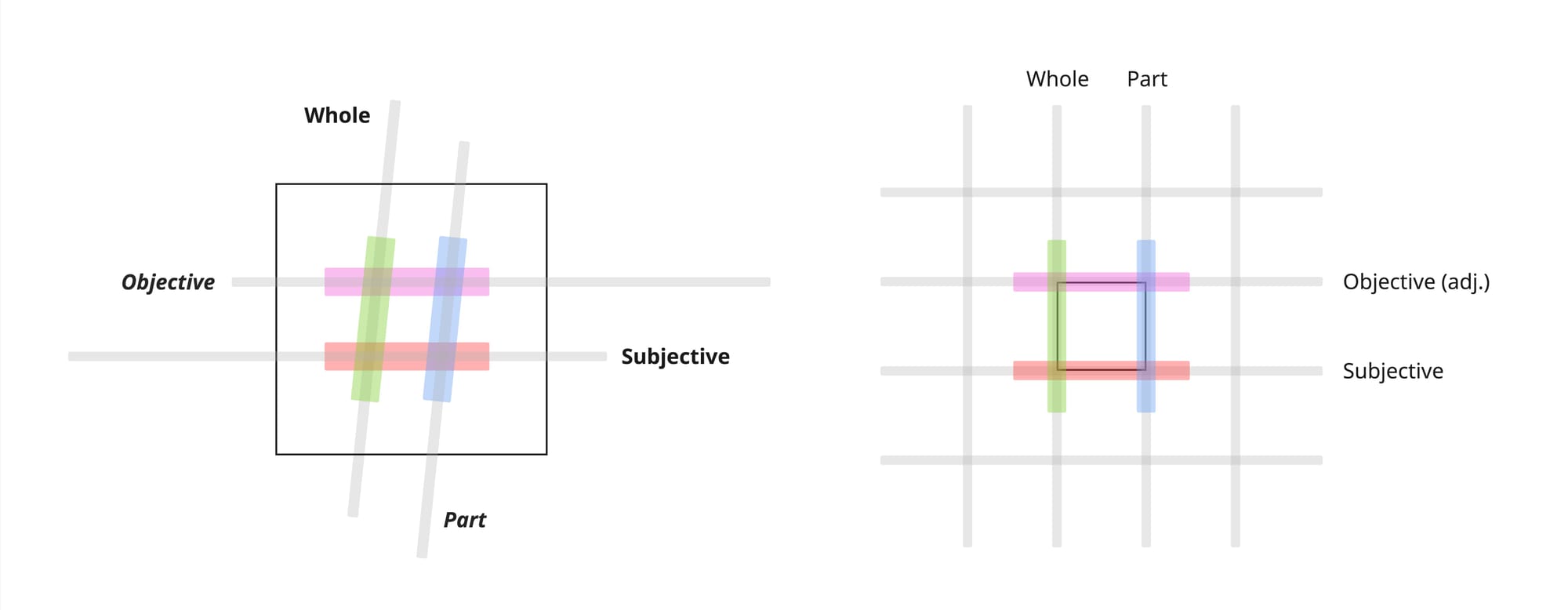
The four original dimensions — Whole, Part, Subjective, and Objective (adj.) — are not abandoned in v3.0. They remain at the spatial center of the new diagram, exactly where they were in the Weave-the-Life v2.0 model. The new dimensions — Outcome and Objective (n.) on the vertical axis, Outside and Inside on the horizontal — are added around them. The result is a structure of two nested squares: the inner 2×2 square preserves the original v2.0 model intact, while the outer 4×4 square expands the conceptual field.
This spatial expansion resolves a conceptual hesitation that had lingered since v2.0. The original model defined four Weave Points, but I had long debated whether the fourth point should be Event or Self. Both were essential, yet the 2×2 structure could only hold four concepts at the core. In v3.0, the additional space dissolves this tension naturally. Event now joins Activity, Enterprise, and Project in the inner square, forming a coherent fourfold core at the Part and Whole levels. Self moves outward to the Inside column, where it gains its own structural position — no longer competing for space, but anchoring the subjective interior of the actor. What was once a forced choice becomes, in the larger diagram, a clarified architecture.
2.3 The Diachronic Expansion: Objective (n.) and Outcome
The vertical axis of the v3.0 diagram expands the original diachronic distinction — Subjective versus Objective (adj.) — into four rows. Two new dimensions enter: Objective (n.) below and Outcome above.
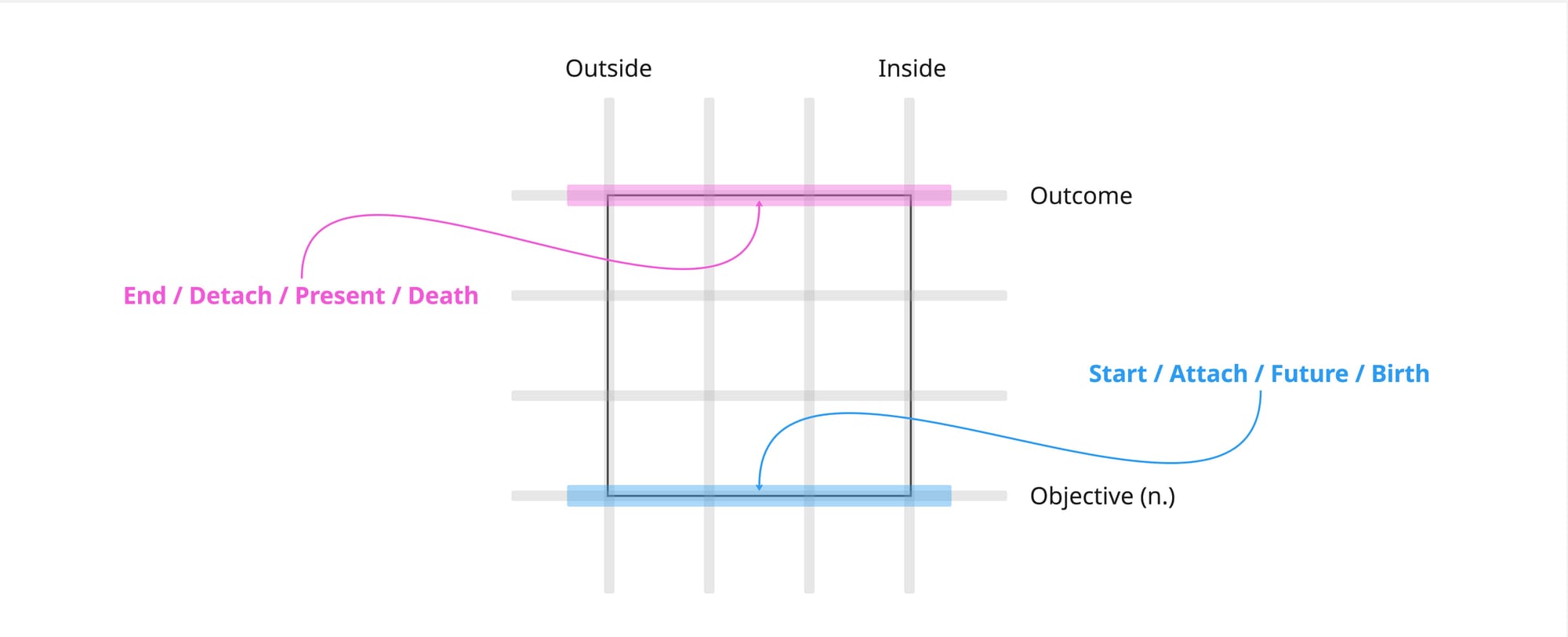
This expansion addresses a tension that has long run through Activity Theory. The concept of Object is foundational — human activity is always directed at something. But that “something” carries a double weight. It is both what is acted on in the present and what is motive about — the future-oriented reason for acting. In 2021, while developing the Anticipatory Activity System framework, I began using two terms to separate these meanings: Object for the present target of action, Objective for the future-oriented motive. The v3.0 diagram gives this distinction its own structural space.
The bottom row, Objective (n.), opens a thematic space around beginnings and forward movement: start, attach, future, birth, anticipation, aspiration. This is the space of motive — the horizon that pulls the actor forward and images of what is not yet but could be. It gathers concepts that traditional Activity Theory often compresses into the single term “object,” unpacking them into a dedicated region where the future-orientedness of human activity can be examined in its own right. Here, Concept represents Andy Blunden's principle of "Activity as Formation of Concept" — the process by which a shared, objective idea crystallizes through a project, enters the public world, and becomes a durable resource for guiding future collective action.
The top row, Outcome, opens a thematic space around endings and residues: end, detach, present, death, result, consequence. This is the space of what activity leaves behind — the traces that persist after action concludes, whether intended results, unintended by-products, or systemic rewards. Elevating Outcome to its own row separates the process of activity from its consequences, allowing the model to support cost–benefit analysis, value assessment, and the tracing of real-world effects.
2.4 The Synchronic Expansion: Inside and Outside
The horizontal axis expands the original synchronic distinction — Part versus Whole — into four columns. Two new dimensions enter: Outside on the left and Inside on the right.
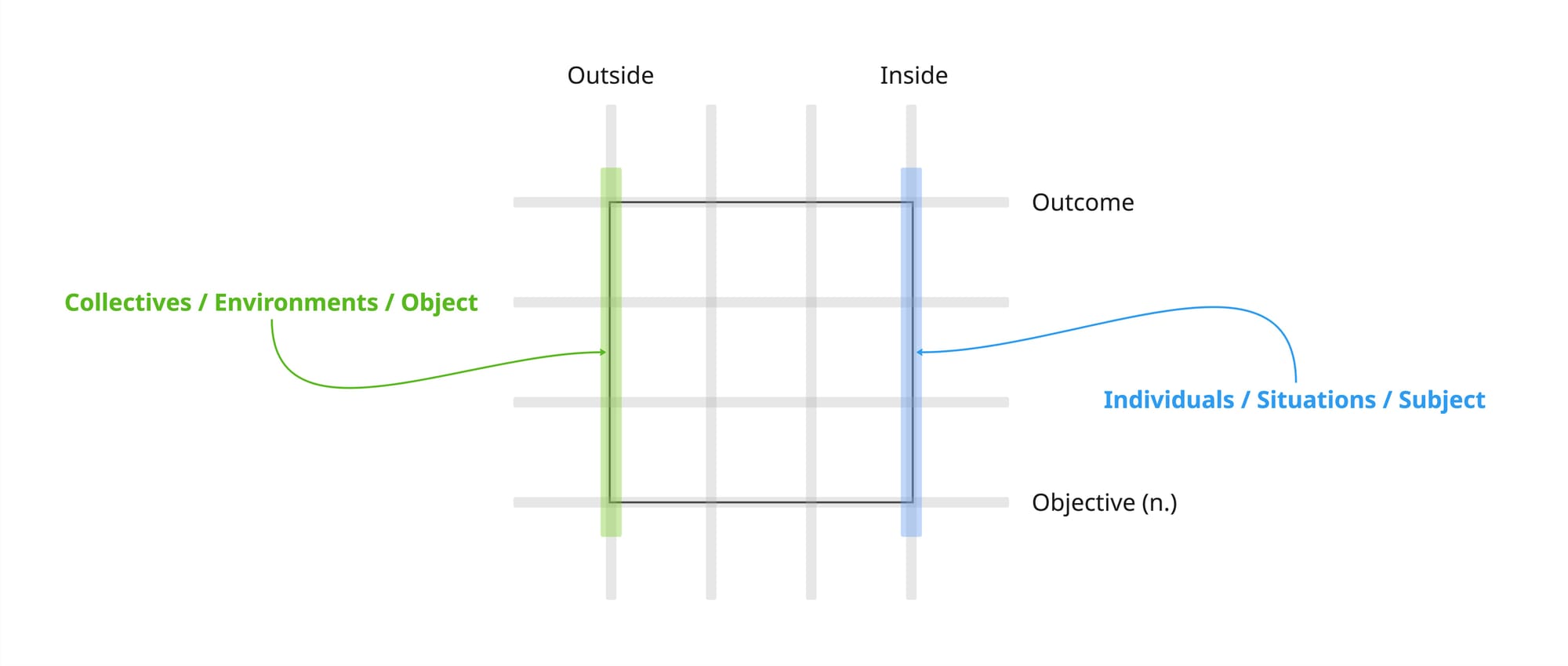
This expansion addresses a central challenge in the Life-as-Activity framework: resolving the inside–outside dualism of social space. Traditional Activity Theory has a principle for this movement — internalization and externalization, the mental traffic between inner psychological processes and outer social reality. The “Activity as Project Engagement” principle builds on this, introducing the Outside–Projecting–Inside triad: a basic ecological form that describes how people move cyclically between themselves and the projects that serve as their social environments.
The leftmost column, Outside, opens a thematic space around collectives, environments, objects, concepts, culture, history, and macro-level structures. This is the space of the Life-History Topology — where social reality confronts the actor as a pre-existing landscape, shaped by forces beyond any single individual. Here, at the intersection with the Objective (n.) row, Concept names the point where shared, objectified ideas take on an enduring public form — becoming part of the very landscape that successive actors will encounter as their historical and cultural inheritance.
The rightmost column, Inside, opens a thematic space around individuals, situations, subjects, self, motivation, psychological processes, and the person's immediate situation. This is the space that traditional Activity Theory often underplays — the subjective interior that registers, interprets, and responds to the world. By giving Inside its own column, the diagram restores individual psychological space to the structure, remedying a long-standing gap.
Part 3: Key Concepts and Thematic Spaces
16 weave-points become a map to curate key concepts from the Life-as-Activity approach.
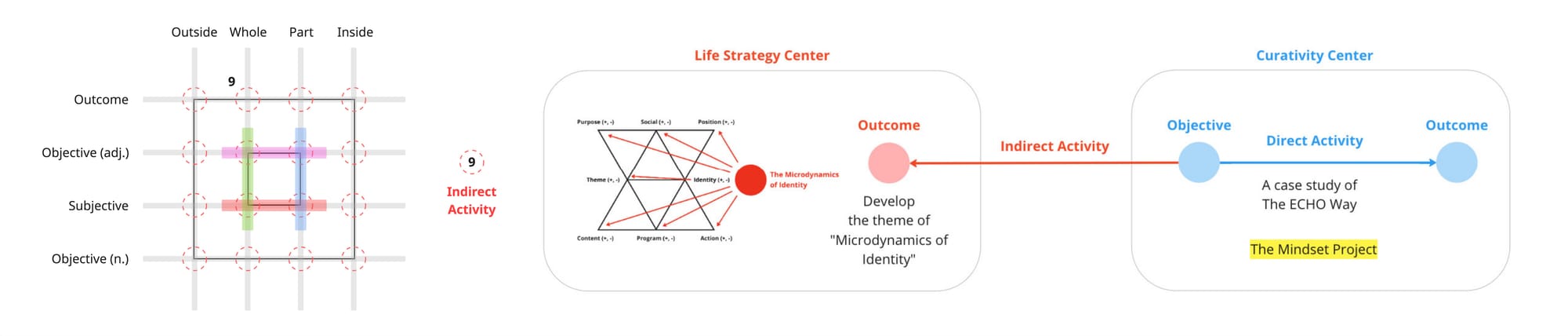
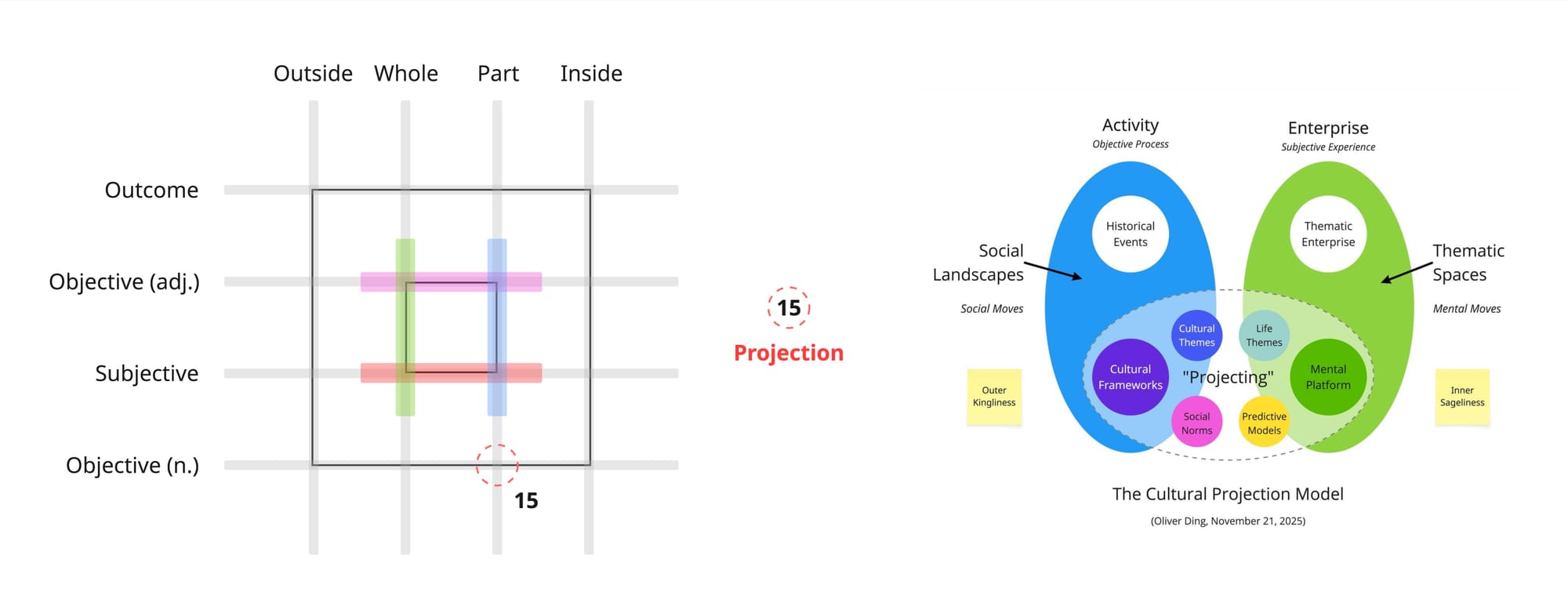
The diagram below shows 16 key concepts — Activity, Enterprise, Event, Project at the core; History, Culture, Concept, Anticipation, Projection, Motivation, Self, Other, Result, By-product, Indirect Activity, Reward in the surrounding positions — are not merely listed but spatially organized. Their positions in the matrix reflect theoretical relationships: objective process versus subjective experience, part versus whole, inside versus outside. The model does not describe these relationships in words; it makes them visible as structure.
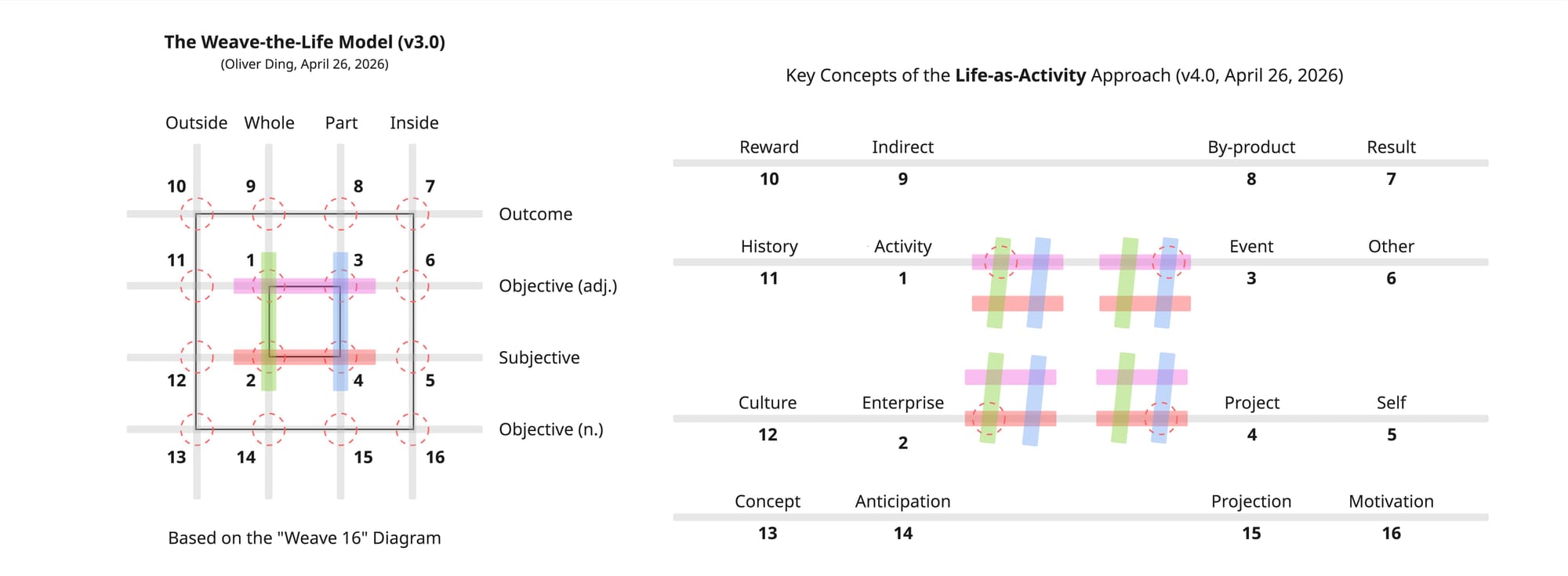
The 16 Weave Points on the v3.0 diagram can hold 16 key concepts — but that is only the surface. A single concept, placed at a coordinate, can only carry so much meaning by itself. The Life-as-Activity approach, however, is a large knowledge system. It contains not only concepts but also frameworks, diagrams, tools, case studies, and book drafts — an entire landscape of creative work accumulated over years. To make the Weave 16 diagram capable of curating such a system, something more than a grid of labels is needed.
This is where Thematic Space Theory enters.
3.1 From Weave-points to Thematic Spaces
Thematic Space Theory treats any concept or term not as a fixed definition but as the name of a dynamically developing cognitive container. Around this name, neighboring terms and related concepts gather naturally — through semantic affinity, shared concerns, or practical association — and together they delineate the character of that container. An individual practitioner places cognitive artifacts — insights, frameworks, cases, tools — into this container over time, building it out through sustained creative work.
Applied to the Weave-the-Life Framework (v3.0), this means that each of the 16 key concepts acquires a second function. Beyond naming a theoretical idea, it becomes the activator of a thematic space. The concept placed there — Self, Project, Projection, Enterprise — names the container and marks its location on the map. But what lives inside that container is far more than a single term. A thematic space may hold multiple frameworks, a series of diagrams, documented case studies, connections to other traditions of thought, and the personal history of how the concept developed over years of work.
This is why the Weave 16 diagram is not a classification system. It is a curatorial map. The 16 Weave Points organize the territory; the thematic spaces populate it. A reader who encounters "Project" at the intersection of Part and Objective (adj.) is not being told a definition. They are being shown a door. What lies beyond it is the entire body of work — frameworks, models, theoretical concepts, book drafts, and diagrams — developed over years across multiple versions of Project Engagement (v1.0 through v4.0). These are core members of the Life-as-Activity approach, gathered around the question of how individuals enter, sustain, and move through specific undertakings. The concept is the name; the thematic space is what the name has gathered.
In short, the reader is invited not to be confined by the definitional content of each concept. The concepts are here to open doors. Each coordinate on the diagram is a portal, and what lies beyond it is a thematic space — a living region of inquiry within the larger Life-as-Activity knowledge system.
The following sections demonstrate three ways these containers are activated. An individual concept opens its own thematic space (3.3). A pair of concepts, brought together, generates a new container that neither could hold alone (3.4). A group — several concepts gathered by thematic affinity rather than geometric proximity — forms a larger container with its own integrative logic (3.5). In each case, a specific diagram accompanies the demonstration, showing the thematic space in visual form.
3.2 Individual Concepts: Three Portals into the Core Engine
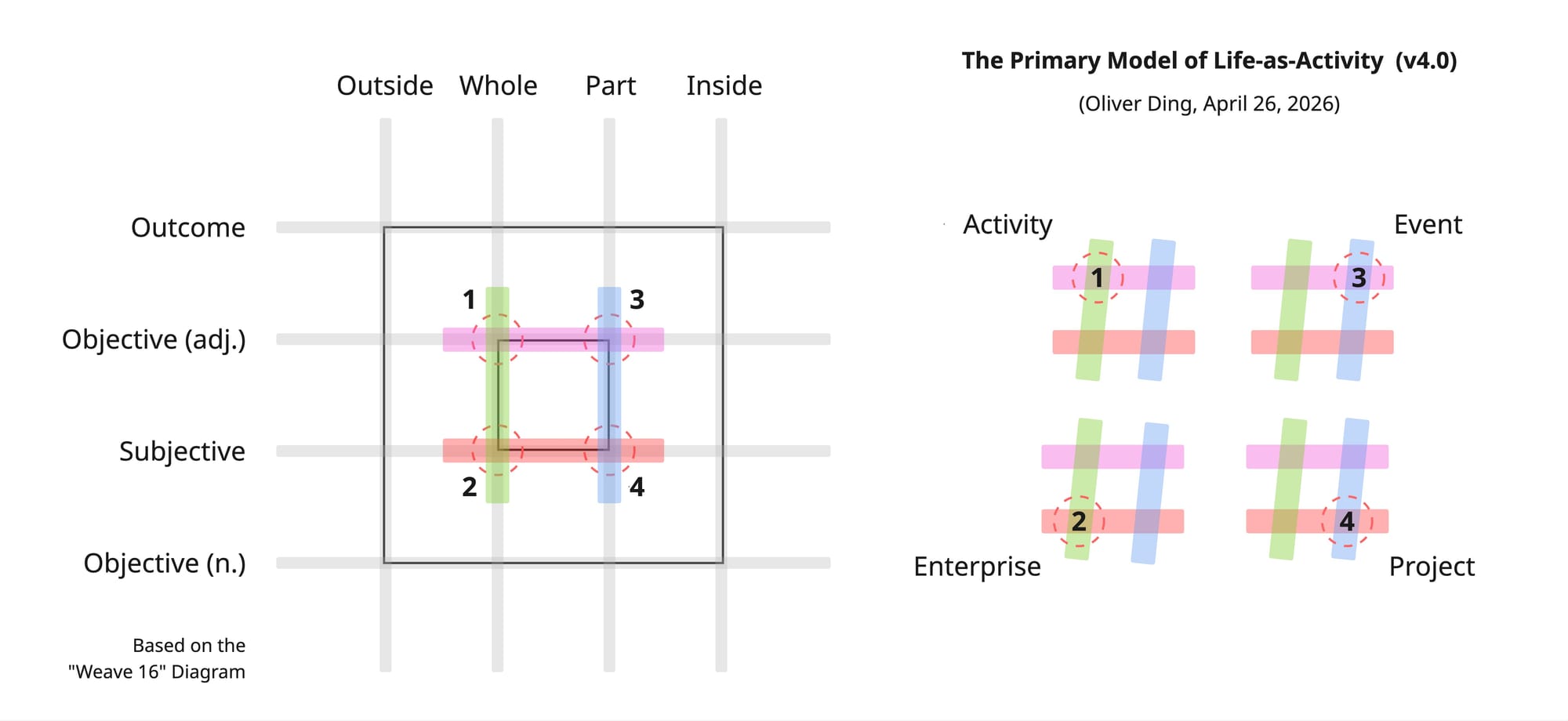
We begin with the core engine — the inner 2×2 square where Activity, Enterprise, Project, and Event reside at the intersection of Whole–Part and Subjective–Objective (adj.). In the Activity Theory tradition, understanding the complexity of activity often calls for hierarchical models, though each scholar configures the levels differently.
The Life-as-Activity approach adopts an AAS–Project–Action hierarchy: a series of related actions composes a project; the abstracted, systemic form of projects is activity; and at a higher organizational level, the Anticipatory Activity System (AAS) framework connects multiple projects into a future-oriented, self-referential system.
The three demonstrations below open the thematic spaces of Activity, Enterprise, and Project. Each follows the same structure: a diagram highlights the coordinate on the Weave 16 map, and a companion framework diagram reveals the cognitive container that the concept names.
Case #1 - Activity
Position: Whole × Objective (adj.)
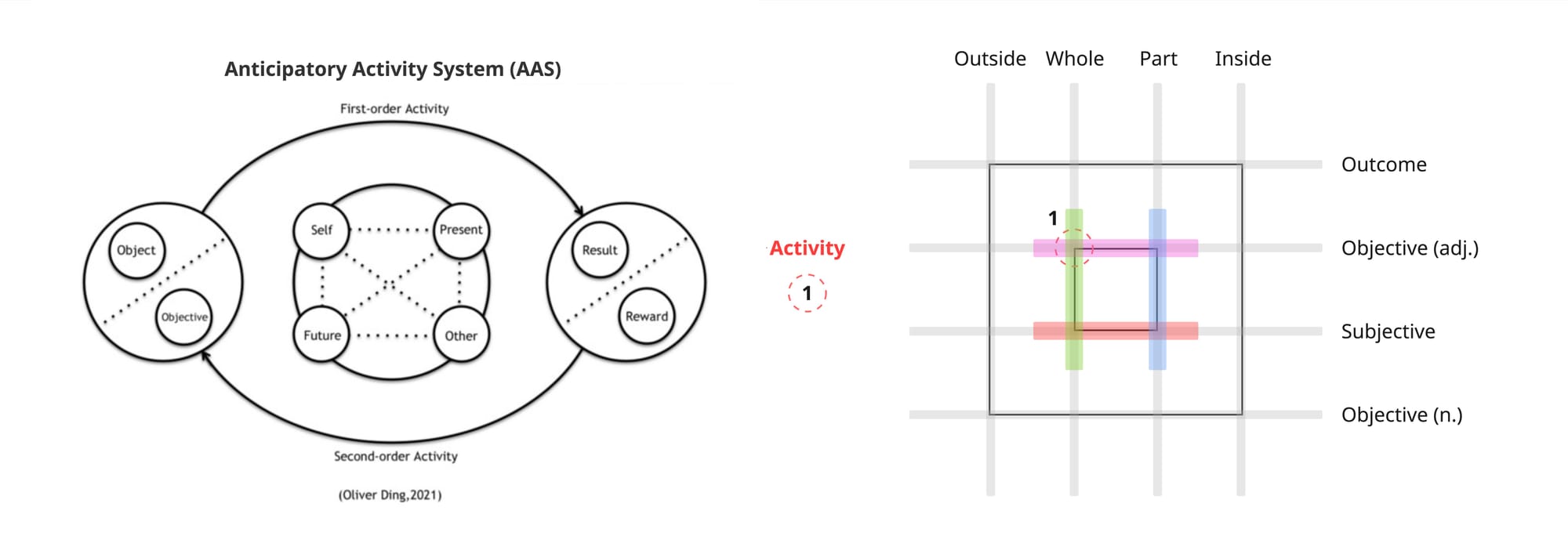
Activity sits at the intersection of the Whole column and the Objective (adj.) row — the macro-level of collective, observable action. This coordinate names a thematic space that has been built by generations of Activity Theorists: each scholar proposes a different model to define activity as a concept and to operationalize it for research, and the concept is typically located at a level more abstract than action.
Within the Life-as-Activity approach, the diagram highlights the Anticipatory Activity System (AAS) framework as the knowledge model occupying this abstract position. Readers may also consult other articles for models of activity developed by other scholars. See the AAS framework for further details.
Case #2 — Enterprise
Position: Whole × Subjective
Enterprise occupies the Whole column and the Subjective row — the macro-level of personal, long-term trajectory. This concept has no direct counterpart in traditional Activity Theory. While Activity Theory studies activity as an object of analysis from the researcher's perspective, Enterprise re-centers the actor's own experience: the sustained, self-determined line of endeavor as lived from the inside.
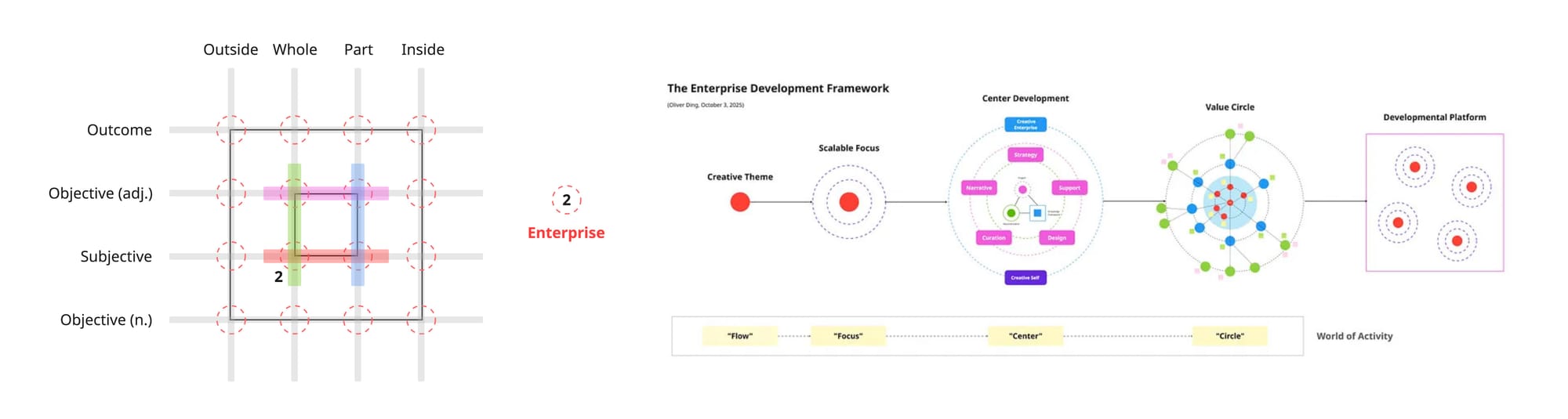
Enterprise does not stand alone in the diagram. It forms a pair with Activity — the same structural pairing that operates at the Part level between Event and Project, but enlarged to the Whole. At the Part level, one person's lived project is another person's observed event, and these two perspectives are bound together by the act of projecting. At the Whole level, the same mechanism applies: one actor's sustained enterprise is, for an observer, a collective activity — and the same projecting dynamic bridges the two.
This pairing mechanism is at the core of the Cultural Projection Model (2025). There, three containers work together: Container X holds Activity as objective process and social moves between social landscapes; Container Y holds Enterprise as subjective experience and mental moves between thematic spaces; Container Z — Projecting — holds the movement between the outside and inside of a project, connecting X and Y into a single dynamic. Enterprise thus activates a thematic space populated not only by the Enterprise Development framework but also by the entire architecture of the Cultural Projection Model. See the Cultural Projection Model (2025) for further details.
The highlighted model on the diagram, Enterprise Development, is a five-phase developmental model that outlines an idealized trajectory of a thematic enterprise: from Creative Theme, through Scalable Focus, Center Development, and Value Circle, to Developmental Platform. See the Bloom of Enterprise for further details.
Case #3 — Project
Position: Part × Subjective
Project sits at the Part level — the meso-level of specific undertakings — crossed with the Subjective row, anchoring the actor's personal experience of engagement. This coordinate names a thematic space rooted in Andy Blunden's notion of "Project as a Unit of Activity."
Building on this foundation, the Life-as-Activity approach has developed the Project Engagement approach across multiple versions, treating the project as the pivotal middle level where actions cohere into meaningful units and where individual lives intersect with social structures.
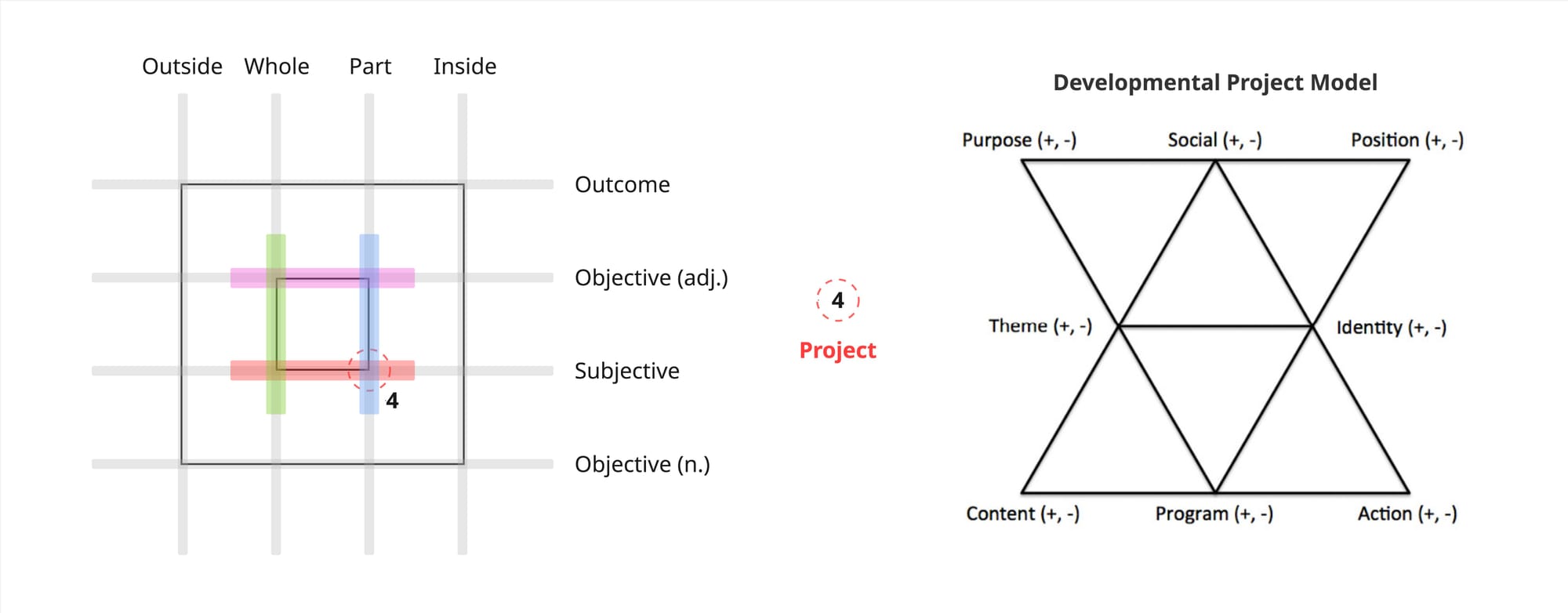
The highlighted model on the diagram, the Developmental Project Model, identifies eight elements — Purpose, Position, Program, Social, Content, Action, Theme, and Identity — that together describe how a project functions as a site of personal development. See the Developmental Project Model for further details.
3.3 Pair: Two Concepts, One Container
When two concepts on the diagram are brought together, they activate a thematic space that neither could hold alone. The pair forms a new container defined not by the sum of two definitions but by the relationship between them. What follows are two demonstrations of this pairing logic.
Case #4 —Event + Project
Position: Part × Objective (adj.) + Part × Subjective
Event and Project sit side by side in the Part column, separated by the same Subjective–Objective (adj.) boundary that divides Enterprise from Activity one level above. They form the most fundamental pair in the Life-as-Activity approach — the one from which the entire Projecting principle is derived.
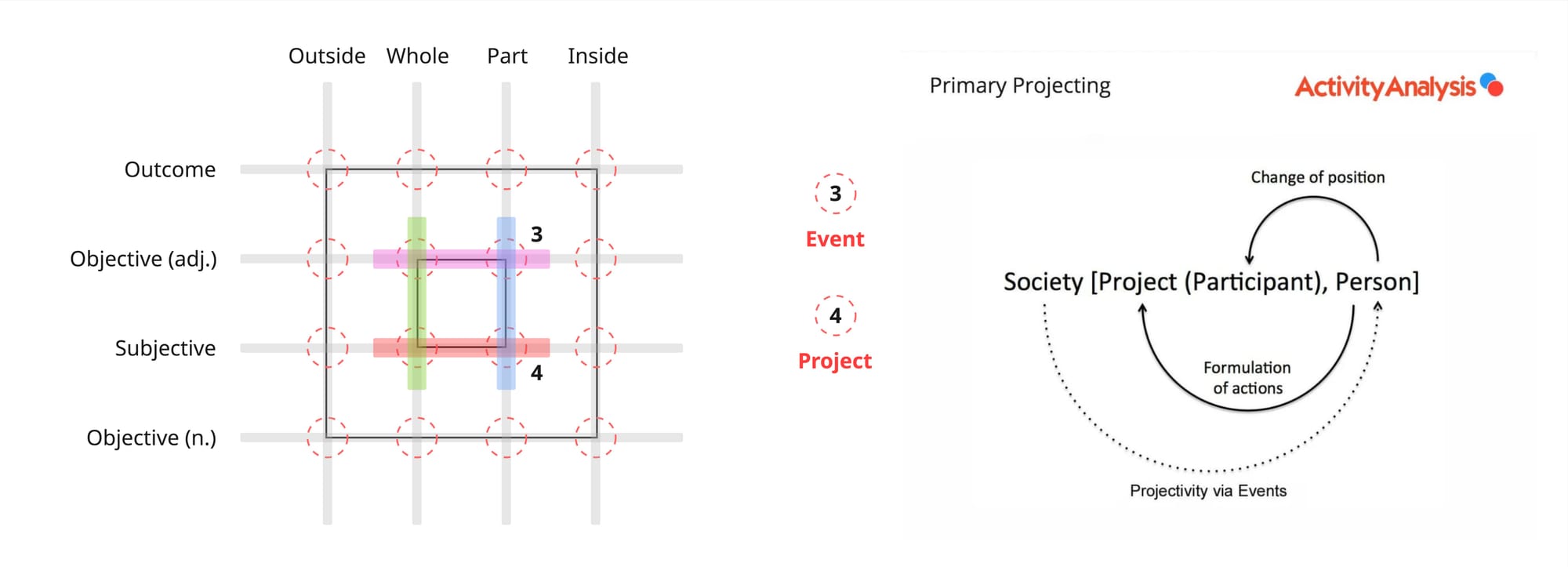
The distinction between Event and Project is not a distinction between two kinds of things. It is a distinction between two positions relative to action. When a person perceives a change in the social environment and remains outside it, that change registers as an Event. When the same person acts to enter that change — to participate, to shape, to commit — it becomes a Project. Event and Project are the same social occurrence viewed from outside and from inside, respectively.
What bridges these two positions is Projecting. The Primary Projecting diagram makes this visible as a spatial logic: a person perceives a potential action opportunity — a Projectivity — offered by the social environment through the sense-maker of an Event. The person then actualizes that Projectivity by formulating actions, moving from the outside space to the inside space, and in doing so, initiates a new Project. Event names the condition before projecting; Project names the condition after. The same dynamic repeats in Secondary Projecting (joining an existing project, the movement from outside to inside) and Tertiary Projecting (leaving one project to initiate another, inspired by its themes).
This pairing mechanism is the basic ecological form — the Outside–Projecting–Inside triad — that the Activity as Project Engagement principle introduces to expand Activity Theory's internalization–externalization cycle. Event and Project thus activate a thematic space that holds not only the two concepts themselves, but the entire Projectivity framework: Primary, Secondary, and Tertiary Projecting; the sense-makers of Event, Identity, and Theme; and the spatial logic that connects social observation to personal engagement. See the Concept of Projectivity for further details.
Case #5 —Self + Other
Position: Inside × Subjective + Inside × Objective (adj.)
Self and Other sit side by side in the Inside column, separated by the Subjective–Objective (adj.) boundary. At first glance, placing Other in the Inside column may seem counterintuitive. But Inside, in the v3.0 diagram, is defined as the micro-level of individual situations — the immediate context of a person's lived experience. And the most immediate element of any person's situation is the concrete other: the specific person one faces, talks to, works with, or encounters. Other is not an abstract social structure; it is a presence within the actor's lifeworld. This is why Other belongs to Inside.
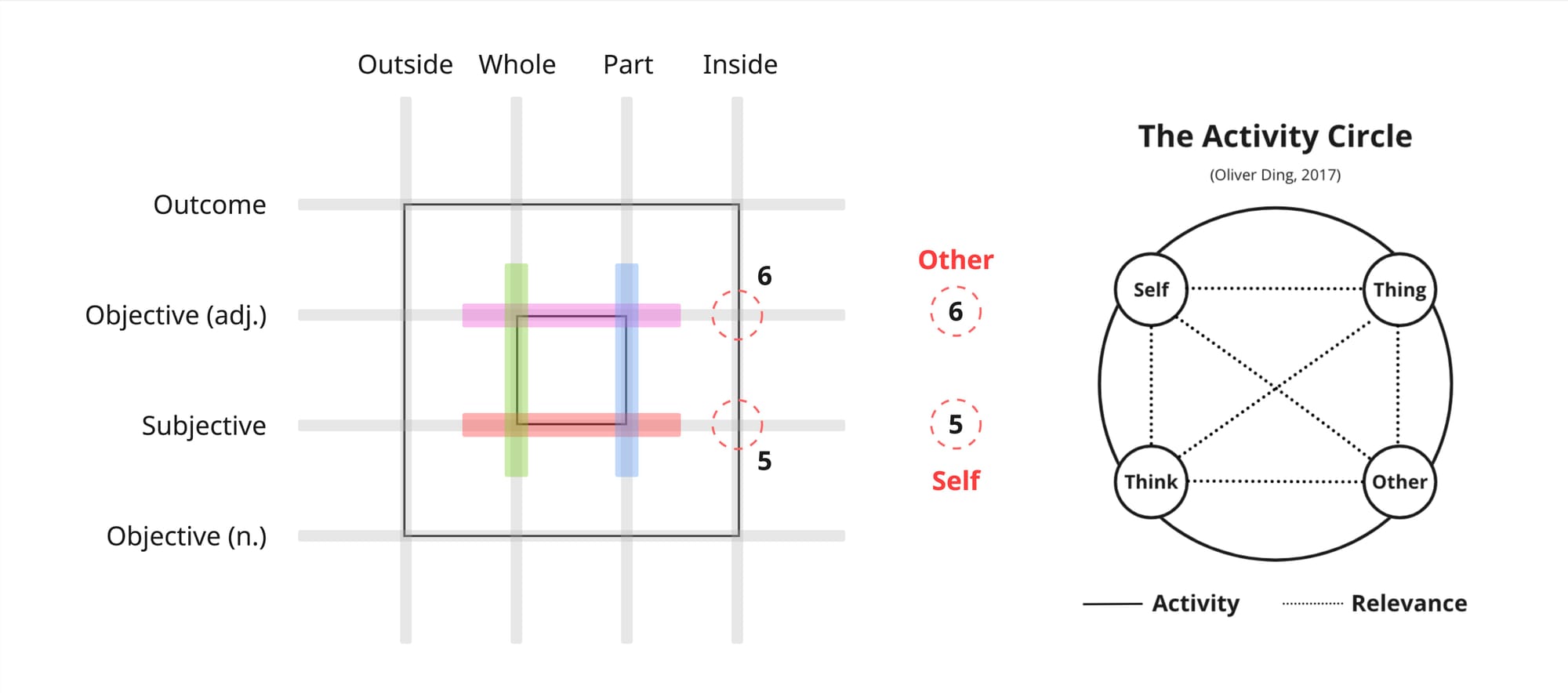
The Self–Other pair reaches back to a classic question in the social sciences: the relationship between self and other, individual and alterity, person and society. In the Life-as-Activity approach, this pair is given a specific activity-theoretic grounding. It points to the most elementary form of collaborative activity.
Andy Blunden observes that the prototype of a collaborative project is the two-person collaboration. Building on this insight, and drawing on Vygotsky's distinction between two types of mediating tools (technological and psychological) and his model of the Zone of Proximal Development, the Life-as-Activity approach identifies a basic ecological form: [Self–Other–Thing–Think]. This form is named the Activity Circle.
The same Self–Other pairing generates a second basic form oriented along the temporal axis: [Self–Other–Present–Future]. This form serves as the core kernel of the Anticipatory Activity System (AAS) framework. Here, Self and Other do not only act together in the present; they orient their shared activity toward an anticipated future. The AAS framework models how two actors — or, at a larger scale, two social groups — coordinate present action through shared expectations about what is to come.
Together, these two basic forms — one synchronic and tool-mediated, the other diachronic and future-oriented — constitute the elementary grammar of human activity. Self and Other, placed together in the Inside column, activate a thematic space that holds the Activity Circle model, the AAS framework, and the deep continuity between Vygotsky's intersubjective insight and the anticipatory architecture of the Life-as-Activity approach.
Case #6 —Activity + Concept
Position: Whole × Objective (adj.) + Outside × Objective (n.)
Concept and Activity occupy two different rows — Concept on the bottom row of Objective (n.), Activity on the middle row of Objective (adj.) — and two different columns — Concept at the Outside edge, Activity at the Whole center. Together, they activate a thematic space that directly embodies Andy Blunden's core principle: Activity as Formation of Concept.
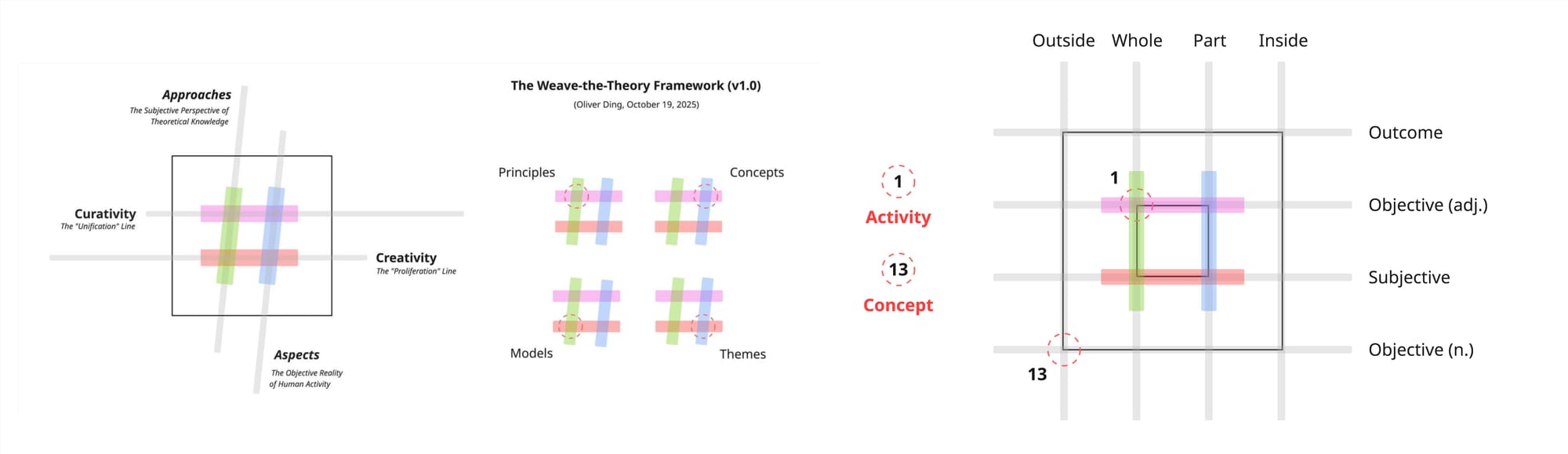
In Blunden's account, a concept is not a mental representation. It is something an activity forms. A project begins when people encounter a problem; through successive attempts and refinements, an adequate concept of the situation is formulated and named. This concept then enters the public world through objectification — symbolic, instrumental, and practical — and eventually becomes institutionalized as part of the cultural landscape. Activity is the process; Concept is what the process produces.
This pairing also connects to the Theme–Concept distinction that runs through the Life-as-Activity approach. What begins as a personal theme, sustained through an enterprise, is gradually objectified through activity. Concept names the destination: the point where an idea has become public, stable, and shareable.
The featured diagram, Weave-the-Theory, offers a model for mapping the theme–concept transformation within a theoretical activity. Although the model was developed to trace abstract theoretical creation, it can be used for a more general purpose: it reveals how any sustained line of inquiry moves from a lived theme to an objectified concept through the interplay of two lines — a Creativity Line (proliferating outward through Theme and Model) and a Curativity Line (unifying inward through Concept and Principle). The Concept + Activity pair, read together with Weave-the-Theory, thus holds the entire theoretical apparatus around concept formation. See Blunden's Concepts: A Critical Approach and the Weave-the-Theory framework for further detail.
3.4 Group: Several Concepts, One Larger Container
When more than two concepts are gathered by thematic affinity — regardless of their geometric positions on the diagram — they form a larger container with its own integrative logic. What follows is a demonstration of this grouping principle.
Case #7 — The "Self-Referential Activity" Thematic Space
Concepts: Enterprise × Project × Result × Self × Motivation
These five concepts — Enterprise, Project, Result, Self, and Motivation — cluster around the Inside column and the Subjective row. They do not form a row or a column; a deeper thematic logic gathers them. Together, they activate a thematic space named Self-Referential Activity.
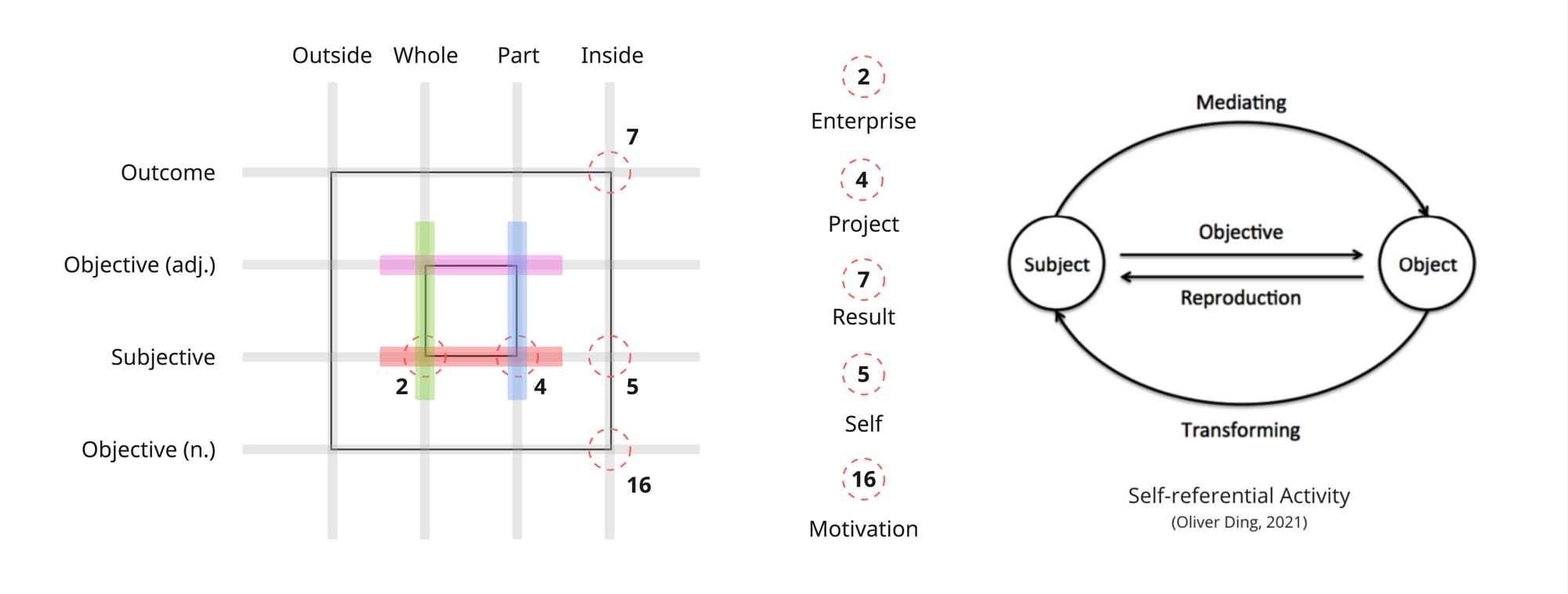
The core insight of this space is that activity does not merely produce outcomes in the world. It also acts back on the actor. When a person engages in a project, the project leaves traces: new skills, changed identity, accumulated themes, transformed motivation. When projects cohere into an enterprise, that enterprise becomes a structure through which the person not only acts but also reflects on their own action, evaluates their own development, and redirects their own trajectory. Activity, in this sense, is self-referential: it changes the self that performs it.
Self-Referential Activity refers to a special type of activity that can support self-referential development. Traditional Activity Theory considers three components — Subject, Mediating, and Object — as its basic model. The Self-Referential Activity model adds a fourth component: Transforming, which indicates the self-referential connection.
Case #8 —The "Life-History Topology" Thematic Space
Concepts: Event × Project × History × Culture
These four concepts — Event, Project, History, and Culture — are concentrated in the Objective (adj.) and Subjective rows, forming a symmetrical pattern across two scales. At the Part scale, Event (Objective adj.) and Project (Subjective) form one pair. At the Outside scale, History (Objective adj.) and Culture (Subjective) form the other. Together, they activate a thematic space named Life-History Topology, one of the three ontological-level models that frame the Life-as-Activity approach.
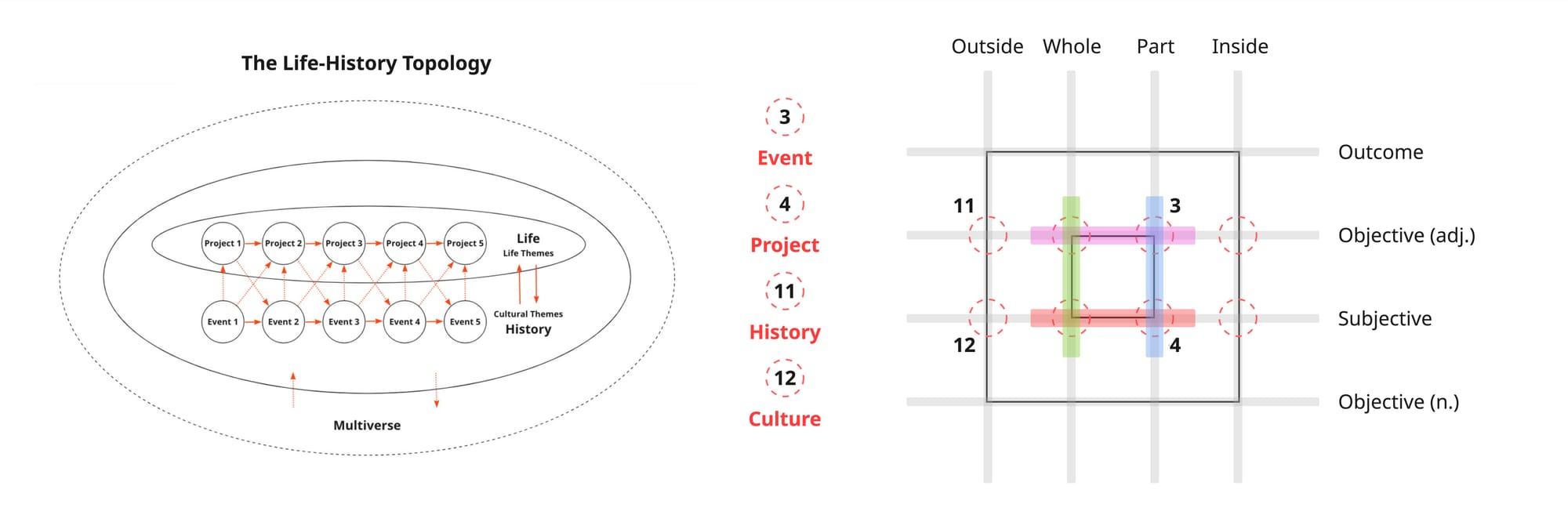
The Life-History Topology model connects the micro-level of individual life with the macro-level of social and cultural history. It was inspired by two conceptual pairs: Event–Project, from the Project Engagement approach, and Life Themes–Cultural Themes, from the Themes of Practice framework. A person's life can be seen as a diachronic chain of projects, just as history can be seen as a diachronic chain of events. At the same time, a life is a journey of moving between thematic spaces: each project carries its own themes, and by joining and leaving projects, a person enacts their significant Life Themes. Projects are thus also Thematic Spaces. This gives rise to the core equation of the model: Life = Projects = Thematic Spaces = Events = History.
In this way, the Life-as-Activity approach echoes Andy Blunden's insight that a project is a concept of both psychology and sociology. The notion of Engagement here takes on a second meaning: it refers not only to participation in a project, but to moving between thematic spaces across the course of a life. See the Life-History Topology model for further details.
3.5 Closing Remark
The Weave-the-Life Framework (v3.0) is, in one sense, a diagram — a 4×4 matrix of sixteen coordinates, four rows, four columns. But what this article has demonstrated is that the diagram is more than a diagram. It is a curatorial map for an entire knowledge system.
The sixteen Weave-points organize the territory. The thematic spaces they activate populate it. Individual concepts open into containers that hold frameworks, models, case studies, and tools accumulated over years of creative work. Pairs of concepts generate new containers defined by the relationship between them — the objective and subjective faces of collective life, the outside and inside perspectives on a single social occurrence, the intersubjective kernel of all collaborative activity. Groups of concepts, gathered by thematic affinity rather than geometric proximity, form larger containers with their own integrative logic — the arc of Projectivity, the self-referential loop of activity, the topology that connects individual life to cultural history.
None of these thematic spaces is closed. The sixteen coordinates are a starting set, not a final catalog. As the Life-as-Activity approach continues to develop, new concepts will settle at these coordinates, existing containers will combine into new configurations, and the map will grow denser without losing its underlying structure. This is the nature of a curatorial map: it is not a classification to be defended but a territory to be explored.
Part 4: Toward the Life-as-Activity Approach (v4.0)
Part 3 demonstrated how individual concepts, pairs, and groups on the Weave 16 diagram activate thematic spaces — showing the framework in operation, concept by concept. Part 4 steps back to assess what this framework means for the Life-as-Activity approach as a whole: what methodological innovations it introduces, what model of the actor it proposes, and how it points toward the next version of the approach.
4.1 Weave 2.0, Living Coordinate, and Thematic Space
The Weave-the-Life Framework (v3.0) is built on a 4×4 Weave diagram — but that description, while accurate, understates what has been achieved. The expansion from a 2×2 to a 4×4 matrix is not merely a matter of more cells. It is a methodological upgrade at the level of the entire Weave knowledge system.
This upgrade operates along two lines. The first is the introduction of the Coordinate. Each Weave-Point now carries a positional address — "Part × Subjective," "Inside × Objective (n.)," and so on. This may seem a small formal addition, but it creates a structural bridge to the Living Coordinate model, which describes how an individual actor navigates life space — finding a coordinate, anchoring a center, orienting a trajectory. When an individual's Living Coordinate is superimposed onto the Weave 16 diagram, the actor's developmental position can be marked at specific coordinates, and the thematic spaces those coordinates activate become resources for the next phase of their journey. What was previously a model of activity-in-general is now a model that can receive the situated work of a specific actor seeking orientation.
The second line is the introduction of Thematic Space. Each coordinate, when occupied by a concept, opens onto a cognitive container — a region populated by frameworks, diagrams, case studies, and tools. This gives the diagram a nesting capacity: a single coordinate can hold an entire sub-system of knowledge. The 4×4 diagram does not flatten the Life-as-Activity approach into sixteen labels. It organizes its sprawling conceptual vocabulary — multiple frameworks, multiple book drafts, multiple tools — into a navigable structure where each point is a portal to a deeper territory.
These three terms — Weave-Point, Coordinate, and Thematic Space — name three aspects of the same entity, seen from three theoretical angles. A Weave-Point is the structural intersection of two dimensions in the matrix: the formal foundation, the point where one diachronic line and one synchronic line meet. A Coordinate is the positional address of that Weave-Point on the map — "Whole × Subjective," for instance — which allows a concept to be placed and later found. A Thematic Space is the cognitive container that the Coordinate activates when a concept occupies it: the living region of inquiry that gathers related knowledge around the core theme. These are not separate things. They form a single logic: from structural intersection, to positional address, to living container. It is this logic that transforms a matrix of sixteen cells into a curatorial map for an entire knowledge system.
4.2 A Weave-Point as a Scalable Focus
This transformation has a direct consequence for how the diagram is used. In the v3.0 framework, a Weave-Point is no longer only a display mechanism for a key concept. It is an invitation. Each Weave-Point points beyond itself to a dynamically developing thematic space — a region of inquiry that continues to grow as new frameworks are built, new cases are documented, and new connections to adjacent traditions are made.
For the creator, each Weave-Point becomes a scalable focus — a site where attention can be concentrated or relaxed depending on the creative task at hand. One can zoom in on a single coordinate and develop its thematic space in depth. One can zoom out to a pair or a group and work at the level of their relationship. One can step back further and read the entire diagram as a single landscape, asking how the whole configuration might be adjusted, extended, or re-curated.
For the reader or learner, the same scalability applies. Not every thematic space needs to be explored at once. A reader can enter through the coordinate most relevant to their own situation — Self, for instance, or Projection — and expand outward as their understanding grows. The Weave-Point becomes a site of cognitive agency: the reader decides, based on their own context and intentions, where to allocate attention and how deep to go.
This is what makes the diagram a curatorial map rather than a textbook table of contents. It does not prescribe a reading order. It provides a spatial structure within which multiple reading paths are possible, each shaped by the interests and developmental position of the person navigating it.
4.3 A New Model of the Actor
Earlier in this article, the concept of "Weave" was traced through a personal intellectual journey — from a passing encounter with the term "model of the actor" in 2023, through the unexpected recognition in March 2026 that the five-ring SDP Living Coordinate had quietly become exactly that, to the decision to incorporate Weave as a model of the actor into the Weave-the-Life framework.
The Weave-the-Life Framework (v3.0), as presented here, gives that model of the actor its formal structure. It is no longer distributed across multiple diagrams and projects. It is housed in a single, coherent spatial argument.
In this model, the actor is not a single coordinate. The actor is the entire diagram — or more precisely, the actor is the capacity to move through the diagram, to occupy different coordinates at different moments, to activate different thematic spaces as developmental needs shift.
This is the model of the actor that the Life-as-Activity approach proposes. Not a portrait of a person, but a map of the structural positions, temporal phases, and thematic spaces through which an actor develops. It is a model that restores the subjective experience that traditional Activity Theory brackets out, without abandoning the structural analysis that gives Activity Theory its explanatory power.
For the ACS (Anticipatory Cultural Sociology) and SDP (Strategic Developmental Psychology) projects, this changes the division of theoretical labor. The Weave-the-Life (v3.0) model now provides the foundational model of the actor — the general orientation of Weave as the integrative action that holds everything together.
With this foundation in place, ACS and SDP can focus on what they are specifically designed to address: the particular models of the cultural creator — the actor whose development is organized around the creation of new thematic enterprises. Their work can now concentrate on refining Discover, Design, Deliver, and Learn — the four outer rings of the SDP Living Coordinate — knowing that the integrative Weave orientation has been structurally secured.
4.4 The Life-as-Activity Approach (v4.0)
A key milestone in the development of the Life-as-Activity approach was the book draft Developmental Projects: The Project Engagement Approach to Adult Development, completed in November 2025. While that book intends to offer a practical toolkit for applying the Developmental Project concept to adult development, its theoretical contributions also advance the Project Engagement approach to version 4.0.
Previously, the full landscape of the Life-as-Activity approach was presented through a knowledge map — a curated display that gathered key framework diagrams, featured a series of book draft covers, and included an image of one tool. The knowledge map showed the territory. But it lacked a coordinating mechanism among the different knowledge frameworks. They sat side by side, each in its own space, their relationships implied but not structurally articulated.
The Weave-the-Life Framework (v3.0) addresses this limitation through a formal innovation. It goes beyond the static, single-layer character of the knowledge map by introducing the mechanisms described above: the nesting capacity of thematic spaces, the positional logic of coordinates, the scalability of Weave-Points as foci, and the integration of the actor's Living Coordinate into the structure itself. Through these innovations, knowledge frameworks that were previously distributed across separate diagrams are now organized within a single spatial argument. The matrix does not merely display them. It integrates them — placing each framework at its proper coordinate, linking each to its relevant thematic space, and revealing the structural relationships among them through the logic of rows, columns, and pairs.
What this article has provided is an introduction to the systematic innovations of the Weave-the-Life Framework (v3.0). A fuller account — one that uses this diagram as its central navigational device to tour the entire landscape of the Life-as-Activity approach, thematic space by thematic space — will be the work of The Life-as-Activity Approach (v4.0) , forthcoming.
v1.0 - April 28, 2026 - 8,117 words