
Weave the Curativity: When Advancing Dances with Analyzing

This article is part of the Dramatic Life Pattern series
by Oliver Ding
April 22, 2026
Introduction
The Weave-the-Theory Framework is one of the derived frameworks within the Weave knowledge system. Built on the Weave Basic Form — two diachronic lines crossing two synchronic lines to produce four weave-points — it applies this structure to the specific domain of theoretical activity. Its four weave-points are Themes, Models, Concepts, and Principles: the four primary types of knowledge elements involved in the long work of building, curating, and integrating theories.
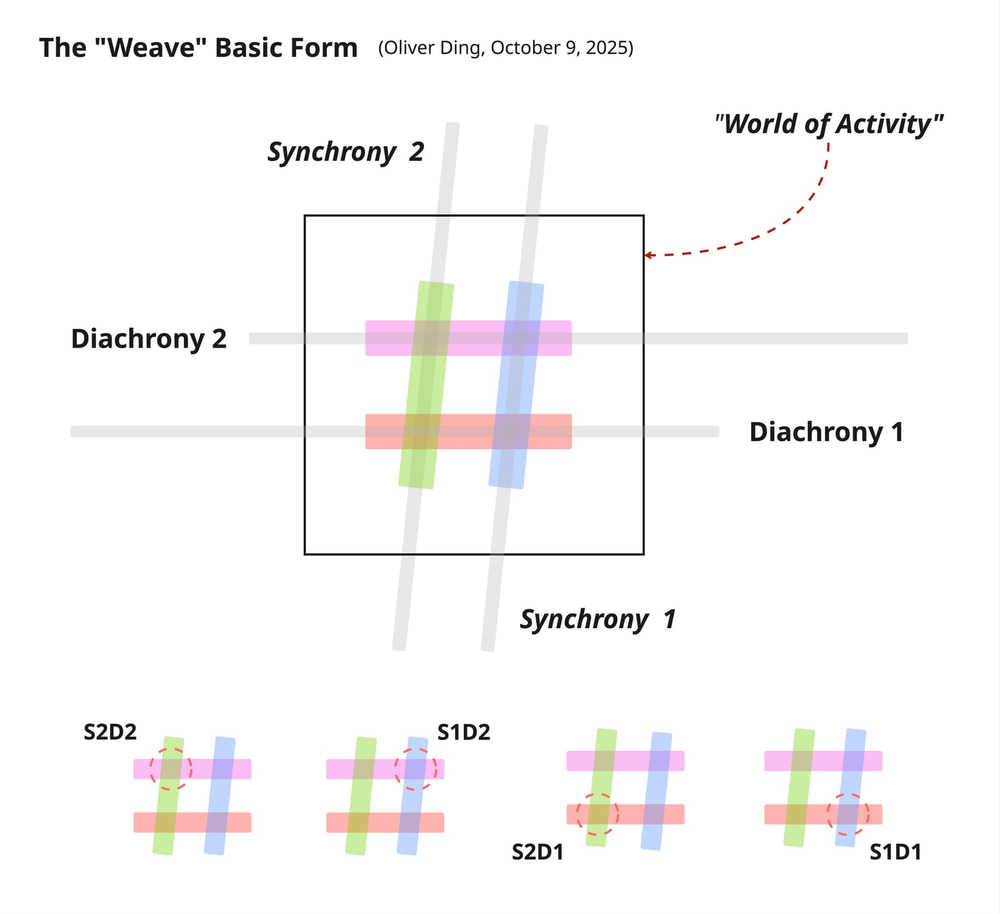
This article is a case study in how that framework illuminates a creative journey that has been unfolding, in one form or another, for more than six years.
The case concerns the development of Curativity Theory — from its origins as a 615-page book draft completed in March 2019, through a series of knowledge projects, knowledge centers, and iterative mappings, to the moment in 2025 when a cluster of related themes finally crystallized into the concept of Theory as Enterprise. The case is drawn from my own creative life, which means the analysis is self-referential: the theoretical tools being used to examine the journey are themselves products of that same journey.
What makes this case distinctive is not simply that a theory was developed over time. It is the structural pattern through which the development occurred. Looking back, I can see that the journey alternated, again and again, between two modes: Advancing — pushing the work forward into new territory — and Analyzing — pausing to map where the work had arrived, using whatever analytical tools were available at the time. This alternation was not planned. It was the natural rhythm of a creative enterprise. But it has a shape, and that shape deserves a name. I call it the AA pattern: Advancing and Analyzing in dance.
This article proceeds through the Weave-the-Theory framework in the standard order: Theme and Model (Creativity Line) first, then Concept and Principle (Curativity Line), moving from the concrete to the abstract. A final section situates the AA pattern within the broader context of the Life-as-Activity approach, showing how this case connects to the Anticipatory Activity System (AAS) framework, the notion of Self-referential Activity, and the potential universality of AA as a pattern of creative engagement.
The article is intended as a contribution to the Weave 42 collection, where it sits alongside other case studies demonstrating how the Weave-the-Theory framework illuminates real theoretical journeys.
Contents
Introduction
Part 1. The Weave-the-Theory Framework
1.1 The Basic Structure
1.2 Line Entry as Application Strategy
1.3 The AA Pattern: A Companion Methodology
Part 2. The Theme: Curativity as a Long-term Enterprise
2.1 The Beginning: An Ontological Invention Without a Name for Its Journey
2.2 First Advance: The Knowledge Curation Project
2.3 First Analysis: How to Grow a Knowledge Enterprise
2.4 Second Analysis: Mapping the Thematic Landscape
2.5 Second Advance: Building the Knowledge Center Network
2.6 Third Analysis: The Platform Perspective
2.7 Third Advance and Fourth Analysis: The Six-Year Review
2.8 Practice-Based Reflection: The Dance Pattern
Part 3. The Models: Multiple Lenses on One Journey
3.1 The BKE Model: Building Knowledge Enterprise Activity (2022)
3.2 The Thematic Landscape Map (2022)
3.3 The House of Thematic Genidentity (2024)
3.4 The Knowledge Discovery Canvas (2025)
3.5 The Evolving Knowledge Enterprise Model (2023–2024)
3.6 The Theory as Enterprise Model: Wonder and Wander (2025)
3.7 The Enterprise Development Framework (2025)
3.8 A Comparative Review: Models Evolving with Practice
Part 4. The Concept: Enterprise
4.1 Theme 1: Knowledge Enterprise
4.2 Theme 2: Curativity Knowledge Enterprise
4.3 Theme 3: Thematic Enterprise
4.4 Theme 4: Theory as Enterprise
4.5 Theme 5: Venture — A Concept Shapes Its Own Vocabulary
4.6 The Concept of Enterprise
Part 5. The Principle: Enterprise and Activity
5.1 Enterprise vs. Activity: The Core Distinction
5.2 The Weave-the-Life v2.0 Model
5.3 Enterprise in Life as Activity v3.2
Part 6. Weave-AA: A Joint Framework in the Landscape of Life as Activity
6.1 Weave-AA and the First/Second-order Activity in AAS
6.2 Weave-AA and Self-referential Activity
6.3 Weave-AA as a Universal Pattern
Part 7. The Weave-the-Theory Toolkit (v1.0)
Appendix: Source Articles
Part 1. The Weave-the-Theory Framework
1.1 The Basic Structure
The Weave-the-Theory Framework (v1.0, October 2025) organizes theoretical knowledge around two diachronic lines and two synchronic lines, producing four weave-points at their intersections.
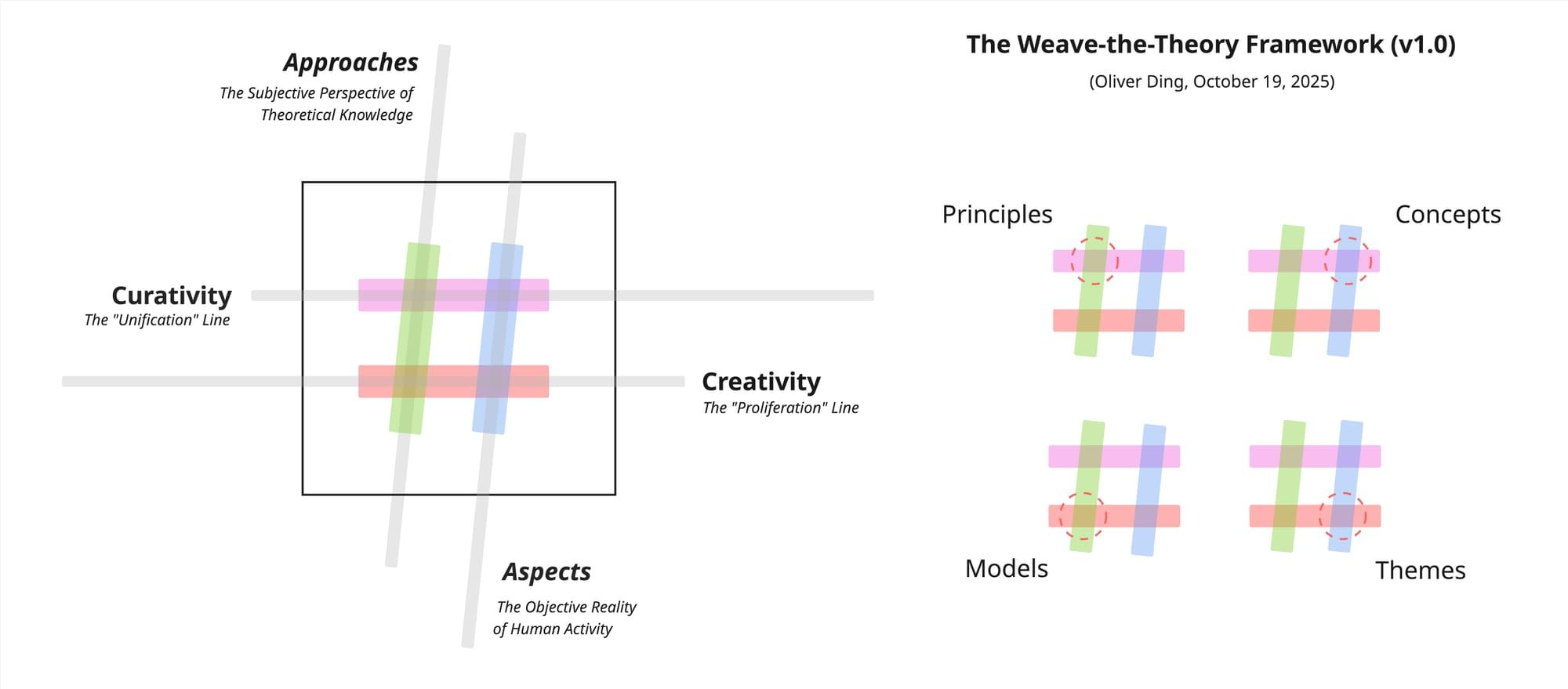
The two diachronic lines are the Creativity Line — the "Proliferation" line, moving from Theme toward Model — and the Curativity Line — the "Unification" line, moving from Concept toward Principle. These lines capture the two fundamental directions of theoretical work: generating new ideas outward (Creativity) and integrating existing ideas upward (Curativity).
The two synchronic lines are Aspects — the objective reality of human activity that theory seeks to explain — and Approaches — the subjective perspective of theoretical knowledge through which that reality is interpreted. These lines hold the framework in the present, capturing the dual orientation of any theoretical act.
The four weave-points that emerge from these intersections are: Themes (Creativity × Aspects — the lived, practiced inhabitation of an idea), Models (Creativity × Approaches — the structural map of how a practice unfolds), Concepts (Curativity × Aspects — the precisely defined theoretical proposition grounded in prior intellectual traditions), and Principles (Curativity × Approaches — the governing insight that unifies the whole).
These four weave-points are not sequential stages. They are simultaneously present dimensions of the same theoretical activity. A Theme does not simply evolve into a Model, which then becomes a Concept, which finally arrives at a Principle. They weave together — each one developing in relation to the others, each casting light on what the others have not yet seen.
1.2 Line Entry as Application Strategy
The Weave 42 framework describes three strategies for applying a Weave-derived framework to a specific case. This article uses Line Entry — entering the analysis through one of the four lines and following that line's logic before moving to the intersecting dimensions.
The entry point here is the Curativity Line: the line of unification, integration, and synthesis. This is the natural entry for a case where the central question is how a cluster of dispersed themes eventually converged into a single concept. The Curativity Line tracks that convergence. It asks: what was being curated, how did curation occur, and what concept emerged when the curation was complete?
The Creativity Line — generating Themes and Models — is not absent from the analysis. The case is rich with both. But the movement that most needs to be traced here runs upward along the Curativity Line: from multiple Themes, through several Models, toward the Concept of Enterprise.
1.3 The AA Pattern: A Companion Methodology
Before entering the case, one methodological observation deserves attention. The Weave-the-Theory Framework describes the structure of theoretical knowledge — what kinds of elements are produced and how they relate spatially. But it does not, by itself, describe the dynamics of theoretical work — how a creator actually moves through the framework over time.
The case studied in this article makes that dynamic visible. What emerges is a pattern I call AA: Advancing and Analyzing.
Advancing is movement along the Creativity Line: creating new themes, developing new models, pushing the theoretical work into new territory. Analyzing is movement along the Curativity Line: pausing to examine what has been produced, mapping the landscape with whatever analytical tools are available, and integrating dispersed elements into a more unified view.
The two movements do not occur in sequence — first advance, then analyze, then advance again. They interweave. While Advancing is underway, seeds of future Analysis are being sown. While Analyzing is underway, new Themes are being recognized that will fuel the next Advance. This is why the title of this article uses the word "dance": Advancing and Analyzing are partners in motion, each leading the other in turn.
AA is thus the companion methodology of Weave-the-Theory: if the framework describes the space of theoretical knowledge, AA describes how a creator inhabits and moves through that space over time.
Part 2. The Theme: Curativity as a Long-term Enterprise
A Theme, in the Weave-the-Theory Framework, is a lived, practiced inhabitation of an idea — the texture of experience that gives it reality. The theme of this case is not Curativity Theory as a finished system. It is Curativity as a long-term enterprise: the experience of building, extending, and returning to a theoretical project over years, through a rhythm of advance and analysis that was not planned but proved to be generative.
2.1 The Beginning: An Ontological Invention Without a Name for Its Journey
From August to September 2018, I reviewed academic literature on curation and practice theories. On September 20, 2018, I recorded a significant insight that reshaped my ontological understanding: the triad of "Pieces, Parts, and Whole." What I had previously understood as a two-term relationship — Part and Whole — revealed a third element that BagTheWeb had always contained: Pieces. This insight gave rise to a new term: Curativity.
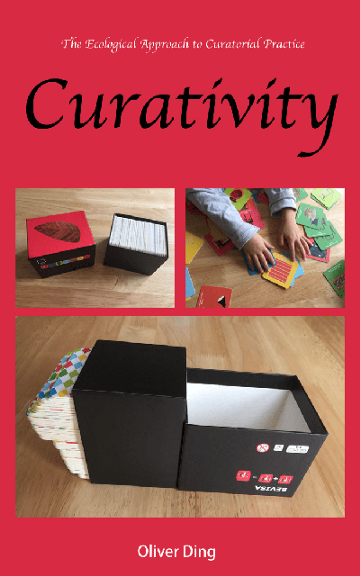
From October 2018 to March 2019, I expanded this insight into a 615-page book draft: Curativity: The Ecological Approach to General Curation Practice. The book introduced a new ontology — the "Pieces—Container—Whole" triad — and drew on James Gibson's Affordance theory, George Lakoff's Container metaphor, and Donald Schön's Reflective Practice as its epistemological tools. Curativity was positioned as an ontological-level invention: not a description of what curation is, but an opening of a new space for knowing and understanding.
At this moment, the enterprise had begun. The ontological invention was complete, and it carried within it, as Merleau-Ponty would say, the anticipation of a body of knowledge. But there was no name yet for the journey itself. I knew that Curativity would be a long-term commitment. I anticipated applying it to Knowledge Curation, Action Curation, Life Curation, and Platform Curation. The practice of building a theoretical enterprise was already underway. The language to describe that practice had not yet arrived.
This is the opening condition of the AA dance: movement has begun on the Creativity Line, but the Curativity Line has not yet been fully activated. Advancing precedes Analyzing, because there is not yet enough to analyze.
2.2 First Advance: The Knowledge Curation Project
After March 2019, the theoretical enterprise expanded outward along the Creativity Line. Curativity Theory became a meta-theory — a framework applied across a series of knowledge projects, each testing and extending its core concepts in a new domain.
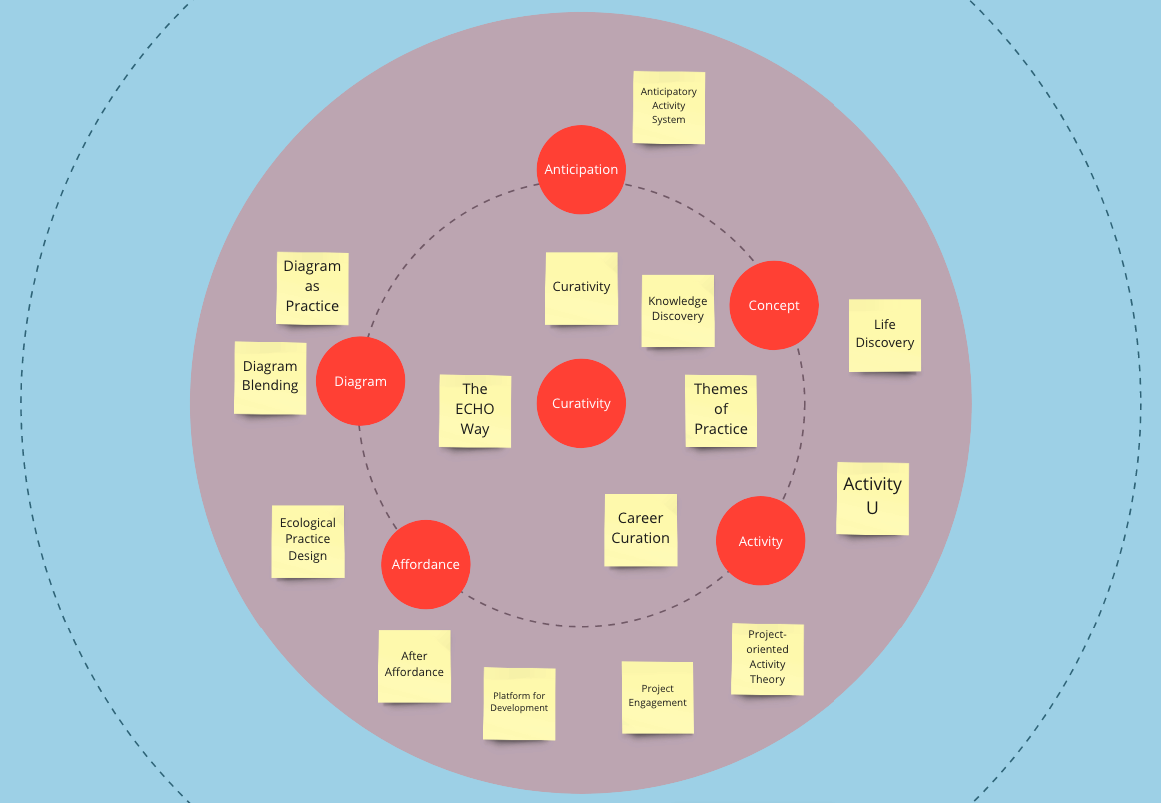
In August 2020, I initiated the Knowledge Curation project, with the Activity U project as its first sub-project. This launched a three-year period of intensive theoretical production. The journey led to five secondary themes — Affordance, Activity, Anticipation, Concept, Diagram — each generating its own book drafts and frameworks. By September 2022, Curativity Theory had produced five possible books of its own, and the secondary themes had generated eight more.
This was pure Advancing: new territory being opened on all fronts simultaneously. The Creativity Line was running at high speed, proliferating themes and generating models across multiple sub-projects. The theoretical enterprise was growing, expanding, branching. There was not yet the pause to look back and see the whole of what had been built.
2.3 First Analysis: How to Grow a Knowledge Enterprise
On May 6, 2022, I published an article that marked a significant moment of transition: CALL: How to Grow A Knowledge Enterprise. This was the first systematic turning-back — the first moment of Analyzing that matched the scale of the Advancing that had preceded it.
The article did something new: it named the journey. Inspired by Howard E. Gruber's concept of the "Network of Enterprise" from his evolving systems approach to creative work, I coined the phrase "knowledge enterprise" to describe what I had been building. This was not simply a label. It was a conceptual act — the first attempt to see the accumulation of projects, themes, books, and frameworks as a whole: a structured, self-directed activity with its own developmental logic.
The article also introduced a three-phase model for Building Knowledge Enterprise (BKE) Activity, inspired by Project-oriented Activity Theory.
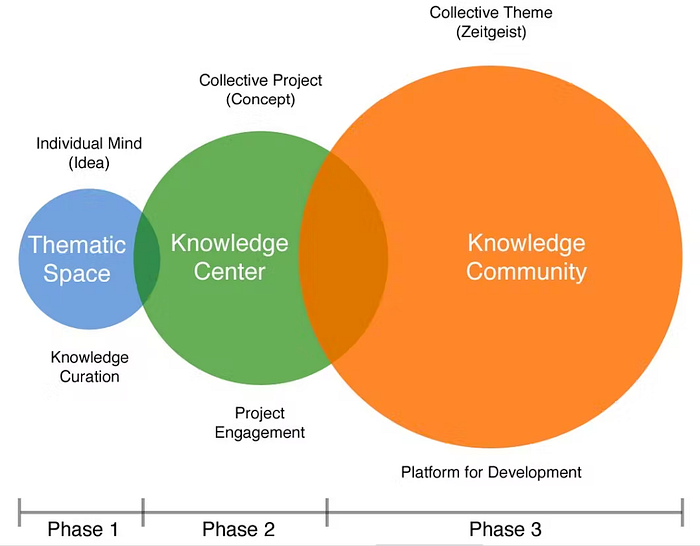
The three phases were supported by three corresponding knowledge frameworks: Knowledge Curation (for the first phase of building a thematic foundation), Project Engagement (for the second phase of running projects and developing a knowledge network), and Platform for Development (for the third phase of growing the enterprise into a platform). This model was deliberately practical — a guide for action rather than a retrospective map. It answered the question not of what an enterprise looks like after it has grown, but of how to grow one deliberately, phase by phase.
This first Analysis produced the foundational vocabulary for everything that followed. The word "enterprise" — applied to knowledge work, to creative life, to the self-directed building of a theoretical body — would not go away. It would develop, deepen, and eventually become a concept in its own right. But that development required more Advancing first.
2.4 Second Analysis: Mapping the Thematic Landscape
On September 2, 2022, I undertook a more systematic mapping of the Curativity knowledge enterprise, producing the article Slow Cognition: Mapping Thematic Landscape (Curativity, 2019–2022). This was the second major Analyzing moment — more comprehensive and more methodologically developed than the first.
The analytical tool introduced here was the Thematic Landscape Map: a three-ring diagram that positioned the primary theme of Curativity at the center, with secondary themes, projects, and knowledge frameworks arranged in concentric circles. The map made visible, for the first time, the full spatial extent of what the enterprise had become: five knowledge centers, thirteen possible books, multiple frameworks operating across different domains.
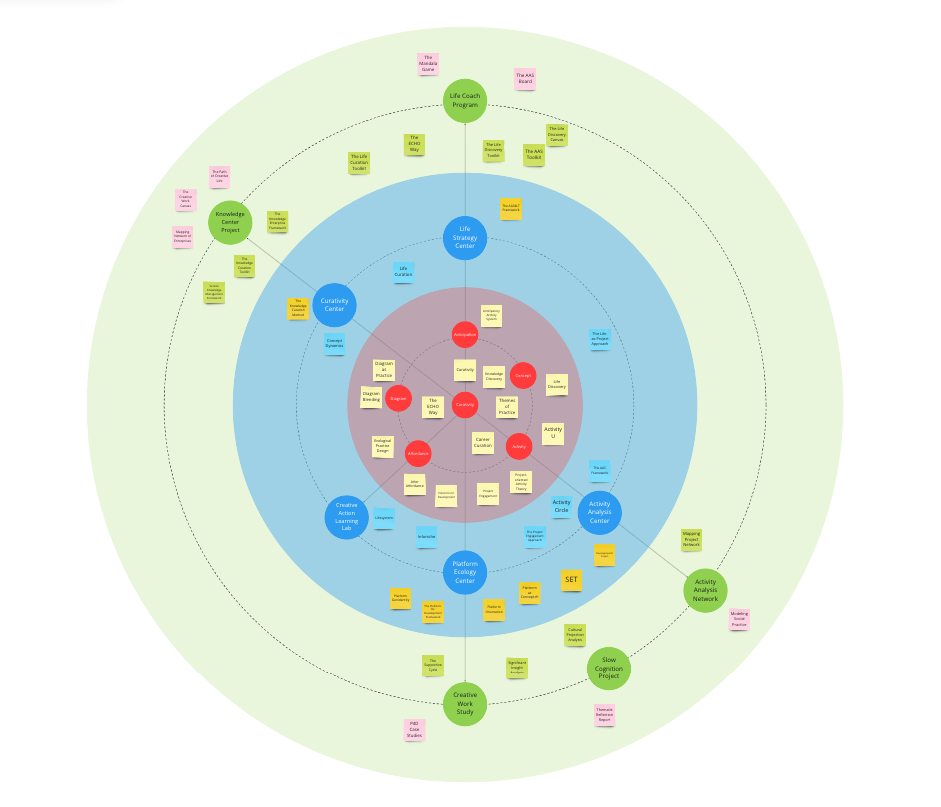
The article also introduced a second mapping method — the Mapping Networks of Enterprise v2.0 — which traced the relationships between insights, activities, projects, and themes across the same period. Together, the two methods provided both a spatial and a relational view of the enterprise.
What is striking in retrospect is that this article already uses the phrase "knowledge enterprise" as a stable, taken-for-granted term — not as a new coinage requiring explanation, but as an established framework for understanding what had been built. The concept introduced in May 2022 had, within four months, become part of the analytical vocabulary. The Analyzing mode was now using the products of earlier Advancing and earlier Analyzing together, in a more sophisticated composite.
2.5 Second Advance: Building the Knowledge Center Network
From 2022 to 2024, the enterprise expanded in a new direction: from a single theoretical body to a network of knowledge centers. On June 2, 2022, I launched Curativity Center as an independent knowledge center — and simultaneously positioned it as a meta-center for a broader network.
By March 2023, I was managing seven knowledge centers: Curativity Center, CALL (Creative Action Learning Lab), Activity Analysis Center, Platform Ecology Center, Life Strategy Center, ARCH Center, and TALE (Thematic Analysis Learning Engagement). Each center hosted its own knowledge enterprise; Curativity Center held the network together.
This was a new kind of Advancing: not the proliferation of theoretical themes, but the construction of an organizational ecology. The complexity of this phase was of a different order than what had come before. It was not primarily cognitive complexity — the challenge of understanding a difficult idea — but social and material complexity: the challenge of running multiple interconnected knowledge projects, maintaining the uniqueness of each center while building synergy across the network.
By October 2024, I had conceptually redesigned the network around a new meta-center — the HELLO THEORY Center — reflecting the growing ambition and structural sophistication of the enterprise. In practice, however, this reorganization was never fully implemented. Curativity Center continued to function as the operational meta-center through 2024 and into 2025. It was only after September 2025 that the meta-center role shifted — not to HELLO THEORY, but to Activity Analysis Center, as the theoretical focus of the enterprise moved toward the Life-as-Activity and World of Activity knowledge systems.
2.6 Third Analysis: The Platform Perspective
In October 2024, I returned to the Curativity case with a new analytical tool: the Platform Genidentity Matrix. The resulting article, Mapping Strategic Moves #12: The House of Thematic Genidentity and the Concept Development Framework, re-examined the same 2019–2022 journey that had been mapped in September 2022 — but from a substantially higher vantage point.
The Platform Genidentity Matrix is a 6×3 structure organized around two axes: six construal levels of knowledge objectification (from meta-theory to general practice) and three types of objectification movement (symbolic, instrumental, practical). Applied to the Curativity journey, this framework revealed a pattern of concept development that the earlier Thematic Landscape Map had not made visible: the iterative movement through levels of construal, the different types of objectification operating simultaneously, and — crucially — the Platform as a high-level developmental stage within the enterprise.
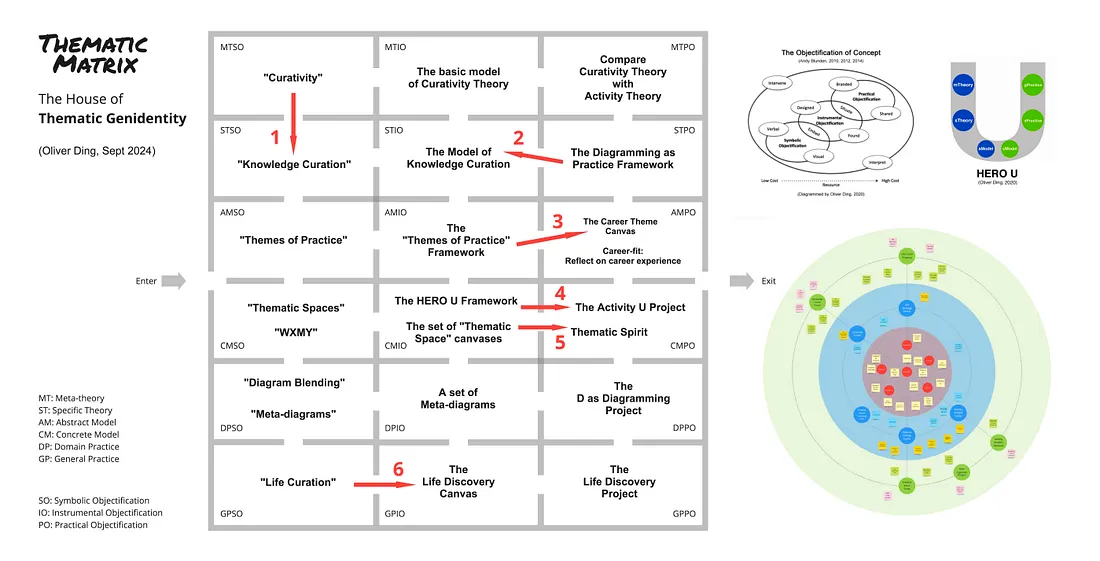
This was the first time "Platform" appeared explicitly as a concept for understanding enterprise development. Not platform in the sense of digital infrastructure, but platform in the sense of a developed foundation from which further creative work becomes possible: the stage at which an enterprise has accumulated enough structure, relationship, and influence to project itself outward into the world. The Platform perspective revealed that the enterprise had grown into something qualitatively different from what it had been in 2022 — and that a new model was needed to account for this difference.
2.7 Third Advance and Fourth Analysis: The Six-Year Review
In March 2025, I undertook the most comprehensive review of the Curativity enterprise yet. Using the Knowledge Discovery Canvas — a tool organized around the THEORY–PRACTICE–END–MEANS schema — I produced a four-part series of articles reflecting on six years of development (2019–2025).
Each article addressed one quadrant of the schema: Curativity as an Ontological Invention (THEORY), Curativity and Creative Dialogue (END), Curativity: A Creative Enterprise (MEANS), and Curativity for Personal Practice (PRACTICE). Together, they constituted a full-spectrum review of the enterprise — its theoretical foundations, its relational ecology, its organizational structure, and its practical applications.
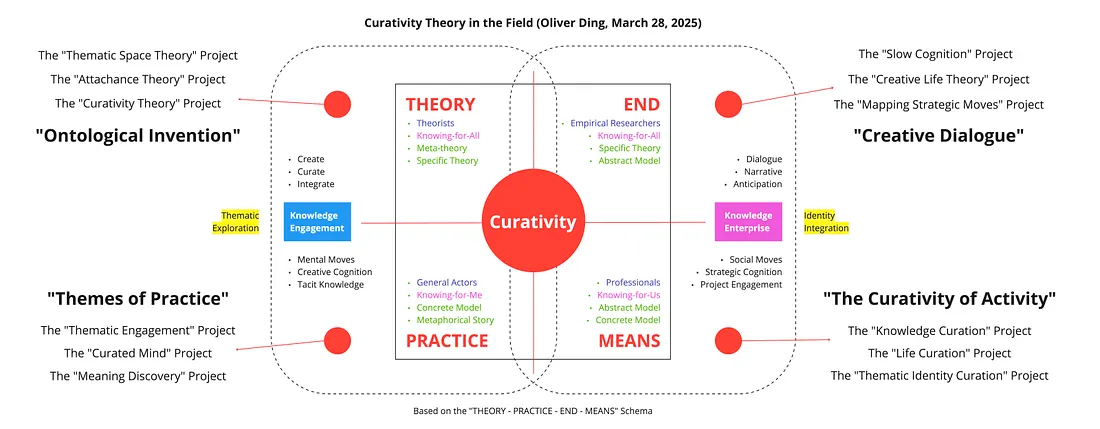
This review produced something new: not just a map of what had been built, but a recognition of what the building itself had been. In Curativity: A Creative Enterprise, I wrote explicitly: "the development of a theory is a thematic enterprise." This sentence crystallized what had been implicit since 2019. The journey of developing Curativity Theory was not merely the creation of a theory. It was the enactment of an enterprise — a long-term, self-directed, thematically organized sequence of actions. Theory as Enterprise was no longer just a practice. It was now a theme — and it was ready to become a concept.
Simultaneously, the April 2025 article Mapping the "Curativity" Thematic Enterprise formally mapped the entire Curativity enterprise using Thematic Enterprise as the explicit analytical framework — applying to Curativity the very concept that Curativity had helped generate.
2.8 Practice-Based Reflection: The Dance Pattern
Looking back across this journey, the AA pattern is unmistakable. But it is not a simple alternation — one Advance followed by one Analysis followed by another Advance. It is something more complex: a spiral in which each Analysis draws on more sophisticated tools than the last, and each Advance builds on a more developed theoretical foundation.
The May 2022 Analysis used a simple three-stage model. The September 2022 Analysis used the Thematic Landscape Map. The October 2024 Analysis used the Platform Genidentity Matrix. The March 2025 Analysis used the Knowledge Discovery Canvas. Each tool was more structurally sophisticated than its predecessor — not because the tools were being developed in isolation, but because the enterprise itself had grown complex enough to require more nuanced instruments.
The Advancing phases show the same developmental logic. The 2019–2022 advance was primarily theoretical proliferation: many themes, many drafts, many frameworks. The 2022–2024 advance was organizational construction: knowledge centers, networks, meta-centers. Each phase of Advancing created a new kind of complexity, which called for a new kind of Analyzing to follow.
This is the dance: not a simple back-and-forth, but a spiral conversation between making and reflecting, between the work and the map of the work, between the enterprise and the understanding of the enterprise.
Part 3. The Models: Multiple Lenses on One Journey
Models, in the Weave-the-Theory Framework, are structural maps of how a practice unfolds — its internal dynamic. This case is unusual in that it generated not one model but a succession of models, each developed at a different moment in the journey and each revealing a different dimension of what was being built.
Crucially, these models belong to two distinct types — a distinction that maps directly onto the AA pattern itself. The first type is models generated through Advancing: frameworks created during the active development of the enterprise, oriented toward the future, predicting and guiding what the enterprise might become. Using the terminology of the Six Faces of the Concept System, these are strategic frameworks — predictive models that shape how the work unfolds. The second type are models deployed during Analyzing: frameworks selected or developed specifically to make sense of what the enterprise has produced, oriented toward the past, illuminating the structure of what has already been built. These are mental platforms — mental models that organize and integrate accumulated experience.
The same creative journey thus produced two parallel streams of models, each serving a different cognitive function. Tracing both streams — and understanding how they interact — is part of what makes this case instructive.
3.1 The BKE Model: Building Knowledge Enterprise Activity (2022)
The first model to explicitly address the developmental structure of the enterprise appeared in May 2022, in the article CALL: How to Grow A Knowledge Enterprise. Inspired by Project-oriented Activity Theory, it introduced a three-phase framework for Building Knowledge Enterprise (BKE) Activity.
The three phases correspond to three knowledge frameworks: Knowledge Curation (Phase 1 — building a thematic foundation through curation projects), Project Engagement (Phase 2 — running projects and developing a knowledge network), and Platform for Development (Phase 3 — growing the enterprise into a platform capable of projecting itself outward).
This is a model of the Advancing type: a strategic framework, predictive and action-oriented, designed to guide the growth of the enterprise rather than to map what had already been produced. It answered the question "how do you grow a knowledge enterprise?" by identifying the three phases through which such growth characteristically occurs — and by naming the tools appropriate to each phase.
Notably, this model was developed while the enterprise was still in its early phases. It did not describe a completed journey; it anticipated one. This anticipatory character is precisely what distinguishes strategic frameworks from mental platforms: they face forward, orienting the creator toward what needs to be built next.
3.2 The Thematic Landscape Map (2022)
The second model — introduced in September 2022 — addressed a different question: not how the enterprise grows, but what it looks like at a given moment. The Thematic Landscape Map uses three concentric circles to represent the spatial structure of a thematic enterprise.
The inner circle contains the primary Theme and its associated books — the cognitive core of the enterprise. The middle circle contains Projects and knowledge frameworks — the work zone where the theme is being actively developed. The outer circle contains Programs, tools, and actions — the social zone where the enterprise meets its audience.
This model captures synchronic complexity — the full landscape of a thematic enterprise at a single point in time. Where the five-stage model was diachronic (showing development over time), the Thematic Landscape Map was synchronic (showing structure at a moment). The two models were complementary: together, they provided both a developmental timeline and a spatial snapshot.
3.3 The House of Thematic Genidentity (2024)
By October 2024, the enterprise had grown substantially more complex, and the available analytical tools needed to match that complexity. The Platform Genidentity Matrix — a 6×3 structure mapping construal levels against types of objectification — provided a more fine-grained instrument for understanding the same Curativity journey.
Applied to the 2019–2022 period, the matrix revealed six distinct construal levels at which Curativity had been objectified: from meta-theory (the abstract theoretical framework) through specific theory, abstract model, concrete model, domain practice, to general practice. At each level, the objectification took different forms — symbolic (naming and diagramming), instrumental (developing tools and canvases), and practical (testing in real cases and communities).
The Platform concept emerged from this analysis as the name for the structural condition that makes further development possible: a level of development at which the enterprise has enough accumulated depth and breadth to project itself into new domains. Platform is not merely a later stage of enterprise development; it is a qualitatively different structural condition.
3.4 The Knowledge Discovery Canvas (2025)
The fourth model — brought to bear in March 2025 — was the Knowledge Discovery Canvas, a tool organized around the THEORY–PRACTICE–END–MEANS schema. Unlike the previous models, which focused primarily on the structure and development of the enterprise, the Knowledge Discovery Canvas organized the review around four types of knowledge engagement: theoretical (THEORY), relational (END), practical (MEANS), and experiential (PRACTICE).
Applied to six years of Curativity development, this framework made visible dimensions of the journey that the earlier models had not foregrounded: the creative dialogues that shaped the theory's development, the personal practices through which the theory had been lived, and the audience relationships that the enterprise had cultivated. It was the most comprehensive analytical frame yet applied to the case.
3.5 The Evolving Knowledge Enterprise Model (2023–2024)
In November 2023, I developed the Evolving Knowledge Enterprise model — a framework with three dimensions and three hierarchical levels. The three dimensions are the Mental Platform (how do you think?), the Behavioral Network (how do you do?), and the Material Container (what do you make?). Together, they move beyond the purely cognitive to encompass the embodied, communicative, and material dimensions of enterprise development. On March 26, 2025, I introduced the "Mental—Social—Material" Schema as a meta-framework to integrate these three dimensions across multiple models.
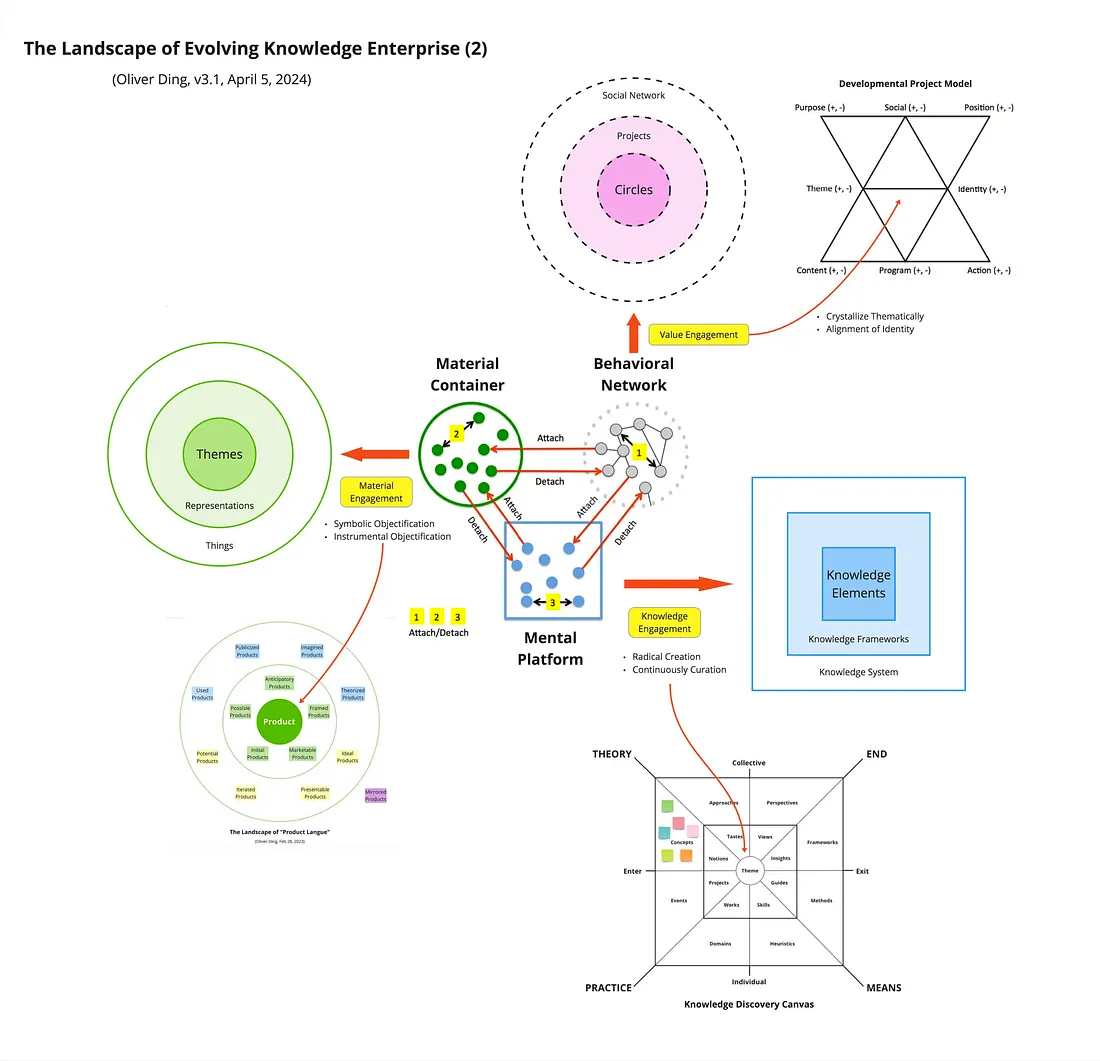
Throughout 2024, I used the Evolving Knowledge Enterprise model as a practical management and reflection tool — a map for representing the landscape of each knowledge center I operated, supporting reflection, exploration, and narrative. Mapping the landscape of TALE (Thematic Analysis Learning Engagement) in April 2024, for instance, revealed that TALE lacked a distinctive theoretical approach compared to other centers — an insight that led directly to assigning Thematic Space Theory to TALE at the end of 2024. The model was proving its value as a strategic framework: predictive and action-oriented, capable of revealing gaps and guiding decisions.
Alongside this management application, I traced a five-stage historical trajectory of my own knowledge enterprise development — from knowledge curation to knowledge engagement, and ultimately to knowledge enterprise and creative enterprise:
- Single Point: "HERO U" (2020)
- Durable Category: "Knowledge Curation" (2020–2022)
- Cross-categorical: "Knowledge Engagement" (2022–2023)
- System/Complex: "Knowledge Enterprise" (2023–2024)
- Trans-system: "Creative Enterprise" (2024–2025)
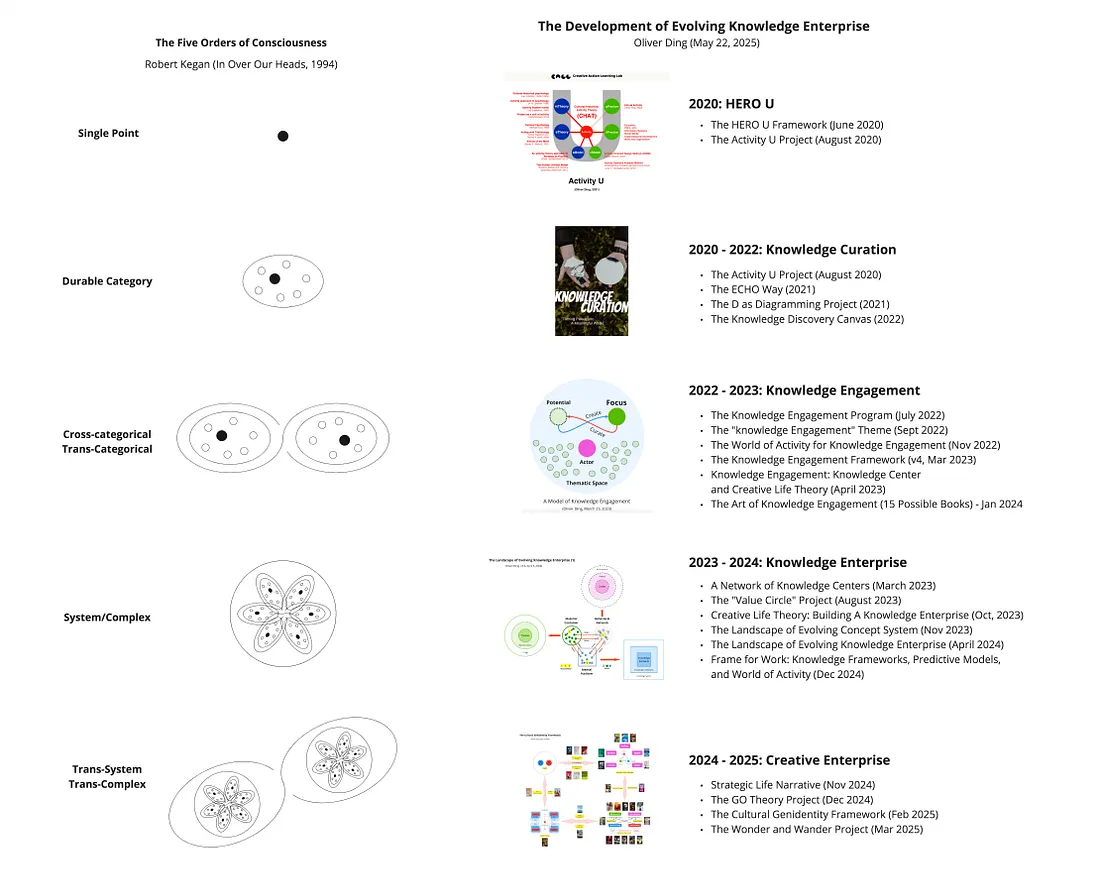
This trajectory became one of the case studies in the Wonder and Wander project — the project designed to provide an empirical foundation for the Evolving Knowledge Enterprise model itself.
3.6 The Theory as Enterprise Model: Wonder and Wander (2025)
The Wonder and Wander project reflected a characteristic pattern in my creative practice: when a model or concept feels theoretically significant, I undertake a dedicated empirical study to test and develop it, collecting the material into a book draft that closes the project. The project ran eight case studies, each examining a different knowledge enterprise from the outside — analyzing how it had grown, what structural stages it had passed through, and how its development illuminated or challenged the model's predictions. This was Analyzing work: systematic, retrospective, empirically grounded.
At the end of the project, I synthesized the insights from all eight cases into a new integrative model: the Theory as Enterprise framework. The original Evolving Knowledge Enterprise model was not abandoned; it was validated. But in the process of validation, it was also transformed — absorbed into the new model as one layer of a richer, multi-level structure. The empirical work had not merely confirmed the model; it had revealed dimensions of enterprise development that the original model had not captured.
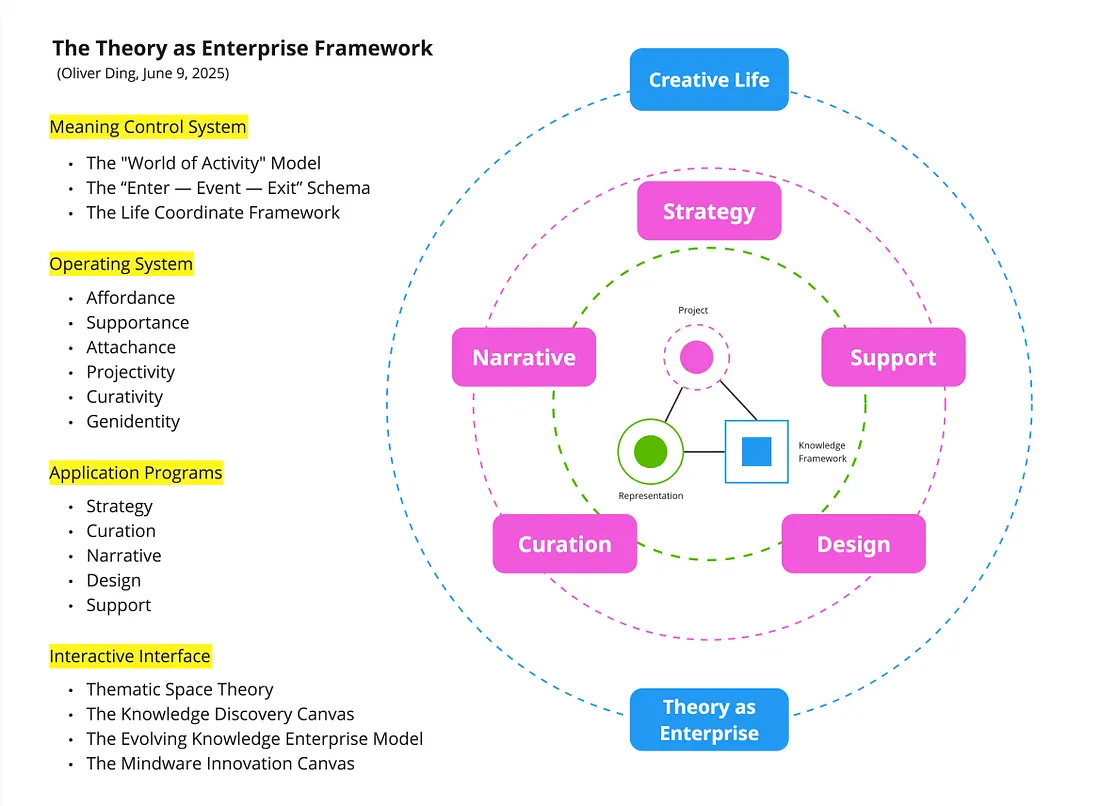
And then something unexpected happened. Looking at what the project had produced — the new model, the eight cases, the book draft — I felt, suddenly and unmistakably, that the original Evolving Knowledge Enterprise model was too simple. Not wrong. Not useless. But inadequate to the complexity that the empirical work had revealed. This was not a gradual realization; it arrived as a shift in perspective, the kind of change that reorganizes what you thought you knew. The cognitive terrain had changed. What had looked sufficient from before the project looked, from after it, like a sketch of something far more intricate.
This moment deserves naming: it was a Creative Watershed within the Analyzing phase itself. The project had been designed to validate a model; it ended by transforming the theorist's relationship to that model. The Analyzing had generated its own Advancing.
3.7 The Enterprise Development Framework (2025)
In October 2025, I developed a five-stage Enterprise Development framework organized along a diachronic axis. The five stages describe how an enterprise moves from initial formation through increasing complexity, from a nascent thematic commitment to a mature platform capable of generating new enterprises of its own.
This framework completed something that had been implicit since the Wonder and Wander project. The Theory as Enterprise model produced by that project was primarily a synchronic structure: a three-layer architecture describing the depth of an enterprise at any given moment — its mental platform, behavioral network, and material container. What it did not yet provide was an account of how an enterprise moves through time. The Enterprise Development Framework supplied precisely this missing dimension: a five-stage diachronic arc that traces the temporal unfolding of an enterprise from its beginning to its maturity.
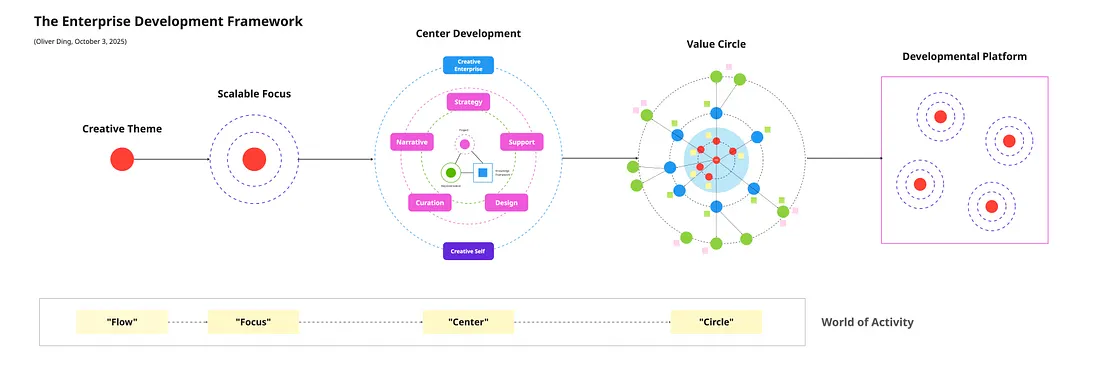
Together, the two models — Theory as Enterprise (synchronic, three-layer) and Enterprise Development (diachronic, five-stage) — constitute a complete model of Enterprise. One captures the structural depth of an enterprise at a moment; the other captures the developmental trajectory of an enterprise across time. Neither is reducible to the other; both are necessary for a full understanding of what an enterprise is and how it grows.
Looking back from 2026, this complementarity has a familiar shape: it mirrors the Weave Basic Form itself, which integrates synchronic and diachronic dimensions into a single structural framework. At the time the two Enterprise models were developed, the Weave vocabulary was not yet available to name this relationship. But the relationship was real — enacted in practice before it could be articulated in theory. Once again, the dance preceded the name.
3.8 A Comparative Review: Models Evolving with Practice
Looking across the full succession of models developed throughout this journey, a structural pattern emerges: models did not evolve in a vacuum. They evolved in direct response to the complexity that the enterprise had generated at each stage — and they served two distinct functions depending on whether they belonged to the Advancing or Analyzing mode.
In 2022, the enterprise was at the stage of building its first knowledge center. The BKE three-phase model was exactly what was needed: a practical, forward-facing guide for growing a knowledge enterprise deliberately, phase by phase. It was an Advancing model — a strategic framework that oriented decisions about what to build next. The Thematic Landscape Map, developed four months later, complemented it from the Analyzing side: a spatial snapshot of what had already been built, making the full landscape of the enterprise visible for the first time.
By 2024, the enterprise had grown substantially more complex — a network of knowledge centers, each with its own theoretical approach, operating under a meta-center. Two new models responded to this complexity. The Platform Genidentity Matrix (an Analyzing model) provided a multi-level framework for tracking objectification processes across six construal levels simultaneously, revealing the Platform stage as a qualitatively new structural condition. The Evolving Knowledge Enterprise model (initially a strategic framework) provided a three-dimensional map for managing each knowledge center's landscape — Mental Platform, Behavioral Network, and Material Container — and proved its value as a practical tool for identifying gaps and guiding decisions.
By 2025, the enterprise was ready for its most comprehensive Analyzing phase yet. The Knowledge Discovery Canvas organized a full six-year review across four dimensions of engagement. The Wonder and Wander project went further: eight empirical case studies tested the Evolving Knowledge Enterprise model against external cases, producing the Theory as Enterprise framework as a synthesis. And the Enterprise Development Framework (October 2025) added the diachronic dimension that the earlier three-dimensional model lacked — a five-stage temporal arc complementing the synchronic three-layer structure.
A particularly significant complementarity emerged across the 2025 models. The Theory as Enterprise framework produced by the Wonder and Wander project was primarily synchronic: a three-layer structure describing the depth of an enterprise at any given moment. The Enterprise Development Framework developed in October 2025 supplied the missing diachronic dimension: a five-stage arc tracing how an enterprise unfolds across time. Together, they constitute a complete model of Enterprise — synchronic depth and diachronic trajectory, neither reducible to the other. At the time, this complementarity was enacted in practice without being explicitly named. Looking back through the lens of Weave-the-Theory, its shape is immediately recognizable: it mirrors the Basic Form itself, which integrates synchronic and diachronic dimensions into a single structural framework.
Taken together, these models tell a story of co-evolution: each Advancing phase generated new complexity, and each Analyzing phase produced the models adequate to that complexity. The models did not anticipate the practice; they followed and illuminated it. And in several cases — most strikingly in the Wonder and Wander project — the Analyzing phase itself generated its own Advancing, producing models and concepts that exceeded what the original analysis had set out to find.
There is a final observation that only becomes visible from the distance of 2026. What I was doing throughout this journey was practicing Strategic Curation — a concept that is itself one of the core contributions of Curativity Theory. I was curating my own theoretical enterprise: selecting, organizing, and presenting the elements of the journey in ways that made the whole visible and usable. But this self-referential character was not something that emerged from maturity. It was built into Curativity Theory from the very beginning: in the 2019 book draft, I explicitly predicted that Knowledge Curation projects would develop my curatorial capacities, which would in turn develop Curativity Theory itself. The loop was anticipated before it was enacted.
Looking back now through the lens of Weave-the-Theory, I can see that this framework was operating throughout the entire journey — Creativity Line and Curativity Line alternately active, weave-points being inhabited and developed — long before the framework had a name or a shape. Weave-the-Theory arrived as a retrospective articulation of a dynamic that had already been unfolding. The framework did not create the dance; it named it.
Part 4. The Concept: Enterprise
The Concept level in Weave-the-Theory is where integration happens. If Themes are lived from the inside and Models map their structure from the outside, Concepts name the deeper idea that the themes and models together express. A Concept is grounded in prior intellectual traditions, precisely defined, and capable of doing theoretical work across contexts beyond the case that generated it.
In this article, the Concept is Enterprise — not as a vague synonym for "activity" or "project," but as a precisely defined theoretical proposition about the nature of long-term, self-directed creative work.
The path to this Concept was not direct. It ran through four related Themes, each arriving at a different moment in the journey, each illuminating a different facet of the same underlying structure. Together, these themes converged on Enterprise as the concept that could unify them all.
4.1 Theme 1: Knowledge Enterprise
The first theme arrived in May 2022, with the explicit naming of "knowledge enterprise" as a framework for understanding the Curativity journey. At this stage, enterprise referred specifically to knowledge work: the self-directed, multi-year activity of building a theoretical body, developing its applications, and constructing the centers and programs through which that body could be shared.
The Gruber reference was important here. Gruber's "Network of Enterprise" placed the concept within a tradition of thinking about creative work as organized around multiple, simultaneous, long-term enterprises rather than around individual projects or tasks. What I added to Gruber's framework was the developmental dimension: enterprises grow through stages, and each stage has its own structural characteristics and challenges.
4.2 Theme 2: Curativity Knowledge Enterprise
The second theme — the "Curativity" knowledge enterprise as a specific case — arrived in September 2022, when the full landscape of the Curativity development was mapped for the first time. This theme was not abstractly theoretical; it was the concrete instance of knowledge enterprise development that the general framework was designed to illuminate.
What this theme added to the first was specificity: the enterprise was not just any knowledge enterprise, but one organized around a distinctive ontological invention (Curativity), deploying a particular meta-theoretical approach (the Ecological Practice Approach), and developing through a characteristic rhythm of advance and analysis. The specific case began to reveal the general pattern.
4.3 Theme 3: Thematic Enterprise
The third theme emerged in 2025, when the concept of enterprise was extended beyond knowledge work to cover any long-term creative activity organized around a central theme. Thematic Enterprise is the general case of which Knowledge Enterprise is a specific instance.
This extension was theoretically significant. It meant that the concept of enterprise was not limited to theory-building or knowledge production. A cultural enterprise, a business enterprise, an artistic enterprise — all could be understood through the same framework, as long as they shared the essential features: a central theme, a self-directed developmental trajectory, and the characteristic rhythm of advance and analysis that generates new knowledge, new structures, and new relationships over time.
4.4 Theme 4: Theory as Enterprise
The fourth theme — Theory as Enterprise — arrived in March 2025 as the articulation of what the Curativity journey had been all along. Theory as Enterprise is Thematic Enterprise applied specifically to the work of building a theoretical body: the claim that a theory is not a static object but a living enterprise, and that the activity of developing a theory over years — through projects, publications, dialogues, and revisitations — is itself a form of creative enterprise deserving analysis and strategic engagement.
This theme is distinctive because it challenges a common assumption about theory: that a theory is something you finish, after which it exists independently of the person who built it. Theory as Enterprise insists that theories are never finished; they are always in development, always being extended, revised, and recontextualized by the ongoing enterprise of their creator. The theory lives in and through the enterprise.
4.5 Theme 5: Venture — A Concept Shapes Its Own Vocabulary
The development of a concept does not only produce theoretical clarity; it also creates new constraints. This became apparent in April 2026, while writing this very article.
In preparing a new Weave model that combined the FFCC framework with the Enterprise Development framework, I was constructing a sequence to represent the successive stages through which an agency's creative work materializes over time: Project → Enterprise → Platform → Culture. Each term in the sequence was meant to name a distinct developmental stage, moving from the most contained to the most expansive.
The difficulty was that Enterprise, now a formally defined Concept, could not comfortably occupy a single position in this sequence. As a Concept, Enterprise names the whole class of long-term, self-directed, thematically organized creative commitments — it is an umbrella term covering everything from a nascent knowledge project to a mature cultural institution. But the sequence required a term for a specific intermediate stage: the moment when a series of projects has cohered into a recognizable enterprise, but has not yet achieved the scale, stability, and influence of a Platform. Enterprise was simultaneously too broad (as a Concept) and too narrow (as a stage label).
The solution was to introduce a new term: Venture. Venture occupies the intermediate position in the sequence — Project → Venture → Platform → Culture — naming the stage at which a cluster of related projects has taken on a recognizable identity and trajectory, but has not yet matured into a Platform. Enterprise, as a Concept, continues to name the whole category; Venture, as a Theme-level term, handles the specific positional work within the sequence without creating conceptual confusion.
This episode illustrates something theoretically important: the formation of a Concept constrains the vocabulary available at the Theme level. When Enterprise was merely a Theme — a lived, practiced inhabitation of an idea — the word could be used loosely, stretched across different contexts without tension. Once it became a precisely defined Concept, the precision itself created a new problem: the word could no longer do double duty. The concept-theme distinction, which Weave-the-Theory treats as a structural feature of theoretical knowledge, turns out to have practical consequences for how vocabulary evolves. Concepts and Themes must be kept distinct not only analytically, but lexically.
This is the fifth theme in the convergence toward Enterprise: not a new direction of application, but a reflexive moment in which the concept's own development reshapes the theoretical landscape it inhabits.
4.6 The Concept of Enterprise
Five themes, arriving over three years and across different registers of experience, each illuminating a different aspect of the same underlying structure. The concept that unifies them is Enterprise: a long-term, self-directed, thematically organized sequence of actions that unfolds over time, generates knowledge and structure as by-products of its own operation, and develops through characteristic stages that can be mapped, analyzed, and strategically engaged.
Enterprise, understood this way, is a concept that belongs simultaneously to the theory of knowledge production (where it clarifies what it means to develop a theory over time) and to the theory of creative life (where it clarifies what it means to commit to a theme and follow it wherever it leads). This dual belonging is not a weakness; it is precisely the theoretical utility of the concept, for it connects the inner life of the creator — the subjective experience of commitment, of advance and analysis, of building toward something not yet fully visible — to the structural patterns that theoretical frameworks can illuminate and strategic thinking can engage. The distinction between Enterprise and Activity that this concept implies — its relationship to the broader theoretical framework of Life as Activity — is the subject of the next part.
Part 5. The Principle: Enterprise and Activity
If the Concept of Enterprise names the deep idea that the case expresses, the Principle asks: what is the governing insight that unifies the whole? In the Weave-the-Theory framework, Principles are the most abstract claims that a theoretical development earns the right to make — not summaries of what was found, but structural insights that reorganize how we understand the territory.
The Principle of this case concerns the relationship between Enterprise and Activity: what distinguishes them, why both are necessary, and how they function together as paired concepts within the Life as Activity theoretical framework.
5.1 Enterprise vs. Activity: The Core Distinction
The distinction between Enterprise and Activity is not merely terminological. It marks a fundamental difference in the mode of engagement and the unit of analysis.
Activity, in the tradition developed from Vygotsky through Leontiev and Engeström, is a synchronic construct. An activity system captures the structure of a collective practice at a given moment: the subject, the object, the mediating tools, the rules, the community, and the division of labor. This structure is enormously powerful as an analytical tool — it makes visible the social and material complexity of what people do at a given time. But its synchronic orientation means that it captures a cross-section of practice rather than a trajectory. It shows the organized structure of action; it does not show the long creative arc through which a person builds something over the years.
Enterprise addresses this gap. It is the diachronic complement to Activity's synchrony. Where Activity asks "what is the structure of this practice right now?", Enterprise asks "what is the trajectory of this creative commitment over time?" Where Activity zooms in to reveal the complexity of a moment, Enterprise zooms out to reveal the shape of a journey.
In the Weave-the-Life framework, this distinction is expressed geometrically: an Enterprise is a chain — an ongoing sequence of endeavors that unfolds over time — while an Activity is a node within that chain, a self-contained system composed of coordinated actions. Enterprise emphasizes temporal unfolding; Activity emphasizes systemic organization. Neither is reducible to the other; both are necessary for a complete understanding of creative life.
5.2 The Weave-the-Life (v2.0) Model
The Weave-the-Life Framework (v2.0, November 11, 2025) provides the structural context in which Enterprise and Activity are formally positioned as paired concepts.
The model integrates four dimensions: Subjective, Objective, Part, and Whole. The Subjective–Objective dimensions capture diachronic aspects of life — the unfolding of individual experience and collective existence over time. The Part–Whole dimensions capture synchronic aspects — the structural depth of life at any given moment.
Four weave-points emerge from these intersections: Self (Subjective × Part), Enterprise (Subjective × Whole), Project (Objective × Part), and Activity (Objective × Whole).
Enterprise occupies the Subjective–Whole position: it is the long-term, self-directed trajectory through which an individual subject builds something that transcends any single project or moment. Activity occupies the Objective–Whole position: it is the collective system of coordinated action through which social life is organized at the level of the whole. The pairing of Enterprise and Activity at the Whole dimension captures both the subjective experience and the objective structure of creative engagement at scale.
This model situates Enterprise within the ontological framework of Life as Activity. It is not an add-on to Activity Theory; it is a complement that restores the subjective dimension that Activity Theory — by design — places in the background. Together, Enterprise and Activity offer a complete picture: the creator's long-term trajectory (Enterprise) unfolding through the organized systems of collective practice (Activity) in which they participate.
5.3 Enterprise in Life-as-Activity (v3.2)
The incorporation of Enterprise into the Life as Activity framework at the ontological level — as one of three paired concepts in the Weave-the-Life v2.0 model — marks a significant development in the theoretical system.
The traditional Activity Theory tradition, from Leontiev onward, has been primarily concerned with understanding what people do in terms of activity systems: the collective, socially mediated structures through which human beings act in the world. This tradition has been enormously productive, but it has tended to place the long-term subjective trajectory of the individual creator — the experience of building something over years, of committing to a theme and following it wherever it leads — in the background.
The concept of Enterprise foregrounds precisely this subjective trajectory. It gives the actor back their experience: the sense of building toward something not yet complete, of engaging in a conversation with one's own past work, of advancing into new territory and then turning back to analyze what the advance has produced. This is the experience that the AA pattern describes — and it is an experience that Activity Theory, with its synchronic orientation, does not have the conceptual resources to fully capture.
By incorporating Enterprise as a concept paired with Activity in the Life as Activity framework, the theoretical system gains the capacity to address both the synchronic structure of practice (Activity) and the diachronic trajectory of creative commitment (Enterprise). The framework becomes adequate to the full complexity of creative life — not just what people do at a given moment, but what they are building over time.
Part 6. Weave-AA: A Joint Framework in the Landscape of Life-as-Activity
The final move of this article is to situate Weave-AA — the joint framework of Weave-the-Theory and the AA pattern — within the broader theoretical context of Life-as-Activity. Weave-the-Theory provides the spatial structure of theoretical knowledge; AA provides the dynamic through which a creator moves through that structure over time. Together they form a single methodological unit: Weave-AA. This situating serves two purposes: it grounds Weave-AA in the established theoretical vocabulary of Life-as-Activity, and it opens the question of how far Weave-AA extends beyond the specific context of theoretical work.
Before situating Weave-AA within this framework, it is worth noting what the Life-as-Activity approach is. It is not a single model but a knowledge system composed of a family of interconnected frameworks. These include the Anticipatory Activity System (AAS), which addresses the structure of anticipatory and reflective activity; Self-referential Activity (SRA), which addresses the special condition in which an activity takes itself as its own object; and the Weave-the-Life model, which provides the ontological foundation for understanding how individual and collective life are woven together across synchronic and diachronic dimensions. More recently, the Weave-the-Activity model has been under development as a further addition to this family. Weave-AA connects to several of these frameworks simultaneously — which is part of what makes it a genuinely integrative methodological contribution rather than a standalone technique.
6.1 Weave-AA and the First/Second-order Activity in AAS
The Anticipatory Activity System (AAS) framework distinguishes between First-order Activity and Second-order Activity. First-order Activity is directed toward an object in the world — it is the work of doing, making, building, transforming. Second-order Activity is directed toward the First-order Activity itself — it is the work of reflecting on, analyzing, and understanding what the First-order Activity is doing and producing.
Weave-AA maps directly onto this distinction:
Advancing is First-order Activity: the work of building Curativity Theory, developing knowledge projects, constructing knowledge centers, writing articles, and book drafts. It is directed toward an object — the theoretical enterprise — and it produces that enterprise's outputs.
Analyzing is Second-order Activity: the work of stepping back from the enterprise, mapping what has been built, examining its structure with new analytical tools, and generating the conceptual frameworks that make further Advancing more intentional and productive. It is directed toward the First-order Activity itself.
In the AAS framework, the relationship between First-order and Second-order Activity is not sequential but recursive: Second-order Activity produces new understanding that enables more effective First-order Activity, which in turn generates new material for Second-order Activity to examine. This is precisely the dynamic that the dance metaphor captures: Advancing and Analyzing are partners, each enabling and enriching the other.
6.2 Weave-AA and Self-referential Activity
There is a further dimension of the AA pattern that the AAS framework alone does not fully capture: its self-referential character in this particular case.
Self-referential Activity (SRA) is the condition in which the object of an activity is the activity itself — or more precisely, in which the tools and frameworks being developed through the activity are simultaneously the tools and frameworks being used to analyze the activity. This is a special case of Second-order Activity, distinguished by the collapse of distance between the analyzing subject and the analyzed object.
The Curativity case is a striking example of SRA. Throughout the six-year journey, the concepts and frameworks being developed through the enterprise — Curativity, Strategic Curation, Knowledge Enterprise, Thematic Enterprise — were simultaneously the concepts and frameworks being used to analyze and manage the enterprise. I was building a theory about how knowledge is curated and enterprises are grown, while curating the knowledge and growing the enterprise that the theory described.
This self-referential character was not an emergent property of the enterprise's maturity — it was built into Curativity Theory from the very beginning. In the 2019 book draft, I explicitly identified Knowledge Curation as a direct application of Curativity Theory, and predicted that the more Knowledge Curation projects I undertook, the more developed my curatorial capacities would become — and consequently, the more developed Curativity Theory itself would become. This prediction proved accurate: in 2020, Knowledge Curation became the primary direction of applied development, and the theory and its practice advanced together. The self-referential loop was not discovered retroactively; it was anticipated at the moment of the ontological invention itself.
6.3 Weave-AA as a Universal Pattern
Weave-AA was identified through a case of theoretical work. But does it extend beyond theory-building? Is it a pattern specific to intellectual enterprises, or does it describe a more general dynamic of creative engagement?
The answer suggested by the Life-as-Activity framework is closer to home. Weave-AA was identified through the Weave-the-Theory case, but its implications extend to the other Weave models within the Life-as-Activity knowledge system. If Weave-the-Theory has AA as its companion methodology — Advancing along the Creativity Line, Analyzing along the Curativity Line — then the question naturally arises: does each Weave model generate its own companion dynamic? What would Weave-AA look like when applied through Weave-the-Life, Weave-the-Narrative, or the emerging Weave-the-Activity model? The structural logic of Weave-AA — a creator moving through a framework's lines and points in alternating modes of production and reflection — is not specific to theoretical work. It is a general feature of how sustained creative engagement inhabits any Weave structure over time. The Curativity case makes this dynamic visible for the first time; the other Weave models await their own AA analyses.
What Weave-the-Theory provides — and what the AA pattern makes explicit — is a vocabulary and a structure for this universal dynamic. Advancing and Analyzing are not merely descriptive labels; they are conceptual handles that allow a creator, in any domain, to understand where they are in the rhythm of their own enterprise, what kind of work the current moment calls for, and how to move between the two modes with greater intentionality.
This is the final contribution of this case to the Weave 42 collection: Weave-AA, emerging from a specific case of theoretical work, is offered here as a general framework for understanding sustained creative commitment. It belongs not only to the methodology of theory-building but to the broader ecology of creative life.
Part 7. The Weave-the-Theory Toolkit (v1.0)
This case is among the more complex applications of Weave-the-Theory attempted so far: the time span is long, the theoretical project is multi-layered, and the succession of models — each developed at a different moment and serving a different analytical function — is unusually rich. This complexity is an opportunity. The case has brought into view a range of analytical tools, each of which can be detached from this particular case and used independently in future Weave-the-Theory applications.
The tools are organized by their primary function within the Weave-AA framework:
Advancing — Strategic Frameworks (Predictive Models):
- The BKE Model — a three-phase framework for growing a knowledge enterprise deliberately, phase by phase
- The Evolving Knowledge Enterprise Model — a three-dimensional framework (Mental Platform / Behavioral Network / Material Container) for mapping the landscape of a knowledge center and guiding its development
- The Enterprise Development Framework — a five-stage diachronic arc for understanding and planning how an enterprise unfolds over time
Analyzing — Mental Platforms (Analytical Models):
- The Thematic Landscape Map — a spatial snapshot of a thematic enterprise at a given moment, organized around three concentric circles (Theme / Work / Play)
- The Platform Genidentity Matrix — a multi-level framework for tracking concept objectification across six construal levels
- The Knowledge Discovery Canvas — a four-quadrant tool (Theory / Practice / End / Means) for full-spectrum review of a knowledge enterprise
- The Theory as Enterprise Framework — an integrative model situating theoretical work within the broader context of Creative Life Theory
Together, these seven tools constitute the first version of a Weave-the-Theory toolkit: instruments for Advancing and Analyzing theoretical work, accumulated through practice in the Curativity case and now available for broader application. Future cases will expand and refine this toolkit.
Postscript
The Weave-the-Theory framework has been applied to a growing number of cases across different domains of creative and theoretical work. Among these applications, two have specifically examined Dramatic Life Patterns: the Revisiting–Rebuilding practice — a pattern organized around the Before–After temporal structure and the dynamics of creative identity development across time — and Creative Watershed — a pattern organized around structural turning points, moments at which the terrain of a creative life changes direction irrevocably.
The present article adds a third application to the Dramatic Life Pattern series: Weave-AA, the alternating dance of Advancing and Analyzing woven into the structural space of Weave-the-Theory.
There is a deeper observation available here. The three patterns are not independent. RR is frequently the occasion for Analysis: returning to past work is often what enables a creator to see, for the first time, the pattern of what they have built. Creative Watershed is frequently the occasion for a new phase of Advancing: a structural turning point in a creative life often marks the opening of new territory that has not yet been explored. Weave-AA is the rhythm within which both RR and Creative Watershed occur.
The three Dramatic Life Patterns — RR, Creative Watershed, and Weave-AA — are thus not separate phenomena but interlocking dimensions of the same creative life. As the systematic development of Dramatic Life Pattern continues, understanding the relationships between these patterns will be as important as developing each one individually. That work belongs to future articles. For now, it is enough to have named the dance.
Appendix: Source Articles
Listed in chronological order:
- Curativity: The Ecological Approach to General Curation Practice (book draft, March 2019)
- CALL: How to Grow A Knowledge Enterprise (May 6, 2022)
- Slow Cognition: Mapping Thematic Landscape (Curativity, 2019–2022) (September 2, 2022)
- Mapping Strategic Moves #12: The House of Thematic Genidentity and the Concept Development Framework (October 8, 2024)
- Curativity as an Ontological Invention (March 30, 2025)
- Curativity and Creative Dialogue (March 2025)
- Curativity: A Creative Enterprise (March 31, 2025)
- Curativity for Personal Practice (March 2025)
- Mapping the "Curativity" Thematic Enterprise (April 14, 2025)
- The Cultural Projection Model (2025) (activityanalysis.net)
- Developmental Projects (book, v1, November 30, 2025)
V1.0 - April 22, 2026 - 9,884 words