
Weave: A Model of the Actor

by Oliver Ding
April 29, 2026
This article is parto of Weave the Life: The Life-as-Activity Approach (v4.0) and Personal Knowledge Ecology (Possible Book, v1, 2026)
On March 13, 2026, I completed a new diagram: The Landscape of Anticipatory Cultural Sociology (ACS) v1.2.
The diagram was the natural endpoint of two weeks of intensive work. ACS development had been advancing simultaneously along three axes since January: the Ontology of Thematic Creation, the operational structure of Cultural Projection, and the structural patterns of the Bureaus of Agency. By mid-March, all three series of articles had reached a point where they could pause — not because the work was finished, but because a stage had completed itself. The three streams had each run their course for this phase, and the landscape had reached a new level of articulation.
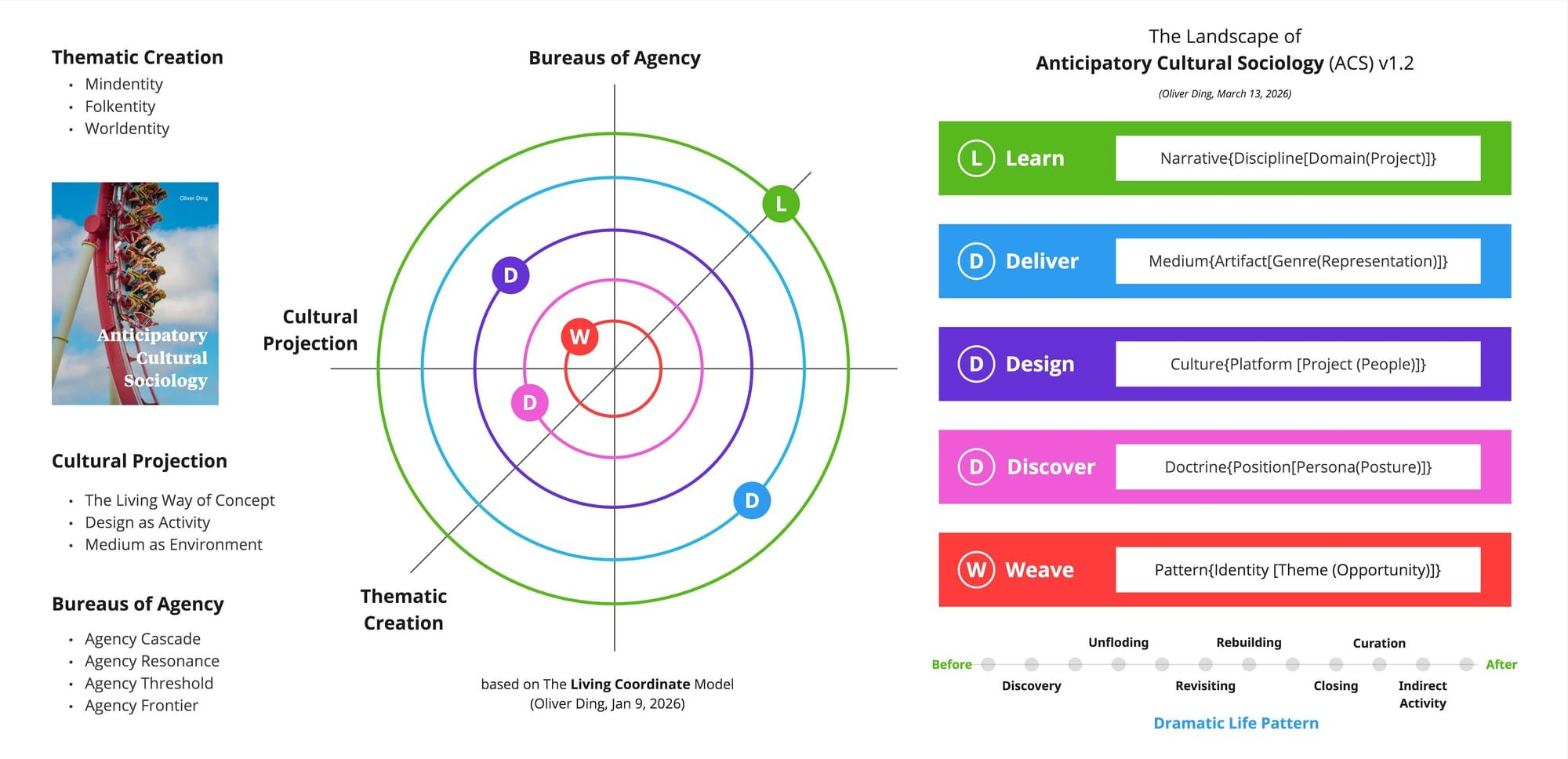
Looking at the completed diagram, something unexpected arrived.
The phrase "model of the actor" came to mind — a concept I had encountered in 2023, while reading a collection of discussion texts by theoretical sociologist Lui Ping-keung and his younger colleagues. I read these texts on weekend mornings, sitting at the sidelines of a football field while my son practiced with his team. In those recorded conversations about the development of theoretical sociology, the term "model of the actor" appeared repeatedly — used as a meta-analytical tool for comparing social theories across traditions, revealing what each theory assumes about human being without necessarily declaring it. Every social theory, in their view, carries an implicit model of the actor at its core.
At that time, I considered his over twenty years of development of theoretical sociology as a case of Creative Life Theory. I noted the concept. I moved on. Other work followed.
Now, more than two years later, looking at the ACS v1.2 diagram, the concept returned. And with it, a recognition: the three-dimensional, five-ring coordinate I had been building — not as a portrait of the person, but as a map of cultural development — had quietly become exactly that. A model of the actor.
The Question Behind Every Social Theory
Every social theory carries within it an implicit answer to a deceptively simple question: what kind of being is a human being? This answer — whether stated openly or buried deep in theoretical assumptions — is what we may call a model of the actor. It is the ontological core of a social theory, the figure of the human that makes the rest of the theoretical architecture possible.
Yet here is something worth noticing: social theorists rarely begin by constructing their model of the actor. The founding gestures of sociology — Durkheim's social facts, Weber's interpretive method, Bourdieu's field analysis — do not open with a declaration of what a person fundamentally is. They open with a map of the social world, a description of its structures, its mechanisms, its patterns. The model of the actor is implicit, embedded in the architecture, to be extracted by later analysts.
This is not accidental. Sociology has always maintained a careful distance from psychology. To announce a model of the actor too explicitly is to risk collapsing the social into the individual — to reduce collective phenomena to the sum of personal motivations.
Lui Ping-keung has made this operation explicit. In his comparative analysis of social theories, he treats the model of the actor as a meta-analytical tool — a lens for reading across theoretical traditions, revealing what each theory assumes about human being without necessarily saying so.
The Unexpected Reversal
And then, on the same day, returning home after a morning of tennis, the ACS v1.2 diagram just completed — something shifted.
Looking at the completed ACS v1.2 diagram, and thinking about its relationship to Strategic Developmental Psychology (SDP) — the mirror enterprise that had been established alongside ACS in January 2026, focused on individual life development where ACS focuses on cultural life development — a recognition arrived quietly:
The three-dimensional, five-ring structure of ACS v1.2 applies equally to SDP.
The same coordinate. The same five orientations. The same container logic of individual-at-center, world-at-periphery. The same Dramatic Life Pattern.
If the diagram applies to both ACS (cultural life development at the collective scale) and SDP (individual life development at the personal scale), then the diagram is not specific to either. It is describing something more fundamental than either cultural sociology or developmental psychology. It is describing the actor — the generic cultural actor — as such.
This was not the intended outcome. ACS had been built as a map of the social world, not a portrait of the person who inhabits it. The strategy had been sociological throughout: map the terrain, describe the structures, trace the mechanisms. The model of the actor had never been the explicit goal.
But this is precisely how the sociological tradition has always worked. Durkheim was not trying to theorize the actor; he was trying to explain suicide rates and collective effervescence. Bourdieu was not trying to draw a portrait of the person; he was trying to analyze the reproduction of social class. The model of the actor that emerges from their work is a consequence of the theoretical architecture, not its starting point.
ACS followed the same path — not by imitation but by structural necessity. Working from the World of Life ontology, through the three axes of Thematic Creation, Cultural Projection, and Bureaus of Agency, across five method-orientations, the landscape of cultural development was mapped. And when the mapping was complete, the figure it had been tracing all along became visible:
A model of the actor.
The deeper logic of this path was set in place even before ACS was named. The ACS-SDP symmetry — one enterprise attending to cultural life at the collective scale, the other attending to individual life development at the personal scale — was not a post-hoc arrangement. It was built into the World of Life ontology from the beginning: Individuals and Collectives as two distinct boundaries of the same social world, each calling for its own theoretical enterprise. When ACS v1.2 was complete and the comparison with SDP became natural, the symmetry did what symmetry is designed to do — it revealed the shared structure beneath two different surfaces.
A Model of the Cultural Creator
What does the ACS model of the actor look like?
It's a model of the Cultural Creator.
It is organized around three dimensions — the axes along which a cultural actor exists:
The actor creates themes (Thematic Creation): bringing forth Mindentities from psychological ownership, projecting them through social engagement as Folkentities, watching them — if the conditions are right — settle into the cultural background as Worldentities. This is the actor as ontological origin of cultural life.
The actor projects into the world (Cultural Projection): discovering personal orientation (Doctrine, Position, Persona, Posture), designing cultural engagements (Culture, Platform, Project, People), delivering into cultural circulation (Medium, Artifact, Genre, Representation). This is the actor as operative presence in social space.
The actor navigates structural configurations (Bureaus of Agency): encountering situations of Cascade, Resonance, Threshold, and Frontier — structural patterns that shape what forms of agency are available at any given moment. This is the actor as positioned being, embedded in social terrain.
And it is organized around five orientations — the fundamental modes of cultural action:
Learn: the actor as recipient and developer of knowledge and skill — the necessary condition of all further action. Discover: the actor as explorer, seeking new connections, recognizing patterns not yet named. Design: the actor as builder, constructing cultural forms, platforms, and engagements. Deliver: the actor as contributor to cultural circulation, working through mediums, artifacts, and genres. Weave: the actor as integrator, holding the other four orientations together in the coherence of living practice.
The diagram itself enacts the model's logic: the actor is at the center (Weave, innermost), the world is at the periphery (Learn, outermost), and the movement between them — through Discover, Design, Deliver — is the substance of cultural life.
Now we can return to the definition that ACS carried from its earliest formulation:
Cultural development is a continuous, dynamic anticipatory activity of creating and curating concept systems and transforming them into thematic enterprises by weaving active agency and evolving structure within the social world.
This definition describes what cultural development does. The ACS model of the actor now provides its complement: a specification of the actor who is capable of this activity.
To create and curate concept systems → the actor must Learn and Discover.
To transform them into thematic enterprises → the actor must Design and Deliver.
To weave active agency and evolving structure → the actor must Weave — and here the connection runs deepest. "Weaving active agency and evolving structure" in the original definition corresponds directly to the symmetry between the Nine Aspects of Strategic Agency (active agency, the cognitive dimension) and the Four Bureaus of Agency (evolving structure, the structural dimension). Weave, as the innermost orientation, is the name for the action that holds these two dimensions together in living practice.
The word "weaving" was already in the definition from December 2025. The v1.2 diagram made it a named orientation. This was not a coincidence — it was the theory recognizing itself.
The v1.0 definition described the activity. The v1.2 model describes the actor adequately. They were always two faces of the same thing.
Weave: The Model of the Actor
At the end of March 2026, the ACS manuscript was released. In early April, the Revisiting–Rebuilding collection followed. On April 10, 2026, I launched the Landscape of Strategic Developmental Psychology (SDP, v1.2).
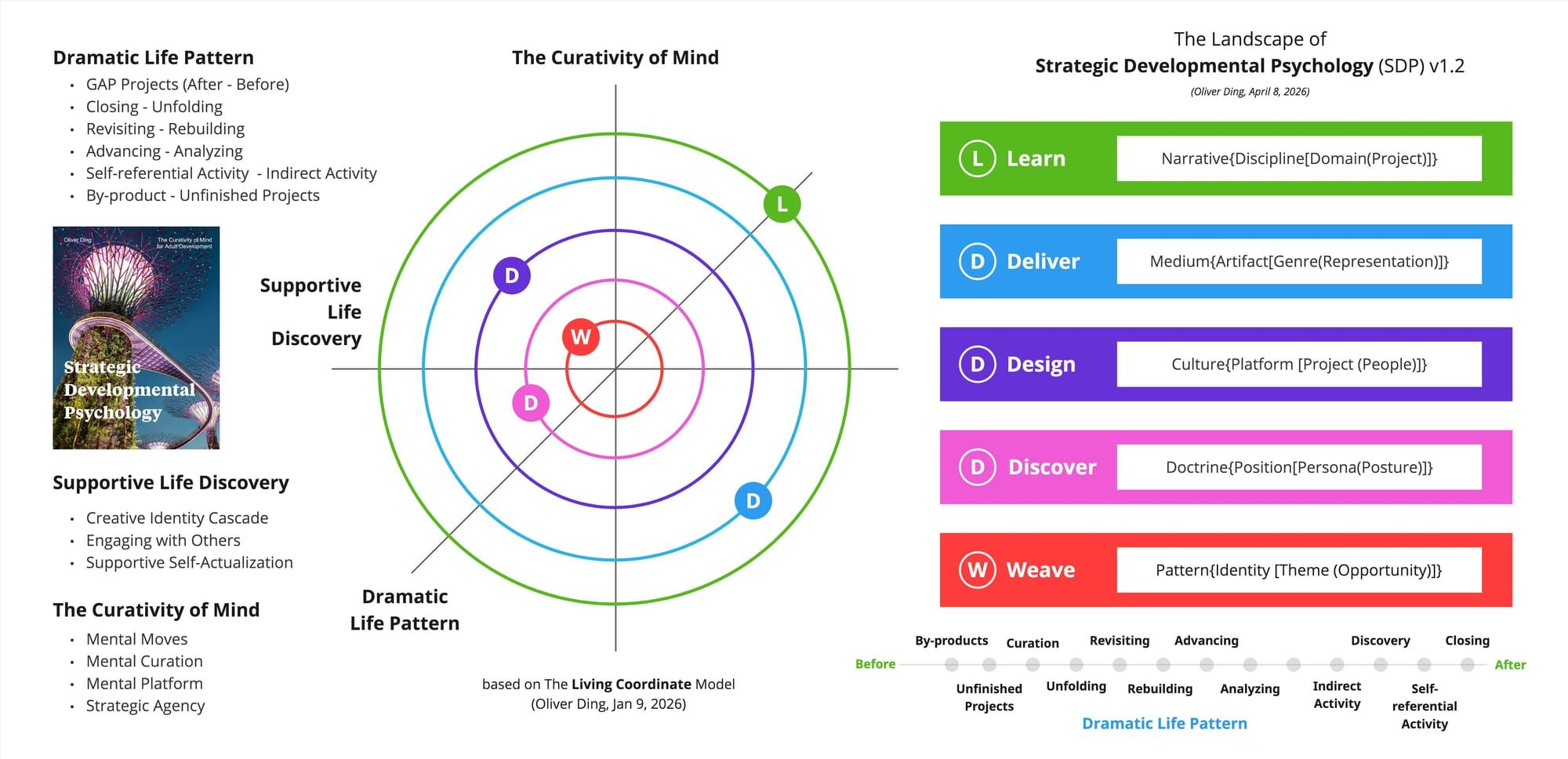
The five rings of the Living Coordinate model were detached from the ACS framework and attached to the SDP framework.
This shift pointed out a significant insight:
The Discover–Design–Deliver model is more specifically oriented toward cultural creators — those whose development is organized around the creation of new thematic enterprises. ACS's core concern is with this type of actor.
However, Weave and Learn apply to all people — they are two universal orientations that describe how any person develops, and it connects naturally to the existing literature in positive psychology, motivational psychology, action psychology, developmental psychology, and educational psychology.
Weave is the innermost ring; it names the integrative action that holds everything together: real practice is never single-mode. A cultural actor always simultaneously discovers, designs, delivers, and learns — and the action that holds these together, that weaves them into a coherent practice, is Weave. Its position at the center is its meaning.
Learn is not merely an additional orientation. It marks the condition of possibility for all the others: an actor who cannot learn cannot act. Knowledge and skill are the necessary antecedents of every cultural engagement. Its position in the diagram — the outermost ring, green — reflects this: it is where the world enters the actor, the interface between an actor's interiority and the cultural resources that surround them.
At that moment, I assigned the "Weave" theme to a general model of the actor, all people.
Weave the Mind
Back in 2023, from June 24 to July 3, 2023, I had a wonderful 10-day road trip with my wife and two little sons.
During the busy trip, I couldn’t take detailed notes. To record exciting moments, I used short, meaningful keywords to capture some insights while taking pictures. These short, meaningful keywords are Situational Themes of my life.
After returning to Houston, I listed 21 situational themes of the trip and made 21 thematic cards. One of them is “Weaving the Mind.”
On June 27, 2023, we visited the Museum of the Cherokee Indian. I saw a large unfinished basket that represents the Cherokee weaving history. I immediately recalled my childhood in a small village where people wove baskets. I also thought about Tim Berners-Lee’s 1999 book Weaving the Web: The Original Design and Ultimate Destiny of the World Wide Web.
I realized that there was an interesting difference in spatial structure between a basket and a web, even though they share the same weaving technique. A basket is a Container, while a web is a Network.
The word “weave” resonated because it named something I had been doing intuitively for years: bringing heterogeneous elements (theory, practice, lived experience) into a coherent pattern. But I had never formalized this as a method.
So, I came up with a new theme: Weaving the Mind. I used it as a metaphor and associated it with the Curated Mind project.
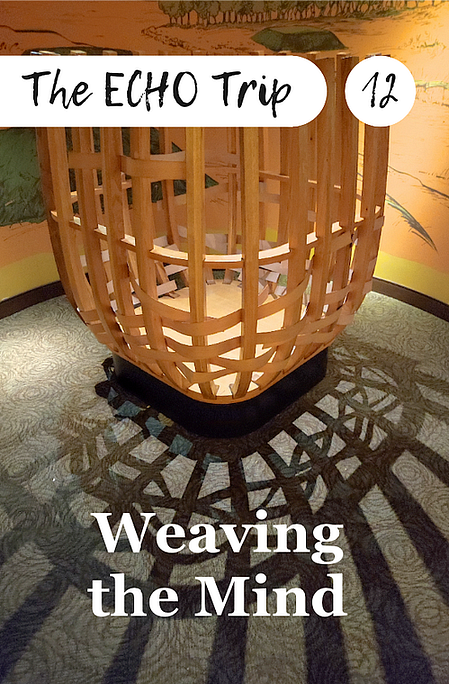
More specifically, I wanted it to represent my own approach to developing an interdisciplinary epistemological framework.
The "Weave" Basic Form
The “Weave” Ecological Metaphor was further developed in September 2025. It became a new focus in my creative flow at that time.
Between September 5 and 18, the metaphor went through rapid iteration:
- September 5: ChatGPT’s words inspired me to revisit the “Weaving the Mind” theme from 2023.
- September 9: I added the “Weaving” metaphor to a large diagram of World of Activity frameworks.
- September 13: I reviewed the discussion about it at a local library.
- September 13: I published an article to share the large diagram, mentioning the “Weaving” ecological metaphor.
- September 17: I designed the “Weaving the Frame” thematic card.
- September 18: During a run, the framework crystallized into its final form
On September 18, 2025, after publishing [Frame for Work] The Landscape of Creative Life Theory (v3.0) and Two Meta-Frameworks, I went for a run in a nearby park.
Meanwhile, I had a new idea about the “Weaving” ecological metaphor. I could use it to make a new framework for the World of Activity approach.
The insight came suddenly, as insights often do during physical movement. What if I could formalize the weaving structure — not as a metaphor, but as a basic form with clear diachronic and synchronic dimensions? After returning home, I made the diagram below in Miro.
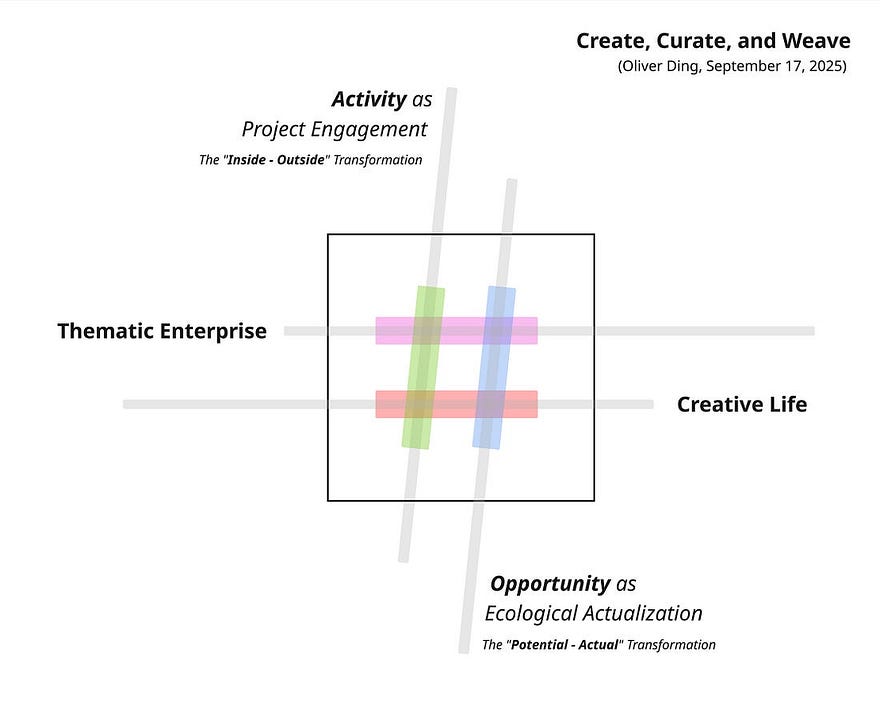
This is a four-dimensional model, weaving the following ideas:
- Creative Life
- Thematic Enterprise
- Activity as Project Engagement
- Opportunity as Ecological Actualization
In addition, I also identified four intersections in the model.
- Event: Activity + Thematic Enterprise
- Project: Activity + Ceative Life
- Concept: Opportuity + Creative Life
- Object: Opportunity + Thematic Enterprise
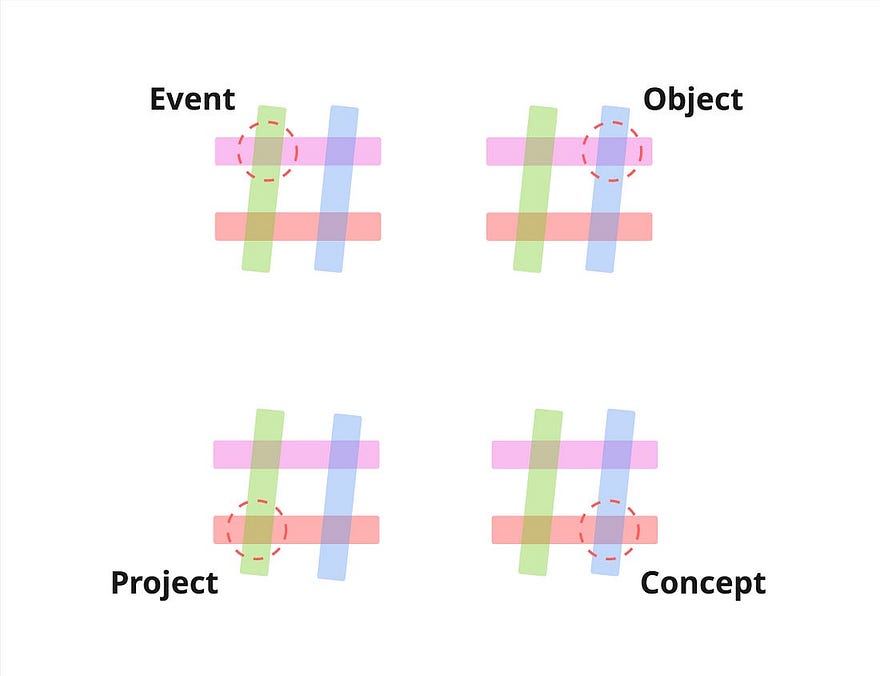
The diagram was named the “Create-Curate-Weave” schema (D7F2).
From September to October 2025, I continued developing the “Create — Curate — Weave” schema and used it to make several new versions for different case studies.
On October 9, 2025, to organize these variations into a coherent body of knowledge, I applied the Ecological Formism Framework to define the “Weave” Basic Form.
This is a super-simple diagram that frames the activity within the World of Activity as the synthesis of two diachronic dimensions and two synchronic dimensions. The model consists of four Weave-points (S1D1, S1D2, S2D1, S2D2), each representing a structural nexus where one synchrony dimension intersects with one diachrony dimension.
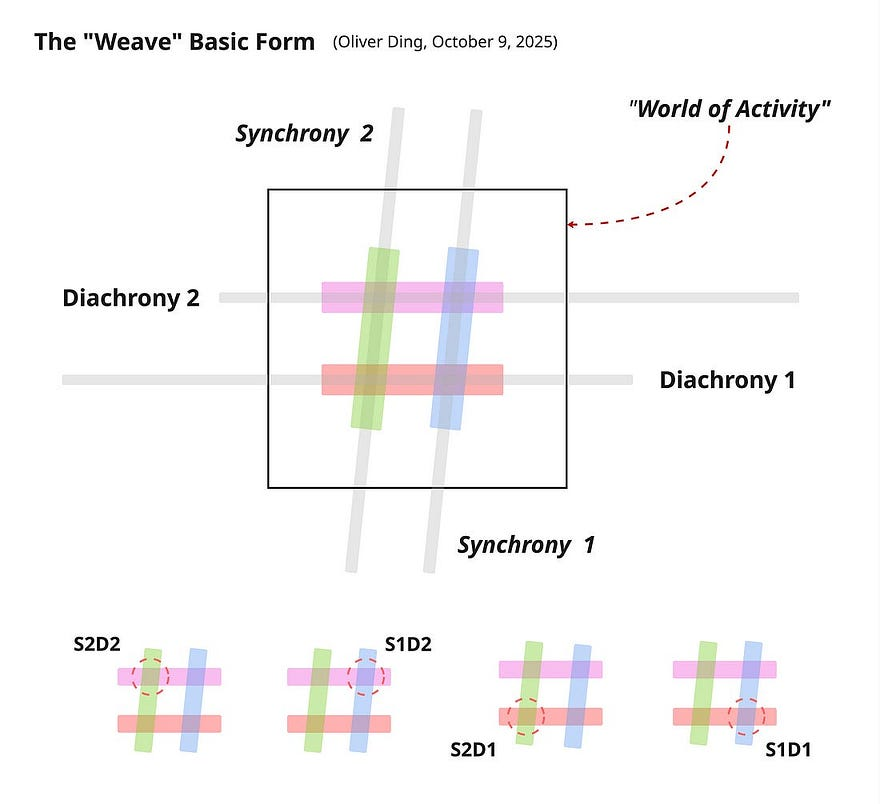
As an abstract model, the “Weave” basic form serves as the foundation for generating derived forms and situational frameworks.
From October to December 2025, the Weave Basic Form inspired me to run a series of concept curation projects, which led to a set of new diagrams and frameworks.
Weave the Life
Inspired by the early experiments with the Weave Diagram, I developed the Weave-the-Life (v1.0) Model on October 3, 2025 (see diagram below).
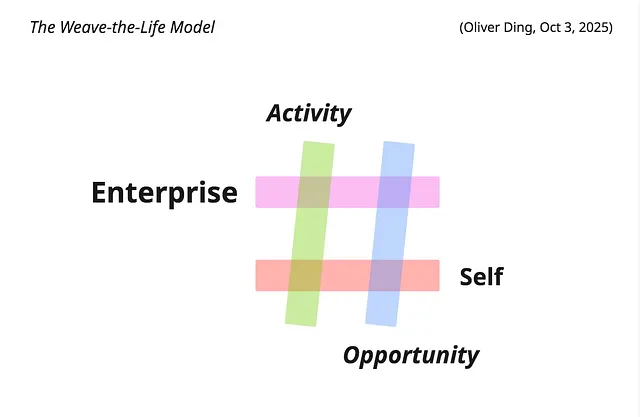
On October 13, 2025, I revisited the Weave-the-Life Model and developed a series of frameworks that together form the Weave-the-Life Framework Family:
- Weave-the-System
- Weave-the-Project
- Weave-the-Case
These three frameworks create a nested structure, providing a scalable way to connect the meso-level and the micro-level analysis. Further details are available in Life-as-Activity: The Weave-the-Life Framework (v1.5).
On November 11, 2025, I designed a new abstract diagram to represent the deep structure of the Weave-the-Life Framework.
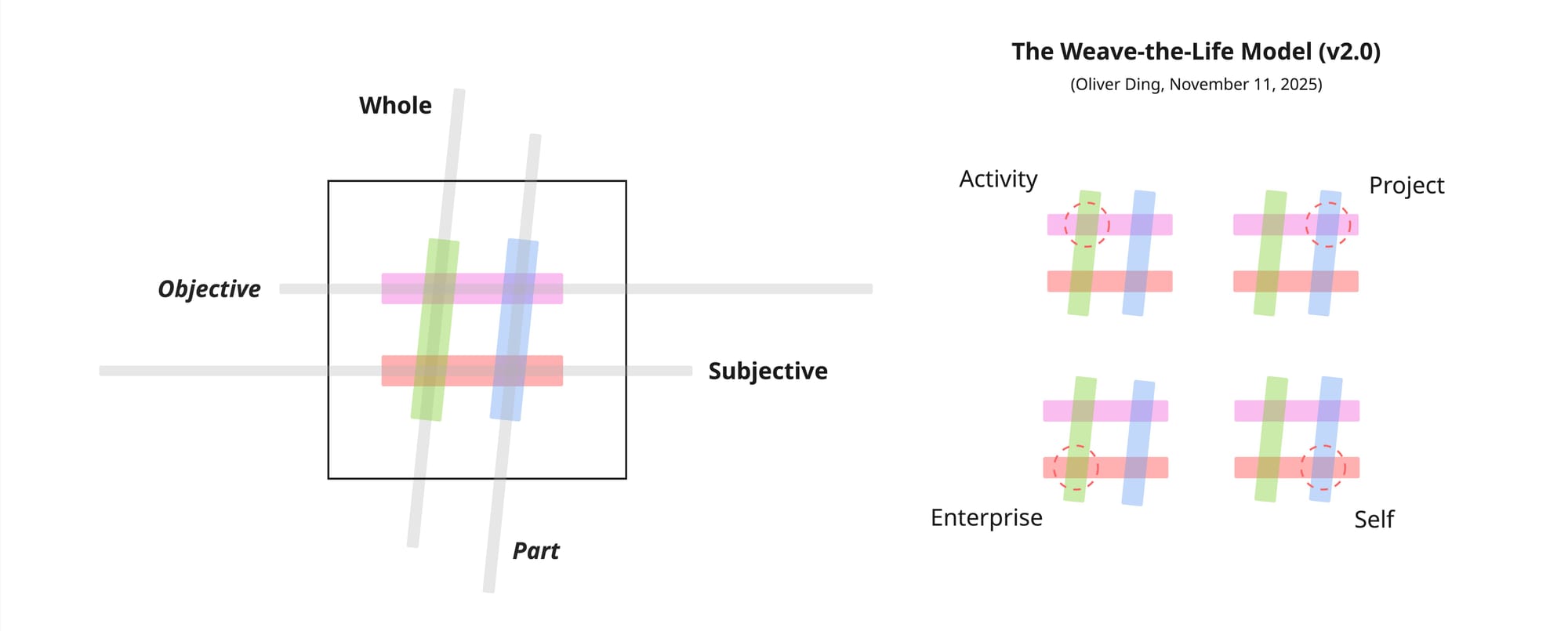
The new model integrates four dimensions: Subjective, Objective, Part, and Whole. The Subjective–Objective dimensions capture diachronic aspects of life, while the Part–Whole dimensions capture synchronical aspects. Together, these dimensions weave individual and collective life within an evolving structural, cultural, and historical landscape.
The model defines four Weave-Points, where one synchronical dimension intersects with one diachronic dimension. Concepts from v1.0 are positioned at these points: Self, Enterprise, Project, and Activity.
- At the Part dimension, the Self–Project connection represents "Project Engagement," where an individual participates in a specific project.
- At the Whole dimension, Activity refers to the aggregation of individual projects, while Enterprise encompasses a series of self-directed actions that extend beyond immediate projects.
The distinction between Subjective and Objective reflects the dual aspects of life: individual experience versus collective existence. The Part–Whole distinction reflects the structural depth of life. These four dimensions are continuously interwoven in lived experience, forming the fabric of both personal biography and social reality.
The framework operates bidirectionally. In the forward direction, individual actions crystallize into enterprises that transcend personal will. In the reverse direction, social structures and historical events enter individual life through activities and projects. This bidirectional dynamic illuminates both individual agency and structural constraints, demonstrating how otherness—aspects of social reality beyond immediate intersubjective negotiation—becomes incorporated into personal life.
By incorporating the concept of Enterprise, the Weave-the-Life Framework emphasizes the subjective dimension of social life: a long-term, self-determined trajectory of actions.
In April 2026, while working on the Weave 42 project, I developed a new version of the Weave Basic Form, a 4×4 edition that I call the Weave 16 diagram. Based on the new diagram, I created the Weave-the-Life framework (v3.0) and used it to curate 16 key concepts of the Life-as-Activity Approach.
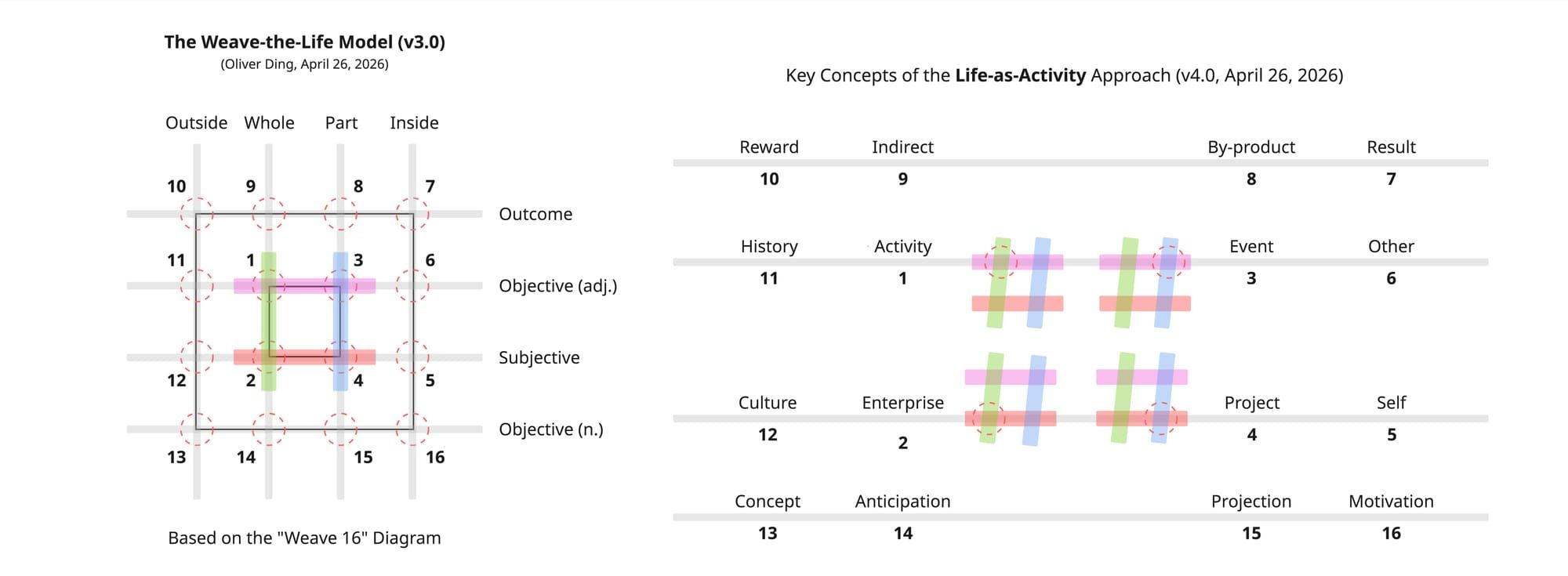
As the intermediate layer between the Activity as Project Engagement model and the Life-History Topology model, the Weave-the-Life framework plays a significant role in the Life-as-Activity approach. Although it is the newest member of the approach, it marks an important milestone because it enables the micro–meso–macro connection.
More importantly, the model draws a clear distinction between researchers and actors. While traditional Activity Theorists study activity as an object of analysis from the researcher’s perspective, the concept of Enterprise re-centers the actor’s own perspective, restoring subjective experience to the person living it.
Weave 2.0, Living Coordinate, and Thematic Space
The Weave-the-Life Framework (v3.0) is built on a 4×4 Weave diagram — but that description, while accurate, understates what has been achieved. The expansion from a 2×2 to a 4×4 matrix is not merely a matter of more cells. It is a methodological upgrade at the level of the entire Weave knowledge system.
This upgrade operates along two lines. The first is the introduction of the Coordinate. Each Weave-Point now carries a positional address — "Part × Subjective," "Inside × Objective (n.)," and so on. This may seem a small formal addition, but it creates a structural bridge to the Living Coordinate model, which describes how an individual actor navigates life space — finding a coordinate, anchoring a center, orienting a trajectory. When an individual's Living Coordinate is superimposed onto the Weave 16 diagram, the actor's developmental position can be marked at specific coordinates, and the thematic spaces those coordinates activate become resources for the next phase of their journey. What was previously a model of activity-in-general is now a model that can receive the situated work of a specific actor seeking orientation.
The second line is the introduction of Thematic Space. Each coordinate, when occupied by a concept, opens onto a cognitive container — a region populated by frameworks, diagrams, case studies, and tools. This gives the diagram a nesting capacity: a single coordinate can hold an entire sub-system of knowledge. The 4×4 diagram does not flatten the Life-as-Activity approach into sixteen labels. It organizes its sprawling conceptual vocabulary — multiple frameworks, multiple book drafts, multiple tools — into a navigable structure where each point is a portal to a deeper territory.
These three terms — Weave-Point, Coordinate, and Thematic Space — name three aspects of the same entity, seen from three theoretical angles. A Weave-Point is the structural intersection of two dimensions in the matrix: the formal foundation, the point where one diachronic line and one synchronic line meet. A Coordinate is the positional address of that Weave-Point on the map — "Whole × Subjective," for instance — which allows a concept to be placed and later found. A Thematic Space is the cognitive container that the Coordinate activates when a concept occupies it: the living region of inquiry that gathers related knowledge around the core theme. These are not separate things. They form a single logic: from structural intersection, to positional address, to living container. It is this logic that transforms a matrix of sixteen cells into a curatorial map for an entire knowledge system.
A New Model of the Actor
Earlier in this article, the concept of "Weave" was traced through a personal intellectual journey — from a passing encounter with the term "model of the actor" in 2023, through the unexpected recognition in March 2026 that the five-ring SDP Living Coordinate had quietly become exactly that, to the decision to incorporate Weave as a model of the actor into the Weave-the-Life framework.
The Weave-the-Life Framework (v3.0), as presented here, gives that model of the actor its formal structure. It is no longer distributed across multiple diagrams and projects. It is housed in a single, coherent spatial argument.
In this model, the actor is not a single coordinate. The actor is the entire diagram — or more precisely, the actor is the capacity to move through the diagram, to occupy different coordinates at different moments, to activate different thematic spaces as developmental needs shift.
This is the model of the actor that the Life-as-Activity approach proposes. Not a portrait of a person, but a map of the structural positions, temporal phases, and thematic spaces through which an actor develops. It is a model that restores the subjective experience that traditional Activity Theory brackets out, without abandoning the structural analysis that gives Activity Theory its explanatory power.
For the ACS (Anticipatory Cultural Sociology) and SDP (Strategic Developmental Psychology) projects, this changes the division of theoretical labor. The Weave-the-Life (v3.0) model now provides the foundational model of the actor — the general orientation of Weave as the integrative action that holds everything together.
With this foundation in place, ACS and SDP can focus on what they are specifically designed to address: the particular models of the cultural creator — the actor whose development is organized around the creation of new thematic enterprises.
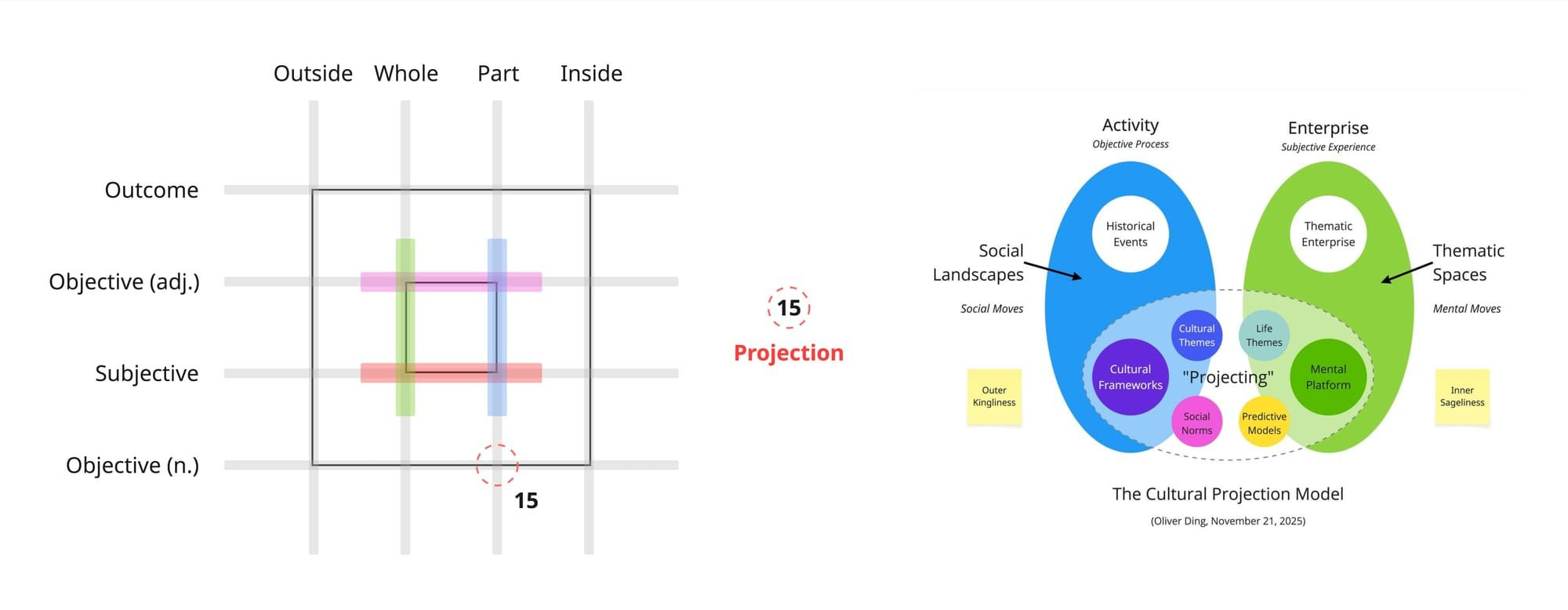
Their work can now concentrate on refining Discover, Design, Deliver, and Learn — the four outer rings of the SDP Living Coordinate — knowing that the integrative Weave orientation has been structurally secured.
Create, Curate, and Weave
In the Weave-the-Life Framework (v3.0), Weave occupies the innermost ring of the model of the actor. Its position is its meaning: Weave is the integrative action that holds everything together. A person who discovers, designs, delivers, and learns is always also weaving — weaving these orientations into a coherent practice, a coherent life, a coherent self. But what does it mean, precisely, to weave?
The answer begins with a dualism.
In 2019, I coined the term Curativity to describe the process of turning pieces into a meaningful whole. Curativity is the complement of Creativity: where Creativity generates new conceptual objects — new ideas, new frameworks, new approaches — Curativity organises existing ones into coherent structures. For several years, the Creativity—Curativity schema served as the dual-center structure underlying the evolution of the Activity Analysis Center. It described two essential movements of intellectual life: the outward movement of creation and the inward movement of curation.
The tension between these two movements is not new. Theoretical sociologists have described it as the tension between proliferation and unification — two essential processes that must occur together, yet pull in opposite directions. Within the Weave-the-Theory framework, Creativity and Curativity appear as two diachronic dimensions — the Proliferation Line and the Unification Line — that together describe how theoretical work develops over time. The key insight is that these two lines are not alternatives; they weave together. A theoretical enterprise that only proliferates becomes incoherent; one that only unifies stops growing. What makes a theoretical enterprise alive is the ongoing movement between the two lines — the weaving of proliferation and unification into a single developing whole.
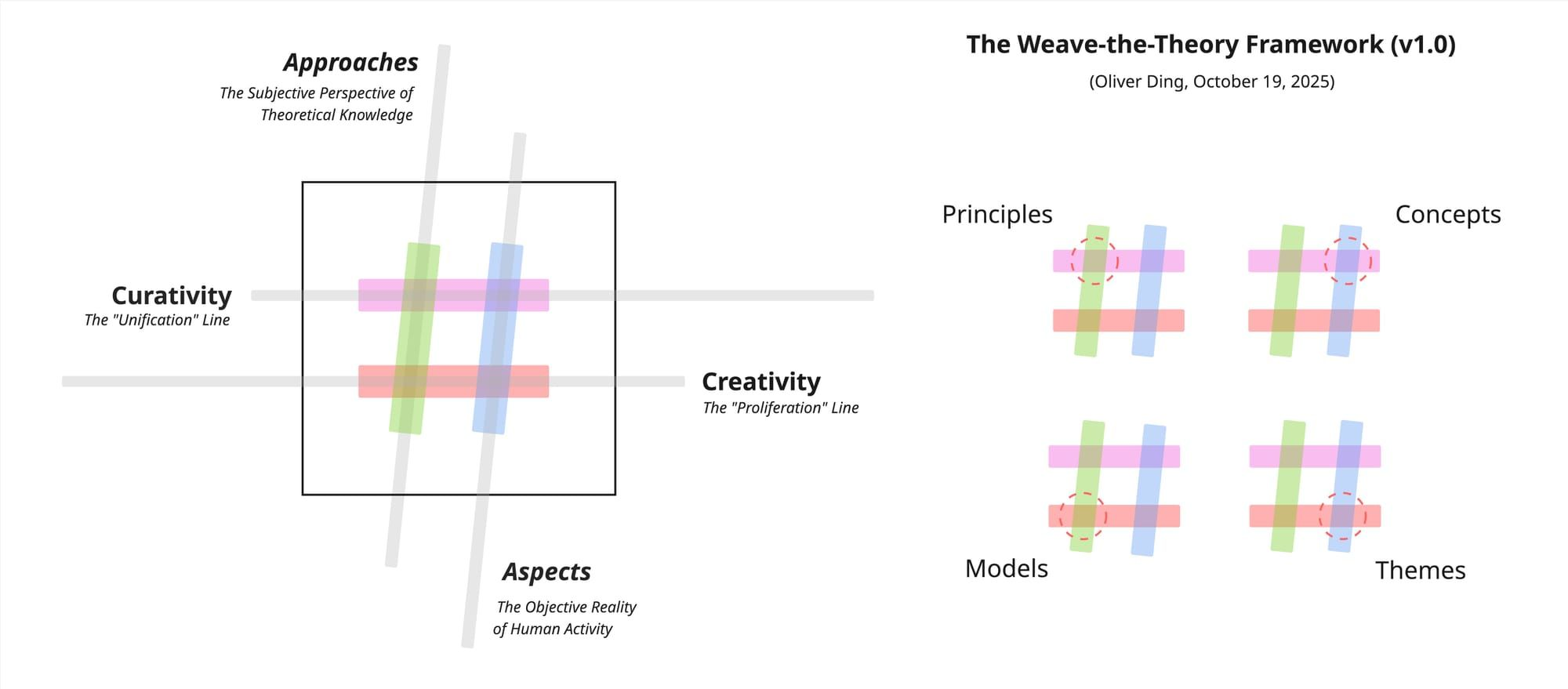
In human activity more broadly, the Create—Curate dualism takes a familiar form. On one side: the drive to seek the new, to explore, to open up, to embrace productive disorder. On the other: the need to preserve, to make good use of what exists, to establish norms, to build coherent order. These two tendencies are not merely intellectual orientations; they are lived experiences that many people find genuinely difficult to hold together. The person who creates prolifically often struggles to organise what they have made. The person who curates carefully often finds it hard to generate something genuinely new. The tension between them is real, and it does not resolve itself automatically.
Within the Life-as-Activity Approach, this tension has been addressed at different levels. In the Anticipatory Activity System (AAS) framework, first-order activity and second-order activity form a self-referential loop — a system in which Life Performance and Life Discovery are not opposing forces but two phases of a single continuous cycle, each feeding the other. This was an early recognition that the Create—Curate dualism could be transformed into a dynamic whole rather than a static opposition.
Following the pattern established by Activity Theory's predecessors — each of whom resolved a dualism by introducing a third element — the question becomes: what is the third element that resolves the Create—Curate dualism?
The answer is Weave.
Weave is not a compromise between Create and Curate, nor a sequence in which one follows the other. It is the integrative action that holds both in motion simultaneously. To weave is to work the two lines together — to create in a way that is already organised, to curate in a way that is still generative. In the Weave-the-Life model, this is why Weave occupies the innermost position: it is not one orientation among others, but the action through which all the other orientations become coherent practice.
This triadic structure — Create, Curate, Weave — continues the tradition identified in The Genidentity of Activity Theory. Vygotsky introduced Mediation to resolve the Stimulus—Response dualism. Leontiev introduced Object-orientedness to resolve the Individual—Collective dualism. Blunden introduced Concept to resolve the Practice—Sign dualism. In each case, the third element does not eliminate the tension between the first two — it transforms that tension into a productive dynamic. Weave does the same for the Create—Curate dualism: it transforms the opposition between proliferation and unification into the lived coherence of a developing person.
Every person who engages with knowledge — who creates and curates, who generates and organizes, who expands outward and integrates inward — is already weaving. The Weave-the-Life Framework (v3.0) gives this activity its structural form.
In Weave the Life: The Life-as-Activity Approach (v4.0) and Personal Knowledge Ecology (Possible Book, v1, 2026), I use "Weave-the-Life" to name this new model of the actor, serving as a shared foundation across my theoretical enterprises, including the Life-as-Activity Approach, the Anticipatory Cultural Sociology (ACS) approach, and the Strategic Developmental Psychology (SDP) approach.
A Different Kind of Model
How does this model of the actor differ from its predecessors?
The classical sociological models of the actor are built from the outside in. Durkheim's actor is shaped by social facts, Weber's by internalized values, Bourdieu's by habitus, Parsons's by systems. Agency is real but always bounded, always already formed by forces that precede it. Even Giddens's reflexive agent operates within structures that simultaneously enable and constrain. These are researchers' models — constructed by theorists observing actors from the outside, mapping the actor as embedded in activity, subject to its pressures and logics.
The classical economic model shares this external orientation: the actor as rational maximizer, computing costs and benefits, optimizing outcomes. Homo Economicus is transparent to the analyst, if not always to himself.
These models are powerful. But they share a limitation: they see the actor from the outside. What they see is the actor embedded in Activity — the objective, structural side of social life. What they do not see is how the actor, from the inside, weaves together the diachronic flow of daily actions and the synchronic configuration of their situation into something that is genuinely their own: an Enterprise.
The Weave-the-Life model begins from the other side. It does not bracket out the actor's subjective experience — it restores it. It asks not only what structures surround the actor, but how the actor navigates them: finding a Living Coordinate, anchoring a creative center, activating a thematic space, drawing on models to understand their own situation.
From the perspective of Thematic Space Theory, the Weave-the-Life model provides a map — a structured space in which Activity and Enterprise, World and Self, Create and Curate are woven together. On this map, the actor is not in a position assigned by external forces. The actor is the one who moves.
This new model of the actor operates at three levels:
- Map — the Weave-the-Life diagram as a spatial argument: a structured field of coordinates, dimensions, and thematic spaces that makes the territory of a life navigable.
- Models — the knowledge frameworks housed at each coordinate: tools for understanding one's situation, one's enterprise, one's patterns of action. Each weave-point opens onto a deeper body of knowledge.
- Moves — the actual movements of a living actor through this space: finding a coordinate, shifting a center, engaging a thematic space, weaving situation and landscape, activity and enterprise, creation and curation into a coherent life.
The diagram does not tell you who you are. It gives you a thematic space in which to find out.
The map was drawn to understand social life and cultural development. The figure it traced, all along, was the actor — free to move.
v1.0 - April 29, 2026 - 4,927 words