
Activity Analysis Network #16: Weave the Life, Theoretical Activity, and Knowledge Ecology

This is the 16th issue of the Activity Analysis Center newsletter
by Oliver Ding
April 30, 2026
Hi, and welcome to Activity Analysis Network, a newsletter hosted by the Activity Analysis Center.
Each issue is organized around the "Flow - Focus - Center - Circle" schema, the primary model of the World of Activity Toolkit (v1, 2025).
As a biweekly newsletter, I share summaries of new articles from the Activity Analysis Center, along with updates on related activities, including some of my own published work elsewhere.
In this issue (#16), 9 new articles have been added to the site:
- #1 - Appropriating Activity Theory #16: The Tool That Kept Changing Its Purpose
- #2 - Case Studies: Dramatic Life Pattern: The Watershed I Lived By
- #3 - Case Studies: Weave the Curativity: When Advancing Dances with Analyzing
- #4 - Case Studies: Weave the Theory: A Case Study of the AAS Framework Development
- #5 - Case Studies: Weave the Theory: Unfolding the Way of Curation
- #6 - Concepts: Weave: A Model of the Actor
- #7 - Life-as-Activity: The Weave-the-Life Framework (v3.0)
- #8 - Life-as-Activity: Introduction to Weave the Life: The Life-as-Activity Approach (v4.0) and Personal Knowledge Ecology
- #9 - Library: Weave the Life: The Life-as-Activity Approach (v4.0) and Personal Knowledge Ecology (Possible Book, v1, 2026)
These articles represent three major themes and one major milestone.
#7 introduces the Weave-the-Life Framework (v3.0) which marks v4.0 of the Life-as-Activity Approach.
#2 - #5 are case studies of the Weave-the-Theory framework, a model for studying Theoretical Activity.
In 2022, using the Thematic Space Canvas as a meta‑canvas, I developed the Knowledge Discovery Canvas and the Life Discovery Canvas. They address, respectively, how an individual explores knowledge around a specific theme, and how an individual explores their own life. #1 reflects on this journey.
While working on the Weave‑the‑Theory cases and editing this issue, I unexpectedly realised that my many years of exploration in two directions — adult development and concept‑centred knowledge engagement — could be gathered under a new thematic space. I call this space Personal Knowledge Ecology.
Finally, these articles inspire me to edit a new possible book titled Weave the Life: The Life-as-Activity Approach (v4.0) and Personal Knowledge Ecology.
This is a major milestone in my journey of engaging with Activity Theory.
Flow
The historical development of the Activity Analysis Center and my experience of daily life
Inspired by the concept of a gap year, I developed “GAP” projects as an application of the Developmental Project model in 2023. Later, I often ran GAP Projects as part of my creative journey from 2023 to the present.
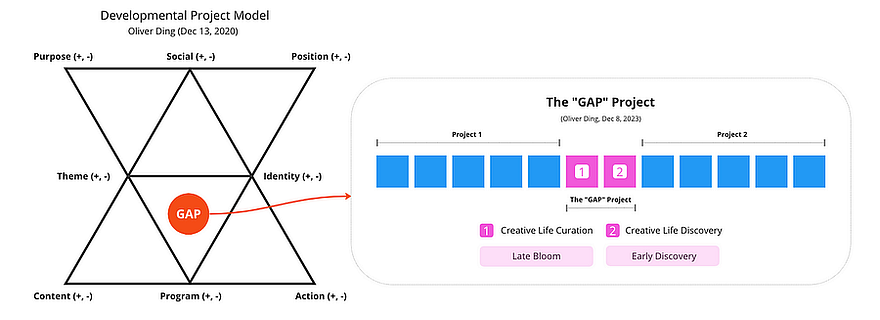
A “GAP” project refers to informal activities that take place between formal projects. The “After | Before” structure classifies these projects into two types:
- The “After” Project, like Creative Life Curation
- The “Before” Project, like Creative Life Discovery
After sending the last issue, I started a Creative Life Discovery project to explore the Weave knowledge system and Yinyang-Bagua knowledge system. The diagram below is part of the five-day exploration.
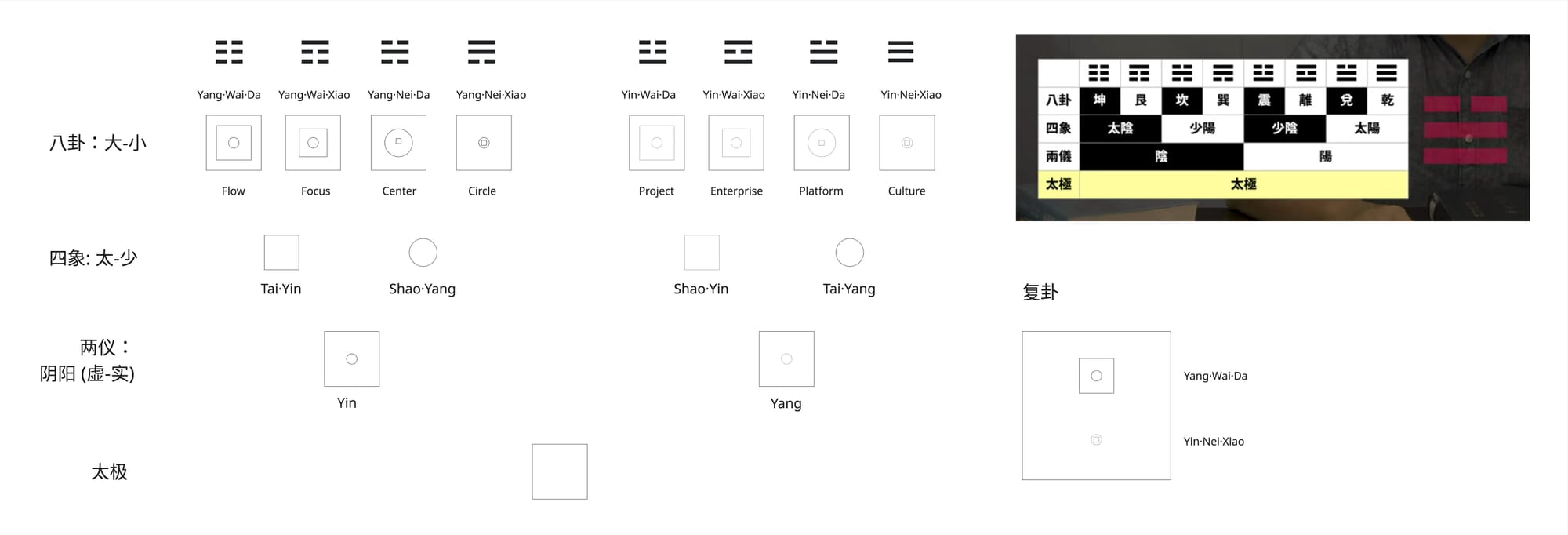
The original Weave Basic Form was a 2×2 model: the synthesis of two diachronic dimensions and two synchronic dimensions, yielding four Weave Points. During the exploration, I expanded it to 4×4 edition and 8×8 edition. These ideas were named Weave 2.0.
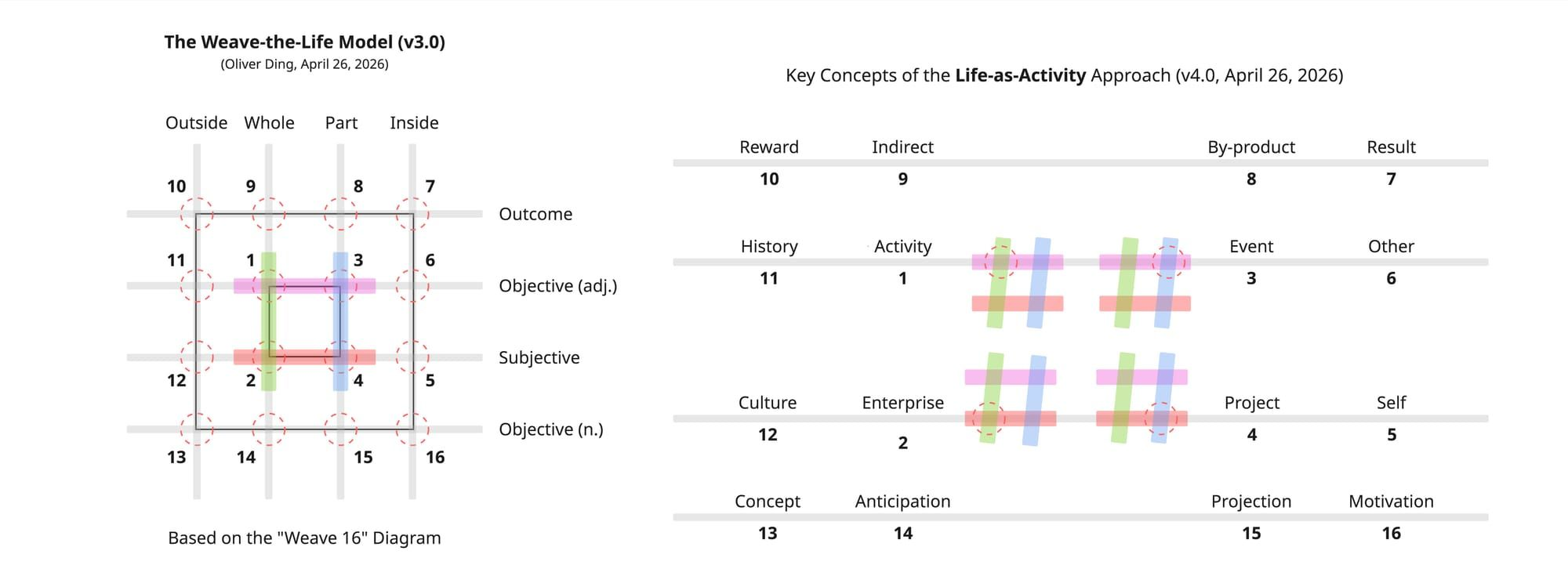
On April 26, 2026, based on the 4×4 edition of Weave Basic Form, I developed the Weave-the-Life Model (v3.0). The original v2.0 structure remains intact at the center; the entire model has grown outward into a larger Weave Diagram.
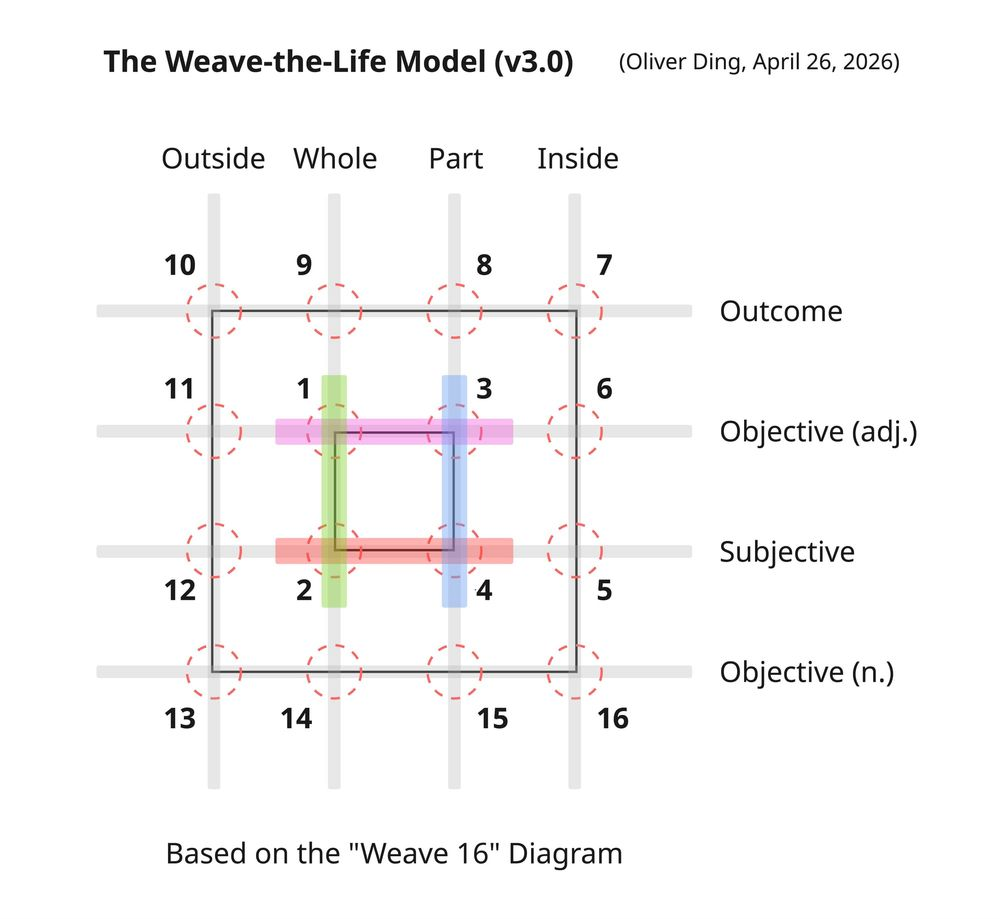
The four diachronic dimensions and four synchronic dimensions draw inspiration from four pairs of concepts — some rooted in traditional Activity Theory, others emerging from my own explorations.
- Whole - Part
- Inside - Outside
- Objective (n.) - Outcome
- Subjective - Objective (adj.)
Based on these conceptual resources, the vertical axis of the v3.0 model is labeled Outcome, Objective (adj.), Subjective, and Objective (n.). The horizontal axis is labeled Outside, Whole, Part, and Inside. Together, these four columns trace a continuum from macro-level social objects to micro-level individual subjects:
- Outside corresponds to the Life-History Topology level, encompassing culture and history.
- Whole corresponds to the Anticipatory Activity System level, encompassing enterprise and activity.
- Part corresponds to the Project Engagement level, encompassing project and event.
- Inside corresponds to the subject — the individual’s psychology and immediate situation.
A subtle but significant transformation occurs here. Traditional Activity Theory’s subject–object relation is reconfigured as a self–world continuum, anchored at the two extremes of Inside and Outside.
Previously, the full landscape of the Life-as-Activity Approach had been presented through a knowledge map — a curated display that gathered key framework diagrams, book draft covers, and tools. The map showed the territory. But it lacked a coordinating mechanism. The frameworks sat side by side, their relationships implied but not structurally articulated.
The Weave-the-Life Framework (v3.0) addressed this limitation through a formal innovation that drew directly on the logic of Thematic Space. Each cell in the 4×4 Weave diagram is simultaneously a Weave-point, a Coordinate, and a Thematic Space — a structural intersection, a positional address, and a living cognitive container. This nesting capacity meant that knowledge frameworks previously distributed across separate diagrams could now be organized within a single spatial argument.
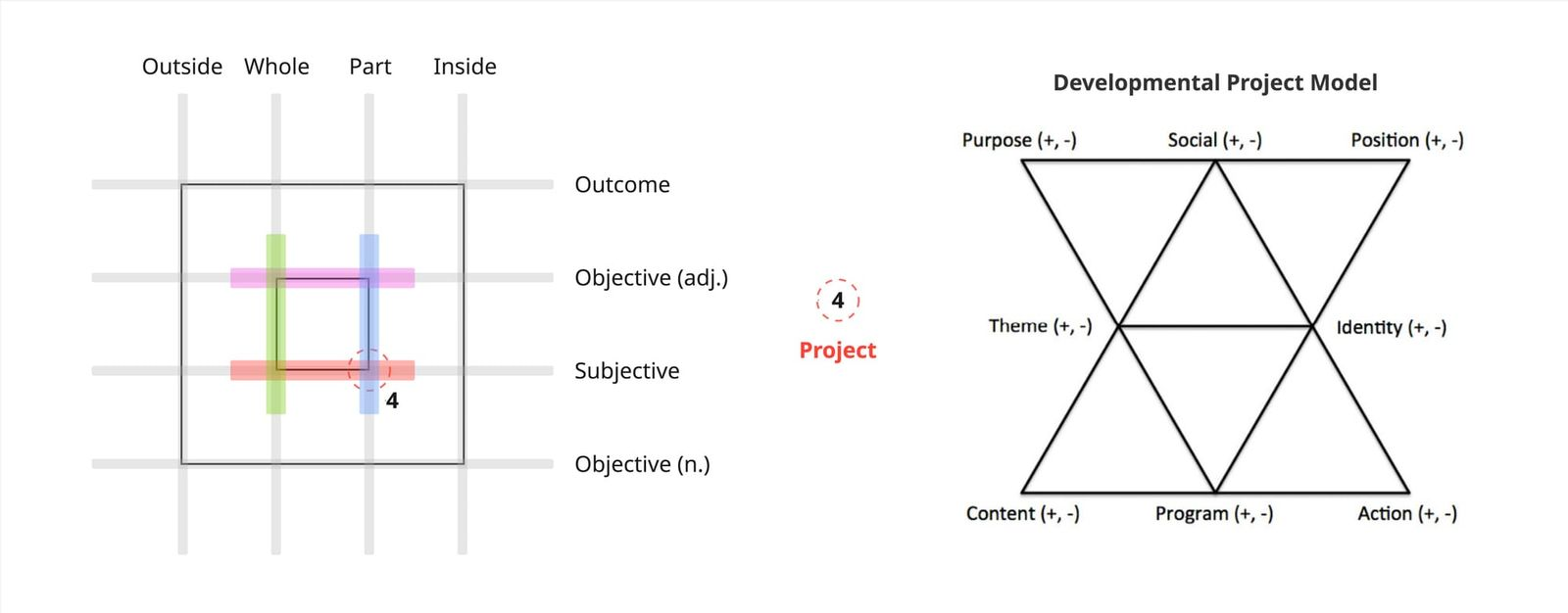
The years spent designing canvases were not merely practical work. They were, in retrospect, a long preparation. Each canvas had been an exercise in spatial argument — in finding the right configuration of dimensions, regions, and positions to make a type of activity visible and navigable. The Thematic Space concept, developed through this practice, carried a design logic that proved transferable far beyond any single canvas.
Mediating tools occupy a central place in Activity Theory. They are not neutral instruments — they shape the activity they serve, and they are reshaped by it in return. Over the years, my engagement with Activity Theory has moved well beyond reading and citation. I have tried to live its principles: to design tools, test them in practice, and follow what the practice reveals.
Focus
The Thematic Foci of the Activity Analysis Center
Over the past two weeks, I worked on two projects: The Dramatic Life Pattern project and the Theoretical Activity project.
The Dramatic Life Pattern project refers to one dimension of the Strategic Developmental Psychology (SDP) v1.2. The diagram below features a set of patterns the project wants to explore in the future.
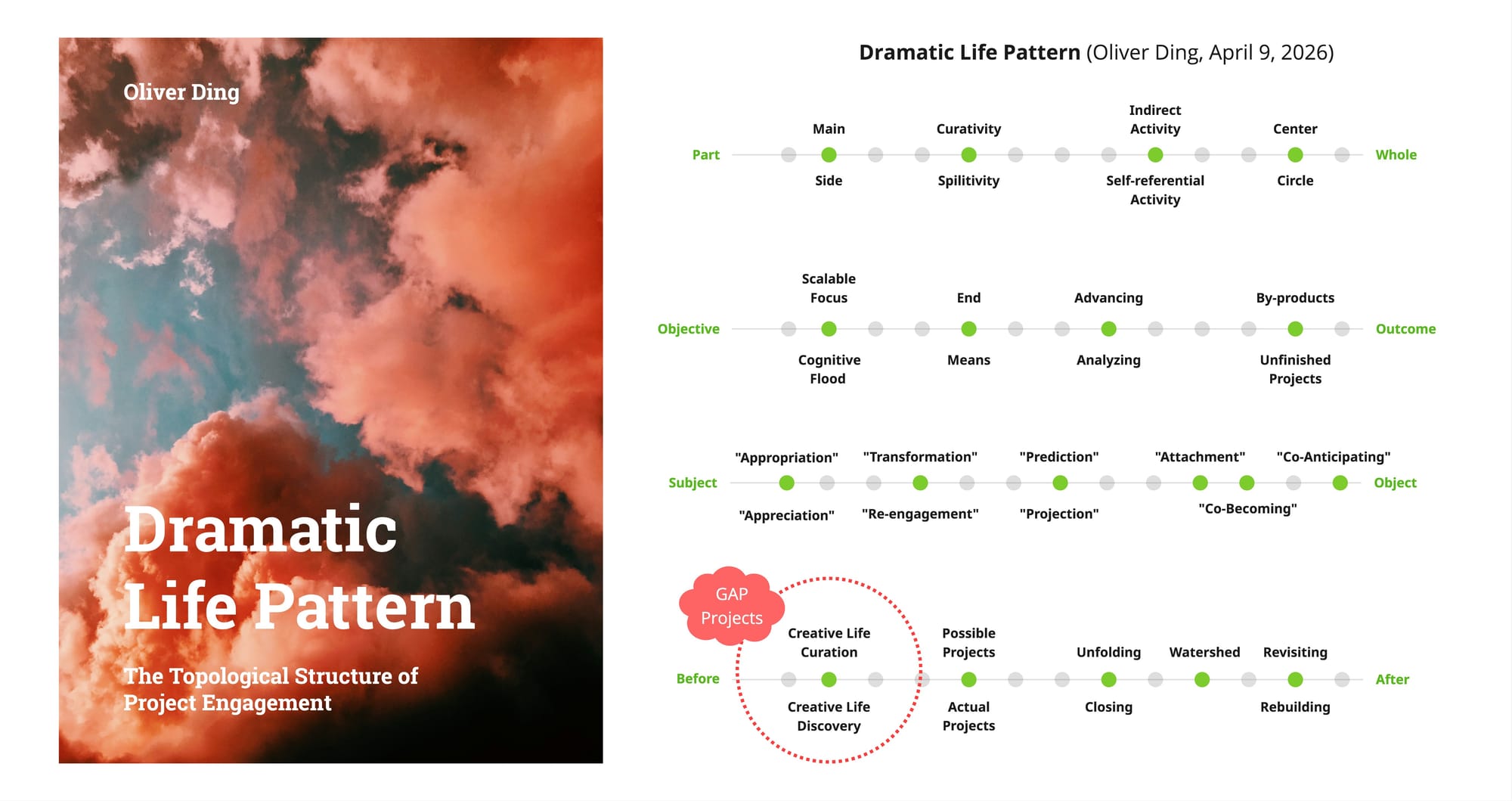
On April 21, 2026, I published an article titled Dramatic Life Pattern: The Watershed I Lived By.
Over the past several weeks, I published a collection of essays touching on the watershed theme across multiple contexts: my decade-long journey with Activity Theory, the development of the Theme–Concept–Framework Transformation, the RR chronicle, and a coaching case study. Each time, the word "watershed" appeared as a natural descriptor for a structural moment that changed the shape of what came before and after. In that article, I formally name and develop this pattern as the Creative Watershed.
This article uses the Weave-the-Theory model to develop Creative Watershed as a pattern within the Dramatic Life Pattern dimension. It proceeds from the Theme (the lived experience of Creative Watershed) through the Model (structural representations across multiple frameworks) to the Concept (the deeper theoretical proposition) and finally to the Principle (the governing insight that unifies the whole). This is the second time I have applied the Weave-the-Theory model to develop a Dramatic Life Pattern — the first was the Revisiting–Rebuilding case. Through these applications, the method is gradually maturing.
I also used the Weave-the-Theory model on three case studies of "Grand" theoretical enterprises:
- #3 - Case Studies: Weave the Curativity: When Advancing Dances with Analyzing
- #4 - Case Studies: Weave the Theory: A Case Study of the AAS Framework Development
- #5 - Case Studies: Weave the Theory: Unfolding the Way of Curation (A case study of the Life-as-Activity Framework)
In the Revisiting–Rebuilding (RR) case, the weave-points emerged organically from a long-standing creative practice. The Theme was lived for years before it was named; the Model grew from within the practice itself; the Concept clarified the theoretical identity of what had been done; the Principle connected the practice to broader questions of creative identity across time.
In the Curativity case, the development followed what we might call the Weave-AA pattern: an alternating rhythm of Advancing and Analyzing that spiraled upward over six years. The Concept (Enterprise) surfaced slowly through accumulated practice, bottom-up, before it could support any Principle. The models proliferated across many projects; the unifying concept arrived late and gradually.
In the AAS (Anticipatory Activity System) case, the structure was strikingly different: the Principle — drawn from Robert Rosen's theory of anticipatory systems — was present from the beginning, governing the development from above even before the full implications of the framework were worked out. The weave moved from Principle downward, clarifying and elaborating.
In the Life-as-Activity case — offers yet another structural configuration. The governing principle (Activity as Project Engagement) did not arrive fully formed. It went through three distinct stages of maturation — from a practical name, to a bridging concept, to a principle recognized through genealogical comparison — before becoming the organizing center for all subsequent development. What is distinctive about this case is that its full arc maps onto three complete waves of the Sandglass model, with the Crystallize Thematically moment producing not an ordinary theme but an unusually abstract principle. This double mapping — Weave-the-Theory and Sandglass together — is the analytical lens this article uses.
Center
The Core of the Activity Analysis Center
The Activity Analysis Center hosts two major theoretical enterprises:
- The Life-as-Activity Approach (including the Project Engagement Approach)
- The World of Activity Approach, now operating within a nested structure: World of Life (World of Activity).
This issue marks a significant milestone: The Life-as-Activity Approach was updated to v4.0.
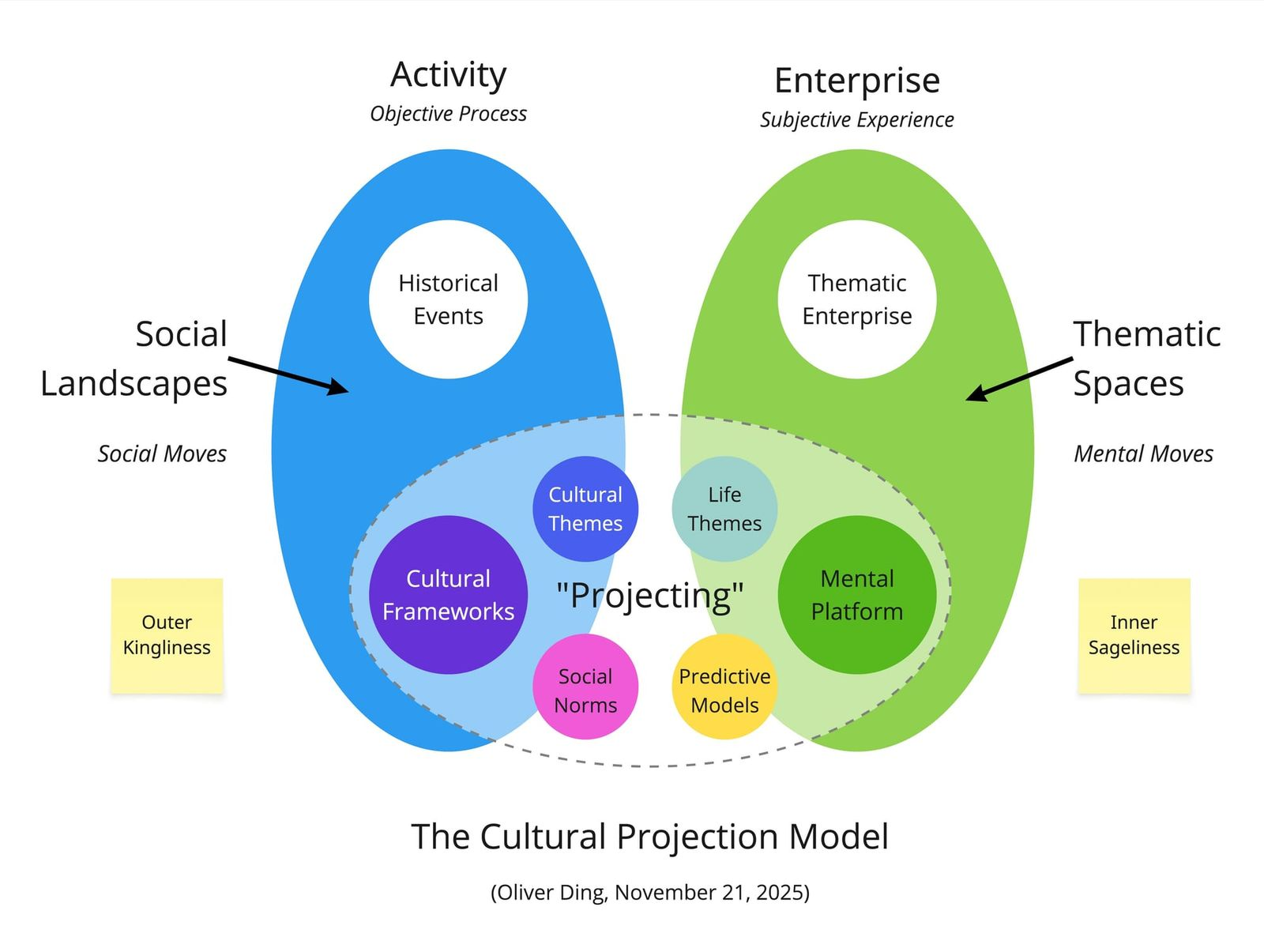
In November 2025, in the book draft Developmental Projects: The Project Engagement Approach to Adult Development, I introduced the Cultural Projection Model (2025), organized around the Activity—Enterprise pairing.
In the Life-as-Activity Approach (v4.0), I take a further step: the Activity—Enterprise—Attachance triad provides a more complete account of how Activity as Project Engagement is expressed at the meso level — the level between individual projects and the full arc of a life.
Activity names the tradition this work belongs to and the organizing concept that has been present from the beginning. The Life-as-Activity Approach was developed primarily through its engagement with the concept of project — the basic unit of individual engagement with the social world. Its governing principle, Activity as Project Engagement, describes how a person moves from outside a project to inside it, forming identity and contributing to collective life through this ecological movement. The foundational equation Life = Projects = Thematic Spaces = Events = History gave the approach its basic ontological structure: Projects on the subjective side, Events on the objective side, and Activity Theory's internalization—externalization principle providing the theoretical home for the Outside—Inside movement.
Enterprise names the concept that arrived through an indirect activity — the development of Creative Life Theory in 2025 — and resolved a structural gap that had been latent in the approach since the formulation of the Life-History Topology in 2022. That ontological framework — Life = Projects = Thematic Spaces = Events = History — established a foundational symmetry: Project sits within the individual's subjective experience, while Event sits outside it, belonging to the objective activities of others. This Project—Event symmetry is the concrete expression of the governing principle Activity as Project Engagement at the micro level. However, the topology left a gap unaddressed. Moving from the micro level (individual projects and events) to the macro level (Life and History) required crossing a meso level that had no clearly named concepts.
When Enterprise emerged as a theoretical element, it became clear that it filled this gap precisely: Enterprise is a higher-order organization of Projects — a series of projects organized by a sustained subjective trajectory. And if Enterprise is the meso-level counterpart to Project on the subjective side, then by the same logic, the meso-level counterpart to Event on the objective side must be Activity itself. The Activity—Enterprise symmetry thus completed the topology at a new level of scale, giving the Life-History framework its missing middle.
Attachance names the mechanism of movement through the social world — and it brings with it a clarification about the theoretical foundations of the approach. In 2021, Projectivity was introduced to describe the ecological interaction between a person and a project: the potential action opportunities that draw a person from outside to inside. What was implicit in this concept, but not yet named directly, was its deeper structure: the fundamental capacity to detach from one thematic space and attach to another. Projectivity, at its deepest level, is Attachance at the project scale. With the Activity—Enterprise pairing now in place, Attachance finds its natural position at the enterprise scale as well — describing the larger movements of a creative life as a person's sustained trajectory shifts and reorients across time. The movement between Living Coordinates is explained by Attachance. It is the concept that connects the micro-level dynamics of project engagement with the meso-level dynamics of enterprise development.
In The Genidentity of Activity Theory, I reviewed the work of Activity Theory's predecessors and found that they all followed the same method: when confronted with a dualism — a pair of opposing concepts — they introduced a third element to form a triadic structure. Vygotsky introduced Mediation to resolve the Stimulus—Response dualism. Leontiev introduced Object-orientedness to resolve the Individual Actions—Collective Activity dualism. Engeström introduced System to resolve the Object—Outcome dualism. Blunden introduced Concept to resolve the Practice—Sign dualism. The triadic structure presented in this book — Activity, Enterprise, and Attachance — continues this tradition.
These new creations and ideas inspired me to edit a new possible book: Weave the Life: The Life-as-Activity Approach (v4.0) and Personal Knowledge Ecology (Introduction, Table of Contents).
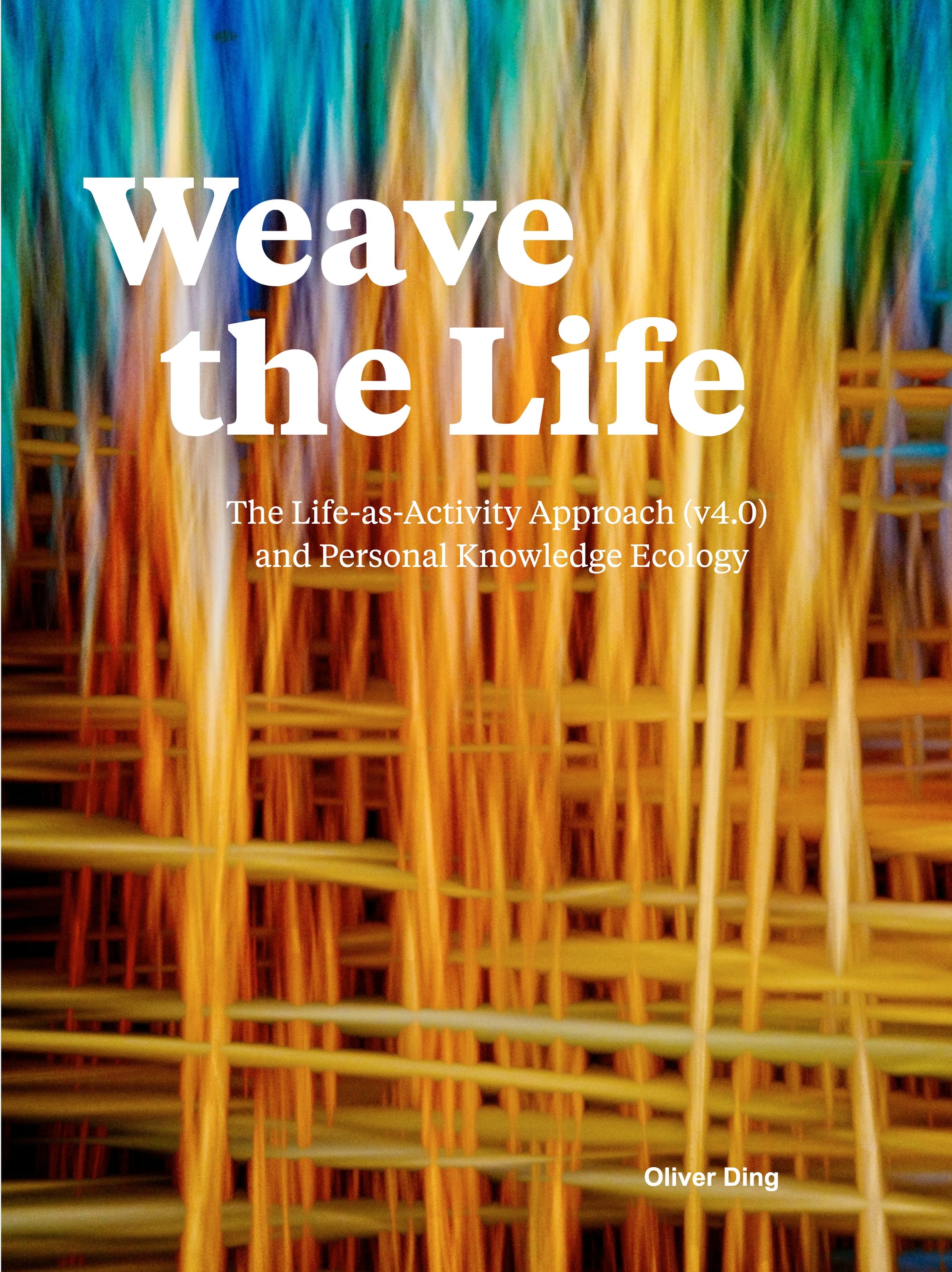
This book manuscript marks a new milestone in that journey. It does not merely collect what I have done. It re‑presents the work through a unified symbolic system — the Weave form — and, for the first time, organizes the full territory of the Life‑as‑Activity Approach (v4.0) around the concept of Personal Knowledge Ecology.
The adult development studies collected here and the theoretical activity cases documented in later parts are not separate interests. They are two expressions of the same underlying phenomenon: how a person builds, sustains, and transforms their own knowledge ecology over time. This book is therefore not a final statement but a curated snapshot — a structured presentation of a living theoretical enterprise at a particular moment in its development.
Circle
The Context of the Activity Analysis Center
Over the past several years, I worked on several theoretical projects, such as the Ecological Practice Approach, Curativity Theory, Creative Life Theory, and Thematic Space Theory.
Inspired by creativity researcher Howard Gruber's idea of "Network of Enterprises," I used the "Knowledge Center" approach to manage this large knowledge system. Each knowledge center hosts one or two related theoretical approaches.
- CALL (Creative Action Learning Lab): the Ecological Practice Approach and Creative Life Theory
- Curativity Center: Curativity Theory
- TALE (Thematic Analysis Learning Engagement): Thematic Space Theory
- Frame for Work: A theory about Knowledge Frameworks
In this issue, we see a case study about Curativity Theory: Weave the Curativity: When Advancing Dances with Analyzing.
Thematic Space Theory was also applied to develop the Weave-the-Life (v3.0) model.
What this issue makes visible is something I have been observing across several years of work: the Knowledge Centers do not operate in isolation. Together, they form what I call a Value Circle — a networked configuration of Knowledge Centers whose conceptual resources resonate with and support one another.
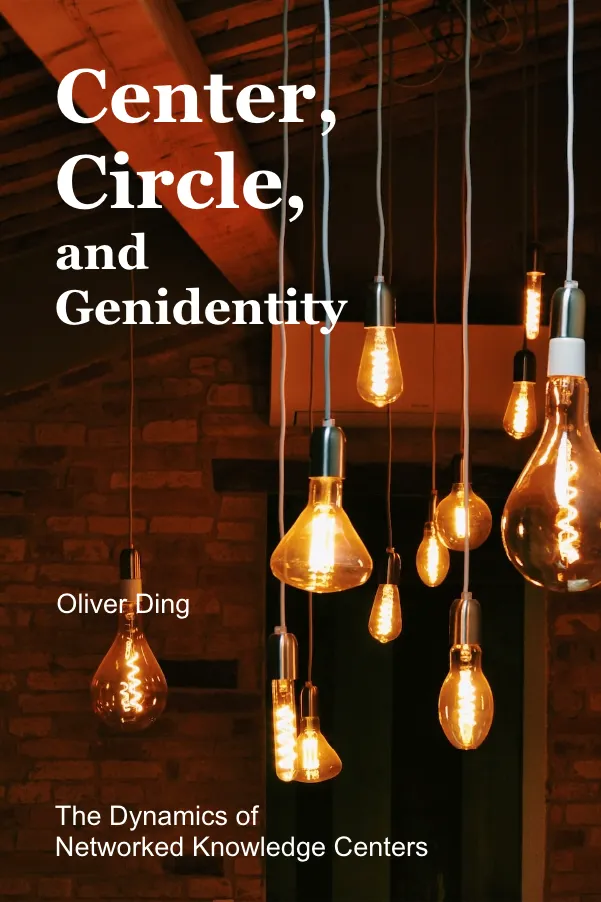
The Weave-the-Life (v3.0) development drew on Thematic Space Theory (TALE) as a structural resource. The Weave-the-Curativity case study belongs to the Curativity Center, yet it also illuminates the logic of Theoretical Activity — a theme central to the Activity Analysis Center itself. The Activity—Enterprise—Attachance triad in the Life-as-Activity Approach (v4.0) could not have taken its current form without the theoretical resources developed through Creative Life Theory (CALL).
These cross-center resonances are not coincidences. They suggest that a knowledge ecology gains coherence and generative capacity not just through the growth of individual centers, but through the relationships that form between them.
World
Me, You, and We
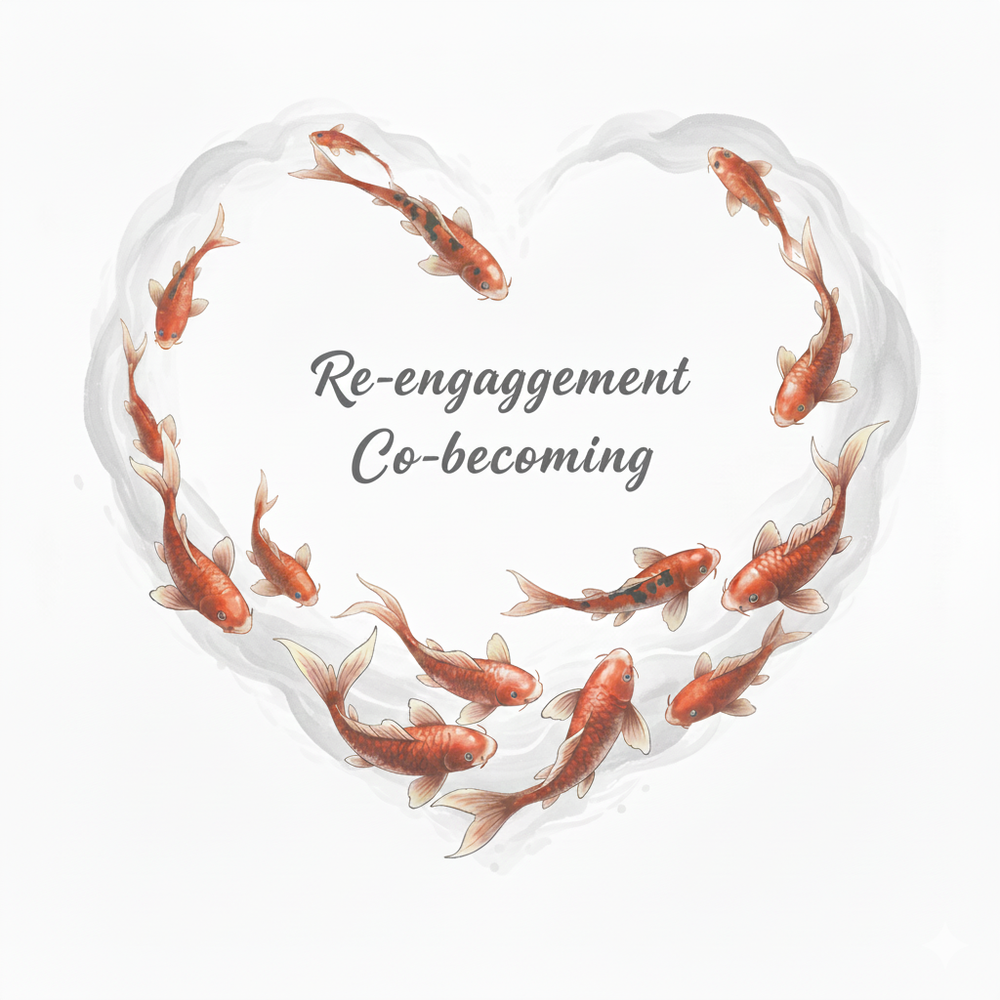
The image above is my New Year's greeting card — and also my annual theme for 2026: Re-engagement and Co-becoming.
In Jaunary 2026, I coined a new term called “Interthyme” and designed a theamtic card. Several days ago, I published a short note titled The “Knowledge — Culture” Transformation and the “Interhyme” Theme on TALE's site.

The thematic card shows a pagoda beside a waterfall. The waterfall descends — water finding its way down through rock and time. The visitor ascends — step by step, floor by floor, toward something not yet seen. Two movements, opposite in direction, yet resonant in rhythm.
During the five-day exploration, I discovered something similar between the Weave knowledge system and the Yinyang-Bagua knowledge system: beneath their different vocabularies and origins, they share a deep structural logic. The waterfall and the footsteps do not speak the same language — but they keep the same rhythm. That is Interhyme.
The five-day exploration (what I call the Weave-the-Bagua project) was itself an instance of Re-engagement and Co-becoming — returning to an ancient knowledge system with new eyes, and finding that both were changed by the encounter.
Re-engagement and Co-becoming. I placed them there in January. The year answered.
Oliver Ding
Founder of the Activity Analysis Center
April 30, 2026
p.s. I am based in Houston, Texas, US. Where are you?
v1.0 - April 30, 2026 - 3,042 words