
Revisiting the Genidentity of Activity Theory

Capturing the Essential Differences of a Theoretical Tradition
by Oliver Ding
May 4, 2026
This article is part of a new possible book Weave the Life: The Life-as-Activity Approach (v4.0) and Personal Knowledge Ecology
Introduction: A Personal Exploration Across Four Years
This article follows the Revisiting—Rebuilding practice. It revisits the 2022 exploration of the Genidentity of Activity Theory, and rebuilds it by integrating the 2025 concepts of Theoretical Activity and Theoretical Enterprise. The result is a more complete account that contributes to the Weave-the-Theory toolkit: the Theoretical Platform concept provides the synchronic analytical dimension, and the Theoretical Activity / Theoretical Enterprise pairing provides the diachronic dimension. Together, they give the Weave-the-Theory model the conceptual resources it needs for analyzing theoretical traditions as a special case of human creative activity.
In 2025, Clay Spinuzzi published Triangles and Tribulations: Translations, Betrayals, and the Making of Cultural-Historical Activity Theory (MIT Press), a detailed historical study of CHAT's development using the sociology of translation. Spinuzzi's account focuses on the internal diversity of the tradition — how each innovation translated and in some sense betrayed what came before, how the tradition accumulated concepts and terms from various sources, and how ongoing disputes about its unit of analysis reflect the uneasy settlements that have allowed it to persist. His is a view from inside: rich, historically grounded, attentive to the contingency and conflict of the tradition's development.
This article asks a different question, from a different vantage point. Rather than looking inside Activity Theory at its internal diversity, it looks outward: how does Activity Theory, taken as a whole, differ from other theoretical traditions? This is the Genidentity question. The very fact that Activity Theory has persisted as a distinct tradition for nearly a century — attracting successive contributors who chose to work within this tradition rather than others — is itself evidence that it has an Essential Differences. If Activity Theory had no genuine distinction from behaviorism, phenomenology, or ecological psychology, it would not have developed into what it is today. The question is: what is that Essential Difference?
This article is rooted in a creative exploration the author undertook in 2022. Through the Deep Analogy technique, a deep structural pattern was discovered and subsequently developed into a creative heuristic for reflecting on the author's own theoretical work. What follows is a faithful reconstruction of that real exploration — its logic, its discoveries, and its limitations. It makes no claim to offer a complete or authoritative account of Activity Theory's historical development. Readers who find that the descriptions of individual theorists' frameworks do not fully accord with the historical record are invited to read them in the spirit of what James March called "near histories" — hypothetical reconstructions that sacrifice some historical precision in order to generate usable theoretical insight. For the real history, readers are directed to Clay Spinuzzi's Triangles and Tribulations (MIT Press, 2025).
Part 1 provides the background: the three projects that led to this article — Activity U (2020), the Platform Genidentity framework (2022), and the Weave-the-Theory model (2025). Part 2 introduces the Genidentity Analysis Method and its key terms. Part 3 rebuilds the 2022 exploration with new tools, introducing Philosophy as Creative Heuristics and establishing the settings for the case analysis. Part 4 presents four developmental episodes from the history of Activity Theory. Part 5 identifies the coordination mechanism as the focus of Essential Differences. Part 6 presents my own developmental episodes as an application of the coordination mechanism as creative heuristic. Part 7 discusses Method as Focus in relation to existing accounts in philosophy of science.
Contents
Part 1. Background
1.1 The Activity U Project (2020)
1.2 The Platform Genidentity Framework (2022)
1.3 The Weave-the-Theory Model (2025)
Part 2. The Genidentity Analysis Method
2.1 Genidentity: Essential Differences and Situated Dynamics
2.2 A Case Study: The Genidentity of a Knowledge System (2024)
2.3 Meta-framework vs. Thematic Enterprise
2.4 Developmental Episode
2.5 Case Selection
Part 3. Rebuilding the 2022 Exploration
3.1 The 2022 Exploration: What Deep Analogy Revealed
3.2 Revisiting with the Weave-the-Theory Model
3.3 Philosophy as Creative Heuristics
3.4 Settings for the Case Analysis
Part 4. Four Developmental Episodes
4.1 Lev Vygotsky: Stimulus — Mediation — Response
4.2 Aleksei Leontiev: Individual Actions — Object-orientedness — Collective Activity
4.3 Yrjö Engeström: Object — System — Outcome
4.4 Andy Blunden: Two Episodes
Part 5. The Coordination Mechanism as Focus of Essential Differences
Part 6. My Own Developmental Episodes
6.1 Activity as Project Engagement: Outside — Engagement — Inside
6.2 Activity — Attachance — Enterprise: Resolving the Scale Gap
6.3 Create — Weave — Curate: Resolving the Content Dualism
Part 7. Method as Focus
7.1 Kuhn's Paradigms
7.2 Lakatos's Scientific Research Programmes
7.3 Chen Ruilin's Theory Versions
7.4 The Activity Theory Case: Method as Focus
7.5 Activity Theory for Theoretical Activity
Conclusion
Appendix
Near History vs. Real History: Formal Descriptions and Creative Operations
Part 1. Background
1.1 The Activity U Project (2020)
Activity Theory is not a single, unified theory. It is better understood as a collective name — a theoretical tradition — referring to a family of related knowledge systems and frameworks created by Vygotsky, Aleksei Leontiev, and other Soviet psychologists, later extended by scholars worldwide including Yrjö Engeström and Andy Blunden. Each contributor brought their own emphasis, their own concepts, their own intellectual resources. What binds them together is not a common doctrine but something more elusive.
This internal diversity fascinated me when I first engaged seriously with Activity Theory around 2015. In 2020, I undertook the Activity U project — a knowledge curation project that mapped the landscape of Activity Theory and CHAT (Cultural-Historical Activity Theory). I selected representative examples of Activity Theory's various usages and placed them on Diagram U — a framework that presents six types of "Objective of Knowing": Meta-theory (mTheory), Specific Theory (sTheory), Abstract Model (aModel), Concrete Model (cModel), Domain Practice (dPractice), and General Practice (gPractice). The result was Activity U: a structured map of the tradition's internal landscape across different levels of knowing.
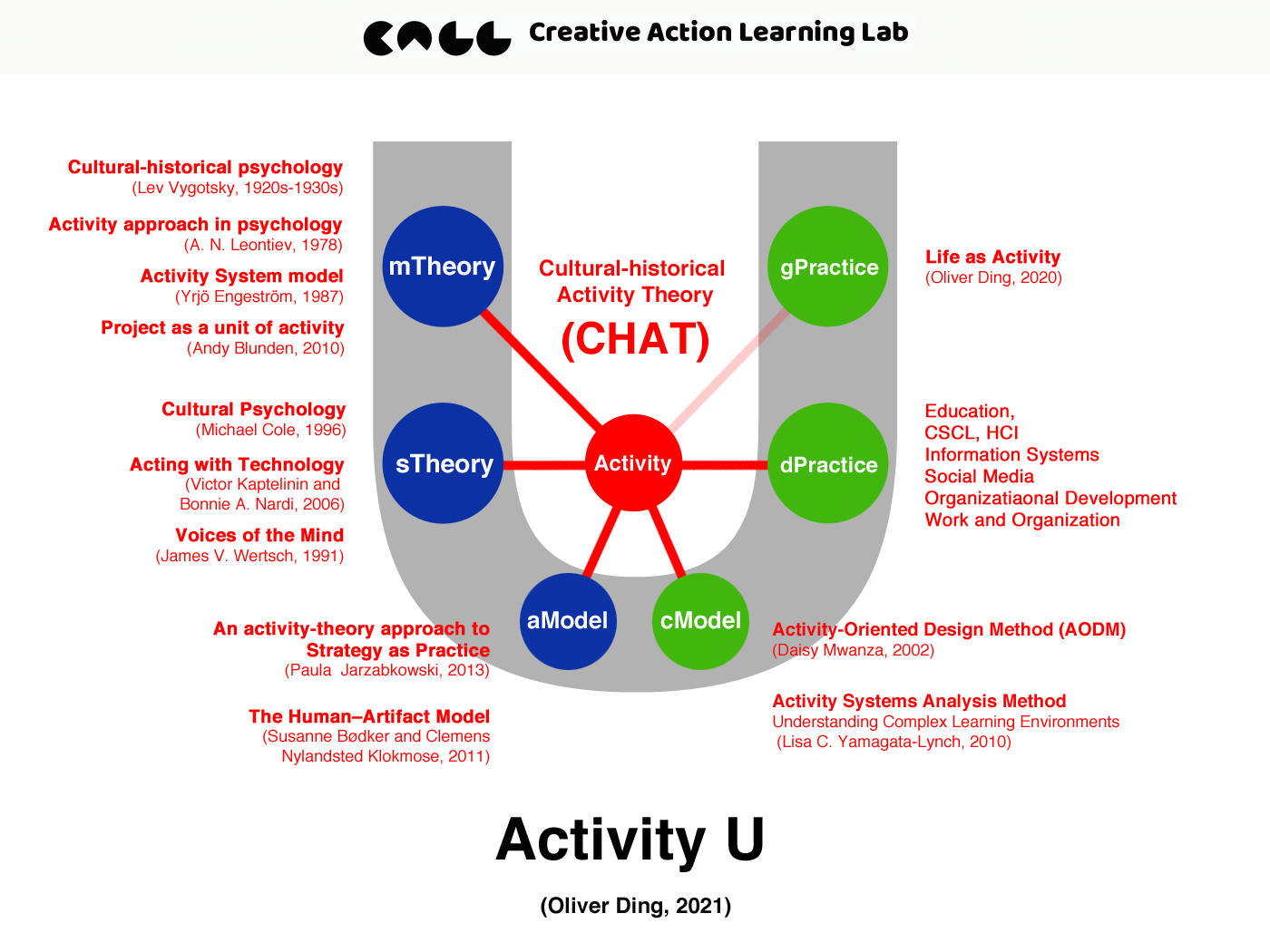
But this raised a further question. The internal diversity was now mapped — but what produced the external distinctiveness? Activity Theory clearly differs from other theoretical traditions, such as behaviorism, psychoanalysis, and phenomenology. What constitutes the essential differences between Activity Theory and these other traditions? What makes it recognizably itself, not just internally diverse but externally distinct?
1.2 The Platform Genidentity Framework (2022)
In May 2022, I developed the Platform Genidentity framework to understand the identity of a knowledge system and a knowledge center over time. The framework drew on Kurt Lewin's early 20th-century concept of Genidentity, defined as the existential continuity of an object through successive phases of development. According to Lewin, identity does not stem from static properties but from a lineage of transformation — "one has developed from the other." Although genidentity was originally developed to compare scientific disciplines and their developmental logic, I interpreted it as a concept of "topology of identity" with temporal dynamics.
To operationalize it, I proposed the following working definition: a thing's Genidentity is defined by Essential Differences with Situated Dynamics. This allowed me to transform a philosophical concept into a usable one for empirical research. I used the concept of Platform Genidentity to describe how a platform maintains its unique identity over a long duration — examples include Google.com, Wikipedia.org, and YouTube.com, all of which retained their original core design features over time. To unpack this further, I introduced four key ideas: Essential Differences (what makes the platform distinctively itself), Situated Dynamics (how it adapts across versions and contexts), Platform Core (the core unit of the platform), and Platform-ba (the platform-based sociocultural field that forms around it).
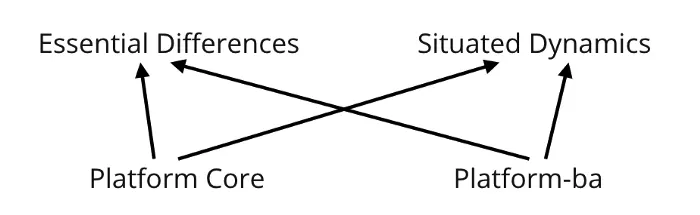
I then applied this framework to theoretical traditions. My intuition was that, for scholars who engage deeply with a theoretical tradition over years, that tradition functions as a developmental platform — a structured environment within which their own theoretical work grows.
If a theoretical tradition is a developmental platform, then Platform Genidentity is the right framework for analyzing what makes it what it is across time. This also echoes Lewin's original intention: he developed the concept of Genidentity precisely to analyze the differentiation between scientific disciplines — for example, how psychology and sociology diverge from a common root. My application operates at a finer level of granularity, focusing not on disciplines but on theoretical traditions within a discipline.
This stage of exploration produced two outcomes: the original note The Genidentity of Activity Theory (April 2022), and the concept of Theoretical Platform.
1.3 The Weave-the-Theory Model (2025)
The 2022 exploration identified the pattern but did not fully explain it. It described what each contributor did — the structural operation of resolving dualisms through the introduction of a third element — without yet providing the conceptual tools to explain how this operation functions within the broader dynamics of theoretical development.
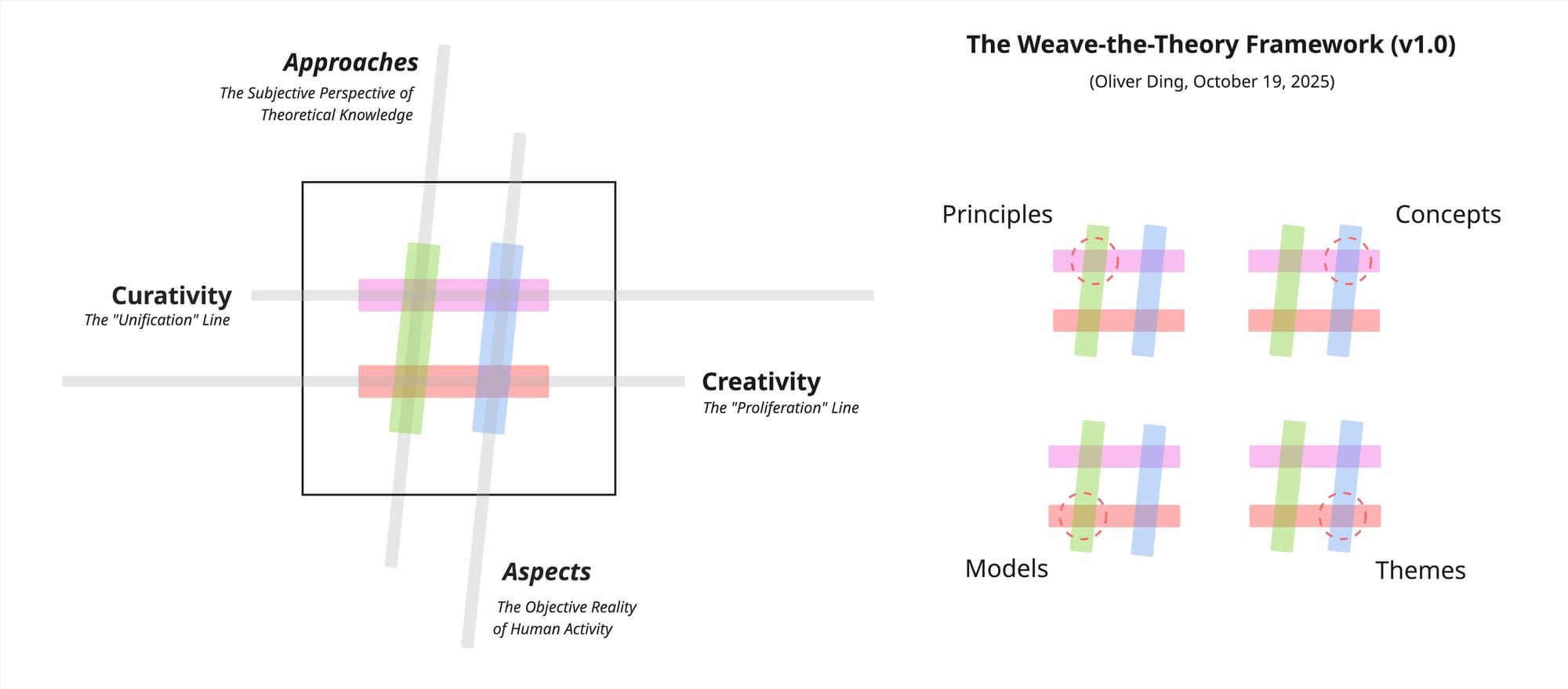
Those tools arrived later, through a different path. In October 2025, working with the Weave Basic Form diagram, I developed the Weave-the-Theory model and introduced the concept of Theoretical Activity.
Subsequently, as the Life-as-Activity Approach developed toward v4.0, the concept of Enterprise entered the theoretical system. At that point, Theoretical Activity and Theoretical Enterprise became a paired set of concepts: two perspectives on the same diachronic development process — the subjective experience of the theorist building an enterprise, and the objective process of activity as seen from outside.
Recently, with the publication of the Weave the Life book manuscript presenting the Life-as-Activity Approach v4.0, I recognized a connection that had not been visible before. The 2022 Theoretical Platform concept is a synchronic analysis — it describes the structural pattern of a tradition at any given moment, what makes it what it is. The 2025 Theoretical Activity / Theoretical Enterprise concepts are a diachronic analysis — they describe how a theoretical tradition unfolds across time as a series of projects and events. Synchronic and diachronic together constitute the structure of the Weave-the-Theory model, since Weave-the-Theory is itself composed of two diachronic lines (Creativity and Curativity) intersecting with synchronic weave-points (Themes, Models, Concepts, Principles).
Part 2. The Genidentity Analysis Method
The Platform Genidentity framework provided the conceptual foundation — Essential Differences and Situated Dynamics — but a concept alone does not constitute an analytical method. Moving from the concept of genidentity to actual case analysis required a series of methodological decisions: what counts as a unit of analysis, how to select cases, how to handle the gap between a theorist's intentions and the structure of their concept system, and what technique to use for comparative pattern recognition. These decisions were not made all at once; they accumulated over several years of working with the framework across different cases and contexts. This section presents the analytical method that emerged from that process — the set of tools that makes it possible to apply genidentity analysis to a theoretical tradition in a rigorous and reproducible way.
2.1 Genidentity: Essential Differences and Situated Dynamics
The concept of genidentity originates in the philosophy of Kurt Lewin, who introduced it to describe the identity of a thing across time: not the static sameness of an object, but the dynamic persistence of a process. A river is not the same water from moment to moment, yet it remains the same river. Its identity is its genidentity — the pattern of continuity that persists through change.
Applied to knowledge platforms and theoretical traditions, genidentity becomes an analytical tool for asking: what is it that persists through the changes of a theoretical enterprise? What makes it recognizably itself across different versions, different contributors, different historical moments?
My operational definition: a thing's genidentity is defined by Essential Differences together with Situated Dynamics.
- Essential Differences: the structural feature that distinguishes this tradition from all others — what it does that nothing else does in quite the same way.
- Situated Dynamics: the varying content, context, and application through which the essential differences is expressed in specific historical moments.
These two components are not opposed. They work together: the Essential Differences is what persists; the Situated Dynamics are how it persists — in different forms, through different materials, under different conditions.
Every theoretical tradition can be understood as a concept system — a set of core concepts together with a coordination mechanism that governs how those concepts relate to each other and how new concepts are introduced. The coordination mechanism is the deep logic of the tradition: it determines what counts as a valid theoretical move, what kinds of problems are recognized as problems, and what kinds of solutions are recognized as solutions. The Essential Differences of a tradition is precisely this coordination mechanism — the structural feature that makes it recognizably itself across all its situated variations.
2.2 A Case Study: The Genidentity of a Knowledge System (2024)
To make the analytical framework concrete, it helps to see it applied to a specific case before turning to the main analysis of Activity Theory. In May 2024, I applied the Platform Genidentity framework to my own knowledge center — the Activity Analysis Center (AA) — and produced the Genidentity of Knowledge System model (see diagram).
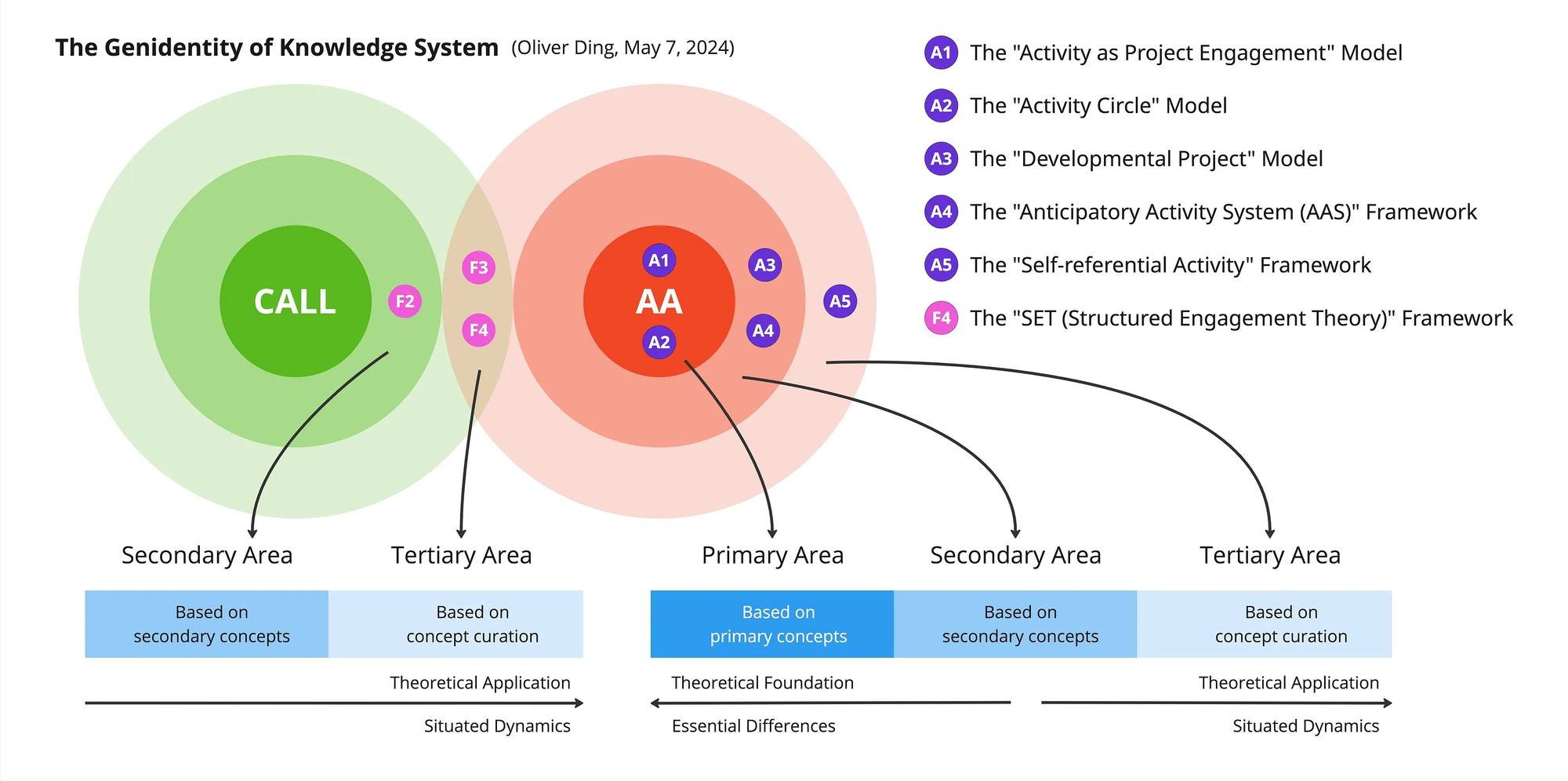
The case focused on the internal structure of AA and its relationship to CALL (Creative Action Learning Lab), a neighboring knowledge center. AA hosts the Activity Analysis Method, rooted in Activity Theory; CALL hosts the Ecological Practice Approach, inspired by Ecological Psychology. The diagram maps six frameworks across three zones — Primary Area, Secondary Area, and Tertiary Area — corresponding to the distinction between Essential Differences and Situated Dynamics.
Primary Area (Theoretical Foundation / Essential Differences): frameworks based on primary concepts that define what makes the knowledge center distinctively itself.
- A1 (The "Activity as Project Engagement" Model): rooted in Andy Blunden's notion of "Project as a unit of analysis of Activity"
- A2 (The "Activity Circle" Model): inspired by Vygotsky's distinction between two types of mediating tools
Secondary Area (based on secondary concepts): frameworks that extend the primary concepts into new territory.
- A3 (The "Developmental Project" Model): an extension of A1 focusing on project development
- A4 (The "Anticipatory Activity System" Framework): a hybrid of Activity Theory and Anticipatory System theory, introducing First-order and Second-order Activity
Tertiary Area (Theoretical Application / Situated Dynamics): frameworks developed through concept curation, combining Activity Theory with other theoretical resources.
- A5 (The "Self-referential Activity" Framework): focused on a specific type of activity
- F4 (The "Structured Engagement Theory" Framework): a creative dialogue between Activity Theory and Ecological Psychology
This case demonstrates how the genidentity framework operates in practice. The Essential Differences of a knowledge center are carried by its Primary Area — the foundational concepts that make it what it is. The Situated Dynamics are expressed through the Secondary and Tertiary Areas — the applications, extensions, and hybrid frameworks that adapt the foundational concepts to different contexts and problems. The boundary between Primary and Secondary is the boundary between what must be preserved for the center to remain itself, and what can vary without loss of identity.
2.3 Meta-framework vs. Thematic Enterprise
In late 2025, I developed the Cultural Genidentity model, which introduced a new pair of concepts to correspond to Essential Differences and Situated Dynamics: Meta-framework and Thematic Enterprise. This model treats cultural and theoretical traditions as concrete expressions of concept systems in social life — not abstract philosophical constructs, but living enterprises that unfold through the work of real people over time.
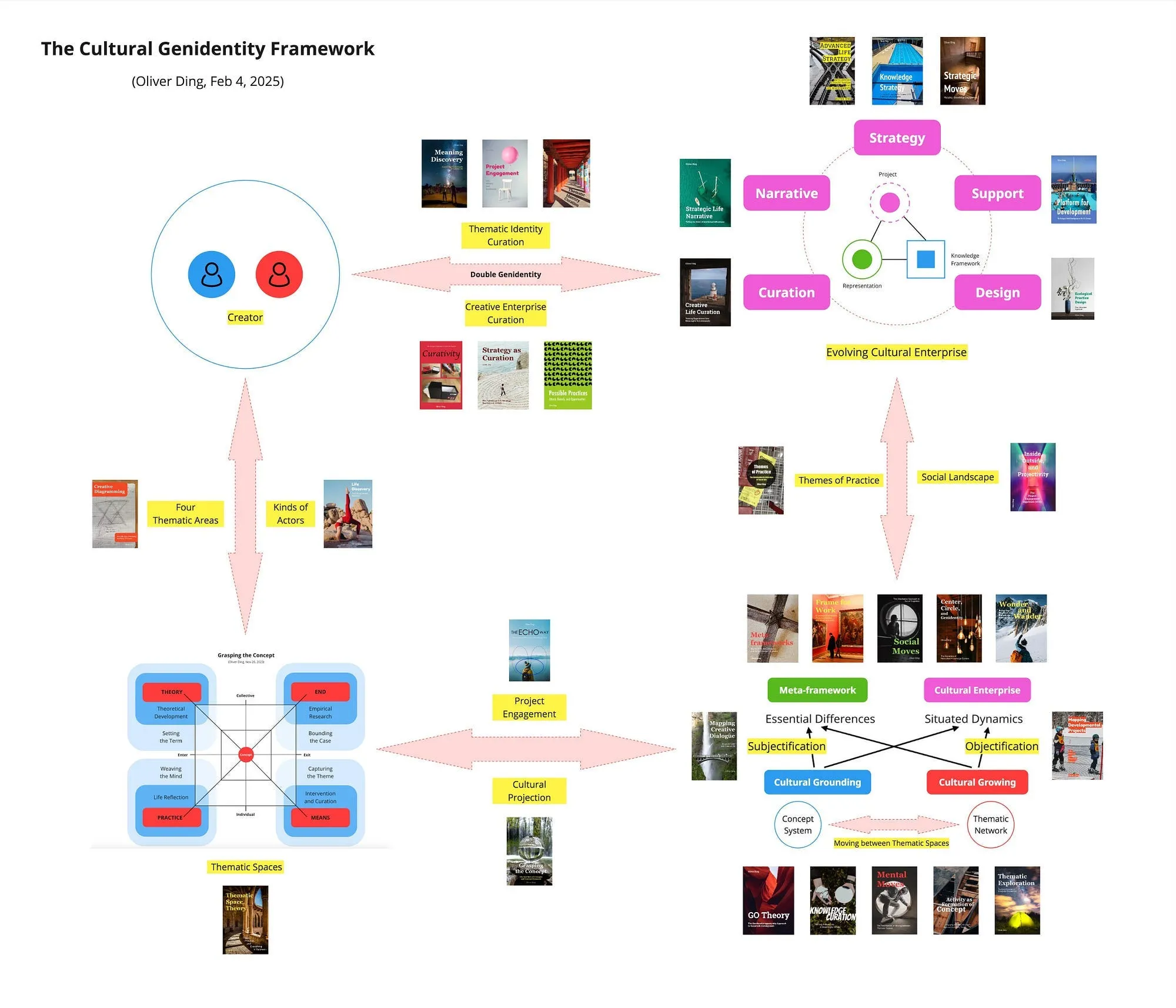
Applied to theoretical traditions, the pairing works as follows:
- Meta-framework = Theoretical Foundation = core concept systems
- Thematic Enterprise = Theoretical Application = theoretical enterprise
Every theoretical tradition can be understood as a theoretical enterprise that is based on a series of core concept systems. Each concept system is a set of concepts together with a coordination mechanism that governs how those concepts relate to each other and how new concepts are introduced. The coordination mechanism is the deep logic of the theoretical enterprise: it determines what counts as a valid theoretical move, what kinds of problems are recognized as problems, and what kinds of solutions are recognized as solutions. The Essential Differences of a theoretical enterprise is precisely this — a set of core concept systems and a coordination mechanism — the structural feature that makes it recognizably itself across all its situated variations.
This framing clarifies what we are looking for when we analyze the genidentity of a theoretical tradition — and why the analytical focus shifts depending on the scale of the enterprise we are examining.
In the case of a knowledge center, the primary question is: what are the core concept systems that constitute the center's Essential Differences? The concept systems are relatively few and can be directly identified, as the 2024 case study demonstrated.
But for a Theoretical Tradition with a long history and multiple generations of contributors, the situation is different. Many concept systems have accumulated over time, and they are genuinely diverse — each generation brings its own concepts, frameworks, and intellectual resources. In this context, the question is no longer simply "what are the core concept systems?"
The more revealing question becomes: what coordination mechanism has governed the construction of all these concept systems across generations? It is the coordination mechanism — not any particular set of concepts — that persists through the diversity and constitutes the Essential Differences of the tradition. We are looking for the deep logic that has remained constant across generations of contributors working with different materials, in different contexts, toward different empirical ends.
2.4 Developmental Episode
Within the Meta-framework vs. Thematic Enterprise pairing, a thematic enterprise is composed of many projects — each contributor decides their own project, pursues their own questions, and works within their own intellectual context. Not all of these projects contribute equally to the Meta-framework. Some remain at the level of application or extension; others make a more fundamental contribution — they change, clarify, or extend the core concept systems that constitute the theoretical foundation.
I use the term Developmental Episode to designate this second type: a project that makes a contribution to the Meta-framework of a theoretical enterprise. A developmental episode is not simply any moment of theoretical work; it is a specific project in which a contributor engages directly with the foundational concept systems of the tradition — identifying a limitation, introducing a new concept, or restructuring the coordination mechanism — in a way that leaves a lasting mark on what the tradition is.
What counts as a successful developmental episode? Following Larry Laudan's philosophy of science, scientific progress is best understood not as the accumulation of truths but as the progressive resolution of problems. A theoretical contribution succeeds when it solves problems that its predecessors could not — empirical problems about the world, and conceptual problems internal to the theoretical tradition itself. By this standard, a developmental episode succeeds when it resolves a problem that had been blocking the development of the tradition, and its solution is adopted and built upon by subsequent contributors.
Most developmental episodes follow the pattern of problem and solution: a theorist identifies a problem in the existing framework, proposes a solution, and the solution endures because it worked. However, not all episodes follow this pattern. An alternative type involves the discovery of a new thematic direction — a new set of questions so productive that the old problem becomes irrelevant rather than solved. In this case, the episode succeeds not by answering the old question but by making it no longer worth asking.
2.5 Case Selection
The cases analyzed in this article were not selected from scratch. In the 2020 Activity U project, I had already mapped the landscape of Activity Theory and identified four representative contributors whose work constituted the Meta-theory level of the tradition: Lev Vygotsky (Cultural-historical psychology, 1920s–1930s), Aleksei Leontiev (Activity approach in psychology, 1940s), Yrjö Engeström (Activity System model, 1987), and Andy Blunden (Project as a unit of activity, 2010). These four were selected then because their contributions operate at the most foundational level — they shaped what Activity Theory is, not merely what it can do.
This article continues from that selection. For each of these four contributors, I identify the developmental episode that most clearly contributed to the Meta-framework of the tradition. In most cases, this means identifying the problem they addressed and the solution they proposed — following Laudan's problem-solving model of scientific progress. In some cases, as the analysis will show, a contributor had more than one episode, with different outcomes.
Part 3. Rebuilding the 2022 Exploration
3.1 The 2022 Exploration: What Deep Analogy Revealed
In April 2022, while reading a thesis by an activity theorist working in design, I used a technique I called Deep Analogy to reflect on the historical development of Activity Theory. The technique involves identifying a structural pattern that recurs across multiple instances and using it as a lens to read each instance more precisely.
The structural pattern I identified was this: each major Activity theorist, when confronted with an inherited dualism, introduced a third element that transformed the binary opposition into a triadic structure. The third element was not a compromise between the two poles, nor a mediating term positioned between them — it named a more fundamental unity within which the two poles became internal moments rather than independent entities.
The pattern was consistent across four contributors:
| Theorist | Inherited Dualism | Third Element | Triadic Structure |
|---|---|---|---|
| Vygotsky | Stimulus — Response | Mediation | S — X — R |
| Leontiev | Individual Actions — Collective Activity | Object-orientedness | Actions — Object — Activity |
| Engeström | Object — Outcome | System | Object — System — Outcome |
| Blunden | Practice — Sign | Concept | Practice — Concept — Sign |
When the same structural operation recurs across four contributors, the recurrence is evidence of something deeper than coincidence. At that time, I took this recurrent structural operation to be the core of Activity Theory's Genidentity — but I held this conclusion tentatively. The pattern was clear; whether it constituted a sufficient answer was not.
After years of development, the Genidentity Analysis method has developed more advanced frameworks and tools for answering this question: what is the Genidentity of Activity Theory?
3.2 Revisiting with the Weave-the-Theory Model
The Weave-the-Theory model is a framework for understanding how theoretical work develops — not what it concludes, but how it moves. It proposes that theoretical development always involves two simultaneous lines of movement: a Creativity Line, which proliferates outward through Themes and Models, and a Curativity Line, which unifies inward through Concepts and Principles. These two lines intersect at four weave-points that mark the key moments of transformation in any theoretical enterprise.
The two diachronic lines map directly onto the Genidentity Analysis Method. The Curativity Line corresponds to the maintenance of Essential Differences — the structural features that persist across time and define what the tradition is. The Creativity Line corresponds to the exploration of Situated Dynamics — the variable content, frameworks, and applications through which the tradition expresses itself in each new context.
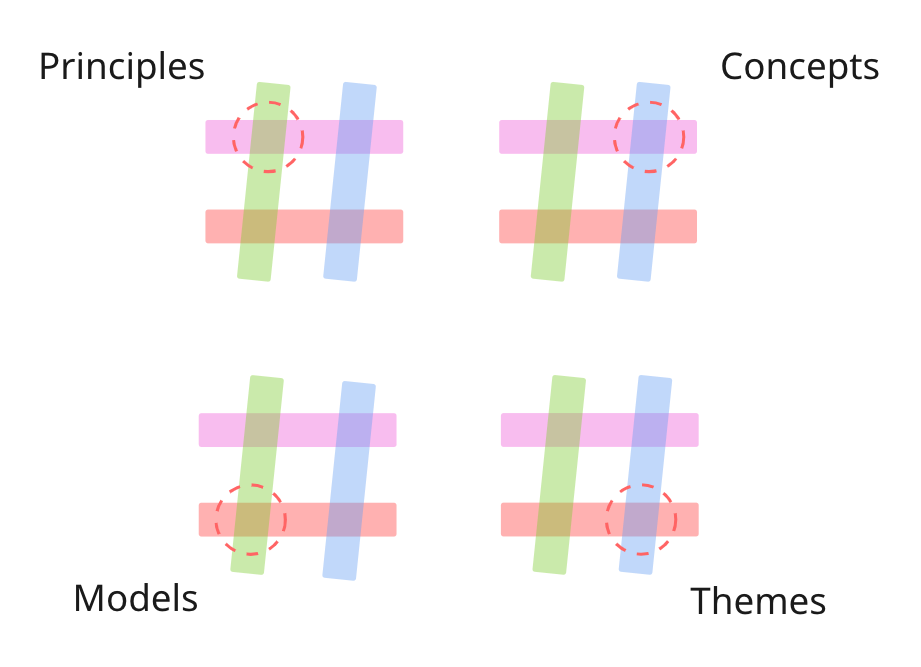
Applied to a large theoretical tradition such as Activity Theory, this mapping becomes specific. At the Curativity Line, the Concepts weave-point corresponds to the core concept system of the tradition — the foundational concepts that define its theoretical identity. The Principles weave-point corresponds to the coordination mechanism of that concept system — the deep logic that governs how new concepts are introduced and how theoretical problems are recognized and resolved. At the Creativity Line, the Themes and Models weave-points correspond to the intermediate frameworks developed and deployed across various projects within the thematic enterprise, representing the tradition's theoretical applications.
Together, the two lines and four weave-points reveal that a theoretical tradition offers multiple creative entry points. Contributors can choose their own path — developing new concepts, building applied frameworks, conducting empirical research — all drawing on the theoretical artifacts accumulated by previous projects. In this sense, a theoretical tradition functions as a developmental platform: a structured environment within which new creative work becomes possible.
The 2022 exploration was concerned with only one of these entry points: the "Principles" weave-point and its associated coordination mechanism. This article continues that focus. Other creative paths — developing new Concepts, building new Models, applying Activity Theory empirically — lie outside the scope of this analysis, though they are no less legitimate as forms of engagement with the tradition.
3.3 Philosophy as Creative Heuristics
The 2022 exploration identified what each contributor did, but left a deeper question unanswered: why did they all do the same thing? What explains the consistency of this structural operation across such different intellectual contexts?
From our interpretive standpoint — looking back across the four cases — a pattern becomes visible that the contributors themselves may not have explicitly articulated: each drew on philosophical resources as creative heuristics — operational tools that helped them recognize a dualism, search for a resolution, and construct a new conceptual unity. Philosophy entered their concept systems not as doctrine or content, but as method: a mental platform for theoretical innovation. This is our reading of what they did, not their own account of it.
This distinction is important. The coordination mechanism belongs to the concept system — it is what Activity Theory is. The philosophical heuristics belong to the theorist's creative process — they are tools the theorist uses. The same coordination mechanism can be reached through different philosophical heuristics; and the same philosophical heuristic can generate different concept systems in different theoretical traditions.
Within this framework, we can re-evaluate the long-standing debate regarding the historical ties between Marxism, Vygotskian psychology, and Leontiev’s Activity Theory. Rather than viewing Marxism as a foundational doctrine to be applied, this perspective reframes it as a creative heuristic—an operational tool used during the construction of these psychological frameworks. Such a demarcation clarifies that Vygotsky’s thought is not a mere derivative of Marxist tenets, nor should it be constrained by the label of "Marxist Psychology." By decoupling the psychological core from the philosophical precursor, we safeguard the autonomy of Activity Theory. This allows the field to evolve as an independent thematic enterprise, unburdened by the ideological weight or historical constraints of its inspirations.
From the 2022 exploration, the key insight was this: all four contributors followed the same problem-solution pattern — inheriting a dualism, identifying its inadequacy, and introducing a third element that transformed the opposition into a triadic structure. The philosophical resources they drew upon varied; the structural operation they performed did not. It is this shared operation — not any shared doctrine or common philosophical commitment — that functions as the creative heuristic governing Activity Theory's development.
The anti-dualist operation that serves as Activity Theory's coordination mechanism can take several distinct philosophical forms. Two are most relevant to the cases examined here:
Dual-aspect monism: the two poles of a dualism are reframed as two perspectives on the same underlying reality. The opposition is not eliminated but relocated — from an external confrontation between two independent entities to an internal tension within a single process viewed from different positions.
Neutral monism: a third element is introduced that is more fundamental than either pole, from which both are derived. The two poles are shown to be expressions of a more basic process, neither of which can be understood independently of that process.
A tradition may have both a conceptual core and a methodological core. But the Activity Theory case, as Part 4 will show, suggests that when the two are in tension — when the concepts diverge while the method persists — the method may be the more fundamental carrier of the tradition's identity.
3.4 Settings for the Case Analysis
With the analytical framework established in Part 2, we can now specify how it applies to Activity Theory as a case.
Genidentity: Essential Differences and Situated Dynamics
As established in 3.2, this article focuses on the Meta-framework dimension of Activity Theory's Genidentity — specifically the "Principles" weave-point and the coordination mechanism. The Situated Dynamics of the tradition — the diverse frameworks, models, and empirical applications developed by contributors over time — are not the concern of this analysis.
What is worth noting, however, is the state of existing work on the Curativity Line. Over the years, many Activity Theory scholars have proposed various accounts of the tradition's "principles" — summaries intended to capture what Activity Theory is, drawing together the contributions of multiple theorists into a coherent picture for newcomers and practitioners. These accounts are genuine curatorial projects, and they belong to the Curativity Line of the tradition's development. They deserve a dedicated study of their own.
But examined closely, most of these accounts do not clearly distinguish between the concepts themselves and the coordination mechanism that governs those concepts. They describe what Activity Theory says — its key concepts, their definitions, their relationships — without identifying the deeper logic that has governed how each new concept system was constructed. It is precisely this distinction — between concept and coordination mechanism — that this article takes as its analytical focus.
The question this article asks is not: what concepts does Activity Theory share? It is: what coordination mechanism has governed the construction of each contributor's concept system? It is the answer to this second question that constitutes Activity Theory's Essential Differences in the strict sense of the genidentity framework.
Meta-framework and Thematic Enterprise
Activity Theory as a whole is a thematic enterprise — a long-running collective project composed of many individual projects, each contributor deciding their own direction. The Meta-framework of this enterprise is the set of core concept systems that constitute its Essential Differences. The case analysis focuses on developmental episodes — those projects that made direct contributions to the Meta-framework, changing or extending the core concept systems in ways that endured.
Developmental Episode
For Activity Theory, a developmental episode takes the following specific form: a contributor inherits a dualism from the existing state of the field, identifies it as a problem blocking further development, introduces a third element that resolves the opposition, and produces a triadic structure that subsequent contributors adopt and build upon. The four cases analyzed in Part 4 each present one or more such episodes.
Case Selection
The four contributors selected — Vygotsky, Leontiev, Engeström, and Blunden — were already identified in the 2020 Activity U project as operating at the Meta-theory level of the tradition. This article continues from that selection, focusing on the specific developmental episodes within each contributor's work that most clearly shaped the Meta-framework of Activity Theory.
Laudan's Problem-Solution Model
Following Laudan, scientific progress is measured by the resolution of problems. For each developmental episode, the analysis identifies: what problem was inherited, what solution was proposed, and whether the solution endured. In cases where a contributor had multiple episodes — some successful, some not — the analysis acknowledges both but focuses on the episode that succeeded, since it is the successful episodes that constitute the tradition's Essential Differences.
Part 4. Four Developmental Episodes
With this framework in place, we can examine the historical record. Before turning to the individual cases, it is useful to establish the specific structure that a developmental episode takes in the context of Activity Theory.
Activity Theory's thematic enterprise has accumulated many concept systems across its contributors. Each major contributor introduced a new concept system by engaging with an inherited dualism — a pair of opposing concepts that had been taken as fundamental but that proved inadequate under the pressure of new problems. The structure of each developmental episode is:
- Inherited dualism: a pair of opposing concepts that has been taken as fundamental by the existing state of the field
- Third element: the new concept introduced to resolve the dualism
- Triadic structure: the new conceptual configuration that results
- Historical outcome: whether the episode succeeded — whether the triadic structure was adopted and developed by subsequent contributors
A single theorist may have multiple developmental episodes — engaging with different dualisms at different points, with different degrees of success. This article selects, for each theorist, the episode that has most clearly endured in the subsequent development of the tradition. The four episodes analyzed here represent the most enduring contributions of the tradition's major figures.
4.1 Lev Vygotsky: Stimulus — Mediation — Response
The inherited dualism: Vygotsky's primary challenge was behaviorism, which had achieved dominance in psychology through the Stimulus—Response (S—R) schema. For behaviorism, all psychological phenomena could in principle be explained as conditioned responses to environmental stimuli. The schema was powerful in its simplicity: it reduced the complexity of psychological life to a binary relationship between an organism and its environment.
But the S—R schema faced a problem that its proponents could not resolve within their own framework: it could not account for the specifically human forms of behavior — language, voluntary attention, logical memory, concept formation — that distinguished human psychological development from that of other animals. These capacities seemed to require something that the S—R schema systematically excluded: the intervention of cultural tools, signs, and symbols that transformed the relationship between stimulus and response.
The dualism exposed: Vygotsky diagnosed the problem not as a failure of behaviorism to apply its schema correctly, but as a structural limitation of the schema itself. The S—R dualism treated stimulus and response as the two fundamental terms of psychological analysis, with the organism's internal processes as merely the mechanism connecting them. What this excluded was precisely what Vygotsky took to be the most important feature of human psychology: the role of culturally produced signs as mediating tools that transformed both the stimulus and the response.
The third element: Vygotsky's solution was to introduce the concept of mediation — specifically, semiotic mediation through cultural signs — as the third element that transforms the S—R dualism into a triadic structure: S—X—R, where X is the mediating sign. But the key is recognizing that X is not simply a new term added to an existing relationship. It is a redefinition of what psychological analysis takes as its fundamental unit.
For Vygotsky, the fundamental unit is not the stimulus, not the response, and not the sign in isolation, but the Mediating Action — the whole composed of stimulus, mediation, and response in their dynamic interrelation. Vygotsky writes explicitly that the unit of analysis must preserve the properties of the whole: the task is to find a unit that "unlike elements, retains all the basic properties of the whole and cannot be further divided without losing them" (Thought and Language, 1934/1986). The Mediating Action is such a unit: it is a whole in which S, X, and R are internal moments, not independent parts.
The resulting framework: From this episode, Vygotsky developed Cultural-Historical Psychology — a framework in which the specifically human forms of mind are understood as the internalization of culturally produced tools and signs. The framework operates at multiple levels: the phylogenetic, the historical, the ontogenetic, and the microgenetic. All of these levels are unified by the same basic insight: that human psychology is mediated psychology, and that mediation is not an addition to but the constitutive condition of specifically human mental life.
Historical note: In real history, Vygotsky achieved this operation through conceptual analogy—he transferred Engels’ account of material tools into the concept of “psychological tools.” See Appendix.
4.2 Aleksei Leontiev: Individual Actions — Object-orientedness — Collective Activity
Note on episode selection: Leontiev faced two major dualisms in his theoretical work. One — the dualism of Consciousness and Activity — he attempted but did not fully resolve; his closest colleague Galperin explicitly noted that this attempt left a parallelism between consciousness and behavior unresolved. The episode analyzed here is the one that endured: his resolution of the Individual Actions — Collective Activity dualism through the introduction of Object-orientedness and the three-level hierarchy.
The inherited dualism: As Spinuzzi has observed, most of Leontiev's work was concerned with connecting individual and societal activity — this was the central problem his framework was designed to address. On one side stood approaches that took the individual subject as the basic unit of psychological analysis. On the other stood the reality of collective social life, with its shared motives, cultural tools, and historically accumulated practices. Vygotsky's semiotic mediation had made important progress, but remained primarily concerned with individual actions and their mediation by cultural signs. The question of how individual actions relate to collective activity — how the personal becomes social and the social becomes personal — remained structurally unresolved.
Significantly, Leontiev himself recognized this limitation. At the end of Activity, Consciousness, and Personality (1975/1978), he explicitly raised the need for better analysis of the interaction between the psychological and social levels — a need that subsequent Soviet psychologists, including Davydov and Lomov, also acknowledged as unfinished business. This is our interpretive reading of Leontiev's developmental episode; the Individual—Collective tension was real and recognized, even if Leontiev did not describe his own work in precisely these terms.
The third element: Leontiev's solution was the concept of Object-orientedness — the principle that human activity is always directed toward an object, and that it is the object of activity, rather than the activity itself in the abstract, that determines the activity's content, structure, and social meaning. The object is not a passive target but the socially constituted pole toward which collective motives and individual actions are directed. As Leontiev wrote, "behind the relationship of activities there is a relationship of motives" — and it is the object that gives activity its motive, connecting the individual's actions to the collective's needs.
The triadic structure is: Individual Actions — Object-orientedness — Collective Activity. The object of activity is social before it is individual: it is defined by collective need and motive, and individual actions acquire their psychological character only by virtue of their orientation toward a socially constituted object.
The resulting framework: Leontiev's Activity Theory introduces the three-level hierarchy: Activity (driven by motive, oriented toward an object), Actions (driven by goals, oriented toward specific outcomes), and Operations (automated, driven by conditions). This hierarchy is not simply a classification of behaviors; it is an account of how collective motives are realized through individual goal-directed actions and automated operations. The three-level structure endured — and its endurance confirms that this was Leontiev's successful episode — even as the deeper Individual—Collective tension remained only partially resolved, leaving work for subsequent contributors.
Historical note: In real history, Leontiev’s operation was closer to scope extension—extending mediated action from the individual to the collective level; the substance of the activity system already existed in his work, though not yet formalized. See Appendix.
4.3 Yrjö Engeström: Object — System — Outcome
The inherited dualism: Engeström identified a limitation in both Vygotsky's and Leontiev's frameworks: the Object—Outcome relation. In the Leontievian framework, this relation appeared as a simple directional relationship: activity is directed toward an object in order to produce an outcome. But this simple relationship obscured the complex mediation that occurs in real collective activity systems.
Note on the main contribution: The mainstream narrative of Engeström's contribution focuses on the expansion of mediating elements in his Activity System model — the addition of rules, community, and division of labor to the original Subject—Mediating Tools—Object triangle. This narrative describes the result. The analysis here identifies the cause: it is the introduction of System as the third element that makes these additional components necessary. The expanded mediating elements are the natural elaboration of what System requires; they are the fruit, not the root, of Engeström's contribution.
The third element: Engeström's solution was the concept of System — specifically, the collective Activity System as the fundamental unit of analysis. The Activity System is not simply the sum of its components; it is a structural whole in which all components are internally related, and in which contradictions arise from the tensions among these components.
The triadic structure is: Object — System — Outcome. The System transforms the simple Object—Outcome relation into a complex, collectively organized process of transformation.
The resulting framework: Engeström's Activity System model provides tools for analyzing contradictions within and between activity systems, for facilitating collective learning processes that lead to systemic transformation, and for understanding how new forms of activity emerge from the resolution of systemic contradictions.
Historical note: In real history, Engeström’s primary aim was to build a theory of expansive learning; systematizing Leontiev’s activity system was a by‑product. Yet he did much more on that foundation—redefining the concet of "Object," making "Contradictions" the core concept, creating the visual form, and driving the long‑term development of activity system model. His creative operation can be summarized as extension. See Appendix.
4.4 Andy Blunden: Two Episodes
Blunden presents a distinctive case: two developmental episodes, each addressing a different dualism, each making a genuine contribution. The connections between them, though noted, remain less than fully explicit and systematic.
Episode 1: Individual — Project — Collective
Blunden's first episode directly addresses a limitation he identified in Leontiev's framework: despite claiming to unite individual and collective, Leontiev's theory remained, as Blunden explicitly argued, "consistently dualistic and asocial." The personal sense of the individual and the objective motive of the collective were never fully unified — they remained two separate terms in an unresolved opposition.
Blunden's solution was to introduce Project as the new unit of analysis. A project, for Blunden, is not the property of an individual; it is an inherently collaborative undertaking, defined by the shared pursuit of a common objective. The triadic structure is: Individual — Project — Collective. The Project is not simply a mediating term; it is the whole of which individual participation and collective organization are internal dimensions.
This episode endured: To be frank, while Andy Blunden proposed the 'Project as a unit of analysis' in 2010, the concept has not been as widely adopted or extended across Activity Theory research as one might expect. However, responding to this theoretical call in 2020, I initiated the development of the Project Engagement Approach. As of 2025, with the release of v4.0, this work has matured into a comprehensive conceptual framework supported by an extensive repository of case studies.
Episode 2: Practice — Concept — Sign
Blunden's second episode operates at a different level. Vygotsky's tradition had always emphasized the role of signs and symbols in mediating psychological activity. But in the development of Activity Theory through Leontiev and Engeström, this semiotic dimension had been partially submerged beneath the emphasis on material practice and systemic organization. A tension had accumulated between Practice (the material, operational dimension of activity) and Sign (the symbolic, meaning-making dimension).
Blunden's response was to introduce Concept — understood not as a static mental content but as the active process of concept formation — as the third element. The triadic structure is: Practice — Concept — Sign. Concept formation is not a purely mental process; it is an activity embedded in social practice and expressed through signs. Nor is it a purely linguistic process; it requires the grounding of material practice to become determinate.
This episode also carries a philosophical dimension: Blunden drew on Hegel's logic of the concept, but reversed its direction. Where Hegel moved from Concept to Activity (the concept realizing itself in practice), Blunden moved from Activity to Concept (the concept formed through practice). This reversal — "Activity as Formation of Concept" — placed the semiotic dimension back at the heart of Activity Theory, but now in a materialist rather than idealist frame.
Historical note: In real history, Blunden's first developmental episode drew on Hegel's Individual-Particular-Universal structure to conceptualize "Project" as the unit of analysis; his second episode employed a conceptual reversal—inverting Hegel's movement from Concept to Activity into "Activity as Formation of Concept." See Appendix.
Part 5. The Coordination Mechanism as Focus of Essential Differences
The four cases — and five developmental episodes — demonstrate the consistency of the pattern. Each contributor performed the same fundamental operation: inheriting a dualism, exposing its inadequacy, introducing a third element that formed a triadic structure, and producing a concept system that endured because it genuinely resolved the problem it addressed.
| Theorist | Inherited Dualism | Third Element | New Concept System |
|---|---|---|---|
| Vygotsky | Stimulus — Response | Mediating Action | Cultural-Historical Psychology |
| Leontiev | Individual Actions — Collective Activity | Object-oriented Activity | Activity Theory (three levels) |
| Engeström | Object — Outcome | Activity System | Activity System Model |
| Blunden | Individual — Collective | Project | Project as unit of analysis of Activity |
| Blunden | Practice — Sign | Concept | Activity as Formation of Concept |
Each contributor created a distinct concept system. These concept systems were not directly integrated with one another — each stood on its own terms, developed in its own intellectual context, addressing its own set of problems. Later scholars curated these concept systems into principles and overviews, weaving them into a meaningful whole for the tradition's learners and practitioners. These curatorial efforts are valuable projects in their own right, belonging to the Curativity Line of the tradition's development.
But beneath both the individual concept systems and the curatorial work that followed, a common coordination mechanism has been operating all along: the anti-dualist triadic operation that transforms inherited dualisms into productive new unities through the introduction of a third element. This is what this article identifies as the Focus of Activity Theory's Essential Differences — not the concepts themselves, not the curated principles, but the coordination mechanism that has governed the construction of each contributor's concept system.
To identify this coordination mechanism is not merely to describe the past. It is also to make it available as a creative heuristic for future contributors — a conscious tool that can be deliberately applied when confronting the dualisms that the current state of Activity Theory leaves unresolved. What was previously an implicit pattern, visible only in retrospect, becomes an explicit method that future theoretical work can draw upon.
Part 6. My Own Developmental Episodes
In 2022, I took this insight as a creative heuristic and applied it directly to my own theoretical work. Placing my work in the same analytical table as Vygotsky, Leontiev, Engeström, and Blunden, I recognized that my approach followed the same coordination mechanism — and this recognition encouraged me to claim "Activity as Project Engagement" as the first principle of my own theoretical enterprise.
Recently, while developing the Life-as-Activity Approach (v4.0), I have further developed this principle through two additional developmental episodes. The three episodes presented here demonstrate that the coordination mechanism identified in the historical cases is not only a retrospective analytical finding, but a living creative heuristic that continues to generate new theoretical work.
6.1 Activity as Project Engagement: Outside — Engagement — Inside
The dualism I inherited was the Outside—Inside opposition in social space. This dualism runs through Activity Theory in the form of the internalization—externalization principle: the movement by which outer social activity becomes inner psychological process, and inner psychological process becomes outer social action. But the internalization—externalization framework leaves the boundary between outside and inside relatively undertheorized: it describes the movement across the boundary but does not fully account for the ecological form of the person-project relationship through which that movement occurs.
The third element I introduced is Engagement (Projecting) — understood not as a psychological state but as an ecological action: the process by which a person moves from being outside a project to being inside it, forming identity and contributing to collective life through this movement. The triadic structure is: Outside — Engagement (Projecting) — Inside.
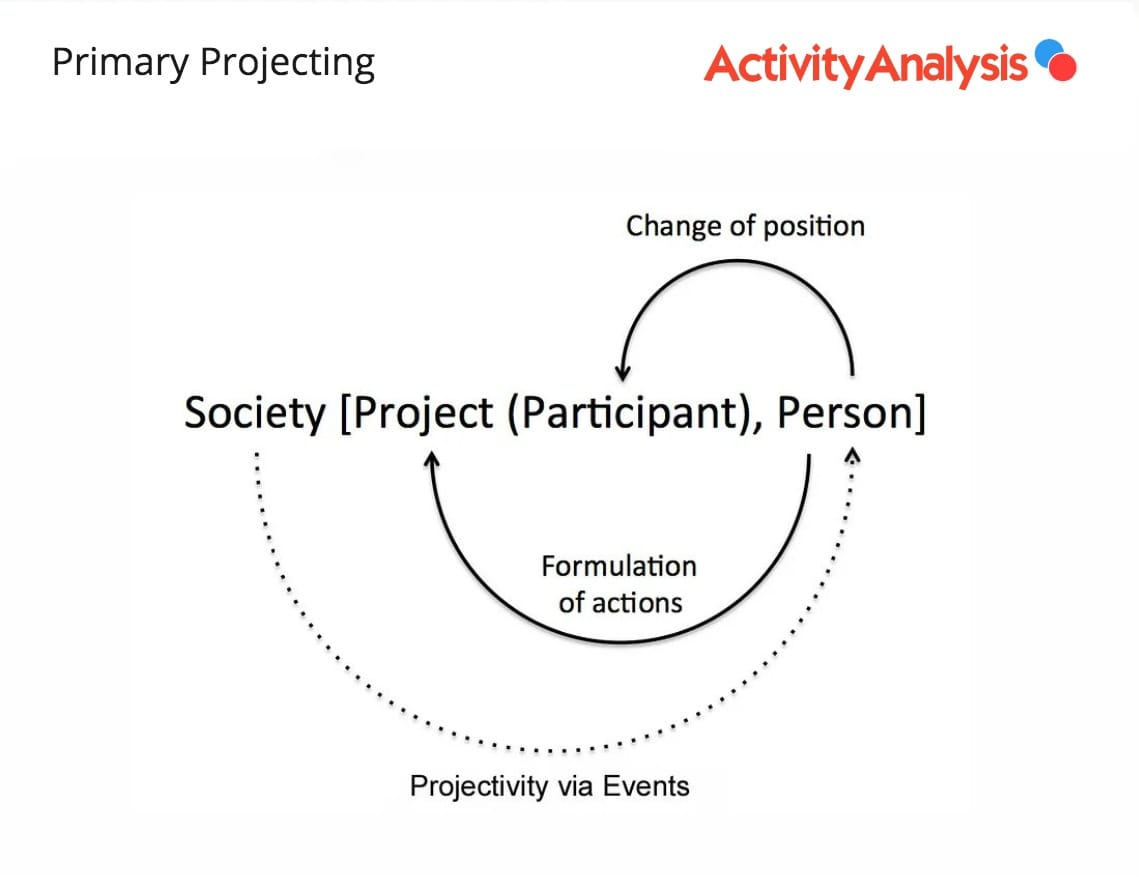
This same process has an alternative expression: Event — Projectivity — Project. In this formulation, Projectivity refers to the potential action opportunities that a project presents to a person from the outside — the latent possibilities of participation. Projecting is the actual act of taking up one of those opportunities — the moment of commitment that moves a person from outside to inside. The two expressions describe the same underlying process: once a person adopts an action opportunity (Projectivity), they cross the boundary from the outside (Event) into the inside (Project). Outside—Inside and Event—Project are thus two ways of naming the same ecological movement, seen from different analytical angles.
This episode exemplifies the dual-aspect monism form of anti-dualist operation: Outside and Inside are not two independent domains but two perspectives on the same social process of Projecting.
6.2 Activity — Attachance — Enterprise: Resolving the Scale Gap
The triadic structure established in 6.1 — Event — Projectivity — Project — operates at the micro level of individual projects and events. But the Life-as-Activity Approach also operates at a larger scale. In Life-as-Activity v4.0, Activity is understood as a series of events, and Enterprise as a series of projects. Activity — Enterprise is thus the direct scale-up of Event — Project: the same Outside—Inside structure, now operating at the meso level of sustained trajectories rather than individual engagements.
This creates a natural question: what is the third element at this scale? In 6.1, the third element was Projectivity — the potential action opportunities that draw a person from outside a project to inside it. Projectivity was itself derived from Attachance in 2020, when I developed it for the Project Engagement framework as a concept describing the ecological interaction between a person and a project. Projectivity named the latent dimension of that interaction; Projecting named the actual movement.
Now, at the enterprise scale, the invitation goes directly to Attachance itself. If Projectivity is Attachance operating at the project scale, then Attachance operating at the enterprise scale describes the larger movements of a creative life — the fundamental capacity to detach from one thematic space and attach to another, through which a person's sustained trajectory shifts and reorients across time.
The triadic structure is: Activity — Attachance — Enterprise. Activity and Enterprise are the same ongoing social reality viewed from outside and inside respectively — the objective process of collective activity systems, and the subjective experience of a person's sustained creative trajectory. Attachance is the mechanism of movement between them: the ecological action that crosses the boundary at the enterprise scale, just as Projecting crosses it at the project scale.
This episode also exemplifies the dual-aspect monism form: Activity and Enterprise are not two separate domains but two perspectives on the same social process, unified by Attachance as the movement that makes the crossing possible.
6.3 Create — Weave — Curate: Resolving the Content Dualism
The third episode involves a different kind of dualism — not the topological dualism of social space, but a dualism of action direction: the opposition between Create (the drive to generate new conceptual objects, to proliferate outward) and Curate (the drive to organize existing objects into coherent structures, to unify inward).
The third element introduced is Weave — the integrative action that holds Create and Curate in motion simultaneously. The triadic structure is: Create — Weave — Curate.
This episode exemplifies the neutral monism form: Weave is not a perspective on Create or Curate, but a more fundamental activity from which both derive their meaning. A theoretical enterprise that only creates becomes incoherent; one that only curates stops growing. Weave is the action that makes both possible simultaneously.
These three episodes share the structural logic of the anti-dualist coordination mechanism. In each case, a dualism is inherited, exposed as inadequate by the demands of practice or theory, and resolved through the introduction of a third element that makes the opposition between its terms intelligible as an internal tension within a more fundamental unity. The coordination mechanism is the same. The content is different. This is exactly what the Genidentity Analysis predicts.
Part 7. Method as Focus
From the case analysis above, a broader insight emerges. When examining the Meta-framework of a theoretical tradition, if there is no obvious consistency at the concept level, then the method hidden behind the coordination mechanism may be the more revealing focus for identifying the tradition's Essential Differences. I call this insight Method as Focus.
In contrast, the dominant orientation in philosophy of science — which locates a tradition's identity in its core concepts, canonical principles, or doctrinal commitments — I call Concept as Focus. This part discusses both orientations and their implications for understanding the Activity Theory case.
7.1 Kuhn's Paradigms
Thomas Kuhn's account of scientific development centers on the concept of the paradigm — the constellation of shared exemplars, values, and metaphysical commitments that define a scientific community's "normal science." Scientific development proceeds through periods of normal science interrupted by revolutionary periods in which a paradigm is overthrown and replaced by another.
The Kuhnian account has two limitations relevant here. First, it focuses on discontinuity at the expense of understanding continuity of traditions that persist through revolutionary changes. Second, it has no framework for understanding how a tradition's essential character is maintained and transmitted across its developments. The concept of the paradigm describes a synchronic snapshot; it does not provide tools for analyzing diachronic continuity.
7.2 Lakatos's Scientific Research Programmes
Imre Lakatos's account of Scientific Research Programmes is more sensitive to continuity. A research programme consists of a "hard core" of unfalsifiable commitments protected by a "protective belt" of auxiliary hypotheses. This distinction parallels, in some respects, my own distinction between Essential Differences and Situated Dynamics.
But Lakatos's account conceives of the hard core primarily in terms of content — the substantive claims the programme's adherents refuse to abandon. This is a Concept as Focus approach: the identity of the tradition is located in its core concepts and doctrinal commitments. The Activity Theory case challenges this assumption, as we will see.
7.3 Chen Ruilin's Theory Versions
Chen Ruilin has developed an account of theoretical development as the evolution of Theory Versions, in which the identity of a theory across its versions is maintained by a core of shared concepts and principles.
Chen's account similarly adopts a Concept as Focus orientation. What persists across versions is a shared conceptual core. If we tried to identify such a core for Activity Theory — a set of concepts that all contributors share — we would find either that the core was so abstract as to be almost content-free, or that we were forced to exclude one or more of the major contributors as not genuinely belonging to the tradition.
7.4 The Activity Theory Case: Method as Focus
The three accounts above — Kuhn, Lakatos, and Chen — each approach the question of a tradition's identity from a Concept as Focus orientation: they look for the shared conceptual content, the doctrinal core, the canonical principles that define what the tradition is.
The Activity Theory case reveals a different possibility. When we examine the Meta-framework of Activity Theory, we find no obvious conceptual consistency across contributors. Vygotsky's concepts are not Leontiev's, which are not Engeström's, which are not Blunden's. If we insist on Concept as Focus, Activity Theory appears to be a loosely related family of approaches rather than a coherent tradition.
But when we shift attention from concepts to the coordination mechanism — the method by which each contributor constructed their concept system — a striking consistency emerges. The anti-dualist triadic operation has governed the construction of every major concept system in the tradition, across a century of development.
This suggests a different analytical orientation: Method as Focus. When the concept level shows no obvious consistency, the method hidden behind the coordination mechanism may be the more revealing focus for identifying a tradition's Essential Differences. The Activity Theory case demonstrates that a theoretical tradition can maintain a strong and distinctive identity not through shared concepts, but through a shared method of theoretical construction.
Method as Focus and Concept as Focus are not mutually exclusive. A tradition may have both a conceptual core and a methodological core. But the Activity Theory case suggests that when the two are in tension — when the concepts diverge while the method persists — the method may be the more fundamental carrier of the tradition's identity.
7.5 Activity Theory for Theoretical Activity
There is a further observation worth making, one that gives the Activity Theory case a particular theoretical significance.
Starting from Method as Focus, and returning to Activity Theory itself, we find that this orientation is not foreign to the tradition — it is, in a sense, deeply consistent with it. Activity Theory has always insisted that what matters is not the product of activity but the activity itself: not the concept arrived at, but the process of concept formation; not the outcome, but the transformative practice that produced it. The tradition's own theoretical commitments point toward method, process, and practice as the primary locus of meaning.
In this light, the finding that Activity Theory's Genidentity is located in its coordination mechanism — its method of theoretical construction — is not a surprise imposed from outside. It is a discovery that Activity Theory itself, taken seriously on its own terms, would predict.
This observation also bears on the research project about Theoretical Activity — a specific type of activity in which creators engage with inherited concept systems, transform them through their own developmental episodes, and contribute new conceptual artifacts to a shared thematic enterprise. The Weave-the-Theory model, and the broader framework of Theoretical Activity and Theoretical Enterprise, are analyses of how theoretical work is done — how it moves, what operations it performs, how it develops over time. This is, in the deepest sense, an application of Activity Theory's own orientation to the domain of theoretical practice itself. The tradition that insists on analyzing activity rather than its products is here being used to analyze the activity of theory-building.
Whether this constitutes a fully developed contribution to the philosophy of science — a rigorous alternative to Kuhn, Lakatos, and Chen — is a question that requires more work than this article can accomplish. That is not its purpose here. But as an exploratory finding, the convergence is significant: the Weave-the-Theory framework, developed as a tool for understanding theoretical development, turns out to be not only consistent with Activity Theory's own theoretical commitments, but in some sense an expression of them.
Conclusion
This article revisited the 2022 exploration of Activity Theory's Genidentity and rebuilt it with more developed analytical tools. The central finding remains: the Genidentity of Activity Theory — what makes it recognizably itself across its long development, through radical changes in content, context, and application — is a coordination mechanism: the anti-dualist triadic operation of resolving inherited dualisms by introducing a third element. This coordination mechanism is the Essential Differences that persists through the Situated Dynamics of each contributor's specific theoretical work.
The Weave-the-Theory model provided the key to deepening this finding. By mapping the tradition's development onto the Curativity and Creativity lines, it became clear that the 2022 exploration had identified the "Principles" weave-point — the coordination mechanism at the deepest level of the Meta-framework. This is not the only place where theoretical traditions can be analyzed, but it is the most revealing when concept-level consistency is absent.
The broader insight — Method as Focus — suggests that when examining the Genidentity of a theoretical tradition, the method hidden behind the coordination mechanism may be more fundamental than any particular set of concepts. The Activity Theory case demonstrates this possibility.
And the fact that Activity Theory's own theoretical commitments point in exactly this direction — toward activity, process, and method rather than static content — makes the finding, in retrospect, feel less like a discovery imposed from outside than a recognition of something the tradition had been quietly demonstrating all along.
In 2023, inspired by Blunden's immanent logic, I developed the theme of 'immanent development.' Today, that theme echoes once more: the Genidentity of a thing is not a mystery to be solved from the outside, but a reality that resides—often hidden in plain sight—within the thing itself.
Appendix
Near History vs. Real History: Formal Descriptions and Creative Operations
The four developmental episodes presented in 4.1–4.4 are, in James March's sense, "near histories"—hypothetical reconstructions that sacrifice some historical precision in order to make a deep structural pattern visible. This section complements those near histories with a closer look at the real historical processes. The purpose is to show, by revisiting real historical details, the concrete content behind the formal descriptions: the specific creative operations each theorist employed. These can be summarized as follows:
- Vygotsky: conceptual analogy
- Leontiev: scope extension
- Engeström: extension (multi-dimensional)
- Blunden: framework borrowing; conceptual reversal
Vygotsky's introduction of "mediation" had a traceable philosophical source. Engels had argued, in The Part Played by Labour in the Transition from Ape to Man, that the use of material tools fundamentally alters the human relationship to nature—the tool transforms the activity and, in so doing, transforms the human being. Vygotsky read these texts and performed a deliberate conceptual analogy. In The Development of Higher Mental Functions, he wrote:
"The human being, by means of tools, masters nature and subordinates it to his own ends. In exactly the same way, the human being, by means of signs—psychological tools—masters his own behavior, subordinates it to his own power. … The introduction of a psychological tool into the process of behavior does not simply facilitate or improve an existing function. It radically restructures the entire process."
The knot in the handkerchief, language, number systems—these are not memory aids in the ordinary sense; they restructure the very process of remembering by introducing an external stimulus that triggers an internal response. The logical chain—material tool → psychological tool → higher mental function—is visible in Vygotsky's own texts. This is conceptual analogy as a creative heuristic.
Leontiev's creative operation can be described as scope extension. He developed activity theory as a psychological framework, and his focus was predominantly on the activity of concrete individuals. Yet he insisted that individual activity is never isolated from social life. As he wrote:
"Human psychology is concerned with the activity of concrete individuals that takes place either in conditions of open association, in the midst of people, or eye to eye with the surrounding object world—before the potter's wheel or behind the writing desk. Under whatever kind of conditions and forms human activity takes place, whatever kind of structure it assumes, it must not be considered as isolated from social relations, from the life of society." (Leontiev, 1978)
For Leontiev, activities can be individual or collective with respect to their form, but they are always social. As Kaptelinin and Nardi observe:
People, for instance, can work alone and yet their work is deterjmined by social and cutural practices, tools, and values. In other words, activties can be individual or collective with resprect to their form, but they are always social. With respect to the subject of activity, Leontiev focused almost exclusively on individual activities. Though he provided clear indications of the possibility of extending the concept of his approach to supraindividual levels of analysism, the concepts themseles, such as the notion of the levels of activity, were developed to provide an account of the activity of an individual human being. (Kaptelinin & Nardi, 2006)
Engeström's case is distinctive. His primary goal was not to perfect activity theory itself but to build a theory of expansive learning—how people collectively learn something that does not yet exist. As he stated in Learning by Expanding, the aim of Chapter 2 was to "find the initial abstraction, the germ-cell category that can mediate between learning and expansion" (1987, p.43). To construct that theory, he needed a model of collective activity. He noted that "Leont'ev never graphically expanded Vygotsky's original model into a model of a collective activity system. Such a modeling effort was made in Chapter 2 of the present book" (1987, p.5). The activity system model was, in this strict sense, a by-product—a necessary tool built in service of a different theoretical aim.
Yet Engeström did more than draw a triangle. On Leontiev's foundation, he performed a sustained work of extension. Leontiev and Engeström share significant common ground: both conceptualize activity as a relationship between subjects and their objects, and both regard all activity as irreducibly social. Yet substantial differences separate their approaches, particularly in how they interpret the object of activity. As Kaptelinin and Nardi note:
"For Leontiev, the object (predmet) of activity is an object of activities carried out by individuals, either collectively or individually, and it is related to motivation. For Engeström, the object, introduced through the 'subject–object' distinction—that is, as object—is the object of collective activities, the object is defined as 'the raw material' or 'problem space' at which the activity is directed and which is molded and transformed into outcomes…" (Kaptelinin & Nardi, 2006)
This difference in the conception of object is not peripheral. It marks the shift from a psychological framework centered on individual activity to a framework capable of analyzing collective activity systems in their own terms. In addition to this conceptual redefinition, Engeström extracted implicit elements into a single triangular representation, and repositioned contradiction as the engine of development rather than a defect to be overcome. Together, these operations—conceptual, structural, and dynamic—constitute extension as a creative operation.
Blunden's two developmental episodes drew on the same philosophical source—Hegel—but employed two distinct creative operations.
In his first episode, Blunden addressed a limitation he identified in Leontiev's framework: despite the claim to unite individual and collective, the two remained, in his view, "consistently dualistic and asocial." His solution was to introduce "Project" as the new unit of analysis. The creative operation here was conceptual framework borrowing. As Blunden himself writes:
"The relation between the individual and the universal is mediated by the particular, that is by praxis, and it is not to be conflated with the subjective-objective relation which is a quite distinct relation. The universal has no separate existence, but exists only in and through its particularization by individuals." (Blunden, 2014, p.26)
Here Blunden explicitly adopts Hegel's triadic structure of Individual–Particular–Universal and uses it to conceptualize how an individual person participates in a collaborative project that is itself embedded in and contributes to broader social life. The project is not the property of any single person; it is an inherently collaborative undertaking in which individual participation, the shared pursuit of a common objective, and the wider societal context are internally related moments. The archetypal unit, as Blunden puts it, is "two people working together in a common project"—within which, he argues, "almost all the mysteries of social science as well as a good part of psychology are contained" (Blunden, 2010, p.315). By borrowing Hegel's triadic structure as a conceptual scaffold, Blunden gave the concept of "Project" the philosophical architecture needed to hold the individual and the collective in genuine unity.
In his second episode, Blunden operated at a different level. A tension had accumulated between Practice (the material, operational dimension of activity) and Sign (the symbolic, meaning-making dimension). His response was to introduce "Concept"—understood not as a static mental content but as the active process of concept formation—as the third element. The creative operation here was conceptual reversal: Blunden took Hegel's logic of the concept, in which the concept realizes itself in practice, and deliberately inverted its direction. For Blunden, "the formation of a concept is activity"—it is through collaborative activity that concepts are formed, not the other way around. This reversal placed the semiotic and conceptual dimension back at the heart of Activity Theory while grounding it firmly in material, collective practice.
v1.0 — May 4, 2026 - 9,803 words
v2.0 - May 19, 2026 - 1,1320 words (adding Appendix)