
Weave the Theory: The Journey of Activity Theory and CHAT (Since 2000)

A Case Study of a Large-Scale Theoretical Tradition
by Oliver Ding
May 10, 2026
Activity Theory is a theoretical tradition originating in the cultural-historical psychology of Vygotsky, Leontiev, and Luria. Over nearly a century, it has grown from a specialized contribution to Soviet psychology into one of the most widely applied interdisciplinary frameworks in the human sciences.
What makes a theoretical tradition a tradition — rather than simply a collection of works — is the collaborative structure that holds it together across time. But "collaboration" here does not mean coordination or planning. It means something more structural: a Before–After relationship between creators. Prior creators produce works that open possibilities; subsequent creators choose which of those possibilities to pursue. The two lines — prior works and subsequent works, earlier contributors and later contributors — are woven together into the tradition's development.
The three-wave structure of the Creative Thematic Curation Framework makes this before–after logic analytically visible. This article applies that framework to Activity Theory's development since 2000 — tracing what prior contributors brought to completion, what possibilities they opened, and how subsequent contributors have chosen to inhabit those possibilities.
Along the way, it develops a further concept for understanding this process: Supportance — the potential action opportunities that a tradition's current state makes available to contributors who are positioned to perceive and actualize them. That this concept should itself be grounded in Vygotsky's Zone of Proximal Development — returning, at the end, to the tradition this article analyzes — was not planned. It is what happened.
Contents
Part 1. Weaving a Theoretical Tradition
1.1 What is Activity Theory?
1.2 Activity Theory as an Interdisciplinary Approach
1.3 The Problem of Theoretical Activity
1.4 The Scope of "Since 2000"
Part 2. Methodology
2.1 The Weave-the-Theory Framework
2.2 The Creative Thematic Curation Framework
2.3 The Genidentity Analysis Method
2.4 Case Selection
Part 3. Theoretical Narratives and Theoretical Analysis
3.1 Engeström's Three-Generation Narrative
3.2 Challenges to the Narrative
3.3 A Different Analytical Frame: Three Waves
Part 4. The First Wave: Activity Theory as an Interdisciplinary Approach Since 2000
4.1 Work Deeply: Engeström and the Finnish School
4.2 Play Widely: Applications Across Domains
4.3 Background: Three Turns in the Social and Cognitive Sciences
Part 5. The Second Wave: New Concepts, New Directions
5.1 Benny Karpatschof: Human Activity and Anthropological Science (2000)
5.2 Andy Blunden: Project and Concept (2010, 2012)
5.3 Anna Stetsenko: The Transformative Activist Stance (2016)
Part 6. The Third Wave: Dialogue with Other Theoretical Systems
6.1 Clay Spinuzzi: Network of Projects (AT + ANT)
6.2 Iskra Nunez: Critical Realist Activity Theory (AT + Critical Realism)
6.3 James Ma: The Synergy of Peirce and Vygotsky (AT + Semiotics)
6.4 Sami Paavola: The Trialogical Approach (AT + Peircean Pragmatism)
Part 7. Engaging with Activity Theory
7.1 The First Wave: Application and Reflection
7.2 The Second Wave: New Creative Spaces
7.3 The Third Wave: Dialogue
Part 8. Actualizing Supportances of an Evolving Theoretical Tradition
8.1 The Concept of Supportance
8.2 Theoretical Tradition as Developmental Platform
8.3 Three Waves, Three Types of Supportances
Postscript
Vygotsky's "Ecological Mind" and a New Approach to Adult Development
Part 1. Weaving a Theoretical Tradition
1.1 What is Activity Theory?
Activity Theory — also known as Cultural-Historical Activity Theory (CHAT) — is an interdisciplinary theoretical tradition originating in the cultural-historical psychology of Vygotsky, Leontiev, and Luria in the 1920s–1930s Soviet Union, and subsequently developed by scholars across Europe, North America, and beyond. It takes the object-oriented, artifact-mediated collective activity system as its primary unit of analysis, seeking to bridge the gap between individual subjects and the broader social and historical structures within which they act. Over nearly a century of development, it has become one of the most widely applied theoretical frameworks in education, workplace research, HCI, organizational development, and the study of learning and practice.
1.2 Activity Theory as an Interdisciplinary Approach
This article is not a historical review of Activity Theory. It is a case study applying the Creative Thematic Curation Framework — specifically the Sandglass model's three-wave structure — to a specific slice of the tradition's development. The analytical focus is set as follows: Activity Theory as an Interdisciplinary Approach. Within this setting, the first wave has two key movements.
1987 marked the Inquire Deeply stage of this first wave. Finnish educational researcher Yrjö Engeström published Learning by Expanding, introducing the activity system model — a triangular diagram that expanded Leontiev's individual-level account of activity into a collective system, adding Community, Rules, and Division of Labor alongside the original Subject, Tools, and Object. This was a sustained theoretical contribution that deepened the tradition's analytical capacity and extended its applicability beyond psychology into education and organizational research. Engeström's model became the most widely adopted framework in Activity Theory's subsequent history.
1999 was the crystallization. Cambridge University Press published Perspectives on Activity Theory, edited by Engeström, Miettinen, and Punamäki — the first comprehensive presentation of contemporary work in activity theory, with 26 original chapters by authors from 19 countries. Its opening lines declared:
Activity Theory is an interdisciplinary approach to human sciences that originates in the cultural-historical psychology initiated by Vygotsky, Leont'ev, and Luria. It takes the object-oriented, artifact-mediated collective activity system as its unit of analysis, thus bridging the gulf between the individual subject and the societal structure.
This was the Crystallize Thematically moment — the point at which a decade of accumulated development condensed into a publicly declared interdisciplinary identity. The contrast with Activity Theory's origins is sharp: where Vygotsky, Leontiev, and Luria worked within a single discipline, the 1999 volume announced a tradition that had crossed into the human sciences as a whole.
At this moment, Engeström was also candid about the risks. In his opening article, he described the tradition's situation with unusual honesty:
This expansion is not unproblematic. Some may fear that activity theory will turn into an eclectic combination of ideas before it has a chance to redefine its own core. Although I realize that such a possibility exists, I anticipate that the current expansive reconstruction of activity theory will actually lead to a new type of theory. Essential to this emerging theory is multivoicedness coexisting with monism. This may sound like a contradiction, and that is exactly what it is.
He then named what he saw as the fundamental tension:
Obviously we are here dealing with a tension between two forces, or directions of development. One force pulls researchers toward individual applications and separate variations of certain general, often vague ideas. The other force pulls researchers toward learning from each other, questioning and contesting each other's ideas and applications, making explicit claims about the theoretical core of the activity approach. The key issue seems to be: Can we have sufficient shared understanding of the idea of activity to make it the cell of an evolving multivoiced activity theory?
The diagnosis was precise. The tool for addressing it had not yet been developed.
1.3 The Problem of Theoretical Activity
The tension Engeström named is not specific to Activity Theory. It appears in every theoretical tradition that has achieved sufficient vitality to spread across disciplines. The spread is evidence of success; the risk of incoherence is the price of that success. Every living tradition faces the same two forces: one centrifugal, pulling contributors toward their own applications and variations; one centripetal, pulling toward a shared theoretical core. A tradition that only proliferates becomes incoherent. A tradition that only consolidates stops growing.
What was missing in 1999 was not the diagnosis but the analytical tool — a concrete vocabulary for tracking how traditions actually navigate this tension over time. The Weave-the-Theory model, developed in 2025, is precisely such a tool. Its two diachronic lines — the Creativity Line (proliferation) and the Curativity Line (unification) — directly name the two forces Engeström identified and place them within an analytical structure that makes their interplay visible and trackable.
In recent developments, the Weave-the-Theory model has identified several companion models that together form a toolkit — each addressing a different dimension of theoretical activity. The present article draws on two of them: the Genidentity Analysis Method, for identifying what makes a tradition distinctively itself, and the Creative Thematic Curation Framework, for tracing how a tradition develops through time. Together, they give the analysis both a synchronic and a diachronic dimension.
1.4 The Scope of "Since 2000"
"Since 2000" in this article means: beginning from the year following the 1999 crystallization, covering the developments that unfolded after Activity Theory had achieved its interdisciplinary identity. It does not attempt to survey all Activity Theory work in this period. Its scope is methodological: to select representative developmental episodes that demonstrate how the Weave-the-Theory toolkit can illuminate the development of a large theoretical tradition. The specific analytical instruments used, and the criteria governing case selection, are introduced in Part 2.
Part 2. Methodology
Part 1 described the analytical position of this article within the three-article Activity Theory case study and named the three instruments being used. This part introduces each instrument in more detail, specifying its structure and the analytical logic it contributes to the present analysis. It concludes with the case selection criteria that govern which developmental episodes are examined in Parts 3 through 6.
2.1 The Weave-the-Theory Framework
The Weave-the-Theory framework is one of the derived frameworks within the Weave knowledge system. Built on the Weave Basic Form — two diachronic lines crossing two synchronic lines to produce four weave-points at their intersections — it applies this structure to the specific domain of theoretical activity.
The two diachronic lines are the Creativity Line (Proliferation) and the Curativity Line (Unification). The Creativity Line moves outward — generating new themes, testing them against lived experience and observed reality, and developing the structural models that give them form. The Curativity Line moves upward — integrating accumulated insights into precisely defined concepts, and synthesizing those concepts into governing principles that unify the whole.
The two synchronic lines are Aspects and Approaches. Aspects refers to the objective reality of human activity that theory seeks to explain. Approaches refers to the subjective perspective of theoretical knowledge through which that reality is interpreted.
The four weave-points that emerge from the intersections of these four lines are: Theme (Creativity × Aspects), Model (Creativity × Approaches), Concept (Curativity × Aspects), and Principle (Curativity × Approaches).
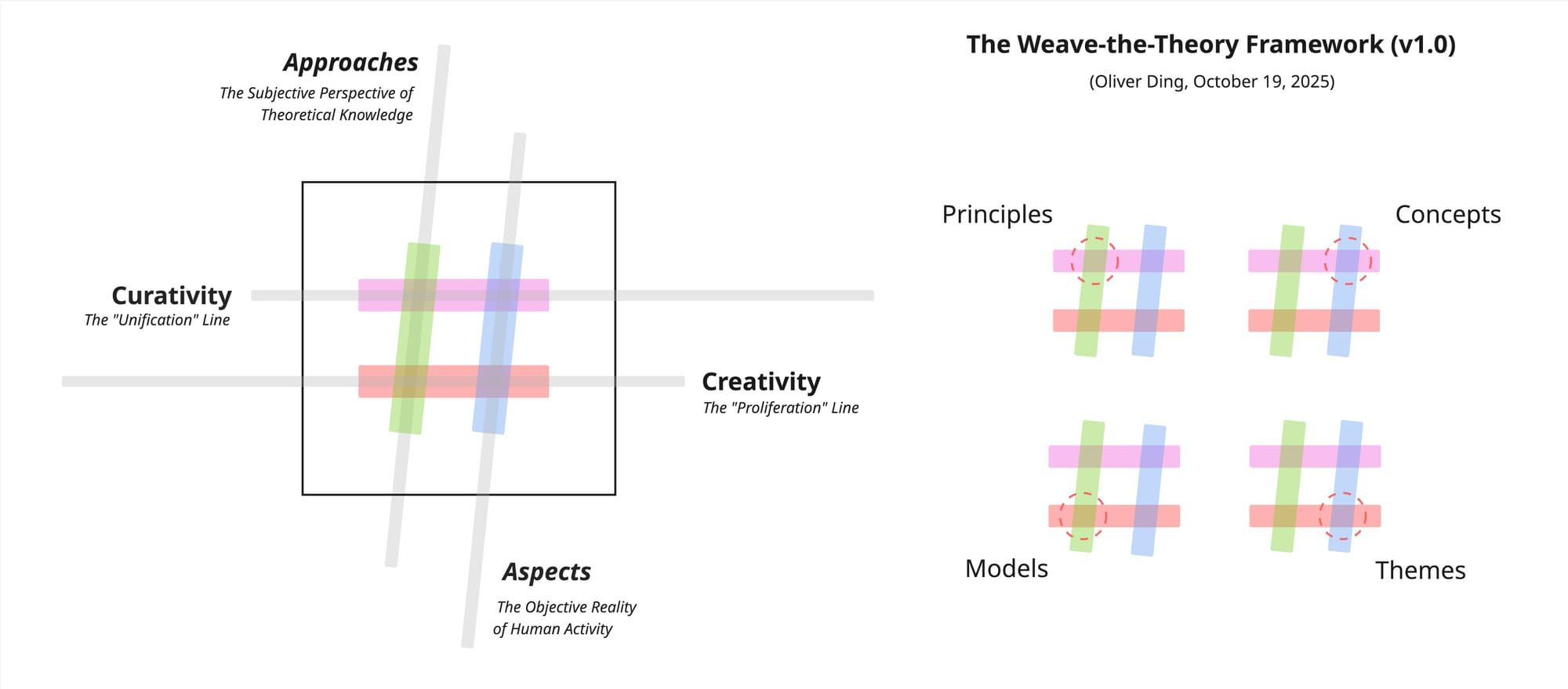
Within the Weave-the-Theory framework, the Curativity Line corresponds to the Meta-framework of a theoretical tradition — the layer that persists through the tradition's varied developments and defines what makes it distinctively itself. The Meta-framework further divides into two components: the core concept systems (corresponding to the Concept weave-point) and the coordination mechanism (corresponding to the Principle weave-point). The companion article Revisiting the Genidentity of Activity Theory (May 4, 2026) focused on the coordination mechanism — the anti-dualist triadic operation that has governed the construction of concept systems across generations of Activity Theory contributors. The present article focuses on the core concept systems — specifically, which new concepts entered the Meta-framework of Activity Theory since 2000, and through what developmental episodes they arrived.
This division of analytical labor between the two articles is not arbitrary. It follows directly from the structure of the Weave-the-Theory framework. Coordination mechanism and Core Concept Systems are the two faces of the same Meta-framework: one describes the deep logic that governs the tradition, the other describes the concepts that logic has produced. Taken together, the two articles constitute a more complete account of Activity Theory's genidentity than either could provide alone.
2.2 The Creative Thematic Curation Framework: The Sandglass Model
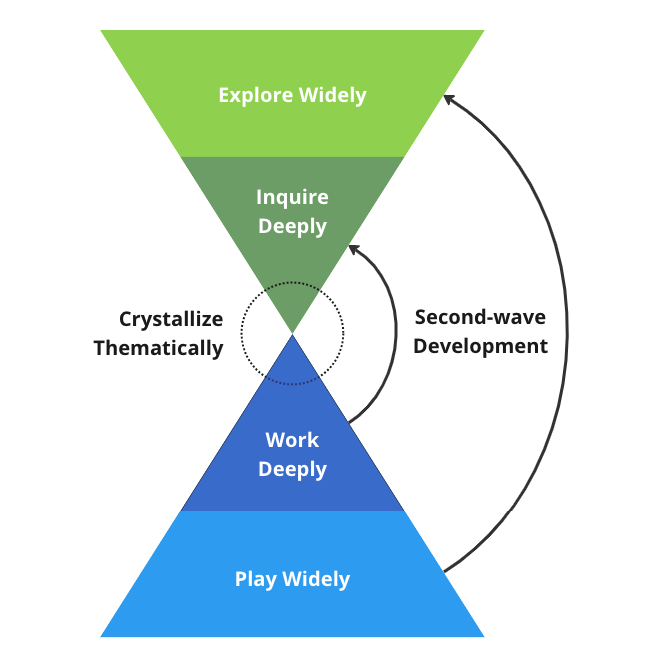
The Creative Thematic Curation Framework — formally represented by the Sandglass model — describes how a creative or theoretical enterprise develops through waves of movement. A single wave passes through five stages: Explore Widely, Inquire Deeply, Crystallize Thematically, Work Deeply, and Play Widely. The first two stages belong to the Subjectification phase — experience and material accumulate inward, and the enterprise is building toward a center not yet visible. The last two belong to the Objectification phase — what was crystallized is worked out and played into the world. Between them sits Crystallize Thematically: the moment when accumulated inquiry condenses into a thematic center that organizes everything before and after it.
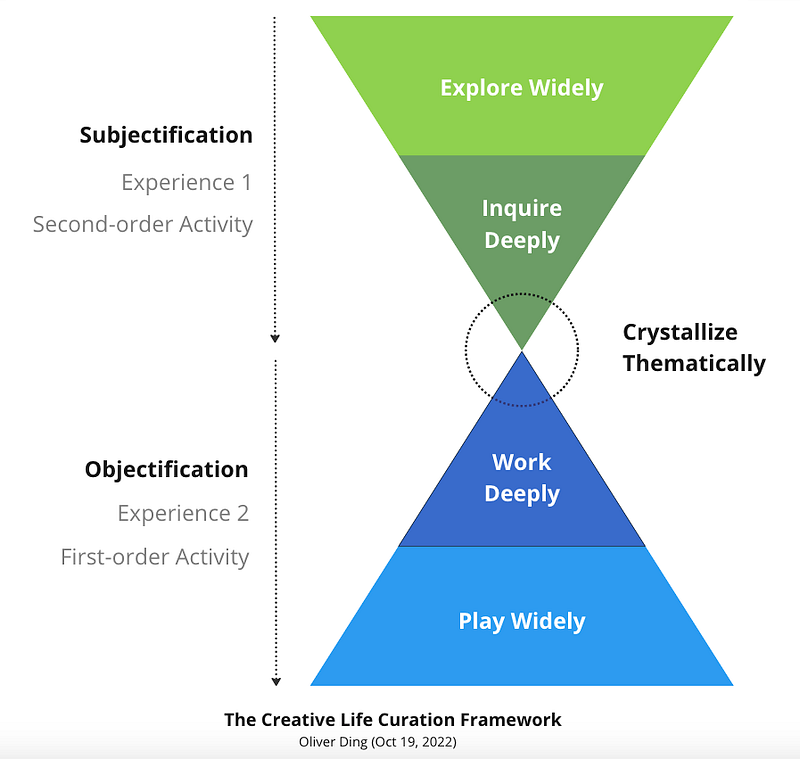
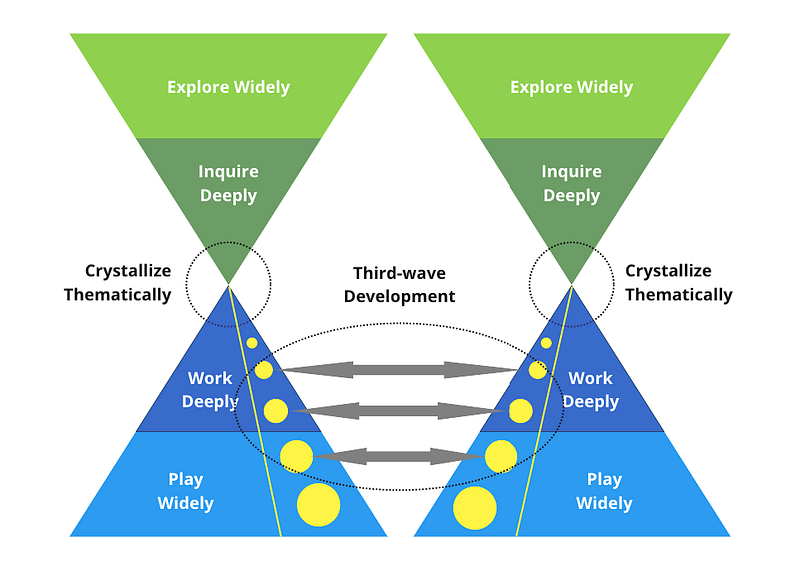
A second wave returns to the upper part of the sandglass — opening a new Subjectification phase that finds its own thematic center and develops through its own S-T-O cycle. What triggers this new cycle and what form it takes varies across cases; the specific path of each second wave is its own story. A third wave describes a more complex situation: dialogue with another knowledge system, in which two enterprises encounter each other and are mutually transformed.
The Sandglass model has been applied in previous Weave-the-Theory case studies to individual theoretical enterprises — one person's long creative journey. The present article applies it to a collective theoretical tradition, asking whether the three-wave structure is visible in the development of Activity Theory since 2000. This is not a straightforward application. A tradition does not have a single center of consciousness; it does not make strategic decisions. But patterns of development can still be recognized from the outside — as the kind of near-historical reconstruction that James March's notion of "near histories" makes available. The three waves are not imposed on the material; they are the analytical lens through which patterns in the material become visible.
2.3 The Genidentity Analysis Method
The Genidentity Analysis Method was developed in Weave the Enterprise: Theoretical Platform and Theoretical Enterprise (May 2026). Its operational core is the following distinction:
- Essential Difference: the structural feature that distinguishes a theoretical tradition from all others — what it does that nothing else does in quite the same way.
- Situated Dynamics: the varying content, context, and application through which the essential difference is expressed in specific historical moments.
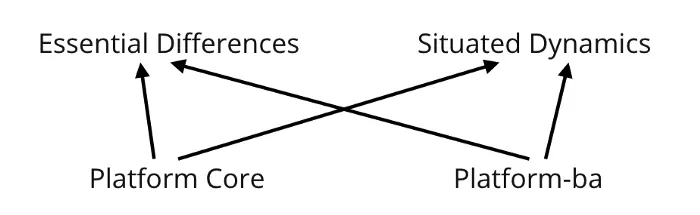
Applied to theoretical traditions, this distinction maps onto a second pairing:
Meta-framework and Thematic Enterprise. The Meta-framework is the theoretical foundation — the core concept systems and the coordination mechanism that governs how new concepts are introduced. The Thematic Enterprise is the tradition in its full social and historical extension — all the projects, contributors, and applications through which the Meta-framework is expressed and developed.
Within this pairing, the analytical concept of Developmental Episode designates a specific type of theoretical project: one that makes a genuine contribution to the Meta-framework, either by introducing new core concepts or by extending the coordination mechanism into new territory. Not all theoretical work constitutes a developmental episode. Most work operates within the framework the tradition has already established, applying its concepts to new domains or refining its models. A developmental episode is distinguished by the endurance of its contribution: the new concept or the restructured framework is adopted and built upon by subsequent contributors.
Following Larry Laudan's philosophy of science, a developmental episode succeeds when it resolves a problem that had been blocking the tradition's development — whether that problem is empirical (the framework cannot account for an observed phenomenon) or conceptual (the framework contains an unresolved tension). The criterion of success is not the theorist's own judgment but the tradition's subsequent response: did the contribution endure?
2.4 Case Selection
The cases analyzed in this article were selected according to three criteria.
First, temporal scope: this article focuses exclusively on developments that occurred since 2000. The foundational work of Vygotsky, Leontiev, and Engeström is analyzed in the companion article Revisiting the Genidentity of Activity Theory; it is not repeated here. The year 2000 is not a sharp boundary — theoretical development does not reset at calendar thresholds — but it provides a working frame that makes the analysis tractable.
Second, methodological purpose: the goal is not a comprehensive historical survey of Activity Theory since 2000. Such a survey would require a different kind of project — and it has been undertaken by others, most recently and thoroughly by Clay Spinuzzi in Triangles and Tribulations (MIT Press, 2025). The goal here is methodological demonstration: to show that the Weave-the-Theory toolkit — specifically the Sandglass model's three-wave structure, used in combination with the Genidentity Analysis Method — can illuminate the development of a large collective theoretical tradition just as it illuminates the development of an individual theoretical enterprise. The cases are selected to serve this demonstration, not to be exhaustive.
Third, contribution to the Meta-framework: priority is given to developmental episodes — contributions that genuinely altered the core concept systems of Activity Theory, rather than applications or extensions that operated within the existing framework. This means the selection leans toward theoretical contributions at the mTheory and sTheory levels of the Theme U diagram, and pays less attention to the large and important domain of case studies and methodological applications at the aModel, cModel, and dPractice levels.
It should also be acknowledged that the present selection reflects the limits of one reader's research. The Landscape article (2020) was shaped by my reading history at that time. The present article is shaped by subsequent research — including encounters with works I had not previously read, such as Karpatschof (2000). The cases are representative; they are not complete. Readers are invited to add their own cases to the structure this article provides.
Part 3. Theoretical Narratives and Theoretical Analysis
Before applying the three-wave analytical frame, it is useful to situate it against existing accounts of Activity Theory's development. This part briefly introduces the dominant theoretical narrative — Engeström's three-generation account — examines the challenges it has faced, and then proposes the Sandglass model's three-wave structure as a different kind of analytical frame: not a narrative of succession but a structural analysis of how different kinds of developmental work have been occurring in the tradition since 2000.
3.1 Engeström's Three-Generation Narrative
The most widely cited account of Activity Theory's historical development is the three-generation narrative proposed by Yrjö Engeström (2001). In this account, the tradition unfolds in a clean linear sequence: the first generation is associated with Vygotsky's work on cultural-historical psychology and semiotic mediation; the second generation is associated with Leontiev's activity approach in psychology, which expanded Vygotsky's individual-level analysis to encompass collective activity; the third generation is associated with Engeström's own development of the activity system model and the theory of expansive learning, which extended the analysis to transformations within and between collective activity systems.
This narrative has been enormously influential. It gives the tradition a coherent developmental story, and it provides newcomers with a clear sense of how the key contributors relate to each other. The term CHAT — Cultural-Historical Activity Theory — was coined in part to reinforce this sense of cumulative unity, suggesting that Vygotsky, Leontiev, and Engeström are chapters in the same long book.
3.2 Challenges to the Narrative
The three-generation narrative has also attracted sustained criticism. Manolis Dafermos (2015) argued that the scheme offers a linear, continuous, and decontextualized account that obscures the genuine gaps, tensions, and inconsistencies in the history of cultural-historical psychology and activity theory. The tension between Vygotsky and Leontiev in the early 1930s, for instance, is difficult to account for within a narrative of smooth generational transmission. And the narrative, written by Engeström himself, unsurprisingly places his own activity system model at the culminating third generation — a positioning that subsequent scholars have questioned.
Clay Spinuzzi's Triangles and Tribulations (2025) offers the most thorough recent account of these complications. Spinuzzi focuses on the internal diversity of the tradition — how each theoretical innovation translated and in some sense betrayed what came before, how CHAT accumulated concepts and terms from disparate sources, and how ongoing disputes about its unit of analysis reflect the unsettled nature of the tradition's development. His account is rich, historically grounded, and attentive to contingency and conflict in a way that the three-generation narrative is not.
The present article does not enter these historical disputes. Its purpose is analytical, not historical. It is worth noting, however, that the Genidentity Analysis Method addresses the same situation from a different angle: rather than looking inside Activity Theory at its internal diversity, it looks outward, asking what persists through the diversity. The answer identified in the companion article — the anti-dualist triadic coordination mechanism — is precisely what is not captured by the three-generation narrative. The narrative tracks the succession of concepts; the genidentity analysis identifies the deep logic that has governed the construction of each new concept system, across all three generations and beyond.
3.3 A Different Analytical Frame: Three Waves
The present article proposes a different analytical frame for understanding Activity Theory's development since 2000 — not a narrative of generational succession, but a structural analysis organized by the Sandglass model's three-wave pattern.
A word first about the temporal scope and the starting point. This article covers the development of Activity Theory as an interdisciplinary approach — what might be called Activity Theory in its contemporary form. Within this framing, the first wave does not begin with Vygotsky in the 1920s but with the moment when Activity Theory became recognizably cross-disciplinary. That moment can be located with some precision: the 1999 publication of Perspectives on Activity Theory (Cambridge University Press, edited by Engeström, Miettinen, and Punamäki) — the first comprehensive presentation of contemporary work in activity theory, with 26 original chapters by authors from 19 countries. The volume's opening description — "Activity Theory is an interdisciplinary approach to human sciences" — marks the transition. Engeström's 1987 activity system model represents the Inquire Deeply stage of this first wave; the 1999 volume is its Crystallize Thematically moment, the point at which the accumulated work of the preceding decade condensed into a thematic center capable of organizing all subsequent development. The present article covers what happened after that crystallization — the Work Deeply and Play Widely stages of the first wave, and the second and third waves that followed.
The first wave covers the ongoing development and application of Activity Theory as an interdisciplinary approach after 1999. The timing of this crystallization was not accidental. Activity Theory's emergence as a cross-disciplinary framework coincided with — and in many ways helped to define — several major intellectual shifts in the social and cognitive sciences around 2000. The Practice Turn, associated with theorists including Schatzki, Giddens, Bourdieu, and the Lave and Wenger tradition, redirected social theory from structures and systems toward practices as the primary unit of social reality. The Materiality Turn, which gained momentum in organization studies, design research, and science and technology studies, redirected attention from abstract social categories toward objects, instruments, artifacts, and the material dimensions of human activity. The Post-cognitive Turn — what cognitive scientists now describe as the "4E cognition" movement (embodied, embedded, enacted, extended) — redirected cognitive science from information-processing models of mind-in-isolation toward accounts of body-mind-environment as an integrated system. Activity Theory's theoretical commitments — its object-orientation, its emphasis on mediated action and artifact use, its account of the social and historical embeddedness of all human activity — aligned naturally with all three of these turns. The tradition did not cause these shifts; but its theoretical resources were precisely what many researchers reaching for a new vocabulary needed. The rapid expansion of Activity Theory applications across education, HCI, organization studies, and workplace research in the 2000s reflects this alignment.
The second wave covers a set of developments that return to the upper part of the sandglass — opening a new Subjectification phase with its own thematic center. In the Sandglass model, this Subjectification stage is the broad exploration that eventually condenses into a Crystallize Thematically moment, from which a new Objectification phase unfolds. For Activity Theory, the second wave's specific character is this: changes at the level of the core concept system — new concepts introduced, or existing concepts redefined in significant ways — that generate new thematic directions and open new S-T-O cycles. Three developmental episodes stand out: Karpatschof (2000), Blunden (2010 and 2012), and Stetsenko (2016).
The third wave covers a set of dialogues between Activity Theory and other theoretical traditions — encounters in which AT enters into sustained engagement with an external knowledge system and is transformed by the encounter. Spinuzzi's dialogue with Actor-Network Theory, Nunez's dialogue with Critical Realism, and James Ma's work on the Peirce-Vygotsky synergy each represent this pattern.
This three-wave structure is not a historical periodization claiming that the three waves occurred in strict temporal sequence since 2000. The developments are overlapping; some second-wave work predates some first-wave applications. The structure is analytical, not chronological: it identifies three different kinds of developmental work that have been occurring in Activity Theory since 2000, each corresponding to a different position within the Sandglass model.
Part 4. The First Wave: Activity Theory as an Interdisciplinary Approach Since 2000
The crystallization of Activity Theory as an interdisciplinary approach — marked by the 1999 Perspectives on Activity Theory volume — opened the Work Deeply and Play Widely stages of the first wave. These two stages are analytically distinct: Work Deeply is where the founding contributors deepen and extend the core framework through sustained theoretical and empirical work; Play Widely is where the framework spreads outward across disciplines and application domains through the work of a broader community.
4.1 Work Deeply: Engeström and the Finnish School
The Work Deeply stage of the first wave is centered on Engeström and his colleagues at CRADLE (Center for Research on Activity, Development and Learning) at the University of Helsinki, and later also at RESET research group at Tampere University. This is the Finnish school of activity theory — the lineage most directly responsible for developing and applying the activity system model since 1987. Three theoretical papers mark the major developments of this period.
In 2001, Engeström published Expansive Learning at Work: Toward an Activity Theoretical Reconceptualization, introducing what he called the third generation of activity theory. The problem he addressed was the need for conceptual tools to understand dialogue, multiple perspectives, and networks of interacting activity systems — a challenge that many activity theorists had been working on through the 1990s through concepts like dialogicality (Wertsch, 1991), activity networks (Russell, 1997), and boundary crossing (Engeström, 1995). His solution was to take two interacting activity systems as the minimal model for the third generation. The core of this reconceptualization was a new account of the object: moving from an initial "raw material" (object 1) to a collectively constructed object (object 2) to a potentially shared object (object 3). The object of activity, Engeström argued, is a moving target, not reducible to conscious short-term goals.
In 2008, Engeström delivered a keynote lecture titled The Future of Activity Theory, later collected in the 2009 Cambridge volume Learning and Expanding with Activity Theory. This lecture introduced the concept of runaway objects — objects that escalate beyond any single actor's control and take on far-reaching, unexpected effects at a global scale. This concept marked a significant expansion of Activity Theory's analytical scope: from the analysis of contradictions within and between activity systems to the analysis of objects whose development exceeds the capacity of any activity system to contain them. The idea of runaway objects led to a major revision of Engeström's triangle diagram, reflecting the changed understanding of the object's character.
In 2020, Engeström and colleagues published From Mediated Actions to Heterogeneous Coalitions: Four Generations of Activity-Theoretical Studies of Work and Learning. This article outlined a fourth generation of theorizing — moving from mediated action, to collective activity systems, to multiple interconnected systems, and most recently to heterogeneous work coalitions aimed at resolving what the authors called "wicked societal problems." This fourth generation represents the latest stage of the Work Deeply development: the core framework continues to evolve in response to the changing nature of work and collective action in contemporary society.
Alongside these theoretical developments, Engeström and his colleagues sustained a parallel program of empirical research and formative interventions — the methodology of Developmental Work Research (DWR), which uses the activity system model as a tool for facilitating collective transformation in workplace settings. Three Cambridge volumes give a sense of this sustained work: Learning and Expanding with Activity Theory (2009), Expertise in Transition: Expansive Learning in Medical Work (2018) — which condenses thirty years of research and intervention in medical settings — and most recently Concept Formation in the Wild (2024), which develops a dialectical theory of collective concept formation in everyday practical activities, going beyond the understanding of concepts as individually acquired static labels.
4.2 Play Widely: Applications Across Domains
The Play Widely stage is characterized by the spread of Activity Theory across disciplines and application domains well beyond Engeström's own field. In HCI, Kaptelinin and Nardi's Acting with Technology (2006) and Activity Theory in HCI: Fundamentals and Reflections (2012) documented how Activity Theory had become, in Carroll's words, "the most canonical theory-base in HCI." Nardi's own trajectory — from trained anthropologist to activity theory advocate in Silicon Valley — illustrates how the tradition's resources travelled across disciplinary boundaries through individuals who found in it exactly what their own domains were reaching for.
Activity Theory has continued to spread into domains that were barely on the map in 2000. Clay Spinuzzi has applied it to the study of SEO, co-working spaces, and distributed work networks. Lisa Yamagata-Lynch's Activity Systems Analysis Methods (2010) provided practitioners in educational research with a methodological toolkit that made the activity system model operational without requiring deep theoretical training. And the spread continues: a 2025 paper applied third-generation Activity Theory to the analysis of a creative marketplace in Chengdu, China — using the activity system model to map the roles of organizers, vendors, and consumers, and identifying contradictions between place branding motives and outcomes across the activity system.
This breadth of application is the defining character of the Play Widely stage. The framework is not being transformed; it is being inhabited and tested across an expanding range of problems and contexts.
4.3 Background: Three Turns in the Social and Cognitive Sciences
The rapid expansion of Activity Theory across disciplines since 2000 was not only the result of the framework's internal development. It was enabled — and in some cases actively pulled forward — by a convergence between Activity Theory's theoretical commitments and several major intellectual shifts that were reshaping the social and cognitive sciences simultaneously. Three turns are particularly relevant.
The Practice Turn
Since around 2001, a group of philosophers, sociologists, and scientists rediscovered the practice perspective and used it as a lens to explore and examine the role of practices in human activity. As Schatzki pointed out, "there is no unified practice approach" — but the shared orientation was clear: social life is constituted through practices, not through structures, systems, or mental representations alone. The Practice Turn in Contemporary Theory (Schatzki, Knorr Cetina, and von Savigny, eds., 2000) was one of the landmark publications signaling this shift.
Davide Nicolini's Practice Theory, Work, and Organization (2013) is a useful map of this landscape. Nicolini identified six different ways of theorizing practice: the work of Giddens and Bourdieu, Communities of Practice (Lave and Wenger), Activity Theory/CHAT, Ethnomethodology (Garfinkel), the Site of Social (Schatzki), and Conversation Analysis/Critical Discourse Analysis. Activity Theory appears here not as a peripheral resource but as one of the central strands of practice-theoretical thinking — valued precisely because it provides both an ontological account of activity (what practices are) and an analytical toolkit for studying them in specific settings. As Nicolini observed, practice theories are "fundamentally ontological projects" that attempt to populate the world with specific units of analysis. Activity Theory's unit — the object-oriented collective activity system — fits naturally within this orientation.
The Materiality Turn
Running alongside and partly overlapping the Practice Turn, the Materiality Turn redirected attention from abstract social categories — structure, institution, symbol, language — toward objects, instruments, artifacts, and the material dimensions of human activity. In organization studies, design research, and science and technology studies, the materiality of practice became a primary theoretical concern. The concept of sociomateriality — the constitutive entanglement of the social and the material in everyday organizational life — became an important research agenda.
Activity Theory had always taken materiality seriously. Its account of artifacts as mediating tools, its treatment of the object of activity as both material and meaningful, and its insistence on the embeddedness of cognition in material practice gave it a natural affinity with the Materiality Turn. Where earlier social theories had treated tools and objects as peripheral to the analysis of action, Activity Theory had placed them at the center from the beginning. The Materiality Turn, in effect, created a wider audience for theoretical commitments that Activity Theory had held all along.
The Post-cognitive Turn
The Post-cognitive Turn describes the shift in cognitive science and applied research domains from the classical information-processing paradigm — which modeled cognition as computation occurring inside an individual brain — toward a broader paradigm that foregrounds the relationship between body, mind, and environment. Cognitive scientists now use the term "4E cognition" to characterize this shift: cognition is embodied, embedded, enacted, and extended. Researchers associated with this turn include Andy Clark, James J. Gibson, Hubert Dreyfus, Gregory Bateson, Michael Turvey, Jerome Bruner, and Humberto Maturana and Francisco Varela.
In HCI, this shift was particularly consequential. Kaptelinin and Nardi describe how the transition from "first wave HCI" to "second wave HCI" in the late 1980s and early 1990s was driven by the need to overcome the limitations of information-processing psychology as a theoretical foundation:
A variety of theoretical approaches were proposed as alternative frameworks for the second wave HCI. They included, among others, phenomenology (Winograd and Flores, 1987), the situated action perspective (Suchman, 1987), activity theory (Bødker, 1991), and distributed cognition (Hollan et al., 2000; Norman, 1991). These frameworks contributed to extending the scope of HCI and prioritizing understanding and supporting meaningful human action and social interaction in everyday contexts.
Activity Theory's insistence on the embeddedness of mind in social and material context — its treatment of cognition as always mediated, always situated, always developing through activity rather than residing in isolated mental processes — made it a natural theoretical home for researchers who had found information-processing psychology too narrow. The Post-cognitive Turn created the conditions in which Activity Theory's foundational commitments could be received as solutions rather than as foreign impositions.
Part 5. The Second Wave: New Concepts, New Directions
The second wave, in the Sandglass model, returns to the upper part of the sandglass — opening a new Subjectification phase that finds its own thematic center and develops through its own S-T-O cycle. In Activity Theory since 2000, this second wave takes a specific form: changes at the level of the core concept system. New concepts are introduced into the Meta-framework, or existing concepts are given new definitions that shift their theoretical weight — and these changes generate new thematic directions that the first wave's framework could not have produced.
Three cases are analyzed here. They are parallel rather than sequential: each represents an independent line of theoretical development, each introduces different concepts or redefines existing ones, and the relationship among them is a question for future analysis rather than a settled answer. What they share is their structural position: each returns to the upper part of the sandglass, opening a new S-T-O cycle with its own thematic center. The specific path each takes — what concept arrives, how it crystallizes, what it makes possible — is different in each case.
5.1 Benny Karpatschof: Human Activity and Anthropological Science (2000)
In 2000, Danish psychologist Benny Karpatschof published Human Activity: Contributions to the Anthropological Sciences from a Perspective of Activity Theory. The book did not achieve wide circulation in the English-language Activity Theory community — and it was not part of the landscape I mapped in 2020 — but its theoretical contribution is significant at the Meta-framework level.
The most important idea in Karpatschof's account is to bring Sign, Meaning, and Concept back into Activity Theory. The dominant tradition after Engeström had placed the emphasis on the collective activity system and its material object-orientation; the semiotic dimension — central to Vygotsky's original work — had been partially submerged. Karpatschof's framework addresses this directly by theorizing the feedback circle between meaning production and object production in human activity. According to Karpatschof:
…the full context of activity in which the category of meaning ("ideas") is situated can be seen. In the feedback circle, there is an operational as well as a referential mediation. I call the referential side meaning production. The other side is the category of object production, where production is to be understood in a broad sense, including interventions that only modified the object. If we now consider the relation between meaning and object production in human activity, there are 3 logical types: 1. The object-reflecting meaning production, 2. The symmetric interplay of objects and meaning production, 3. The concept based object production. (2000, p.248)
Karpatschof's account of human activity considers both Tool and Sign — echoing Vygotsky's distinction between technological tools and psychological tools, a distinction that the activity system model had not fully integrated. The three logical types of the meaning-object relation provide a more differentiated account of how conceptual and material dimensions of activity interweave than the existing frameworks had offered.
This is a second-wave developmental episode: it returns to the upper part of the sandglass, reopening the question of Sign and Meaning within activity theory and opening a new S-T-O cycle around the theme of concept-based human activity. The new thematic direction it generates — the reintegration of semiotic mediation into the core of Activity Theory's analytical framework — is one that subsequent contributors have continued to explore, including through the dialogue with Peircean semiotics discussed in Part 6.
5.2 Andy Blunden: Project and Concept (2010, 2012)
Andy Blunden's contributions to Activity Theory represent the clearest and most thoroughly analyzed second-wave developmental episodes in this article. The companion article Revisiting the Genidentity of Activity Theory already analyzed Blunden's two main episodes — Project as unit of activity (2010) and Activity as Formation of Concept (2012) — in detail, as instances of the anti-dualist coordination mechanism. What needs to be added here is their position in the Sandglass model's second wave.
Blunden's work has the character of a return to the sources that is characteristic of second-wave development. His 2010 book An Interdisciplinary Theory of Activity did not start from the activity system model and refine it. It returned to Hegel, to Vygotsky, and to the concept of project as a unit of analysis — theoretical resources that had been present in the tradition's background but had not been brought to the foreground in Engeström's development. The result was not a rejection of Engeström's contribution but a supplementation at a deeper level: Blunden introduced a different unit of analysis (the project, as a collaborative undertaking with a shared objective) that gave Activity Theory a more adequate account of the Individual—Collective relationship than the activity system model had provided.
His 2012 book Concepts: A Critical Approach took a second step in the same direction. Returning to Vygotsky's work on concept formation, Blunden developed Activity as Formation of Concept — an account in which the development of a concept is understood as the central movement of activity itself. This reintroduced the semiotic dimension that Leontiev's and Engeström's accounts had partially submerged beneath the emphasis on collective activity systems and material practice.
Both episodes return to the upper part of the sandglass, opening new S-T-O cycles centered on new core concepts — Project as unit, Concept as the medium of Activity — that enter the Meta-framework at the foundational level, altering what Activity Theory is rather than merely extending what it can do.
5.3 Anna Stetsenko: The Transformative Activist Stance (2016)
In 2016, Anna Stetsenko published The Transformative Mind: Expanding Vygotsky's Approach to Development and Education, introducing the Transformative Activist Stance (TAS). TAS had been developing over several years before this book — a 2014 chapter by Vianna, Hougaard, and Stetsenko in Blunden's Collaborative Projects collection described it as "an extension of Vygotsky's project interpreted through a political-ideological, rather than value-neutral, lens," one that "highlights this project's exemplary close ties with the egalitarian practices of social transformation premised on a commitment to ideals of social justice and equality." The authors noted that the revolutionary theoretical and methodological implications of Vygotsky's project — given the historical and sociopolitical circumstances of how it emerged and became assimilated in Western approaches — still awaited full explication.
TAS was developed specifically to address this gap. As the 2014 chapter states, it "opens up ways to understand human development that integrates notions of social change and activism into the most basic assumptions of how human beings come to be, to act and to know the world." This is a second-wave movement at the Meta-framework level: Stetsenko returns to Vygotsky's theoretical sources with new questions — political, ideological, and transformative — and develops concepts that the existing frameworks, including Engeström's activity system model, had not foregrounded. The result is an addition to Activity Theory's core concept systems that opens new theoretical territory without displacing what came before. Her work has found significant uptake in educational research and critical approaches to cultural-historical psychology.
At the same time, TAS raises a question that the tradition as a whole has not fully resolved: whether Activity Theory's development should be guided by a political-ideological orientation toward intervention and social transformation, or by a value-neutral research orientation focused on description and analysis. Different contributors' preferences on this question are not merely personal — they shape the direction of the tradition's ongoing development, and the tension between these two orientations is itself one of the defining features of Activity Theory's current moment.
Part 6. The Third Wave: Dialogue with Other Theoretical Systems
The third wave, in the Sandglass model, describes a more complex situation than the first two waves: not the application of an existing crystallization (first wave) or the return to theoretical sources to produce new concepts (second wave), but the encounter of Activity Theory with another, independent theoretical tradition. Such dialogues are generative precisely because neither system can predict what the encounter will produce. The dialogue does not simply apply one tradition's tools to the other's problems; it creates new conceptual territory that neither tradition could have generated alone.
The theoretical products of third-wave dialogues have a distinctive character that distinguishes them from both first-wave applications and second-wave core concept contributions. They typically do not enter the Meta-framework at its most foundational level — the coordination mechanism and the central core concept systems remain relatively stable through third-wave encounters. What the dialogues produce instead are what might be called mediating concepts: theoretical constructs that sit at the intersection of two traditions, doing work that neither could do alone. These mediating concepts are particularly valuable not because they redefine what Activity Theory fundamentally is, but because they keep the tradition capable of addressing the problems of its present moment. A theoretical tradition that never engages in third-wave dialogues risks becoming self-referential — rich in internal coherence but increasingly distant from the empirical and conceptual challenges that make theoretical work urgent.
There is a further dimension to third-wave development that deserves emphasis. The dialogue is never one-directional. When Activity Theory engages with Actor-Network Theory, with Critical Realism, or with Peircean semiotics, it does not simply absorb useful concepts from the outside. It also clarifies its own commitments through the encounter — discovering, through the contrast with another tradition's assumptions, what Activity Theory actually presupposes and where its own boundaries lie. The tradition develops its self-understanding through dialogue just as much as it develops new concepts. Activity Theory since 2000 is, in part, a tradition that has learned what it is by discovering what it is not.
For practitioners and learners, the frameworks that emerge from third-wave dialogues are often the most immediately useful. A model like Spinuzzi's Network of Projects, or Nunez's Critical Realist Activity Theory, arrives pre-adapted for a specific domain or set of problems. It has already done the work of connecting Activity Theory's concepts to another tradition's vocabulary — it is, in effect, a bridge already built. Practitioners who need to analyze distributed work organizations, or who are working at the intersection of learning theory and social ontology, can enter these frameworks without first mastering the full depth of either source tradition. This accessibility is not a sign of shallowness; it is a structural feature of mediating concepts. They are designed to be picked up and used, precisely because the theorists who created them did the hard work of synthesis first.
Three such dialogues stand out in Activity Theory's development since 2000. Each involves a sustained engagement between Activity Theory and an external theoretical system; each produces new frameworks or concepts that belong to both traditions simultaneously; and each opens territory that continues to be explored.
6.1 Clay Spinuzzi: Network of Projects (AT + ANT)
Clay Spinuzzi's work represents one of the most sustained and methodologically developed instances of third-wave dialogue in Activity Theory since 2000. His project was not, in his own terms, an integration of Activity Theory and Actor-Network Theory — he has consistently resisted that characterization. What he built was something more practically focused: a research framework that draws on both traditions' accounts of networks and activity to support empirical investigation of knowledge work in organizational settings.
The core of Spinuzzi's contribution is methodological. His two major empirical studies — Network: Theorizing Knowledge Work in Telecommunications (2008) and All Edge: Inside the New Workplace Networks (2015) — applied the curated framework to concrete research sites, developing both the analytical vocabulary and the empirical procedures through sustained fieldwork. His methodological handbook Topsight: A Guide to Studying, Diagnosing, and Fixing Information Flow in Organizations (2013) distilled this accumulated practice into a systematic guide for researchers — covering the full arc from research design and data collection to theoretical analysis and practical intervention.
What Spinuzzi achieved was the construction of a mature, deployable methodological toolkit. Activity Theory provided the account of object-oriented, artifact-mediated collective activity; ANT contributed its sensitivity to the heterogeneous networks through which work is organized — the way human and non-human actors are enrolled, translated, and stabilized into functioning assemblages. Neither tradition alone provided what Spinuzzi needed for his research questions about distributed knowledge work; by drawing on both, he built something that could handle the complexity of contemporary workplace networks.
The significance of this case, from the perspective of the Weave-the-Theory toolkit, is that it exemplifies what third-wave mediating concepts actually do in practice. Spinuzzi's framework does not alter Activity Theory's coordination mechanism or its core concept systems. It does something different and equally valuable: it builds a bridge at the application level, making it possible for researchers to bring AT's analytical depth to bear on problems that require ANT's vocabulary of heterogeneous networks — without having to master the full philosophical depth of either tradition from scratch. This is a mediating concept in the most practical sense: a knowledge framework that has already done the work of curation, and can be picked up and used.
I use the term Network of Projects to name this body of work — though Spinuzzi himself does not use this term. It names the conceptual space his research has opened: the intersection of activity-theoretic and network-theoretic analysis, developed through sustained empirical engagement into a mature methodological tradition.
Moreover, the Network of Projects framework establishes a genuine knowledge niche rather than simply extending one of its source traditions. It is anchored in two Aspects — projectification and network — that belong to the world, not to any particular theoretical Approach. And it was produced not by a single dialogue between two traditions, but by the slow convergence of three streams across more than two decades of empirical research.
6.2 Iskra Nunez: Critical Realist Activity Theory (AT + Critical Realism)
Iskra Nunez's Critical Realist Activity Theory (2013) represents a dialogue between Activity Theory and Critical Realism — a philosophical tradition associated with Roy Bhaskar's work on the nature of social science and the relationship between structure and agency.
The dialogue is motivated by a shared concern: both traditions are committed to realist ontology (the claim that there is a real social world that exists independently of our descriptions of it) and to understanding the relationship between human agency and social structure. But they approach this concern with different conceptual tools. Activity Theory's strengths lie in its account of mediation, object-orientation, and the development of activity systems through contradiction. Critical Realism's strengths lie in its stratified ontology — its account of how different levels of reality (the empirical, the actual, and the real) relate to each other — and in its analysis of the mechanisms that generate social outcomes.
Nunez's project was to bring these two traditions into productive dialogue, using each to address the limitations of the other. Activity Theory provided a concrete account of how learning and development unfold through activity; Critical Realism provided a philosophical foundation for explaining why those processes take the forms they do — an ontological grounding that Activity Theory had left partially underdeveloped. The result was a new account of the nature of learning that drew on both traditions, opening territory that remains productive for researchers working at the intersection of education, philosophy, and social theory.
6.3 James Ma: The Synergy of Peirce and Vygotsky (AT + Semiotics)
James Ma's 2014 paper "The Synergy of Peirce and Vygotsky as an Analytical Approach to the Multimodality of Semiotic Mediation" represents a third-wave dialogue of a different character: not a sustained research program spanning multiple books, but a theoretical proposal that opens a productive conceptual territory through a single, carefully argued intervention.
Ma's starting point is the resonance between Peirce's semiotics and Vygotsky's account of semiotic mediation — two traditions that had developed independently and had rarely been brought into direct theoretical contact. Both were concerned with the role of signs in mediating human engagement with the world; both had developed sophisticated accounts of how signs function in practice. But their accounts were structured differently, and the differences, when examined closely, revealed complementary strengths.
Ma's proposal was to develop a Peirce–Vygotsky synergy — using the logical structure of Peircean semiotics (specifically the relationship between deduction and abduction) to articulate how multimodal sign systems function in the kind of mediated activity that Vygotsky had described. The result was an analytical approach capable of addressing the multimodality of semiotic mediation in ways that neither tradition could manage alone.
From the perspective of the Sandglass model, this is third-wave work because the dialogue involves genuine mutual transformation: Vygotsky's account of mediation gains conceptual precision from Peirce's semiotic categories, while Peirce's semiotics gains a developmental and activity-theoretic grounding that gives it a new domain of application. The concepts that emerge from the dialogue belong to both traditions simultaneously.
6.4 Sami Paavola: The Trialogical Approach (AT + Peircean Pragmatism)
Sami Paavola's work represents a third-wave dialogue between Activity Theory and the pragmatist philosophy of Charles S. Peirce. This dialogue is distinct from James Ma's third-wave contribution (Section 6.3), which focuses on the synergy of Peirce and Vygotsky for analyzing multimodality. Paavola’s project is broader: it leverages Peirce’s theory of inquiry, particularly the concept of "abduction," to fundamentally reframe the understanding of learning and knowledge creation within the CHAT tradition.
The dialogue is motivated by a limitation Paavola identified in existing learning theories: both the "acquisition" metaphor (learning as individual knowledge transfer) and the "participation" metaphor (learning as socialization) underestimate the processes by which new knowledge is deliberately created, not merely adopted or transformed.
Paavola's central theoretical act was to introduce a third metaphor: knowledge creation. Drawing on Peirce's logic of abduction—the reasoning pattern through which novel hypotheses are generated—Paavola developed the Trialogical Approach, where learning is understood as the collaborative creation and development of shared mediating artifacts and concepts. The dialogue connects Activity Theory's account of object-oriented collective activity with Peirce's semiotic theory of inquiry, providing a precise epistemic mechanism for expansive learning.
The dialogue produced a tangible mediating concept: a set of trialogical design principles that translate the abstract epistemology into concrete pedagogical practices—organizing work around shared objects, fostering interaction between personal and collective agency, and enabling flexible tool mediation. These principles have been taken up in fields from teacher education to software development.
The dialogue transformed both traditions. Activity Theory gained a specific account of how innovative, abductive reasoning operates as a mediated, collective process. Peirce's logical theory gained a developmental and activity-theoretic grounding, moving abduction from an individual cognitive logic to a historically situated, artifact-mediated collective practice. Paavola's analysis of Building Information Modeling (BIM) as an evolving, mediating digital object in design collaboration exemplifies this synthesis empirically.
This third-wave dialogue continues. Paavola's recent work on Artificial Intelligence as a "catalyst for co-creation" extends the same core inquiry into new territory, exploring how knowledge-creating processes operate when the mediating artifact is itself generative—a new chapter rooted in the trialogical concept system.
It is worth noting that both Sami Paavola and the previously mentioned Annalisa Sannino are formal members of CRADLE, the research center founded by Yrjö Engeström — a fact that reveals Engeström not merely as an individual contributor to the development of the Activity Theory tradition, but as an educator who has cultivated a new generation of theorists and researchers. The detailed story of CRADLE itself deserves a separate article.
Part 7. Engaging with Activity Theory
What makes a theoretical tradition a tradition — rather than simply a collection of works — is the collaborative structure that holds it together across time. But "collaboration" here does not mean coordination or planning. It means something more structural: a Before–After relationship between creators. Prior creators produce works that open possibilities; subsequent creators choose which of those possibilities to pursue. The two lines — prior works and subsequent works, earlier contributors and later contributors — are woven together into the tradition's development
The three-wave structure makes this before–after logic visible. What a prior creator brings to completion defines what becomes available to subsequent creators. When the first wave's Crystallize Thematically moment occurred in 1987 — when Engeström's activity system model gave the tradition a new center — the subsequent development was already implicitly shaped: the Work Deeply and Play Widely stages were opened, and a new generation of contributors could choose to inhabit those stages. Similarly, when the second wave's contributors — Karpatschof, Blunden, Stetsenko — introduced new core concept systems, they opened entirely new creative spaces that had not previously existed. And the third wave's dialogues with other traditions opened yet a different kind of opportunity: not the extension of an existing framework, but the generative encounter with an external knowledge system.
From the perspective of the Enterprise Development Framework, a predecessor who completes a stage creates the structural conditions for a successor to begin the next. The prior creator cannot determine what the successor will do. But the prior work determines what is now possible. The tradition develops through this distributed, multi-generational before–after structure — and an individual contributor's relationship to the tradition is always, in part, a matter of recognizing which stage has been completed by prior work and which opportunities that completion has made available.
My own engagement with Activity Theory has followed this logic, though I did not always recognize it as such at the time.
7.1 The First Wave: Application and Reflection
The first wave of Activity Theory's development since 2000 — the Work Deeply and Play Widely stages following Engeström's 1987 crystallization — offered two distinct types of creative opportunity: application and reflection. Both involve operating within the tradition's existing framework rather than extending or transforming it. But they involve different orientations toward the framework and produce different kinds of creative work.
Application means taking the tradition's existing concepts and models and bringing them to bear on a new domain or problem — testing what the framework can do, discovering where it is generative and where it encounters its limits. My first serious engagement with Activity Theory in this mode came in 2018, when I applied the Activity System Model to the BagTheWeb project — a web content curation platform I had been involved with since 2010. The outcome was instructive in a way I had not anticipated: what I produced was what I later called a case of Misdiagramming. I had borrowed Engeström's triangular visual structure but had replaced its conceptual content with my own elements, and I had applied a model designed for collective activity to what was fundamentally an individual curation activity. The outcome — the Curating Activity System model — was practically useful. But it was based on a misunderstanding of the source framework. Looking back, this misunderstanding was itself a form of learning: it revealed the limits of the activity system model for my purposes and set in motion a theoretical inquiry that eventually led somewhere quite different.
The full story of this episode is documented in Appropriating Activity Theory #1: Misunderstanding and Repurposing (2018).
Reflection means stepping back from the application of a framework to examine the framework itself — its structure, its limits, its relationship to other theoretical resources. My clearest instance of this mode within the first-wave period was the development of the SET (Structured Engagement Theory) framework, which began in 2017 and reached its mature form by 2020. SET began as a practical problem: the Activity System Model did not provide adequate conceptual resources for analyzing the kind of intersubjective social actions that characterized the products I was working on — one-to-one video talk platforms, structured engagement services, developmental programs. The model was designed for collective activity systems; it was not well suited for the analysis of host-participant relationships, situational environments, and the ecology of structured interaction.
The response was not to abandon Activity Theory but to reflect on its gap and supplement it from another source. SET brought Activity Theory into dialogue with Ecological Psychology — specifically Roger Barker's Behavior Settings Theory and J.J. Gibson's concept of affordance — to produce a hybrid framework that could address what neither tradition could address alone. In doing so, it anticipated the third-wave pattern at a smaller scale: two theoretical traditions encountering each other, and the encounter producing something new.
The full account of the SET framework is available at the Activity Analysis Center.
7.2 The Second Wave: New Creative Spaces
The second wave's developmental episodes — Karpatschof, Blunden, Stetsenko — introduced new core concept systems into Activity Theory's Meta-framework. From the perspective of the before–after structure, these contributions opened creative spaces that had not previously existed within the tradition. A subsequent contributor who encounters these new concepts faces a different landscape than one who encountered the tradition before they arrived. Each of the three second-wave episodes opened a different kind of space for me — and my response to each was different.
Karpatschof: Reconnecting Tool and Sign
I encountered Karpatschof's Human Activity (2000) several years after its publication, and the encounter immediately resolved a tension I had been carrying without fully naming. The Activity Circle model — a diagram I had developed in 2017 as a meta-diagram for discussing the Thing-People ecological structure, organized around Self, Other, Thing, and Think — had been built on an intuition that Vygotsky's two types of mediating tools (technological tools and psychological tools) were not fully integrated in the mainstream Activity Theory tradition. Karpatschof's framework, with its account of the feedback circle between meaning production and object production, and its three logical types of the concept-object relationship, provided exactly the theoretical grounding that the Activity Circle had been implicitly reaching toward.
The connection was structural: Karpatschof brought Sign and Meaning back into the analysis of human activity in a way that the dominant activity system model had partially set aside. The Activity Circle, which at the time of its creation had been an intuitive design rather than a theoretically grounded framework, found its retrospective justification in Karpatschof's account. This is the before–after logic operating in reverse: not a case of Karpatschof's prior work opening a creative space that I then entered, but a case of my prior work finding its theoretical anchor in a book I encountered later. The creative space had been occupied before I knew the name of the tradition that made it habitable.
The full account of this encounter is documented in The Activity Circle (Oliver Ding, 2017) at the Activity Analysis Center.
Blunden: The Most Consequential Encounter
Among the second-wave contributions, Blunden's is the one that has most deeply shaped my theoretical enterprise. The encounter began in 2020, during the Activity U project, when I first engaged seriously with his notion of Project as unit of analysis of activity and Activity as Formation of Concept. But the full significance of this encounter only became visible years later — and the way it became visible is itself instructive.
In mid-2024, preparing learning materials for a Fellow at the Activity Analysis Center, I compiled a book draft titled Activity as Formation of Concept — a systematic curation of Blunden's approach together with my own applications of it. The act of compilation produced an unexpected recognition: the book formed a trilogy with two other manuscripts I had written — Grasping the Concept (November 2023) and Center, Circle, and Genidentity (June 2024) — and the three books had been completed in the exact reverse chronological order of my actual creative practice. I had lived forward through appropriation, practice, and the formation of my own concepts; I had written backward from mature framework to synthesis to foundational resources.
This temporal inversion revealed what appropriation actually is: not linear absorption of a theory, but a recursive transformation in which the appropriated concepts are rebuilt through practice until they become something new that both honors and transcends the original. I had been forming concepts — Knowledge Center, Value Circle, Platform Genidentity — through the practice Blunden had theorized, without fully recognizing the structure of what I was doing. Only when I needed to teach did I see the architecture of the journey.
The Project Engagement approach (v1.0 through v4.0), the Life-History Topology, and the Weave-the-Life framework are all, in part, extended explorations of what becomes possible once the project is established as the primary unit of analysis — once Activity Theory is centered on the individual's engagement with a project rather than on the collective activity system. Blunden's contribution did not merely add concepts to the tradition; it opened a genuinely different orientation toward what Activity Theory is for. The before–after logic here is exact: Blunden completed a theoretical episode, and I chose to inhabit the space it opened.
The full story of this engagement is documented in Appropriating Activity Theory #6: Engaging with Andy Blunden's Creative Ideas (November 2025).
Stetsenko: A Resonance to Be Followed
My engagement with Stetsenko's work has been less direct than with Karpatschof or Blunden, partly because her primary focus is education research. But the resonance between TAS and my own theoretical development has become increasingly visible. Her account of the Self as active, transformative, and always already social connects to the direction of the Life-as-Activity Approach — particularly the recent development of Supportive Self-Actualization as Anticipatory Activity (March 2026), with its three-layer architecture of Self and its account of self-actualization as an ongoing mode of engagement rather than a level to be reached.
At the same time, the resonance has a clear limit. TAS is explicitly developed through a political-ideological lens, committed to ideals of social justice and transformative intervention. My own orientation is different: I maintain a distance from political-ideological commitments and prefer a value-neutral research stance. I find Stetsenko's account of the transformative Self theoretically generative, while setting aside the political framing within which she develops it. This is a connection to be followed selectively, not adopted wholesale.
7.3 The Third Wave: Dialogue
My own contribution to Activity Theory's development belongs to the third wave. Two episodes stand out: the development of the Anticipatory Activity System (AAS) framework, and the introduction of the Enterprise concept into the Life-as-Activity Approach (v4.0).
AAS: Introducing Anticipation into Activity Theory
The Anticipatory Activity System (AAS) framework, developed from 2021 onward, brought Activity Theory into sustained engagement with Robert Rosen's Anticipatory System Theory — a framework from theoretical biology concerned with how systems model their own future states and act in anticipation of them. The central concept introduced through this dialogue was Anticipation itself — a concept that Activity Theory had not explicitly theorized, despite the fact that forward-orientation is implicit in any account of object-directed activity.
In Activity Theory's foundational framework, activity is always object-oriented: directed toward an object that motivates the activity and gives it meaning. But the temporal structure of this object-orientation — the way in which a person or collective acts not only in response to the present state of affairs but in anticipation of a future state — had remained largely undeveloped. The activity system model captures the present configuration of subject, tools, object, community, rules, and division of labor; it does not explicitly model the anticipatory dimension through which future possibilities shape present action.
Rosen's Anticipatory System Theory provided precisely what was needed to address this gap. An anticipatory system, in Rosen's account, is one that contains a model of itself and of its environment, and uses that model to generate predictions about future states — acting now in light of what it anticipates will happen, rather than responding only to what has already occurred. This is a fundamentally different temporal logic from the reactive systems that classical cybernetics had theorized. Rosen's Anticipatory System Theory belongs to theoretical biology — a mathematically grounded framework for modeling how biological systems represent and anticipate their own future states. To bring this into dialogue with Activity Theory required an active constructive effort: taking Rosen's formal account of anticipatory systems and combining it with Activity Theory's established conceptual vocabulary to build something new. The result is the AAS framework, which has two interlocking components. The first is the distinction between Second-order Activity — the exploratory activity of discovering an Objective and setting an Object, before a project can properly begin — and First-order Activity — the performance activity that becomes possible once a clear Objective and Object are in place. The results and rewards of First-order Activity in turn generate resources that support further Second-order Activity, constituting a self-referential system. The second is the anchoring of this cycle in a basic social form: Self — Other — Present — Future — the four-dimensional structure that underlies human activity and social life, and within which both orders of activity find their proper coordinates. Anticipation also gave new theoretical depth to the concept of the Object–Objective gap — a distinction the AAS framework develops in detail. The Object relates to performance, facing the present; the Objective relates to anticipation, facing the future. The gap between them is not a deficiency to be eliminated but the generative space within which activity unfolds — at any scale, from an individual project to an organizational initiative to a social movement. The AAS framework is scale-free: the same structural logic applies whether the subject of analysis is a person, a team, or a larger system.
A full analysis of this developmental episode is available in the companion article Weave the Theory: A Case Study of the AAS Framework Development (April 24, 2026).
Enterprise: A Concept That Arrived Through Indirect Activity
The second third-wave episode has a different character. It did not arise from a deliberate dialogue with another tradition. It arrived, as Howard Gruber described the most significant theoretical breakthroughs, as a by-product of efforts aimed elsewhere.
During 2025, the primary theoretical work was the development of Creative Life Theory (v3.0–v3.1). Within that project, the concept of Enterprise was developed and refined as a core theoretical element — naming the subjective experience dimension of a person's engagement with the social world: not the objective structure of activity systems, but the long-term, self-directed trajectory of a person's endeavors as lived from the inside.
When this concept was transferred back into the Life-as-Activity Approach, it solved a structural gap that had been latent since the formulation of the Life-History Topology in 2022. The foundational equation Life = Projects = Thematic Spaces = Events = History had established a symmetry at the micro level: Project sits within the individual's subjective experience, Event sits outside it. But the topology left a gap at the meso level — between the individual project and the full arc of a life — that had no clearly named concepts. Enterprise filled the meso level on the subjective side: a series of projects organized by a sustained personal trajectory. And by the same structural logic, Activity fills the meso level on the objective side — the collective, systemic process within which individual enterprises unfold. The Activity — Enterprise pairing completed the topology at a new level of scale.
The significance of this episode for the present article is its third-wave character. Enterprise arrived from Creative Life Theory — a framework that had developed through sustained dialogue with sociology, psychology, and ecological approaches to creative life. It was not generated from within Activity Theory's own conceptual system. Yet when it was introduced into Activity Theory's framework through the Life-as-Activity Approach (v4.0), it produced something that Activity Theory had not previously articulated: a structural account of the meso-level relationship between subjective experience and objective social process, and a named concept — Enterprise — that gives the individual's long-term creative trajectory its proper theoretical identity within an activity-theoretic framework.
This is the mediating concept logic of the third wave, enacted from the inside: a concept developed through dialogue with other traditions enters Activity Theory's framework and makes visible a structural gap that had been present but unnamed. The tradition is changed by the encounter — not at the level of its coordination mechanism, but at the level of its core concept systems. And the change came, as so many significant theoretical changes do, through a path that was not planned in advance.
The full account of this development is available in the Introduction to Weave the Life: The Life-as-Activity Approach (v4.0) and Personal Knowledge Ecology (April 29, 2026).
Part 8. Actualizing Supportances of an Evolving Theoretical Tradition
Parts 4 through 7 have traced Activity Theory's three-wave development and one contributor's engagement with it. This part steps back from both the tradition and the personal account to ask a more general question: how does a contributor find and actualize the creative opportunities that an evolving theoretical tradition makes available? The answer requires two moves — first, understanding the tradition as a developmental platform, and second, recognizing that the three-wave structure generates qualitatively different types of supportances.
8.1 The Concept of Supportance
The concept of supportance was first developed in October 2021, as part of the Platform Ecology project and the broader Ecological Practice approach. It was introduced in the book draft Platform for Development: The Ecology of Adult Development in the 21st Century, where it served as the theoretical foundation for understanding how social environments enable individual development.
Two intellectual sources converge in this concept.
The first is Lev Vygotsky's Zone of Proximal Development (ZPD) — "the distance between the actual developmental level as determined by independent problem solving and the level of potential development as determined through problem solving under adult guidance or in collaboration with more capable peers" (Vygotsky, 1978, p.86). The ZPD frames development as always relational: what a person can become is not determined by present capacities alone, but by the possibilities that open up in interaction with others and with the social environment. The diagram developed in the 2021 book draft generalizes this insight into an ecological model of adult development: the Self and the Social Environment each contain Potential and Actual states, and development unfolds through a reciprocal loop — Action (from Self to Environment) and Supportance (from Environment to Self).
The second source is James J. Gibson's concept of Affordance: "The affordances of the environment are what it offers the animal, what it provides or furnishes, either for good or ill... I mean by it something that refers to both the environment and the animal in a way that no existing term does. It implies the complementarity of the animal and the environment." (Gibson, 1979, p.119) Gibson's concept describes possibilities for action that the environment offers to a particular organism — neither purely in the environment nor purely in the organism, but in the relational encounter between them. The concept of Supportance is inspired specifically by Gibson's canonical example of supportive affordance: a horizontal, flat, rigid surface that affords support, standing, walking, running — a structured environment that makes certain actions possible for organisms equipped to perceive and use it.
Where Gibson's affordance applies to the natural environment, Supportance is specifically focused on the social environment. A supportance is a potential action possibility offered by a social environment — a structured opportunity that becomes available to a person who is positioned and equipped to perceive and actualize it. Like an affordance, it is relational: it exists neither in the environment alone nor in the person alone, but in the encounter between a specific social configuration and a specific person's current capacities, needs, and orientations.
Applied to theoretical traditions, supportance names the concrete creative action opportunities that a tradition's current state makes available to contributors. A theoretical tradition that has reached the Developmental Platform stage — as Activity Theory had by 1999 — offers a rich and structured landscape of supportances: conceptual tools, social connections, material artifacts, established frameworks, and open questions. Which of these a specific contributor perceives and actualizes depends on where they stand in relation to the tradition, what questions they bring to it, and what other theoretical resources they carry.
8.2 Theoretical Tradition as Developmental Platform
The companion article Weave the Enterprise: Theoretical Platform and Theoretical Enterprise (May 5, 2026) developed a precise account of what a theoretical tradition does for its contributors — one that goes beyond the familiar metaphors of "influence" or "intellectual heritage." The key concept is Theoretical Platform: a theoretical tradition that has reached the Developmental Platform stage of the Enterprise Development Framework — the stage at which the enterprise has achieved sufficient maturity and structural stability to actively support the work of others, not merely as a resource to be drawn upon, but as a structured environment within which new enterprises can themselves develop.
A Theoretical Platform is not a starting condition but an achievement. Activity Theory began as a Creative Theme — a small number of Soviet psychologists working in a specific historical context. Over decades, through successive developmental episodes, it accumulated the Meta-framework, the Social network, and the Material resources that eventually made it capable of functioning as a developmental platform for contributors across the world and across generations. By 1999 — the crystallization moment this article identified as the beginning of the first wave — Activity Theory had become a fully realized Theoretical Platform: its Essential Differences were established, its Platform-ba was global, its Material dimension was rich with texts, diagrams, and methodological tools.
What a Theoretical Platform provides to a contributor is not a fixed doctrine to be applied. It provides what Weave the Enterprise calls a structured landscape of action opportunities — conceptual tools, social connections, material artifacts, and theoretical frameworks that a contributor can enter from multiple angles, at multiple scales, and through multiple modes of engagement. The transition from Possible Platform to actual Developmental Platform is personal and situational: a tradition becomes a developmental platform for a specific contributor at the moment when that contributor finds in it the structured support that enables their own work to develop. This moment is not dictated by the tradition's objective state; it depends on the contributor's own developing questions and their capacity to perceive what the tradition makes available.
The concept that names this capacity for perception and actualization is supportance — drawn from ecological psychology's notion of affordance, but applied to the structured environment of a theoretical tradition. A supportance is a concrete action opportunity that a tradition's current state makes available to a contributor who is positioned to recognize and actualize it. Like an affordance, a supportance is relational: it exists neither in the tradition alone nor in the contributor alone, but in the encounter between a tradition's current configuration and a contributor's current needs and capacities. The tradition does not impose a path; it opens possibilities. Which possibilities a contributor perceives and pursues depends on where they stand.
8.3 Three Waves, Three Types of Supportances
A theoretical tradition is not static. It develops continuously through the work of its contributors — and as it develops, the supportances it offers change. This is the crucial insight that the three-wave structure makes analytically legible.
Part 7 traced one contributor's engagement with Activity Theory across three waves. Stepping back from that personal account, a more general pattern becomes visible: the three waves of a tradition's development generate qualitatively different types of supportances, each requiring a different kind of positioning to perceive and actualize.
First-wave supportances are the most visible and the most widely actualized. The Work Deeply stage opens opportunities for sustained theoretical and empirical deepening — the kind of work Engeström and the Finnish school have pursued for decades. The Play Widely stage opens opportunities for application — bringing the established framework to new domains, new problems, new research communities. These supportances are accessible to a wide range of contributors, which is precisely why the Play Widely stage produces the tradition's broadest expansion. The cost of accessibility is predictability: first-wave supportances tend to produce incremental rather than transformative contributions.
Second-wave supportances are less visible and require a different kind of positioning to actualize. They open when prior contributors introduce new core concepts into the Meta-framework — not refinements of the existing framework but genuine alterations of what the tradition can analytically address. A contributor who recognizes a second-wave supportance is not extending the existing framework; they are inhabiting the new thematic space that a new concept has opened, beginning a fresh S-T-O cycle from within that space. These supportances often go unrecognized at first — the space is there before the contributor knows how to name it, as the Karpatschof case illustrated.
Third-wave supportances are the most generative and the least predictable. They open through dialogue with other theoretical traditions — encounters that produce mediating concepts at the intersection of two knowledge systems. A contributor who actualizes a third-wave supportance brings another tradition's resources into contact with Activity Theory, and the specific outcome cannot be planned in advance. The tradition's current state creates the conditions for the dialogue; the result of the dialogue transforms the tradition's future state.
The three-wave map is therefore not only a historical account of how Activity Theory has developed since 2000. It is a navigational instrument for contributors engaging with any evolving theoretical tradition. The question "where is this tradition in its three-wave structure?" is simultaneously the question "what kinds of supportances are currently available, and am I positioned to actualize them?" The tradition's current state is not a fixed landscape but a living ecology of action opportunities, continuously restructured by the developmental episodes of its contributors — and the Weave-the-Theory toolkit, with the Sandglass model at its core, provides the analytical vocabulary for reading that ecology with precision.
Postscript: Vygotsky's "Ecological Mind" and a New Approach to Adult Development
This article has traced the development of Activity Theory since 2000 through the lens of the Creative Thematic Curation Framework. But the analysis has also generated a contribution that extends beyond Activity Theory itself — one that connects back to Vygotsky's original theoretical concerns through an unexpected route.
The concept of Supportance, introduced in 2021 and elaborated in the book draft Platform for Development: The Ecology of Adult Development in the 21st Century, was developed as part of a new approach to adult development grounded in Vygotsky's "ecological mind" — specifically his concept of the Zone of Proximal Development and its insight that development is always relational, always shaped by the structured possibilities that a social environment offers. Developmental Projects provide structured opportunities for personal growth, enabling individuals to engage meaningfully with their environments. Building on these projects, Developmental Platforms highlight social formations that strongly support adult development. A central perspective in this approach is viewing Projects and Platforms as successive stages within a broader Enterprise — a Project may grow into a Platform, which in turn enables new Projects to emerge.
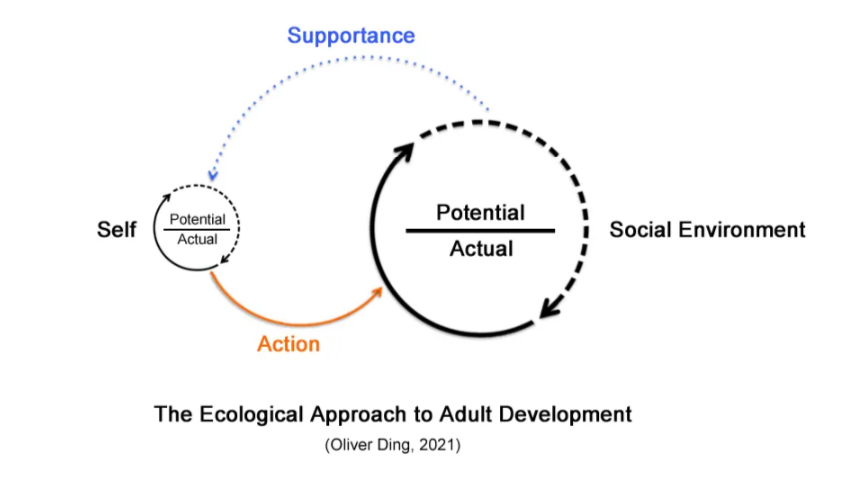
The present article is a case study within this framework. A theoretical tradition — Activity Theory — is understood here as a social environment organized around its own distinctive thematic schema: the ongoing tension and interplay between thematic proliferation and conceptual unification. The three-wave analysis has traced how this social environment has developed since 2000, and Parts 7 and 8 have shown how one contributor has engaged with it — perceiving and actualizing the supportances it offered at each stage. The before—after structure of the tradition's development is precisely the structure of supportances: each completed developmental episode restructures the landscape of action opportunities available to subsequent contributors.
For a fuller account of how theoretical traditions function as developmental platforms, and how the Enterprise Development Framework applies across different types of social environments, the reader is directed to Toward a Project-Oriented Ecology of Adult Development (2025).
v1.0 - May 10, 2026 - 1,3858 words