
Clay Spinuzzi: Mediating Concept and Network of Projects

This article is part of a new possible book Weave the Theory: The Art of Theoretical Activity and Knowledge Ecology
by Oliver Ding
May 17, 2026
In Weave the Theory: The Journey of Activity Theory and CHAT (Since 2000), Activity Theory's development since 2000 was analyzed through a three-wave structure. The third wave describes the encounter of Activity Theory with other independent theoretical traditions — dialogues that produce what that article called mediating concepts: theoretical constructs that sit at the intersection of two traditions, doing work that neither could do alone. Four cases were identified: Clay Spinuzzi's dialogue between AT and Actor-Network Theory, Iskra Nunez's Critical Realist Activity Theory, James Ma's Peirce-Vygotsky synergy, and Sami Paavola's Trialogical Approach drawing on Peircean Pragmatism.
The present article develops the first of these cases in full. Clay Spinuzzi's engagement with Activity Theory spans more than two decades of empirical research, methodological development, and theoretical dialogue — a body of work that the earlier article named but could not examine in detail. What follows is that examination.
This article examines Spinuzzi's work through two lenses. The first is the concept of the Mediating Concept — the theoretical construct that sits at the intersection of two traditions, doing work that neither can do alone. The second is the Network of Projects Framework — a curation of Spinuzzi's analytical contributions across different works, organized around a four-level hierarchy that makes visible the structural logic implicit in his scholarship.
The article also documents a personal engagement. Over the years from 2017 to 2026, Spinuzzi's work has appeared in my own theoretical practice at three different moments, each representing a different mode of engagement with the same theoretical resources. Taken together, these three encounters illustrate what the Activity Theory knowledge ecology actually looks like for a practitioner who does not follow the tradition's boundaries but uses what works, where it works, for the purposes at hand.
Contents
Part 1. Clay Spinuzzi and Creative Dialogue
1.1 A Creative Life Centered on Domain-based Social Science Research
1.2 From Network to All Edge
1.3 Mediating Concept: The Theoretical Lens
Part 2. How Are Networks Theorized?
2.1 Weaving a Network: Activity Theory's Account
2.2 Splicing a Network: Actor-Network Theory's Account
2.3 Triangulating Two Maps
2.4 Hierarchies, Markets, Clans, and Networks
2.5 Mediating Concept and the Weave-the-Theory Framework
Part 3. The Network of Projects Framework
3.1 The Framework: Four Levels of Activity Analysis
3.2 The Age of Projectification: Beyond Bounded Institutions
3.3 Project: Multiple Understandings
3.4 Project as Objective of Activity
3.5 Project as Fractional Coherence
3.6 Project as Grand Project
Part 4. Multi-perspectives, Multi-models
4.1 Activity System Model
4.2 The Limitations of the Activity System Model
4.3 Project Assemblage
4.4 Translation Analysis
4.5 The Weave-the-Theory Framework: A Meta-level Analysis
Part 5. Engaging with Network of Projects
5.1 Case Study: Andmind Group (2017)
5.2 A Case Study of "Social Moves" (2023)
5.3 The Frame-for-Work Canvas and the Milieu–Mediator–Method–Mastery Schema (2025)
5.4 A Knowledge Center in the Making
Postscript
Creative Dialogue and Generative Confluence
Part 1: Clay Spinuzzi and Creative Dialogue
1.1 A Creative Life Centered on Domain-based Social Science Research
Clay Spinuzzi is a professor of rhetoric and writing at The University of Texas at Austin. He has over twenty years of empirical research experience with Activity Theory, with interests in research methods and methodology, workplace research, and computer-mediated activity. His published books trace a sustained engagement across two decades: Tracing Genres Through Organizations (2003), Network: Theorizing Knowledge Work in Telecommunications (2008), Topsight: A Guide to Studying, Diagnosing, and Fixing Information Flow in Organizations (2013), All Edge: Inside the New Workplace Networks (2015), and most recently Triangles and Tribulations: Translations, Betrayals, and the Making of Cultural-Historical Activity Theory (MIT Press, 2025), and The Persuasive Entrepreneur: How to Develop and Pitch Your Early-Stage Technology Startup (MIT Press, 2026).
What holds this body of work together is not a single theoretical framework but a consistent empirical focus: understanding how people communicate, coordinate, and collaborate at work. In a 2024 exchange, Spinuzzi articulated his own orientation with unusual directness: "My focus is on better understanding how people communicate, coordinate, and collaborate at work, and I do that by conducting qualitative research. Activity theory often does a good job of helping me interpret the results of that qualitative research, so I often use it and have tried to develop it further in ways that will aid that work. But I sometimes reach for other frameworks such as actor-network theory, which is good at interpreting other aspects of this work."
This self-description — of a researcher who uses frameworks instrumentally, reaching for whichever tools best serve the empirical encounter — marks a distinctive position within Activity Theory's landscape. Where some contributors develop AT primarily as a theoretical knowledge system, and others deploy it primarily as an interventionist methodology, Spinuzzi's commitment is first to the empirical domain. The framework serves the research; the research does not serve the framework.
The research domain itself has shifted across his career. Tracing Genres traced work practices at the Iowa Department of Transportation, with its analytical focus on how genres operate across different levels of activity — macroscopic, mesoscopic, and microscopic. Network moved the analytical unit upward from single activity systems to networks of interconnected systems — and imported Actor-Network Theory to address what Activity Theory alone could not see. All Edge extended this network focus into the new organizational forms emerging from the digital economy: nonemployer firms, coworking spaces, gig workers, SEO specialists — organizational forms that are organized around projects and networks rather than departments and hierarchies. Topsight translated these theoretical developments into a practical research methodology. Triangles and Tribulations stepped back from empirical research altogether to apply ANT's sociology of translation to the historical development of CHAT itself.
The trajectory is one of expanding scope: from single organizations to organizational networks, from contemporary workplace ethnography to intellectual history. The theoretical toolkit has expanded alongside it. But the core research commitment — qualitative investigation of how people work — has remained constant.
1.2 From Network to All Edge
The story of how All Edge developed from Network is instructive — not only for understanding Spinuzzi's creative practice, but for understanding how a theoretical enterprise grows through the accumulation of empirical encounters.
In November 2023, I asked Spinuzzi directly about the All Edge project's origins. His account is worth quoting in full.
On when he knew he would write a book: "This is easy: I'm always planning to write a book. I think of each case study as a stair step, and when I have enough steps, I write a book, which is like the landing at the top of the stairs."
On when he knew he was working on All Edge: "After writing Network, I became interested in how people worked in networks. As I began conducting case studies, I also read a lot of theory to make sense of what was going on. At some point I could see how the case studies could help me illustrate the connections I was seeing. It took a while for me to conceptualize 'all edge,' but it came from linking the two."
On how the project developed: "I wrote the articles first, then once I could articulate the relationship between them, I wrote an outline. I spent a lot of time figuring out a structure and sequence that allowed me to build the book's concepts. Once that made sense, I knew how to write the interstitial chapters and edit the case chapters appropriately. I also presented several talks on parts of this argument so I could see how it landed with different audiences."
This account reveals a working method that is genuinely inductive: the case studies precede the book concept, not the other way around. The case studies span 2007 to 2011, the resulting articles appear in 2010, 2012, and 2014, and only when enough steps have accumulated does the "landing at the top of the stairs" — the book — become conceivable. The concept "all edge" itself arrived late, as a way of naming a pattern that the accumulated cases had been revealing without yet having a name.
This is a recognizable structure within the Creative Thematic Curation Framework: a long Explore Widely and Inquire Deeply phase, in which empirical encounters accumulate and the researcher reads widely to make sense of them, followed by a Crystallize Thematically moment when the connections finally become articulable. For Spinuzzi, the crystallization came not from theoretical reflection alone but from the combination of empirical cases and theoretical reading — and from the social test of presenting the argument to different audiences. The "landing" required both.
In the same exchange, Spinuzzi also addressed the question of how a situational framework — built for a specific case — can become useful to others. He was characteristically precise: "I discovered that some of the things I was seeing were not explainable through activity theory. So I turned to a different theory, actor-network theory, which had a better set of concepts for dealing with those things. If I hadn't done that, I would have had to have disregarded some of the experiences my participants described, experiences that they found important to their work." The hybrid framework that emerged from Network was not planned as a theoretical contribution; it was a by-product of empirical fidelity — of refusing to disregard what the participants were actually experiencing.
1.3 Mediating Concept: The Theoretical Lens
Spinuzzi locates himself firmly within empirical research. His self-described focus is on understanding how people communicate, coordinate, and collaborate at work — a pursuit he advances through qualitative research, drawing on whatever theoretical frameworks best serve each empirical encounter. From inside this self-description, the relationship between AT and ANT in his work is purely instrumental: two toolkits, deployed where they fit.
Over the years, Spinuzzi has pursued many empirical research projects, and even wrote a research methodology book — Topsight (2013) — distilling his accumulated practice into a systematic guide for researchers. Throughout this process, he has sustained a continuous dialogue between theory and practice, never confining himself to a single theoretical framework but adjusting his analytical tools according to the demands of each research situation. These ongoing dialogues have continuously updated his toolkit, and the by-products have accumulated over time.
The sections that follow document this development in detail: from the early four-level hierarchy of activity analysis, to the network analysis framework, to the four-type activity typology (of which Network is one type), to the different understandings of project across different periods and their corresponding analytical models. In this case study, I use the concept of Network of Projects to describe the overall character of this dynamically evolving toolkit — a concept that names not a single framework but the structured landscape of analytical resources that Spinuzzi's sustained theory-practice dialogue has produced.
As noted above, the Network of Projects concept that emerges from Spinuzzi's practice belongs, in the terms of Weave the Theory: The Journey of Activity Theory and CHAT (Since 2000), to the third wave of Activity Theory's development since 2000. The third wave's defining characteristic is the encounter of Activity Theory with other independent theoretical traditions — dialogues that produce new conceptual territory at their intersection. Yet from the perspective of Spinuzzi's own creative life, his position is better described as one of sustained theory-practice creative dialogue: he engages theoretical traditions not as a theorist building a system, but as an empirical researcher reaching for whatever tools the research situation demands.
It is also worth noting that over more than two decades, alongside his academic research and university teaching, Spinuzzi has maintained a long-running personal blog on the internet — sharing reading notes, theoretical reflections, and work-in-progress thinking with a readership that extends well beyond the academic circle. This is a different kind of creative dialogue: one between inside and outside, between the formal register of academic publication and the more exploratory register of public intellectual engagement.
It is the interweaving of these three modes of creative dialogue — between theory and practice, between Activity Theory and Actor-Network Theory, and between academic and public discourse — that gives Spinuzzi's creative life its distinctive character. And it is this interweaving that gives the concept of Mediating Concept a richer meaning than any single dimension of his work could supply.
Part 2: How Are Networks Theorized?
The concept of network sits at the center of Spinuzzi's theoretical enterprise. It appears in the title of his 2008 book, organizes the analytical framework of All Edge (2015), and provides the terrain vocabulary through which his empirical studies of knowledge work become theoretically legible. But "network" is not a concept that belongs to any single theoretical tradition. It is a term that Activity Theory and Actor-Network Theory each claim, each define differently, and each use to do different kinds of analytical work.
This part examines how the two traditions theorize networks — not to adjudicate between them, but to understand what Spinuzzi's dialogue between them produces. The question is not which account of networks is correct, but what becomes visible when the two accounts are held alongside each other. As Spinuzzi himself puts it in Network (2008), what he is attempting is "a constructive dialogue — a dialogue, not a dialectic." The differences between the positions won't be resolved; but by drawing comparisons and finding common ground, it becomes possible to see where the two perspectives diverge — and what lies in that divergence.
What lies in that divergence, this part argues, is the concept of Network of Projects: a mediating concept that emerges from the dialogue between two Approaches by anchoring itself in two Aspects of human activity that neither tradition had fully named. The argument is developed across five sections: Activity Theory's account of woven networks (2.1), ANT's account of spliced networks (2.2), how Spinuzzi triangulates the two maps without resolving their differences (2.3), the four-type typology as a terrain tool (2.4), and a Weave-the-Theory analysis of how the mediating concept earns its place in the knowledge ecology (2.5).
2.1 Weaving a Network: Activity Theory's Account
Spinuzzi opens his theoretical dialogue in Network (2008) with a careful statement of the differences between the two traditions he is bringing together: "Whereas activity theorists are looking for cultural-historical, developmental explanations for human activity, actor-network theory is interested in political and rhetorical explanations for power and its exercise. Activity theory is interested in how people work; actor-network theory is interested in how power works" (p.32). These are not merely different emphases — they are different questions, rooted in different philosophical traditions. And yet, Spinuzzi argues, a constructive dialogue between them is possible: not a dialectic that resolves the differences, but a comparison that finds common ground while mapping where the two perspectives diverge.
The organizing metaphor Spinuzzi introduces for this dialogue is the distinction between two ways of building sociotechnical networks: weaving and splicing. These two modes of network-building correspond, respectively, to Activity Theory's account and Actor-Network Theory's account of how networks come into being and hold together.
Woven networks are exemplified by Activity Theory's account of the division of labor. Spinuzzi draws on Leontiev's Activity, Consciousness, and Personality (1978): labor is divided in collectives — some weave nets, some fish, some build boats — but all in the community can benefit from the catch. Over time, specialization deepens: activities that were once performed by a single person diverge into separate activities, each with its own tools, practices, and participants. The fishing net one buys today in a sporting goods store was manufactured by workers who know nothing about fishing, sold by a shopkeeper who knows nothing about fishing — yet genetically and historically, these activities interrelate. "Though the fishing nets may evolve, they recall their origins. The diverse types of nets we see in everyday life are constructed using tools and techniques originally employed by weavers of fishing nets. They started at a common point and diverged" (p.34).
This is the Activity Theory account of how networks form: through the historical division and differentiation of collective activity. Networks are woven — they grow from shared origins, diverge through specialization, and remain connected through the genetic and historical relationships among their component activities. As Spinuzzi characterizes it, Activity Theory offers "an arborescent, evolutionary explanation of how activities link, combine, merge, interpenetrate, and divide over time through a process of developing and resolving contradictions" (p.80). The account is decidedly asymmetrical: human beings hold agency; nonhumans serve as mediating tools. And it is decidedly developmental: change happens through the cyclical resolution of dialectical contradictions, not through the political work of alliance-building.
Activity Theory's strength is precisely this developmental account. It does a "remarkably good job of explaining weaving" (p.81) — of tracing the historical genesis of network connections, understanding how workers develop competence, and explaining how learning unfolds through mediated activity. Its relative weakness, Spinuzzi notes, is splicing: it has "only lately begun to grapple with splicing in earnest and is still working through the issues" (p.81). Its account of political and rhetorical network-building is informed throughout by the underlying assumptions of weaving — development, education, dialectics.
2.2 Splicing a Network: Actor-Network Theory's Account
Where Activity Theory sees networks as woven from historical origins, Actor-Network Theory sees them as spliced together through active political and rhetorical work. ANT is rooted in relational sociology and what Spinuzzi calls a "Machiavellian view": it emphasizes alliances, relationships, reversals, and betrayals. But unlike Machiavelli, it applies these principles to nonhumans as much as humans — expanding from a political theory into an ontology. In ANT's account, "every actant defines and mediates others, and thus every actant is a potential agent; it is a symmetrical account" (p.92).
A spliced network is not grown from a common root — it is assembled from heterogeneous elements that have no prior relationship, brought into connection through the efforts of specific actors who work to interest, enroll, and mobilize others. ANT's account of network-building focuses on translation — the process through which an actor articulates a project, defines a problem space, and works to convince others that their interests align with the project's objectives. Translation moves through four moments: problematization (defining the problem and the actors' roles), interessement (locking others into those roles), enrollment (consolidating the alliance), and mobilization (making the network durable). Translation is always a transformation: to bring another actor into the network is to redefine what they want and what they do in terms of the project.
ANT's account does "a remarkable job of exploring the political-rhetorical work that makes technical mediation possible" (p.92-93). Its strength is precisely the splicing account: it traces how networks are assembled through the work of translation, how actants define each other through their relationships, and how changes in relationships lead to changes in the actants themselves. Its relative weakness, Spinuzzi notes, is weaving: "it barely touches on issues of weaving, that is, education and development. And when it does explore these issues... it bases its explorations on a spliced understanding: a rhizomatic, relationist explanation" (p.92). It has "very little to explain or address" the issues of development, learning, and cognition that Activity Theory handles well.
The contrast with weaving is precise. In a woven network, the connections among elements are already there — inherited from the historical division of labor, recoverable through genetic analysis. In a spliced network, the connections must be actively made and actively maintained. A woven network persists because of where it came from; a spliced network persists only as long as the work of translation continues.
2.3 Triangulating Two Maps
Spinuzzi is careful to note that the weaving/splicing distinction is artificial: "any network involves both ways of building." Real networks are neither purely woven nor purely spliced — they involve historical inheritances and active political work simultaneously. The distinction is analytical, not ontological: it allows the two theoretical perspectives to be held separately long enough to see what each contributes, before the complication of their interaction is addressed.
The question, then, is how to work with two traditions that genuinely differ — not by resolving their differences, but by using those differences productively. Spinuzzi's own account of this, offered in a 2025 email exchange, is worth quoting directly:
"I see social theories as different attempts to pull out and explain parts of social life, which itself is too complex and multiple to explain in total. A social theory is sort of like a map you use to navigate a territory. If you're trying to get from one address in a city to another, a useful map will show the road system, but it probably will not show lots of other aspects, such as topography, plumbing systems, or property values. Similarly, a social theory reduces a lot of complexity into a relatively small set of relations for you to explore further... So, when you try to bring two social theories into alignment, you have to be careful to understand what they are trying to map — that is, what their premises are, what they deem as important to analyze. I sometimes use AT and ANT together, not because they agree, but because they have different blind spots. Triangulating the theories allows me to superimpose the two maps."
This is not synthesis — it is triangulation. The two maps are superimposed not to produce a single unified map but to reveal what each map alone cannot show. Activity Theory maps the developmental, historical, cognitive dimensions of network formation; ANT maps the political, rhetorical, relational dimensions. Neither map is complete; each illuminates what the other leaves in the dark.
In Network (2008), Spinuzzi identifies the common ground that makes triangulation possible. Despite their differences, Activity Theory and ANT are both monist, materialist approaches to understanding human activity. They are both applied to technical mediation. They both theorize mediated activities in terms of networks, posit multiplicity within those networks, examine texts as mediational means, and allow for different social languages in different parts of those networks. And they both see networks as heterogeneous, multiply linked, transformative, and capable of black-boxing. These shared commitments are the basis on which the two maps can be superimposed — without pretending they show the same things.
The specific triangulation Spinuzzi performs is this: "applying two accounts of change to see how networks can be historicized: activity theory's contradictions and actor-network theory's translations" (p.94-95). Contradictions explain how networks develop from within — how internal tensions drive transformation. Translations explain how networks are assembled from without — how external political work builds and maintains connections. Together, they provide a more complete account of how sociotechnical networks change over time than either tradition alone can offer.
2.4 Hierarchies, Markets, Clans, and Networks
In 2014, Spinuzzi published a paper titled "Toward a Typology of Activities: Understanding Internal Contradictions in Multiperspectival Activities." He observed that Activity Theory "currently lacks a suitable typology for characterizing ideal types of activities in terms of multiperspectivity, so it has had trouble systematically characterizing the resulting sets of internal contradictions." His solution was to develop a matrix organized around two dimensions: how the object of activity is defined (explicitly and deductively, or tacitly and inductively), and where it is defined (within the activity's division of labor, or outside it).
The outcome was a four-quadrant typology of ideal activity types:
- Hierarchies: object defined explicitly, within the division of labor — structured around formal rules and defined roles
- Markets: object defined explicitly, outside the division of labor — structured around external contracts and competitive exchange
- Clans: object defined tacitly, within the division of labor — structured around shared values and mutual trust
- Networks: object defined tacitly, outside the division of labor — structured around informal relationships and flexible collaboration
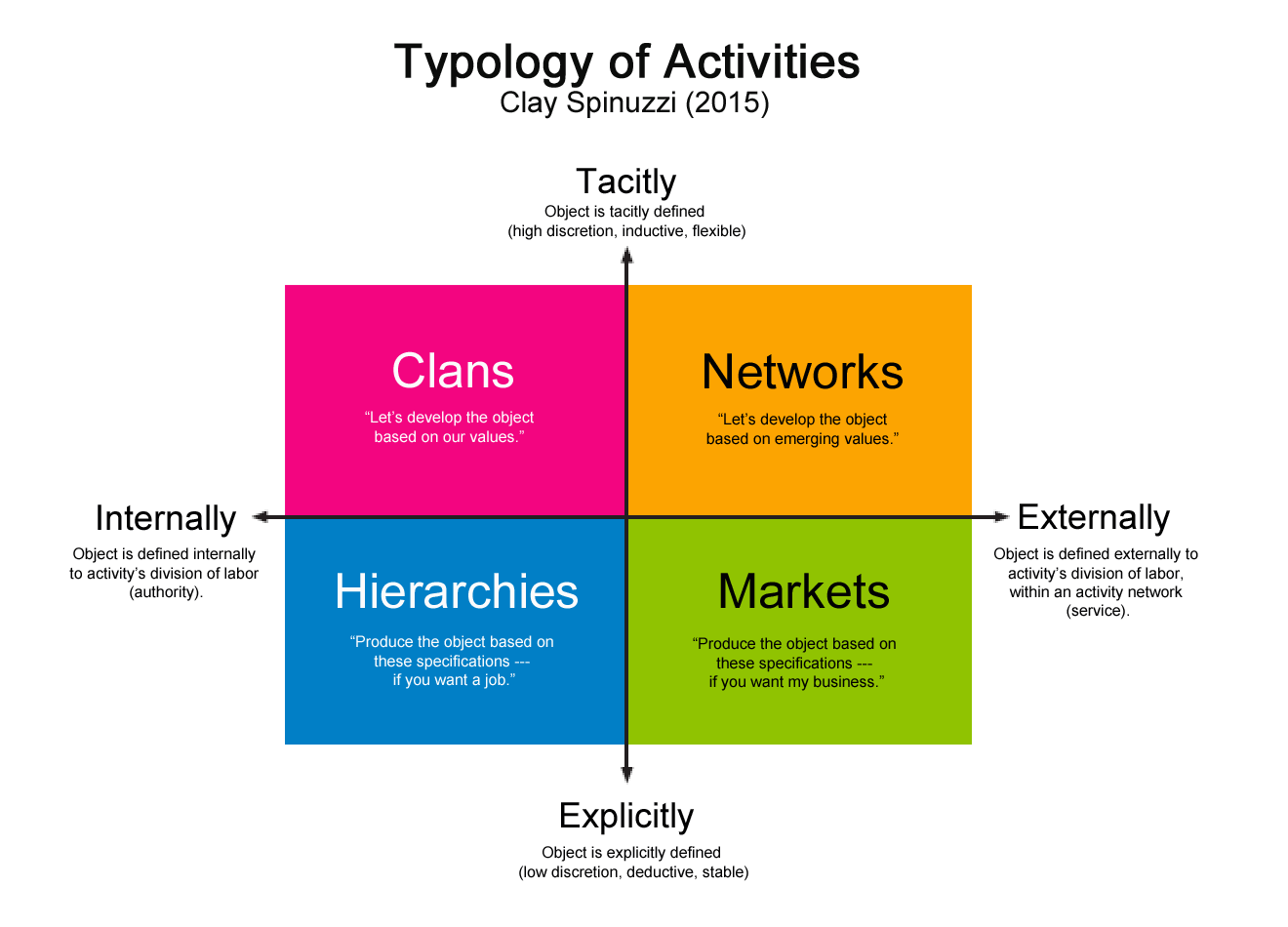
Spinuzzi was careful to note that these terms are used in the sense of organizational typologies, not strictly in the sense of commerce or kinship. "Clan" in particular he would have preferred to replace with "community" — but that term already carries a specific meaning within Activity Theory. The four types are ideal types; real activities are typically hybrids located within the matrix rather than neatly fitting any single quadrant.
This typology serves two analytical purposes. First, it provides a vocabulary for characterizing the kind of activity a system is — which of the four types governs its object definition and its structural logic. Second, it provides a vocabulary for characterizing the internal contradictions that arise when activities of different types are brought into contact — when a Network encounters a Hierarchy, or when a Clan is forced to operate in a Market context.
The typology belongs to both AT and ANT in a precise sense. Its theoretical foundation — the centrality of the object, the role of contradiction, the analysis of multiperspectival activity — is Activity Theory's. Its analytical sensitivity to the diversity of social organizational forms — to the fact that not all activity is hierarchically structured, that networks follow different logics than bureaucracies — reflects ANT's broader ecological awareness of the heterogeneity of social life. Neither tradition alone would have generated exactly this typology; it is a product of their dialogue.
2.5 Mediating Concept and the Weave-the-Theory Framework
The preceding sections have traced two ways of theorizing networks — Activity Theory's account of historically woven networks and ANT's account of politically spliced networks — and one of the analytical tools that emerged from their dialogue: Spinuzzi's four-type typology of Hierarchies, Markets, Clans, and Networks. Before proceeding to Part 3's analysis of how project appears across Spinuzzi's work, it is useful to step back and ask: what kind of theoretical contribution is this dialogue producing, and how can the Weave-the-Theory framework help us understand it?
The Weave-the-Theory framework proposes that any theoretical development involves two simultaneous lines of movement — a Creativity Line (Theme → Model) and a Curativity Line (Concept → Principle) — and two synchronic dimensions: Approaches and Aspects.
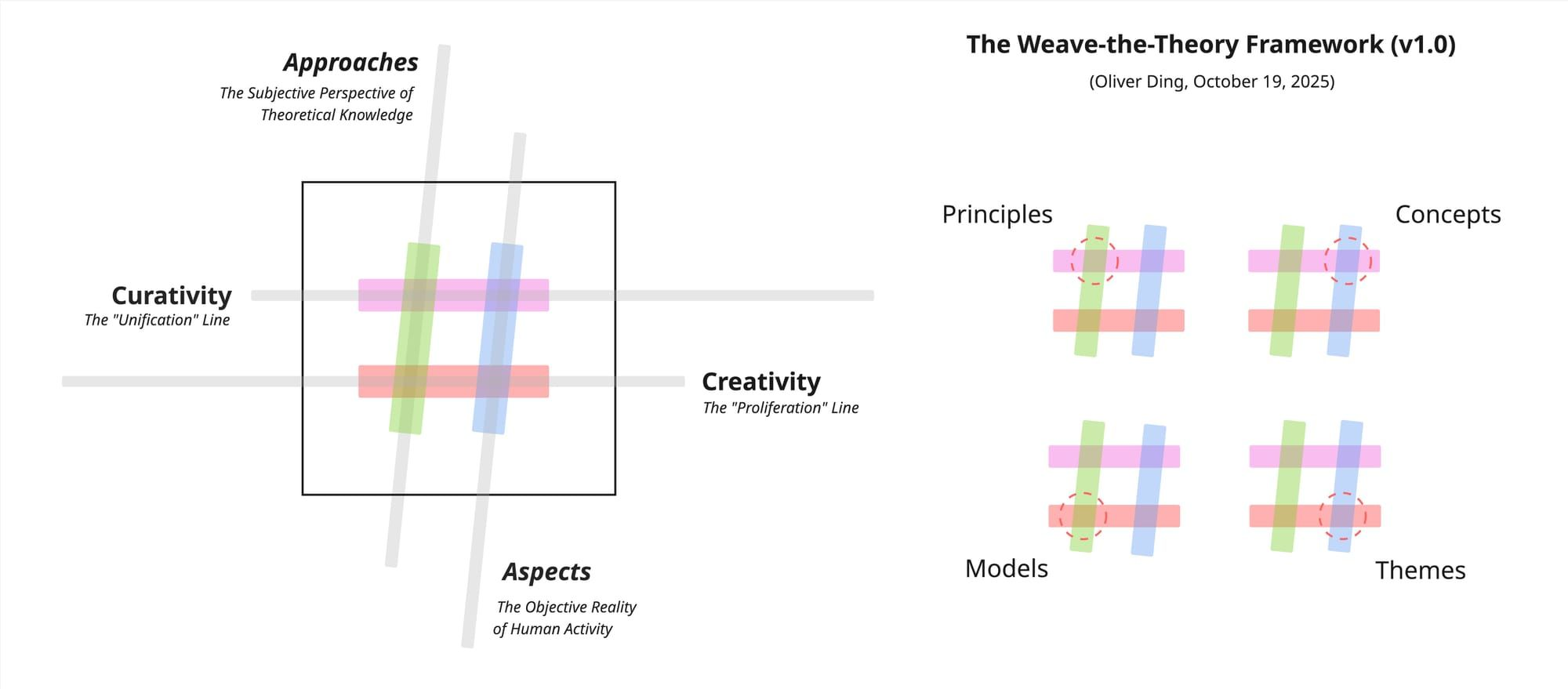
Approaches refers to the subjective perspective of theoretical knowledge — the analytical lenses, frameworks, and traditions through which researchers make sense of human activity. Activity Theory and Actor-Network Theory are both Approaches: each offers a distinctive way of seeing, each asks different questions, each has its own vocabulary and its own blind spots.
Aspects refers to the objective reality of human activity — the phenomena, structures, and dynamics that exist independently of the theoretical traditions used to analyze them. Aspects are what theories aim to explain; they are the anchor that prevents theoretical development from becoming purely internal to a tradition.
The relationship between Approaches and Aspects is the key to understanding what a mediating concept does. When two theoretical traditions — two Approaches — are brought into dialogue, the most productive outcome is not a synthesis of the two traditions but the identification of an Aspect that neither tradition had adequately captured on its own. The mediating concept earns its place in the knowledge ecology not by belonging to either tradition, but by anchoring itself in an Aspect of human activity that both traditions were reaching toward but neither could fully see.
In Spinuzzi's case, the two Approaches are Activity Theory and Actor-Network Theory. What the dialogue between them makes visible are two Aspects of contemporary human activity that neither tradition alone had adequately theorized:
Projectification — the objective reality of contemporary work organization: temporary, cross-boundary, expert-assembled, funded-dependent, and dispersing upon completion. This Aspect exists independently of any theoretical tradition; it describes a structural feature of how an increasing proportion of human work is organized in the contemporary world.
Network — the objective reality of how projects connect to each other: not as isolated undertakings but as nodes in a larger ecology, linked through shared participants, shared themes, shared resources, and shared terrain. This Aspect also exists independently of any theoretical tradition; it describes the landscape within which any individual project is situated.
It is the combination of these two Aspects — projectification and network — that gives the concept Network of Projects its theoretical identity and its ecological niche. The concept is not simply "network" — Activity Theory already had the Activity Network concept for that. It is not simply "projects" — both AT and ANT discuss projects in various ways. It is the specific combination: a network structured by and composed of projects, where the projectified character of contemporary work is the organizing principle of the network's topology.
This dual anchoring in two Aspects is what allows Network of Projects to establish its own niche in the knowledge ecology — independent of either source tradition. A concept anchored in a genuine Aspect cannot be simply absorbed by either tradition, because the Aspect it captures belongs to the world, not to any particular Approach. This is the structural logic of the mediating concept: it sits at the intersection of two Approaches, but it earns its independence by being anchored in an Aspect that neither Approach had yet fully named.
The subsequent parts of this article develop this analysis in detail. Part 3 examines how the concept of project — and through it, the Aspect of projectification — appears across Spinuzzi's work in three distinct forms. Part 4 examines the models he developed to operationalize these understandings, and closes with a Weave-the-Theory mapping of the full development. Part 5 documents how these concepts and models have been actualized in my own theoretical practice across different contexts and scales.
Part 3: The Network of Projects Framework
Part 2 established the theoretical context: two traditions theorizing networks from different angles, a triangulation strategy that holds their differences in productive tension, and a Weave-the-Theory analysis that identifies the two Aspects — projectification and network — that give the concept of Network of Projects its analytical identity. This part now turns to Spinuzzi's work directly, tracing how these two Aspects appear and develop across his scholarship.
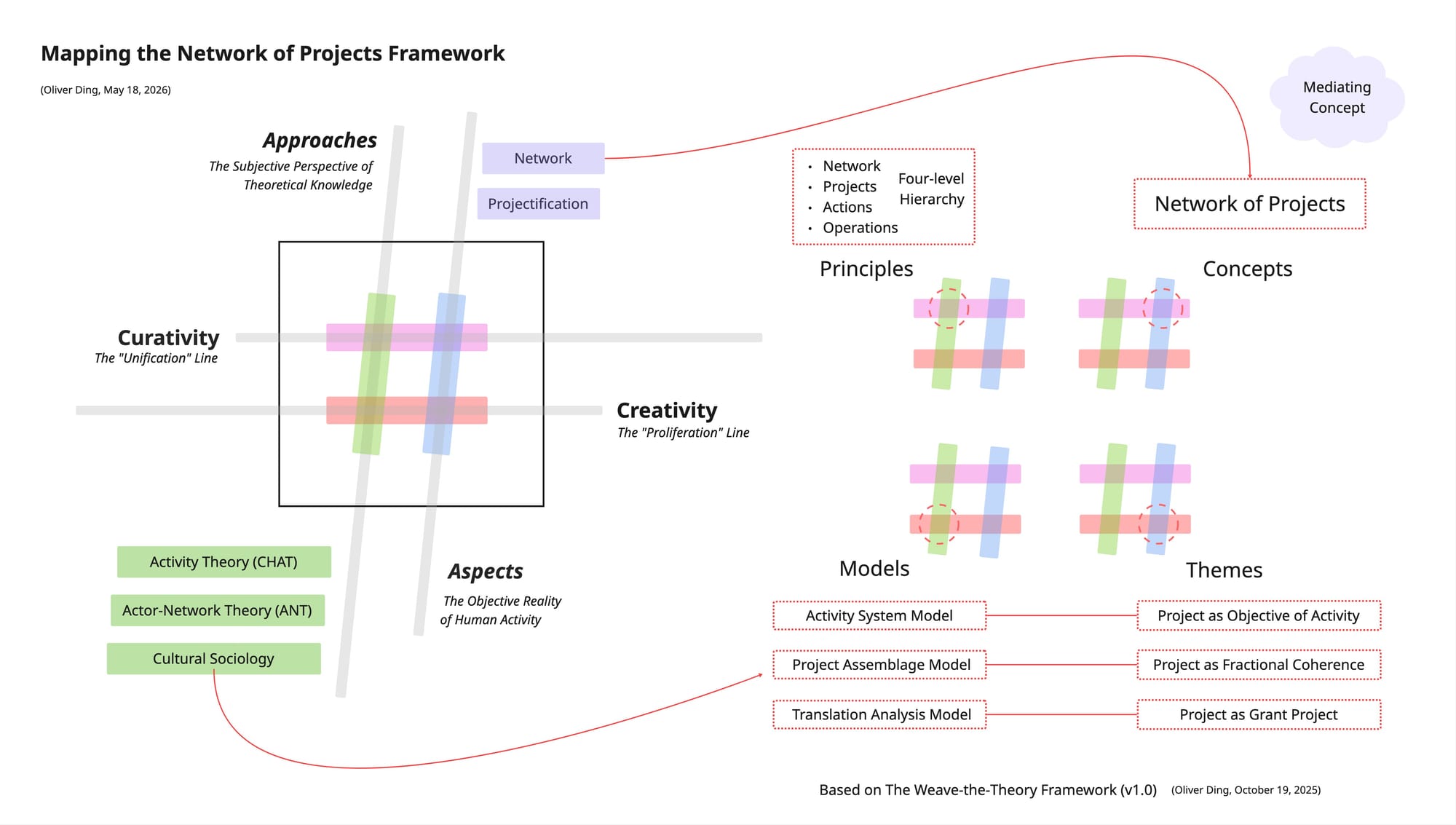
The organizing tool is a four-level hierarchy of activity analysis, proposed here as the implicit Principle beneath Spinuzzi's accumulated empirical and theoretical work. Around this hierarchy, the concept of project appears in three distinct forms — each theorized through a different framework, each revealing a different dimension of the Aspect of projectification. The sections that follow establish the hierarchy, trace the historical background that makes projectification analytically urgent, examine the limits of the existing Activity System model, and then develop each of the three understandings of project in turn.
3.1 The Framework: Four Levels of Activity Analysis
Since Network (2008), Spinuzzi has continued to pursue qualitative empirical research across a variety of organizational settings — nonemployer firms, coworking spaces, SEO professionals, and most recently entrepreneurial ventures. Across these studies, the concept of project appears repeatedly, each time in a different analytical form, serving a different purpose. And behind all of these appearances, a four-level hierarchical structure has remained quietly stable as the organizing framework.
The foundation was laid in Tracing Genres Through Organizations (2003), where Spinuzzi introduced "three levels of scope" corresponding to Activity Theory's foundational hierarchy. Drawing on Leontiev's three-level structure, he proposed Macroscopic, Mesoscopic, and Microscopic as the three analytical levels for empirical research — corresponding to Activity (cultural-historical, usually unconscious), Action (goal-directed, conscious), and Operation (habitual, unconscious). He argued that single-scope approaches, which privilege one level over another, are inherently limited: "These relationships are not typically examined — and are inherently difficult to examine — through single-scope approaches, which by definition privilege one level of scope over another and which take level of scope as foundational to the other levels. They lend little attention to how that level is constituted and made meaningful through what occurs at the other levels" (Tracing Genres, p.29).
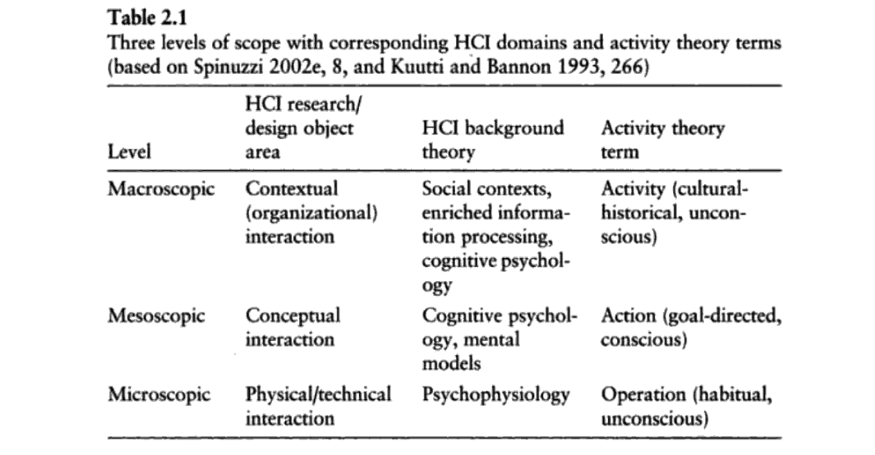
By Topsight (2013), a structural expansion had occurred. The macro level now refers to two models simultaneously: Activity Systems and Activity Networks. The concept of activity network, introduced by Engeström in 1987, is not part of Leontiev's original theoretical framework — its inclusion at the macro level implicitly adds a fourth level above the original three.
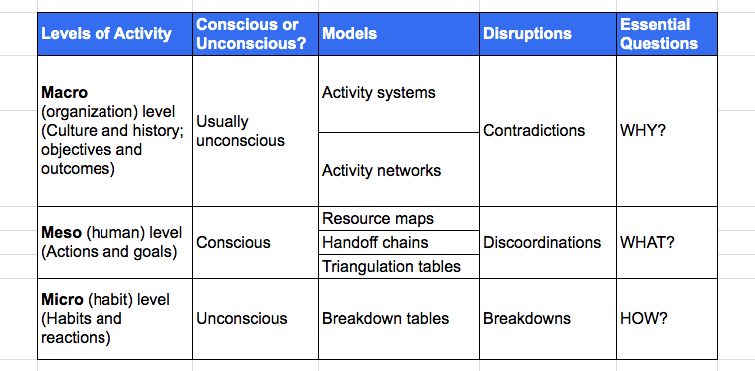
If we make this expansion explicit, the four-level hierarchy becomes:
- Network: the network of interconnected activity systems, operating across organizational boundaries
- Activity System: the collective activity system with its seven structural components
- Actions: goal-directed, conscious behaviors pursued by individual subjects
- Operations: habitual, unconscious behaviors that have become automated through practice
This article proposes a reframing of this four-level structure. Rather than placing the Activity System at the third level, it places Project there. This reframing is grounded in an empirical observation: across Spinuzzi's work since Network, the concept of project appears repeatedly as the key analytical focus at this level — the bounded undertaking that gives individual actions their coherence and connects them to the larger network. What theoretical framework he uses to explain this focus varies: sometimes the Activity System model, sometimes ANT's vocabulary, sometimes a new hybrid he develops for the specific case. The theoretical framing shifts; the analytical position of project in the hierarchy remains stable.
The Network level, correspondingly, is understood as the organizational context within which multiple projects are connected and coordinated. It is worth noting that Spinuzzi's 2014 typology — Hierarchies, Markets, Clans, and Networks — identifies four different types of organizational context, each of which can serve as the higher-level structure above the Project level. In this sense, the fourth level of the hierarchy is expandable: Hierarchies, Markets, Clans, and Networks are all possible forms that this level can take. The present article focuses on Network as the primary form — consistent with the central theme of Spinuzzi's work — but the analytical structure applies equally to the other three types. The four levels then become:
- Network: the network of interconnected projects, which may take different organizational forms
- Project: the bounded undertaking that organizes collective action toward a shared objective
- Actions: goal-directed, conscious behaviors pursued by individual participants
- Operations: habitual, unconscious behaviors that have become automated through practice
This reframing is the analytical move of the present article, not Spinuzzi's own. He does not use this terminology or this four-level structure explicitly. What follows is a curation of his work through the Weave-the-Theory lens — an attempt to make visible a coherent framework that is implicit across his scholarship, without claiming that he would recognize or endorse this particular articulation.
The sections that follow examine how the concept of project appears across Spinuzzi's work — each time in a different form, theorized through different frameworks, but always occupying the same structural position: above individual actions, below the network that connects multiple projects together.
3.2 The Age of Projectification: Beyond Bounded Institutions
The concept of projectification was originally coined by Christophe Midler (1995) to refer to the transformation from hierarchical function-centered organization to cross-functional project-centered organization. Spinuzzi, drawing on Midler and Toffler, brought this concept into his analysis of contemporary knowledge work in All Edge (2015).
The term "adhocracy" — borrowed from Alvin Toffler — captures the organizational form that projectification produces: "rotating teams of specialists who could come together to swarm a project, disperse at the end of it, and re-form in a different configuration for the next project" (All Edge, p.1). The organizing principle that distinguishes adhocracies from bureaucracies is precisely projectification: "the organization of work around project teams oriented to defined projects, as opposed to departments oriented to narrow functions" (p.32). The adhocracy is organized around a specific, defined project objective with a specific endpoint.
Spinuzzi identifies knowledge work as the primary domain of adhocracy. Knowledge work — work that involves thinking about, analyzing, and communicating things rather than growing or manufacturing things — tends to be project-oriented, specialist, and fast-changing. Its products are symbolic and electronically transportable. It needs, as Spinuzzi puts it, "what organizational networks can provide" (p.60).
Within this organizational landscape, the project sits at a distinctive structural level. Spinuzzi's analysis of nonemployer firms (NEFs) illustrates this clearly. A NEF operates around two primary objectives: the front-stage performance — the long-term identity and brand of the firm, lasting beyond any specific project — and the project — the specific short-term undertaking that gives the backstage subcontractor network its temporary shape and coherence. As Spinuzzi writes: "The project gave shape and unity to the network, providing a temporary back stage… To complete each project objective, a nonemployer firm had to assemble a network of subcontractors who shared this objective but saw different aspects of it" (p.62).
A third objective further complicates the picture: collaboration — the persistent need to coordinate the swarm across front stage and project simultaneously. "Unfortunately, these three objectives (collaboration, the front stage, the project) don't always line up… the tensions among these objectives provide the network with its shape and — ideally — its coherence… these tensions can produce innovations, but they also produce disruptions and instabilities" (p.65).
This analysis establishes projectification as a terrain problem as much as a model problem. The question is not only how to analyze what happens inside a project, but how to map the landscape within which projects are assembled, pursued, and dissolved — a landscape where multiple objectives coexist in tension, where specialists engage fractionally, and where the network's coherence is always provisional.
3.3 Project: Multiple Understandings
Across Spinuzzi's work, the concept of project appears repeatedly — but it does not carry a single fixed meaning. Each time it appears, it is theorized through a different framework, serving a different analytical purpose. Before examining each in detail, it is useful to map the range.
Three distinct understandings of project can be identified across his body of work, presented here in chronological order:
Project as objective of activity. In All Edge (2015), project names the specific short-term undertaking around which an adhocracy temporarily assembles. It is what the network is oriented toward — the shared objective that gives the backstage subcontractor network its temporary coherence and direction. This understanding draws primarily on Activity Theory's vocabulary of object-orientation.
Project as fractional coherence. In the 2023 paper with Guile, project is understood through Law's concept of fractional coherence: an assemblage of heterogeneous socio-material activity that lacks a single centre, coherent enough to anchor collaborative action, yet incoherent enough to remain tractable to the different specializations contributing to it. This understanding addresses the ontological instability of the project object in projectified work — a concept that the subsequent Project Assemblage model was built to operationalize.
Project as grand project. In Triangles and Tribulations (2025), Spinuzzi examines how key figures in CHAT's history each endorsed a "project" — an overarching, long-cycle pursuit that drove their theoretical work. Drawing on Latour's notion that a technological project begins as a fiction and either remains in the file drawers or is transformed into an object, Spinuzzi uses this concept to name each theorist's sustained commitment: Vygotsky's project was the New Soviet Human; Leontiev's was the supervised Soviet citizen; Engeström and Bødker's was the supermediator. What Spinuzzi calls "project" in this context is better understood as a grand project — a long-cycle commitment that organizes a series of concrete studies, methods, and interventions across years or decades, operating at the Network level of the four-level hierarchy.
These three understandings are not competing definitions. They describe the concept of project at different scales and through different theoretical lenses, across a decade of Spinuzzi's empirical and theoretical development. The sections that follow examine each in turn.
3.4 Project as Objective of Activity
In All Edge (2015), Spinuzzi's analysis of nonemployer firms (NEFs) provides the clearest empirical illustration of project as objective of activity. The organizational form he is analyzing — the adhocracy — is defined precisely by its orientation toward a project objective. As Spinuzzi writes, projectification is "the organizing principle of adhocracies: the organization of work around project teams oriented to defined projects, as opposed to departments oriented to narrow functions. The adhocracy is organized around a specific, defined project objective with a specific endpoint" (p.32).
Within the activity network of a NEF, the project occupies a specific structural position. Spinuzzi identifies three objectives that govern the network simultaneously: the front-stage performance (the long-term identity and brand of the firm, lasting beyond any specific project), the project (the specific short-term undertaking), and the collaboration (the persistent need to coordinate the swarm). These three objectives operate at different temporal scales and serve different functions within the network.
The front-stage performance and the project stand in a particular relationship. The front stage is long-term, lasting beyond any specific project; but behind it, the NEF organizes a temporary all-edge adhocracy of subcontractors that swarms the short-term project. As Spinuzzi describes it: "The project gave shape and unity to the network, providing a temporary back stage… To complete each project objective, a nonemployer firm had to assemble a network of subcontractors who shared this objective but saw different aspects of it" (p.62).
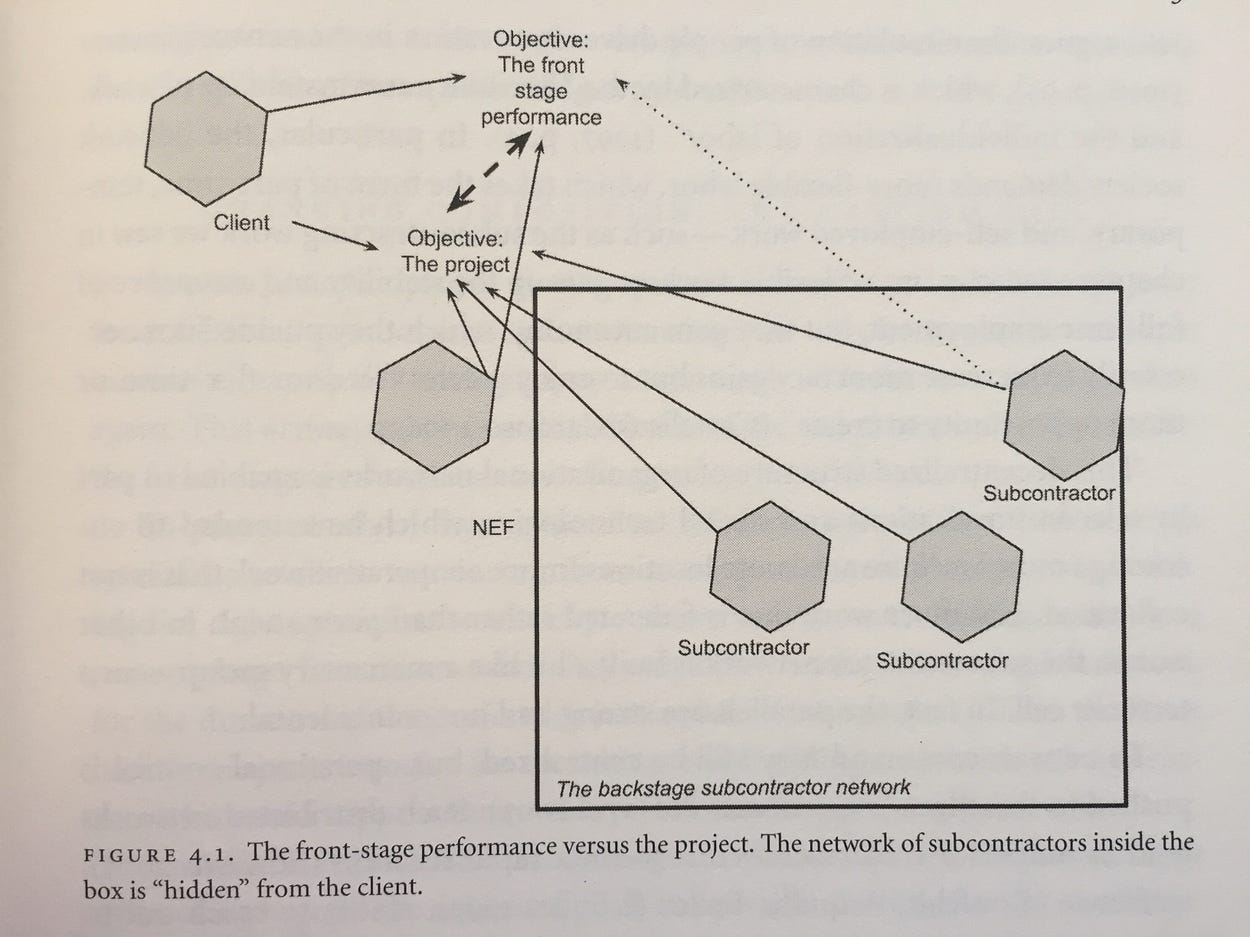
This last phrase is analytically significant: subcontractors share the project objective but see different aspects of it. The project is not a single unified perception held identically by all participants — it is a shared orientation that each participant approaches from their own specialization and position. This is the project as objective of activity in its most precise form: not a common understanding, but a common direction, toward which multiple partial perspectives are collectively oriented.
The third objective — collaboration — reveals the project's structural role within the network most clearly. Collaboration is not merely a means to completing the project; it is itself an objective, because projectification requires coordinating the swarm in ways that address both the short-term project and the long-term front stage simultaneously. As Spinuzzi notes: "Unfortunately, these three objectives (collaboration, the front stage, the project) don't always line up… the tensions among these objectives provide the network with its shape and — ideally — its coherence… these tensions can produce innovations, but they also produce disruptions and instabilities" (p.65).
This tension among three objectives — operating at different temporal scales, held together by the project's temporary coherence — is what distinguishes the adhocracy from both the bureaucracy and the simple activity system. The bureaucracy resolves this tension by eliminating it: departments have narrow functions, objectives are formally aligned, coordination is hierarchical. The adhocracy lives with the tension: it is the productive friction among front stage, project, and collaboration that drives both the network's vitality and its instability.
Read through the four-level framework proposed in 3.1, the project as objective of activity occupies the Project level precisely: above the individual actions of each specialist (who pursue their own goals within the project), and below the network of activity systems (which the front-stage performance and the broader subcontractor ecology constitute). The project is the unit that gives the network its temporary shape — and its dissolution, when the project objective is achieved, is what allows the network to reconstitute itself around the next project.
3.5 Project as Fractional Coherence
The concept of fractional coherence arrives in Spinuzzi's work through his 2023 collaboration with David Guile. Its theoretical source is John Law's Aircraft Stories (2002), where Law introduces fractional coherence to describe a way of "drawing things together without centring them" — an object that has no single centre, yet coheres sufficiently to anchor collaborative action. For Law, objects are assemblages of multiples: technical design, specific features, social and political purpose. The performances of multiple actors involved in a project "make objects that cohere" as they make connections between continuity and discontinuity, simultaneously addressing the tensions that arise in the process of centring. The resulting project object is therefore fractional: coherent enough to anchor collaborative activity, yet incoherent enough that it can provide traction to the different specializations attempting to transform it.
This concept addresses precisely what the Activity System model cannot see. The AS presumes a relatively durable, shared object — something that "is durable and constantly under construction," generating "a perspective for possible actions within the activity." In projectified work, no such durable shared object exists at the outset. The object must be formulated and deliberated rather than assumed as a starting point. Different specializations may enact the object differently — the object of a cross-specialization collaboration may be ontologically unsettled, where specialists are continually renegotiating it even when there is overarching agreement about its desired general outline. Moreover, specialists engage with that object intermittently, having a fractional relationship with it: they enter the project at different stages, contribute what their specialization makes possible, and exit when their contribution is complete.
What distinguishes this understanding of project from the one in 3.5 is the analytical emphasis. In All Edge, the project as objective of activity is a relatively stable shared orientation — what the adhocracy is aimed at. Here, the project object is ontologically unsettled from the outset: it must be cohered through dialogue rather than assumed. The project does not begin with a clear objective; it begins with a potential for funding and an emerging set of actors, and the object takes shape — fractionally, provisionally — through the work of the assemblage itself.
3.6 Project as Grand Project
In Triangles and Tribulations (2025), Spinuzzi's translation analysis introduces a third understanding of project — one that operates at a very different scale from the previous two. Where project as objective of activity names a short-term undertaking within an adhocracy, and project as fractional coherence names an ontologically unsettled object in projectified work, what Spinuzzi calls "project" in this context is better understood as a grand project: a long-cycle commitment that organizes a series of concrete studies, methods, and interventions across years or decades. It does not occupy the Project level of the four-level hierarchy proposed in 3.1 — it operates at the Network level, nesting multiple concrete projects within a single overarching pursuit.
The concept enters through Latour's account of technological projects: "By definition, a technological project is a fiction, since at the outset it does not exist, and there is no way it can exist yet because it is in the project phase." Technologists are thus novelists — their project, indistinguishable from a novel at the outset, will gradually veer in one direction or another: either remaining in the file drawers or being transformed into an object. Spinuzzi applies this vocabulary to the history of CHAT: in each chapter of the translation analysis, he examines an overarching project endorsed by a key figure — a grand project in which the key figure attempts to interest others, articulating an endpoint within their domain that could secure the interest of participants and resources.

The cases Spinuzzi examines reveal the range of what this kind of grand project can look like:
Vygotsky's grand project was the New Soviet Human — a human being whose potential had been unlocked by the transition from capitalism to socialism. This overarching commitment drove his attempt to develop a Marxist psychology suitable for producing this new kind of person.
Leontiev's grand project was the supervised Soviet citizen — not Vygotsky's superhuman, but a human being who could be led into the service of the Soviet state. The shift from Vygotsky's grand project to Leontiev's was not merely theoretical; it reflected the political conditions of the post-Terror period and the demands of rehabilitation work during the Second World War.
Engeström and Bødker's grand project was the supermediator — not superhumans, nor supervised citizens, but workplaces and activity systems that could be collectively redesigned to revolutionize specific forms of work. In the majority of cases, this grand project involved acting with technology: developing new interfaces, texts, tools, and agreements to unlock new capabilities.
Writing studies' grand project was describing and diagnosing types of mediatory texts — mapping the texts that mediate work in specific workplaces, and identifying ways to improve how those text types were constructed, used, and coordinated.
Engeström's third-generation grand project was the reorganization of interorganizational work — developing an organizational sociology capable of analyzing how organizations worked and how they could be made to work better across institutional boundaries.
Engeström and Sannino's fourth-generation grand project was the implementation of public policy objectives to address acute societal problems — homelessness, global warming, pandemics — often described as producing "alternatives to capitalism."
In each case, the grand project is not a bounded undertaking with a specific endpoint — it is the sustained commitment that gives the theorist's work its direction and coherence across time. Vygotsky did not pursue the New Soviet Human through a single study; it organized an entire research program. Engeström's supermediator grand project did not crystallize in a single book; it unfolded across decades of empirical research, methodological development, and institutional building.
This is the most abstract of the three understandings of project in Spinuzzi's work. It operates not at the level of organizational activity or projectified work, but at the level of intellectual biography. From the perspective of the Life-as-Activity Approach, the grand project corresponds to what that framework calls Theoretical Enterprise: the sustained trajectory of a theorist's engagement with a domain, organized around a central commitment, and encompassing a series of concrete projects over years or decades. What Spinuzzi identifies as "project" in his translation analysis is, at this scale, not a single project in the four-level hierarchy — it is the network-level structure within which multiple concrete projects are nested, giving each its meaning and direction.
Part 4: Multi-perspectives, Multi-models
Part 3 examined three distinct understandings of project that appear across Spinuzzi's work — project as objective of activity, project as fractional coherence, and project as grand project. Each understanding names the concept at a different scale and through a different theoretical lens. But a concept alone is not an analytical tool. What makes these understandings operational — what allows them to be applied to concrete empirical cases — is the set of models that Spinuzzi developed alongside them.
This part examines three such models: the Activity System model, the Project Assemblage, and the Translation Analysis method. Each corresponds to one of the three understandings of project developed in Part 3. Each provides a different kind of analytical structure — a way of bounding a case, identifying its key elements, and tracing the dynamics that govern its development. A meta-level analysis of how these models and concepts relate to each other is provided in 4.5, using the Weave-the-Theory framework as the analytical lens.
4.1 Activity System Model
The Activity System model corresponds to the understanding of project developed in 3.5 — project as objective of activity. It is the primary analytical tool for understanding how projects function as shared orientations within organizational networks — what the adhocracy is aimed at, and how the tensions among multiple objectives generate the network's shape and dynamic.
The Activity System model — Engeström's triangular diagram with its seven components (Subject, Tools, Object, Community, Rules, Division of Labor, Outcome) — provides the conceptual vocabulary for the macro level of Spinuzzi's three-level scope: the cultural-historical, usually unconscious level of activity that governs why an organization operates as it does. It provides the conceptual vocabulary for the macro level of Spinuzzi's three-level scope: the cultural-historical, usually unconscious level of activity that governs why an organization operates as it does.
The AS is anchored in the object — "the raw material or problem space at which the activity is directed." The object is "what the activity is oriented toward," something that "is durable and constantly under construction." As the activity's "true motive," the object "generates a perspective for possible actions within the activity." In filling these roles, the object is understood as the same coherent object for different actors in the AS — that is, anyone involved in the activity is by definition oriented to the same relatively durable object, taking on the same basic perspective to address the same basic problem space.
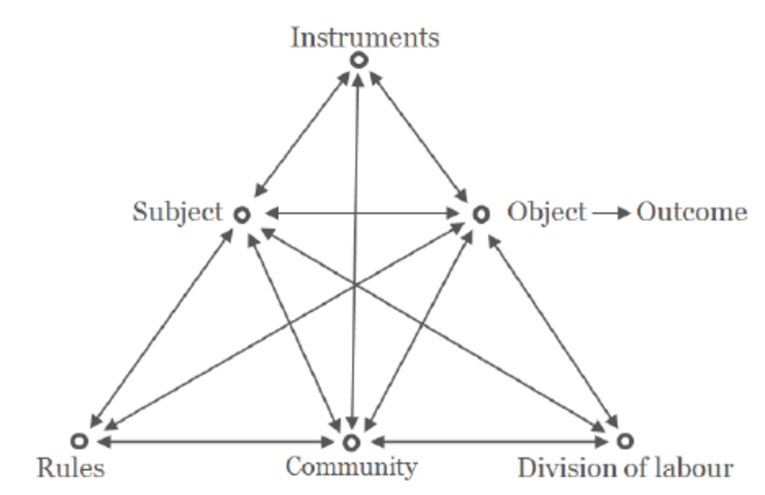
In All Edge, the Activity System model serves as the conceptual foundation for analyzing how adhocracies organize their activity. The three objectives that govern a NEF's activity network — front-stage performance, project, and collaboration — are intelligible as objects of distinct but interconnected activity systems: the front-stage performance belongs to one activity system (the long-term identity of the firm), while the project belongs to another (the short-term adhocracy), and their coordination requirements generate the systemic contradictions that drive the network's development.
The Activity System model also provides the vocabulary for the four-type typology introduced in Spinuzzi's 2014 paper. Each of the four types — Hierarchies, Markets, Clans, and Networks — describes a different configuration of how the object of activity is defined and where that definition is located. In Hierarchies, the object is defined explicitly within the division of labor; in Markets, explicitly outside it; in Clans, tacitly within; in Networks, tacitly outside. The typology uses the AS's structural vocabulary — object, division of labor — to map the terrain of organizational diversity that the AS alone cannot see.
This is the characteristic move of the Activity System model in Spinuzzi's work: it provides the conceptual anchors — object, contradiction, division of labor — that make the network visible and analyzable. The model does not describe the network directly; it describes the activity systems that compose the network, and the contradictions among them that give the network its shape and dynamic.
4.2 The Limitations of the Activity System Model
The Activity System model excels at capturing the dynamics of bounded collective activities with a shared and durable object. But as Guile and Spinuzzi's 2023 paper demonstrates, it faces genuine limits when confronted with projectified work.
The AS presumes a relatively stable relationship among subjects and object: a relatively stable set of subjects cyclically transforms the work object as they collaborate to achieve a regular outcome. This assumption is embedded in Engeström's interventionist methodology, the Change Laboratory, which works with representative stakeholders of a relatively independent pilot unit in a large organization — people who are continuously involved and who share a recognized institutional object. The first step in the expansive learning process is "questioning the existing practice" — a step that presupposes an existing practice to be questioned, a stabilized division of labor to be rethought, and a continuously involved community that can supply representative stakeholders.
These conditions rarely obtain in projectified work. In project work, the object itself is in the process of being formulated and deliberated by a fluctuating assemblage of actors; it is defined by its funding and the emerging collaboration across specialists over the course of a given project. The relation between subject and object is contingently stabilized and there may be little agreement about it across actors. Many of these vital actors disengage at the end of the process rather than continuing to engage in the new practice, as is presumed in Engeström's cycle of expansive learning.
Guile and Spinuzzi identify two specific dynamic relationships that the AS does not capture: the relationship between funding and forms of working and learning, and the implications of the extended temporal dimension of temporary work. These are not peripheral concerns — they are constitutive features of projectified work. A project team only exists because funding has been secured; and the temporal dimension of projectified work — specialists cycling in and out across extended periods, each contributing fractionally — produces patterns of engagement that are genuinely different from the cyclic transformation of a durable object by a stable community.
Engeström himself recognized this difficulty. His concept of knotworking — "a temporal and spatial trajectory of successive task-oriented combinations of people and artifacts" — was developed precisely to address cases of fluid temporary coordination. Yet knotworking cases in practice remained anchored in bounded institutional contexts with agreed-upon objects and existing funding. His later attempt to preserve the AS through the concept of mycorrhizae — postulating hidden formations that coordinate historically separate, bounded activities beneath seemingly unbound activities — only reinforced the boundary structure the AS required. As Engeström himself acknowledged in 2009: "In social production and peer production, the boundaries and structures of activity systems seem to fade away."
The limitation is not a failure of the AS — it is a feature of its design. The AS was built to analyze bounded collective activity with a durable shared object. Projectified work is something else: temporary, fractional, entrepreneurially assembled, and ontologically unsettled. What is needed is a different unit of analysis, built for these conditions.
4.3 Project Assemblage
The Project Assemblage corresponds to the understanding of project developed in 3.6 — project as fractional coherence. It is the unit of analysis that Guile and Spinuzzi developed to operationalize that concept, providing the analytical structure for capturing how a fractionally coherent object emerges, develops, and disperses through the work of a temporary assemblage of specialists. Where the Activity System model is anchored in a durable shared object cyclically transformed by a stable community, the Project Assemblage is anchored in an emerging, ontologically unsettled object episodically shaped by a fluctuating assemblage of specialists. The two models are not competitors — they address different kinds of social organization, each requiring its own unit of analysis.
The project assemblage encompasses why and how a project, its object of activity, and the team working on it emerge together. The project becomes the unit of analysis, bounded by the actors and mediators that engage in dialogic negotiations to enact its fractional object. Such negotiations happen throughout the life of the project, as actors and mediators enter, negotiate, collaborate, and exit at different times — stabilizing and transforming the fractional object at different points. This ebb and flow engenders fractional working and learning dynamics that the model captures through two stages.
The first stage is the dialogic cycle of cohering the fractional object, which moves through three phases. In the first phase — emergence and funding — an emerging project draws on diverse specializations and actors with a successful track record, establishing the contractual or entrepreneurial basis for the assemblage. In the second phase — assembly of expertise — actors are brought into contact to address the funding opportunity, each engaging fractionally based on their specialization. In the third phase — proliferation of links — each specialist contributes based on their own specialty, proliferating links for the project and passing the baton as they complete their contributions. Each specialist understands the project's fractional object in terms of their own specialty, meaning that the object is only relatively coherent — but it becomes more coherent as these efforts are meshed, often repeatedly drawing in different expertise.
The second stage is the sufficient coherence of the fractional object, leading to the dispersal of the assembly of actors. When the fractional object coheres sufficiently, the project or a stage in the project is completed and the assemblage or elements of it disperse. The actors move on to other projects, taking with them what they have learned through their fractional engagement.
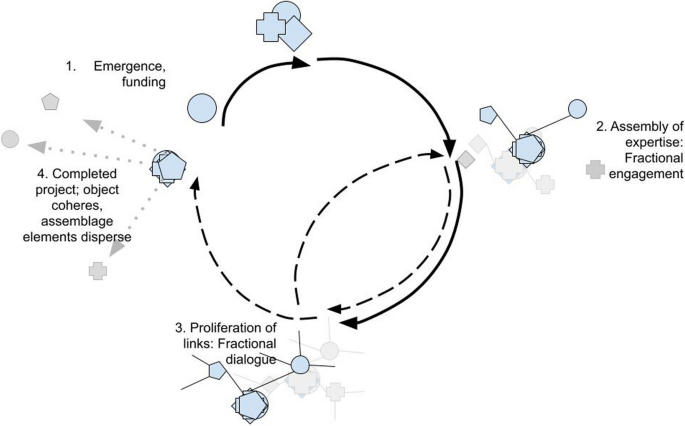
Two cases from Guile and Spinuzzi's research illustrate this cycle. In the entrepreneurship case, a technology startup founder navigated a series of intermittent engagements — with accelerator mentors, potential investors, contractors, and customer discovery interviews — each of which transformed the startup's object. The startup was co-created through ongoing dialogue with intermittent partners, necessarily emergent and incrementally revised to address tensions across actors' needs and desires. At some point, the fractional object stabilized sufficiently for the assembly to enter an execution phase — the founder and chosen partners producing a specific, relatively coherent technology that could be reliably deployed in a specific market.
In the client-facing interprofessional project team case, construction professionals from different firms assembled around a tender, each contributing based on their specialization and passing the baton as their phase of work was completed. The project's object — the redesign of a building — remained fractionally coherent throughout: coherent enough to anchor the team's work, incoherent enough that each specialization could shape it from its own angle. Members of the team had to learn afresh in each project how to resolve dilemmas, listen to new colleagues, and anticipate the implications of their discussions for the work of actors not yet present.
The Project Assemblage model reveals aspects of vocational working and learning that the Activity System model cannot easily address. In the AS, learning is understood as the transformation of an existing practice through the resolution of contradictions — a dialectical process oriented toward a new and more acceptable practice. In the Project Assemblage, learning is dialogical rather than dialectical: drawing meaning through difference rather than through an emerging unity. Actors simultaneously contribute to different phases of projectified work in different projects, learning how to attend to different conceptions of worth, and using emerging ideas as trading goods to dialogically renegotiate each project's object as it becomes relatively more coherent.
4.4 Translation Analysis
The Translation Analysis method corresponds to the understanding of project developed in 3.7 — project as grand project. Where the Activity System model and the Project Assemblage address the internal dynamics of projects at the Project level of the four-level hierarchy, Translation Analysis operates at the Network level: it traces how a grand project — an overarching, long-cycle theoretical commitment — is enacted, translated, and transformed as it moves across different domains over years or decades.
The method was developed by Spinuzzi in Triangles and Tribulations (2025) to analyze CHAT's historical development through the lens of ANT's sociology of translation. It attends to four elements: Domain, Project, Translations, and Trials.
Domain asks: in what field is CHAT deployed? As Spinuzzi's analysis shows, CHAT has been applied at various times to psychology, pedology, education, human-computer interaction, workplace learning, writing studies, organizational sociology, and public policy. These domains have different needs, different associational networks, and CHAT had to be translated to address each.
Project asks: what grand project did a key figure endorse when translating CHAT? That is, how did they articulate an endpoint within the domain — an objective that could secure the interest of others? As discussed in 3.7, this is not a single bounded undertaking but an overarching commitment: Vygotsky's New Soviet Human, Leontiev's supervised citizen, Engeström and Bødker's supermediator. Each of these grand projects drove a sustained program of theoretical and empirical work across years or decades.
Translations asks: how was CHAT altered in its uptake as it was applied to a domain in the service of a shared grand project? Spinuzzi examines three categories of translations consistently across all cases:
- Empirical focus: what scope of human interaction did CHAT investigate, and what methods did researchers draw upon?
- Mastery: what were human beings portrayed as mastering within that scope, and how was human agency portrayed?
- Mediators: what means were human beings portrayed as using in their attempts at mastery?
These three categories were developed by Spinuzzi specifically for the CHAT case. As he noted in our 2025 email exchange, the first two elements — Domain and Project — could be generalized beyond CHAT, but the three translation categories are more local to activity theory. They reflect the specific theoretical concerns that have governed CHAT's development: the scope of empirical investigation, the understanding of human agency, and the role of mediating artifacts.
Trials asks: to what challenges was CHAT subjected, and what were the results? Trials include both theoretical objections from within and outside the tradition, and empirical tests of whether the translated framework could do the work it claimed to do. Some settlements weathered their trials successfully — Leontiev's activity theory survived the political conditions of the post-Terror period; Engeström's activity system model proliferated across dozens of countries. Others did not — Vygotsky's Marxist psychology did not survive the Great Terror.
Taken together, the four elements of Translation Analysis give the Network level of Spinuzzi's framework its diachronic dimension. Where the Activity System model and the Project Assemblage analyze what happens within and around a project at a given moment, Translation Analysis traces how a grand project moves through time — how it is articulated, translated, tested, and either transformed into an enduring object or left in the file drawers.
4.5 The Weave-the-Theory Framework: A Meta-level Analysis
The Weave-the-Theory framework is a model for understanding how theoretical work develops — not what it concludes, but how it moves. It proposes that theoretical development always involves two simultaneous lines of movement: a Creativity Line, which proliferates outward, and a Curativity Line, which unifies inward. These two lines intersect at four weave-points that mark the key moments of transformation in any theoretical enterprise.
For the purposes of case analysis, the framework identifies four types of knowledge elements corresponding to the four weave-points:
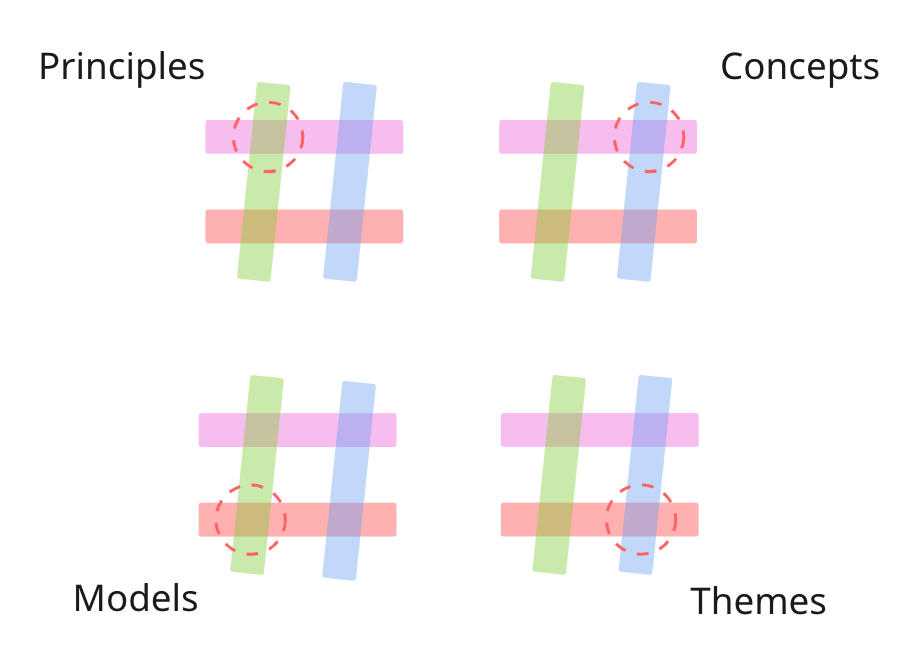
- Themes: lived, practiced inhabitations of an idea — the texture of experience that gives a concept its reality before it has been fully named or theorized. A Theme is a thematic space that has been opened and can now attract further elements.
- Models: structural maps of how a practice or phenomenon unfolds — the internal dynamic made visible through diagrams, frameworks, and analytical tools.
- Concepts: precisely defined theoretical propositions, grounded in prior intellectual traditions. A Concept does something specific — it resolves a tension, bridges two traditions, or stakes out a position within a wider field.
- Principles: the governing insights that unify the whole — the most abstract claims a development earns the right to make. A Principle is not a portable abstraction but something inseparable from the history that produced it.
One of the distinctive features of the Weave-the-Theory framework is its scalability. It can be applied at different scales of analysis without changing its basic structure.
At the smallest scale, it can analyze a single period of a creator's work — a specific project or a short creative episode, tracing how a Theme crystallized into a Model or how a Concept emerged from a particular encounter. At a larger scale, it can analyze the full arc of a creator's theoretical enterprise across years or decades — as in the case studies of Curativity, AAS, and the Life-as-Activity Approach in the Weave-the-Theory series, each tracing how a long-cycle development moved through its four weave-points over time. At the largest scale, it can analyze an entire theoretical tradition — as in the companion article Revisiting the Genidentity of Activity Theory, which applied the framework to Activity Theory as a collective enterprise spanning nearly a century of development.
The present application occupies an intermediate scale: it analyzes one contributor's sustained engagement with a set of theoretical problems across approximately two decades of empirical and theoretical work. The four weave-points — Principle, Themes, Models, Concept — are identified not within a single project but across a body of work, and the Concept that emerges is not one that Spinuzzi himself articulated but one that the curation of his work makes available. This is the curatorial mode of the Weave-the-Theory framework: using the four weave-points not to describe what a creator consciously developed, but to make visible the structure that their accumulated work contains.
Applied to Spinuzzi's work as analyzed in Parts 3 and 4, the four weave-points map as follows:
Principle: The four-level hierarchy — Operations / Actions / Project / Network — established in 3.1 is the governing analytical principle of this case study. It is not Spinuzzi's own explicit framework; it is the structural logic that this article proposes as the organizing principle beneath his accumulated empirical and theoretical work. As a Principle, it makes the most abstract claim the analysis can earn the right to make: that Spinuzzi's work, across two decades, has been systematically exploring the four levels of a hierarchy whose structure was never fully articulated in a single place.
Themes: The three understandings of project developed in Part 3 — project as objective of activity, project as fractional coherence, and project as grand project — each constitute a Theme. Each names a thematic space that Spinuzzi's work has opened and inhabited, attracting further empirical and theoretical work. They are not yet a unified Concept; they are three distinct angles of approach to the same phenomenon, each revealing a dimension the others cannot fully address.
Models: The three models examined in Part 4 — the Activity System model, the Project Assemblage, and the Translation Analysis method — each constitute a Model in the Weave-the-Theory sense. Each provides a structural map for a specific kind of analytical work: the AS for bounded collective activity, the Project Assemblage for fractional projectified work, and Translation Analysis for the diachronic movement of grand projects across domains and generations.
Concept: The Network of Projects is the Concept that this article proposes as the unifying theoretical proposition that the accumulated Themes and Models earn the right to make. It is not a term Spinuzzi himself uses — it is a curatorial act, a naming of what the four-level hierarchy, the three thematic understandings, and the three models, taken together, point toward. A network of projects is not simply a collection of projects; it is a structured landscape in which projects of different kinds — short-term undertakings, fractionally coherent assemblages, grand theoretical enterprises — coexist at different levels of the hierarchy, connected through the terrain vocabulary that Spinuzzi's work has progressively developed.
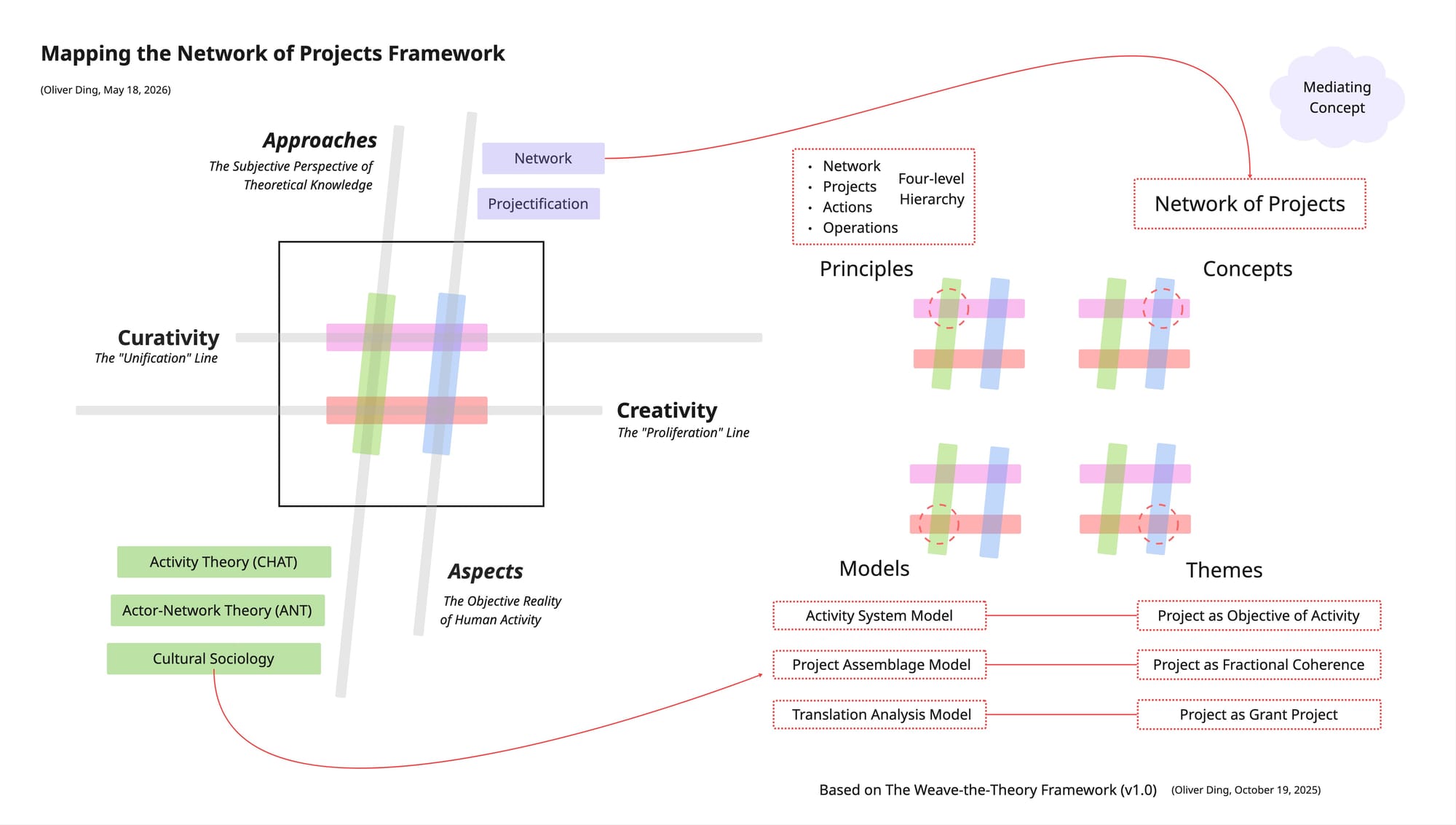
The Weave-the-Theory analysis reveals something that the case study's sequential presentation — moving from Part 3 to Part 4 — might obscure. The development was not linear. The Themes did not precede the Models in a clean sequence; they developed alongside each other, each empirical encounter generating both a new thematic understanding and a new analytical tool. The Principle — the four-level hierarchy — was not present from the beginning as a governing framework; it became visible only retrospectively, as the accumulated work created the conditions for recognizing the structure that had been implicit all along. And the Concept — Network of Projects — is not the culmination of a planned theoretical program; it is the name that becomes available when enough of the territory has been mapped to see what the whole landscape looks like.
This is what the Weave-the-Theory framework is for: not to impose a predetermined structure on theoretical development, but to make visible the structure that was already there — waiting to be recognized.
Part 5: Engaging with Network of Projects
The three cases documented in this part span 2017 to 2026 — nearly a decade of engagement with Spinuzzi's work, at different scales, in different contexts, and toward different purposes. Together they demonstrate what a theoretical tradition's knowledge ecology actually looks like from inside it: not a systematic curriculum in which contributors learn the tradition's core concepts and then apply them, but an opportunistic landscape of action opportunities that practitioners actualize when — and only when — the theoretical resources connect with a live problem they are working on.
5.1 Case Study: Andmind Group (2017)
In 2015, I discovered Spinuzzi's paper "Toward a Typology of Activities" while searching for typologies that could connect Activity Theory's analytical vocabulary with practical design work. The four-type matrix — Hierarchies, Markets, Clans, Networks — was immediately useful as a heuristic: a way of naming the different kinds of activities that coexist in a complex enterprise, and of characterizing the contradictions that arise when activities of different types are brought into contact.
In September 2017, I applied this typology to a strategic development discussion with Mr. Seldon, the founder of Andmind Group — a knowledge-centered enterprise that had grown across four quadrants simultaneously: Andmind Social Media Group (Network), Andmind Company (Hierarchy), Seldon's Club (Clan), and various publication and event programs (Market). The activities were distributed widely, and the internal contradictions among them were generating the kind of instability that often precedes a strategic decision.
Using the typology as a heuristic, I proposed a simple decision framework: reduce the scope to two quadrants. This generated six possible strategic directions — Political Group (Clans + Hierarchies), Technological Platform (Networks + Markets), Traditional Business (Hierarchies + Markets), Communities of Practice (Clans + Networks), Family Gang (Clans + Markets), Social Enterprise (Networks + Hierarchies) — each with its own internal logic, its own relationship to Seldon's personal enterprise, and its own implications for what the organization would need to become.
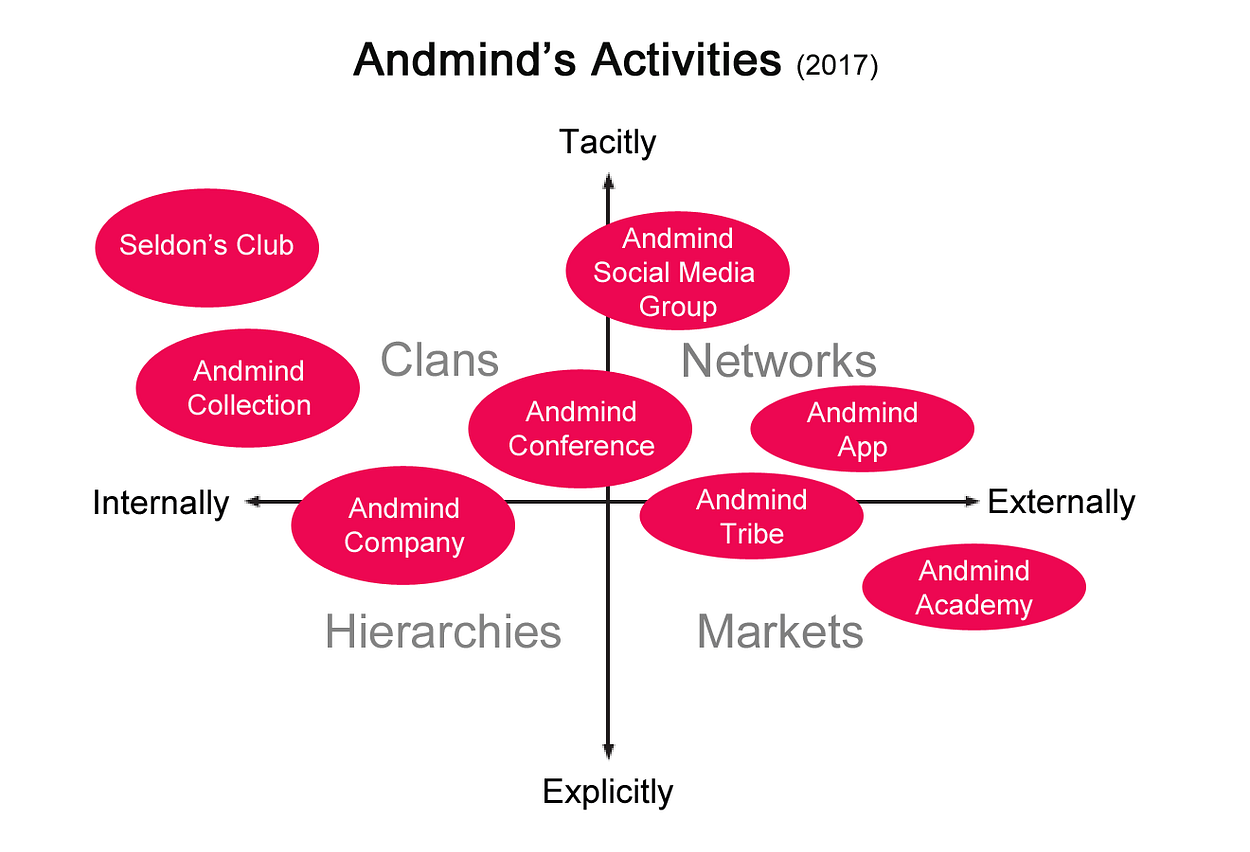
The typology was not applied as Activity Theory — it was applied as a heuristic tool for strategic thinking. I was not analyzing Andmind Group as an activity system, or locating its contradictions within the full apparatus of CHAT. I was using the four-type terrain map to make the organization's distributed activities visible as distinct types, and to generate possible futures by asking which combinations of types the organization could coherently inhabit.
This is the first-wave supportance mode: an analytical tool from the tradition is taken up and applied to an empirical domain for practical purposes. The theoretical pedigree is present but not foregrounded; the tool does its work in the practitioner's hands, independent of the tradition that produced it.
5.2 A Case Study of "Social Moves" (2023)
In September 2023, I was developing the Activity Analysis & Intervention (AAI) project. While drafting a visual note about the AAI model's social implications, a sudden recognition occurred: the AAI model could be extended into a rough theory of Social Moves.
The key move was combining two frameworks: Spinuzzi's four-type activity typology and my own Activity Circle model — the basic social structure of Self, Other, Thing, Think. Each of the seven roles in a Psychological Counseling Platform (Influencer, Supporter, Founder, Supervisor, Counselor, Client, Follower) could be understood as an Activity Circle, occupying a specific position in the social landscape. And the social landscape itself could be mapped using the four-type terrain: each Activity Circle is located within a social zone — Clan, Hierarchy, Market, or Network — that governs the kind of activity and the kind of engagement appropriate to it.
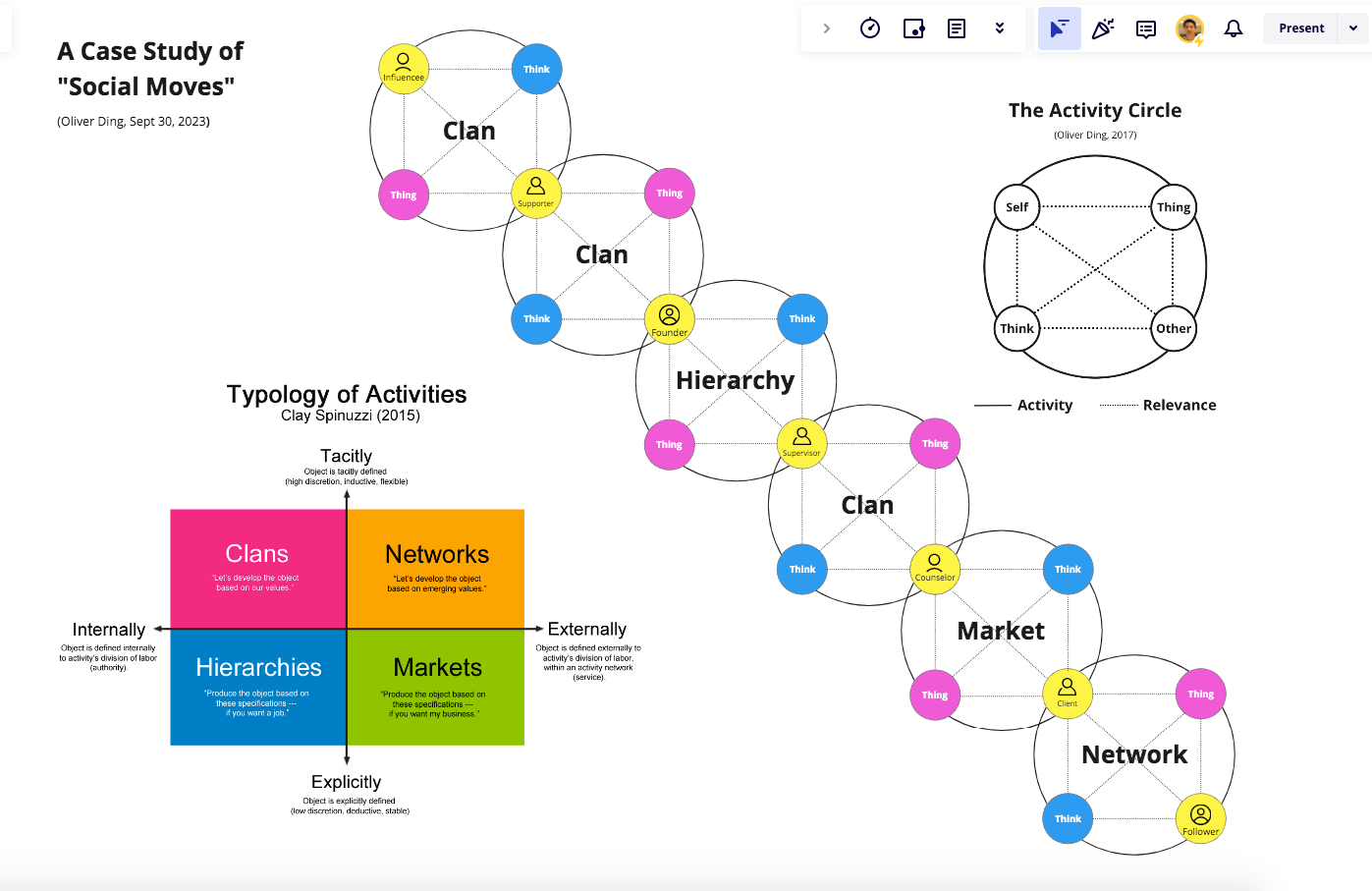
The resulting insight: people's social life can be understood as moving between different types of Activity Circles and Anticipatory Activity Systems. Good mindsets guide productive moves across the terrain; poor mindsets produce unsuccessful moves that generate negative experiences.
This is not a straightforward application of either the Activity Circle model or Spinuzzi's typology. It is a synthesis — a new analytical structure that uses the typology as the terrain map within which the Activity Circle model operates. The typology names the zones of the landscape; the Activity Circle and the AAS are models — they describe the internal structure of the activity that inhabits each zone. The two frameworks work together precisely because they operate at different levels: terrain and model are complementary, not competing.
5.3 The Frame-for-Work Canvas and the Milieu–Mediator–Method–Mastery Schema (2025)
In August 2025, while reading Triangles and Tribulations, I wrote to Spinuzzi about his translation analysis method. His three categories of translations — Empirical Focus, Mastery, Mediators — were clearly productive for the CHAT case; the question I brought to our exchange was whether they could be generalized to other knowledge enterprises.
Spinuzzi's response was precise: the first two elements of the translation analysis (Domain and Project) could be generalized beyond the CHAT case, but the three translation categories (Empirical Focus, Mastery, Mediators) were more local to Activity Theory. He also suggested reading Latour's "Drawing Things Together" for a broader discussion of representations and what they do.
From this exchange, I developed my own schema for the Frame-for-Work project: Milieu–Mediator–Method–Mastery. The modifications were deliberate. I replaced Empirical Focus with Milieu — a broader term that could cover more than empirical research settings, encompassing the full social and cultural environment within which a framework is deployed. I added Method to create a conceptual link between Mastery (the human capacities being developed) and Mediators (the means through which those capacities are exercised). The result was a four-element schema that retained the analytical spirit of Spinuzzi's categories while becoming more general and more closely aligned with the Frame-for-Work project's concerns.
This schema is a mediating concept in the precise sense: it sits at the intersection of ANT's translation vocabulary and my own framework development practice, doing work that neither alone could accomplish. Spinuzzi's original categories were built for analyzing a theoretical tradition's historical development; the Milieu–Mediator–Method–Mastery schema was built for analyzing how any cultural framework is deployed, learned, and mastered in practice. The genealogy is traceable, but the new schema has its own analytical identity.
5.4 A Knowledge Center in the Making
The three cases traced in this part span nearly a decade of engagement with Spinuzzi's work — from 2017 to 2025, across different contexts, different scales, and different modes of engagement. In each case, Spinuzzi's accumulated body of work provided a structured landscape of action opportunities: a typology for strategic thinking, a terrain vocabulary for social analysis, a translation method that opened new questions about framework deployment. These are three different forms of supportance — each actualized differently, each producing a different kind of outcome.
These three engagements also represent a specific kind of creative dialogue: between empirical research and the application of its outcomes. Viewed through the Knowledge Discovery Canvas, this is a dialogue between the END area — Spinuzzi's empirical studies of workplace communication, knowledge work, and projectified organizations — and the MEANS area — the analytical tools, typologies, and methods that his research produced and that practitioners like myself have drawn upon. This kind of END–MEANS dialogue is not incidental; it is the mechanism through which a body of empirical work establishes its influence beyond its original research context.
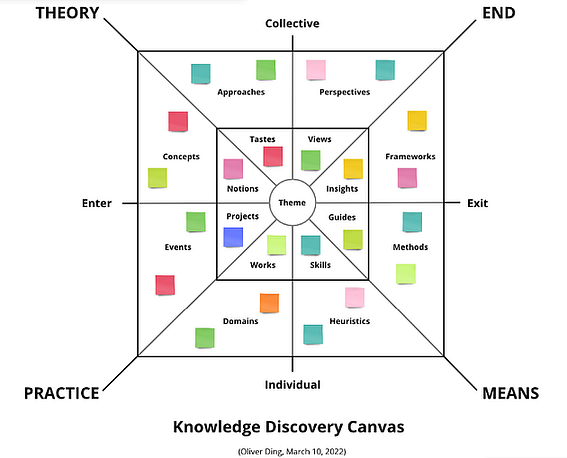
Taken together, they demonstrate that Spinuzzi's body of work has become a knowledge center capable of supporting the development of others — not only through direct application of his frameworks, but through the broader landscape of conceptual resources, analytical tools, and open questions that his two decades of empirical research and theoretical dialogue have produced. A knowledge center in the making: one whose influence continues to expand, whose terrain vocabulary continues to find new applications, and whose ongoing creative dialogue — with practitioners, with other theoretical traditions, and with the empirical world — ensures that it remains a living rather than a settled enterprise.
Postscript: Creative Dialogue and Generative Confluence
The third wave of Activity Theory's development since 2000, as described in Weave the Theory: The Journey of Activity Theory and CHAT (Since 2000), is characterized by creative dialogue between Activity Theory and other independent theoretical traditions. Four cases were identified: Spinuzzi's dialogue between AT and ANT (6.1), Nunez's Critical Realist Activity Theory (6.2), Ma's Peirce-Vygotsky synergy (6.3), and Paavola's Trialogical Approach drawing on Peircean Pragmatism (6.4).
Placed within the broader landscape of Activity Theory's knowledge ecology, Spinuzzi's contribution occupies a distinctive position. Engeström's Finnish school deepened the tradition's model vocabulary: expansive learning, developmental work research, the Change Laboratory. Nardi's contribution was of a different kind — making the tradition's model vocabulary accessible across disciplinary terrains it had not previously inhabited, establishing a stable institutional presence in North America and in HCI. Spinuzzi's contribution is different again: not deepening the models, not transmitting them to new communities, but expanding the terrain vocabulary itself — giving the tradition new maps for the organizational and network landscapes that knowledge work increasingly inhabits. And doing so not through a deliberate program of theoretical development, but through the accumulated by-products of two decades of empirical fidelity.
But not all creative dialogues produce the same kind of outcome. A dialogue between two theoretical traditions may generate new frameworks, new methods, or new analytical vocabulary — mediating concepts that sit at the intersection of the two traditions and do work that neither could do alone. This is valuable. But it is not always sufficient to establish a distinctive knowledge niche — a new conceptual territory with its own identity, its own problems, and its own developmental trajectory.
Spinuzzi's case is distinctive precisely because it did establish such a niche. And looking more closely at the structure of his engagement, what emerges is not simply a dialogue between two traditions but something more complex: a Generative Confluence of three theoretical resources — Activity Theory, Actor-Network Theory, and the cultural sociology of Boltanski and Thévénot's "conceptions of worth," which enters explicitly in the 2023 paper with Guile.
The concept of Generative Confluence was developed in my Creative Life Theory to describe a pattern in which ideas inspired by distinct theoretical approaches evolve from separate into interconnected, generating a new center for a brand-new possible theoretical enterprise. Unlike traditional confluence in geography, where streams merge and lose their individual identities, Generative Confluence describes a pattern where the original theoretical approaches still keep their developmental trajectories — they are not absorbed into the new center, but they make it possible.
In Spinuzzi's case, the three theoretical streams maintained their independence across decades of his work:
- Activity Theory continued to provide the developmental, historical account of networked activity — the weaving dimension, the contradiction-driven transformation of activity systems
- Actor-Network Theory continued to provide the political-rhetorical account of how networks are assembled and maintained — the splicing dimension, the translation of interests across heterogeneous actors
- Cultural sociology (Boltanski and Thévénot) provided the account of how different conceptions of worth are negotiated within project teams — the dialogical dimension of fractional coherence
Each stream retained its own vocabulary, its own problems, its own developmental logic. But at the point where the three streams converged — in the analysis of projectified work — something new emerged that none of the three streams alone could have generated: the Network of Projects framework, with its four-level hierarchy, its three understandings of project, and its three corresponding models.
This is why the Network of Projects establishes a genuine knowledge niche rather than simply extending one of its source traditions. It is anchored in two Aspects — projectification and network — that belong to the world, not to any particular theoretical Approach. And it was produced not by a single dialogue between two traditions, but by the slow convergence of three streams across more than two decades of empirical research.
The theoretical implication is worth stating directly: the third wave of a tradition's development may produce not only mediating concepts but, in some cases, a Generative Confluence — a new theoretical center that emerges from the sustained interaction of multiple streams, and that has the potential to grow into an independent enterprise. Whether two streams are sufficient for confluence, or whether three or more are required, is itself an open question. Spinuzzi's case suggests that the key condition is not the number of streams but the presence of a genuine Aspect — an objective feature of human activity — at the point of convergence.
v1.0 - May 17, 2026 - 13,935 words