
From Personal Epistemology to Knowledge Ecology

Oliver Ding
May 14, 2026
This is the Postscript of a new possible book: Weave the Theory: The Art of Theoretical Activity and Knowledge Ecology
This book occupies an unusual position in my creative life. It is simultaneously a work of analytical practice — applying a set of frameworks to a set of cases — and a work of personal epistemological development. The Art of Theoretical Activity, as this book's subtitle names it, encompasses both dimensions: the study of how theoretical traditions develop and sustain themselves as collective enterprises, and the study of how an individual builds, sustains, and transforms their own knowledge ecology over time. What makes this book unusual is that it does not treat these two dimensions as separate concerns. It holds them together — using the same analytical vocabulary to describe Activity Theory's hundred-year development and a single creator's fifteen-year theoretical journey, and finding in both the same structural patterns: Create, Curate, Weave; Creativity Line, Curativity Line; Theme, Model, Concept, Principle.
This integration — across scales, from the individual to the collective — is what I mean by "unlocking the gap between individual micro and collective macro." The Weave-the-Theory framework does not simply apply the same labels to different sizes of object. It demonstrates that the same structural dynamic — the ongoing tension between proliferation and unification, between creating and curating — operates at every scale at which theoretical activity occurs. A single creator developing a framework over a decade, and a tradition developing across generations of contributors: the movement is the same. The vocabulary that describes one also describes the other.
A Long-Standing Interest
My interest in the philosophy of science and the epistemological development of creative individuals has been present for a long time. In 2017, I wrote a series of articles on "the landscape of personal epistemology" — early attempts to discuss the relationship between knowledge and personal development. Later, I introduced "personal epistemological framework" as a specific type of knowledge framework. In the 2025 book draft The Curativity of Mind, I used the term "mental platform" to name a similar idea.
This sustained interest took a new direction in 2023, when I was studying the creative life of Hong Kong sociological theorist Ping-keung Lui. What I found in Lui's work was not primarily a theory about social life, but a theory about theory — a sustained philosophical engagement with what it means to construct a theoretical sociology, what distinguishes a theoretical sociology from other kinds of social scientific work. Lui's theoretical sociology was born precisely in the dialogue between philosophy of science and sociology.
This encounter generated the concept of Theoretical Platform — a theoretical enterprise that has reached sufficient maturity to actively support the work of others. At the time, the concept was primarily structural and synchronic. Over the subsequent two years, through the development of the Weave knowledge system and the writing of the case studies in this book, it was joined by Theoretical Enterprise and Theoretical Activity — giving the conceptual cluster its full analytical scope.
These three concepts together constitute what I consider my own distinctive contribution to the knowledge ecology direction: not a theory about social life, but a theory about theoretical activity and the knowledge ecologies it produces and inhabits.
The Research Method
Readers of this book will notice that it makes extensive use of my own creative history as empirical material — using my own past projects, their outcomes, and the frameworks they generated as the primary data for case analysis. This is not accidental. It is a methodological commitment that has been developing since 2022, when the Slow Cognition project introduced a sustained practice of using lived history as empirical data for cognitive and epistemological research.
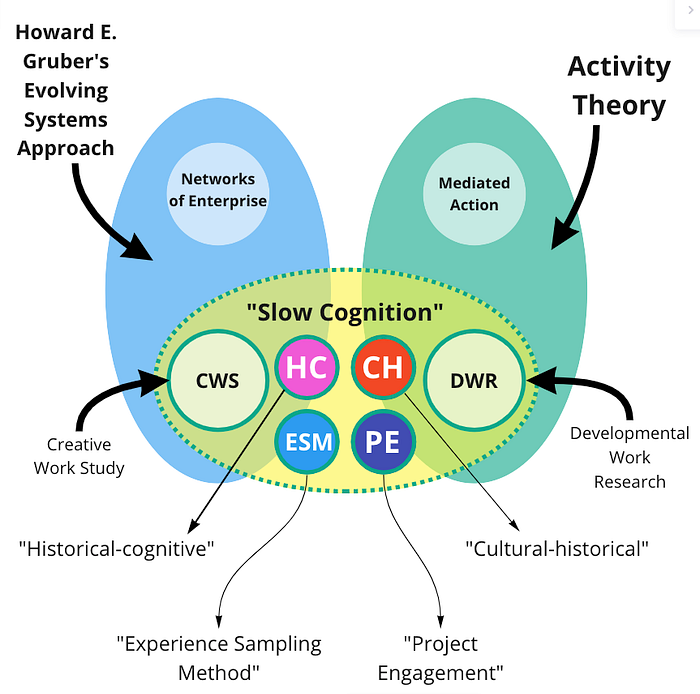
The method draws on several intellectual sources. Howard E. Gruber's Evolving Systems Approach — which uses Task, Project, Enterprise, and Networks of Enterprise as a structure for understanding a creative person's work — provides the unit-of-analysis framework. Furthermore, his historical-cognitive method combins historical research with cognitive analysis — provides the methodological precedent for treating historical documents (articles, notes, emails, diagrams) as primary data for creative work research.Vygotsky's lifespan perspective on creativity and development provides the theoretical orientation: creativity is not a single act but a long-term process of self-transformation through engagement with cultural tools and social environments.
The Wonder and Wander project (2025) gave this method its most explicit formulation. As I described in its introduction:
The method combines Empirical Study, the Creative Life Curation Method, Historical-cognitive Research, Multiple-theme Reflection, and Framework Development. The research draws upon articles, notes, emails, and diagrams as empirical data derived from lived history — primarily sourced from published materials and documented notes created prior to the project's inception. Distinguishing itself from traditional biographic research, the approach treats real-life experience as a primary resource guided by the principle of Multiple-Theme Reflection: multiple themes are investigated simultaneously, each with its own data, temporal boundaries, and analytical framework. A central feature is Framework Development: the research process consistently generates new frameworks as outcomes, often exceeding the project's original scope in ways that are treated as features rather than deviations.
The present book follows this same method. The "Grand" theories and "Mini" theories cases in Parts 4 and 5 are historical-cognitive studies of my own theoretical enterprises — using past articles, situational notes, and documented creative events as empirical data. The Activity Theory cases in Part 3 are historical-cognitive studies of other creators' enterprises, using published works and documented career trajectories as data. In both cases, the analytical frameworks — Weave-the-Theory, Genidentity Analysis Method, Sandglass Model, Supportance Analysis — function as the interpretive lenses through which the historical data becomes analytically visible.
The Philosophy of Science and Its Limitations
The intellectual context for this book's ambitions is the philosophy of science — specifically, the tradition of philosophers who have attempted to describe how theoretical knowledge is built, developed, and transmitted across generations of contributors. Kuhn's paradigms, Lakatos's scientific research programmes, Chen Ruilin's theory versions — each has offered an account of how a theoretical tradition maintains its identity through change.
But this tradition has a limitation that has rarely been directly named. Almost without exception, the case studies that have driven philosophy of science have been drawn from the natural sciences. Kuhn's paradigm theory was built from the history of physics and chemistry. Lakatos developed his account of research programmes from the history of mathematics and physics. Chen Ruilin's theory versions framework, despite its ambitions toward generality, still uses Newton's theoretical development as its primary illustration. The philosophy of science has been, for most of its history, a philosophy of natural science.
Nancy J. Nersessian explicitly addressed this in 2015, co-editing Empirical Philosophy of Science: Introducing Qualitative Methods into Philosophy of Science. The volume argued that philosophers of science could and should use qualitative empirical methods — interviews, field observations, case studies — to study scientific practice rather than relying solely on introspective conceptual analysis. It was a significant methodological step: philosophy of science becoming genuinely empirical.
But even Nersessian's empirical work remained within the natural sciences. The case studies in that volume examined laboratory practices in biology, biomedical research, and related fields. The social sciences — with their different relationship to theory, their different criteria for theoretical success, and their fundamentally different structure as knowledge ecologies — remained largely outside the scope.
This gap matters. As Clay Spinuzzi observed in Triangles and Tribulations (2025), "theory" in the social sciences means something structurally different from theory in the natural sciences: not a scientifically established principle that supports predictive models, but "a big idea that organizes many other ideas with a high degree of explanatory power." Activity Theory itself, as Kaptelinin and Nardi have noted, "is a clarifying, orienting framework... It does not support creating and running predictive models which only need be 'fed' with appropriate data. Instead, it aims to help researchers and practitioners orientate themselves in complex real-life problems." A philosophy of science that takes only natural science theories as its cases cannot adequately describe this kind of theoretical tradition — its development, its identity, its coordination mechanism, its way of supporting the work of contributors across generations.
The analysis of Activity Theory in this book is, among other things, an attempt to address this gap. By applying the Weave-the-Theory toolkit — developed through individual theoretical enterprise cases — to the analysis of a social science theoretical tradition, the book demonstrates what an empirical philosophy of social science might look like: historical-cognitive in method, case-based in procedure, framework-developing in outcome.
Toward an Empirical Philosophy of Social Science
Looking back from 2026 across the long arc from 2017 to now — the individual epistemological landscape articles, the Slow Cognition project, the 2023 engagement with Lui's theoretical sociology, the development of the Weave knowledge system, and the sustained case studies of this book — I can see a direction that was always present but took years to become fully explicit.
The direction is toward what Nersessian and colleagues called an empirical philosophy of science — but extended from natural science to social science, and from professional scientific laboratories to the broader ecology of theoretical activity that includes individual creators developing personal knowledge ecologies alongside institutional traditions developing collective ones. The Art of Theoretical Activity, as this book's subtitle names it, is the study of this broader ecology: how knowledge is created, curated, and woven into coherent structures at every scale from a single creator's notebook to a century-long theoretical tradition.
The Weave 42 methodology, the Weave-the-Theory framework and toolkit, and the case studies in this book together provide a foundation for this empirical research program. They demonstrate that the structural patterns of theoretical activity — Create, Curate, Weave; Creativity Line, Curativity Line; Developmental Episode, Supportance, Creative Delta — are empirically visible across cases drawn from very different scales and contexts. They demonstrate that the same analytical vocabulary can describe an individual's fifteen-year journey and a tradition's hundred-year development. And they demonstrate that historical-cognitive methods — treating past creative work as empirical data, analyzing it through developing frameworks, generating new conceptual tools through the process of analysis — can produce genuinely cumulative theoretical knowledge.
The concepts of Theoretical Activity, Theoretical Enterprise, and Theoretical Platform are this book's most specific contribution to the knowledge ecology direction. They provide an analytical vocabulary for studying theoretical traditions as a special case of human creative activity — one that has its own structural features, its own developmental patterns, its own ways of supporting and being supported by the individual creators who engage with it. Together with the Supportance Analysis method, the Genidentity Analysis Method, and the Sandglass Model, they give the emerging field of empirical philosophy of social science a set of tools it did not previously have.
This is a small step. The cases in this book are drawn from a single tradition (Activity Theory) and a single creator's enterprise. The method needs more cases — from different traditions, different disciplines, different cultural contexts — before its full scope and limits can be established. The emerging concepts need more testing. The analytical vocabulary needs more refinement through use.
But small steps, made carefully and documented honestly, are how knowledge ecologies grow. This book is offered in that spirit: as a contribution to a research direction that is larger than any single book, and whose development will require the work of many contributors across many years — each perceiving and actualizing the supportances that this and other prior work has made available.
v1.0 — May 14, 2026 - 1,947 words