
Activity Analysis Network #17: Weave the Theory

This is the 17th issue of the Activity Analysis Center newsletter
by Oliver Ding
May 15, 2026
Hi, and welcome to Activity Analysis Network, a newsletter hosted by the Activity Analysis Center.
Each issue is organized around the "Flow - Focus - Center - Circle" schema, the primary model of the World of Activity Toolkit (v1, 2025).
As a biweekly newsletter, I share summaries of new articles from the Activity Analysis Center, along with updates on related activities, including some of my own published work elsewhere.
In this issue (#17), 7 new articles have been added to the site:
- #1 - Appropriating Activity Theory #17: The Art of Theoretical Activity
- #2 - Case Studies: Revisiting the Genidentity of Activity Theory
- #3 - Case Studies: Weave the Enterprise: Theoretical Platform and Theoretical Enterprise
- #4 - Case Studies: Weave the Theory: The Journey of Activity Theory and CHAT (Since 2000)
- #5 - Case Studies: Bonnie Nardi: Engaging with a Theoretical Tradition
- #6 - Concepts: One Center, Multi-voices, and Multi-moves
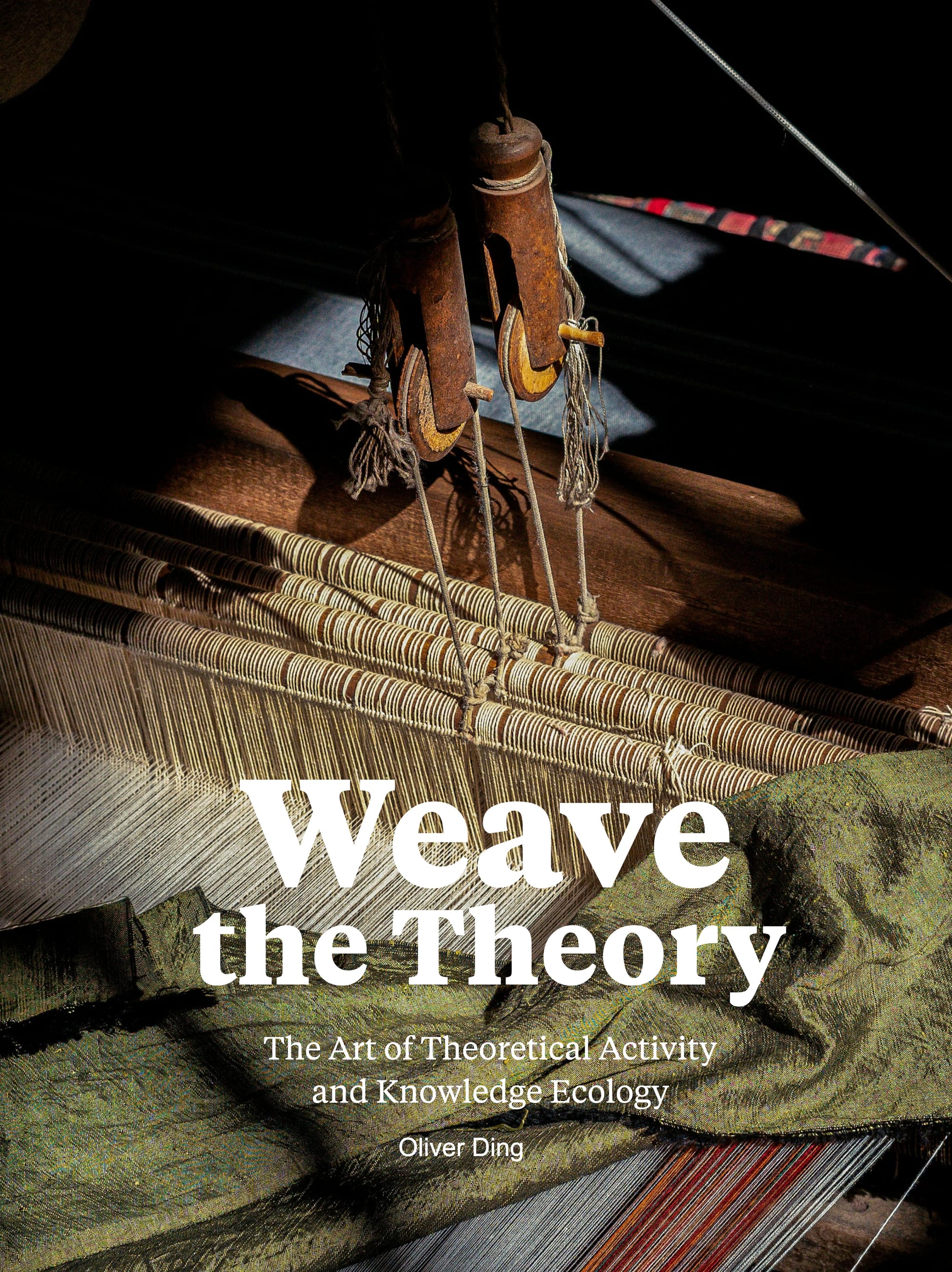
- #7 - Library: Weave the Theory (Possible Book, v1, 2026)
These articles represent an RR (Revisiting-Rebuilding) project. '
Last issue, I released the Weave the Life possible book. After that, I revisited the Genidentity of Activity Theory (2022) note and rebuilt it, using the Weave-the-Theory framework. The outcome is article #2.
This article further inspired me to revisit the Activity U series of articles I wrote in 2020. Eventually, I wrote a new series of articles about Activity Theory, this time treating it as a theoretical tradition and a theoretical platform.
Finally, these articles prompted me to detach Part 4 (Weave the Theory) from Weave the Life: The Life-as-Activity Approach (v4.0) and Personal Knowledge Ecology and edit a new possible book: Weave the Theroy.
What a beautiful movement in my journey of engaging with Activity Theory!
Flow
The historical development of the Activity Analysis Center and my experience of daily life
On May 30, 2022, I drew a diagram.
The left side of the diagram traces a lineage within Activity Theory: from Vygotsky's Mediated Action down to Engeström's Developmental Work Research (DWR) methodology. Its core concept is Activity System. The right side traces Howard Gruber's Evolving Systems Approach, structured as Task → Project → Enterprise → Networks of Enterprise. Two arrows converge at the center, pointing to an unnamed zone. I labeled it "The Slow Cognition Method."
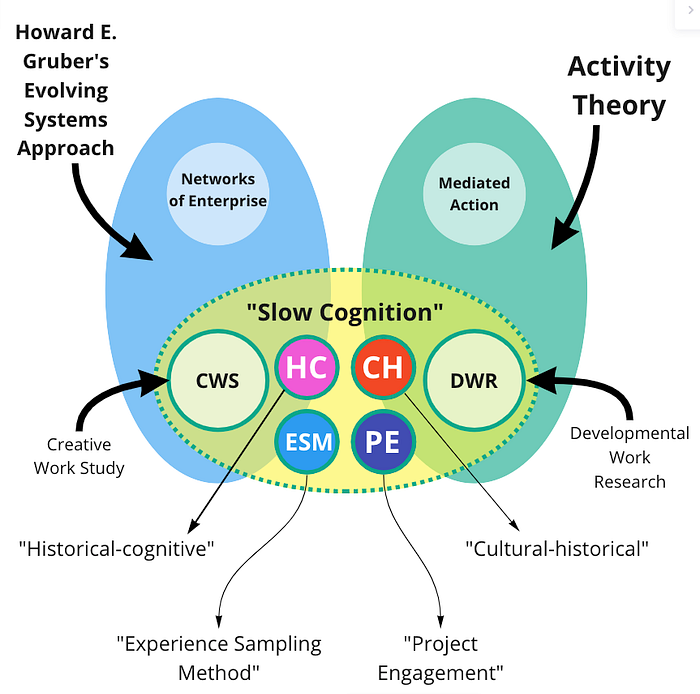
The diagram was born from a sentence I read that morning. In the preface to Creative People at Work, Gruber and Wallace wrote: "Our book is about how creative people do what they do." I realized immediately that the same sentence could be spoken by any empirically oriented Activity Theorist. "How…People do what they do" — this is the fundamental concern of Activity Theorists observing work practices in the wild.
It was a moment of recognition. Two traditions, speaking in different vocabularies, were looking at the same thing. Gruber spoke of Enterprise and Networks, tracing how a creative individual organizes and advances their work across a lifetime. Activity Theory spoke of Activity Systems and Mediated Action, tracing how human activity unfolds through tools and social contexts. The vocabularies differed, but their gaze pointed in the same direction: how human beings work creatively.
The story of "Slow Cognition" in my journey of engaging with Activity Theory is the primary theme of Appropriating Activity Theory #17: The Art of Theoretical Activity.
Focus
The Thematic Foci of the Activity Analysis Center
Over the past two weeks, I continously worked on the Theoretical Activity project.
Over the past few years, I have worked on connecting theory with practice and developing knowledge frameworks. Eventually, I also studied how theorists develop their theories. While theorists always deal with abstract ideas, what they do can be considered a type of activity. I call this special type of activity Theoretical Activity, which encompasses activities such as building theories, theoretical curation, theory integration, and theorizing. I also distinguish between the individual cognitive level of theoretical projects and the collective, collaborative level involved in building a theoretical enterprise. Both levels belong to Theoretical Activity.
On October 19, 2025, I applied the Weave Basic Form to develop the Weave-the-Theory Framework. Soon, it became a tool for studying Theoretical Activity.
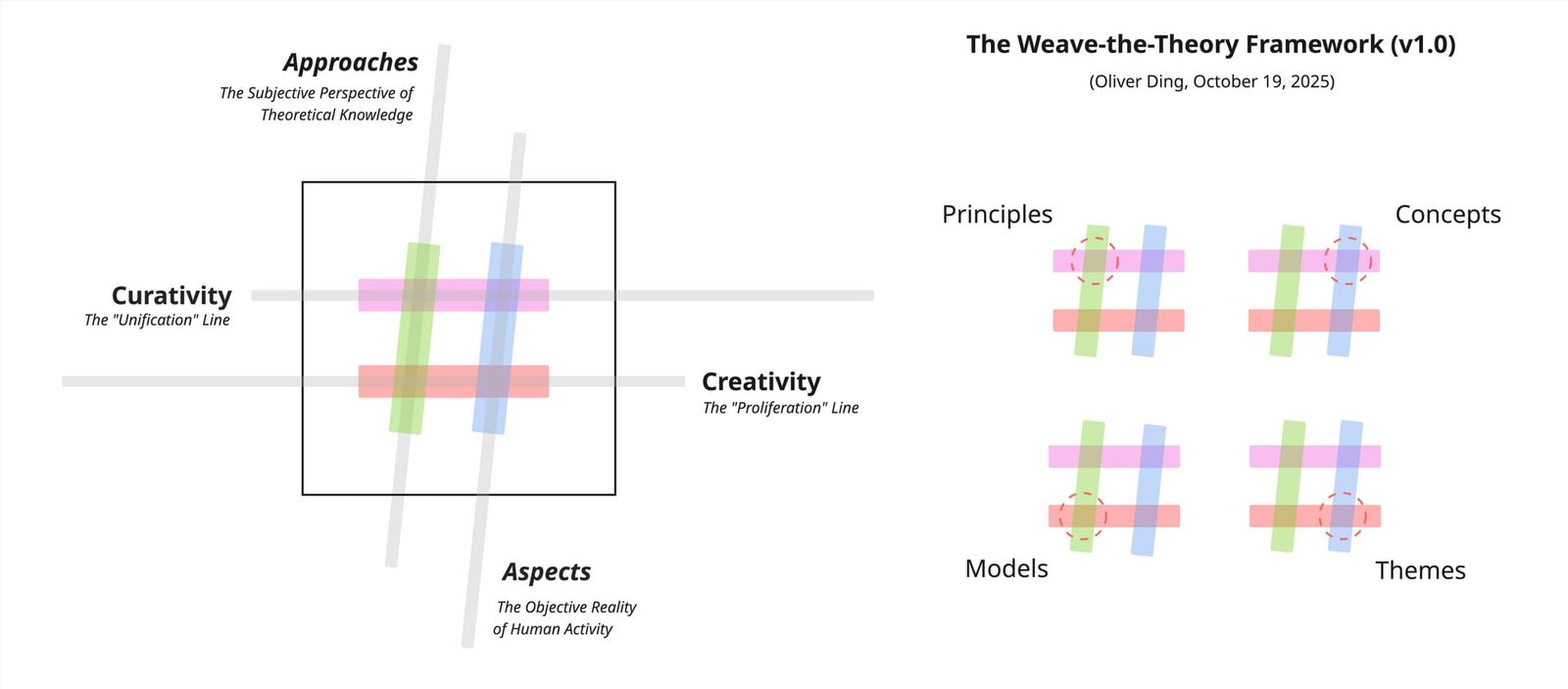
Weave the Life collected a series of case studies of Weave-the-Theory at invididual level. These case studies are all based on my personal experiences.
The recent new case studies, focusing on the Activity Theory tradition, move to the collective level.
In November 2024, I designed a new logo for the Activity Analysis Center.
The old logo, from 2022, was a red circle, symbolizing a meaningful whole: Activity. The new logo has two circles — one red, one blue.
The direct inspiration came from a sudden insight while sharing the basic model of Project-oriented Activity Theory with a friend. I suddenly saw a spatial mapping between that model and the AAI project: the lower layer is Activity, the higher layer is Knowledge. I was struck by the experience — it was the same kind of recognition as reading Gruber's preface in May 2022: not deliberate construction, but a sudden seeing.
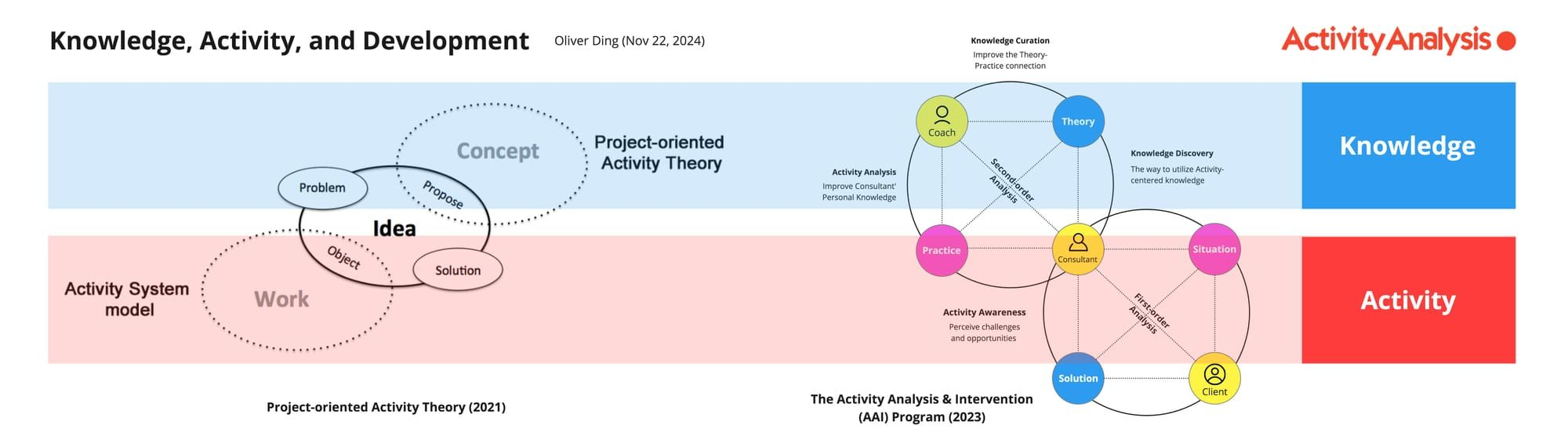
And when I place it alongside Weave the Theory, a more precise reading emerges: the red circle represents Activity Theory — the external theoretical tradition as an object of study; the blue circle represents Theoretical Activity — the internal creative work of engaging with theory.
Weave the Theory is precisely about the dialogue between these two circles. It is not a book "about Activity Theory." It is a book that demonstrates how Theoretical Activity operates — how I use the resources of Activity Theory to build analytical tools, and then use those tools to analyze the Activity Theory tradition itself. This entire recursive process is what the blue circle stands for: Theoretical Activity.
Center
The Core of the Activity Analysis Center
The Activity Analysis Center hosts two major theoretical enterprises:
- The Life-as-Activity Approach (including the Project Engagement Approach)
- The World of Activity Approach, now operating within a nested structure: World of Life (World of Activity).
The previous issue marked a significant milestone: The Life-as-Activity Approach was updated to v4.0. The new possible book, Weave the Theory, is the first concentrated case study testing of the approach at scale.
The testing runs in two directions. The Grand Theory cases (Curativity, AAS, LAA) demonstrate how individual theoretical enterprises develop through the Weave-the-Theory framework's four weave-points and two diachronic lines. The Mini Theory cases (Weave-the-Culture, RR, Creative Watershed) demonstrate the same framework operating at smaller scale and faster tempo. And the AT series demonstrates the framework operating at the largest scale yet attempted: a collective theoretical tradition developing across a century.
What the AT series reveals about LAA v4.0 is particularly significant. The Activity—Enterprise pairing, which was developed theoretically in Weave the Life, here receives its most demanding empirical test. In the AT case studies, Activity names the objective collective process of the tradition's development; Enterprise names the subjective trajectory of individual contributors — Engeström, Nardi, Spinuzzi — each building their own enterprise within and alongside the tradition. The Attachance mechanism describes how contributors move between thematic spaces: how Nardi detached from anthropology and attached to HCI and Activity Theory; how Spinuzzi moved from workplace research to ANT dialogue to historical sociology. The triadic structure that was abstract in Weave the Life is here made analytically concrete, case by case.
The AT case studies also display the diversity of Activity Theory's knowledge ecology — what different modes of engagement with the same theoretical tradition look like when examined closely. Engeström's pattern is social and systemic, strong across all four areas of the KDC. Nardi's pattern is curatorial and network-building, with a distinctive second-founding contribution on the Curativity Line. Spinuzzi's pattern is dialogical, operating through sustained third-wave encounters with ANT that produced mediating concepts neither tradition could have generated alone. The diversity is not incidental. It is what a living knowledge ecology looks like from the inside: many contributors, many modes of engagement, many supportances actualized — all organized around a shared Meta-framework whose coordination mechanism has remained consistent across a century of otherwise radical change.
Circle
The Context of the Activity Analysis Center
Over the past several years, I worked on several theoretical projects, such as the Ecological Practice Approach, Curativity Theory, Creative Life Theory, and Thematic Space Theory.
Inspired by creativity researcher Howard Gruber's idea of "Network of Enterprises," I used the "Knowledge Center" approach to manage this large knowledge system. Each knowledge center hosts one or two related theoretical approaches.
- CALL (Creative Action Learning Lab): the Ecological Practice Approach and Creative Life Theory
- Curativity Center: Curativity Theory
- TALE (Thematic Analysis Learning Engagement): Thematic Space Theory
- Frame for Work: A theory about Knowledge Frameworks
Now we can see this networked knowledge centers as a special form of knowledge ecology.
In April 2026, while working on the Weave-the-Theory cases and editing the Weave the Life book, the organizing concept finally arrived: Personal Knowledge Ecology. As the Weave the Life introduction states, this concept expands the earlier focus on tacit knowledge and concept-centered engagement to encompass the individual's full social interactions — collaborative projects and activity systems — as essential contexts for cognitive development. The tools I have designed — knowledge maps, canvases, frameworks — are themselves integral parts of this ecology, not merely instruments for studying it.
The three possible books form a trilogy in retrospect:
- Knowledge Discovery (2022) — the individual cognitive level: developing tacit knowledge through thematic space engagement
- Castle and Forest (2025) — the landscape level: the broader ecosystem of concept-related knowledge activities
- Weave the Theory (2026) — the ecology level: how theoretical activity builds, sustains, and transforms knowledge ecologies across different scales
The release of Weave the Theroy marks the moment when the knowledge engagement exploration reaches the knowledge ecology stage. What had been implicit across years of canvas design, framework development, and case study writing is now named and organized: the work is about how people — individually and collectively — build and sustain their knowledge ecologies over time.
The AT case studies in Part 3 contribute a specific dimension to this theme: a theoretical tradition is a particular form of knowledge ecology — one with unusual historical depth, unusual social reach, and an unusual capacity to support the development of new enterprises within and around it. Studying Activity Theory through the Weave-the-Theory toolkit is not only a set of interesting case studies. It is an investigation into how knowledge ecologies at the collective scale develop, maintain their identity, and remain capable of generating new forms of inquiry across generations.
World
Me, You, and We
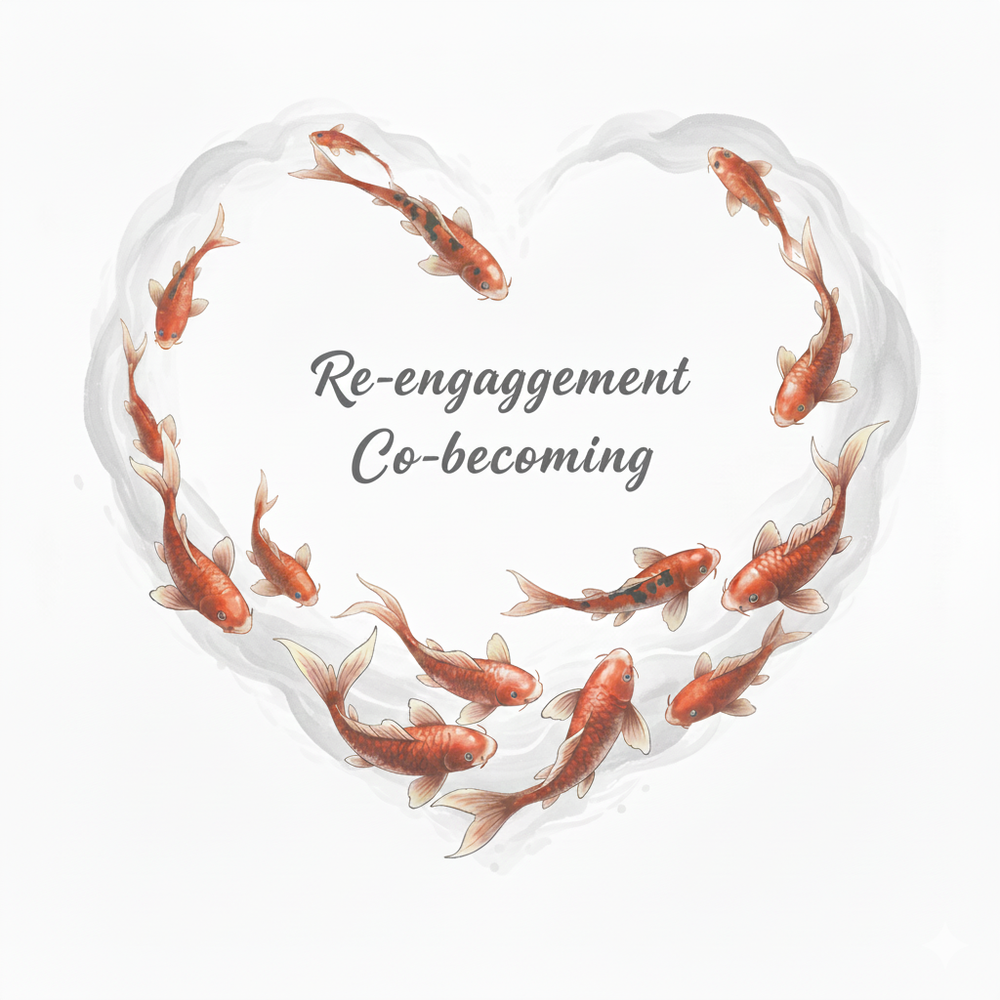
The image above is my New Year's greeting card — and also my annual theme for 2026: Re-engagement and Co-becoming.
In Jaunary 2026, I designed a set of thematic cards to further develop these annual themes. Below is one of them.

Weave the Theory is about the creative dialogue between Theory and Practice, Creativity and Curativity, Self and World, Subjective and Objective, etc.
Re-engagement and Co-becoming. I placed them there in January. The year answered.
Oliver Ding
Founder of the Activity Analysis Center
May 15, 2026
p.s. I am based in Houston, Texas, US. Where are you?
v1.0 - May 15, 2026 - 1,900 words