
Bonnie Nardi: Engaging with a Theoretical Tradition

A Case Study of Supportance, Platform, and the Evolution of Activity Theory
by Oliver Ding
May 11, 2026
This article is part of the Weave-the-Theory series.
Theoretical traditions do not develop on their own. They develop through the work of specific people — through the projects they undertake, the events that change their direction, the enterprises they sustain across years and decades. The tradition at any moment is the accumulated outcome of these acts: the books written and edited, the tools designed, the communities built, the concepts articulated and transmitted. Remove the people and their concrete activities, and what remains is an abstraction with no power to grow.
Bonnie A. Nardi's engagement with Activity Theory is one of the clearest available demonstrations of this principle. She entered the tradition from an unlikely angle — a trained anthropologist, working in the high-tech industry, encountering a single article by accident — and over the following three decades became one of the most consequential contributors to Activity Theory's development in North America and in HCI (Human-Computer Interaction). Her story is not primarily a story of intellectual influence. It is a story of how a person's engagement with a theoretical tradition, at the right moment and from the right position, changes the tradition itself — and how that engagement, seen from the inside, constitutes her own theoretical enterprise.
This article uses two analytical frameworks to read Nardi's story. The first is the Life-as-Activity Approach (v4.0), specifically the four-concept structure of Project, Event, Enterprise, and Activity, which operates at two complementary scales. The second is the Weave-the-Theory model, which provides a vocabulary for analyzing the specific character of Nardi's theoretical contributions across the Creativity and Curativity lines. Together, these two frameworks reveal a structure that neither alone would make fully visible: how an individual's engagement with a theoretical tradition, understood at the right level of resolution, illuminates the dynamics by which theoretical traditions evolve.
This article is part of the Weave-the-Theory series and draws directly on a 2020 article, Activity U (III): Bonnie Nardi's Choices and Boundary Knowledge Work, which analyzed Nardi's career trajectory using earlier frameworks. The present article revisits that material with the more developed analytical tools now available, finding in the same story a richer and more theoretically precise account. Part 1 tells Nardi's story. Part 2 revisits it through the Life-as-Activity (v4.0) lens. Part 3 analyzes her movement from Platform-ba to Platform Core through the concept of supportance. Part 4 draws the theoretical implications for understanding how a theoretical tradition evolves as a living platform.
Source:
- Bonnie Nardi: Appropriating Theory
- Bonnie Nardi’s personal website: https://artifex.org/~bonnie/
Contents
Part 1. Bonnie Nardi's Story
1.1 From Anthropology to Silicon Valley
1.2 Encountering Activity Theory
1.3 Building the Network
1.4 A Career Shaped by Theoretical Commitment
Part 2. Revisiting from the Life-as-Activity (v4.0) Perspective
2.1 Life-as-Activity (v4.0)
2.2 The Micro Scale: Project and Event
2.3 The Meso Scale: Enterprise and Activity
2.4 The Same Structure at Micro and Meso Scales
Part 3. Supportance: From Platform-ba to Platform Core
3.1 Activity Theory as Theoretical Platform
3.2 Theory Makers vs. Theory Users
3.3 Nardi's Trajectory: A Different Kind of Engagement
3.4 The Moment of Supportance
3.5 Five Theory-Based Supportances
Part 4. Activity Theory as an Evolving Theoretical Tradition
4.1 The Weave-the-Theory Model
4.2 The Curativity Line
4.3 The Creativity Line
4.4 The Tradition Is What Its Contributors Do
4.5 Constructing the Creative Delta
Postscript
Part 1. Bonnie Nardi's Story
1.1 From Anthropology to Silicon Valley
Bonnie A. Nardi was trained as an anthropologist. In the 1980s, she held a tenure-track position in the discipline — and she was discontented. Her own account of the period is candid: "I was disgruntled with anthropology's total lack of interest in digital technology, its insular jargon, and its somewhat negative attitude. During anthropology's relentless critique of issues of race-class-gender, my head was in a different space — I was energized and excited about what I perceived to be the development of rapidly changing life-altering digital technologies."
The conflict she describes was not merely personal. It was a mismatch between the domain she inhabited professionally and the domain that genuinely engaged her. Anthropology, in the 1980s, had turned its critical energies toward questions of representation, colonialism, and the politics of fieldwork. Digital technology was, from that perspective, a marginal or suspect object of inquiry. Nardi found it "liberating, compelling, and so impactful on global culture that I could scarcely believe it remained outside anthropology's sights."
In the mid-1980s, she made the decisive move: she left the tenure-track job in anthropology and relocated to Silicon Valley, joining the high-tech industry as a researcher. By 1993 she was at Hewlett-Packard Labs in Palo Alto, conducting ethnographic studies in the HCI research group. The disciplinary crossing was complete. She had brought her anthropological methods — participant observation, ethnographic fieldwork, attention to context and meaning — into a domain that had been shaped primarily by cognitive psychology and computer science.
1.2 Encountering Activity Theory
The encounter with Activity Theory arrived, as significant theoretical encounters often do, through an indirect path. In 1993, a colleague at HP — another anthropologist, working in a product group — handed Nardi a copy of Kari Kuutti's article "Activity theory and its applications to information systems research and development" (1991). Nardi began reading it in what she describes as "the ordinary desultory way one does with random articles" — and then something changed.
"I soon snapped to attention, the words jumping off the page. I was astonished to find that someone had theorized information systems as activity systems wherein the technical system was conceived as part of object-oriented human activity. The clarity and good sense in Kuutti's argument — that we should study what people are doing with technical systems and why! — set me off on a crash course in activity theory to determine whether my enthusiasm would withstand further exposure to the ideas."
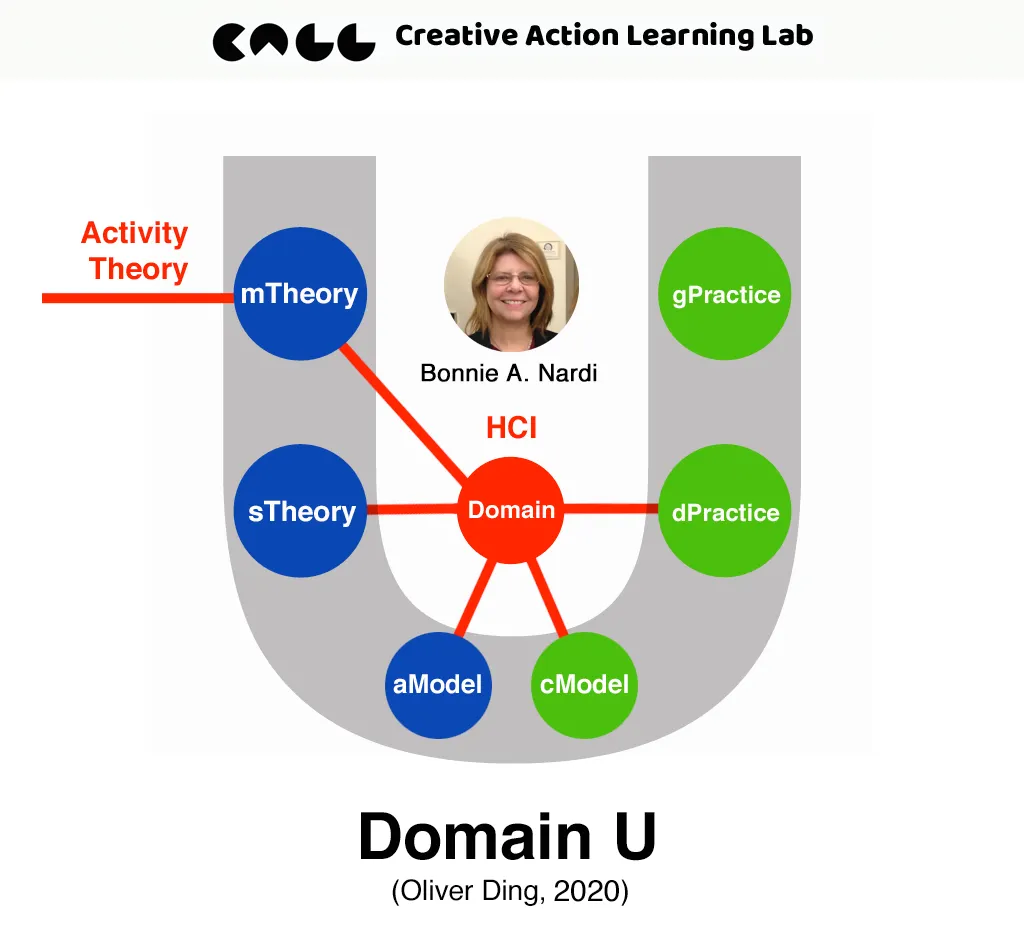
The enthusiasm held. What attracted Nardi was not just the content of Activity Theory but its character as a theoretical system: an integrating framework linking a set of theoretical principles, rather than the isolated insights that HCI research typically produced. She would later write that this was precisely the strength of AT as she understood it — the difference between a hammer with a handle and a collection of interesting pieces of metal. Activity Theory was a complete tool.
1.3 Building the Network
Nardi's response to the encounter was characteristic: she did not simply begin applying Activity Theory to her existing research. She decided to enter the tradition's social core. Her account of this decision is memorable: "I decided if I were to penetrate the core activity theory circle — centered in what Don Norman once called 'that hardy band of Scandinavians' — I would have to make personal contact with the illustrious natives."
She emailed Kari Kuutti and Susanne Bødker. They helped her build a network of contributors for an edited volume on Activity Theory and HCI, published by MIT Press in 1996 as Context and Consciousness. Her reasoning for undertaking editorial work was deliberate: "I reasoned that if I had a bunch of papers written by activity theorists in front of me to edit, it would be a good way to imbibe its principles and concerns." She also recommended the strategy to others: editorial work — special issues, edited collections — as a method for gaining deep understanding of a field while simultaneously contributing to its development.
By 1996, when Context and Consciousness appeared, Nardi had moved from HP to Apple. The book was written and edited entirely alongside her industry work — a new project running parallel to her existing position, detaching from one identity and attaching to another. In the short term, the new position was "an editor." Over time, it became "an activity theorist."
1.4 A Career Shaped by Theoretical Commitment
The arc of Nardi's subsequent career demonstrates the sustained nature of her engagement. With Victor Kaptelinin, she co-authored two books that became standard references in AT-HCI: Acting with Technology (2006) and Activity Theory in HCI (2012). The first synthesized AT's foundational principles for the HCI community and introduced practical tools including the Activity Checklist and the UMEA system (User-Monitoring Environments for Activities). The second extended the synthesis with new conceptual clarifications and addressed AT's relationship to HCI's evolving concerns. Together, they constituted the most comprehensive account of Activity Theory available to HCI researchers in English.
Beyond the books, Nardi sustained a long-term editorial commitment to the tradition's institutional infrastructure: she co-edited the MIT Press Acting with Technology series, which produced multiple award-winning titles, and served as Senior Editor for Mind, Culture, and Activity, the journal most closely associated with CHAT research. These roles placed her at the center of the tradition's curation and transmission across decades.
Her research projects extended AT into territories that the tradition's founders had not anticipated. An anthropological study of World of Warcraft, conducted from 2005 to 2008, produced My Life as a Night Elf Priest (2010) — an account that used AT alongside John Dewey's concept of active aesthetic experience to analyze gaming as a form of meaningful human activity. With Hamid Ekbia, she co-authored Heteromation, and Other Stories of Computing and Capitalism (2017), extending AT's analytical reach into questions of political economy. Throughout, she maintained the thematic commitment that had driven her initial crossing from anthropology to HCI: understanding the relationship between human beings and digital technology as a form of human activity.
In 2016, she published "Appropriating Theory" — an account of her own trajectory that she described as a template she would recommend to others. The article serves as a chapter of Theory Development in Information: Reflecting on the Process (2016).
Part 2. Revisiting from the Life-as-Activity (v4.0) Perspective
2.1 Life-as-Activity (v4.0)
The Life-as-Activity Approach is a body of theoretical work that has been developing since 2020, rooted in Activity Theory and oriented toward individual creative development. Its governing principle — Activity as Project Engagement — describes how a person moves from outside a project to inside it, forming identity and contributing to collective life through this ecological movement. The foundational equation Life = Projects = Thematic Spaces = Events = History gives the approach its basic ontological structure: Projects on the subjective side, Events on the objective side, with Activity Theory's internalization—externalization principle providing the theoretical home for the Outside—Inside movement.
Version 4.0, reached in April 2026 through the development of the Weave-the-Life Framework (v3.0), introduced a new level of conceptual integration.
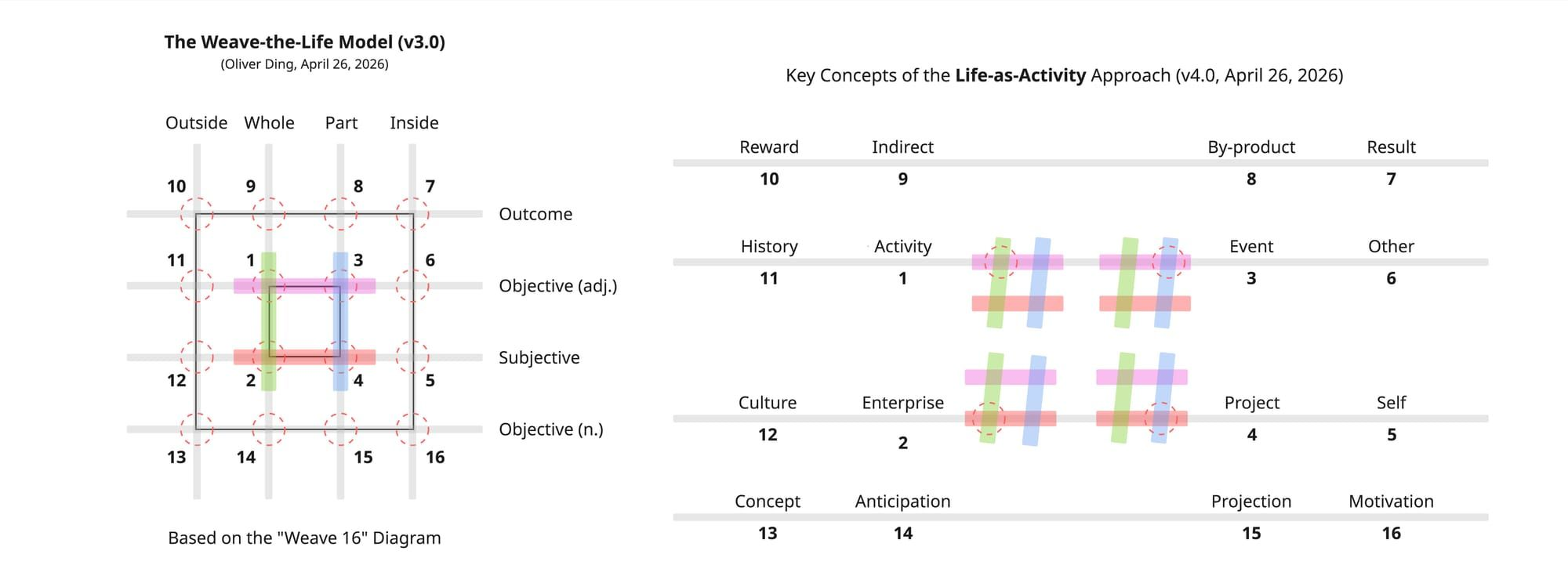
At its core is the Activity—Enterprise—Attachance triad, which provides a more complete account of how Activity as Project Engagement operates at the meso level — the level between individual projects and the full arc of a life.
Activity names the objective collective process — the social structures and systemic processes within which individual lives unfold. From the outside, a person's trajectory is observable as participation in various collective activity within social life: disciplines, institutions, research traditions, industries.
Enterprise names the subjective experience of the same trajectory from the inside — the sustained, self-directed series of projects organized by a continuous thematic commitment. What I experience from the inside as my Enterprise is, from the outside, observable as Activity. The two concepts are not in opposition; they are two faces of the same social reality, seen from different positions.
Attachance names the mechanism of movement — the fundamental capacity to detach from one thematic space and attach to another. At the project scale, Attachance operates as Projectivity: the potential action opportunities that draw a person from outside a project to inside it. At the enterprise scale, Attachance describes the larger reorientations of a creative life as a person's sustained trajectory shifts across time. These two scales — project and enterprise — are not independent. They are isomorphic: Project is to Event as Enterprise is to Activity, and the same Outside—Inside movement governs both.
This four-concept structure — Project, Event, Enterprise, Activity — is the primary analytical lens this Part applies to Nardi's story.
2.2 The Micro Scale: Project and Event
At the micro level, the Life-as-Activity Approach introduces a foundational symmetry: Project and Event are two perspectives on the same social occurrence, seen from different positions. A project is a social environment experienced from the inside — the sustained engagement through which a person contributes to and is shaped by a shared endeavor. An event is the same social occurrence seen from the outside — an objective happening that enters a person's life from without and creates new possibilities or demands.
Nardi's entry into Activity Theory can be read precisely through this structure. In 1993, she was working as an HCI researcher at Hewlett-Packard Labs in Palo Alto. A colleague handed her an article by Kari Kuutti on activity theory and information systems. This was an event — an objective occurrence that arrived from outside her existing projects, uninvited and unpredicted. Her response was to "snap to attention": the words jumped off the page, and she immediately recognized that someone had theorized information systems in exactly the way she had been reaching toward.
What followed was a new project: a crash course in activity theory, then a decision to edit a volume on activity theory and HCI, then the deliberate effort to build personal contact with the Scandinavian activity theorists who formed the tradition's core. Nardi's own account of this sequence is precise: "I decided if I were to penetrate the core activity theory circle — centered in what Don Norman once called 'that hardy band of Scandinavians' — I would have to make personal contact with the illustrious natives."
The 2020 article captured this dynamic through the Boundary Knowledge Work diagram: Old Project → New Project, Old Position → New Position. For an industry HCI researcher, editing a theoretical book was not part of the job description. It was a new project that detached from the old position and began attaching to a new one. In the short term, the new position was "an editor." Over time, it became "an activity theorist."
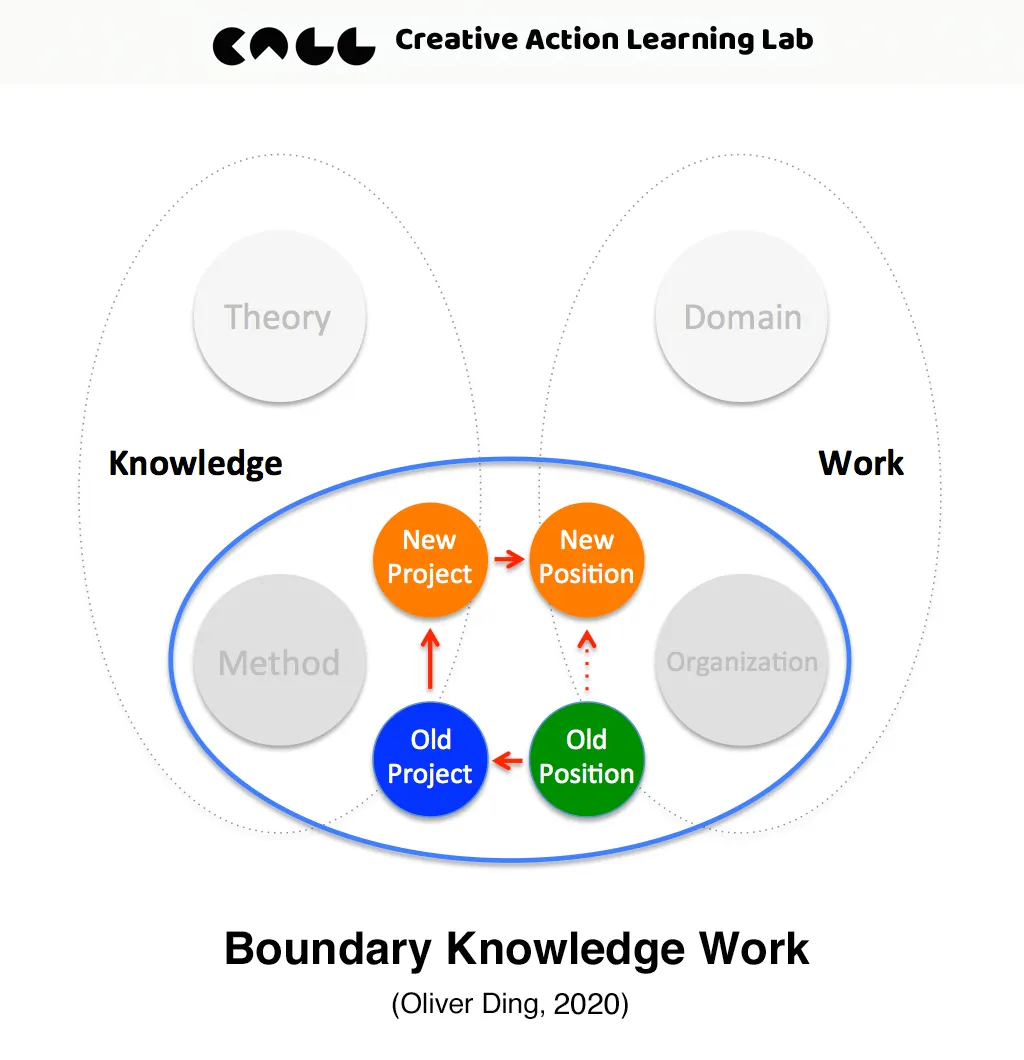
This is the micro-scale structure: a specific event triggers a specific project, which generates a chain of further projects and events, which cumulatively transform the person's position within the social landscape they inhabit.
2.3 The Meso Scale: Enterprise and Activity
At the meso level, the central focus is Nardi’s Enterprise — the sustained subjective logic that gives her career its coherence. The core theme of this Enterprise, stated at the right level of abstraction, is: understanding the relationship between human beings and digital technology through the lens of human activity. This thematic commitment was present from the very beginning — it was the reason she left a tenure-track position in anthropology, which “had a total lack of interest in digital technology,” to join the high-tech industry in Silicon Valley. It was the reason she “snapped to attention” when she read Kuutti’s article: activity theory offered precisely the theoretical resources her core theme required. And it is visible in her later work — on video gaming, on heteromation, on the critical analysis of computing and capitalism — each of which extends the same core theme into new empirical territory.
Attachance is an abstract concept for discussing the switching between enterprise and activity. In this case, we use three related terms to analyze such switching. A mental move involves a change in cognitive orientation or theoretical commitment: for Nardi, engaging deeply with activity theory after reading Kuutti was a mental move that reconfigured her Living Coordinate — the set of orientations through which she engaged with her work. A social move is a shift in institutional position and community: her departure from a university anthropology department to work as a researcher in Silicon Valley is a clear example. A strategic move is a move that embodies a strategic intent — a deliberate action taken to advance one’s enterprise. For Nardi, editing Context and Consciousness: Activity Theory and Human-Computer Interaction (1996) was such a strategic move: the volume connected the academic activity-theory community with design practitioners and consolidated her new theoretical direction.
Viewed from the outside, this very same trajectory is Nardi’s Activity. In the course of her Activity, three social environments deserve attention: anthropology as an academic discipline, HCI as an interdisciplinary research domain, and Activity Theory as a theoretical tradition. Each has its own history, community, tools, and rules, but from Nardi’s perspective they were never separate areas — only successive settings in which a single Enterprise was pursued.
2.4 The Same Structure at Micro and Meso Scales
The precision of the Life-as-Activity Approach here lies in recognizing that these two scales are not independent. They are isomorphic: Project is to Event as Enterprise is to Activity. The same Outside—Inside structure operates at both scales, and the same mechanism — Attachance, in its project-scale form of Projectivity — governs movement at both.
At the micro scale: an event (Kuutti’s article) triggers projectivity — the potential action opportunity that draws a person from outside a project to inside it. Nardi perceives and actualizes this projectivity by beginning a new project. At the meso scale: the social environment of Activity Theory, at a specific moment in its development, makes available an enterprise-scale action opportunity — one that a person with Nardi’s background and thematic commitments is uniquely positioned to perceive and actualize. The mechanisms are the same; the scale is different.
This isomorphic structure is what makes Nardi's story analytically illuminating rather than merely interesting. It is not a story of individual brilliance or fortunate circumstance. It is a story of a specific person, with a specific accumulation of experience and commitments, encountering a specific theoretical tradition at a specific moment in its development — and the encounter producing outcomes that neither party could have predicted.
Part 3. Supportance: From Platform-ba to Platform Core
3.1 Activity Theory as Theoretical Platform
By the early 1990s, Activity Theory had achieved the status of a Theoretical Platform — a theoretical enterprise that had reached sufficient maturity to actively support the work of others.
A theoretical tradition has a Platform Core (its founding theorists and core curators), a Platform-ba (the community of practitioners and researchers who work within it), Essential Differences (meta-framworks, core concept systems and coordination mechanisms), and Situated Dynamics (the diverse frameworks, models, and applications that express the meta-frameworks and core concept systems across contexts). This application of the Platform Genidentity Framework to theoretical traditions produced the concept of Theoretical Platform.
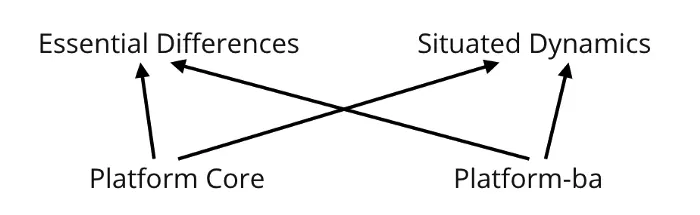
Its Platform Core consisted of the founding theorists and their canonical works: Vygotsky's cultural-historical psychology, Leontiev's activity approach, and Engeström's activity system model, which had crystallized in 1987 and given the tradition a new analytical center. Its Platform-ba was expanding — a growing community of researchers across Europe, North America, and elsewhere who were engaging with the tradition's concepts and applying them to diverse empirical domains.
What a Theoretical Platform offers to a potential contributor is not a fixed doctrine to be applied. It offers a structured landscape of supportances — concrete action opportunities that become available to a person who is positioned to perceive and actualize them.
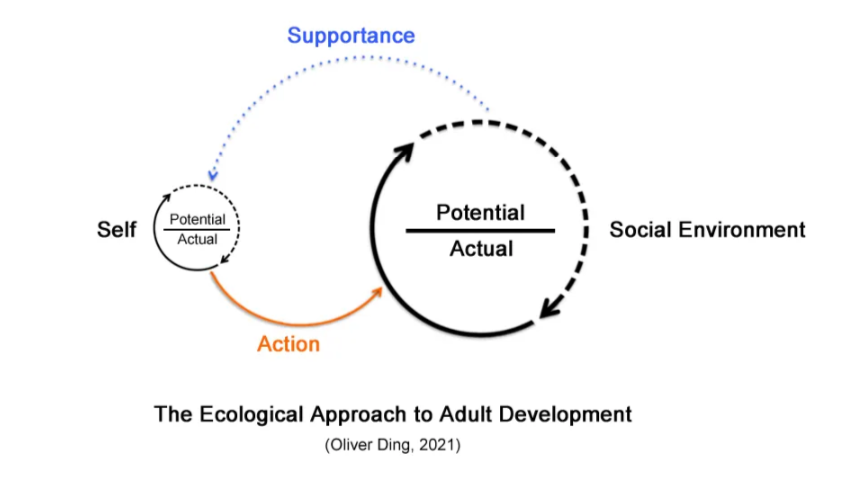
The concept of supportance, drawing on Gibson's notion of affordance and Vygotsky's Zone of Proximal Development, names this relational structure: a supportance exists neither in the platform alone nor in the person alone, but in the encounter between a platform's current configuration and a contributor's current capacities, needs, and orientations. More details can be found in Vygotsky’s “Ecological Mind” and a New Approach to Adult Development.
3.2 Theory Makers vs. Theory Users
In 2016, Nardi and her colleagues published an analysis of 109 HCI papers that used Activity Theory, identifying five strategies through which HCI researchers engaged with the tradition:
- Theory as object of analysis — studying Activity Theory itself (5 papers)
- Theory as conceptual tool for design — applying AT to support design work (17 papers)
- Theory as meta-tool — using AT to develop new analytical tools (16 papers)
- Theory as tool for conceptual analysis — using AT for theoretical analysis of HCI (30 papers)
- Theory as tool for empirical analysis — using AT to guide empirical research (41 papers)
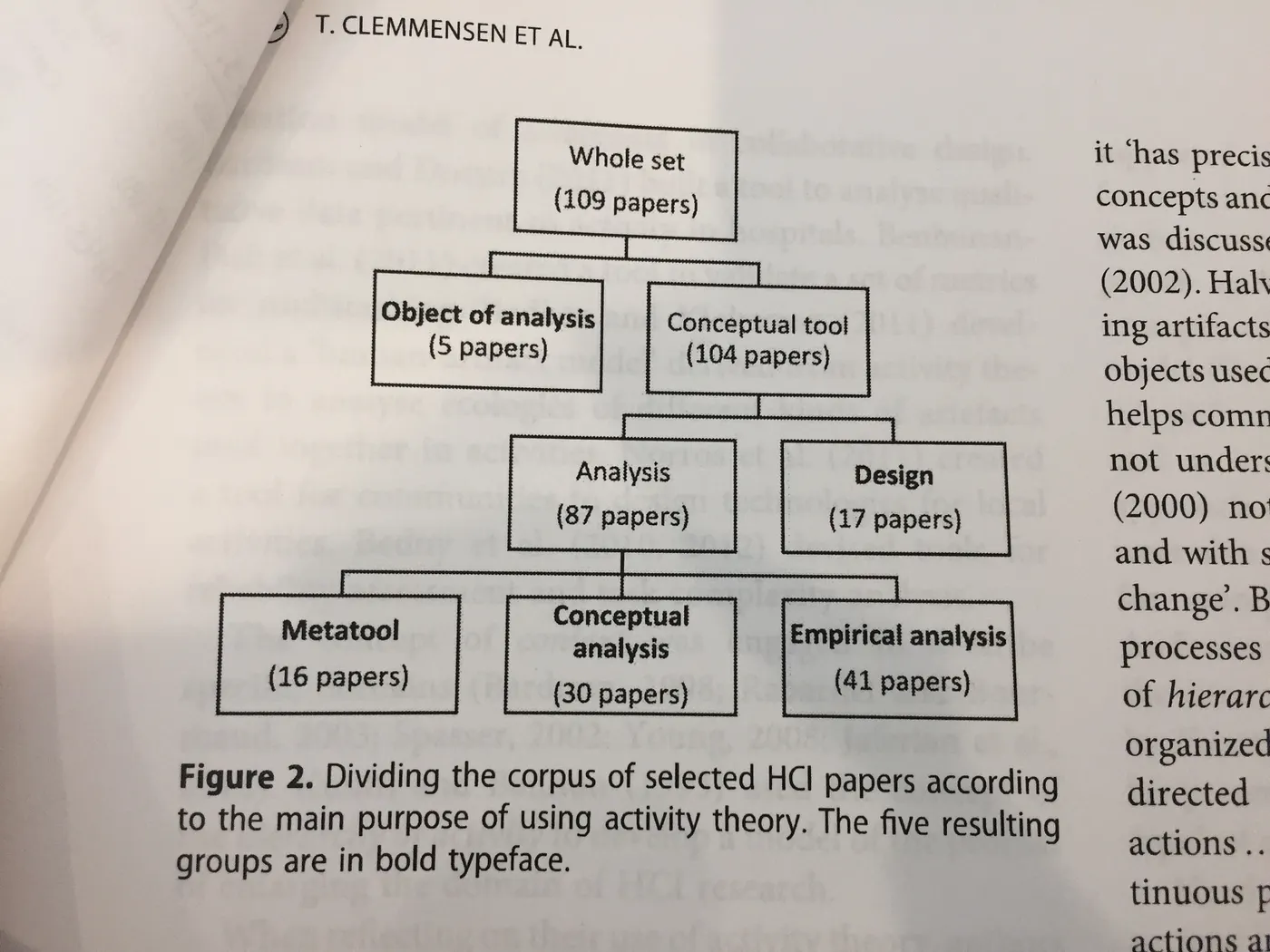
This analysis, while framed as a study of HCI research practices, is simultaneously a map of how most contributors relate to a Theoretical Platform. The great majority — represented by strategies 2 through 5 — are operating from Platform-ba: they draw on the tradition's resources, apply its concepts, and extend its reach into new empirical territory. Their work is valuable and necessary; it is how a platform's Situated Dynamics are populated and its influence extended. But it does not change what the platform fundamentally is.
The distinction Nardi herself draws from this analysis is telling: most HCI researchers are theory users, while a smaller number are theory makers. She writes: "Instead of theory use as passive consumption of a theory 'product', we found numerous cases of theory development. These papers would, for example, alert the reader in the title, abstract, and keywords that the paper is about activity theory; cite the reference HCI activity theory texts; use activity theory deeply and in a substantial way; and reflect core HCI activity theory concerns. We believe that HCI researchers can be described as not only 'theory users', but also as 'theory-makers'." Theory users consume the platform's resources; theory makers contribute to the platform's development. The former operates from Platform-ba; the latter moves toward Platform Core.
Nardi is also careful to note the limits of this claim: "However, not all HCI researchers are (or should be) either theory-makers or theory users. Many HCI papers may be better characterised as experience reports, or as challenging and provocative texts to jog our imaginations with little or no trace of theory." The landscape of engagement is diverse; Platform Core membership is one position among many, and not the only valuable one.
3.3 Nardi's Trajectory: A Different Kind of Engagement
Nardi's own engagement with Activity Theory followed a different path from the majority of HCI researchers she analyzed. What drew her to AT in the first place was precisely its character as a systematic theoretical framework — not a collection of insights but an integrating structure. She wrote: "One of the key points Kaptelinin makes about strength of activity theory is the importance of its integrating framework linking a set of theoretical principles — rather than what we often get in HCI, which is an insight here and an insight there." This preference for theoretical coherence over isolated insights shaped everything that followed.
The 1996 edited volume Context and Consciousness was not an application of AT to an HCI problem. It was a curatorial and organizational act — one that brought the tradition's core contributors into dialogue with the HCI community and established AT as a legitimate theoretical framework for the field. The two books written with Victor Kaptelinin — Acting with Technology (2006) and Activity Theory in HCI (2012) — were not primarily research reports. They were systematic accounts of the tradition's principles, designed to make AT coherent and accessible to a community that had previously engaged with it only through scattered papers and partial appropriations.
These contributions did not operate from Platform-ba. They were acts of Platform Core membership: maintaining, extending, and transmitting the tradition's foundational commitments to new communities and new generations. Nardi became, in Carroll's assessment, the person most responsible for AT achieving canonical status in HCI — a status she built not through a single theoretical breakthrough but through sustained curatorial and organizational work over three decades.
3.4 The Moment of Supportance
How did this happen? The answer begins with that 1993 encounter with Kuutti's article — but the encounter alone does not explain it. Many people read that article. Most read it in the ordinary desultory way. Nardi snapped to attention.
The difference was not the article. It was her position: the accumulation of capacities, commitments, and frustrations that made the article's content land with the force of recognition rather than mere information. She was a trained anthropologist who had already crossed one domain boundary. She was discontented with the theoretical resources available in HCI. She had a background in ethnographic fieldwork that made AT's emphasis on context and human activity immediately intelligible. And she was in Silicon Valley, at the center of the technological development that AT's framework was precisely designed to analyze.
What followed was deliberate. Nardi recognized that perceiving a supportance was not the same as actualizing it. She chose a specific strategy for entry: editorial work. "I reasoned that if I had a bunch of papers written by activity theorists in front of me to edit, it would be a good way to imbibe its principles and concerns." She has since recommended this strategy to others: "I recommend editorial work such as special issues or edited collections as a general recipe for plunging into a field or deepening knowledge of a field in which a researcher seeks to gain more understanding." The editorial project was not only a learning device. It was the act through which she built the social network — the personal contacts with Kuutti, Bødker, and the wider Scandinavian community — that made her subsequent Platform Core membership possible.
This is the ecological structure of supportance: the platform had been generating this action opportunity for years — the need for AT's concepts to reach the HCI community, the gap between the tradition's Scandinavian core and the North American research world. But only a person with Nardi's specific accumulation of experience, positioned at that specific intersection of domains and traditions, could perceive and actualize it. The supportance was there; she was the person who could see it — and who knew what to do with it.
3.5 Five Theory-Based Supportances
The five strategies Nardi and her colleagues identified are not only a classification of research practices. Read through the lens of supportance, they describe five distinct types of action opportunity that Activity Theory, as a Theoretical Platform, makes available to researchers who engage with it.
Each strategy corresponds to a different kind of supportance:
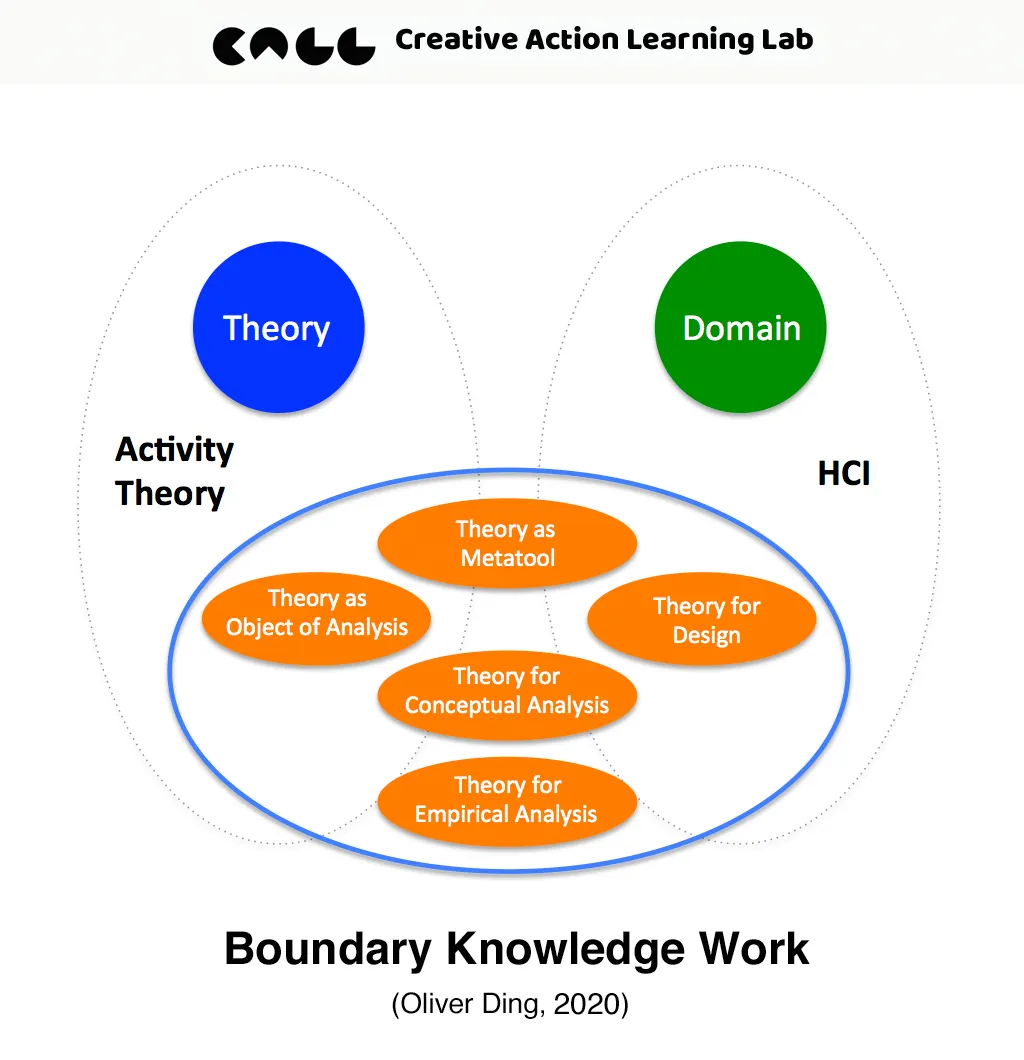
- Theory as object of analysis — the supportance of treating AT itself as a research subject, analyzing its concepts, development, and internal structure. This is the rarest activation (5 papers): it requires a researcher positioned at sufficient distance from the tradition to observe it as an object rather than inhabit it as a tool.
- Theory as meta-tool — the supportance of using AT to generate new analytical frameworks and methods. This requires methodological creativity beyond application, and produces artifacts that can themselves become resources for other researchers.
- Theory as tool for conceptual analysis — the supportance of using AT's concepts to analyze HCI phenomena theoretically, contributing to the tradition's conceptual development within the domain.
- Theory as tool for empirical analysis — the most widely actualized supportance (41 papers), available to any researcher who brings empirical questions to the tradition's analytical framework.
- Theory as conceptual tool for design — the supportance of translating AT's theoretical resources into practical design support, connecting the tradition to the work of practitioners.
The distribution is itself significant. The closer a supportance lies to the Platform Core — toward theoretical construction and meta-level analysis — the fewer researchers perceive and actualize it. The closer it lies to Platform-ba — toward application and empirical use — the more widely it is activated. This is not a deficiency; it is the normal ecology of a mature Theoretical Platform. A tradition needs both ends of the spectrum to remain alive.
These five theory-based supportances are, however, of a different character from the three-wave supportances described in Weave the Theory: The Journey of Activity Theory and CHAT (Since 2000). The five theory-based supportances are visible and systematic: they can be identified by examining what researchers actually do with a theory, and they are available to anyone who engages with the tradition at any level.
The three-wave supportances are more concealed. They become visible only to someone who has developed a sufficiently deep and historically informed understanding of where the tradition currently stands — what conceptual gaps remain unresolved, what communities have not yet been reached, what dialogues with other traditions remain to be opened. A first-wave supportance (application and extension) is relatively accessible; a second-wave supportance (introducing new core concepts) requires years of engagement before it becomes perceptible; a third-wave supportance (dialogue with another tradition) requires the contributor to be genuinely fluent in both traditions simultaneously.
Nardi's case sits at the intersection of both types. She actualized a theory-based supportance of the curatorial and organizational kind — building the network, editing the volumes, synthesizing the principles. But she also perceived and actualized a three-wave supportance of a less visible kind: the need for AT to establish a stable institutional presence in North America and in HCI. This second perception required something that most of her HCI colleagues did not have — a view of the tradition as a whole, from a position close enough to its core to see what it lacked.
Part 4. Activity Theory as an Evolving Theoretical Platform
4.1 The Weave-the-Theory Model
The Weave-the-Theory framework is one of the derived frameworks within the Weave knowledge system. Built on the Weave Basic Form — two diachronic lines crossing two synchronic lines to produce four weave-points at their intersections — it applies this structure to the specific domain of theoretical activity.
The Weave-the-Theory model describes theoretical development as the interplay of two diachronic lines: the Creativity Line (proliferation, moving through Theme and Model) and the Curativity Line (unification, moving through Concept and Principle). Every contributor to a theoretical tradition works on one or both of these lines; what distinguishes contributors is not whether they contribute but where their contributions land, and at what moment in the tradition's development.
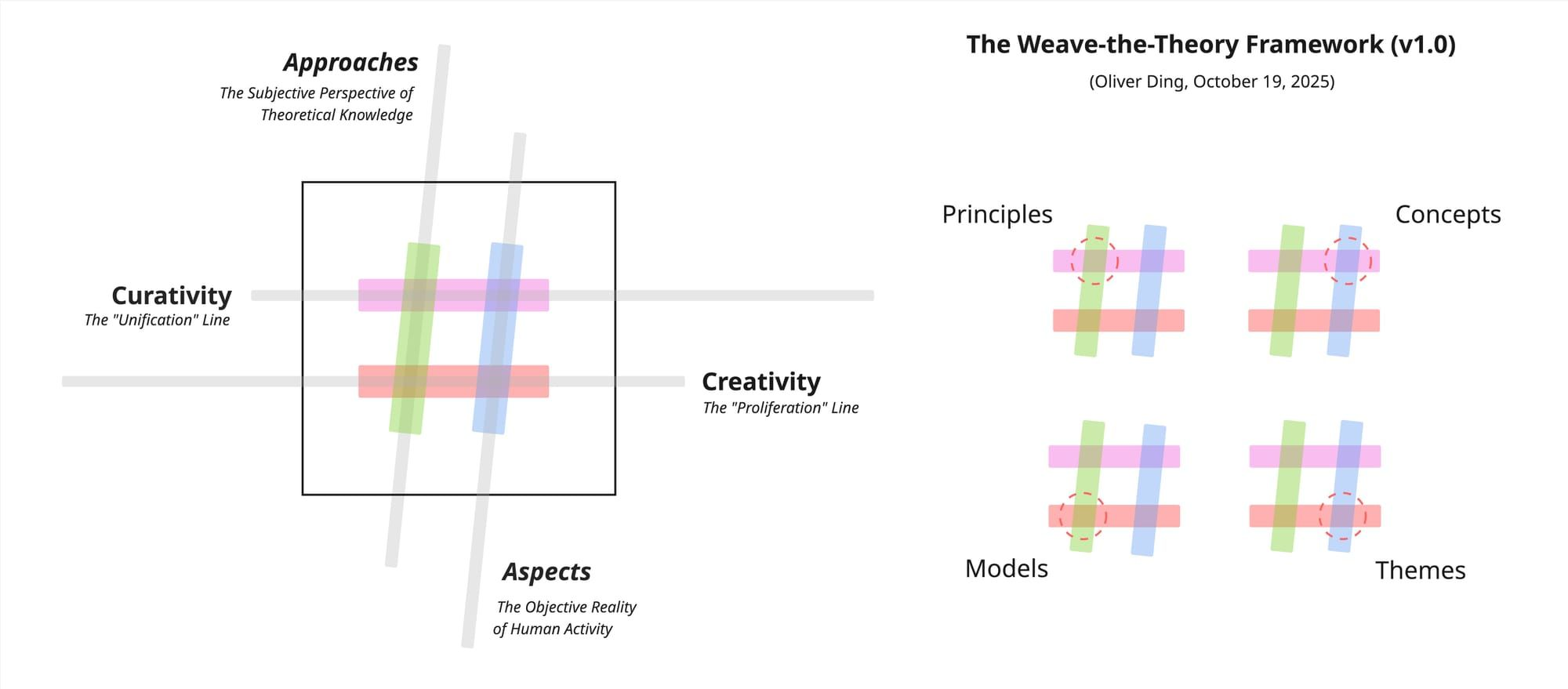
The Curativity Line is where a tradition's Essential Difference is established and maintained. It is the line on which the Meta-framework is built: the core concept systems and the principles that govern what the tradition is and how it develops. Without sustained work on the Curativity Line, a tradition's concepts may proliferate but will not cohere; they will be cited but not understood; they will spread but fail to take root.
When a theoretical tradition reaches a moment of broad cross-boundary expansion — entering many different disciplines and communities of practice simultaneously — the Curativity Line faces a specific and historically significant challenge. The Meta-framework must be made accessible not to one new community but to many, across different institutional environments, different disciplinary cultures, and different practical orientations.
This is the condition under which a Creative Delta becomes possible: the tradition enters a broad and unfamiliar terrain, branches into many directions, and the question of whether it will cohere across those branches depends on whether someone does the foundational Curativity Line work. This is the second founding — and it only appears at such moments of genuine large-scale crossing, not in ordinary domain extension.
4.2 The Curativity Line: A Second Founding
Activity Theory's cross-boundary expansion in the 1990s was precisely such a moment. AT was moving out of its original home in Soviet and Scandinavian psychology and education research, entering a wide range of disciplines across the English-speaking academic world: HCI, organizational research, education, CSCW, workplace studies, and beyond. This was the historical formation of AT's Creative Delta — the moment when the concentrated theoretical stream began branching across a new and much larger terrain.
At this moment, someone needed to do the second-founding work on the Curativity Line: to articulate AT's Meta-framework — its core concept systems and governing principles — in a form that was rigorous, coherent, and accessible to researchers coming from many different disciplinary backgrounds. This is what Nardi and Kaptelinin's two books accomplished. Acting with Technology (2006) synthesized AT's foundational principles into a coherent account that could serve as a reference point across disciplines — not a simplified version, but a careful articulation of what the tradition actually claimed, what its core concepts meant, and how they held together. Activity Theory in HCI (2012) extended and sharpened this account. Together, the two books established a transmissible Meta-framework for AT's expanded terrain.
The reach of this work extended well beyond HCI. According to Nardi, “In contrast, there are reasons to believe that HCI is in a better situation when it comes to providing theoretical influence on other disciplines. There are indications that HCI acts as a reference discipline; for example, the classic activity theory HCI text Context and Consciousness (Nardi 1996) has been widely cited outside HCI." In other words, Nardi's curatorial work provided a foundation that researchers from many fields could draw upon. This is second-founding work in the full sense — not founding a tradition within one discipline, but re-establishing the tradition's Essential Difference at the moment of its broadest expansion, so that the Creative Delta could form with coherence rather than fragmentation.
4.3 The Creativity Line
On the Creativity Line, Nardi's contributions are of a different character. With Kaptelinin, she developed two operational tools introduced in Acting with Technology (2006): the Activity Checklist, which translates AT's abstract concepts into a practical instrument for design analysis, and the UMEA system (User-Monitoring Environments for Activities), a concrete technical implementation of AT principles in HCI design practice. These tools give practitioners a usable entry point into the tradition's conceptual resources.
Beyond tool development, Nardi and Kaptelinin made a significant theoretical contribution in Acting with Technology (2006) that addresses one of the most contested questions in HCI and the broader social sciences: the nature of agency. In response to ongoing debates about the distribution of agency between human and non-human actors — debates that had become particularly sharp with the rise of Actor-Network Theory — they proposed a systematic classification grounded in a key distinction: humans have both basic needs and cultural needs, while other living beings have basic needs only. From this distinction, they identified six forms of agency across different types of agents: things (natural), things (cultural), non-human living beings (natural), non-human living beings (cultural), human beings, and social entities. This classification is a Theme-level contribution on the Creativity Line — it opens new theoretical territory within AT by providing a principled account of what makes human agency distinctive, without dismissing the genuine agency of non-human actors.
Her research projects extended AT into further thematic territories: the ethnographic study of World of Warcraft, the work on heteromation and capitalism, the development of hn-HCI with Kaptelinin. These are additional Theme-level contributions, demonstrating what AT can do when brought to bear on digital culture, political economy, and social justice.
4.4 The Tradition Is What Its Contributors Do
A theoretical tradition has no existence apart from the specific acts of specific people. Activity Theory is not a set of principles floating in intellectual space. It is the accumulated outcome of what Vygotsky wrote in the 1920s and 1930s, what Leontiev developed in the 1940s, what Engeström built from 1987 onward — and what Nardi edited, organized, synthesized, researched, and transmitted from 1993 to the present. The tradition's current landscape at any moment is constituted by these acts, not by some abstract entity called Activity Theory that exists independently of them.
When we ask "what is Activity Theory in HCI?" we are asking about a set of ongoing activities — the books being written, the principles being articulated, the communities being sustained. The tradition at any moment is the living outcome of these activities. Nardi's case makes this visible because her second-founding work on the Curativity Line is precisely what gave AT its coherent presence in HCI. The concepts she synthesized were not new. But the account through which they became accessible to the HCI community — rigorous, coherent, transmissible — was built by her and Kaptelinin. Without it, AT's Essential Difference would not have taken root in the new terrain.
4.5 The Creative Delta
While developing this article, I began to feel that the development of a theoretical tradition may need a different ecological metaphor from the ones commonly used in intellectual history. We often describe theories as systems, schools, paradigms, or networks. These descriptions are useful, but they do not fully explain what happens when a theoretical tradition crosses disciplinary boundaries and enters new fields of practice.
What happens in such moments is not simply diffusion. Nor is it only interdisciplinary transfer. Something more ecological begins to appear.
A river begins as a relatively concentrated flow with identifiable upstream sources and a clear direction. But when it reaches a broad and uneven terrain, it no longer continues as a single channel. It branches. Some channels deepen and become stable. Others narrow and disappear. Sediment gathers unevenly. New ecological zones emerge. Over time, the landscape develops properties that cannot be reduced to the river alone.
The development of a theoretical tradition sometimes follows a similar pattern. In its early stages, a theoretical tradition may have a relatively coherent upstream structure: foundational concepts, canonical texts, core contributors, and shared commitments. But when the tradition begins crossing disciplinary boundaries and entering new fields of practice, the structure starts to change. The theory no longer exists only as a unified intellectual stream. It gradually becomes a distributed landscape of projects, methods, tools, infrastructures, institutions, and cross-boundary communities. This change cannot be understood well through the language of "application" alone. What emerges is a particular form of knowledge ecology.
The concept of Creative Delta is an attempt to describe this form more precisely.

A Creative Delta is a form of knowledge ecology that appears when a theoretical tradition enters different terrains and undergoes processes of branching, accumulation, recombination, stabilization, and long-term construction. In such a formation, the original theoretical stream remains important, but it no longer fully determines the development of the system. The interaction between the theoretical tradition and the terrain of practice begins to produce new structures that neither side could generate on its own.
From this perspective, Nardi's contribution becomes easier to situate. She did not simply apply Activity Theory to HCI. Her work helped construct one of the channels through which the tradition reorganized itself in a new intellectual and institutional environment. Editorial work, conceptual synthesis, conference organization, network building, institutional maintenance, and long-term curatorial commitment all contributed to shaping this Creative Delta. The result was not the transfer of a fixed theory into a new field, but the formation of a new ecological structure in which the tradition itself became different — more distributed, more institutionally embedded, more capable of sustaining the work of a much wider community of contributors.
This perspective also changes how we think about theoretical contribution. Some contributors generate new concepts near the upstream core of a tradition. Others play a different but equally necessary role: they build and maintain the ecological structures through which a tradition can survive, spread, and evolve across different terrains. They stabilize channels, connect regions, build platforms, organize transmission, and hold together what might otherwise fragment. Without such work, theoretical traditions may spread but fail to cohere.
The Creative Delta should not be treated as a universal model for all theoretical traditions. It is one possible form of knowledge ecology among many. Different traditions may produce different knowledge ecologies depending on their historical conditions, institutional settings, modes of transmission, and forms of engagement. Even the same tradition may produce different ecological forms at different stages of its development.
What interests me here is a more specific possibility: when a theoretical tradition begins moving across boundaries, the interaction between the theoretical stream and the terrain of practice may produce a Creative Delta — a form of knowledge ecology created by a particular historical and spatial configuration, and sustained by the specific contributions of specific people who chose to build its channels rather than only draw from them.
Whether other such formations exist — and how they differ — remains an open question that will likely require many more case studies across different theoretical traditions and creative lives.
Postscript
Nardi's case points toward a general structure that the Weave-the-Theory toolkit can now articulate with precision.
A Theoretical Platform is not a stable entity that individual contributors draw upon. It is a collective tradition continuously produced by the activities of its contributors — each pursuing their own enterprise, each contributing to the platform's objective development — and simultaneously providing the structured landscape of supportances that shapes what future contributors can perceive and actualize.
This mutual constitution operates through two mechanisms. The first is the supportance mechanism: a contributor perceives and actualizes a supportance that the platform's current state makes available, advancing the platform's development in a direction it could not have advanced without that specific act. Nardi perceived the supportance of AT's need for a coherent presence in North America and HCI; she actualized it through thirty years of sustained work; AT is different because of it.
The second is the two-line mechanism: contributors working on the Creativity Line extend the platform's thematic territory and methodological toolkit, while contributors working on the Curativity Line maintain and re-establish its Essential Difference across new terrains. When a theoretical tradition reaches a moment of broad cross-boundary expansion — entering many disciplines simultaneously, forming a Creative Delta — the Curativity Line work at that moment is foundational: it determines whether the tradition will cohere across its many new branches or fragment into incoherent citations. This is the Second Founding, and it only appears at such historically significant moments of large-scale expansion, not in ordinary domain extension.
The tradition is what its contributors do. And what they do is shaped by what the tradition, at each moment of its development, makes possible for them to perceive and actualize. Nardi's story is a clear demonstration of this mutual constitution — of how a person's enterprise and a theoretical tradition develop each other, over time, through the concrete acts that constitute their engagement.
v1.0 - May 11, 2026 - 7,165 words