
Appropriating Activity Theory #17: The Art of Theoretical Activity
This post is part of the "Appropriating Activity Theory" series, which reflects my creative journey of engaging with Activity Theory from 2015 to 2026.
by Oliver Ding
May 14, 2026
1
On May 30, 2022, I drew a diagram.
The left side of the diagram traces a lineage within Activity Theory: from Vygotsky's Mediated Action down to Engeström's Developmental Work Research (DWR) methodology. Its core concept is Activity System. The right side traces Howard Gruber's Evolving Systems Approach, structured as Task → Project → Enterprise → Networks of Enterprise. Two arrows converge at the center, pointing to an unnamed zone. I labeled it "The Slow Cognition Method."
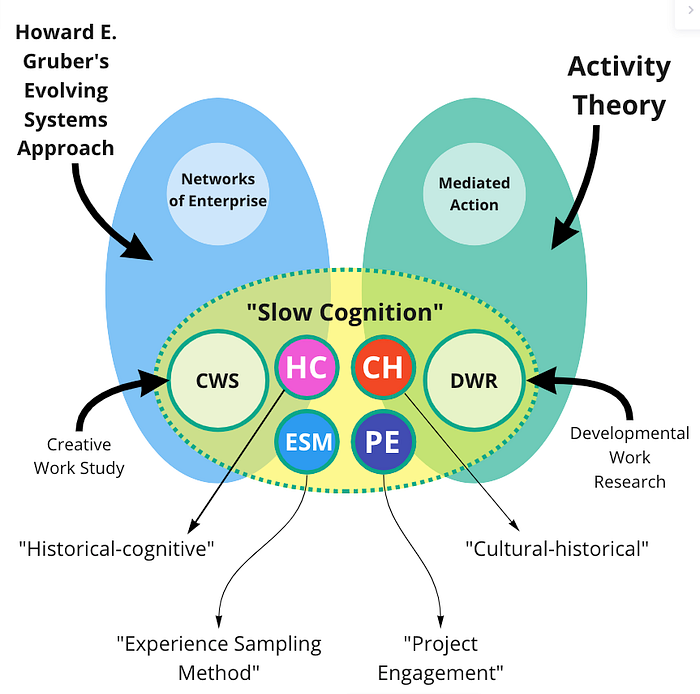
The diagram was born from a sentence I read that morning. In the preface to Creative People at Work, Gruber and Wallace wrote: "Our book is about how creative people do what they do." I realized immediately that the same sentence could be spoken by any empirically oriented Activity Theorist. "How…People do what they do" — this is the fundamental concern of Activity Theorists observing work practices in the wild.
It was a moment of recognition. Two traditions, speaking in different vocabularies, were looking at the same thing. Gruber spoke of Enterprise and Networks, tracing how a creative individual organizes and advances their work across a lifetime. Activity Theory spoke of Activity Systems and Mediated Action, tracing how human activity unfolds through tools and social contexts. The vocabularies differed, but their gaze pointed in the same direction: how human beings work creatively.
On May 31, 2022, I designed the picture below to highlight the focus of the Slow Cognition project (phase II).
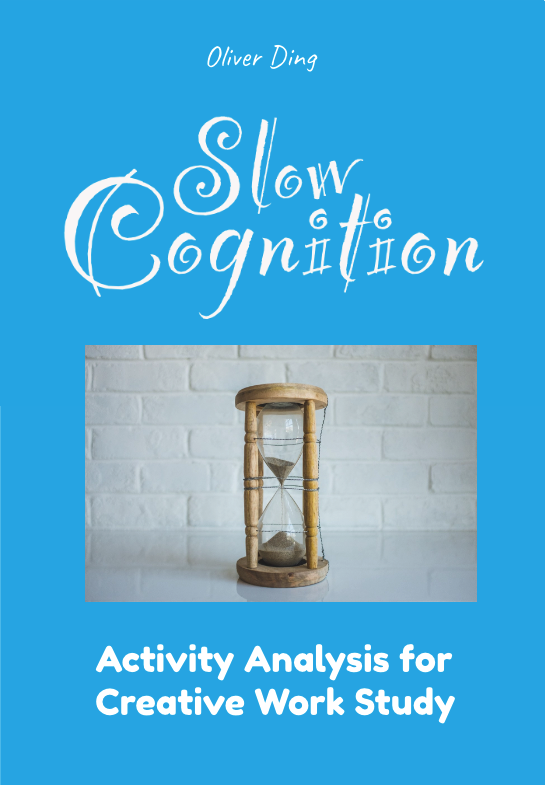
The value of that diagram was not that it provided an answer. It revealed an unnamed symmetry — between Enterprise and Activity. It drew a dotted line. What lay behind that line would take four years to unfold.
The Slow Cognition project (Phase II) was closed on Oct 1, 2022. Later, I launched Creative Life Theory (v1.0) in December 2022. Since then, I have used the "Creative Life Curation" method to name my method for case studies of creative life.
Yet the four sources that inspired the Slow Cognition Method have continued to echo through everything I have done.
2
Four years later, the symmetry hidden in that diagram had found its conceptual articulation.
In November 2025, I released the book Developmental Projects and introduced a new version of the Cultural Projection Model. In this model, Activity and Enterprise are used as two containers. We may picture an Enterprise as a chain — an ongoing sequence of endeavors that unfolds over time — while an Activity can be seen as a node within that chain, a self-contained system composed of coordinated actions.
The model draws a clear distinction between researchers and actors. Traditional Activity Theorists study Activity as an object of analysis from the researcher's perspective. The concept of Enterprise re-centers the actor's own perspective, giving the subjective experience back to them.
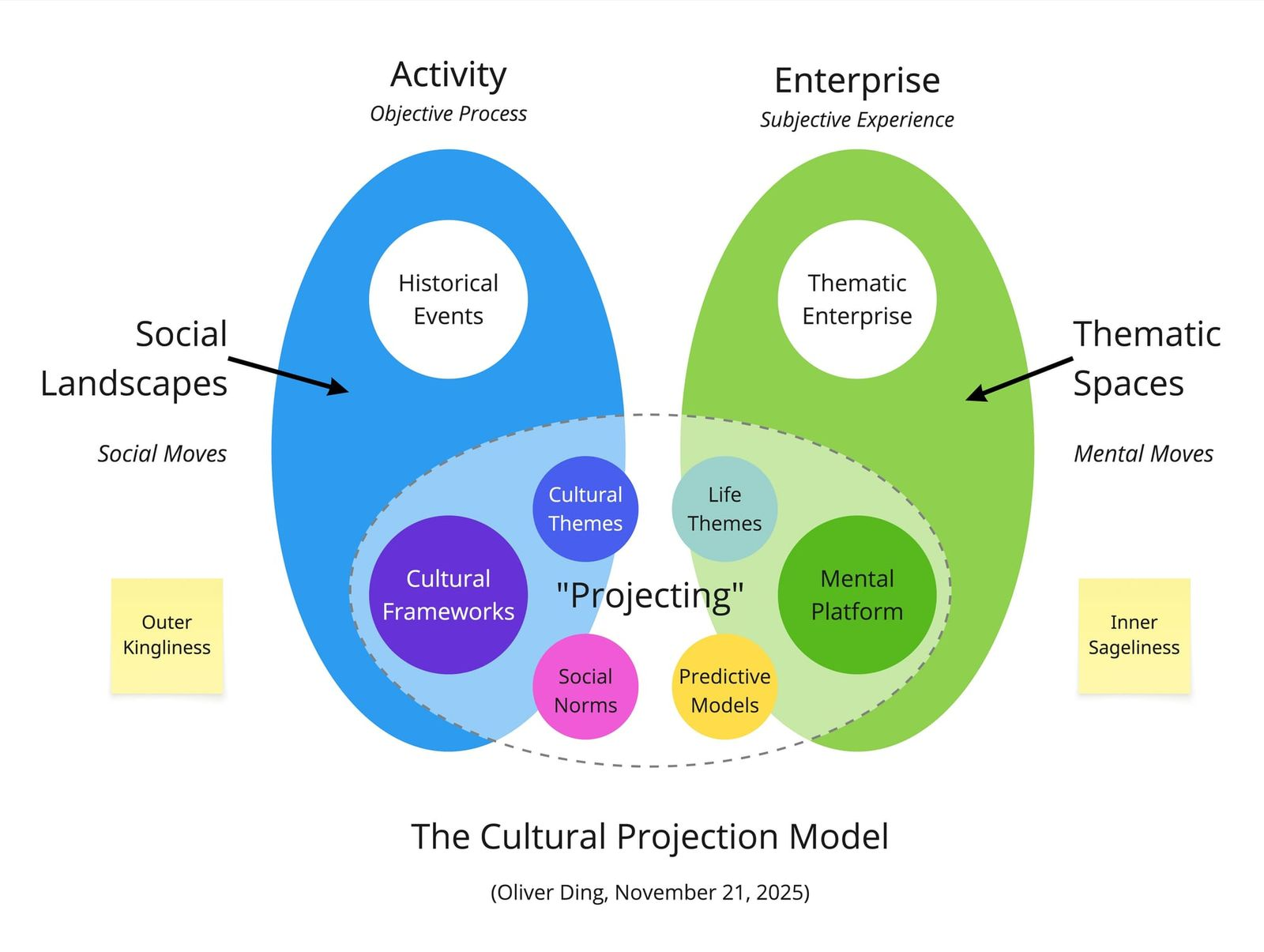
In Weave the Theory, the book I am releasing today, this symmetry underwent another transformation. I established a three-level conceptual relationship: Theoretical Activity — Theoretical Enterprise — Theoretical Platform. Enterprise, originally from Gruber. Activity, originally from Activity Theory. They are no longer in competition. They occupy three positions on a single continuum, woven together by a toolkit I call "Weave the Enterprise."
What does this toolkit analyze? In Part 3 of the book, I use it to study Activity Theory itself as a century-long theoretical tradition. Engeström, Nardi, Spinuzzi — each engaged with this theoretical platform in a different mode, each built their own theoretical enterprise within and alongside it. Engeström's pattern is social and systemic, spanning all four areas of the Knowledge Discovery Canvas. Nardi's pattern is curatorial and network-building; she performed a second founding of Activity Theory for the HCI community. Spinuzzi's pattern is dialogical; through sustained third-wave encounters with Actor-Network Theory, he produced mediating concepts neither tradition could have generated alone.
This diversity is not incidental. It is what a living knowledge ecology looks like from the inside: many contributors, many modes of engagement, many supportances actualized — all organized around a shared Meta-framework whose coordination mechanism has remained consistent across a century of radical change.
The Enterprise and Activity that stood side by side in that 2022 diagram were just two words. Four years later, they have become a framework capable of analyzing a hundred-year theoretical tradition. The dotted line has been filled in.
3
The Slow Cognition project formally ended in the fall of 2022. But the cognitive stance it named never left my work.
Beneath that method diagram, I wrote that the Slow Cognition Method drew inspiration from four sources: the Historical-cognitive method (HC), the Cultural-historical method (CH), the Experience Sampling Method (ESM), and the Project Engagement method (PE).
These four have continued to echo through everything I have done since.
HC comes from Gruber. Its core is combining historical research with cognitive research to trace the long-term evolution of a creative individual's thought. My 2017 "Individual Epistemology Landscape" series, the 2022 Slow Cognition case studies — such as "How did I develop Curativity Theory?" — and the Engeström, Nardi, and Spinuzzi case studies in Weave the Theory all practice this method. Each case asks the same question: in what sequence did this thinker's ideas unfold?
CH comes from the Activity Theory tradition, with its emphasis on tool mediation, social context, and systemic transformation. In the AT series of Weave the Theory, it appears in my analysis of Activity Theory as a Theoretical Tradition and a Theoretical Platform — not the product of a few brilliant minds, but a collective knowledge ecology spanning a century and multiple generations.
ESM originally came from Csikszentmihalyi and Larson's daily experience sampling, recording participants' feelings and behaviors at micro time-scales. I transformed it into a different practice: not logging daily emotions, but continuously recording the ideas, turning points, and intermediate outputs of my own theoretical creation process. The articles I have published on Medium since 2021 are traces of this "cognitive sampling." Together, they form the empirical ground that makes my theoretical career available as an object of analysis.
PE is my own methodological creation. It focuses on how an individual engages with a concrete project and is transformed by it. This spirit runs through Weave the Theory: every case study traces how a theorist engaged with a series of projects, and how that engagement in turn shaped their theory.
The case studies in Weave the Theory are not retrospective chronicles. They are a simultaneous enactment of all four method sources. The Genidentity analysis — how a tradition maintains its identity over time — that is HC's long-term tracing. The Journey analysis and the Sandglass Model — that is CH's structural awareness. Both my "mini" theories and "grand" theories case studies require ESM's sensitivity to collect original data. And every case is organized around concrete project trajectories — that is PE's core operation.
The title "Slow Cognition" can step back from the stage. Its methodological spirit has never left. It has sedimented into my way of working, becoming the background color of the analytical toolkit itself.
4
While I was building the methodology, another line was advancing in parallel.
In August 2022, I designed the "Modeling Social Practices" framework for the Activity Analysis Center. Its core is a WXMY meta-diagram: Container X (Theory) — Container Z (Echozone) — Container Y (Social Practice).
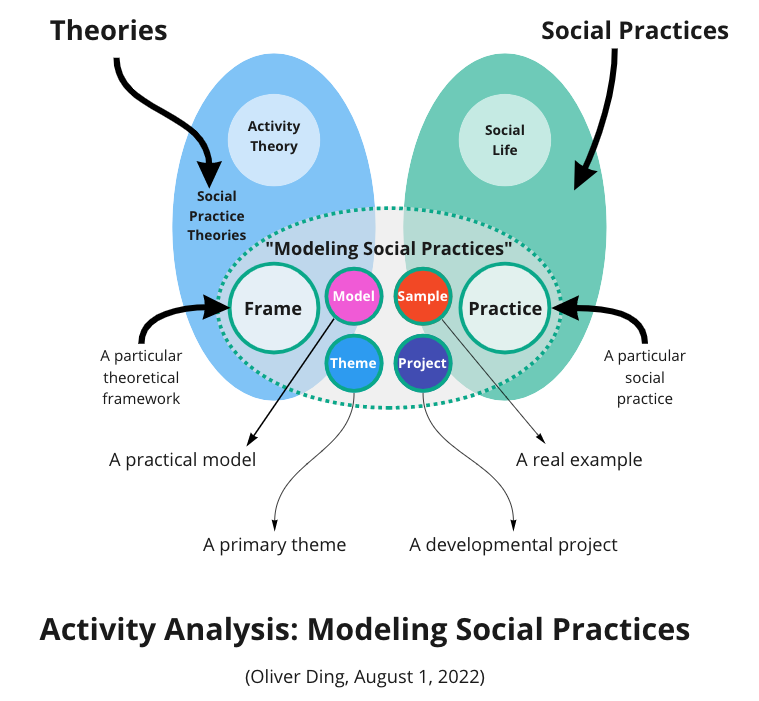
Container Z is defined as a Developmental Project. Each participant develops a model for their own specific social practice within this container. The process structure is: Practice → Sample → Model → Theme → Frame → Project.
The elegance of this design is that Container Z is not simply "theory application." It is a creative space for dialogue, the place where theory and practice encounter each other. At the time, I made a demonstration case for a friend working on an adult development program — using the Hubhood framework as a theoretical lens to develop a Sailor's Mandala model for her project.
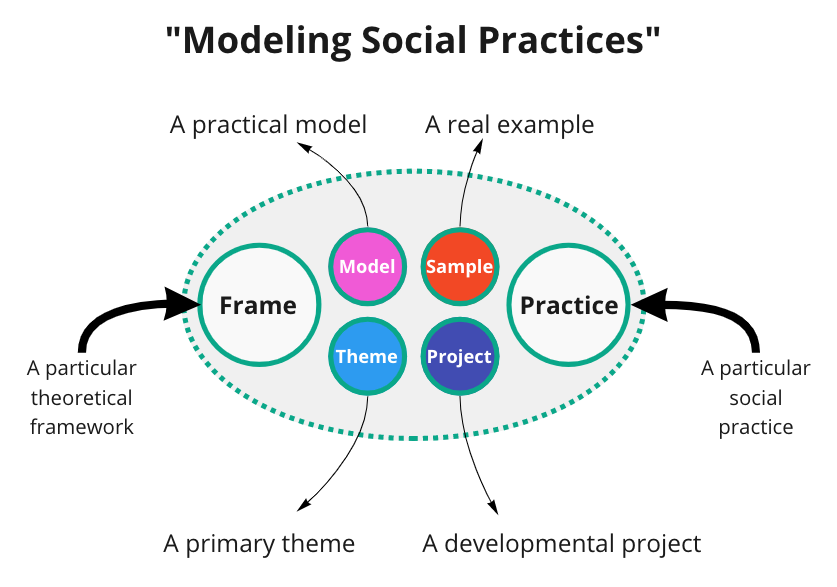
When I place this design next to the Slow Cognition diagram, a symmetry emerges. The Slow Cognition diagram faces inward — two methodological traditions in dialogue, building my own cognitive tools. Modeling Social Practices faces outward — theory and practice in dialogue, building developmental containers for others. Yet both share a common kernel: the Developmental Project. In Gruber's framework, Project → Enterprise is an individual's developmental line. In the WXMY meta-diagram, Container Z itself is a developmental project.
The significance of these two parallel lines is this: theoretical activity is never only about building more refined frameworks. It must include an exit — a way for frameworks to become developmental containers for other people's cognition.
5
In September 2023, I found a more systematic form for this exit: the Activity Analysis & Intervention (AAI) project.
AAI's core design consists of two nested analytical cycles. First-order Analysis (Client-Consultant) faces outward — using Activity-centered knowledge to solve clients' practical problems. Second-order Analysis (Consultant-Coach) faces inward — the consultant, supported by a coach, reflects on their own mode of engaging with theory and develops their personal knowledge.
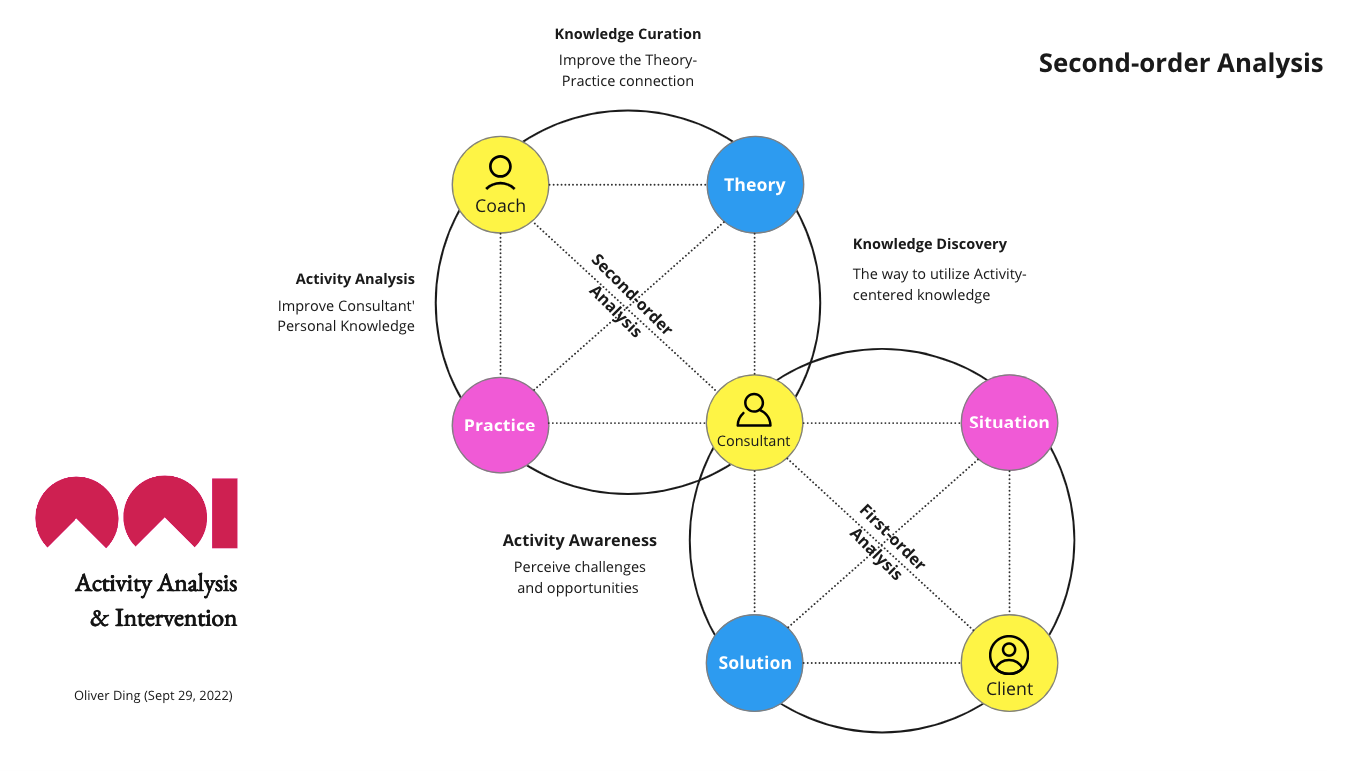
This nested structure is exactly what I have been doing all along: using Activity Theory to analyze other people's creative work, while simultaneously analyzing my own engagement with Activity Theory. AAI transforms this "self-reflexive theoretical activity" into a service structure in which others can work.
In Second-order Analysis, the Coach's role is particularly crucial. The Coach is not there to transmit theoretical content, but to help the Consultant develop their own capacity for theoretical activity — not merely "using theory," but understanding their own cognitive process as they use it. It is here that the four method sources find their "other." HC becomes the Coach helping the Consultant trace their own cognitive trajectory. CH becomes placing the Consultant's personal practice within the larger tradition of Activity Theory for examination. ESM becomes the Consultant's recording and reflection on their own practice process. PE becomes the entire analysis itself as a Developmental Project.
I ended that announcement with a line: "The AAI project is an accelerator for you to achieve a creative life." Ostensibly written for the participant, it can also be read as a self-summary of this entire path: the ultimate purpose of methodological exploration is not to build a more refined theory, but to enable more people to find their own creative life through the dialogue between theory and practice.
6
In November 2024, I designed a new logo for the Activity Analysis Center.
The old logo, from 2022, was a red circle, symbolizing a meaningful whole: Activity. The new logo has two circles — one red, one blue.
The direct inspiration came from a sudden insight while sharing the basic model of Project-oriented Activity Theory with a friend. I suddenly saw a spatial mapping between that model and the AAI project: the lower layer is Activity, the higher layer is Knowledge. I was struck by the experience — it was the same kind of recognition as reading Gruber's preface in May 2022: not deliberate construction, but a sudden seeing.
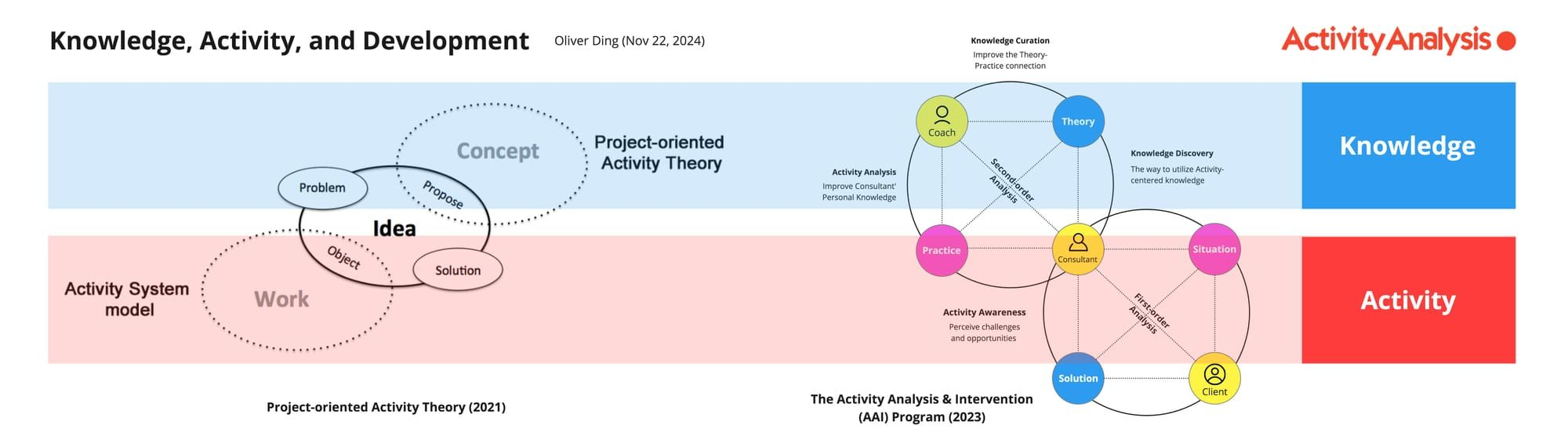
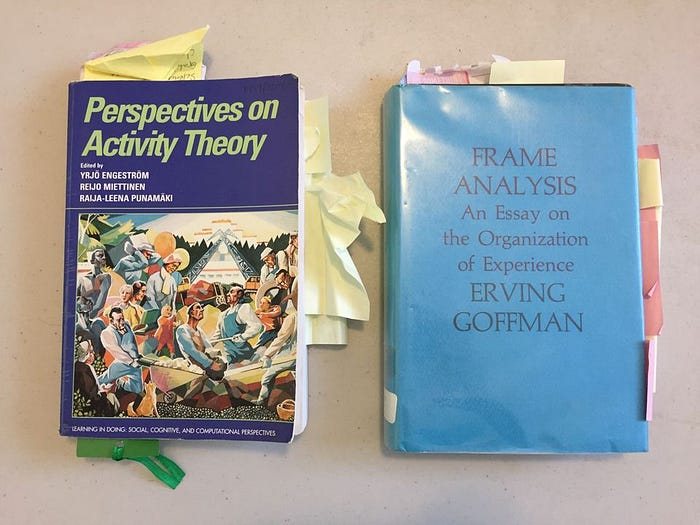
But the meaning of this mapping runs deeper. It led me to trace the evolution of the term "Activity Analysis" itself. In 2022, it was merely a website name, inspired by Perspectives on Activity Theory and Goffman's Frame Analysis. After the AAI project launched in 2023, it became a theoretical concept — the introduction of Second-order Analysis meant that the object of analysis was not only other people's activity, but also the analyst's own mode of engaging with theory.
By late 2024, drawing inspiration from Eric Berne's Transactional Analysis, I began to envision a new method: systematically analyzing a person's activities in order to develop their Self, Mind, Life, and Mindset. Traditional Activity Theory has focused on understanding human activity and social practices. The direction I am opening is to use activity analysis as a pathway for facilitating individual adult development.
The new logo is a condensation of all this.
And when I place it alongside Weave the Theory, a more precise reading emerges: the red circle represents Activity Theory — the external theoretical tradition as an object of study; the blue circle represents Theoretical Activity — the internal creative work of engaging with theory.
Weave the Theory is precisely about the dialogue between these two circles. It is not a book "about Activity Theory." It is a book that demonstrates how Theoretical Activity operates — how I use the resources of Activity Theory to build analytical tools, and then use those tools to analyze the Activity Theory tradition itself. This entire recursive process is what the blue circle stands for: Theoretical Activity.
7
From the Slow Cognition diagram of 2022 to the red-and-blue logo of 2024 — along this path, my engagement with Activity Theory has traced a complete arc.
That diagram was complex and open — two methodological traditions in mutual gaze, an unnamed middle zone, arrows needed to connect them. The new logo is simple and settled — the two circles no longer need arrows. They have found their places within a single symbol.
From diagram to logo, Activity Theory moved from being an object learned and appropriated (red) to being an ecological space within which I can continue to unfold theoretical activity (blue). Weave the Theory is the most complete record of this path: it analyzes Activity Theory and simultaneously demonstrates how theoretical activity itself can operate.
Two circles, red and blue. This is not an endpoint. It is a moment of clear self-referential confirmation: my engagement with Activity Theory has itself become part of my theoretical activity.
This, perhaps, is what the art of theoretical activity consists in — not standing outside theory to apply it, nor standing inside theory to annotate it, but in the long-term engagement with it, turning oneself into an object that theoretical activity can study, and from that reflection, growing new frameworks, new tools, new exits into practice.
In 2022 I called it Slow Cognition. In 2026, it has a more accurate name: The Art of Theoretical Activity.
v1.0 - May 14, 2026 - 2,375 words