
Methodological Empathy: The HITED Framework and the Theory-Method Fit

This article is part of a new possible book Weave the Theory.
by Oliver Ding
May 24, 2026
There is a widely shared aspiration in the social sciences that researchers should be open to multiple methods — that no single approach holds a monopoly on valid inquiry, and that different methods illuminate different dimensions of social reality. This aspiration is usually called methodological pluralism, or methodological openness. It is a reasonable and important commitment. But it is not what this article is about.
Methodological Empathy is something different. It is not the tolerance of other methods, but the understanding of them — the capacity to enter another researcher's methodological choices from the inside, to grasp why those choices are, for them, not arbitrary preferences but necessary consequences of their theoretical commitments. This requires more than openness. It requires the recognition that method and theory are bound together: that a researcher's way of generating hypotheses, collecting data, and validating claims is not separable from what they believe knowledge is, what they think social reality consists of, and what they consider a satisfying explanation.
In 2022, I developed the HITED framework as a visual language for making methodological differences visible — and named Methodological Empathy as an aspiration in its final paragraph. What that article did not do was theorize the concept or identify the governing principle behind it. This article revisits and rebuilds that work through the Weave-the-Theory model. The HITED framework is retained as the Model, Methodological Empathy is developed as the Concept, and Theory-Method Fit is introduced as the Principle that gives the whole development its theoretical foundation.
Contents
Part 1. Background: Weave-the-Theory and the RR Practice
1.1 The Weave-the-Theory Framework
1.2 The Revisiting-Rebuilding Strategy
Part 2. Theme: The Aspects-Approaches Fit as Lived Experience
Part 3. Model: The HITED Framework
3.1 The Five Elements
3.2 The Hypothesis-Data Gap
3.3 Six Configurations
3.4 The Anti-Theory Configuration
3.5 The Hypothetico-Deductive Configuration
3.6 The Experimental Configuration
3.7 The Private Science Configuration
3.8 The Action Research Configuration
3.9 The Imagination Design Configuration
Part 4. Concept: Methodological Empathy
4.1 From Openness to Empathy
4.2 Three Levels of Empathy
4.3 HITED as an Empathy Instrument
Part 5. Principle: Theory-Method Fit
5.1 Activity as Principle or Object: Yudin's Distinction
5.2 The Binding of Theory and Method
5.3 Formal Cause and the Map Character of HITED
Postscript:
What the Rebuild Reveals
Part 1. Background: Weave-the-Theory and the RR Practice
Before the Rebuild can proceed, two things need to be established: the analytical framework being used to conduct it, and the creative strategy that governs how a past work is revisited and taken to a deeper level. This Part introduces both — the Weave-the-Theory model and the Revisiting-Rebuilding practice — and explains how they combine in this article.
1.1 The Weave-the-Theory Framework
The Weave-the-Theory framework is a meta-model for analyzing theoretical activity — the work that researchers and theorists do when they develop, refine, and apply theoretical knowledge. It proposes that any theoretical enterprise involves two simultaneous lines of movement: a Creativity Line that proliferates outward through Theme and Model, and a Curativity Line that unifies inward through Concept and Principle. These two diachronic lines intersect at four weave-points — Theme, Model, Concept, Principle — that mark the key moments of transformation in any theoretical development.
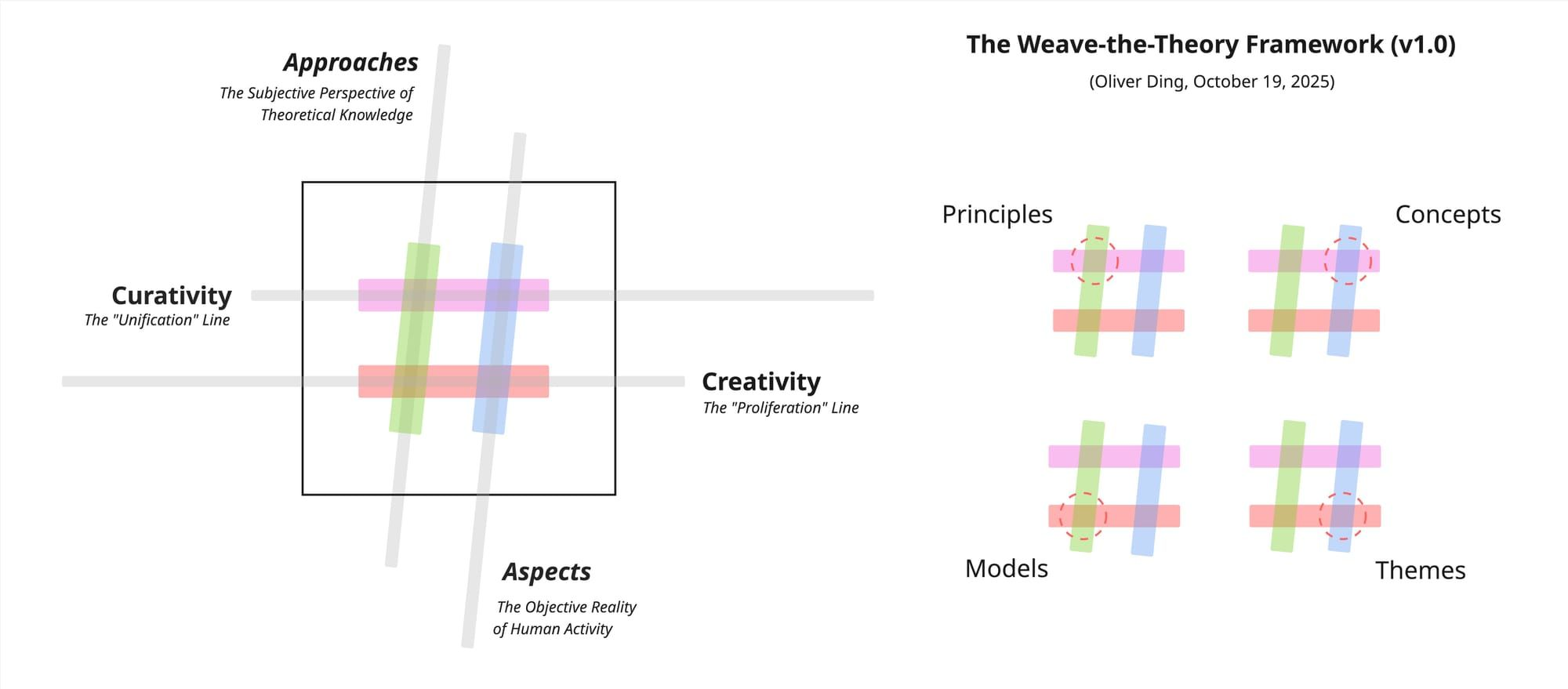
The framework also has two synchronic dimensions: Aspects, referring to the objective structures of reality that theory seeks to explain, and Approaches, referring to the theoretical perspectives through which that reality is interpreted. Together, the four lines produce a thematic space within which any theoretical enterprise can be located and analyzed.
As a meta-model, Weave-the-Theory does not prescribe how theoretical work should proceed. It describes where it is and how it moves. This neutrality is not a limitation — it is the condition that makes the framework useful across different theoretical traditions, methodological positions, and knowledge domains. It is an observatory, not a laboratory.
1.2 The Revisiting-Rebuilding Strategy
The Revisiting-Rebuilding (RR) practice is a creative strategy for returning to past work and rebuilding it through a more developed present identity. It is not revision — it is not correcting errors or updating details. It is the recognition that a prior piece of work was operating at a particular level of development, and that the accumulated work since then makes it possible to take the same material to a deeper level.
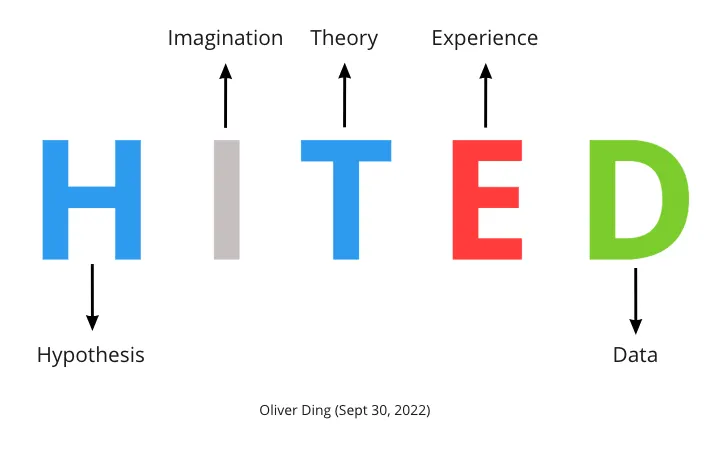
In 2022, I developed the HITED framework as a visual language for making methodological differences visible. That article was written for a design innovation audience — practitioners working at the intersection of design, creativity, and organizational change. It named Methodological Empathy and introduced five letters — H, I, T, E, D — as a thematic space for mapping different research approaches. The framework was genuinely useful. But it remained at the Theme and Model levels: it named a real phenomenon and provided a structural tool for describing it, without developing the concept or identifying the governing principle.
This article applies the RR practice to that 2022 work. The rebuild returns to the social science research domain — the context in which methodological debates are most explicitly theorized — and uses the Weave-the-Theory model as its organizing structure. Theme, Model, Concept, and Principle are each addressed in turn.
The move from design practice to social science research is not a change of subject. It is evidence that Methodological Empathy operates at the Concept level — not the Theme level. A Theme is always situated: it belongs to a specific domain, a specific practice, a specific community of inquiry. A Concept, by contrast, captures an objective structure that holds across situations. The fact that Methodological Empathy applies equally to a designer navigating different design methods and a sociologist navigating different research traditions is precisely what distinguishes it as a Concept rather than a situated observation.
The underlying structure — that methodological choices are bound to theoretical commitments, and that understanding this binding is what makes genuine empathy possible — is invariant across contexts. The 2022 article encountered this structure in one domain; this Rebuild demonstrates that the structure holds in another. What was already there — the HITED framework and the naming of Methodological Empathy — is retained and deepened. What was missing — the theoretical definition of the concept and its governing principle — is now supplied.
Part 2. Theme: The Aspects-Approaches Fit as Lived Experience
Every theoretical development in the Weave-the-Theory framework begins with a Theme — a lived, practiced experience of something real, noticed and named before its full structure has been worked out. The Theme for this development is the experience of practicing Methodological Empathy directly: entering four distinct methodological positions from the inside and discovering, through that entry, what genuine empathy requires. — not with a theoretical proposition, but with a lived, practiced experience of something real. The Theme is the territory of the phenomenon before it has been fully theorized: it has been noticed, named, and inhabited, but its structural character has not yet been fully worked out.
The Theme for this development is the experience documented in my companion article The Aspects-Approaches Fit — an article that is itself an act of Methodological Empathy, though it does not use that term. In that article I traced four methodological positions — Grounded Theory, Adaptive Theory, Swedberg's craft-based theorizing, and Ecological Formism — and examined each from the inside: not asking which is correct, but asking what theoretical commitments make each position internally coherent and, for its practitioners, necessary.
Working through those four positions produced a recognition that is the lived starting point for the present development. Grounded theory's insistence on bracketing prior theory is not stubbornness or naivety — it is a consequence of its deepest theoretical commitment: the belief that concepts imposed from outside will distort the empirical encounter before it has had a chance to reveal its own structure. Layder's Adaptive Theory is not methodological opportunism — it reflects the conviction that the theorist's prior knowledge is always already shaping observation, and that pretending otherwise produces impoverished rather than purer inquiry. Swedberg's suspicion of theoretical frameworks is not anti-intellectualism — it follows from his understanding of theorizing as craft, as a form of knowing that must grow organically from inside the researcher's own encounter with the phenomenon. And Ecological Formism's insistence on direct structural perception is not mysticism — it is grounded in a specific epistemological claim about how Invariant Structure becomes visible through the movement of the point of observation.
Each of these positions, entered from the inside, reveals a coherent architecture. The differences between them are not differences in rigor or intelligence. They are differences in theoretical commitment — in what each position believes about the nature of knowledge, the structure of social reality, and what counts as a satisfying explanation. This recognition — that methodological differences are grounded in theoretical differences — is the lived experience from which this development grows.
Part 3. Model: The HITED Framework
The Theme established in Part 2 — the lived recognition that methodological differences are grounded in theoretical differences — needs a structural tool: a way of making those differences visible, describable, and comparable across traditions. The HITED framework is that tool. Developed in 2022 as a visual language for design practitioners, it is retained here as the Model for this development, now applied to the social science research domain and expanded with more precise accounts of its six configurations.
3.1 The Five Elements
The HITED framework takes its name from five letters, each naming a distinct element in the landscape of knowledge production:
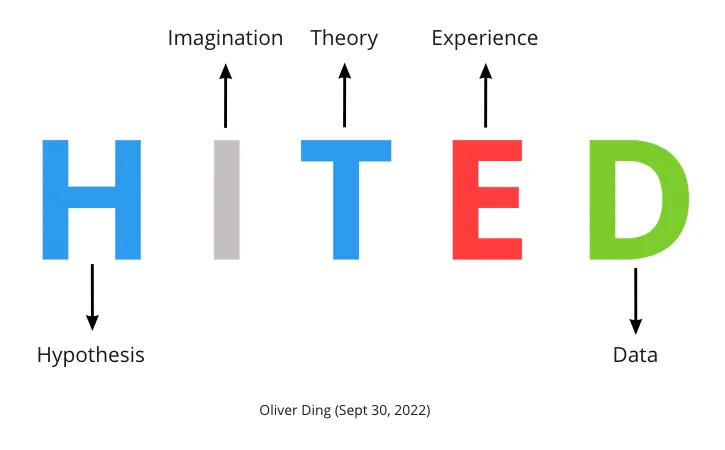
H — Hypothesis: the theoretical proposition that a researcher brings to the empirical encounter, or generates through it. A hypothesis is not simply a guess — it is a structured claim about how things are, derived from or pointing toward a theoretical framework.
I — Imagination: the generative cognitive capacity that operates between the established and the unknown. Imagination is what allows a researcher to move beyond the data they have, to connect disparate domains through analogy, to construct a simulative world in which new hypotheses can be tested before empirical encounter. It occupies the I position in the framework precisely because it is neither reducible to Theory nor to Experience — it is the mediating capacity between them.
T — Theory: the established body of conceptual knowledge that the researcher brings to the inquiry. Theory is not merely a source of hypotheses — it is also a lens that shapes what counts as relevant data, what counts as a satisfying explanation, and what counts as a meaningful question. This shaping function is what makes Theory methodologically consequential beyond its content.
E — Experience: the domain of empirical encounter — the researcher's direct engagement with social reality through fieldwork, observation, interview, or participation. Experience is the source of Data, but it is not identical with Data. Experience is lived and contextual; Data is selected, recorded, and made portable. The movement from Experience to Data is itself a theoretical operation, shaped by the frameworks the researcher brings.
D — Data: the structured records of empirical encounter that can be analyzed, compared, and used to test or generate hypotheses. Data does not speak for itself — its significance is always relative to the hypotheses it is being used to evaluate and the theoretical frameworks within which those hypotheses make sense.
These five elements are not a linear sequence. They are positions in a thematic space. Any research process activates some of these positions and connects them through specific pathways — but different approaches activate different positions, establish different connections, and leave different positions inactive. The connections between positions are Mental Moves: the cognitive operations through which a researcher moves from one element to another — from Theory to Hypothesis through deduction, from Experience to Data through observation, from Data back to Hypothesis through validation, from Imagination outward to both Hypothesis and Simulative World. Different methodological configurations are, in this sense, different patterns of Mental Moves within the same thematic space.
The HITED framework is a map of this thematic space: it shows where the positions are and makes visible which Mental Moves any given approach is drawing.
3.2 The Hypothesis-Data Gap
The organizing tension in the HITED thematic space is the Hypothesis-Data Gap — the structural distance between what a researcher proposes (Hypothesis) and what the empirical world provides (Data). This gap is not a problem to be eliminated. It is the generative space within which research operates. Every approach to the gap is simultaneously a methodological choice and a theoretical commitment: it reflects beliefs about how propositions relate to evidence, how the abstract relates to the concrete, and how knowledge grows.
The gap has two faces. On one side is the Theory-Experience gap: the distance between the conceptual vocabulary a researcher brings and the messy, contextual reality they encounter. On the other side is the Hypothesis-Data gap in the strict sense: the distance between the structured claim the researcher is testing and the records of empirical encounter they have produced. Different approaches manage these two faces of the gap differently — some prioritizing the closure of the Theory-Experience gap through immersive fieldwork, others prioritizing the precise alignment of Hypothesis and Data through controlled measurement, still others dissolving the gap through the organic growth of concepts from within the encounter itself.
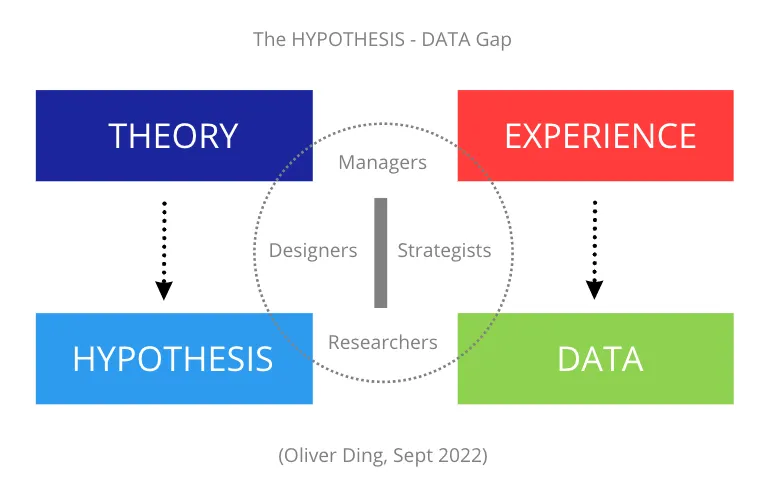
The I position — Imagination — sits at the center of the thematic space precisely because it is the element most capable of spanning the gap. It can work in both directions: generating hypotheses that reach toward the data, and interpreting data in ways that reach toward new theoretical territory. Its centrality is not accidental. It marks the point where the mechanical application of method gives way to the creative act of theorizing.
3.3 Six Configurations
Different research approaches configure the five HITED elements differently — activating some connections, leaving others dormant, introducing new mediating concepts at key junctures. Six configurations are developed here, each representing a distinct approach to the Hypothesis-Data Gap:
- 3.4 The Anti-Theory Configuration
- 3.5 The Hypothetico-Deductive Configuration
- 3.6 The Experimental Configuration
- 3.7 The Private Science Configuration
- 3.8 The Action Research Configuration
- 3.9 The Imagination Design Configuration
These six are illustrations, not an exhaustive inventory. The HITED thematic space can accommodate many more configurations — each new research tradition, interdisciplinary hybrid, or domain-specific practice that a reader brings to the framework is likely to generate its own distinctive pattern of element activation and connection. The framework is open precisely because it is a map, not a prescription.
3.4 The Anti-Theory Configuration
The HITED diagram for the Anti-Theory configuration shows a single direction of movement: Experience generates Data, and Data generates Hypothesis through a process I call Grounded Induction. The T and I positions are deliberately set aside — not because they are irrelevant to research in general, but because this configuration treats their premature activation as a methodological danger. The arrow does not run from T to H; it runs from E through D to H. The Hypothesis that eventually emerges is not derived from Theory but distilled from the accumulated encounter with empirical reality.
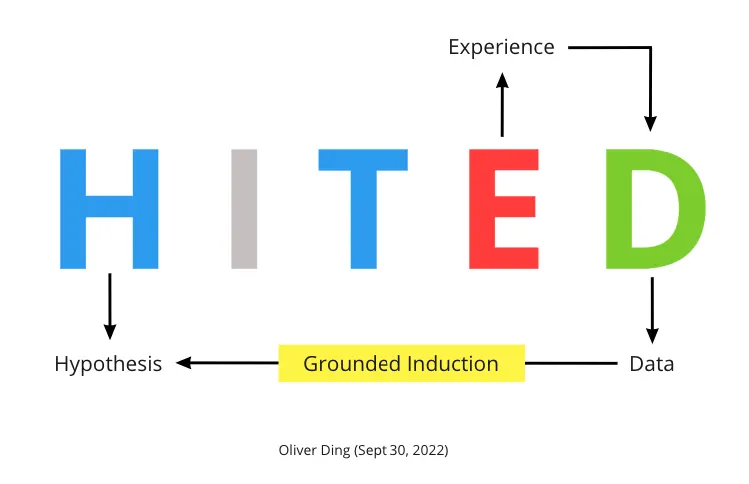
The clearest expression of this configuration is Grounded Theory, developed by Glaser and Strauss in The Discovery of Grounded Theory (1967). Their fundamental argument was a challenge to the dominant positivist model of social research: rather than beginning with a theoretical framework and testing hypotheses derived from it, researchers should allow theory to emerge organically from systematic engagement with empirical material. The T position is not merely bracketed as a methodological precaution — it is actively resisted as a source of contamination. If the researcher enters the field already committed to a theoretical framework, they will find what the framework leads them to look for, and miss what the empirical reality is actually showing them.
The operational core of Grounded Theory consists of three interlocking procedures that together constitute what Glaser and Strauss called the "troublesome trinity": Theoretical Sampling, Constant Comparison, and Theoretical Saturation.
Theoretical Sampling is the distinctive data collection strategy of this configuration: the researcher does not design a sample in advance but decides what data to collect next based on the categories and concepts that have already emerged from earlier analysis. Data collection and analysis are simultaneous and recursive — each analytical move generates new questions that drive the next round of data collection. This means that the E→D→H pathway in the Anti-Theory configuration is not a linear sequence but an iterative spiral: Experience generates Data, Data generates preliminary concepts, concepts generate new questions about Experience, new Experience generates new Data, and so on, until the categories are sufficiently developed to sustain a theoretical claim.
Constant Comparison is the analytical engine of this spiraling process: the researcher systematically compares data segments, codes, and categories across different situations, time points, and participants, looking for patterns, divergences, and structural similarities. The coding process moves through several phases — Open Coding (attaching labels to data segments), Axial Coding (integrating categories and their properties), and Selective Coding (organizing the analysis around a Core Category that represents the central theoretical claim). It is through Constant Comparison that the movement from Data toward Hypothesis becomes structured rather than merely associative: the researcher is not simply accumulating observations but actively testing emerging concepts against new data.
Theoretical Saturation is the stopping rule: data collection continues until no new properties or characteristics of the emerging categories appear from additional data. This is not a statistical criterion but a conceptual one — the researcher judges that the categories are sufficiently developed and that further data collection would not substantially modify the theoretical claims being built. The Hypothesis — or, in Grounded Theory's preferred language, the substantive theory — that results is one whose categories are fully saturated: each concept has been defined through multiple instances, its properties have been elaborated, and its relationships to adjacent concepts have been specified.
It is worth noting that this configuration harbors an internal tension that Glaser and Strauss themselves eventually resolved differently from each other. Glaser's version of Grounded Theory insists on the most radical suspension of prior theory: the researcher should enter the field with a general problem area in mind but without specific theoretical commitments, allowing the theory to emerge as freely as possible. Strauss and Corbin's version is more willing to use pre-existing analytical frameworks — including axial coding paradigms — to guide the analysis, which critics argue reintroduces theoretical commitments through the back door. This internal divergence is itself an illustration of the Theory-Method Fit principle: a disagreement about how much prior theory is permissible reflects a deeper disagreement about the epistemological status of theoretical knowledge and its relationship to empirical encounter.
In the HITED thematic space, the Anti-Theory configuration occupies the E and D positions intensively while deliberately minimizing the T position and constraining the I position to moves within the data rather than leaps toward external theoretical territory. Its strength is fidelity to the empirical: its Hypotheses are genuinely accountable to the material from which they emerge, and the iterative procedures of Theoretical Sampling and Constant Comparison give the analyst a systematic path from raw Experience to theoretical claim. Its limitation — and this is the limitation that the Aspects-Approaches Fit article addresses directly — is that the configuration has no method for distinguishing between a Concept that has genuinely reached the structural level of an Aspect and one that is merely a generalization of surface appearances. Grounded Induction can produce rich, empirically saturated concepts. But it cannot guarantee that those concepts capture invariant structure rather than locally recurring patterns.
3.5 The Hypothetico-Deductive Configuration
The HITED diagram for the Hypothetico-Deductive configuration highlights two key operations: Deduction and Validation. A Hypothesis is generated by deductive reasoning from a pre-existing Theory — the arrow runs from T to H through Deduction. On the other side, Data is used to test the Hypothesis — the arrow runs from D to H through Validation. H occupies the center: it is simultaneously the product of the deductive movement from Theory and the object of the validating movement from Data. The two arrows converge on the same point from opposite directions, and the entire configuration is organized around the question of whether they meet — whether the Hypothesis that Theory generates is the Hypothesis that Data supports.
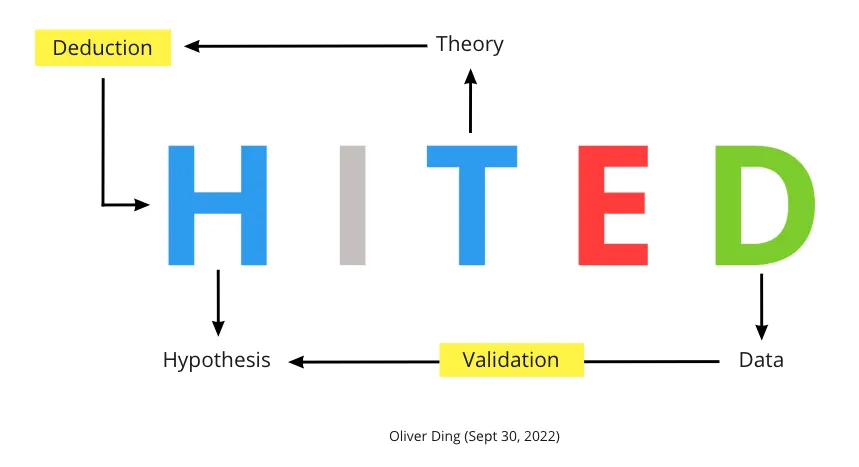
This diagram captures a structural truth about the HD approach, but the simplicity of the picture conceals a significant internal diversity. The two most influential versions of the HD method — Popper's and Hempel's — differ fundamentally on the Deduction side, and that difference has direct methodological consequences.
In Hempel's covering-law model, the T→H path is genuinely deductive in the strict logical sense: a Hypothesis is derived from a general theoretical law together with a set of initial conditions, such that if the theory is true and the conditions obtain, the hypothesis follows necessarily. This is explanation by subsumption — the phenomenon to be explained is shown to be an instance of a general pattern that the theory specifies. The I position plays almost no role in this version: Imagination is not needed when the deductive path from Theory to Hypothesis is fully specified by logical form.
Popper's version is structurally different. For Popper, the source of a Hypothesis is entirely open — it can come from a bold conjecture, an analogy, an intuition, or an act of theoretical imagination. What matters is not how the Hypothesis was generated but how it is tested: a scientific Hypothesis must be falsifiable, meaning it must make predictions that could in principle be shown to be wrong. In Popper's HD, the I position is not marginal — it is where theoretical progress actually originates. The movement from T to H is not strict deduction but what Popper called conjectures: creative leaps that go beyond what the existing theory strictly entails, and that are subsequently subjected to the severest tests the researcher can devise. Science advances not by confirming hypotheses but by eliminating false ones — what Popper called conjecture and refutation.
The Validation side — the D→H path — introduces a further complexity that neither Popper nor Hempel fully resolved. This is the Duhem-Quine problem: any empirical test of a Hypothesis requires not only the Hypothesis itself but also a set of auxiliary hypotheses — background assumptions about instruments, measurement procedures, the reliability of the data-generating process, and the theoretical commitments embedded in the research design. When Data fails to confirm a Hypothesis, the logical structure of the situation does not determine which element of the conjunction is to blame. As Duhem argued, non-separability is the fundamental condition of empirical testing: because predictions are always deduced from a conjunction of the main hypothesis and multiple auxiliary hypotheses, a failed prediction leaves open the possibility of revising any one of the conjuncts rather than abandoning the core theory. Quine generalized this insight into the thesis of underdetermination: the empirical evidence is never sufficient, on its own, to determine which of multiple possible theoretical configurations is correct.
In the HITED thematic space, the Duhem-Quine problem means that the D→H Validation arrow is not a simple path. What is actually being tested at H is not the Hypothesis alone but the entire conjunction of Hypothesis and auxiliary assumptions. When the test fails, the researcher faces a genuine decision — not a logical compulsion — about where to assign the blame. This decision is shaped by the theoretical commitments already held, the cost of abandoning different elements of the conjunction, and the standards of what counts as a sufficient revision. The HD configuration, in practice, is therefore not the clean T→H→D→Validation loop that the diagram suggests. It is a negotiation, in the face of recalcitrant data, about which elements of a complex theoretical-empirical structure to revise and which to protect.
The strength of the HD configuration is its explicit accountability: the Hypothesis is stated in advance, the test is designed to challenge it, and the result is in principle decisive. Its limitation is that this decisiveness is partially illusory — the Duhem-Quine problem means that the result is never as clean as the diagram implies, and the protection of auxiliary hypotheses can insulate a core theory from genuine refutation for much longer than the logic of falsification would suggest.
3.6 The Experimental Configuration
The HITED diagram for the Experimental configuration shows a distinctive structural innovation: H guides the design of an experiment, which creates Artificial Experience — a controlled situation specifically constructed to produce Data relevant to the Hypothesis being tested. The movement is H→Experiment→E→D→Validation, with Artificial Experience as the key mediating element. Unlike the Anti-Theory configuration, which takes E as it naturally occurs, the Experimental configuration actively constructs the experiential conditions under which Data is produced. The experiment is the bridge between Hypothesis and Data — a designed situation that makes the D→H Validation pathway as clean and unambiguous as possible.
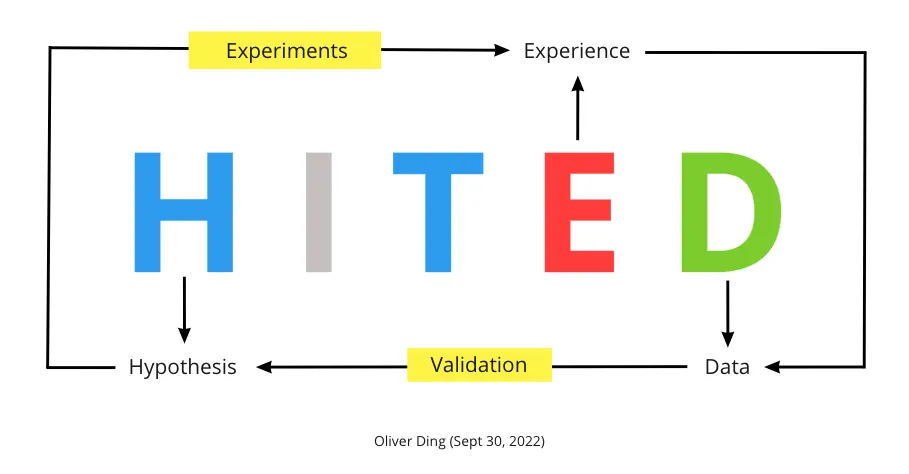
This configuration has very different implications depending on the domain in which it is applied. Three domains — natural science, psychological science, and social science — illustrate the range of what experimental logic can and cannot achieve.
In natural science — physics, chemistry, materials science — the experimental configuration operates closest to its ideal form. The phenomena under investigation are sufficiently stable, law-governed, and context-independent that Artificial Experience closely approximates natural Reality. A chemical reaction produces the same products under the same conditions regardless of when or where the experiment is conducted; the speed of light does not vary with the cultural context of the measurement. Repeatability is not only achievable but definitional: a result that cannot be replicated under the same conditions is not considered a scientific finding. The H→Experiment→D→Validation loop is genuinely closed.
In psychological science, the picture is considerably more complicated. The phenomena under investigation — human cognition, emotion, motivation, behavior — are context-sensitive in ways that physical phenomena are not. The experimental configuration in psychology creates Artificial Experience through laboratory conditions: controlled environments, standardized stimuli, random assignment to conditions, statistical analysis of group differences. These procedures are designed to maximize internal validity — the confidence that any observed effect is caused by the experimental manipulation rather than by extraneous factors. But they do so at the cost of ecological validity: the correspondence between the laboratory situation and the real-world situations in which the psychological phenomena actually occur.
This tension between internal validity and ecological validity is not merely a technical problem — it is a structural feature of the experimental configuration when applied to human psychological phenomena. The laboratory creates an Artificial Experience that is, by design, unlike the situated, contextual, meaning-laden experiences of everyday life. A participant solving an abstract reasoning task in a psychology laboratory is not in the same cognitive situation as a manager making a real decision under pressure, a child learning to read in a classroom, or a patient choosing between medical treatments. The Artificial Experience produces Data about what people do under laboratory conditions; whether that Data tells us what people do under real-world conditions is a question the experimental design cannot answer from the inside.
The result has been a de facto split within psychological science between an experimental laboratory psychology — which maintains the experimental configuration and its standards of internal validity — and a practice psychology — clinical, organizational, educational, counseling — which works with real-world phenomena in their natural contexts and finds the laboratory findings of limited direct applicability. This split is not a sign of failure but of the Theory-Method Fit principle operating at scale: different theoretical commitments about what psychological knowledge is and what it should explain lead to genuinely different methodological choices, and those choices produce genuinely different bodies of knowledge.
In social science — sociology, political science, anthropology, economics in many of its applications — the experimental configuration faces a more fundamental obstacle: the phenomena under investigation are often not experimentable at all, or only at prohibitive cost. You cannot randomly assign countries to political systems, create a controlled laboratory version of a social movement, or replicate the conditions of a historical crisis. Where social experiments are possible — randomized controlled trials in development economics, field experiments in political science — they are expensive, ethically constrained, and contested. The Artificial Experience that the experimental configuration requires is, in much of social science, simply unavailable. This is not a failure of the field but a structural feature of its subject matter: social phenomena are historically embedded, contextually specific, and irreversible in ways that make controlled repetition impossible.
It is worth distinguishing the experimental configuration, as developed here, from what is often called trial and error or action experimentation in design and innovation practice. In trial and error, there is no prior Hypothesis derived from Theory — the designer or practitioner acts, observes the result, modifies the action, and acts again. The H position in this loop is much weaker than in the scientific experimental configuration: it is closer to a guess or a direction of exploration than a theoretically derived proposition. The Data produced is not used to validate a Hypothesis in the strict sense but to inform the next action. This is the "experimental" logic of rapid prototyping, iterative design, and agile development — valuable and generative, but structurally different from the scientific experiment. The Imagination Design configuration (3.9) returns to this theme, where I as the driver of both Hypothesis generation and Simulative World construction makes the distinction between scientific experiment and design experimentation most visible.
Bayesian inference offers one way of connecting experimental logic to the iterative character of trial-and-error practice. Where the classical frequentist framework treats each experiment as a discrete binary test — reject or fail to reject the null hypothesis — Bayesian reasoning allows prior beliefs to be updated continuously as new data arrives. Each experimental result becomes prior information for the next iteration, making the process explicitly cumulative rather than episodic. A/B testing in digital product development is the most widespread contemporary application of this logic: two versions of a feature are exposed to different user populations, behavioral data is collected, and the results are used to update beliefs about which version performs better. The A/B test is an experimental configuration — it controls variables, creates Artificial Experience, and produces Data for Validation — but the hypotheses it tests are typically weak (does A outperform B on metric M?) rather than theoretically derived, and the iteration cycle is fast rather than sequential. It represents the experimental configuration adapted for the practical demands of design innovation rather than the knowledge-production demands of science.
In the HITED thematic space, the Experimental configuration's strength is its precision: by constructing Artificial Experience, it can produce Data that is clean enough to support or undermine a specific Hypothesis with a degree of confidence unavailable to other configurations. Its limitation is the price of that precision: the construction of Artificial Experience necessarily introduces a gap between the laboratory and the world, and how significant that gap is depends entirely on whether the phenomena under investigation are stable and context-independent enough to survive the construction. For natural science phenomena, the gap is negligible. For human psychological and social phenomena, it is structurally significant — and the ongoing tensions within psychological science and the methodological debates in social science are, in no small part, the consequence of applying an experimental configuration to phenomena whose most important features are precisely those that controlled conditions must exclude.
3.7 The Private Science Configuration
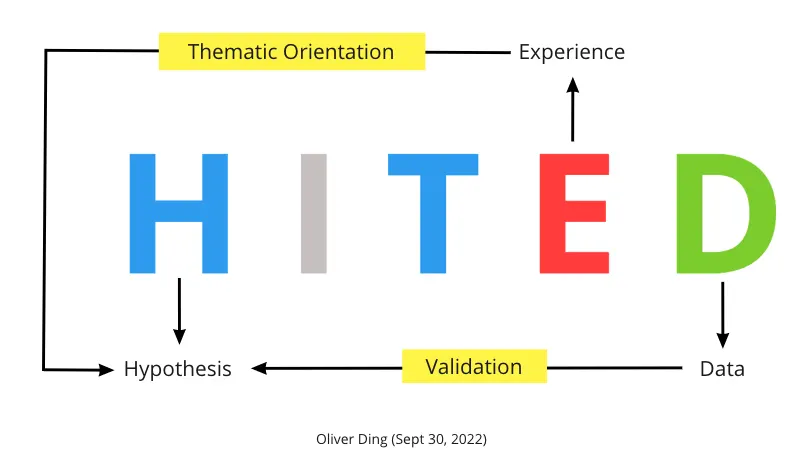
The HITED diagram for the Private Science configuration shows Thematic Orientation connecting T and H — but with a crucial qualification. The arrow from T to H is not the explicit deductive path of the Hypothetico-Deductive configuration. It is a hidden path: the movement from a scientist's deep theoretical commitments to their hypotheses passes through a dimension that does not appear on the surface of published scientific work. The T position is active, but what is active in it is not the publicly stated theoretical framework. It is what Gerald Holton called the thematic dimension of science — the layer of fundamental preconceptions that drives scientific work from below, visible in the private notebooks and initial motivations of scientists but rarely confessed in public print.
Holton's framework, developed in Thematic Origins of Scientific Thought (1973), begins with an observation about the standard account of scientific knowledge. All philosophies of science, he notes, agree on the meaningfulness of two types of scientific statements: propositions concerning empirical matters of fact — which ultimately reduce to meter readings — and propositions concerning logic and mathematics — which ultimately reduce to tautologies. These two types may be called phenomenic (empirical) and analytic, and they can be imagined as two orthogonal axes — an x-axis and a y-axis — defining what Holton calls the contingent plane: the plane in which scientific concepts and propositions have both empirical and analytical relevance. This is the plane of normal scientific discourse — the plane on which experiments are reported, theories are evaluated, and arguments are made.
But the contingent plane, Holton argues, is insufficient to explain how science actually develops. Contingency analysis — the analysis of a scientific statement's empirical and logical dimensions — does not help us understand how the individual scientific mind arrives at its discoveries, or how scientific ideas meet with acceptance or rejection across generations. To understand these processes, a third dimension is necessary: a z-axis, perpendicular to the x-y plane, representing the dimension of themata — those fundamental preconceptions of a stable and widely diffused kind that are not resolvable into or derivable from observation and analytic reasoning. Themata operate in the initial and continuing motivation of a scientist's actual work, and also in the end products toward which that work reaches out. They are the hidden architecture of scientific imagination.
Holton observes that themata almost invariably appear in opposing pairs — a thema and an antithema. For almost every thematically informed theory in science, there exists a theory using the opposite thema. The history of physics is full of such dyads: continuity versus discontinuity, simplicity versus complexity, unity versus plurality, hierarchical structure versus field structure. These are not merely philosophical preferences — they are genuine structural tensions within scientific traditions, and scientists who hold opposing themata will interpret the same experimental results differently, find different theoretical solutions satisfying, and resist each other's frameworks with a persistence that purely empirical or logical disagreement cannot explain. When scientists seem to be arguing past each other despite agreeing on the data, they are often operating from opposed themata — and no amount of additional evidence will resolve the dispute, because the dispute is not at the level of evidence.
The most revealing illustration Holton offers is P.A.M. Dirac. Dirac's theoretical confidence — sometimes in the face of current fashion and experimental evidence — led him to declare: "A theory that has some mathematical beauty is more likely to be correct than an ugly one that gives a detailed fit to some experiments." This quasi-aesthetic judgment is a form of thematic commitment with deep psychological roots. It is not derived from Theory in the explicit sense — it is not a proposition that can be stated as a premise in a logical argument. It is not an empirical observation — no data set can establish that beautiful theories are more likely to be correct. It operates at the Z-axis level: a deep, stable orientation that shapes what Dirac's Imagination finds worth pursuing, what his Hypothesis generation reaches toward, and what his standards of theoretical satisfaction require. And, as Holton notes, such confessions are not common in public print — the thematic dimension of scientific work is precisely what gets filtered out in the transformation from private inquiry to published result.
This is where the relationship between Holton's Z-axis and the HITED framework becomes most illuminating. Holton's second book, The Scientific Imagination (1978), takes this connection as its central subject: how the imagination of the scientist functions early in the formation of a new insight or theory, and how in certain crucial instances a scientist adopts an explicit or implicit thema that guides their work to success or failure. In the HITED thematic space, the I position — Imagination — is precisely the site of Scientific Imagination in Holton's sense: it is where the scientist reaches beyond the existing Theory and available Data to generate new Hypotheses, construct new interpretive possibilities, and feel their way toward configurations that seem theoretically right. The Private Science configuration reveals that this I position is not operating freely. It is operating under the direction of thematic commitment. Dirac's Imagination was not simply generating hypotheses at random — it was searching, systematically and with deep conviction, for theoretically beautiful structures. His I position was shaped by a Z-axis orientation that made certain kinds of hypotheses feel right and others feel wrong, independently of their relationship to existing Theory or available Data.
The precise relationship is this: thematic commitment works through the I position, but it is deeper than I. It is the hidden premise of Imagination — the orientation that determines where Imagination is willing to go, what it finds worth pursuing, and what it considers a satisfying destination. The I position is visible on the HITED diagram; the Z-axis that gives it direction is not. This is why Holton calls it Private Science: the published scientific paper presents the T→H→D pathway — theory, hypothesis, data — which belongs to the X-Y contingent plane and can be evaluated publicly. But the thematic commitment that oriented the scientist's Imagination throughout the research process — why this problem rather than that one, why this theoretical structure rather than that one, why this result feels like progress and that one does not — lives in the I position's hidden depth, and rarely surfaces in the official account.
In the HITED thematic space, the Private Science configuration is unique in making visible what all other configurations also contain but do not acknowledge: the Z-axis of thematic commitment that runs through every scientist's I position, shaping the Hypothesis-Data gap from below. Every configuration has a thematic dimension; only the Private Science configuration makes it the explicit object of analysis.
For Methodological Empathy, this has a direct consequence. Understanding another researcher's methodological choices at the surface level — seeing their T→H→D pathway, their data collection procedures, their validation criteria — is the work of the contingent plane. But genuinely entering their methodological position requires reaching the Z-axis: understanding their thematic commitments, the quasi-aesthetic and quasi-metaphysical orientations that make certain theoretical structures feel right and others feel wrong. This is the deepest level of Methodological Empathy, and the hardest to practice — because thematic commitments are not only rarely stated publicly, they are often not fully conscious even to the scientist who holds them.
3.8 The Action Research Configuration
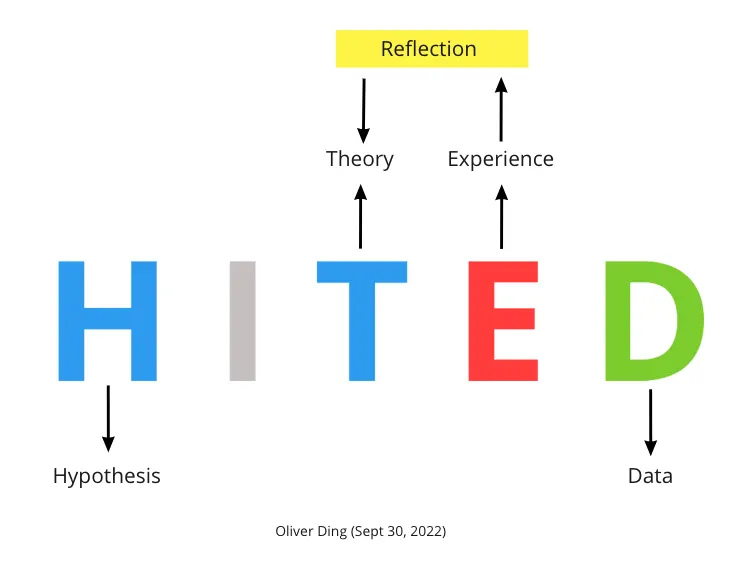
The HITED diagram for the Action Research configuration introduces Reflection as the central mediating element — a process that sits above the T and E positions and connects them bidirectionally. Unlike the Hypothetico-Deductive configuration, where T generates H through deduction and D validates it from below, the Action Research configuration makes the T-E relationship itself the primary object of inquiry. The practitioner does not simply apply Theory to Experience or derive Hypotheses from Data; they develop knowledge through sustained reflection on the relationship between what they think and what they do, what they believe and what their actions reveal. This configuration contains two analytically distinct modules, each with its own account of what T means, what D means, and how Reflection works.
Module 1: Schön and the Reflective Practitioner
Donald Schön's account of professional knowledge begins with a geographical metaphor. On the high ground, technical problems are well-defined, theories are available, and rigorous methods produce reliable results. In the swamp of professional practice, problems are messy, ill-defined, and resistant to technical solution — the situations that matter most are precisely the ones where the established theoretical toolkit is least adequate. Schön's critique of Technical Rationality — the dominant model of professional competence derived from positivist epistemology — is that it privileges the high ground and treats the swamp as a domain of imperfect application rather than a legitimate site of knowledge creation.
Against this, Schön proposed Reflection-in-Action as the core competency of the effective practitioner: the capacity to think about what one is doing while doing it, to notice when a situation surprises or resists, and to reframe the problem and experiment with new approaches in the midst of practice. This is not the application of prior theory to a new case — it is the generation of new understanding from the encounter between the practitioner's existing knowledge and the resistant particularity of the situation. Schön also distinguished Reflection-in-Action from Reflection-on-Practice: the former is immediate, situated, and concurrent with action; the latter is retrospective, cross-situational, and produces more durable theoretical propositions from accumulated experience.
In the HITED thematic space, Schön's module places T in an unusual position. Theory is not the starting point of H — it is a scaffolding tool that the practitioner draws on selectively as they encounter situations that exceed their current understanding. T enters the configuration not through deduction but through Reflection: the practitioner reaches back to theoretical resources when the situation demands a reframing, and the theoretical resource is evaluated by whether it helps them see the situation differently and act more effectively. The E→D pathway is the practitioner's direct encounter with the situation; the T position is activated by Reflection when that encounter produces surprise, confusion, or resistance. This makes the Action Research configuration distinctive: T is not prior to E but responsive to it, and the movement between T and E is not linear but recursive.
Module 2: Argyris and Action Science
Chris Argyris's Action Science operates on a different terrain from Schön's, and it requires a careful clarification of what "theory" means in this context. When Argyris speaks of Espoused Theory and Theory-in-Use, he is not using "theory" in the social science sense — as a framework of concepts and propositions about social reality developed through systematic inquiry. He is using it in a psychological sense: the individual's operative belief system — the set of assumptions, values, and action strategies that govern their behavior in practice.
This distinction matters enormously for how the HITED diagram maps Argyris's framework. His "theories" are not in the T position. They are in the H position: they are the hypotheses — explicit or implicit — that the practitioner holds about what will happen if they act in a certain way. Espoused Theory is the H that the practitioner says they hold: the beliefs they articulate when asked to explain their behavior, the values they claim guide their decisions. Theory-in-Use is the H that their actual behavior reveals: the operative assumptions that can be inferred from what they consistently do, regardless of what they say. The gap between Espoused Theory and Theory-in-Use is a gap between two Hypotheses — one publicly stated, one behaviorally enacted — and they are often significantly different.
In Argyris's framework, D is not external empirical data — it is the practitioner's own behavior, made observable through careful inquiry, video analysis, or structured reflection. The Validation movement in this configuration is not the testing of a theoretical proposition against independent evidence; it is the confrontation of the practitioner with what their behavior actually reveals about their operative beliefs. This confrontation is often uncomfortable, because the gap between Espoused H and in-use H is typically not a matter of hypocrisy but of unawareness: practitioners genuinely believe they are acting on their espoused values while their behavior enacts different assumptions.
Single-loop learning addresses this gap at the level of action: the practitioner modifies their behavior to bring it closer to the outcomes their Espoused H predicts. Double-loop learning goes deeper: it challenges the governing values and assumptions that constitute the Theory-in-Use H itself — not just "am I doing this effectively?" but "should I be doing this at all, and what assumptions am I making that I have never examined?" Double-loop learning is a change at the level of the H structure, not just at the level of action.
The Two Modules in the HITED Space
The two modules share the Action Research label but differ structurally in what they place in each HITED position. In Schön's module, T is social science theory used as scaffolding — an external theoretical resource that the practitioner reaches for when Reflection demands a reframing. In Argyris's module, T is effectively absent from its standard position: what occupies the operative role of T is actually H — the individual's belief system, divided into its espoused and enacted versions. The T position in Argyris's configuration, if it appears at all, is the Action Science framework itself — the external theoretical apparatus that the researcher uses to analyze the practitioner's behavior, not the practitioner's own theoretical commitments.
This structural difference has a direct implication for Methodological Empathy. To understand the Action Research configuration from the inside requires recognizing that "theory" is doing two different jobs in its two modules — jobs that correspond to different positions in the HITED space. A reader who assumes that "theory" always means social science theory in the T position will misread Argyris: they will look for his theoretical framework in the T position and find instead the practitioner's operative beliefs. The clarification is not terminological pedantry — it is the kind of structural understanding that Methodological Empathy requires: entering the configuration on its own terms, recognizing what each element actually means within the logic of the approach, and resisting the temptation to map it onto the more familiar configurations that surround it.
3.9 The Imagination Design Configuration
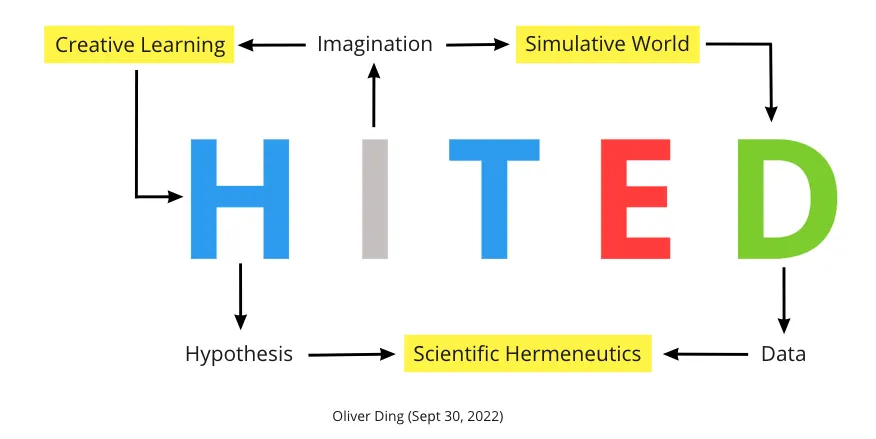
The Imagination Design configuration activates the I position as the primary driver of the entire thematic space — a structural role that no other configuration assigns to Imagination. In the configurations examined so far, I operates as a mediating capacity between established positions: it helps bridge the gap between Theory and Hypothesis, generates interpretive possibilities when Data is ambiguous, or supplies the quasi-aesthetic orientation that makes certain theoretical structures feel right. In the Imagination Design configuration, I is not a bridge between other elements — it is the engine from which other elements are generated. Imagination simultaneously produces new Hypotheses, constructs a Simulative World that generates new Data, and drives the Creative Learning process that transforms both the researcher and the theoretical framework in the course of the inquiry.
This configuration is where the relationship between scientific experimentation and design experimentation — anticipated in the discussion of 3.6 — becomes most clearly visible. In the Experimental configuration, the H position is strong: Hypothesis derives from Theory through deduction or conjecture, and the experiment is designed to test it. In trial and error — the logic of rapid prototyping, iterative design, and agile development — the H position is deliberately weak: the designer acts, observes the result, and modifies the next action without committing to a prior theoretical proposition. The action itself generates the learning. Trial and error does not need a Hypothesis in the strict sense; it needs only a direction, a criterion of success, and the willingness to iterate.
The Imagination Design configuration occupies the space between these two logics. It is not trial and error — it does not simply act and observe. Imagination actively constructs a Simulative World: a domain of possible futures, alternative configurations, and imagined scenarios in which new Hypotheses can be explored before empirical encounter. This is closer to the experimental logic than trial and error is, because the Simulative World is structured by the Hypotheses that Imagination generates — it is not random action but guided exploration. But it is less constrained than scientific experimentation, because the Simulative World is constructed by Imagination rather than controlled by Theory, and the Data it produces is generative rather than validating. The movement in the Imagination Design configuration is not H→Experiment→Data→Validation but I→Hypothesis + Simulative World→Creative Learning→new I.
The specific instantiation of this configuration that I explored in conversation with Maurizio Goetz involves organizations facing radical uncertainty: situations where the existing theoretical vocabulary is insufficient to frame the questions, let alone answer them, and where the gap between what is known and what needs to be known cannot be bridged by deduction, induction, reflection, or trial and error alone. In such situations, Imagination works through analogy and remixing — connecting domains that do not normally speak to each other, recombining elements from different knowledge traditions, and constructing simulative scenarios that make the unknown tractable by giving it a provisional form. The moral dimension Goetz emphasizes — not only what you know but what you value, what is right and ethical and good — is also part of the Imagination Design configuration: I is not value-neutral. It reaches toward futures that are shaped by commitments, and the Hypotheses it generates carry the mark of those commitments.
The key mediating concept in this configuration is Scientific Hermeneutics: the interpretive process through which the Hypotheses generated by Imagination are matched to the Data produced through the Simulative World. Scientific Hermeneutics is what prevents the Imagination Design configuration from collapsing into fantasy: without a disciplined interpretive process, the Simulative World may produce Data that confirms the Imagined Hypotheses through circularity rather than genuine encounter with independent reality. The risk is real — Imagination that is insufficiently constrained by interpretive discipline tends to find what it was already looking for. Scientific Hermeneutics is the element that keeps the configuration epistemically honest.
In the HITED thematic space, the Imagination Design configuration is distinctive in its relationship to the T position. Theory is not absent — it enters through Creative Learning, as the accumulated results of Imagination-driven inquiry gradually crystallize into more stable theoretical propositions. But Theory arrives late and provisionally, as an outcome of the configuration rather than its starting point. The configuration begins with I and moves outward; Theory is what the movement eventually produces, not what it begins from. This is the inverse of the Hypothetico-Deductive configuration, where Theory precedes everything, and it is structurally different from the Action Research configuration, where Theory enters as a scaffolding tool in response to experiential demand. In the Imagination Design configuration, Theory is the destination — the form that Creative Learning takes when Imagination has done its work and the Simulative World has been sufficiently explored.
Part 4. Concept: Methodological Empathy
The HITED framework in Part 3 makes methodological differences visible. But visibility alone does not produce understanding. A researcher can look at six HITED configurations and recognize that they differ without grasping why they differ, or why those differences matter. What is needed is a concept that names and defines the cognitive capacity that transforms visible difference into genuine understanding. That concept is Methodological Empathy — and this Part develops it with the precision that the 2022 article left unfinished.
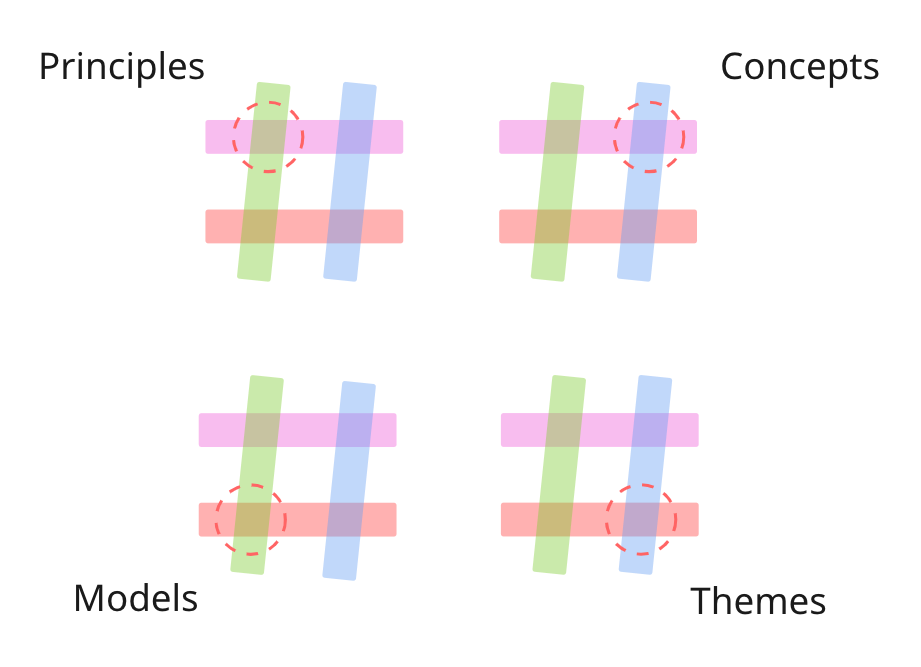
4.1 From Openness to Empathy
Methodological Openness is the recognition that multiple methods are legitimate — that no single approach has a monopoly on valid inquiry, and that different methods illuminate different dimensions of social reality. This is a reasonable and important commitment. It prevents the kind of methodological imperialism in which practitioners of one tradition dismiss all others as invalid. It creates space for intellectual diversity and interdisciplinary exchange.
But Methodological Openness is not sufficient. It is possible to be open to other methods while understanding none of them — to acknowledge their existence while remaining unable to inhabit their logic, engage with their findings on their own terms, or recognize why their practitioners find them not just useful but necessary. This kind of openness is generous but shallow. It tolerates difference without understanding it.
Methodological Empathy goes further. It is the capacity to enter another researcher's methodological choices from the inside — to understand not just what they do but why, given their theoretical commitments, they could not easily do otherwise. This requires recognizing that methodological choices are not arbitrary preferences or habits of training. They are the operational consequences of theoretical commitments: beliefs about what knowledge is, what social reality consists of, and what a satisfying explanation looks like. To practice Methodological Empathy is to trace this connection — to move from the surface of a methodological choice to the theoretical commitments that necessitate it.
4.2 Three Levels of Empathy
Methodological Empathy operates at three distinct levels, each requiring a deeper cognitive move than the one before.
The first level is recognition: the researcher becomes aware that other methodological positions exist and that their practitioners are not simply confused or misguided. This is the level of Methodological Openness — a necessary condition for Empathy but not sufficient for it. At this level, the researcher can say: "I know that grounded theorists bracket prior theory, and I understand that this is deliberate." But they cannot yet say why it is necessary.
The second level is understanding the internal logic: the researcher grasps the coherence of another position on its own terms — recognizes the internal architecture of its commitments and sees how its methodological choices follow from its theoretical presuppositions. At this level, the researcher can say: "I understand that grounded theory brackets prior theory because it is committed to the view that concepts imposed from outside distort the empirical encounter before it has had a chance to reveal its own structure — and given that commitment, the bracketing is not just reasonable but necessary." This is genuine Empathy: the ability to inhabit another position's logic from the inside.
The third level is simultaneous holding: the researcher can occupy their own methodological position with full commitment while simultaneously inhabiting another position's logic — not as a performance or a thought experiment, but as a genuine cognitive act. This is the most demanding level. It requires the researcher to hold two different theoretical architectures in mind at the same time, moving between them without collapsing one into the other. This capacity is what makes genuine methodological dialogue possible — not the mutual reduction of different positions to a common denominator, but the genuine encounter of different theoretical architectures in a shared space.
4.3 HITED as an Empathy Instrument
The HITED framework serves Methodological Empathy specifically as an instrument for the second level — for understanding the internal logic of different methodological positions. This is what the six configurations in Part 3 demonstrate: each configuration is not merely described from the outside but traced from the inside, showing how the activation of specific elements and the establishment of specific connections follow from the theoretical commitments of the approach.
But HITED's contribution to Empathy goes beyond description. As a visual language — a thematic space of five elements — it provides a neutral shared vocabulary within which practitioners of different approaches can locate themselves and each other without immediately falling into the language of mutual critique. When a grounded theorist and a hypothetico-deductive researcher look at the same HITED diagram, they can see that they are not simply disagreeing about method: they are activating different elements of the same thematic space, drawing different connections, leaving different positions dormant. The disagreement is visible as a structural difference, not a personal or intellectual failing.
This is the sense in which HITED is a formal cause tool rather than a purpose or process tool. It does not tell researchers what to do or why. It shows them where they are — and where others are — in the landscape of knowledge production. The map does not resolve methodological differences. But it makes them discussable.
Part 5. Principle: Theory-Method Fit
Methodological Empathy, as developed in Part 4, is a Concept that defines a cognitive capacity and articulates its three levels. But a Concept, in the Weave-the-Theory framework, is not yet the most abstract claim a development can make. The Principle is: the governing insight that explains why the Concept is structured the way it is, and what makes it theoretically necessary rather than merely practically useful. For Methodological Empathy, that governing insight is the Theory-Method Fit — the binding relationship between a researcher's theoretical commitments and their methodological choices that makes empathy both necessary and difficult.
5.1 Activity as Principle or Object: Yudin's Distinction
In the 1970s, the Soviet philosopher E.G. Yudin drew a distinction that bears directly on the question of Methodological Empathy. He noted that the concept of Activity — the central concept of Activity Theory — could be understood in two fundamentally different ways: as a principle of explanation or as an object of study.
When Activity functions as a principle of explanation, it is the lens through which other phenomena are analyzed. The researcher does not study Activity directly; they use the concept of Activity to make sense of learning, development, work, communication, or any other domain of human life. Activity is the theoretical framework — the Approach — that organizes the inquiry.
When Activity functions as an object of study, it is itself the phenomenon under investigation. The researcher treats Activity as something that can be observed, described, and analyzed — as data to be explained rather than a framework for explaining. Activity moves from the Approaches side of the Weave-the-Theory thematic space to the Aspects side.
Yudin's distinction is not merely a terminological clarification. It identifies a structural feature of theoretical concepts that has direct methodological consequences. The same concept, deployed as a principle of explanation versus an object of study, generates completely different research designs, different data requirements, different standards of evidence, and different forms of valid argument. A researcher who treats Activity as an explanatory principle and a researcher who treats it as an object of study are not simply studying the same thing with different methods. They are doing structurally different kinds of inquiry — and their methodological choices are consequences of this structural difference, not independent variables.
5.2 The Binding of Theory and Method
Yudin's distinction generalizes into a governing principle: theory and method are bound together. A researcher's methodological choices — how they generate hypotheses, collect data, validate claims, and build arguments — are not separable from their theoretical commitments. They are the operational consequences of those commitments.
This binding is what makes Methodological Empathy both necessary and difficult. It is necessary because superficial methodological comparison — describing what different approaches do without understanding why — produces only the first level of Empathy: recognition without understanding. To reach the second and third levels, the researcher must trace the connection between methodological choices and the theoretical commitments that necessitate them. Only by understanding the theoretical architecture can they understand why the methodological choices are not arbitrary.
It is difficult because the binding is often implicit. Most researchers do not begin their work by stating their theoretical commitments and then deriving their methodological choices from them. The binding operates in the other direction: the methodological habits and choices of a research tradition encode its theoretical commitments, and practitioners absorb those commitments through practice rather than through explicit instruction. This is why methodological disagreements so often feel like disagreements about values or identity rather than about technique: the theoretical commitments encoded in methodological practice are bound up with the researcher's sense of what good inquiry looks like, what counts as understanding, and what the point of research is.
The Theory-Method Fit principle states this binding as a positive theoretical claim: for any methodological choice, there is a corresponding theoretical commitment that necessitates it — and the work of Methodological Empathy is to identify that commitment. Conversely, for any theoretical commitment, there is a range of methodological choices that are compatible with it and a range that are not — and the work of methodological self-awareness is to understand which choices one's own theoretical commitments require or exclude.
5.3 Formal Cause and the Map Character of HITED
The six HITED configurations described in Part 3 are not explanations of why researchers choose the methods they do. They are descriptions of what different approaches look like in the HITED thematic space — what elements they activate, what connections they draw, what mediating concepts they introduce. HITED is a formal cause tool: it captures the formal structure of different knowledge production approaches without prescribing their purpose or their driving force.
This formal character is not a limitation. It is precisely what makes HITED useful as an instrument of Methodological Empathy. A tool that prescribed purpose — that told researchers what their inquiry should be for — would already be encoding a theoretical commitment, and practitioners of other traditions would rightly resist it. A tool that prescribed process — that told researchers how to move through the thematic space — would already be favoring certain configurations over others. By remaining at the level of formal structure, HITED creates a neutral space in which different theoretical architectures can be mapped and compared without one being subordinated to another.
This map character connects HITED to the broader character of the Weave toolkit. The Weave-the-Theory framework itself, the Knowledge Discovery Canvas, the Sandglass model — all of these tools share the same formal cause orientation. They capture the structure of different kinds of activity without prescribing their content, purpose, or driving force. This shared character is not accidental. It reflects the Ecological Formism commitment to formal cause as the primary analytical orientation: the conviction that the most fundamental questions about human activity are questions about its form — what positions exist, what connections are possible, what structures persist across different contents and contexts. A fuller account of this commitment is developed in the Ecological Formism book.
Postscript: What the Rebuild Reveals
Applying the RR practice to my 2022 HITED article reveals what was already present in that work and what was missing.
What was already present: a genuine insight — that methodological differences are real and that a visual language for making them visible would serve researchers who work across traditions. The HITED thematic space, and the six configurations sketched in the original article, were a real contribution. The naming of Methodological Empathy, even as a brief aspiration in the final paragraph, pointed toward something theoretically significant.
What was missing: the theoretical architecture that would give the insight its full weight. In 2022 I did not develop Methodological Empathy as a Concept — did not distinguish it precisely from Methodological Openness, did not identify its three levels, did not explain why it requires more than tolerance. And I did not identify the governing principle — the Theory-Method Fit — that explains why Methodological Empathy is both necessary and difficult. Without this principle, the call for Empathy remains an aspiration rather than a theoretical claim.
The Rebuild supplies both. Methodological Empathy is now a Concept with a precise definition and a three-level structure. Theory-Method Fit is now a Principle that gives the concept its theoretical foundation. The HITED framework is retained as the Model — the visual language that makes the thematic space visible and the configurations describable. And the Theme — the lived experience that grounds the whole development — is my practice of entering four methodological positions from the inside, documented in The Aspects-Approaches Fit.
Four weave-points, one development. The 2022 work was at the Theme and Model levels. The Rebuild brings it to the Concept and Principle levels. This is what the RR practice is for: not to replace what was done, but to take it where it was already pointing.
v1. 0 - May 24, 2026 - 10,661 words