
GO Square: Mapping the Symbolic Universe

The GO Theory Series
by Oliver Ding
April 24, 2026
This article introduces GO Square, an operational framework for systematically mapping the Symbolic Universe—the intersection of the Cultural System and the Historical System in the History{Life[Self(Body)]} Framework (v3.0).
GO Square merges the eight boundaries of the World of Activity (Heaven, Earth, Birth, Death) and the World of Life (Collectives, Individuals, Spirituality, Science) into a unified set of eight elements, then employs a synchronic-diachronic weave model to generate 64 intersection points. Each intersection designates a thematic space—a structurally distinct domain within which concept systems emerge, compete, sediment, and evolve.
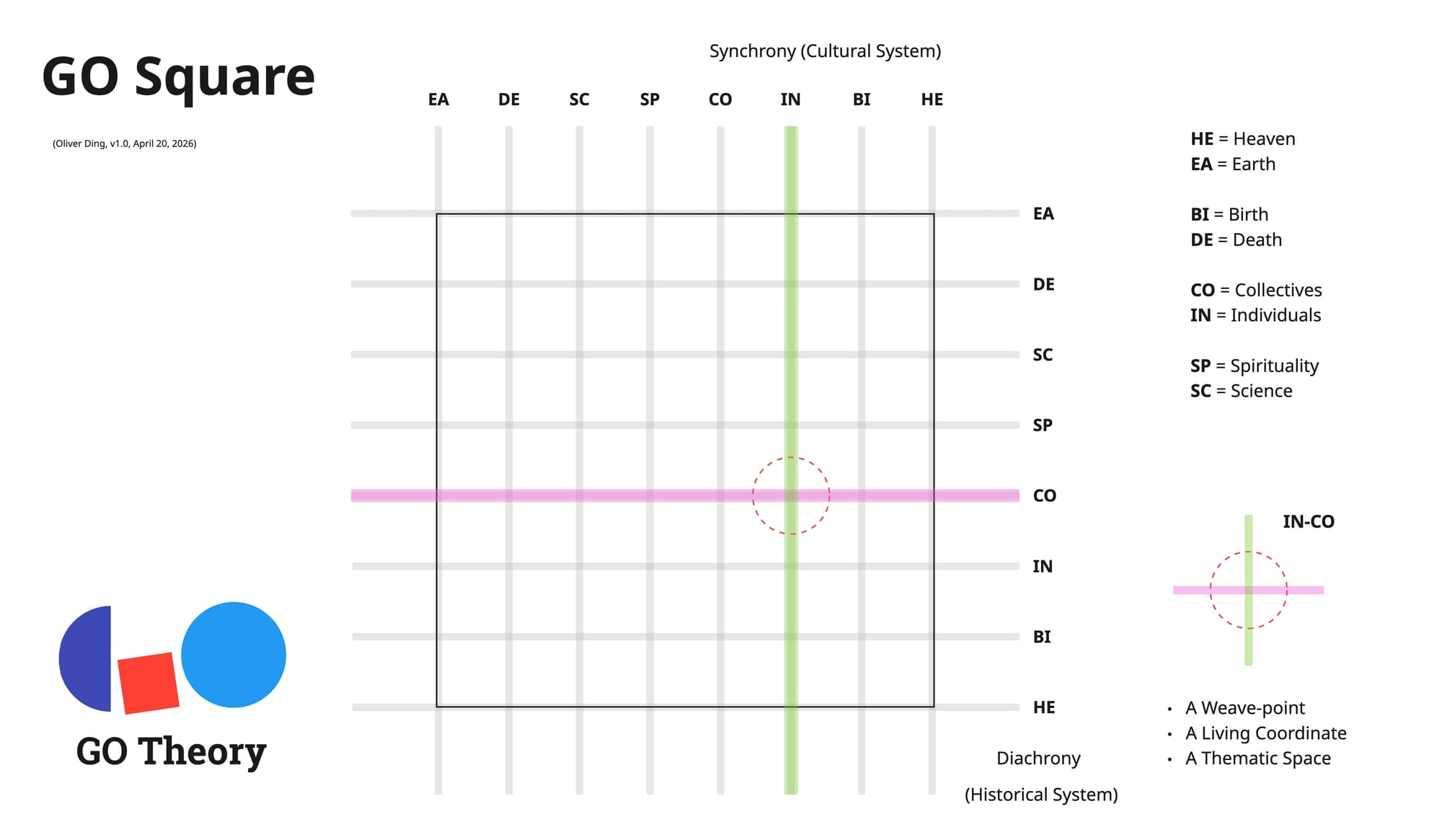
While the internal contents of these 64 thematic spaces change with historical time, their external boundaries remain invariant, providing a stable coordinate system for analyzing how meaning is organized at the scale of the Symbolic Universe.
Contents
1.Background: From GO Theory to the Need for an Operational Tool
2. Symbolic Universe: From Concept to Operational Map
3. Discovery: A Five-Day Exploration and the Genesis of GO Square
4. The Genesis of the Eight Units
4.1 The Four Boundaries of the World of Activity
4.2 The Four Boundaries of the World of Life
5. Two Types of Givenness and the Human Model
5.1 Natural Givenness
5.2 Cultural Givenness
5.3 A Living Being and A Social Person
6. GO Coordinate
6.1 From Weave-Point to GO Coordinate
6.2 Why “Coordinate”?
6.3 GO Coordinate and Living Coordinate
6.4 The 64 Coordinates as a Stable Reference System
6.5 Naming the GO Coordinates
6.7 From Coordinate to Thematic Space
7. The 64 Thematic Spaces
7.1 What is a Thematic Space?
7.2 The 64 Thematic Spaces of GO Square
7.3 The Diachronic and Synchronic Dimensions
7.4 The 64 Thematic Spaces as a Research Program
8. The Fractal Architecture of GO Square
8.1 The Principle of Emergent Sub-Units
8.2 The Procedure
8.3 Closed and Open
8.4 Tools for Refinement
9. Resonance with the Yinyang-Bagua
9.1 A Shared Formal Logic
9.2 An Unexpected Structural Convergence
9.3 The Element-to-Element Correspondence
9.4 An Independent Framework, Not a Derivative Application
10. Conclusion
1. Background: From GO Theory to the Need for an Operational Tool
The first quarter of 2026 witnessed the rapid development of GO Theory and its two symmetric enterprises. Anticipatory Cultural Sociology (ACS), launched on January 5, 2026, advanced through versions 1.0 to 2.0, establishing a three-dimensional framework organized around Thematic Creation, Cultural Projection, and Bureaus of Agency. In parallel, Strategic Developmental Psychology (SDP) progressed to version 1.2, articulating its own three dimensions—the Curativity of Mind, Supportive Life Discovery, and Dramatic Life Pattern—alongside a five-ring developmental orientation model.
These developments built upon the ontological foundation laid in December 2025, when the Meta-frameworks project established the World of Life (World of Activity) approach and the History[Life[Self(Body)]] (HLS) framework as the core ontology of GO Theory. One of the most significant contributions of that project was the Six Faces of the Concept System model, which distinguishes Knowledge Frameworks, Mental Platforms, Strategic Frameworks, Cultural Frameworks, Institutional Frameworks, and Spiritual Frameworks. This model revealed how concept systems at the individual level (Mental Platforms, Strategic Frameworks) and the collective level (Cultural Frameworks, Institutional Frameworks) interact and transform into one another.
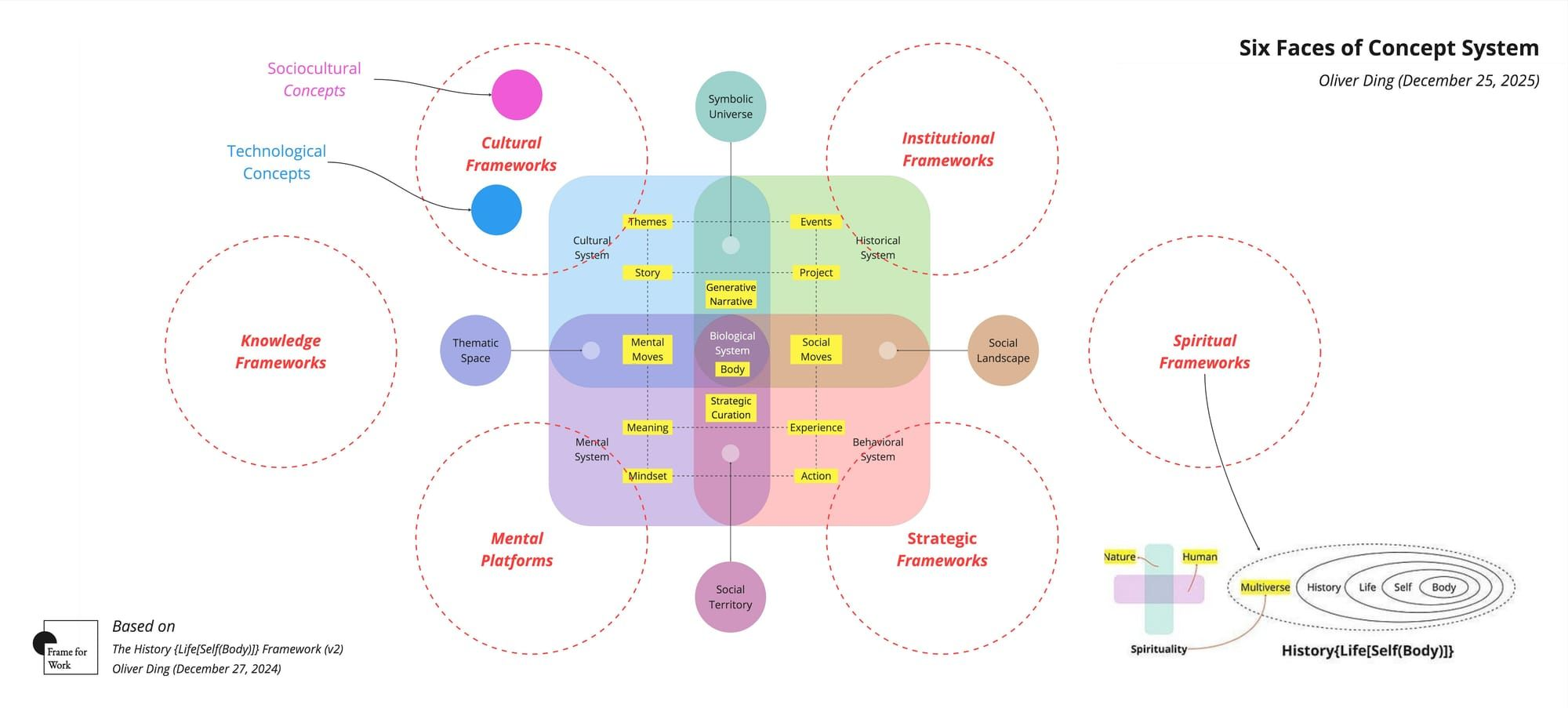
With ACS v2.0 and SDP v1.2 now established, a new task emerges: returning to the Six Faces model and developing a concrete, operational tool for systematically classifying and mapping the vast diversity of concept systems that populate the Symbolic Universe.
While the Six Faces provide a functional typology, and the HLS framework provides a structural ontology, what is still needed is a spatial coordinate system—a map that allows researchers and practitioners to locate any concept system within a finite, well-defined set of structural positions. GO Square is designed to fill this gap.
2. Symbolic Universe: From Concept to Operational Map
The term "Symbolic Universe" has a precise lineage in theoretical sociology. Peter L. Berger and Thomas Luckmann, in The Social Construction of Reality (1966), used it to describe the fourth and highest level of legitimation:
The symbolic universe is conceived of as the matrix of all socially objectivated and subjectively real meanings; the entire historic society and the entire biography of the individual are seen as events taking place within this universe. (p.96)
For Berger and Luckmann, the symbolic universe is the most comprehensive level of meaning-integration—the level at which discrete institutional processes achieve their ultimate reflective integration, and a whole world is created.
Theoretical sociologist Ping-keung Lui adopted this concept within his Subjectivist Structuralism, making a crucial distinction: the Symbolic Universe belongs to "Outside Subjective Experience." It exists beyond any individual's subjective awareness. The works of a knowledge creator—books, theories, artistic productions—continue to exist in the Symbolic Universe even after the creator's death. They are objective constituents of a shared, trans-individual reality.
In the HLS framework, I further specified the location of the Symbolic Universe: it is the intersection of the Cultural System and the Historical System. The Cultural System is the domain of living meaning—contemporary debates, competing narratives, emerging frameworks that are still in formation. The Historical System is the domain of sedimented meaning—institutionalized norms, canonized texts, established narratives that have crystallized into stable structures. Their intersection—the Symbolic Universe—is the zone where culture is becoming history, and where history is being reactivated as culture.
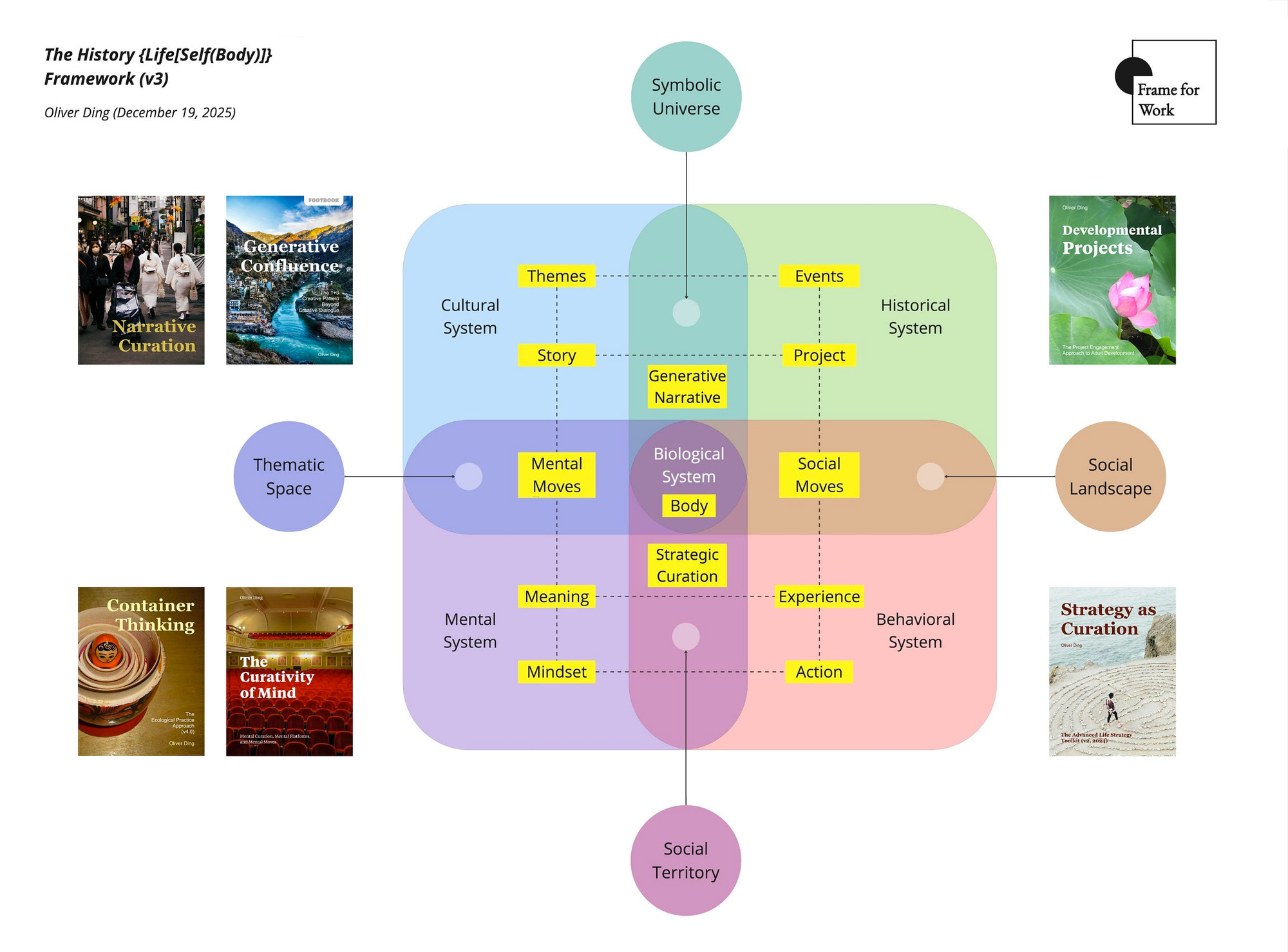
This is a powerful theoretical specification. It identifies the Symbolic Universe as a domain with distinct structural characteristics, not merely a vague totality of "all meanings." However, what has been missing is an operational tool for mapping this domain—a coordinate system that can systematically locate and differentiate the countless concept systems that populate the Symbolic Universe.
GO Square is designed to be precisely this tool. It takes the theoretical specification of the Symbolic Universe as the intersection of Culture and History, and provides a concrete spatial framework for analyzing it. The 64 thematic spaces defined by the GO Square matrix are the structurally distinct positions within this intersection—the places where meaning can be generated, contested, sedimented, revived, or erased.
With GO Square, the Symbolic Universe is no longer an abstract philosophical concept. It becomes a map on which specific concept systems can be located, their trajectories traced, and their relationships to other concept systems analyzed. This is not merely a theoretical refinement; it is the provision of an operational bridge between the ontological framework of GO Theory and the empirical study of cultural and historical meaning.
3. Discovery: A Five-Day Exploration and the Genesis of GO Square
In mid-April 2026, during a five-day creative exploration, I engaged in an intensive comparative study between the conceptual structure of the Yinyang-Bagua knowledge system and my own weave knowledge system. This was not an attempt to appropriate the Yinyang-Bagua as a theoretical resource, nor to translate its cosmology into modern terms. Rather, it was a creative dialogue—a process of structural comparison that revealed unexpected resonances and generative tensions between two independently developed systems of thought.
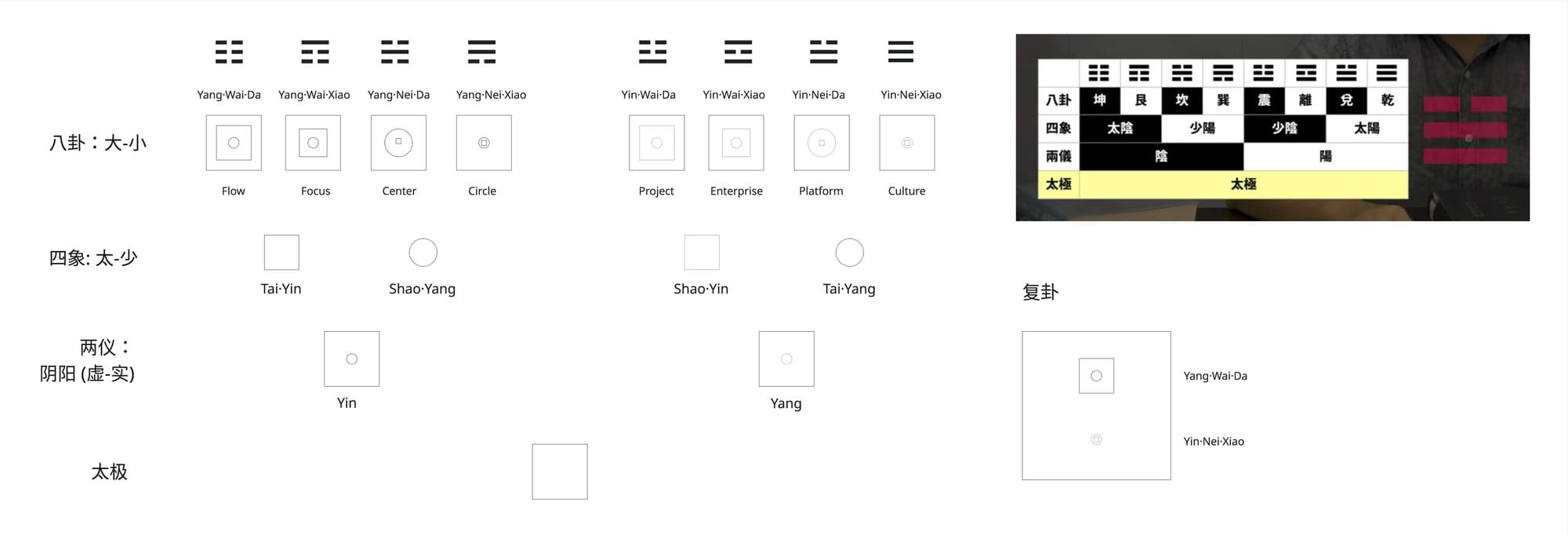
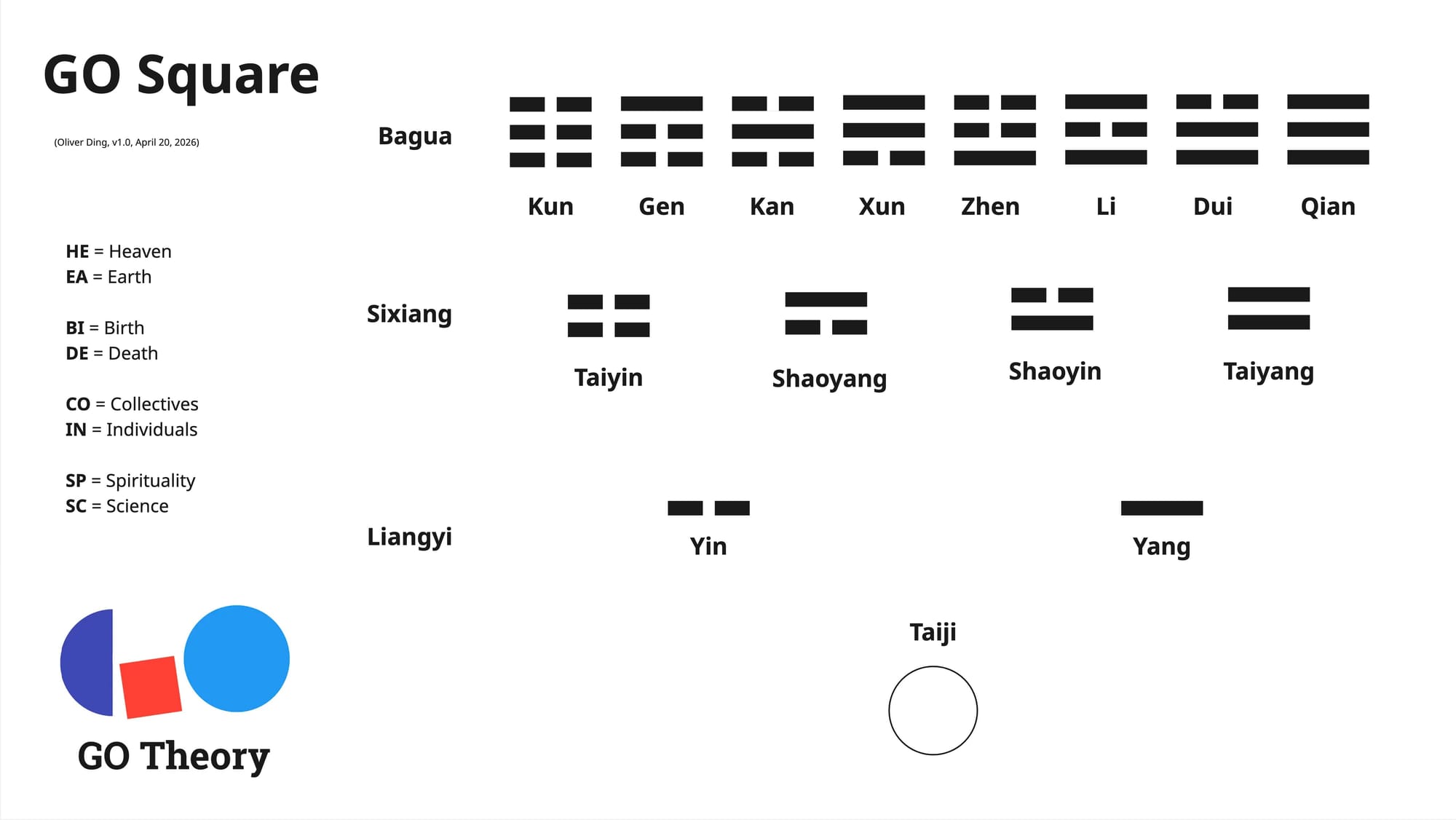
The Yinyang-Bagua knowledge system operates with a highly structured formal logic: Taiji (the Great Ultimate) generates Liangyi (the Two Modes: Yin and Yang), which generate Sixiang (the Four Images), which in turn generate Bagua (the Eight Trigrams). The Eight Trigrams are then combined into 64 hexagrams (8 × 8 = 64), each representing a distinct situational configuration. This formal structure—a finite set of fundamental elements that combine to generate a larger set of structurally distinct positions—has proven remarkably durable across millennia of Chinese intellectual history.
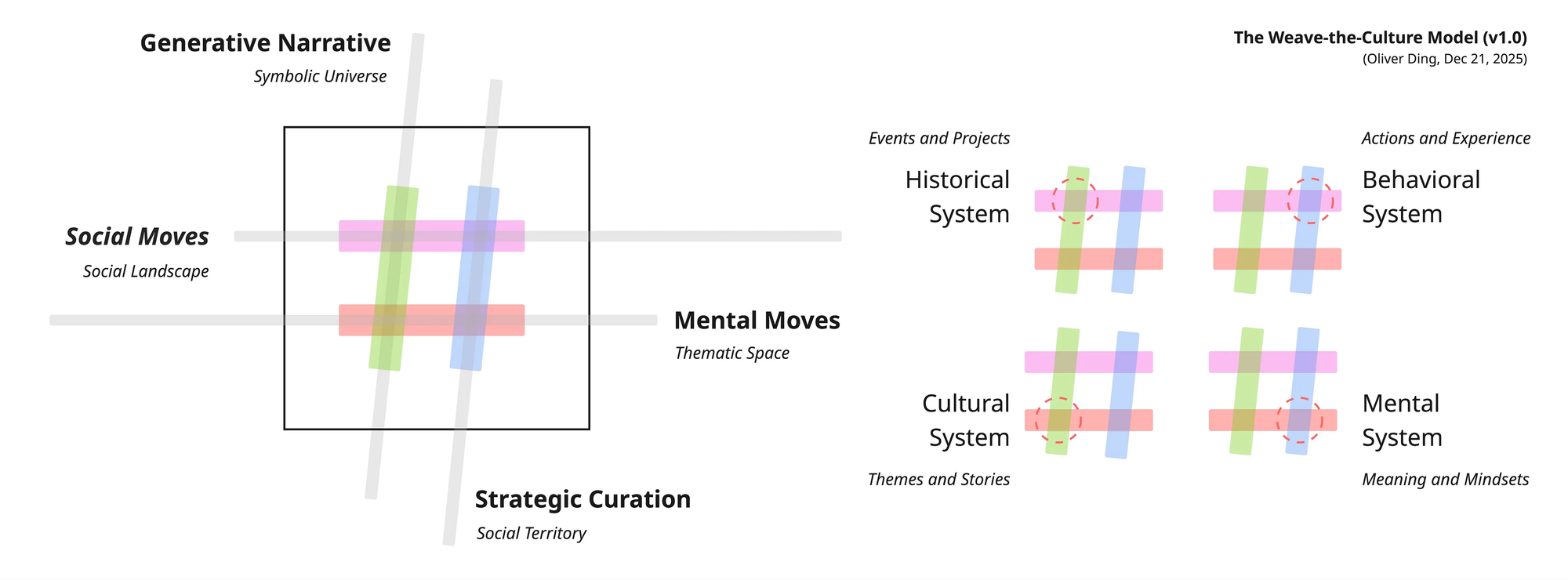
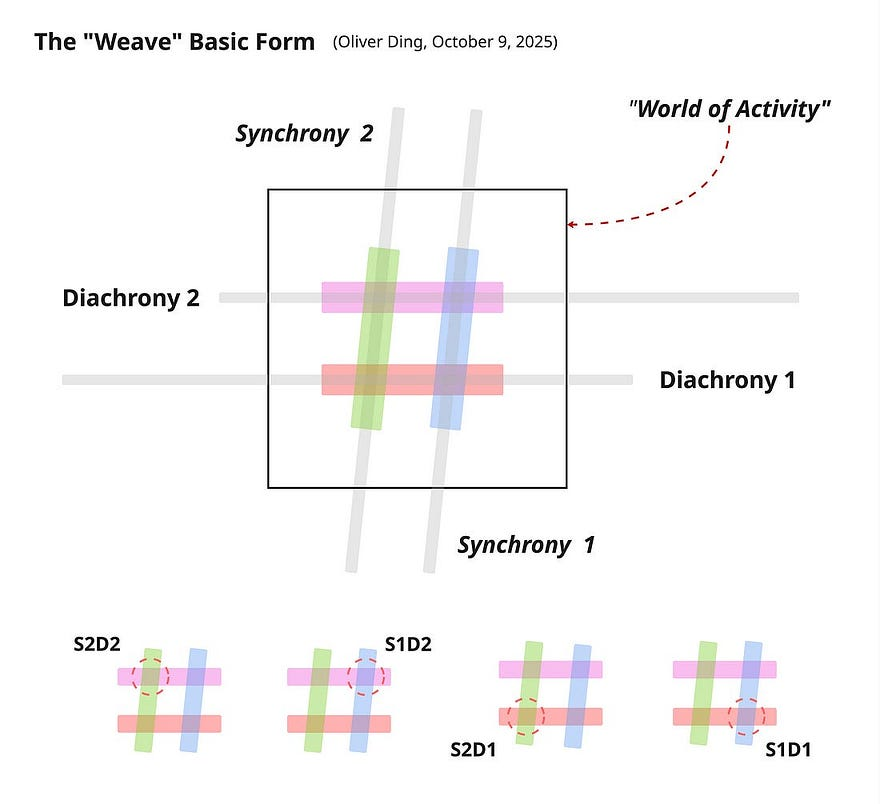
My Weave knowledge system, developed independently through the Meta-frameworks project and the Creative Life Curation methodology, employs a synchronic-diachronic distinction. Synchronic dimensions represent structural positions that coexist simultaneously; diachronic dimensions represent processes that unfold across time. The Weave-the-Culture Model, for example, positions Mental Moves and Social Moves as diachronic dimensions, and Strategic Curation and Generative Narrative as synchronic dimensions. Their intersection generates four weave-points—structural nexuses where processes and structures meet.
During this exploration, a creative insight emerged: the formal logic of the Yinyang-Bagua (8 × 8 = 64 structural positions) could be productively engaged with the substantive content of my own theoretical framework. The question became: what eight fundamental elements, derived from GO Theory's ontology, could serve as the basis for such a matrix?
The answer was already present in the theoretical materials developed over the preceding years. The World of Activity defines four boundaries: Heaven (HE), Earth (EA), Birth (BI), and Death (DE). The World of Life defines another four boundaries: Collectives (CO), Individuals (IN), Spirituality (SP), and Science (SC). Together, these eight boundaries constitute the complete set of structural limits within which all human meaning-making activity unfolds. They are the eight basic concepts—the Eight Units—from which a 64-fold matrix can be generated.
The Weave model, with its synchronic-diachronic logic, provides the method for generating the matrix.
By treating the Eight Units as one dimension (synchronic, representing the structural boundaries of existence) and crossing them with themselves (diachronic, representing the temporal unfolding of meaning across these boundaries), an 8 × 8 grid of 64 intersection points is produced. Each intersection designates a distinct structural position—a thematic space—within the Symbolic Universe.
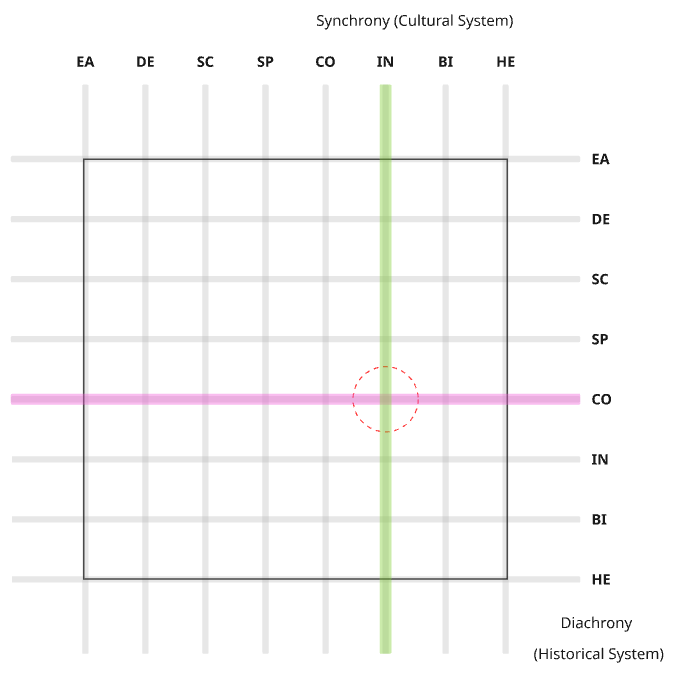
It is essential to clarify the correspondence between the two dimensions and the two systems introduced earlier.
The diachronic dimension — which traces the unfolding of meaning across time — corresponds to the Historical System. This is the domain of sedimented meaning: institutionalized norms, canonized texts, and established narratives that have crystallized into stable structures.
The synchronic dimension — which captures the coexistence of structural boundaries at a given moment — corresponds to the Cultural System. This is the domain of living meaning: contemporary debates, competing narratives, and emerging frameworks still in formation.
4. The Genesis of the Eight Units
The Eight Units are not arbitrarily chosen categories. They are derived from the convergence of two independently developed ontological frameworks, each grounded in distinct theoretical traditions and empirical concerns.
4.1 The Four Boundaries of the World of Activity
The World of Activity (v1.0, 2022) framework defines every individual's experiential horizon through four boundaries: Heaven (HE), Earth (EA), Birth (BI), and Death (DE). This four-dimensional structure emerged from a generative confluence of three independent sources between November 2021 and November 2022: the Means-End Spectrum derived from Activity Theory, the San Cai (三才) cosmology from Chinese philosophical tradition, and diagram research leading to the Universal Reference framework.
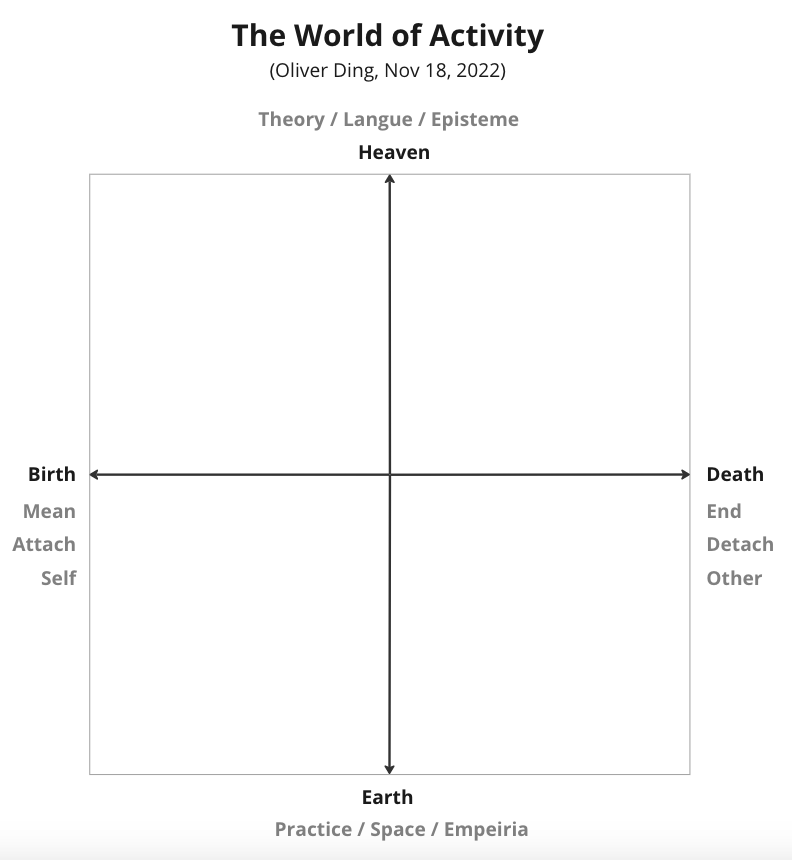
Heaven (HE) serves as the upper conceptual boundary. It unifies Theory (from Activity Theory), Langue (from Semiotics), and Episteme (from Aristotelian epistemology). It is the dimension of language, culture, and symbolic systems—the realm of abstract representation and formal knowledge.
Earth (EA) serves as the lower material boundary. It unifies Activity (from Activity Theory), Space (from Semiotics), and Empeiria (from Aristotelian epistemology). It is the dimension of ecology, environment, and material conditions—the realm of concrete practice and embodied engagement.
Birth (BI) serves as the temporal starting boundary. It unifies Means (from Activity Theory), Attach (from Ecological Practice), and Self (from Social Interaction). It is the dimension of beginnings, entry, and initiation—the point from which all activity unfolds.
Death (DE) serves as the temporal ending boundary. It unifies End (from Activity Theory), Detach (from Ecological Practice), and Other (from Social Interaction). It is the dimension of endings, departure, and termination—the horizon that frames urgency and purpose.
These four boundaries function not as descriptive categories but as multi-dimensional coordinates. Each boundary unifies multiple theoretical distinctions, serving as a symbolic integrator that transcends any single theoretical tradition.
4.2 The Four Boundaries of the World of Life
The World of Life emerged later, during the development of the Meta-frameworks project in December 2025. While the World of Activity frames the experiential horizon of a single individual, the World of Life frames the broader social and cultural terrain in which many individual lives intersect. It was further elaborated during the ACS project from January to March 2026, with particular attention to the collective scale of cultural development.
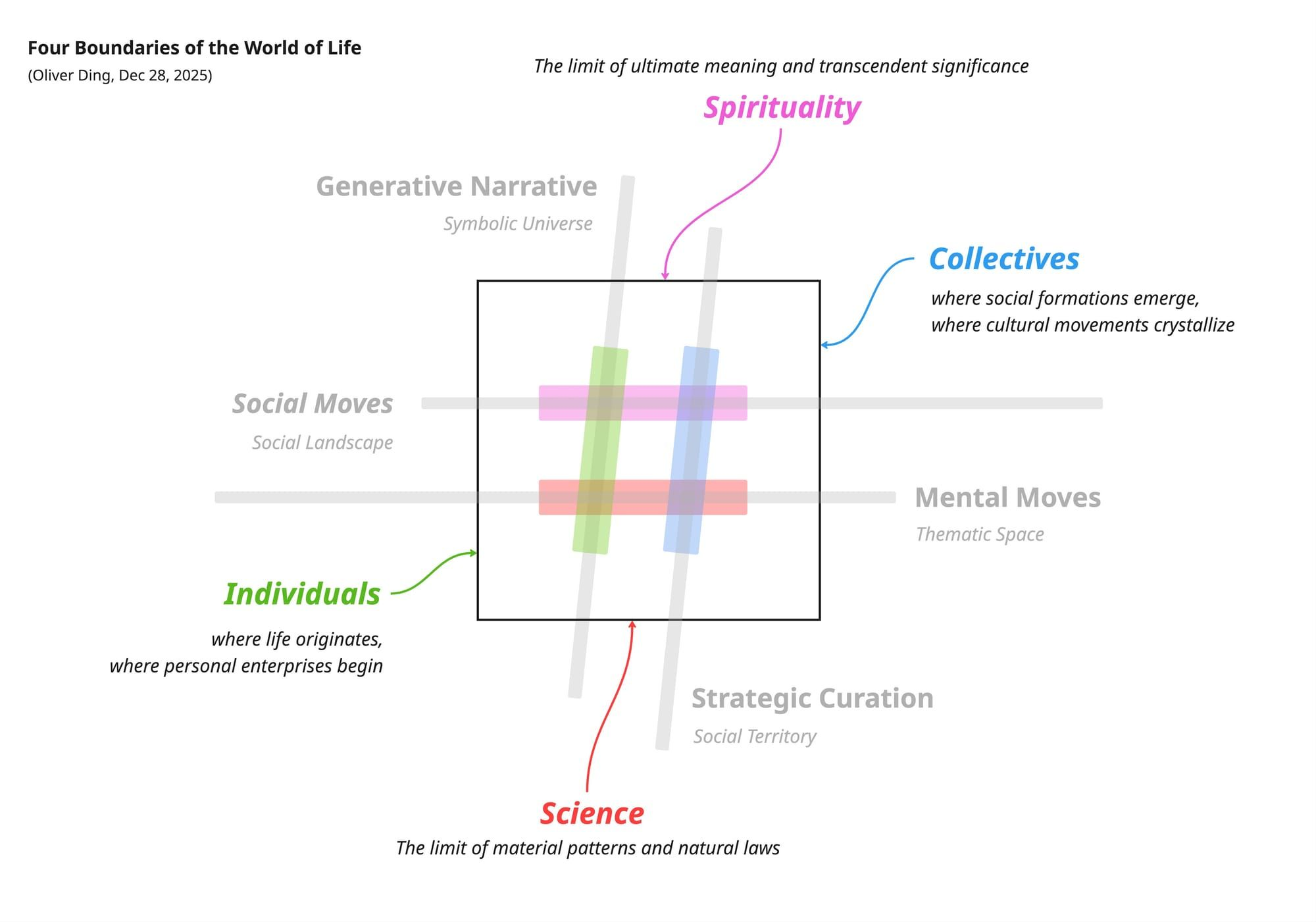
The four boundaries of the World of Life were derived from the Six Faces of the Concept System framework, which identified six types of concept systems. Of these six, four correspond to the core systems of the social world. The remaining two—Knowledge Frameworks and Spiritual Frameworks—were "displaced" to the extreme poles of truth and meaning. These two displaced faces, together with the two fundamental poles of social life (individuals and collectives), define the four boundaries of the World of Life:
Collectives (CO) is the boundary of social constitution and cultural movement crystallization. It is the dimension where individual actions aggregate into collective formations, where shared meanings emerge, and where cultural frameworks compete for dominance.
Individuals (IN) is the boundary of life origination and personal enterprise initiation. It is the dimension where each person's unique trajectory begins, where creative identity takes shape, and where the intimate work of meaning-making unfolds.
Spirituality (SP) is the boundary of ultimate meaning and transcendent significance. It is the dimension toward which Spiritual Frameworks are oriented—the opening toward what lies beyond immediate social life, the realm of existential significance.
Science (SC) is the boundary of material patterns and natural laws. It is the dimension toward which Knowledge Frameworks are oriented—the grounding in objective reality that constrains all human activity.
Together, these eight boundaries constitute the Eight Units: a complete set of structural limits within which human meaning-making unfolds. They are not eight separate categories into which phenomena are sorted, but eight orientations, each pointing toward a different dimension of the human situation.
5. Two Types of Givenness and the Human Model
The relationship between the two sets of boundaries can be precisely articulated through the distinction between Natural Givenness and Cultural Givenness—a purpose-built conceptual pair developed within the World of Activity framework.
5.1 Natural Givenness
Natural Givenness refers to the four boundaries of the World of Activity: Birth - Death - Heaven - Earth. These boundaries are unconditional, universally necessary, temporally permanent, and non-human in origin.
Every person, regardless of culture or historical period, is born and will die, lives under the same sky and on the same earth. These boundaries define the existential condition of being human as such. They are not chosen; they are encountered as the fundamental given of human existence.
- Birth: The temporal beginning—the starting state from which all activity unfolds
- Death: The temporal horizon—the ending state that frames urgency and purpose
- Heaven: The upper conceptual boundary—language, culture, symbolic systems
- Earth: The lower material boundary—ecology, environment, material conditions
Natural Givenness refers specifically to these four boundaries—structures that are unconditionally present, universally necessary, temporally permanent, and non-human in origin.
5.2 Cultural Givenness
Cultural Givenness refers to the four boundaries of the World of Life: Collectives - Individuals - Spirituality - Science. These boundaries, while equally real in their structural effects, are products of human collective activity sedimented over generations.
The tension between Individuals and Collectives, the pursuit of scientific understanding (Science), and the reach toward transcendent meaning (Spirituality)—these are not universal conditions of organic life but historical achievements of human culture. They are "already-there" for any individual entering the social world, yet they remain chooseable in how one engages with them. Unlike the unconditional givenness of Birth - Death - Heaven - Earth, the givenness of Collectives - Individuals - Spirituality - Science is the accumulated product of countless human lives and can, in principle, be transformed by human activity.
This distinction illuminates the spatial relationship between the Eight Units when they are placed together in the GO Square matrix. The four boundaries of Natural Givenness (Birth - Death - Heaven - Earth) occupy the outer positions. They are the stage upon which all human drama unfolds—the unconditional container within which all cultural activity takes place. The four boundaries of Cultural Givenness (Collectives - Individuals - Spirituality - Science) occupy the inner positions. They are the drama itself—the historically accumulated and continuously evolving structures of meaning, relationship, and inquiry that human beings have woven within that container.
5.3 A Living Being and A Social Person
The spatial arrangement is not a claim about relative importance. It is a structural claim about the logical relationship between two types of boundary: the natural boundaries are the condition of possibility for the cultural boundaries. Anyone is first a living being, and only then a social person.
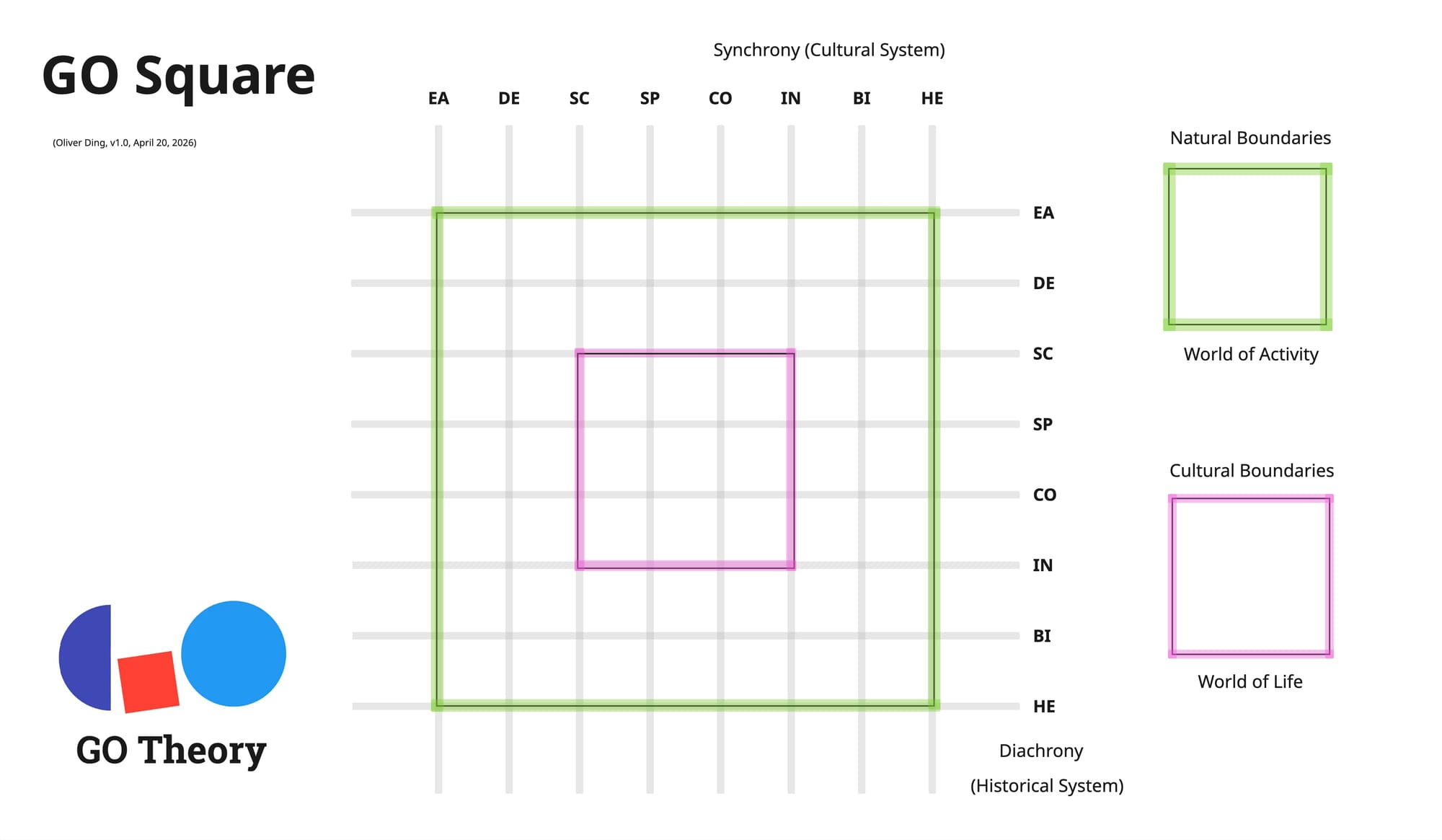
This is the core insight of the Human Model that underlies GO Theory: human existence is fundamentally a life phenomenon before it is a social phenomenon. The outer boundaries mark the existential given; the inner boundaries mark the cultural achievement.
This also resolves the apparent tension in the naming of the two worlds. The World of Activity, despite its name suggesting a narrower scope, is defined by the Natural Givenness boundaries—the very boundaries that set the stage for all human life and activity. It is called the World of Activity precisely because activity—the concrete, embodied, temporal unfolding of a life—is the mode through which an individual inhabits these boundaries. The World of Life, despite its name suggesting a broader scope, is defined by the Cultural Givenness boundaries and the shared, intersubjective terrain that emerges from countless individuals' activities.
The reader may find it confusing that the full name of GO Theory—the "World of Life (World of Activity) approach"—employs a different spatial nesting, with the World of Life as the larger container that encloses the World of Activity (society contains individuals). This is why it is important to distinguish two perspectives.
Taken from a third-person perspective, the full name of GO Theory presents the World of Life as the larger container that encompasses the World of Activity. However, GO Square is not a third-person map; it is a first-person tool designed for interactive use. When you, the user, engage with this map, you are situated in your own World of Activity. From this first-person standpoint, your lived experience of natural boundaries—Heaven, Earth, Birth, Death—is the horizon of all your meanings. The social world, with its cultural boundaries—Collectives, Individuals, Spirituality, Science—appears within your activity world, not outside it. Therefore, in GO Square, the World of Activity is the outer frame, and the World of Life is the inner domain.
6. GO Coordinate
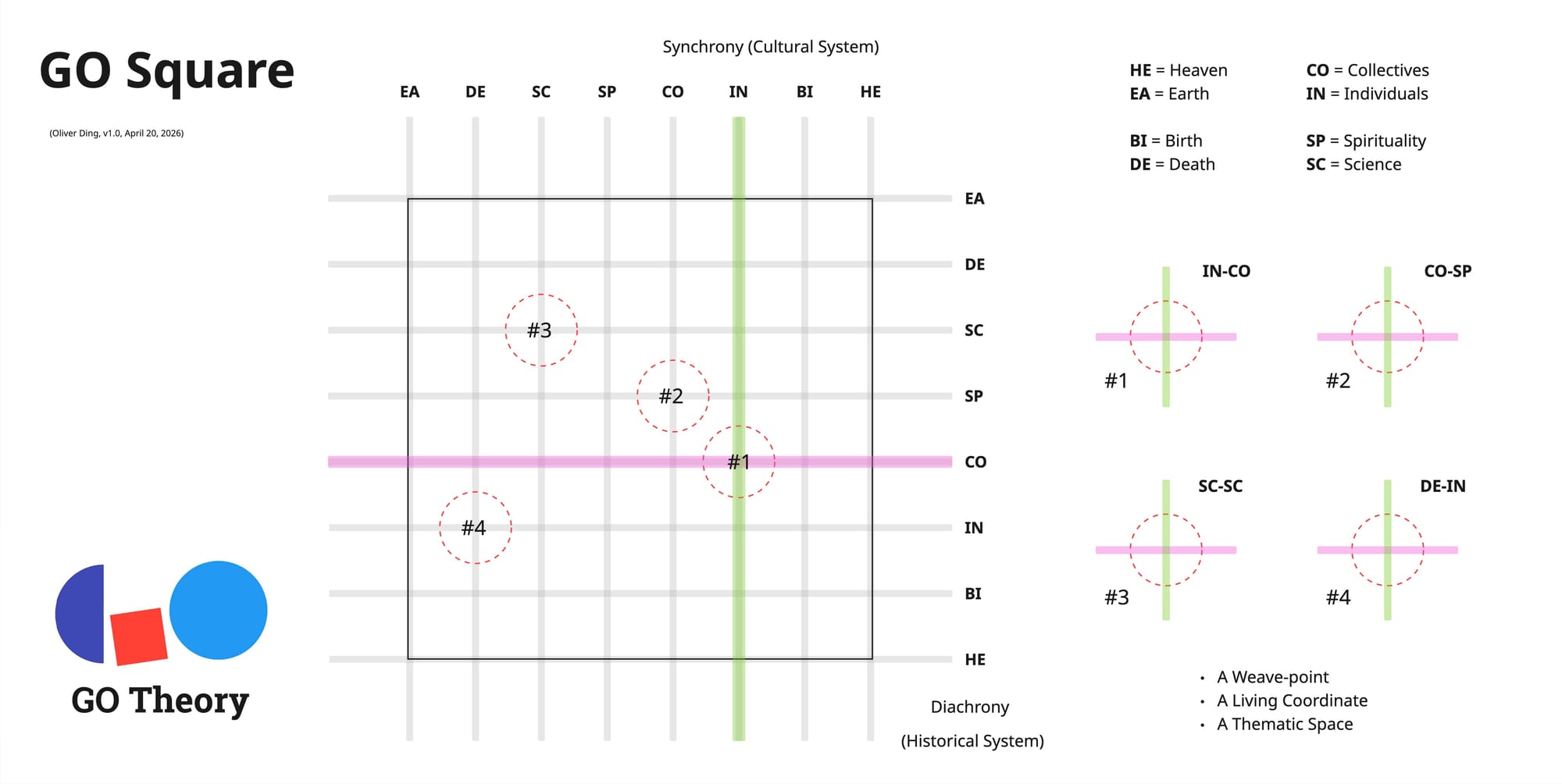
The 8 × 8 matrix of the Eight Units generates 64 weave-points—intersection points where two boundary-dimensions meet and intertwine. In the GO Square framework, each of these weave-points is designated as a GO Coordinate.
6.1 From Weave-Point to GO Coordinate
The term "weave-point" belongs to the Weave knowledge system developed through the Meta-frameworks project. In the Weave-the-Culture Model, four weave-points are generated by the intersection of two diachronic dimensions (Mental Moves, Social Moves) and two synchronic dimensions (Strategic Curation, Generative Narrative). Each weave-point marks a structural nexus—a site where process and structure meet, where the temporal unfolding of activity and the spatial organization of meaning intersect.
GO Square extends this logic. By crossing the Eight Units with themselves—treating them simultaneously as diachronic (the temporal unfolding of meaning across a boundary) and synchronic (the structural position of that boundary within the totality)—an 8 × 8 matrix of 64 weave-points is produced. Each weave-point is a distinct structural position defined by the intersection of two boundary-dimensions.
Within the GO Theory platform, these weave-points are called GO Coordinates. The term emphasizes their function as positioning tools: each GO Coordinate is a location in the Symbolic Universe at which a concept system—or an entire family of concept systems—can be located, analyzed, and compared with others.
6.2 Why "Coordinate"?
A coordinate in ordinary usage is a set of values that specifies a position within a spatial framework. A GO Coordinate serves precisely this function for the Symbolic Universe. Just as a geographical coordinate (latitude, longitude) locates a place on the Earth's surface regardless of what is built there, a GO Coordinate locates a structural position within the meaning-space defined by the Eight Units, regardless of which concept systems currently occupy it.
But a GO Coordinate is more than a passive marker. Because each coordinate is defined by the intersection of two boundary-dimensions, it carries the structural character of those boundaries. The coordinate at the intersection of Birth (BI) and Death (DE) is not merely a point; it is a site defined by the fundamental tension between beginning and ending, emergence and cessation. The coordinate at the intersection of Spirituality (SP) and Science (SC) is defined by the polarity between transcendent meaning and material law. Each GO Coordinate thus designates not just a location, but a distinctive structural tension—a unique way in which two fundamental dimensions of human existence meet.
6.3 GO Coordinate and Living Coordinate
The term "GO Coordinate" also anticipates a future integration with the Living Coordinate model. The Living Coordinate, developed in the context of Creative Life Theory and elaborated in Lake 42: The Great Confluence, is a three-dimensional framework for mapping an individual's life orientation. It describes how a person navigates their World of Activity: finding their position, anchoring their center, and expanding their reach.
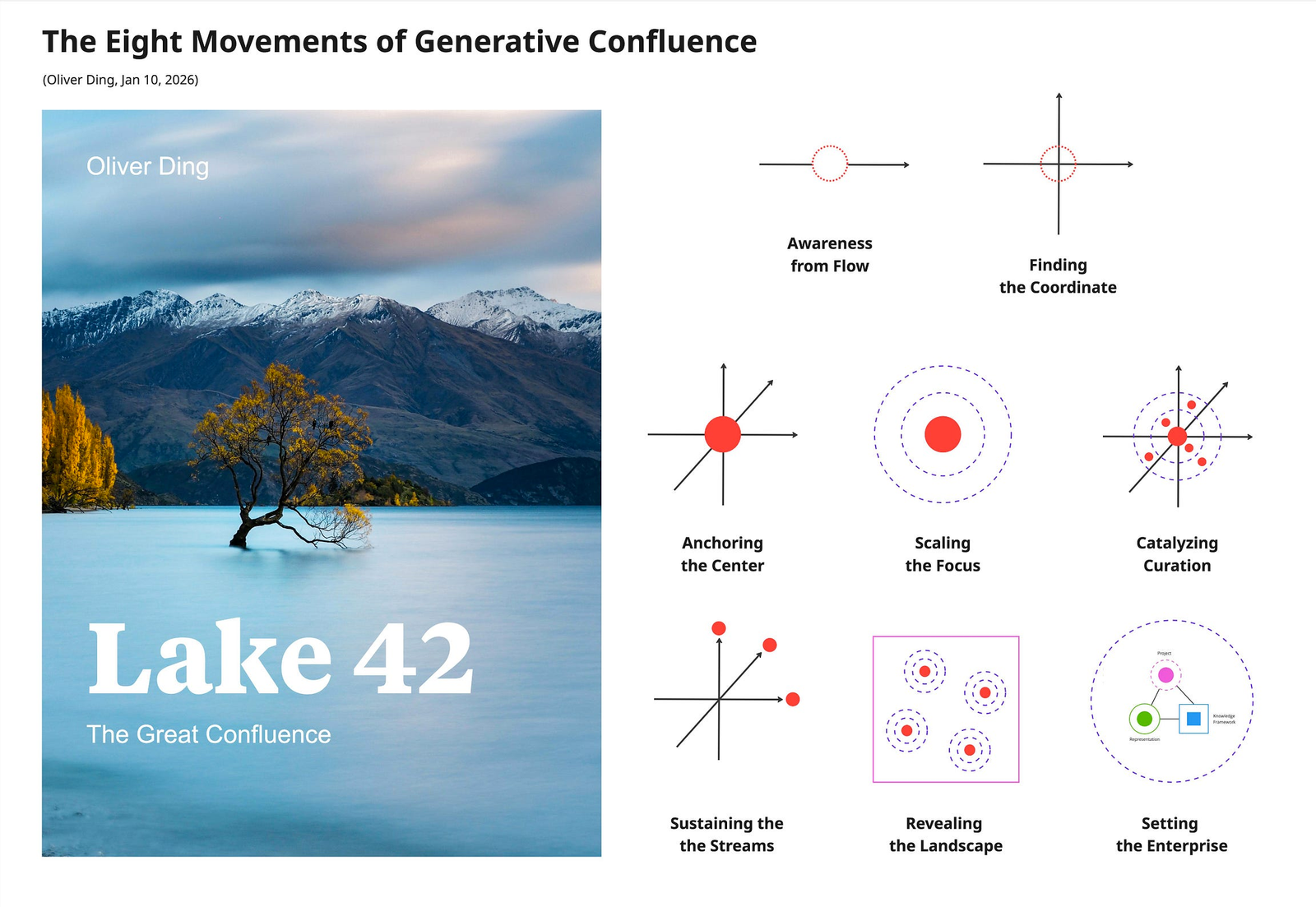
The relationship between the two is structural and complementary. The Living Coordinate maps the orientation of an individual life within the World of Activity. The GO Coordinate maps the position of a concept system within the Symbolic Universe. When an individual—a creator, a researcher, a cultural actor—engages with the Symbolic Universe, their Living Coordinate intersects with specific GO Coordinates. They locate concept systems at certain GO Coordinates and not others. They internalize meaning from some coordinates into their Mental Platform. They externalize their own thematic creations toward specific coordinates, contributing new concept systems to the Symbolic Universe.
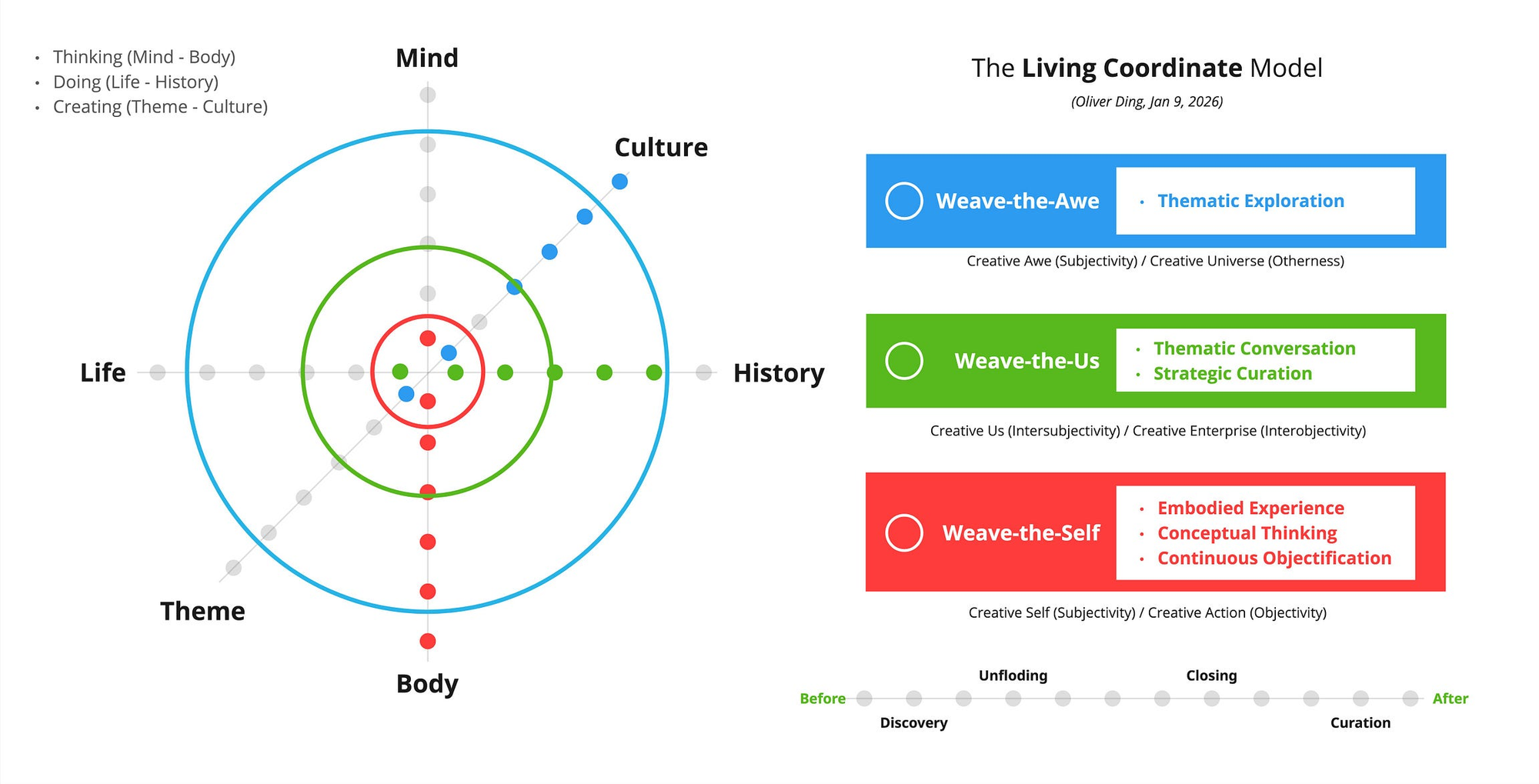
This is the operational mechanism through which the Six Faces of the Concept System interact: an individual's Mental Platform and Strategic Frameworks (at the individual scale) engage with Cultural Frameworks and Institutional Frameworks (at the collective scale) through the mediation of GO Coordinates. The coordinate structure provides the spatial logic for the bidirectional flow between individual and collective meaning-making.
6.4 The 64 Coordinates as a Stable Reference System
Crucially, the 64 GO Coordinates constitute a stable, invariant reference system. While the concept systems that occupy any given coordinate change with historical time—new theories replace old ones, forgotten ideas are revived, different traditions compete for dominance—the structural position of each coordinate remains constant. The intersection of Collectives (CO) and Individuals (IN) will always designate the same structural tension, even as the specific concept systems that address that tension evolve across centuries.
This stability is what makes GO Square an operational tool for cultural analysis. It provides a common reference frame that is independent of any particular cultural tradition, historical period, or theoretical perspective. Researchers from different disciplines, studying different concept systems from different eras, can use the same set of GO Coordinates to locate their objects of study and to compare them with one another.
6.5 Naming the GO Coordinates
Each of the Eight Units is assigned a two-letter abbreviation:
- Heaven (HE)
- Earth (EA)
- Birth (BI)
- Death (DE)
- Collectives (CO)
- Individuals (IN)
- Spirituality (SP)
- Science (SC)
A GO Coordinate is named by joining its synchronic dimension (the theoretical core) and its diachronic dimension (the application field) with a hyphen, as in Science-Collectives (SC-CO) or Individuals-Spirituality (IN-SP). In contexts where compactness is preferred, the four-letter form without the hyphen may be used: SCCO, INSP.
6.6 From Coordinate to Thematic Space
Each GO Coordinate opens onto a thematic space. If the coordinate is the structural position—the address—then the thematic space is the lived domain that occupies that address. The coordinate specifies where; the thematic space specifies what. It is to this relationship that we now turn.
7. The 64 Thematic Spaces
The core of the GO Square framework is an 8 × 8 matrix generated by crossing the Eight Units with themselves, following the logic of the Weave model. Each of the 64 intersection points designates a thematic space—a structurally distinct domain of meaning within the Symbolic Universe.
7.1 What is a Thematic Space?
Thematic Space is a concept developed through Thematic Space Theory, which has been a central component of my work since 2022. A thematic space is a cognitive and cultural domain organized around a particular theme. It functions as a "living cognitive container" with specific operations: separation of name and reality, injection and outflow of creative elements, juxtaposition of diverse materials, continuous curation, and strategic moves between spaces.
A thematic space is not merely a mental category. It exists simultaneously at multiple levels:
- As Map: A thematic space provides a spatial structure within which diverse materials can be organized. It is the bounded territory that defines what belongs to this theme and what lies outside it.
- As Models: Within a thematic space, multiple models can coexist—different theoretical frameworks, explanatory schemes, or interpretive perspectives that seek to account for the phenomena gathered by the theme.
- As Moves: A thematic space is activated by cognitive and social moves—the operations through which individuals and groups navigate among thematic spaces, connect them, separate them, or transform them.
This triadic structure—Map, Models, Moves—distinguishes Thematic Space Theory from traditional epistemology. Rather than privileging one model over others, or attempting to synthesize all perspectives into a single framework, it provides a topological solution: maintain distinctions between models while grounding all in a shared map and connecting them through structured moves.
7.2 The 64 Thematic Spaces of GO Square
In the GO Square framework, each intersection point in the 8 × 8 matrix designates one thematic space. For example:
- The intersection of Individuals (IN) and Collectives (CO) designates a thematic space concerned with how individual lives engage with collective social formations. Concept systems such as "One-Person Company" (OPC) or my 2021 book draft "Platform for Development" would naturally locate here.
- The intersection of Collectives (CO) and Spirituality (SP) designates a thematic space concerned with how collective social formations engage with transcendent meaning. Concept systems such as Pope Leo XIV's encyclical Magnifica humanitas would locate here.
- The intersection of Science (SC) and Science (SC) designates a thematic space concerned with how scientific knowledge engage with scientific knowledge. While both dimensions are the same unit, they represent different meanings: the first SC concerns the newest ideas of how scientific knowledge development while the second SC refers to the tradtional understanding of scientific knowledge.Concept systems such as Empirical Philosophy of Science (Nersessian, 2015) would locate here.
- The intersection of Death (DE) and Individuals (IN) designates a thematic space concerned with death in contemporary culture and the historical evolution of the individuals. Concept systems such as AI Resurrection (the popular social media concept of using digital traces to simulate the deceased) would locate here.
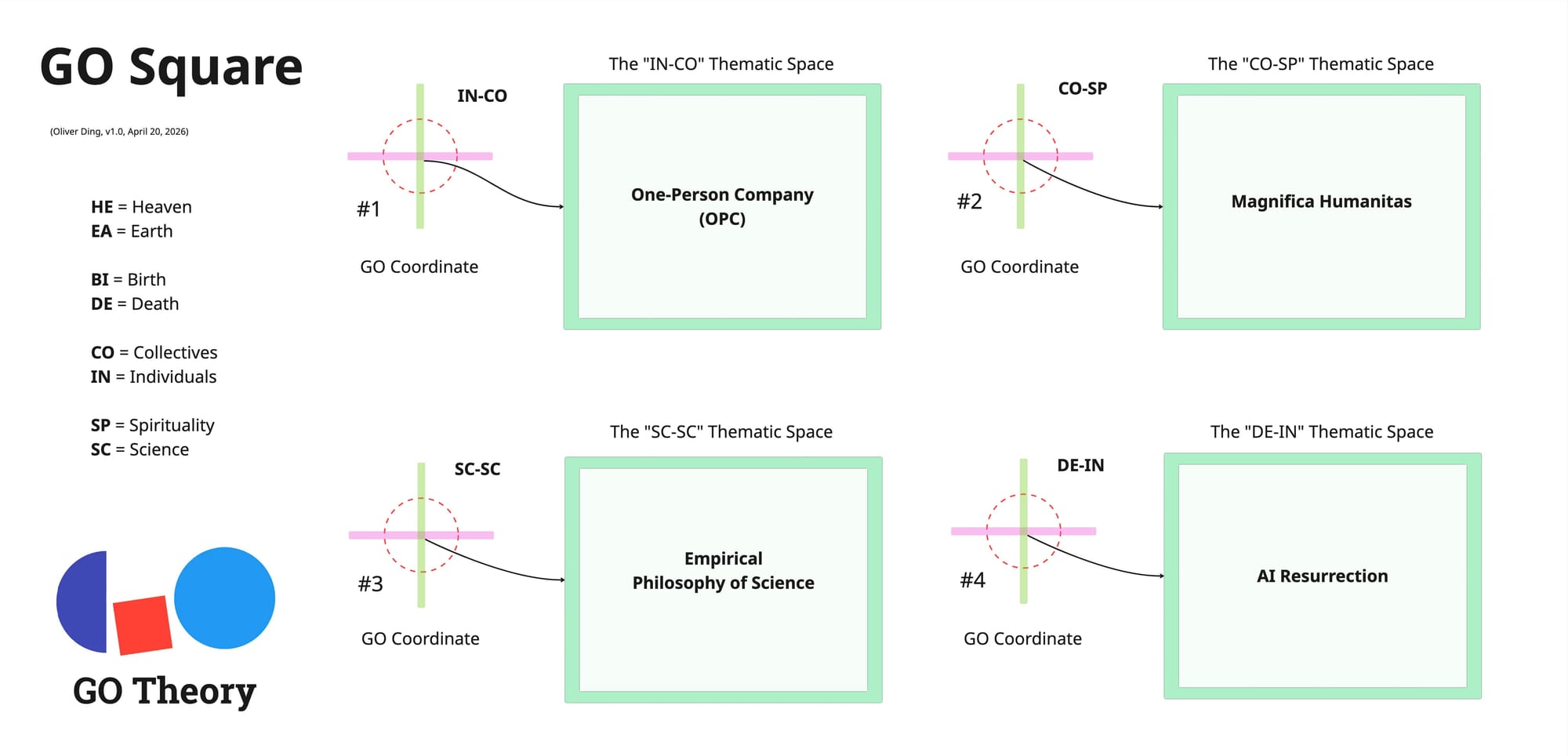
Each thematic space has its own internal structure—its own map, its own models, and its own characteristic moves. The concept systems that populate a given thematic space may change over time. New theories may be proposed, old ones may fall out of favor, different traditions may compete for dominance. But the structural position of the thematic space itself—the intersection of two fundamental boundaries—remains invariant.
This is the crucial feature of GO Square: the contents of each thematic space evolve with historical time, but the boundaries between thematic spaces remain constant. The map provides a stable coordinate system even as the territory's contents shift.
7.3 The Diachronic and Synchronic Dimensions
The 8 × 8 matrix is constructed by crossing the Eight Units as both a synchronic and a diachronic dimension. This means that each intersection point represents not just a static structural position, but a dynamic field where temporal processes unfold. A thematic space is not a passive container; it is a zone where meanings are generated (Generation) and directions are taken (Orientation)—where the forward-moving dimension of cultural life and the positional dimension of situated action intersect.
Within each thematic space, concept systems undergo the full range of processes that characterize the Symbolic Universe: generation, sedimentation, canonization, contestation, revival, erasure, translation, and institutionalization. But these processes are always bounded by the structural position of the space itself. The kinds of meanings that can be generated at the intersection of Collectives (CO) and Spirituality (SP) are structurally different from those generated at the intersection of Individuals (IN) and Collectives (CO). The boundaries do not determine the content, but they constrain the form.
#1 (IN-CO) – One-Person Company (OPC)
- Synchronic dimension (IN): This conceptual system occupies the structural position of the "Individuals" in contemporary culture – the individual as an independent legal entity, entrepreneur, and subject of responsibility.
- Diachronic dimension (CO): This conceptual system concerns the historical evolution of the "Collective" – the institutional history and conceptual history of the traditional company as a mode of multi-person collaboration.
The emergence of the One-Person Company redefines the boundary of the "Individuals" at the synchronic level while simultaneously standing in contrast to the traditional form of the "Collective" at the diachronic level. It is a conceptual space where contemporary individual entrepreneurship meets the historical trajectory of collective labor organization.
#2 (CO-SO) – Pope Leo XIV's Encyclical Magnifica humanitas (2026)
- Synchronic dimension (CO): The content of this conceptual system is collective in nature – it concerns the development of humanity as a whole, social order, and the common good, rather than individual spiritual cultivation or personal salvation.
- Diachronic dimension (SO): This conceptual system concerns the historical evolution of "Spirituality" – how the Church, through encyclicals and other doctrinal documents across different eras, reinterprets spiritual issues such as human dignity, moral law, and the divine order.
As the first encyclical of Pope Leo XIV, Magnifica humanitas takes the collective development of humanity as its object of concern. It is simultaneously anchored in the synchronic structural position of the "Collective" and participates in the continuing historical trajectory of "Spirituality."
#3 (SC-SC) – Empirical Philosophy of Science
- Synchronic dimension (SC): This conceptual system occupies a structural position within contemporary discourse on "Science" – representing a new epistemological and methodological stance within the boundary of "Science."
- Diachronic dimension (SC): This conceptual system concerns the historical evolution of the "Science" category itself – marking a major methodological turn within the discipline of philosophy of science, shifting from traditional a priori conceptual analysis to the qualitative empirical study of scientific practice.
Nancy J. Nersessian explicitly addressed this in her 2015 co-edited volume, Empirical Philosophy of Science: Introducing Qualitative Methods into Philosophy of Science. The volume argued that philosophers of science could and should use qualitative empirical methods—interviews, field observations, case studies—to study scientific practice rather than relying solely on introspective conceptual analysis. This conceptual system represents a reflexive effort to study science using the methods of science itself, simultaneously anchored in both the synchronic structural position and the diachronic trajectory of "Science."
#4 (DE-IN) – AI Resurrection
- Synchronic dimension (DE): This conceptual system occupies the structural position of "Death" in contemporary culture – how death is being technologically reconstructed, re-ritualized through digital media, and turned into an event that data and algorithms can intervene upon.
- Diachronic dimension (IN): This conceptual system concerns the historical evolution of the "Individuals" – how individual consciousness, self-understanding, and the desire for continuity after death have been articulated and transformed across different eras.
"AI Resurrection" is a popular concept circulating widely on social media. It refers to the practice of using digital traces—voice recordings, photos, text messages—of a deceased person to train chatbots that simulate their conversational style or even generate moving images that interact with the living. This phenomenon reveals a contemporary attitude toward death (death as no longer an absolute endpoint) while simultaneously reflecting the evolving notion of the individual: can a person's uniqueness be captured and recreated from data? It is simultaneously anchored in the synchronic structural position of "Death" and the diachronic trajectory of the "Individuals."
7.4 The 64 Thematic Spaces as a Research Program
At this initial stage of the GO Square project, the primary task is not to fill each thematic space with content. It is to establish the structural framework: to name each of the 64 intersection points by the two boundaries that define it, and to recognize that each names a distinct thematic space with its own structural logic.
As case studies accumulate—whether of "One-Person Company," "Magnifica humanitas," "Empirical Philosophy of Science," "AI Resurrection," or any other concept system—each can be located within one or more of the 64 thematic spaces. Over time, the abstract structure of GO Square will be gradually inhabited by concrete analyses, transforming it from a formal coordinate system into an empirically grounded map of the Symbolic Universe.
8. The Fractal Architecture of GO Square
A map with 64 thematic spaces may seem limited. A reader who begins to apply GO Square to concrete cases will soon notice that certain coordinates attract far more traffic than others. The coordinate IN-CO (Individuals-Collectives) , for example, is likely to be densely populated: work-life balance, professional identity, citizenship, role conflict, and countless other concept systems all negotiate the boundary between the individual and the collective. Is 64 enough?
This question misunderstands the nature of GO Square. It is not a filing cabinet with a fixed number of drawers. It is a fractal coordinate system—a structured space within which new coordinate systems can emerge at finer scales, driven by the specific materials that gather at each intersection.
8.1 The Principle of Emergent Sub-Units
The Eight Units—Heaven (HE), Earth (EA), Birth (BI), Death (DE), Collectives (CO), Individuals (IN), Spirituality (SP), and Science (SC)—operate at the macro scale. They define the invariant boundaries of the Symbolic Universe as a whole. They are not applied again at lower levels.
Instead, when a particular thematic space accumulates sufficient concept systems, the analyst can study how these systems are structurally differentiated from one another. From this study, a new set of Sub-Units may emerge—units that are specific to the materials gathered within that thematic space, that capture the structural tensions and distinctions most relevant to that particular domain.
The number of such Sub-Units is not fixed in advance. It may be two, four, eight, or any other number that faithfully represents the internal differentiations observed in the materials. For example, a researcher working within a given thematic space might identify four fundamental Sub-Units, leading to a 4 × 4 grid of 16 sub-coordinates. Another thematic space might yield eight units, producing an 8 × 8 grid of 64 sub-coordinates.
Take the thematic space at IN-CO. At the macro scale, this coordinate designates concept systems that negotiate the boundary between individuals and collectives. But within this space, different concept systems handle this negotiation in entirely different ways. Some emphasize temporal strategies (short-term coping versus long-term restructuring). Others draw on different knowledge resources (clinical psychology versus organizational sociology). Still others orient toward different types of collectives (family versus workplace versus state). These distinctions are not captured by the macro Eight Units. They require their own vocabulary.
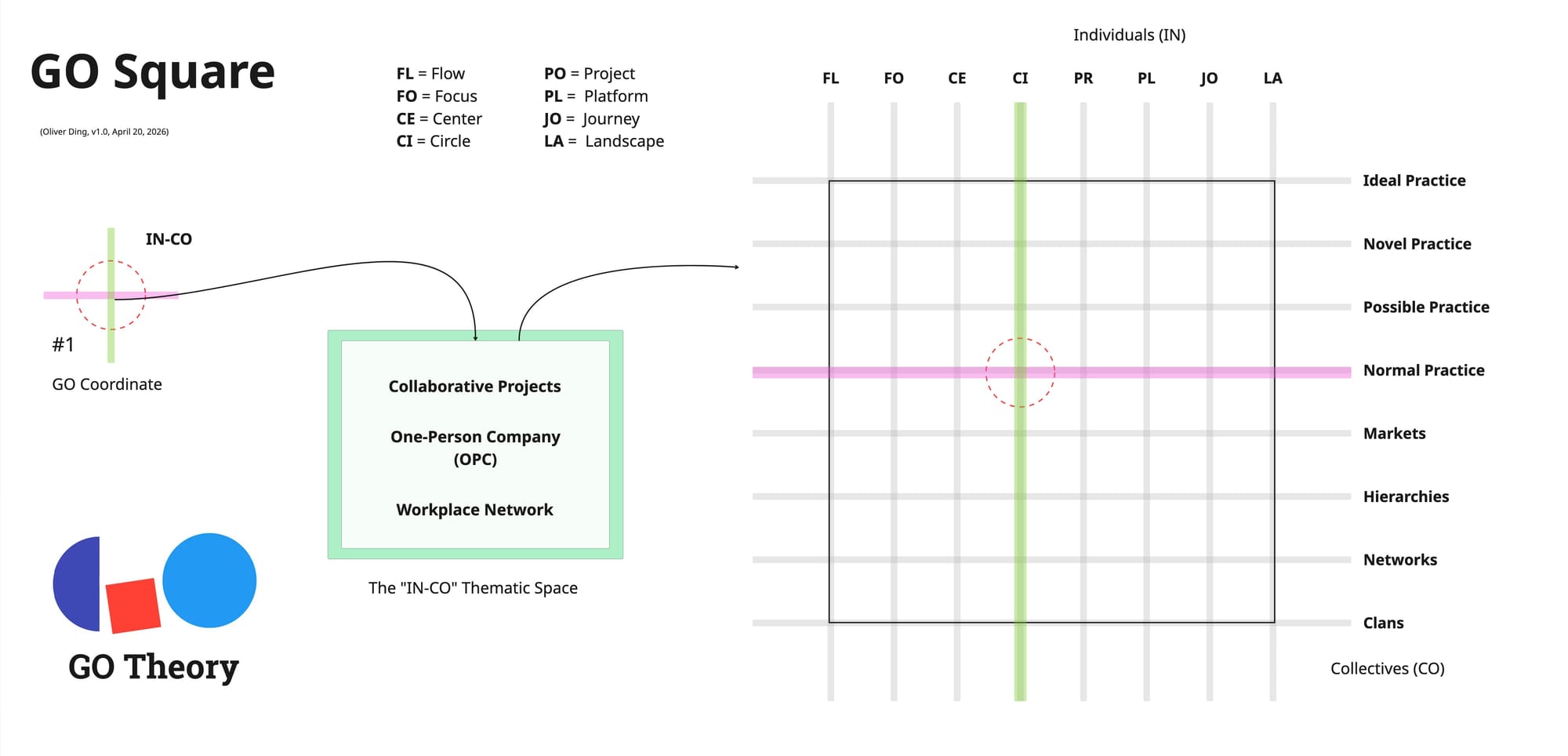
A researcher working intensively within the IN-CO thematic space could, over time, derive a set of Sub-Units that map the internal structure of this domain. These sub-units are not imposed from above. They emerge from the materials themselves, just as the macro Eight Units emerged from the ontological structure of GO Theory rather than from empirical sampling.
8.2 The Procedure
The recursive refinement of a thematic space follows the same formal logic as the construction of the macro map, but the dimensions are locally generated:
- Gather the concept systems that populate a given thematic space.
- Study their structural differences: how their theoretical cores diverge, how their application fields vary, what tensions exist between them.
- Identify the fundamental axes of differentiation. Which units best capture the internal structure of this domain?
- Derive a new set of sub-units (of any number, as determined by the analysis) specific to this thematic space.
- Construct a new matrix by crossing these sub-units with themselves (or, if the analysis calls for it, with another set of sub-units), generating a set of sub-coordinates. For instance, if the analysis yields 8 sub-units, an 8 × 8 matrix of 64 sub-coordinates is produced.
- Construct a new 8 × 8 matrix, generating 64 sub-coordinates.
Each sub-coordinate can in turn host its own sub-map, generating a third level of 4,096 coordinates (if the 8 × 8 pattern is repeated)—and so on, limited only by the richness of the materials and the needs of the inquiry.
8.3 Closed and Open
This fractal architecture gives GO Square a distinctive character: it is simultaneously closed and open.
It is closed at the level of the macro form. The Eight Units are fixed. They are derived from the ontological structure of GO Theory, not from empirical sampling. There will never be a ninth macro-dimension. The formal logic that generates the 8 × 8 matrix—synchronic and diachronic dimensions producing structured intersections—is invariant.
It is open at every level below. Each thematic space can, when its internal complexity warrants it, develop its own coordinate system with its own locally meaningful dimensions. These sub-dimensions are not predetermined. They are discovered through engagement with the specific concept systems that inhabit that space. They can be revised as new systems enter and old ones transform. The system expands not by extending the macro framework, but by cultivating local coordinate systems that respond to local complexity.
This combination of formal closure at the macro scale and emergent openness at every lower scale is what makes GO Square a generative tool rather than a finished classification. It does not tell you in advance what you will find. It provides the structural conditions within which finer structures can be built.
8.4 Tools for Refinement
Several methodological tools developed within the broader GO Theory platform support the discovery of local Sub-Units within a thematic space:
- The ECHO Way provides a method for exploring structural tensions between opposing themes. Within a densely populated thematic space, tensions between competing concept systems—border theory versus work-family enrichment, for example—often reveal the most significant axes of differentiation. The ECHO Way helps make these tensions visible and productive.
- The 2 × 2 Weave model applies the weave basic form at a finer scale. Within a single thematic space, two locally significant synchronic dimensions and two locally significant diachronic dimensions can be identified, generating four weave-points that capture the dynamic interplay of concept systems within that space.
- The Thematic Matrix Canvas extends this further to 4 × 4, organizing a thematic space into 16 thematic blocks. Each block can host a distinct family of concept systems, creating a structured landscape within the landscape.
These tools are not required for basic use of GO Square. The macro coordinate system can be applied directly. But for those who find that 64 thematic spaces are not enough—who find that certain coordinates overflow with complexity—the fractal architecture of GO Square, together with its supporting methodological toolkit, provides a clear path forward. The system does not impose an upper bound. It provides the structural conditions within which ever-finer maps may be drawn.
9. Resonance with the Yinyang-Bagua
Before proceeding further, I wish to express my deep gratitude to the ancient sages who created the Yinyang-Bagua—one of the world's most enduring works of systematic thought. During my five-day exploration in April 2026, I engaged in an intensive study of its formal symbolic structure. The resonance I discovered between that ancient system and my own weave knowledge system did not supply me with new formal principles, but it helped me see more clearly the logic already latent in my own framework—and thus enabled me to articulate the structure of GO Square with greater precision.
9.1 A Shared Formal Logic
The Yinyang-Bagua (Eight Trigrams) system employs a compositional principle of remarkable elegance. Each hexagram in the 64-fold system is a compound structure formed by an upper trigram and a lower trigram.
When combining the eight trigrams to form the 64 hexagrams, the same three-line trigram takes on two different conceptual interpretations depending on its position within the hexagram. One is called the inner trigram, which expresses the inner aspect — the subject, the foundation, the immanent condition. The other is called the outer trigram, which expresses the outer aspect — the object, the context, the encountered situation. Visually, the inner trigram is placed at the bottom of the hexagram and is also called the lower trigram; the outer trigram is placed at the top and is also called the upper trigram. It is important to note that there are two distinct levels here: the level of conceptual meaning (inner/outer) and the level of visual form (lower/upper).
When I examined the formal structure of my own Weave knowledge system during the five-day exploration, I realized that it already embodied a similar logic. In the Weave model, the horizontal dimension represents the diachronic—historical events and processes unfolding across time—while the vertical dimension represents the synchronic—cultural landscape and structural positions coexisting in the present. Each weave-point is precisely the intersection of one diachronic and one synchronic line, defining a living coordinate.
The unexpected resonance was this: both systems are built upon a pair of contrasting elements that together form a coherent whole. The Bagua distinguishes between the inner trigram (foundational, immanent tendency) and the outer trigram (contextual, encountered situation). My Weave model distinguishes between the diachronic (historical events and processes unfolding across time, corresponding to the Historical System) and the synchronic (cultural landscape and structural positions coexisting in the present, corresponding to the Cultural System). Their specific meanings are different—mine refer to the Historical and Cultural Systems, spanning time and space—but the formal structure, using two contrasting dimensions to generate a complete framework, is remarkably analogous. I did not adopt this logic from the Bagua; rather, I discovered that the logic already at work in the Weave model was isomorphic to it at the level of formal structure.
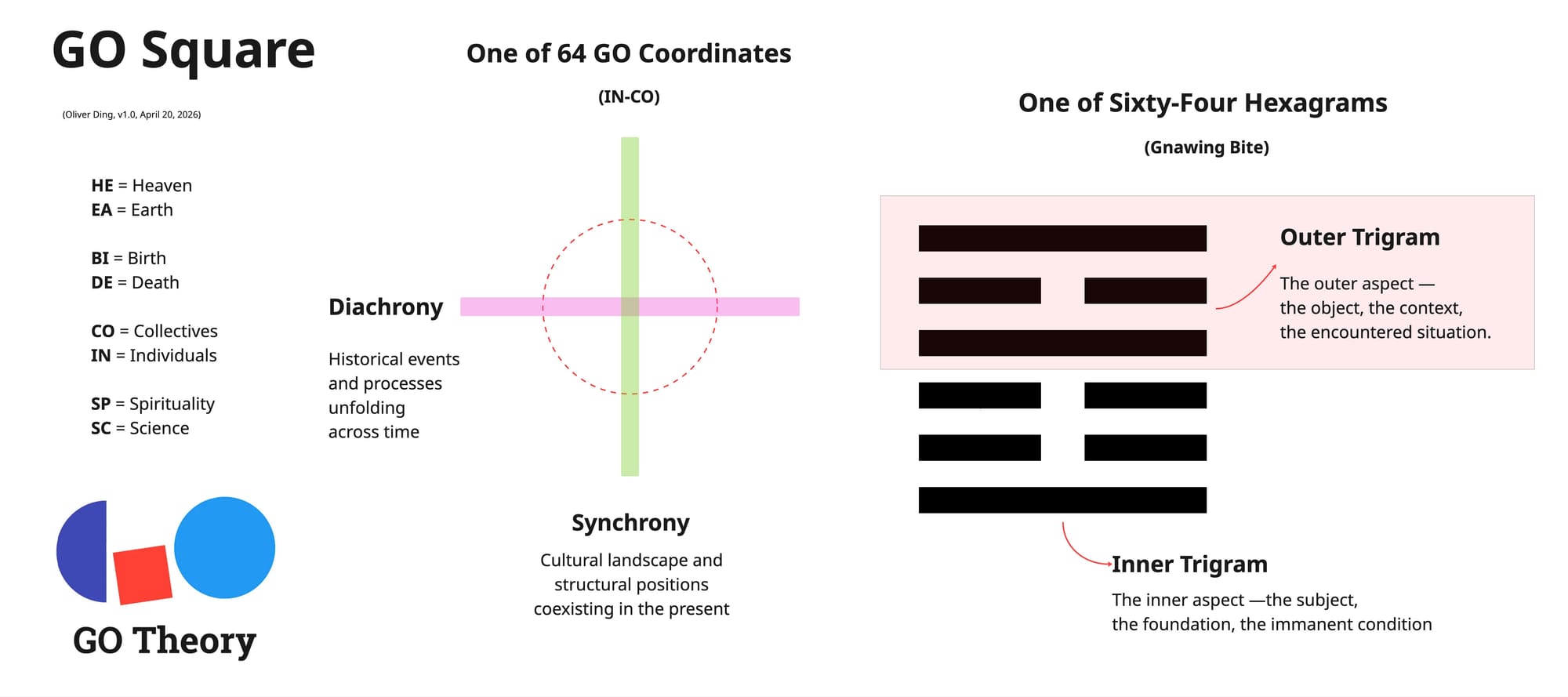
This shared formal logic led to an unexpected discovery during the five-day exploration. Because the two systems are isomorphic at the level of combinatorial structure, I found that I could establish a direct one‑to‑one correspondence between the Eight Units of GO Square and the Eight Trigrams of the Yinyang‑Bagua. Consequently, each of the 64 ordered pairs (Unit_A, Unit_B) that defines a thematic space in GO Square maps directly onto one of the 64 hexagrams. This mapping was not planned; it emerged from the resonance between two independently developed frameworks. It does not mean that GO Square derives its content or semantics from the Bagua. Rather, it reveals that two different systems—one rooted in ancient Chinese cosmology, the other in contemporary social theory—have converged on the same formal architecture for generating a complete set of structurally distinct positions. This is the essence of a shared formal logic: not borrowing, but parallel discovery of the same underlying formal logic.
9.2 An Unexpected Structural Convergence
Beyond this methodological inspiration, a deeper and entirely unexpected structural convergence emerged during the exploration. The Eight Units of GO Square are themselves generated by a logic of boundary symmetry that mirrors the generative logic of the Yinyang-Bagua's Eight Trigrams.
According to I Ching (Book of Changes), , there are two classical accounts of the origin of the eight trigrams. The first source is found in the "Great Treatise" (Xi Ci shang), which describes the generative process as follows:
"There is in the Changes the Great Primal Beginning. (易有太極, Yì yǒu tàijí,)
This generates the two primary forces. (是生兩儀, shì shēng liǎngyí,)
The two primary forces generate the four images.(兩儀生四象, liǎngyí shēng sìxiàng,)
The four images generate the eight trigrams." (四象生八卦。sìxiàng shēng bāguà.)
— Wilhelm/Baynes translation
The Eight Units are formed by the four boundaries of two squares. The outer square—the World of Activity—defines the four boundaries of natural existence: Heaven (HE, 天) and Earth (EA, 地) as the vertical spatial axis, Birth (BI, 生) and Death (DE, 死) as the horizontal temporal axis. The inner square—the World of Life—defines the four boundaries of cultural existence: Collectives (CO, 群) and Individuals (IN, 己) as the Subject axis, Spirituality (SP, 灵) and Science (SC, 科) as the Object axis.
When these eight are arranged according to their structural logic, a profound resonance with the Yinyang-Bagua's Eight Trigrams becomes visible. This figure illustrates the one-to-one formal correspondence between the Eight Units of GO Square and the Eight Trigrams of the Yinyang‑Bagua. The spatial arrangement follows the structure of the Primordial Eight Trigrams (先天八卦), with the following specific placements:
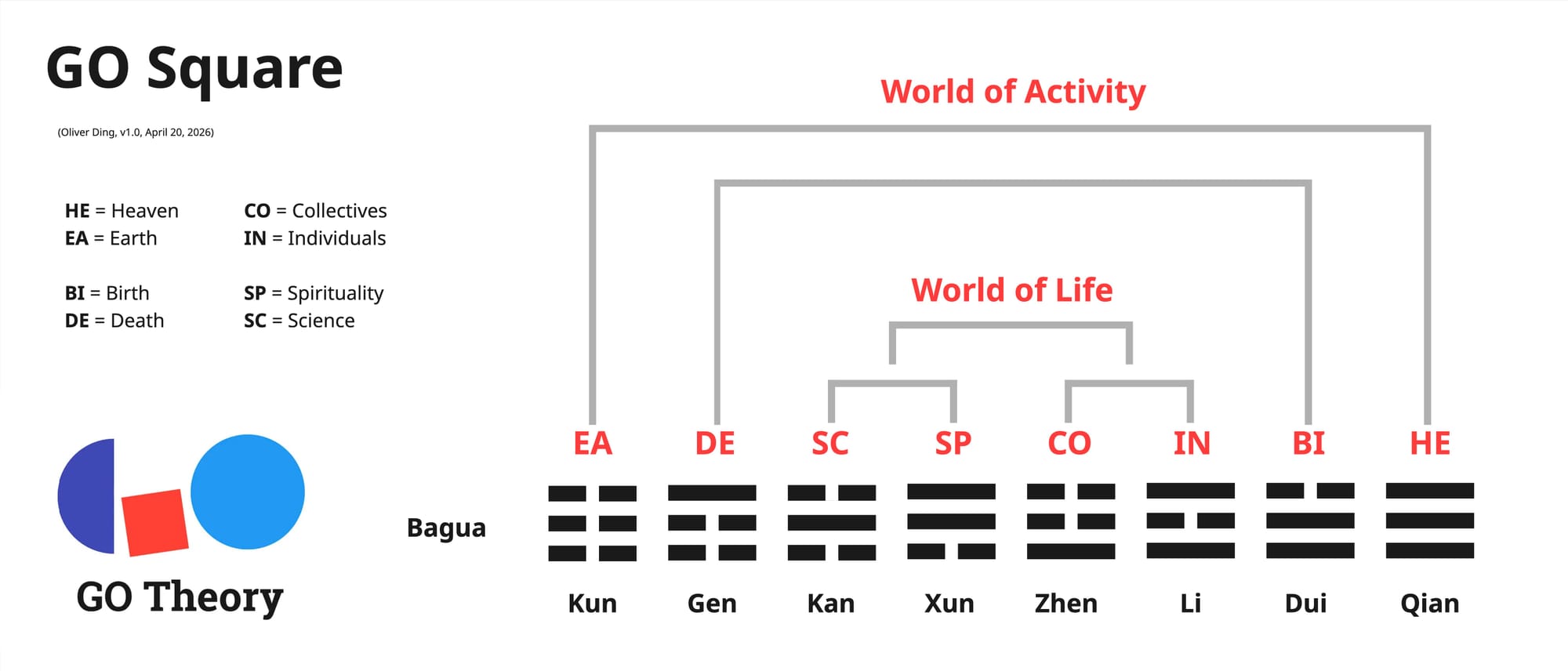
Outermost layer – spatial axis: Heaven (HE, 天) on the far right (position 1) and Earth (EA, 地) on the far left (position 1). These two oppose each other as the vertical spatial poles of the World of Activity.
Second layer – temporal axis: Birth (BI, 生) on the right (position 2) and Death (DE, 死) on the left (position 2). These oppose each other as the beginning and end of existence.
Middle four – the World of Life: These are divided into two groups of two:
- Right side – subject: Collectives (CO, 群) on the left of this group and Individuals (IN, 己) on the right. Together they form the social axis.
- Left side – object: Science (SC, 科) on the left and Spirituality (SP, 灵) on the right. Together they form the knowledge axis.
Beyond the spatial alignment of the diagram, I also examined whether the eight Units align with their corresponding trigrams at the level of conceptual meaning. Remarkably, the correspondence holds with surprising coherence.
9.3 The Element-to-Element Correspondence
During the five-day exploration, I established the following one-to-one correspondence between the Eight Units of GO Square and the Eight Trigrams of the Yinyang-Bagua. The alignment follows the order of the Primordial Eight Trigrams (先天八卦) from left to right:
- Earth (EA, 地) corresponds to Kun (☷). Kun represents pure receptivity and the material boundary, which aligns with Earth as the tangible, physical ground of existence.
- Death (DE, 死) corresponds to Gen (☶). Gen signifies stopping, stillness, and boundary — the very end of existence, the termination point of a life.
- Science (SC, 科) corresponds to Kan (☵). Kan is water — flowing, dangerous, entrapment. It represents the risk of venturing into the unknown and immersion in the surging currents of uncertainty — a perfect metaphor for scientific inquiry.
- Spirituality (SP, 灵) corresponds to Xun (☴). Xun is wind, permeating and diffusing without obstacle — matching the transcendent, all-pervading quality of spiritual meaning.
- Collectives (CO, 群) corresponds to Zhen (☳). Zhen is thunder, arousing, starting, and generating movement — reflecting social movements and collective formations.
- Individuals (IN, 己) corresponds to Li (☲). Li is fire, clinging, illuminating, and spreading outward — capturing individual agency and self-expression.
- Birth (BI, 生) corresponds to Dui (☱). Dui is the lake, joyful gathering and exchange — resonating with the beginning of life, the joy of coming into existence.
- Heaven (HE, 天) corresponds to Qian (☰). Qian is heaven, creative, originating, and purely dynamic — aligning with the symbolic boundary of language, culture, and meaning.
This correspondence follows the generative logic of the Four Images (四象): from the most material and passive (Earth – Death, the Taiyin pole), through the Object axis (Science – Spirituality, Shaoyang), through the Subject axis (Collectives – Individuals, Shaoyin), to the most creative and formless (Birth – Heaven, Taiyang). The sequence embodies the yin-within-yang and yang-within-yin dynamic that the Yinyang-Bagua encodes. Thus, the mapping is not arbitrary; it is grounded in both formal position and conceptual polarity.
This convergence is so precise that I established a direct one-to-one correspondence between the Eight Units and the Eight Trigrams. This element‑to‑element isomorphism is distinct from the combinatorial isomorphism of 9.1; together, they mean that each of the 64 thematic spaces in GO Square formally corresponds to one of the 64 hexagrams.
9.4 An Independent Framework, Not a Derivative Application
But the resemblance is purely formal, not substantive. It is essential to state clearly what GO Square is and what it is not.
GO Square is not an interpretation of the Yinyang-Bagua. It is not an application of Yinyang-Bagua's logic to modern sociology. It is not an attempt to translate ancient Chinese cosmology into contemporary theoretical language. It is not a claim that the ancient sages anticipated modern cultural sociology.
The Eight Units of GO Square are derived entirely from the ontological framework of GO Theory—specifically, from the convergence of the World of Activity (with its four Natural Givenness boundaries) and the World of Life (with its four Cultural Givenness boundaries). These boundaries were developed through independent theoretical work spanning multiple years, drawing on Activity Theory, ecological psychology, theoretical sociology, and phenomenology. They were not imported from the Yinyang-Bagua; they were arrived at through a long process of theoretical development, as documented in preceding sections.
The formal isomorphism — the fact that two independently developed systems, separated by three millennia and entirely different cultural and intellectual contexts, arrive at analogous formal structures—is worthy of reflection. It may suggest that certain structural logics are intrinsic to the task of mapping fundamental dimensions of existence. When any systematic thinker, ancient or modern, seeks to identify the finite set of basic coordinates that define the human situation, they may converge on a limited set of formal possibilities. The Yinyang-Bagua found one expression of this logic through the symbolic vocabulary of ancient Chinese cosmology. GO Square finds another through the theoretical vocabulary of contemporary social science. Their isomorphism is a testament to the deep structure of the problem they both address, not an indication of intellectual dependency.
The intention of GO Square is specific and operational: to provide a coordinate system for mapping the Symbolic Universe—the intersection of the Cultural System and the Historical System—as a domain of 64 structurally distinct thematic spaces. The content of these spaces is supplied by my eight boundaries, which define the fundamental dimensions of human meaning-making: the natural bounds of existence (Heaven–Earth, Birth–Death) and the cultural bounds of collective life (Collectives–Individuals, Spirituality–Science).
The Yinyang-Bagua, by contrast, operates with a different ontology, a different vocabulary, and a different purpose: its eight trigrams symbolize natural forces and elemental dynamics — Heaven (Qian ☰), Earth (Kun ☷), Thunder (Zhen ☳), Wind (Xun ☴), Water (Kan ☵), Fire (Li ☲), Mountain (Gen ☶), and Lake (Dui ☱) — its 64 hexagrams describe situational configurations for the guidance of human action, and its ultimate concern is the alignment of human conduct with the cosmic order.
I do not need the Yinyang-Bagua to validate GO Square, nor do I claim GO Square as an extension of the Yinyang-Bagua. The two systems stand as independent achievements, each with its own integrity. The resonance between them is a gift—an unexpected moment of recognition across vast distances of time and culture, a reminder that systematic thought about fundamental structures may converge on similar forms without one being derived from the other.
I honor the Yinyang-Bagua not by appropriating its authority, but by acknowledging that its formal logic helped me see more clearly the logic already latent in my own framework. This is the nature of creative dialogue across traditions: not borrowing, not translating, not synthesizing—but being awakened to what was already present, waiting to be articulated.
10. Conclusion
GO Square is both a culmination and a beginning.
It is a culmination of theoretical work that spans multiple years—from the World of Activity framework in 2022, through the HLS framework and the Six Faces model in 2025, to the rapid development of ACS and SDP in early 2026.
The Eight Units are not ad hoc inventions; they are the fundamental boundaries already established by GO Theory's ontology. What is new is their integration into a single, operational coordinate system for mapping the Symbolic Universe.
It is a beginning because the map now exists, but the territory remains to be explored. The 64 GO Coordinates, each opening onto a thematic space, constitute an invitation. They invite researchers, creators, and practitioners from any discipline to locate the concept systems they care about within this shared reference frame. They invite case studies that will gradually fill the abstract structure with concrete analyses. They invite critical dialogue that will test the framework's limits and reveal its blind spots.
The Symbolic Universe—the intersection of the Cultural System and the Historical System—is too vast for any single person to map alone. GO Square offers not a completed map but a shared coordinate language for a collective enterprise of exploration. Each working concept system study, each case analysis, each critical engagement contributes one more piece to an understanding of how meaning is generated, contested, sedimented, and revived in human life.
This is the logic of GO Theory itself: Generation and Orientation. The Eight Units provide the orientation—the stable reference system within which meaning-making unfolds. The 64 thematic spaces are sites of generation—zones where concept systems emerge, compete, transform, and sometimes endure. Together, they constitute a dynamic map of the Symbolic Universe.
One World. Many Concept Systems. The platform is open.
v1.0 - April 24, 2026 - 9,048 words