
Unit of Analysis, Level of Analysis, and Configurational Theory

A Methodological Note on Four Distinct Uses of a Shared Term
by Oliver Ding
May 26, 2026
This article is part of Weave the Theory: The Art of Theoretical Activity and Knowledge Ecology
In 2020, while working on the Activity U project — a knowledge curation effort mapping the landscape of Activity Theory and CHAT — I encountered a persistent source of confusion. The phrase "unit of analysis" appeared repeatedly, across different contributors, across different traditions, and clearly doing very different kinds of work. Vygotsky used it. Leontiev used it. Engeström used it. Blunden used it. Later, Clay Spinuzzi used it. And they were not all saying the same thing.
"Unit of analysis" is a standard term in social science research methodology. It appears in virtually every introductory research methods textbook, usually defined simply as the basic entity about which the researcher wishes to draw conclusions — the "what" or "who" that is being studied. Is your unit of analysis the individual? The group? The organization? The nation-state? The textbook treatment handles this as a relatively straightforward methodological decision: identify your level of analysis, bound your case accordingly, and collect data at that level. The decision matters for research design, but its significance is largely practical — a matter of ensuring that the right data is collected at the right scale.
This textbook simplicity is useful for introductory purposes. But it conceals a deeper complexity. When Vygotsky argued for "word meaning" as the unit of analysis for psychology, he was not making a decision about research design. He was making a foundational claim about the basic form of verbal thought — a claim whose implications restructured an entire scientific tradition. When Blunden argued that Activity Theory had "failed to identify a proper unit of analysis," he was not complaining about research design choices. He was diagnosing a theoretical failure — the tradition's inability to identify a germ-cell concept from which a coherent interdisciplinary theory could be derived. When Spinuzzi specified his unit of analysis for studying entrepreneurship education, he was doing something closer to the textbook description: bounding a case so that systematic empirical inquiry could proceed.
Three researchers, all using the same phrase, all doing entirely different things with it. The textbook definition does not give us the vocabulary to name the difference.
At the time of the 2020 Activity U project, I developed the concept of Niches of Analysis as a heuristic tool for mapping different theoretical positions across a two-dimensional landscape. That tool was useful for what it did. But it did not address the underlying conceptual question: what are the different things that "unit of analysis" can mean, and what are the consequences of conflating them?
This article revisits that 2020 exploration and rebuilds it through a more developed analytical lens — the Knowledge Discovery Canvas (KDC) and the Weave-the-Theory model. The central argument is simple: "unit of analysis" operates differently in four distinct positions within the knowledge ecology of a theoretical tradition. Recognizing these differences is not merely a matter of terminological precision. It has consequences for how theoretical traditions develop, and for why they sometimes lose coherence.
Contents
Part 1. The Knowledge Discovery Canvas as Analytical Lens
Part 2. Configurational Theory and Case Study: Two Different Concerns
2.1 Configurational Theory
2.2 Case Study
Part 3. THEORY (Concept): Single Concept as Unit of Analysis
3.1 Lev Vygotsky on Unit of Analysis
3.2 Andy Blunden on the Historical Roots
3.3 Blunden's Proposal: Project as Unit of Activity
Part 4. THEORY (Approach): Theoretical Orientation as Unit
4.1 Erik Stolterman's Design Example
4.2 Platform Ecology: A Personal Example
Part 5. END (Framework): The Case Study Operation
5.1 Unit of Analysis and Case Study
5.2 Is I-Space a Unit of Analysis?
5.3 I-Space as Meta-framework
5.4 Project Assemblage as a Unit of Analysis
5.5 Unit of Analysis vs. Unit of Synthesis
Part 6. END (Perspective): Levels of Analysis
6.1 From Theory to Perspective
6.2 Heteromation and Levels of Analysis
6.3 Varieties of Heteromated Labor
6.4 Business as Project Engagement: Six Levels of Analysis
6.5 Two Modes of Multi-Level Analysis
Part 7. MEANS: Niches of Analysis, Methods, and Heuristics
7.1 Methods and Heuristics
7.2 Niches of Analysis as Curatorial Tool
7.3 Thematic Rooms as Cognitive Map
7.4 Data, Theory, and the Formal Cause of MEANS Tools
Postscript: Two Lines, One Confusion
Part 1. The Knowledge Discovery Canvas as Analytical Lens
Before examining the four uses of "unit of analysis" in detail, the analytical tool that will organize the examination needs to be introduced. The Knowledge Discovery Canvas (KDC) was developed as a framework for mapping how a creator engages with a core theme across different modes of knowledge activity. Its four areas — THEORY, END, MEANS, and PRACTICE — provide the spatial vocabulary for locating different kinds of intellectual work within a knowledge ecology. The internal distinctions within two of these areas turn out to map directly onto the four distinct uses of unit of analysis that this article aims to distinguish.
The Knowledge Discovery Canvas (KDC) divides a creator's engagement with a core theme into four areas, each corresponding to a different mode of knowledge activity:
- THEORY: the development of abstract concepts, models, and frameworks — the work of building a theoretical structure.
- END: the encounter with concrete reality — empirical research, case studies, fieldwork — where abstract claims are tested against the world.
- MEANS: the development of methodological tools — instruments that translate theoretical commitments into practical procedures for analysis and intervention.
- PRACTICE: the reflective engagement with one's own activity as a creator — concept formation in the context of lived experience.
Each area is not a simple container but has internal structure. The THEORY area distinguishes between Concept and Approach; the END area distinguishes between Perspective and Framework. In the context of this article's specific concern — the different uses of "unit of analysis" — these distinctions map onto four qualitatively different operations: Concept refers to a single concept that defines the unit of analysis; Approach refers to a theoretical orientation composed of multiple concepts that together define the unit; Perspective corresponds to the theoretically derived lens through which empirical reality is encountered at multiple scales; and Framework corresponds to the operationally defined bounding device for a specific case study.
These internal distinctions turn out to be precisely what is needed to sort out the four distinct uses of "unit of analysis" that have accumulated within Activity Theory and related traditions.
Part 2. Configurational Theory and Case Study: Two Different Concerns
With the KDC framework in place, it is now possible to name what is at stake in the confusion around "unit of analysis." Before examining the four positions in sequence, it is worth pausing on the observation that originally motivated this article: the striking contrast between how Andy Blunden and Clay Spinuzzi each use the phrase. Their contrast is not a minor terminological dispute; it reveals two entirely different intellectual operations, located at entirely different positions in the knowledge ecology. Two bodies of work provide the analytical tools for understanding these positions: Configurational Theory on the THEORY side, and case study methodology on the END side.
Blunden, in his 2010 book An Interdisciplinary Theory of Activity, uses "unit of analysis" to mount a methodological critique of Activity Theory as a whole. His complaint is that the tradition has failed to identify a proper unit of analysis — a foundational concept that could serve as the "germ-cell" of an interdisciplinary theory of activity. His proposal of "project" as that unit is a claim about the theoretical architecture of the entire tradition.
Spinuzzi, in his work on case study methodology, uses it to address a completely different problem: how to bound a specific empirical case so that data collection and analysis can proceed systematically. His concern is operational — how do you decide what to include and exclude when designing a qualitative research study?
These two uses are not simply different emphases within a shared concern. They occupy different positions in the knowledge ecology entirely. Blunden's concern is at the THEORY level; Spinuzzi's is at the END level. And the tools they have brought to bear on the problem — Configurational Theory on one side, case study methodology on the other — reflect these different positions.
2.1 Configurational Theory
The concept of Configurational Theory was introduced to me through Erik Stolterman's work on the disciplinary identity of HCI research. Stolterman and his colleagues describe it this way:
"Configurational theories constitute unique frames of reference for the objects they describe. Configurational theory commonly focuses on how elements and their relationships constitute a whole. A configurational theory emphasizes the composition of elements and their relationships that make up a whole. The composition generates new and different meanings that could not be achieved in isolation."
Another key aspect, as Stolterman notes, is the emphasis on "building theory from the ground up rather than by applying existing theoretical frames of reference, which are imbued with values and meanings from other disciplines." The goal is a "genuinely analytic and internal theory" — one that arises from within the domain it describes, rather than being imported from elsewhere.
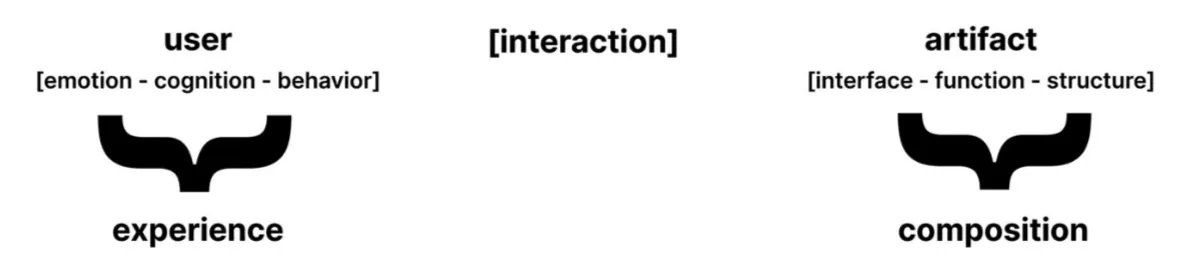
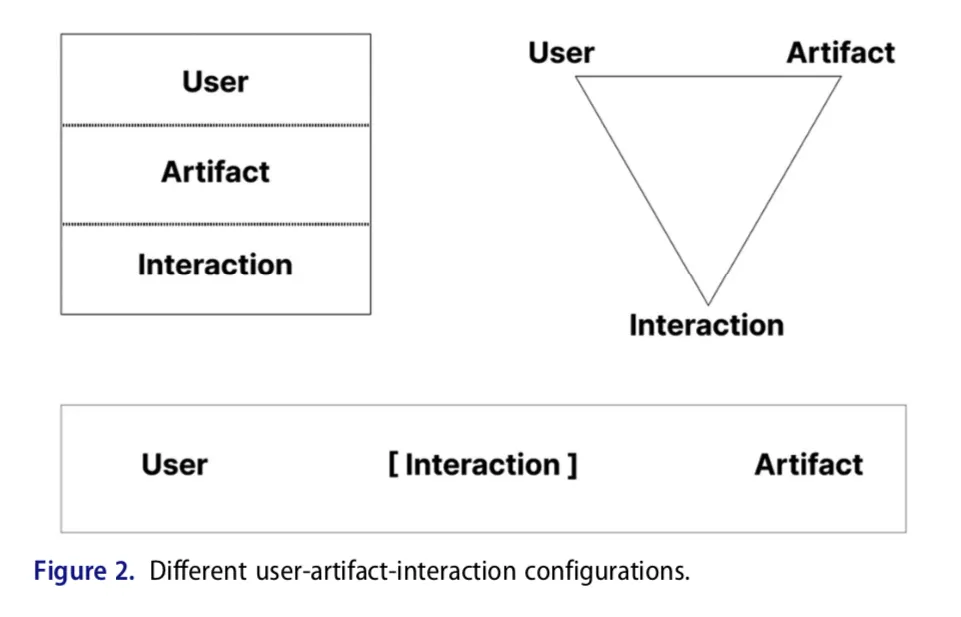
Applied to HCI, Stolterman's team identified User, Interaction, and Artifact as the three core elements and explored different configurations of these elements.
Their point is that the configuration — how the elements are arranged and related — generates meaning that no single element could carry alone. And crucially, a configurational theory should be both descriptive and generative: "it becomes possible to alter the configuration and to explore the implications of each alteration."
The goal of a configurational theory, as they put it, is "to define the core object of study of a discipline. By identifying core elements and their relationship, the members of a discipline can share the same core object of study while keeping their creative freedom in interpretations."
This is what happens at the THEORY level when a theorist defines a unit of analysis in the foundational sense. They are performing a configurational operation: identifying the basic elements and their primary relationship in a way that captures the essential character of the whole domain. Vygotsky did this for psychology. Blunden is attempting to do it for an interdisciplinary theory of activity.
2.2 Case Study
Clay Spinuzzi's account of unit of analysis in case study methodology operates on entirely different ground. In his paper on mapping representations in qualitative case studies, he draws on Säljö's definition: a unit of analysis is "a choice of a conceptualization of a phenomenon that corresponds to a theoretical perspective or framework."
The purpose here is operational: to establish what data to collect, how to bound the case, and what counts as relevant evidence. Spinuzzi is explicit about the challenges this creates. A unit of analysis must address both a scaling problem — different populations require different data collection — and a framing problem — members of a population might act differently depending on the frame, case, or activity in which they are involved.
His solution is to identify a unit of analysis that bounds the empirical case in a principled way. In his own studies of entrepreneurship education, this meant "examining firms' participation in that program at specific points" — a bounded unit that allowed systematic data collection, triangulation across different data streams, and principled comparison across cases.
This is a methodology for grounding empirical inquiry in a specific context. It is not a claim about what entrepreneurship fundamentally is, or what the essential elements of an educational activity system are. It is a claim about what this particular research project is investigating and how it will gather evidence.
The contrast with Configurational Theory is clear. Configurational Theory asks: what is the basic form of this domain? Case study methodology asks: how do I bound a specific inquiry so that I can study it rigorously? The first is a founding operation; the second is an operational one. Both use the phrase "unit of analysis," but they are doing entirely different things with it.
The following parts examine these and the remaining two uses in more detail, drawing on specific examples from Activity Theory and beyond.
Part 3. THEORY (Concept): Single Concept as Unit of Analysis
At the THEORY (Concept) level, a unit of analysis is a single concept that functions as the foundational element of an entire theoretical system. It is not merely a definition of what the researcher will study; it is a claim about the basic form of the domain itself — the simplest element that already contains the essential properties of the whole.
Two figures define this use: Vygotsky, who performed the operation most explicitly; Blunden, who traced its historical roots and diagnosed its absence in Activity Theory; and Blunden again, who proposed his own candidate unit. Together they demonstrate what it means to identify a unit of analysis in the configurational, germ-cell sense — and why this operation is categorically different from the textbook definition.
3.1 Lev Vygotsky on Unit of Analysis
Vygotsky's most direct account of unit of analysis appears in the opening chapter of Thought and Language (1934). His argument moves through three distinct steps: a methodological critique, a proposed alternative, and a demonstration of what the new method makes possible.
The methodological critique. Vygotsky begins by diagnosing what has gone wrong in the psychological study of verbal thought. The dominant practice — what he calls the method of decomposition into elements — breaks a complex whole into its component parts and studies each in isolation. The problem is not the analysis itself but what analysis by decomposition destroys. He illustrates with a chemical analogy: decomposing water into hydrogen and oxygen produces two elements, neither of which possesses the properties of water. Hydrogen burns; oxygen sustains fire. Neither extinguishes fire. The very property you wanted to explain has vanished in the act of analysis.
Psychology, he argues, faces the same dead end when it separates thought and word and studies them independently. The original properties of verbal thought disappear. What remains is a mechanical interaction between two fragments — and no amount of reassembling fragments can recover the living unity that was there before the decomposition.
The proposed alternative. Against decomposition into elements, Vygotsky proposes analysis into units. A unit, in his sense, is not the smallest piece but the simplest whole: "unlike elements, retains all the basic properties of the whole and cannot be further divided without losing them." The unit is not a fragment of the phenomenon; it is the phenomenon in its simplest form — already containing, in miniature, the essential structure of the whole.
For the study of verbal thought, Vygotsky's unit is word meaning. Not the word alone — an empty sound without meaning is not part of human speech. Not the meaning alone — abstracted from its linguistic embodiment, it is not verbal thought. Word meaning is the living union of the two: "A word without meaning is an empty sound, no longer a part of human speech. Since word meaning is both thought and speech, we find in it the unit of verbal thought we are looking for."
What the new unit makes possible. Having identified word meaning as the unit, Vygotsky is explicit about what this methodological choice enables. Word meaning is simultaneously a unit of thought and a unit of communication — it holds together the intellectual function of speech and its social function, which previous analyses had treated as separate parallel processes. The unit captures both in their structural and developmental interrelation.
More importantly, Vygotsky emphasizes that this method does not merely analyze — it synthesizes: "This method combines the advantages of analysis and synthesis, and it permits adequate study of complex wholes." This is the decisive point. The unit of analysis is simultaneously a unit of synthesis. It does not reduce the whole to its parts; it identifies the simplest form in which the whole is already present. Analysis and synthesis are not opposed operations but two faces of the same methodological move.
This observation allows us to name Blunden's subsequent proposal with greater precision. When Blunden argues for "project" as the unit of analysis for an interdisciplinary theory of activity, he is proposing not merely a unit of analysis but a unit of synthesis — a concept that, like Vygotsky's word meaning, already contains in its simplest form the essential dynamics of the whole it represents. The naming is precise: it specifies a unit of analysis in the methodological sense while simultaneously marking the anti-reductionist commitment that distinguishes this operation from ordinary decomposition. Both Vygotsky and Blunden are doing the same thing: finding the simplest whole, not the smallest part.
3.2 Andy Blunden on the Historical Roots
Blunden's 2010 book An Interdisciplinary Theory of Activity traces the methodological lineage of Vygotsky's operation back through Marx to Hegel and Goethe. This genealogical reconstruction is important because it reveals that Vygotsky was not inventing a new method but applying an established principle that runs through the entire tradition from which Activity Theory draws.
Goethe introduced the concept of Urphänomen — an archetypal phenomenon in which all the essential features of a complex process are manifested in their simplest form. The Urphänomen is not an abstraction derived from many instances; it is the primal form that already contains the logic of the whole. Blunden summarizes the principle: "in order to understand a complex process as an integral whole or gestalt, we have to identify and understand just its simplest immediately given part."
Marx applied the same principle to political economy. The commodity — the simplest unit of capitalist economic life — already contains within it the contradiction between use value and exchange value that drives the entire capitalist system. Capital begins with the commodity not because it is the most important category, but because it is the germ-cell from which everything else can be derived.
Vygotsky applied the principle to psychology. Word meaning is not important because it is the most frequent or most observable unit of verbal behavior; it is important because it already contains the essential structure — the unity of thought and language — that verbal thought as a whole embodies.
For Blunden, this lineage constitutes a methodological obligation for activity theorists. If the tradition traces its roots to Goethe, Hegel, Marx, and Vygotsky — as it claims — then it is bound by the Urphänomen principle. A proper unit of analysis must not merely describe what the theory studies; it must be the germ-cell from which the full theoretical account can be derived. The question Blunden poses to the tradition is therefore not a minor terminological one: it is a demand that the tradition honor its own methodological commitments.
His diagnosis is that the tradition has accumulated many candidate units of analysis — mediated action, activity system, object-oriented collective activity — but that none of these fully satisfies the Urphänomen criterion. Each captures something important, but none serves as the germ-cell from which an interdisciplinary theory of activity can be systematically developed.
3.3 Blunden's Proposal: Project as Unit of Activity
Blunden's positive proposal is that project — understood as a collaborative undertaking organized around a shared concept — is the appropriate unit of analysis for an interdisciplinary theory of activity.
His definition is worth quoting in full: "A project is something projected by the subject, rather than an object to which the subject is drawn; the subject may be an individual or many people who are united precisely in that they are pursuing the same project. A project is an ongoing collection of actions and is both the aim of the actions and the process of attaining that object. A project is a concept, but every individual has a different concept of the project, these constituting the various shades of meaning and connotations to be found in representations of the project." (2010, p.9)
The archetypal unit of this concept is given concretely: "two people working together in a common project." Blunden argues that "almost all the mysteries of social science as well as a good part of psychology are contained in this archetypal unit." The notions of hierarchy, command, division of labor, cooperation, exchange, service, exploitation, dependence, solidarity — all of these can be studied in the context of just two people working together on a common project. The unit is simple, but it already contains the full complexity of social activity in miniature.
The philosophical grounding of this proposal is in Hegel's theory of concept. A project, for Blunden, is not merely a practical undertaking; it is a formation of concept. The project arises when a group of people develop a shared concept of a problem and commit to realizing it. The formation of this concept is itself the activity — not a precondition for activity, but the activity itself. This is why Blunden's approach can be summarized in the phrase "Activity as Formation of Concept": the unit of analysis is not the action directed toward an object, but the collaborative process through which a concept forms and is realized in practice.
Part 4. THEORY (Approach): Theoretical Orientation as Unit
The second use of unit of analysis at the THEORY level operates through an entire theoretical orientation rather than a single concept. Here, the unit is not defined by one foundational element but by the configuration of multiple concepts that together constitute a theoretical approach — its core commitments, its primary categories, and the relationships among them.
4.1 Erik Stolterman's Design Example
Stolterman's configurational theory of HCI provides a clear illustration of this second THEORY-level use. Having identified User, Interaction, and Artifact as the three core elements, his team does not simply define a single unit. Instead, they develop a full configurational theory that specifies how these elements relate to each other in different arrangements.
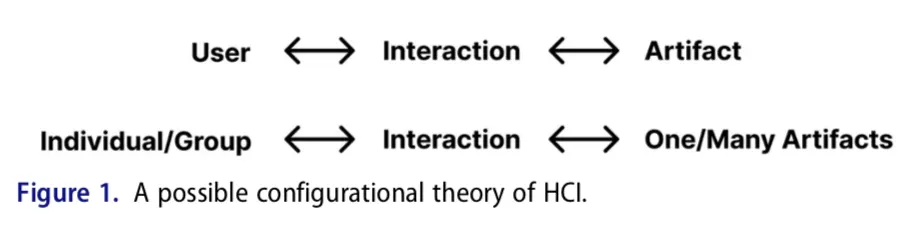
In their framework, Interaction is understood as a function of the relationship between User and Artifact: I = f(UA). This formula is not a single concept; it is a relational structure that defines an entire approach to HCI research.
Different configurations of the same three elements — with User elevated, or with Interaction as mediator, or in a flat hierarchy — each generate different assumptions about what HCI research should study and how it should proceed.
What is significant here is the distinction Stolterman draws between the Object of Study and the Theoretical Approaches. The configurational theory defines the core Object of Study for HCI — the User–Interaction–Artifact configuration — while leaving room for different researchers to bring different Theoretical Approaches to bear on that shared object. The configuration at the Approach level thus serves a coordinating function: it allows a diverse research community to share a common focus while maintaining genuine intellectual diversity in how they pursue it.
This is the THEORY (Approach) use of unit of analysis: the unit is not a single concept but an entire theoretical orientation — a configuration of multiple concepts whose mutual relationships define what counts as the relevant object of study for an entire research community.
4.2 Platform Ecology: A Personal Example
In 2023, while developing the Platform Ecology project, I applied Stolterman's configurational approach to define the Object of Study for what I was calling "Platform Ecology." The process illustrates how the THEORY (Approach) use of unit of analysis works in practice.
The starting point was the recognition that Platform Ecology, as a research orientation, could not be defined by a single concept. "Platform" alone is too narrow; it describes the environment but not the practice. "People" alone is equally insufficient; it describes the actors but not the structural context in which they act. What was needed was a configuration — a set of elements and their primary relationship — that could serve as the shared Object of Study for researchers coming from different theoretical backgrounds.
I arrived at four core elements: People, Project, Platform, and Platformba. Their primary configuration is hierarchical and nested: Platformba{Platform[Project(People)]}. People are embedded in Projects; Projects are embedded in Platforms; Platforms exist within a broader sociocultural field (Platformba) formed by the activities of their participants extending beyond the platform's formal boundaries.
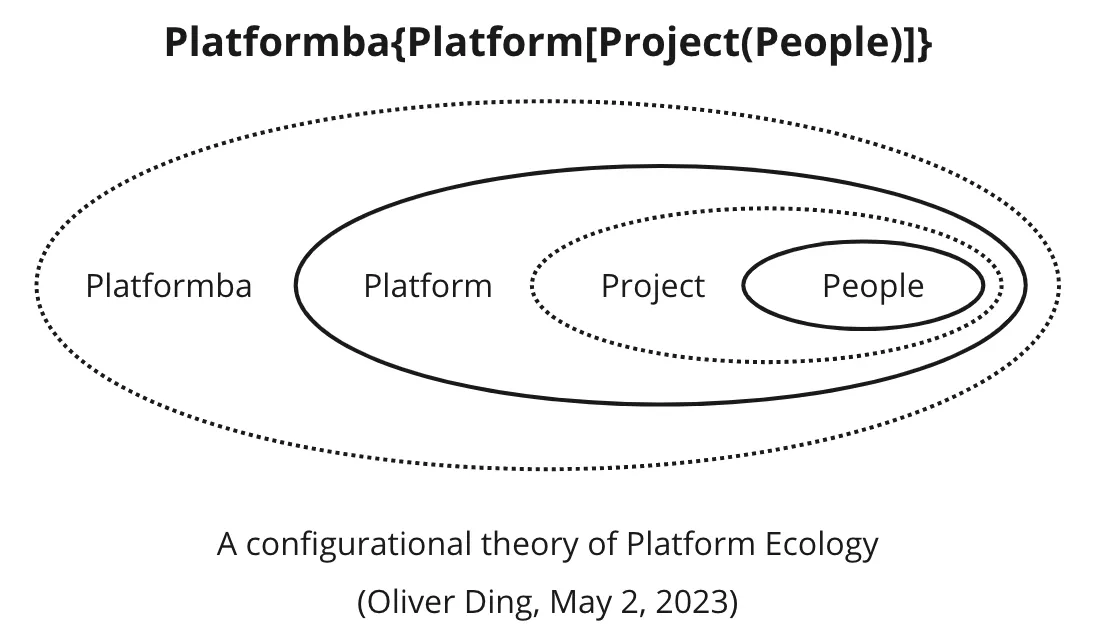
This configuration is not a single concept; it is an approach. Different researchers can bring different theoretical resources to bear on this shared object — Activity Theory, Ecological Psychology, Platform Economics, Cultural Theory — while still being recognizably engaged with the same core phenomenon: platform-based social practice, and the ways in which people's activities within and around platforms constitute a distinctive form of social life.
The contrast with the THEORY (Concept) use is worth making explicit. When Vygotsky defined word meaning as his unit of analysis, he was performing a single configurational operation: identifying the germ-cell of verbal thought. When Blunden proposed project as the unit of activity, he was doing the same at the level of social theory. By contrast, when Stolterman's team defines User–Interaction–Artifact as the configurational core of HCI, and when I define Platformba{Platform[Project(People)]} as the configurational core of Platform Ecology, we are defining an entire approach — a multi-element configuration that organizes a research community's shared object of study without reducing it to a single foundational concept.
Both operations are legitimate; they are simply working at different levels of the THEORY area.
Part 5. END (Framework): The Case Study Operation
When researchers move from theory‑building to empirical investigation, “unit of analysis” changes its function dramatically. It is no longer a foundational claim about the essential structure of a domain, but an operational device for bounding a specific case so that data collection, triangulation, and comparison can proceed rigorously.
This part examines how the unit of analysis works at the END (Framework) level—drawing on Clay Spinuzzi’s case study methodology, the instructive failure of Boisot’s I‑Space as an empirical unit, and the emergence of the Project Assemblage as a response to projectified work. It concludes by distinguishing a unit of analysis (an empirical bounding device) from a unit of synthesis (a foundational theoretical concept), showing how even well‑known models like Engeström’s Activity System have been “demoted” through sustained empirical testing.
5.1 Unit of Analysis and Case Study
Moving from the THEORY area to the END area, the unit of analysis changes its function entirely. At the END (Framework) level, it is no longer a claim about the essential structure of a domain; it is an operational device for making a specific empirical investigation tractable.
Clay Spinuzzi's account in his paper on mapping representations in qualitative case studies provides the most systematic treatment of this use. Drawing on Säljö, he defines a unit of analysis as "a choice of a conceptualization of a phenomenon that corresponds to a theoretical perspective or framework." The key word is choice: the unit is not discovered by analyzing the domain's essential structure, but selected by the researcher on the basis of their research question and theoretical commitments.
This selection addresses two concrete methodological challenges. The first is a scaling problem: the unit must be appropriate to the scale at which data collection is feasible. Studying an individual, a small group, a large organization, or an entire national culture each requires different data collection strategies; the unit of analysis determines which scale is operative. The second is a framing problem: the unit establishes what counts as inside and outside the case, allowing the researcher to decide which data streams are relevant and which can be set aside.
In his own studies of entrepreneurship education, Spinuzzi bounded the case by examining "firms' participation in that program at specific points." This bounding decision — identifying the program's participant firms at specific temporal moments as the unit — determined what data to collect (video recordings of pitches, interviews with participants and program personnel, artifact collection), how to triangulate across data streams, and how to draw principled comparisons between cases.
The logic here is importantly different from the THEORY (Concept) operation. Spinuzzi's unit of analysis does not claim to capture the essential form of entrepreneurship or education as such. It is designed to make a specific research project possible — to establish the boundary conditions within which data collection, analysis, and interpretation can proceed rigorously. A different researcher asking a different question about the same general phenomenon would legitimately select a different unit of analysis.
5.2 Is I-Space a Unit of Analysis?
Spinuzzi's paper on mapping representations in qualitative case studies does not merely describe what a good unit of analysis looks like — it also demonstrates, through a careful evaluation of Max Boisot's I-Space model, what a unit of analysis is not. This negative case is as instructive as any positive example.
Boisot's I-Space model characterizes knowledge assets in organizational and cultural contexts along three axes: codification, abstraction, and diffusion. The model is visually sophisticated and analytically ambitious — it offers a framework for understanding how information changes states as it moves through organizations and cultures, from embodied and uncodified knowledge to abstract and widely diffused knowledge. Spinuzzi was drawn to it because it seemed to offer exactly what case study researchers need: a way to map representations and their transformations both synchronically and diachronically.
But his evaluation reveals a fundamental incompatibility. The problem is precisely the unit of analysis — or rather, the absence of one. I-Space, as Boisot himself repeatedly emphasizes, is a conceptual framework, not a directly testable theory: "As a broad conceptual framework, the I-Space does not lend itself to direct empirical testing. It operates at too high a level of generality. Its value resides in its ability to generate potentially fruitful and empirically testable theories." Because the axes of I-Space are not operationalized, they cannot be systematically applied to specific observed representations. Whether a particular document is "more codified" than another cannot be determined through the framework itself — only through additional interpretive work that the framework does not supply.
Spinuzzi identifies three disjunctures that make I-Space unsuitable as an empirical UoA. Theoretically, I-Space treats information as encoded in structures that change states through individual agents' knowledge — incompatible with the constructivist and interactionist theories that underpin most case study methodology, which understand knowledge as enacted through social interaction rather than stocked in individual minds. Methodologically, Boisot's studies, while superficially resembling case studies, lack the systematic data collection, triangulation, and validation that case study methodology requires. And at the UoA level, I-Space defines its scope through "population" — but without a principled way to bound which population is relevant for a given inquiry, or how overlapping populations are distinguished.
This is a precise methodological test: take a sophisticated analytical model and ask whether it can serve as a unit of analysis for empirical case study research. I-Space fails the test — not because it is poorly designed, but because it was designed for a different purpose. It is a conceptual map, not an empirical bounding device. The distinction matters enormously for research practice.
What this case illuminates, read through the KDC lens, is the difference between a THEORY-level tool and an END (Framework)-level tool. I-Space operates at the THEORY level — it provides a conceptual vocabulary for understanding knowledge dynamics across organizations and cultures. This is valuable work. But a conceptual vocabulary, however sophisticated, cannot substitute for the operational bounding that case study methodology requires. A unit of analysis at the END (Framework) level must be operationalizable: it must generate specific, answerable questions about what data to collect and how to analyze it.
5.3 I-Space as Meta-framework
The I-Space case raises a further question: if I-Space cannot function as a unit of analysis in the case study sense, what kind of tool is it? Boisot's own characterization provides the answer. He consistently describes I-Space as a conceptual framework that "generates potentially fruitful and empirically testable theories" rather than being directly testable itself. In the KDC vocabulary, this places it at the THEORY (Approach) level: a meta-framework that organizes a domain of inquiry without itself specifying the empirical units through which that inquiry proceeds.
Spinuzzi acknowledges this, and does not dismiss I-Space on account of the mismatch. He proposes instead that I-Space can be adapted — its insights applied analogically rather than adopted directly — to the specific demands of case study methodology. The three axes of codification, abstraction, and diffusion can be translated into observable, operationalizable categories: regulation (the strictness of criteria for recognizing a representation as appropriately executed), coordination (the degree to which participants are observed using representations together), and uptake (the degree to which participants use a given representation type). These translated categories are measurable from case study data; they preserve the analytical spirit of I-Space while meeting the operational demands of empirical research.
This move — from adoption to adaptation, from meta-framework to operationalized categories — is itself instructive. It demonstrates that THEORY-level and END-level tools are not simply interchangeable. Moving from one level to the other requires a deliberate translation operation that both preserves the conceptual insight and produces the operational specificity that empirical research requires. The failure to recognize this distinction — treating a THEORY-level conceptual framework as though it were directly applicable as an empirical unit — is one of the characteristic mistakes that the present article aims to diagnose.
5.4 Project Assemblage as a Unit of Analysis
If I-Space illustrates what happens when a THEORY-level tool is mistakenly evaluated against END-level criteria, the Project Assemblage case illustrates something different: what happens when an existing unit of analysis — one that was designed with Unit of Synthesis ambitions — encounters empirical conditions it was not built to handle.
Engeström's Activity System model was introduced, in Learning by Expanding (1987), as Activity Theory's answer to the unit of analysis question. It was designed to be comprehensive: by adding Community, Rules, and Division of Labor to Vygotsky's original Subject–Tool–Object triad, it claimed to capture the full structural complexity of collective human activity. In the terms developed in Part 3 of this article, it aspired to be a Unit of Synthesis — not merely a bounding device for specific cases, but the foundational configurational unit from which an entire theory of collective activity could be derived.
For many kinds of collective activity, the model has served this function well. Activity systems with a stable, shared object, a recognized community, established rules, and a relatively durable division of labor — the kinds of organizations that Engeström studied in Finnish health centers, postal services, and legal courts — are well described by the model. It provides the conceptual vocabulary for identifying systemic contradictions, tracing their origins in the historical development of the activity, and designing interventions that address them.
But in their 2023 paper, Guile and Spinuzzi demonstrate that the Activity System model faces fundamental limits when confronted with projectified work. In project-based activities, the object is not stable and pre-given — it must be formulated and deliberated by a fluctuating assemblage of actors with different specializations. Participants engage fractionally, entering the project at different stages and exiting when their contribution is complete. There is no recognized, continuous community; the composition of the team changes as the project progresses. And the rules are not pre-established — they emerge through the dialogic negotiation of the fractional object itself.
These are not marginal cases or difficult extensions of the Activity System model's basic design. They are structural features of a growing proportion of contemporary knowledge work. The model's assumptions — relatively stable subject and object, durable shared object, cyclical transformation by a stable community — simply do not hold in this terrain.
The response was not to abandon Activity Theory but to develop a new unit of analysis adequate to the new terrain: the Project Assemblage. Where the Activity System model anchors its analysis in a durable shared object cyclically transformed by a stable community, the Project Assemblage is anchored in a fractionally coherent object episodically shaped by a temporary assemblage of specialists. The unit encompasses the dialogic cycle through which the project's object coheres sufficiently for the assemblage to complete its work and disperse. It is purpose-built for projectified activity — and precisely for that reason, it cannot claim the Unit of Synthesis ambitions of the Activity System model. It is an END (Framework) tool: operational, case-specific, designed for a particular class of empirical situations.
5.5 Unit of Analysis vs. Unit of Synthesis
The trajectory from Activity System model to Project Assemblage enacts, in concrete theoretical practice, the distinction that runs through this entire article. The Activity System model was designed with Unit of Synthesis ambitions: it aspired to be the foundational unit from which a complete theory of collective human activity could be derived. The Project Assemblage is designed with Unit of Analysis humility: it is a bounding device for a specific class of empirical cases, building knowledge of projectified work case by case without claiming to capture the essential form of all activity.
The consequence of this trajectory is instructive. The Activity System model has not been refuted — it remains a powerful analytical tool for the kinds of collective activity it was designed to analyze. What has happened is more precise: it has been demoted. What was presented as a Unit of Synthesis — a configurational unit at the THEORY (Concept) level — has been revealed to be, in empirical practice, a unit of analysis at the END (Framework) level: effective for stable, bounded, object-oriented collective activities, limited beyond that terrain.
This demotion is not a failure of the Activity System model. It is what happens when a THEORY-level claim is tested by sustained empirical engagement. The model claimed too much — or rather, its scope was implicitly bounded in ways that its proponents had not explicitly acknowledged. Projectified work falls outside that scope. The Project Assemblage, developed to fill the gap, does not reclaim the Unit of Synthesis ambition; it accepts the END-level role that the situation requires.
Read through this lens, Blunden's insistence on finding a genuinely foundational concept — a unit in the Vygotsky–Goethe–Marx sense, a germ-cell that already contains in miniature the essential dynamics of the whole — appears not as philosophical overreach but as a precise methodological response to a genuine problem. If the Activity System model cannot bear the weight of a Unit of Synthesis, then the search for something that can is not idle theorizing. It is what the tradition needs: not more empirically-grounded frameworks proliferating at the END level, but a foundational concept at the THEORY (Concept) level that can organize and constrain all of the END-level proliferation into a coherent whole.
Part 6. END (Perspective): Levels of Analysis
At the second use within the END area, the unit of analysis shifts from bounding a single case to providing a multi‑scale lens through which a phenomenon is followed across different levels of social reality. Here the researcher does not decide on a fixed boundary in advance; instead, a theoretical perspective prescribes—or reveals—the relevant scales of observation.
This part explores two modes of multi‑level analysis: pre‑structured levels (exemplified by the six layers of the “Business as Engagement” framework) and inductively discovered levels (exemplified by Ekbia and Nardi’s five varieties of heteromated labor). Both belong to the END (Perspective) category because they are driven by a theoretical lens rather than by the bounding of a specific case, yet they arrive at their analytical scales through very different paths.
6.1 From Theory to Perspective
The second use within the END area occupies a different position from the Framework use: closer to the THEORY area, further from the specific case. Here, the unit of analysis is not a bounding device for a single empirical inquiry but a set of analytical scales — a multi-level perspective that determines at what distances from the phenomenon the researcher chooses to look, and how they move between those distances.
The key structural difference from the Framework use is the direction of determination. In the Framework use, the researcher arrives at the empirical field with a bounding decision already made — they have identified a specific case and committed to collecting and triangulating data within that boundary. The unit of analysis is an operational device that makes the inquiry tractable. In the Perspective use, the researcher arrives with a theoretical lens that itself prescribes the scales of analysis. The lens comes from the THEORY area; the levels of analysis are its empirical expression. The researcher does not bound a case; they follow a phenomenon across whatever levels the lens makes visible.
This distinction has a practical implication. The Framework use tends to produce bounded, comparable, triangulatable cases — the kind of evidence that supports systematic empirical claims. The Perspective use tends to produce multi-scale accounts of a phenomenon — the kind of evidence that supports structural claims about how different levels of social reality are connected. Neither is superior; they are suited to different kinds of research questions.
The contrast with Spinuzzi's case study approach is instructive. Spinuzzi's methodology requires the researcher to commit to a bounding decision before data collection begins — to decide, precisely, what the case is. Ekbia and Nardi's multi-level perspective does not require this commitment; their "case" is the phenomenon as it appears across levels, not a bounded social situation from which data is systematically collected and triangulated. Both are legitimate empirical strategies. They are doing different things with the encounter between theory and reality.
6.2 Heteromation and Levels of Analysis
Ekbia and Nardi's 2017 book Heteromation, and Other Stories of Computing and Capitalism is organized around a single conceptual lens: the extraction of economic value from low-cost or free labor in computer-mediated networks. They name this phenomenon heteromation — a term they coined precisely because the existing vocabulary was inadequate to describe what they were observing.
The inadequacy of the existing vocabulary is itself instructive. Ekbia and Nardi do not arrive at heteromation by generalizing from cases. They arrive at it by recognizing that four established concepts — each valid within its own domain — all fail to capture a structural feature of contemporary digital capitalism that their empirical observations were revealing.
Automation describes machines replacing human labor. Heteromation is the opposite: it describes the reintegration of human labor into processes that appear automated. When a user clicks, types, or posts, they are performing labor that the system requires but does not compensate. This is not automation — it is a new form of human contribution, extracted under the appearance of voluntary participation.
Crowdsourcing describes the deliberate outsourcing of tasks to large groups of people, typically with some form of explicit invitation or compensation. Heteromation includes cases where users contribute labor without any explicit request or awareness — the system is designed to extract value from routine participation, not to assign tasks.
Prosumption — the fusion of consumption and production — describes how users simultaneously consume and produce value on digital platforms. But prosumption is an ontological description: it says what users do. Heteromation is a political economic analysis: it says who benefits, and how the value flows away from the producers toward capital. The same activity can be described as prosumption and as heteromation; the two concepts illuminate different aspects of the same phenomenon.
Digital labor is the broadest of the four terms — a general category for human activity that generates value in digital environments. Heteromation is more specific: it designates a particular mechanism of value extraction, a particular logic of accumulation, operating within the broader category of digital labor. The specificity is the point. Heteromation is not a synonym for digital labor; it is an analysis of how digital labor is organized and exploited under capitalism.
By establishing these distinctions, Ekbia and Nardi carve out a specific conceptual niche for heteromation — one that no existing term occupied. This is the Perspective at the THEORY level: a precisely defined analytical lens that determines what the researcher will look for and at what scales they will look for it.
The explicit statement of their multi-level commitment appears in the book's opening: the topic "can be meaningfully studied only through a conceptual lens that can smoothly shift back and forth between different levels of analysis. This is the tack that we have followed in this writing." The levels range from individual psychology and subjectivity all the way to the economic, political, and epochal changes of the embedding social system. The heteromation lens does not privilege any single level; it requires movement across all of them.
6.3 Varieties of Heteromated Labor
The book's central analytical section — "Varieties of Heteromated Labor" — applies the heteromation lens across five distinct types of digitally mediated activity, each examined through its own chapter. Read through the lens of levels of analysis, these five types are not merely a classification of labor forms; they are five different scales at which the heteromation mechanism manifests, each requiring a different analytical proximity to the phenomenon.
Communicative labor — a story of connection — examines how value is extracted from the social activities of connection and communication: user-generated content on social media, the building of networks and communities, the continuous production of relational material that platforms monetize. The analytical level here is social and relational: the unit of observation is the interpersonal connection and the content that flows through it.
Cognitive labor — a story of mental toil — examines microwork (tasks distributed through platforms like Amazon Mechanical Turk) and self-service (work transferred from paid employees to unpaid users). The analytical level here is individual and cognitive: the unit of observation is the mental task, the unit of attention, the cognitive effort that the system captures and redirects toward economically valuable ends.
Creative labor — a story of mental magic — examines how creative production — from game modding to literary fan fiction to open-source software contribution — generates value for platforms and corporations while the creators receive little or no compensation. The analytical level here is cultural and productive: the unit of observation is the creative work, the cultural artifact, the product of imagination and skill.
Emotional labor — a story of caring — examines how emotional work, often hidden within paid jobs (as when workers care for PARO robotic companions in elder care settings) or performed voluntarily by platform participants, is appropriated by technology manufacturers and service providers. The analytical level here is affective and relational: the unit of observation is the emotional engagement, the care work, the human warmth that the system channels into economically valuable interactions.
Organizing labor — a story of commitment — examines how collaborative groups — citizen scientists, open-source communities, Wikipedia editors, activist collectives — produce collective goods that benefit corporations and platforms while the organizers themselves absorb the costs of coordination. The analytical level here is collective and organizational: the unit of observation is the group, the community, the sustained commitment to a shared project.
What is significant about this five-part structure is that it was not derived from a pre-existing framework of labor types. It emerged from the empirical encounter — from the accumulated cases that the heteromation lens made visible. The five types are not levels in a hierarchy; they are varieties of the same mechanism operating at different scales and in different domains of human activity. Together they demonstrate the multi-level reach of the heteromation perspective: from the individual cognitive act to the collective organizational commitment, the same structural logic of value extraction is at work.
This is what the END (Perspective) use of levels of analysis produces: not a bounded case, not a predetermined hierarchy, but an empirically derived map of the scales at which a theoretical perspective finds its phenomenon. The map is not the framework; it is what the framework reveals when brought into contact with the empirical world.
6.4 Business as Project Engagement: Six Levels of Analysis
A different illustration of the END (Perspective) use comes from my own 2023 work on "Business as Engagement." Here the multi-level structure was not derived from empirical encounter but built into the theoretical framework itself — a case where the Perspective comes pre-equipped with its own levels.
The Project Engagement approach (v2.1) uses six analytical units, organized under three keywords that each capture a different dimension of business activity:
Significance — the "Person–Project" relationship — operates at two levels:
- Zone: the basic social interactive space between two people around a shared theme or object. Andy Blunden's archetypal unit — "two people working together in a common project" — names this level. It is the smallest social unit within which business activity begins.
- Project: the bounded collaborative undertaking that organizes multiple zones into a coherent whole. A business project contains several zones; the project gives them direction and coherence.
Complexity — the "Project–Project" relationship — also operates at two levels:
- Project Network: how multiple projects connect to each other, forming the web of activities that constitute an organization's work. This includes both Porter's Value Chain (Project 2: routine work activities) and Blunden's conceptual project (Project 3: social movement and cultural innovation).
- Platform: how a business grows with an ecosystem. The Platform for Development framework treats Platform as a super-large container that holds Projects and Platformba — the sociocultural field formed by the activities of participants extending beyond the platform's formal boundaries.
Genidentity — the "Project–Platform" relationship across time — operates at the two largest levels:
- Life-History: how individual biography and social history interweave through the chain of projects and events. A business is not only a present-tense activity; it is a node in the longer developmental trajectories of the people who build it and the society that surrounds it.
- Multiverse: how a business contributes to the development of culture — the largest scale, at which individual projects and platforms become participants in the formation of cultural themes and social change.
The structure is: Zone → Project → Project Network → Platform → Life-History → Multiverse. Each level emerges from the previous one; together they constitute a complete account of what "business as engagement" means at every scale of social life.
What distinguishes this from Ekbia and Nardi's case is the origin of the levels. Their five varieties of heteromated labor were derived inductively — they emerged from the empirical encounter with the phenomenon, guided by the heteromation lens. The six levels of the Business as Engagement framework were constructed deductively — they were built into the theoretical framework before any specific empirical inquiry began. The researcher who applies this framework already knows, in advance, that they will be looking at six levels; the researcher who applies the heteromation lens discovers, through empirical engagement, that the phenomenon appears at multiple scales.
6.5 Two Modes of Multi-Level Analysis
These two cases — heteromation and Business as Engagement — illuminate the two modes in which multi-level analysis can arise within the END (Perspective) use of unit of analysis.
In the first mode, the framework is pre-structured with multiple levels. The theoretical approach itself specifies the relevant scales in advance, and the researcher's empirical work is organized around those pre-specified levels. The levels are not discovered in the field; they are brought to the field. Business as Engagement exemplifies this mode: the six levels were designed into the framework, waiting to be populated by specific cases.
In the second mode, the phenomenon drives the discovery of levels. The researcher begins with a theoretical perspective — a lens that determines what to look for — but the specific levels at which the phenomenon appears emerge from the empirical encounter. The researcher follows the phenomenon across scales that the perspective makes visible but does not pre-specify. Heteromation exemplifies this mode: the five varieties of heteromated labor were not anticipated in the original 2014 concept paper; they emerged from the sustained application of the heteromation lens to a growing body of cases across the 2017 book.
Both modes belong to the END (Perspective) category because in both cases the analytical scales are determined by a theoretical perspective rather than by the bounding of a specific case. But they arrive at their levels differently — one through theoretical design, the other through empirical discovery. This difference is itself methodologically significant: it determines whether the researcher enters the field with a pre-structured map or constructs the map in the course of the journey.
Part 7. MEANS: Niches of Analysis, Methods, and Heuristics
The MEANS area of the Knowledge Discovery Canvas occupies a distinctive position: it is neither the domain of theoretical construction nor the domain of empirical encounter, but the domain of methodological tools that support both. These tools include systematic methods (research designs, analytical protocols) and heuristics (maps, diagrams, thematic spaces) that help researchers navigate knowledge ecologies.
This part introduces two such tools—the Niches of Analysis framework, a 4×4 matrix that maps theoretical positions within a tradition, and the House of Project Engagement, a twelve‑room cognitive map that connects first‑person experience with third‑person theory. Both are “formal cause” tools: they create the structural conditions for data‑theory connection without prescribing content, serving as the navigational infrastructure of knowledge work.
7.1 Methods and Heuristics
The MEANS area of the Knowledge Discovery Canvas occupies a distinctive position in the knowledge ecology. It is neither the domain of theoretical construction (THEORY) nor the domain of empirical encounter (END). It is the domain of methodological tools — instruments developed to support the work of both theory-building and empirical inquiry, but operating at a different level from either. Where THEORY tools establish conceptual foundations and END tools enable empirical investigations, MEANS tools help researchers and practitioners navigate the landscape of knowledge production: finding their position within it, moving between positions, and connecting what they know to what they encounter.
Two types of tools populate the MEANS area. The first are Methods in the strict sense: systematic procedures for generating and validating knowledge — research designs, data collection protocols, analytical frameworks, coding schemes. These tools are operational: they specify how to do something, step by step, with criteria for assessing whether it has been done well. The second are Heuristics: looser cognitive tools that provide orientation rather than prescription — maps, diagrams, thematic spaces, and organizing schemas that help researchers and practitioners think about their work without telling them what to conclude. The distinction is not sharp — many tools have elements of both — but it is analytically useful.
The two tools examined in this Part each straddle both types. Niches of Analysis functions as a curatorial heuristic — a landscape map that helps researchers locate theoretical positions within a knowledge ecology — but it is also the interface to a fuller Knowledge Curation Method: a systematic approach to mapping, organizing, and developing knowledge enterprises. The House of Project Engagement functions as a cognitive map — a spatial metaphor that helps practitioners navigate life narratives and knowledge curation — but it directly generates the Mapping Strategic Moves Method, developed in the 2024 book draft Strategic Moves: Mapping Knowledge Engagement. In both cases, the heuristic is the navigational surface; the method is the operational depth. Together, they demonstrate that MEANS tools are not merely passive maps but active instruments connected to systematic procedures for knowledge work. Both are Formal Cause tools — they capture the structure of a domain without prescribing its content, purpose, or process — and this shared formal character is what gives them their distinctive usefulness within the MEANS area.
7.2 Niches of Analysis as Curatorial Tool
The Niches of Analysis concept, developed in the 2020 Activity U project, was created to address a specific problem in knowledge curation: how to map the landscape of a large theoretical tradition so that both its internal diversity and its structural logic become visible at a glance.
The framework takes the form of a 4×4 matrix, crossing two analytical dimensions — one representing scales of human organization (Individual, Compositional, Systematic, Historical) and the other representing scales of artifact organization (Individual, Compositional, Systematic, Historical) — to produce sixteen niches, each representing a distinct creative space for theory-building. Different theoretical contributions can be placed in different niches according to the level at which they operate: Gibson's affordance theory in niche #1 (Individual artifact × Individual human), Leontiev's activity system in niche #11 (Systematic × Systematic), Blunden's collaborative project in niche #6 (Compositional artifact × Compositional human), and so on.
The tool's value lies in what it makes visible that was previously implicit. When Activity Theory contributions are placed in the Niches framework, the landscape reveals both the tradition's strengths — the niches it has populated densely — and its gaps: the niches that remain underoccupied, where future theoretical work could productively be directed. This is not a judgment about which contributions are more important; it is a structural observation about where the tradition has concentrated its energy and where it has not.
A crucial distinction must be maintained about what this tool is and is not. Niches of Analysis is a curatorial tool: a map developed after the fact to help researchers and learners see what theoretical positions exist within a knowledge ecology, which niches are occupied, and which remain open as creative spaces. It was not a tool that any of the Activity Theory contributors used when doing their original creative work. Vygotsky did not consult a niche map before identifying word meaning as his unit of analysis. Engeström did not position his activity system model within a landscape of alternatives before developing it. The map is the curator's retrospective view of a landscape that the theorists built through their own work, guided by their own theoretical commitments and creative intuitions.
This distinction matters for how the tool is appropriately used. A researcher who consults the Niches of Analysis map to orient themselves within an existing knowledge tradition is doing something different from a theorist performing a configurational operation at the THEORY level. They are using a curatorial resource to understand where prior work has clustered and where new contributions might productively be positioned. The map does not perform the theoretical work; it helps the researcher understand the terrain before beginning it.
7.3 Thematic Rooms as Cognitive Map
The House of Project Engagement represents a different kind of MEANS tool — one designed not for the orientation of theoretical researchers but for the navigation of life narrative and knowledge curation practices. Its structural innovation is the explicit separation of Map and Model: the twelve thematic rooms constitute the Map, while the theoretical frameworks that can be brought to bear on each room constitute the Models. The Map provides spatial structure; the Models provide analytical depth. They are intentionally kept distinct.
The twelve rooms — Before, Role Models, Ideas, Possible Project, Meet with Others, Actual Project, Settings, Supportive Platform, Public Square, Network of Projects, Conflict, After — are named with deliberately ordinary, semantically open vocabulary. This is not a limitation of the tool but a design principle. Ordinary words are activating rather than prescriptive: they invite the practitioner to recall their own experience in relation to the room's theme, without constraining what counts as relevant. "Before" can mean many things — a temporal state, a psychological condition, a structural position in a journey — and the deliberate openness of the term allows different practitioners to bring different kinds of experience to the same room, making the map usable across very different life narratives and organizational contexts.
The deliberate openness of the naming also creates the conditions for a productive asymmetry between the practitioner using the map and the knowledge specialist supporting them. The practitioner inhabits the room from the inside — their experience, their story, their particular version of what "Before" or "Conflict" or "Possible Project" means in their own life. The specialist can use the same room as an entry point for applying theoretical Models: Spinuzzi's research on startup founders in the "Possible Project" room, the AAS framework's Object-Objective Gap in the "Ideas" room, the Platform-for-Development framework in the "Supportive Platform" room. The twelve rooms simultaneously hold the practitioner's first-person experience and the specialist's third-person theoretical vocabulary, without reducing either to the other.
This is the distinctive quality of a cognitive map at the MEANS level: it creates the structural conditions for dialogue between experience and theory, between first-person narrative and third-person analysis, between the particular and the general. It does not perform the theoretical analysis; it creates the space in which that analysis can meet the experience it needs to illuminate.
7.4 Data, Theory, and the Formal Cause of MEANS Tools
The preceding two sections describe Niches of Analysis and the House of Project Engagement as different kinds of heuristic tools serving different populations. But at a deeper level, both tools are doing the same thing: they are creating the structural conditions for data-theory connection — for the meeting of empirical particulars and theoretical frameworks in a way that neither distorts the particulars nor impoverishes the frameworks.
This is, at bottom, what all research methodology is about. Whether the approach is grounded theory, hypothetico-deductive testing, action research, or multi-level analysis, the fundamental challenge is always the same: how do you bring theoretical knowledge into productive contact with empirical reality without either forcing the reality into a theoretical mold it doesn't fit, or abandoning theoretical rigor in the face of empirical complexity? Every methodology is a specific answer to this challenge, and every methodological tool is a device that makes one answer operational.
MEANS tools address this challenge at a different level from END tools. An END tool — a case study methodology, a multi-level analytical framework — provides the operational procedures for a specific kind of data-theory connection: here is how you bound your case, here is how you collect data, here is how you move between scales. A MEANS tool provides the navigational conditions for choosing among these operational procedures: here is the landscape of possibilities, here is where different approaches are positioned, here is the space within which a productive encounter between data and theory can be designed.
This is why MEANS tools are formal cause tools: they capture the structure of the data-theory relationship without prescribing its content. The Niches of Analysis matrix does not tell researchers what theory to develop; it shows them where in the knowledge ecology their theoretical work will land. The House of Project Engagement does not tell practitioners what to do with their life experiences; it provides the spatial structure within which those experiences can be located, articulated, and connected to relevant theoretical resources.
This formal cause character connects both tools to the broader Weave toolkit, and specifically to the HITED framework developed in the companion article Methodological Empathy: The HITED Framework and the Theory-Method Fit. The HITED framework is itself a MEANS tool: it maps the thematic space of knowledge production approaches — the five elements (Hypothesis, Imagination, Theory, Experience, Data) and the connections between them — without prescribing which configuration is correct. Its function, as that article argues, is to support Methodological Empathy: the capacity to enter another researcher's methodological position from the inside and understand why their theoretical commitments make their methodological choices not merely reasonable but necessary.
The governing principle of the HITED article — Theory-Method Fit — names the binding relationship that MEANS tools help navigate. Theory and method are not independent choices; they are bound together such that theoretical commitments necessitate methodological choices, and methodological choices encode theoretical commitments. This binding is what makes methodological dialogue difficult: researchers who appear to disagree about methods are often actually disagreeing about theory, and the disagreement cannot be resolved at the methodological level because it runs deeper. MEANS tools — whether the Niches of Analysis landscape, the House of Project Engagement's twelve rooms, or the HITED thematic space — work by making the structural dimensions of this binding visible, creating the conditions under which productive dialogue across theoretical and methodological differences becomes possible.
In this sense, MEANS tools are not merely practical conveniences. They are the navigational infrastructure of knowledge ecologies: the tools that help practitioners find their position, understand their neighbors, and design the encounters between data and theory that the knowledge enterprise requires.
Postscript: Two Lines, One Confusion
The Weave-the-Theory model offers a diagnostic perspective on what happens when the four uses of unit of analysis are conflated.
The model proposes that theoretical development involves two simultaneous lines of movement: the Creativity Line (proliferation, moving through Theme and Model) and the Curativity Line (unification, moving through Concept and Principle). These two lines must operate together for a tradition to develop coherently. When the Creativity Line dominates without sufficient Curativity Line work, the tradition proliferates without converging — generating more and more material without the integrative architecture that would give it coherence.
This is precisely what has happened with unit of analysis in Activity Theory.
The THEORY (Concept) operation — Vygotsky's original configurational move — belongs to the Curativity Line. It establishes a governing center that constrains and organizes the entire conceptual system. A well-chosen unit at this level does not merely describe what the tradition studies; it governs what counts as a valid theoretical move within the tradition. It is, in the Weave-the-Theory vocabulary, a Principle-level contribution: the most abstract claim the development has earned the right to make, the one that holds everything together.
The END (Framework) operation belongs to the Creativity Line. Each new case study, bounded by its own appropriate unit of analysis, proliferates outward — generating new empirical material, new frameworks, new models. This proliferation is the normal and healthy operation of a research tradition. It is how traditions grow and demonstrate their range.
The confusion arises when researchers mistake a Creativity Line operation for a Curativity Line one. Many Activity Theory researchers, observing that Vygotsky had defined a unit of analysis and that this definition had been foundational for the tradition, concluded that defining their own unit of analysis was an appropriate theoretical move. But they were not all performing the same operation. Some were genuinely working at the THEORY (Concept) level — attempting to identify a new configurational unit that would restructure the tradition's understanding of its core object. Others were working at the END (Framework) level — developing appropriate analytical units for specific empirical projects. And some were, perhaps unconsciously, simply imitating the form of Vygotsky's move without performing its substance: seeing that the founding generation had defined a unit of analysis, they too defined one, without recognizing that Vygotsky's operation was a Curativity Line founding act while their own was a Creativity Line empirical device.
The result was an accumulation of units of analysis that, taken individually, each had merit, but that, taken together, lacked the coherence that only Curativity Line work can produce. Each contributed to the Creativity Line's proliferation. But without clarity about which operation was being performed, the Curativity Line — the line that would have organized these diverse contributions into a more unified theoretical whole — remained underdeveloped.
From this perspective, Blunden's intervention in 2010 is best understood as a Curativity Line move: a deliberate attempt to return to the THEORY (Concept) level and identify a configurational unit — the collaborative project as unit of synthesis — that could provide the governing center the tradition had been lacking. His diagnosis of the tradition's failure to identify a proper unit of analysis was not merely a terminological complaint; it was a recognition that the Creativity Line had proliferated far beyond what the Curativity Line could hold together. More proliferation of empirically-grounded frameworks, however valuable in their own terms, could not address this need. What was required was foundational Curativity Line work — the kind that Vygotsky had done in 1934 and that the tradition had not adequately repeated since.
The lesson is not that END (Framework) work is less valuable than THEORY (Concept) work. Both are necessary. A tradition that only curates without generating new empirical material is equally impoverished. The lesson is that the two operations are different, they belong to different lines of theoretical development, and conflating them — assuming that defining an empirical unit of analysis is the same operation as defining a theoretical unit of analysis — produces a particular kind of confusion that is difficult to diagnose without the analytical vocabulary to name the difference.
v1.0 — May 26, 2026 - 11,433 words