
Activity Analysis Network #18: Weave 2.0, GO Square, and Leeway Model

This is the 18th issue of the Activity Analysis Center newsletter
by Oliver Ding
May 31, 2026
Hi, and welcome to Activity Analysis Network, a newsletter hosted by the Activity Analysis Center.
Each issue is organized around the "Flow - Focus - Center - Circle" schema, the primary model of the World of Activity Toolkit (v1, 2025).
In this biweekly newsletter, I share summaries of new articles from the Activity Analysis Center, along with updates on related activities, including some of my own published work elsewhere.
In this issue (#18), 11 new articles have been added to the site:
- #1 - Appropriating Activity Theory #18: Revisiting and Rebuilding a Theoretical Tradition
- #2 - Case Studies: Clay Spinuzzi: Mediating Concept and Network of Projects
- #3 - Case Studies: Generative Confluence: Theoretical Activity, Theoretical Enterprise, and Theoretical Platform
- #4 - Methods: The Aspects - Approaches Fit
- #5 - Methods: The HITED Framework and the Theory-Method Fit
- #6 - Methods: Unit of Analysis, Level of Analysis, and Configurational Theory
- #7 - Methods: Weave the Method: Part and Whole, Synchrony and Diachrony, Inside and Outside
- #8 - Methods: From Personal Epistemology to Knowledge Ecology
- #9 - Z-Lab: GO Square: Mapping the Symbolic Universe
- #10 - Z-Lab: How to Navigate the Symbolic Universe: Three Principles of Spatial Heuristics
- #11 - Z-Lab: Weave 2.0: Synchronic Line, Diachronic Line, and Living Coordinate
These articles represent three foci:
- Weave the Method (Part 6 of Weave the Theory)
- GO Square and Weave 2.0
- Creative Confluence Analysis
#4-#7 are articles inspired by the 2020 Activity U project. After the new round of Rebuilding-Revisiting practice, these articles form a new part for the Weave the Theory book draft.
#9-#11 introduces the GO Square map, a new tool for mapping concept systems within the Symbolic Universe. #11 further considers it with other creative projects, set a new milestone of the Weave knowledge system.
#3 and #11 represent two case studies of the Creative Confluence Analysis method.
Flow
The historical development of the Activity Analysis Center and my experience of daily life
In 2020, I spent several months mapping the landscape of Activity Theory. The result was the Activity U project — a diagram that placed representative contributions across six types of knowing, from Meta-theory to General Practice. Each position on the diagram corresponded to several specific contributors and their works.
There was one exception. At the gPractice position (General Practice) I put a question mark.
I knew something belonged there. I could not yet name it.
Several months later, in 2021, I updated the diagram. The question mark was replaced by a name: Life as Activity (Oliver Ding, 2020) — a framework I had been developing, then at version 0.3.
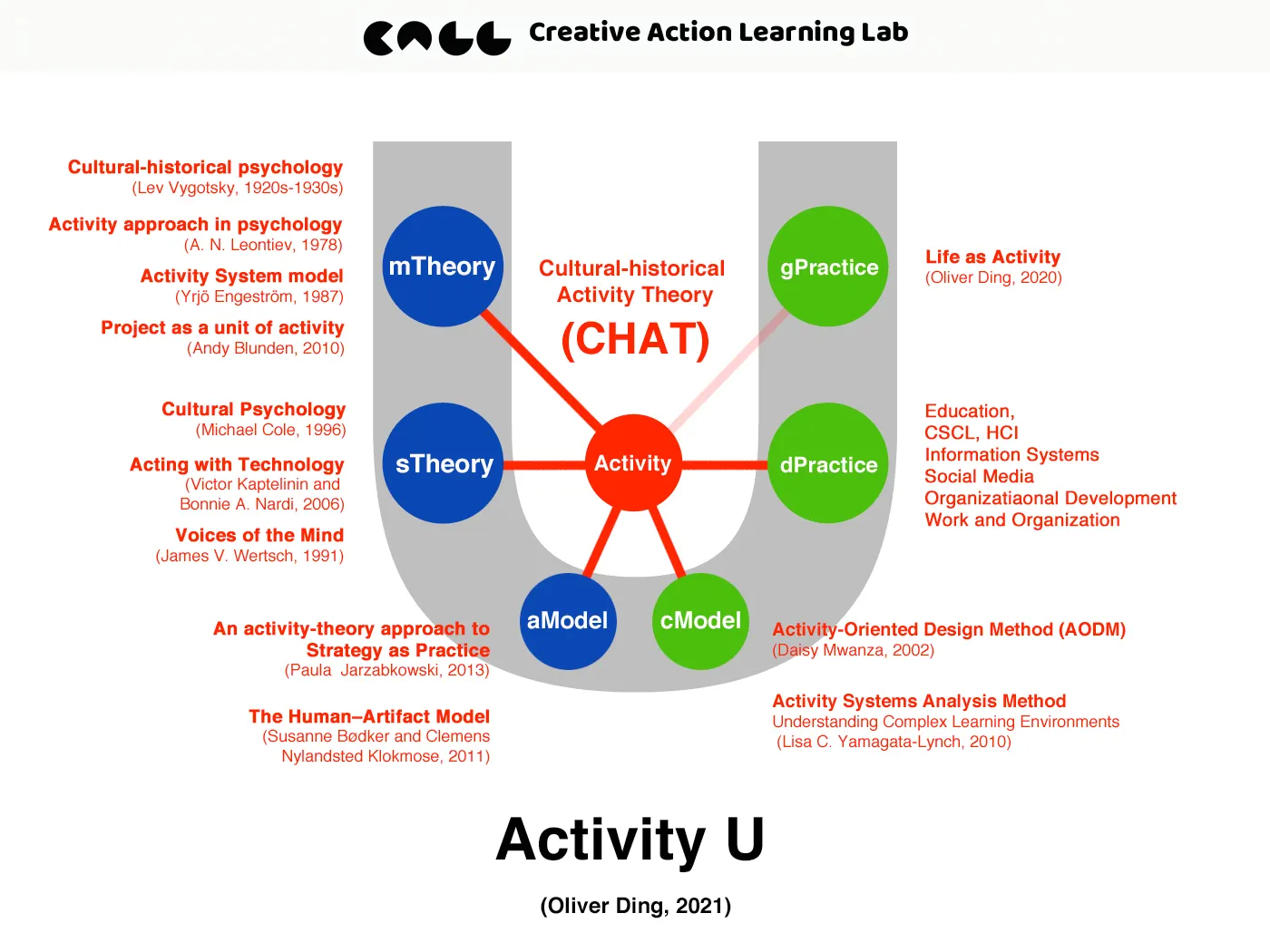
In the years that followed, I returned to it irregularly. I set aside older versions, worked on other models, let it sit. And yet I kept coming back. Eventually I chose this name again — to give it to the entire body of activity-centered creations I had been building over many years. Last month, v4.0 was released as a possible book. A long arc, finally named.
Looking back at that journey now, I notice something I had not seen while living it. The pattern of returning — setting aside, continuing elsewhere, coming back at a different level — is exactly what I have recently named the Revisiting–Rebuilding strategy. And the more I look at my years of engaging with Activity Theory, the more I find the same pattern everywhere. RR is not just a creative technique. It may be one of the characteristic ways a creator appropriates a theoretical tradition over time.
This issue of the "Appropriating Activity Theory" column is about three rounds of that practice, all compressed into the last month.
Moreover, the column itself is a RR practice.
This column began in September 2025. Its subtitle has always been 2015–2025 — a decade of engaging with Activity Theory, told one episode at a time.
Eighteen issues later, I find myself at a natural stopping point. Not because the engagement is over — it is not — but because the story this column was built to tell has reached its conclusion. The decade has been accounted for. The pattern has been named.
What comes next belongs to a different kind of writing.
Focus
The Thematic Foci of the Activity Analysis Center
Over the past two weeks, I continuously worked on the Theoretical Activity project, by adding a new part titled Methodological Empathy to the Weave the Theory book draft.
The Weave knowledge system has produced derived frameworks for theoretical activity (Weave-the-Theory), for life development (Weave-the-Life), for enterprise analysis (Weave-the-Enterprise), and for cultural development (Weave-the-Culture). What the three chapters of Part 6 open is a methodological dimension of the same system: an inquiry into the structural foundations of method — what makes one methodological choice necessary rather than arbitrary, how different approaches relate to the reality they study, and what kind of understanding crosses the boundaries between traditions. This direction can be named Weave the Method. The three chapters are its first concentrated articulation: not a systematic treatise, but a convergence of methodological concerns around a shared set of structural questions that the Weave framework is positioned to address.
In the final chapter of Part 6, Weave the Method: Part and Whole, Synchrony and Diachrony, Inside and Outside, I also review the development of the Weave-The-Theory framework:
The first wave crystallized on December 7, 2024, when the concept of Theoretical Activity surfaced — the recognition that theory-building is itself a form of activity, analyzable with the same tools that Activity Theory applies to other domains of practice. Its form was not a book manuscript or a board, but a conceptual breakthrough recorded in a journal entry — the kind of recognition that feels, as it arrives, like something that was always already true. The Work Deeply stage followed in October 2025 with the development of the Weave-the-Theory framework as the operational form of that insight: two diachronic lines, two synchronic dimensions, four weave-points. The Play Widely stage is the series of case studies that began immediately and runs through this book — each case applying the framework to a long-cycle theoretical development, testing its analytical capacity and revealing configurations it had not anticipated.
What makes this first wave structurally coherent is visible in retrospect. The framework began with its core model and companion cases. Through the writing process, a set of partner models accumulated around it — Theme U, the Knowledge Discovery Canvas, the Sandglass Model, the Genidentity Analysis Method, the Weave-AA Pattern, Supportance Analysis, Deep Analogy, and the emerging concepts.
The second wave is visible as a return to the upper part of the sandglass — a new Subjectification phase has begun — but its full content is not yet determined. What the writing of Weave the Theory generated, beyond the toolkit itself, was a layer of content produced by the application of the model: the Activity-Enterprise-Platform triad that emerged from the AT series, the Weave the Method direction that emerged from Part 6, the Creative Delta and Second Founding concepts that emerged from the Nardi case. These are the raw materials of the new wave — not yet crystallized into a single thematic center, but recognizably different in character from the first wave's work.
The third wave has already begun, though its full form is not yet consolidated. In April 2026, a sustained exploration of the relationship between the Weave knowledge system and the Yinyang-Bagua knowledge system opened a creative dialogue between two structural vocabularies developed in entirely different cultural and intellectual contexts.
Center
The Core of the Activity Analysis Center
The Activity Analysis Center hosts two major theoretical enterprises:
- The Life-as-Activity Approach (including the Project Engagement Approach)
- The World of Activity Approach, now operating within a nested structure: World of Life (World of Activity).
These two enterprises are major creative sources of two case studies of the Creative Confluence pattern, documenting in two articles:
- Generative Confluence: Theoretical Activity, Theoretical Enterprise, and Theoretical Platform
- Weave 2.0: Synchronic Line, Diachronic Line, and Living Coordinate
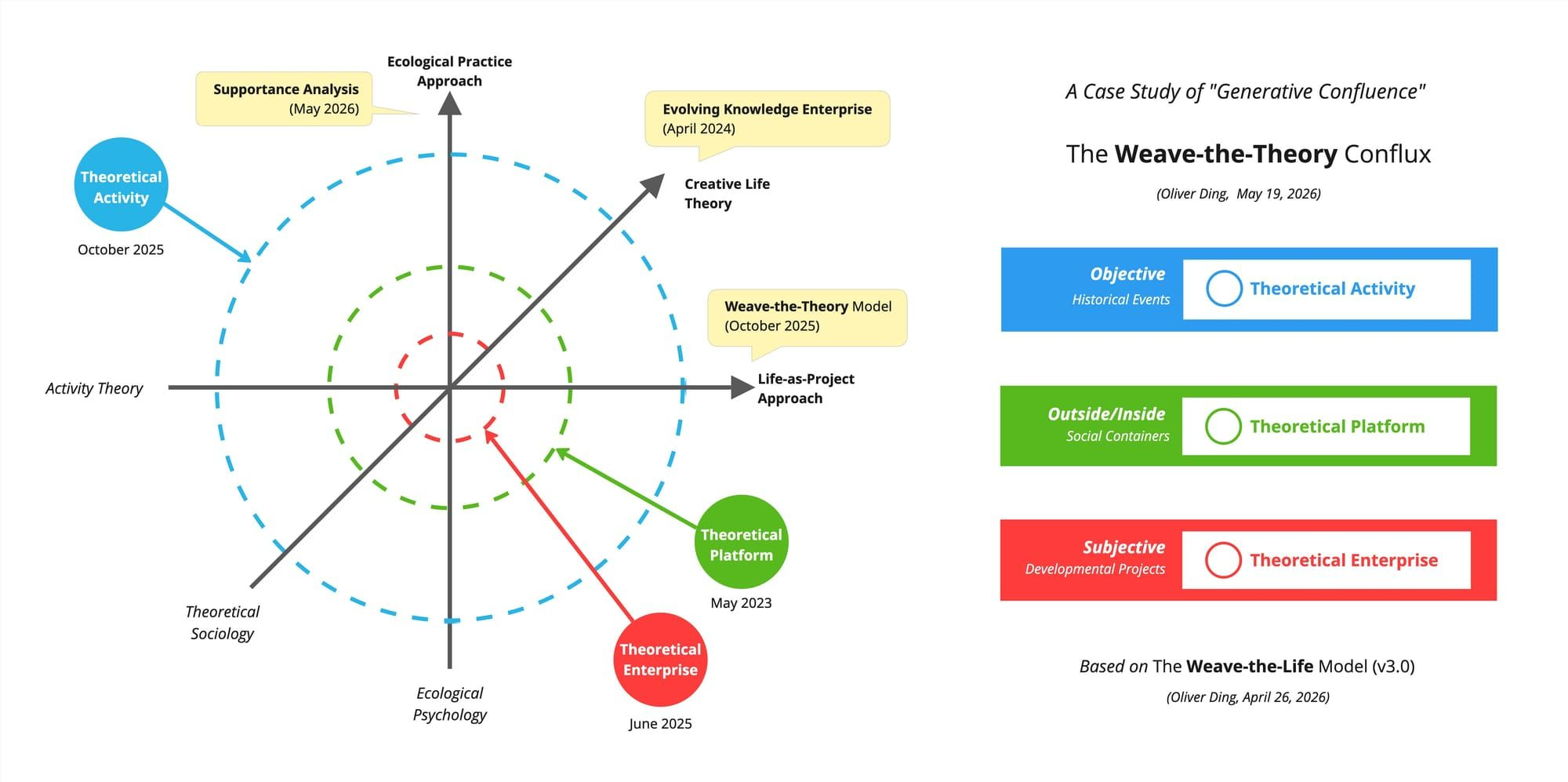
In June 2025, while reflecting on my creative journey, I discovered a pattern I had not previously recognized: three theoretical traditions I had engaged with over several years had, without deliberate planning, begun to converge. I named this pattern Generative Confluence — a process in which distinct streams of ideas, each inspired by different theoretical approaches, evolve from separate into interconnected, generating a new creative center while preserving the independent trajectories of the original streams.
Soon after, I uncovered a deeper structure. The three streams that converged in 2025 were themselves outcomes of earlier confluences. Each branch had its own story of generative confluence. I called this recursive, scale-crossing pattern Fractal Confluence — a journey in which confluences nest inside confluences, and the outcome of one confluence becomes the soil for the next. Looking back, my creative journey from 2019 to 2025 can be understood precisely as a Fractal Confluence journey.
In the months following the 2025 Generative Confluence, a new theoretical platform — GO Theory: the World of Life(World of Activity) approach — emerged as its central outcome. That platform did not mark an end. As the Fractal Confluence pattern would predict, it became the developmental environment for yet another confluence.
In May 2026, I recognized that the trio of concepts I had recently developed — Theoretical Activity, Theoretical Enterprise, and Theoretical Platform — was itself a product of a smaller, nested confluence. Each of the three concepts had its own developmental episode (2023, mid-2025, late-2025), and they converged within the GO Theory platform to form a coherent, interdefined triad. This is a fresh case of Fractal Confluence in action — a continuing episode of the same recursive journey.
Drawing on the simplified Creative Confluence analysis method (a version of the full eight-movement Generative Confluence pattern, focused on center emergence), I reconstruct the three developmental episodes, show how they converged, and demonstrate that theoretical platforms can function as recursive engines for further confluences. The diagram below offers a visual map of the case. More details can be found in Generative Confluence: Theoretical Activity, Theoretical Enterprise, and Theoretical Platform.
The second Creative Confluence case study is about the development of Weaver 2.0.
In October 2025, I introduced the “Weave” Basic Form as a meta-framework that conceptualizes the "World of Activity" as the synthesis of two diachronic dimensions and two synchronic dimensions. Later, I used the basic form to develop a series of diagrams for various knowledge projects.
In April 2026, while working on the Weave 42 project, I developed a new version of the Weave Basic Form, a 4×4 edition that I call the Weave 16 diagram. Based on the new diagram, I created the Weave-the-Life framework (v3.0) and used it to curate 16 key concepts of the Life-as-Activity Approach. The same idea is applied to developing GO Square: the Weave 8×8 edition produces 64 GO coordinates for mapping concept systems within the GO Theory framework. Yet, there are more creative elements I curated within this version, especially the following three ideas:
- Weave-points
- Living Coordinates
- Thematic Spaces
These three ideas come from three different knowledge systems:
- Weave knowledge system
- The World of Activity Approach
- Thematic Space Theory
In Unit of Analysis, Unit of Synthesis, and Configurational Theory (Part 6 of Weave the Theory), four distinct uses of "unit of analysis" are distinguished. The deepest — Vygotsky's sense — is the unit of synthesis: not a boundary drawn around a phenomenon for analytical convenience, but the simplest form in which the whole is already fully present. Word meaning, for Vygotsky, was such a unit: it contained verbal thought in its essential structure, and nothing about that structure would be lost by starting the analysis there.
As the Weave 16 diagram developed, it became clear that each coordinate position was not merely a structural intersection. It was simultaneously a Weave-point (a position defined by the intersection of axes), a Living Coordinate (a position an actor can inhabit and move through), and a Thematic Space (a populated territory of concepts, cases, and tools). These three aspects were not added to the diagram from outside — they were discovered within it. One diachronic line crossing one synchronic line produces a Living Coordinate; every such coordinate opens onto a Thematic Space. This is the unit of synthesis: the smallest structural unit from which the entire 16-point and 64-point architecture can be derived.
Before the confluence, the three concepts existed separately: Weave-point as a structural position, Living Coordinate as the actor's developmental orientation, Thematic Space as a populated knowledge territory. Each was analytically useful on its own. After the confluence, they are three dimensions of a single integrated understanding — three aspects of what it means to inhabit a position within any structured space of human activity:
- Structure (Weave-point): the given positional architecture of the environment — where the actor is located within the diachronic and synchronic grid
- Habitation (Living Coordinate): the actor's lived experience of dwelling in and moving through that position over time — the developmental trajectory from the inside
- Possibility (Thematic Space): the dynamic cognitive space of what can be explored, reflected upon, and created from within that position — the open territory that gives each position its generative character
The new creative center of Weave 2.0 is the Leeway Model — a conceptual object that names what the three creative elements, taken together, reveal. The name leeway captures the essential insight: the environment provides structure, the actor is situated within it, but the actor retains many possibilities for movement. Leeway is not freedom from structure — the Weave-point is given, the axes are fixed — but freedom within structure: the range of moves, trajectories, and cognitive explorations that remain available at any given position. This condition is not specific to knowledge ecology. It applies wherever structure and freedom coexist — which is everywhere that human activity occurs.
More details can be found in Weave 2.0: Synchronic Line, Diachronic Line, and Living Coordinate.
Circle
The Context of the Activity Analysis Center
Over the past several years, I worked on several theoretical projects, such as the Ecological Practice Approach, Curativity Theory, Creative Life Theory, and Thematic Space Theory.
Inspired by creativity researcher Howard Gruber's idea of "Network of Enterprises," I used the "Knowledge Center" approach to manage this large knowledge system. Each knowledge center hosts one or two related theoretical approaches.
- CALL (Creative Action Learning Lab): the Ecological Practice Approach and Creative Life Theory
- Curativity Center: Curativity Theory
- TALE (Thematic Analysis Learning Engagement): Thematic Space Theory
- Frame for Work: A theory about Knowledge Frameworks
In the #14 issue (March 31, 2026), I started to use GO Theory to name a new theoretical platform to support these enterprises.
On this platform, five theoretical enterprises operate, each occupying a distinct position within the World of Life: Life as Activity (including the Project Engagement Approach), Anticipatory Cultural Sociology (ACS), Strategic Developmental Psychology (SDP), Cognitive Hydrology, and Platform Ecology.
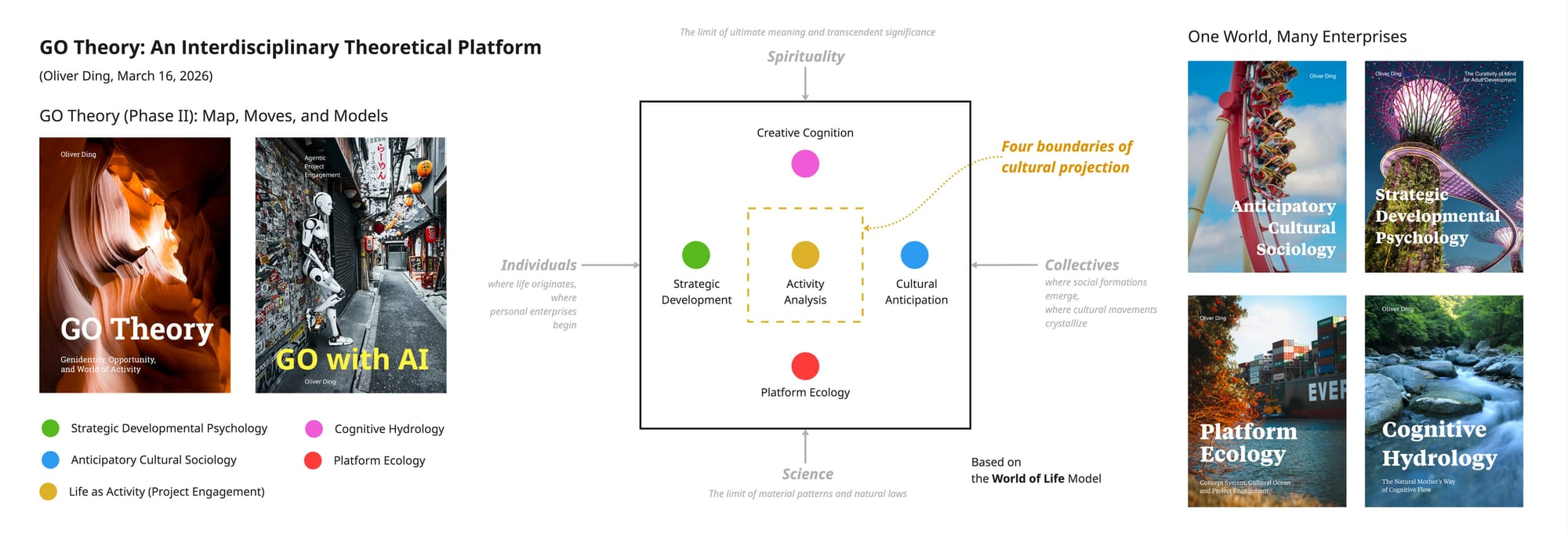
These five enterprises are equal. None is the foundation of the others. Each occupies a different position within the World of Life, which means each brings a genuinely different theoretical perspective. And because they share the same spatial foundation — the same map, the same boundaries, the same operating concepts — they naturally support one another, forming a network of enterprises rather than a hierarchy.
As mentioned in the #16 issue (April 30, 2026), I spent five days to explore the Weave knowledge system and Yinyang-Bagua knowledge system. During this exploration, a creative insight emerged: the formal logic of the Yinyang-Bagua (8 × 8 = 64 structural positions) could be productively engaged with the substantive content of my own theoretical framework. The question became: what eight fundamental elements, derived from GO Theory's ontology, could serve as the basis for such a matrix?
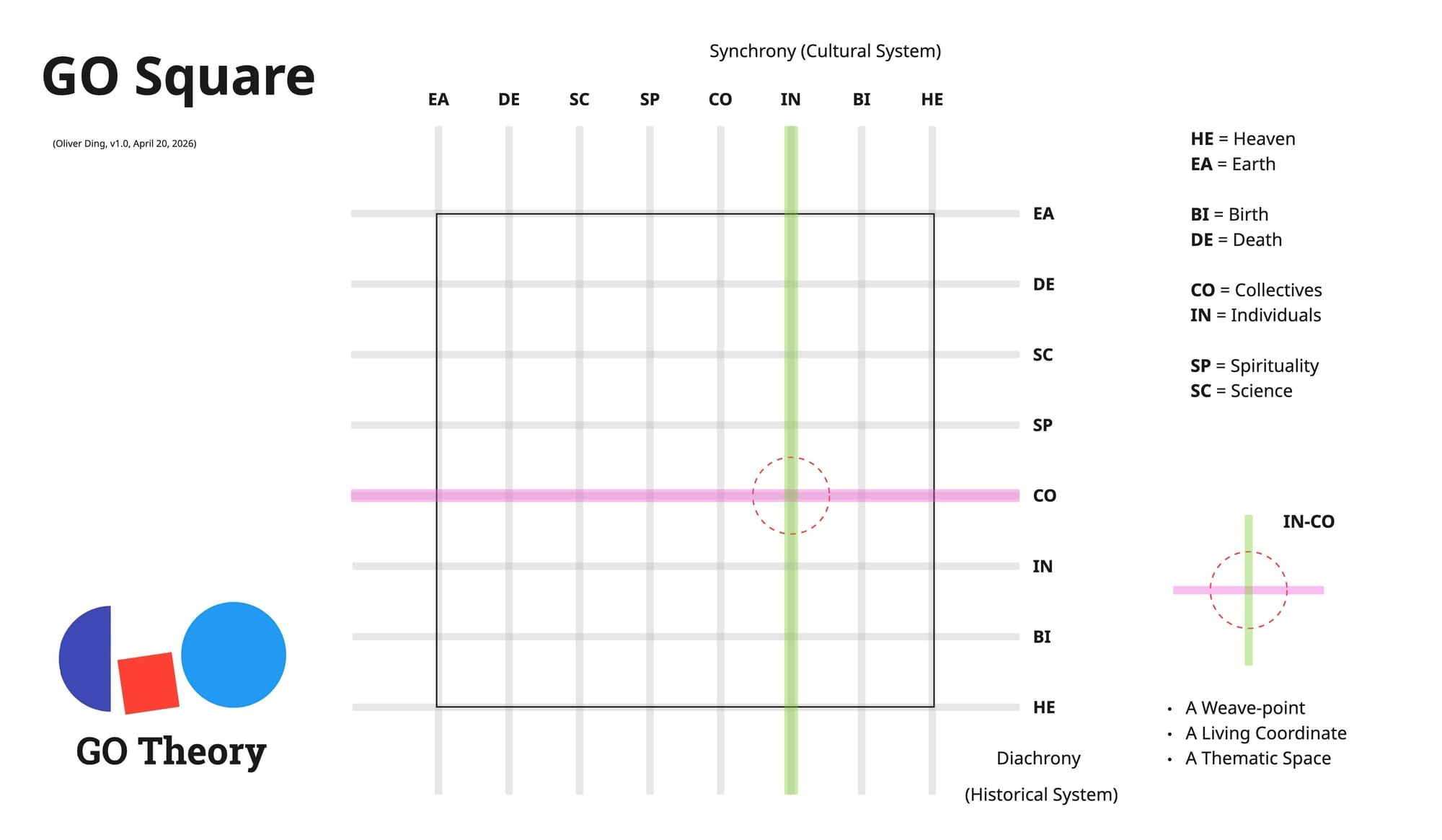
The answer was already present in the theoretical materials developed over the preceding years. The World of Activity defines four boundaries: Heaven (HE), Earth (EA), Birth (BI), and Death (DE). The World of Life defines another four boundaries: Collectives (CO), Individuals (IN), Spirituality (SP), and Science (SC). Together, these eight boundaries constitute the complete set of structural limits within which all human meaning-making activity unfolds. They are the eight basic concepts—the Eight Units—from which a 64-fold matrix can be generated.
The Weave model, with its synchronic-diachronic logic, provides the method for generating the matrix.
The outcome is the GO Square, a tool for mapping the Symbolic Universe.
The Yinyang-Bagua (Eight Trigrams) system employs a compositional principle of remarkable elegance. Each hexagram in the 64-fold system is a compound structure formed by an upper trigram and a lower trigram. When combining the eight trigrams to form the 64 hexagrams, the same three-line trigram takes on two different conceptual interpretations depending on its position within the hexagram. One is called the inner trigram, which expresses the inner aspect — the subject, the foundation, the immanent condition. The other is called the outer trigram, which expresses the outer aspect — the object, the context, the encountered situation.
When I examined the formal structure of my own Weave knowledge system during the five-day exploration, I realized that it already embodied a similar logic. In the Weave model, the horizontal dimension represents the diachronic—historical events and processes unfolding across time—while the vertical dimension represents the synchronic—cultural landscape and structural positions coexisting in the present. Each weave-point is precisely the intersection of one diachronic and one synchronic line, defining a living coordinate.
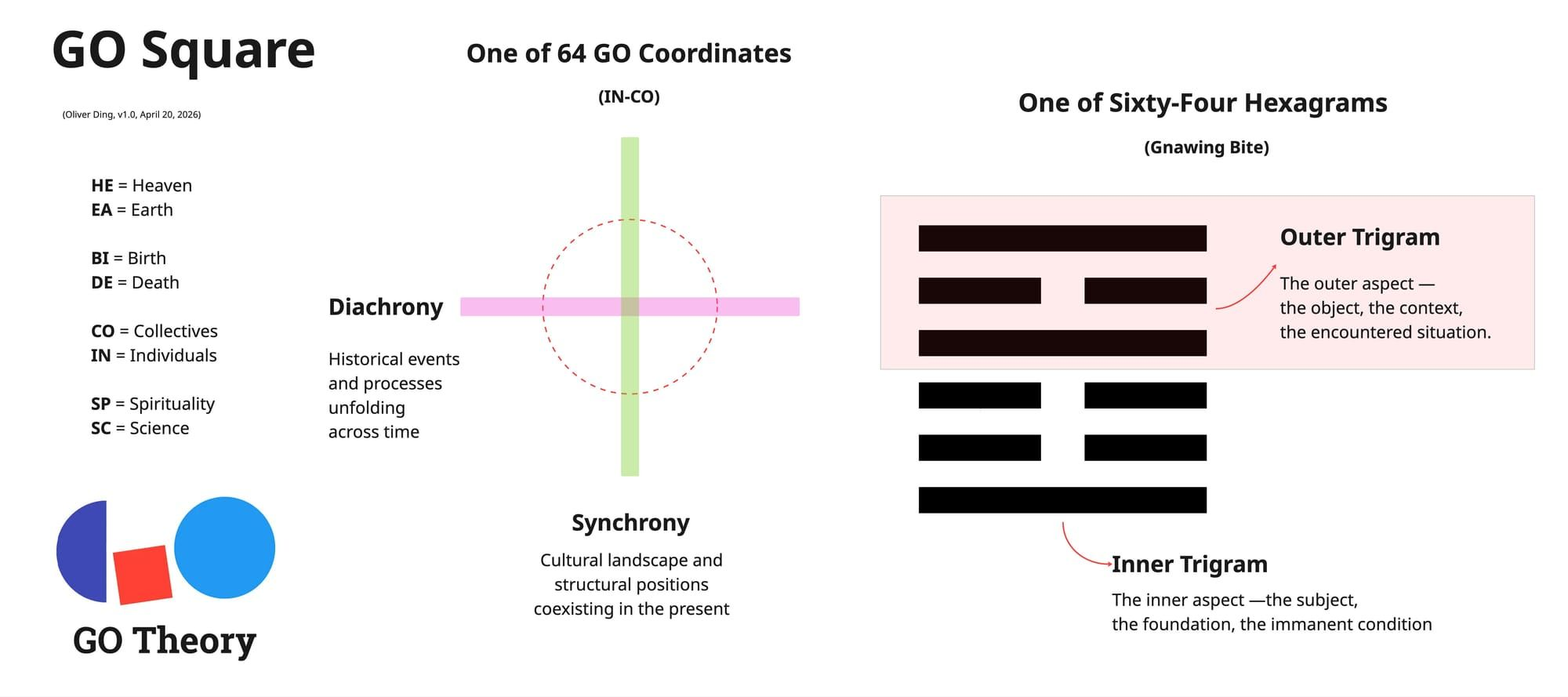
The unexpected resonance was this: both systems are built upon a pair of contrasting elements that together form a coherent whole. The Bagua distinguishes between the inner trigram (foundational, immanent tendency) and the outer trigram (contextual, encountered situation). My Weave model distinguishes between the diachronic (historical events and processes unfolding across time, corresponding to the Historical System) and the synchronic (cultural landscape and structural positions coexisting in the present, corresponding to the Cultural System). Their specific meanings are different—mine refer to the Historical and Cultural Systems, spanning time and space—but the formal structure, using two contrasting dimensions to generate a complete framework, is remarkably analogous. I did not adopt this logic from the Bagua; rather, I discovered that the logic already at work in the Weave model was isomorphic to it at the level of formal structure.
With the map in hand, we now turn to the compass.
But a structural map of concept systems is only the beginning. From the perspective of cultural development, no concept system exists in isolation. Every concept system emerges alongside other concept systems, competes with some, borrows from others, sediments into institutions while new ones rise to challenge it. A concept system's life—its birth, its travels, its transformations, its possible death—unfolds in a web of relationships with other concept systems. To understand any one of them, we must understand how they move, connect, and form larger wholes.
In the second article about the GO Square, How to Navigate the Symbolic Universe: Three Principles of Spatial Heuristics, I introduce three principles of using the GO Square:
- Genidentity: Where is this concept system located?
- Attachance: How does it move between locations?
- Curativity: How does it form larger wholes with others?
The seven case studies demonstrated that navigation is possible. Each concept system—whether an academic methodology, a cultural theme, a philosophical revival, a doctrinal document, or a technological fantasy—could be located at a primary GO Coordinate. The diagnoses of Genidentity, the trajectories of Attachance, and the constellations of Curativity transformed isolated placements into a coherent method.
As discussed in the previous section, GO Square opens new possibilities for the history of concepts (Begriffsgeschichte) by adding spatial anchoring to semantic analysis. It also serves my own practice of Thematic Development Study. Beyond these, GO Square can support comparative intellectual history, science and technology studies, personal knowledge management, and educational design.
GO Square is not a closed system. It is a platform. The eight Units are fixed, but the 64 thematic spaces are open to endless exploration. The method developed in this article—the diagnostic questions, the six‑step procedure, the three principles—is meant to be used, tested, refined, and extended by others.
The map is drawn. The principles are set. The navigation begins.
World
Me, You, and We
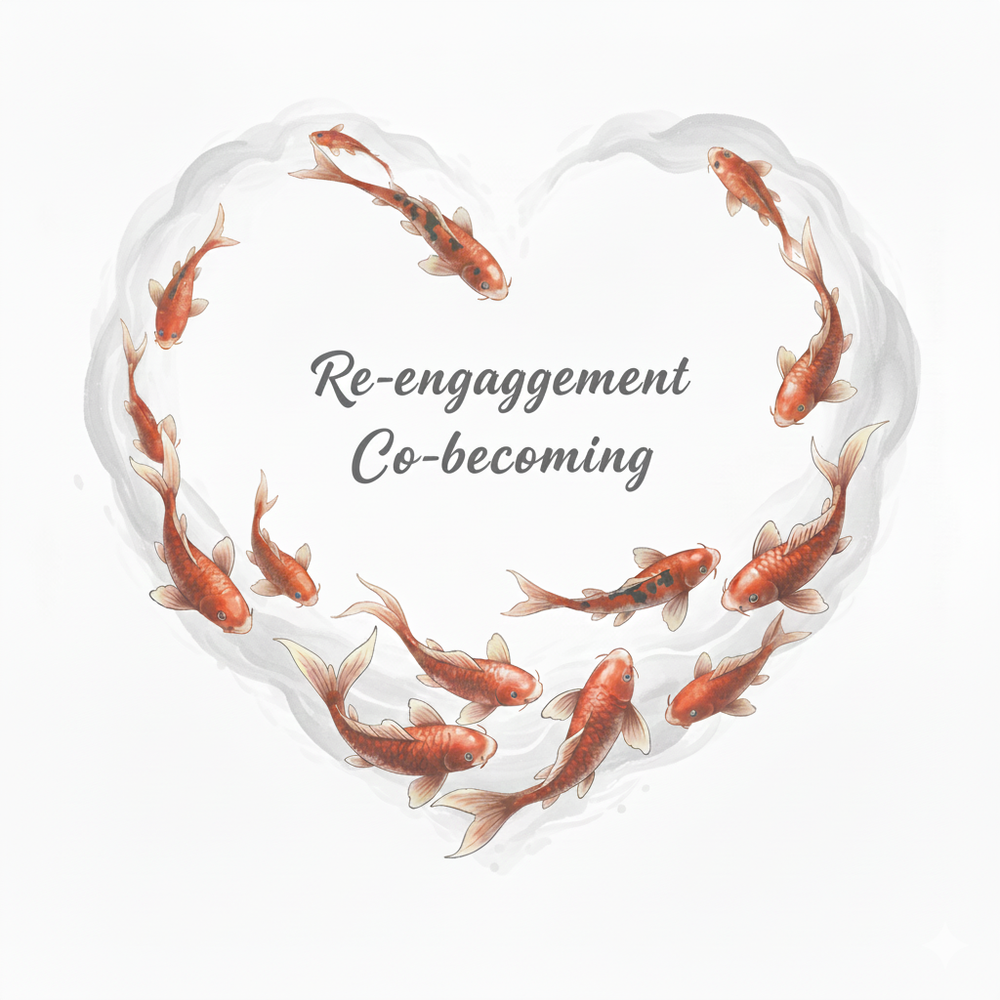
The image above is my New Year's greeting card — and also my annual theme for 2026: Re-engagement and Co-becoming.
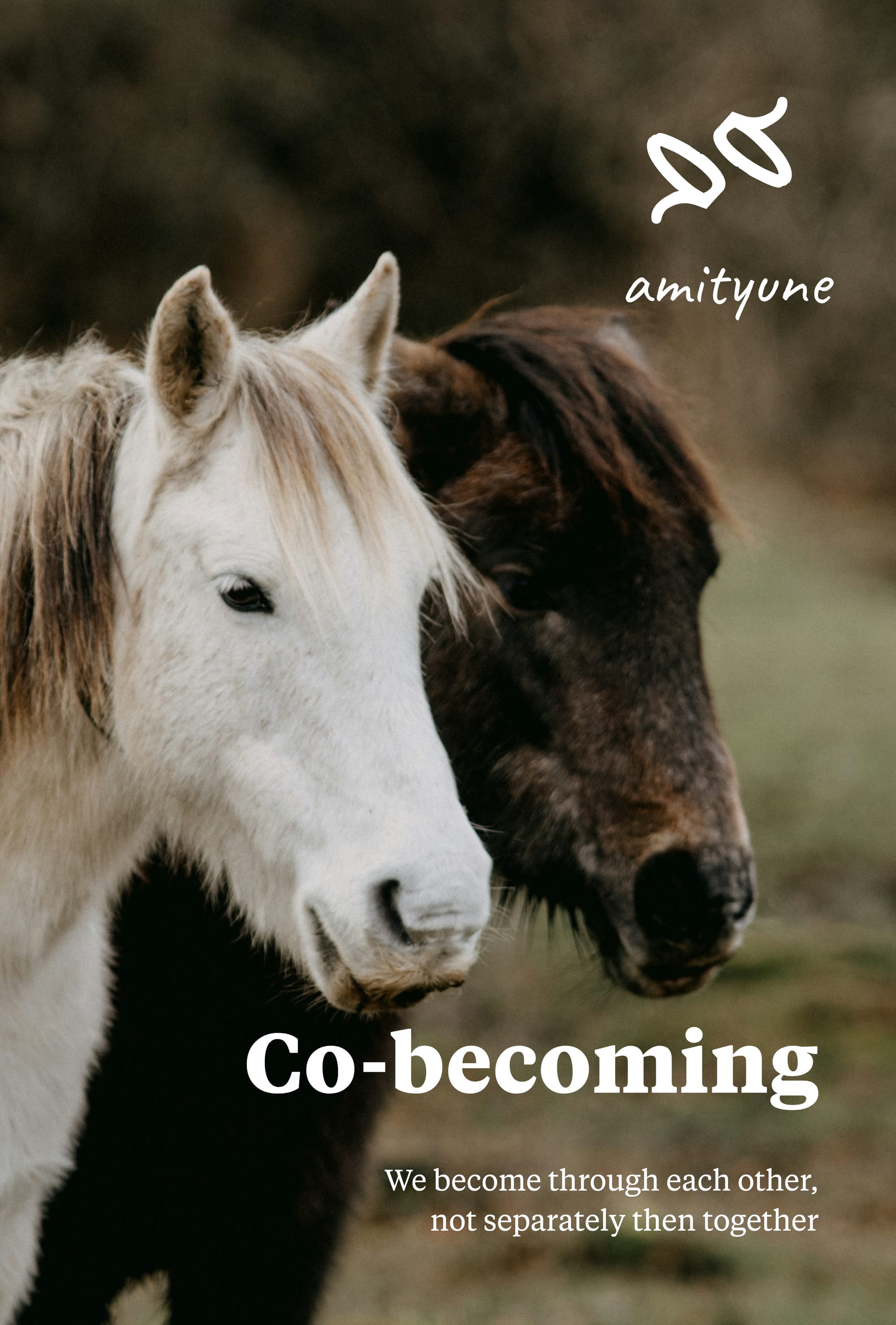
In Jaunary 2026, I designed a set of thematic cards to further develop these annual themes. Below is one of them.
This issue marks the end of the "Appropriating Activity Theory" column.
This column began in September 2025. The #1 issue is titled Misunderstanding and Repurposing (2018). The #18 issue, published yesterday, is titled Revisiting and Rebuilding a Theoretical Tradition.
Its subtitle has always been 2015–2025 — a decade of engaging with Activity Theory, told one episode at a time.
A decade of engagement and the column are both the journey of Co-becoming.
A theoretical tradition is a knowledge ecology. The individual creator moves inside it, draws from it, contributes to it, and is shaped by it in return.
Re-engagement and Co-becoming. I placed them there in January. The year answered.
Oliver Ding
Founder of the Activity Analysis Center
May 31, 2026
p.s. I am based in Houston, Texas, US. Where are you?
v1.0 - May 31, 2026 - 3,593 words