
SDP: Two Diagrams about the Self-Life-Mind Schema
This short post is part of the Strategic Developmental Psychology (SDP) project.
by Oliver Ding
June 7, 2026
This week, I have been working on a case study of a young female entrepreneur who is in the process of refreshing her life belief system. In her own words, she is “reinstalling her internal operating system” and “updating the underlying logic of her life development.”
I used the World of Activity approach (especially the Flow-Focus-Center-Circle model), the Self-Life-Mind (SLM) model, and several other related knowledge frameworks to conduct an in-depth discussion of her experience. This was the first time I brought the World of Activity and Self-Life-Mind models together in a single analysis.
After completing the first draft of the research report, I began to reflect on the role that the Self-Life-Mind model played in this case study.
Previously, I had used this model repeatedly, always treating it as a meta-framework. In my manuscript Meta-Frameworks (late 2025), I collected a series of articles about this model, showing the specific contexts in which I had used it. In my manuscript Lake 42 (early 2026), I described in detail how I used Self-Life-Mind to anchor a new creative center back in June 2025. In both cases, the model stayed in the background — once the front-stage work was done, it faded from view.
This time was different.
I used Self-Life-Mind directly as a knowledge model. It stood at the front, orchestrating a series of other frameworks. It came down to the ground and did the work, rather than hiding behind the scenes.
This reflection has led me to reposition the model’s function within my overall knowledge landscape. In this new process of exploration, I have drawn two diagrams.
The Self-Life-Mind Toolkit
The first diagram places Self-Life-Mind at the center, surrounded by five concepts, each connected to a corresponding tool, forming an integrated toolkit.
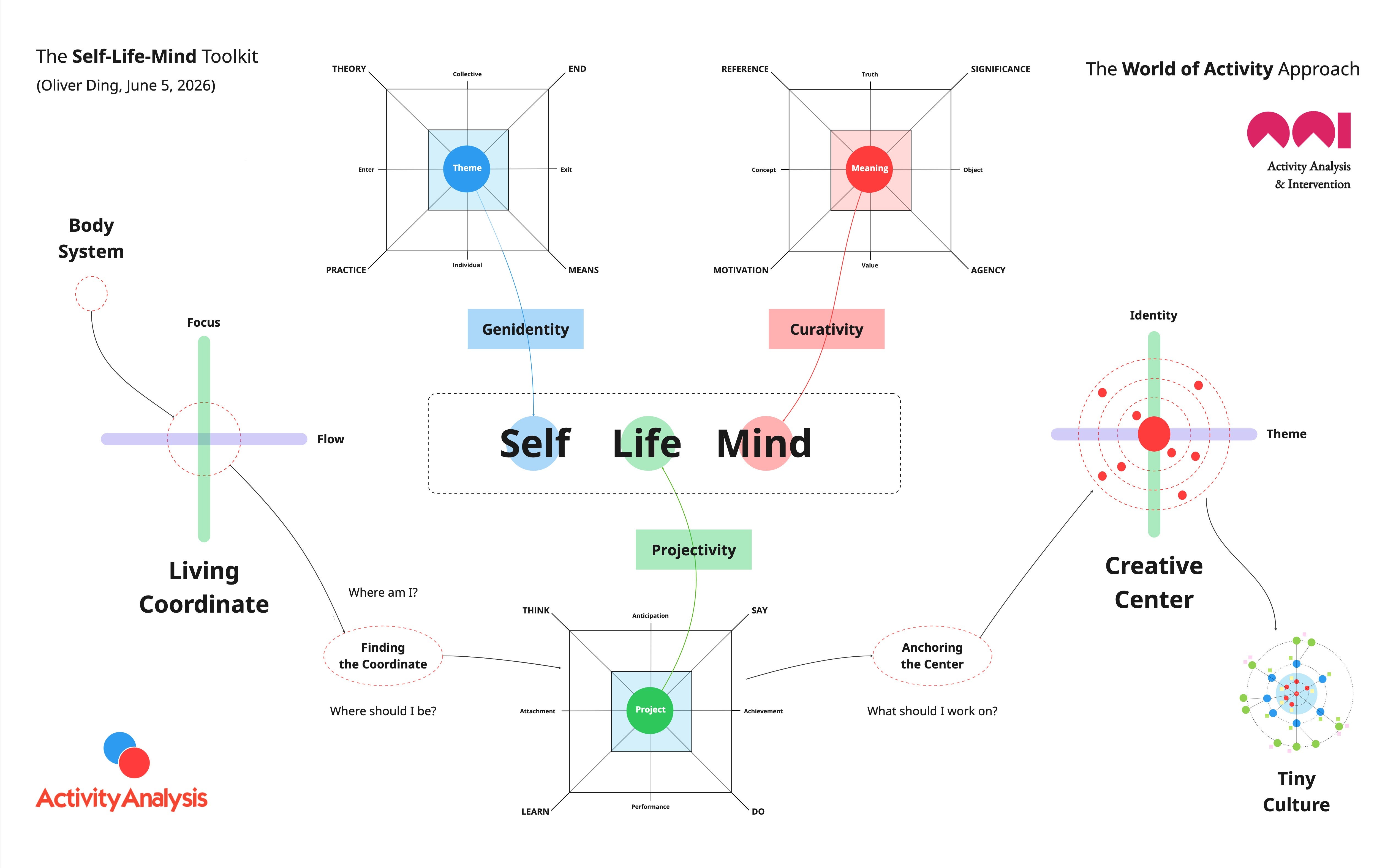
- Self → Genidentity → Knowledge Discovery Canvas
- Life → Projectivity → Life Discovery Canvas
- Mind → Curativity → Meaning Discovery Canvas
- SLM → Finding the Coordinate → Living Coordiante Model
- SLM → Anchoring the Center → Creative Center Model
The recent case study focused primarily on rebuilding the living coordinate of a young female entrepreneur. In using the SLM model to analyze her journey, I also employed the Genidentity framework — because the central theme was how she was refreshing her belief system, which is fundamentally a question of self-continuity and transformation over time.
Although the case also touched on her entrepreneurial work, that was not the main focus of this analysis.
The joint operation of SLM and Genidentity gave me an insight: I could extend this pattern to the Life and Mind dimensions, building out a comparable toolkit for each. The final configuration turned out to be satisfying, as it brought together the three “discovery” canvases I have developed over the past few years:
- Knowledge Discovery Canvas (for Self, via Genidentity)
- Life Discovery Canvas (for Life, via Projectivity)
- Meaning Discovery Canvas (for Mind, via Curativity)
The Life Discovery Canvas is project-centered. In the diagram, it connects to both Finding the Coordinate and Anchoring the Center.
In the Lake 42 manuscript’s discussion of the Generative Confluence Model, these two operations represent two of the eight movements. In the present configuration, they are further specified as pointing toward two Developmental Projects — concrete undertakings through which an adult enacts their development.
The diagram thus performs two functions. First, it integrates three discovery canvases under the Self-Life-Mind umbrella. Second, it shows how the two Self-Life-Mind-anchored models connect to project-centered work via the Life Discovery Canvas. This configuration did not exist before the case study. It emerged from the reflective process of using Self-Life-Mind as a front-stage knowledge model rather than a background meta-framework.
The Self-Life-Mind Schema for Adult Development
Hours after completing the first toolkit diagram, I noticed something important. While the first diagram curated a set of external tools around Self-Life-Mind, it failed to express the integrity of Self-Life-Mind as a whole — the very insight I had emphasized in the case study.
So I created a second diagram, this time focusing on the internal relations within Self-Life-Mind itself.
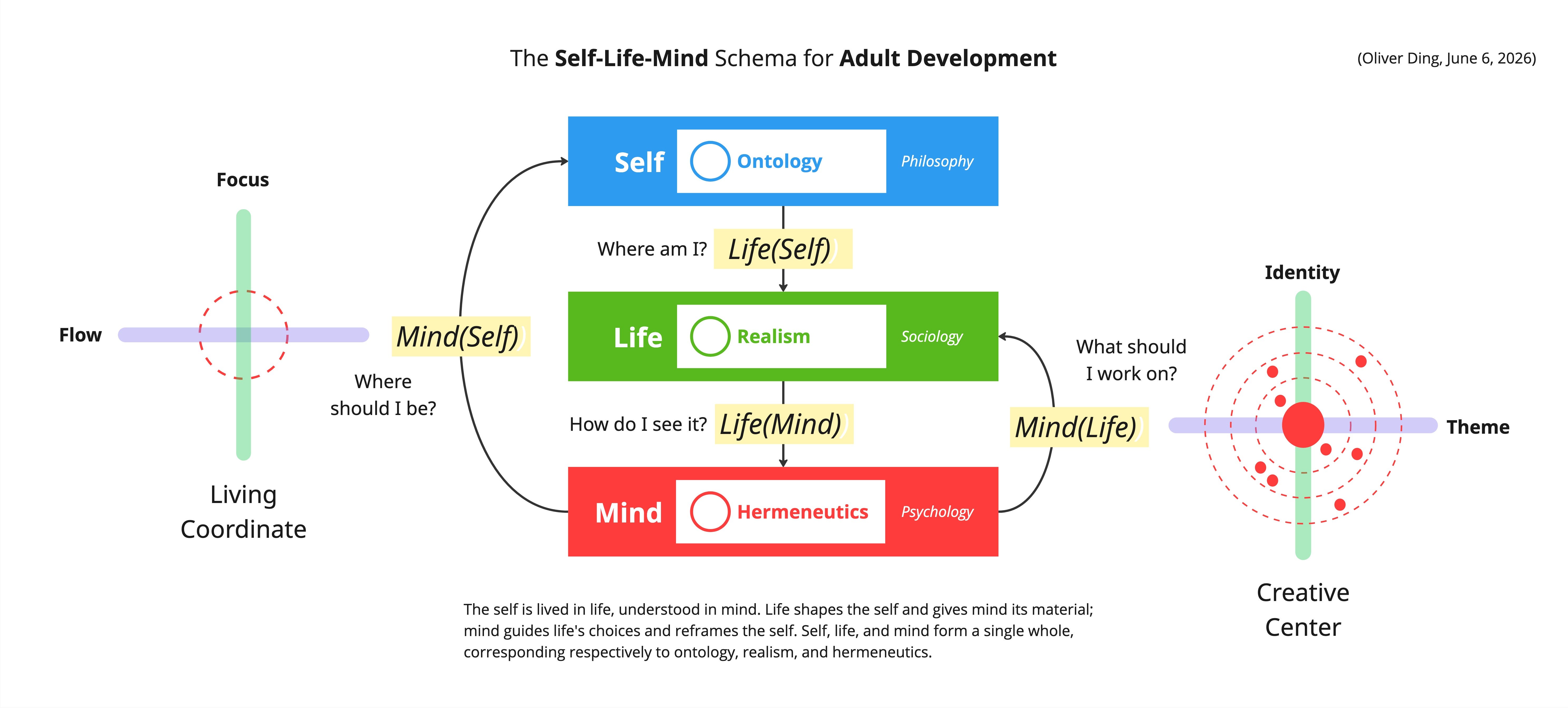
I returned to the standard formulation of Self-Life-Mind, which aligns with ontology, realism, and hermeneutics, as well as philosophy, sociology, and psychology. This formulation specifies three functions of the model and three corresponding academic resources. Life refers to the actual activities a person engages in within social life, which can be understood through sociology. Mind refers to the person’s interpretation of those activities, which can be understood through psychology. When neither sociology nor psychology can adequately address the Self, we need to return to philosophy to work through the relevant questions.
In my case study report, I wrote:
“The self is lived in life, understood in mind. Life shapes the self and gives mind its material; mind guides life’s choices and reframes the self. Self, life, and mind form a single whole, corresponding respectively to ontology, realism, and hermeneutics.”
Around this foundational framing, I further developed four units of analysis, each with its own heuristic question:
- Life (Self): Where am I?
- Mind (Self): Where should I be?
- Life (Mind): How do I see it?
- Mind (Life): What should I work on?
For understanding Life (Self), I used the Flow-Focus-Center-Circle model from the World of Activity toolkit. Due to space constraints, I did not show the FFCC model on the diagram itself.
For Mind (Self), I placed the Living Coordinate Model, which is precisely designed to answer “Where should I be?”
For Mind (Life), I placed the Creative Center Model, which corresponds to “What should I work on?”
Similarly, due to visual space limitations, I did not include a model for “How do I see it?” — though it could be addressed by the Meaning Discovery Canvas or other interpretive tools.
These four units of analysis can also generate additional questions beyond the ones listed here. That is a direction for further exploration going forward.
The Seed of Strategic Developmental Psychology
The Self-Life-Mind schema was first articulated in a diagram I made on May 8, 2024 — a note about a meta-framework of Theoretical Psychology. The major idea of the diagram was a simple correspondence: Self = Ontology, Life = Realism, Mind = Hermeneutics. This “Ontology — Realism — Hermeneutics” schema was adopted from Ping-keung Lui’s Theoretical Sociology (2016, p.251). As Lui noted, we should see this grand theory as a dialogue between philosophy and sociology because “Ontology” and “hermeneutics” are respectable terms in philosophy, but “realism” — sandwiched between them — is not.
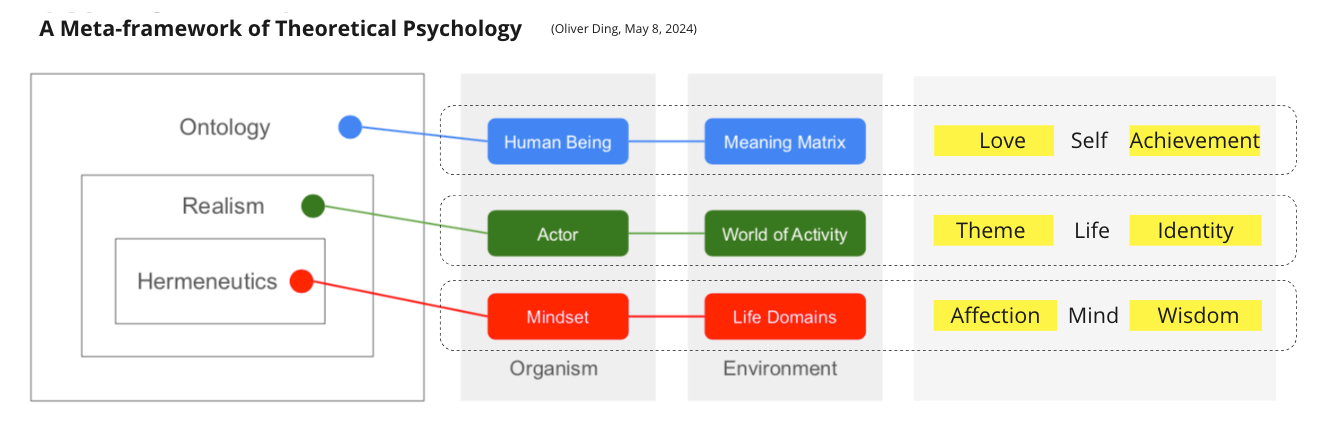
For Psychological Science, the concept of “Self” is hard for empirical research. I use the concept of “Self” to refer to the Ontology of Theoretical Psychology, meaning that we should define it from a philosophical perspective.
The concept of “Life” refers to the Realism of Theoretical Psychology. The concept of “Mind” refers to the Hermeneutics of Theoretical Psychology.
In this way, the “Self — Life — Mind” schema was established as a vehicle of the “Ontology — Realism — Hermeneutics” schema. This is the unique foundation of a brand new Theoretical Psychology.
That was the schema’s original role: a meta-framework, a philosophical anchor for organizing and relating knowledge frameworks, not a tool for direct application.
The seed of Strategic Developmental Psychology, however, had been planted earlier. When we consider my work on “Development Projects” across the book drafts Platform for Development, Advanced Life Strategy, and Creative Life Curation together, a new theme begins to emerge: Strategic Developmental Psychology. On May 6, 2024, I developed the Strategic Life Development framework and wrote a 66-slide deck.
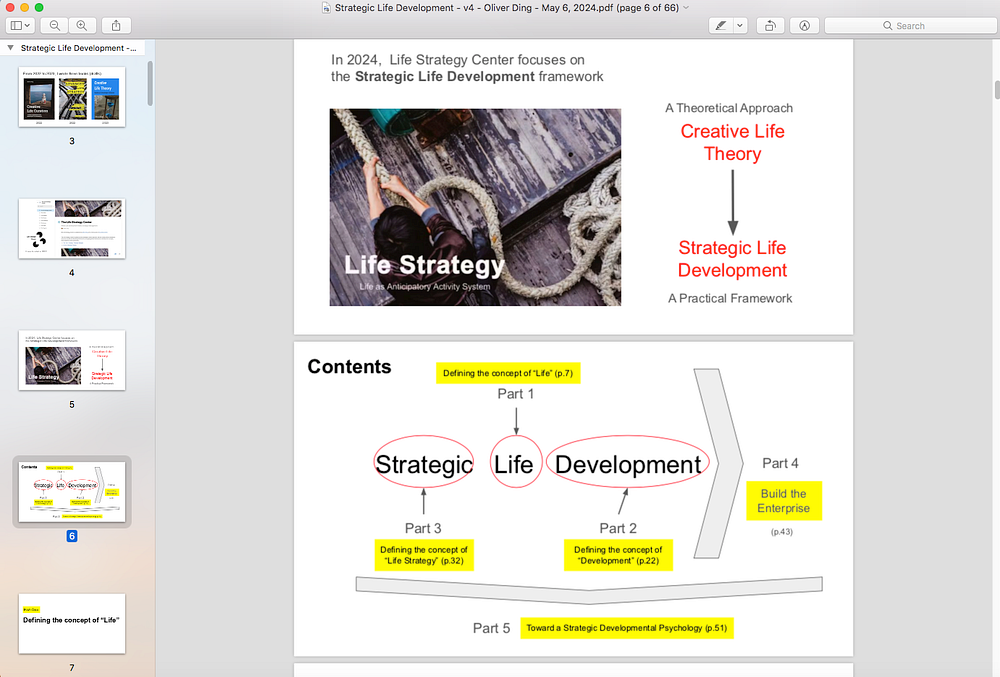
The last section of that deck was titled “Toward a Strategic Developmental Psychology.” In that section, I used the meta-framework of Theoretical Psychology — the precursor to what would become the Self-Life-Mind schema — to frame my knowledge frameworks. Two days later, on May 8, 2024, I explicitly drew this meta-framework as a diagram, giving it the visual form that would become the Self-Life-Mind schema.
Thus, the Self-Life-Mind schema was not an isolated invention. It was the crystallization of a larger vision — a strategic developmental psychology that could serve both explanatory and interventionist purposes.
Today, the two new diagrams I have presented in this reflection bring the Self-Life-Mind schema back to the center of the Strategic Developmental Psychology (SDP) project. What has changed is not the schema itself, but its relationship to the work.
It remains a meta-framework. But it now plays a more stable and central role. Rather than hiding in the background after front-stage work is done, it sits at the center, actively orchestrating a network of concepts, questions, and models. The two diagrams capture this new configuration from two complementary angles. The first diagram places Self-Life-Mind at the center, surrounded by five concepts (Genidentity, Projectivity, Curativity, Finding the Coordinate, Anchoring the Center) and five corresponding tools, forming an integrated toolkit. The second diagram returns to the internal relations of Self-Life-Mind itself, unfolding the schema into four units of analysis, each with its own heuristic question and knowledge model.
Together, these diagrams reveal a new architecture. Around the stable center of Self-Life-Mind, four units of analysis have emerged:
- Life (Self): Where am I?
- Mind (Self): Where should I be?
- Life (Mind): How do I see it?
- Mind (Life): What should I work on?
These four units are not merely a classification scheme. They are entry points — four ways of entering the developmental space that opens up when Self, Life, and Mind are held together as an indivisible whole. Each unit, however, also implies a trajectory. And that trajectory moves in two directions.
Path One: From Theory to Practice
The first path moves from theory to practice. It begins with a unit of analysis, which generates a heuristic question. The heuristic question directs attention to a practical phenomenon in the lived experience of an adult. And the investigation of that phenomenon yields research insights that can inform intervention.
This is the path of application: taking the conceptual structure of Self-Life-Mind and using it to ask disciplined questions about real human development.
Unit of Analysis → Heuristic Question → Practical Phenomenon → Research Insight
For example, the unit Mind (Life) asks “What should I work on?” This question directs attention to the process of anchoring a new creative center — moving from a vague theme or a set of disparate resources to a coherent, generative core. I have discussed this dynamic in Lake 42, where the “Theorizing Creative Life” project served as a GAP project. The practical phenomenon might be the experience of having multiple theoretical interests or creative fragments without a unifying structure. The research insight, in turn, might reveal the underlying structure of how a meta‑framework (like Self‑Life‑Mind) can serve as a container to curate diverse creative elements, transforming a focus into a stable center for future growth.
This path is where the Self-Life-Mind schema proves its utility. It is not abstract philosophy. It is a tool for seeing, asking, and acting.
Path Two: From Practice to Theory
The second path moves in the opposite direction — from practice back to theory. It begins with research insights drawn from concrete experience. Those insights are then articulated as creative themes — distinctive ideas that captures something real. The creative themes are then developed into knowledge models, structured frameworks that can be applied repeatedly. Finally, creative themes and knowledge models point toward theoretical concepts that can enter the larger disciplinary conversation.
This is the path of discovery: taking the messy reality of lived experience and distilling it into shareable, reusable theoretical resources.
Research Insights → Creative Themes → Knowledge Models → Theoretical Concepts
For example, the case study of the young female entrepreneur generated research insights about how, within the sources of her belief system, some components are native rather than internalized from external influences. Those insights were articulated as a creative theme around the tension or relationship between the native and the internalized. To analyze this process, I applied the Cultural Projection Model (2025) and the internalization-externalization principle from Activity Theory — knowledge models developed earlier. These models, in turn, point toward a potential theoretical concept that has not yet been fully established: perhaps native belief as a distinct category, though this remains uncertain at this stage.
This path is where the Self-Life-Mind schema proves its generative power. It is not a closed system. It is a living framework that grows from engagement with real lives. Methodologically, the Weave-the-Theory model provides a highly useful reference — see Weave the Theory (possible book, 2026).
A Living Center
These two paths are not separate. They form a cycle. Theory informs practice, and practice informs theory. The analytical units generate questions that lead to insights; those insights become models that refine the analytical units. The Self-Life-Mind schema sits at the center of this cycle — not as a static diagram but as a dynamic interface where understanding and intervention continuously meet and reshape each other.
This is the promise of Strategic Developmental Psychology: a psychology that engages, that asks, that builds, and that learns. The Self-Life-Mind schema, born as a philosophical vehicle in May 2024, has become the stable center of that promise.
The two new diagrams presented in this reflection mark a turning point. They do not replace the original schema but return to it, deepening and expanding it. The schema is no longer just a background structure. It is now a living center — visible, active, and generative. The four analytical units offer four entry points; the two paths offer two directions of movement. Together, they form a complete developmental space where adults can ask where they are, where they should be, how they see it, and what they should work on — and where researchers and practitioners can move freely between theory and practice, insight and model, phenomenon and concept.
The seed planted in 2023, articulated in May 2024, and reflected upon today has not reached a final destination. It has found its center. And from that center, new growth will continue to emerge.
v1.0 - June 7, 2026 - 2,398 words