
Supportances in Intimate Relationships: A Theoretical Framework

Supportance Theory and the RelationField framework
by Oliver Ding
June 18, 2026
This article applies Supportance Theory and the RelationField framework to intimate relationships for the first time.
Both concepts were developed in contexts far removed from this domain. Supportance Theory grew out of Platform Ecology and the study of Developmental Platforms — social environments that strongly support adult development through structured landscapes of potential action possibilities. The RelationField framework was worked out through the analysis of a very different kind of social encounter: a visit to a scholar's former residence, a photograph of a chair, a chain of thematic objects passing across decades of cultural memory. The canonical case for RelationField v3.0 is the story of Yan Fu — a nineteenth-century translator whose chair, preserved in his Fuzhou residence, became a thematic object carrying the narrative of East–West intellectual dialogue into the present. This is the domain of public cultural life: historical figures, intellectual traditions, shared cultural heritage, and the social mechanisms through which a completed life continues to offer thematic supportance to those who come after.
Intimate relationships are a different domain entirely. They are not public but private; not historical but immediate; not curated for strangers but lived between particular people who have chosen each other and are changed by that choice. The Supportances available within an intimate RelationField are not thematic in the way Yan Fu's chair is thematic — they are psychological, practical, economic, existential. They involve being seen and not being seen; being sustained and being undermined; finding in another person a ground of security or discovering that the ground has given way.
The argument proceeds in four parts.
- Part 1 traces the development of Supportance Theory across three developmental episodes, arriving at the limits of what the theory could accomplish with its existing analytical unit.
- Part 2 introduces RelationField v3.0 as the meta-level model of the social environment that Supportance Theory needed — developed through the analysis of the Yan Fu case and yielding the unit of analysis: Subject–Subject (Subject–Object) = RelationField, structured by the R–S–N–C schema.
- Part 3 introduces self psychology and Kohut's concept of the selfobject as the most productive existing framework for identifying the specific types of Supportance that intimate RelationFields characteristically offer.
- Part 4 integrates all four bodies of knowledge — Supportance Theory, RelationField v3.0, self psychology, and family sociology — to produce a typology of Supportances in intimate relationships, organized in two groups: psychological Supportances (derived from self psychology) and functional Supportances (derived from family sociology).

Contents
Part 1. Supportance
1.1 The Concept of Supportance
1.2 Developmental Episode 1: Supportance and the Developmental Platform
1.3 Developmental Episode 2: The Three-Level Map
1.4 Developmental Episode 3: Meta-Supportance and the Ap-Re-Co Framework
1.5 The Hidden Thread and Its Limit
Part 2. RelationField v3.0
2.1 From a Suspended Name to a Concept
2.2 Three RelationFields: A Concrete Case
2.3 R–S–N–C: The Internal Structure of a RelationField
2.4 Curation: The Mechanism Linking RelationFields
2.5 The Overall Pattern: Subject–Subject (Subject–Object)
Part 3. Self Psychology and the Selfobject
3.1 Three Core Types of Selfobject Experience
3.2 Selfobject Experiences Across Relationship Types
3.3 Why Self Psychology Is Introduced Here
3.4 Two Structural Differences
Part 4. A Typology of Supportances in Intimate Relationships
4.1 Group A: Psychological Supportances
4.2 Group B: Functional Supportances
4.3 The Integrated Picture
Postscript
Part 1. Supportance
This part introduces the concept of Supportance and traces its development across three developmental episodes. It begins with the founding definition — Supportance as the potential supportive action possibility offered by the social environment — and follows the successive attempts to model the social environment with increasing precision and depth, arriving at the limit that the RelationField framework, introduced in Part 2, was developed to address.
1.1 The Concept of Supportance
The concept of Supportance was first developed in October 2020, emerging from an effort to extend James Gibson's ecological psychology from the domain of natural environments into the domain of social life. Gibson defined affordance as what the environment offers the animal — what it provides or furnishes, for good or ill. The concept implies complementarity: an affordance exists neither in the environment alone nor in the organism alone, but in the relational encounter between them. His canonical example is a horizontal, flat, rigid surface that affords support, standing, and walking — a structured environment that makes certain actions possible for organisms equipped to perceive and use it.
Affordance applies to the natural environment. The question I faced was: what is the analogous concept for the social environment — for the action possibilities that human-to-human relationships and social structures make available? To answer this question, I coined a new term: Supportance, defined as the potential supportive action possibility offered by the social environment. Like affordance, it is relational and ecological: it exists neither in the environment alone nor in the person alone, but in the encounter between a subject and the structured social world. Unlike affordance, it specifically concerns human-to-human interaction, and therefore introduces the intentional/non-intentional distinction that arises when both parties have agency.
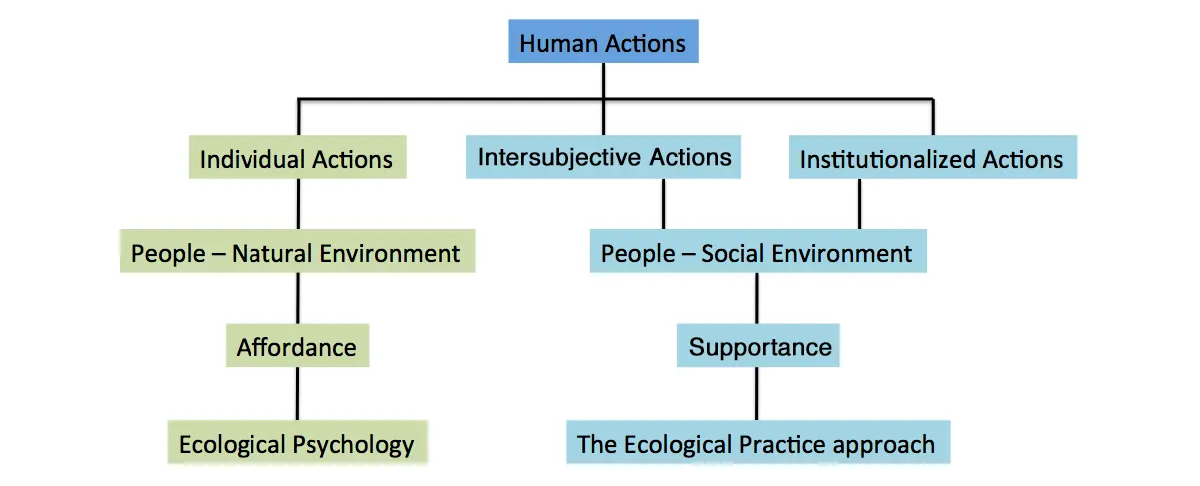
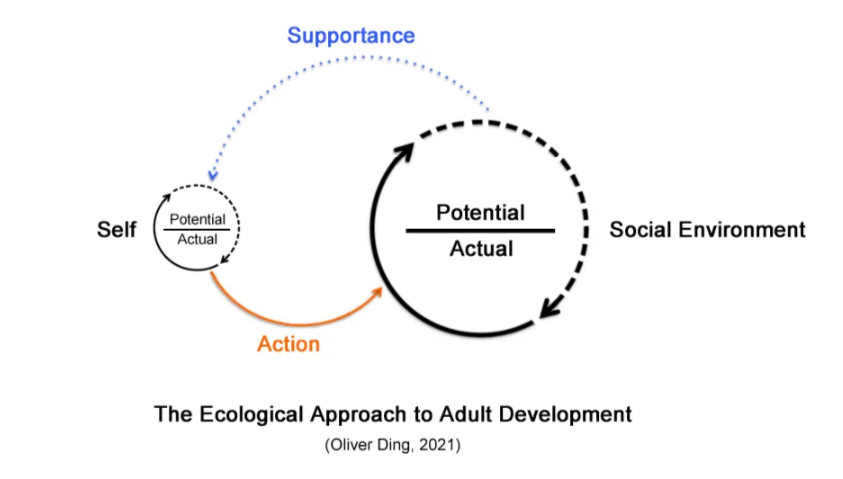
This distinction is what separates Supportance from the existing concept of social support. Social support, as typically theorized, is something one person provides to another — it is dispensed by the provider and received by the recipient. Supportance, by contrast, is something perceived and actualized by the receiver. Person A may not intend to support Person B, yet Person B can nevertheless perceive and actualize a Supportance that Person A's presence, knowledge, or activity indirectly offers. This asymmetry is fundamental to the ecological character of the concept: it locates the decisive act in the receiver's perception and actualization, not in the provider's intention. Without this distinction, Supportance collapses into a mere synonym for social support; with it, the concept opens a genuinely different analytical space.
When the Supportance concept was applied to the domain of development, it encountered Vygotsky's Zone of Proximal Development — the distance between what a person can do independently and what becomes possible through interaction with others or a more developed environment. Rather than treating ZPD as a parallel source, I found that Supportance could serve as a more general ecological model of the same phenomenon: what ZPD describes as a developmental opening between actual and potential, Supportance names as a structured set of potential action possibilities that the social environment makes available — a formulation that applies beyond individual learning to the full range of developmental encounters across a life.
The concept was established early. But the development of Supportance Theory across the following years was, in a deep sense, the story of successive attempts to model the social environment with increasing precision and depth. Three developmental episodes mark this trajectory.
1.2 Developmental Episode 1: Supportance and the Developmental Platform (2020–2021)
The first developmental episode situated Supportance within Platform Ecology and the concept of the Developmental Platform. The problem it addressed was: what does a social environment that strongly supports development actually offer, and how is that offering structured?
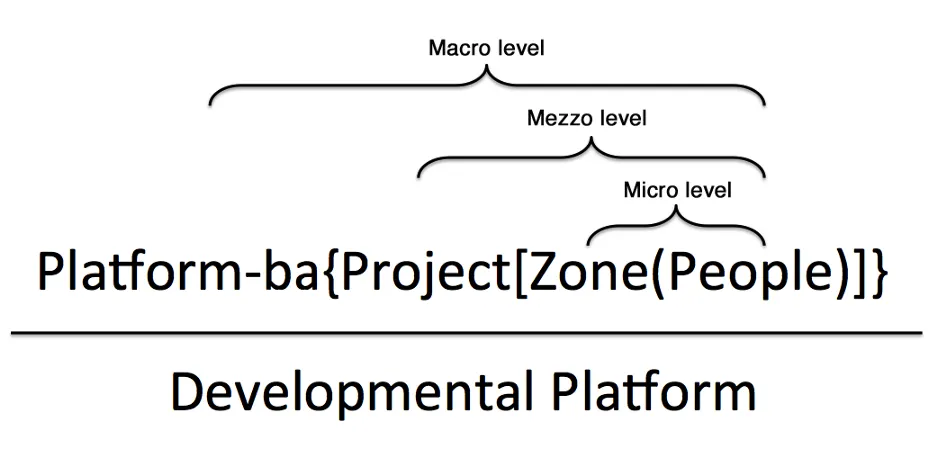
The Developmental Platform was defined as a social environment that strongly supports adult development — distinguished from ordinary social environments by the degree and structure of the supportances it offers. Within this context, a multi-level toolkit took shape:
- Individual-level supportances: Zone and Offer (including Self Offer, Tacit Offer, Explicit Offer, and Shared Offer)
- Project-level supportances: Projectivity — the potential action possibility that a project offers to a person who may enter it. Primary Projectivity initiates a project; Secondary enables others to participate; Tertiary inspires new projects to emerge
- Platform-level supportances: Platform-ba and Platform-ship — the sociocultural field formed through users and stakeholders, and the sustained relational structures that connect platforms to their participants
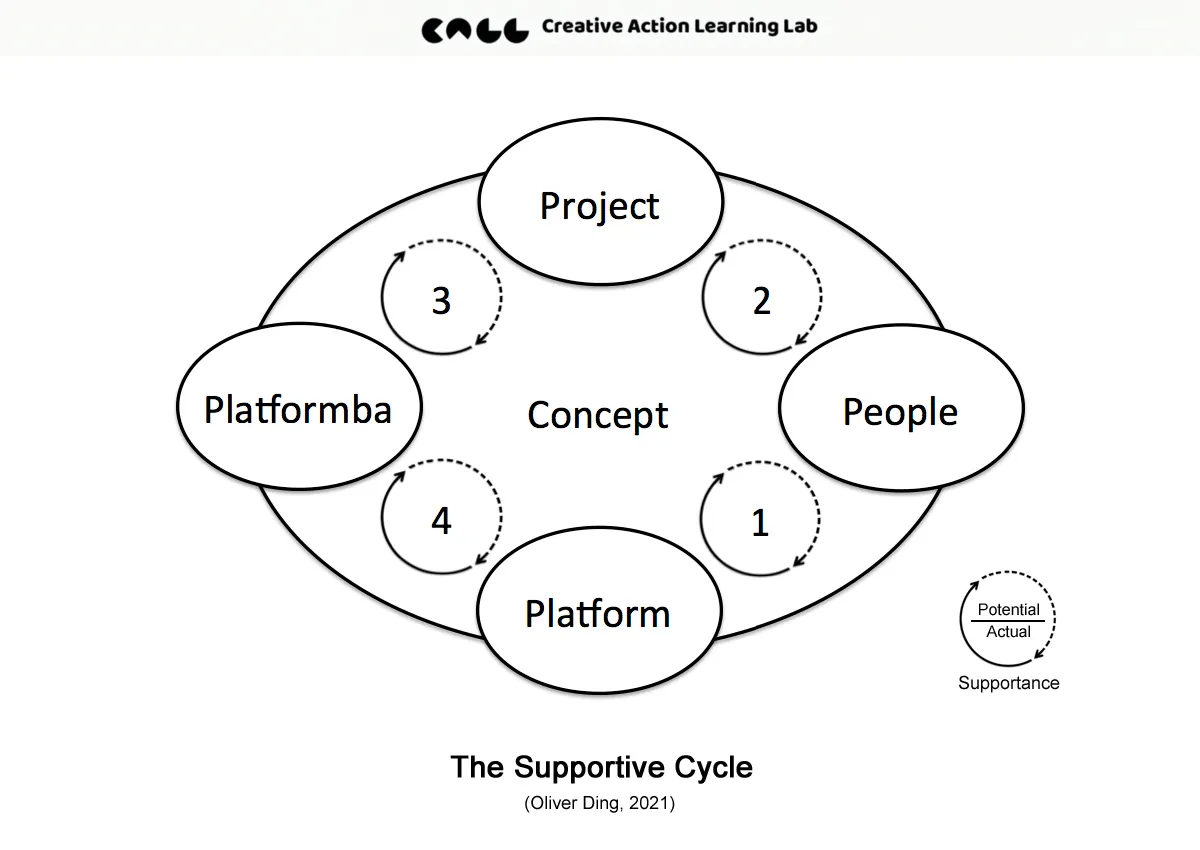
To understand how these elements interact dynamically, this episode also introduced the Supportive Cycle model — a creative heuristic tool for analyzing the dynamic interactions between four key entities: Platform, People, Project, and Platform-ba. The model identifies four supportive movements among these entities. These movements are not sequential steps or stages; they are parallel and reciprocal, occurring simultaneously as a platform facilitates and sustains Supportance-based development:
- Movement 1 (Platform → People): The Platform functions as environment, People as organisms. The primary Supportance here is Primary Projectivity — the potential action opportunities for initiating a brand-new Project that the Platform makes available.
- Movement 2 (Project → People): The Project functions as environment, People as organisms. The Supportances here are Secondary Projectivity (opportunities to participate in an existing project) and Tertiary Projectivity (opportunities to initiate a new project inspired by an established one).
- Movement 3 (Project → Platform-ba): The Project functions as environment, Platform-ba as organism. This movement focuses on Constructive Supportance — how the Platform-ba collectively shapes and constructs the project, both through inside activities (within the platform) and outside activities (beyond its boundaries).
- Movement 4 (Platform → Platform-ba): The Platform functions as environment, Platform-ba as organism. This movement extends the Constructive Supportance analysis to the Platform itself, distinguishing between its material dimension (Affordance: technological capabilities and functional characteristics) and its sociocultural dimension (Supportance: rules, norms, policies, rewards, and resources).
The Supportive Cycle captures something that a static map of supportance types cannot: the ongoing, mutually constituting dynamic through which platforms, people, projects, and sociocultural fields co-evolve.
The limitation this episode left open was also clear: it was organized around the Developmental Platform as a specific type of social environment. Supportance Theory needed a more general account of what the social environment is and how it is structured.
1.3 Developmental Episode 2: The Three-Level Map (2022–2025)
The second developmental episode addressed the question of how the social environment is layered. The problem inherited from the first episode was the over-specificity of the platform model: real social life cannot be reduced to platform structures, and the search for a general model of the social environment required new conceptual tools.
Work on the Attachance concept — the ecological action of detaching from one social field and attaching to another — produced a multi-level map that eventually crystallized into three levels:
- Thematic Space: the knowledge and meaning dimension — what thematic fields are available to be entered
- Project Engagement: the activity dimension — what projects exist that a person can participate in
- Social Landscape: the environmental dimension — the broader structures of social life within which both are embedded
A case study of a knowledge center's twenty-year partnership with local schools demonstrated this map in operation: the center's creator was continuously searching for supportances across all three levels across two decades of sustained effort, moving between thematic spaces, entering and exiting projects, and navigating the broader social landscape of institutional relationships.
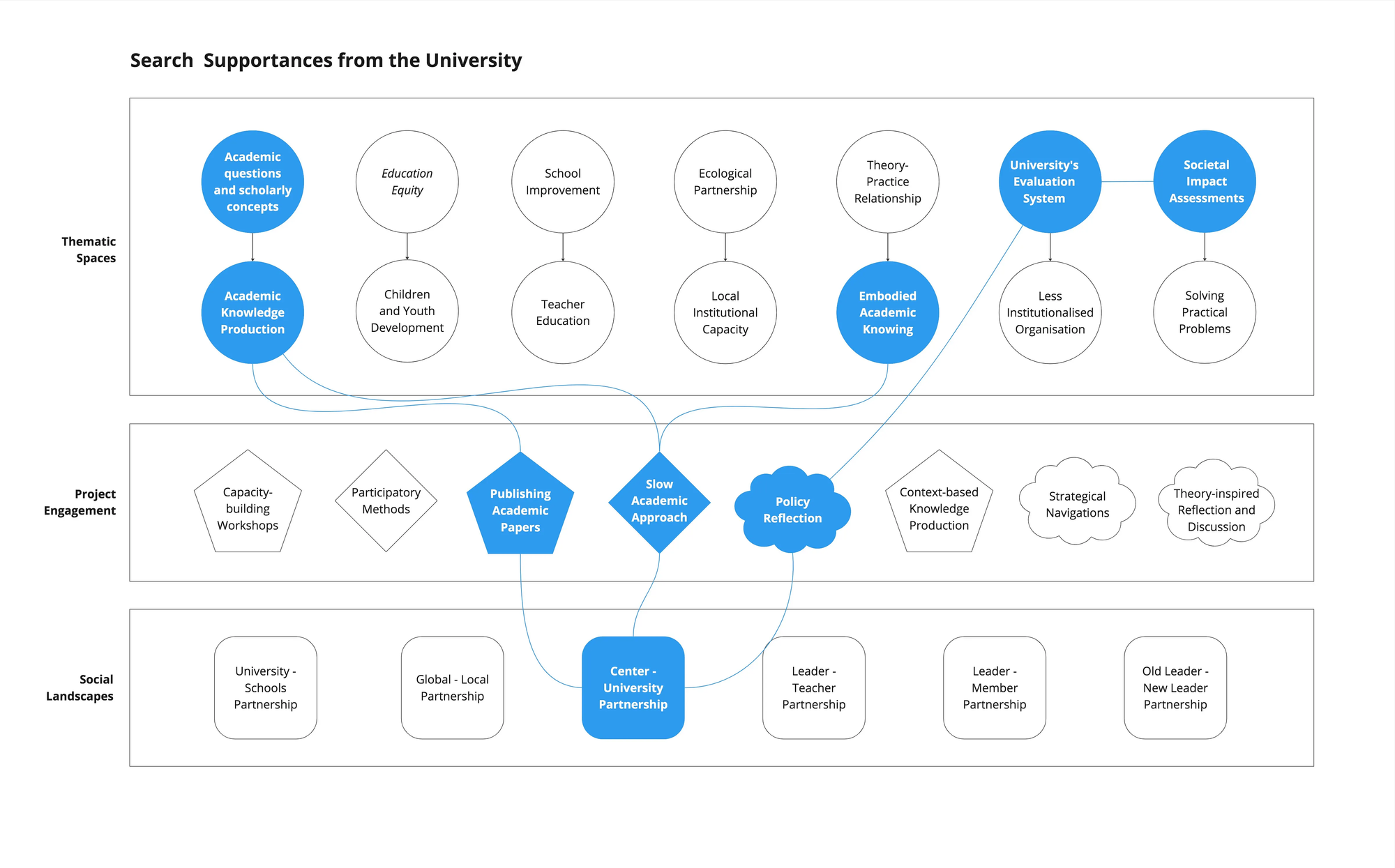
This episode gave Supportance Theory a more general model of the social environment: not a platform but a layered landscape. But the model was still primarily anatomical — it described what the social environment contains and how it is layered, without giving a full account of how the social environment is generated and transmitted through intersubjective encounter. The environment was treated as a structure to be navigated, not as something constituted through the act of engagement itself.
1.4 Developmental Episode 3: Meta-Supportance and the Ap-Re-Co Framework (2025)
The third developmental episode arrived through a different path: a return to the question of the Subject–Object relation itself. Reading Edward Reed's account of Social Appropriation — that shared human techniques enable people to socialize their awareness of what an environment offers — raised the question: what model of the Subject–Object relation is adequate to ground a theory of Meta-Supportance?
The Ap-Re-Co Framework emerged from pulling apart the word appropriation through its prefixes: ap- (toward), re- (return and renewal), co- (togetherness). These prefixes encode three modes of relational movement that, when unfolded across space and time, reveal the full grammar of how a subject engages with any pole — person or thing. An expanded version, Ap-Re-Pro-Co, added a prospective dimension (pro-, anticipation and feedforward), yielding a 3×5 matrix of fifteen thematic spaces mapping the full field of possible Subject–Object relations.
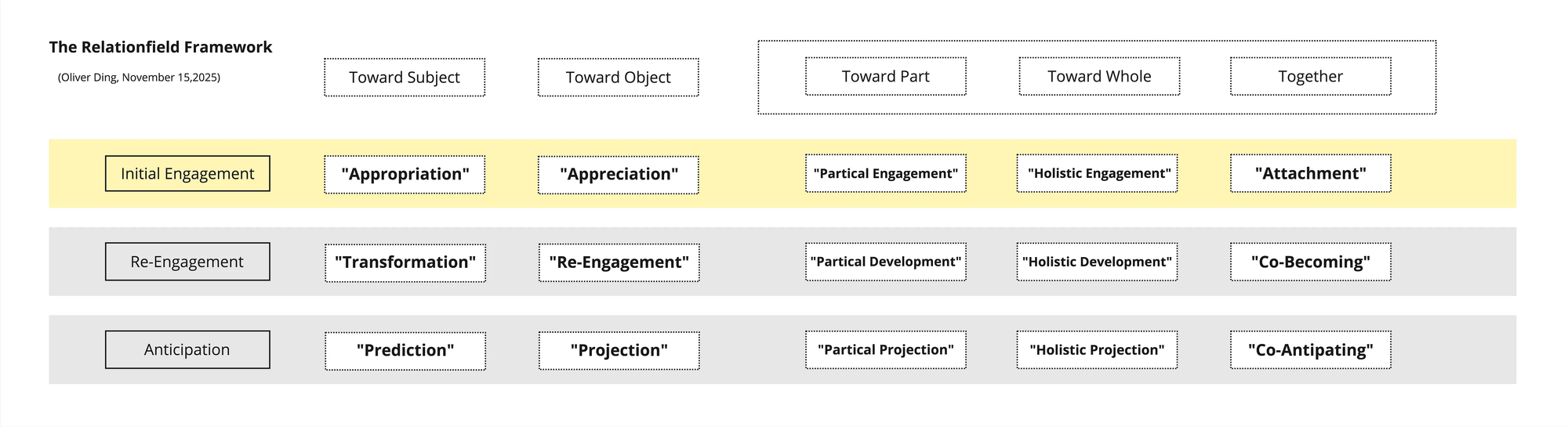
From this framework, four types of Meta-Supportance were identified — each corresponding to a different mode of the Subject–Object relation, and each generating a different quality of action possibility:
- Subject-Focused Meta-Supportance: the social environment offers possibilities for the subject to expand its own capabilities. Both intended and unintended forms are included.
- Object-Focused Meta-Supportance: the social environment sustains and maintains the object in its own right, not as a mere instrument. Education, caregiving, and aesthetic engagement belong here in their genuine forms.
- Mutual Meta-Supportance: the social environment supports collaborative and reciprocal growth in which both subject and object evolve together.
- Continuous Meta-Supportance: the social environment sustains the coherence and continuity of relationships and developmental trajectories over time.
Two additional specific types of Supportance emerged from parallel theoretical work. Thematic Supportance was identified through the analysis of how material objects become thematic objects through symbolization and curation: when Yan Fu's chair was preserved and displayed in his former residence, it ceased to offer affordance and began to offer the possibility of engaging with East–West dialogue as a living concern — a form of support available only to subjects who arrive prepared to recognize it. Theoretical Platform Supportance was identified through the analysis of Activity Theory's three-wave development: the structured action possibilities that a mature theoretical tradition offers to contributors positioned to perceive them, generating qualitatively different types across its three waves of development.
1.5 The Hidden Thread and Its Limit
The three developmental episodes, taken together, trace a movement in how the social environment was being modeled. The first episode modeled it as a platform — a structured field with identifiable levels of supportance. The second modeled it as a layered landscape — a three-dimensional structure that a person navigates across a lifetime. The third began modeling it as a relational field — not a structure that exists prior to participation, but a dynamic constituted through the Subject–Object encounter itself.
This third move reached the limit of what Supportance Theory, as a theory of potential action possibilities, could accomplish with its existing unit of analysis. To take the insight fully seriously required something new: not a map of what environments contain, not a typology of what encounters can produce, but a model of the intersubjective field itself — how it is formed, how it generates Supportance, and how it transmits its narrative forward to open new fields.
That is what RelationField v3.0 provides.
Part 2. RelationField v3.0
Supportance Theory requires a model of the social environment — a way of understanding what individuals are moving through when they explore and actualize supportances. The Subject–Object schema, well established in the social sciences, offers a natural starting point: it frames the individual as a subject positioned in a world of objects, oriented toward what that world offers. For Supportance Theory, this schema captures something real — the person searching their social environment for potential action possibilities, detecting what is available, and deciding whether and how to actualize it.
But Supportance has an intersubjective dimension that the simple Subject–Object schema cannot fully hold. Supportances do not only flow from the environment to the individual; they flow between subjects — they are curated, transmitted, and activated through Subject–Subject engagement. A subject who offers a Tacit Supportance to another subject is not simply an object in that person's environment; they are a second subject, with their own orientation, their own narrative, their own capacity to be affected by the encounter. The schema needed to accommodate this was not Subject–Object alone, but something more complex: Subject–Subject (Subject–Object) — a nested structure in which the Subject–Object relation remains the kernel, but a Subject–Subject dynamic unfolds around it.
This theoretical understanding did not arrive all at once. It developed across a series of moves — from the Ap-Re-Co Framework, to the 3×5 matrix, to the activity analysis of a real journey — before the concept became clear enough to name. The name that eventually crystallized this development is RelationField.
2.1 From a Suspended Name to a Concept
The name relationfield had surfaced in November 2025, while developing what became the 3×5 matrix. Ap-Re-Pro-Co was still a name that recorded a method — its derivation was legible from the name itself. Relationfield, by contrast, was a name for a concept: it named what something is, not how it was derived. The two kinds of names sat awkwardly together. The name had arrived, but the content it should designate had not yet arrived with it.
That content arrived through a real journey. In June 2026, looking back over a chain of events that had begun the previous summer — a friend's visit to Yan Fu's former residence in Fuzhou, a photograph of a chair, a book cover, a column epilogue, and finally this meta-level analysis of the whole trajectory — what came into view was not one RelationField but three, each completing itself and handing something forward to the next.
2.2 Three RelationFields: A Concrete Case
RelationField I was the relation between Yan Fu and his chair, completed with his life. As a material environment, the chair offered affordance: the physical possibility of sitting, resting, thinking, writing. When Yan Fu's life ended, the relation was complete. But through the preservation of his former residence and its opening to the public, the chair acquired a second life — it became a thematic object: no longer offering affordance but thematic supportance, the possibility of engaging with "Yan Fu" as a theme, with everything his life had come to represent.
RelationField II was the visit itself: my friend and I walking into the residence in the summer of 2025, already prepared to engage with the theme the chair now carried. Our visit activated the thematic supportance the chair offered — and the conversation that followed, at West Lake Park later that afternoon, was the Narrative of this RelationField, happening in real time between two people. The photograph I took of the chair during this trip became a thematic object in its own right: the curation that linked RelationField II to RelationField III.
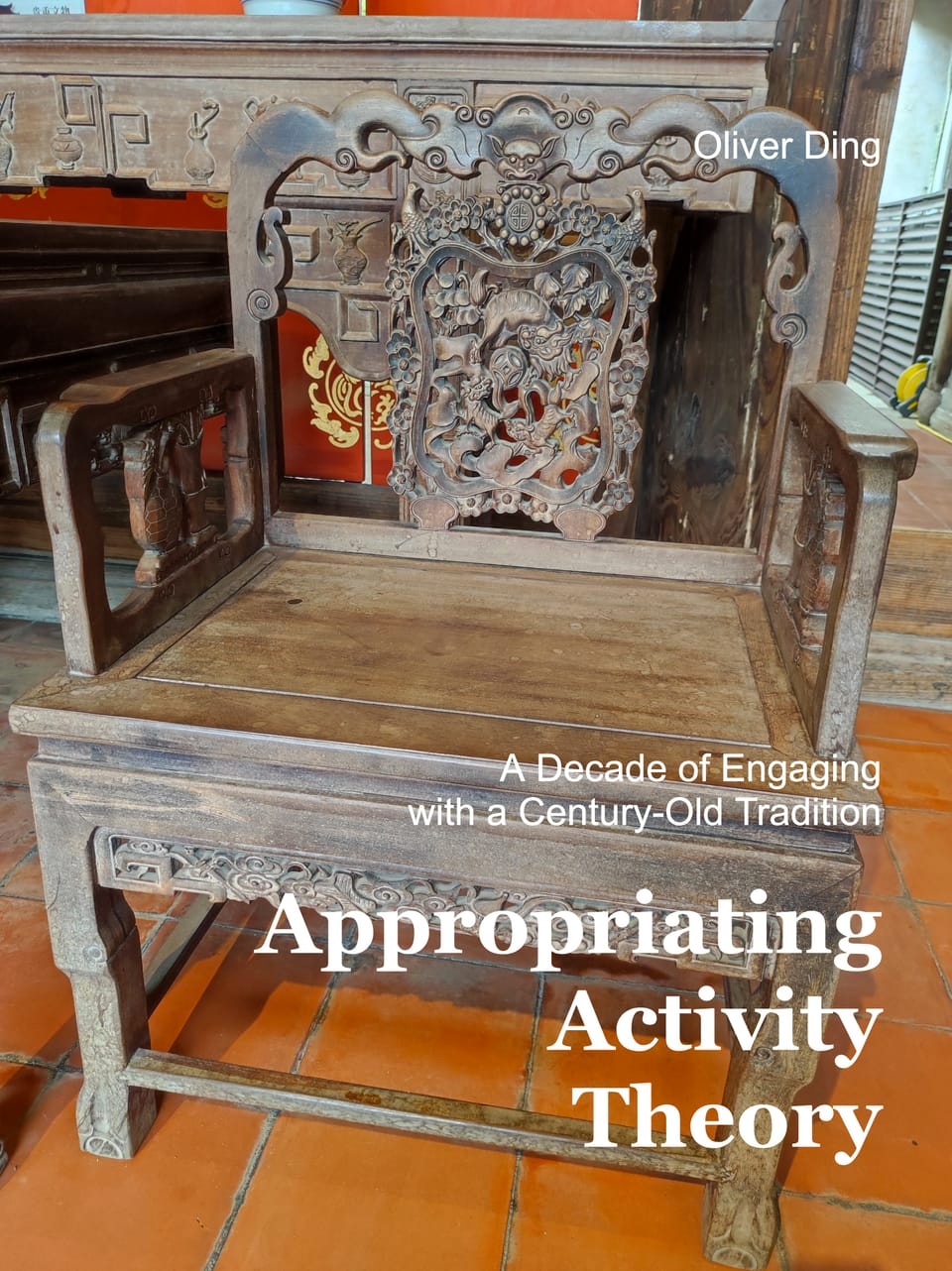
RelationField III was the creative trail the photograph traced across the following months. Set aside without purpose after the visit, it was rediscovered months later as exactly the right cover image for a book. The photograph was no longer the chair — it was a second-order object carrying not only the chair's original theme but a second layer of meaning, born from its own story of appreciation, dormancy, and reactivation.
2.3 R–S–N–C: The Internal Structure of a RelationField
Looking across the three RelationFields revealed a structure that holds within any single RelationField — but one that divides into two distinct layers.
The first layer consists of Relation and Support: the qualities of the RelationField itself. Relation names what kind of connection exists between a subject and the other pole — person or thing. Support names what Supportances the RelationField makes available within that connection. Crucially, both exist prior to and independent of any particular actor's engagement. Yan Fu's chair, after curation, carried a Relation to his intellectual legacy and offered thematic Supportance to any visitor who might arrive. These qualities were there before my friend and I walked in. They did not depend on us to exist — only to be perceived and actualized.
The second layer consists of Narrative and Curation: the qualities of the actor. Narrative and Curation are both human actions. They do not exist without an actor who performs them. Where R and S describe what the RelationField is and what it offers, N and C describe what the actor does with it. The same R–S — the same RelationField, the same Supportances — will generate entirely different N–C when different actors enter it.
These two layers are co-present in every RelationField. They are not sequential — a RelationField does not first establish its R–S and then wait for N–C to arrive. But the distinction between them is structurally important: it marks the difference between what the social environment offers and what the actor makes of that offering.
2.4 Curation: The Mechanism Linking RelationFields
The mechanism that connects different RelationFields is curation. It is not a fourth step in the R–S–N sequence — it is an operator that crosses levels: the Narrative of one RelationField, through curation, becomes the thematic object that opens the next RelationField's Relation.
Curation operates across both layers of the RelationField structure. At the Subject–Object level, it is the actor's act of organizing, symbolizing, and giving form to their relation with an object — selecting the chair photograph as a book cover is curation at this level. At the Subject–Subject level, curation is performed for others, so that what one actor has produced can become a thematic object for another subject's future Relation. These two levels are not mutually exclusive: the same act of curation can operate on both simultaneously. What they share is the essential character of curation: it is always a human action, belonging to the N–C layer, not given by the RelationField itself.
2.5 The Overall Pattern: Subject–Subject (Subject–Object)
The Subject–Object relation is not where RelationField's depth ends. It is where it begins. As a relation deepens — from Relation, to Support, to Narrative, to Curation — a Subject–Subject dynamic unfolds around it. This gives v3.0 its overall unit of analysis:
Subject–Subject (Subject–Object) = RelationField
The Subject–Object relation — the content, the containee — is the kernel. The Subject–Subject dynamic — the container — is what unfolds around it. A relation that begins at the Subject–Object kernel does not remain there; it is taken up, carried, and told between subjects — and it is this carrying-and-telling that constitutes a field rather than a single point.
With this unit of analysis in place — Subject–Subject (Subject–Object) = RelationField, structured by R–S–N–C, connected across instances by curation — the analysis of intimate relationships and their supportances can begin.
Part 3. Self Psychology and the Selfobject
When Supportance Theory and the RelationField framework are applied to intimate relationships, a key task emerges: to explore the specific types of Supportance that intimate RelationFields characteristically offer. This is consistent with how Supportance Theory has developed across its previous developmental episodes — each episode not only expanded the general framework but also identified and named specific types of Supportance appropriate to the social environments it was analyzing. Projectivity was a specific type identified for project-level environments; Thematic Supportance for thematic objects; Theoretical Platform Supportance for mature theoretical traditions. The application to intimate relationships requires the same move: identifying the specific types of Supportance that are distinctive to this domain.
Rather than constructing these types from scratch, we find an existing body of knowledge that provides an excellent starting point: self psychology, developed by Heinz Kohut, and its core concept of the selfobject. Self psychology has, through decades of clinical and theoretical work, identified with precision the psychological experiences that intimate relationships most fundamentally offer — and what happens when those offerings fail. This is not reinventing the wheel; it is recognizing that the wheel has already been built, and that what remains is to understand it within the Supportance and RelationField framework.
Self psychology was developed by Heinz Kohut, who identified a phenomenon that classical psychoanalysis had not adequately theorized: the human need, throughout life, for a specific kind of relational experience that sustains the cohesion and vitality of the self. Kohut named the object of this need the selfobject — not an object in the ordinary sense, but an experience of another person (or thing) that the self uses to maintain its own stability and completeness.
The selfobject concept names a function, not a person. A person who functions as a selfobject for another is not simply present; they are performing a specific psychological role — providing experiences that the self cannot yet reliably provide for itself.
3.1 Three Core Types of Selfobject Experience
Kohut identified three core types of selfobject experience, each meeting a different developmental need:
Mirroring: The experience of being seen, recognized, affirmed, and celebrated by the other. In childhood, the parent whose eyes light up at the child's achievements provides the mirroring that allows the child to form a stable sense of its own value. In adult intimate relationships, the partner who genuinely receives and responds to what the other brings — achievements, joys, sorrows, ideas — provides mirroring that sustains the adult self's sense of worth and visibility.
Idealizing: The experience of being able to look up to and rely on a calm, strong, trustworthy other. In childhood, the idealized parent who can be turned to in moments of fear or confusion provides the security that allows the child to develop internal resources. In adult intimate relationships, the partner who can be experienced as a stable, capable presence provides idealizing experience — particularly important in times of stress, uncertainty, or threat.
Twinship: The experience of essential likeness — "we are the same kind." In childhood, this is the sense of belonging to the family, of sharing a fundamental orientation to life. In adult intimate relationships, twinship is the deep resonance of shared values, shared sensibility, shared rhythm — the experience of not needing to translate oneself because the other already recognizes what one is.
3.2 Selfobject Experiences Across Relationship Types
The three types of selfobject experience operate differently depending on the relational context. The table below maps their specific character across three relationship types: intimate partners, parent and child, and therapist and client.
| Mirroring | Idealizing | Twinship | |
|---|---|---|---|
| Intimate partners | Bidirectional: each partner affirms the other's value, achievements, and inner experience. Healthy mirroring is attuned rather than flattering — it accurately reflects what the other brings. Chronic failure produces selfobject hunger and erodes the relationship's foundation. | Bidirectional: each partner can, at different moments, be the calm and stable ground the other turns toward in difficulty. Neither partner holds the idealizing position permanently; healthy partnerships allow this to shift fluidly with circumstance. | The deepest form of twinship in intimate partnership is the sense of fundamental shared orientation — values, rhythm, ways of being in the world. It does not require agreement on everything; it requires the experience of not needing to fundamentally translate oneself. |
| Parent and child | Primarily unidirectional: the parent mirrors the child. The parent's eyes that light up at the child's joy, the parent's accurate recognition of the child's distress — these are the building blocks of the child's stable self-esteem. | Primarily unidirectional: the child idealizes the parent as a calm, powerful, trustworthy figure. Through this idealization, the child internalizes values, security, and a sense that the world can be trusted. The parent's task is to be adequately — not perfectly — idealized. | The child's twinship need is the need to feel essentially the same kind of being — to belong to the family, to share its basic orientation. The healthy outcome is individuation that does not require the destruction of belonging. |
| Therapist and client | Unidirectional and professionally bounded: the therapist provides empathic attunement — accurate, non-evaluative recognition of the client's experience. The therapist's own need for mirroring is explicitly held outside the therapeutic relationship. | Unidirectional: the client may idealize the therapist, understood therapeutically as a developmental need being expressed. The therapist holds this with equanimity, neither confirming it as accurate nor prematurely interpreting it away. | Twinship appears as the client's need to feel that the therapist is a recognizable human being — that enough essential similarity exists that understanding is possible. Unlike intimate partnership, this twinship is asymmetric: the therapist does not seek twinship with the client. |
Kohut argued that "there is no mature love which does not also include the love object as a selfobject" — meaning that even in the most developed adult relationships, these needs remain present and active. The mark of maturity is not the transcendence of selfobject needs but the capacity to meet them through a bidirectional, flexible, and mutually sustaining relational dynamic.
When selfobject functions fail — when the mirror is broken, the idealized figure collapses, or the sense of twinship dissolves — the self experiences what Kohut called narcissistic injury: a disruption in its sense of cohesion, continuity, and vitality. Repeated failures produce a state of chronic "selfobject hunger" — a persistent sense of incompleteness, a compulsive search for the missing experience from other sources.
3.3 Why Self Psychology Is Introduced Here
Self psychology enters this analysis for a specific theoretical purpose. What self psychology contributes is a precise account of what the object in the intimate RelationField's Subject–Object kernel actually is, psychologically speaking. The answer: the object is not simply a person, but a person-as-selfobject-function. What one partner is primarily oriented toward is not the other person in their full independent existence, but the selfobject experience that person can provide. This does not make intimate relationships narcissistic in a pathological sense; Kohut insisted that selfobject needs are universal and lifelong.
This opens a direct path into the analysis of Supportance. If the object in an intimate RelationField's kernel is the selfobject function, then the Support dimension of the RelationField includes, crucially, the potential to actualize each of the three selfobject experiences. The three types of selfobject experience are three specific types of Supportance available within intimate RelationFields.
3.4 Two Structural Differences
Two structural differences between parent–child and adult intimate partner selfobject relations matter for the analysis that follows.
First, directionality: parent–child selfobject relations are primarily unidirectional; healthy adult intimate relations are bidirectional. The failure of bidirectionality in an adult intimate relationship is a relational pathology, not simply an unfortunate asymmetry.
Second, the nature of failure's consequences: when parent–child selfobject experiences are severely disrupted, the result can be structural self-deficits requiring therapeutic repair. When adult intimate selfobject functions fail, the result is typically dynamic dysregulation — a persistent functional frustration that erodes the quality and vitality of the self without necessarily damaging its underlying architecture.
Part 4. A Typology of Supportances in Intimate Relationships
The typology developed in this part draws on four bodies of knowledge, each contributing a distinct layer to the analysis of Supportances in intimate relationships.
Supportance Theory provides the ecological logic: what a relational field offers is not a fixed set of resources but a structured landscape of potential action possibilities, available to be perceived and actualized by subjects positioned to do so. It is Supportance Theory that frames the question this typology answers — what specific types of Supportance does an intimate RelationField make available?
RelationField v3.0 provides the structural container: the nested Subject–Subject (Subject–Object) unit, within which Relation, Support, Narrative, and Curation are co-present dimensions. The Support dimension of the RelationField is precisely where Supportances reside — what the RelationField structurally makes available to the subject. The typology developed here is, in essence, a map of the Support dimension of intimate RelationFields.
Self psychology, as introduced in section 1.3, provides the psychological content. Kohut's identification of the three selfobject experiences — Mirroring, Idealizing, and Twinship — gives us the first group of Supportances in the typology: the psychological Supportances specific to intimate RelationFields, which sustain the self's cohesion, vitality, and sense of being recognized.
Family sociology provides the social and functional content. Across several decades of research, family sociology has identified the distinct functions that intimate relationships and family units characteristically serve in social life — economic, reproductive, status-related, informational, domestic, and companionship functions. When reframed ecologically within Supportance Theory, each of these functions names a specific type of potential action possibility that an intimate RelationField makes available. These constitute the second group of Supportances in the typology.
Taken together, these four bodies of knowledge yield a typology organized in two groups: psychological Supportances (derived from self psychology) and functional Supportances (derived from family sociology), both grounded in the ecological logic of Supportance Theory and situated within the structural container of the RelationField framework. The two groups are complementary: the first addresses the psychological depth of the intimate RelationField; the second addresses its social and practical breadth.
4.1 Group A: Psychological Supportances (Selfobject Experiences)
These three types of Supportance are specific to the psychological dimension of intimate RelationFields. They name what the Subject–Object kernel of an intimate relationship most fundamentally offers at the level of self-experience.
- Mirroring Supportance: The RelationField offers the potential to be genuinely seen, recognized, and affirmed. This is attunement: the other's capacity to accurately receive what the subject brings and reflect it back in a way that confirms its reality and value. Mirroring Supportance operates primarily in the Relation dimension of the RelationField: it is constituted by the quality of the connection itself.
- Idealizing Supportance: The RelationField offers the potential to experience the other as a stable, trustworthy ground — someone who can be turned toward in moments of vulnerability without the fear of collapse or attack. Idealizing Supportance operates primarily in the Support dimension: it is what the RelationField structurally makes available to the subject in moments of need.
- Twinship Supportance: The RelationField offers the potential to experience deep essential likeness — a shared orientation to life that does not require translation or explanation. Twinship Supportance operates across all four dimensions of the RelationField: it shapes the Relation (its quality of resonance), the Support (the ease of access to what the RelationField offers), the Narrative (the shared language through which the connection is told), and the Curation (the sense of shared purpose in what is preserved and passed on).
In a healthy intimate RelationField, these three Supportances flow bidirectionally between partners. Their absence, failure, or — most damagingly — their active inversion, constitutes the primary form of psychological harm that an intimate RelationField can inflict.
4.2 Group B: Functional Supportances (Sociological Dimensions)
Family sociology identifies several distinct functions that intimate relationships characteristically serve. Understood ecologically, these functions become specific types of Supportance — potential action possibilities that the intimate RelationField makes available across different dimensions of life.
- Economic Supportance: Intimate relationships typically constitute a shared economic unit — income, expenses, assets, and risks are pooled or divided. Each partner's economic activity creates potential action possibilities for the other: financial security, expanded capacity, shared stability, or conversely, economic constraint and dependency. Economic Supportance is largely structural: it exists as a set of conditions rather than as a felt experience in each interaction, but it shapes what other Supportances are accessible.
- Reproductive and Parenting Supportance: Within an intimate partnership that includes children, each partner's engagement with parenting creates or forecloses possibilities for the other — shared responsibility, developmental partnership, or its absence and antagonism. Parenting Supportance is both practical (who does what) and symbolic (what image of parenthood and family the shared RelationField makes available).
- Status and Social Capital Supportance: Intimate relationships embed individuals in wider social networks and institutional structures. A partner's social connections, professional standing, cultural capital, and institutional affiliations create potential action possibilities for the other: access to networks, prestige, institutional legitimacy. This form of Supportance is primarily distal — mediated through the partner's relation to broader social structures rather than through direct intersubjective encounter.
- Informational and Cognitive Supportance: Intimate partners share knowledge, perspectives, skills, and ways of making sense of the world. Each partner's informational resources create potential action possibilities for the other: expanded worldview, complementary expertise, shared cognitive frameworks — or alternatively, informational constraint and the suppression of perspectives that deviate from the dominant one.
- Domestic and Practical Supportance: The daily labor of household maintenance, care work, logistical coordination, and the management of practical life creates or constrains what is possible for each partner. This is the most immediately material form of Supportance: it operates through concrete actions in shared physical space and directly shapes what time, energy, and attention are available for other activities.
- Companionship and Belonging Supportance: Beyond psychological attunement and shared practical life, intimate relationships offer the experience of not being alone in the world — of having a home in another person's presence. This is not the same as Twinship, which concerns deep essential likeness; Companionship Supportance concerns presence and continuity — the accumulated texture of shared life over time.
4.3 The Integrated Picture
These two groups of Supportances are not independent. They interpenetrate in complex ways: Economic Supportance shapes the conditions under which Mirroring is possible; Twinship Supportance shapes the quality of Domestic Supportance; Parenting Supportance is saturated with Mirroring, Idealizing, and Twinship dimensions.
Placing this typology against the four Meta-Supportance types introduced in section 1.1 reveals how the specific Supportances of intimate relationships distribute across the broader framework.
Mirroring Supportance and Idealizing Supportance are primarily instances of Subject-Focused Meta-Supportance: the intimate RelationField offers the subject possibilities for expanding and stabilizing its own self-experience through the presence and attunement of the other. Status and Social Capital Supportance also belongs here: it is through the partner's relation to the broader social world that the subject's own range of action possibilities is extended.
Twinship Supportance is the clearest instance of Mutual Meta-Supportance: it is not something one partner provides to the other, but a quality that arises from the encounter itself — a shared field of resonance that neither party generates alone. Parenting Supportance, when functioning well, also carries a mutual dimension: both partners are transformed through the shared project of raising a child, even as the child remains the primary object of care.
Economic Supportance, Domestic and Practical Supportance, and Companionship and Belonging Supportance are primarily instances of Continuous Meta-Supportance: they sustain the coherence and continuity of the relational trajectory over time, making it possible for other forms of development to unfold without abrupt disruption. They are the background conditions without which the foreground Supportances cannot be reliably actualized.
Parenting Supportance carries a further dimension that belongs specifically to Object-Focused Meta-Supportance: the care and development of the child as an end in itself, not as a means to either partner's self-expansion. This is the dimension of parenting that points beyond the intimate RelationField of the couple toward a third RelationField — the parent-child RelationField — that the couple's intimate field makes possible and sustains.
What the typology provides is not a checklist but a map of the landscape of potential action possibilities that an intimate RelationField can offer. In a healthy RelationField, these Supportances are distributed across both partners in a dynamic, mutually sustaining way. In a damaged or adversarial RelationField, some or all of these Supportances may be absent, inverted, or weaponized — turned from sources of potential action into sources of constraint or harm.
To situate the intimate RelationField typology within the broader development of Supportance Theory, the table below maps the specific Supportances identified across the theory's developmental episodes — from Platform Ecology through to intimate relationships — against the four Meta-Supportance types. In this mapping, the individual is always the Subject, and the social environment (platform, theoretical tradition, or intimate partner) is always the environment.
| Specific Supportance | Domain | Meta-Supportance Type |
|---|---|---|
| Primary Projectivity | Platform Ecology | Subject-Focused |
| Secondary Projectivity | Platform Ecology | Subject-Focused |
| Tertiary Projectivity | Platform Ecology | Mutual / Continuous |
| Constructive Supportance (Movements 3 & 4) | Platform Ecology | Mutual |
| Platform-ship Supportance | Platform Ecology | Subject-Focused / Continuous |
| Thematic Supportance | RelationField | Subject-Focused / Continuous |
| Theoretical Platform Supportance (Wave 1) | Theoretical Tradition | Subject-Focused |
| Theoretical Platform Supportance (Wave 2) | Theoretical Tradition | Subject-Focused |
| Theoretical Platform Supportance (Wave 3) | Theoretical Tradition | Mutual |
| Mirroring Supportance | Intimate Relationship | Subject-Focused |
| Idealizing Supportance | Intimate Relationship | Subject-Focused |
| Twinship Supportance | Intimate Relationship | Mutual |
| Economic Supportance | Intimate Relationship | Continuous |
| Reproductive & Parenting Supportance | Intimate Relationship | Object-Focused / Mutual |
| Status & Social Capital Supportance | Intimate Relationship | Subject-Focused |
| Informational & Cognitive Supportance | Intimate Relationship | Subject-Focused / Mutual |
| Domestic & Practical Supportance | Intimate Relationship | Continuous |
| Companionship & Belonging Supportance | Intimate Relationship | Continuous |
The typology developed here provides a foundation for future case analyses of intimate RelationFields. At the same time, the process of developing this domain-specific typology itself demonstrates a method: beginning with the general ecological logic of Supportance Theory and the structural container of RelationField v3.0, identifying the relevant existing bodies of knowledge (here, self psychology and family sociology), and translating their findings into domain-specific Supportance types. Researchers working in other domains — educational relationships, professional mentorship, community life, cross-cultural encounter — can follow the same method to develop their own domain-specific typologies, building a cumulative and differentiated map of the Supportances available across the full range of human social environments.
Postscript
This article began from a question about domain: Supportance Theory and the RelationField framework had been developed in the context of knowledge work, creative life, and intellectual traditions — public domains in which the relevant objects are thematic, the relevant subjects are contributors to shared projects, and the relevant Supportances are those that a theoretical tradition or a cultural heritage makes available to those who engage with it seriously.
Intimate relationships are, in almost every respect, the opposite of this. They are private rather than public; particular rather than general; lived rather than theorized. The Supportances they offer are not thematic but psychological, practical, and existential. They concern being seen, being sustained, being at home in another person's presence.
And yet the expansion reveals something that was already implicit in the framework's structure. The unit of analysis — Subject–Subject (Subject–Object) = RelationField — was always adequate to describe an intimate relationship. The nested structure, the R–S–N–C dimensions, the curation mechanism: none of these required modification to accommodate the new domain. What was needed was not a different framework but a different content to fill the Support dimension — a map of what intimate RelationFields specifically offer, which is what the typology in section 1.4 provides.
This suggests that the RelationField framework is more general than its original cases implied. It is not a framework for public cultural life or intellectual traditions specifically. It is a framework for the structure of human engagement — wherever that engagement takes the form of a subject in relation with another pole, person or thing, within a field that offers Supportances and generates Narratives that, through Curation, become the thematic objects of the next field.
Intimate relationships are one instance of this structure. They are, for most people, the most consequential instance. Understanding them through the RelationField lens does not reduce their particularity — it illuminates the structural conditions under which their particularity becomes possible, is sustained, or collapses.
v1.0 — June 18, 2026 - 7,150 words