
A Chair from a Hundred Years Ago
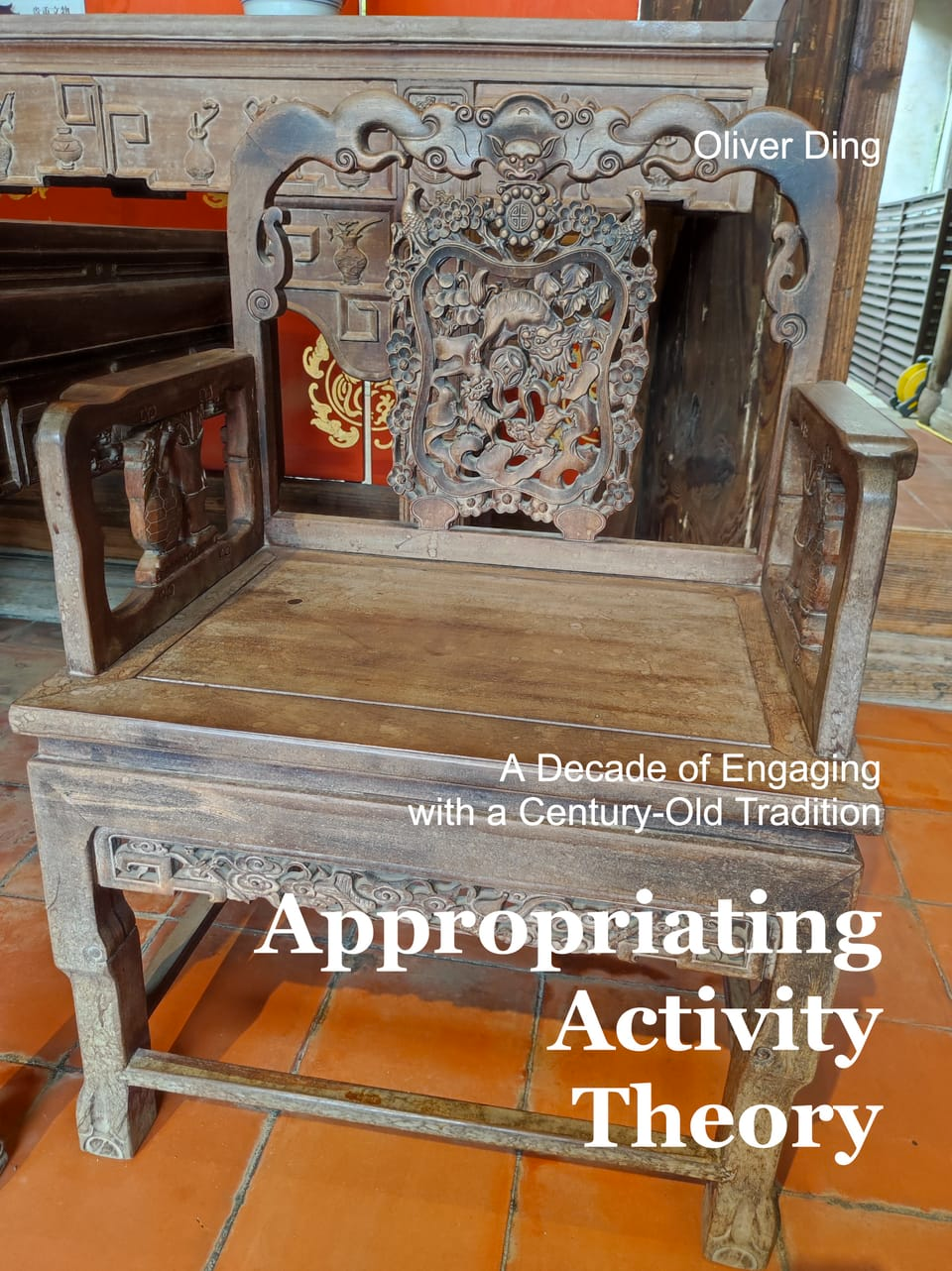
This article is the Epilogue of a possible book: Appropriating Activity Theory (June 2026)
by Oliver Ding
June 10, 2026
The chair on the cover of this book is over a hundred years old. Readers can find its story in this epilogue.
1
In the summer of 2025, I returned to Fuzhou — the city where I had lived for nearly twenty years before moving to the United States. A friend came a long way to visit me. He was the person who had once helped localize Wikipedia into Chinese — translating its structure, defining entries based on the Chinese knowledge system, and creating some of the first Chinese-language pages. His very first article was about Yan Fu. I asked him why. He said it was the theme of East–West Dialogue that inspired him.
Together, we walked through the historic district of Sanfang Qixiang and visited Yan Fu's former residence. Yan Fu had lived and worked there a century ago. He is best known as the translator who brought Western thought into the Chinese intellectual tradition — Darwin, Spencer, Mill, Montesquieu. He did not simply apply these ideas from the outside; he appropriated them, rebuilt them in a new language, gave them new life in a new context. His translations were not transfers. They were transformations.
I took many photographs in those rooms. One of them was this chair.
After Sanfang Qixiang, we visited the Fujian Museum and strolled under the dense shade of trees by West Lake Park. I asked his impression of Fuzhou. Surprisingly, he compared it with Xi'an. Xi'an, though historically rich, felt disconnected from the present. Fuzhou, on the other hand, was vibrant in modern history — its many famous figures and events deeply intertwined with the nation's fate. He felt much closer to Fuzhou's history.
Most importantly, he said that the East–West dialogue that began a century ago is far from over. It continues — with our generation as the protagonists.
2
In September 2025, I opened the "Appropriating Activity Theory" column. I needed a cover image. I went back to my archive from the summer trip and found the chair photograph immediately. Something about it felt right — the carved woodwork, the quiet weight of something that had outlasted everything around it. I used it for the first issue. Then the second. Then all eighteen.
In early November, I was developing a new framework for thinking about Subject-Object relations in Activity Theory — one of the tradition's oldest and most generative issues. The framework I called Ap-Re-Co organized the different ways a subject can relate to an object: Appropriation, Appreciation, Attachment, Transformation, Re-engagement, and Co-becoming. Version 1.0 took shape over several days of sustained work.
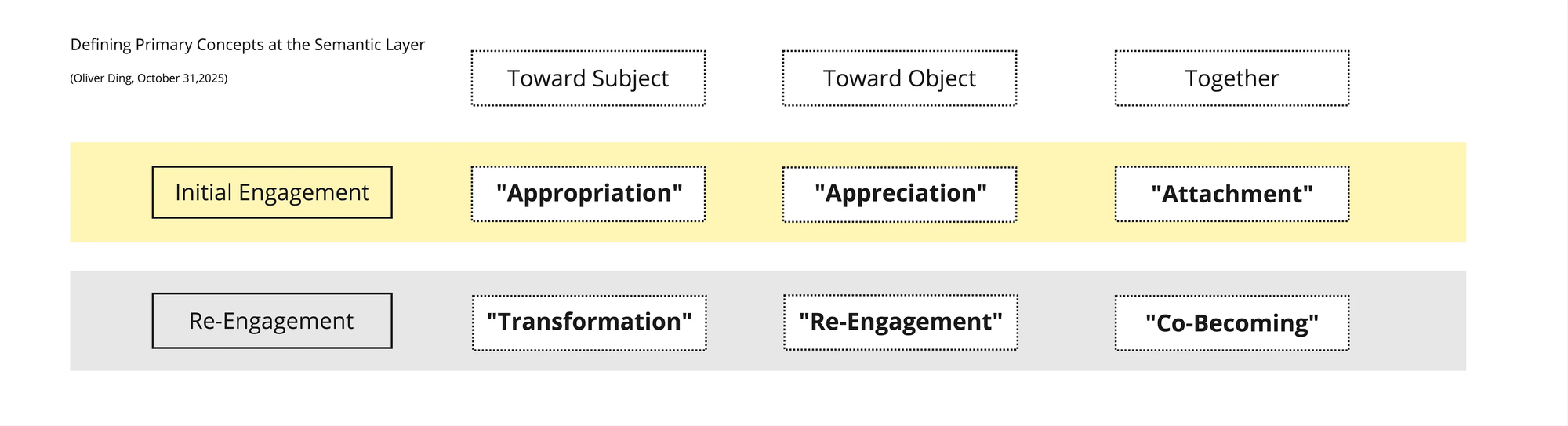
A few days after completing it, I found myself thinking back to the chair. Not as a cover image — as an object. How had I related to it? The framework I had just built was supposed to answer exactly this kind of question. So I applied it to my own photography. I discovered four distinct types of photography practice, each reflecting different subject-object relations and temporal orientation.
Memorial Photography places the photographer at the center. The object serves as a vehicle for preserving personal experience — tourist snapshots at landmarks, photos with friends, family gatherings. The composition often includes myself or companions, emphasizing "I was here" or "we were together." Temporally, it points backward, creating materials for future remembering and life narrative construction.
Appreciative Photography is the purest form of no means-end relation. I photograph simply to present what deserves to be seen — its beauty, form, or presence — without any consideration for future use. The act completes itself in the moment. There is no intention to archive, no anticipation of later retrieval — only the impulse to let the object be seen.
Material Documentation introduces a latent purposiveness. As a professional designer, I photograph visually interesting objects and spaces with a background awareness — though not directed toward any specific project — that "this might be useful someday." The images still focus on the object itself, but with a quiet sense of building an archive for eventual retrieval.
Anticipatory Photography is the most deliberate. Since starting the TALE project in 2023 and frequently designing thematic cards and book covers, I have developed a highly intentional photographic practice. When I notice a compelling scene, I deliberately take multiple pictures, adjusting perspective and spatial layout specifically to create materials suitable for future design work. I consciously leave negative space for text placement, composing with expected layout requirements in mind. Here, the future project — though not yet existing — actively guides my present photographic decisions through what I called "feedforward" from anticipatory systems theory.
The chair photograph belonged to Type 2 — pure appreciative photography. At the moment of capture, I was simply struck by its beauty. No thought of future use, no anticipation of any project. And yet months later, when I needed a cover image, I recognized immediately that it was exactly right. This was genuine serendipity — not planned retrieval. The photograph had been waiting to be activated in a context I could not have anticipated.
But the more I examined this sequence, the more I saw a structural limitation in the framework I had just built. The Ap-Re-Co model addressed how we return to past interactions — retrospective temporality. What it did not capture was the opposite movement: how anticipated activity shapes present behavior. The chair case revealed both directions simultaneously. The original photograph was pure appreciation, completed in the moment. The cover design was retrospective re-engagement. But Anticipatory Photography pointed toward something else entirely: a prospective temporality in which the future pulls present action forward. The framework needed expansion.
A new version followed — one that held both retrospective and prospective dimensions together, with the present moment as their point of convergence: pushed by the past, pulled by anticipated futures. The chair had become an object of theoretical activity without ever intending to be one.
3
In Activity Theory, the object of an activity is not simply a thing. It is the material and conceptual entity toward which activity is directed — the pole that gives activity its meaning, its motive, its orientation toward a future outcome. An object is never passive. It calls forth activity; it shapes the subject who engages with it. And sometimes an object does something stranger: it waits.
The chair photograph waited nine months before it became a cover. It waited a few more months before it became a case study. It is waiting still — in this book, on this page — for whatever comes next.
Yan Fu's chair has been sitting in that house for over a hundred years. It outlasted the man who sat in it, the dynasty he served, the intellectual battles he fought. It is still there, in Sanfang Qixiang, available to anyone who walks through the door. It does not know that it inspired a framework revision, or that its image appeared on eighteen consecutive issues of a column about appropriating a theoretical tradition. Objects do not know these things. That is precisely what makes them objects.
But we know. And knowing changes what the object is — not the chair itself, but the chair as an object of activity. The chair I photographed in appreciation, the chair that became a cover, the chair that triggered a theoretical reflection, the chair that now closes this book — these are not four different chairs. They are four moments in the life of a single object that has been repeatedly activated, each time in a context its maker could not have anticipated.
My friend said the East–West dialogue is far from over. Activity Theory began in Soviet psychology a century ago, traveled through Scandinavia and North America, and arrived in Houston in the hands of a practitioner who wanted to connect theory with practice. The chair sat in Fuzhou through all of it. Now it is on the cover of a book that tries to say something about what that journey means.
The story of the chair is not finished. That is the nature of objects that have been genuinely activated. They do not stay still.
v1.0 - June 10, 2026 - 1,377 words