
Appropriating Activity Theory (Possible Book, 2026)

A Decade of Engaging with a Century-Old Tradition
by Oliver Ding
June 10, 2026
I first heard the words "activity theory" in 2015. It happened after an online lecture on mindfulness. At that time, I raised a question about integrating mindfulness with other theoretical frameworks. A psychologist replied that activity theory might offer a comprehensive framework for that.
The conversation moved on. But a seed had been planted.
I went looking for literature. The first book I found was Bonnie Nardi's Activity Theory in HCI — my gateway into this tradition. Then I discovered her short intellectual biography, titled "Appropriating Theory." That phrase struck me. Not "applying," not "learning" — appropriating.
Back then, I was a digital product strategist and interaction designer at a startup. I wanted to connect theory with practice. Nardi's example showed me it was possible. That set me on the path that became the core theme of my work for years to come: connecting theory and practice — not as an academic, but as a practitioner.
What followed was a decade of creative misreading, accidental insights, and slow reconstruction.
In 2020, I worked on the Activity U project, which produced two book drafts and the initial development of the Project Engagement approach. From 2021 to 2022, I built the Anticipatory Activity System (AAS) framework and applied it to life strategy. In 2023, I designed the Activity Analysis & Intervention (AAI) Program. In 2024, I revisited Project Engagement and refined it to version 3.1.
In September 2025 — the same month I started this column — I decided to use "Life as Activity" as the umbrella name for my activity‑centered work, a direction first explored back in 2020 with version 0.3 of the Life‑as‑Activity framework. By November 2025, I released Developmental Projects: The Project Engagement Approach to Adult Development, updating the approach to v4.0.
The final book draft in this arc, Weave the Life, introduced the Life‑as‑Activity Approach (v4.0). It marked the end of the ten‑year journey.
Turning a Column into a Possible Book
The "Appropriating Activity Theory" column aims to reflect my creative journey of engaging with Activity Theory from 2015 to 2025. It was started on September 4, 2025.
On May 30, 2026, I wrote the #18 issue and ended with the words:
Eighteen issues later, I find myself at a natural stopping point. Not because the engagement is over — it is not — but because the story this column was built to tell has reached its conclusion. The decade has been accounted for. The pattern has been named.
Now, as planned at the beginning, it is time to turn the column into a possible book. On June 9, 2026, I reviewed the stories I told within each issue and looked other relevant articles I published outside the column. The final decision is simple: the new possible book is structured into three parts:
- Part 1: the meta-narrative of the journey and the column, presented by three articles - named Curating.
- Part 2: the column, including #1 to #18 - named Storytelling
- Part 3: seven case studies about the journey have been selected - named Modeling
They present three different modes of engaging with a theoretical tradition: curating its making, telling its stories, and modeling its structures.
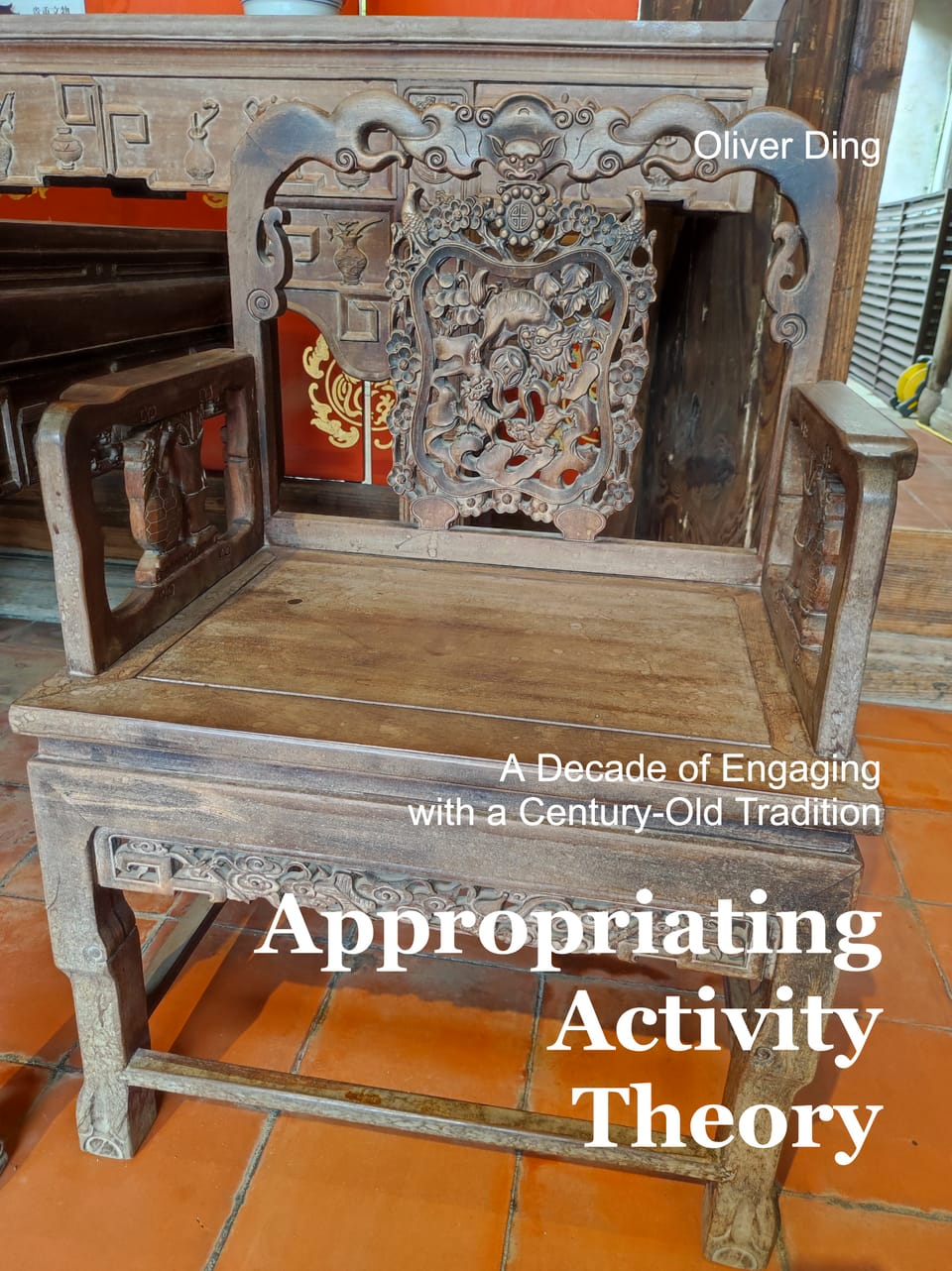
Table of Contents
- Preface: A New Member of the Cognitive Hydrology Series
- Part 1: Curating
- Part 2: Storytelling
- Part 3: Modeling
- Epilogue: A Chair from a Hundred Years Ago
Total: 126,631 words
Part 1: Curating
This part exists because the making of a book is itself a form of activity — and in a book about appropriating a theoretical tradition, it would be strange to leave that activity unexamined.
This book is unusual. It grew from a biweekly column that ran for nine months. In September 2025, after completing Homecoming, I opened the "Appropriating Activity Theory" column with a clear intention: to tell the story of a decade of engagement with Activity Theory, and to eventually edit those essays into a possible book. What actually happened was considerably more complex than that initial plan.
The column was embedded within a larger editorial rhythm. Every two weeks, I publish the Activity Analysis Network newsletter, and I made a particular decision: the column essay would always be written last — after the rest of each issue's content was complete. The reasoning was practical: the choice of which past material to revisit could then be shaped by what the current fortnight had actually produced. The past would respond to the present.
This structural constraint turned out to be the hinge on which everything turned. It meant that my relationship to the past was no longer autonomous. I was not browsing the archive at will. The present was calling the past forward. The current creative work was determining which past materials became relevant. The past was being summoned, not excavated.
And as I wrote each entry, I found myself doing something that went beyond curation. I was not simply reporting what had happened. I was tracking concepts and methods through time — connecting their origins to their current forms, showing how a diagram from 2017 had evolved into a framework in 2025, how an early intuition had become a governing principle. The past was not being preserved; it was being rebuilt.
By issue #9, in January 2026, I could see the transformation clearly enough to name it: "Previously, I focused on revisiting the past and writing its story. Now, the column immerses in the present, returns to the past, and moves toward the future." A new practice had emerged: Revisiting–Rebuilding.
The first two pieces in this part tell the fuller story of how that practice developed — one in narrative form, one as a systematic chronicle of every RR instance across the column and newsletter during this period. Readers who want to understand what was really happening beneath the surface of the eighteen issues will find it there.
The third piece steps back further, using the Project Engagement framework to analyze the making of this book itself: how the column, the practice, and the decade of engagement eventually converged into a specific editorial project with a specific form.
Together, they make the editorial process visible before the reader enters the book itself. They are not required reading — the stories in Part 2 and the models in Part 3 stand on their own. But readers who want to understand how a decade of engagement becomes a book — and how a creative strategy is born in the process of making one — will find the answers here.
The RR practice ultimately produced a possible book. But more significant than the book is what the practice itself became: a recognizable activity — one that can be named, examined, and developed further. In this sense, the curativity of activity does not only generate manuscripts. It can also identify new practices.
Total: 12,202 words
- Revisiting and Rebuilding: A Journey of Developing a New Practice
- A Chronicle of Revisiting–Rebuilding Practice (September 2025 – March 2026)
- Project Engagement as a Theme of Practice
Part 2: Storytelling
This part collects all eighteen issues of the "Appropriating Activity Theory" column, published biweekly from September 4, 2025 to May 30, 2026. The column set out to tell the story of a decade — 2015 to 2025 — of engaging with Activity Theory: the first encounter, the creative misreadings, the emergent concepts, the people and places, and the final reflections on what appropriation means when it runs long enough.
The writing style follows the mode established in Homecoming: narrative, reflective, personal. Life story, theoretical discovery, and cultural observation are braided together. These are not academic essays, nor are they memoir in the conventional sense. They are something in between — theory lived, and living experience theorized.
The column had a structural rhythm. Each essay was always written last in the biweekly newsletter — after the rest of that issue's content was complete. This meant the choice of which past material to revisit was shaped by what the current fortnight had actually produced. The present determined which past became relevant.
Through the first eight issues, the practice felt like revisiting: returning to a past moment, telling its story, tracing how it connected to the present. Then something shifted. By issue #9, a new dynamic had become visible: the column was no longer just looking backward. It was immersing in the present, summoning the past, and moving toward the future. The Revisiting–Rebuilding practice had a name.
The four issues that followed showed what this looked like in operation. Across issues #10 through #13, the Anticipatory Cultural Sociology project was developing the Four Bureaus of Agency — Agency Cascade, Agency Threshold, Agency Resonance, Agency Frontier. Each bureau was introduced through that issue's theoretical work, and each column essay revisited a past case that had, without knowing it at the time, enacted exactly that pattern. Agency Cascade returned to the LARGE Method (2018). Agency Threshold returned to four puzzling moments at a Chinese weekend school (2023). Agency Resonance returned to the 2022 project network. Agency Frontier returned to a 2020 article on the Universal Hierarchy of Human Activity. Present concept and past instance illuminated each other — neither complete without the other.
The eighteen issues are presented here in the order they were written. When editing this book, the question arose whether to reorder them into the chronological sequence of the events they describe. The decision was to keep the original order — because it preserves the visible evolution of the Revisiting–Rebuilding practice itself, and because appropriation does not move in straight lines. It circles back, misreads forward, and finds its meaning in the gaps between one encounter and the next. Reordering would have imposed a false linearity on a practice that was never linear.
The final issue — #18, published on May 30, 2026 — stepped back from the personal account to ask a larger question. A theoretical tradition develops not only by generating new work. It develops, sometimes crucially, by returning to what it has already done and reading it more deeply. The Weave-the-Theory model names this precisely: a tradition that only proliferates on the Creativity Line — new frameworks, new case studies, new applications — risks losing coherence without the Curativity Line work that gives proliferation its depth. Revisiting–Rebuilding is that Curativity Line work. It takes the prior work seriously enough to ask what it was really pointing toward, supplies the Concept and Principle that the original Theme and Model could not yet reach, and in doing so fulfills rather than replaces what came before.
Eighteen issues of personal stories turned out to be, at their deepest level, a demonstration of how a theoretical tradition grows.
Total: 52,744 words
- #1: Misunderstanding and Repurposing (2018)
September 4, 2025–2,355 words - #2: The Project Engagement Approach in November 2020
September 25, 2025–2,788 words - #3: Means, End, and Creative Chaos
October 12, 2025–2,841 words - #4: When Vygotsky Meets Dewey (2019)
October 24, 2025–2,711 words - #5: Kids are Our Teachers (2018)
November 14, 2025–2,680 words - #6: Engaging with Andy Blunden’s Creative Ideas
November 30, 2025–2,508 words - #7: The Piano House and Activity as Container
December 15, 2025–2,066 words - #8: Stage, Map, and Moves
December 31, 2025–2,257 words - #9: The ECHO Way (2021)
January 13, 2026–2,307 words - #10: The LARGE Method (2018 - 2026)
January 30, 2026–4,404 words - #11: When Two Students Aren’t Enough (2023)
February 15, 2026–4,661 words - #12: Agency Resonance Behind the Project Network (2022)
February 28, 2026–2,030 words - #13: Agency Frontier Behind the Hierarchy of Human Activity (2020)
March 14, 2026–4,247 words - #14: Self, Other, and Embodied Social Forms (2017, 2021, 2025)
March 31, 2026–3,805 words - #15: Before, After, and Watershed
April 15, 2026–3,051 words - #16: The Tool That Kept Changing Its Purpose
April 29, 2026–3,466 words - #17: The Art of Theoretical Activity
May 14, 2026–2,375 words - #18: Revisiting and Rebuilding a Theoretical Tradition
May 30, 2026–2,192 words
Part 3: Modeling
This part collects seven case studies written between 2022 and 2026, each returning to the same decade of engagement with Activity Theory — but with a different eye. Where Part 2 tells stories, Part 3 extracts structures. The same experiences, the same turning points, the same encounters with frameworks and people — now examined for their underlying patterns, rendered into diagrams and conceptual models, made available as reusable analytical tools.
The seven pieces are arranged in the order they were written, which is also roughly the order in which the analytical tools available to the author deepened. The earliest piece, from December 2022, uses the Attachance framework to map the "Oliver–Activity Theory" thematic engagement across seven years. By 2024, the House of Project Engagement provides a richer spatial vocabulary for the same journey. The 2025 Wonder and Wander trilogy applies the Evolving Knowledge Enterprise model to trace the development of the Activity Analysis Center across two phases. And the two 2026 case studies bring the full Weave-the-Theory framework to bear on the AAS framework and the Life-as-Activity Approach — the most analytically developed pieces in the collection.
Reading Part 2 before Part 3 lets you see where the models came from — they crystallized slowly from a decade of lived practice, and the stories give them their texture and their stakes. Reading Part 3 before Part 2 gives you the analytical lenses first, so that when the stories arrive, you are already equipped to see their structure. Either order works. The two parts are designed to be read together, not in sequence — two different modes of understanding the same creative life.
Total: 57,534 words
- A Journey of Knowledge Engagement: Appropriating Activity Theory (2015–2022) — Dec 2022
- Mapping Strategic Moves #2: Engaging with Activity Theory — Sep 2024
- [Wonder and Wander] The ECHO Journey (2019–2021) — Apr 2025
- [Wonder and Wander] The Center Journey (2022–2025, Part A) — May 2025
- [Wonder and Wander] The Center Journey (2022–2025, Part B) — May 2025
- A Case Study of the AAS Framework Development — Apr 2026
- A Case Study of the Life-as-Activity Approach — Apr 2026
Postscript: What Does It Mean to Publish?
For most of the years I ran the Activity Analysis Center website, I held an implicit standard: what gets published should be finished, formal, theoretically grounded. The website was a place for frameworks and analyses, not for stories about how those frameworks came to be. The process stayed private; the product went public.
This meant that a large body of early work — the years before the watershed, the practitioner identity, the creative experiments of 2015 to 2019 — never appeared on the website. Not because it was unimportant. Because it did not fit the form.
What makes this worth pausing on is that the Activity Analysis Center has always operated independently — outside academic institutions, outside commercial publishing structures. There are no editors to satisfy, no peer reviewers to convince, no tenure committees to impress. The freedom to publish anything, in any form, has always been structurally available. And yet the implicit standard remained. The internal editor was stricter than any external one would have been. Even in the absence of institutional constraints, I had internalized a logic of what counts as publishable — and that logic quietly shaped what got shared and what stayed private for years.
The column changed this. Writing eighteen issues of narrative essays meant returning to that earlier material and giving it a different kind of form — not as theoretical evidence, but as story. For the first time, the Piano House appeared. The kids who were my teachers appeared. The misreading of Engeström's triangle appeared. These had always been part of the journey. They had never been published — not because the platform was unavailable, but because the internal standard had deemed them insufficiently finished, insufficiently formal.
The experience prompted a question I had not expected to ask: what does it mean to publish?
The conventional answer is something like: to make available, to finalize, to share with an audience. But the RR practice had been quietly dissolving the boundary between before and after, between process and product, between the private archive and the public record. When a 2017 diagram is revisited in 2026 and rebuilt into something new, which moment is the publication? The 2017 creation that sat unpublished for nine years? The 2026 rebuilding that brought it into a new context? Or the ongoing movement between the two?
Activity Theory would recognize this question. One of its deepest commitments is to resist the reification of activity into static entities — to keep the process visible, to see things not as objects but as moments in ongoing transformation. The RR practice, it turns out, enacts exactly this orientation. It refuses to let a past creation become a fixed artifact. It insists that what was made before is still in motion — still capable of generating new meaning when re-entered from a different position.
There is something fitting about arriving at this reflection through a book about Activity Theory. Activity, as a concept, has always carried a productive tension within it. On one side is its structural face: activity requires norms, rules, and shared objects — without these, it dissolves into mere situational response, losing the coherence that makes development possible. On the other side is its agentive face: activity is always developing, always capable of transforming its own conditions — without this, it hardens into doctrine, losing the generativity that makes it alive. The internal editor that kept early stories unpublished was the structural face at work — maintaining coherence, upholding standards, preserving form. The column that finally let those stories out was the agentive face — developing beyond the norms that had been sufficient until they were not.
RR practice lives in the tension between these two faces. It takes structure seriously enough to return to prior work with precision and care. And it takes agency seriously enough to refuse letting that work remain fixed.
In this light, publishing is not a terminus. It is a moment of visibility in an ongoing process. The 2015 seed, the 2022 note, the 2026 rebuild, and this book are not separate publications. They are one continuous act of theoretical activity, made visible at different points along its arc.
v1.0 - June 10, 2026 - 3,071 words