
Appropriating Activity Theory (Possible Book, 2026) - Preface

Turning a column into a possible book
by Oliver Ding
June 9, 2026
The "Appropriating Activity Theory" column aims to reflect my creative journey of engaging with Activity Theory from 2015 to 2025. It was started on September 4, 2025.
On May 30, 2026, I wrote the #18 issue and ended with the words:
Eighteen issues later, I find myself at a natural stopping point. Not because the engagement is over — it is not — but because the story this column was built to tell has reached its conclusion. The decade has been accounted for. The pattern has been named.
Now, as planned at the beginning, it is time to turn the column into a possible book. This morning, I reviewed the stories I told within each issue and looked other relevant articles I published outside the column. The final decision is simple: the new possible book is structured into three parts:
- Part 1: three articles about the meta-narrative of the column — named Curating
- Part 2: the column, including #1 to #18 — named Storytelling
- Part 3: seven case studies about the journey have been selected — named Modeling
They present three different modes of engaging with a theoretical tradition: curating its making, telling its stories, and modeling its structures.
Preface
I first heard the words "activity theory" in 2015. It happened after an online lecture on mindfulness. At that time, I raised a question about integrating mindfulness with other theoretical frameworks. A psychologist replied that activity theory might offer a comprehensive framework for that.
The conversation moved on. But a seed had been planted.
I went looking for literature. The first book I found was Bonnie Nardi's Activity Theory in HCI — my gateway into this tradition. Then I discovered her short intellectual biography, titled "Appropriating Theory." That phrase struck me. Not "applying," not "learning" — appropriating.
Back then, I was a digital product strategist and interaction designer at a startup. I wanted to connect theory with practice. Nardi's example showed me it was possible. That set me on the path that became the core theme of my work for years to come: connecting theory and practice — not as an academic, but as a practitioner.
What followed was a decade of creative misreading, accidental insights, and slow reconstruction.
Engaging with Activity Theory
In 2020, I worked on the Activity U project, which produced two book drafts and the initial development of the Project Engagement approach. From 2021 to 2022, I built the Anticipatory Activity System (AAS) framework and applied it to life strategy. In 2023, I designed the Activity Analysis & Intervention (AAI) Program. In 2024, I revisited Project Engagement and refined it to version 3.1.
In September 2025 — the same month I started this column — I decided to use "Life as Activity" as the umbrella name for my activity‑centered work, a direction first explored back in 2020 with version 0.3 of the Life‑as‑Activity framework. By November 2025, I released Developmental Projects: The Project Engagement Approach to Adult Development, updating the approach to v4.0.
The final book draft in this arc, Weave the Life, introduced the Life‑as‑Activity Approach (v4.0). It marked the end of the ten‑year journey.
The detailed stories behind these projects — the specific encounters, turning points, and breakthroughs — are told in Part 2 (Storytelling) of this book. The remainder of this preface focuses on something else: the methodology behind this book, and how it relates to the three other books in the Cognitive Hydrology series.
Creative Life Curation and the First Three Books
2025 was a dense year of writing. In June, I finished Wonder and Wander: Revealing the Evolving Knowledge Enterprise — a work of modeling. Through eight case studies, it extracted the deep structures of my knowledge journey from 2019 to 2025. It was an analytical, framework-driven book.
In September, I published Homecoming: A Thematic Trip and the World of Activity Approach. This book used a completely different mode: narrative. Structured around a journey of return, it wove together personal memory (1974–2014), theoretical reflection, and cultural observation. Homecoming gave me a genre I would come to love — where life story, theoretical development, and cultural critique are braided together.

These two books showed me that my "Creative Life Curation" methodology could accommodate two very different voices: modeling for case studies, narrative for life writing. So what should the third book be?
The natural answer was: use the narrative mode of Homecoming to tell a specific, decade-long story of wrestling with a theoretical tradition. I had been wanting to write that story for years. I first encountered activity theory in 2015. By the end of 2022, I had produced a model-map of the first seven years. But from 2022 to 2025, the story kept growing — new projects, new concepts, new turns.
So in September 2025, I started a biweekly column called "Appropriating Activity Theory." I borrowed the title from that 2022 model-map, but the writing style was completely different. I switched fully to the Homecoming mode — narrative, reflective, personal. At the time, I imagined this would be the third book in a "creative life curation" trilogy:
- Wonder and Wander (modeling)
- Homecoming (narrative · life biography)
- Appropriating Activity Theory (narrative · theoretical appropriation)
But creation is never linear.
The Unexpected Birth of Lake 42
On January 1, 2026, a completely new idea landed: Lake 42.
It chronicled a six-month period (June–December 2025) when three theoretical streams converged — the Ecological Practice approach, the Life-as-Activity approach, and Creative Life Theory (early edition) — and produced something genuinely emergent. Its voice followed Homecoming, but it was more self-reflexive: it didn't just document a knowledge journey; it also theorized the act of documentation itself.
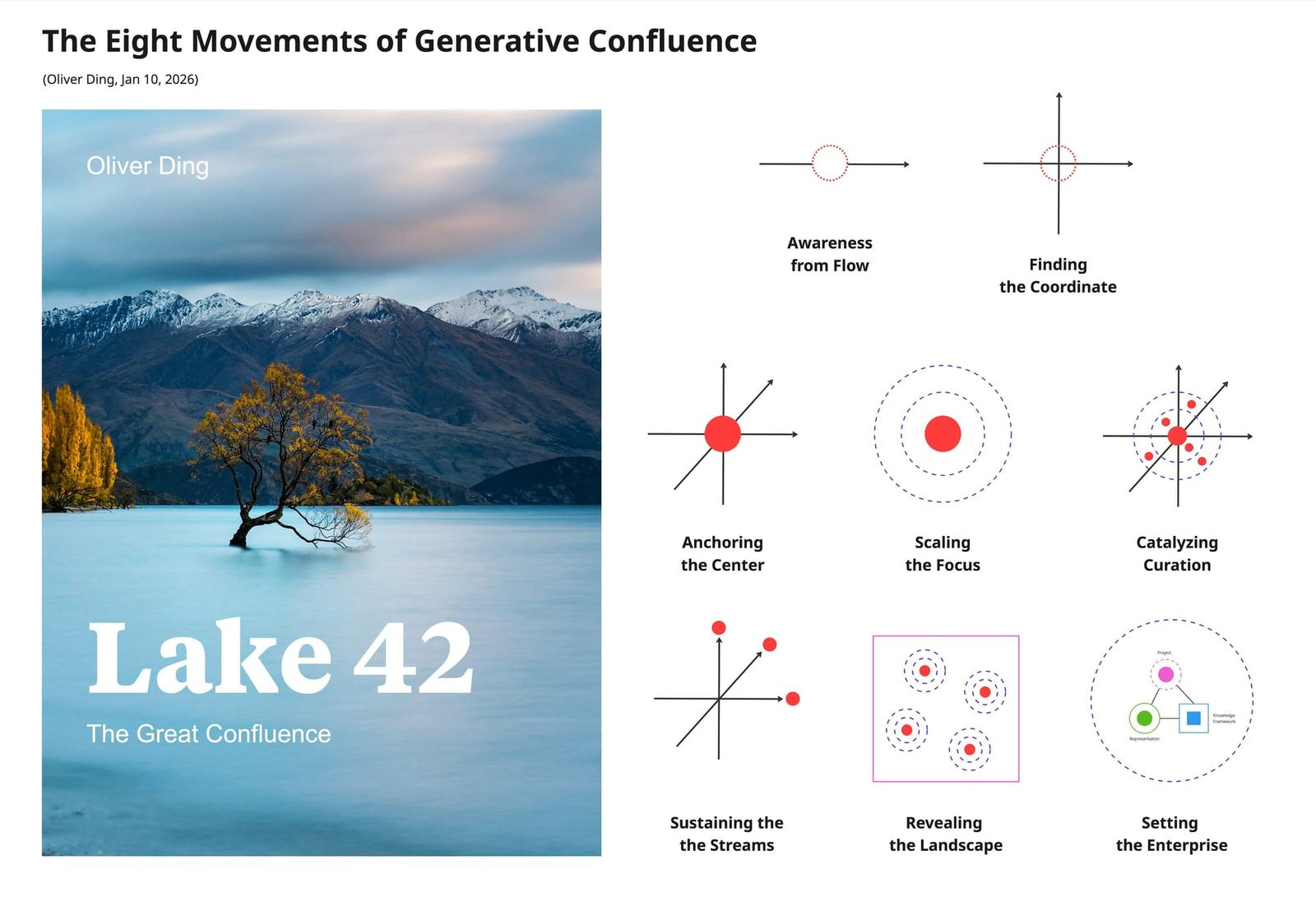
I finished the manuscript during the Lunar New Year. In the epilogue, I wrote a title: "Cognitive Hydrology." At that moment, it was just an image — thought flows like water, gathering and dividing in specific landscapes, forming recognizable channels. That image ran through Lake 42, so I put it in the epilogue.
The name carries a specific logic. Lake 42 introduces Generative Confluence — the pattern by which distinct theoretical streams converge to produce something genuinely new, documented across six months of creative work. Looking back further, Lake 42 also reveals Fractal Confluence — the same generative pattern operating at a larger scale across the years 2019 to 2025, the very period that Wonder and Wander had documented. And Homecoming connects back further still, to the embodied experience of growing up within the Min River watershed in Fujian, where water itself, long before any theory, was already teaching the same lesson.
"Cognitive Hydrology" Becomes the Name
After Lake 42 was released, I found myself talking with readers and friends. I needed a name that could hold the three books together — Wonder and Wander, Homecoming, and Lake 42. They all circled the same question: How does a person truly relate to knowledge? Each answered from a different angle: methodological grounding, practical bridge, theoretical crown.
I remembered that phrase from the epilogue. It was born for Lake 42, but it turned out to be the perfect umbrella. So in February 2026, I officially named the trilogy Cognitive Hydrology.
These three manuscripts were not planned as a trilogy. They grew organically out of the flow of a creative journey.
Looking back, they form a unified application of the Creative Life Curation method across three distinct time scales:
- Homecoming: A Thematic Trip and the World of Activity Approach (September 2025) — spanning my life from childhood to midlife (1974–2014)
- Wonder and Wander: Revealing the Evolving Knowledge Enterprise (June 2025) — focusing on my knowledge creation journey (2019–2025)
- Lake 42: The Great Confluence (February 2026) — documenting six months of high-density theoretical confluence (June–December 2025)
Three time scales: decades, years, months. Three narrative rhythms: biographical, knowledge journey, creative confluence. And yet running through all three is the same current.
At that time, the Appropriating Activity Theory column was still ongoing (I had just published #11). I did not stop to ask where it belonged. The trilogy was complete, the column was still flowing, and the two coexisted without tension.
The Discovery While Editing This Book
On May 30, 2026, I published the 18th and final column. I announced the end of the series, then began gathering the 18 essays — along with other related pieces — to edit into a book.
It was during this editing process, as I placed this manuscript next to the existing trilogy, that a question surfaced for the first time: Where does this book belong in the Cognitive Hydrology series?
The trilogy was already complete. If the trilogy were a closed set, this book would be "outside." But I could choose another path: expand the trilogy into an open series, one that could hold more than three books. I decided to do the latter. The series can start with a trilogy, but it doesn't have to end there.
That decision, in turn, changed how I approached editing this book. As I began to see the four books as a family, I re-examined the first three — and discovered something I had not noticed before. The trilogy had two absences. Not flaws. Just empty spaces. And this book, it turned out, could fill both.
Two Absences
First, a gap in the timeline.
The trilogy covers: childhood to 2014 (Homecoming), the source material for 2019–2025 (Wonder and Wander's case-study period), and the second half of 2025 (Lake 42). But one complete decade is missing: my 2015–2025 journey with activity theory.
Wonder and Wander draws from that period, but it is modeling, not narrative. It does not use the Homecoming voice — the braiding of life story, theoretical discovery, and cultural reflection — to tell the story of how one person met, misused, appropriated, and rebuilt a century-old tradition.
Second, a gap in genre.
Homecoming is a life-biography narrative (forty years). Lake 42 is a creative-confluence narrative (six months). The Cognitive Hydrology series needs a third narrative work — with the same narrative texture — but at a medium scale. A decade. Exactly that scale.
Wonder and Wander stands alone as the modeling wing of the series. In the trilogy, the narrative-to-modeling ratio was two to one. If the series can expand, then narrative works can become three, while modeling remains one. The ratio becomes three to one.
Where This Book Belongs
Appropriating Activity Theory was not planned to fill these two absences. It began in September 2025 as a different project — the intended third book of the "Creative Life Curation" trilogy.
When Lake 42 arrived and took that spot, this book did not lose its meaning. It was only when I finally placed it next to the trilogy that I saw: it falls perfectly into the two gaps I later discovered.
So in the expanding Cognitive Hydrology series, this book has a clear place:
It is the fourth book (after Wonder and Wander, Homecoming, and Lake 42).
It fills the temporal gap (2015–2025) and the genre gap (a third narrative work at the decade scale).
Thematically, the trilogy focuses on knowledge generation from one's own creative life — how methodology grows from practice, how it gets applied in life writing, how it surges at moments of confluence. This book focuses on personal appropriation of an existing theoretical tradition — how one person meets, wrestles with, misuses, rebuilds, and eventually finds their own voice within a century-old body of thought.
The Structure of This Book
Importantly, this book does not abandon modeling. It places narrative and modeling side by side in the same volume.
Part 1 (Curating) makes the editorial process visible. It comprises three pieces that arrived during the editing of this book: a narrative account of how the Revisiting–Rebuilding practice emerged from the column's structural rhythm, a systematic chronicle of every RR instance across the column and newsletter from September 2025 to March 2026, and a case analysis of this book's own making through the Project Engagement framework.
Part 2 (Storytelling) is narrative. Eighteen essays, trace the arc from 2015 to 2026: the first encounter, the creative misreadings, the emergent concepts (Project Engagement, Agency Resonance), the people and places (Andy Blunden, the Piano House, ECHO, LARGE), and the final reflections on rebuilding a tradition. These essays weave personal memory, theoretical breakthrough, and cultural observation. They are theory lived.
Part 3 (Modeling) is analytical. It revisits the same decade, but not by retelling the story. Instead, it looks back with a modeler's eye. Each essay extracts a specific conceptual structure — the phase model of the ECHO journey, the journey of building the Activity Analysis Center, the development of the AAS framework, the version evolution of the Life-as-Activity approach. Here, experience is turned into examinable, reusable, debatable conceptual artifacts.
Neither mode is superior. Narrative lets you enter an experience; modeling lets you take something away from it. If you read the narrative first, you see where the models came from — they crystallized slowly from a decade of practice. If you read the modeling first, you carry analytical lenses into the stories, spotting structures behind every anecdote. Either order works.
In this sense, this book is unique within the Cognitive Hydrology series. It is the only one that places narrative and modeling together in a single volume. Wonder and Wander is pure modeling. Homecoming and Lake 42 are pure narrative. This book is both.
Why Place Them Together?
Most of the time, we are forced to choose between the two modes. Academic writing demands modeling (even narratives are required to "theorize"). Memoir and personal essays stay in literary territory. But I believe that for the question of how a person appropriates a theory, both modes are indispensable. Appropriation is never purely logical, never purely emotional. It is a mixture of logic and emotion, structure and accident, inheritance and rebellion. Narrative captures the texture of that mixture; modeling extracts its structural contours.
This book is that mixture. It is not a textbook of activity theory, nor is it my personal memoir. It is a methodological demonstration: a display of how one person consciously, deliberately, looks back at the same intellectual journey through two radically different modes of writing.
Theoretical Activity as the Meta-Concept
Finally, this book is also a practice and a demonstration of what I call theoretical activity — a concept I develop in a recent possible book Weave the Theory: The Art of Theoretical Activity and Knowledge Ecology. Theoretical activity means engaging with theory as an activity in itself, not as a set of propositions to be mastered. The decade I spent engaging with Activity Theory was a decade of theoretical activity. And turning that history into both narrative and model is an act of self-reference: I am active within theory, and I turn that activity itself into theoretical material.
If you have ever felt that theory is distant from your life, or that your experience cannot be captured by existing conceptual frameworks, I hope this book offers a different imagination. Theory is not a building you only visit. It is something you can handle — appropriate, dismantle, reassemble, misuse, and recreate.
The Cognitive Hydrology trilogy looked back at how knowledge grows from one's own creative life. This book looks back at how an existing theoretical tradition can be appropriated, rebuilt, and eventually turned into one's own voice. They are not separate — engaging with a theory is itself an act within a creative life, not outside it. This book does not stand apart from the trilogy; it extends it, fills its gaps, and shares its fundamental question.
Yet as I wrote the final essay of this book (Issue #18), I realized that something larger had begun to take shape. The concepts I named in Weave the Theory — Theoretical Activity, Theoretical Enterprise, Theoretical Platform — offer a way to see any knowledge ecology from three sides: the objective process, the subjective trajectory, and the mature structure that supports others' development.
What interests me now is that this model is not limited to theoretical traditions. Any knowledge ecology — a knowledge center, a creative community, a long-term personal project — has the same three faces. The Activity U project was a Theoretical Activity I participated in. My own creative journey with Activity Theory is a Theoretical Enterprise. And Activity Theory itself, by the time I encountered it, was already a Theoretical Platform — structured, rich, capable of supporting work it would never directly touch.
I spent ten years doing this. This book is the record.
version 1.0 - June 9, 2026 - 2,774 words