
Project Engagement as a Theme of Practice

A tiny activity analysis
by Oliver Ding
June 9, 2026
This article is part of a new possible book: Appropriating Activity Theory: A Decade of Engaging with a Century-Old Tradition.
After wrapping up the Activity U project, I established the Activity Analysis Center to continue my journey of engaging with activity theory. The term "activity analysis" has taken on different meanings at different times, but I generally understand it as: using activity‑theory concepts or knowledge frameworks to make sense of and reflect on concrete practices.
The Storytelling and Modeling sections of this book present a wide range of activity analyses in various forms. The eighteen column essays offer narrative reflections on a decade‑long journey; the seven case studies extract conceptual models from the same stretch of experience. All of them are translations from practice to understanding.
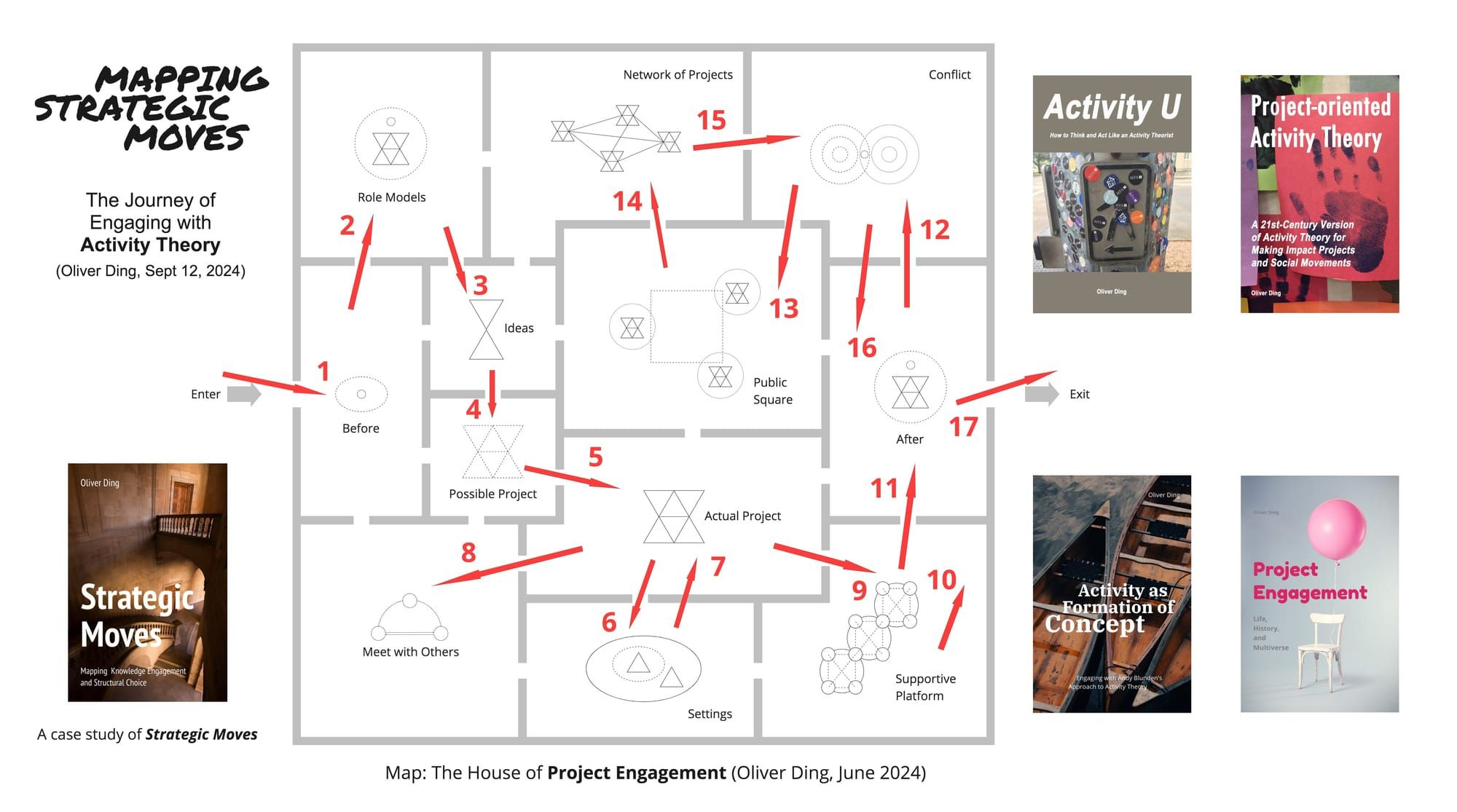
In fact, one piece in this book already applies the Project Engagement framework to analyze my own exploration journey — “Mapping Strategic Moves #2: Engaging with Activity Theory” (written in September 2024, see Part 3). In that article, I used The House of Project Engagement with its 12 thematic rooms to diagram my trajectory of engaging with activity theory over the years.
Yet one more activity analysis case is not included in the main text — the very process of writing and editing this book.
This process is quite interesting. It was not a pre‑planned project, but a journey that gradually emerged, kept transforming, and finally found its place over several years of creative work. Readers may feel first‑hand how I have been connecting theory and practice all these years — not through a fixed method, but by maintaining a reflective distance from “projects” themselves.
In this short piece, I will continue to use the same tool and method — the Ideas → Possible Project → Actual Project triad from The House of Project Engagement — as a simple demonstration of how it can be used to understand the making of this book manuscript. This triad comes from the framework I completed in 2024, describing three basic states any project passes through from germination to completion.
1. From Macro to Micro: A Shift in Perspective
As shown in Life‑as‑Activity (v4.0), at the macro level (whole) we have the pair Activity – Enterprise. Activity is the objective process observed from the outside; Enterprise is the personal subjective journey lived from the inside. At the micro level (part), this pair materializes as Project – Event. If you personally engage in something, it becomes your project. If you observe it from the outside, it is merely an event in your life — someone else’s project.
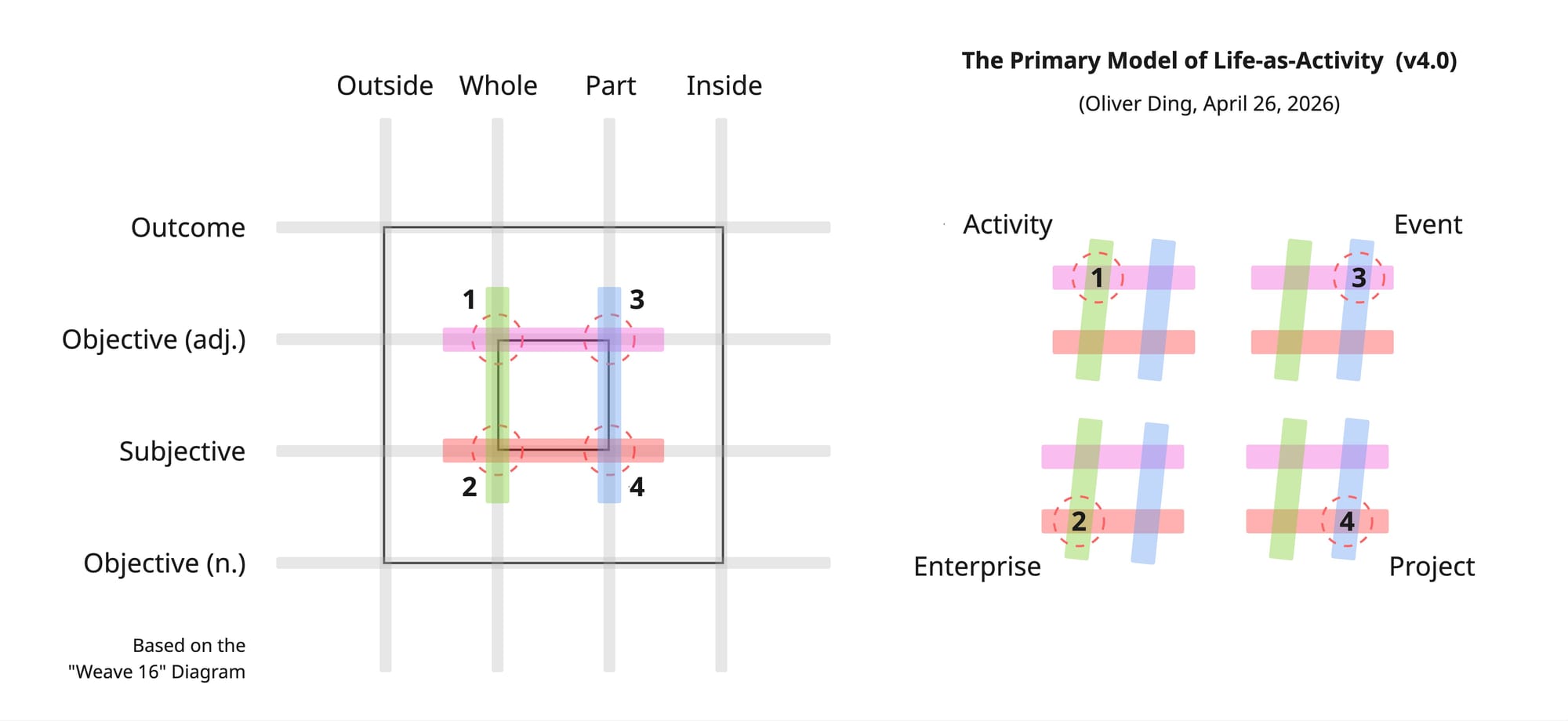
This shift in perspective prompted me to re‑examine the writing and editing process of this book. If we view it as a project, how did it move from a vague idea, to a possible conception, and finally to an actual work?
2. Three Thematic Rooms
In The House of Project Engagement, I designed 12 thematic rooms, three of which form a core movement path:
2.1 The “Ideas” Room
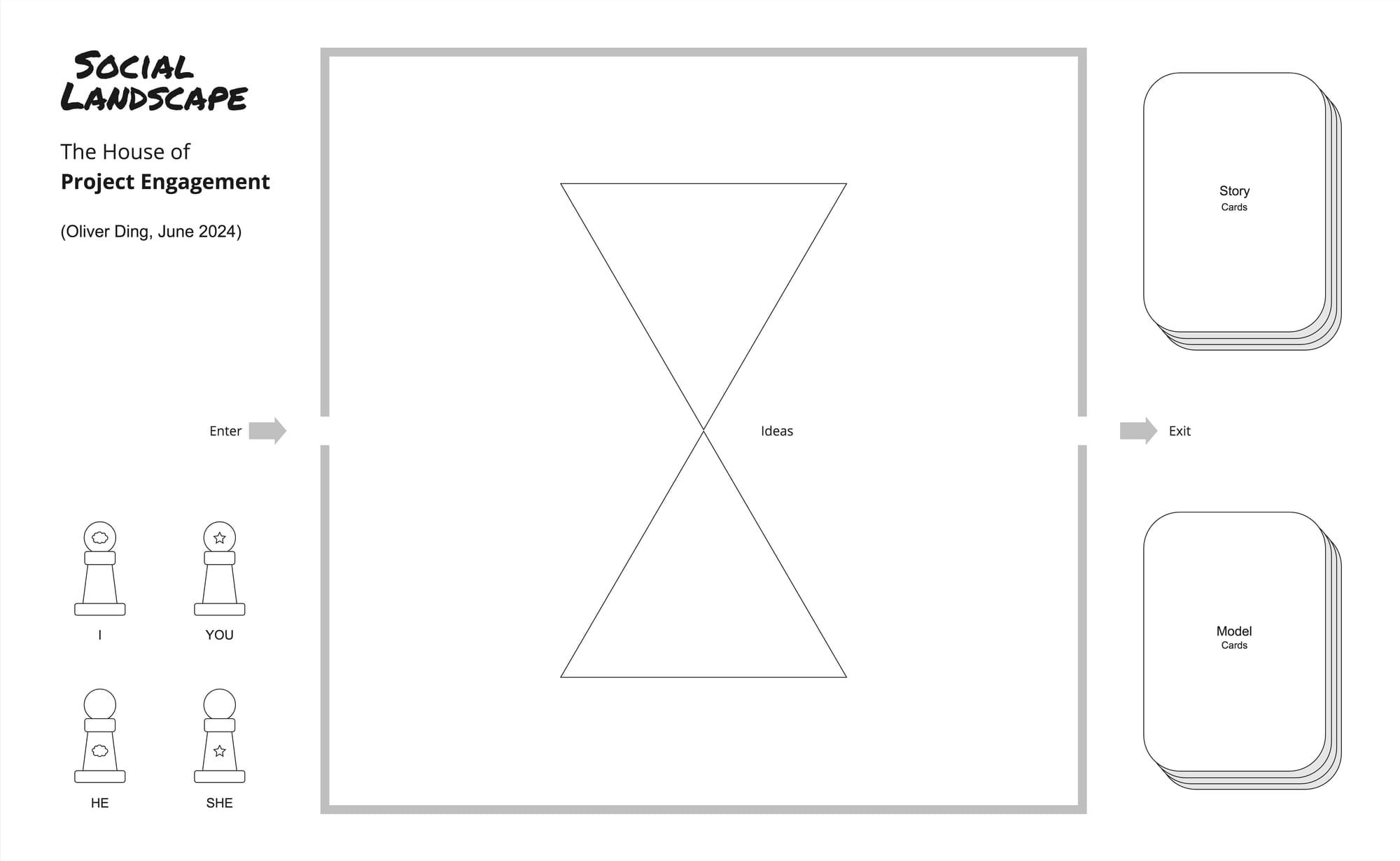
This room holds an individual’s concrete ideas — a theme, a concept, an insight, an intention, a strategy, a goal. It concerns what we think about, especially those thoughts that will affect our actions. In Project Engagement’s mapping moves, we focus on ideas that are connected to action and project execution.
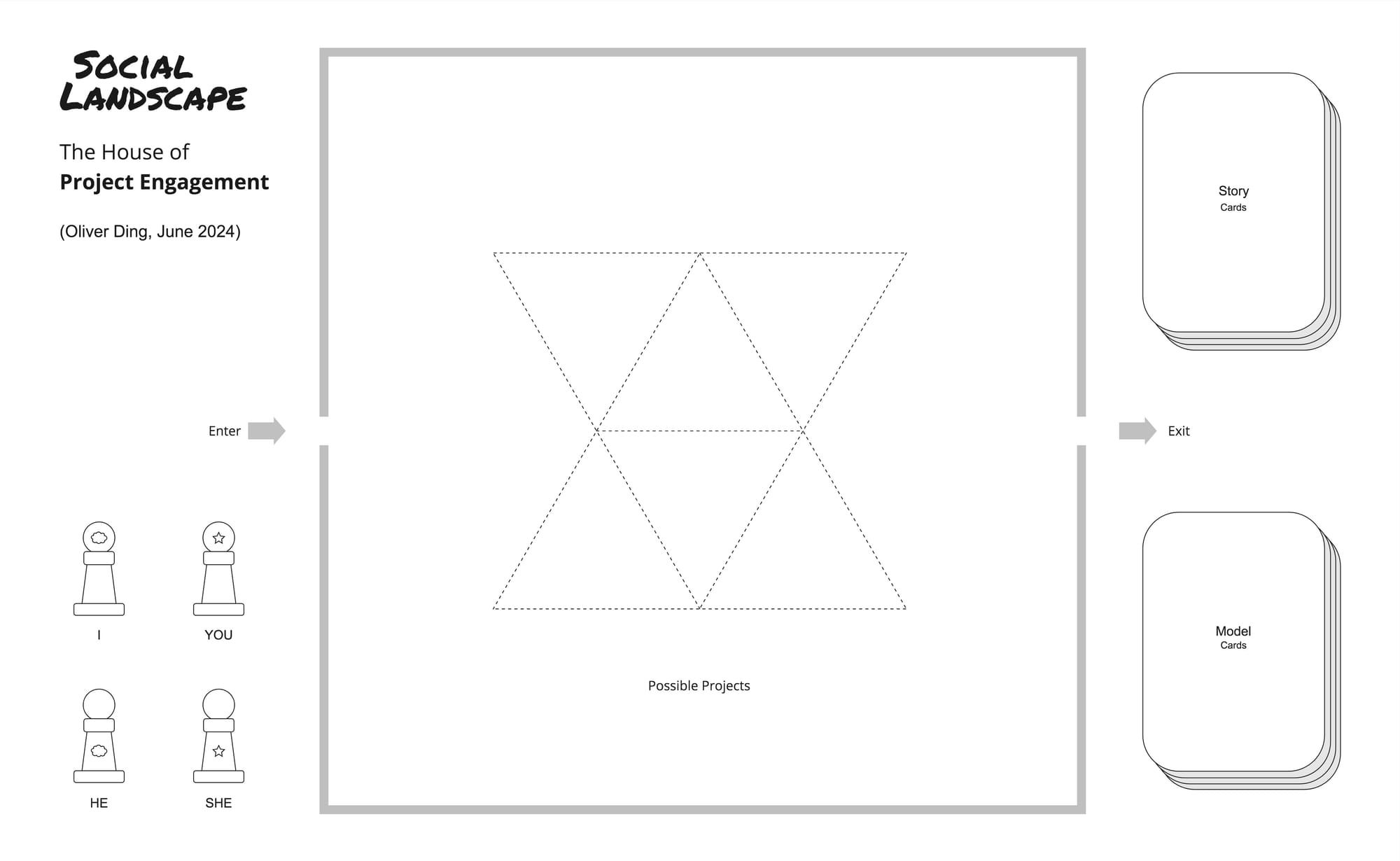
2.2 The “Possible Project” Room
This room serves as a bridge between “Ideas” and “Actual Project.” It covers an individual’s expectations, plans, explorations, experiments, and tentative actions. Its value lies in tracing the progress from idea to goal, from goal to object, from object to outcome — including both planned products and unexpected by‑products. When paired with “Actual Project,” early‑stage, canceled, unfinished, or failed projects can be placed here.
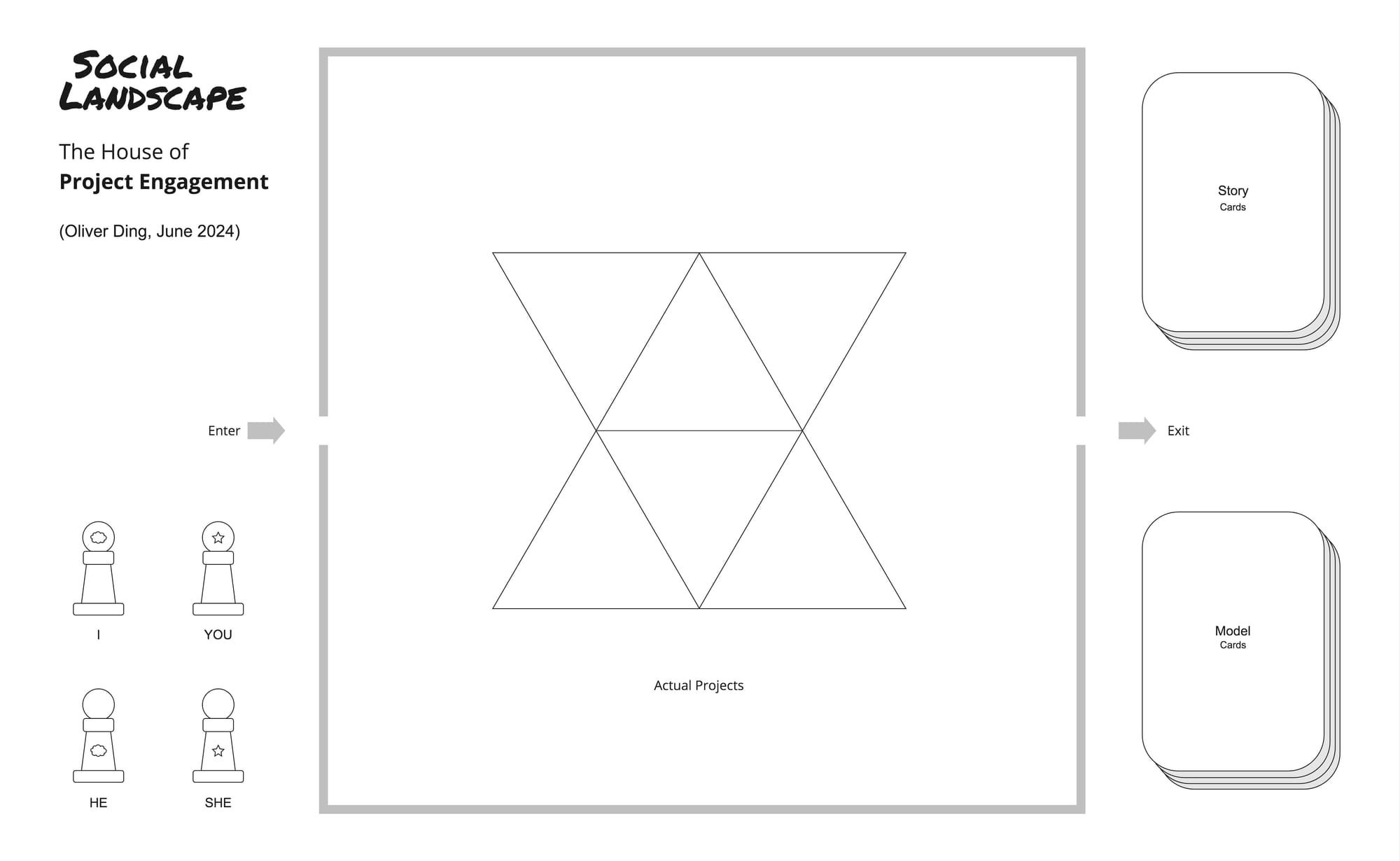
2.3 The “Actual Project” Room
This is the central room of the House of Project Engagement. Unlike “Possible Project,” which deals with states not yet realized or completed, “Actual Project” refers to long‑term, completed, successful projects. It represents an idea fully realized as an accomplished goal.
3. The Making of This Book Through the Three Rooms
Now let us use these three rooms to revisit the birth of Appropriating Activity Theory.
3.1 Ideas Room (first time: 2015–2020)
In 2015, a psychologist’s response after a mindfulness lecture planted a seed. I found Bonnie Nardi’s Activity Theory in HCI as my gateway, and then her short intellectual biography titled “Appropriating Theory.” That phrase struck me: not “applying,” not “learning” — appropriating. At the time, I was a digital product strategist and interaction designer at a startup. I wanted to connect theory with practice. That idea became the core theme of my work for years to come.
3.2 Actual Project Room: The 2022 Manuscript
On December 31, 2022, I edited a book manuscript with the same title, Appropriating Activity Theory. Its introduction was a 2,400‑word article with a model map, subtitled “A Journey of Knowledge Engagement.” In the opening, I wrote: “Initially, my purpose was to develop some methods and frameworks for the Creative Life project. Later, I realized that I can collect these articles together and curate them into a new meaningful whole.”
That new meaningful whole was a “Person‑Theme” engagement — the relationship between myself and Activity Theory. Using the Attachance framework, I reflected on the “Oliver‑Activity” thematic engagement.
This manuscript was not a “possible project.” It was a completed actual project — a coherent curation of existing work, framed by a clear concept. More importantly, it directly led to TALE (Thematic Analysis Learning Engagement) in January 2023, a new knowledge center for deepening thematic engagement.
3.3 Ideas Room (second time: 2025)
In September 2025, after finishing Homecoming, I began to envision a “Creative Life Curation” trilogy. The first two books were already in place: Wonder and Wander as modeling, Homecoming as life narrative.
The natural third book would be a narrative work that told the decade‑long story of wrestling with activity theory. This was an idea — a clear, actionable concept — but not yet a project.
3.4 Possible Project Room (second time: September 2025 – January 2026)
I started a biweekly column under the title Appropriating Activity Theory, borrowing the title from the 2022 manuscript but switching fully to the narrative style of Homecoming.
The column was in progress. It was a possible project — it had not yet found its final form or its place in a larger structure. Issue after issue was published, but the book remained in a state of possibility, not yet actualized.
3.5 Ideas Room (third time: February 2026)
Then Lake 42 happened. I finished the manuscript during the Lunar New Year, and when I looked back at the three existing books — Wonder and Wander, Homecoming, Lake 42 — I realized they formed a natural trilogy. I named it Cognitive Hydrology. This was an actual trilogy, completed and coherent.
Now a tension appeared in the Ideas room: the “Creative Life Curation” trilogy (which had Appropriating Activity Theory as its third book) and the Cognitive Hydrology trilogy (which had Lake 42 as its third book) were incompatible. Two different trilogies; only one could be actual. The column continued through the spring of 2026, and while I did not consciously dwell on this conflict, it lingered in the background.
3.6 Actual Project Room: This Book (June 2026)
After the 18th and final column on May 30, 2026, I began editing the manuscript. Placing it next to the Cognitive Hydrology trilogy, I discovered two absences: a gap in the timeline (the 2015–2025 decade was missing) and a gap in genre (a medium‑scale narrative work was needed). This book fell perfectly into those two gaps.
By positioning it as the fourth member of the Cognitive Hydrology series — not as the third book of a “Creative Life Curation” trilogy — the conflict dissolved. The book became actual.
3.7 Ideas Room (fourth time: June 2026)
Once the series was open, a new idea emerged: the Cognitive Hydrology series could expand beyond four members. Other possible books could join. This idea — an open series — now lives in the Ideas room, waiting for future moves.
3.8 Possible Project Room (third time: June 2026)
And indeed, a possible project is already underway. Spatial Heuristics, a creative project focused on the development of the World of Life approach and Anticipatory Cultural Sociology (from January to March 2026), has already produced two case studies. It is not yet a completed book, but it exists in the Possible Project room — a candidate for a future member of the series.
4. Supportive Platform: Activity Theory as a Theoretical Platform
In the layout of The House of Project Engagement, the room adjacent to “Actual Project” is Supportive Platform. This is no accident. Any actual project needs a platform that supports it — an institution, a community, a resource network, or, as in this case, a mature theoretical tradition.
Activity Theory is my Supportive Platform.
When I began engaging with activity theory, it was already a century‑old tradition. Vygotsky, Leontiev, Engeström, Nardi … generations of scholars had built a rich conceptual system (activity, action, operation, motive, object, tool, rules, division of labor, community, etc.) and a set of methodological tools (activity system model, contradiction analysis, expansive learning, etc.). The platform does not care how I use it — it simply sits there, waiting to be appropriated, modified, reassembled.
That is what a “theoretical platform” means: stable enough to support others’ work, rich enough to accommodate different uses, open enough not to mind being misread, dismantled, or recombined. Activity Theory as Supportive Platform is not the “object of study” of this book; it is the condition that made this book possible.
When I say “this book is the fourth book of the Cognitive Hydrology series,” I mean not only a narrative continuation but also a project‑structural position: an Actual Project requires a Supportive Platform, and the earlier books in the trilogy (especially Wonder and Wander and Homecoming), together with the broader activity theory tradition, collectively constitute that platform.
5. The Meaning of Moving Between Rooms
In The House of Project Engagement, “Ideas,” “Possible Project,” and “Actual Project” are not three isolated islands. Together with the other nine thematic rooms, they form an interconnected network. Each room illuminates the phenomenon of “project” from a different angle. In this case, we can clearly see the presence of other rooms:
- Role Models — Bonnie Nardi appears in this room. Her biography “Appropriating Theory” and her academic path directly inspired my stance of “appropriation.” The Role Models room sits adjacent to the Ideas room, meaning that the power of role models often transforms into the seeds of our own ideas.
- Settings — My work as a digital product strategist and interaction designer at a startup. This concrete working context shaped the urgency and direction of my desire to “connect theory and practice.” The Settings room and the Ideas room support each other.
- Network of Projects — Activity U, AAS framework development, AAI program, column writing … these are not isolated projects but a dynamic network. The output of one project (e.g., the 2022 manuscript) becomes the raw material for another (the 2025 column). The Network of Projects room is tightly linked to the Possible Project room.
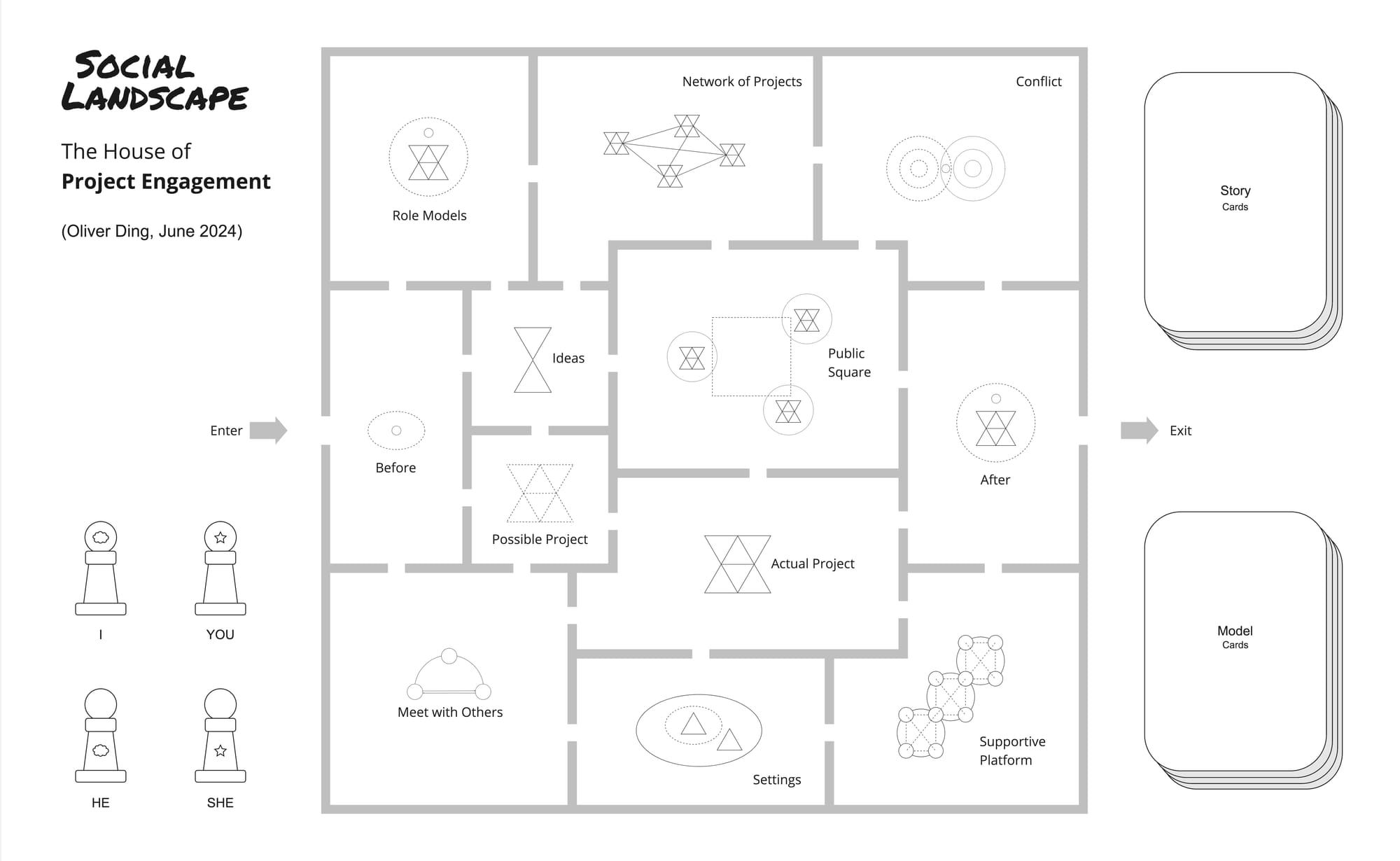
This case fully demonstrates that movement among the three core rooms is always embedded in the larger network of thematic rooms. To understand the generation of a project, we cannot look only at the mainline of Ideas → Possible → Actual; we must also see how role models spark ideas, how settings shape actions, and how the project network feeds resources.
The significance of moving between the three rooms is threefold:
- The value of possibility space. Even if a project never becomes “Actual,” its “Possible” state is meaningful in itself.
- Flexibility of movement. Movement between rooms is not one‑way. If an actual project does not materialize as expected, it can fall back to the possible state and wait for a new opportunity. And a possible project can be reactivated years later and become actual in a different form.
- From external event to internal project. In Project Engagement terms, we can choose to turn events we encounter into our own projects — and that is precisely what “appropriating” means at the methodological level. When I discovered the two absences in the trilogy, I did not treat them as a “problem” to solve, but as an “opportunity” to grasp: positioning this book as the work that fills those gaps.
More details about the House of Project Engagement can be found in Strategic Moves: Mapping Knowledge Engagement and Structural Choice (v1, 2024).
Postscript
This tiny activity analysis case may illustrate better than any theoretical article in this book how I have been connecting theory and practice all these years: not by mastering a fixed method, but by maintaining a reflective distance from “projects” themselves — using my own conceptual frameworks to examine my own actions, adjusting the frameworks in action, and then continuing to act with the updated frameworks.
If we merely read articles about the Project Engagement approach, look at its diagrams, and then put them aside, they become just another piece of knowledge we learn and eventually forget. But if we bring them into our own lives, using them to reflect on our actual practice, they become a theme that we practice repeatedly. Only when a theory becomes a theme of our practice can we truly master the wisdom it offers.
As this book has shown, practicing a theory does not require a grand undertaking like writing a 250‑page monograph. Sometimes, simply taking a few elements from a large theoretical system is enough to get started — and to practice quickly.
That is what Project Engagement as a Theme of Practice means. It is not a course to be studied, but a craft to be practiced continuously. And the process of writing and editing this book is itself a demonstration of that craft.
v1.0 - June 9, 2026 - 2,331 words