
Rebuilding the Living Coordinate: A Case Study Summary

A case study of the transformation of belief system
by Oliver Ding
June 12, 2026
Introduction
About two weeks before writing this article, I noticed that a friend had been sharing a series of articles and materials about a profound transformation in her belief system — what she called "reinstalling her internal operating system." With her consent, I began analyzing her experience using the World of Activity toolkit and the Self-Life-Mind (SLM) model.
The original research report was written in Chinese and runs to over 40,000 characters. It is a full-length case study covering the complete analytical journey, including detailed theoretical comparisons, extended framework discussions, and multiple rounds of analysis. This article is a summary of original version of that report. It presents the essential story, the key analytical frameworks, and the core theoretical findings — without attempting to reproduce the full depth of the original.
Contents
Part 1: Quinn's Story and Timeline
1.1 Who Is Quinn?
1.2 The Three Collapses
1.3 The Turning Point
1.4 Rebuilding
1.5 Two Years Later
Part 2: Analytical Frameworks
2.1 World of Activity: The FFCC Model and Living Coordinate
2.2 Self-Life-Mind Analysis
2.3 Genidentity
Part 3: Core Themes
3.1 The "Internal Operating System" Metaphor
3.2 Living Coordinate and Enterprise Development
3.3 Theoretical Comparison
3.4 Research Findings: The Internalized and the Native
Conclusion
Belief Systems in a Cross-Cultural Age
Postscript
A Missing Dimension
Part 1: Quinn's Story and Timeline
1.1 Who Is Quinn?
Quinn (pseudonym) is a female entrepreneur born in 1992 in central China. She grew up inside one of the world's most demanding academic selection systems and excelled at it — graduating near the top of her class throughout her school years, earning a place at a top university in China (comparable to Harvard or Yale in prestige and selectivity), then completing a graduate degree at a leading U.S. research university. During her time in the United States, she also received formal coach training and obtained a professional coaching certification, which would later form the professional foundation of her entrepreneurial work.
She describes the first eighteen years of her life as those of "a typical good student living inside an exam-based evaluation system" — obedient, high-achieving, never stepping out of line. Her self-worth was built on a simple equation: value equals performance ranking. This equation worked — until she arrived at university and found herself surrounded by the top students from every province in the country. The old coordinate system stopped working. She spent the next seven years rebuilding her sense of self: through studying abroad, through meeting different kinds of people, through repeated cycles of self-exploration.
In 2018, while working at a leading U.S. education technology company, she posted a message on Chinese social media on impulse and assembled a ten-person team within a day. This was the founding of EduPlus — initially a knowledge community for education professionals. In 2019, her mother was diagnosed with terminal cancer. Accompanying her mother through the final months, and surviving a major financial fraud in the same period, fundamentally changed her understanding of what life was for. This experience became the primary reason she later resigned her corporate job and committed to EduPlus full-time.
In 2021, she left her American employer and became a full-time entrepreneur — only to immediately encounter a sweeping Chinese education policy reform that disrupted the entire industry she had been building for. What followed was four years of repeated collapse and rebuilding: two partial repairs, and then, in 2024, something that could no longer be patched.
1.2 The Three Collapses
First collapse (2021): One month after going full-time, the policy reform made her existing business model unworkable and her co-founder departed. She could barely get out of bed in the mornings. With support from a professional coach, she navigated the transition and repositioned EduPlus from an education-sector community into a career development brand. Energy returned. The platform found new direction.
From the perspective of this case study, this was what we might call "rescuing the center" — an external shock disrupted the direction a person's core activities, and through targeted support and repositioning, stability was restored. The underlying belief system driving Quinn's work was untouched.
Second collapse (2023): The new business model was working. Quinn set a goal of reaching one million RMB in annual revenue and pursued it relentlessly — working across a fifteen-hour time zone gap between the U.S. West Coast city where she lived with her husband and her primary user base in mainland China, getting up before dawn to run live sessions, pushing past signals from her body. Eventually her endocrine system broke down. One day she couldn't get out of bed. She completed five psychological assessment scales and scored in the moderate depression range on all of them.
Again, she sought coaching support. Again, she came through. She later described it as a period of genuine inner breakthroughs — seeing certain patterns more clearly, making adjustments. But looking back from 2024, she would recognize that even these breakthroughs had occurred within the old system's logic. The deepest layer had not been touched.
Third collapse (2024): This one was different. There was no dramatic breaking point — instead, a slow, grinding loss of drive that she described as "chronic pain." Things that had once energized her no longer did. She could look back at her original motivation and still see it as meaningful, but couldn't summon any energy from it. Her famously strong action orientation became intermittent. The future felt unclear.
This was not a crisis that could be resolved by repositioning the platform or finding a new goal. The engine itself had stopped generating fuel.
1.3 The Turning Point
In January 2024, Quinn had found what felt like a genuine breakthrough in positioning: the concept of "lifestyle entrepreneurship" — building a business that supports the life you want to live, rather than subordinating life to the business. She described the moment of discovery with characteristic intensity: "There is actually a concept that precisely describes who I am and what I'm doing. This is exactly THE THING for me. This belongs to no one but me."
The concept was real. Her identification with it was genuine. But by April, the slow collapse had begun anyway. Something deeper than positioning was failing.
The key moment of insight came in August 2024, during a week-long Zen-style meditation retreat in Dali, a city in southwestern China known for its contemplative communities. Sitting with her mentor — a figure with deep roots in Chinese contemplative practice who she had initially approached simply for business advice — she suddenly saw something she had not been able to see before:
"After positioning 'lifestyle entrepreneurship' at the start of the year, there was a force in me wanting to go all out. I wanted myself and EduPlus to become a benchmark, to show another possibility, to prove that 'our camp' could achieve the same commercial results as 'their camp.' I don't deny this was a kind of mission. But behind it was a deeply hidden motive of self-justification: I want to prove that I — or we — are excellent and capable."
This was the deep belief — the one that had been running underneath everything else, invisible, attaching itself to each new direction as soon as she found it. "Lifestyle entrepreneurship" as a concept was clean. But the way she had deployed it — as a vehicle for proving something — had been quietly hijacked by the old logic.
Seeing this was not comfortable. But it was the condition for everything that followed.
1.4 Rebuilding
The reconstruction of Quinn's belief system did not happen in a single moment of illumination. It unfolded over several months through two primary channels.
The first was her relationship with her mentor, whose approach she described as a combination of "stabbing deep" and "warming deeply." Her mentor did not give her a new belief system to adopt. What he did — and this would prove theoretically significant — was identify something that was already there. He named her essential quality directly: "Quinn has one enormous strength: a particularly pure quality of genuineness. Every question she has ever asked me has been her real question." Then he gave her permission to trust it: "Trust your heart. You won't die."
The second channel was Michael Singer's memoir The Surrender Experiment, which she had first read in May 2023 without fully understanding it. In September 2024, she traveled to Singer's community in Florida and spent a week in the environment he had built — attending meditations, participating in communal practice, eventually asking Singer a question directly. When she heard his answer — about how to remain with uncertainty rather than forcing the mind to generate solutions — she was, she said, close to tears, because it precisely named what she had been living.
She read the book again on the flight back, grounded by a hurricane. This time it was different. Notably, when she wrote about "surrender" in her own posts and articles, she consistently placed the word in quotation marks — a small but telling detail. She was not wholesale adopting Singer's cosmological framework. She was borrowing a word as a symbolic tool to express a psychological orientation she had already arrived at through her own experience: releasing control, trusting the flow of life. The quotation marks signal the distance between the borrowed symbol and the meaning she was loading into it.
Throughout this period, her support network — her husband, her team, a set of close friends and professional coaches — provided the material and emotional conditions for her to actually stop working in the way she had been working. Stopping was not metaphorical. She genuinely withdrew from high-intensity operations for a sustained period, letting the body and mind rest.
1.5 Two Years Later
In May 2026, Quinn was in the late stages of pregnancy, expecting her first child in July. She had set down EduPlus as a high-intensity operation in October 2025 — not because it had failed, but because she heard clearly, from inside, that it was time to return to life.
A month after making that decision, she became pregnant, after a year of trying. She maintained a light-touch presence in the community she had built, continued writing, and described her current state with a phrase that carries its own weight in Chinese: "rooted in the soil — that kind of grounded, concrete happiness."
Part 2: Analytical Frameworks
This case study marks the first time I have used the World of Activity framework and the Self-Life-Mind (SLM) model together in a single case analysis. Previously, I had treated SLM primarily as a meta-framework for developing other knowledge frameworks — it organized and related concepts in the background, but did not step forward as a direct analytical tool for specific cases.
This case changed that. Analyzing Quinn's experience required working at multiple levels simultaneously: the structural dynamics of her Creative Center (which called for the World of Activity's FFCC model), the deeper question of what drives a Living Coordinate (which called for SLM), and the distinctive character of her continuity through transformation (which called for Genidentity analysis). Each of these introduced a different framework or concept, not because I planned a comprehensive toolkit in advance, but because the case itself demanded it.
Both the World of Activity system and the SLM framework are designed to be open in this way. When applying them to a specific case, the researcher can bring in additional knowledge frameworks as needed — including frameworks not originally developed within these systems. In this case, that meant drawing on Genidentity (developed within Creative Life Theory), Living Coordinate (a concept from the same system used here in direct dialogue with SLM), and comparative material from CBT and ACT.
The experience of making these connections — watching frameworks that had existed separately begin to illuminate each other through the demands of a single case — generated insights that fed back into my own knowledge development. Several theoretical observations in Part 3 emerged not from planning but from the friction of application. The full Chinese-language report also includes analyses using the Strategic Agency framework and a Dual-Center analysis; these are not reproduced here but form part of the complete case study.
2.1 World of Activity: The FFCC Model and Living Coordinate
The World of Activity framework describes a person's large-scale life container using four structural concepts: Flow, Focus, Center, and Circle (FFCC).
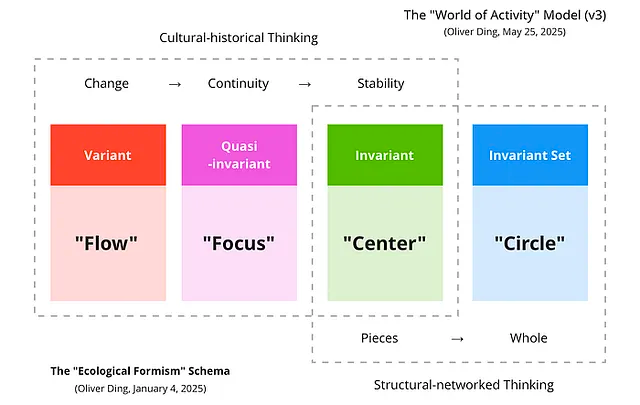
Flow is the stream of daily experience — thoughts, feelings, impulses, creative sparks — that have not yet been organized into any stable structure. Focus is when something in that stream begins to attract sustained attention, when a direction starts to crystallize. Center is a stable creative core — a knowledge center, a business, a life mission — that a person actively builds and maintains over time. Circle is the social network that forms around the Center: the community, collaborators, and relationships that sustain and extend it.
The normal direction of development is Flow → Focus → Center → Circle. But this movement can also reverse. When a Center loses its inner support, the person begins to regress: Center collapses back into Focus, Focus dissolves back into Flow. This is what happened to Quinn in 2024.
What the FFCC model captures is the structural nature of this collapse. Quinn's loss of drive was not simply a mood problem or a motivation problem. It was a structural event: her Center had lost the inner logic that had been sustaining it, and the whole edifice began to reverse. Understanding this framing matters because it changes what kind of response is appropriate. Rescuing a Center — adjusting direction, finding new positioning — is a different operation from rebuilding the foundation that makes a Center possible in the first place.
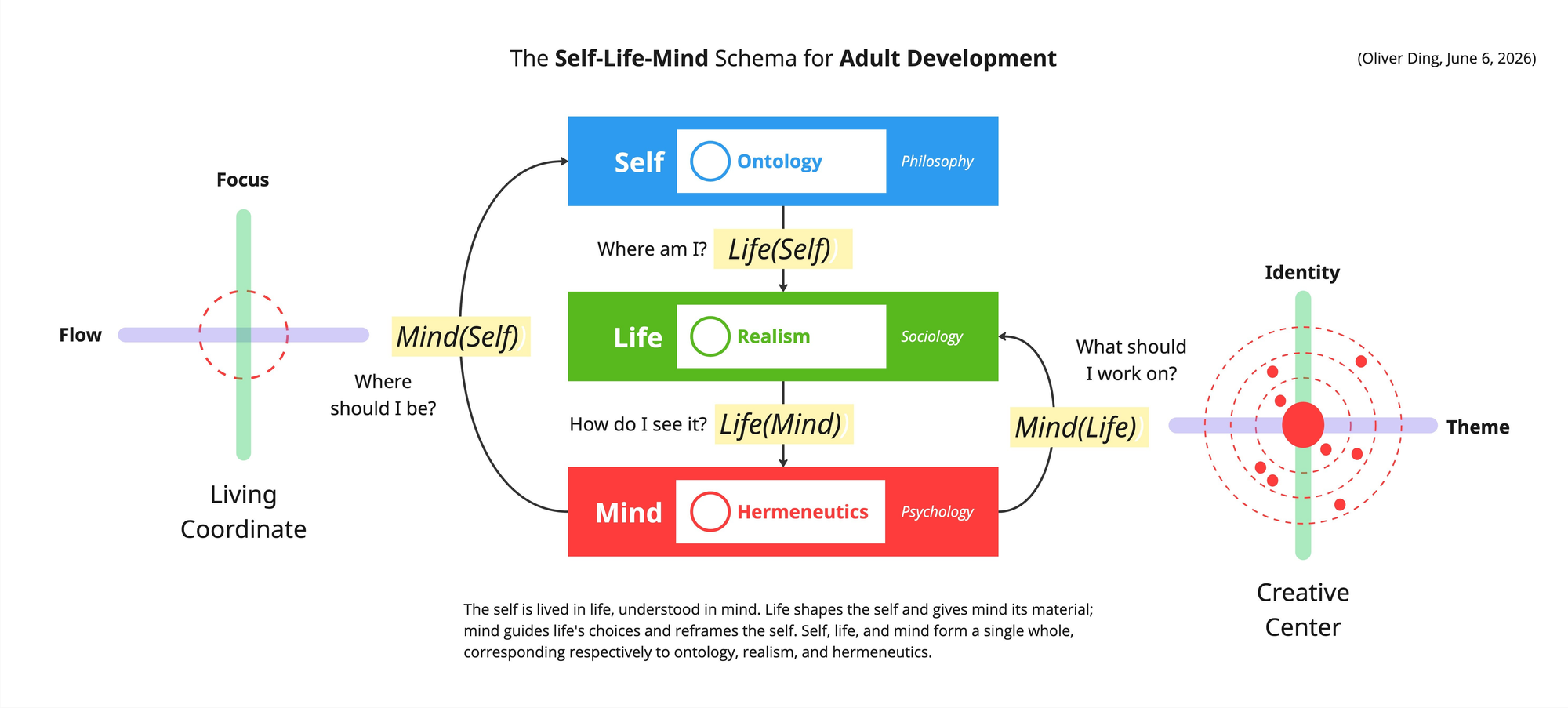
The concept of Living Coordinate sits at the heart of this distinction. A Living Coordinate is the structured expression of a person's worldview and life orientation — the underlying logic that answers two questions: Where am I? and Where should I be? It operates automatically, without needing to be consciously recognized, driving choices, actions, and self-evaluations. Quinn's phrase "internal operating system" maps precisely onto this concept: a set of background logic running beneath conscious awareness, shaping everything that runs on top of it.
What Quinn underwent in 2024 was not the repair of a Center but the fundamental rebuilding of a Living Coordinate.
2.2 Self-Life-Mind Analysis
The Self-Life-Mind (SLM) framework provides the analytical structure for examining how a Living Coordinate is built and how it changes. It maps onto three philosophical dimensions: Self (ontology), Life (realism), and Mind (hermeneutics).
These three are not separate layers that can be analyzed independently. They are three ways of looking at the same indivisible whole. The self is lived in life and understood through mind. Life shapes the self and gives mind its material. Mind guides life's choices and reframes the self. Any adequate analysis must hold all three simultaneously.
Quinn's old system, analyzed through this framework:
Self layer: Quinn's sense of self was conditional — built on external validation. The invisible equation was: I am worthy only if I achieve enough, only if I am recognized, only if I do not fall behind. She described her old drivers as "proving myself, gaining recognition, fear of falling behind, fear of not being loved." The deepest version of this, the zero-th belief she saw in Dali, was: I need to prove that I am excellent.
Life layer: All of her practices served the goal of being recognized. Her Circle was primarily the commercial entrepreneurship world, which continuously reinforced external metrics as the measure of value. Her characteristic high action-orientation — which looked like strength from the outside — was fueled by anxiety rather than genuine drive. She described the state before stopping as "the habitual burden-carrying mode."
Mind layer: Her interpretive framework treated external results as truth. Success was proof of value; the absence of visible achievement was evidence of inadequacy. The Curation function — the capacity to integrate experience into a coherent narrative — kept weaving all incoming data into the same story: I must keep proving myself to maintain my value.
Quinn's new system, analyzed through the same framework:
Self layer: The foundational assumption shifted from conditional to unconditional. Existence itself is value. She articulated this operationally: "It's not that I can settle only after getting things done. It's that I settle first, and from that settled place, things can be seen, responded to, and placed more clearly."
Life layer: Practice shifted from "burden-carrying" to what she called "firm and relaxed." She was no longer driven by targets set to prove something. Her Circle expanded to include her mentor's contemplative community alongside the commercial world. The two Centers she now maintains — her light-touch professional community and the new life she is building around her expected child — are structured by an entirely different driving logic.
Mind layer: The interpretive principle shifted to what she called "respect for the truth of life" — seeing what is actually happening, without forcing external meaning frameworks onto experience. Her Perceiving capacity matured: she described being able to sense her internal state within minutes, recognize when the mind is generating "phantom problems," and return to the body before reacting.
The transformation was not sequential — first Self changes, then Life, then Mind. All three shifted together, each change enabling and reinforcing the others.
2.3 Genidentity
The concept of Genidentity, drawn from Kurt Lewin's work and developed within Creative Life Theory, tracks a creator's continuity through time — not as a static set of fixed traits, but as the ongoing development of a distinctive core. It operates through two subconcepts: Essential Difference (the structural characteristic that makes this person distinctively themselves, persisting across time) and Situated Dynamics (the specific expressions of that core in different contexts and periods).
Genidentity is particularly useful in this case because it allows us to identify what stayed constant through the transformation and what changed — a question that neither the FFCC model nor the SLM framework addresses directly.
Quinn's Essential Difference is genuineness (真实, zhēnshí). This is not a personality trait in the conventional sense — not a stable behavioral tendency measurable on a scale. It is the structural core of who she is when most fully herself: the refusal to perform, the insistence on asking real questions, the discomfort with any gap between inner state and outer presentation. Her mentor identified it precisely when he described her as someone who always asks her actual questions, who tells him when she is collapsing, who admits fear when she is afraid. This quality was present before the transformation. It was present during it. It remained after.
What changed was the relationship between her Essential Difference and her Situated Dynamics. In the old system, "genuineness" was present but suppressed — constantly overridden by the proving logic. In the new system, "genuineness" became the active center. The Situated Dynamics reorganized around it.
There is a further dimension worth noting. The concept of lifestyle entrepreneurship that Quinn identified as her business's Essential Difference in January 2024 was genuine. But as the Dali retreat revealed, the way she deployed it in practice had been hijacked by the old proving logic. Essential Difference at the level of concept was clean; Situated Dynamics at the level of execution was contaminated. The transformation required not just identifying the right concept but actually changing the logic through which it was enacted.
Part 3: Core Themes
The four themes examined in this section are not simply observations extracted from the case. They are the points where the case pushed back against existing frameworks — where Quinn's experience raised questions that the available theoretical tools could not fully answer, and where new theoretical ground had to be opened. Each theme emerged from the friction between the case material and the analytical frameworks, rather than being anticipated in advance.
3.1 The "Internal Operating System" Metaphor
Quinn's own language for what she experienced — "reinstalling my internal operating system," "updating the underlying logic of my life development" — is intuitive rather than theoretical. But it points, with remarkable precision, to a real phenomenon that has a distinct theoretical character.
The metaphor of an operating system captures something significant: the difference between content that runs on a system and the system itself that determines how all content is processed. A person can change their goals, their strategies, their self-descriptions, their social roles — all content-level changes — while the operating system underneath remains untouched. Quinn's first two collapses and recoveries were exactly this kind of change. New positioning, new goals, new insights — all running on the old logic.
What changed in 2024 was different in kind, not just in degree. It was a change at the system level.
Within the SLM framework, this distinction maps onto the difference between knowledge-type cognition and belief systems. Knowledge-type cognition can be updated relatively quickly — one can learn a new concept, adopt a new framework, accept a new proposition, without any of it necessarily changing how one actually lives. Belief systems are different. They are not stored in the Mind layer's Conception dimension alone. They are embedded across the entire Self-Life-Mind system: shaping what the Self takes as its foundational assumption, driving how Life is practiced, determining the hermeneutic principles through which Mind interprets experience. Changing a belief system requires simultaneous reorganization across all three layers.
This is why Quinn could know, intellectually, that "existence itself is value" — and have known it for years — without that knowledge changing anything. The belief system was not a set of propositions waiting to be corrected. It was a self-sustaining structure running at a level below propositional thought.
The therapeutic implications of this distinction are significant, and Quinn herself sensed them intuitively. Her resistance to "hard-linking meaning through the head" — her insistence on not trying to think her way out of the system — reflects an accurate perception that cognitive approaches alone could not reach the level where the problem was located. The reconstruction required body-level practice (the retreat, the physical rest, the daily routines of sleeping and eating and tending to living things), relational experience (her mentor's direct recognition of her Essential Difference), and sustained narrative externalization (her writing and sharing over months and years). All three were needed because the system operates across all three layers.
Reference:
3.2 Living Coordinate and Enterprise Development
Quinn's case does not only illuminate the internal dynamics of belief system transformation. It also raises a question about the relationship between a person's Living Coordinate and the development of their enterprise — a relationship that runs deeper than the usual framing of "founder and business."
Throughout the original Chinese report, several observations point in the same direction. Quinn's Essential Difference — "genuineness" — is not only her personal core. It is also the core of EduPlus as a creative enterprise. The platform's distinctive character, what makes it different from other career development or entrepreneurship communities, is precisely the quality of unperformed honesty that Quinn embodies and that her community recognizes in her. This is what Creative Life Theory calls a Shared Genidentity: the creator and the created thing carry the same essential character. Quinn's business did not develop separately from her belief system and then come into alignment with it. They were, from the beginning, expressions of the same underlying core — and the distortions in one (the proving logic hijacking the "lifestyle entrepreneurship" positioning) were simultaneously distortions in the other.
This also explains why the third collapse could not be resolved by repositioning the platform. When Quinn's Living Coordinate was running on the proving logic, EduPlus was inevitably shaped by that same logic — even when the explicit positioning pointed in a different direction. The rebuild of the Living Coordinate and the reorientation of the enterprise were not two separate tasks. They were the same task, approached from different angles. The original report traces how, as Quinn's internal system shifted, her entrepreneurial practice shifted in parallel: from anxiety-driven production to what she called "person and work becoming one," from chasing external metrics to building from genuine inner drive. The full Chinese report includes a detailed Strategic Agency Analysis of EduPlus's development arc from 2018 to 2025, which documents this parallel evolution in considerable depth.
The relationship between Living Coordinate and Enterprise Development is one dimension of this case that deserves further dedicated research. Quinn's publicly available materials are unusually rich — spanning seven years of entrepreneurial practice, multiple pivots, a detailed ten-thousand-word business retrospective, and extensive reflection on the inner life of building a business. The case as presented here focuses on the belief system transformation as its primary subject; the enterprise development thread, while present throughout, has not been fully drawn out. It remains a productive direction for future analysis.
3.3 Theoretical Comparison
Quinn's transformation invites comparison with several established frameworks for belief change and personal development.
Cognitive Behavioral Therapy (CBT) operates primarily at the Mind layer's Conception dimension, working to identify and restructure automatic negative thoughts, intermediate beliefs, and core beliefs. The standard pathway moves from surface automatic thoughts toward deeper core beliefs through a layered, progressive approach. CBT also employs behavioral techniques — exposure, behavioral activation — that work "bottom-up" through the Life layer. It is a clinical intervention framework: it begins from symptoms and aims at functional restoration.
Acceptance and Commitment Therapy (ACT) represents a significant advance over classic CBT in one key respect: it abandons the assumption that problematic beliefs can simply be replaced through cognitive restructuring, focusing instead on changing the relationship between a person and their thoughts (cognitive defusion) rather than changing the thoughts themselves. ACT shares with the SLM approach an emphasis on values-directed action and a non-symptom-focused conception of the goal. But ACT remains a clinical framework — it begins from psychological dysfunction and aims at psychological flexibility.
The World of Activity Framework differs from both in its starting point. It is a life development framework rather than a clinical intervention framework. It does not begin from symptoms; it begins from a person's World of Activity and Living Coordinate. It asks not "what is dysfunctional and how do we restore function?" but "what is this person's Creative Center, and how does their Living Coordinate need to develop to allow that core to fully unfold?"
This distinction had direct practical consequences in Quinn's case. The coaching support she received during her first two collapses operated, in retrospect, within a functional-restoration logic — identify what has broken, repair it, restore momentum. It worked, each time, at the level it was addressing. What it did not do was identify Quinn's Essential Difference and work from there. Her mentor did something structurally different: he saw the Essential Difference first, named it, and returned it to her as a foundation to build from rather than a problem to solve.
One further observation is worth noting. The intuitive language Quinn herself developed — "don't hard-link meaning through the head," "body-mind unity," "give space to the system" — proves, when examined closely, to be more sensitive to the social-relational dimensions of belief change (her Circle, the structural container of the retreat community) and to the Genidentity dimension (her mentor's recognition of her "genuineness") than either CBT or ACT.
3.4 Research Findings: The Internalized and the Native
The most theoretically generative finding from this case concerns the sources of belief system components. Standard accounts of how belief systems form — including the internalization-externalization principle in Activity Theory — tend to emphasize the process by which external cultural resources are taken in, transformed, and made one's own. What this case adds is a different category: the native.
Quinn's Essential Difference — "genuineness" — was not internalized from any external source. It was not learned from a book, modeled on a mentor, or constructed through practice. Her mentor did not give it to her. What he did was see it and reflect it back. He recognized something that was already there before the transformation, that persisted through the transformation, and that became the center of the new system after it. In the language of this framework: he activated a Perceiving capacity, not a content transfer.
This distinction — between components of a belief system that are internalized from external cultural sources and components that are native, awaiting recognition rather than acquisition — is not well theorized in existing frameworks. Activity Theory's internalization-externalization principle has historically been better developed on the internalization side; the externalization process, by which internal qualities become visible and symbolized, has received less systematic attention. This case suggests that externalization can sometimes be the primary mechanism not for expressing what was taken in from outside, but for surfacing what was there from the beginning.
The practical significance is considerable. A belief system reconstruction that works only at the internalization level — helping the person take in new frameworks, new concepts, new models — may be incomplete if it does not also create conditions for native qualities to be recognized and returned to their owner. Quinn's mentor understood this intuitively. Her coaching support, valuable as it was, was addressing a different dimension.
This is not a criticism of coaching as a practice. It is an observation about what different kinds of support accomplish, and what a complete account of belief system reconstruction needs to include.
Conclusion: Belief Systems in a Cross-Cultural Age
Quinn's story is, among other things, a cross-cultural story — and this is worth pausing on, because it is not incidental to the case. It is one of its most distinctive features.
The resources Quinn drew on to rebuild her belief system came from at least three different cultural traditions. Her mentor operated from within a Chinese contemplative tradition with roots in Zen Buddhism. Michael Singer's The Surrender Experiment is a product of American spiritual culture, itself a synthesis of Indian Vedanta philosophy and Christian mysticism. The coaching tradition Quinn had trained in and drawn support from throughout her entrepreneurial years is an international professional practice with its own distinct epistemology about human potential and change. These three streams do not belong to the same cultural world. Yet Quinn moved between them fluidly, drawing from each what she needed, translating concepts across boundaries, assembling a belief system that cannot be assigned to any single tradition.
This is increasingly typical rather than exceptional. In a globally connected world, individuals — particularly those who have lived and worked across cultural contexts, as Quinn has — do not inherit a single coherent cultural ecology. They navigate multiple ones simultaneously. Their belief systems are assembled from sources that may originate in traditions separated by centuries and continents, mediated through translations, platforms, communities, and personal encounters that would have been impossible in earlier eras. Quinn first encountered Singer's work through his book, then traveled to Florida to meet him in person. The cultural ecology of any individual belief system is now, for many people, irreducibly plural.
For the World of Activity framework and the SLM model, this cross-cultural character of Quinn's case has a direct implication. Both frameworks are designed to analyze structural dynamics — how a person's underlying logic is organized, how it breaks down, how it rebuilds — without prescribing the content that fills those structures. A Living Coordinate can collapse and rebuild whether the person is Chinese or American, whether the resources they draw on come from Zen Buddhism or cognitive behavioral therapy or Stoic philosophy. The framework's claim is about the structure of the process, not about the content that fills it in any particular case.
Genidentity is different in kind. It is not a content-neutral analytical tool but a specific conception of the self — one drawn from Creative Life Theory — that holds a particular view: that what matters most about a person is their distinctive core, the Essential Difference that persists and develops through time. Introducing Genidentity into this analysis was a theoretical choice, not a neutral methodological move. It meant adopting a specific ontological position about selfhood. Other researchers working with the World of Activity or SLM frameworks might choose a different conception of the self — and their analysis would look different at the Self layer as a result. The openness of the SLM framework accommodates this: it specifies the structure of the Self-Life-Mind whole, but leaves the content of the Self layer — including what theory of selfhood one adopts — as an explicit philosophical choice for the researcher to make and declare.
This means that Quinn's case can be read by an English-language audience not as a story about Chinese culture, but as a story about a structural phenomenon — the rebuilding of a Living Coordinate — that happens to be illustrated through a person whose cultural materials are partly Chinese, partly American, and partly global. The specific traditions she drew on are part of the case's texture; they are not what the framework is analyzing.
It also means that readers should not treat Quinn's path as a template. She rebuilt her Living Coordinate through Zen-style retreat practice, through Singer's surrender framework, through her mentor's direct recognition of her essential quality. These were her resources, assembled from her particular cultural ecology at this particular moment in her life. Another person rebuilding a Living Coordinate might draw on entirely different resources — and the structural analysis would look similar even if the content looked completely different. The World of Activity framework illuminates the shape of the process. It does not prescribe the materials.
Postscript: A Missing Dimension
The cross-cultural richness of Quinn's belief system sources does not mean her cultural ecology was without gaps. The original Chinese report identifies one structural absence that is worth naming here.
Quinn's available cultural resources — the spiritual and contemplative traditions she drew from, including her mentor's contemplative community and Singer's framework — were well equipped for one task: dissolving the old proving logic, creating inner stillness, helping her return to her native quality of genuineness. What they were less equipped to provide was a pathway for externalizing that quality into sustained social practice — a symbolic framework for translating "genuineness" as an inner state into a durable and articulable way of being with others in the world.
The persistent difficulty Quinn experienced in naming what she was doing — her ongoing search for words that could capture her work ("lifestyle entrepreneurship," "new individual," neither quite right) — may be related to this gap. She could live the quality. She could not yet fully name the practice.
It is worth noting, in this context, that the Confucian tradition contains precisely such a framework. The concepts of chéngyì (诚意, making the will sincere) and zhèngxīn (正心, rectifying the heart-mind) from the Great Learning describe a practice of not deceiving oneself, of facing one's actual inner state honestly, and of maintaining inner clarity as the foundation for action in the world — a structure that is remarkably close to what Quinn calls "genuineness" and "inner clarity and stability." More importantly, the Confucian tradition provides a complete pathway from this inner quality outward into social practice: from chéngyì to zhèngxīn to xiūshēn (self-cultivation) and beyond into relationship and community.
Quinn never drew on this resource. It was not present in her cultural ecology, despite being part of the broader tradition she grew up within. Whether its absence is incidental or structurally significant is an open question — one that belongs to the emerging research direction this case has helped open.
A clarification is needed here for English-language readers. As stated in the Conclusion, the analytical position of this research is content-neutral. The reason the Confucian tradition is mentioned here is specific to Quinn's situation: she was born and grew up in a cultural world shaped by that tradition, which means it represents a potential resource that was available to her in principle but not drawn upon in practice. The observation is about her particular cultural ecology, not a claim that Confucian concepts are universally applicable or superior to other frameworks. For readers from other cultural backgrounds, the broader point is this: cultural ecologies are enormously diverse, and the symbolic tools available for externalizing inner qualities can be drawn from any tradition. What matters is finding concepts and frameworks — from whatever cultural source — that can serve as vehicles for translating inner experience into a sustainable, articulable way of living and working in the world.
What the case suggests, more broadly, is that belief system development is not only a psychological process — it is also shaped by the cultural ecology a person inhabits. The symbolic resources available in a person's environment — the traditions, communities, texts, and frameworks they can draw on — influence not only what beliefs they can access but what aspects of their inner life they can successfully externalize and sustain in practice. The relationship between belief systems and cultural ecologies — including what is present, what is absent, and what arrives from elsewhere — is a productive new direction for the World of Activity research program.
The relationship between belief systems and cultural ecologies — including what is present, what is absent, and what arrives from elsewhere — is a productive new direction for the World of Activity research program.
This article is an English summary of a longer Chinese-language research report: "Blooming Like a Flower: Reinstalling the Inner Operating System — A Case Study" (Ding, 2026), which runs to over 40,000 Chinese characters. The full report includes additional analyses using the Strategic Agency Framework and a Dual Center analysis, as well as complete comparative framework tables and an extended Genidentity discussion. Readers who wish to consult the full analysis are referred to the original report.
Case material source: Quinn (pseudonym), series of public blog articles and WeChat Moments (a Chinese social media platform) posts, 2022–2026. All names and identifying details have been fictionalized.
Related articles in the SDP series:
- SDP: Two Diagrams about the Self-Life-Mind Schema
- SDP: Revisiting the "Self" Issue from the Self-Life-Mind Perspective
v1.0 — June 12, 2026 - 6,447 words