
RelationField (v3.0): A Model of Social Appropriation

From a Suspended Name to a Concept
by Oliver Ding
June 14, 2026
A few days ago, I finished editing a new book draft — the closing work for a column that had run for several months, "Appropriating Activity Theory." The cover of this book is a photograph of a chair. I also wrote an epilogue explaining the story behind that photograph.
The photograph was taken last summer, during a trip to Fuzhou. A friend of mine — someone who had helped localize Wikipedia into Chinese, and whose very first article was on Yan Fu — came to visit, and together we explored Yan Fu's former residence. There, I photographed this chair.
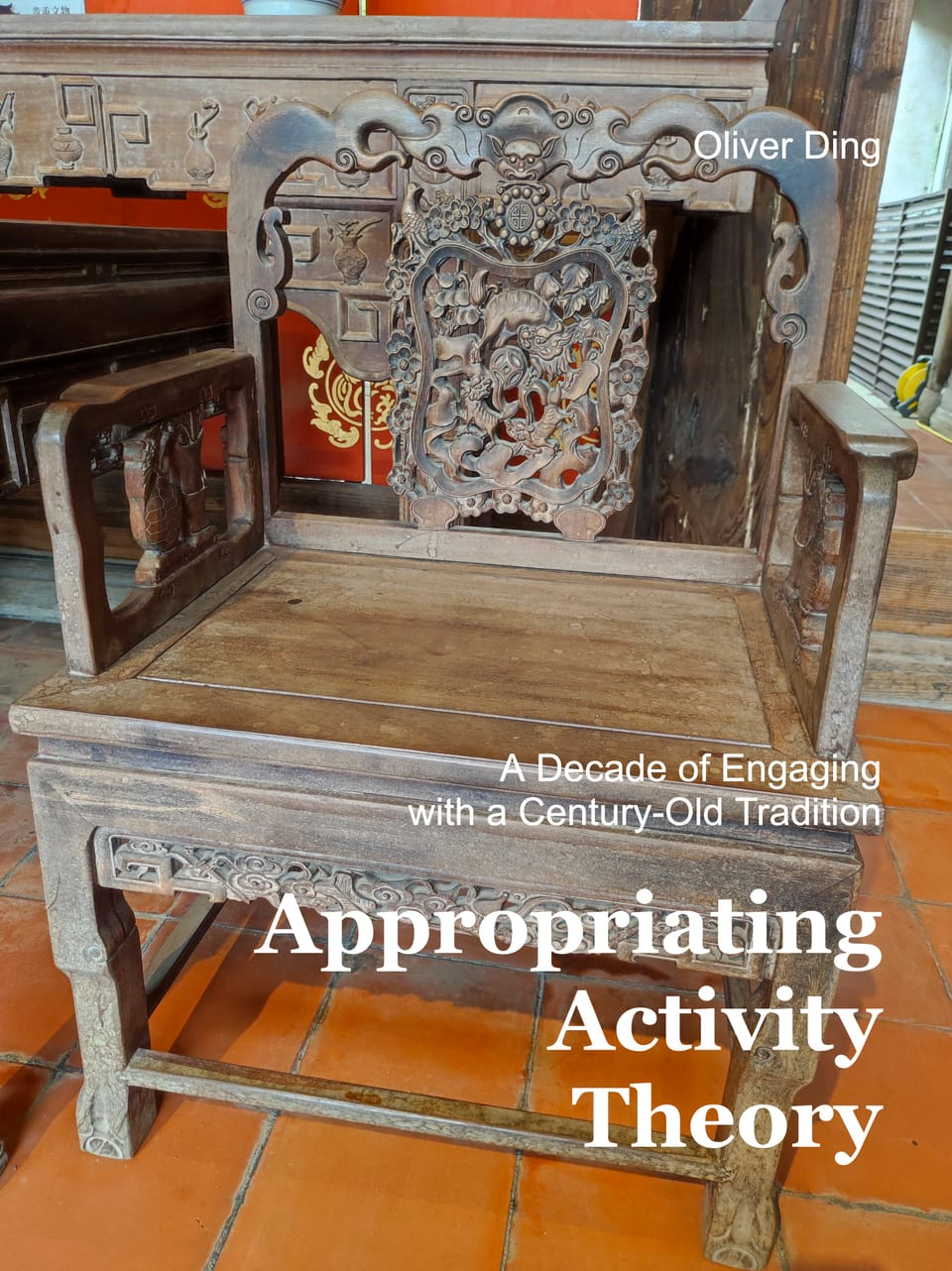
That same trip later gave rise to another book draft: Homecoming: A Thematic Trip and the World of Activity Approach. A reflection my friend shared at West Lake Park — that the East–West dialogue which began a century ago is far from over, and that our generation remains its protagonists — became one of its central threads.
And the chair itself is part of the furnishings of Yan Fu's former residence. The relation between Yan Fu and that chair ended long ago — his life has already settled into history. It is the preservation and display of the residence that gave this chair a second life: a symbol waiting to be reactivated.
Looking back over this whole chain — Yan Fu's residence, the trip, the photograph, the cover, the postscript, and now this article — I was reminded of a framework I had worked on last November, concerned with the Subject–Object relation. At that time, I introduced an expanded 3×5 matrix, and a name surfaced in my notes — relationfield. I wasn't sure whether to use it. In the end, I didn't.
Now, I want to revisit that suspended name — and use this real journey itself to rebuild what it might mean.
Part 1: The Linguistic Trace of a Name
The earliest version of this framework was called the Ap-Re-Co Framework. It emerged from a reflection on a concept from James Gibson's ecological psychology: Social Appropriation.
The idea, as developed by Edward Reed, is that people living in the same environment, despite differing habits, can each find their own proper and expedient ways of using its resources — and that this is made possible by the shared human techniques for socializing awareness of what an environment offers. As Reed put it:
"We all live in the same environment, even though our habits differ, showing that a variety of combinations of proper and expedient ways can be successful. Underlying this process of social appropriation of the valuable resources of the environment are the various human techniques for sharing the socializing awareness." (Reed, 1988, p.66)
Pictures, language, maps, and measuring systems are some of these techniques. As Reed continues:
"Pictures, language, maps, measuring systems, and so on enable people to communicate about the facts of the environment. These techniques can fix and constrain awareness for good or for ill. Symbols do not create realities, but they do help specify the realities that we are interested in… Gibson's later distinction between direct perception (first-hand experience) and indirect perception (second-hand knowledge, usually socially mediated) emerged from his early concern to try to separate veridical perception from stereotyped, schematized, or otherwise constrained perception." (Reed, 1988, p.66)
Reading this again last October, I realized that to define what I had been calling a "meta-supportance," I needed something more fundamental than a model of environments: I needed a model of the subject–object relation itself.
So I started from the word appropriation, and began pulling it apart.
The prefix ap- (from ad-, "toward") names a movement of approach — an initial gesture of engagement. For the subject–object relation, this movement has two possible directions: toward subject, and toward object.
The prefix re- names a movement of return — reflection, renewal, reconnection. Here too there are two states: initial engagement (no return yet) and re-engagement (a return has occurred).
And there is a third kind of movement: togetherness. The prefix co- names mutuality and shared participation — two states: staying together, and transforming together.
Combining these three ideas — two spatial directions (toward subject / toward object), one additional spatial mode (together), and two temporal states (initial / re-engagement) — produced six thematic spaces.
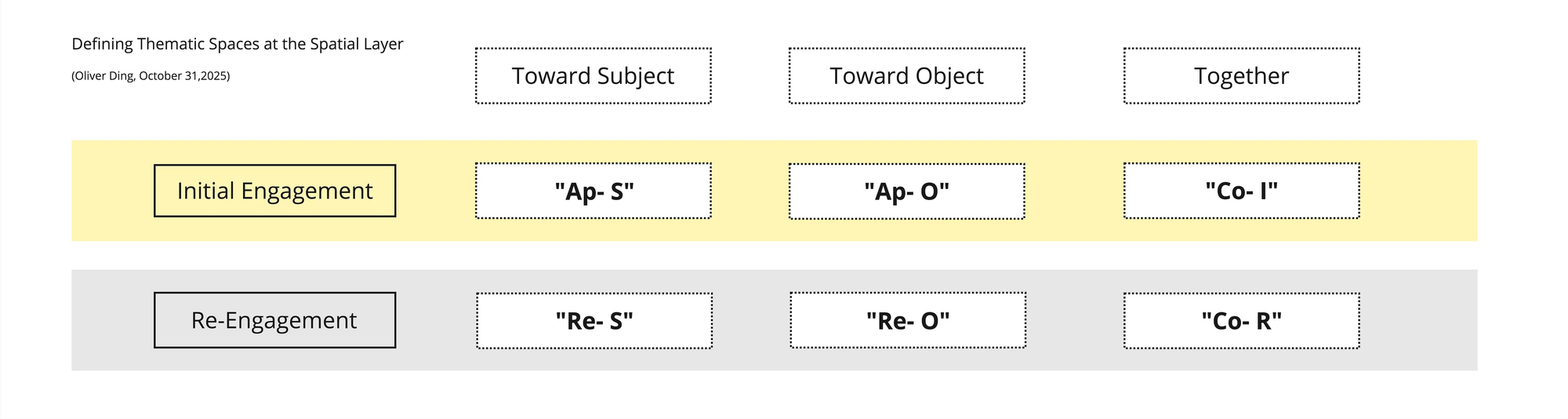
At the semantic layer, I found words for each: Appropriation, Appreciation, Attachment (initial engagement); Transformation, Re-Engagement, Co-Becoming (re-engagement).
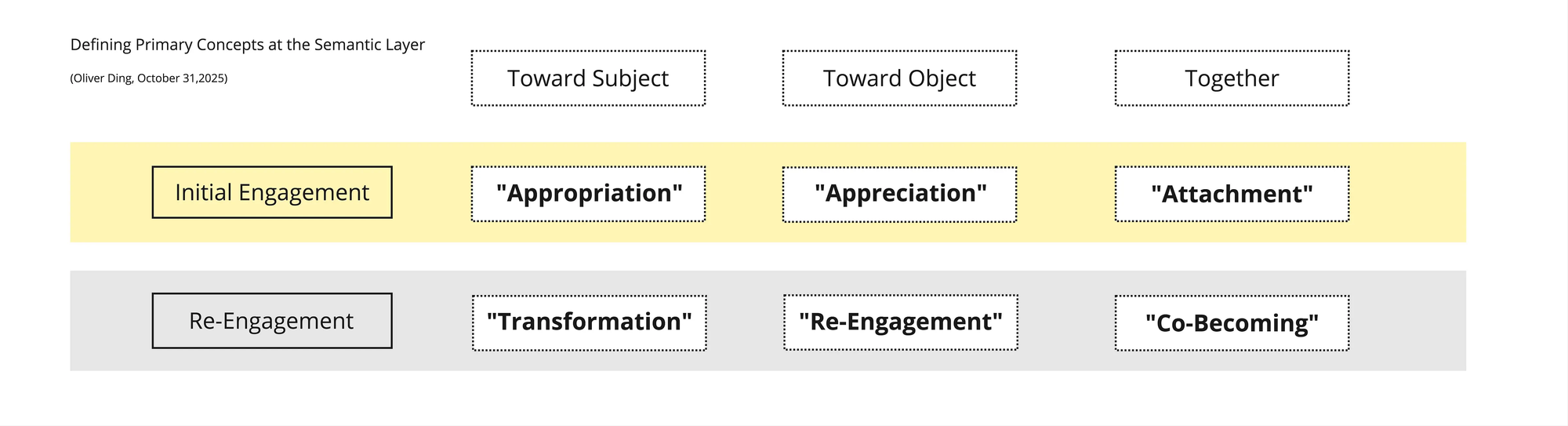
This was the Ap-Re-Co Framework: a linguistic-spatial grammar for the subject–object relation. Each prefix encoded a mode of relational movement, and unfolded in time, the three prefixes traced a rhythm — from approach, through reflection and renewal, to mutual transformation.
What matters here, for the story that follows, is the character of this name. Ap-Re-Co is not a name for a concept — it is a name for a method. It tells you, quite literally, how it was made: take a word, strip it to its prefixes, and let the prefixes generate a grammar. Anyone who knows nothing about subject–object relations could, in principle, reverse-engineer the derivation just by looking at the name. It is a record of a process, not a designation of a thing.
This distinction — between a name that records a method and a name that designates a concept — will turn out to matter a great deal.
Part 2: The 3×5 Matrix, and a Name Left Unused
In September 2025, that photograph of the chair from Yan Fu's residence became the cover of one issue of the "Appropriating Activity Theory" column. This was the first transformation the photograph underwent — from something simply appreciated to something that now served a function. A relation had become a support.
In November 2025, having developed the basic Ap-Re-Co Framework, I looked back at that cover and began thinking about the circumstances under which the photograph had been taken. This reflection triggered something different from the linguistic derivation that had produced Ap-Re-Co — it was an exercise in activity analysis: starting not from a word, but from what I had actually done.
I realized that my own habits of taking photographs fall into four distinct types.
Memorial Photography. Like most people, I sometimes take pictures to capture memorable moments — a snapshot at a landmark, a photo with friends. The purpose is to preserve personal experience. I am at the center; the photographed object is a vehicle for memory. This is the "Subject as End" mode (what I called the s-type): the photographer is the ultimate purpose, the object a means. Temporally, it points backward — toward future remembering.
Appreciative Photography. Sometimes I photograph simply to present the object itself — its beauty, its form, its presence — with no thought of future use. The act completes itself in the moment. There is no archiving, no anticipation of retrieval, only the impulse to let something be seen. This is the purest form of "No Means-End Relation" (the n-type).
Material Documentation. As a designer, I have a long-standing habit of collecting visually interesting materials with a background awareness of their future potential — even without any specific project in mind. I called this the n2-type, or "Latent Means-End Relation": the focus remains on the object itself, as in appreciative photography, but a latent purposiveness — "this might be useful someday" — is already present.
Anticipatory Photography. Since starting a project that regularly required designing thematic cards and book covers, a more deliberate pattern emerged. When I notice a compelling scene, I take multiple shots, adjusting composition specifically to leave negative space for text, anticipating a layout that does not yet exist. This is the "Object as End" mode (the o-type), but with a crucial temporal twist: the not-yet-existing future project actively shapes present behavior — what anticipatory systems theory calls feedforward.
The chair photograph belonged squarely to the second type — appreciative photography. At the moment I took it, I was simply struck by the chair's presence. There was no thought of future use. Only months later, needing a cover image, did I recognize how perfectly this photograph fit. This was genuine serendipity — a photograph waiting to be rediscovered in a context I could not have anticipated.
This four-type analysis exposed a gap in the original Ap-Re-Co Framework. The framework's re- dimension captured retrospective movement — returning to and transforming past relations. But Anticipatory Photography revealed an entirely different temporal logic: not a pull from the past, but a pull from an anticipated future. The framework needed a second temporal direction — pro- (or ante-), prospective: not retrospective re-engagement, but anticipation, projection, feedforward.
With this addition, Ap-Re-Co became Ap-Re-Pro-Co — a 3×5 matrix: three temporal positions (initial engagement / re-engagement / anticipation) crossed with five spatial directions (toward subject / toward object / toward part / toward whole / together). Fifteen thematic spaces, together mapping the full field of possible subject–object relations.
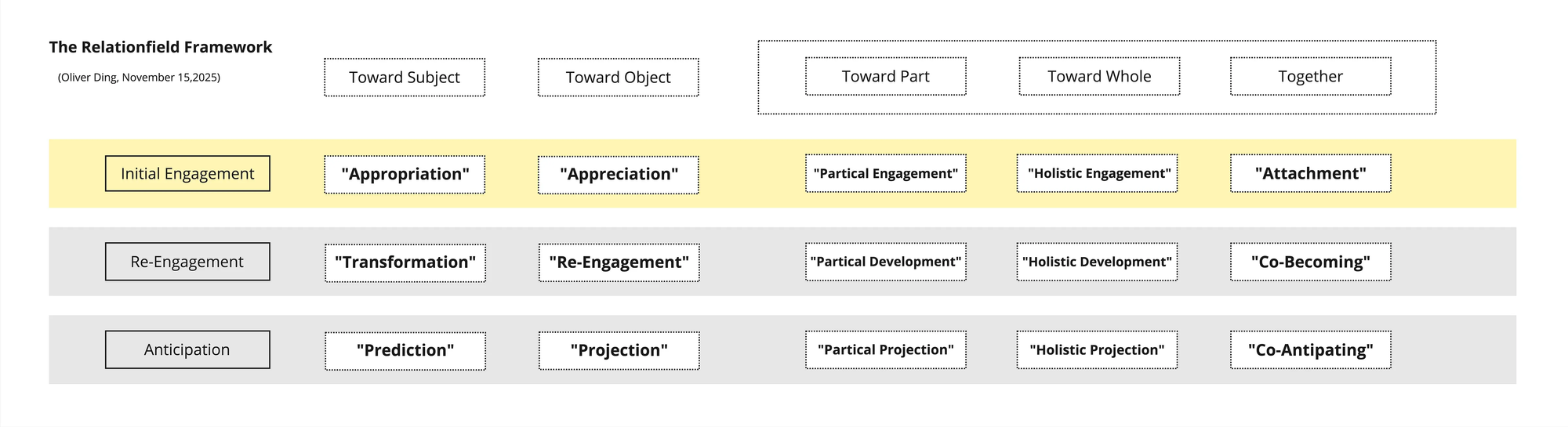
And it was at exactly this point — while developing this expanded matrix — that a new name first appeared in my notes:
relationfield.
I did not use it.
Looking back, I think the reason is this. Ap-Re-Pro-Co, like Ap-Re-Co before it, was still a name that recorded a method — an extension of the linguistic-spatial grammar. Relationfield, by contrast, is a name for a concept: it names what something is, not how it was derived. The two kinds of names sat awkwardly together. The name had arrived — but the content it should designate had not yet arrived with it.
So the name was set aside.
Part 3: Three RelationFields — A Real Recursive Journey
Fast-forward to June 2026. The column was finished, the new book draft edited, the epilogue written. I began to look back over the entire journey — from Yan Fu's residence to this very article. And this time, the activity analysis did not abstract away into a typology, as it had in November. It stayed with the real journey itself.
What this analysis revealed was not one RelationField, but three — nested inside one another, each completing itself and handing something forward to the next.
3.1 RelationField I: Yan Fu — An Activity Already Complete
The relation between Yan Fu and this chair took place over a century ago — he sat in it, day after day, in the course of an ordinary life. As a material environment, the chair and the room around it offered an affordance: the physical possibility of sitting, resting, thinking, writing. This was support of the most basic kind — the chair supporting a life, not yet a theme.
Out of that life came a sustained engagement in bridging Chinese and Western thought, culminating in an enduring standard for translation — faithfulness, fluency, and elegance. Severed from the man who lived it, this life eventually settled into something else: a narrative, the story of Yan Fu as a pivotal figure in modern China's intellectual history.
This first relation — Yan Fu and his chair — is complete. It ended with his life.
But a second relation began where the first one ended. The preservation and curation of Yan Fu's former residence — its restoration, its opening to the public, performed by those who came after him — gave rise to this second relation: between Yan Fu, or rather the narrative of Yan Fu, and everyone who would later walk through these rooms. Through this curation, the chair is no longer simply a piece of furniture offering a place to sit. It has become a thematic object, and what it now offers is no longer affordance but thematic supportance: the possibility of a thematic engagement with "Yan Fu" as a theme — with everything his life has come to represent, including the East–West dialogue that runs through this article.
The narrative that supports this second relation is the very one the first relation produced: the story of Yan Fu's life and its place in history. What had been the outcome of the first relation becomes the resource for the second.
Without this curation — without the chair becoming a thematic object, carrying a narrative that visitors can step into — there would be nothing here to visit. Because of it, the chair could become the starting point of the next RelationField.
3.2 RelationField II: A Thematic Trip
In the summer of 2025, my friend and I walked into Yan Fu's former residence. Our visit was, in essence, a relation with the thematic object that RelationField I had produced — but what we were really connecting with was the narrative of "East–West dialogue" that the chair, and the residence around it, now carried.
My friend himself embodies this theme. Years ago, when he helped localize Wikipedia into Chinese, the very first article he wrote was on Yan Fu — precisely because Yan Fu represents this theme of dialogue between East and West. Our shared visit, from the outset, carried this theme with it.
The residence itself — and the chair within it — is what made this possible. As a material environment, it simply afforded our visit: we could walk in, look around, stand before the chair. But as a thematic object, it offered something more specific: a thematic supportance — the theme of "East–West dialogue," already carried by Yan Fu's legacy, available to be taken up by anyone who arrived prepared to recognize it. This supportance was there before we arrived. Our visit activated it.
After the residence, we visited the Fujian Museum and walked under the trees of West Lake Park. I asked for his impression of Fuzhou. He compared it, unexpectedly, to Xi'an — a city historically rich but, in his view, disconnected from the present. Fuzhou felt different to him: vibrant in modern history, its notable figures and happenings deeply intertwined with the fate of the nation. He felt closer to Fuzhou's history than to Xi'an's.
And then he said something that has stayed with me. The East–West dialogue that began a century ago is far from over — it continues, with our generation as its protagonists. Our conversation echoed Tsinghua University's school motto: "Uphold virtue and voice, regardless of East or West." Cultural boundaries will always exist, I said — but only those willing to cross them, in either direction, can be called free souls. Dichotomies like East and West, theory and practice, author and reader, are not walls but wide spectrums — invitations to explore the grey space between black and white.
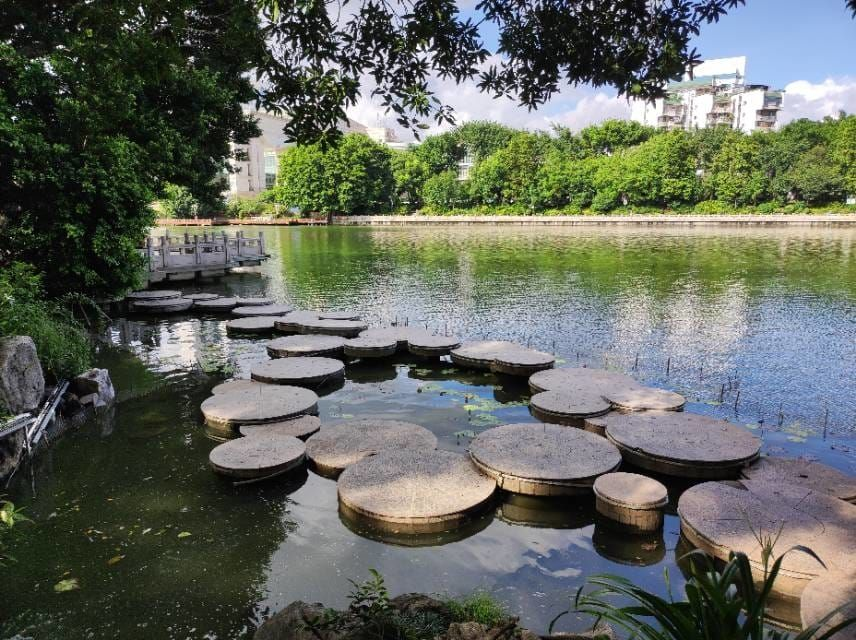
This conversation — at West Lake Park, and throughout the day — is itself the narrative of this RelationField. It is narrative happening in its most immediate form: spoken, shared between us, in real time. The supportance offered by the residence and the chair had been activated; what we did with it was tell — to each other — what it meant. The book draft that followed, Homecoming: A Thematic Trip and the World of Activity Approach, is a later curation of this same narrative, carrying it from a conversation between two people into a form that could reach other readers.
And the photograph I took of the chair during this trip — that, too, became something new: a thematic object of its own. This was the curation that linked RelationField II to RelationField III.
3.3 RelationField III: A Creative Trail
We have already followed this photograph's journey through Parts 1 and 2: in September 2025, it became a column cover; in November 2025, it triggered the photography-type analysis and the 3×5 matrix, and with it, the suspended name relationfield; in June 2026, the column came to a close, the epilogue told the photograph's story — and this article is part of that same narrative.
The photograph, and the book cover later designed from it, are second-order objects — derived from the chair, but no longer the chair. Neither offers any affordance: a cover cannot be sat in, walked around, or stood before. And yet their thematic supportance is, if anything, richer than the chair's own. They still carry the theme the chair carried in Yan Fu's residence — but layered onto it is a second theme, born from their own story: a photograph taken in appreciation, set aside without purpose, rediscovered months later as exactly the right image for a cover. What these objects support is no longer a visit to a historical site, but a reflection on photography itself, on how a relation with an object can mature into something useful long after the relation has ended — which is, of course, the very reflection that gave rise to the photography-type analysis in November 2025.
What distinguishes this latest round of activity analysis — the one looking at RelationField I through III as a whole — from the one in November 2025, is its object. In November, the object of analysis was an abstraction: a typology of photography habits. This time, the object of analysis is the whole journey of engaging with the chair across several months.
It was precisely through this meta-level activity analysis that the long-suspended name relationfield finally found its meaning.
Part 4: v3.0 — From a Suspended Name to a Concept
This activity analysis revealed a structure: every RelationField has three dimensions, present at once — relation, support, and narrative. Relation names what kind of connection a subject has with the other pole, person or thing. Support names what supportance is being offered or drawn on within that connection. Narrative names how that connection is being told — to oneself, to another, to a future reader. A RelationField always has all three at once; in the chair's story, told as a sequence of events over time, the three dimensions happened to come into view one after another — but that is an artifact of telling the story this way, not a property of RelationField itself.
This is the Concept of RelationField: Relation — Support — Narrative.
It does not replace the 3×5 matrix — it complements it. In the vocabulary of Weave-the-Theory, the 3×5 matrix is the Model, and Relation–Support–Narrative is the Concept; the two sit on the Creativity Line and the Curativity Line respectively. The Model has been in place since Ap-Re-Pro-Co. What this round of work did was give it a Concept that could finally anchor it.
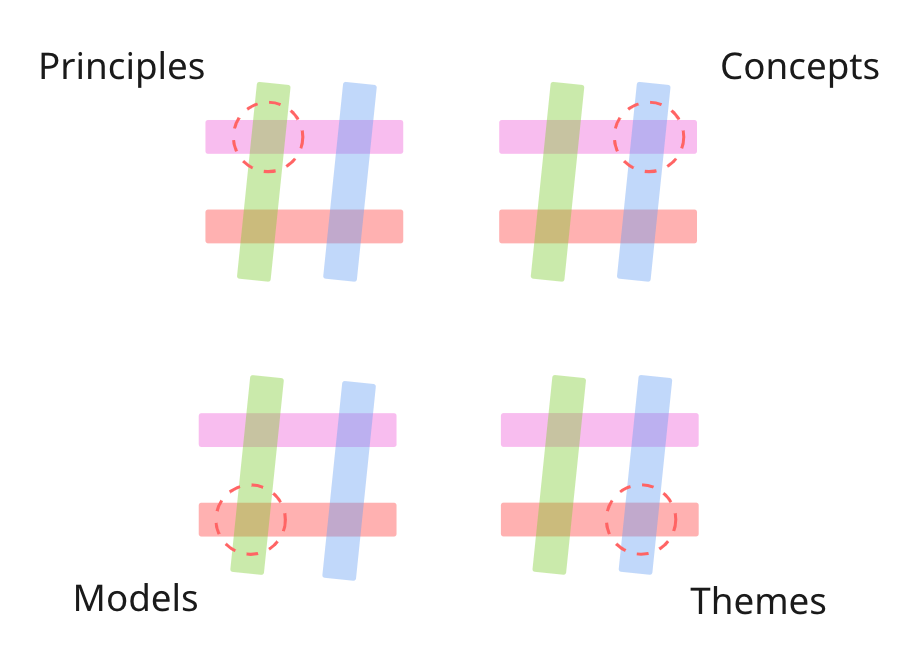
The mechanism that connects different RelationFields is curation. It is not a fourth step in the Relation–Support–Narrative sequence — it is an operator that crosses levels: the narrative of one RelationField, through curation, becomes the thematic object that opens the next RelationField's relation. RelationField I connects to RelationField II, and RelationField II to RelationField III, precisely through this mechanism.
Together, these two findings — Relation–Support–Narrative as the internal depth of a single RelationField, and curation as the mechanism that links RelationFields together — give the name relationfield the content it had been waiting for.
4.1 Two Names, Two Methods
The relation between Ap-Re-Pro-Co and RelationField can now be stated precisely.
Ap-Re-Pro-Co is the trace of a method — it records the operation of linguistic heuristics: four prefixes, arranged according to the morphology of language.
RelationField is the embodiment of a concept — it designates a dynamic field constituted by Relation–Support–Narrative, a content arrived at through activity analysis applied to real, lived activity.
This renaming is itself a marker that the work on the Curativity Line has been completed: when a Concept truly takes hold, a name naturally shifts from recording a method to designating a concept.
Nor did this confidence arrive from nowhere. Activity analysis, as a method, has been growing in importance across my recent work — from the photography typology of last November, to several cases this year. This meta-level analysis of the "chair" journey is a natural extension of where that method has already arrived. It is precisely because the method that could support the name relationfield has itself matured to this point, that the name now has grounds to be used.
I am calling this round of work RelationField v3.0.
4.2 A Meeting with Thematic Object
It is worth noting that "thematic object" is not a term coined for this article. It comes from another line of work, developed independently over many years — Thematic Space Theory — and figures centrally in last year's book draft, Homecoming: A Thematic Trip and the World of Activity Approach, which discusses thematic trips, thematic objects, and thematic places.
This is not a case of RelationField "extending" or "dynamizing" thematic object — these two lines have each developed independently for years. What this activity analysis revealed is that thematic object answers the question "what is it" — a thing, a place, an occasion that carries narrative potential. And Relation–Support–Narrative answers the question "how does it work" — how it is activated through relation, how it produces support, how it crystallizes into narrative, and how, through curation, it (or something it gives rise to) becomes the next thematic object.
This is a confluence, not a derivation — two rivers that, in this act of looking back, were seen for the first time to have been flowing toward the same sea.
Part 5: Subject–Subject (Subject–Object) — The Overall Pattern of v3.0
There is one more structural observation that this round of work has made visible — and it concerns the overall shape of v3.0 itself, not just its individual parts.
The 3×5 matrix — the Model carried over from v2.0 — describes a subject–object relation. Its five spatial directions (toward subject, toward object, toward part, toward whole, together) are all framed from the position of a single subject relating to a single pole — and that pole, despite being called "object," need not be a thing at all. It can equally be another person. A relation toward a friend, a collaborator, a reader — all of these can be mapped onto the same 3×5 matrix, with "object" simply naming whatever the subject is in relation with. This is the kernel of the framework: a precise, fine-grained map of how one subject can relate to one pole — person or thing — across space and time.
What v3.0 adds is not a redefinition of this kernel, but something that unfolds around it: a subject–subject dynamic that takes shape as the relation deepens. Relation–Support–Narrative is not confined to either pole — it plays out both between a subject and an object, and between subjects. The chain we have been tracing shows this directly, with both kinds of relation appearing across its three RelationFields. The same three-step pattern runs through both.
In other words: the subject–object relation (v2.0's kernel) is not where RelationField's depth ends. It is where it begins. As a relation deepens — from relation, to support, to narrative — a subject–subject dynamic unfolds around it: between me and my friend, between me and a reader, between Yan Fu and the visitors his residence will one day receive.
This gives v3.0 its overall pattern:
Subject–Subject (Subject–Object)=RelationField
The subject–object relation — the content, the containee — is the kernel. The subject–subject dynamic — the container — is what unfolds around it: a relation that begins at the subject–object kernel does not remain there; it is taken up, carried, and told between subjects, and it is this carrying-and-telling that constitutes a field rather than a single point.
Curation, too, belongs to this outer layer. It is fundamentally a subject–subject act — performed by someone, for someone, so that a narrative can become a thematic object for another subject's future relation. The preservation of Yan Fu's residence was not Yan Fu's own act; it was the act of those who came after him, curating his completed activity so that it could be reactivated by others — by my friend, by me, and now, by whoever reads this article.
v2.0 gave us a precise instrument for the kernel. v3.0 places that kernel inside the container it was always destined for.
Closing
This article is itself another revisiting and rebuilding of the chain that runs from RelationField I through RelationField III. It is also part of that chain's own narrative — being written, even now.
Without the chair in Yan Fu's former residence, none of this revisiting would have been possible. An activity that has already completed itself, already settled into history, can be carried forward into a thematic object, and wait for some future relation to reactivate it. This is the phenomenon that RelationField v3.0 set out to describe. And its own coming-into-being is one demonstration of that very phenomenon.
It is worth returning, here at the end, to where this began. Reed's account of Social Appropriation pointed to something real: people living in a shared environment, recognizing — through socially shared techniques — which of its possibilities are worth attending to. What Reed named, but did not give a structure for analyzing, was how this happens: how a relation between a person and an environment becomes something shared between people.
That is what Subject–Subject (Subject–Object) names. The environment — the chair, its affordances, its ecological values — is the subject–object kernel Reed was pointing at. The "socially shared techniques" — pictures, language, the act of telling — are the subject–subject dynamic that v3.0 places around that kernel. And Relation–Support–Narrative gives this dynamic its working parts: what kind of connection is there, what does it make available, and how is it being told.
In this sense, RelationField v3.0 is not a new idea brought in to decorate an old one. It is what Reed's brief remark on Social Appropriation looks like, worked out — extended across the years it took to find the right vocabulary, and grounded, finally, in a chair that one person photographed, and another can now read about.
What this article curates into being next — what thematic object it leaves behind, and what RelationField that might open — is left for the future to answer.
v1.0 - June 14, 2026 - 4,355 words